×
Request Free Sample ×

Kindly complete the form below to receive a free sample of this Report

* Please use a valid business email

Leading companies partner with us for data-driven Insights

clients tt-cursor
Hero Background
English
Chinese
French
Japanese
Korean
German
Spanish

Floating Wind Turbine Market Share

ID: MRFR/EnP/8573-HCR
128 Pages
Garvit Vyas
October 2025

Floating Wind Turbine Market Size, Share & Growth Analysis Report By Technology (Spar-Buoy, Semi-Submersible, Tension Leg Platform, Dynamic Positioning Systems), By Mooring System (Drag-In Anchoring, Catenary Anchoring, Tethered Anchoring, Suction Anchoring), By Installation Method (Floating Installation, Wet Tow Installation, Dry Tow Installation), By End Use (Energy Production, Research and Development, Commercial Agreements) and By Regional (North America, Europe, South America, Asia Pacific, Middle East and Africa) - Trends & I... read more

Share:
Download PDF ×

We do not share your information with anyone. However, we may send you emails based on your report interest from time to time. You may contact us at any time to opt-out.

Floating Wind Turbine Market Infographic
Purchase Options

Market Share

Introduction: Navigating the Competitive Waters of Floating Wind Turbines

Floating windmills are experiencing a period of unparalleled growth, driven by the fast uptake of technology, the development of regulatory frameworks and the increasing demand for sustainable energy. In this growth market, the main players – windmill manufacturers, IT service companies and offshore platform suppliers – are competing for leadership by deploying advanced digital tools such as data analytics, automation and IoT. And the market is being shaken up by new entrants, especially new start-ups specializing in green technology and biometrics. Strategic trends are increasingly moving towards the development of cooperative and integrated systems that optimize performance and scalability. This will be of particular importance to C-level managers and strategic planners trying to understand the complexities of this changing market.

Competitive Positioning

Full-Suite Integrators

These vendors provide comprehensive solutions encompassing design, manufacturing, and installation of floating wind turbines.

Vendor Competitive Edge Solution Focus Regional Focus
MHI Vestas Offshore Wind Strong engineering and manufacturing capabilities Offshore wind turbine technology Global
Siemens Gamesa Renewable Energy Extensive experience in offshore projects Wind turbine solutions Global
General Electric Innovative technology and large-scale production Renewable energy solutions Global
RWE Integrated energy solutions provider Renewable energy generation Europe, North America

Specialized Technology Vendors

These companies focus on specific technologies or innovations that enhance floating wind turbine performance.

Vendor Competitive Edge Solution Focus Regional Focus
Principle Power Innovative floating platform technology Floating wind turbine platforms Europe, Asia
Blue H Technologies Advanced digital solutions for wind energy Digital technology for wind turbines Global
Habitat Energy Expertise in energy management systems Energy optimization solutions Europe

Infrastructure & Equipment Providers

These vendors supply the necessary infrastructure and equipment to support floating wind turbine deployment.

Vendor Competitive Edge Solution Focus Regional Focus
Nordex Strong focus on sustainability and efficiency Wind turbine manufacturing Europe, Americas
Senvion Tailored solutions for diverse wind conditions Wind turbine technology Europe, Asia
Shell Significant investment in renewable energy Energy infrastructure Global
EDF Renewables Strong project development capabilities Renewable energy projects North America, Europe
Equinor Pioneering offshore energy solutions Offshore wind energy Europe, North America
Copenhagen Infrastructure Partners Focus on large-scale infrastructure investments Investment in renewable energy Global

Emerging Players & Regional Champions

  • PRINCEL POWER (U.S.A.): This company specializes in the WindFloat technology which allows the installation of windmills on floating platforms in the deeper waters. It is the winner of the contract for the WindFloat Atlantic project, located off the coast of Portugal, and has a contract for the WindFloat Atlantic project, off the coast of Portugal, which will demonstrate the feasibility of floating solutions in the harshest marine environments.
  • Norway: Concentrates on the Hywind concept, which will be the world's first floating wind farm. Recently widened its portfolio with the Hywind Tampen project, showcasing the ability to integrate floating wind with oil and gas production, thereby complementing the traditional energy sector.
  • COBRA GROUP (Spain): Floating platform design, has been awarded a contract in Spain and Portugal. Challenges established suppliers by focusing on cost-effectiveness and local supply chains.
  • MHI Vestas (Denmark): Known for its V164-800 wind-turbine, MHI Vestas is now entering the floating-wind-power market. It is primarily interested in hybrid solutions that combine floating wind with other renewable energy sources. Its recent collaboration with a number of European companies puts it in a strong position to compete with the established wind-turbine manufacturers.

Regional Trends: In 2024, the Floating Wind Turbines Market is expected to grow at a CAGR of 16% in Europe, especially in countries such as Norway, Portugal and Spain, owing to the increasing investment in the development of renewable energy sources. The technological specialization is shifting towards hybrid solutions that combine floating wind with other energy sources, thus reducing costs and enhancing energy efficiency. Japan and South Korea are also beginning to adopt floating wind technology. This reflects a growing trend towards sustainable energy solutions around the world.

Collaborations & M&A Movements

  • The agreement between Siemens Gamesa and rsted consists of the joint development of floating wind-power technology, which will reduce costs and increase the efficiency of offshore wind farms, thereby strengthening their position in the growing field of renewable energy.
  • Equinor bought a half interest in the floating wind farm from EDP-Renováveis. The aim was to take advantage of EDP-Renováveis' experience in the field of floating plants and to strengthen its position in the offshore wind sector, where support for the development of offshore wind power is growing.
  • MHI Vestas and Principle Power have entered into a partnership to deploy their floating wind power solutions on the U.S. West Coast.

Competitive Summary Table

Capability Leading Players Remarks
Floating Platform Design Equinor, Principle Power The HYWIND project is a demonstration of the most advanced floating platform technology, demonstrating its stability in harsh marine environments. Windfloat has been successfully tested in the Portuguese seas, demonstrating its versatility in various sea conditions.
Turbine Technology Siemens Gamesa, GE Renewable Energy Siemens Gamesa's SG 14-222 DD turbine is designed for high efficiency and reliability in floating applications. GE's Haliade-X turbine has set records for energy output, proving its capability in offshore settings.
Installation and Maintenance Van Oord, Subsea 7 Van Oord has extensive experience in offshore wind installation, utilizing innovative vessels for efficient deployment. Subsea 7's expertise in subsea engineering enhances maintenance operations for floating turbines.
Grid Integration DNV GL, ABB DNV GL provides comprehensive solutions for grid integration, ensuring stability and reliability of energy supply. ABB's technology facilitates seamless connection of floating wind farms to existing grids.
Environmental Impact Assessment Ramboll, Wood Group Ramboll's extensive environmental studies for offshore projects ensure compliance with regulations and stakeholder engagement. Wood Group's sustainability assessments help optimize project designs to minimize ecological footprints.
Energy Storage Solutions Siemens, Tesla Siemens is integrating energy storage with floating wind projects to enhance energy reliability. Tesla's battery technology is being explored for use in offshore wind applications, providing backup power and grid stability.

Conclusion: Navigating the Floating Wind Turbine Landscape

In 2024, the Floating Wind Turbine Market is expected to show a fragmented structure, with the market dominated by both new and old players. The old ones use their experience and resources to develop new products, while the new ones use their new technology to invent new products. The prevailing trend in the global Floating Wind Turbine Market is the increasing emphasis on government support and green development, especially in Europe and Asia-Pacific, which have become hotspots for investment. The market is developing rapidly, and the demand for green energy is growing. To meet the increasing demand, vendors must strategically enhance their abilities in artificial intelligence, automation, and flexibility. The ability to change and the ability to integrate new technology are the key to leadership in this fast-changing industry.


Author
Garvit Vyas
Analyst

Explore the profile of Garvit Vyas, one of our esteemed authors at Market Research Future, and access their expert research contributions in the field of market research and industry analysis

Leave a Comment

FAQs

What is the expected market size of the Floating Wind Turbine Market in 2024?

The Floating Wind Turbine Market is expected to be valued at 3.37 billion USD in 2024.

What is the projected market value for the Floating Wind Turbine Market by 2035?

By 2035, the Floating Wind Turbine Market is projected to reach a value of 19.99 billion USD.

What is the expected CAGR for the Floating Wind Turbine Market from 2025 to 2035?

The expected compound annual growth rate (CAGR) for the Floating Wind Turbine Market is 17.57% from 2025 to 2035.

Which region is forecasted to have the largest market size in 2035?

Europe is forecasted to have the largest market size in 2035, valued at 10.0 billion USD.

What are the expected market values for the Spar-Buoy technology segment in 2024 and 2035?

The Spar-Buoy technology segment is expected to be valued at 1.0 billion USD in 2024 and 5.5 billion USD by 2035.

What is the market size forecast for the Semi-Submersible segment by 2035?

The Semi-Submersible segment is expected to reach a market size of 7.0 billion USD by 2035.

What is the projected market value for North America in 2035?

North America is projected to reach a market value of 4.0 billion USD by 2035.

Who are the key players in the Floating Wind Turbine Market?

Key players in the Floating Wind Turbine Market include General Electric, Siemens Gamesa Renewable Energy, and MHI Vestas Offshore Wind.

What is the expected market value for the Tension Leg Platform technology by 2035?

The Tension Leg Platform technology segment is expected to be valued at 4.5 billion USD by 2035.

What challenges does the Floating Wind Turbine Market face?

The market faces challenges such as high initial costs and technical complexities associated with floating wind technology.

Market Summary

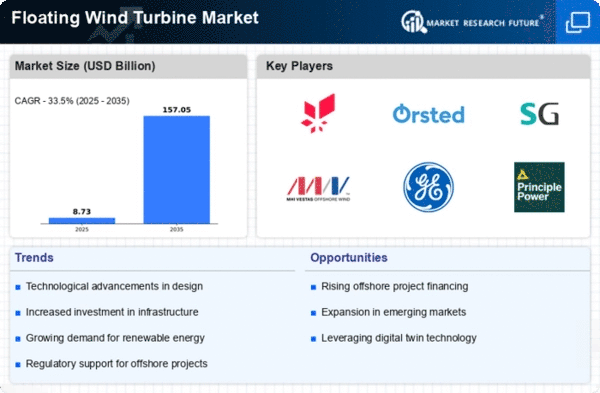
As per MRFR analysis, the Floating Wind Turbine Market Size was estimated at 6.54 USD Billion in 2024. The Floating Wind Turbine industry is projected to grow from 8.73 USD Billion in 2025 to 157.05 USD Billion by 2035, exhibiting a compound annual growth rate (CAGR) of 33.5 during the forecast period 2025 - 2035.

Key Market Trends & Highlights

The Floating Wind Turbine Market is poised for substantial growth driven by technological advancements and increasing environmental awareness.

  • North America remains the largest market for floating wind turbines, driven by significant investments in renewable energy infrastructure. Asia-Pacific is emerging as the fastest-growing region, reflecting a surge in demand for sustainable energy solutions. The Energy Generation segment dominates the market, while the Research and Development segment is experiencing rapid growth. Rising energy demand and government incentives are key drivers propelling the floating wind turbine market forward.

Market Size & Forecast

2024 Market Size 6.54 (USD Billion)
2035 Market Size 157.05 (USD Billion)
CAGR (2025 - 2035) 33.5%
Largest Regional Market Share in 2024 Europe

Major Players

Equinor (NO), Ørsted (DK), Siemens Gamesa (ES), MHI Vestas (DK), General Electric (US), Principle Power (US), Cobra Group (ES), Senvion (DE), Aker Solutions (NO)

Market Trends

The Floating Wind Turbine Market is currently experiencing a notable transformation, driven by advancements in technology and increasing demand for renewable energy sources. This sector appears to be gaining traction as countries seek to diversify their energy portfolios and reduce reliance on fossil fuels. The integration of floating wind turbines into energy systems seems to offer a viable solution for harnessing wind energy in deeper waters, where traditional fixed turbines may not be feasible. As a result, the market is likely to witness a surge in investments and innovations aimed at enhancing efficiency and reducing costs. Moreover, the Floating Wind Turbine Market is characterized by a growing emphasis on sustainability and environmental considerations. Stakeholders are increasingly aware of the potential benefits of offshore wind energy, which may contribute to lower greenhouse gas emissions and promote energy independence. Collaborative efforts among governments, private enterprises, and research institutions appear to be fostering a conducive environment for the development of floating wind technologies. This collaborative approach could lead to the establishment of standardized practices and regulations, further propelling market growth in the coming years.

Technological Advancements

Recent innovations in floating wind turbine design and materials are enhancing performance and reliability. These advancements may lead to increased energy output and reduced operational costs, making floating wind projects more attractive to investors.

Regulatory Support

Government policies and incentives aimed at promoting renewable energy are likely to bolster the Floating Wind Turbine Market. Supportive regulations may encourage investment and development, facilitating the deployment of floating wind farms.

Environmental Awareness

Growing concerns about climate change and environmental degradation are driving interest in sustainable energy solutions. The Floating Wind Turbine Market may benefit from this heightened awareness, as stakeholders seek cleaner alternatives to traditional energy sources.

Floating Wind Turbine Market Market Drivers

Rising Demand for Renewable Energy

The Global Floating Wind Turbine Market Industry is experiencing a surge in demand for renewable energy sources, driven by the increasing global emphasis on sustainability and reducing carbon emissions. Governments worldwide are implementing policies and incentives to promote clean energy technologies, which is likely to bolster the adoption of floating wind turbines. For instance, the European Union aims to achieve a significant share of its energy from renewable sources by 2030, which could enhance market growth. The market is projected to reach 3.37 USD Billion in 2024, reflecting the growing commitment to renewable energy solutions.

Market Segment Insights

By Application: Energy Generation (Largest) vs. Research and Development (Fastest-Growing)

The Floating Wind Turbine Market is significantly driven by the application of energy generation, which holds the largest market share among the various applications. This segment capitalizes on the technological advancements and favorable offshore conditions that maximize energy output. In contrast, research and development represent the fastest-growing application, reflecting the industry's commitment to innovation and optimization of floating wind technologies. This shift indicates a robust pipeline of new projects and initiatives aimed at enhancing floating turbine efficiency and deployment strategies.

Energy Generation (Dominant) vs. Research and Development (Emerging)

Energy generation stands as the dominant application within the Floating Wind Turbine Market, largely due to the escalating demand for renewable energy sources and the feasibility of offshore installations. This sector is characterized by established practices, robust infrastructure, and significant interest from commercial stakeholders aiming for sustainable energy solutions. On the other hand, research and development represent an emerging application, driven by advancements in technology and increasing investment aimed at improving turbine efficiencies and addressing challenges associated with floating installations. The emphasis on R&D reflects the industry's proactive approach to enhancing performance, reducing costs, and maintaining competitive advantages in the rapidly evolving energy landscape.

By Technology: Semi-Submersible Technology (Largest) vs. Spar-Buoy Technology (Fastest-Growing)

In the Floating Wind Turbine Market, the distribution of market share is significantly influenced by various technologies. Semi-submersible technology presently commands the largest share owing to its advanced stability and suitability for deep-water deployment. This technology's design allows for enhanced performance in harsh marine environments, thereby attracting considerable investment and interest. Conversely, Spar-buoy technology is emerging rapidly, appealing to developers looking for cost-effective and efficient solutions, positioning it as the fastest-growing segment among floating wind technologies.

Technology: Semi-Submersible (Dominant) vs. Spar-Buoy (Emerging)

Semi-Submersible Technology dominates the Floating Wind Turbine Market through its innovative design that allows for better stability and adaptability to various water depths. This technology effectively mitigates the impact of wave motion, resulting in increased energy generation efficiency in offshore wind farms. In contrast, Spar-Buoy Technology is emerging as a cost-effective alternative, characterized by its simpler design that facilitates easier assembly and deployment. Its growing acceptance is driven by advancements in materials and engineering, making it an appealing option for developers targeting untapped offshore sites and expanding the market potential for floating wind solutions.

By Installation Type: Fixed Installation (Largest) vs. Mobile Installation (Fastest-Growing)

The Floating Wind Turbine Market is shaped significantly by the Installation Type segment, where Fixed Installation holds the largest market share. This dominant position is attributed to its reliability and established methodologies in offshore environments, allowing companies to capitalize on long-term energy contracts and stability in operations. In contrast, Mobile Installation, while currently smaller in market share, is gaining traction due to its adaptability and potential for rapid deployment in various locations, making it appealing for companies looking to innovate and capture new markets.

Fixed Installation: Dominant vs. Mobile Installation: Emerging

Fixed Installation in the Floating Wind Turbine Market is recognized for its stability and established presence. It benefits from extensive infrastructure and proven technology, resulting in a strong competitive advantage. Conversely, Mobile Installation, which is considered emerging, offers flexibility and quick setup, catering to sectors where rapid deployment is essential. This segment appeals to offshore projects requiring adaptability in harsh environments. As technology progresses, Mobile Installation is likely to see enhanced efficiency and performance, positioning it as a key player in future market dynamics.

By End User: Utility Companies (Largest) vs. Government Agencies (Fastest-Growing)

In the Floating Wind Turbine Market, the distribution of market share among end users reveals that utility companies constitute the largest segment, significantly influencing demand with their extensive operational capabilities. They play a crucial role in deploying floating wind technologies on a large scale, leveraging their established infrastructure and capital. Government agencies, while smaller in market share, are experiencing rapid growth as they push for renewable energy initiatives to meet ambitious climate goals, thus driving innovation and adoption in the sector.

Utility Companies (Dominant) vs. Government Agencies (Emerging)

Utility companies are at the forefront of the floating wind turbine market, characterized by their extensive investments in renewable energy sources and their ability to scale operations effectively. Their dominant position allows them to harness cutting-edge technologies and economic advantages, solidifying their role in transforming energy production. On the other hand, government agencies represent a growing segment in this market, propelled by policy incentives and mandates for clean energy adoption. They are increasingly funding research and laying the groundwork for projects that enhance innovations in offshore wind technology, effectively creating a nurturing environment for emerging players and fostering collaboration among stakeholders.

Get more detailed insights about Floating Wind Turbine Market Research Report – Forecast till 2035

Regional Insights

North America : Growing Renewable Energy Sector

The North American floating wind turbine market is poised for significant growth, driven by increasing investments in renewable energy and supportive government policies. With a market size of $1.5 billion, the region is focusing on harnessing offshore wind resources to meet energy demands and reduce carbon emissions. Regulatory frameworks are evolving to facilitate the deployment of floating wind technologies, enhancing market attractiveness. Leading countries like the US and Canada are at the forefront of this transition, with major players such as General Electric and Principle Power actively participating in the market. The competitive landscape is characterized by collaborations and partnerships aimed at advancing technology and reducing costs. As the region aims for a sustainable energy future, the presence of established companies and innovative startups will be crucial in driving market growth.

Europe : Leading Global Market Innovator

Europe continues to lead the floating wind turbine market, boasting a market size of $3.5 billion. The region's growth is fueled by ambitious renewable energy targets and substantial investments in offshore wind projects. Regulatory support, including favorable policies and funding initiatives, has catalyzed the expansion of floating wind technologies, making Europe a hub for innovation in this sector. Countries like Denmark, Norway, and the UK are spearheading advancements, with key players such as Ørsted and Siemens Gamesa driving competition. The presence of established firms and a robust supply chain enhances the region's market position. As Europe aims to achieve its climate goals, the floating wind sector is expected to play a pivotal role in the energy transition, supported by a collaborative ecosystem of stakeholders. "The European Union aims to have at least 60 GW of offshore wind capacity by 2030," European Commission report, 2021.

Asia-Pacific : Emerging Market Potential

The Asia-Pacific floating wind turbine market is emerging as a significant player, with a market size of $1.5 billion. The region is witnessing a surge in demand for renewable energy, driven by government initiatives and a growing focus on sustainability. Countries are increasingly investing in offshore wind projects to diversify their energy sources and meet rising electricity demands, supported by favorable regulatory frameworks. Leading nations such as Japan and South Korea are making strides in floating wind technology, with companies like MHI Vestas and Aker Solutions actively involved. The competitive landscape is evolving, with both local and international players vying for market share. As the region continues to prioritize renewable energy, the floating wind sector is expected to expand rapidly, contributing to energy security and environmental sustainability.

Middle East and Africa : Untapped Renewable Resources

The Middle East and Africa floating wind turbine market, valued at $0.54 billion, is in its nascent stages but holds significant potential for growth. The region is beginning to recognize the importance of renewable energy in diversifying its energy mix and reducing reliance on fossil fuels. Government initiatives aimed at promoting clean energy are gradually paving the way for floating wind projects, although challenges remain in infrastructure and investment. Countries like South Africa and Morocco are exploring offshore wind opportunities, with a focus on harnessing their vast coastal resources. The competitive landscape is still developing, with a few key players beginning to establish a foothold. As the region seeks to enhance energy security and sustainability, the floating wind sector could play a crucial role in its energy transition.

Key Players and Competitive Insights

The Floating Wind Turbine Market is currently characterized by a dynamic competitive landscape, driven by the increasing demand for renewable energy and the need for sustainable solutions to combat climate change. Key players such as Equinor (NO), Ørsted (DK), and Siemens Gamesa (ES) are at the forefront, each adopting distinct strategies to enhance their market positioning. Equinor (NO) focuses on innovation and technological advancements, particularly in floating wind technology, while Ørsted (DK) emphasizes strategic partnerships and regional expansion to bolster its project portfolio. Siemens Gamesa (ES) is leveraging its expertise in turbine manufacturing and digital transformation to optimize operational efficiency, thereby shaping a competitive environment that is increasingly reliant on technological prowess and strategic collaborations.
In terms of business tactics, companies are localizing manufacturing and optimizing supply chains to enhance operational efficiency and reduce costs. The market structure appears moderately fragmented, with several key players exerting influence over their respective segments. This fragmentation allows for a diverse range of strategies, as companies seek to differentiate themselves through innovation and localized solutions, thereby collectively shaping the competitive dynamics of the market.
In November 2025, Ørsted (DK) announced a significant partnership with a leading technology firm to develop advanced digital solutions for monitoring and optimizing floating wind farms. This strategic move is likely to enhance Ørsted's operational capabilities, allowing for improved efficiency and reduced downtime, which is crucial in maximizing energy output. Such collaborations indicate a trend towards integrating digital technologies within the sector, potentially setting a new standard for operational excellence.
In October 2025, Siemens Gamesa (ES) unveiled a new floating wind turbine model designed to operate in deeper waters, which could significantly expand the geographical reach of floating wind projects. This innovation not only positions Siemens Gamesa as a leader in technological advancement but also reflects a broader industry trend towards developing solutions that can harness wind energy in previously inaccessible areas. The introduction of this model may catalyze further investments in floating wind infrastructure.
In December 2025, Equinor (NO) secured a major contract for a floating wind project off the coast of Scotland, marking a pivotal moment in its expansion strategy. This project is expected to generate substantial energy output and demonstrates Equinor's commitment to leading the transition to renewable energy. The successful execution of this project could enhance Equinor's reputation and market share, reinforcing its position as a key player in the floating wind sector.
As of December 2025, current competitive trends indicate a strong emphasis on digitalization, sustainability, and the integration of artificial intelligence within operational frameworks. Strategic alliances are increasingly shaping the landscape, as companies recognize the value of collaboration in driving innovation and efficiency. Looking ahead, competitive differentiation is likely to evolve, with a shift from price-based competition towards a focus on technological innovation, reliability in supply chains, and sustainable practices. This evolution suggests that companies that prioritize these aspects will be better positioned to thrive in the Floating Wind Turbine Market.

Key Companies in the Floating Wind Turbine Market include

Industry Developments

  • Q2 2024: Windletter #88 - OceanX, the dual-rotor floating platform by Mingyang, installed at its final location Mingyang installed its OceanX dual-rotor floating wind platform at its final location in 2024, marking a significant technology deployment in the floating wind turbine sector.
  • Q2 2024: France: 750 MW awarded in the AO5 and AO6 tenders, spread across three floating projects France awarded 750 MW of floating wind capacity in 2024 through the AO5 and AO6 tenders, distributed across three separate floating wind projects.
  • Q2 2024: South Korea: 750 MW for the Firefly project South Korea awarded 750 MW of floating wind capacity to the Firefly project in 2024, representing a major contract win in the sector.
  • Q2 2024: United Kingdom: 400 MW for the Green Volt project, in the CfD Allocation Round 6 The UK awarded 400 MW of floating wind capacity to the Green Volt project during the sixth round of Contracts for Difference (CfD) in 2024.

Future Outlook

Floating Wind Turbine Market Future Outlook

The Floating Wind Turbine Market is poised for robust growth at 33.5% CAGR from 2025 to 2035, driven by technological advancements, increasing energy demands, and supportive government policies.

New opportunities lie in:

  • Development of advanced floating platform designs for deeper waters.
  • Integration of AI for predictive maintenance and operational efficiency.
  • Expansion into emerging markets with tailored financing solutions.

By 2035, the Floating Wind Turbine Market is expected to achieve substantial growth and innovation.

Market Segmentation

Floating Wind Turbine Market End User Outlook

  • Utility Companies
  • Government Agencies
  • Private Sector
  • Research Institutions

Floating Wind Turbine Market Technology Outlook

  • Spar-Buoy Technology
  • Semi-Submersible Technology
  • Tension Leg Platform Technology
  • Floating Platform Technology

Floating Wind Turbine Market Application Outlook

  • Energy Generation
  • Research and Development
  • Environmental Monitoring
  • Offshore Power Supply

Floating Wind Turbine Market Installation Type Outlook

  • Fixed Installation
  • Mobile Installation
  • Temporary Installation

Report Scope

MARKET SIZE 2024 6.54(USD Billion)
MARKET SIZE 2025 8.73(USD Billion)
MARKET SIZE 2035 157.05(USD Billion)
COMPOUND ANNUAL GROWTH RATE (CAGR) 33.5% (2025 - 2035)
REPORT COVERAGE Revenue Forecast, Competitive Landscape, Growth Factors, and Trends
BASE YEAR 2024
Market Forecast Period 2025 - 2035
Historical Data 2019 - 2024
Market Forecast Units USD Billion
Key Companies Profiled Equinor (NO), Ørsted (DK), Siemens Gamesa (ES), MHI Vestas (DK), General Electric (US), Principle Power (US), Cobra Group (ES), Senvion (DE), Aker Solutions (NO)
Segments Covered Application, Technology, Installation Type, End User
Key Market Opportunities Advancements in floating wind turbine technology enhance offshore energy generation potential and sustainability.
Key Market Dynamics Technological advancements and regulatory support drive growth in the floating wind turbine market, enhancing competitive dynamics.
Countries Covered North America, Europe, APAC, South America, MEA

FAQs

What is the expected market size of the Floating Wind Turbine Market in 2024?

The Floating Wind Turbine Market is expected to be valued at 3.37 billion USD in 2024.

What is the projected market value for the Floating Wind Turbine Market by 2035?

By 2035, the Floating Wind Turbine Market is projected to reach a value of 19.99 billion USD.

What is the expected CAGR for the Floating Wind Turbine Market from 2025 to 2035?

The expected compound annual growth rate (CAGR) for the Floating Wind Turbine Market is 17.57% from 2025 to 2035.

Which region is forecasted to have the largest market size in 2035?

Europe is forecasted to have the largest market size in 2035, valued at 10.0 billion USD.

What are the expected market values for the Spar-Buoy technology segment in 2024 and 2035?

The Spar-Buoy technology segment is expected to be valued at 1.0 billion USD in 2024 and 5.5 billion USD by 2035.

What is the market size forecast for the Semi-Submersible segment by 2035?

The Semi-Submersible segment is expected to reach a market size of 7.0 billion USD by 2035.

What is the projected market value for North America in 2035?

North America is projected to reach a market value of 4.0 billion USD by 2035.

Who are the key players in the Floating Wind Turbine Market?

Key players in the Floating Wind Turbine Market include General Electric, Siemens Gamesa Renewable Energy, and MHI Vestas Offshore Wind.

What is the expected market value for the Tension Leg Platform technology by 2035?

The Tension Leg Platform technology segment is expected to be valued at 4.5 billion USD by 2035.

What challenges does the Floating Wind Turbine Market face?

The market faces challenges such as high initial costs and technical complexities associated with floating wind technology.

  1. SECTION I: EXECUTIVE SUMMARY AND KEY HIGHLIGHTS
    1. | 1.1 EXECUTIVE SUMMARY
    2. | 1.1.1 Market Overview
    3. | 1.1.2 Key Findings
    4. | 1.1.3 Market Segmentation
    5. | 1.1.4 Competitive Landscape
    6. | 1.1.5 Challenges and Opportunities
    7. | 1.1.6 Future Outlook
  2. SECTION II: SCOPING, METHODOLOGY AND MARKET STRUCTURE
    1. | 2.1 MARKET INTRODUCTION
    2. | 2.1.1 Definition
    3. | 2.1.2 Scope of the study
    4. |-- 2.1.2.1 Research Objective
    5. |-- 2.1.2.2 Assumption
    6. |-- 2.1.2.3 Limitations
    7. | 2.2 RESEARCH METHODOLOGY
    8. | 2.2.1 Overview
    9. | 2.2.2 Data Mining
    10. | 2.2.3 Secondary Research
    11. | 2.2.4 Primary Research
    12. |-- 2.2.4.1 Primary Interviews and Information Gathering Process
    13. |-- 2.2.4.2 Breakdown of Primary Respondents
    14. | 2.2.5 Forecasting Model
    15. | 2.2.6 Market Size Estimation
    16. |-- 2.2.6.1 Bottom-Up Approach
    17. |-- 2.2.6.2 Top-Down Approach
    18. | 2.2.7 Data Triangulation
    19. | 2.2.8 Validation
  3. SECTION III: QUALITATIVE ANALYSIS
    1. | 3.1 MARKET DYNAMICS
    2. | 3.1.1 Overview
    3. | 3.1.2 Drivers
    4. | 3.1.3 Restraints
    5. | 3.1.4 Opportunities
    6. | 3.2 MARKET FACTOR ANALYSIS
    7. | 3.2.1 Value chain Analysis
    8. | 3.2.2 Porter's Five Forces Analysis
    9. |-- 3.2.2.1 Bargaining Power of Suppliers
    10. |-- 3.2.2.2 Bargaining Power of Buyers
    11. |-- 3.2.2.3 Threat of New Entrants
    12. |-- 3.2.2.4 Threat of Substitutes
    13. |-- 3.2.2.5 Intensity of Rivalry
    14. | 3.2.3 COVID-19 Impact Analysis
    15. |-- 3.2.3.1 Market Impact Analysis
    16. |-- 3.2.3.2 Regional Impact
    17. |-- 3.2.3.3 Opportunity and Threat Analysis
  4. SECTION IV: QUANTITATIVE ANALYSIS
    1. | 4.1 Energy & Power, BY Application (USD Billion)
    2. | 4.1.1 Energy Generation
    3. | 4.1.2 Research and Development
    4. | 4.1.3 Environmental Monitoring
    5. | 4.1.4 Offshore Power Supply
    6. | 4.2 Energy & Power, BY Technology (USD Billion)
    7. | 4.2.1 Spar-Buoy Technology
    8. | 4.2.2 Semi-Submersible Technology
    9. | 4.2.3 Tension Leg Platform Technology
    10. | 4.2.4 Floating Platform Technology
    11. | 4.3 Energy & Power, BY Installation Type (USD Billion)
    12. | 4.3.1 Fixed Installation
    13. | 4.3.2 Mobile Installation
    14. | 4.3.3 Temporary Installation
    15. | 4.4 Energy & Power, BY End User (USD Billion)
    16. | 4.4.1 Utility Companies
    17. | 4.4.2 Government Agencies
    18. | 4.4.3 Private Sector
    19. | 4.4.4 Research Institutions
    20. | 4.5 Energy & Power, BY Region (USD Billion)
    21. | 4.5.1 North America
    22. |-- 4.5.1.1 US
    23. |-- 4.5.1.2 Canada
    24. | 4.5.2 Europe
    25. |-- 4.5.2.1 Germany
    26. |-- 4.5.2.2 UK
    27. |-- 4.5.2.3 France
    28. |-- 4.5.2.4 Russia
    29. |-- 4.5.2.5 Italy
    30. |-- 4.5.2.6 Spain
    31. |-- 4.5.2.7 Rest of Europe
    32. | 4.5.3 APAC
    33. |-- 4.5.3.1 China
    34. |-- 4.5.3.2 India
    35. |-- 4.5.3.3 Japan
    36. |-- 4.5.3.4 South Korea
    37. |-- 4.5.3.5 Malaysia
    38. |-- 4.5.3.6 Thailand
    39. |-- 4.5.3.7 Indonesia
    40. |-- 4.5.3.8 Rest of APAC
    41. | 4.5.4 South America
    42. |-- 4.5.4.1 Brazil
    43. |-- 4.5.4.2 Mexico
    44. |-- 4.5.4.3 Argentina
    45. |-- 4.5.4.4 Rest of South America
    46. | 4.5.5 MEA
    47. |-- 4.5.5.1 GCC Countries
    48. |-- 4.5.5.2 South Africa
    49. |-- 4.5.5.3 Rest of MEA
  5. SECTION V: COMPETITIVE ANALYSIS
    1. | 5.1 Competitive Landscape
    2. | 5.1.1 Overview
    3. | 5.1.2 Competitive Analysis
    4. | 5.1.3 Market share Analysis
    5. | 5.1.4 Major Growth Strategy in the Energy & Power
    6. | 5.1.5 Competitive Benchmarking
    7. | 5.1.6 Leading Players in Terms of Number of Developments in the Energy & Power
    8. | 5.1.7 Key developments and growth strategies
    9. |-- 5.1.7.1 New Product Launch/Service Deployment
    10. |-- 5.1.7.2 Merger & Acquisitions
    11. |-- 5.1.7.3 Joint Ventures
    12. | 5.1.8 Major Players Financial Matrix
    13. |-- 5.1.8.1 Sales and Operating Income
    14. |-- 5.1.8.2 Major Players R&D Expenditure. 2023
    15. | 5.2 Company Profiles
    16. | 5.2.1 Equinor (NO)
    17. |-- 5.2.1.1 Financial Overview
    18. |-- 5.2.1.2 Products Offered
    19. |-- 5.2.1.3 Key Developments
    20. |-- 5.2.1.4 SWOT Analysis
    21. |-- 5.2.1.5 Key Strategies
    22. | 5.2.2 Ørsted (DK)
    23. |-- 5.2.2.1 Financial Overview
    24. |-- 5.2.2.2 Products Offered
    25. |-- 5.2.2.3 Key Developments
    26. |-- 5.2.2.4 SWOT Analysis
    27. |-- 5.2.2.5 Key Strategies
    28. | 5.2.3 Siemens Gamesa (ES)
    29. |-- 5.2.3.1 Financial Overview
    30. |-- 5.2.3.2 Products Offered
    31. |-- 5.2.3.3 Key Developments
    32. |-- 5.2.3.4 SWOT Analysis
    33. |-- 5.2.3.5 Key Strategies
    34. | 5.2.4 MHI Vestas (DK)
    35. |-- 5.2.4.1 Financial Overview
    36. |-- 5.2.4.2 Products Offered
    37. |-- 5.2.4.3 Key Developments
    38. |-- 5.2.4.4 SWOT Analysis
    39. |-- 5.2.4.5 Key Strategies
    40. | 5.2.5 General Electric (US)
    41. |-- 5.2.5.1 Financial Overview
    42. |-- 5.2.5.2 Products Offered
    43. |-- 5.2.5.3 Key Developments
    44. |-- 5.2.5.4 SWOT Analysis
    45. |-- 5.2.5.5 Key Strategies
    46. | 5.2.6 Principle Power (US)
    47. |-- 5.2.6.1 Financial Overview
    48. |-- 5.2.6.2 Products Offered
    49. |-- 5.2.6.3 Key Developments
    50. |-- 5.2.6.4 SWOT Analysis
    51. |-- 5.2.6.5 Key Strategies
    52. | 5.2.7 Cobra Group (ES)
    53. |-- 5.2.7.1 Financial Overview
    54. |-- 5.2.7.2 Products Offered
    55. |-- 5.2.7.3 Key Developments
    56. |-- 5.2.7.4 SWOT Analysis
    57. |-- 5.2.7.5 Key Strategies
    58. | 5.2.8 Senvion (DE)
    59. |-- 5.2.8.1 Financial Overview
    60. |-- 5.2.8.2 Products Offered
    61. |-- 5.2.8.3 Key Developments
    62. |-- 5.2.8.4 SWOT Analysis
    63. |-- 5.2.8.5 Key Strategies
    64. | 5.2.9 Aker Solutions (NO)
    65. |-- 5.2.9.1 Financial Overview
    66. |-- 5.2.9.2 Products Offered
    67. |-- 5.2.9.3 Key Developments
    68. |-- 5.2.9.4 SWOT Analysis
    69. |-- 5.2.9.5 Key Strategies
    70. | 5.3 Appendix
    71. | 5.3.1 References
    72. | 5.3.2 Related Reports

Energy & Power Market Segmentation

Energy & Power By Application (USD Billion, 2025-2035)

  • Energy Generation
  • Research and Development
  • Environmental Monitoring
  • Offshore Power Supply

Energy & Power By Technology (USD Billion, 2025-2035)

  • Spar-Buoy Technology
  • Semi-Submersible Technology
  • Tension Leg Platform Technology
  • Floating Platform Technology

Energy & Power By Installation Type (USD Billion, 2025-2035)

  • Fixed Installation
  • Mobile Installation
  • Temporary Installation

Energy & Power By End User (USD Billion, 2025-2035)

  • Utility Companies
  • Government Agencies
  • Private Sector
  • Research Institutions
Infographic

Free Sample Request

Kindly complete the form below to receive a free sample of this Report

Get Free Sample

Customer Strories

Compare Licence

×
Features License Type
Single User Multiuser License Enterprise User
Price $4,950 $5,950 $7,250
Maximum User Access Limit 1 User Upto 10 Users Unrestricted Access Throughout the Organization
Free Customization
Direct Access to Analyst
Deliverable Format
Platform Access
Discount on Next Purchase 10% 15% 15%
Printable Versions