
Request Free Sample ×

Kindly complete the form below to receive a free sample of this Report

* Please use a valid business email

Leading companies partner with us for data-driven Insights

clients tt-cursor
Hero Background
English
Chinese
French
Japanese
Korean
German
Spanish

Flight Simulator Market Size

ID: MRFR/AD/5680-CR
136 Pages
Shubham Munde
Last Updated: February 11, 2026

Flight Simulator Market Size, Share, Industry Trend & Analysis Research Report Information by Platform (Commercial Aerospace [Full Flight Simulator and Flight Training Devices], Military Aerospace [Air combat Simulator, Basic Flight Trainer, Computer Based Training and Full Mission Simulator and others]), by Aircraft Type (Fixed Wing Aircraft, Rotary Wing Aircraft and UAV), by Simulator Type (Live Simulation and Virtual Simulation) and Region (North America, Europe, Asia-Pacific and Middle East and Africa and Latin America) - Forecast to 2030

Share:
Download PDF ×

We do not share your information with anyone. However, we may send you emails based on your report interest from time to time. You may contact us at any time to opt-out.

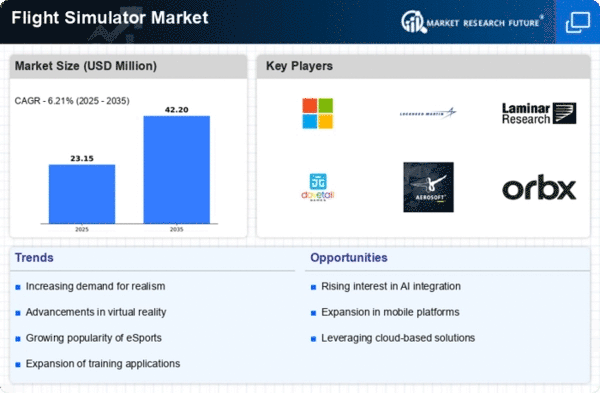
Flight Simulator Market Infographic
Purchase Options

Flight Simulator Size

Flight Simulator Market Growth Projections and Opportunities

As, the aviation industry continues to experience significant growth and changes that affect operations in the flight simulator market. This is mainly driven by the growing focus on pilot training and skill development. With the increasing interest in air travel, airlines and aviation bodies are putting more resources into developing high-quality training programs for competent pilot workforces. Flight simulators have a significant role in giving realistic and immersive training, where pilots are able to develop their skills through different scenarios without needing real aircraft. The development of technologies is the main driver behind Flight Simulator market. Simulators that are highly realistic and sophisticated keep on increasing due to continuous innovation in the technology associated with simulation, graphics as well as software. Immersive training is enhanced using high-fidelity visuals, motion platforms and virtual reality integration replicating the complexities of different aircraft types and various flying conditions. These technological developments do not only enhance the effectiveness of training, but also save on costs by minimizing requirements for real flights and fuel burns.

The Flight Simulator market dynamics depend on regulatory requirements and safety standards. Across the globe, aviation authorities enforce stringent training and certification requirements for pilots. These standards must be followed by flight simulators to ensure that training programs accurately reflect real-world scenarios. Regulations address new challenges arising and improvements in the development of aviation technology. This helps meeting all compliance requirements while practising trust among regulators of this field as well its training institutions. Key players and market competition are the factors that greatly influence flight simulator market. Established simulation technology providers as well as emerging players are actively involved in the production of high quality simulators. Intensive competition motivates innovation and forces firms to invest in researching simulator technologies that become more realistic, cost-effective, and versatile. The competitive environment also impacts pricing strategies and services being offered to training institutions as well as aviation organizations giving them the opportunity for a wide variety of choices that would cater precisely into their own requirements.
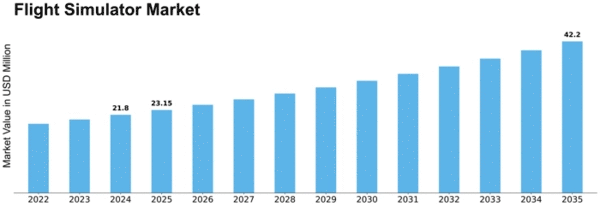

Flight Simulator Market Size Graph
Author
Author Profile
Shubham Munde
Team Lead - Research

Shubham brings over 7 years of expertise in Market Intelligence and Strategic Consulting, with a strong focus on the Automotive, Aerospace, and Defense sectors. Backed by a solid foundation in semiconductors, electronics, and software, he has successfully delivered high-impact syndicated and custom research on a global scale. His core strengths include market sizing, forecasting, competitive intelligence, consumer insights, and supply chain mapping. Widely recognized for developing scalable growth strategies, Shubham empowers clients to navigate complex markets and achieve a lasting competitive edge. Trusted by start-ups and Fortune 500 companies alike, he consistently converts challenges into strategic opportunities that drive sustainable growth.

Leave a Comment

FAQs

What is the current valuation of the Flight Simulator Market as of 2024?

<p>The Flight Simulator Market was valued at 21.8 USD Billion in 2024.</p>

What is the projected market size for the Flight Simulator Market by 2035?

<p>The market is projected to reach 42.2 USD Billion by 2035.</p>

What is the expected CAGR for the Flight Simulator Market during the forecast period 2025 - 2035?

<p>The expected CAGR for the Flight Simulator Market during 2025 - 2035 is 6.21%.</p>

Which companies are considered key players in the Flight Simulator Market?

<p>Key players include Microsoft, Lockheed Martin, Laminar Research, and Dovetail Games.</p>

What segment of the Flight Simulator Market had the highest valuation in 2024?

The Pilot Training segment had the highest valuation at 8.0 USD Billion in 2024.

How much is the Air Traffic Control Simulation segment projected to grow by 2035?

The Air Traffic Control Simulation segment is projected to grow from 3.5 USD Billion in 2024 to 6.5 USD Billion by 2035.

What is the valuation range for the Consumer Flight Simulators segment by 2035?

The Consumer Flight Simulators segment is expected to range from 7.0 USD Billion to 14.0 USD Billion by 2035.

Which platform is anticipated to have the highest growth in the Flight Simulator Market?

The Virtual Reality platform is anticipated to grow from 5.0 USD Billion in 2024 to 10.0 USD Billion by 2035.

What is the projected valuation for the Simulation Software technology segment by 2035?

The Simulation Software technology segment is projected to reach between 9.8 USD Billion and 16.2 USD Billion by 2035.

How does the Home Users segment compare to the Military segment in terms of valuation?

The Home Users segment was valued at 1.8 USD Billion in 2024, whereas the Military segment was valued at 5.0 USD Billion.

Market Summary

As per MRFR analysis, the Flight Simulator Market Size was estimated at 21.8 USD Million in 2024. The Flight Simulator industry is projected to grow from 23.1 in 2025 to 42.2 by 2035, exhibiting a compound annual growth rate (CAGR) of 6.21% during the forecast period 2025 - 2035.

Key Market Trends & Highlights

The Flight Simulator Market is experiencing robust growth driven by technological advancements and increasing demand for training solutions.

  • North America remains the largest market for flight simulators, driven by a strong aviation sector and advanced training facilities. The Asia-Pacific region is emerging as the fastest-growing market, fueled by rising disposable incomes and a burgeoning interest in aviation. Pilot training solutions dominate the market, while entertainment segments are witnessing rapid growth due to the rise of online flight simulation communities. Technological advancements in simulation software and the integration of virtual reality technologies are key drivers propelling market expansion.

Market Size & Forecast

2024 Market Size 21.8 (USD Million)
2035 Market Size 42.2 (USD Million)
CAGR (2025 - 2035) 6.21%
Largest Regional Market Share in 2024 North America

Major Players

Microsoft (US), <a href="https://www.lockheedmartin.com/en-gb/index.html">Lockheed Martin</a> (US), Laminar Research (US), <a href="https://dovetailgames.com/">Dovetail Games</a> (GB), Aerosoft (DE), Orbx (AU), Flight1 (US), Just Flight (GB), X-Plane (US)

Market Trends

The Flight Simulator Market is currently experiencing a dynamic evolution, driven by advancements in technology and increasing demand for realistic training solutions. The integration of virtual reality and augmented reality into flight simulation systems appears to enhance user experience significantly, providing immersive environments that closely mimic real-world flying conditions. Furthermore, the growing emphasis on pilot training and safety protocols suggests a robust market for high-fidelity simulators, which are essential for both commercial and military aviation sectors. As the aviation industry continues to expand, the Flight Simulator Market is likely to witness further innovations, potentially leading to more sophisticated training methodologies and enhanced operational efficiencies. In addition, the rise of online platforms for flight simulation gaming indicates a shift in consumer engagement, where enthusiasts seek more interactive and community-driven experiences. This trend may lead to increased collaboration between developers and users, fostering a vibrant ecosystem that supports both casual gamers and professional pilots. Overall, the Flight Simulator Market seems poised for growth, with various factors contributing to its ongoing transformation and adaptation to modern technological advancements.

Technological Advancements

The Flight Simulator Market is witnessing rapid technological advancements, particularly in the realms of virtual reality and artificial intelligence. These innovations are enhancing the realism of simulations, allowing users to experience flight scenarios that closely replicate actual conditions. As technology continues to evolve, the potential for more immersive and interactive training solutions increases, appealing to both professional pilots and aviation enthusiasts.

Increased Demand for Training Solutions

There is a growing demand for effective training solutions within the Flight Simulator Market, driven by the need for enhanced pilot training and safety measures. Organizations are increasingly recognizing the value of high-fidelity simulators in preparing pilots for real-world challenges. This trend indicates a shift towards more comprehensive training programs that prioritize safety and operational efficiency.

Rise of Online Flight Simulation Communities

The emergence of online flight simulation communities is reshaping the Flight Simulator Market, as enthusiasts seek collaborative and interactive experiences. These platforms facilitate user engagement and knowledge sharing, fostering a sense of community among both casual gamers and serious pilots. This trend may lead to increased innovation and development within the market, as user feedback becomes integral to the evolution of flight simulation products.

Flight Simulator Market Market Drivers

Market Growth Projections

The Global Flight Simulator Industry is poised for substantial growth, with projections indicating a market value of 6.57 USD Billion in 2024 and an anticipated increase to 13.7 USD Billion by 2035. This growth trajectory suggests a compound annual growth rate (CAGR) of 6.89% from 2025 to 2035. Such figures highlight the increasing reliance on flight simulators across various sectors, including commercial aviation, military, and training institutions. The consistent demand for innovative training solutions and the integration of advanced technologies are likely to drive this growth, positioning the industry for a robust future.

Technological Advancements

The Global Flight Simulator Industry is experiencing a surge driven by rapid technological advancements. Innovations in virtual reality and augmented reality are enhancing the realism of flight simulations, making them more immersive and engaging. For instance, the integration of high-definition graphics and real-time weather systems allows users to experience flight scenarios that closely mimic real-life conditions. This trend is expected to contribute to the market's growth, with projections indicating a market value of 6.57 USD Billion in 2024. As technology continues to evolve, the demand for sophisticated flight simulators is likely to increase, further propelling the industry forward.

Growing Demand for Pilot Training

The increasing need for pilot training is a significant driver in the Global Flight Simulator Industry. With the aviation sector expanding, airlines and training institutions are investing heavily in flight simulation technology to ensure pilots receive comprehensive training. Flight simulators provide a safe and controlled environment for pilots to practice various scenarios, including emergency situations. This trend is reflected in the projected market growth, with an anticipated value of 13.7 USD Billion by 2035. The emphasis on safety and efficiency in pilot training is likely to sustain the demand for advanced flight simulators, thereby fostering industry expansion.

Rising Adoption in Military Applications

The Global Flight Simulator Industry is also witnessing increased adoption in military applications. Armed forces worldwide are utilizing flight simulators for training purposes, allowing pilots to hone their skills without the risks associated with actual flight. These simulators are equipped with advanced features that replicate combat scenarios, enhancing the training experience. The military sector's investment in simulation technology is expected to contribute to the industry's growth, with a projected CAGR of 6.89% from 2025 to 2035. This focus on realistic training solutions is likely to bolster the demand for flight simulators in military applications.

Expansion of the Commercial Aviation Sector

The expansion of the commercial aviation sector is a pivotal driver for the Global Flight Simulator Industry. As air travel demand continues to rise globally, airlines are compelled to enhance their training programs to accommodate the growing number of pilots needed. This expansion is reflected in the projected market value of 6.57 USD Billion in 2024, with expectations of reaching 13.7 USD Billion by 2035. The increasing number of aircraft deliveries and the establishment of new airlines contribute to this trend, necessitating advanced flight simulation solutions to ensure pilots are adequately trained. This dynamic environment is likely to sustain the industry's growth trajectory.

Increased Focus on Cost-Effective Training Solutions

Cost-effectiveness is becoming a crucial factor in the Global Flight Simulator Industry. As airlines and training organizations seek to minimize operational costs, flight simulators offer a viable solution by reducing the need for expensive aircraft usage during training. Simulators allow for repeated practice of complex maneuvers without incurring the costs associated with fuel and maintenance. This shift towards cost-effective training solutions is likely to drive market growth, as organizations recognize the long-term financial benefits of investing in flight simulation technology. The trend aligns with the overall expansion of the industry, further solidifying its relevance in aviation training.

Market Segment Insights

By Application: Pilot Training (Largest) vs. Entertainment (Fastest-Growing)

In the Flight Simulator Market, the application segment showcases diverse functionalities, with pilot training emerging as the largest value due to its critical role in ensuring proficient flying skills. Following closely behind are <a href="https://www.marketresearchfuture.com/reports/air-traffic-market-33794" target="_blank" rel="noopener">air traffic</a> control simulations and research and development applications, both vital for enhancing aviation safety and technological advancement. Entertainment also holds a significant share, catering to users seeking immersive flying experiences, while aircraft design is a niche but important segment contributing to innovation in aviation.

Pilot Training (Dominant) vs. Entertainment (Emerging)

Pilot training remains the dominant segment within the Flight Simulator Market, as it forms the foundation of professional aviation education and proficiency. This application emphasizes realistic simulation conditions that closely replicate actual flying scenarios, equipping pilots with skills for various flight situations. Meanwhile, entertainment emerges as a rapidly growing segment driven by advances in technology, attractive gaming experiences, and a surge in consumer interest for flight simulation as a recreational activity. This rising trend is fueled by improvements in graphics and user interfaces, making flight simulators more accessible and appealing to amateur enthusiasts.

By End Use: Aerospace Industry (Largest) vs. Military (Fastest-Growing)

<p>In the Flight Simulator Market, the end-use segment showcases a diverse landscape with significant market share held by the Aerospace Industry. This sector, driven by increasing advancements in aviation technology and a growing emphasis on safe pilot training, represents a substantial portion of the market. On the other hand, the Military segment has emerged as a key player, driven by rising defense budgets and a focus on enhancing pilot readiness through simulation technology.</p>

<p>Aerospace Industry (Dominant) vs. Military (Emerging)</p>

<p>The Aerospace Industry remains the dominant force in the Flight Simulator Market, characterized by substantial investment in simulation technology to improve pilot training efficiency and safety. This segment benefits from robust research and development initiatives and a stringent need for realistic training environments, leading to enhanced operational readiness. Conversely, the Military segment is rapidly emerging, fueled by modernization efforts and robust government funding. Military flight simulators facilitate mission rehearsal and tactical training, making them essential for contemporary defense strategies. As both segments progress, they are likely to leverage advanced technologies like virtual reality and AI to enhance training outcomes, further shaping their market positions.</p>

By Platform: PC (Largest) vs. Console (Fastest-Growing)

<p>The Flight Simulator Market is delineated by several platforms, with the PC segment holding the largest market share due to its extensive capabilities and performance enhancements. This segment appeals to dedicated flight simulation enthusiasts and professionals, who often prefer the high fidelity and extensive modding capabilities that PCs offer. In contrast, the Console segment has rapidly gained traction, capturing a significant portion of the market as game consoles become more powerful and capable of supporting sophisticated flight simulation experiences.</p>

<p>PC (Dominant) vs. Console (Emerging)</p>

<p>The PC segment remains the dominant platform in the Flight Simulator Market, primarily due to its capacity for advanced graphics and broader customization options. Enthusiasts often modify their setups, integrating peripherals like flight sticks and virtual cockpits, which enhances immersion. On the other hand, the Console segment is becoming an emerging powerhouse, fueled by user-friendly interfaces and an expanding library of flight simulation titles. With major game consoles increasingly capable of delivering impressive realism in flight simulations, this segment is poised for substantial growth, attracting casual gamers seeking an accessible entry point into the flight simulation world.</p>

By Type: Professional Flight Simulators (Largest) vs. Consumer Flight Simulators (Fastest-Growing)

The Flight Simulator market exhibits a diverse segmentation by type, with Professional Flight Simulators dominating the market share. These simulators are primarily utilized by flight schools, military training, and aviation authorities, which drives their steady demand. In contrast, Consumer Flight Simulators, often favored by hobbyists and gaming enthusiasts, have witnessed rapid growth as technology advances make these products more accessible and immersive for the average user. The growth trends in this segment are influenced by the rising popularity of virtual reality, advancements in simulation technologies, and a growing interest in aviation among younger demographics. Additionally, the expansion of online communities and competitive gaming environments further boosts the adoption of Consumer Flight Simulators, making them the fastest-growing segment in the industry.

Professional Flight Simulators (Dominant) vs. Mixed Reality Simulators (Emerging)

Professional Flight Simulators are characterized by their high fidelity, complex systems, and realism, catering primarily to aviation professionals who require precise training tools. These simulators integrate advanced technologies to replicate real-life scenarios, making them indispensable for pilot training and certification. Conversely, Mixed Reality Simulators represent an emerging segment that combines physical and digital elements for increased interactivity and immersion. While still developing, they attract attention due to their innovative approach and potential applications in both entertainment and serious training environments. Both types contribute significantly to their respective areas; however, Professional Flight Simulators maintain a stronghold as the preferred choice for rigorous training, while Mixed Reality Simulators pave the way for future integration of technology in flight simulation.

By Technology: Virtual Reality Technology (Largest) vs. Artificial Intelligence (Fastest-Growing)

<p>In the Flight Simulator Market, the technology segment is primarily driven by Virtual Reality (VR) technology, which dominates the landscape due to its immersive experience that appeals to both training and recreational users. This segment holds a significant share as more users seek realistic simulation experiences. Following closely are advancements in Artificial Intelligence (AI), which are rapidly gaining traction by providing smarter, more adaptable simulators, enhancing user interaction and realism, making it a vital player in modern flight simulation development. The growth trends in this segment illustrate a shift towards more integrated solutions, with VR leading as the first choice among consumers seeking realism in their simulation experiences. Meanwhile, AI is positioning itself as the fastest-growing technology, driven by its ability to personalize simulation environments and cater to evolving training needs. These technologies are further bolstered by increased investments in R&D and a growing user base among commercial airlines and training institutions, indicating a robust outlook for the segment.</p>

<p>Virtual Reality Technology (Dominant) vs. Cloud Computing (Emerging)</p>

<p>Virtual Reality Technology stands out as the dominant force in the Flight Simulator Market, offering unparalleled immersion that enhances the training and entertainment value of flight simulations. Its capability to engage users through realistic environments has made it a staple among aviation professionals and hobbyists alike. In contrast, Cloud Computing is emerging as a significant player, bringing the advantage of accessibility and scalability to simulation platforms. As simulations can be hosted and operated in the cloud, users are no longer limited by hardware constraints, allowing broader adoption and innovation. Both technologies represent pivotal shifts in how flight simulation is approached, with VR leading the charge while Cloud Computing opens new avenues for interactive and collaborative training solutions.</p>

Get more detailed insights about Flight Simulator Market Research Report -Forecast till 2035

Regional Insights

aviation infrastructure

Key Players and Competitive Insights

The Flight Simulator Market is currently characterized by a dynamic competitive landscape, driven by technological advancements and an increasing demand for realistic simulation experiences. Key players such as Microsoft (US), Lockheed Martin (US), and Laminar Research (US) are at the forefront, each adopting distinct strategies to enhance their market positioning. Microsoft (US) continues to leverage its Azure cloud platform to integrate advanced AI capabilities into its flight simulation software, thereby enhancing user experience and engagement. Lockheed Martin (US), on the other hand, focuses on defense and training applications, emphasizing partnerships with military organizations to develop specialized simulation solutions. Laminar Research (US) is known for its commitment to community-driven development, frequently updating its X-Plane platform based on user feedback, which fosters a loyal customer base and encourages innovation.The business tactics employed by these companies reflect a moderately fragmented market structure, where collaboration and strategic partnerships play a crucial role. For instance, localizing software development and optimizing supply chains are common practices that enhance operational efficiency. The collective influence of these key players shapes a competitive environment where innovation and user-centric approaches are paramount, allowing companies to differentiate themselves in a crowded marketplace.
In November Microsoft (US) announced a significant update to its Flight Simulator platform, integrating real-time weather data and enhanced AI-driven flight dynamics. This strategic move not only improves realism but also positions Microsoft as a leader in technological innovation within the market. The incorporation of real-time data is likely to attract both casual gamers and professional pilots, thereby expanding its user base and reinforcing its competitive edge.
In October Lockheed Martin (US) secured a contract with the U.S. Air Force to develop advanced flight simulation training systems. This partnership underscores Lockheed Martin's focus on defense applications and highlights the growing importance of simulation in military training. By aligning its offerings with the needs of defense organizations, Lockheed Martin strengthens its market position and ensures a steady revenue stream from government contracts.
In September Laminar Research (US) launched a new version of X-Plane, featuring enhanced graphics and improved user interface based on community feedback. This release exemplifies Laminar's commitment to user engagement and innovation, which is crucial in maintaining its competitive position. By prioritizing user input, Laminar Research not only fosters loyalty but also adapts quickly to market demands, ensuring its relevance in a rapidly evolving industry.
As of December the Flight Simulator Market is witnessing trends such as digitalization, AI integration, and a growing emphasis on sustainability. Strategic alliances among key players are increasingly shaping the competitive landscape, as companies seek to combine resources and expertise to drive innovation. The shift from price-based competition to a focus on technological advancement and supply chain reliability is evident, suggesting that future differentiation will hinge on the ability to innovate and deliver superior user experiences.

Key Companies in the Flight Simulator Market include

Industry Developments

  • Q3 2025: Microsoft Flight Simulator Market 2024 Launches with Advanced Simulation Technologies Microsoft released its new flagship flight simulation platform, Microsoft Flight Simulator Market 2024, featuring significant upgrades in simulation, cloud, machine learning, and graphics, powered by the evolved Asobo Studio engine. The product is now available for purchase on Xbox Game Pass, PC Game Pass, Xbox Cloud Gaming, Windows 10/11, and Steam.
  • Q2 2025: Honeycomb Aeronautical Expands Flight Sim Hardware Offerings for Home Users Honeycomb Aeronautical, a leading flight sim hardware manufacturer, continued its expansion in 2025 by delivering new yoke and throttle products designed to bridge the gap between entry-level and professional-grade flight simulation equipment for home users.


Recent Developments

  • In April 2019, JetBlue Airways (U.S.) and CAE signed a partnership agreement to offer 2 Airbus A220- 300 CAE 7000XR Series full-flight simulators and 2 CAE 500XR flight training devices for enhancing the customer base.
  • In September 2019, the U.S. Navy was signed a contract worth USD 45.8 million with Boeing to develop P-8A Poseidon maritime patrol jet simulators.
  • In March 2019, Leonardo SpA and CAE Inc. formed a joint venture for its Philadelphia Training Academy. This has aimed to offer 3000 Series full-flight simulators, which are expected to launch in 2020. 

Future Outlook

Flight Simulator Market Future Outlook

The Flight Simulator Market is projected to grow at a 6.21% CAGR from 2025 to 2035, driven by technological advancements, increased demand for pilot training, and the rise of virtual reality applications.

New opportunities lie in:

  • <p>Development of cloud-based simulation platforms for remote training access. Integration of AI-driven analytics for personalized training experiences. Expansion into emerging markets with localized training solutions.</p>

By 2035, the Flight Simulator Market is expected to be robust, reflecting substantial growth and innovation.

Market Segmentation

Flight Simulator Market Type Outlook

  • Professional Flight Simulators
  • Consumer Flight Simulators
  • Mixed Reality Simulators
  • Hardware-Based Simulators

Flight Simulator Market End Use Outlook

  • Aerospace Industry
  • Military
  • Educational Institutions
  • Commercial Aviation
  • Home Users

Flight Simulator Market Platform Outlook

  • PC
  • Console
  • Mobile
  • Virtual Reality
  • Cloud-Based

Flight Simulator Market Technology Outlook

  • Virtual Reality
  • Augmented Reality
  • Artificial Intelligence
  • Cloud Computing

Flight Simulator Market Application Outlook

  • Pilot Training
  • Air Traffic Control Simulation
  • Aircraft Design
  • Research and Development
  • Entertainment

Report Scope

MARKET SIZE 2024 21.8(USD Million)
MARKET SIZE 2025 23.1(USD Million)
MARKET SIZE 2035 42.2(USD Million)
COMPOUND ANNUAL GROWTH RATE (CAGR) 6.21% (2025 - 2035)
REPORT COVERAGE Revenue Forecast, Competitive Landscape, Growth Factors, and Trends
BASE YEAR 2024
Market Forecast Period 2025 - 2035
Historical Data 2019 - 2024
Market Forecast Units USD Million
Key Companies Profiled Microsoft (US), Lockheed Martin (US), Laminar Research (US), Dovetail Games (GB), Aerosoft (DE), Orbx (AU), Flight1 (US), Just Flight (GB), X-Plane (US)
Segments Covered Application, End Use, Platform, Type, Technology
Key Market Opportunities Integration of virtual reality technology enhances user experience in the Flight Simulator Market.
Key Market Dynamics Technological advancements and consumer demand drive innovation and competition in the Flight Simulator Market.
Countries Covered North America, Europe, APAC, South America, MEA

FAQs

What is the current valuation of the Flight Simulator Market as of 2024?

<p>The Flight Simulator Market was valued at 21.8 USD Billion in 2024.</p>

What is the projected market size for the Flight Simulator Market by 2035?

<p>The market is projected to reach 42.2 USD Billion by 2035.</p>

What is the expected CAGR for the Flight Simulator Market during the forecast period 2025 - 2035?

<p>The expected CAGR for the Flight Simulator Market during 2025 - 2035 is 6.21%.</p>

Which companies are considered key players in the Flight Simulator Market?

<p>Key players include Microsoft, Lockheed Martin, Laminar Research, and Dovetail Games.</p>

What segment of the Flight Simulator Market had the highest valuation in 2024?

The Pilot Training segment had the highest valuation at 8.0 USD Billion in 2024.

How much is the Air Traffic Control Simulation segment projected to grow by 2035?

The Air Traffic Control Simulation segment is projected to grow from 3.5 USD Billion in 2024 to 6.5 USD Billion by 2035.

What is the valuation range for the Consumer Flight Simulators segment by 2035?

The Consumer Flight Simulators segment is expected to range from 7.0 USD Billion to 14.0 USD Billion by 2035.

Which platform is anticipated to have the highest growth in the Flight Simulator Market?

The Virtual Reality platform is anticipated to grow from 5.0 USD Billion in 2024 to 10.0 USD Billion by 2035.

What is the projected valuation for the Simulation Software technology segment by 2035?

The Simulation Software technology segment is projected to reach between 9.8 USD Billion and 16.2 USD Billion by 2035.

How does the Home Users segment compare to the Military segment in terms of valuation?

The Home Users segment was valued at 1.8 USD Billion in 2024, whereas the Military segment was valued at 5.0 USD Billion.

  1. SECTION I: EXECUTIVE SUMMARY AND KEY HIGHLIGHTS
    1. | 1.1 EXECUTIVE SUMMARY
    2. | | 1.1.1 Market Overview
    3. | | 1.1.2 Key Findings
    4. | | 1.1.3 Market Segmentation
    5. | | 1.1.4 Competitive Landscape
    6. | | 1.1.5 Challenges and Opportunities
    7. | | 1.1.6 Future Outlook
  2. SECTION II: SCOPING, METHODOLOGY AND MARKET STRUCTURE
    1. | 2.1 MARKET INTRODUCTION
    2. | | 2.1.1 Definition
    3. | | 2.1.2 Scope of the study
    4. | | | 2.1.2.1 Research Objective
    5. | | | 2.1.2.2 Assumption
    6. | | | 2.1.2.3 Limitations
    7. | 2.2 RESEARCH METHODOLOGY
    8. | | 2.2.1 Overview
    9. | | 2.2.2 Data Mining
    10. | | 2.2.3 Secondary Research
    11. | | 2.2.4 Primary Research
    12. | | | 2.2.4.1 Primary Interviews and Information Gathering Process
    13. | | | 2.2.4.2 Breakdown of Primary Respondents
    14. | | 2.2.5 Forecasting Model
    15. | | 2.2.6 Market Size Estimation
    16. | | | 2.2.6.1 Bottom-Up Approach
    17. | | | 2.2.6.2 Top-Down Approach
    18. | | 2.2.7 Data Triangulation
    19. | | 2.2.8 Validation
  3. SECTION III: QUALITATIVE ANALYSIS
    1. | 3.1 MARKET DYNAMICS
    2. | | 3.1.1 Overview
    3. | | 3.1.2 Drivers
    4. | | 3.1.3 Restraints
    5. | | 3.1.4 Opportunities
    6. | 3.2 MARKET FACTOR ANALYSIS
    7. | | 3.2.1 Value chain Analysis
    8. | | 3.2.2 Porter's Five Forces Analysis
    9. | | | 3.2.2.1 Bargaining Power of Suppliers
    10. | | | 3.2.2.2 Bargaining Power of Buyers
    11. | | | 3.2.2.3 Threat of New Entrants
    12. | | | 3.2.2.4 Threat of Substitutes
    13. | | | 3.2.2.5 Intensity of Rivalry
    14. | | 3.2.3 COVID-19 Impact Analysis
    15. | | | 3.2.3.1 Market Impact Analysis
    16. | | | 3.2.3.2 Regional Impact
    17. | | | 3.2.3.3 Opportunity and Threat Analysis
  4. SECTION IV: QUANTITATIVE ANALYSIS
    1. | 4.1 Aerospace & Defense, BY Application (USD Billion)
    2. | | 4.1.1 Pilot Training
    3. | | 4.1.2 Air Traffic Control Simulation
    4. | | 4.1.3 Aircraft Design
    5. | | 4.1.4 Research and Development
    6. | | 4.1.5 Entertainment
    7. | 4.2 Aerospace & Defense, BY End Use (USD Billion)
    8. | | 4.2.1 Aerospace Industry
    9. | | 4.2.2 Military
    10. | | 4.2.3 Educational Institutions
    11. | | 4.2.4 Commercial Aviation
    12. | | 4.2.5 Home Users
    13. | 4.3 Aerospace & Defense, BY Platform (USD Billion)
    14. | | 4.3.1 PC
    15. | | 4.3.2 Console
    16. | | 4.3.3 Mobile
    17. | | 4.3.4 Virtual Reality
    18. | | 4.3.5 Cloud-Based
    19. | 4.4 Aerospace & Defense, BY Type (USD Billion)
    20. | | 4.4.1 Professional Flight Simulators
    21. | | 4.4.2 Consumer Flight Simulators
    22. | | 4.4.3 Mixed Reality Simulators
    23. | | 4.4.4 Hardware-Based Simulators
    24. | | 4.4.5 Software-Based Simulators
    25. | 4.5 Aerospace & Defense, BY Technology (USD Billion)
    26. | | 4.5.1 Virtual Reality Technology
    27. | | 4.5.2 Augmented Reality Technology
    28. | | 4.5.3 Artificial Intelligence
    29. | | 4.5.4 Cloud Computing
    30. | | 4.5.5 Simulation Software
    31. | 4.6 Aerospace & Defense, BY Region (USD Billion)
    32. | | 4.6.1 North America
    33. | | | 4.6.1.1 US
    34. | | | 4.6.1.2 Canada
    35. | | 4.6.2 Europe
    36. | | | 4.6.2.1 Germany
    37. | | | 4.6.2.2 UK
    38. | | | 4.6.2.3 France
    39. | | | 4.6.2.4 Russia
    40. | | | 4.6.2.5 Italy
    41. | | | 4.6.2.6 Spain
    42. | | | 4.6.2.7 Rest of Europe
    43. | | 4.6.3 APAC
    44. | | | 4.6.3.1 China
    45. | | | 4.6.3.2 India
    46. | | | 4.6.3.3 Japan
    47. | | | 4.6.3.4 South Korea
    48. | | | 4.6.3.5 Malaysia
    49. | | | 4.6.3.6 Thailand
    50. | | | 4.6.3.7 Indonesia
    51. | | | 4.6.3.8 Rest of APAC
    52. | | 4.6.4 South America
    53. | | | 4.6.4.1 Brazil
    54. | | | 4.6.4.2 Mexico
    55. | | | 4.6.4.3 Argentina
    56. | | | 4.6.4.4 Rest of South America
    57. | | 4.6.5 MEA
    58. | | | 4.6.5.1 GCC Countries
    59. | | | 4.6.5.2 South Africa
    60. | | | 4.6.5.3 Rest of MEA
  5. SECTION V: COMPETITIVE ANALYSIS
    1. | 5.1 Competitive Landscape
    2. | | 5.1.1 Overview
    3. | | 5.1.2 Competitive Analysis
    4. | | 5.1.3 Market share Analysis
    5. | | 5.1.4 Major Growth Strategy in the Aerospace & Defense
    6. | | 5.1.5 Competitive Benchmarking
    7. | | 5.1.6 Leading Players in Terms of Number of Developments in the Aerospace & Defense
    8. | | 5.1.7 Key developments and growth strategies
    9. | | | 5.1.7.1 New Product Launch/Service Deployment
    10. | | | 5.1.7.2 Merger & Acquisitions
    11. | | | 5.1.7.3 Joint Ventures
    12. | | 5.1.8 Major Players Financial Matrix
    13. | | | 5.1.8.1 Sales and Operating Income
    14. | | | 5.1.8.2 Major Players R&D Expenditure. 2023
    15. | 5.2 Company Profiles
    16. | | 5.2.1 Microsoft (US)
    17. | | | 5.2.1.1 Financial Overview
    18. | | | 5.2.1.2 Products Offered
    19. | | | 5.2.1.3 Key Developments
    20. | | | 5.2.1.4 SWOT Analysis
    21. | | | 5.2.1.5 Key Strategies
    22. | | 5.2.2 Lockheed Martin (US)
    23. | | | 5.2.2.1 Financial Overview
    24. | | | 5.2.2.2 Products Offered
    25. | | | 5.2.2.3 Key Developments
    26. | | | 5.2.2.4 SWOT Analysis
    27. | | | 5.2.2.5 Key Strategies
    28. | | 5.2.3 Laminar Research (US)
    29. | | | 5.2.3.1 Financial Overview
    30. | | | 5.2.3.2 Products Offered
    31. | | | 5.2.3.3 Key Developments
    32. | | | 5.2.3.4 SWOT Analysis
    33. | | | 5.2.3.5 Key Strategies
    34. | | 5.2.4 Dovetail Games (GB)
    35. | | | 5.2.4.1 Financial Overview
    36. | | | 5.2.4.2 Products Offered
    37. | | | 5.2.4.3 Key Developments
    38. | | | 5.2.4.4 SWOT Analysis
    39. | | | 5.2.4.5 Key Strategies
    40. | | 5.2.5 Aerosoft (DE)
    41. | | | 5.2.5.1 Financial Overview
    42. | | | 5.2.5.2 Products Offered
    43. | | | 5.2.5.3 Key Developments
    44. | | | 5.2.5.4 SWOT Analysis
    45. | | | 5.2.5.5 Key Strategies
    46. | | 5.2.6 Orbx (AU)
    47. | | | 5.2.6.1 Financial Overview
    48. | | | 5.2.6.2 Products Offered
    49. | | | 5.2.6.3 Key Developments
    50. | | | 5.2.6.4 SWOT Analysis
    51. | | | 5.2.6.5 Key Strategies
    52. | | 5.2.7 Flight1 (US)
    53. | | | 5.2.7.1 Financial Overview
    54. | | | 5.2.7.2 Products Offered
    55. | | | 5.2.7.3 Key Developments
    56. | | | 5.2.7.4 SWOT Analysis
    57. | | | 5.2.7.5 Key Strategies
    58. | | 5.2.8 Just Flight (GB)
    59. | | | 5.2.8.1 Financial Overview
    60. | | | 5.2.8.2 Products Offered
    61. | | | 5.2.8.3 Key Developments
    62. | | | 5.2.8.4 SWOT Analysis
    63. | | | 5.2.8.5 Key Strategies
    64. | | 5.2.9 X-Plane (US)
    65. | | | 5.2.9.1 Financial Overview
    66. | | | 5.2.9.2 Products Offered
    67. | | | 5.2.9.3 Key Developments
    68. | | | 5.2.9.4 SWOT Analysis
    69. | | | 5.2.9.5 Key Strategies
    70. | 5.3 Appendix
    71. | | 5.3.1 References
    72. | | 5.3.2 Related Reports
  6. LIST OF FIGURES
    1. | 6.1 MARKET SYNOPSIS
    2. | 6.2 NORTH AMERICA MARKET ANALYSIS
    3. | 6.3 US MARKET ANALYSIS BY APPLICATION
    4. | 6.4 US MARKET ANALYSIS BY END USE
    5. | 6.5 US MARKET ANALYSIS BY PLATFORM
    6. | 6.6 US MARKET ANALYSIS BY TYPE
    7. | 6.7 US MARKET ANALYSIS BY TECHNOLOGY
    8. | 6.8 CANADA MARKET ANALYSIS BY APPLICATION
    9. | 6.9 CANADA MARKET ANALYSIS BY END USE
    10. | 6.10 CANADA MARKET ANALYSIS BY PLATFORM
    11. | 6.11 CANADA MARKET ANALYSIS BY TYPE
    12. | 6.12 CANADA MARKET ANALYSIS BY TECHNOLOGY
    13. | 6.13 EUROPE MARKET ANALYSIS
    14. | 6.14 GERMANY MARKET ANALYSIS BY APPLICATION
    15. | 6.15 GERMANY MARKET ANALYSIS BY END USE
    16. | 6.16 GERMANY MARKET ANALYSIS BY PLATFORM
    17. | 6.17 GERMANY MARKET ANALYSIS BY TYPE
    18. | 6.18 GERMANY MARKET ANALYSIS BY TECHNOLOGY
    19. | 6.19 UK MARKET ANALYSIS BY APPLICATION
    20. | 6.20 UK MARKET ANALYSIS BY END USE
    21. | 6.21 UK MARKET ANALYSIS BY PLATFORM
    22. | 6.22 UK MARKET ANALYSIS BY TYPE
    23. | 6.23 UK MARKET ANALYSIS BY TECHNOLOGY
    24. | 6.24 FRANCE MARKET ANALYSIS BY APPLICATION
    25. | 6.25 FRANCE MARKET ANALYSIS BY END USE
    26. | 6.26 FRANCE MARKET ANALYSIS BY PLATFORM
    27. | 6.27 FRANCE MARKET ANALYSIS BY TYPE
    28. | 6.28 FRANCE MARKET ANALYSIS BY TECHNOLOGY
    29. | 6.29 RUSSIA MARKET ANALYSIS BY APPLICATION
    30. | 6.30 RUSSIA MARKET ANALYSIS BY END USE
    31. | 6.31 RUSSIA MARKET ANALYSIS BY PLATFORM
    32. | 6.32 RUSSIA MARKET ANALYSIS BY TYPE
    33. | 6.33 RUSSIA MARKET ANALYSIS BY TECHNOLOGY
    34. | 6.34 ITALY MARKET ANALYSIS BY APPLICATION
    35. | 6.35 ITALY MARKET ANALYSIS BY END USE
    36. | 6.36 ITALY MARKET ANALYSIS BY PLATFORM
    37. | 6.37 ITALY MARKET ANALYSIS BY TYPE
    38. | 6.38 ITALY MARKET ANALYSIS BY TECHNOLOGY
    39. | 6.39 SPAIN MARKET ANALYSIS BY APPLICATION
    40. | 6.40 SPAIN MARKET ANALYSIS BY END USE
    41. | 6.41 SPAIN MARKET ANALYSIS BY PLATFORM
    42. | 6.42 SPAIN MARKET ANALYSIS BY TYPE
    43. | 6.43 SPAIN MARKET ANALYSIS BY TECHNOLOGY
    44. | 6.44 REST OF EUROPE MARKET ANALYSIS BY APPLICATION
    45. | 6.45 REST OF EUROPE MARKET ANALYSIS BY END USE
    46. | 6.46 REST OF EUROPE MARKET ANALYSIS BY PLATFORM
    47. | 6.47 REST OF EUROPE MARKET ANALYSIS BY TYPE
    48. | 6.48 REST OF EUROPE MARKET ANALYSIS BY TECHNOLOGY
    49. | 6.49 APAC MARKET ANALYSIS
    50. | 6.50 CHINA MARKET ANALYSIS BY APPLICATION
    51. | 6.51 CHINA MARKET ANALYSIS BY END USE
    52. | 6.52 CHINA MARKET ANALYSIS BY PLATFORM
    53. | 6.53 CHINA MARKET ANALYSIS BY TYPE
    54. | 6.54 CHINA MARKET ANALYSIS BY TECHNOLOGY
    55. | 6.55 INDIA MARKET ANALYSIS BY APPLICATION
    56. | 6.56 INDIA MARKET ANALYSIS BY END USE
    57. | 6.57 INDIA MARKET ANALYSIS BY PLATFORM
    58. | 6.58 INDIA MARKET ANALYSIS BY TYPE
    59. | 6.59 INDIA MARKET ANALYSIS BY TECHNOLOGY
    60. | 6.60 JAPAN MARKET ANALYSIS BY APPLICATION
    61. | 6.61 JAPAN MARKET ANALYSIS BY END USE
    62. | 6.62 JAPAN MARKET ANALYSIS BY PLATFORM
    63. | 6.63 JAPAN MARKET ANALYSIS BY TYPE
    64. | 6.64 JAPAN MARKET ANALYSIS BY TECHNOLOGY
    65. | 6.65 SOUTH KOREA MARKET ANALYSIS BY APPLICATION
    66. | 6.66 SOUTH KOREA MARKET ANALYSIS BY END USE
    67. | 6.67 SOUTH KOREA MARKET ANALYSIS BY PLATFORM
    68. | 6.68 SOUTH KOREA MARKET ANALYSIS BY TYPE
    69. | 6.69 SOUTH KOREA MARKET ANALYSIS BY TECHNOLOGY
    70. | 6.70 MALAYSIA MARKET ANALYSIS BY APPLICATION
    71. | 6.71 MALAYSIA MARKET ANALYSIS BY END USE
    72. | 6.72 MALAYSIA MARKET ANALYSIS BY PLATFORM
    73. | 6.73 MALAYSIA MARKET ANALYSIS BY TYPE
    74. | 6.74 MALAYSIA MARKET ANALYSIS BY TECHNOLOGY
    75. | 6.75 THAILAND MARKET ANALYSIS BY APPLICATION
    76. | 6.76 THAILAND MARKET ANALYSIS BY END USE
    77. | 6.77 THAILAND MARKET ANALYSIS BY PLATFORM
    78. | 6.78 THAILAND MARKET ANALYSIS BY TYPE
    79. | 6.79 THAILAND MARKET ANALYSIS BY TECHNOLOGY
    80. | 6.80 INDONESIA MARKET ANALYSIS BY APPLICATION
    81. | 6.81 INDONESIA MARKET ANALYSIS BY END USE
    82. | 6.82 INDONESIA MARKET ANALYSIS BY PLATFORM
    83. | 6.83 INDONESIA MARKET ANALYSIS BY TYPE
    84. | 6.84 INDONESIA MARKET ANALYSIS BY TECHNOLOGY
    85. | 6.85 REST OF APAC MARKET ANALYSIS BY APPLICATION
    86. | 6.86 REST OF APAC MARKET ANALYSIS BY END USE
    87. | 6.87 REST OF APAC MARKET ANALYSIS BY PLATFORM
    88. | 6.88 REST OF APAC MARKET ANALYSIS BY TYPE
    89. | 6.89 REST OF APAC MARKET ANALYSIS BY TECHNOLOGY
    90. | 6.90 SOUTH AMERICA MARKET ANALYSIS
    91. | 6.91 BRAZIL MARKET ANALYSIS BY APPLICATION
    92. | 6.92 BRAZIL MARKET ANALYSIS BY END USE
    93. | 6.93 BRAZIL MARKET ANALYSIS BY PLATFORM
    94. | 6.94 BRAZIL MARKET ANALYSIS BY TYPE
    95. | 6.95 BRAZIL MARKET ANALYSIS BY TECHNOLOGY
    96. | 6.96 MEXICO MARKET ANALYSIS BY APPLICATION
    97. | 6.97 MEXICO MARKET ANALYSIS BY END USE
    98. | 6.98 MEXICO MARKET ANALYSIS BY PLATFORM
    99. | 6.99 MEXICO MARKET ANALYSIS BY TYPE
    100. | 6.100 MEXICO MARKET ANALYSIS BY TECHNOLOGY
    101. | 6.101 ARGENTINA MARKET ANALYSIS BY APPLICATION
    102. | 6.102 ARGENTINA MARKET ANALYSIS BY END USE
    103. | 6.103 ARGENTINA MARKET ANALYSIS BY PLATFORM
    104. | 6.104 ARGENTINA MARKET ANALYSIS BY TYPE
    105. | 6.105 ARGENTINA MARKET ANALYSIS BY TECHNOLOGY
    106. | 6.106 REST OF SOUTH AMERICA MARKET ANALYSIS BY APPLICATION
    107. | 6.107 REST OF SOUTH AMERICA MARKET ANALYSIS BY END USE
    108. | 6.108 REST OF SOUTH AMERICA MARKET ANALYSIS BY PLATFORM
    109. | 6.109 REST OF SOUTH AMERICA MARKET ANALYSIS BY TYPE
    110. | 6.110 REST OF SOUTH AMERICA MARKET ANALYSIS BY TECHNOLOGY
    111. | 6.111 MEA MARKET ANALYSIS
    112. | 6.112 GCC COUNTRIES MARKET ANALYSIS BY APPLICATION
    113. | 6.113 GCC COUNTRIES MARKET ANALYSIS BY END USE
    114. | 6.114 GCC COUNTRIES MARKET ANALYSIS BY PLATFORM
    115. | 6.115 GCC COUNTRIES MARKET ANALYSIS BY TYPE
    116. | 6.116 GCC COUNTRIES MARKET ANALYSIS BY TECHNOLOGY
    117. | 6.117 SOUTH AFRICA MARKET ANALYSIS BY APPLICATION
    118. | 6.118 SOUTH AFRICA MARKET ANALYSIS BY END USE
    119. | 6.119 SOUTH AFRICA MARKET ANALYSIS BY PLATFORM
    120. | 6.120 SOUTH AFRICA MARKET ANALYSIS BY TYPE
    121. | 6.121 SOUTH AFRICA MARKET ANALYSIS BY TECHNOLOGY
    122. | 6.122 REST OF MEA MARKET ANALYSIS BY APPLICATION
    123. | 6.123 REST OF MEA MARKET ANALYSIS BY END USE
    124. | 6.124 REST OF MEA MARKET ANALYSIS BY PLATFORM
    125. | 6.125 REST OF MEA MARKET ANALYSIS BY TYPE
    126. | 6.126 REST OF MEA MARKET ANALYSIS BY TECHNOLOGY
    127. | 6.127 KEY BUYING CRITERIA OF AEROSPACE & DEFENSE
    128. | 6.128 RESEARCH PROCESS OF MRFR
    129. | 6.129 DRO ANALYSIS OF AEROSPACE & DEFENSE
    130. | 6.130 DRIVERS IMPACT ANALYSIS: AEROSPACE & DEFENSE
    131. | 6.131 RESTRAINTS IMPACT ANALYSIS: AEROSPACE & DEFENSE
    132. | 6.132 SUPPLY / VALUE CHAIN: AEROSPACE & DEFENSE
    133. | 6.133 AEROSPACE & DEFENSE, BY APPLICATION, 2024 (% SHARE)
    134. | 6.134 AEROSPACE & DEFENSE, BY APPLICATION, 2024 TO 2035 (USD Billion)
    135. | 6.135 AEROSPACE & DEFENSE, BY END USE, 2024 (% SHARE)
    136. | 6.136 AEROSPACE & DEFENSE, BY END USE, 2024 TO 2035 (USD Billion)
    137. | 6.137 AEROSPACE & DEFENSE, BY PLATFORM, 2024 (% SHARE)
    138. | 6.138 AEROSPACE & DEFENSE, BY PLATFORM, 2024 TO 2035 (USD Billion)
    139. | 6.139 AEROSPACE & DEFENSE, BY TYPE, 2024 (% SHARE)
    140. | 6.140 AEROSPACE & DEFENSE, BY TYPE, 2024 TO 2035 (USD Billion)
    141. | 6.141 AEROSPACE & DEFENSE, BY TECHNOLOGY, 2024 (% SHARE)
    142. | 6.142 AEROSPACE & DEFENSE, BY TECHNOLOGY, 2024 TO 2035 (USD Billion)
    143. | 6.143 BENCHMARKING OF MAJOR COMPETITORS
  7. LIST OF TABLES
    1. | 7.1 LIST OF ASSUMPTIONS
    2. | | 7.1.1
    3. | 7.2 North America MARKET SIZE ESTIMATES; FORECAST
    4. | | 7.2.1 BY APPLICATION, 2025-2035 (USD Billion)
    5. | | 7.2.2 BY END USE, 2025-2035 (USD Billion)
    6. | | 7.2.3 BY PLATFORM, 2025-2035 (USD Billion)
    7. | | 7.2.4 BY TYPE, 2025-2035 (USD Billion)
    8. | | 7.2.5 BY TECHNOLOGY, 2025-2035 (USD Billion)
    9. | 7.3 US MARKET SIZE ESTIMATES; FORECAST
    10. | | 7.3.1 BY APPLICATION, 2025-2035 (USD Billion)
    11. | | 7.3.2 BY END USE, 2025-2035 (USD Billion)
    12. | | 7.3.3 BY PLATFORM, 2025-2035 (USD Billion)
    13. | | 7.3.4 BY TYPE, 2025-2035 (USD Billion)
    14. | | 7.3.5 BY TECHNOLOGY, 2025-2035 (USD Billion)
    15. | 7.4 Canada MARKET SIZE ESTIMATES; FORECAST
    16. | | 7.4.1 BY APPLICATION, 2025-2035 (USD Billion)
    17. | | 7.4.2 BY END USE, 2025-2035 (USD Billion)
    18. | | 7.4.3 BY PLATFORM, 2025-2035 (USD Billion)
    19. | | 7.4.4 BY TYPE, 2025-2035 (USD Billion)
    20. | | 7.4.5 BY TECHNOLOGY, 2025-2035 (USD Billion)
    21. | 7.5 Europe MARKET SIZE ESTIMATES; FORECAST
    22. | | 7.5.1 BY APPLICATION, 2025-2035 (USD Billion)
    23. | | 7.5.2 BY END USE, 2025-2035 (USD Billion)
    24. | | 7.5.3 BY PLATFORM, 2025-2035 (USD Billion)
    25. | | 7.5.4 BY TYPE, 2025-2035 (USD Billion)
    26. | | 7.5.5 BY TECHNOLOGY, 2025-2035 (USD Billion)
    27. | 7.6 Germany MARKET SIZE ESTIMATES; FORECAST
    28. | | 7.6.1 BY APPLICATION, 2025-2035 (USD Billion)
    29. | | 7.6.2 BY END USE, 2025-2035 (USD Billion)
    30. | | 7.6.3 BY PLATFORM, 2025-2035 (USD Billion)
    31. | | 7.6.4 BY TYPE, 2025-2035 (USD Billion)
    32. | | 7.6.5 BY TECHNOLOGY, 2025-2035 (USD Billion)
    33. | 7.7 UK MARKET SIZE ESTIMATES; FORECAST
    34. | | 7.7.1 BY APPLICATION, 2025-2035 (USD Billion)
    35. | | 7.7.2 BY END USE, 2025-2035 (USD Billion)
    36. | | 7.7.3 BY PLATFORM, 2025-2035 (USD Billion)
    37. | | 7.7.4 BY TYPE, 2025-2035 (USD Billion)
    38. | | 7.7.5 BY TECHNOLOGY, 2025-2035 (USD Billion)
    39. | 7.8 France MARKET SIZE ESTIMATES; FORECAST
    40. | | 7.8.1 BY APPLICATION, 2025-2035 (USD Billion)
    41. | | 7.8.2 BY END USE, 2025-2035 (USD Billion)
    42. | | 7.8.3 BY PLATFORM, 2025-2035 (USD Billion)
    43. | | 7.8.4 BY TYPE, 2025-2035 (USD Billion)
    44. | | 7.8.5 BY TECHNOLOGY, 2025-2035 (USD Billion)
    45. | 7.9 Russia MARKET SIZE ESTIMATES; FORECAST
    46. | | 7.9.1 BY APPLICATION, 2025-2035 (USD Billion)
    47. | | 7.9.2 BY END USE, 2025-2035 (USD Billion)
    48. | | 7.9.3 BY PLATFORM, 2025-2035 (USD Billion)
    49. | | 7.9.4 BY TYPE, 2025-2035 (USD Billion)
    50. | | 7.9.5 BY TECHNOLOGY, 2025-2035 (USD Billion)
    51. | 7.10 Italy MARKET SIZE ESTIMATES; FORECAST
    52. | | 7.10.1 BY APPLICATION, 2025-2035 (USD Billion)
    53. | | 7.10.2 BY END USE, 2025-2035 (USD Billion)
    54. | | 7.10.3 BY PLATFORM, 2025-2035 (USD Billion)
    55. | | 7.10.4 BY TYPE, 2025-2035 (USD Billion)
    56. | | 7.10.5 BY TECHNOLOGY, 2025-2035 (USD Billion)
    57. | 7.11 Spain MARKET SIZE ESTIMATES; FORECAST
    58. | | 7.11.1 BY APPLICATION, 2025-2035 (USD Billion)
    59. | | 7.11.2 BY END USE, 2025-2035 (USD Billion)
    60. | | 7.11.3 BY PLATFORM, 2025-2035 (USD Billion)
    61. | | 7.11.4 BY TYPE, 2025-2035 (USD Billion)
    62. | | 7.11.5 BY TECHNOLOGY, 2025-2035 (USD Billion)
    63. | 7.12 Rest of Europe MARKET SIZE ESTIMATES; FORECAST
    64. | | 7.12.1 BY APPLICATION, 2025-2035 (USD Billion)
    65. | | 7.12.2 BY END USE, 2025-2035 (USD Billion)
    66. | | 7.12.3 BY PLATFORM, 2025-2035 (USD Billion)
    67. | | 7.12.4 BY TYPE, 2025-2035 (USD Billion)
    68. | | 7.12.5 BY TECHNOLOGY, 2025-2035 (USD Billion)
    69. | 7.13 APAC MARKET SIZE ESTIMATES; FORECAST
    70. | | 7.13.1 BY APPLICATION, 2025-2035 (USD Billion)
    71. | | 7.13.2 BY END USE, 2025-2035 (USD Billion)
    72. | | 7.13.3 BY PLATFORM, 2025-2035 (USD Billion)
    73. | | 7.13.4 BY TYPE, 2025-2035 (USD Billion)
    74. | | 7.13.5 BY TECHNOLOGY, 2025-2035 (USD Billion)
    75. | 7.14 China MARKET SIZE ESTIMATES; FORECAST
    76. | | 7.14.1 BY APPLICATION, 2025-2035 (USD Billion)
    77. | | 7.14.2 BY END USE, 2025-2035 (USD Billion)
    78. | | 7.14.3 BY PLATFORM, 2025-2035 (USD Billion)
    79. | | 7.14.4 BY TYPE, 2025-2035 (USD Billion)
    80. | | 7.14.5 BY TECHNOLOGY, 2025-2035 (USD Billion)
    81. | 7.15 India MARKET SIZE ESTIMATES; FORECAST
    82. | | 7.15.1 BY APPLICATION, 2025-2035 (USD Billion)
    83. | | 7.15.2 BY END USE, 2025-2035 (USD Billion)
    84. | | 7.15.3 BY PLATFORM, 2025-2035 (USD Billion)
    85. | | 7.15.4 BY TYPE, 2025-2035 (USD Billion)
    86. | | 7.15.5 BY TECHNOLOGY, 2025-2035 (USD Billion)
    87. | 7.16 Japan MARKET SIZE ESTIMATES; FORECAST
    88. | | 7.16.1 BY APPLICATION, 2025-2035 (USD Billion)
    89. | | 7.16.2 BY END USE, 2025-2035 (USD Billion)
    90. | | 7.16.3 BY PLATFORM, 2025-2035 (USD Billion)
    91. | | 7.16.4 BY TYPE, 2025-2035 (USD Billion)
    92. | | 7.16.5 BY TECHNOLOGY, 2025-2035 (USD Billion)
    93. | 7.17 South Korea MARKET SIZE ESTIMATES; FORECAST
    94. | | 7.17.1 BY APPLICATION, 2025-2035 (USD Billion)
    95. | | 7.17.2 BY END USE, 2025-2035 (USD Billion)
    96. | | 7.17.3 BY PLATFORM, 2025-2035 (USD Billion)
    97. | | 7.17.4 BY TYPE, 2025-2035 (USD Billion)
    98. | | 7.17.5 BY TECHNOLOGY, 2025-2035 (USD Billion)
    99. | 7.18 Malaysia MARKET SIZE ESTIMATES; FORECAST
    100. | | 7.18.1 BY APPLICATION, 2025-2035 (USD Billion)
    101. | | 7.18.2 BY END USE, 2025-2035 (USD Billion)
    102. | | 7.18.3 BY PLATFORM, 2025-2035 (USD Billion)
    103. | | 7.18.4 BY TYPE, 2025-2035 (USD Billion)
    104. | | 7.18.5 BY TECHNOLOGY, 2025-2035 (USD Billion)
    105. | 7.19 Thailand MARKET SIZE ESTIMATES; FORECAST
    106. | | 7.19.1 BY APPLICATION, 2025-2035 (USD Billion)
    107. | | 7.19.2 BY END USE, 2025-2035 (USD Billion)
    108. | | 7.19.3 BY PLATFORM, 2025-2035 (USD Billion)
    109. | | 7.19.4 BY TYPE, 2025-2035 (USD Billion)
    110. | | 7.19.5 BY TECHNOLOGY, 2025-2035 (USD Billion)
    111. | 7.20 Indonesia MARKET SIZE ESTIMATES; FORECAST
    112. | | 7.20.1 BY APPLICATION, 2025-2035 (USD Billion)
    113. | | 7.20.2 BY END USE, 2025-2035 (USD Billion)
    114. | | 7.20.3 BY PLATFORM, 2025-2035 (USD Billion)
    115. | | 7.20.4 BY TYPE, 2025-2035 (USD Billion)
    116. | | 7.20.5 BY TECHNOLOGY, 2025-2035 (USD Billion)
    117. | 7.21 Rest of APAC MARKET SIZE ESTIMATES; FORECAST
    118. | | 7.21.1 BY APPLICATION, 2025-2035 (USD Billion)
    119. | | 7.21.2 BY END USE, 2025-2035 (USD Billion)
    120. | | 7.21.3 BY PLATFORM, 2025-2035 (USD Billion)
    121. | | 7.21.4 BY TYPE, 2025-2035 (USD Billion)
    122. | | 7.21.5 BY TECHNOLOGY, 2025-2035 (USD Billion)
    123. | 7.22 South America MARKET SIZE ESTIMATES; FORECAST
    124. | | 7.22.1 BY APPLICATION, 2025-2035 (USD Billion)
    125. | | 7.22.2 BY END USE, 2025-2035 (USD Billion)
    126. | | 7.22.3 BY PLATFORM, 2025-2035 (USD Billion)
    127. | | 7.22.4 BY TYPE, 2025-2035 (USD Billion)
    128. | | 7.22.5 BY TECHNOLOGY, 2025-2035 (USD Billion)
    129. | 7.23 Brazil MARKET SIZE ESTIMATES; FORECAST
    130. | | 7.23.1 BY APPLICATION, 2025-2035 (USD Billion)
    131. | | 7.23.2 BY END USE, 2025-2035 (USD Billion)
    132. | | 7.23.3 BY PLATFORM, 2025-2035 (USD Billion)
    133. | | 7.23.4 BY TYPE, 2025-2035 (USD Billion)
    134. | | 7.23.5 BY TECHNOLOGY, 2025-2035 (USD Billion)
    135. | 7.24 Mexico MARKET SIZE ESTIMATES; FORECAST
    136. | | 7.24.1 BY APPLICATION, 2025-2035 (USD Billion)
    137. | | 7.24.2 BY END USE, 2025-2035 (USD Billion)
    138. | | 7.24.3 BY PLATFORM, 2025-2035 (USD Billion)
    139. | | 7.24.4 BY TYPE, 2025-2035 (USD Billion)
    140. | | 7.24.5 BY TECHNOLOGY, 2025-2035 (USD Billion)
    141. | 7.25 Argentina MARKET SIZE ESTIMATES; FORECAST
    142. | | 7.25.1 BY APPLICATION, 2025-2035 (USD Billion)
    143. | | 7.25.2 BY END USE, 2025-2035 (USD Billion)
    144. | | 7.25.3 BY PLATFORM, 2025-2035 (USD Billion)
    145. | | 7.25.4 BY TYPE, 2025-2035 (USD Billion)
    146. | | 7.25.5 BY TECHNOLOGY, 2025-2035 (USD Billion)
    147. | 7.26 Rest of South America MARKET SIZE ESTIMATES; FORECAST
    148. | | 7.26.1 BY APPLICATION, 2025-2035 (USD Billion)
    149. | | 7.26.2 BY END USE, 2025-2035 (USD Billion)
    150. | | 7.26.3 BY PLATFORM, 2025-2035 (USD Billion)
    151. | | 7.26.4 BY TYPE, 2025-2035 (USD Billion)
    152. | | 7.26.5 BY TECHNOLOGY, 2025-2035 (USD Billion)
    153. | 7.27 MEA MARKET SIZE ESTIMATES; FORECAST
    154. | | 7.27.1 BY APPLICATION, 2025-2035 (USD Billion)
    155. | | 7.27.2 BY END USE, 2025-2035 (USD Billion)
    156. | | 7.27.3 BY PLATFORM, 2025-2035 (USD Billion)
    157. | | 7.27.4 BY TYPE, 2025-2035 (USD Billion)
    158. | | 7.27.5 BY TECHNOLOGY, 2025-2035 (USD Billion)
    159. | 7.28 GCC Countries MARKET SIZE ESTIMATES; FORECAST
    160. | | 7.28.1 BY APPLICATION, 2025-2035 (USD Billion)
    161. | | 7.28.2 BY END USE, 2025-2035 (USD Billion)
    162. | | 7.28.3 BY PLATFORM, 2025-2035 (USD Billion)
    163. | | 7.28.4 BY TYPE, 2025-2035 (USD Billion)
    164. | | 7.28.5 BY TECHNOLOGY, 2025-2035 (USD Billion)
    165. | 7.29 South Africa MARKET SIZE ESTIMATES; FORECAST
    166. | | 7.29.1 BY APPLICATION, 2025-2035 (USD Billion)
    167. | | 7.29.2 BY END USE, 2025-2035 (USD Billion)
    168. | | 7.29.3 BY PLATFORM, 2025-2035 (USD Billion)
    169. | | 7.29.4 BY TYPE, 2025-2035 (USD Billion)
    170. | | 7.29.5 BY TECHNOLOGY, 2025-2035 (USD Billion)
    171. | 7.30 Rest of MEA MARKET SIZE ESTIMATES; FORECAST
    172. | | 7.30.1 BY APPLICATION, 2025-2035 (USD Billion)
    173. | | 7.30.2 BY END USE, 2025-2035 (USD Billion)
    174. | | 7.30.3 BY PLATFORM, 2025-2035 (USD Billion)
    175. | | 7.30.4 BY TYPE, 2025-2035 (USD Billion)
    176. | | 7.30.5 BY TECHNOLOGY, 2025-2035 (USD Billion)
    177. | 7.31 PRODUCT LAUNCH/PRODUCT DEVELOPMENT/APPROVAL
    178. | | 7.31.1
    179. | 7.32 ACQUISITION/PARTNERSHIP
    180. | | 7.32.1

Aerospace & Defense Market Segmentation

Aerospace & Defense By Application (USD Billion, 2025-2035)

  • Pilot Training
  • Air Traffic Control Simulation
  • Aircraft Design
  • Research and Development
  • Entertainment

Aerospace & Defense By End Use (USD Billion, 2025-2035)

  • Aerospace Industry
  • Military
  • Educational Institutions
  • Commercial Aviation
  • Home Users

Aerospace & Defense By Platform (USD Billion, 2025-2035)

  • PC
  • Console
  • Mobile
  • Virtual Reality
  • Cloud-Based

Aerospace & Defense By Type (USD Billion, 2025-2035)

  • Professional Flight Simulators
  • Consumer Flight Simulators
  • Mixed Reality Simulators
  • Hardware-Based Simulators
  • Software-Based Simulators

Aerospace & Defense By Technology (USD Billion, 2025-2035)

  • Virtual Reality Technology
  • Augmented Reality Technology
  • Artificial Intelligence
  • Cloud Computing
  • Simulation Software
Infographic

Free Sample Request

Kindly complete the form below to receive a free sample of this Report

Get Free Sample

Customer Strories

Compare Licence

×
Features License Type
Single User Multiuser License Enterprise User
Price $4,950 $5,950 $7,250
Maximum User Access Limit 1 User Upto 10 Users Unrestricted Access Throughout the Organization
Free Customization
Direct Access to Analyst
Deliverable Format
Platform Access
Discount on Next Purchase 10% 15% 15%
Printable Versions