
×
Request Free Sample ×

Kindly complete the form below to receive a free sample of this Report

* Please use a valid business email

Leading companies partner with us for data-driven Insights

clients tt-cursor
Hero Background
English
Chinese
French
Japanese
Korean
German
Spanish

Flight Simulator Market Analysis

ID: MRFR/AD/5680-CR
136 Pages
Swapnil Palwe
February 2021

Flight Simulator Market Size, Share, Industry Trend & Analysis Research Report Information by Platform (Commercial Aerospace [Full Flight Simulator and Flight Training Devices], Military Aerospace [Air combat Simulator, Basic Flight Trainer, Computer Based Training and Full Mission Simulator and others]), by Aircraft Type (Fixed Wing Aircraft, Rotary Wing Aircraft and UAV), by Simulator Type (Live Simulation and Virtual Simulation) and Region (North America, Europe, Asia-Pacific and Middle East and Africa and Latin America) - Forecast to... read more

Share:
Download PDF ×

We do not share your information with anyone. However, we may send you emails based on your report interest from time to time. You may contact us at any time to opt-out.

Flight Simulator Market Infographic
×
Flight Simulator Market Infographic Full View
Purchase Options

Market Analysis

In-depth Analysis of Flight Simulator Market Industry Landscape

The global flight simulator market is set to reach US$ 6.15 BN by 2030, at a 6.89% CAGR between years 2022-2030. The aviation industry relies heavily on advanced flight simulation technologies to train new pilots and upgrade the skills of existing ones. The global shortage of qualified pilots, alongside the increasing demand for pilot training across commercial, military, and general aviation sectors substantiates the market size. Flight simulator plays a vital role in the market dynamics as it influences pilot training, aircraft development and aviation safety are reflected. Over the years, flight simulators have advanced into highly developed training tools that imitate actual flying conditions in order to provide an affordable and safe environment for pilots where they can perfect their skills. Commercial aviation industry is one of the key segments that make up Flight Simulator market, since companies involved in this sphere continue to try and satisfy growing needs for air transport while maintaining high levels of security. Flight Simulators allow pilots to practice a variety of possible scenarios ranging from normal takeoffs and landings through emergencies, thereby improving the competence of aviators as well as ensuring safety within aircrafts. The introduction of new aircraft models or upgrades by airlines leads to the need for simulators capable of mimicking specific features present in these planes, contributing to the innovativeness characteristic of Flight Simulator market. In the military aviation industry, flight simulators play a critical role in pilot training and mission preparedness. Simulators enable military pilots to train on intricate maneuvers, air combat simulations and task-specific activities in a predictable setting. The rising intricacy seen in modern military aircraft and the focus on cutting down training cost drive demand for more sophisticated simulators, which can mimic these high-tech platforms to a tee. The general aviation category encompassing private pilot instruction and pleasure flying also adds to the expansion of the Flight Simulator market. Flight schools and independent pilots training simulators are used for flight crews’ but also to check proficiency, instrument flying skills. The growing computing power and widespread availability of desktop and home-based simulators has widened the market to an increasing audience of aviation enthusiasts, boosting interest in simulation technology across the board. Finally, technological advancements are the primary influencing factors of Flight Simulators market dynamics. So there was the integration of virtual reality VR and augmented reality AR technologies which brought the level of realism in simulators to a new high by making training more immersive. Not only this trend makes training more effective, but it also opens up the opportunities for simulator manufacturers to resolve rather a wide field of training


Author
Swapnil Palwe
Team Lead - Research

With a technical background as Bachelor's in Mechanical Engineering, with MBA in Operations Management , Swapnil has 6+ years of experience in market research, consulting and analytics with the tasks of data mining, analysis, and project execution. He is the POC for our clients, for their consulting projects running under the Automotive/A&D domain. Swapnil has worked on major projects in verticals such as Aerospace & Defense, Automotive and many other domain projects. He has worked on projects for fortune 500 companies' syndicate and consulting projects along with several government projects.

Leave a Comment

FAQs

What is the CAGR for flight simulator market?

Flight simulator market can expand at 6.89% CAGR by 2030.

Who are key players of the flight simulator market?

CAE Inc. (Switzerland), Lockheed Martin Corporation (US), and L3Harris Technologies, Inc. (US) are some reputed names in the flight simulator market.

What is the flight simulator market driver?

Rise in demand for military helicopter can promote the flight simulator market.

What is the flight simulator market restrain?

Lack of military expenditure can hinder the flight simulator market.

Market Summary

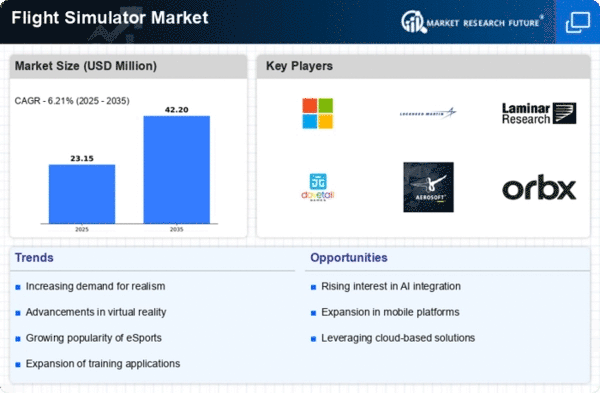
As per MRFR analysis, the Flight Simulator Market Size was estimated at 21.8 USD Million in 2024. The Flight Simulator industry is projected to grow from 23.1 in 2025 to 42.2 by 2035, exhibiting a compound annual growth rate (CAGR) of 6.21 during the forecast period 2025 - 2035.

Key Market Trends & Highlights

The Flight Simulator Market is experiencing robust growth driven by technological advancements and increasing demand for training solutions.

  • North America remains the largest market for flight simulators, driven by a strong aviation sector and advanced training facilities.
  • The Asia-Pacific region is emerging as the fastest-growing market, fueled by rising disposable incomes and a burgeoning interest in aviation.
  • Pilot training solutions dominate the market, while entertainment segments are witnessing rapid growth due to the rise of online flight simulation communities.
  • Technological advancements in simulation software and the integration of virtual reality technologies are key drivers propelling market expansion.

Market Size & Forecast

2024 Market Size 21.8 (USD Million)
2035 Market Size 42.2 (USD Million)
CAGR (2025 - 2035) 6.21%
Largest Regional Market Share in 2024 North America

Major Players

<p>Microsoft (US), Lockheed Martin (US), Laminar Research (US), Dovetail Games (GB), Aerosoft (DE), Orbx (AU), Flight1 (US), Just Flight (GB), X-Plane (US)</p>

Market Trends

The Flight Simulator Market is currently experiencing a dynamic evolution, driven by advancements in technology and increasing demand for realistic training solutions. The integration of virtual reality and augmented reality into flight simulation systems appears to enhance user experience significantly, providing immersive environments that closely mimic real-world flying conditions. Furthermore, the growing emphasis on pilot training and safety protocols suggests a robust market for high-fidelity simulators, which are essential for both commercial and military aviation sectors. As the aviation industry continues to expand, the Flight Simulator Market is likely to witness further innovations, potentially leading to more sophisticated training methodologies and enhanced operational efficiencies. In addition, the rise of online platforms for flight simulation gaming indicates a shift in consumer engagement, where enthusiasts seek more interactive and community-driven experiences. This trend may lead to increased collaboration between developers and users, fostering a vibrant ecosystem that supports both casual gamers and professional pilots. Overall, the Flight Simulator Market seems poised for growth, with various factors contributing to its ongoing transformation and adaptation to modern technological advancements.

Technological Advancements

The Flight Simulator Market is witnessing rapid technological advancements, particularly in the realms of virtual reality and artificial intelligence. These innovations are enhancing the realism of simulations, allowing users to experience flight scenarios that closely replicate actual conditions. As technology continues to evolve, the potential for more immersive and interactive training solutions increases, appealing to both professional pilots and aviation enthusiasts.

Increased Demand for Training Solutions

There is a growing demand for effective training solutions within the Flight Simulator Market, driven by the need for enhanced pilot training and safety measures. Organizations are increasingly recognizing the value of high-fidelity simulators in preparing pilots for real-world challenges. This trend indicates a shift towards more comprehensive training programs that prioritize safety and operational efficiency.

Rise of Online Flight Simulation Communities

The emergence of online flight simulation communities is reshaping the Flight Simulator Market, as enthusiasts seek collaborative and interactive experiences. These platforms facilitate user engagement and knowledge sharing, fostering a sense of community among both casual gamers and serious pilots. This trend may lead to increased innovation and development within the market, as user feedback becomes integral to the evolution of flight simulation products.

Flight Simulator Market Market Drivers

Market Growth Projections

The Global Flight Simulator Industry is poised for substantial growth, with projections indicating a market value of 6.57 USD Billion in 2024 and an anticipated increase to 13.7 USD Billion by 2035. This growth trajectory suggests a compound annual growth rate (CAGR) of 6.89% from 2025 to 2035. Such figures highlight the increasing reliance on flight simulators across various sectors, including commercial aviation, military, and training institutions. The consistent demand for innovative training solutions and the integration of advanced technologies are likely to drive this growth, positioning the industry for a robust future.

Technological Advancements

The Global Flight Simulator Industry is experiencing a surge driven by rapid technological advancements. Innovations in virtual reality and augmented reality are enhancing the realism of flight simulations, making them more immersive and engaging. For instance, the integration of high-definition graphics and real-time weather systems allows users to experience flight scenarios that closely mimic real-life conditions. This trend is expected to contribute to the market's growth, with projections indicating a market value of 6.57 USD Billion in 2024. As technology continues to evolve, the demand for sophisticated flight simulators is likely to increase, further propelling the industry forward.

Growing Demand for Pilot Training

The increasing need for pilot training is a significant driver in the Global Flight Simulator Industry. With the aviation sector expanding, airlines and training institutions are investing heavily in flight simulation technology to ensure pilots receive comprehensive training. Flight simulators provide a safe and controlled environment for pilots to practice various scenarios, including emergency situations. This trend is reflected in the projected market growth, with an anticipated value of 13.7 USD Billion by 2035. The emphasis on safety and efficiency in pilot training is likely to sustain the demand for advanced flight simulators, thereby fostering industry expansion.

Rising Adoption in Military Applications

The Global Flight Simulator Industry is also witnessing increased adoption in military applications. Armed forces worldwide are utilizing flight simulators for training purposes, allowing pilots to hone their skills without the risks associated with actual flight. These simulators are equipped with advanced features that replicate combat scenarios, enhancing the training experience. The military sector's investment in simulation technology is expected to contribute to the industry's growth, with a projected CAGR of 6.89% from 2025 to 2035. This focus on realistic training solutions is likely to bolster the demand for flight simulators in military applications.

Expansion of the Commercial Aviation Sector

The expansion of the commercial aviation sector is a pivotal driver for the Global Flight Simulator Industry. As air travel demand continues to rise globally, airlines are compelled to enhance their training programs to accommodate the growing number of pilots needed. This expansion is reflected in the projected market value of 6.57 USD Billion in 2024, with expectations of reaching 13.7 USD Billion by 2035. The increasing number of aircraft deliveries and the establishment of new airlines contribute to this trend, necessitating advanced flight simulation solutions to ensure pilots are adequately trained. This dynamic environment is likely to sustain the industry's growth trajectory.

Increased Focus on Cost-Effective Training Solutions

Cost-effectiveness is becoming a crucial factor in the Global Flight Simulator Industry. As airlines and training organizations seek to minimize operational costs, flight simulators offer a viable solution by reducing the need for expensive aircraft usage during training. Simulators allow for repeated practice of complex maneuvers without incurring the costs associated with fuel and maintenance. This shift towards cost-effective training solutions is likely to drive market growth, as organizations recognize the long-term financial benefits of investing in flight simulation technology. The trend aligns with the overall expansion of the industry, further solidifying its relevance in aviation training.

Market Segment Insights

By Application: Pilot Training (Largest) vs. Entertainment (Fastest-Growing)

<p>In the Flight Simulator Market, the application segment showcases diverse functionalities, with pilot training emerging as the largest value due to its critical role in ensuring proficient flying skills. Following closely behind are <a href="https://www.marketresearchfuture.com/reports/air-traffic-market-33794" target="_blank">air traffic</a> control simulations and research and development applications, both vital for enhancing aviation safety and technological advancement. Entertainment also holds a significant share, catering to users seeking immersive flying experiences, while aircraft design is a niche but important segment contributing to innovation in aviation.</p>

<p>Pilot Training (Dominant) vs. Entertainment (Emerging)</p>

<p>Pilot training remains the dominant segment within the Flight Simulator Market, as it forms the foundation of professional aviation education and proficiency. This application emphasizes realistic simulation conditions that closely replicate actual flying scenarios, equipping pilots with skills for various flight situations. Meanwhile, entertainment emerges as a rapidly growing segment driven by advances in technology, attractive gaming experiences, and a surge in consumer interest for flight simulation as a recreational activity. This rising trend is fueled by improvements in graphics and user interfaces, making flight simulators more accessible and appealing to amateur enthusiasts.</p>

By End Use: Commercial Aviation (Largest) vs. Military (Fastest-Growing)

<p>The Flight Simulator Market is segmented into various end uses, with Commercial Aviation commanding the largest share, owing to the increasing demand for pilot training and recurrent checks. The military segment holds a significant position as well, enabling armed forces to hone their skills in a cost-effective manner without the risks associated with live flying. Other noteworthy segments include educational institutions, which are increasingly adopting simulators, and home users looking for immersive flight experiences.</p>

<p>End Use: Commercial Aviation (Dominant) vs. Military (Emerging)</p>

<p>In the Flight Simulator Market, Commercial Aviation remains the dominant segment due to its extensive use for training pilots and improving operational efficiencies. The segment benefits from airlines' rising investments in advanced simulation technology to mitigate training costs and enhance pilot proficiency. Conversely, the Military segment is emerging rapidly as defense budgets allocate more resources towards simulation for combat readiness and advanced training scenarios. The growing complexity of military operations necessitates advanced flight simulators that offer realistic environments to prepare personnel, making this segment one of the fastest-growing in the industry.</p>

By Platform: PC (Largest) vs. Virtual Reality (Fastest-Growing)

<p>Within the Flight Simulator Market, the platform segment exhibits a diverse distribution, where PCs continue to hold the largest market share. Their dominance is attributed to their robust performance capabilities, extensive customization options, and a vast library of flight simulation content. In contrast, virtual reality platforms are emerging rapidly, appealing to users through immersive experiences that bring realism to flight simulations, attracting a new generation of users eager for cutting-edge technology.</p>

<p>PC: (Dominant) vs. Virtual Reality (Emerging)</p>

<p>PCs dominate the Flight Simulator Market thanks to their ability to handle complex simulations and high-fidelity graphics, which are essential for serious enthusiasts and professional pilots-in-training. They support a wide array of peripherals and upgrades, which enhances user experience and engagement. On the other hand, virtual reality is becoming an emerging force, driven by technological advancements that enhance user immersion. VR platforms, although currently smaller in comparison, offer unparalleled realism and interactivity, which positions them favorably for future growth as hardware becomes more accessible and software development accelerates.</p>

By Type: Professional Flight Simulators (Largest) vs. Consumer Flight Simulators (Fastest-Growing)

<p>The Flight Simulator market exhibits a diverse segmentation by type, with Professional Flight Simulators dominating the market share. These simulators are primarily utilized by flight schools, military training, and aviation authorities, which drives their steady demand. In contrast, Consumer Flight Simulators, often favored by hobbyists and gaming enthusiasts, have witnessed rapid growth as technology advances make these products more accessible and immersive for the average user. The growth trends in this segment are influenced by the rising popularity of virtual reality, advancements in simulation technologies, and a growing interest in aviation among younger demographics. Additionally, the expansion of online communities and competitive gaming environments further boosts the adoption of Consumer Flight Simulators, making them the fastest-growing segment in the industry.</p>

<p>Professional Flight Simulators (Dominant) vs. Mixed Reality Simulators (Emerging)</p>

<p>Professional Flight Simulators are characterized by their high fidelity, complex systems, and realism, catering primarily to aviation professionals who require precise training tools. These simulators integrate advanced technologies to replicate real-life scenarios, making them indispensable for pilot training and certification. Conversely, Mixed Reality Simulators represent an emerging segment that combines physical and digital elements for increased interactivity and immersion. While still developing, they attract attention due to their innovative approach and potential applications in both entertainment and serious training environments. Both types contribute significantly to their respective areas; however, Professional Flight Simulators maintain a stronghold as the preferred choice for rigorous training, while Mixed Reality Simulators pave the way for future integration of technology in flight simulation.</p>

By Technology: Virtual Reality (Largest) vs. Augmented Reality (Fastest-Growing)

<p>The Flight Simulator Market is currently being dominated by Virtual Reality (VR) technology, which offers immersive experiences, making it the most significant contributor to the overall market share. With increasing investments in VR hardware and software, this segment is flourishing and appeals largely to both professional pilots and aviation enthusiasts. In contrast, Augmented Reality (AR) is witnessing unprecedented growth, bolstered by advancements in mobile technology and its integration into pilot training programs, making it the fastest-growing segment within this market.</p>

<p>Technology: Virtual Reality (Dominant) vs. Augmented Reality (Emerging)</p>

<p>Virtual Reality has established itself as the dominant force in the Flight Simulator Market, providing users with fully immersive environments that simulate real-world flying conditions. This technology enhances user engagement and training effectiveness, making it a preferred choice among flight schools and simulation enthusiasts. Conversely, Augmented Reality is emerging rapidly, adding interactive layers to conventional flight simulations. It combines real-world elements with digital information, enriching the training experience for pilots. The adaptability of AR technology to various devices has contributed to its growing popularity, positioning it as an essential tool for modern aviation training.</p>

Get more detailed insights about Flight Simulator Market Research Report -Forecast till 2035

Regional Insights

aviation infrastructure

Key Players and Competitive Insights

The Flight Simulator Market is currently characterized by a dynamic competitive landscape, driven by technological advancements and an increasing demand for realistic simulation experiences. Key players such as Microsoft (US), Lockheed Martin (US), and Laminar Research (US) are at the forefront, each adopting distinct strategies to enhance their market positioning. Microsoft (US) continues to leverage its Azure cloud platform to integrate advanced AI capabilities into its flight simulation software, thereby enhancing user experience and engagement. Lockheed Martin (US), on the other hand, focuses on defense and training applications, emphasizing partnerships with military organizations to develop specialized simulation solutions. Laminar Research (US) is known for its commitment to community-driven development, frequently updating its X-Plane platform based on user feedback, which fosters a loyal customer base and encourages innovation.

The business tactics employed by these companies reflect a moderately fragmented market structure, where collaboration and strategic partnerships play a crucial role. For instance, localizing software development and optimizing supply chains are common practices that enhance operational efficiency. The collective influence of these key players shapes a competitive environment where innovation and user-centric approaches are paramount, allowing companies to differentiate themselves in a crowded marketplace.

In November 2025, Microsoft (US) announced a significant update to its Flight Simulator platform, integrating real-time weather data and enhanced AI-driven flight dynamics. This strategic move not only improves realism but also positions Microsoft as a leader in technological innovation within the market. The incorporation of real-time data is likely to attract both casual gamers and professional pilots, thereby expanding its user base and reinforcing its competitive edge.

In October 2025, Lockheed Martin (US) secured a contract with the U.S. Air Force to develop advanced flight simulation training systems. This partnership underscores Lockheed Martin's focus on defense applications and highlights the growing importance of simulation in military training. By aligning its offerings with the needs of defense organizations, Lockheed Martin strengthens its market position and ensures a steady revenue stream from government contracts.

In September 2025, Laminar Research (US) launched a new version of X-Plane, featuring enhanced graphics and improved user interface based on community feedback. This release exemplifies Laminar's commitment to user engagement and innovation, which is crucial in maintaining its competitive position. By prioritizing user input, Laminar Research not only fosters loyalty but also adapts quickly to market demands, ensuring its relevance in a rapidly evolving industry.

As of December 2025, the Flight Simulator Market is witnessing trends such as digitalization, AI integration, and a growing emphasis on sustainability. Strategic alliances among key players are increasingly shaping the competitive landscape, as companies seek to combine resources and expertise to drive innovation. The shift from price-based competition to a focus on technological advancement and supply chain reliability is evident, suggesting that future differentiation will hinge on the ability to innovate and deliver superior user experiences.

Key Companies in the Flight Simulator Market include

Industry Developments

  • Q3 2025: Microsoft Flight Simulator Market 2024 Launches with Advanced Simulation Technologies Microsoft released its new flagship flight simulation platform, Microsoft Flight Simulator Market 2024, featuring significant upgrades in simulation, cloud, machine learning, and graphics, powered by the evolved Asobo Studio engine. The product is now available for purchase on Xbox Game Pass, PC Game Pass, Xbox Cloud Gaming, Windows 10/11, and Steam.
  • Q2 2025: Honeycomb Aeronautical Expands Flight Sim Hardware Offerings for Home Users Honeycomb Aeronautical, a leading flight sim hardware manufacturer, continued its expansion in 2025 by delivering new yoke and throttle products designed to bridge the gap between entry-level and professional-grade flight simulation equipment for home users.


Recent Developments

  • In April 2019, JetBlue Airways (U.S.) and CAE signed a partnership agreement to offer 2 Airbus A220- 300 CAE 7000XR Series full-flight simulators and 2 CAE 500XR flight training devices for enhancing the customer base.
  • In September 2019, the U.S. Navy was signed a contract worth USD 45.8 million with Boeing to develop P-8A Poseidon maritime patrol jet simulators.
  • In March 2019, Leonardo SpA and CAE Inc. formed a joint venture for its Philadelphia Training Academy. This has aimed to offer 3000 Series full-flight simulators, which are expected to launch in 2020. 

Future Outlook

Flight Simulator Market Future Outlook

<p>The Flight Simulator Market is projected to grow at a 6.21% CAGR from 2024 to 2035, driven by technological advancements, increased demand for pilot training, and the rise of virtual reality applications.</p>

New opportunities lie in:

  • <p>Development of cloud-based simulation platforms for remote training access.</p>
  • <p>Integration of AI-driven analytics for personalized training experiences.</p>
  • <p>Expansion into emerging markets with localized training solutions.</p>

<p>By 2035, the Flight Simulator Market is expected to be robust, reflecting substantial growth and innovation.</p>

Market Segmentation

Flight Simulator Market Type Outlook

  • Professional Flight Simulators
  • Consumer Flight Simulators
  • Mixed Reality Simulators
  • Hardware-Based Simulators

Flight Simulator Market End Use Outlook

  • Aerospace Industry
  • Military
  • Educational Institutions
  • Commercial Aviation
  • Home Users

Flight Simulator Market Platform Outlook

  • PC
  • Console
  • Mobile
  • Virtual Reality
  • Cloud-Based

Flight Simulator Market Technology Outlook

  • Virtual Reality
  • Augmented Reality
  • Artificial Intelligence
  • Cloud Computing

Flight Simulator Market Application Outlook

  • Pilot Training
  • Air Traffic Control Simulation
  • Aircraft Design
  • Research and Development
  • Entertainment

Report Scope

MARKET SIZE 202421.8(USD Million)
MARKET SIZE 202523.1(USD Million)
MARKET SIZE 203542.2(USD Million)
COMPOUND ANNUAL GROWTH RATE (CAGR)6.21% (2024 - 2035)
REPORT COVERAGERevenue Forecast, Competitive Landscape, Growth Factors, and Trends
BASE YEAR2024
Market Forecast Period2025 - 2035
Historical Data2019 - 2024
Market Forecast UnitsUSD Million
Key Companies ProfiledMicrosoft (US), Lockheed Martin (US), Laminar Research (US), Dovetail Games (GB), Aerosoft (DE), Orbx (AU), Flight1 (US), Just Flight (GB), X-Plane (US)
Segments CoveredApplication, End Use, Platform, Type, Technology
Key Market OpportunitiesIntegration of virtual reality technology enhances user experience in the Flight Simulator Market.
Key Market DynamicsTechnological advancements and consumer demand drive innovation and competition in the Flight Simulator Market.
Countries CoveredNorth America, Europe, APAC, South America, MEA

FAQs

What is the CAGR for flight simulator market?

Flight simulator market can expand at 6.89% CAGR by 2030.

Who are key players of the flight simulator market?

CAE Inc. (Switzerland), Lockheed Martin Corporation (US), and L3Harris Technologies, Inc. (US) are some reputed names in the flight simulator market.

What is the flight simulator market driver?

Rise in demand for military helicopter can promote the flight simulator market.

What is the flight simulator market restrain?

Lack of military expenditure can hinder the flight simulator market.

  1. SECTION I: EXECUTIVE SUMMARY AND KEY HIGHLIGHTS
    1. | 1.1 EXECUTIVE SUMMARY
  2. SECTION II: SCOPING, METHODOLOGY AND MARKET STRUCTURE
    1. | 2.1 MARKET INTRODUCTION
    2. | 2.2 RESEARCH METHODOLOGY
  3. SECTION III: QUALITATIVE ANALYSIS
    1. | 3.1 MARKET DYNAMICS
    2. | 3.2 MARKET FACTOR ANALYSIS
  4. SECTION IV: QUANTITATIVE ANALYSIS
    1. | 4.1 Aerospace & Defense, BY Application (USD Million)
    2. | 4.2 Aerospace & Defense, BY End Use (USD Million)
    3. | 4.3 Aerospace & Defense, BY Platform (USD Million)
    4. | 4.4 Aerospace & Defense, BY Type (USD Million)
    5. | 4.5 Aerospace & Defense, BY Technology (USD Million)
    6. | 4.6 Aerospace & Defense, BY Region (USD Million)
  5. SECTION V: COMPETITIVE ANALYSIS
    1. | 5.1 Competitive Landscape
    2. | 5.2 Company Profiles
    3. | 5.3 Appendix

Flight Simulator Market Segmentation

Market Segmentation Overview

  • Detailed segmentation data will be available in the full report
  • Comprehensive analysis by multiple parameters
  • Regional and country-level breakdowns
  • Market size forecasts by segment
Infographic

Free Sample Request

Kindly complete the form below to receive a free sample of this Report

Get Free Sample

Customer Strories

Compare Licence

×
Features License Type
Single User Multiuser License Enterprise User
Price $4,950 $5,950 $7,250
Maximum User Access Limit 1 User Upto 10 Users Unrestricted Access Throughout the Organization
Free Customization
Direct Access to Analyst
Deliverable Format
Platform Access
Discount on Next Purchase 10% 15% 15%
Printable Versions