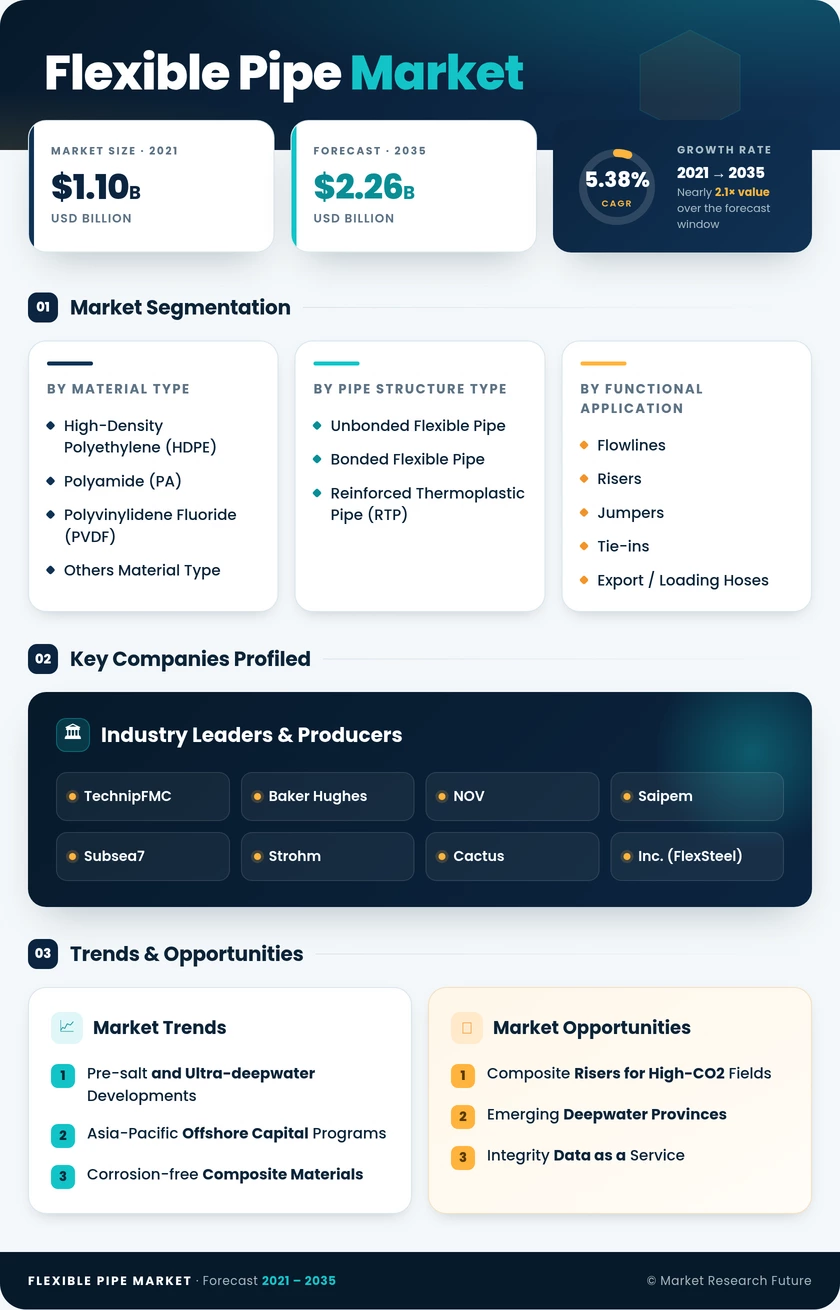
Flexible Pipe Market (2026 - 2035)

ID: MRFR/PCM/23625-HCR 111 Pages Snehal Singh Last Updated: November 16, 2026
Flexible Pipe Market Research Report Information By Material Type (High-Density Polyethylene (HDPE), Polyamide (PA), Polyvinylidene Fluoride (PVDF), and Other Material Types), By Pipe Structure Type (Unbonded Flexible Pipe, Bonded Flexible Pipe, and Reinforced Thermoplastic Pipe (RTP)), By Functional Application (Flowlines, Risers, Jumpers and Tie-ins, and Export/Loading Hoses), By Installation Environment (Offshore and Onshore), And By Region (North America, Europe, Asia-Pacific, and Rest of the World) – Market Forecast Till 2035.
Flexible Pipe Market
Market Size
Forecast Period2026-2035
CAGR (2026-2035)5.38%
2025 Market SizeUSD 1.35 Billion
2035 Market SizeUSD 2.26 Billion
Key Players
TechnipFMC
Baker Hughes
NOV
Saipem
Subsea7
Strohm
Opportunities
  • Composite Risers for High-CO2 Fields
  • Emerging Deepwater Provinces
  • Integrity Data as a Service
  1. 1 Market Summary | |
  2. 2 Key Report Takeaways | |
    1. 2.1 By Material Type | |
    2. 2.2 By Pipe Structure Type | |
    3. 2.3 By Functional Application | |
    4. 2.4 By Installation Environment | |
    5. 2.5 By Region | |
  3. 3 Market Size and Forecast (2021–2035) | |
    1. 3.1 Historical Market Size (2021–2025) | |
    2. 3.2 Forecast Market Size (2026–2035) | |
  4. 4 Driver Impact Analysis | |
    1. 4.1 Pre-salt and Ultra-deepwater Developments | |
    2. 4.2 Asia-Pacific Offshore Capital Programs | |
    3. 4.3 Corrosion-free Composite Materials | |
    4. 4.4 Subsea Tie-back Economics | |
    5. 4.5 Middle East Capacity Expansion | |
    6. 4.6 Embedded Integrity Monitoring | |
    7. 4.7 Hydrogen and CCS Pipeline Buildout | |
  5. 5 Restraints Impact Analysis | |
    1. 5.1 Oil Price Softness Delaying Sanctions | |
    2. 5.2 CO2 Stress Corrosion and Integrity Failures | |
    3. 5.3 Qualification Lead Times for High-pressure Lines | |
    4. 5.4 Capital Rotation Toward Low-carbon Assets | |
    5. 5.5 Polymer and Composite Input Cost Volatility | |
  6. 6 Opportunities | |
    1. 6.1 Composite Risers for High-CO2 Fields | |
    2. 6.2 Emerging Deepwater Provinces | |
    3. 6.3 Integrity Data as a Service | |
    4. 6.4 Hydrogen and CO2 Transport Lines | |
    5. 6.5 Onshore Spoolable Gathering Systems | |
  7. 7 Regional Market Share and Country-Level Analysis | |
    1. 7.1 Asia-Pacific | | |
      1. 7.1.1 China | | |
      2. 7.1.2 India | | |
      3. 7.1.3 Japan | | |
      4. 7.1.4 South Korea | | |
      5. 7.1.5 Australia and New Zealand | | |
      6. 7.1.6 Rest of Asia-Pacific | |
    2. 7.2 North America | | |
      1. 7.2.1 United States | | |
      2. 7.2.2 Canada | | |
      3. 7.2.3 Mexico | |
    3. 7.3 Europe | | |
      1. 7.3.1 Germany | | |
      2. 7.3.2 United Kingdom | | |
      3. 7.3.3 France | | |
      4. 7.3.4 Italy | | |
      5. 7.3.5 Spain | | |
      6. 7.3.6 Russia | | |
      7. 7.3.7 Rest of Europe | |
    4. 7.4 South America | | |
      1. 7.4.1 Brazil | | |
      2. 7.4.2 Argentina | | |
      3. 7.4.3 Rest of South America | |
    5. 7.5 Middle East and Africa | | |
      1. 7.5.1 Middle East | | |
      2. 7.5.2 United Arab Emirates | | |
      3. 7.5.3 Saudi Arabia | | |
      4. 7.5.4 Turkey | | |
      5. 7.5.5 Rest of Middle East | | |
      6. 7.5.6 Africa | | |
      7. 7.5.7 South Africa | | |
      8. 7.5.8 Nigeria | | |
      9. 7.5.9 Egypt | | |
      10. 7.5.10 Rest of Africa | |
  8. 8 Future Outlook (2026–2035) | |
    1. 8.1 Autonomous Integrity Management | |
    2. 8.2 Composite Displacement of Steel Armour | |
    3. 8.3 Consolidation of Subsea Contractors | |
    4. 8.4 Energy Transition Pipelines | |
  9. 9 Segmentation Analysis | |
    1. 9.1 By Material Type | | |
      1. 9.1.1 High-Density Polyethylene (HDPE) | | |
      2. 9.1.2 Polyamide (PA) | | |
      3. 9.1.3 Polyvinylidene Fluoride (PVDF) | | |
      4. 9.1.4 Other Material Type | |
    2. 9.2 By Pipe Structure Type | | |
      1. 9.2.1 Unbonded Flexible Pipe | | |
      2. 9.2.2 Bonded Flexible Pipe | | |
      3. 9.2.3 Reinforced Thermoplastic Pipe (RTP) | |
    3. 9.3 By Functional Application | | |
      1. 9.3.1 Flowlines | | |
      2. 9.3.2 Risers | | |
      3. 9.3.3 Jumpers and Tie-ins | | |
      4. 9.3.4 Export / Loading Hoses | |
    4. 9.4 By Installation Environment | | |
      1. 9.4.1 Offshore | | |
      2. 9.4.2 Onshore | |
  10. 10 Competitive Landscape | |
    1. 10.1 Market Concentration Analysis | |
    2. 10.2 Competitive Benchmarking Table | |
    3. 10.3 Company Profiles | | |
      1. 10.3.1 TechnipFMC | | |
      2. 10.3.2 Baker Hughes | | |
      3. 10.3.3 NOV | | |
      4. 10.3.4 Saipem | | |
      5. 10.3.5 Subsea7 | | |
      6. 10.3.6 Strohm | | |
      7. 10.3.7 Cactus, Inc. (FlexSteel) | | |
      8. 10.3.8 Mattr Corp | | |
      9. 10.3.9 Pipelife Nederland (SoluForce) | | |
      10. 10.3.10 ContiTech (Continental) | | |
      11. 10.3.11 Trelleborg | |
  11. 11 Recent News & Developments | |
  12. 12 Report Scope and Methodology | |
  13. 13 Detailed Sources and Citations | |
  14. 14 Frequently Asked Questions (FAQs) | | LIST OF TABLES | |
  15. TABLE 1 Global Market Size & Forecast, by Revenue (USD Billion), 2021–2035 | |
  16. TABLE 2 Driver Impact Analysis | |
  17. TABLE 3 Restraints Impact Analysis | |
  18. TABLE 4 Regional Summary, 2025 | |
  19. TABLE 5 Asia-Pacific Country-Level Analysis, 2025 | |
  20. TABLE 6 North America Country-Level Analysis, 2025 | |
  21. TABLE 7 Europe Country-Level Analysis, 2025 | |
  22. TABLE 8 South America Country-Level Analysis, 2025 | |
  23. TABLE 9 Middle East and Africa Country-Level Analysis, 2025 | |
  24. TABLE 10 Segmentation by Material Type, 2025 | |
  25. TABLE 11 Segmentation by Pipe Structure Type, 2025 | |
  26. TABLE 12 Segmentation by Functional Application, 2025 | |
  27. TABLE 13 Segmentation by Installation Environment, 2025 | |
  28. TABLE 14 Competitive Benchmarking Table | |
  29. TABLE 15 Report Scope and Methodology | |
  30. TABLE 16 Detailed Sources and Citations | | LIST OF FIGURES | |
  31. FIGURE 1 Market Dynamics Overview (Drivers, Restraints, Opportunities) | |
  32. FIGURE 2 Industry Value Chain Analysis | |
  33. FIGURE 3 Porter's Five Forces Analysis | |
  34. FIGURE 4 Global Market Size Trend, 2021–2035 (USD Billion) | |
  35. FIGURE 5 Share by Material Type, 2025 | |
  36. FIGURE 6 Share by Pipe Structure Type, 2025 | |
  37. FIGURE 7 Share by Functional Application, 2025 | |
  38. FIGURE 8 Share by Installation Environment, 2025 | |
  39. FIGURE 9 Regional Share, 2025 | |
  40. FIGURE 10 Competitive Landscape and Market Concentration, 2025

Segmentation Quick Reference

DimensionSub-SegmentsDominant SegmentFastest Growing Segment
By Material TypeHigh-Density Polyethylene (HDPE), Polyamide (PA), Polyvinylidene Fluoride (PVDF), Other Material TypeHigh-Density Polyethylene (HDPE) (37.6% share)Others Material Type (8.6% CAGR)
By Pipe Structure TypeUnbonded Flexible Pipe, Bonded Flexible Pipe, Reinforced Thermoplastic Pipe (RTP)Unbonded Flexible Pipe (48.2% share)Reinforced Thermoplastic Pipe (RTP) (7.6% CAGR)
By Functional ApplicationFlowlines, Risers, Jumpers and Tie-ins, Export / Loading HosesFlowlines (USD 0.54 Billion)Jumpers and Tie-ins (8.3% CAGR)
By Installation EnvironmentOffshore, OnshoreOffshore (63.9% share)Onshore (6.6% CAGR)
By RegionAsia-Pacific, North America, Europe, South America, Middle East and AfricaAsia-Pacific (38.5% share)Asia-Pacific (38.5% share)

Market Segmentation Overview

By Material Type

Sub-SegmentKey Trend
High-Density Polyethylene (HDPE)Default liner for water injection and low-temperature lines
Polyamide (PA)Mid-temperature production service
Polyvinylidene Fluoride (PVDF)Sour and high-temperature wells
Other Material TypeCarbon-fibre composites for lightweight risers

High-Density Polyethylene (HDPE) leads because it is cheap to extrude and chemically inert in water injection and low-temperature flowlines. Other material types grow fastest as carbon-fibre composites cut riser weight on floating hulls. PA and PVDF hold the middle ground, covering temperature and sour-service windows HDPE cannot reach.

By Pipe Structure Type

Sub-SegmentKey Trend
Unbonded Flexible PipeDynamic risers under API 17J
Bonded Flexible PipeLoading hoses and high-pressure niches
Reinforced Thermoplastic Pipe (RTP)Corrosion-free spoolable lines

Unbonded Flexible Pipe leads because its separate armour layers handle dynamic riser loads and can be repaired in the field. Reinforced Thermoplastic Pipe (RTP) grows fastest as operators replace corroding steel in onshore gathering and brownfield tie-ins. Bonded Flexible Pipe stays a niche for hoses and specialised high-pressure duty.

By Functional Application

Sub-SegmentKey Trend
FlowlinesCore well-to-facility transfer
RisersHigh unit value on floating hosts
Jumpers and Tie-insStandardised quick-connect kits
Export / Loading HosesTied to FPSO and FSO fleet growth

Flowlines lead because every subsea well needs a connection to a manifold or host. Jumpers and Tie-ins grow fastest as modular field layouts increase inter-well connections and quick-connect kits shorten installation. Risers carry the highest value per kilometre, while Export / Loading Hoses follow floating storage deployments.

By Installation Environment

Sub-SegmentKey Trend
OffshoreShallow Water (Less than 500 m), Deepwater (500-1500 m) and Ultra-deepwater (More than 1500 m) developments
OnshoreSpoolable gathering and hydrogen lines

Offshore leads on the strength of pre-salt, Guyana and Gulf deepwater projects, with Ultra-deepwater (More than 1500 m) commanding premium pricing. Onshore grows fastest as spoolable composites cut trench widths and crew sizes in shale gathering, and as hydrogen networks call for embrittlement-resistant lines.


Download PDF ×

We do not share your information with anyone. However, we may send you emails based on your report interest from time to time. You may contact us at any time to opt-out.