Request Free Sample ×

Kindly complete the form below to receive a free sample of this Report

* Please use a valid business email

Leading companies partner with us for data-driven Insights

clients tt-cursor
Hero Background
English
Chinese
French
Japanese
Korean
German
Spanish

Flexible Electronics Materials Market Analysis

ID: MRFR/SEM/0646-HCR
110 Pages
Aarti Dhapte
March 2026

Flexible Electronics and Materials Market Size, Share and Research Report By Segments (Silicon Materials, Dielectrics, Sensors, Semiconductors, Contact Materials, Presentations), By Application (Incorporate Medical Car, Auto, Buyer GadgeThe integration of Internet of Things (IoT) technology and wearable devices is becoming a prominent trend in the Flexible Electronics and Materials Market. As consuts, Military and Guard, Biometrics) And By Region (North America, Europe, Asia-Pacific, And Rest Of The World) – Industry Forecast Till 2035

Share:
Download PDF ×

We do not share your information with anyone. However, we may send you emails based on your report interest from time to time. You may contact us at any time to opt-out.

Flexible Electronics Materials Market Infographic
Purchase Options

Market Analysis

In-depth Analysis of Flexible Electronics Materials Market Industry Landscape

The global flexible electronics and materials market is set to reach US$ 72.6 BN by 2032, growing at a 9.20% CAGR between years 2023-2032. The market dynamics exhibit a complex interplay, which reflects how fast this new industry keeps changing and garner attention. The market is pushed by the growing demand for compact, bendable and stretchy electronic parts. This breaks away from the usual stiffness of older technology devices. The need for bendy electronics comes from many uses like wearable gadgets, fold-up screens, and healthcare equipment & devices. It is driving the market to grow more. In recent years, technology improvements have been very important in creating the flexible electronics market. Creating flexible materials like organic polymers and thin film stuff has allowed us to make electronic gadgets that bend easily with better toughness. This has made a big difference in what can be used, leading to more people using it across different businesses. This led people in the market to put a lot of money into research and development so they could improve their flexibility and performance. The flexible electronic market has become a big force because of consumer electronics. People want more smartphones, watches and handheld items that can bend. This is making big companies create new things to stay ahead in the market. The car industry is using flexible electronics for things like curved screens, bendable lights and adjusting sensors. This opens up new designs and ways it can work. As people care more about being environmentally friendly, there is a focus on using materials that are kind to the Earth and making things in ways that don't harm nature. As people start to notice how much trash electronic waste makes, the market for bendable electronics and materials is changing. This change includes moving more towards things that can be re-used or easily broken down by nature because it's better for the environment. This change goes with world actions to make a round-way system and lessen things thrown away from electronics, so it affects what producers and users choose too. In the flexible electronics and materials market, competition is driven by companies joining forces in partnerships or mergers. They also buy out others to gain an edge over their rivals. Businesses are coming together to combine their resources, share knowledge and speed up new ideas. This way not only speeds up making products, but also helps the companies involved to be stronger in their market. As industries like electronics, materials science and healthcare get closer together, it becomes more important to work together. This is because they face many different problems in the market. But problems still exist, especially in areas of size and value for money.


Author
Author Profile
Aarti Dhapte
AVP - Research

A consulting professional focused on helping businesses navigate complex markets through structured research and strategic insights. I partner with clients to solve high-impact business problems across market entry strategy, competitive intelligence, and opportunity assessment. Over the course of my experience, I have led and contributed to 100+ market research and consulting engagements, delivering insights across multiple industries and geographies, and supporting strategic decisions linked to $500M+ market opportunities. My core expertise lies in building robust market sizing, forecasting, and commercial models (top-down and bottom-up), alongside deep-dive competitive and industry analysis. I have played a key role in shaping go-to-market strategies, investment cases, and growth roadmaps, enabling clients to make confident, data-backed decisions in dynamic markets.

Leave a Comment

FAQs

What is the projected market valuation for the Flexible Electronics and Materials Market in 2035?

<p>The projected market valuation for the Flexible Electronics and Materials Market in 2035 is 91.51 USD Billion.</p>

What was the overall market valuation for the Flexible Electronics and Materials Market in 2024?

<p>The overall market valuation for the Flexible Electronics and Materials Market in 2024 was 39.2 USD Billion.</p>

What is the expected CAGR for the Flexible Electronics and Materials Market during the forecast period 2025 - 2035?

<p>The expected CAGR for the Flexible Electronics and Materials Market during the forecast period 2025 - 2035 is 8.01%.</p>

Which companies are considered key players in the Flexible Electronics and Materials Market?

<p>Key players in the Flexible Electronics and Materials Market include Samsung Electronics, LG Display, Apple, Sony, BASF, 3M, DuPont, Nissan Chemical, Agfa-Gevaert, and Flex.</p>

What are the projected valuations for silicon materials in the Flexible Electronics and Materials Market by 2035?

<p>The projected valuation for silicon materials in the Flexible Electronics and Materials Market is expected to reach 12.0 USD Billion by 2035.</p>

How much is the dielectrics segment expected to grow by 2035?

<p>The dielectrics segment is projected to grow to 15.0 USD Billion by 2035.</p>

What is the anticipated valuation for the sensors segment in 2035?

The anticipated valuation for the sensors segment in the Flexible Electronics and Materials Market is 14.0 USD Billion by 2035.

What is the expected market size for semiconductors in 2035?

The expected market size for semiconductors in the Flexible Electronics and Materials Market is projected to be 22.0 USD Billion by 2035.

What is the projected valuation for the automotive application segment by 2035?

The projected valuation for the automotive application segment is expected to reach 25.0 USD Billion by 2035.

How much is the buyer gadgets application segment expected to be valued at in 2035?

The buyer gadgets application segment is expected to be valued at 30.0 USD Billion by 2035.

Market Summary

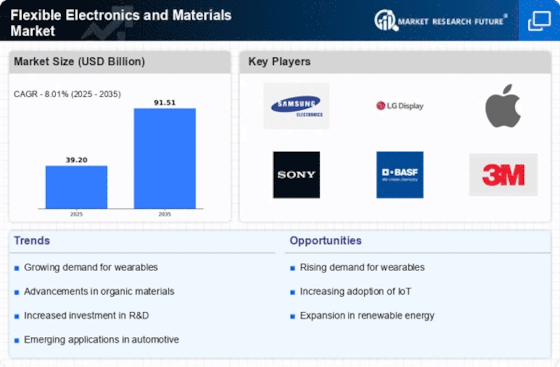
As per Market Research Future analysis, the Flexible Electronics and Materials Market was estimated at 39.2 USD Billion in 2024. The Flexible Electronics and Materials industry is projected to grow from 42.34 USD Billion in 2025 to 91.51 USD Billion by 2035, exhibiting a compound annual growth rate (CAGR) of 8.01% during the forecast period 2025 - 2035

Key Market Trends & Highlights

The Flexible Electronics and Materials Market is poised for substantial growth driven by technological advancements and sustainability initiatives.

  • North America remains the largest market for flexible electronics, driven by robust demand in consumer electronics and automotive sectors. Asia-Pacific is emerging as the fastest-growing region, fueled by increasing investments in IoT and wearable technology. Silicon materials dominate the market, while sensors are rapidly gaining traction as the fastest-growing segment due to their applications in various industries. Rising demand for wearable devices and advancements in flexible display technology are key drivers propelling market expansion.

Market Size & Forecast

2024 Market Size 39.2 (USD Billion)
2035 Market Size 91.51 (USD Billion)
CAGR (2025 - 2035) 8.01%
Largest Regional Market Share in 2024 North America

Major Players

Samsung Electronics (KR), LG Display (KR), Apple (US), Sony (JP), BASF (DE), 3M (US), DuPont (US), Nissan Chemical (JP), Agfa-Gevaert (BE), Flex (US)

Market Trends

The Flexible Electronics and Materials Market is currently experiencing a transformative phase, driven by advancements in technology and increasing demand for lightweight, portable devices. This market encompasses a wide array of applications, including consumer electronics, healthcare, automotive, and energy sectors. The integration of flexible materials into electronic devices allows for innovative designs and functionalities, which appear to enhance user experience and expand the potential for new applications. As industries continue to explore the benefits of flexibility, the market is likely to witness a surge in research and development efforts aimed at improving material properties and manufacturing processes. Moreover, sustainability concerns are becoming increasingly prominent within the Flexible Electronics and Materials Market. Manufacturers are exploring eco-friendly materials and production methods to reduce environmental impact. This shift towards sustainable practices not only aligns with global environmental goals but also appeals to a growing consumer base that prioritizes sustainability in their purchasing decisions. As a result, the market is poised for growth, with opportunities for companies that can innovate while adhering to these emerging standards. The future landscape of this market may be characterized by a blend of technological advancement and environmental responsibility, shaping the way flexible electronics are developed and utilized across various sectors.

Sustainable Material Development

There is a noticeable trend towards the development of sustainable materials within the Flexible Electronics and Materials Market. Companies are increasingly focusing on eco-friendly alternatives to traditional materials, which may reduce environmental impact and appeal to environmentally conscious consumers. This shift suggests a potential for innovation in material science, leading to the creation of biodegradable or recyclable components that maintain performance while promoting sustainability.

Integration of IoT and Wearable Technology

The integration of Internet of Things (IoT) technology and wearable devices is becoming a prominent trend in the Flexible Electronics and Materials Market. As consumers seek more interconnected and smart solutions, flexible electronics are being utilized in various applications, from health monitoring to smart clothing. This trend indicates a growing demand for devices that are not only functional but also seamlessly integrate into daily life.

Advancements in Manufacturing Techniques

Advancements in manufacturing techniques are significantly influencing the Flexible Electronics and Materials Market. Innovations such as roll-to-roll processing and additive manufacturing are enhancing production efficiency and reducing costs. These developments may lead to increased scalability and accessibility of flexible electronics, potentially expanding their application across diverse industries.

Flexible Electronics Materials Market Market Drivers

Growth in Automotive Electronics

The automotive sector is increasingly adopting flexible electronics, which serves as a significant driver for the Flexible Electronics and Materials Market. With the rise of electric vehicles and autonomous driving technologies, there is a growing need for lightweight and flexible components that can be integrated into vehicle designs. The automotive electronics market is projected to exceed 300 billion USD by 2025, highlighting the potential for flexible materials in applications such as dashboards, sensors, and displays. This trend not only enhances vehicle performance but also contributes to overall energy efficiency. As the automotive industry continues to evolve, the Flexible Electronics and Materials Market is likely to experience substantial growth.

Rising Demand for Wearable Devices

The increasing consumer interest in wearable technology is a primary driver for the Flexible Electronics and Materials Market. As health and fitness awareness grows, devices such as smartwatches and fitness trackers are becoming ubiquitous. According to recent estimates, the wearable technology market is projected to reach approximately 60 billion USD by 2025. This surge in demand necessitates the development of flexible electronics that can seamlessly integrate into various forms, enhancing user experience. The Flexible Electronics and Materials Market is thus positioned to benefit from this trend, as manufacturers seek innovative materials that offer durability, comfort, and functionality in wearable devices.

Sustainability and Eco-Friendly Materials

The push for sustainability is reshaping the Flexible Electronics and Materials Market. As environmental concerns become more pronounced, manufacturers are increasingly focusing on eco-friendly materials that reduce waste and energy consumption. The market for sustainable electronics is projected to grow significantly, with a focus on biodegradable and recyclable materials. This shift not only meets consumer demand for greener products but also aligns with regulatory pressures for sustainable practices. Companies that prioritize sustainability in their product offerings are likely to gain a competitive edge in the Flexible Electronics and Materials Market, appealing to environmentally conscious consumers.

Advancements in Flexible Display Technology

The evolution of flexible display technology is significantly influencing the Flexible Electronics and Materials Market. Innovations in OLED and LCD technologies have led to the creation of bendable screens that can be used in a variety of applications, from smartphones to large-scale displays. The flexible display market is expected to grow at a compound annual growth rate of over 20% in the coming years. This growth is driven by consumer demand for more versatile and portable devices. As manufacturers continue to explore new materials and production techniques, the Flexible Electronics and Materials Market is likely to see increased investment and development in this area.

Integration of Smart Technologies in Consumer Electronics

The integration of smart technologies into consumer electronics is a pivotal driver for the Flexible Electronics and Materials Market. As devices become more interconnected, the need for flexible and lightweight materials that can support advanced functionalities is paramount. The smart home market is anticipated to reach over 150 billion USD by 2025, creating a substantial demand for flexible electronics that can be embedded in various devices. This trend encourages innovation in material science, leading to the development of new flexible substrates and components that enhance device performance. Consequently, the Flexible Electronics and Materials Market is poised for growth as it adapts to these technological advancements.

Market Segment Insights

By Segments: Silicon materials (Largest) vs. Sensors (Fastest-Growing)

In the Flexible Electronics and Materials Market, silicon materials hold the largest market share due to their established use in a range of electronic applications. This dominant position is attributed to the durability, efficiency, and versatility silicon offers, making it integral in flexible electronics solutions. In contrast, sensors have emerged as a pivotal segment, reflecting rapid growth driven by the increasing demand for smart devices and IoT applications. This shift highlights the transition towards advanced technological integration in everyday materials.

Silicon materials (Dominant) vs. Sensors (Emerging)

Silicon materials are characterized by their robustness and conductivity, making them essential in various flexible electronic devices. Their properties allow for the development of lightweight and high-performance applications, maintaining their position as the dominant player in the market. On the other hand, sensors are gaining traction due to the rising trend of automation and connectivity. Their ability to provide critical data in real-time applications underlines their emerging role in the industry, positioned for significant growth as they integrate into flexible electronic systems increasingly.

By Application: Incorporate Medical Care (Largest) vs. Buyer Gadgets (Fastest-Growing)

In the Flexible Electronics and Materials Market, the application segments exhibit diverse trends, with 'Incorporate Medical Care' holding the largest market share. This segment benefits from the increasing integration of flexible electronics into medical devices, improving diagnostics and patient monitoring. 'Auto' and 'Military and Guard' segments follow closely, leveraging advanced materials for enhanced performance and safety features in automotive and defense applications. The 'Biometrics' segment also plays a crucial role, catering to security needs across various industries.

Incorporate Medical Care (Dominant) vs. Buyer Gadgets (Emerging)

The 'Incorporate Medical Care' segment remains dominant, driven by the demand for innovative healthcare solutions that utilize flexible materials for wearable devices, sensors, and telemedicine. Its applications span from heart rate monitors to advanced prosthetics, enabling real-time health tracking and enhancing patient outcomes. In contrast, the 'Buyer Gadgets' segment is rapidly emerging, fueled by consumer electronics trends that prioritize flexibility and portability in devices such as smartphones and smartwatches. This growth is supported by advancements in material technology, enabling manufacturers to develop lighter and more efficient gadgets, thus appealing to the tech-savvy consumers who seek cutting-edge features.

Get more detailed insights about Flexible Electronics and Materials Market Research Report- Forecast to 2035

Regional Insights

North America : Innovation and Market Leadership

North America is the largest market for flexible electronics and materials, holding approximately 40% of the global market share. The region benefits from strong demand driven by advancements in consumer electronics, automotive applications, and healthcare technologies. Regulatory support for innovation and sustainability initiatives further catalyzes growth, making it a hub for research and development in flexible materials. The United States is the leading country in this sector, with major players like Apple, 3M, and DuPont driving innovation. The competitive landscape is characterized by significant investments in R&D and collaborations between tech companies and research institutions. Canada also plays a vital role, focusing on sustainable materials and manufacturing processes, enhancing the region's overall market position.

Europe : Sustainability and Innovation Focus

Europe is the second-largest market for flexible electronics, accounting for around 30% of the global share. The region's growth is propelled by stringent regulations promoting sustainability and eco-friendly materials. Initiatives like the European Green Deal encourage innovation in flexible electronics, particularly in sectors such as automotive and renewable energy, driving demand for advanced materials and technologies. Germany, France, and the UK are the leading countries in this market, with key players like BASF and Agfa-Gevaert leading the charge. The competitive landscape is marked by a strong emphasis on sustainability, with many companies investing in green technologies and circular economy practices. Collaborative efforts between industry and academia are also fostering innovation, positioning Europe as a leader in the flexible electronics market.

Asia-Pacific : Rapid Growth and Adoption

Asia-Pacific is a rapidly growing market for flexible electronics, holding approximately 25% of the global market share. The region's growth is driven by increasing demand for consumer electronics, automotive applications, and advancements in wearable technology. Countries like China and Japan are at the forefront, supported by favorable government policies and investments in technology and infrastructure. China is the largest market in the region, with significant contributions from companies like Samsung Electronics and LG Display. Japan follows closely, with a strong focus on innovation in materials and manufacturing processes. The competitive landscape is characterized by a mix of established players and emerging startups, all vying for a share of the expanding market, making Asia-Pacific a dynamic hub for flexible electronics.

Middle East and Africa : Emerging Market Potential

The Middle East and Africa region is witnessing emerging growth in the flexible electronics market, accounting for about 5% of the global share. The growth is primarily driven by increasing investments in technology and infrastructure, alongside a rising demand for consumer electronics and smart devices. Governments in the region are also promoting initiatives to enhance local manufacturing capabilities, which is expected to further boost market growth. Countries like South Africa and the UAE are leading the charge, with a growing number of tech startups and investments in research and development. The competitive landscape is evolving, with both local and international players entering the market. This region's potential for growth in flexible electronics is significant, as it seeks to diversify its economy and embrace technological advancements.

Key Players and Competitive Insights

The Flexible Electronics and Materials Market is currently characterized by a dynamic competitive landscape, driven by rapid technological advancements and increasing demand for lightweight, flexible devices across various sectors. Key players such as Samsung Electronics (South Korea), LG Display (South Korea), and Apple (United States) are at the forefront, focusing on innovation and strategic partnerships to enhance their market positions. Samsung Electronics (South Korea) emphasizes its commitment to research and development, particularly in organic light-emitting diode (OLED) technology, which is pivotal for flexible displays. Meanwhile, LG Display (South Korea) is leveraging its expertise in flexible display technology to cater to the growing demand for foldable smartphones and wearable devices, thereby solidifying its competitive edge. Apple (United States) continues to invest heavily in flexible materials for its product lines, indicating a strategic focus on integrating advanced materials into its devices to enhance user experience and functionality.In terms of business tactics, companies are increasingly localizing manufacturing to mitigate supply chain disruptions and optimize operational efficiency. The market structure appears moderately fragmented, with several players vying for market share, yet the collective influence of major companies like Samsung Electronics (South Korea) and LG Display (South Korea) suggests a trend towards consolidation in certain segments. This competitive environment is further shaped by the strategic maneuvers of these key players, who are actively pursuing collaborations and technological advancements to maintain their market positions.

In August Samsung Electronics (South Korea) announced a partnership with a leading semiconductor manufacturer to develop next-generation flexible chips. This collaboration is expected to enhance the performance of flexible electronics, allowing for more sophisticated applications in consumer electronics and automotive sectors. The strategic importance of this move lies in its potential to position Samsung as a leader in the flexible electronics space, particularly as demand for high-performance, lightweight devices continues to rise.

In September LG Display (South Korea) unveiled its latest generation of flexible OLED panels, designed specifically for the automotive industry. This innovation not only showcases LG's commitment to expanding its product offerings but also highlights the growing trend of integrating flexible displays into vehicles, enhancing user interfaces and overall driving experience. The strategic significance of this development is profound, as it aligns with the automotive industry's shift towards more advanced, tech-driven solutions.

In October Apple (United States) revealed its plans to invest in a new facility dedicated to the research and development of flexible materials. This initiative underscores Apple's long-term vision of incorporating flexible technology into its product ecosystem, potentially revolutionizing the way consumers interact with their devices. The strategic implications of this investment are substantial, as it may lead to breakthroughs in product design and functionality, further differentiating Apple in a competitive market.

As of October the competitive trends within the Flexible Electronics and Materials Market are increasingly defined by digitalization, sustainability, and the integration of artificial intelligence. Strategic alliances are becoming more prevalent, as companies recognize the need to collaborate to drive innovation and meet evolving consumer demands. Looking ahead, it appears that competitive differentiation will increasingly hinge on technological advancements and supply chain reliability, rather than solely on price. This shift suggests a future where innovation and quality will be paramount in determining market leadership.

Key Companies in the Flexible Electronics Materials Market include

Industry Developments

June 2023, At InfoComm 2023, Samsung Electronics announced the launch of its new digital signage collection, featuring revolutionary displays that enable businesses to thrive across industries. The Wall for Virtual development is a dedicated display that blends ultra-large LED walls with real-time visual effects technology, lowering content development time and cost. In addition, Samsung debuted the QxC Series Crystal UHD Signage and the LED All-in-One display, as well as achieving carbon footprint certifications for its Smart Signage models, showcasing its dedication to environmental sustainability.

June 2023, Samsung Electronics announced the launch of its new digital signage lineup at InfoComm 2023, featuring revolutionary displays that enable businesses to grow across industries. The Wall for Virtual development is a dedicated display that blends ultra-large LED walls with real-time visual effects technology, decreasing time and expense in content development. In addition, Samsung unveiled the QxC Series Crystal UHD Signage and the LED All-in-One display, as well as receiving carbon footprint certifications for its Smart Signage models, showcasing its dedication to environmental sustainability.

Future Outlook

Flexible Electronics Materials Market Future Outlook

The Flexible Electronics and Materials Market is projected to grow at 8.01% CAGR from 2025 to 2035, driven by advancements in technology, increasing demand for lightweight devices, and sustainability initiatives.

New opportunities lie in:

  • Development of flexible solar panels for renewable energy applications.</p><p>Integration of flexible electronics in wearable health monitoring devices.</p><p>Expansion of flexible displays in consumer electronics and automotive sectors.

By 2035, the market is expected to achieve substantial growth, driven by innovation and diverse applications.

Market Segmentation

Flexible Electronics Materials Market Segments Outlook

  • Silicon materials
  • Dielectrics
  • Sensors
  • Semiconductors
  • Contact materials
  • Presentations

Flexible Electronics Materials Market Application Outlook

  • Incorporate medical car
  • Auto
  • Buyer gadgets
  • Military and guard
  • Biometrics

Report Scope

MARKET SIZE 2024 39.2(USD Billion)
MARKET SIZE 2025 42.34(USD Billion)
MARKET SIZE 2035 91.51(USD Billion)
COMPOUND ANNUAL GROWTH RATE (CAGR) 8.01% (2025 - 2035)
REPORT COVERAGE Revenue Forecast, Competitive Landscape, Growth Factors, and Trends
BASE YEAR 2024
Market Forecast Period 2025 - 2035
Historical Data 2019 - 2024
Market Forecast Units USD Billion
Key Companies Profiled Samsung Electronics (KR), LG Display (KR), Apple (US), Sony (JP), BASF (DE), 3M (US), DuPont (US), Nissan Chemical (JP), Agfa-Gevaert (BE), Flex (US)
Segments Covered Segments, Application, Region
Key Market Opportunities Integration of advanced materials in wearable technology enhances performance in the Flexible Electronics and Materials Market.
Key Market Dynamics Technological advancements drive innovation in flexible electronics, enhancing applications across consumer electronics and wearable devices.
Countries Covered North America, Europe, APAC, South America, MEA

FAQs

What is the projected market valuation for the Flexible Electronics and Materials Market in 2035?

<p>The projected market valuation for the Flexible Electronics and Materials Market in 2035 is 91.51 USD Billion.</p>

What was the overall market valuation for the Flexible Electronics and Materials Market in 2024?

<p>The overall market valuation for the Flexible Electronics and Materials Market in 2024 was 39.2 USD Billion.</p>

What is the expected CAGR for the Flexible Electronics and Materials Market during the forecast period 2025 - 2035?

<p>The expected CAGR for the Flexible Electronics and Materials Market during the forecast period 2025 - 2035 is 8.01%.</p>

Which companies are considered key players in the Flexible Electronics and Materials Market?

<p>Key players in the Flexible Electronics and Materials Market include Samsung Electronics, LG Display, Apple, Sony, BASF, 3M, DuPont, Nissan Chemical, Agfa-Gevaert, and Flex.</p>

What are the projected valuations for silicon materials in the Flexible Electronics and Materials Market by 2035?

<p>The projected valuation for silicon materials in the Flexible Electronics and Materials Market is expected to reach 12.0 USD Billion by 2035.</p>

How much is the dielectrics segment expected to grow by 2035?

<p>The dielectrics segment is projected to grow to 15.0 USD Billion by 2035.</p>

What is the anticipated valuation for the sensors segment in 2035?

The anticipated valuation for the sensors segment in the Flexible Electronics and Materials Market is 14.0 USD Billion by 2035.

What is the expected market size for semiconductors in 2035?

The expected market size for semiconductors in the Flexible Electronics and Materials Market is projected to be 22.0 USD Billion by 2035.

What is the projected valuation for the automotive application segment by 2035?

The projected valuation for the automotive application segment is expected to reach 25.0 USD Billion by 2035.

How much is the buyer gadgets application segment expected to be valued at in 2035?

The buyer gadgets application segment is expected to be valued at 30.0 USD Billion by 2035.

  1. SECTION I: EXECUTIVE SUMMARY AND KEY HIGHLIGHTS
    1. | 1.1 EXECUTIVE SUMMARY
    2. | | 1.1.1 Market Overview
    3. | | 1.1.2 Key Findings
    4. | | 1.1.3 Market Segmentation
    5. | | 1.1.4 Competitive Landscape
    6. | | 1.1.5 Challenges and Opportunities
    7. | | 1.1.6 Future Outlook
  2. SECTION II: SCOPING, METHODOLOGY AND MARKET STRUCTURE
    1. | 2.1 MARKET INTRODUCTION
    2. | | 2.1.1 Definition
    3. | | 2.1.2 Scope of the study
    4. | | | 2.1.2.1 Research Objective
    5. | | | 2.1.2.2 Assumption
    6. | | | 2.1.2.3 Limitations
    7. | 2.2 RESEARCH METHODOLOGY
    8. | | 2.2.1 Overview
    9. | | 2.2.2 Data Mining
    10. | | 2.2.3 Secondary Research
    11. | | 2.2.4 Primary Research
    12. | | | 2.2.4.1 Primary Interviews and Information Gathering Process
    13. | | | 2.2.4.2 Breakdown of Primary Respondents
    14. | | 2.2.5 Forecasting Model
    15. | | 2.2.6 Market Size Estimation
    16. | | | 2.2.6.1 Bottom-Up Approach
    17. | | | 2.2.6.2 Top-Down Approach
    18. | | 2.2.7 Data Triangulation
    19. | | 2.2.8 Validation
  3. SECTION III: QUALITATIVE ANALYSIS
    1. | 3.1 MARKET DYNAMICS
    2. | | 3.1.1 Overview
    3. | | 3.1.2 Drivers
    4. | | 3.1.3 Restraints
    5. | | 3.1.4 Opportunities
    6. | 3.2 MARKET FACTOR ANALYSIS
    7. | | 3.2.1 Value chain Analysis
    8. | | 3.2.2 Porter's Five Forces Analysis
    9. | | | 3.2.2.1 Bargaining Power of Suppliers
    10. | | | 3.2.2.2 Bargaining Power of Buyers
    11. | | | 3.2.2.3 Threat of New Entrants
    12. | | | 3.2.2.4 Threat of Substitutes
    13. | | | 3.2.2.5 Intensity of Rivalry
    14. | | 3.2.3 COVID-19 Impact Analysis
    15. | | | 3.2.3.1 Market Impact Analysis
    16. | | | 3.2.3.2 Regional Impact
    17. | | | 3.2.3.3 Opportunity and Threat Analysis
  4. SECTION IV: QUANTITATIVE ANALYSIS
    1. | 4.1 Semiconductor & Electronics, BY Segments (USD Billion)
    2. | | 4.1.1 Silicon materials
    3. | | 4.1.2 Dielectrics
    4. | | 4.1.3 Sensors
    5. | | 4.1.4 Semiconductors
    6. | | 4.1.5 Contact materials
    7. | | 4.1.6 Presentations
    8. | 4.2 Semiconductor & Electronics, BY Application (USD Billion)
    9. | | 4.2.1 Incorporate medical car
    10. | | 4.2.2 Auto
    11. | | 4.2.3 Buyer gadgets
    12. | | 4.2.4 Military and guard
    13. | | 4.2.5 Biometrics
    14. | 4.3 Semiconductor & Electronics, BY Region (USD Billion)
    15. | | 4.3.1 North America
    16. | | | 4.3.1.1 US
    17. | | | 4.3.1.2 Canada
    18. | | 4.3.2 Europe
    19. | | | 4.3.2.1 Germany
    20. | | | 4.3.2.2 UK
    21. | | | 4.3.2.3 France
    22. | | | 4.3.2.4 Russia
    23. | | | 4.3.2.5 Italy
    24. | | | 4.3.2.6 Spain
    25. | | | 4.3.2.7 Rest of Europe
    26. | | 4.3.3 APAC
    27. | | | 4.3.3.1 China
    28. | | | 4.3.3.2 India
    29. | | | 4.3.3.3 Japan
    30. | | | 4.3.3.4 South Korea
    31. | | | 4.3.3.5 Malaysia
    32. | | | 4.3.3.6 Thailand
    33. | | | 4.3.3.7 Indonesia
    34. | | | 4.3.3.8 Rest of APAC
    35. | | 4.3.4 South America
    36. | | | 4.3.4.1 Brazil
    37. | | | 4.3.4.2 Mexico
    38. | | | 4.3.4.3 Argentina
    39. | | | 4.3.4.4 Rest of South America
    40. | | 4.3.5 MEA
    41. | | | 4.3.5.1 GCC Countries
    42. | | | 4.3.5.2 South Africa
    43. | | | 4.3.5.3 Rest of MEA
  5. SECTION V: COMPETITIVE ANALYSIS
    1. | 5.1 Competitive Landscape
    2. | | 5.1.1 Overview
    3. | | 5.1.2 Competitive Analysis
    4. | | 5.1.3 Market share Analysis
    5. | | 5.1.4 Major Growth Strategy in the Semiconductor & Electronics
    6. | | 5.1.5 Competitive Benchmarking
    7. | | 5.1.6 Leading Players in Terms of Number of Developments in the Semiconductor & Electronics
    8. | | 5.1.7 Key developments and growth strategies
    9. | | | 5.1.7.1 New Product Launch/Service Deployment
    10. | | | 5.1.7.2 Merger & Acquisitions
    11. | | | 5.1.7.3 Joint Ventures
    12. | | 5.1.8 Major Players Financial Matrix
    13. | | | 5.1.8.1 Sales and Operating Income
    14. | | | 5.1.8.2 Major Players R&D Expenditure. 2023
    15. | 5.2 Company Profiles
    16. | | 5.2.1 Samsung Electronics (KR)
    17. | | | 5.2.1.1 Financial Overview
    18. | | | 5.2.1.2 Products Offered
    19. | | | 5.2.1.3 Key Developments
    20. | | | 5.2.1.4 SWOT Analysis
    21. | | | 5.2.1.5 Key Strategies
    22. | | 5.2.2 LG Display (KR)
    23. | | | 5.2.2.1 Financial Overview
    24. | | | 5.2.2.2 Products Offered
    25. | | | 5.2.2.3 Key Developments
    26. | | | 5.2.2.4 SWOT Analysis
    27. | | | 5.2.2.5 Key Strategies
    28. | | 5.2.3 Apple (US)
    29. | | | 5.2.3.1 Financial Overview
    30. | | | 5.2.3.2 Products Offered
    31. | | | 5.2.3.3 Key Developments
    32. | | | 5.2.3.4 SWOT Analysis
    33. | | | 5.2.3.5 Key Strategies
    34. | | 5.2.4 Sony (JP)
    35. | | | 5.2.4.1 Financial Overview
    36. | | | 5.2.4.2 Products Offered
    37. | | | 5.2.4.3 Key Developments
    38. | | | 5.2.4.4 SWOT Analysis
    39. | | | 5.2.4.5 Key Strategies
    40. | | 5.2.5 BASF (DE)
    41. | | | 5.2.5.1 Financial Overview
    42. | | | 5.2.5.2 Products Offered
    43. | | | 5.2.5.3 Key Developments
    44. | | | 5.2.5.4 SWOT Analysis
    45. | | | 5.2.5.5 Key Strategies
    46. | | 5.2.6 3M (US)
    47. | | | 5.2.6.1 Financial Overview
    48. | | | 5.2.6.2 Products Offered
    49. | | | 5.2.6.3 Key Developments
    50. | | | 5.2.6.4 SWOT Analysis
    51. | | | 5.2.6.5 Key Strategies
    52. | | 5.2.7 DuPont (US)
    53. | | | 5.2.7.1 Financial Overview
    54. | | | 5.2.7.2 Products Offered
    55. | | | 5.2.7.3 Key Developments
    56. | | | 5.2.7.4 SWOT Analysis
    57. | | | 5.2.7.5 Key Strategies
    58. | | 5.2.8 Nissan Chemical (JP)
    59. | | | 5.2.8.1 Financial Overview
    60. | | | 5.2.8.2 Products Offered
    61. | | | 5.2.8.3 Key Developments
    62. | | | 5.2.8.4 SWOT Analysis
    63. | | | 5.2.8.5 Key Strategies
    64. | | 5.2.9 Agfa-Gevaert (BE)
    65. | | | 5.2.9.1 Financial Overview
    66. | | | 5.2.9.2 Products Offered
    67. | | | 5.2.9.3 Key Developments
    68. | | | 5.2.9.4 SWOT Analysis
    69. | | | 5.2.9.5 Key Strategies
    70. | | 5.2.10 Flex (US)
    71. | | | 5.2.10.1 Financial Overview
    72. | | | 5.2.10.2 Products Offered
    73. | | | 5.2.10.3 Key Developments
    74. | | | 5.2.10.4 SWOT Analysis
    75. | | | 5.2.10.5 Key Strategies
    76. | 5.3 Appendix
    77. | | 5.3.1 References
    78. | | 5.3.2 Related Reports
  6. LIST OF FIGURES
    1. | 6.1 MARKET SYNOPSIS
    2. | 6.2 NORTH AMERICA MARKET ANALYSIS
    3. | 6.3 US MARKET ANALYSIS BY SEGMENTS
    4. | 6.4 US MARKET ANALYSIS BY APPLICATION
    5. | 6.5 CANADA MARKET ANALYSIS BY SEGMENTS
    6. | 6.6 CANADA MARKET ANALYSIS BY APPLICATION
    7. | 6.7 EUROPE MARKET ANALYSIS
    8. | 6.8 GERMANY MARKET ANALYSIS BY SEGMENTS
    9. | 6.9 GERMANY MARKET ANALYSIS BY APPLICATION
    10. | 6.10 UK MARKET ANALYSIS BY SEGMENTS
    11. | 6.11 UK MARKET ANALYSIS BY APPLICATION
    12. | 6.12 FRANCE MARKET ANALYSIS BY SEGMENTS
    13. | 6.13 FRANCE MARKET ANALYSIS BY APPLICATION
    14. | 6.14 RUSSIA MARKET ANALYSIS BY SEGMENTS
    15. | 6.15 RUSSIA MARKET ANALYSIS BY APPLICATION
    16. | 6.16 ITALY MARKET ANALYSIS BY SEGMENTS
    17. | 6.17 ITALY MARKET ANALYSIS BY APPLICATION
    18. | 6.18 SPAIN MARKET ANALYSIS BY SEGMENTS
    19. | 6.19 SPAIN MARKET ANALYSIS BY APPLICATION
    20. | 6.20 REST OF EUROPE MARKET ANALYSIS BY SEGMENTS
    21. | 6.21 REST OF EUROPE MARKET ANALYSIS BY APPLICATION
    22. | 6.22 APAC MARKET ANALYSIS
    23. | 6.23 CHINA MARKET ANALYSIS BY SEGMENTS
    24. | 6.24 CHINA MARKET ANALYSIS BY APPLICATION
    25. | 6.25 INDIA MARKET ANALYSIS BY SEGMENTS
    26. | 6.26 INDIA MARKET ANALYSIS BY APPLICATION
    27. | 6.27 JAPAN MARKET ANALYSIS BY SEGMENTS
    28. | 6.28 JAPAN MARKET ANALYSIS BY APPLICATION
    29. | 6.29 SOUTH KOREA MARKET ANALYSIS BY SEGMENTS
    30. | 6.30 SOUTH KOREA MARKET ANALYSIS BY APPLICATION
    31. | 6.31 MALAYSIA MARKET ANALYSIS BY SEGMENTS
    32. | 6.32 MALAYSIA MARKET ANALYSIS BY APPLICATION
    33. | 6.33 THAILAND MARKET ANALYSIS BY SEGMENTS
    34. | 6.34 THAILAND MARKET ANALYSIS BY APPLICATION
    35. | 6.35 INDONESIA MARKET ANALYSIS BY SEGMENTS
    36. | 6.36 INDONESIA MARKET ANALYSIS BY APPLICATION
    37. | 6.37 REST OF APAC MARKET ANALYSIS BY SEGMENTS
    38. | 6.38 REST OF APAC MARKET ANALYSIS BY APPLICATION
    39. | 6.39 SOUTH AMERICA MARKET ANALYSIS
    40. | 6.40 BRAZIL MARKET ANALYSIS BY SEGMENTS
    41. | 6.41 BRAZIL MARKET ANALYSIS BY APPLICATION
    42. | 6.42 MEXICO MARKET ANALYSIS BY SEGMENTS
    43. | 6.43 MEXICO MARKET ANALYSIS BY APPLICATION
    44. | 6.44 ARGENTINA MARKET ANALYSIS BY SEGMENTS
    45. | 6.45 ARGENTINA MARKET ANALYSIS BY APPLICATION
    46. | 6.46 REST OF SOUTH AMERICA MARKET ANALYSIS BY SEGMENTS
    47. | 6.47 REST OF SOUTH AMERICA MARKET ANALYSIS BY APPLICATION
    48. | 6.48 MEA MARKET ANALYSIS
    49. | 6.49 GCC COUNTRIES MARKET ANALYSIS BY SEGMENTS
    50. | 6.50 GCC COUNTRIES MARKET ANALYSIS BY APPLICATION
    51. | 6.51 SOUTH AFRICA MARKET ANALYSIS BY SEGMENTS
    52. | 6.52 SOUTH AFRICA MARKET ANALYSIS BY APPLICATION
    53. | 6.53 REST OF MEA MARKET ANALYSIS BY SEGMENTS
    54. | 6.54 REST OF MEA MARKET ANALYSIS BY APPLICATION
    55. | 6.55 KEY BUYING CRITERIA OF SEMICONDUCTOR & ELECTRONICS
    56. | 6.56 RESEARCH PROCESS OF MRFR
    57. | 6.57 DRO ANALYSIS OF SEMICONDUCTOR & ELECTRONICS
    58. | 6.58 DRIVERS IMPACT ANALYSIS: SEMICONDUCTOR & ELECTRONICS
    59. | 6.59 RESTRAINTS IMPACT ANALYSIS: SEMICONDUCTOR & ELECTRONICS
    60. | 6.60 SUPPLY / VALUE CHAIN: SEMICONDUCTOR & ELECTRONICS
    61. | 6.61 SEMICONDUCTOR & ELECTRONICS, BY SEGMENTS, 2024 (% SHARE)
    62. | 6.62 SEMICONDUCTOR & ELECTRONICS, BY SEGMENTS, 2024 TO 2035 (USD Billion)
    63. | 6.63 SEMICONDUCTOR & ELECTRONICS, BY APPLICATION, 2024 (% SHARE)
    64. | 6.64 SEMICONDUCTOR & ELECTRONICS, BY APPLICATION, 2024 TO 2035 (USD Billion)
    65. | 6.65 BENCHMARKING OF MAJOR COMPETITORS
  7. LIST OF TABLES
    1. | 7.1 LIST OF ASSUMPTIONS
    2. | | 7.1.1
    3. | 7.2 North America MARKET SIZE ESTIMATES; FORECAST
    4. | | 7.2.1 BY SEGMENTS, 2025-2035 (USD Billion)
    5. | | 7.2.2 BY APPLICATION, 2025-2035 (USD Billion)
    6. | 7.3 US MARKET SIZE ESTIMATES; FORECAST
    7. | | 7.3.1 BY SEGMENTS, 2025-2035 (USD Billion)
    8. | | 7.3.2 BY APPLICATION, 2025-2035 (USD Billion)
    9. | 7.4 Canada MARKET SIZE ESTIMATES; FORECAST
    10. | | 7.4.1 BY SEGMENTS, 2025-2035 (USD Billion)
    11. | | 7.4.2 BY APPLICATION, 2025-2035 (USD Billion)
    12. | 7.5 Europe MARKET SIZE ESTIMATES; FORECAST
    13. | | 7.5.1 BY SEGMENTS, 2025-2035 (USD Billion)
    14. | | 7.5.2 BY APPLICATION, 2025-2035 (USD Billion)
    15. | 7.6 Germany MARKET SIZE ESTIMATES; FORECAST
    16. | | 7.6.1 BY SEGMENTS, 2025-2035 (USD Billion)
    17. | | 7.6.2 BY APPLICATION, 2025-2035 (USD Billion)
    18. | 7.7 UK MARKET SIZE ESTIMATES; FORECAST
    19. | | 7.7.1 BY SEGMENTS, 2025-2035 (USD Billion)
    20. | | 7.7.2 BY APPLICATION, 2025-2035 (USD Billion)
    21. | 7.8 France MARKET SIZE ESTIMATES; FORECAST
    22. | | 7.8.1 BY SEGMENTS, 2025-2035 (USD Billion)
    23. | | 7.8.2 BY APPLICATION, 2025-2035 (USD Billion)
    24. | 7.9 Russia MARKET SIZE ESTIMATES; FORECAST
    25. | | 7.9.1 BY SEGMENTS, 2025-2035 (USD Billion)
    26. | | 7.9.2 BY APPLICATION, 2025-2035 (USD Billion)
    27. | 7.10 Italy MARKET SIZE ESTIMATES; FORECAST
    28. | | 7.10.1 BY SEGMENTS, 2025-2035 (USD Billion)
    29. | | 7.10.2 BY APPLICATION, 2025-2035 (USD Billion)
    30. | 7.11 Spain MARKET SIZE ESTIMATES; FORECAST
    31. | | 7.11.1 BY SEGMENTS, 2025-2035 (USD Billion)
    32. | | 7.11.2 BY APPLICATION, 2025-2035 (USD Billion)
    33. | 7.12 Rest of Europe MARKET SIZE ESTIMATES; FORECAST
    34. | | 7.12.1 BY SEGMENTS, 2025-2035 (USD Billion)
    35. | | 7.12.2 BY APPLICATION, 2025-2035 (USD Billion)
    36. | 7.13 APAC MARKET SIZE ESTIMATES; FORECAST
    37. | | 7.13.1 BY SEGMENTS, 2025-2035 (USD Billion)
    38. | | 7.13.2 BY APPLICATION, 2025-2035 (USD Billion)
    39. | 7.14 China MARKET SIZE ESTIMATES; FORECAST
    40. | | 7.14.1 BY SEGMENTS, 2025-2035 (USD Billion)
    41. | | 7.14.2 BY APPLICATION, 2025-2035 (USD Billion)
    42. | 7.15 India MARKET SIZE ESTIMATES; FORECAST
    43. | | 7.15.1 BY SEGMENTS, 2025-2035 (USD Billion)
    44. | | 7.15.2 BY APPLICATION, 2025-2035 (USD Billion)
    45. | 7.16 Japan MARKET SIZE ESTIMATES; FORECAST
    46. | | 7.16.1 BY SEGMENTS, 2025-2035 (USD Billion)
    47. | | 7.16.2 BY APPLICATION, 2025-2035 (USD Billion)
    48. | 7.17 South Korea MARKET SIZE ESTIMATES; FORECAST
    49. | | 7.17.1 BY SEGMENTS, 2025-2035 (USD Billion)
    50. | | 7.17.2 BY APPLICATION, 2025-2035 (USD Billion)
    51. | 7.18 Malaysia MARKET SIZE ESTIMATES; FORECAST
    52. | | 7.18.1 BY SEGMENTS, 2025-2035 (USD Billion)
    53. | | 7.18.2 BY APPLICATION, 2025-2035 (USD Billion)
    54. | 7.19 Thailand MARKET SIZE ESTIMATES; FORECAST
    55. | | 7.19.1 BY SEGMENTS, 2025-2035 (USD Billion)
    56. | | 7.19.2 BY APPLICATION, 2025-2035 (USD Billion)
    57. | 7.20 Indonesia MARKET SIZE ESTIMATES; FORECAST
    58. | | 7.20.1 BY SEGMENTS, 2025-2035 (USD Billion)
    59. | | 7.20.2 BY APPLICATION, 2025-2035 (USD Billion)
    60. | 7.21 Rest of APAC MARKET SIZE ESTIMATES; FORECAST
    61. | | 7.21.1 BY SEGMENTS, 2025-2035 (USD Billion)
    62. | | 7.21.2 BY APPLICATION, 2025-2035 (USD Billion)
    63. | 7.22 South America MARKET SIZE ESTIMATES; FORECAST
    64. | | 7.22.1 BY SEGMENTS, 2025-2035 (USD Billion)
    65. | | 7.22.2 BY APPLICATION, 2025-2035 (USD Billion)
    66. | 7.23 Brazil MARKET SIZE ESTIMATES; FORECAST
    67. | | 7.23.1 BY SEGMENTS, 2025-2035 (USD Billion)
    68. | | 7.23.2 BY APPLICATION, 2025-2035 (USD Billion)
    69. | 7.24 Mexico MARKET SIZE ESTIMATES; FORECAST
    70. | | 7.24.1 BY SEGMENTS, 2025-2035 (USD Billion)
    71. | | 7.24.2 BY APPLICATION, 2025-2035 (USD Billion)
    72. | 7.25 Argentina MARKET SIZE ESTIMATES; FORECAST
    73. | | 7.25.1 BY SEGMENTS, 2025-2035 (USD Billion)
    74. | | 7.25.2 BY APPLICATION, 2025-2035 (USD Billion)
    75. | 7.26 Rest of South America MARKET SIZE ESTIMATES; FORECAST
    76. | | 7.26.1 BY SEGMENTS, 2025-2035 (USD Billion)
    77. | | 7.26.2 BY APPLICATION, 2025-2035 (USD Billion)
    78. | 7.27 MEA MARKET SIZE ESTIMATES; FORECAST
    79. | | 7.27.1 BY SEGMENTS, 2025-2035 (USD Billion)
    80. | | 7.27.2 BY APPLICATION, 2025-2035 (USD Billion)
    81. | 7.28 GCC Countries MARKET SIZE ESTIMATES; FORECAST
    82. | | 7.28.1 BY SEGMENTS, 2025-2035 (USD Billion)
    83. | | 7.28.2 BY APPLICATION, 2025-2035 (USD Billion)
    84. | 7.29 South Africa MARKET SIZE ESTIMATES; FORECAST
    85. | | 7.29.1 BY SEGMENTS, 2025-2035 (USD Billion)
    86. | | 7.29.2 BY APPLICATION, 2025-2035 (USD Billion)
    87. | 7.30 Rest of MEA MARKET SIZE ESTIMATES; FORECAST
    88. | | 7.30.1 BY SEGMENTS, 2025-2035 (USD Billion)
    89. | | 7.30.2 BY APPLICATION, 2025-2035 (USD Billion)
    90. | 7.31 PRODUCT LAUNCH/PRODUCT DEVELOPMENT/APPROVAL
    91. | | 7.31.1
    92. | 7.32 ACQUISITION/PARTNERSHIP
    93. | | 7.32.1

Semiconductor & Electronics Market Segmentation

Semiconductor & Electronics By Segments (USD Billion, 2025-2035)

  • Silicon materials
  • Dielectrics
  • Sensors
  • Semiconductors
  • Contact materials
  • Presentations

Semiconductor & Electronics By Application (USD Billion, 2025-2035)

  • Incorporate medical car
  • Auto
  • Buyer gadgets
  • Military and guard
  • Biometrics
Infographic

Free Sample Request

Kindly complete the form below to receive a free sample of this Report

Get Free Sample

Customer Strories

Compare Licence

×
Features License Type
Single User Multiuser License Enterprise User
Price $4,950 $5,950 $7,250
Maximum User Access Limit 1 User Upto 10 Users Unrestricted Access Throughout the Organization
Free Customization
Direct Access to Analyst
Deliverable Format
Platform Access
Discount on Next Purchase 10% 15% 15%
Printable Versions