Request Free Sample ×

Kindly complete the form below to receive a free sample of this Report

* Please use a valid business email

Leading companies partner with us for data-driven Insights

clients tt-cursor
Hero Background
English
Chinese
French
Japanese
Korean
German
Spanish

Flexible Display Technology Market Analysis

ID: MRFR/SEM/1695-HCR
200 Pages
Shubham Munde
December 2024

Flexible Display Technology Market Size, Share and Research Report By Display Type (Bendable, Rollable), By Application (Smartphone, tablets, laptops, smartcards, TV, wearable displays, digital signage, e-reader, electronic shelf label, and others), By End-User (Retail, Automotive), And By Region (North America, Europe, Asia-Pacific, And Rest Of The World) – Industry Forecast Till 2035

Share:
Download PDF ×

We do not share your information with anyone. However, we may send you emails based on your report interest from time to time. You may contact us at any time to opt-out.

Flexible Display Technology Market Infographic
Purchase Options

Market Analysis

In-depth Analysis of Flexible Display Technology Market Industry Landscape

In recent years, the flexible display technology market has exploded as a large player in the global electronics industry. The pervasive trend of smartphones, tablets and wearable devices combining flexible displays is one major source of power for this expansion. They are giving consumers the opportunity to carry bendable folding or roll-up screens in their pockets. The need for sleek, lightweight and portable devices has led to the integration of flexible displays in all manner of electronics. Manufacturers also love to create contemporary devices featuring advanced technology, or ones with an innovative and beautiful design. This has prompted investment in research and development so that companies can come up with flexible display technologies which are highly durable, as well as yielding vibrant images of high resolution. Moreover, the competitive environment among major industry players exerts a strong influence on market dynamics. With regard to product innovation, cost-efficiency and market share as a whole companies compete with each other. As a result, the development of new flexible display technologies has continued unabated. From OLED (Organic Light Emitting Diode) to E-Paper and beyond, each is fighting for supremacy on the market. It's a competitive world that benefits consumers by providing them with more choice and it pressures manufacturers to improve the quality of workmanship and thus functionality. On the other hand, economic bad times may affect consumer spending habits and distort the growth path of this market. Furthermore, changes in the prices of raw materials (such as polymers and conductive substances used for flexible displays) can affect production costs or market trends. As well, new developments in technology also add to the market's dynamism. As a result of continued R & D efforts, breakthroughs are achieved which raise the level up to that point attainable for flexible displays making them applicable beyond consumer electronics in many industrial areas. With applications extending into the automotive dashboard, medical devices and clothing beyond traditional boundaries; flexible displays are often seen in these fields.


Author
Author Profile
Shubham Munde
Team Lead - Research

Shubham brings over 7 years of expertise in Market Intelligence and Strategic Consulting, with a strong focus on the Automotive, Aerospace, and Defense sectors. Backed by a solid foundation in semiconductors, electronics, and software, he has successfully delivered high-impact syndicated and custom research on a global scale. His core strengths include market sizing, forecasting, competitive intelligence, consumer insights, and supply chain mapping. Widely recognized for developing scalable growth strategies, Shubham empowers clients to navigate complex markets and achieve a lasting competitive edge. Trusted by start-ups and Fortune 500 companies alike, he consistently converts challenges into strategic opportunities that drive sustainable growth.

Leave a Comment

FAQs

What is the current valuation of the Flexible Display Technology Market as of 2024?

<p>The market valuation was 46.75 USD Billion in 2024.</p>

What is the projected market size for the Flexible Display Technology Market by 2035?

<p>The market is projected to reach 1269.16 USD Billion by 2035.</p>

What is the expected CAGR for the Flexible Display Technology Market during the forecast period 2025 - 2035?

<p>The expected CAGR for the market is 35.0% during the forecast period 2025 - 2035.</p>

Which application segment holds the largest market share in 2024?

<p>The Consumer Electronics segment held the largest market share at 18.0 USD Billion in 2024.</p>

How does the Automotive Displays segment perform in terms of market valuation?

<p>The Automotive Displays segment was valued at 10.0 USD Billion in 2024.</p>

What technology type is leading the Flexible Display Technology Market?

<p>The Organic Light Emitting Diode technology type led the market with a valuation of 18.0 USD Billion in 2024.</p>

Which end-use industry is projected to have the highest market valuation by 2035?

The Entertainment industry is projected to have the highest market valuation at 336.0 USD Billion by 2035.

What role do key players like Samsung Electronics and LG Display play in the market?

Key players such as Samsung Electronics and LG Display are instrumental in driving innovation and market growth.

What is the market valuation for Wearable Devices in 2024?

The Wearable Devices segment was valued at 8.0 USD Billion in 2024.

How does the Digital Signage segment compare to other segments in terms of market size?

The Digital Signage segment was valued at 6.0 USD Billion in 2024, indicating a smaller market size compared to others.

Market Summary

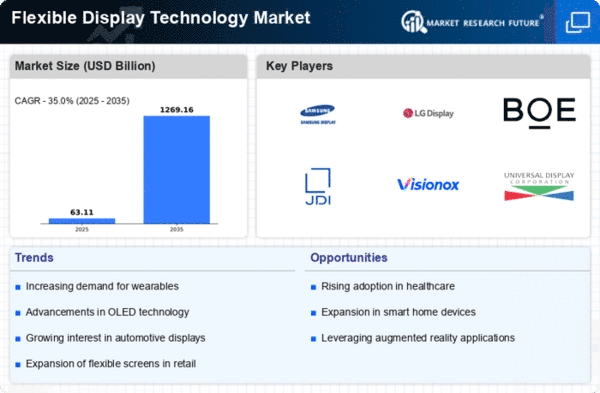
As per MRFR analysis, the Flexible Display Technology Market Size was estimated at 46.75 USD Billion in 2024. The Flexible Display Technology industry is projected to grow from 63.11 USD Billion in 2025 to 1269.16 USD Billion by 2035, exhibiting a compound annual growth rate (CAGR) of 35.0% during the forecast period 2025 - 2035.

Key Market Trends & Highlights

The Flexible Display Technology Market is poised for substantial growth driven by innovation and increasing applications across various sectors.

  • North America remains the largest market for flexible display technology, driven by high consumer electronics adoption. Asia-Pacific is recognized as the fastest-growing region, fueled by rapid advancements in material science and manufacturing capabilities. The consumer electronics segment dominates the market, while the automotive displays segment is experiencing the fastest growth due to rising demand for innovative vehicle interfaces. Key market drivers include the increasing adoption of consumer electronics and the growing interest in smart wearables, enhancing user experience through design flexibility.

Market Size & Forecast

2024 Market Size 46.75 (USD Billion)
2035 Market Size 1269.16 (USD Billion)
CAGR (2025 - 2035) 35.0%
Largest Regional Market Share in 2024 Asia-Pacific

Major Players

Samsung Display (KR), LG Display (KR), BOE Technology Group (CN), Japan Display Inc. (JP), Visionox Technology Inc. (CN), Universal Display Corporation (US), AU Optronics (TW), E Ink Holdings (TW), FlexEnable (GB)

Market Trends

The Flexible Display Technology Market is currently experiencing a transformative phase, characterized by rapid advancements in materials and manufacturing processes. This evolution is largely driven by the increasing demand for lightweight, portable devices that offer enhanced user experiences. As consumer preferences shift towards more versatile and adaptable display solutions, manufacturers are investing heavily in research and development to create innovative products that cater to these needs. The integration of flexible displays into various applications, including smartphones, wearables, and automotive displays, suggests a promising trajectory for the market. Furthermore, the growing emphasis on sustainability and eco-friendly materials is likely to influence future developments, as companies strive to reduce their environmental impact while maintaining high performance standards. In addition to technological advancements, the competitive landscape of the Flexible Display Technology Market is evolving. Key players are forming strategic partnerships and collaborations to leverage complementary strengths and expand their market reach. This collaborative approach appears to enhance innovation and accelerate the commercialization of flexible display solutions. Moreover, the increasing penetration of Internet of Things (IoT) devices is expected to further drive the adoption of flexible displays, as these technologies require adaptable and dynamic interfaces. Overall, the Flexible Display Technology Market is poised for substantial growth, with numerous opportunities emerging across various sectors as the demand for flexible and efficient display solutions continues to rise.

Rising Demand for Wearable Technology

The Flexible Display Technology Market is witnessing a notable increase in demand for wearable devices. As consumers seek more integrated and multifunctional gadgets, flexible displays are becoming essential components in smartwatches, fitness trackers, and augmented reality glasses. This trend indicates a shift towards more personalized and interactive user experiences, which could redefine how individuals engage with technology.

Advancements in Material Science

Innovations in material science are playing a crucial role in the evolution of the Flexible Display Technology Market. The development of new substrates and organic materials enhances the performance and durability of flexible displays. This trend suggests that manufacturers are increasingly focused on creating displays that not only meet aesthetic demands but also withstand the rigors of daily use.

Integration with IoT Devices

The integration of flexible displays with Internet of Things (IoT) devices is emerging as a significant trend within the Flexible Display Technology Market. As smart home and connected devices proliferate, the need for adaptable and responsive interfaces becomes paramount. This trend indicates a growing synergy between flexible display technology and IoT applications, potentially leading to innovative solutions that enhance user interaction.

Flexible Display Technology Market Market Drivers

Market Growth Projections

The Global Flexible Display Technology Market Industry is projected to experience substantial growth over the next decade. With an expected market value of 46.8 USD Billion in 2024, the industry is set to expand significantly, reaching an estimated 1269.1 USD Billion by 2035. This growth trajectory indicates a compound annual growth rate of 35.0% from 2025 to 2035, reflecting the increasing adoption of flexible displays across various sectors. The market's expansion is likely driven by advancements in technology, rising consumer demand, and the integration of flexible displays in diverse applications, suggesting a promising future for the industry.

Surge in Consumer Electronics

The surge in consumer electronics is a pivotal driver of the Global Flexible Display Technology Market Industry. With the proliferation of smart TVs, gaming consoles, and other electronic devices, the demand for high-quality displays is at an all-time high. Flexible displays provide manufacturers with the ability to create unique form factors and immersive experiences. As the market is expected to reach 1269.1 USD Billion by 2035, it suggests a robust appetite for innovative display solutions. This growth is likely to be fueled by consumer preferences for advanced technology that enhances visual experiences across various platforms.

Growing Focus on Sustainability

The increasing emphasis on sustainability and eco-friendly products is shaping the Global Flexible Display Technology Market Industry. Manufacturers are exploring ways to produce flexible displays using sustainable materials and processes, aligning with global environmental goals. This focus on sustainability not only meets consumer demand for greener products but also helps companies comply with regulatory standards. As the market evolves, the integration of sustainable practices may enhance brand reputation and attract environmentally conscious consumers. This trend is likely to drive innovation and growth within the flexible display sector, contributing to its long-term viability.

Advancements in Display Technology

Technological advancements play a crucial role in shaping the Global Flexible Display Technology Market Industry. Innovations in materials, such as organic light-emitting diodes and liquid crystal displays, enhance the performance and efficiency of flexible screens. These advancements lead to improved image quality, lower power consumption, and greater design flexibility. As manufacturers invest in research and development, the market is poised for significant growth. The anticipated compound annual growth rate of 35.0% from 2025 to 2035 indicates a robust trajectory, driven by the continuous evolution of display technologies that cater to diverse applications.

Rising Demand for Portable Devices

The increasing consumer preference for portable and lightweight devices drives the Global Flexible Display Technology Market Industry. As smartphones, tablets, and wearables become more prevalent, manufacturers seek flexible displays to enhance user experience. In 2024, the market is projected to reach 46.8 USD Billion, reflecting a growing inclination towards innovative display solutions. Flexible displays offer advantages such as reduced weight and improved durability, which appeal to tech-savvy consumers. This trend is likely to continue, as the demand for portable devices is expected to surge, further propelling the market's growth.

Increased Adoption in Automotive Sector

The automotive sector's growing adoption of flexible display technology significantly influences the Global Flexible Display Technology Market Industry. Flexible displays are increasingly integrated into vehicle dashboards and infotainment systems, providing enhanced aesthetics and functionality. This trend aligns with the automotive industry's shift towards smart and connected vehicles. As the market evolves, flexible displays offer opportunities for manufacturers to create innovative user interfaces that improve driver experience. The projected growth in this sector is indicative of the broader acceptance of flexible displays, which may contribute to the market's expansion in the coming years.

Market Segment Insights

By Application: Consumer Electronics (Largest) vs. Automotive Displays (Fastest-Growing)

The Flexible Display Technology Market is diverse, with Consumer Electronics occupying the largest share due to the widespread adoption of flexible screens in smartphones, tablets, and televisions. Automotive Displays, while currently smaller in comparison, are rapidly gaining traction as automotive manufacturers integrate cutting-edge technology for in-vehicle infotainment systems. Other noteworthy segments include Wearable Devices, Advertising Displays, and Medical Devices, each contributing significantly to the overall market dynamics.

Wearable Devices (Emerging) vs. Advertising Displays (Dominant)

In the Flexible Display Technology Market, Wearable Devices are emerging as a key segment, driven by innovation in smartwatches and fitness trackers that utilize flexible displays for better usability and comfort. Unlike Wearable Devices, Advertising Displays dominate the market, leveraging large, eye-catching flexible screens for impactful advertising across various platforms. Advertising Displays benefit from their ability to engage consumers more effectively than traditional static displays. As brands seek to enhance customer interaction, the demand for both segments continues to evolve, paving the way for new applications and technological advancements.

By Technology Type: Organic Light Emitting Diode (Largest) vs. MicroLED Display (Fastest-Growing)

<p>In the Flexible Display Technology Market, the Organic Light Emitting Diode (OLED) segment commands a significant market share due to its superior color reproduction and flexibility. OLED technology finds widespread applications in smartphones, televisions, and wearables, making it the largest segment. Meanwhile, Liquid Crystal Display (LCD) and Electroluminescent Display (ELD) segments follow closely, benefiting from established manufacturing processes and compatibility with existing electronics, yet they are gradually losing ground to more innovative technologies like Quantum Dot and MicroLED.</p>

<p>Technology: OLED (Dominant) vs. MicroLED (Emerging)</p>

<p>The OLED segment remains dominant in the Flexible Display Technology Market, praised for its high contrast ratio and wide viewing angles, making it ideal for various applications. Its lightweight and flexible characteristics allow for innovative product developments, such as bendable smartphones and large-screen televisions. On the other hand, Emerging MicroLED Display technology is gaining traction due to its outstanding energy efficiency and lifelike image quality. Positioned for rapid adoption in premium devices, MicroLED is anticipated to outpace traditional display technologies in growth, mainly driven by increasing demand for high-performance screens and advancements in display fabrication technologies.</p>

By End Use Industry: Telecommunications (Largest) vs. Healthcare (Fastest-Growing)

<p>In the Flexible Display Technology Market, telecommunications occupies the largest market share, driven by the increasing demand for advanced communication devices featuring flexible displays. This segment benefits from the rapid evolution of mobile technology, encouraging manufacturers to innovate and offer enhanced user experiences. Other notable segments include healthcare, entertainment, retail, and education, each contributing to the expanding portfolio of flexible display applications. As flexible displays enhance product differentiation, companies across these sectors increasingly integrate this technology into their offerings.</p>

<p>Telecommunications: Dominant vs. Healthcare: Emerging</p>

<p>Telecommunications remains the dominant end-use industry in the flexible display technology market, leveraging the need for lightweight and slim mobile devices. The integration of flexible displays into smartphones and portable gadgets is reshaping consumer expectations around functionality and design. On the other hand, healthcare is emerging as a fast-growing segment, driven by the increasing adoption of digital health solutions and wearable technologies. The ability of flexible displays to conform to various shapes makes them ideal for medical devices and diagnostics, fostering innovation in patient monitoring and telemedicine. As both sectors continue to evolve, the interplay between telecommunications' established presence and healthcare's rapid growth will shape the future landscape of flexible display technology.</p>

By Form Factor: Flexible Screens (Largest) vs. Rollable Displays (Fastest-Growing)

The Flexible Display Technology Market is currently dominated by Flexible Screens, which hold a significant market share due to their widespread applications in smartphones and tablets. This segment is followed by Foldable Displays and Curved Displays, both of which contribute substantially to the overall market, while Transparent Displays are gaining attention for niche applications in retail and advertising. The market dynamics indicate a healthy distribution among these segments, with growing consumer preferences driving demand for innovative display technologies. In recent years, the growth potential for Rollable Displays has rapidly increased as manufacturers focus on developing compact devices without sacrificing screen size. The integration of advanced technologies in Flexible Screens and Foldable Displays is further fuelling their market presence, yet Rollable Displays are positioned to become a key player as versatility and space-saving designs gain traction among consumers and enterprises alike.

Flexible Screens (Dominant) vs. Rollable Displays (Emerging)

Flexible Screens are currently the dominant form factor in the Flexible Display Technology Market, providing consumers with versatile display options that are utilized extensively in mobile devices, wearables, and automotive applications. Their ability to conform to various shapes and sizes has made them a preferred choice for manufacturers aiming to deliver enhanced user experiences. Conversely, Rollable Displays represent an emerging innovation catering to consumers looking for highly portable devices that can expand screen real estate while maintaining compactness when not in use. This segment is characterized by a unique technology that allows screens to unfurl from a compact form, making it particularly appealing for future devices that demand flexibility and adaptation to user needs. As the market evolves, both segment values reflect a shift towards personalized and adaptable display technologies.

By Material Type: Polymer (Largest) vs. Glass (Fastest-Growing)

In the Flexible Display Technology Market, the material type segment is primarily dominated by polymer, which has established itself as the largest contributor to market share. Its lightweight and flexible nature makes it ideal for various applications in consumer electronics, where durability and convenience are key. Following closely is glass, which, while traditionally offering robustness, is gaining a foothold due to advancements in technology that enhance its flexibility and lightweight characteristics, appealing to manufacturers seeking improved display options.

Polymer (Dominant) vs. Glass (Emerging)

Polymer stands out as the dominant material in the Flexible Display Technology sector due to its superior flexibility, lower weight, and cost-effectiveness. This material allows for innovations in design and functionality, making it the preferred choice for manufacturers of flexible displays. Conversely, glass is emerging with new manufacturing techniques that allow for thin, robust, and increasingly flexible options, appealing to premium product markets. Its reputation for high-quality imaging and durability positions it well against polymer, creating competitive dynamics as demand for more sophisticated displays grows.

Get more detailed insights about Flexible Display Technology Market Research Report - Global Forecast to 2035

Regional Insights

North America : Innovation and Growth Hub

The North American flexible display technology market is projected to reach $15.0 billion by December 2025, driven by increasing demand for innovative consumer electronics and automotive applications. Regulatory support for advanced manufacturing and sustainability initiatives further catalyzes growth. The region's focus on R&D and technological advancements positions it as a leader in the flexible display sector, with significant investments from both private and public sectors. Leading countries such as the United States and Canada are home to major players like Universal Display Corporation and Samsung Display. The competitive landscape is characterized by a mix of established firms and emerging startups, fostering innovation. The presence of key players enhances collaboration opportunities, driving advancements in flexible display technologies. The market is expected to continue evolving, with a strong emphasis on enhancing user experience and product functionality.

Europe : Emerging Market with Potential

Europe's flexible display technology market is anticipated to reach $10.0 billion by December 2025, fueled by rising consumer demand for portable devices and smart wearables. The region benefits from stringent regulations promoting energy efficiency and sustainability, which are pivotal in shaping market dynamics. European governments are increasingly investing in research initiatives to support innovation in flexible display technologies, enhancing the region's competitive edge. Countries like Germany, France, and the UK are at the forefront of this market, hosting key players such as LG Display and AU Optronics. The competitive landscape is marked by collaborations between tech firms and research institutions, fostering innovation. The presence of established companies alongside startups creates a vibrant ecosystem, driving advancements in flexible display applications across various sectors, including automotive and healthcare.

Asia-Pacific : Leading Global Market Leader

The Asia-Pacific region is the largest market for flexible display technology, projected to reach $20.0 billion by December 2025. This growth is driven by rapid technological advancements, increasing consumer electronics demand, and significant investments in R&D. Countries in this region are focusing on enhancing manufacturing capabilities and fostering innovation, supported by favorable government policies and regulations that encourage technological development. China, South Korea, and Japan are the leading countries in this market, with major players like BOE Technology Group and Japan Display Inc. dominating the landscape. The competitive environment is intense, with numerous companies vying for market share, leading to continuous innovation and product development. The presence of established firms and a robust supply chain further strengthens the region's position as a global leader in flexible display technology.

Middle East and Africa : Emerging Market with Challenges

The Middle East and Africa's flexible display technology market is expected to reach $1.75 billion by December 2025, driven by increasing interest in smart devices and digital signage. However, the market faces challenges such as limited infrastructure and lower consumer awareness. Governments in the region are beginning to recognize the potential of flexible displays, leading to initiatives aimed at promoting technology adoption and innovation. Countries like South Africa and the UAE are emerging as key players in this market, with a growing number of startups focusing on flexible display applications. The competitive landscape is still developing, with opportunities for international companies to enter the market. As awareness and infrastructure improve, the region is poised for growth, particularly in sectors like retail and advertising, where flexible displays can enhance consumer engagement.

Key Players and Competitive Insights

The Flexible Display Technology Market is currently characterized by a dynamic competitive landscape, driven by rapid technological advancements and increasing consumer demand for innovative display solutions. Key players such as Samsung Display (KR), LG Display (KR), and BOE Technology Group (CN) are at the forefront, each adopting distinct strategies to enhance their market positioning. Samsung Display (KR) focuses on innovation, particularly in OLED technology, while LG Display (KR) emphasizes partnerships with automotive manufacturers to integrate flexible displays into vehicles. BOE Technology Group (CN) is expanding its production capabilities, aiming to capture a larger share of the market through aggressive pricing strategies and local manufacturing initiatives. Collectively, these strategies contribute to a moderately fragmented market structure, where competition is intensifying as companies seek to differentiate themselves through technological advancements and strategic collaborations.
In terms of business tactics, companies are increasingly localizing manufacturing to mitigate supply chain disruptions and optimize operational efficiency. This trend is particularly evident in the Flexible Display Technology Market, where firms are establishing production facilities closer to key markets. The competitive structure remains moderately fragmented, with several players vying for market share. The collective influence of these key players shapes the market dynamics, as they engage in strategic partnerships and collaborations to enhance their technological capabilities and expand their product offerings.
In November 2025, Samsung Display (KR) announced a groundbreaking partnership with a leading automotive manufacturer to develop next-generation flexible displays for electric vehicles. This collaboration is poised to revolutionize the in-car experience, integrating advanced display technologies that enhance user interaction and vehicle aesthetics. The strategic importance of this partnership lies in its potential to position Samsung Display (KR) as a leader in the automotive display segment, tapping into the growing demand for innovative solutions in the automotive industry.
In October 2025, LG Display (KR) unveiled its latest flexible OLED technology at a major electronics trade show, showcasing its commitment to innovation and product development. This new technology is designed to be ultra-thin and lightweight, catering to the increasing demand for portable devices. The introduction of this technology underscores LG Display's (KR) focus on maintaining a competitive edge through continuous innovation, which is essential in a rapidly evolving market.
In September 2025, BOE Technology Group (CN) expanded its production capacity by launching a new manufacturing facility dedicated to flexible displays. This strategic move is expected to enhance BOE's (CN) ability to meet the rising global demand for flexible display solutions, particularly in consumer electronics. The expansion reflects BOE's commitment to scaling operations and improving supply chain reliability, which are critical factors in maintaining competitiveness in the market.
As of December 2025, current trends in the Flexible Display Technology Market are increasingly defined by digitalization, sustainability, and the integration of artificial intelligence (AI) into display technologies. Strategic alliances are becoming more prevalent, as companies recognize the need to collaborate to drive innovation and enhance product offerings. Looking ahead, competitive differentiation is likely to evolve, shifting from price-based competition to a focus on technological innovation and supply chain reliability. This transition suggests that companies that prioritize R&D and strategic partnerships will be better positioned to thrive in the future.

Key Companies in the Flexible Display Technology Market include

Industry Developments

At the International Consumer Electronics Show 2024 (CES 2024) in Las Vegas, USA, in January 2024, BOE presented its advanced display technology and smart cockpit solutions, which received significant attention.

In October 2023, TRG Screen, a major provider of corporate subscription spend management software and usage tracking tools announced that it has received strategic growth investment from Vista Equity Partners as a leading enterprise software investor worldwide specializing in enterprise software businesses operating on data and technology platforms.

Samsung Electronics Co., South Korea’s Samsung Electronics Co., is set to launch its 83-inch 4K OLED TV model into the European market during September 2023 including panels coming from its domestic rival LG Display Co.

October 2023- On October 19, OnePlus introduced its first foldable smartphone, the OnePlus Open. The Chinese electronics company describes the OnePlus Open as a contemporary flagship smartphone, with flagship-grade features, a slim design, and a lightweight form factor. The smartphone, priced at Rs 139,999, will be available for pre-order in India on October 19, with open sales beginning October 27.

The folding gadget measures 5.9mm at its narrowest point and weighs 239g. It's a book-shaped foldable, similar to the Samsung Galaxy Z Fold 5, with a flexible primary display and a secondary display on the cover. The primary foldable display is a 7.82-inch 2K AMOLED device with a variable refresh rate of 1 to 120Hz (LTPO 3.0). The display on the cover measures 6.31 inches. It also has a 2K AMOLED display with a customizable refresh rate of 10Hz to 120Hz. Both displays offer 10-bit colour depth and support the full DCI-P3 color gamut.

The OnePlus Open is powered by Qualcomm's Snapdragon 8 Gen 2 system-on-chip and comes with 16GB RAM and 512GB of on-board storage. It boots the Android 13 operating system-based OxygenOS 13.2 interface, which is filled with tools and features designed exclusively for the foldable form factor. These features include a desktop-style taskbar on the main display, as well as a recent folder for easy access to pictures, stored images, and other files. In addition, the Open Canvas functionality allows for multi-window splitting on the primary display.

The OnePlus Open is powered by a 4,805 mAh battery with a 67W rapid wired charger.

The OnePlus Open boasts five cameras: three on the back, one on the main display, and one on the cover display. The rear camera system consists of a 48-megapixel primary sensor (Sony Lytia-808) with optical image stabilisation, a 64MP 3x telephoto with autofocus and OIS, and a 48MP ultra-wide-angle sensor with autofocus.

April 2023- Researchers at the University of Chicago's Pritzker School of Molecular Engineering created a material that can be bent in half or stretched to more than twice its original length while generating a fluorescent pattern. Wearable electronics and health sensors, as well as foldable computer screens, can all benefit from the material. The researchers created numerous prototypes using computational predictions for novel flexible electroluminescent polymers. The materials were flexible, stretchy, brilliant, resilient, and energy efficient, just as the model anticipated.

The utilization of "thermally activated delayed fluorescence," which allowed the materials to transform electrical energy into light in a very efficient manner, was a significant aspect in their design. This third-generation organic emitter mechanism can deliver materials with performance comparable to commercial OLED technology.

November 2022- LG Display has developed a new prototype display that can fold, twist, and expand from 12 to 14 inches. The stretchy display has a resolution of 100ppi and can display full-color RGB images. The prototype was constructed by embedding tiny LEDs with pixel pitches of less than 40m into a silicon substrate often used in contact lenses. This, according to LG Display, gives it a consistency "similar to that of a rubber band" and allows it to be stretched by up to 20% in any direction.

Future Outlook

Flexible Display Technology Market Future Outlook

The Flexible Display Technology Market is projected to grow at a 35.0% CAGR from 2025 to 2035, driven by advancements in consumer electronics, automotive applications, and wearable devices.

New opportunities lie in:

  • Development of flexible OLED displays for automotive dashboards.
  • Integration of flexible displays in smart home devices.
  • Expansion of flexible display applications in healthcare monitoring systems.

By 2035, the market is expected to be a leader in innovative display solutions.

Market Segmentation

Flexible Display Technology Market End Use Outlook

  • Retail
  • Healthcare
  • Transportation
  • Entertainment
  • Education

Flexible Display Technology Market Application Outlook

  • Consumer Electronics
  • Automotive Displays
  • Wearable Devices
  • Advertising Displays
  • Medical Devices

Flexible Display Technology Market Form Factor Outlook

  • Flexible Screens
  • Foldable Displays
  • Rollable Displays
  • Curved Displays
  • Transparent Displays

Flexible Display Technology Market Material Type Outlook

  • Polymer
  • Glass
  • Metal
  • Ceramic
  • Composite

Flexible Display Technology Market Technology Type Outlook

  • Organic Light Emitting Diode
  • Liquid Crystal Display
  • Electroluminescent Display
  • Quantum Dot Display
  • MicroLED

Report Scope

MARKET SIZE 2024 46.75(USD Billion)
MARKET SIZE 2025 63.11(USD Billion)
MARKET SIZE 2035 1269.16(USD Billion)
COMPOUND ANNUAL GROWTH RATE (CAGR) 35.0% (2025 - 2035)
REPORT COVERAGE Revenue Forecast, Competitive Landscape, Growth Factors, and Trends
BASE YEAR 2024
Market Forecast Period 2025 - 2035
Historical Data 2019 - 2024
Market Forecast Units USD Billion
Key Companies Profiled Samsung Display (KR), LG Display (KR), BOE Technology Group (CN), Japan Display Inc. (JP), Visionox Technology Inc. (CN), Universal Display Corporation (US), AU Optronics (TW), E Ink Holdings (TW), FlexEnable (GB)
Segments Covered Application, End Use, Technology Type, Form Factor, Material Type
Key Market Opportunities Integration of flexible displays in wearable technology enhances user experience and drives market growth.
Key Market Dynamics Rising demand for lightweight, flexible displays drives innovation and competition among technology manufacturers.
Countries Covered North America, Europe, APAC, South America, MEA

FAQs

What is the current valuation of the Flexible Display Technology Market as of 2024?

<p>The market valuation was 46.75 USD Billion in 2024.</p>

What is the projected market size for the Flexible Display Technology Market by 2035?

<p>The market is projected to reach 1269.16 USD Billion by 2035.</p>

What is the expected CAGR for the Flexible Display Technology Market during the forecast period 2025 - 2035?

<p>The expected CAGR for the market is 35.0% during the forecast period 2025 - 2035.</p>

Which application segment holds the largest market share in 2024?

<p>The Consumer Electronics segment held the largest market share at 18.0 USD Billion in 2024.</p>

How does the Automotive Displays segment perform in terms of market valuation?

<p>The Automotive Displays segment was valued at 10.0 USD Billion in 2024.</p>

What technology type is leading the Flexible Display Technology Market?

<p>The Organic Light Emitting Diode technology type led the market with a valuation of 18.0 USD Billion in 2024.</p>

Which end-use industry is projected to have the highest market valuation by 2035?

The Entertainment industry is projected to have the highest market valuation at 336.0 USD Billion by 2035.

What role do key players like Samsung Electronics and LG Display play in the market?

Key players such as Samsung Electronics and LG Display are instrumental in driving innovation and market growth.

What is the market valuation for Wearable Devices in 2024?

The Wearable Devices segment was valued at 8.0 USD Billion in 2024.

How does the Digital Signage segment compare to other segments in terms of market size?

The Digital Signage segment was valued at 6.0 USD Billion in 2024, indicating a smaller market size compared to others.

  1. SECTION I: EXECUTIVE SUMMARY AND KEY HIGHLIGHTS
    1. | 1.1 EXECUTIVE SUMMARY
    2. | | 1.1.1 Market Overview
    3. | | 1.1.2 Key Findings
    4. | | 1.1.3 Market Segmentation
    5. | | 1.1.4 Competitive Landscape
    6. | | 1.1.5 Challenges and Opportunities
    7. | | 1.1.6 Future Outlook
  2. SECTION II: SCOPING, METHODOLOGY AND MARKET STRUCTURE
    1. | 2.1 MARKET INTRODUCTION
    2. | | 2.1.1 Definition
    3. | | 2.1.2 Scope of the study
    4. | | | 2.1.2.1 Research Objective
    5. | | | 2.1.2.2 Assumption
    6. | | | 2.1.2.3 Limitations
    7. | 2.2 RESEARCH METHODOLOGY
    8. | | 2.2.1 Overview
    9. | | 2.2.2 Data Mining
    10. | | 2.2.3 Secondary Research
    11. | | 2.2.4 Primary Research
    12. | | | 2.2.4.1 Primary Interviews and Information Gathering Process
    13. | | | 2.2.4.2 Breakdown of Primary Respondents
    14. | | 2.2.5 Forecasting Model
    15. | | 2.2.6 Market Size Estimation
    16. | | | 2.2.6.1 Bottom-Up Approach
    17. | | | 2.2.6.2 Top-Down Approach
    18. | | 2.2.7 Data Triangulation
    19. | | 2.2.8 Validation
  3. SECTION III: QUALITATIVE ANALYSIS
    1. | 3.1 MARKET DYNAMICS
    2. | | 3.1.1 Overview
    3. | | 3.1.2 Drivers
    4. | | 3.1.3 Restraints
    5. | | 3.1.4 Opportunities
    6. | 3.2 MARKET FACTOR ANALYSIS
    7. | | 3.2.1 Value chain Analysis
    8. | | 3.2.2 Porter's Five Forces Analysis
    9. | | | 3.2.2.1 Bargaining Power of Suppliers
    10. | | | 3.2.2.2 Bargaining Power of Buyers
    11. | | | 3.2.2.3 Threat of New Entrants
    12. | | | 3.2.2.4 Threat of Substitutes
    13. | | | 3.2.2.5 Intensity of Rivalry
    14. | | 3.2.3 COVID-19 Impact Analysis
    15. | | | 3.2.3.1 Market Impact Analysis
    16. | | | 3.2.3.2 Regional Impact
    17. | | | 3.2.3.3 Opportunity and Threat Analysis
  4. SECTION IV: QUANTITATIVE ANALYSIS
    1. | 4.1 Semiconductor & Electronics, BY Application (USD Billion)
    2. | | 4.1.1 Consumer Electronics
    3. | | 4.1.2 Automotive Displays
    4. | | 4.1.3 Wearable Devices
    5. | | 4.1.4 Digital Signage
    6. | | 4.1.5 Smart Home Devices
    7. | 4.2 Semiconductor & Electronics, BY Technology Type (USD Billion)
    8. | | 4.2.1 Organic Light Emitting Diode
    9. | | 4.2.2 Liquid Crystal Display
    10. | | 4.2.3 Electroluminescent Display
    11. | | 4.2.4 Quantum Dot Display
    12. | | 4.2.5 MicroLED Display
    13. | 4.3 Semiconductor & Electronics, BY End Use Industry (USD Billion)
    14. | | 4.3.1 Telecommunications
    15. | | 4.3.2 Healthcare
    16. | | 4.3.3 Entertainment
    17. | | 4.3.4 Retail
    18. | | 4.3.5 Education
    19. | 4.4 Semiconductor & Electronics, BY Region (USD Billion)
    20. | | 4.4.1 North America
    21. | | | 4.4.1.1 US
    22. | | | 4.4.1.2 Canada
    23. | | 4.4.2 Europe
    24. | | | 4.4.2.1 Germany
    25. | | | 4.4.2.2 UK
    26. | | | 4.4.2.3 France
    27. | | | 4.4.2.4 Russia
    28. | | | 4.4.2.5 Italy
    29. | | | 4.4.2.6 Spain
    30. | | | 4.4.2.7 Rest of Europe
    31. | | 4.4.3 APAC
    32. | | | 4.4.3.1 China
    33. | | | 4.4.3.2 India
    34. | | | 4.4.3.3 Japan
    35. | | | 4.4.3.4 South Korea
    36. | | | 4.4.3.5 Malaysia
    37. | | | 4.4.3.6 Thailand
    38. | | | 4.4.3.7 Indonesia
    39. | | | 4.4.3.8 Rest of APAC
    40. | | 4.4.4 South America
    41. | | | 4.4.4.1 Brazil
    42. | | | 4.4.4.2 Mexico
    43. | | | 4.4.4.3 Argentina
    44. | | | 4.4.4.4 Rest of South America
    45. | | 4.4.5 MEA
    46. | | | 4.4.5.1 GCC Countries
    47. | | | 4.4.5.2 South Africa
    48. | | | 4.4.5.3 Rest of MEA
  5. SECTION V: COMPETITIVE ANALYSIS
    1. | 5.1 Competitive Landscape
    2. | | 5.1.1 Overview
    3. | | 5.1.2 Competitive Analysis
    4. | | 5.1.3 Market share Analysis
    5. | | 5.1.4 Major Growth Strategy in the Semiconductor & Electronics
    6. | | 5.1.5 Competitive Benchmarking
    7. | | 5.1.6 Leading Players in Terms of Number of Developments in the Semiconductor & Electronics
    8. | | 5.1.7 Key developments and growth strategies
    9. | | | 5.1.7.1 New Product Launch/Service Deployment
    10. | | | 5.1.7.2 Merger & Acquisitions
    11. | | | 5.1.7.3 Joint Ventures
    12. | | 5.1.8 Major Players Financial Matrix
    13. | | | 5.1.8.1 Sales and Operating Income
    14. | | | 5.1.8.2 Major Players R&D Expenditure. 2023
    15. | 5.2 Company Profiles
    16. | | 5.2.1 Samsung Electronics (KR)
    17. | | | 5.2.1.1 Financial Overview
    18. | | | 5.2.1.2 Products Offered
    19. | | | 5.2.1.3 Key Developments
    20. | | | 5.2.1.4 SWOT Analysis
    21. | | | 5.2.1.5 Key Strategies
    22. | | 5.2.2 LG Display (KR)
    23. | | | 5.2.2.1 Financial Overview
    24. | | | 5.2.2.2 Products Offered
    25. | | | 5.2.2.3 Key Developments
    26. | | | 5.2.2.4 SWOT Analysis
    27. | | | 5.2.2.5 Key Strategies
    28. | | 5.2.3 BOE Technology Group (CN)
    29. | | | 5.2.3.1 Financial Overview
    30. | | | 5.2.3.2 Products Offered
    31. | | | 5.2.3.3 Key Developments
    32. | | | 5.2.3.4 SWOT Analysis
    33. | | | 5.2.3.5 Key Strategies
    34. | | 5.2.4 Apple Inc. (US)
    35. | | | 5.2.4.1 Financial Overview
    36. | | | 5.2.4.2 Products Offered
    37. | | | 5.2.4.3 Key Developments
    38. | | | 5.2.4.4 SWOT Analysis
    39. | | | 5.2.4.5 Key Strategies
    40. | | 5.2.5 Sony Corporation (JP)
    41. | | | 5.2.5.1 Financial Overview
    42. | | | 5.2.5.2 Products Offered
    43. | | | 5.2.5.3 Key Developments
    44. | | | 5.2.5.4 SWOT Analysis
    45. | | | 5.2.5.5 Key Strategies
    46. | | 5.2.6 Huawei Technologies (CN)
    47. | | | 5.2.6.1 Financial Overview
    48. | | | 5.2.6.2 Products Offered
    49. | | | 5.2.6.3 Key Developments
    50. | | | 5.2.6.4 SWOT Analysis
    51. | | | 5.2.6.5 Key Strategies
    52. | | 5.2.7 Sharp Corporation (JP)
    53. | | | 5.2.7.1 Financial Overview
    54. | | | 5.2.7.2 Products Offered
    55. | | | 5.2.7.3 Key Developments
    56. | | | 5.2.7.4 SWOT Analysis
    57. | | | 5.2.7.5 Key Strategies
    58. | | 5.2.8 Visionox Technology (CN)
    59. | | | 5.2.8.1 Financial Overview
    60. | | | 5.2.8.2 Products Offered
    61. | | | 5.2.8.3 Key Developments
    62. | | | 5.2.8.4 SWOT Analysis
    63. | | | 5.2.8.5 Key Strategies
    64. | | 5.2.9 E Ink Holdings (TW)
    65. | | | 5.2.9.1 Financial Overview
    66. | | | 5.2.9.2 Products Offered
    67. | | | 5.2.9.3 Key Developments
    68. | | | 5.2.9.4 SWOT Analysis
    69. | | | 5.2.9.5 Key Strategies
    70. | 5.3 Appendix
    71. | | 5.3.1 References
    72. | | 5.3.2 Related Reports
  6. LIST OF FIGURES
    1. | 6.1 MARKET SYNOPSIS
    2. | 6.2 NORTH AMERICA MARKET ANALYSIS
    3. | 6.3 US MARKET ANALYSIS BY APPLICATION
    4. | 6.4 US MARKET ANALYSIS BY TECHNOLOGY TYPE
    5. | 6.5 US MARKET ANALYSIS BY END USE INDUSTRY
    6. | 6.6 CANADA MARKET ANALYSIS BY APPLICATION
    7. | 6.7 CANADA MARKET ANALYSIS BY TECHNOLOGY TYPE
    8. | 6.8 CANADA MARKET ANALYSIS BY END USE INDUSTRY
    9. | 6.9 EUROPE MARKET ANALYSIS
    10. | 6.10 GERMANY MARKET ANALYSIS BY APPLICATION
    11. | 6.11 GERMANY MARKET ANALYSIS BY TECHNOLOGY TYPE
    12. | 6.12 GERMANY MARKET ANALYSIS BY END USE INDUSTRY
    13. | 6.13 UK MARKET ANALYSIS BY APPLICATION
    14. | 6.14 UK MARKET ANALYSIS BY TECHNOLOGY TYPE
    15. | 6.15 UK MARKET ANALYSIS BY END USE INDUSTRY
    16. | 6.16 FRANCE MARKET ANALYSIS BY APPLICATION
    17. | 6.17 FRANCE MARKET ANALYSIS BY TECHNOLOGY TYPE
    18. | 6.18 FRANCE MARKET ANALYSIS BY END USE INDUSTRY
    19. | 6.19 RUSSIA MARKET ANALYSIS BY APPLICATION
    20. | 6.20 RUSSIA MARKET ANALYSIS BY TECHNOLOGY TYPE
    21. | 6.21 RUSSIA MARKET ANALYSIS BY END USE INDUSTRY
    22. | 6.22 ITALY MARKET ANALYSIS BY APPLICATION
    23. | 6.23 ITALY MARKET ANALYSIS BY TECHNOLOGY TYPE
    24. | 6.24 ITALY MARKET ANALYSIS BY END USE INDUSTRY
    25. | 6.25 SPAIN MARKET ANALYSIS BY APPLICATION
    26. | 6.26 SPAIN MARKET ANALYSIS BY TECHNOLOGY TYPE
    27. | 6.27 SPAIN MARKET ANALYSIS BY END USE INDUSTRY
    28. | 6.28 REST OF EUROPE MARKET ANALYSIS BY APPLICATION
    29. | 6.29 REST OF EUROPE MARKET ANALYSIS BY TECHNOLOGY TYPE
    30. | 6.30 REST OF EUROPE MARKET ANALYSIS BY END USE INDUSTRY
    31. | 6.31 APAC MARKET ANALYSIS
    32. | 6.32 CHINA MARKET ANALYSIS BY APPLICATION
    33. | 6.33 CHINA MARKET ANALYSIS BY TECHNOLOGY TYPE
    34. | 6.34 CHINA MARKET ANALYSIS BY END USE INDUSTRY
    35. | 6.35 INDIA MARKET ANALYSIS BY APPLICATION
    36. | 6.36 INDIA MARKET ANALYSIS BY TECHNOLOGY TYPE
    37. | 6.37 INDIA MARKET ANALYSIS BY END USE INDUSTRY
    38. | 6.38 JAPAN MARKET ANALYSIS BY APPLICATION
    39. | 6.39 JAPAN MARKET ANALYSIS BY TECHNOLOGY TYPE
    40. | 6.40 JAPAN MARKET ANALYSIS BY END USE INDUSTRY
    41. | 6.41 SOUTH KOREA MARKET ANALYSIS BY APPLICATION
    42. | 6.42 SOUTH KOREA MARKET ANALYSIS BY TECHNOLOGY TYPE
    43. | 6.43 SOUTH KOREA MARKET ANALYSIS BY END USE INDUSTRY
    44. | 6.44 MALAYSIA MARKET ANALYSIS BY APPLICATION
    45. | 6.45 MALAYSIA MARKET ANALYSIS BY TECHNOLOGY TYPE
    46. | 6.46 MALAYSIA MARKET ANALYSIS BY END USE INDUSTRY
    47. | 6.47 THAILAND MARKET ANALYSIS BY APPLICATION
    48. | 6.48 THAILAND MARKET ANALYSIS BY TECHNOLOGY TYPE
    49. | 6.49 THAILAND MARKET ANALYSIS BY END USE INDUSTRY
    50. | 6.50 INDONESIA MARKET ANALYSIS BY APPLICATION
    51. | 6.51 INDONESIA MARKET ANALYSIS BY TECHNOLOGY TYPE
    52. | 6.52 INDONESIA MARKET ANALYSIS BY END USE INDUSTRY
    53. | 6.53 REST OF APAC MARKET ANALYSIS BY APPLICATION
    54. | 6.54 REST OF APAC MARKET ANALYSIS BY TECHNOLOGY TYPE
    55. | 6.55 REST OF APAC MARKET ANALYSIS BY END USE INDUSTRY
    56. | 6.56 SOUTH AMERICA MARKET ANALYSIS
    57. | 6.57 BRAZIL MARKET ANALYSIS BY APPLICATION
    58. | 6.58 BRAZIL MARKET ANALYSIS BY TECHNOLOGY TYPE
    59. | 6.59 BRAZIL MARKET ANALYSIS BY END USE INDUSTRY
    60. | 6.60 MEXICO MARKET ANALYSIS BY APPLICATION
    61. | 6.61 MEXICO MARKET ANALYSIS BY TECHNOLOGY TYPE
    62. | 6.62 MEXICO MARKET ANALYSIS BY END USE INDUSTRY
    63. | 6.63 ARGENTINA MARKET ANALYSIS BY APPLICATION
    64. | 6.64 ARGENTINA MARKET ANALYSIS BY TECHNOLOGY TYPE
    65. | 6.65 ARGENTINA MARKET ANALYSIS BY END USE INDUSTRY
    66. | 6.66 REST OF SOUTH AMERICA MARKET ANALYSIS BY APPLICATION
    67. | 6.67 REST OF SOUTH AMERICA MARKET ANALYSIS BY TECHNOLOGY TYPE
    68. | 6.68 REST OF SOUTH AMERICA MARKET ANALYSIS BY END USE INDUSTRY
    69. | 6.69 MEA MARKET ANALYSIS
    70. | 6.70 GCC COUNTRIES MARKET ANALYSIS BY APPLICATION
    71. | 6.71 GCC COUNTRIES MARKET ANALYSIS BY TECHNOLOGY TYPE
    72. | 6.72 GCC COUNTRIES MARKET ANALYSIS BY END USE INDUSTRY
    73. | 6.73 SOUTH AFRICA MARKET ANALYSIS BY APPLICATION
    74. | 6.74 SOUTH AFRICA MARKET ANALYSIS BY TECHNOLOGY TYPE
    75. | 6.75 SOUTH AFRICA MARKET ANALYSIS BY END USE INDUSTRY
    76. | 6.76 REST OF MEA MARKET ANALYSIS BY APPLICATION
    77. | 6.77 REST OF MEA MARKET ANALYSIS BY TECHNOLOGY TYPE
    78. | 6.78 REST OF MEA MARKET ANALYSIS BY END USE INDUSTRY
    79. | 6.79 KEY BUYING CRITERIA OF SEMICONDUCTOR & ELECTRONICS
    80. | 6.80 RESEARCH PROCESS OF MRFR
    81. | 6.81 DRO ANALYSIS OF SEMICONDUCTOR & ELECTRONICS
    82. | 6.82 DRIVERS IMPACT ANALYSIS: SEMICONDUCTOR & ELECTRONICS
    83. | 6.83 RESTRAINTS IMPACT ANALYSIS: SEMICONDUCTOR & ELECTRONICS
    84. | 6.84 SUPPLY / VALUE CHAIN: SEMICONDUCTOR & ELECTRONICS
    85. | 6.85 SEMICONDUCTOR & ELECTRONICS, BY APPLICATION, 2024 (% SHARE)
    86. | 6.86 SEMICONDUCTOR & ELECTRONICS, BY APPLICATION, 2024 TO 2035 (USD Billion)
    87. | 6.87 SEMICONDUCTOR & ELECTRONICS, BY TECHNOLOGY TYPE, 2024 (% SHARE)
    88. | 6.88 SEMICONDUCTOR & ELECTRONICS, BY TECHNOLOGY TYPE, 2024 TO 2035 (USD Billion)
    89. | 6.89 SEMICONDUCTOR & ELECTRONICS, BY END USE INDUSTRY, 2024 (% SHARE)
    90. | 6.90 SEMICONDUCTOR & ELECTRONICS, BY END USE INDUSTRY, 2024 TO 2035 (USD Billion)
    91. | 6.91 BENCHMARKING OF MAJOR COMPETITORS
  7. LIST OF TABLES
    1. | 7.1 LIST OF ASSUMPTIONS
    2. | | 7.1.1
    3. | 7.2 North America MARKET SIZE ESTIMATES; FORECAST
    4. | | 7.2.1 BY APPLICATION, 2025-2035 (USD Billion)
    5. | | 7.2.2 BY TECHNOLOGY TYPE, 2025-2035 (USD Billion)
    6. | | 7.2.3 BY END USE INDUSTRY, 2025-2035 (USD Billion)
    7. | 7.3 US MARKET SIZE ESTIMATES; FORECAST
    8. | | 7.3.1 BY APPLICATION, 2025-2035 (USD Billion)
    9. | | 7.3.2 BY TECHNOLOGY TYPE, 2025-2035 (USD Billion)
    10. | | 7.3.3 BY END USE INDUSTRY, 2025-2035 (USD Billion)
    11. | 7.4 Canada MARKET SIZE ESTIMATES; FORECAST
    12. | | 7.4.1 BY APPLICATION, 2025-2035 (USD Billion)
    13. | | 7.4.2 BY TECHNOLOGY TYPE, 2025-2035 (USD Billion)
    14. | | 7.4.3 BY END USE INDUSTRY, 2025-2035 (USD Billion)
    15. | 7.5 Europe MARKET SIZE ESTIMATES; FORECAST
    16. | | 7.5.1 BY APPLICATION, 2025-2035 (USD Billion)
    17. | | 7.5.2 BY TECHNOLOGY TYPE, 2025-2035 (USD Billion)
    18. | | 7.5.3 BY END USE INDUSTRY, 2025-2035 (USD Billion)
    19. | 7.6 Germany MARKET SIZE ESTIMATES; FORECAST
    20. | | 7.6.1 BY APPLICATION, 2025-2035 (USD Billion)
    21. | | 7.6.2 BY TECHNOLOGY TYPE, 2025-2035 (USD Billion)
    22. | | 7.6.3 BY END USE INDUSTRY, 2025-2035 (USD Billion)
    23. | 7.7 UK MARKET SIZE ESTIMATES; FORECAST
    24. | | 7.7.1 BY APPLICATION, 2025-2035 (USD Billion)
    25. | | 7.7.2 BY TECHNOLOGY TYPE, 2025-2035 (USD Billion)
    26. | | 7.7.3 BY END USE INDUSTRY, 2025-2035 (USD Billion)
    27. | 7.8 France MARKET SIZE ESTIMATES; FORECAST
    28. | | 7.8.1 BY APPLICATION, 2025-2035 (USD Billion)
    29. | | 7.8.2 BY TECHNOLOGY TYPE, 2025-2035 (USD Billion)
    30. | | 7.8.3 BY END USE INDUSTRY, 2025-2035 (USD Billion)
    31. | 7.9 Russia MARKET SIZE ESTIMATES; FORECAST
    32. | | 7.9.1 BY APPLICATION, 2025-2035 (USD Billion)
    33. | | 7.9.2 BY TECHNOLOGY TYPE, 2025-2035 (USD Billion)
    34. | | 7.9.3 BY END USE INDUSTRY, 2025-2035 (USD Billion)
    35. | 7.10 Italy MARKET SIZE ESTIMATES; FORECAST
    36. | | 7.10.1 BY APPLICATION, 2025-2035 (USD Billion)
    37. | | 7.10.2 BY TECHNOLOGY TYPE, 2025-2035 (USD Billion)
    38. | | 7.10.3 BY END USE INDUSTRY, 2025-2035 (USD Billion)
    39. | 7.11 Spain MARKET SIZE ESTIMATES; FORECAST
    40. | | 7.11.1 BY APPLICATION, 2025-2035 (USD Billion)
    41. | | 7.11.2 BY TECHNOLOGY TYPE, 2025-2035 (USD Billion)
    42. | | 7.11.3 BY END USE INDUSTRY, 2025-2035 (USD Billion)
    43. | 7.12 Rest of Europe MARKET SIZE ESTIMATES; FORECAST
    44. | | 7.12.1 BY APPLICATION, 2025-2035 (USD Billion)
    45. | | 7.12.2 BY TECHNOLOGY TYPE, 2025-2035 (USD Billion)
    46. | | 7.12.3 BY END USE INDUSTRY, 2025-2035 (USD Billion)
    47. | 7.13 APAC MARKET SIZE ESTIMATES; FORECAST
    48. | | 7.13.1 BY APPLICATION, 2025-2035 (USD Billion)
    49. | | 7.13.2 BY TECHNOLOGY TYPE, 2025-2035 (USD Billion)
    50. | | 7.13.3 BY END USE INDUSTRY, 2025-2035 (USD Billion)
    51. | 7.14 China MARKET SIZE ESTIMATES; FORECAST
    52. | | 7.14.1 BY APPLICATION, 2025-2035 (USD Billion)
    53. | | 7.14.2 BY TECHNOLOGY TYPE, 2025-2035 (USD Billion)
    54. | | 7.14.3 BY END USE INDUSTRY, 2025-2035 (USD Billion)
    55. | 7.15 India MARKET SIZE ESTIMATES; FORECAST
    56. | | 7.15.1 BY APPLICATION, 2025-2035 (USD Billion)
    57. | | 7.15.2 BY TECHNOLOGY TYPE, 2025-2035 (USD Billion)
    58. | | 7.15.3 BY END USE INDUSTRY, 2025-2035 (USD Billion)
    59. | 7.16 Japan MARKET SIZE ESTIMATES; FORECAST
    60. | | 7.16.1 BY APPLICATION, 2025-2035 (USD Billion)
    61. | | 7.16.2 BY TECHNOLOGY TYPE, 2025-2035 (USD Billion)
    62. | | 7.16.3 BY END USE INDUSTRY, 2025-2035 (USD Billion)
    63. | 7.17 South Korea MARKET SIZE ESTIMATES; FORECAST
    64. | | 7.17.1 BY APPLICATION, 2025-2035 (USD Billion)
    65. | | 7.17.2 BY TECHNOLOGY TYPE, 2025-2035 (USD Billion)
    66. | | 7.17.3 BY END USE INDUSTRY, 2025-2035 (USD Billion)
    67. | 7.18 Malaysia MARKET SIZE ESTIMATES; FORECAST
    68. | | 7.18.1 BY APPLICATION, 2025-2035 (USD Billion)
    69. | | 7.18.2 BY TECHNOLOGY TYPE, 2025-2035 (USD Billion)
    70. | | 7.18.3 BY END USE INDUSTRY, 2025-2035 (USD Billion)
    71. | 7.19 Thailand MARKET SIZE ESTIMATES; FORECAST
    72. | | 7.19.1 BY APPLICATION, 2025-2035 (USD Billion)
    73. | | 7.19.2 BY TECHNOLOGY TYPE, 2025-2035 (USD Billion)
    74. | | 7.19.3 BY END USE INDUSTRY, 2025-2035 (USD Billion)
    75. | 7.20 Indonesia MARKET SIZE ESTIMATES; FORECAST
    76. | | 7.20.1 BY APPLICATION, 2025-2035 (USD Billion)
    77. | | 7.20.2 BY TECHNOLOGY TYPE, 2025-2035 (USD Billion)
    78. | | 7.20.3 BY END USE INDUSTRY, 2025-2035 (USD Billion)
    79. | 7.21 Rest of APAC MARKET SIZE ESTIMATES; FORECAST
    80. | | 7.21.1 BY APPLICATION, 2025-2035 (USD Billion)
    81. | | 7.21.2 BY TECHNOLOGY TYPE, 2025-2035 (USD Billion)
    82. | | 7.21.3 BY END USE INDUSTRY, 2025-2035 (USD Billion)
    83. | 7.22 South America MARKET SIZE ESTIMATES; FORECAST
    84. | | 7.22.1 BY APPLICATION, 2025-2035 (USD Billion)
    85. | | 7.22.2 BY TECHNOLOGY TYPE, 2025-2035 (USD Billion)
    86. | | 7.22.3 BY END USE INDUSTRY, 2025-2035 (USD Billion)
    87. | 7.23 Brazil MARKET SIZE ESTIMATES; FORECAST
    88. | | 7.23.1 BY APPLICATION, 2025-2035 (USD Billion)
    89. | | 7.23.2 BY TECHNOLOGY TYPE, 2025-2035 (USD Billion)
    90. | | 7.23.3 BY END USE INDUSTRY, 2025-2035 (USD Billion)
    91. | 7.24 Mexico MARKET SIZE ESTIMATES; FORECAST
    92. | | 7.24.1 BY APPLICATION, 2025-2035 (USD Billion)
    93. | | 7.24.2 BY TECHNOLOGY TYPE, 2025-2035 (USD Billion)
    94. | | 7.24.3 BY END USE INDUSTRY, 2025-2035 (USD Billion)
    95. | 7.25 Argentina MARKET SIZE ESTIMATES; FORECAST
    96. | | 7.25.1 BY APPLICATION, 2025-2035 (USD Billion)
    97. | | 7.25.2 BY TECHNOLOGY TYPE, 2025-2035 (USD Billion)
    98. | | 7.25.3 BY END USE INDUSTRY, 2025-2035 (USD Billion)
    99. | 7.26 Rest of South America MARKET SIZE ESTIMATES; FORECAST
    100. | | 7.26.1 BY APPLICATION, 2025-2035 (USD Billion)
    101. | | 7.26.2 BY TECHNOLOGY TYPE, 2025-2035 (USD Billion)
    102. | | 7.26.3 BY END USE INDUSTRY, 2025-2035 (USD Billion)
    103. | 7.27 MEA MARKET SIZE ESTIMATES; FORECAST
    104. | | 7.27.1 BY APPLICATION, 2025-2035 (USD Billion)
    105. | | 7.27.2 BY TECHNOLOGY TYPE, 2025-2035 (USD Billion)
    106. | | 7.27.3 BY END USE INDUSTRY, 2025-2035 (USD Billion)
    107. | 7.28 GCC Countries MARKET SIZE ESTIMATES; FORECAST
    108. | | 7.28.1 BY APPLICATION, 2025-2035 (USD Billion)
    109. | | 7.28.2 BY TECHNOLOGY TYPE, 2025-2035 (USD Billion)
    110. | | 7.28.3 BY END USE INDUSTRY, 2025-2035 (USD Billion)
    111. | 7.29 South Africa MARKET SIZE ESTIMATES; FORECAST
    112. | | 7.29.1 BY APPLICATION, 2025-2035 (USD Billion)
    113. | | 7.29.2 BY TECHNOLOGY TYPE, 2025-2035 (USD Billion)
    114. | | 7.29.3 BY END USE INDUSTRY, 2025-2035 (USD Billion)
    115. | 7.30 Rest of MEA MARKET SIZE ESTIMATES; FORECAST
    116. | | 7.30.1 BY APPLICATION, 2025-2035 (USD Billion)
    117. | | 7.30.2 BY TECHNOLOGY TYPE, 2025-2035 (USD Billion)
    118. | | 7.30.3 BY END USE INDUSTRY, 2025-2035 (USD Billion)
    119. | 7.31 PRODUCT LAUNCH/PRODUCT DEVELOPMENT/APPROVAL
    120. | | 7.31.1
    121. | 7.32 ACQUISITION/PARTNERSHIP
    122. | | 7.32.1

Semiconductor & Electronics Market Segmentation

Semiconductor & Electronics By Application (USD Billion, 2025-2035)

  • Consumer Electronics
  • Automotive Displays
  • Wearable Devices
  • Digital Signage
  • Smart Home Devices

Semiconductor & Electronics By Technology Type (USD Billion, 2025-2035)

  • Organic Light Emitting Diode
  • Liquid Crystal Display
  • Electroluminescent Display
  • Quantum Dot Display
  • MicroLED Display

Semiconductor & Electronics By End Use Industry (USD Billion, 2025-2035)

  • Telecommunications
  • Healthcare
  • Entertainment
  • Retail
  • Education
Infographic

Free Sample Request

Kindly complete the form below to receive a free sample of this Report

Get Free Sample

Customer Strories

Compare Licence

×
Features License Type
Single User Multiuser License Enterprise User
Price $4,950 $5,950 $7,250
Maximum User Access Limit 1 User Upto 10 Users Unrestricted Access Throughout the Organization
Free Customization
Direct Access to Analyst
Deliverable Format
Platform Access
Discount on Next Purchase 10% 15% 15%
Printable Versions