Request Free Sample ×

Kindly complete the form below to receive a free sample of this Report

* Please use a valid business email

Leading companies partner with us for data-driven Insights

clients tt-cursor
Hero Background
English
Chinese
French
Japanese
Korean
German
Spanish

Flavored Syrups Market Share

ID: MRFR/FnB/7141-CR
100 Pages
Snehal Singh
September 2022

Flavored Syrups Market Size, Share, Industry Trend & Analysis Research Report: Information By Flavor Type (Fruits, Coffee, Chocolate, Vanilla, Mint, Nuts, Caramel and Blends), By Category (Conventional and Organic), By Distribution Channel (Food Service and Food Retail), and By Region (North America, Europe, Asia-Pacific, And Rest Of The World) – Forecast Till 2035

Share:
Download PDF ×

We do not share your information with anyone. However, we may send you emails based on your report interest from time to time. You may contact us at any time to opt-out.

Flavored Syrups Market Infographic
Purchase Options

Market Share

Flavored Syrups Market Share Analysis

Over the past five years, there have been significant changes in the global vanilla export landscape. The surge in demand for vanilla, coupled with its widespread use in various industries, has led to a substantial increase in export capacity among major producing nations.

The five primary importers of vanilla on a global scale are the United States, France, the Philippines, Germany, and the United Kingdom. This heightened demand is particularly evident in these developed countries, driven by their substantial consumption of flavored bakery and confectionery products. The flourishing popularity of vanilla-infused items in these regions has become a key factor contributing to the notable upswing in vanilla import volumes.

Despite the overall positive trend, certain challenges have emerged, notably in the United States and France. The adoption of synthetic vanilla, as opposed to natural vanilla, has become more widespread in some countries, leading to a decline in import volumes. In both the United States and France, the import volume of vanilla experienced a reduction, with a 5% decrease in the U.S. and a 3% decline in France.

The escalating utilization of synthetic vanilla can be attributed to several factors. One of the primary reasons is likely the lower cost associated with producing synthetic vanilla compared to its natural counterpart. As a result, industries and manufacturers may find synthetic vanilla more economically viable, leading to a shift away from natural vanilla.

Additionally, advancements in technology and the ability to replicate the distinct flavor profile of vanilla synthetically have contributed to the increased adoption of synthetic alternatives. This has further impacted the market dynamics, causing fluctuations in the import patterns of natural vanilla in certain regions.

The implications of these changes are significant for both producers and consumers in the vanilla industry. Producers in countries heavily reliant on natural vanilla may face challenges as the demand for synthetic alternatives grows. On the other hand, consumers may experience variations in the quality and authenticity of vanilla-flavored products as the market witnesses a transition between natural and synthetic sources.

To adapt to these changes, stakeholders in the vanilla industry may need to explore strategies that align with evolving consumer preferences and market dynamics. This could involve promoting the unique qualities of natural vanilla, exploring sustainable cultivation practices, or innovating in product development to cater to changing tastes.

The global vanilla export landscape has undergone notable transformations in the last five years, driven by rising demand and diverse applications. While developed countries remain major importers due to their high consumption of vanilla-infused products, the increasing use of synthetic alternatives has introduced challenges, resulting in a decline in import volumes in certain regions. Navigating these changes requires a nuanced understanding of consumer preferences and a strategic approach to meet the evolving demands of the vanilla market.

Author
Author Profile
Snehal Singh
Manager - Research

High acumen in analyzing complex macro & micro markets with more than 6 years of work experience in the field of market research. By implementing her analytical skills in forecasting and estimation into market research reports, she has expertise in Packaging, Construction, and Equipment domains. She handles a team size of 20-25 resources and ensures smooth running of the projects, associated marketing activities, and client servicing.

Leave a Comment

FAQs

What is the current valuation of the flavored syrup market?

<p>The flavored syrup market was valued at 5.5 USD Billion in 2024.</p>

What is the projected market size for flavored syrups by 2035?

<p>The flavored syrup market is projected to reach 10.0 USD Billion by 2035.</p>

What is the expected CAGR for the flavored syrup market during the forecast period?

<p>The expected CAGR for the flavored syrup market from 2025 to 2035 is 5.59%.</p>

Which application segments are driving growth in the flavored syrup market?

<p>The beverages segment, valued at 4.0 USD Billion in 2024, is a key driver of growth.</p>

How do natural and artificial flavored syrups compare in market valuation?

<p>In 2024, the market for artificial flavored syrups was valued at 1.5 USD Billion, while natural syrups were at 1.1 USD Billion.</p>

What distribution channels are most effective for flavored syrup sales?

<p>Supermarkets, with a valuation of 2.0 USD Billion in 2024, are a leading distribution channel for flavored syrups.</p>

Which key players dominate the flavored syrup market?

<p>Key players in the flavored syrup market include Monin, Torani, and Da Vinci Gourmet.</p>

What is the market valuation for sugar-free flavored syrups?

<p>The market for sugar-free flavored syrups was valued at 0.9 USD Billion in 2024.</p>

How does the market for concentrated flavored syrups compare to other types?

<p>Concentrated flavored syrups were valued at 1.0 USD Billion in 2024, indicating a growing segment.</p>

What trends are expected in the flavored syrup market by 2035?

<p>The flavored syrup market is likely to see continued growth, reaching 10.0 USD Billion by 2035, driven by diverse applications.</p>

Market Summary

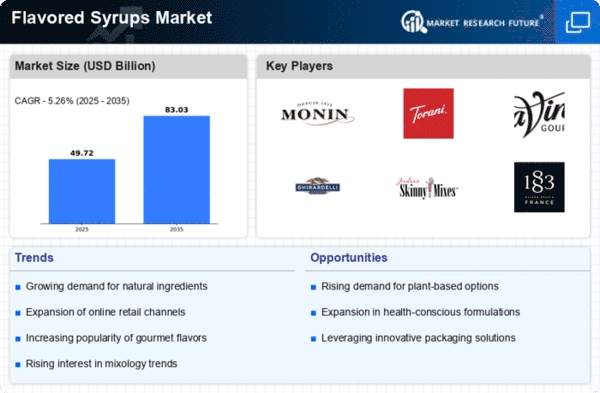
As per MRFR analysis, the Flavored Syrups Market Size was estimated at 47.24 USD Billion in 2024. The flavored syrups industry is projected to grow from 49.72 USD Billion in 2025 to 83.03 USD Billion by 2035, exhibiting a compound annual growth rate (CAGR) of 5.26% during the forecast period 2025 - 2035.

Key Market Trends & Highlights

The Flavored Syrups Market is experiencing a dynamic shift towards health-conscious and innovative products.

  • The North American market remains the largest, driven by a strong demand for flavored syrups in beverages.
  • Asia-Pacific is emerging as the fastest-growing region, fueled by increasing consumer interest in diverse flavor profiles.
  • The beverages segment dominates the market, while the desserts segment is witnessing rapid growth due to evolving consumer preferences.
  • Rising demand for natural ingredients and innovative flavor profiles are key drivers propelling market expansion.

Market Size & Forecast

2024 Market Size 47.24 (USD Billion)
2035 Market Size 83.03 (USD Billion)
CAGR (2025 - 2035) 5.26%
Largest Regional Market Share in 2024 North America

Major Players

Monin (FR), Torani (US), Da Vinci Gourmet (US), Ghirardelli (US), Jordan's Skinny Syrups (US), Routin 1883 (FR), Amoretti (US), Fabbri 1905 (IT), Syrup Company (US)

Market Trends

The Flavored Syrups Market is currently experiencing a dynamic evolution, driven by changing consumer preferences and an increasing inclination towards innovative beverage options. As individuals seek to enhance their culinary experiences, flavored syrups are becoming integral to both home and commercial applications. This market encompasses a diverse range of products, including fruit, chocolate, and herbal syrups, which cater to various tastes and occasions. The growing trend of personalization in food and drink is likely to further propel the demand for unique and artisanal syrup offerings, as consumers gravitate towards products that reflect their individual tastes and lifestyles. Moreover, the Flavored Syrups Market appears to be influenced by the rising popularity of specialty coffee and craft cocktails, where these syrups serve as essential components for flavor enhancement. The increasing focus on health and wellness may also lead to a shift towards natural and organic syrup options, as consumers become more conscious of ingredient sourcing and nutritional content. This evolving landscape suggests that manufacturers must remain agile and responsive to emerging trends, ensuring that their product lines align with consumer expectations and preferences. As the market continues to expand, the potential for innovation and diversification remains substantial, indicating a promising future for flavored syrups in various culinary applications.

Health-Conscious Choices

There is a noticeable shift towards health-oriented flavored syrups, as consumers increasingly seek options that align with their wellness goals. This trend encompasses the demand for organic, low-calorie, and natural ingredient syrups, reflecting a broader movement towards healthier eating and drinking habits.

Artisanal and Craft Products

The Flavored Syrups Market is witnessing a rise in artisanal and craft syrup offerings, as consumers show a preference for unique, small-batch products. This trend highlights the desire for authenticity and quality, with many individuals willing to pay a premium for distinctive flavors and locally sourced ingredients.

Customization and Personalization

Customization is becoming a key driver in the Flavored Syrups Market, as consumers increasingly seek personalized flavor experiences. This trend is evident in the growing popularity of customizable beverages, where individuals can tailor their drinks to suit their specific tastes, enhancing overall satisfaction.

Flavored Syrups Market Market Drivers

Market Growth Projections

The Global Flavored Syrups Industry is poised for substantial growth, with projections indicating a compound annual growth rate (CAGR) of 5.26% from 2025 to 2035. This growth trajectory reflects the increasing consumer interest in flavored beverages and the ongoing innovation within the industry. As the market evolves, it is anticipated that new entrants will emerge, further intensifying competition. The projected market size of 83.1 USD Billion by 2035 underscores the potential for expansion and the importance of strategic positioning for existing players. This growth is likely to be driven by a combination of factors, including changing consumer preferences and the expansion of distribution channels.

Expansion of Food Service Sector

The expansion of the food service sector plays a pivotal role in driving the Global Flavored Syrups Industry. As restaurants, cafes, and bars continue to proliferate globally, the demand for flavored syrups to enhance menu offerings is increasing. The versatility of flavored syrups allows food service establishments to create signature drinks and desserts, thereby attracting a diverse clientele. This trend is expected to contribute to the market's growth, with projections indicating a rise to 83.1 USD Billion by 2035. The food service industry's evolution, characterized by innovative beverage pairings and unique flavor profiles, underscores the importance of flavored syrups in enhancing customer experiences.

Health-Conscious Consumer Trends

Health-conscious trends significantly influence the Global Flavored Syrups Industry, as consumers increasingly prioritize natural and organic ingredients. The demand for syrups with reduced sugar content and natural flavorings is on the rise, reflecting a broader shift towards healthier lifestyles. This trend is particularly evident in the beverage sector, where consumers are opting for syrups that align with their dietary preferences. Manufacturers are adapting by developing syrups that are free from artificial additives and preservatives. This shift not only caters to health-conscious consumers but also positions brands favorably in a competitive market, potentially enhancing their market share as the industry evolves.

Innovations in Product Development

Innovations in product development are crucial drivers of the Global Flavored Syrups Industry. Manufacturers are increasingly investing in research and development to create new flavors and formulations that cater to evolving consumer preferences. This includes the introduction of unique flavor combinations and the incorporation of functional ingredients, such as vitamins and minerals, into syrups. Such innovations not only attract health-conscious consumers but also enhance the overall appeal of flavored syrups in various applications, from beverages to desserts. As the market continues to evolve, these innovations are likely to play a significant role in maintaining competitive advantage and driving sustained growth.

Growing E-commerce and Online Sales

The rise of e-commerce and online sales channels significantly impacts the Global Flavored Syrups Industry. With the increasing prevalence of online shopping, consumers are more inclined to purchase flavored syrups through digital platforms. This shift is facilitated by the convenience of home delivery and the ability to access a wider variety of products than what is available in physical stores. E-commerce platforms also allow brands to engage directly with consumers, fostering brand loyalty and enhancing customer relationships. As online sales continue to grow, this trend is expected to contribute to the overall expansion of the flavored syrups market, creating new opportunities for manufacturers.

Rising Demand for Specialty Beverages

The Global Flavored Syrups Industry experiences a notable surge in demand for specialty beverages, particularly among millennials and Gen Z consumers. This demographic increasingly seeks unique and innovative flavors to enhance their drink experiences. The market is projected to reach 47.2 USD Billion in 2024, driven by the growing popularity of craft cocktails and artisanal coffee drinks. As consumers become more adventurous in their flavor choices, manufacturers are responding with a diverse range of flavored syrups, catering to both alcoholic and non-alcoholic beverages. This trend indicates a shift towards premiumization in the beverage sector, further propelling market growth.

Market Segment Insights

By Application: Beverages (Largest) vs. Cocktails (Fastest-Growing)

<p>In the flavored syrup market, the application segment showcases a diverse distribution, with beverages taking the lead as the largest segment. This category significantly outperforms others due to the growing demand for flavored drinks in both retail and foodservice markets. Following beverages, desserts and baking also hold substantial portions, but cocktails have emerged as the sector with rapid growth, driven by evolving consumer preferences for innovative drink experiences. The growth trends in the flavored syrup market are particularly impressive in the cocktails segment, which benefits from the rise of mixology culture and craft beverages. As consumers explore unique flavors and premium options, the demand for specialty flavored syrups in cocktails is rapidly increasing. Furthermore, the increasing popularity of home bartending and creative mixology is contributing to an expanded market reach and engagement in this segment.</p>

<p>Beverages (Dominant) vs. Cocktails (Emerging)</p>

<p>The beverages segment in the flavored syrup market establishes itself as the dominant force, primarily fueled by a wide range of applications in carbonated and non-carbonated drinks. Manufacturers focus on introducing diverse flavor profiles, catering to health-conscious consumers through natural and organic options. On the other hand, cocktails represent the emerging segment that is capturing significant attention among consumers seeking unique, trendy beverage experiences. This segment is bolstered by innovative flavor combinations and the growing interest in craft cocktails, with consumers increasingly looking for premium syrups to enhance their drink's taste. The ongoing shift towards experiential drinking is giving cocktails a strong foothold, indicating vibrant prospects for future growth.</p>

By Type: Natural (Largest) vs. Sugar-Free (Fastest-Growing)

<p>In the flavored syrup market, the Natural segment holds the largest share, as consumers increasingly seek authentic and organic ingredients in their food products. This demand for higher-quality options has contributed to the steady growth of natural syrups, often perceived as healthier alternatives. Conversely, the Sugar-Free segment is gaining traction, catering to health-conscious consumers looking to reduce sugar intake without sacrificing flavor. These trends indicate a dynamic shift in consumer preferences towards healthier solutions in flavoring and sweetening products.</p>

<p>Natural (Dominant) vs. Sugar-Free (Emerging)</p>

<p>The Natural flavored syrups are characterized by their purely organic ingredients, appealing to consumers looking for authenticity and quality in their sweetening options. These syrups typically use extracts from fruits, herbs, and spices, providing a rich and true-to-nature taste that resonates particularly well with health-oriented customers. Meanwhile, the Sugar-Free segment is rapidly emerging in the market, driven by the increasing prevalence of dietary concerns regarding sugar consumption. Innovations in artificial sweeteners and natural sugar alternatives are enhancing the appeal of these syrups to those who need to monitor their sugar levels while still enjoying diverse flavors. Together, these segments illustrate the growing consumer trend towards healthier and more conscientious choices in the flavored syrup market.</p>

By Distribution Channel: Supermarkets (Largest) vs. Online (Fastest-Growing)

<p>In the flavored syrup market, supermarkets hold the largest market share among distribution channels, capitalizing on their extensive reach and established customer bases. These retail giants not only offer a wide selection of flavored syrups but also provide consumers with the convenience of in-person shopping. Following closely, online sales channels are gaining traction, reflecting an increasing consumer preference for e-commerce, particularly in the wake of the pandemic, leading to shifts in buying behavior.</p>

<p>Supermarkets (Dominant) vs. Online (Emerging)</p>

<p>Supermarkets dominate the flavored syrup distribution channel, benefiting from extensive shelf space and strategic partnerships with manufacturers. Their ability to promote large varieties of flavored syrups makes them the go-to location for consumers seeking quality and choice. Conversely, online sales channels are emerging rapidly as consumers shift towards the convenience of e-shopping. This segment is driven by innovations in e-commerce logistics and targeted digital marketing strategies that enhance consumer engagement. The ease of purchasing flavored syrups online, combined with exclusive online deals, is contributing to its rapid growth in market presence.</p>

By End Use: Household (Largest) vs. Food Service (Fastest-Growing)

<p>In the Flavored Syrups Market, the 'Household' segment dominates the market with the largest share, driven by the increasing consumer preference for sweetening options during home cooking and beverage preparation. This segment largely benefits from the trend of personalization in food and beverage choices, where households are looking to enhance flavors with various syrup options, thus sustaining its position as the leading end use.</p>

<p>Household (Dominant) vs. Food Service (Emerging)</p>

<p>The Household segment is characterized by its broad customer base, including families and individuals who use flavored syrups for various applications, such as pancakes, desserts, and home-mixed beverages. This segment's established presence in the market has created brand loyalty, which contributes to its dominant position. Conversely, the Food Service segment, while emerging rapidly, is driven by demand from restaurants and cafes seeking to diversify their menu offerings with unique flavored syrups. This trend to provide distinctive menu experiences is fueling the growth of this segment as establishments aim to attract more customers.</p>

Get more detailed insights about Flavored Syrups Market Research Report-Global Forecast till 2035

Regional Insights

North America : Market Leader in Flavored Syrups

North America continues to lead the flavored syrups market, holding a significant share of 25.0% in 2024. The growth is driven by increasing consumer demand for innovative beverage options and the rising popularity of specialty coffee and cocktails. Regulatory support for food and beverage innovation further fuels this trend, allowing for diverse flavor offerings and healthier alternatives. The United States is the primary market within North America, showcasing a competitive landscape with key players like Torani, Da Vinci Gourmet, and Monin. These companies are focusing on product diversification and sustainability to capture consumer interest. The presence of established brands and a robust distribution network enhances market accessibility, solidifying North America's position as a powerhouse in the flavored syrups sector.

Europe : Emerging Market with Growth Potential

Europe's flavored syrups market is valued at €10.0 million, reflecting a growing trend towards flavored beverages and culinary experimentation. The demand is driven by an increasing focus on premium products and artisanal flavors, alongside a shift towards healthier options. Regulatory frameworks in the EU encourage innovation in food products, supporting the growth of this market segment. Leading countries such as France, Germany, and the UK are at the forefront of this market, with brands like Routin 1883 and Fabbri 1905 making significant impacts. The competitive landscape is characterized by a mix of local artisans and international brands, fostering a rich variety of offerings. This diversity, combined with a growing café culture, positions Europe as a promising market for flavored syrups.

Asia-Pacific : Emerging Powerhouse in Syrups

The Asia-Pacific flavored syrups market, valued at $8.0 million, is witnessing rapid growth, driven by urbanization and changing consumer preferences towards flavored beverages. The increasing popularity of coffee culture and innovative cocktails is propelling demand. Additionally, regulatory support for food safety and quality standards is enhancing consumer confidence in flavored products. Countries like Japan, Australia, and China are leading the market, with local and international brands competing for market share. Key players such as Amoretti and Da Vinci Gourmet are expanding their presence, focusing on unique flavors and health-conscious options. The competitive landscape is evolving, with a growing emphasis on e-commerce and distribution channels to reach a broader audience.

Middle East and Africa : Untapped Market with Potential

The Middle East and Africa flavored syrups market, valued at $4.24 million, is in its nascent stages but shows significant potential for growth. The rising trend of café culture and the increasing popularity of flavored beverages are key drivers. Regulatory frameworks are gradually evolving to support food and beverage innovation, which is crucial for market expansion. Countries like South Africa and the UAE are emerging as key players in this market, with local brands and international companies like Ghirardelli and Torani making inroads. The competitive landscape is characterized by a mix of traditional and modern beverage offerings, creating opportunities for flavored syrups to gain traction among consumers seeking variety and quality.

Key Players and Competitive Insights

The Flavored Syrups Market exhibits a dynamic competitive landscape characterized by innovation and strategic partnerships. Key players such as Monin (FR), Torani (US), and Da Vinci Gourmet (US) are actively shaping the market through diverse operational focuses. Monin (FR) emphasizes sustainability in its product offerings, aligning with consumer preferences for eco-friendly options. Torani (US) has adopted a strategy of regional expansion, enhancing its distribution channels to reach a broader audience. Da Vinci Gourmet (US) appears to be concentrating on digital transformation, leveraging e-commerce platforms to enhance customer engagement and streamline operations. Collectively, these strategies contribute to a competitive environment that is increasingly focused on meeting consumer demands for quality and sustainability.In terms of business tactics, companies are localizing manufacturing to reduce supply chain vulnerabilities and optimize logistics. The market structure is moderately fragmented, with several key players exerting influence over various segments. This fragmentation allows for niche players to thrive, while larger companies leverage their scale to dominate market share. The collective influence of these key players fosters a competitive atmosphere where innovation and customer-centric strategies are paramount.

In November Monin (FR) launched a new line of organic flavored syrups, responding to the growing consumer demand for natural ingredients. This strategic move not only enhances Monin's product portfolio but also positions the company as a leader in the organic segment of the market. By prioritizing organic offerings, Monin (FR) is likely to attract health-conscious consumers, thereby expanding its market reach.

In October Torani (US) announced a partnership with a major coffee chain to supply flavored syrups for their seasonal beverage lineup. This collaboration is strategically significant as it allows Torani (US) to penetrate a high-traffic retail environment, increasing brand visibility and driving sales. Such partnerships are indicative of a trend where companies seek to align with established brands to enhance their market presence.

In September Da Vinci Gourmet (US) introduced a new line of zero-calorie flavored syrups, targeting the growing segment of health-conscious consumers. This initiative reflects a broader trend within the industry towards healthier alternatives, suggesting that Da Vinci Gourmet (US) is keenly aware of shifting consumer preferences. By diversifying its product range, the company is likely to capture a larger share of the market.

As of December the Flavored Syrups Market is witnessing trends such as digitalization and sustainability becoming increasingly central to competitive strategies. Companies are forming strategic alliances to enhance their market positioning and operational efficiencies. The competitive differentiation is expected to evolve, moving away from price-based competition towards innovation, technology integration, and supply chain reliability. This shift indicates a future where companies that prioritize quality and sustainability will likely emerge as leaders in the market.

Key Companies in the Flavored Syrups Market include

Industry Developments

November 2022: With the flavours Strawberry, Pineapple and Mango, MONIN unveiled Le Crush de MONIN, a collection of fresh products. Due to MONIN, flavor options are now more varied for pastry chefs, bartenders, baristas, ice cream producers, and home mixologists.

June 2022: First Day Lawson Ltd. bought Quest Ingredients Ltd., a taste and botanical extracts manufacturer. The main objectives of FDL's acquisition strategy are increased primary markets and customer bases in Europe and the US.

December 2020: Sweet Green Fields, a supplier of stevia, was fully acquired by Tate & Lyle. Tate & Lyle would enhance its stevia solution and capabilities through this acquisition by fusing its supply chain and research and development operations to boost stevia product innovation.

Future Outlook

Flavored Syrups Market Future Outlook

The Flavored Syrups Market is projected to grow at a 5.26% CAGR from 2025 to 2035, driven by rising consumer demand for innovative beverage options and health-conscious formulations.

New opportunities lie in:

  • Expansion into organic and natural flavored syrups to meet health trends.
  • Development of customizable syrup dispensers for cafes and restaurants.
  • Strategic partnerships with beverage brands for co-branded syrup products.

By 2035, the Flavored Syrups Market is expected to achieve robust growth, reflecting evolving consumer preferences.

Market Segmentation

Flavored Syrups Market Type Outlook

  • Natural Syrups
  • Artificial Syrups
  • Organic Syrups
  • Sugar-Free Syrups

Flavored Syrups Market End Use Outlook

  • Household
  • Food Service
  • Beverage Industry
  • Catering Services

Flavored Syrups Market Application Outlook

  • Beverages
  • Desserts
  • Bakery
  • Dairy Products
  • Cocktails

Flavored Syrups Market Distribution Channel Outlook

  • Online Retail
  • Supermarkets
  • Specialty Stores
  • Convenience Stores

Report Scope

MARKET SIZE 2024 47.24(USD Billion)
MARKET SIZE 2025 49.72(USD Billion)
MARKET SIZE 2035 83.03(USD Billion)
COMPOUND ANNUAL GROWTH RATE (CAGR) 5.26% (2025 - 2035)
REPORT COVERAGE Revenue Forecast, Competitive Landscape, Growth Factors, and Trends
BASE YEAR 2024
Market Forecast Period 2025 - 2035
Historical Data 2019 - 2024
Market Forecast Units USD Billion
Key Companies Profiled Monin (FR), Torani (US), Da Vinci Gourmet (US), Ghirardelli (US), Jordan's Skinny Syrups (US), Routin 1883 (FR), Amoretti (US), Fabbri 1905 (IT), Syrup Company (US)
Segments Covered Application, Type, Distribution Channel, End Use
Key Market Opportunities Growing consumer preference for natural ingredients drives innovation in the Flavored Syrups Market.
Key Market Dynamics Rising consumer preference for natural ingredients drives innovation and competition in the flavored syrups market.
Countries Covered North America, Europe, APAC, South America, MEA

FAQs

What is the current valuation of the flavored syrup market?

<p>The flavored syrup market was valued at 5.5 USD Billion in 2024.</p>

What is the projected market size for flavored syrups by 2035?

<p>The flavored syrup market is projected to reach 10.0 USD Billion by 2035.</p>

What is the expected CAGR for the flavored syrup market during the forecast period?

<p>The expected CAGR for the flavored syrup market from 2025 to 2035 is 5.59%.</p>

Which application segments are driving growth in the flavored syrup market?

<p>The beverages segment, valued at 4.0 USD Billion in 2024, is a key driver of growth.</p>

How do natural and artificial flavored syrups compare in market valuation?

<p>In 2024, the market for artificial flavored syrups was valued at 1.5 USD Billion, while natural syrups were at 1.1 USD Billion.</p>

What distribution channels are most effective for flavored syrup sales?

<p>Supermarkets, with a valuation of 2.0 USD Billion in 2024, are a leading distribution channel for flavored syrups.</p>

Which key players dominate the flavored syrup market?

<p>Key players in the flavored syrup market include Monin, Torani, and Da Vinci Gourmet.</p>

What is the market valuation for sugar-free flavored syrups?

<p>The market for sugar-free flavored syrups was valued at 0.9 USD Billion in 2024.</p>

How does the market for concentrated flavored syrups compare to other types?

<p>Concentrated flavored syrups were valued at 1.0 USD Billion in 2024, indicating a growing segment.</p>

What trends are expected in the flavored syrup market by 2035?

<p>The flavored syrup market is likely to see continued growth, reaching 10.0 USD Billion by 2035, driven by diverse applications.</p>

  1. SECTION I: EXECUTIVE SUMMARY AND KEY HIGHLIGHTS
    1. | 1.1 EXECUTIVE SUMMARY
    2. | | 1.1.1 Market Overview
    3. | | 1.1.2 Key Findings
    4. | | 1.1.3 Market Segmentation
    5. | | 1.1.4 Competitive Landscape
    6. | | 1.1.5 Challenges and Opportunities
    7. | | 1.1.6 Future Outlook
  2. SECTION II: SCOPING, METHODOLOGY AND MARKET STRUCTURE
    1. | 2.1 MARKET INTRODUCTION
    2. | | 2.1.1 Definition
    3. | | 2.1.2 Scope of the study
    4. | | | 2.1.2.1 Research Objective
    5. | | | 2.1.2.2 Assumption
    6. | | | 2.1.2.3 Limitations
    7. | 2.2 RESEARCH METHODOLOGY
    8. | | 2.2.1 Overview
    9. | | 2.2.2 Data Mining
    10. | | 2.2.3 Secondary Research
    11. | | 2.2.4 Primary Research
    12. | | | 2.2.4.1 Primary Interviews and Information Gathering Process
    13. | | | 2.2.4.2 Breakdown of Primary Respondents
    14. | | 2.2.5 Forecasting Model
    15. | | 2.2.6 Market Size Estimation
    16. | | | 2.2.6.1 Bottom-Up Approach
    17. | | | 2.2.6.2 Top-Down Approach
    18. | | 2.2.7 Data Triangulation
    19. | | 2.2.8 Validation
  3. SECTION III: QUALITATIVE ANALYSIS
    1. | 3.1 MARKET DYNAMICS
    2. | | 3.1.1 Overview
    3. | | 3.1.2 Drivers
    4. | | 3.1.3 Restraints
    5. | | 3.1.4 Opportunities
    6. | 3.2 MARKET FACTOR ANALYSIS
    7. | | 3.2.1 Value chain Analysis
    8. | | 3.2.2 Porter's Five Forces Analysis
    9. | | | 3.2.2.1 Bargaining Power of Suppliers
    10. | | | 3.2.2.2 Bargaining Power of Buyers
    11. | | | 3.2.2.3 Threat of New Entrants
    12. | | | 3.2.2.4 Threat of Substitutes
    13. | | | 3.2.2.5 Intensity of Rivalry
    14. | | 3.2.3 COVID-19 Impact Analysis
    15. | | | 3.2.3.1 Market Impact Analysis
    16. | | | 3.2.3.2 Regional Impact
    17. | | | 3.2.3.3 Opportunity and Threat Analysis
  4. SECTION IV: QUANTITATIVE ANALYSIS
    1. | 4.1 Food, Beverages & Nutrition, BY Application (USD Billion)
    2. | | 4.1.1 Beverages
    3. | | 4.1.2 Desserts
    4. | | 4.1.3 Baking
    5. | | 4.1.4 Cocktails
    6. | | 4.1.5 Sauces
    7. | 4.2 Food, Beverages & Nutrition, BY Type (USD Billion)
    8. | | 4.2.1 Natural
    9. | | 4.2.2 Artificial
    10. | | 4.2.3 Organic
    11. | | 4.2.4 Sugar-Free
    12. | | 4.2.5 Concentrated
    13. | 4.3 Food, Beverages & Nutrition, BY Distribution Channel (USD Billion)
    14. | | 4.3.1 Online
    15. | | 4.3.2 Supermarkets
    16. | | 4.3.3 Convenience Stores
    17. | | 4.3.4 Specialty Stores
    18. | | 4.3.5 Food Service
    19. | 4.4 Food, Beverages & Nutrition, BY Region (USD Billion)
    20. | | 4.4.1 North America
    21. | | | 4.4.1.1 US
    22. | | | 4.4.1.2 Canada
    23. | | 4.4.2 Europe
    24. | | | 4.4.2.1 Germany
    25. | | | 4.4.2.2 UK
    26. | | | 4.4.2.3 France
    27. | | | 4.4.2.4 Russia
    28. | | | 4.4.2.5 Italy
    29. | | | 4.4.2.6 Spain
    30. | | | 4.4.2.7 Rest of Europe
    31. | | 4.4.3 APAC
    32. | | | 4.4.3.1 China
    33. | | | 4.4.3.2 India
    34. | | | 4.4.3.3 Japan
    35. | | | 4.4.3.4 South Korea
    36. | | | 4.4.3.5 Malaysia
    37. | | | 4.4.3.6 Thailand
    38. | | | 4.4.3.7 Indonesia
    39. | | | 4.4.3.8 Rest of APAC
    40. | | 4.4.4 South America
    41. | | | 4.4.4.1 Brazil
    42. | | | 4.4.4.2 Mexico
    43. | | | 4.4.4.3 Argentina
    44. | | | 4.4.4.4 Rest of South America
    45. | | 4.4.5 MEA
    46. | | | 4.4.5.1 GCC Countries
    47. | | | 4.4.5.2 South Africa
    48. | | | 4.4.5.3 Rest of MEA
  5. SECTION V: COMPETITIVE ANALYSIS
    1. | 5.1 Competitive Landscape
    2. | | 5.1.1 Overview
    3. | | 5.1.2 Competitive Analysis
    4. | | 5.1.3 Market share Analysis
    5. | | 5.1.4 Major Growth Strategy in the Food, Beverages & Nutrition
    6. | | 5.1.5 Competitive Benchmarking
    7. | | 5.1.6 Leading Players in Terms of Number of Developments in the Food, Beverages & Nutrition
    8. | | 5.1.7 Key developments and growth strategies
    9. | | | 5.1.7.1 New Product Launch/Service Deployment
    10. | | | 5.1.7.2 Merger & Acquisitions
    11. | | | 5.1.7.3 Joint Ventures
    12. | | 5.1.8 Major Players Financial Matrix
    13. | | | 5.1.8.1 Sales and Operating Income
    14. | | | 5.1.8.2 Major Players R&D Expenditure. 2023
    15. | 5.2 Company Profiles
    16. | | 5.2.1 Monin (FR)
    17. | | | 5.2.1.1 Financial Overview
    18. | | | 5.2.1.2 Products Offered
    19. | | | 5.2.1.3 Key Developments
    20. | | | 5.2.1.4 SWOT Analysis
    21. | | | 5.2.1.5 Key Strategies
    22. | | 5.2.2 Torani (US)
    23. | | | 5.2.2.1 Financial Overview
    24. | | | 5.2.2.2 Products Offered
    25. | | | 5.2.2.3 Key Developments
    26. | | | 5.2.2.4 SWOT Analysis
    27. | | | 5.2.2.5 Key Strategies
    28. | | 5.2.3 Da Vinci Gourmet (US)
    29. | | | 5.2.3.1 Financial Overview
    30. | | | 5.2.3.2 Products Offered
    31. | | | 5.2.3.3 Key Developments
    32. | | | 5.2.3.4 SWOT Analysis
    33. | | | 5.2.3.5 Key Strategies
    34. | | 5.2.4 Ghirardelli (US)
    35. | | | 5.2.4.1 Financial Overview
    36. | | | 5.2.4.2 Products Offered
    37. | | | 5.2.4.3 Key Developments
    38. | | | 5.2.4.4 SWOT Analysis
    39. | | | 5.2.4.5 Key Strategies
    40. | | 5.2.5 Jordan's Skinny Syrups (US)
    41. | | | 5.2.5.1 Financial Overview
    42. | | | 5.2.5.2 Products Offered
    43. | | | 5.2.5.3 Key Developments
    44. | | | 5.2.5.4 SWOT Analysis
    45. | | | 5.2.5.5 Key Strategies
    46. | | 5.2.6 Amoretti (US)
    47. | | | 5.2.6.1 Financial Overview
    48. | | | 5.2.6.2 Products Offered
    49. | | | 5.2.6.3 Key Developments
    50. | | | 5.2.6.4 SWOT Analysis
    51. | | | 5.2.6.5 Key Strategies
    52. | | 5.2.7 Routin (FR)
    53. | | | 5.2.7.1 Financial Overview
    54. | | | 5.2.7.2 Products Offered
    55. | | | 5.2.7.3 Key Developments
    56. | | | 5.2.7.4 SWOT Analysis
    57. | | | 5.2.7.5 Key Strategies
    58. | | 5.2.8 Fabbri (IT)
    59. | | | 5.2.8.1 Financial Overview
    60. | | | 5.2.8.2 Products Offered
    61. | | | 5.2.8.3 Key Developments
    62. | | | 5.2.8.4 SWOT Analysis
    63. | | | 5.2.8.5 Key Strategies
    64. | | 5.2.9 Syrup Company (US)
    65. | | | 5.2.9.1 Financial Overview
    66. | | | 5.2.9.2 Products Offered
    67. | | | 5.2.9.3 Key Developments
    68. | | | 5.2.9.4 SWOT Analysis
    69. | | | 5.2.9.5 Key Strategies
    70. | 5.3 Appendix
    71. | | 5.3.1 References
    72. | | 5.3.2 Related Reports
  6. LIST OF FIGURES
    1. | 6.1 MARKET SYNOPSIS
    2. | 6.2 NORTH AMERICA MARKET ANALYSIS
    3. | 6.3 US MARKET ANALYSIS BY APPLICATION
    4. | 6.4 US MARKET ANALYSIS BY TYPE
    5. | 6.5 US MARKET ANALYSIS BY DISTRIBUTION CHANNEL
    6. | 6.6 CANADA MARKET ANALYSIS BY APPLICATION
    7. | 6.7 CANADA MARKET ANALYSIS BY TYPE
    8. | 6.8 CANADA MARKET ANALYSIS BY DISTRIBUTION CHANNEL
    9. | 6.9 EUROPE MARKET ANALYSIS
    10. | 6.10 GERMANY MARKET ANALYSIS BY APPLICATION
    11. | 6.11 GERMANY MARKET ANALYSIS BY TYPE
    12. | 6.12 GERMANY MARKET ANALYSIS BY DISTRIBUTION CHANNEL
    13. | 6.13 UK MARKET ANALYSIS BY APPLICATION
    14. | 6.14 UK MARKET ANALYSIS BY TYPE
    15. | 6.15 UK MARKET ANALYSIS BY DISTRIBUTION CHANNEL
    16. | 6.16 FRANCE MARKET ANALYSIS BY APPLICATION
    17. | 6.17 FRANCE MARKET ANALYSIS BY TYPE
    18. | 6.18 FRANCE MARKET ANALYSIS BY DISTRIBUTION CHANNEL
    19. | 6.19 RUSSIA MARKET ANALYSIS BY APPLICATION
    20. | 6.20 RUSSIA MARKET ANALYSIS BY TYPE
    21. | 6.21 RUSSIA MARKET ANALYSIS BY DISTRIBUTION CHANNEL
    22. | 6.22 ITALY MARKET ANALYSIS BY APPLICATION
    23. | 6.23 ITALY MARKET ANALYSIS BY TYPE
    24. | 6.24 ITALY MARKET ANALYSIS BY DISTRIBUTION CHANNEL
    25. | 6.25 SPAIN MARKET ANALYSIS BY APPLICATION
    26. | 6.26 SPAIN MARKET ANALYSIS BY TYPE
    27. | 6.27 SPAIN MARKET ANALYSIS BY DISTRIBUTION CHANNEL
    28. | 6.28 REST OF EUROPE MARKET ANALYSIS BY APPLICATION
    29. | 6.29 REST OF EUROPE MARKET ANALYSIS BY TYPE
    30. | 6.30 REST OF EUROPE MARKET ANALYSIS BY DISTRIBUTION CHANNEL
    31. | 6.31 APAC MARKET ANALYSIS
    32. | 6.32 CHINA MARKET ANALYSIS BY APPLICATION
    33. | 6.33 CHINA MARKET ANALYSIS BY TYPE
    34. | 6.34 CHINA MARKET ANALYSIS BY DISTRIBUTION CHANNEL
    35. | 6.35 INDIA MARKET ANALYSIS BY APPLICATION
    36. | 6.36 INDIA MARKET ANALYSIS BY TYPE
    37. | 6.37 INDIA MARKET ANALYSIS BY DISTRIBUTION CHANNEL
    38. | 6.38 JAPAN MARKET ANALYSIS BY APPLICATION
    39. | 6.39 JAPAN MARKET ANALYSIS BY TYPE
    40. | 6.40 JAPAN MARKET ANALYSIS BY DISTRIBUTION CHANNEL
    41. | 6.41 SOUTH KOREA MARKET ANALYSIS BY APPLICATION
    42. | 6.42 SOUTH KOREA MARKET ANALYSIS BY TYPE
    43. | 6.43 SOUTH KOREA MARKET ANALYSIS BY DISTRIBUTION CHANNEL
    44. | 6.44 MALAYSIA MARKET ANALYSIS BY APPLICATION
    45. | 6.45 MALAYSIA MARKET ANALYSIS BY TYPE
    46. | 6.46 MALAYSIA MARKET ANALYSIS BY DISTRIBUTION CHANNEL
    47. | 6.47 THAILAND MARKET ANALYSIS BY APPLICATION
    48. | 6.48 THAILAND MARKET ANALYSIS BY TYPE
    49. | 6.49 THAILAND MARKET ANALYSIS BY DISTRIBUTION CHANNEL
    50. | 6.50 INDONESIA MARKET ANALYSIS BY APPLICATION
    51. | 6.51 INDONESIA MARKET ANALYSIS BY TYPE
    52. | 6.52 INDONESIA MARKET ANALYSIS BY DISTRIBUTION CHANNEL
    53. | 6.53 REST OF APAC MARKET ANALYSIS BY APPLICATION
    54. | 6.54 REST OF APAC MARKET ANALYSIS BY TYPE
    55. | 6.55 REST OF APAC MARKET ANALYSIS BY DISTRIBUTION CHANNEL
    56. | 6.56 SOUTH AMERICA MARKET ANALYSIS
    57. | 6.57 BRAZIL MARKET ANALYSIS BY APPLICATION
    58. | 6.58 BRAZIL MARKET ANALYSIS BY TYPE
    59. | 6.59 BRAZIL MARKET ANALYSIS BY DISTRIBUTION CHANNEL
    60. | 6.60 MEXICO MARKET ANALYSIS BY APPLICATION
    61. | 6.61 MEXICO MARKET ANALYSIS BY TYPE
    62. | 6.62 MEXICO MARKET ANALYSIS BY DISTRIBUTION CHANNEL
    63. | 6.63 ARGENTINA MARKET ANALYSIS BY APPLICATION
    64. | 6.64 ARGENTINA MARKET ANALYSIS BY TYPE
    65. | 6.65 ARGENTINA MARKET ANALYSIS BY DISTRIBUTION CHANNEL
    66. | 6.66 REST OF SOUTH AMERICA MARKET ANALYSIS BY APPLICATION
    67. | 6.67 REST OF SOUTH AMERICA MARKET ANALYSIS BY TYPE
    68. | 6.68 REST OF SOUTH AMERICA MARKET ANALYSIS BY DISTRIBUTION CHANNEL
    69. | 6.69 MEA MARKET ANALYSIS
    70. | 6.70 GCC COUNTRIES MARKET ANALYSIS BY APPLICATION
    71. | 6.71 GCC COUNTRIES MARKET ANALYSIS BY TYPE
    72. | 6.72 GCC COUNTRIES MARKET ANALYSIS BY DISTRIBUTION CHANNEL
    73. | 6.73 SOUTH AFRICA MARKET ANALYSIS BY APPLICATION
    74. | 6.74 SOUTH AFRICA MARKET ANALYSIS BY TYPE
    75. | 6.75 SOUTH AFRICA MARKET ANALYSIS BY DISTRIBUTION CHANNEL
    76. | 6.76 REST OF MEA MARKET ANALYSIS BY APPLICATION
    77. | 6.77 REST OF MEA MARKET ANALYSIS BY TYPE
    78. | 6.78 REST OF MEA MARKET ANALYSIS BY DISTRIBUTION CHANNEL
    79. | 6.79 KEY BUYING CRITERIA OF FOOD, BEVERAGES & NUTRITION
    80. | 6.80 RESEARCH PROCESS OF MRFR
    81. | 6.81 DRO ANALYSIS OF FOOD, BEVERAGES & NUTRITION
    82. | 6.82 DRIVERS IMPACT ANALYSIS: FOOD, BEVERAGES & NUTRITION
    83. | 6.83 RESTRAINTS IMPACT ANALYSIS: FOOD, BEVERAGES & NUTRITION
    84. | 6.84 SUPPLY / VALUE CHAIN: FOOD, BEVERAGES & NUTRITION
    85. | 6.85 FOOD, BEVERAGES & NUTRITION, BY APPLICATION, 2024 (% SHARE)
    86. | 6.86 FOOD, BEVERAGES & NUTRITION, BY APPLICATION, 2024 TO 2035 (USD Billion)
    87. | 6.87 FOOD, BEVERAGES & NUTRITION, BY TYPE, 2024 (% SHARE)
    88. | 6.88 FOOD, BEVERAGES & NUTRITION, BY TYPE, 2024 TO 2035 (USD Billion)
    89. | 6.89 FOOD, BEVERAGES & NUTRITION, BY DISTRIBUTION CHANNEL, 2024 (% SHARE)
    90. | 6.90 FOOD, BEVERAGES & NUTRITION, BY DISTRIBUTION CHANNEL, 2024 TO 2035 (USD Billion)
    91. | 6.91 BENCHMARKING OF MAJOR COMPETITORS
  7. LIST OF TABLES
    1. | 7.1 LIST OF ASSUMPTIONS
    2. | | 7.1.1
    3. | 7.2 North America MARKET SIZE ESTIMATES; FORECAST
    4. | | 7.2.1 BY APPLICATION, 2025-2035 (USD Billion)
    5. | | 7.2.2 BY TYPE, 2025-2035 (USD Billion)
    6. | | 7.2.3 BY DISTRIBUTION CHANNEL, 2025-2035 (USD Billion)
    7. | 7.3 US MARKET SIZE ESTIMATES; FORECAST
    8. | | 7.3.1 BY APPLICATION, 2025-2035 (USD Billion)
    9. | | 7.3.2 BY TYPE, 2025-2035 (USD Billion)
    10. | | 7.3.3 BY DISTRIBUTION CHANNEL, 2025-2035 (USD Billion)
    11. | 7.4 Canada MARKET SIZE ESTIMATES; FORECAST
    12. | | 7.4.1 BY APPLICATION, 2025-2035 (USD Billion)
    13. | | 7.4.2 BY TYPE, 2025-2035 (USD Billion)
    14. | | 7.4.3 BY DISTRIBUTION CHANNEL, 2025-2035 (USD Billion)
    15. | 7.5 Europe MARKET SIZE ESTIMATES; FORECAST
    16. | | 7.5.1 BY APPLICATION, 2025-2035 (USD Billion)
    17. | | 7.5.2 BY TYPE, 2025-2035 (USD Billion)
    18. | | 7.5.3 BY DISTRIBUTION CHANNEL, 2025-2035 (USD Billion)
    19. | 7.6 Germany MARKET SIZE ESTIMATES; FORECAST
    20. | | 7.6.1 BY APPLICATION, 2025-2035 (USD Billion)
    21. | | 7.6.2 BY TYPE, 2025-2035 (USD Billion)
    22. | | 7.6.3 BY DISTRIBUTION CHANNEL, 2025-2035 (USD Billion)
    23. | 7.7 UK MARKET SIZE ESTIMATES; FORECAST
    24. | | 7.7.1 BY APPLICATION, 2025-2035 (USD Billion)
    25. | | 7.7.2 BY TYPE, 2025-2035 (USD Billion)
    26. | | 7.7.3 BY DISTRIBUTION CHANNEL, 2025-2035 (USD Billion)
    27. | 7.8 France MARKET SIZE ESTIMATES; FORECAST
    28. | | 7.8.1 BY APPLICATION, 2025-2035 (USD Billion)
    29. | | 7.8.2 BY TYPE, 2025-2035 (USD Billion)
    30. | | 7.8.3 BY DISTRIBUTION CHANNEL, 2025-2035 (USD Billion)
    31. | 7.9 Russia MARKET SIZE ESTIMATES; FORECAST
    32. | | 7.9.1 BY APPLICATION, 2025-2035 (USD Billion)
    33. | | 7.9.2 BY TYPE, 2025-2035 (USD Billion)
    34. | | 7.9.3 BY DISTRIBUTION CHANNEL, 2025-2035 (USD Billion)
    35. | 7.10 Italy MARKET SIZE ESTIMATES; FORECAST
    36. | | 7.10.1 BY APPLICATION, 2025-2035 (USD Billion)
    37. | | 7.10.2 BY TYPE, 2025-2035 (USD Billion)
    38. | | 7.10.3 BY DISTRIBUTION CHANNEL, 2025-2035 (USD Billion)
    39. | 7.11 Spain MARKET SIZE ESTIMATES; FORECAST
    40. | | 7.11.1 BY APPLICATION, 2025-2035 (USD Billion)
    41. | | 7.11.2 BY TYPE, 2025-2035 (USD Billion)
    42. | | 7.11.3 BY DISTRIBUTION CHANNEL, 2025-2035 (USD Billion)
    43. | 7.12 Rest of Europe MARKET SIZE ESTIMATES; FORECAST
    44. | | 7.12.1 BY APPLICATION, 2025-2035 (USD Billion)
    45. | | 7.12.2 BY TYPE, 2025-2035 (USD Billion)
    46. | | 7.12.3 BY DISTRIBUTION CHANNEL, 2025-2035 (USD Billion)
    47. | 7.13 APAC MARKET SIZE ESTIMATES; FORECAST
    48. | | 7.13.1 BY APPLICATION, 2025-2035 (USD Billion)
    49. | | 7.13.2 BY TYPE, 2025-2035 (USD Billion)
    50. | | 7.13.3 BY DISTRIBUTION CHANNEL, 2025-2035 (USD Billion)
    51. | 7.14 China MARKET SIZE ESTIMATES; FORECAST
    52. | | 7.14.1 BY APPLICATION, 2025-2035 (USD Billion)
    53. | | 7.14.2 BY TYPE, 2025-2035 (USD Billion)
    54. | | 7.14.3 BY DISTRIBUTION CHANNEL, 2025-2035 (USD Billion)
    55. | 7.15 India MARKET SIZE ESTIMATES; FORECAST
    56. | | 7.15.1 BY APPLICATION, 2025-2035 (USD Billion)
    57. | | 7.15.2 BY TYPE, 2025-2035 (USD Billion)
    58. | | 7.15.3 BY DISTRIBUTION CHANNEL, 2025-2035 (USD Billion)
    59. | 7.16 Japan MARKET SIZE ESTIMATES; FORECAST
    60. | | 7.16.1 BY APPLICATION, 2025-2035 (USD Billion)
    61. | | 7.16.2 BY TYPE, 2025-2035 (USD Billion)
    62. | | 7.16.3 BY DISTRIBUTION CHANNEL, 2025-2035 (USD Billion)
    63. | 7.17 South Korea MARKET SIZE ESTIMATES; FORECAST
    64. | | 7.17.1 BY APPLICATION, 2025-2035 (USD Billion)
    65. | | 7.17.2 BY TYPE, 2025-2035 (USD Billion)
    66. | | 7.17.3 BY DISTRIBUTION CHANNEL, 2025-2035 (USD Billion)
    67. | 7.18 Malaysia MARKET SIZE ESTIMATES; FORECAST
    68. | | 7.18.1 BY APPLICATION, 2025-2035 (USD Billion)
    69. | | 7.18.2 BY TYPE, 2025-2035 (USD Billion)
    70. | | 7.18.3 BY DISTRIBUTION CHANNEL, 2025-2035 (USD Billion)
    71. | 7.19 Thailand MARKET SIZE ESTIMATES; FORECAST
    72. | | 7.19.1 BY APPLICATION, 2025-2035 (USD Billion)
    73. | | 7.19.2 BY TYPE, 2025-2035 (USD Billion)
    74. | | 7.19.3 BY DISTRIBUTION CHANNEL, 2025-2035 (USD Billion)
    75. | 7.20 Indonesia MARKET SIZE ESTIMATES; FORECAST
    76. | | 7.20.1 BY APPLICATION, 2025-2035 (USD Billion)
    77. | | 7.20.2 BY TYPE, 2025-2035 (USD Billion)
    78. | | 7.20.3 BY DISTRIBUTION CHANNEL, 2025-2035 (USD Billion)
    79. | 7.21 Rest of APAC MARKET SIZE ESTIMATES; FORECAST
    80. | | 7.21.1 BY APPLICATION, 2025-2035 (USD Billion)
    81. | | 7.21.2 BY TYPE, 2025-2035 (USD Billion)
    82. | | 7.21.3 BY DISTRIBUTION CHANNEL, 2025-2035 (USD Billion)
    83. | 7.22 South America MARKET SIZE ESTIMATES; FORECAST
    84. | | 7.22.1 BY APPLICATION, 2025-2035 (USD Billion)
    85. | | 7.22.2 BY TYPE, 2025-2035 (USD Billion)
    86. | | 7.22.3 BY DISTRIBUTION CHANNEL, 2025-2035 (USD Billion)
    87. | 7.23 Brazil MARKET SIZE ESTIMATES; FORECAST
    88. | | 7.23.1 BY APPLICATION, 2025-2035 (USD Billion)
    89. | | 7.23.2 BY TYPE, 2025-2035 (USD Billion)
    90. | | 7.23.3 BY DISTRIBUTION CHANNEL, 2025-2035 (USD Billion)
    91. | 7.24 Mexico MARKET SIZE ESTIMATES; FORECAST
    92. | | 7.24.1 BY APPLICATION, 2025-2035 (USD Billion)
    93. | | 7.24.2 BY TYPE, 2025-2035 (USD Billion)
    94. | | 7.24.3 BY DISTRIBUTION CHANNEL, 2025-2035 (USD Billion)
    95. | 7.25 Argentina MARKET SIZE ESTIMATES; FORECAST
    96. | | 7.25.1 BY APPLICATION, 2025-2035 (USD Billion)
    97. | | 7.25.2 BY TYPE, 2025-2035 (USD Billion)
    98. | | 7.25.3 BY DISTRIBUTION CHANNEL, 2025-2035 (USD Billion)
    99. | 7.26 Rest of South America MARKET SIZE ESTIMATES; FORECAST
    100. | | 7.26.1 BY APPLICATION, 2025-2035 (USD Billion)
    101. | | 7.26.2 BY TYPE, 2025-2035 (USD Billion)
    102. | | 7.26.3 BY DISTRIBUTION CHANNEL, 2025-2035 (USD Billion)
    103. | 7.27 MEA MARKET SIZE ESTIMATES; FORECAST
    104. | | 7.27.1 BY APPLICATION, 2025-2035 (USD Billion)
    105. | | 7.27.2 BY TYPE, 2025-2035 (USD Billion)
    106. | | 7.27.3 BY DISTRIBUTION CHANNEL, 2025-2035 (USD Billion)
    107. | 7.28 GCC Countries MARKET SIZE ESTIMATES; FORECAST
    108. | | 7.28.1 BY APPLICATION, 2025-2035 (USD Billion)
    109. | | 7.28.2 BY TYPE, 2025-2035 (USD Billion)
    110. | | 7.28.3 BY DISTRIBUTION CHANNEL, 2025-2035 (USD Billion)
    111. | 7.29 South Africa MARKET SIZE ESTIMATES; FORECAST
    112. | | 7.29.1 BY APPLICATION, 2025-2035 (USD Billion)
    113. | | 7.29.2 BY TYPE, 2025-2035 (USD Billion)
    114. | | 7.29.3 BY DISTRIBUTION CHANNEL, 2025-2035 (USD Billion)
    115. | 7.30 Rest of MEA MARKET SIZE ESTIMATES; FORECAST
    116. | | 7.30.1 BY APPLICATION, 2025-2035 (USD Billion)
    117. | | 7.30.2 BY TYPE, 2025-2035 (USD Billion)
    118. | | 7.30.3 BY DISTRIBUTION CHANNEL, 2025-2035 (USD Billion)
    119. | 7.31 PRODUCT LAUNCH/PRODUCT DEVELOPMENT/APPROVAL
    120. | | 7.31.1
    121. | 7.32 ACQUISITION/PARTNERSHIP
    122. | | 7.32.1

Food, Beverages & Nutrition Market Segmentation

Food, Beverages & Nutrition By Application (USD Billion, 2025-2035)

  • Beverages
  • Desserts
  • Baking
  • Cocktails
  • Sauces

Food, Beverages & Nutrition By Type (USD Billion, 2025-2035)

  • Natural
  • Artificial
  • Organic
  • Sugar-Free
  • Concentrated

Food, Beverages & Nutrition By Distribution Channel (USD Billion, 2025-2035)

  • Online
  • Supermarkets
  • Convenience Stores
  • Specialty Stores
  • Food Service
Infographic

Free Sample Request

Kindly complete the form below to receive a free sample of this Report

Get Free Sample

Customer Strories

Compare Licence

×
Features License Type
Single User Multiuser License Enterprise User
Price $4,950 $5,950 $7,250
Maximum User Access Limit 1 User Upto 10 Users Unrestricted Access Throughout the Organization
Free Customization
Direct Access to Analyst
Deliverable Format
Platform Access
Discount on Next Purchase 10% 15% 15%
Printable Versions