Request Free Sample ×

Kindly complete the form below to receive a free sample of this Report

* Please use a valid business email

Leading companies partner with us for data-driven Insights

clients tt-cursor
Hero Background
English
Chinese
French
Japanese
Korean
German
Spanish

Fire Trucks Market Share

ID: MRFR/AT/5924-CR
150 Pages
Shubham Munde
November 2023

Fire Truck Market Size, Share & Growth Analysis Report by Type (Rescue Truck, Tanker, Pumper, Multi-Tasking Truck, Aerial Ladder, ARFF, and Specialty Vehicles), by Application (Municipal, Industrial, Commercial, Airport Vehicle Security, and Military) and by Region (North America, Europe, Asia-Pacific, Middle East & Africa, and South America) - Industry Outlook & Forecast to 2035

Share:
Download PDF ×

We do not share your information with anyone. However, we may send you emails based on your report interest from time to time. You may contact us at any time to opt-out.

Fire Truck Market Infographic
Purchase Options

Market Share

Fire Truck Market Share Analysis

In a market packed with competitors selling similar products, companies try to distinguish their fire trucks apart from rivals using unique features, innovative designs, or strategic approaches. Organizations might focus on developing innovative firefighting equipment, combining cutting-edge materials, or designing automobiles with increased mobility, for instance. This division helps with marking dependability in addition to attracting customers searching for innovative alternatives. Some companies choose to position themselves as cost leaders in a price-sensitive market by providing aggressive pricing without sacrificing quality. This strategy aims to capture a significant portion of the market by appealing to thrifty customers and areas that need sensible firefighting plans. Businesses using this approach focus on improving production procedures, acquiring resources efficiently, and streamlining work to maintain control over estimation. To expand their reach and influence, organizations may form cooperative efforts with other business partners, governmental agencies, or groups for crisis management. Organizations can reach new markets or client segments and enhance their market offer by using the characteristics of different aspects. Organizations examine the different necessities of their objective clients and foster items custom fitted to explicit market fragments. For example, an organization could focus in on assembling minimal and coordinated fire trucks for metropolitan conditions or bigger, more hearty vehicles for country regions with explicit firefighting challenges. By getting it and tending to the remarkable prerequisites of various market sections, organizations can acquire an upper hand and secure a more critical portion of the general market. In the fire truck industry, advancement and ongoing product development are essential elements of market share positioning. Organizations that invest in creative work expand more quickly because firefighting innovation and welfare concepts are constantly improving. Organizations can attract customers seeking the newest innovations in firefighting equipment by consistently showcasing fire trucks that meet or exceed industry standards, so solidifying their market position. Attracting and retaining customers requires developing a picture's core strengths, being conscious of item contributions, and maintaining a favorable reputation. Companies invest in advertising campaigns, attend trade shows, and communicate through various media platforms to establish themselves as reliable and trustworthy providers of firefighting supplies. When these systems are implemented successfully, they help firms gain an advantage and ensure that they have a significant but controlled presence in the ever-changing and fundamental sector of firefighting tools.


Author
Author Profile
Shubham Munde
Team Lead - Research

Shubham brings over 7 years of expertise in Market Intelligence and Strategic Consulting, with a strong focus on the Automotive, Aerospace, and Defense sectors. Backed by a solid foundation in semiconductors, electronics, and software, he has successfully delivered high-impact syndicated and custom research on a global scale. His core strengths include market sizing, forecasting, competitive intelligence, consumer insights, and supply chain mapping. Widely recognized for developing scalable growth strategies, Shubham empowers clients to navigate complex markets and achieve a lasting competitive edge. Trusted by start-ups and Fortune 500 companies alike, he consistently converts challenges into strategic opportunities that drive sustainable growth.

Leave a Comment

FAQs

What is the current valuation of the Fire Truck Market as of 2024?

<p>The Fire Truck Market was valued at 9.155 USD Million in 2024.</p>

What is the projected market valuation for the Fire Truck Market in 2035?

<p>The market is projected to reach 16.71 USD Million by 2035.</p>

What is the expected CAGR for the Fire Truck Market during the forecast period 2025 - 2035?

<p>The expected CAGR for the Fire Truck Market during 2025 - 2035 is 5.62%.</p>

Which companies are considered key players in the Fire Truck Market?

<p>Key players include Pierce Manufacturing, E-ONE, Ferrara Fire Apparatus, Rosenbauer, Gimaex, KME Fire, Smeal Fire Apparatus, Mack Trucks, and Volvo Group.</p>

What are the main types of fire trucks in the market and their valuations?

<p>Main types include Rescue Trucks valued at 1.5 to 2.8 USD Million, Tankers at 2.0 to 3.5 USD Million, and Pumpers at 2.5 to 4.5 USD Million.</p>

How does the application segment of the Fire Truck Market break down?

The application segment includes Municipal vehicles valued at 3.5 to 6.5 USD Million and Industrial vehicles at 2.0 to 3.5 USD Million.

What is the valuation range for Aerial Ladder trucks in the Fire Truck Market?

Aerial Ladder trucks are valued between 1.0 and 1.7 USD Million.

What is the valuation range for Specialty Vehicles in the Fire Truck Market?

Specialty Vehicles are valued between 0.35 and 1.0 USD Million.

What is the projected growth trend for the Fire Truck Market in the coming years?

The market is expected to grow steadily, reaching 16.71 USD Million by 2035.

How do the valuations of Military fire trucks compare to other applications?

Military fire trucks are valued between 1.155 and 2.41 USD Million, indicating a niche but essential segment.

Market Summary

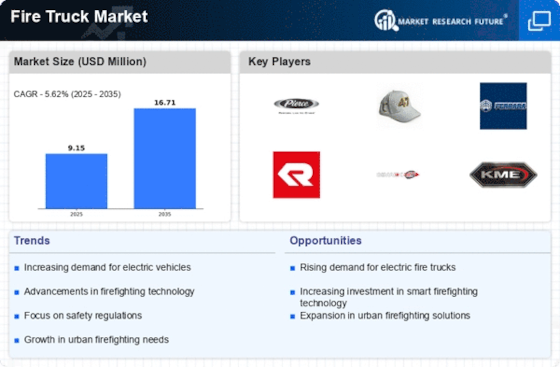
As per Market Research Future analysis, the Fire Truck Market Size was estimated at 9.155 USD Million in 2024. The Fire Truck industry is projected to grow from USD 9.67 Million in 2025 to USD 16.71 Million by 2035, exhibiting a compound annual growth rate (CAGR) of 5.6% during the forecast period 2025 - 2035.

Key Market Trends & Highlights

The Fire Truck Market is experiencing a dynamic shift driven by technological advancements and increasing demand for customized solutions.

  • Technological advancements are reshaping the Fire Truck Market, enhancing operational efficiency and safety. Customization trends are gaining traction, allowing fire departments to tailor vehicles to specific needs and preferences. North America remains the largest market, while the Asia-Pacific region is emerging as the fastest-growing area for fire truck sales. Key market drivers include rising urbanization and increasing investment in emergency services, which are propelling demand for both Pumper and Aerial Ladder segments.

Market Size & Forecast

2024 Market Size 9.155 (USD Million)
2035 Market Size 16.71 (USD Million)
CAGR (2025 - 2035) 5.62%
Largest Regional Market Share in 2024 Europe

Major Players

Pierce Manufacturing (US), E-ONE (US), Ferrara Fire Apparatus (US), Rosenbauer (AT), Gimaex (FR), KME Fire (US), Smeal Fire Apparatus (US), Mack Trucks (US), Volvo Group (SE)

Market Trends

The Fire Truck Market is currently experiencing a dynamic evolution, driven by advancements in technology and increasing safety regulations. Manufacturers are focusing on integrating innovative features such as enhanced communication systems, improved water delivery mechanisms, and eco-friendly engines. This shift not only aims to meet the demands of modern firefighting but also addresses environmental concerns, reflecting a broader trend towards sustainability.

Furthermore, the growing emphasis on emergency preparedness and response capabilities is influencing procurement strategies among municipalities and fire departments. As urbanization continues to rise, the need for efficient and reliable fire response solutions becomes increasingly critical, prompting investments in state-of-the-art fire apparatus.

In addition to technological advancements, the Fire Truck Market is witnessing a shift in consumer preferences towards customized solutions. Fire departments are seeking vehicles tailored to their specific operational needs, which may include specialized equipment for urban or rural environments. This trend suggests a move away from one-size-fits-all models, as agencies prioritize functionality and versatility. Moreover, collaborations between manufacturers and end-users are becoming more prevalent, fostering innovation and ensuring that new designs align with real-world requirements. Overall, the Fire Truck Market appears poised for continued growth, driven by a combination of technological innovation, customization, and a heightened focus on safety and efficiency.

Technological Advancements

The Fire Truck Market is increasingly influenced by technological innovations. Features such as advanced communication systems, automated firefighting equipment, and eco-friendly engines are becoming standard. These enhancements not only improve operational efficiency but also address environmental concerns, aligning with global sustainability goals.

Customization Trends

There is a noticeable shift towards customized fire trucks tailored to specific operational needs. Fire departments are moving away from generic models, opting instead for vehicles designed for particular environments, whether urban or rural. This trend highlights the importance of functionality and adaptability in modern firefighting.

Collaborative Innovations

Collaboration between manufacturers and fire departments is fostering innovation within the Fire Truck Market. By working closely with end-users, manufacturers can develop vehicles that meet real-world challenges. This partnership approach is likely to lead to more effective designs and improved firefighting capabilities.

Fire Truck Market Market Drivers

Increasing Urbanization

The trend of increasing urbanization appears to be a significant driver for the Fire Truck Market. As more people migrate to urban areas, the demand for efficient fire response systems escalates. Urban environments often present unique challenges, such as high-rise buildings and densely populated areas, necessitating specialized fire trucks equipped with advanced technology. According to recent data, urban areas are projected to house over 68% of the world's population by 2050, which could lead to a corresponding rise in fire incidents. Consequently, municipalities are likely to invest in modern fire trucks to enhance their emergency response capabilities, thereby propelling the Fire Truck Market forward.

Technological Integration

Technological integration is a pivotal driver in the Fire Truck Market. The incorporation of advanced technologies such as IoT, AI, and telematics into fire trucks is transforming operational efficiency and effectiveness. These technologies enable real-time data collection and analysis, which can significantly improve response times and resource allocation during emergencies. For example, fire trucks equipped with telematics can monitor vehicle health and performance, reducing downtime and maintenance costs. The market for smart fire trucks is anticipated to expand, with estimates suggesting a growth rate of approximately 15% annually over the next few years. This technological evolution is likely to redefine the capabilities of fire services, thereby enhancing the Fire Truck Market.

Rising Awareness of Fire Safety

Rising awareness of fire safety among the public and organizations is driving the Fire Truck Market. As incidents of fire-related disasters continue to garner media attention, there is a growing emphasis on fire prevention and safety measures. This heightened awareness is prompting both public and private sectors to invest in advanced fire-fighting equipment, including modern fire trucks. Educational campaigns and training programs are also contributing to this trend, as they inform communities about the importance of fire safety. Consequently, fire departments are likely to seek out more sophisticated fire trucks that can effectively address various fire scenarios, thus stimulating growth in the Fire Truck Market.

Investment in Emergency Services

Investment in emergency services is a crucial driver for the Fire Truck Market. Governments and municipalities are increasingly recognizing the importance of robust emergency response systems, leading to enhanced funding for fire departments. This investment often translates into the procurement of new fire trucks and equipment, as well as the upgrading of existing fleets. Recent data indicates that public spending on emergency services has risen by approximately 10% in the last year, reflecting a commitment to improving community safety. As fire departments strive to modernize their operations, the demand for advanced fire trucks is likely to surge, thereby propelling the Fire Truck Market.

Regulatory Compliance and Safety Standards

Regulatory compliance and safety standards are increasingly influencing the Fire Truck Market. Governments and regulatory bodies are establishing stringent safety regulations that fire trucks must adhere to, which may include emissions standards, equipment specifications, and operational protocols. This regulatory landscape compels manufacturers to innovate and upgrade their offerings to meet these requirements. For instance, the introduction of electric fire trucks is gaining traction as a response to environmental regulations. The market for electric fire trucks is expected to grow significantly, with projections indicating a potential increase of 20% in the next five years. This shift not only enhances safety but also aligns with sustainability goals, thereby driving the Fire Truck Market.

Market Segment Insights

By Type: Pumper (Largest) vs. Aerial Ladder (Fastest-Growing)

In the Fire Truck Market, Pumper trucks hold the largest market share due to their versatility and essential role in firefighting operations. They are designed for transporting water along with competitive equipment, making them a staple in most fire departments. Following this, Aerial Ladder trucks have been gaining attention, attributed to urban development, where high-rise buildings necessitate advanced firefighting techniques. While they currently hold a smaller share, their importance is recognized, and demand is projected to grow significantly. The growth trends in this segment are primarily driven by advancements in truck technology and increasing urbanization. The necessity for efficient firefighting capabilities in densely populated areas underlines the demand for Aerial Ladder trucks. Meanwhile, the ongoing modernization of fire services emphasizes the need for versatile Pumper trucks that can adapt to multiple fire scenarios, ensuring their sustained presence in the market.

Pumper (Dominant) vs. Aerial Ladder (Emerging)

Pumper trucks are the cornerstone of the fire service, known for their reliability and multi-functionality. They are equipped to handle various firefighting tasks, making them the go-to choice for many fire departments. Their dominance arises from the widespread need for efficient water delivery in extinguishing fires. In contrast, Aerial Ladder trucks represent an emerging segment within the market, driven by the architectural trend of taller buildings requiring advanced firefighting solutions. These trucks feature extendable ladders that enable firefighters to access elevated structures quickly. As the focus shifts towards enhancing firefighting strategies in urban settings, the demand for Aerial Ladder trucks continues to increase, creating a dynamic balance with the established Pumper trucks.

By Application: Municipal (Largest) vs. Military (Fastest-Growing)

The Fire Truck Market showcases a diverse distribution of application segments, with Municipal applications leading the way. This segment accounts for a significant portion of the market due to the continuous demand for firefighting services in urban areas. Following closely is the Industrial segment, which is essential for safeguarding manufacturing and production facilities. Other notable contributors include the Commercial and <a href="https://www.marketresearchfuture.com/reports/airport-ground-support-vehicle-market-33808">Airport Vehicle</a> Security segments, each playing a vital role in their respective domains, while the Military segment, though smaller in comparison, is gaining traction due to increasing defense budgets and modernization efforts.

Municipal (Dominant) vs. Military (Emerging)

The Municipal application segment remains the dominant player in the Fire Truck Market, driven by consistent investments in urban firefighting infrastructure and a growing emphasis on public safety. Municipal fire trucks are designed to meet the diverse needs of fire departments, including advanced firefighting capabilities and versatility. On the other hand, the Military application segment is emerging rapidly as military organizations worldwide seek to enhance their firefighting responses during operations and emergencies. Military fire trucks are tailored for rugged environments and come equipped with specialized features to handle unique challenges, making them increasingly relevant in contemporary defense strategies.

Get more detailed insights about Fire Truck Market Research Report – Global Forecast till 2035

Regional Insights

North America : Market Leader in Fire Trucks

North America is the largest market for fire trucks, accounting for approximately 45% of the global share. The region's growth is driven by increasing urbanization, stringent safety regulations, and the need for advanced firefighting technologies. The demand for fire trucks is further fueled by government initiatives aimed at enhancing public safety and emergency response capabilities. The U.S. and Canada are the primary contributors to this market, with a strong focus on innovation and modernization of firefighting equipment. The competitive landscape in North America is characterized by the presence of key players such as Pierce Manufacturing, E-ONE, and Ferrara Fire Apparatus. These companies are known for their advanced technology and high-quality products, catering to both municipal and industrial sectors. The market is also witnessing collaborations and partnerships aimed at enhancing product offerings and expanding market reach. The emphasis on sustainability and eco-friendly solutions is shaping the future of fire truck manufacturing in this region.

Europe : Emerging Market Dynamics

Europe is witnessing significant growth in the fire truck market, holding approximately 30% of the global share. The increasing focus on fire safety regulations and the modernization of firefighting fleets are key drivers of this growth. Countries like Germany and France are leading the market, supported by government initiatives aimed at improving emergency response systems. The demand for advanced firefighting technologies, including electric and hybrid fire trucks, is also on the rise, reflecting a shift towards sustainable solutions. Leading countries in Europe, such as Germany, France, and the UK, are home to major manufacturers like Rosenbauer and Gimaex. The competitive landscape is marked by innovation and a strong emphasis on quality and safety standards. European manufacturers are increasingly investing in R&D to develop advanced firefighting solutions that meet the evolving needs of fire departments. The market is also characterized by collaborations between manufacturers and government agencies to enhance firefighting capabilities across the region.

Asia-Pacific : Rapid Growth and Development

The Asia-Pacific region is emerging as a significant player in the fire truck market, accounting for approximately 20% of the global share. The rapid urbanization, increasing industrialization, and rising awareness of fire safety are key factors driving market growth. Countries like China and India are witnessing a surge in demand for fire trucks, supported by government initiatives aimed at enhancing public safety and emergency response capabilities. The region is also seeing a shift towards advanced firefighting technologies, including smart fire trucks equipped with IoT capabilities. China and India are the leading countries in this market, with a growing number of local manufacturers entering the space. The competitive landscape is becoming increasingly dynamic, with both established players and new entrants vying for market share. Key players such as KME Fire and Smeal Fire Apparatus are focusing on expanding their presence in the region through strategic partnerships and collaborations. The emphasis on cost-effective solutions and compliance with safety regulations is shaping the future of the fire truck market in Asia-Pacific.

Middle East and Africa : Emerging Market Opportunities

The Middle East and Africa region is witnessing a gradual increase in the fire truck market, holding approximately 5% of the global share. The growth is primarily driven by increasing investments in infrastructure development and a rising focus on fire safety regulations. Countries like the UAE and South Africa are leading the market, supported by government initiatives aimed at enhancing emergency response capabilities. The demand for advanced firefighting technologies is also on the rise, reflecting a shift towards modern solutions in firefighting operations. In the competitive landscape, local manufacturers are emerging alongside established global players. The presence of companies like Mack Trucks and Volvo Group highlights the growing interest in this region. The market is characterized by collaborations between manufacturers and government agencies to improve firefighting capabilities. As urbanization continues to rise, the demand for fire trucks is expected to grow, presenting significant opportunities for market players.

Key Players and Competitive Insights

The Fire Truck Market is currently characterized by a dynamic competitive landscape, driven by increasing demand for advanced firefighting technologies and enhanced safety features. Key players such as Pierce Manufacturing (US), E-ONE (US), and Rosenbauer (AT) are strategically positioned to leverage innovation and regional expansion to capture market share. These companies focus on developing cutting-edge fire apparatus that integrate digital technologies, thereby enhancing operational efficiency and safety.
Their collective emphasis on innovation and partnerships with local fire departments shapes a competitive environment that is increasingly focused on meeting specific regional needs while maintaining high standards of performance. In terms of business tactics, companies are increasingly localizing manufacturing to reduce lead times and optimize supply chains. The Fire Truck Market appears moderately fragmented, with several key players exerting influence over various segments. This fragmentation allows for niche players to thrive, while larger companies consolidate their positions through strategic acquisitions and partnerships. The collective influence of these key players fosters a competitive structure that encourages innovation and responsiveness to market demands.
In August 2025, Pierce Manufacturing (US) announced the launch of its latest fire truck model, which incorporates advanced AI-driven safety features. This strategic move not only enhances the safety of firefighters but also positions Pierce as a leader in technological innovation within the market. The introduction of AI capabilities is likely to attract attention from fire departments seeking to modernize their fleets, thereby potentially increasing Pierce's market share.
In September 2025, E-ONE (US) expanded its manufacturing capabilities by opening a new facility in the Midwest. This expansion is significant as it allows E-ONE to better serve its customer base in that region, reducing delivery times and enhancing customer service. The strategic importance of this move lies in its potential to strengthen E-ONE's competitive position by improving operational efficiency and responsiveness to local market demands.
In July 2025, Rosenbauer (AT) entered into a partnership with a leading technology firm to develop smart firefighting solutions. This collaboration aims to integrate IoT technologies into fire trucks, enhancing real-time data analytics and operational decision-making. The strategic importance of this partnership is profound, as it positions Rosenbauer at the forefront of the digital transformation trend within the fire truck market, potentially setting new standards for operational efficiency and safety.
As of October 2025, the Fire Truck Market is witnessing trends that emphasize digitalization, sustainability, and the integration of AI technologies. Strategic alliances are increasingly shaping the competitive landscape, allowing companies to pool resources and expertise to drive innovation. Looking ahead, competitive differentiation is likely to evolve from traditional price-based competition to a focus on technological advancements, supply chain reliability, and the ability to meet specific customer needs. This shift underscores the importance of innovation and adaptability in maintaining a competitive edge in the market.

Key Companies in the Fire Truck Market include

Industry Developments

  • Q2 2025: Fire Trucks Market Outlook 2025-2035: Featuring Zoomlion, Danko Emergency Equipment Co., Ziegler Group, Naffco, REV Group, Morita Group, Spartan Motors, Magirus GmbH, Oshkosh Corporation In 2025, Pierce Manufacturing (Oshkosh Corporation subsidiary) delivered its Volterra electric fire truck to King County International Airport (Boeing Field), marking a milestone in airport decarbonization efforts. Rosenbauer also delivered its electric RTX fire truck to the Victoria Fire Department in British Columbia, Canada, supporting sustainability in emergency response.[4]
  • Q1 2024: Fire Trucks Market Outlook 2025-2035: Featuring Zoomlion, Danko Emergency Equipment Co., Ziegler Group, Naffco, REV Group, Morita Group, Spartan Motors, Magirus GmbH, Oshkosh Corporation In 2024, Fire Truck Market Center expanded its product line with custom-built brush trucks designed for wildfire containment and rural operations, featuring reinforced aluminum bodies and modular storage. These trucks are in high demand from municipal and forestry departments across North America.[4]

Future Outlook

Fire Truck Market Future Outlook

The Global Fire Truck Market is projected to grow at a 5.62% CAGR from 2025 to 2035, driven by technological advancements, increasing urbanization, and heightened safety regulations.

New opportunities lie in:

  • <p>Development of electric fire trucks for urban environments. Integration of IoT for real-time fleet management solutions. Expansion into emerging markets with tailored fire response vehicles.</p>

By 2035, the Fire Truck Market is expected to be robust, reflecting substantial growth and innovation.

Market Segmentation

Fire Truck Market Type Outlook

  • Rescue Truck
  • Tanker
  • Pumper
  • Multi-Tasking Truck
  • Aerial Ladder
  • ARFF
  • Specialty Vehicles

Fire Truck Market Application Outlook

  • Municipal
  • Industrial
  • Commercial
  • Airport Vehicle Security
  • Military

Report Scope

MARKET SIZE 2024 9.155(USD Million)
MARKET SIZE 2025 9.67(USD Million)
MARKET SIZE 2035 16.71(USD Million)
COMPOUND ANNUAL GROWTH RATE (CAGR) 5.62% (2025 - 2035)
REPORT COVERAGE Revenue Forecast, Competitive Landscape, Growth Factors, and Trends
BASE YEAR 2024
Market Forecast Period 2025 - 2035
Historical Data 2019 - 2024
Market Forecast Units USD Million
Key Companies Profiled Pierce Manufacturing (US), E-ONE (US), Ferrara Fire Apparatus (US), Rosenbauer (AT), Gimaex (FR), KME Fire (US), Smeal Fire Apparatus (US), Mack Trucks (US), Volvo Group (SE)
Segments Covered Type, Application, Region
Key Market Opportunities Integration of advanced firefighting technologies and automation in the Fire Truck Market.
Key Market Dynamics Technological advancements in firefighting equipment drive competitive dynamics and influence procurement decisions across various regions.
Countries Covered North America, Europe, APAC, South America, MEA

FAQs

What is the current valuation of the Fire Truck Market as of 2024?

<p>The Fire Truck Market was valued at 9.155 USD Million in 2024.</p>

What is the projected market valuation for the Fire Truck Market in 2035?

<p>The market is projected to reach 16.71 USD Million by 2035.</p>

What is the expected CAGR for the Fire Truck Market during the forecast period 2025 - 2035?

<p>The expected CAGR for the Fire Truck Market during 2025 - 2035 is 5.62%.</p>

Which companies are considered key players in the Fire Truck Market?

<p>Key players include Pierce Manufacturing, E-ONE, Ferrara Fire Apparatus, Rosenbauer, Gimaex, KME Fire, Smeal Fire Apparatus, Mack Trucks, and Volvo Group.</p>

What are the main types of fire trucks in the market and their valuations?

<p>Main types include Rescue Trucks valued at 1.5 to 2.8 USD Million, Tankers at 2.0 to 3.5 USD Million, and Pumpers at 2.5 to 4.5 USD Million.</p>

How does the application segment of the Fire Truck Market break down?

The application segment includes Municipal vehicles valued at 3.5 to 6.5 USD Million and Industrial vehicles at 2.0 to 3.5 USD Million.

What is the valuation range for Aerial Ladder trucks in the Fire Truck Market?

Aerial Ladder trucks are valued between 1.0 and 1.7 USD Million.

What is the valuation range for Specialty Vehicles in the Fire Truck Market?

Specialty Vehicles are valued between 0.35 and 1.0 USD Million.

What is the projected growth trend for the Fire Truck Market in the coming years?

The market is expected to grow steadily, reaching 16.71 USD Million by 2035.

How do the valuations of Military fire trucks compare to other applications?

Military fire trucks are valued between 1.155 and 2.41 USD Million, indicating a niche but essential segment.

  1. SECTION I: EXECUTIVE SUMMARY AND KEY HIGHLIGHTS
    1. | 1.1 EXECUTIVE SUMMARY
    2. | | 1.1.1 Market Overview
    3. | | 1.1.2 Key Findings
    4. | | 1.1.3 Market Segmentation
    5. | | 1.1.4 Competitive Landscape
    6. | | 1.1.5 Challenges and Opportunities
    7. | | 1.1.6 Future Outlook
  2. SECTION II: SCOPING, METHODOLOGY AND MARKET STRUCTURE
    1. | 2.1 MARKET INTRODUCTION
    2. | | 2.1.1 Definition
    3. | | 2.1.2 Scope of the study
    4. | | | 2.1.2.1 Research Objective
    5. | | | 2.1.2.2 Assumption
    6. | | | 2.1.2.3 Limitations
    7. | 2.2 RESEARCH METHODOLOGY
    8. | | 2.2.1 Overview
    9. | | 2.2.2 Data Mining
    10. | | 2.2.3 Secondary Research
    11. | | 2.2.4 Primary Research
    12. | | | 2.2.4.1 Primary Interviews and Information Gathering Process
    13. | | | 2.2.4.2 Breakdown of Primary Respondents
    14. | | 2.2.5 Forecasting Model
    15. | | 2.2.6 Market Size Estimation
    16. | | | 2.2.6.1 Bottom-Up Approach
    17. | | | 2.2.6.2 Top-Down Approach
    18. | | 2.2.7 Data Triangulation
    19. | | 2.2.8 Validation
  3. SECTION III: QUALITATIVE ANALYSIS
    1. | 3.1 MARKET DYNAMICS
    2. | | 3.1.1 Overview
    3. | | 3.1.2 Drivers
    4. | | 3.1.3 Restraints
    5. | | 3.1.4 Opportunities
    6. | 3.2 MARKET FACTOR ANALYSIS
    7. | | 3.2.1 Value chain Analysis
    8. | | 3.2.2 Porter's Five Forces Analysis
    9. | | | 3.2.2.1 Bargaining Power of Suppliers
    10. | | | 3.2.2.2 Bargaining Power of Buyers
    11. | | | 3.2.2.3 Threat of New Entrants
    12. | | | 3.2.2.4 Threat of Substitutes
    13. | | | 3.2.2.5 Intensity of Rivalry
    14. | | 3.2.3 COVID-19 Impact Analysis
    15. | | | 3.2.3.1 Market Impact Analysis
    16. | | | 3.2.3.2 Regional Impact
    17. | | | 3.2.3.3 Opportunity and Threat Analysis
  4. SECTION IV: QUANTITATIVE ANALYSIS
    1. | 4.1 Automobile, BY Type (USD Million)
    2. | | 4.1.1 Rescue Truck
    3. | | 4.1.2 Tanker
    4. | | 4.1.3 Pumper
    5. | | 4.1.4 Multi-Tasking Truck
    6. | | 4.1.5 Aerial Ladder
    7. | | 4.1.6 ARFF
    8. | | 4.1.7 Specialty Vehicles
    9. | 4.2 Automobile, BY Application (USD Million)
    10. | | 4.2.1 Municipal
    11. | | 4.2.2 Industrial
    12. | | 4.2.3 Commercial
    13. | | 4.2.4 Airport Vehicle Security
    14. | | 4.2.5 Military
    15. | 4.3 Automobile, BY Region (USD Million)
    16. | | 4.3.1 North America
    17. | | | 4.3.1.1 US
    18. | | | 4.3.1.2 Canada
    19. | | 4.3.2 Europe
    20. | | | 4.3.2.1 Germany
    21. | | | 4.3.2.2 UK
    22. | | | 4.3.2.3 France
    23. | | | 4.3.2.4 Russia
    24. | | | 4.3.2.5 Italy
    25. | | | 4.3.2.6 Spain
    26. | | | 4.3.2.7 Rest of Europe
    27. | | 4.3.3 APAC
    28. | | | 4.3.3.1 China
    29. | | | 4.3.3.2 India
    30. | | | 4.3.3.3 Japan
    31. | | | 4.3.3.4 South Korea
    32. | | | 4.3.3.5 Malaysia
    33. | | | 4.3.3.6 Thailand
    34. | | | 4.3.3.7 Indonesia
    35. | | | 4.3.3.8 Rest of APAC
    36. | | 4.3.4 South America
    37. | | | 4.3.4.1 Brazil
    38. | | | 4.3.4.2 Mexico
    39. | | | 4.3.4.3 Argentina
    40. | | | 4.3.4.4 Rest of South America
    41. | | 4.3.5 MEA
    42. | | | 4.3.5.1 GCC Countries
    43. | | | 4.3.5.2 South Africa
    44. | | | 4.3.5.3 Rest of MEA
  5. SECTION V: COMPETITIVE ANALYSIS
    1. | 5.1 Competitive Landscape
    2. | | 5.1.1 Overview
    3. | | 5.1.2 Competitive Analysis
    4. | | 5.1.3 Market share Analysis
    5. | | 5.1.4 Major Growth Strategy in the Automobile
    6. | | 5.1.5 Competitive Benchmarking
    7. | | 5.1.6 Leading Players in Terms of Number of Developments in the Automobile
    8. | | 5.1.7 Key developments and growth strategies
    9. | | | 5.1.7.1 New Product Launch/Service Deployment
    10. | | | 5.1.7.2 Merger & Acquisitions
    11. | | | 5.1.7.3 Joint Ventures
    12. | | 5.1.8 Major Players Financial Matrix
    13. | | | 5.1.8.1 Sales and Operating Income
    14. | | | 5.1.8.2 Major Players R&D Expenditure. 2023
    15. | 5.2 Company Profiles
    16. | | 5.2.1 Pierce Manufacturing (US)
    17. | | | 5.2.1.1 Financial Overview
    18. | | | 5.2.1.2 Products Offered
    19. | | | 5.2.1.3 Key Developments
    20. | | | 5.2.1.4 SWOT Analysis
    21. | | | 5.2.1.5 Key Strategies
    22. | | 5.2.2 E-ONE (US)
    23. | | | 5.2.2.1 Financial Overview
    24. | | | 5.2.2.2 Products Offered
    25. | | | 5.2.2.3 Key Developments
    26. | | | 5.2.2.4 SWOT Analysis
    27. | | | 5.2.2.5 Key Strategies
    28. | | 5.2.3 Ferrara Fire Apparatus (US)
    29. | | | 5.2.3.1 Financial Overview
    30. | | | 5.2.3.2 Products Offered
    31. | | | 5.2.3.3 Key Developments
    32. | | | 5.2.3.4 SWOT Analysis
    33. | | | 5.2.3.5 Key Strategies
    34. | | 5.2.4 Rosenbauer (AT)
    35. | | | 5.2.4.1 Financial Overview
    36. | | | 5.2.4.2 Products Offered
    37. | | | 5.2.4.3 Key Developments
    38. | | | 5.2.4.4 SWOT Analysis
    39. | | | 5.2.4.5 Key Strategies
    40. | | 5.2.5 Gimaex (FR)
    41. | | | 5.2.5.1 Financial Overview
    42. | | | 5.2.5.2 Products Offered
    43. | | | 5.2.5.3 Key Developments
    44. | | | 5.2.5.4 SWOT Analysis
    45. | | | 5.2.5.5 Key Strategies
    46. | | 5.2.6 KME Fire (US)
    47. | | | 5.2.6.1 Financial Overview
    48. | | | 5.2.6.2 Products Offered
    49. | | | 5.2.6.3 Key Developments
    50. | | | 5.2.6.4 SWOT Analysis
    51. | | | 5.2.6.5 Key Strategies
    52. | | 5.2.7 Smeal Fire Apparatus (US)
    53. | | | 5.2.7.1 Financial Overview
    54. | | | 5.2.7.2 Products Offered
    55. | | | 5.2.7.3 Key Developments
    56. | | | 5.2.7.4 SWOT Analysis
    57. | | | 5.2.7.5 Key Strategies
    58. | | 5.2.8 Mack Trucks (US)
    59. | | | 5.2.8.1 Financial Overview
    60. | | | 5.2.8.2 Products Offered
    61. | | | 5.2.8.3 Key Developments
    62. | | | 5.2.8.4 SWOT Analysis
    63. | | | 5.2.8.5 Key Strategies
    64. | | 5.2.9 Volvo Group (SE)
    65. | | | 5.2.9.1 Financial Overview
    66. | | | 5.2.9.2 Products Offered
    67. | | | 5.2.9.3 Key Developments
    68. | | | 5.2.9.4 SWOT Analysis
    69. | | | 5.2.9.5 Key Strategies
    70. | 5.3 Appendix
    71. | | 5.3.1 References
    72. | | 5.3.2 Related Reports
  6. LIST OF FIGURES
    1. | 6.1 MARKET SYNOPSIS
    2. | 6.2 NORTH AMERICA MARKET ANALYSIS
    3. | 6.3 US MARKET ANALYSIS BY TYPE
    4. | 6.4 US MARKET ANALYSIS BY APPLICATION
    5. | 6.5 CANADA MARKET ANALYSIS BY TYPE
    6. | 6.6 CANADA MARKET ANALYSIS BY APPLICATION
    7. | 6.7 EUROPE MARKET ANALYSIS
    8. | 6.8 GERMANY MARKET ANALYSIS BY TYPE
    9. | 6.9 GERMANY MARKET ANALYSIS BY APPLICATION
    10. | 6.10 UK MARKET ANALYSIS BY TYPE
    11. | 6.11 UK MARKET ANALYSIS BY APPLICATION
    12. | 6.12 FRANCE MARKET ANALYSIS BY TYPE
    13. | 6.13 FRANCE MARKET ANALYSIS BY APPLICATION
    14. | 6.14 RUSSIA MARKET ANALYSIS BY TYPE
    15. | 6.15 RUSSIA MARKET ANALYSIS BY APPLICATION
    16. | 6.16 ITALY MARKET ANALYSIS BY TYPE
    17. | 6.17 ITALY MARKET ANALYSIS BY APPLICATION
    18. | 6.18 SPAIN MARKET ANALYSIS BY TYPE
    19. | 6.19 SPAIN MARKET ANALYSIS BY APPLICATION
    20. | 6.20 REST OF EUROPE MARKET ANALYSIS BY TYPE
    21. | 6.21 REST OF EUROPE MARKET ANALYSIS BY APPLICATION
    22. | 6.22 APAC MARKET ANALYSIS
    23. | 6.23 CHINA MARKET ANALYSIS BY TYPE
    24. | 6.24 CHINA MARKET ANALYSIS BY APPLICATION
    25. | 6.25 INDIA MARKET ANALYSIS BY TYPE
    26. | 6.26 INDIA MARKET ANALYSIS BY APPLICATION
    27. | 6.27 JAPAN MARKET ANALYSIS BY TYPE
    28. | 6.28 JAPAN MARKET ANALYSIS BY APPLICATION
    29. | 6.29 SOUTH KOREA MARKET ANALYSIS BY TYPE
    30. | 6.30 SOUTH KOREA MARKET ANALYSIS BY APPLICATION
    31. | 6.31 MALAYSIA MARKET ANALYSIS BY TYPE
    32. | 6.32 MALAYSIA MARKET ANALYSIS BY APPLICATION
    33. | 6.33 THAILAND MARKET ANALYSIS BY TYPE
    34. | 6.34 THAILAND MARKET ANALYSIS BY APPLICATION
    35. | 6.35 INDONESIA MARKET ANALYSIS BY TYPE
    36. | 6.36 INDONESIA MARKET ANALYSIS BY APPLICATION
    37. | 6.37 REST OF APAC MARKET ANALYSIS BY TYPE
    38. | 6.38 REST OF APAC MARKET ANALYSIS BY APPLICATION
    39. | 6.39 SOUTH AMERICA MARKET ANALYSIS
    40. | 6.40 BRAZIL MARKET ANALYSIS BY TYPE
    41. | 6.41 BRAZIL MARKET ANALYSIS BY APPLICATION
    42. | 6.42 MEXICO MARKET ANALYSIS BY TYPE
    43. | 6.43 MEXICO MARKET ANALYSIS BY APPLICATION
    44. | 6.44 ARGENTINA MARKET ANALYSIS BY TYPE
    45. | 6.45 ARGENTINA MARKET ANALYSIS BY APPLICATION
    46. | 6.46 REST OF SOUTH AMERICA MARKET ANALYSIS BY TYPE
    47. | 6.47 REST OF SOUTH AMERICA MARKET ANALYSIS BY APPLICATION
    48. | 6.48 MEA MARKET ANALYSIS
    49. | 6.49 GCC COUNTRIES MARKET ANALYSIS BY TYPE
    50. | 6.50 GCC COUNTRIES MARKET ANALYSIS BY APPLICATION
    51. | 6.51 SOUTH AFRICA MARKET ANALYSIS BY TYPE
    52. | 6.52 SOUTH AFRICA MARKET ANALYSIS BY APPLICATION
    53. | 6.53 REST OF MEA MARKET ANALYSIS BY TYPE
    54. | 6.54 REST OF MEA MARKET ANALYSIS BY APPLICATION
    55. | 6.55 KEY BUYING CRITERIA OF AUTOMOBILE
    56. | 6.56 RESEARCH PROCESS OF MRFR
    57. | 6.57 DRO ANALYSIS OF AUTOMOBILE
    58. | 6.58 DRIVERS IMPACT ANALYSIS: AUTOMOBILE
    59. | 6.59 RESTRAINTS IMPACT ANALYSIS: AUTOMOBILE
    60. | 6.60 SUPPLY / VALUE CHAIN: AUTOMOBILE
    61. | 6.61 AUTOMOBILE, BY TYPE, 2024 (% SHARE)
    62. | 6.62 AUTOMOBILE, BY TYPE, 2024 TO 2035 (USD Million)
    63. | 6.63 AUTOMOBILE, BY APPLICATION, 2024 (% SHARE)
    64. | 6.64 AUTOMOBILE, BY APPLICATION, 2024 TO 2035 (USD Million)
    65. | 6.65 BENCHMARKING OF MAJOR COMPETITORS
  7. LIST OF TABLES
    1. | 7.1 LIST OF ASSUMPTIONS
    2. | | 7.1.1
    3. | 7.2 North America MARKET SIZE ESTIMATES; FORECAST
    4. | | 7.2.1 BY TYPE, 2025-2035 (USD Million)
    5. | | 7.2.2 BY APPLICATION, 2025-2035 (USD Million)
    6. | 7.3 US MARKET SIZE ESTIMATES; FORECAST
    7. | | 7.3.1 BY TYPE, 2025-2035 (USD Million)
    8. | | 7.3.2 BY APPLICATION, 2025-2035 (USD Million)
    9. | 7.4 Canada MARKET SIZE ESTIMATES; FORECAST
    10. | | 7.4.1 BY TYPE, 2025-2035 (USD Million)
    11. | | 7.4.2 BY APPLICATION, 2025-2035 (USD Million)
    12. | 7.5 Europe MARKET SIZE ESTIMATES; FORECAST
    13. | | 7.5.1 BY TYPE, 2025-2035 (USD Million)
    14. | | 7.5.2 BY APPLICATION, 2025-2035 (USD Million)
    15. | 7.6 Germany MARKET SIZE ESTIMATES; FORECAST
    16. | | 7.6.1 BY TYPE, 2025-2035 (USD Million)
    17. | | 7.6.2 BY APPLICATION, 2025-2035 (USD Million)
    18. | 7.7 UK MARKET SIZE ESTIMATES; FORECAST
    19. | | 7.7.1 BY TYPE, 2025-2035 (USD Million)
    20. | | 7.7.2 BY APPLICATION, 2025-2035 (USD Million)
    21. | 7.8 France MARKET SIZE ESTIMATES; FORECAST
    22. | | 7.8.1 BY TYPE, 2025-2035 (USD Million)
    23. | | 7.8.2 BY APPLICATION, 2025-2035 (USD Million)
    24. | 7.9 Russia MARKET SIZE ESTIMATES; FORECAST
    25. | | 7.9.1 BY TYPE, 2025-2035 (USD Million)
    26. | | 7.9.2 BY APPLICATION, 2025-2035 (USD Million)
    27. | 7.10 Italy MARKET SIZE ESTIMATES; FORECAST
    28. | | 7.10.1 BY TYPE, 2025-2035 (USD Million)
    29. | | 7.10.2 BY APPLICATION, 2025-2035 (USD Million)
    30. | 7.11 Spain MARKET SIZE ESTIMATES; FORECAST
    31. | | 7.11.1 BY TYPE, 2025-2035 (USD Million)
    32. | | 7.11.2 BY APPLICATION, 2025-2035 (USD Million)
    33. | 7.12 Rest of Europe MARKET SIZE ESTIMATES; FORECAST
    34. | | 7.12.1 BY TYPE, 2025-2035 (USD Million)
    35. | | 7.12.2 BY APPLICATION, 2025-2035 (USD Million)
    36. | 7.13 APAC MARKET SIZE ESTIMATES; FORECAST
    37. | | 7.13.1 BY TYPE, 2025-2035 (USD Million)
    38. | | 7.13.2 BY APPLICATION, 2025-2035 (USD Million)
    39. | 7.14 China MARKET SIZE ESTIMATES; FORECAST
    40. | | 7.14.1 BY TYPE, 2025-2035 (USD Million)
    41. | | 7.14.2 BY APPLICATION, 2025-2035 (USD Million)
    42. | 7.15 India MARKET SIZE ESTIMATES; FORECAST
    43. | | 7.15.1 BY TYPE, 2025-2035 (USD Million)
    44. | | 7.15.2 BY APPLICATION, 2025-2035 (USD Million)
    45. | 7.16 Japan MARKET SIZE ESTIMATES; FORECAST
    46. | | 7.16.1 BY TYPE, 2025-2035 (USD Million)
    47. | | 7.16.2 BY APPLICATION, 2025-2035 (USD Million)
    48. | 7.17 South Korea MARKET SIZE ESTIMATES; FORECAST
    49. | | 7.17.1 BY TYPE, 2025-2035 (USD Million)
    50. | | 7.17.2 BY APPLICATION, 2025-2035 (USD Million)
    51. | 7.18 Malaysia MARKET SIZE ESTIMATES; FORECAST
    52. | | 7.18.1 BY TYPE, 2025-2035 (USD Million)
    53. | | 7.18.2 BY APPLICATION, 2025-2035 (USD Million)
    54. | 7.19 Thailand MARKET SIZE ESTIMATES; FORECAST
    55. | | 7.19.1 BY TYPE, 2025-2035 (USD Million)
    56. | | 7.19.2 BY APPLICATION, 2025-2035 (USD Million)
    57. | 7.20 Indonesia MARKET SIZE ESTIMATES; FORECAST
    58. | | 7.20.1 BY TYPE, 2025-2035 (USD Million)
    59. | | 7.20.2 BY APPLICATION, 2025-2035 (USD Million)
    60. | 7.21 Rest of APAC MARKET SIZE ESTIMATES; FORECAST
    61. | | 7.21.1 BY TYPE, 2025-2035 (USD Million)
    62. | | 7.21.2 BY APPLICATION, 2025-2035 (USD Million)
    63. | 7.22 South America MARKET SIZE ESTIMATES; FORECAST
    64. | | 7.22.1 BY TYPE, 2025-2035 (USD Million)
    65. | | 7.22.2 BY APPLICATION, 2025-2035 (USD Million)
    66. | 7.23 Brazil MARKET SIZE ESTIMATES; FORECAST
    67. | | 7.23.1 BY TYPE, 2025-2035 (USD Million)
    68. | | 7.23.2 BY APPLICATION, 2025-2035 (USD Million)
    69. | 7.24 Mexico MARKET SIZE ESTIMATES; FORECAST
    70. | | 7.24.1 BY TYPE, 2025-2035 (USD Million)
    71. | | 7.24.2 BY APPLICATION, 2025-2035 (USD Million)
    72. | 7.25 Argentina MARKET SIZE ESTIMATES; FORECAST
    73. | | 7.25.1 BY TYPE, 2025-2035 (USD Million)
    74. | | 7.25.2 BY APPLICATION, 2025-2035 (USD Million)
    75. | 7.26 Rest of South America MARKET SIZE ESTIMATES; FORECAST
    76. | | 7.26.1 BY TYPE, 2025-2035 (USD Million)
    77. | | 7.26.2 BY APPLICATION, 2025-2035 (USD Million)
    78. | 7.27 MEA MARKET SIZE ESTIMATES; FORECAST
    79. | | 7.27.1 BY TYPE, 2025-2035 (USD Million)
    80. | | 7.27.2 BY APPLICATION, 2025-2035 (USD Million)
    81. | 7.28 GCC Countries MARKET SIZE ESTIMATES; FORECAST
    82. | | 7.28.1 BY TYPE, 2025-2035 (USD Million)
    83. | | 7.28.2 BY APPLICATION, 2025-2035 (USD Million)
    84. | 7.29 South Africa MARKET SIZE ESTIMATES; FORECAST
    85. | | 7.29.1 BY TYPE, 2025-2035 (USD Million)
    86. | | 7.29.2 BY APPLICATION, 2025-2035 (USD Million)
    87. | 7.30 Rest of MEA MARKET SIZE ESTIMATES; FORECAST
    88. | | 7.30.1 BY TYPE, 2025-2035 (USD Million)
    89. | | 7.30.2 BY APPLICATION, 2025-2035 (USD Million)
    90. | 7.31 PRODUCT LAUNCH/PRODUCT DEVELOPMENT/APPROVAL
    91. | | 7.31.1
    92. | 7.32 ACQUISITION/PARTNERSHIP
    93. | | 7.32.1

Automobile Market Segmentation

Automobile By Type (USD Million, 2025-2035)

  • Rescue Truck
  • Tanker
  • Pumper
  • Multi-Tasking Truck
  • Aerial Ladder
  • ARFF
  • Specialty Vehicles

Automobile By Application (USD Million, 2025-2035)

  • Municipal
  • Industrial
  • Commercial
  • Airport Vehicle Security
  • Military
Infographic

Free Sample Request

Kindly complete the form below to receive a free sample of this Report

Get Free Sample

Customer Strories

Compare Licence

×
Features License Type
Single User Multiuser License Enterprise User
Price $4,950 $5,950 $7,250
Maximum User Access Limit 1 User Upto 10 Users Unrestricted Access Throughout the Organization
Free Customization
Direct Access to Analyst
Deliverable Format
Platform Access
Discount on Next Purchase 10% 15% 15%
Printable Versions