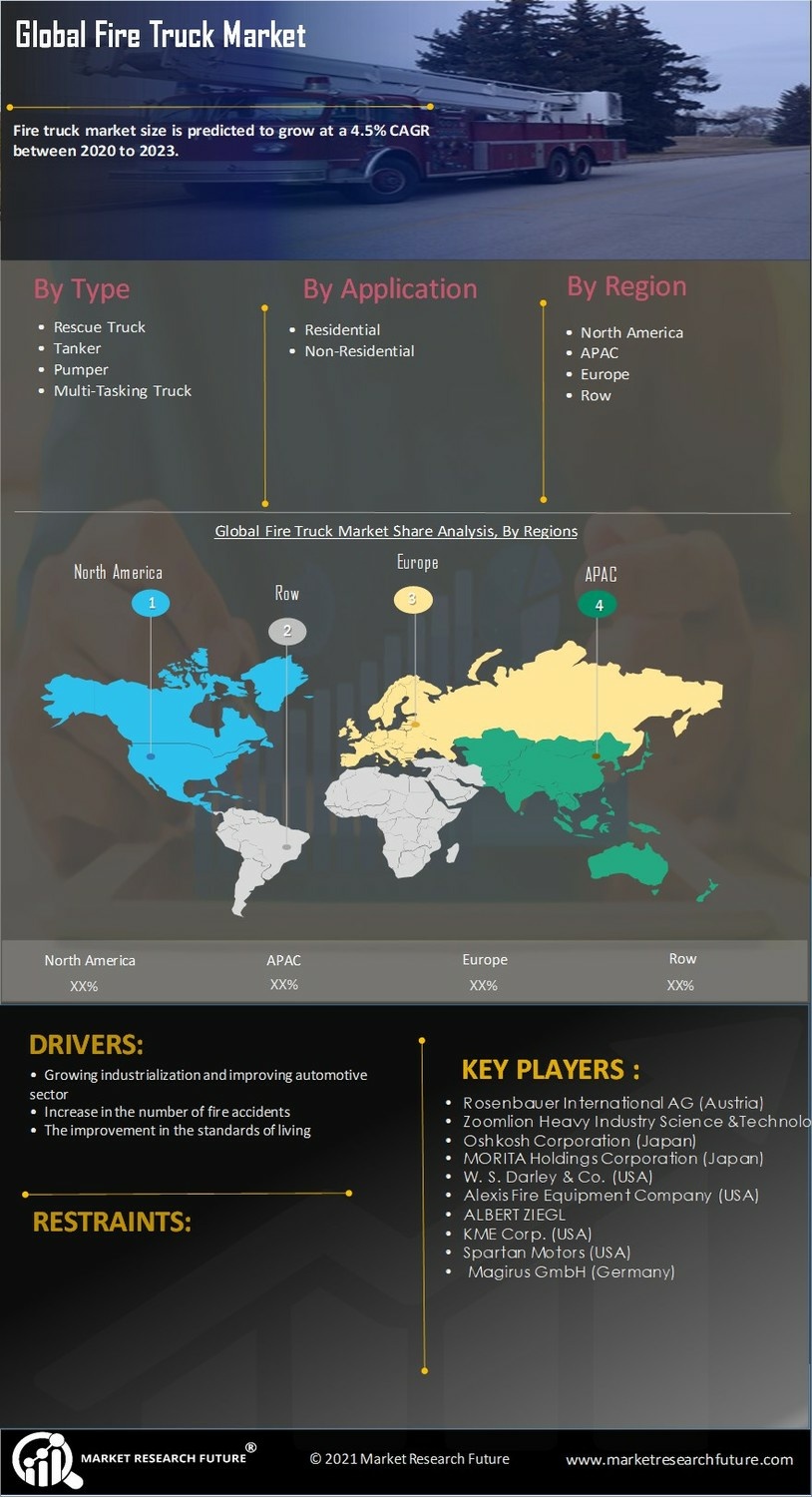
Fire Trucks Market (2026 - 2035)

ID: MRFR/AT/5924-CR 150 Pages Shubham Munde Last Updated: September 02, 2026
Fire Truck Market Research Report By Type (Pumpers, Aerial Ladder & Platform Trucks, Tankers (Water Tenders), Rescue Trucks, Others (ARFF, Wildland, Specialty)), By Application (Residential and Commercial, Airports, Military, Wildland and Forestry, Industrial and Others), By Propulsion (Internal Combustion Engine (ICE), Hybrid, Battery-Electric), By End-User (Municipal Fire Departments, Industrial & Private Fire Brigades, Airport Authorities, Military & Defense) - Forecast to 2035
Fire Trucks Market
Market Size
Forecast Period2026-2035
CAGR (2026-2035)8.09%
2025 Market SizeUSD 10.86 Billion
2035 Market SizeUSD 23.52 Billion
Key Players
Oshkosh Corporation
REV Group, Inc.
Rosenbauer International AG
Magirus GmbH
Morita Holdings Corporation
Albert Ziegler GmbH
Opportunities
  • Refurbishment and Life-Extension Programs
  • Emerging-Market Fleet Formation
  • Telematics and Data-Led Service Contracts
  1. 1 Market Summary | |
    1. 1.1 Study Assumptions & Market Definition | |
    2. 1.2 Scope of the Study | |
    3. 1.3 Research Methodology | |
  2. 2 Key Report Takeaways | |
    1. 2.1 By Technology | |
    2. 2.2 By Sector | |
    3. 2.3 By Region | |
  3. 3 Market Size & Forecast (2021–2035) | |
    1. 3.1 Historical Market Size (2021–2024) | |
    2. 3.2 Base Year Assessment (2025) | |
    3. 3.3 Forecast Market Size (2026–2035) | |
    4. 3.4 Year-over-Year Growth Analysis | |
  4. 4 Driver Impact Analysis | |
    1. 4.1 Replacement Backlog Is the Structural Engine | |
    2. 4.2 Wildfire Economics Have Changed Procurement | |
    3. 4.3 Electrification Moves From Pilot to Policy | |
    4. 4.4 Airport Rescue Fleets Face a Hard Compliance Clock | |
  5. 5 Restraints Impact Analysis | |
    1. 5.1 Lead Times Are the Binding Constraint | |
    2. 5.2 Price Inflation Outruns Municipal Budgets | |
    3. 5.3 Charging Infrastructure Is an Unfunded Line Item | |
  6. 6 Opportunities | |
    1. 6.1 Refurbishment and Life-Extension Programs | |
    2. 6.2 Emerging-Market Fleet Formation | |
    3. 6.3 Telematics and Data-Led Service Contracts | |
    4. 6.4 PFAS-Free Foam Transition | |
    5. 6.5 Modular Platform Standardization | |
  7. 7 Regional Market Share and Country-Level Analysis | |
    1. 7.1 North America | | |
      1. 7.1.1 US | | |
      2. 7.1.2 Canada | | |
      3. 7.1.3 Mexico | |
    2. 7.2 Europe | | |
      1. 7.2.1 Germany | | |
      2. 7.2.2 UK | | |
      3. 7.2.3 France | | |
      4. 7.2.4 Italy | | |
      5. 7.2.5 Spain | | |
      6. 7.2.6 Nordic Countries | | |
      7. 7.2.7 Russia | | |
      8. 7.2.8 Rest of Europe | |
    3. 7.3 Asia-Pacific | | |
      1. 7.3.1 China | | |
      2. 7.3.2 India | | |
      3. 7.3.3 Japan | | |
      4. 7.3.4 South Korea | | |
      5. 7.3.5 ASEAN | | |
      6. 7.3.6 Rest of Asia-Pacific | |
    4. 7.4 South America | | |
      1. 7.4.1 Brazil | | |
      2. 7.4.2 Argentina | | |
      3. 7.4.3 Rest of South America | |
    5. 7.5 Middle East & Africa | | |
      1. 7.5.1 Saudi Arabia | | |
      2. 7.5.2 UAE | | |
      3. 7.5.3 South Africa | | |
      4. 7.5.4 Egypt | | |
      5. 7.5.5 Rest of Middle East & Africa | |
  8. 8 Future Outlook (2026–2035) | |
    1. 8.1 Autonomy Arrives Sideways | |
    2. 8.2 Electrification Compounds Rather Than Spikes | |
    3. 8.3 Service Revenue Reshapes the Business Model | |
    4. 8.4 Procurement Transparency Becomes a Regulatory Theme | |
  9. 9 Segmentation Analysis | |
    1. 9.1 By Type | | |
      1. 9.1.1 Pumpers | | |
      2. 9.1.2 Aerial Ladder & Platform Trucks | | |
      3. 9.1.3 Tankers (Water Tenders) | | |
      4. 9.1.4 Rescue Trucks | | |
      5. 9.1.5 Others (ARFF, Wildland, Specialty) | |
    2. 9.2 By Application | | |
      1. 9.2.1 Residential and Commercial | | |
      2. 9.2.2 Airports | | |
      3. 9.2.3 Military | | |
      4. 9.2.4 Wildland and Forestry | | |
      5. 9.2.5 Industrial and Others | |
    3. 9.3 By Propulsion | | |
      1. 9.3.1 Internal Combustion Engine (ICE) | | |
      2. 9.3.2 Hybrid | | |
      3. 9.3.3 Battery-Electric | |
    4. 9.4 By End-User | | |
      1. 9.4.1 Municipal Fire Departments | | |
      2. 9.4.2 Industrial & Private Fire Brigades | | |
      3. 9.4.3 Airport Authorities | | |
      4. 9.4.4 Military & Defense | |
  10. 10 Competitive Landscape | |
    1. 10.1 Market Concentration Analysis (2026) | |
    2. 10.2 Competitive Benchmarking Matrix | |
    3. 10.3 Company Profiles | | |
      1. 10.3.1 Oshkosh Corporation (Pierce Manufacturing) | | |
      2. 10.3.2 REV Group, Inc. | | |
      3. 10.3.3 Rosenbauer International AG | | |
      4. 10.3.4 Magirus GmbH | | |
      5. 10.3.5 Morita Holdings Corporation | | |
      6. 10.3.6 Albert Ziegler GmbH | | |
      7. 10.3.7 Sutphen Corporation | | |
      8. 10.3.8 NAFFCO FZCO | | |
      9. 10.3.9 Bronto Skylift Oy Ab | | |
      10. 10.3.10 W.S. Darley & Co. | | |
      11. 10.3.11 Gimaex Group | | |
      12. 10.3.12 Iturri Group | |
  11. 11 Recent News & Developments | |
  12. 12 Report Scope and Methodology | |
    1. 12.1 Study Period & Base Year | |
    2. 12.2 Valuation Currency & Units | |
    3. 12.3 Abbreviations | |
  13. 13 Detailed Sources and Citations | |
  14. 14 Frequently Asked Questions | | LIST OF TABLES | |
  15. TABLE 1 Global Fire Truck Market Size & Forecast, by Revenue (USD Billion), 2021–2035 | |
  16. TABLE 2 Global Fire Truck Market — Year-over-Year Growth Analysis, 2021–2035 | |
  17. TABLE 3 Driver Impact Analysis — Fire Truck Market, 2026–2035 | |
  18. TABLE 4 Restraint Impact Analysis — Fire Truck Market, 2026–2035 | |
  19. TABLE 5 Global Fire Truck Market Size, by Region, 2021–2035 (USD Billion) | |
  20. TABLE 6 North America Fire Truck Market Size, by Country, 2021–2035 (USD Billion) | |
  21. TABLE 7 Europe Fire Truck Market Size, by Country, 2021–2035 (USD Billion) | |
  22. TABLE 8 Asia-Pacific Fire Truck Market Size, by Country, 2021–2035 (USD Billion) | |
  23. TABLE 9 South America Fire Truck Market Size, by Country, 2021–2035 (USD Billion) | |
  24. TABLE 10 Middle East & Africa Fire Truck Market Size, by Country, 2021–2035 (USD Billion) | |
  25. TABLE 11 Global Fire Truck Market Size, by Type, 2021–2035 (USD Billion) | |
  26. TABLE 12 Global Fire Truck Market Size, by Application, 2021–2035 (USD Billion) | |
  27. TABLE 13 Global Fire Truck Market Size, by Propulsion, 2021–2035 (USD Billion) | |
  28. TABLE 14 Global Fire Truck Market Size, by End-User, 2021–2035 (USD Billion) | |
  29. TABLE 15 North America Fire Truck Market Size, by Type and Propulsion, 2021–2035 (USD Billion) | |
  30. TABLE 16 Europe Fire Truck Market Size, by Type and Propulsion, 2021–2035 (USD Billion) | |
  31. TABLE 17 Asia-Pacific Fire Truck Market Size, by Type and Propulsion, 2021–2035 (USD Billion) | |
  32. TABLE 18 South America Fire Truck Market Size, by Application and End-User, 2021–2035 (USD Billion) | |
  33. TABLE 19 Middle East & Africa Fire Truck Market Size, by Application and End-User, 2021–2035 (USD Billion) | |
  34. TABLE 20 Competitive Benchmarking Matrix — Global Fire Truck Market, 2026 | |
  35. TABLE 21 Company Profiles — Key Players, Global Fire Truck Market | |
  36. TABLE 22 Recent Developments & Strategic Announcements, 2023–2025 | |
  37. TABLE 23 Report Scope & Methodology Summary | |
  38. TABLE 24 Detailed Sources and Citations Index | | LIST OF FIGURES | |
  39. FIGURE 1 Global Fire Truck Market — Market Dynamics Snapshot (Drivers, Restraints, Opportunities) | |
  40. FIGURE 2 Industry Value Chain Analysis — Fire Truck Market | |
  41. FIGURE 3 Porter's Five Forces Analysis — Fire Truck Market | |
  42. FIGURE 4 Global Fire Truck Market Size Trend, 2021–2035 (USD Billion) | |
  43. FIGURE 5 Year-over-Year Growth Trajectory, 2022–2035 (%) | |
  44. FIGURE 6 Market Share by Type, 2025 vs. 2035 (%) | |
  45. FIGURE 7 Market Share by Application, 2025 vs. 2035 (%) | |
  46. FIGURE 8 Market Share by Propulsion, 2025 vs. 2035 (%) | |
  47. FIGURE 9 Market Share by End-User, 2025 (%) | |
  48. FIGURE 10 Regional Revenue Share Distribution, 2025 (%) | |
  49. FIGURE 11 Regional CAGR Comparison, 2026–2035 (%) | |
  50. FIGURE 12 Country-Level Contribution Heat Map, 2025 | |
  51. FIGURE 13 Competitive Landscape — Estimated Revenue Share Ranges, 2026 | |
  52. FIGURE 14 Strategic Positioning Matrix — Leading Manufacturers | |
  53. FIGURE 15 Electrification Adoption Curve, 2026–2035

Segmentation Quick Reference

DimensionSub-SegmentsDominant SegmentFastest Growing Segment
By TypePumpers; Aerial Ladder & Platform Trucks; Tankers (Water Tenders); Rescue Trucks; Others (ARFF, Wildland, Specialty)PumpersTankers (Water Tenders)
By ApplicationResidential and Commercial; Airports; Military; Wildland and Forestry; Industrial and OthersResidential and CommercialWildland and Forestry
By PropulsionInternal Combustion Engine (ICE); Hybrid; Battery-ElectricInternal Combustion Engine (ICE)Battery-Electric
By End-UserMunicipal Fire Departments; Industrial & Private Fire Brigades; Airport Authorities; Military & DefenseMunicipal Fire DepartmentsAirport Authorities
By RegionNorth America; Europe; Asia-Pacific; South America; Middle East & AfricaNorth AmericaAsia-Pacific


Market Segmentation Overview

By Type

Sub-SegmentKey Trend
PumpersStandardized modular bodies shorten build slots and stabilize pricing
Aerial Ladder & Platform TrucksReach requirements climbing past 30 m as urban building stock rises
Tankers (Water Tenders)Rural volunteer staffing decline drives larger onboard water capacity
Rescue TrucksTechnical rescue and extrication call volumes outpace fire calls
Others (ARFF, Wildland, Specialty)Airport category upgrades and interface fire risk expand niche volumes


Type mix in the Fire Truck Market is shifting at the margins rather than the core. Pumpers remain the volume anchor, but the growth differential sits with tankers and specialty configurations that answer specific operational gaps — water supply in unhydranted districts and rapid-attack capability at the wildland-urban interface.

By Application

Sub-SegmentKey Trend
Residential and CommercialStatutory response obligations create non-discretionary baseline demand
AirportsICAO Annex 14 category upgrades follow widebody traffic growth
MilitaryFlight-line and installation protection tied to defense budget cycles
Wildland and ForestryRecord acreage burned expands dedicated Type 3 and Type 6 fleets
Industrial and OthersInsurer-mandated on-site brigades at high-hazard facilities


Application demand splits between obligation and escalation. Municipal structural response is stable and predictable; wildland and airport requirements move with external variables — climate and air traffic respectively — which is why both outpace the blended average.

By Propulsion

Sub-SegmentKey Trend
Internal Combustion Engine (ICE)Retains dominance on reliability, range, and existing service infrastructure
HybridBridge technology satisfying emissions rules without operational compromise
Battery-ElectricFalling pack costs push toward unsubsidized total-cost parity by the early 2030s


Propulsion is the segmentation dimension where the Fire Truck Market will look most different in 2035. Diesel keeps the majority through the forecast window, but the share it loses flows disproportionately to battery-electric platforms as station charging capital gets budgeted rather than deferred.

By End-User

Sub-SegmentKey Trend
Municipal Fire DepartmentsGrant cycles and bond referenda govern purchase timing
Industrial & Private Fire BrigadesPetrochemical and data center capex drives specialized foam capability
Airport AuthoritiesRegulatory compliance deadlines create non-negotiable order windows
Military & DefenseMulti-year framework contracts smooth demand volatility


Buyer behavior differs sharply by end-user. Municipalities buy when funding appears; airport authorities and military buyers purchase against fixed compliance and framework schedules, which makes their order flow considerably easier to forecast and more resilient through fiscal downturns.


Download PDF ×

We do not share your information with anyone. However, we may send you emails based on your report interest from time to time. You may contact us at any time to opt-out.