×
Hero Background
English
Chinese
French
Japanese
Korean
German
Spanish

Fiber-Reinforced Plastic Grating Market Analysis

ID: MRFR/CnM/7075-HCR
111 Pages
Anshula Mandaokar
October 2025

Fiber-Reinforced Plastic (FRP) Grating Market Research Report Information By Material Type (Vinyl Ester Resin, Polyester Resin, Others), By Product Type (Molded Fiberglass Gratings, Pultruded Fiberglass Gratings), By End-Use (Building and Construction, Wastewater Treatment, Chemical, Food & Beverages, Oil & Gas, Others) - Forecast to 2035

Share:
Download PDF ×

We do not share your information with anyone. However, we may send you emails based on your report interest from time to time. You may contact us at any time to opt-out.

Fiber-Reinforced Plastic Grating Market Infographic
Purchase Options

Market Analysis

In-depth Analysis of Fiber-Reinforced Plastic Grating Market Industry Landscape

The Fiber-Reinforced Plastic (FRP) Grating market is characterized by dynamic factors that influence the production, demand, and applications of these high-performance materials widely used in industrial and commercial settings. FRP grating, composed of reinforced plastic fibers such as fiberglass, offers superior strength, corrosion resistance, and durability. The market dynamics are intricately linked to factors such as industrial growth, infrastructure development, and the increasing preference for lightweight, corrosion-resistant materials.

One of the key drivers of the FRP Grating market is the demand from industries requiring durable, corrosion-resistant flooring solutions. FRP gratings find applications in chemical processing plants, oil and gas facilities, water treatment plants, and marine environments where exposure to corrosive substances and harsh conditions is prevalent. The use of FRP gratings in these settings helps enhance safety, reduce maintenance costs, and improve the longevity of flooring systems.

The construction and infrastructure sector represents a significant influencer of the FRP Grating market dynamics. FRP gratings are used in construction projects for applications such as walkways, platforms, and bridges. The lightweight nature of FRP gratings facilitates easier installation and transportation while providing high load-bearing capacity. As infrastructure projects continue to grow globally, the demand for corrosion-resistant and durable materials like FRP gratings increases.

The offshore and marine industry is another major contributor to the FRP Grating market. The marine environment poses significant challenges, including saltwater corrosion and harsh weather conditions. FRP gratings, with their corrosion resistance and non-slip properties, are widely adopted for marine applications such as ship decks, docks, and offshore platforms. The demand for FRP gratings in the marine industry is driven by the need for materials that can withstand harsh marine environments.

Supply dynamics in the FRP Grating market are influenced by factors such as the availability and cost of raw materials, including fiberglass and resins. The production processes for FRP gratings, such as pultrusion and molding, impact the overall supply chain dynamics. Additionally, advancements in raw material processing and sourcing impact the availability and cost-effectiveness of FRP gratings.

Global trade dynamics play a significant role in the FRP Grating market, with many countries involved in both the production and consumption of FRP-based products. Trade agreements, tariffs, and regional economic conditions can impact the flow of FRP gratings across borders. The market is also influenced by competition among manufacturers to develop innovative FRP grating products with enhanced properties.

Environmental considerations and sustainability initiatives are increasingly shaping the market dynamics of FRP gratings. As industries and consumers prioritize eco-friendly practices, the demand for FRP gratings made from recycled materials or those with low environmental impact is growing. Companies in the FRP Grating market are responding to these concerns by adopting sustainable manufacturing practices and developing environmentally friendly FRP products.

Price volatility is a common factor in the FRP Grating market, driven by fluctuations in raw material prices, manufacturing costs, and market demand. Companies in this dynamic market must implement effective pricing strategies and risk management practices to navigate the uncertainties associated with price variations.

Technological advancements in FRP manufacturing contribute to the market dynamics, enabling the development of grating products with improved strength, resilience, and design flexibility. Innovations in resin formulations, fiber reinforcement techniques, and grating profiles continue to enhance the performance and versatility of FRP gratings, influencing their adoption in various industries.


Author
Anshula Mandaokar
Team Lead - Research

Anshula Mandaokar holds an academic degree in Chemical Engineering and has been contributing to the field for more than 5 years. She has expertise in Market Research and Business Consulting and serves as a Team Lead for a reputed Market Research firm under the Chemicals and Materials domain spectrum. She has worked on multiple projects, generating explicit results in a quick turnaround time. Her understanding of data interpretation justifies her role as a leader.

Leave a Comment

FAQs

At what CAGR is the fiber-reinforced plastic grating market projected to grow during the forecast period?

fiber-reinforced plastic grating market is projected to grow at a 4.52% CAGR between 2025-2035.

What will be the value of the fiber-reinforced plastic grating market during the forecast period?

fiber-reinforced plastic grating market is predicted to touch USD 688.59 million by 2035.

Which region is projected to dominate the fiber-reinforced plastic grating market?

The Asia Pacific is projected to dominate the fiber-reinforced plastic grating market.

What are the key factors driving the fiber-reinforced plastic grating market growth?

Low lifecycle cost and growing demand across different end use industries are the key factors driving the fiber-reinforced plastic grating market growth.

Which factors may limit the fiber-reinforced plastic grating market growth?

High cost related to disposal and recyclability may limit the fiber-reinforced plastic grating market growth.

Market Summary

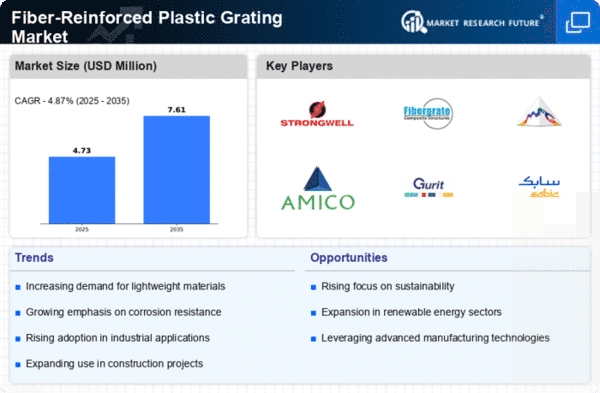
As per MRFR analysis, the Fiber-Reinforced Plastic Grating Market Size was estimated at 4.51 USD Million in 2024. The Fiber-Reinforced Plastic Grating industry is projected to grow from 4.73 in 2025 to 7.61 by 2035, exhibiting a compound annual growth rate (CAGR) of 4.87 during the forecast period 2025 - 2035.

Key Market Trends & Highlights

The Fiber-Reinforced Plastic Grating Market is poised for substantial growth driven by sustainability and technological advancements.

  • The market is witnessing a pronounced shift towards sustainability, with increasing demand for eco-friendly materials.
  • Technological advancements are enhancing the performance and applications of fiber-reinforced plastic grating across various sectors.
  • North America remains the largest market, while the Asia-Pacific region is emerging as the fastest-growing area for fiber-reinforced plastic grating.
  • The growth is primarily driven by sustainability initiatives and safety regulations that promote the use of durable and compliant materials.

Market Size & Forecast

2024 Market Size 4.51 (USD Million)
2035 Market Size 7.61 (USD Million)
CAGR (2025 - 2035) 4.87%
Largest Regional Market Share in 2024 North America

Major Players

<p>Strongwell Corporation (US), Fibergrate Composite Structures (US), Molded Fiber Glass Companies (US), AMICO (US), Gurit Holding AG (CH), SABIC (SA), Hawkeye Industries (US), Creative Composites (US), Cleveland Plastics (US)</p>

Market Trends

The Fiber-Reinforced Plastic Grating Market is currently experiencing a notable transformation, driven by a combination of technological advancements and increasing demand across various sectors. This market encompasses a diverse range of applications, including industrial flooring, walkways, and platforms, which are favored for their lightweight yet durable properties. The growing emphasis on sustainability and environmental considerations is also influencing the adoption of fiber-reinforced plastic materials, as they offer a viable alternative to traditional materials. Furthermore, the market is witnessing innovations in manufacturing processes, which enhance the performance characteristics of these products, making them more appealing to end-users. In addition, the Fiber-Reinforced Plastic Grating Market is likely to benefit from the rising awareness regarding safety and maintenance in industrial environments. The non-corrosive nature of these gratings makes them suitable for harsh conditions, thereby extending their lifespan and reducing replacement costs. As industries continue to prioritize efficiency and safety, the demand for fiber-reinforced plastic solutions is expected to grow. Overall, the market appears poised for expansion, with various factors contributing to its evolution and increased adoption across multiple sectors.

Sustainability Focus

The emphasis on sustainable materials is becoming increasingly prominent within the Fiber-Reinforced Plastic Grating Market. As industries seek to reduce their environmental footprint, the demand for eco-friendly alternatives to traditional materials is rising. This trend is likely to drive innovation in the development of bio-based and recyclable fiber-reinforced plastics.

Technological Advancements

Ongoing technological advancements are reshaping the Fiber-Reinforced Plastic Grating Market. Innovations in manufacturing techniques are enhancing the performance and durability of these products. As a result, end-users are presented with improved options that meet their specific needs, potentially leading to wider adoption.

Safety and Compliance

The growing emphasis on safety regulations in various industries is influencing the Fiber-Reinforced Plastic Grating Market. These materials are recognized for their non-corrosive properties and slip resistance, making them suitable for environments where safety is paramount. This trend may lead to increased demand as companies prioritize compliance with safety standards.

Fiber-Reinforced Plastic Grating Market Market Drivers

Regulatory Support and Standards

Regulatory frameworks and standards are playing a crucial role in the Global Fiber-Reinforced Plastic Grating Market Industry. Governments worldwide are increasingly implementing regulations that promote the use of advanced materials in construction and industrial applications. These regulations often emphasize safety, durability, and environmental impact, thereby encouraging industries to adopt fiber-reinforced plastic grating. For example, compliance with safety standards in hazardous environments drives the demand for this type of grating. As regulatory support continues to strengthen, it is expected to further bolster market growth and adoption across various sectors.

Rising Infrastructure Development

The Global Fiber-Reinforced Plastic Grating Market Industry is poised for growth due to the rising infrastructure development across the globe. As countries invest in modernizing their infrastructure, the demand for durable and lightweight materials like fiber-reinforced plastic grating is increasing. This material is particularly favored in pedestrian walkways, bridges, and industrial flooring due to its strength and resistance to environmental factors. The ongoing global initiatives to enhance infrastructure are likely to contribute to the market's expansion, providing opportunities for manufacturers and suppliers to capitalize on this upward trend.

Growing Demand in Industrial Applications

The Global Fiber-Reinforced Plastic Grating Market Industry is experiencing a surge in demand driven by its extensive applications in various industrial sectors. Industries such as oil and gas, chemical processing, and wastewater treatment are increasingly adopting fiber-reinforced plastic grating due to its corrosion resistance and lightweight properties. For instance, in the oil and gas sector, the use of this grating enhances safety and operational efficiency, as it can withstand harsh environments. The market is projected to reach 681.7 USD Million in 2024, reflecting the growing reliance on advanced materials that offer durability and safety in industrial settings.

Technological Advancements in Manufacturing

Technological advancements are significantly shaping the Global Fiber-Reinforced Plastic Grating Market Industry. Innovations in manufacturing processes, such as improved resin formulations and automated production techniques, enhance the performance and reduce the costs of fiber-reinforced plastic grating. These advancements not only improve the mechanical properties of the grating but also expand its application range across various sectors, including construction and marine environments. As a result, the market is likely to witness a steady growth rate, with a projected CAGR of 1.31% from 2025 to 2035, reflecting the ongoing evolution of production technologies.

Sustainability and Environmental Considerations

Sustainability is becoming a pivotal factor influencing the Global Fiber-Reinforced Plastic Grating Market Industry. As industries strive to reduce their carbon footprint, the demand for eco-friendly materials is on the rise. Fiber-reinforced plastic grating, being recyclable and requiring less energy for production compared to traditional materials, aligns with these sustainability goals. This shift is particularly evident in construction and infrastructure projects, where environmentally conscious choices are prioritized. The anticipated growth in this market segment suggests that by 2035, the market could reach 786.2 USD Million, indicating a robust trend towards sustainable industrial practices.

Market Segment Insights

By Application: Industrial (Largest) vs. Commercial (Fastest-Growing)

<p>In the Fiber-Reinforced Plastic Grating Market, the application segments reveal distinct patterns in market share distribution. The industrial sector holds the largest portion, driven by the need for durable and corrosion-resistant materials in manufacturing and processing facilities. Following closely is the commercial segment, which is witnessing rapid adoption due to increasing demand for modern architectural designs and safety in various public and private structures. As the market develops, growth trends indicate that the commercial segment is emerging as the fastest-growing area, fueled by innovations in aesthetics, lightweight designs, and customization options. Meanwhile, the industrial segment continues to benefit from ongoing industrialization and the implementation of stringent safety standards, bolstering its substantial market share position over time.</p>

<p>Industrial (Dominant) vs. Commercial (Emerging)</p>

<p>The industrial application of Fiber-Reinforced Plastic Grating remains the dominant force in the market due to its unparalleled durability and resistance to harsh chemicals and environmental conditions. This segment is characterized by a wide range of applications in manufacturing, petrochemicals, and food processing industries, where safety and longevity are paramount. On the other hand, the commercial segment is emerging rapidly, appealing to architects and builders with its lightweight nature and flexibility in design. This segment caters to aesthetic demands while maintaining safety standards, often being utilized in walkways, stairs, and outdoor spaces. The dynamic growth in commercial applications signifies a shift towards innovative designs without compromising on functionality.</p>

By End Use: Construction (Largest) vs. Water Treatment (Fastest-Growing)

<p>The Fiber-Reinforced Plastic Grating Market is showing a varied distribution of market share among its key end-use applications. Notably, the construction sector holds the largest share due to its extensive use in flooring, walkways, and safety applications, which leverage the material's strength and lightweight properties. Following closely are the water treatment and chemical processing sectors, which also utilize FRP gratings for their corrosion resistance and durability in harsh environments.</p>

<p>Construction (Dominant) vs. Water Treatment (Emerging)</p>

<p>The construction sector is the dominant end-use market for Fiber-Reinforced Plastic Grating, primarily driven by its high demand for lightweight, non-corrosive materials that enhance safety and efficiency in infrastructure projects. FRP gratings provide significant advantages such as ease of installation and minimal maintenance, which are crucial in large-scale construction endeavors. In contrast, the water treatment sector is emerging as a fast-growing segment, fueled by increasing investments in environmental protection and wastewater management. This sector benefits from FRP's resistance to aggressive chemicals, making it ideal for various treatment processes. The synergy of durability and functionality positions both sectors for sustained growth in the coming years.</p>

By Material Type: Polyester (Largest) vs. Vinyl Ester (Fastest-Growing)

<p>In the Fiber-Reinforced Plastic Grating Market, the material type segment showcases a diverse range of options, with Polyester holding the largest market share due to its cost-effectiveness and versatility. It is widely used across various applications, including industrial and commercial sectors. Vinyl Ester, while smaller in share, is emerging rapidly due to its superior corrosion resistance and strength, appealing to industries requiring high-performance materials, hence making it the fastest-growing segment in this category.</p>

<p>Polyester (Dominant) vs. Vinyl Ester (Emerging)</p>

<p>Polyester grating is recognized for its affordability and adaptability, making it a preferred choice for many applications, including walkways and platforms. Its robust properties enable it to withstand diverse environmental conditions, enhancing overall durability. On the other hand, Vinyl Ester, characterized by its exceptional resistance to harsh chemicals and high temperatures, is gaining traction in specialized industries such as marine and chemical processing. This growth is attributed to increasing demands for materials that offer enhanced longevity and safety, thus positioning Vinyl Ester as an emerging player in the market alongside the established Polyester.</p>

By Manufacturing Process: Pultrusion (Largest) vs. Molding (Fastest-Growing)

<p>In the Fiber-Reinforced Plastic Grating Market, the manufacturing processes play a crucial role in determining product characteristics and applications. Pultrusion leads the market with its efficiency and ability to produce continuous lengths of grating with high dimensional accuracy. Molding, on the other hand, is gaining traction and is recognized as the fastest-growing segment due to advancements in technology that enhance production flexibility and reduce costs. The growth trends in manufacturing processes are significantly influenced by the rising demand for lightweight and corrosion-resistant materials in various industries. The push towards sustainable solutions is prompting manufacturers to optimize their processes, notably in molding techniques that utilize recyclable materials. Increasing investments in research and development also support innovations, affirming the ongoing evolution of the Fiber-Reinforced Plastic Grating sector.</p>

<p>Pultrusion (Dominant) vs. Hand Lay-Up (Emerging)</p>

<p>Pultrusion stands out as the dominant manufacturing process in the Fiber-Reinforced Plastic Grating Market due to its ability to produce high-strength grating panels with consistent quality. This method involves drawing continuous fibers through a resin bath and then curing them, resulting in lightweight but robust products suitable for various applications. In contrast, Hand Lay-Up emerges as a more traditional and artisanal approach, often utilized for custom projects and smaller runs. While it offers flexibility in design and the ability to work with complex shapes, it typically requires more labor and time, making it less efficient compared to automated processes like pultrusion. This difference in efficiency and scalability influences their market positions, with pultrusion leading in mass production scenarios and hand lay-up catering to niche markets.</p>

By Load Capacity: Heavy Duty (Largest) vs. Light Duty (Fastest-Growing)

<p>In the Fiber-Reinforced Plastic Grating Market, the load capacity segment is divided into four main categories: Light Duty, Medium Duty, Heavy Duty, and Extra Heavy Duty. Among these, Heavy Duty grating holds the largest market share, preferred for demanding industrial applications. In contrast, Light Duty grating is gaining traction due to its suitability for residential and light commercial use, appealing to a different market segment. The distribution of market shares indicates a strong preference towards Heavy Duty applications while showcasing a growing interest in the flexibility and cost-effectiveness of Light Duty solutions. Growth trends indicate that while Heavy Duty grating remains a standard for industry equipment, Light Duty is emerging as a crucial segment driven by the demand for lighter and less expensive alternatives. Factors such as the rise in DIY projects and the increasing popularity of outdoor living spaces are leading to a surge in Light Duty applications. Additionally, sustainability trends are influencing preference as manufacturers develop more eco-friendly Light Duty options, positioning them well for future market expansion.</p>

<p>Heavy Duty (Dominant) vs. Light Duty (Emerging)</p>

<p>In the Fiber-Reinforced Plastic Grating Market, Heavy Duty grating is characterized by its robust construction and ability to withstand intense loads and harsh environmental conditions. This segment is widely utilized in heavy industrial applications such as petrochemical plants, water treatment facilities, and heavy manufacturing, where durability is a prime concern. Its market dominance is attributed to the reliance on sturdy materials that ensure safety and longevity. On the other hand, Light Duty grating represents an emerging market segment, tailored for less demanding applications such as walkways, patios, and light commercial environments. Its appeal lies in its lightweight nature, ease of installation, and cost-effectiveness. The growth of this segment is propelled by trends towards user-friendly and sustainable building solutions, catering to both professional and residential users.</p>

Get more detailed insights about Fiber-Reinforced Plastic (FRP) Grating Market Research Report - Forecast till 2035

Regional Insights

North America : Market Leader in Grating Solutions

North America is poised to maintain its leadership in the Fiber-Reinforced Plastic Grating Market, holding a significant market share of 2.26 million units as of 2024. The region's growth is driven by increasing demand in construction, infrastructure, and industrial applications, alongside stringent safety regulations that favor lightweight and corrosion-resistant materials. The push for sustainable building practices further catalyzes market expansion, as companies seek eco-friendly alternatives. The competitive landscape is robust, with key players such as Strongwell Corporation, Fibergrate Composite Structures, and Molded Fiber Glass Companies leading the charge. The U.S. remains the dominant country, supported by a strong manufacturing base and innovation in composite materials. The presence of established firms ensures a steady supply chain and technological advancements, positioning North America as a hub for fiber-reinforced plastic solutions.

Europe : Emerging Market with Growth Potential

Europe's Fiber-Reinforced Plastic Grating Market is on the rise, with a market size of 1.2 million units. The region is increasingly focusing on sustainability and environmental regulations, which are driving demand for lightweight and durable materials in various sectors, including construction and transportation. The European Union's commitment to reducing carbon emissions is a significant catalyst for adopting innovative materials, enhancing market growth prospects. Leading countries in this region include Germany, France, and the UK, where a strong emphasis on infrastructure development and renewable energy projects is evident. Key players like Gurit Holding AG and SABIC are actively investing in R&D to meet the evolving market needs. The competitive landscape is characterized by a mix of established companies and emerging startups, fostering innovation and collaboration in the fiber-reinforced plastic sector.

Asia-Pacific : Rapid Growth in Emerging Economies

The Asia-Pacific region is witnessing significant growth in the Fiber-Reinforced Plastic Grating Market, with a market size of 0.9 million units. This growth is primarily driven by rapid industrialization, urbanization, and increasing investments in infrastructure projects across countries like China and India. The demand for lightweight and durable materials is rising, particularly in the construction and automotive sectors, as companies seek to enhance efficiency and reduce costs. China is the leading country in this market, supported by a robust manufacturing base and government initiatives promoting advanced materials. The competitive landscape features both local and international players, including Hawkeye Industries and Creative Composites. As the region continues to develop, the presence of key players and increasing awareness of fiber-reinforced plastics will likely drive further market expansion.

Middle East and Africa : Emerging Market with Challenges

The Middle East and Africa region represents a nascent market for Fiber-Reinforced Plastic Grating, with a market size of 0.15 million units. The growth in this region is primarily driven by increasing investments in infrastructure and construction projects, particularly in the Gulf Cooperation Council (GCC) countries. The demand for lightweight and corrosion-resistant materials is gaining traction as industries seek to improve efficiency and reduce maintenance costs. Countries like the UAE and Saudi Arabia are leading the way in adopting advanced materials, supported by government initiatives aimed at diversifying economies. However, challenges such as limited awareness and high initial costs may hinder market penetration. Key players are beginning to establish a presence, indicating potential for future growth as the market matures.

Key Players and Competitive Insights

The Fiber-Reinforced Plastic Grating Market is currently characterized by a dynamic competitive landscape, driven by increasing demand for lightweight, corrosion-resistant materials across various industries, including construction, marine, and chemical processing. Key players such as Strongwell Corporation (US), Fibergrate Composite Structures (US), and Gurit Holding AG (CH) are strategically positioning themselves through innovation and regional expansion. Strongwell Corporation (US) focuses on enhancing its product offerings through continuous research and development, while Fibergrate Composite Structures (US) emphasizes partnerships to broaden its market reach. Gurit Holding AG (CH) appears to be leveraging its expertise in composite materials to penetrate new markets, thereby shaping a competitive environment that is increasingly focused on technological advancements and customer-centric solutions.

In terms of business tactics, companies are localizing manufacturing to reduce lead times and optimize supply chains, which is particularly crucial in a moderately fragmented market. This approach not only enhances operational efficiency but also allows for better responsiveness to regional demands. The collective influence of these key players fosters a competitive structure that encourages innovation and collaboration, ultimately benefiting end-users through improved product offerings and services.

In November 2025, Strongwell Corporation (US) announced the launch of a new line of eco-friendly grating products designed to meet the growing demand for sustainable construction materials. This strategic move is significant as it aligns with global trends towards sustainability, potentially attracting environmentally conscious customers and enhancing the company's market position.

In October 2025, Fibergrate Composite Structures (US) entered into a strategic partnership with a leading construction firm to supply custom grating solutions for a major infrastructure project. This collaboration not only expands Fibergrate's market presence but also demonstrates its commitment to providing tailored solutions that meet specific client needs, thereby reinforcing its competitive edge.

In September 2025, Gurit Holding AG (CH) acquired a smaller composite materials company to enhance its product portfolio and technological capabilities. This acquisition is likely to strengthen Gurit's position in the market by integrating advanced technologies and expanding its manufacturing capabilities, which could lead to increased market share and improved customer offerings.

As of December 2025, the competitive trends in the Fiber-Reinforced Plastic Grating Market are increasingly defined by digitalization, sustainability, and the integration of AI technologies. Strategic alliances are becoming more prevalent, as companies recognize the value of collaboration in driving innovation and enhancing supply chain reliability. Looking ahead, competitive differentiation is expected to evolve from traditional price-based competition towards a focus on innovation, technological advancements, and sustainable practices, suggesting a transformative shift in how companies position themselves in the market.

Key Companies in the Fiber-Reinforced Plastic Grating Market market include

Industry Developments

Future Outlook

Fiber-Reinforced Plastic Grating Market Future Outlook

<p>The Fiber-Reinforced Plastic Grating Market is projected to grow at a 4.87% CAGR from 2024 to 2035, driven by increasing demand in construction, industrial applications, and environmental sustainability.</p>

New opportunities lie in:

  • <p>Expansion into renewable energy sector applications</p>
  • <p>Development of customized grating solutions for niche markets</p>
  • <p>Investment in advanced manufacturing technologies for cost reduction</p>

<p>By 2035, the market is expected to achieve robust growth, solidifying its position in various industries.</p>

Market Segmentation

Fiber-Reinforced Plastic Grating Market End Use Outlook

  • Construction
  • Water Treatment
  • Chemical Processing
  • Oil and Gas
  • Food Processing

Fiber-Reinforced Plastic Grating Market Application Outlook

  • Industrial
  • Commercial
  • Residential
  • Marine
  • Transportation

Fiber-Reinforced Plastic Grating Market Load Capacity Outlook

  • Light Duty
  • Medium Duty
  • Heavy Duty
  • Extra Heavy Duty

Fiber-Reinforced Plastic Grating Market Material Type Outlook

  • Polyester
  • Vinyl Ester
  • Epoxy
  • Phenolic
  • Thermoplastic

Fiber-Reinforced Plastic Grating Market Manufacturing Process Outlook

  • Pultrusion
  • Molding
  • Extrusion
  • Lamination
  • Hand Lay-Up

Report Scope

MARKET SIZE 20244.51(USD Million)
MARKET SIZE 20254.73(USD Million)
MARKET SIZE 20357.61(USD Million)
COMPOUND ANNUAL GROWTH RATE (CAGR)4.87% (2024 - 2035)
REPORT COVERAGERevenue Forecast, Competitive Landscape, Growth Factors, and Trends
BASE YEAR2024
Market Forecast Period2025 - 2035
Historical Data2019 - 2024
Market Forecast UnitsUSD Million
Key Companies ProfiledStrongwell Corporation (US), Fibergrate Composite Structures (US), Molded Fiber Glass Companies (US), AMICO (US), Gurit Holding AG (CH), SABIC (SA), Hawkeye Industries (US), Creative Composites (US), Cleveland Plastics (US)
Segments CoveredApplication, End Use, Material Type, Manufacturing Process, Load Capacity
Key Market OpportunitiesGrowing demand for lightweight, corrosion-resistant materials in industrial applications drives Fiber-Reinforced Plastic Grating Market expansion.
Key Market DynamicsRising demand for lightweight, corrosion-resistant materials drives innovation in the Fiber-Reinforced Plastic Grating Market.
Countries CoveredNorth America, Europe, APAC, South America, MEA

FAQs

At what CAGR is the fiber-reinforced plastic grating market projected to grow during the forecast period?

fiber-reinforced plastic grating market is projected to grow at a 4.52% CAGR between 2025-2035.

What will be the value of the fiber-reinforced plastic grating market during the forecast period?

fiber-reinforced plastic grating market is predicted to touch USD 688.59 million by 2035.

Which region is projected to dominate the fiber-reinforced plastic grating market?

The Asia Pacific is projected to dominate the fiber-reinforced plastic grating market.

What are the key factors driving the fiber-reinforced plastic grating market growth?

Low lifecycle cost and growing demand across different end use industries are the key factors driving the fiber-reinforced plastic grating market growth.

Which factors may limit the fiber-reinforced plastic grating market growth?

High cost related to disposal and recyclability may limit the fiber-reinforced plastic grating market growth.

  1. Executive Summary
  2. Market Introduction
    1. Market Definition
    2. Scope of the Study
    3. List of Assumptions
    4. Markets Structure
  3. Market Research Methodology
    1. Research
    2. Process
    3. Primary Research
    4. Secondary Research
    5. Market
    6. Size Estimation
    7. Forecast Model
  4. Market Dynamics of the Global Fiber-Reinforced
    1. Plastic (FRP) Grating Market
    2. Introduction
    3. Drivers
    4. Restraints
    5. Opportunities
    6. Challenges
    7. Trends/Technology
  5. Market Factor Analysis of the Global Fiber-Reinforced Plastic (FRP) Grating
    1. Market
    2. Supply Chain Analysis
      1. Raw Material Type Suppliers
      2. Manufacturers/Producers
      3. Distributors/Retailers/Wholesalers/E-Commerce
      4. End-Use Industry
    3. Porter’s Five Forces Analysis
      1. Bargaining Power of Buyers
      2. Bargaining
      3. Threat of Substitutes
      4. Intensity of Competitive
    4. Threat of New Entrants
    5. Power of Suppliers
    6. Rivalry
    7. Pricing Analysis
  6. Global Fiber-Reinforced Plastic (FRP)
  7. Grating Market, by Material Type
    1. Introduction
    2. Vinyl Ester Resin
      1. Market Estimates & Forecast, 2020−2027
      2. Market Estimates
    3. & Forecast, by Region, 2020−2027
    4. Polyester Resin
      1. Market
      2. Market Estimates & Forecast,
    5. Estimates & Forecast, 2020−2027
    6. by Region, 2020−2027
    7. Others
      1. Market Estimates & Forecast,
      2. Market Estimates & Forecast, by Region, 2020−2027
  8. Global Fiber-Reinforced Plastic (FRP) Grating Market, by Product Type
    1. Introduction
    2. Molded Fiberglass Grating
      1. Market Estimates &
      2. Market Estimates & Forecast, by Region,
    3. Forecast, 2020−2027
    4. Pultruded Fiberglass Grating
      1. Market Estimates
      2. Market Estimates & Forecast, by Region,
    5. & Forecast, 2020−2027
  9. Global Fiber-Reinforced Plastic (FRP) Grating Market, by
    1. End-Use Industry
    2. Introduction
    3. Building and construction
      1. Market Estimates &
    4. Market Estimates & Forecast, 2020−2027
    5. Forecast, by Region, 2020−2027
    6. Water & wastewater Treatment
      1. Market Estimates & Forecast, 2020−2027
      2. Market Estimates
    7. & Forecast, by Region, 2020−2027
    8. Chemical
      1. Market Estimates
      2. Market Estimates & Forecast, by Region,
    9. & Forecast, 2020−2027
    10. Food & beverages
      1. Market Estimates &
      2. Market Estimates & Forecast, by Region,
    11. Forecast, 2020−2027
    12. Oil & Gas
      1. Market Estimates & Forecast,
      2. Market Estimates & Forecast, by Region, 2020−2027
    13. Others
      1. Market Estimates & Forecast, 2020−2027
  10. Market Estimates & Forecast, by Region, 2020−2027
  11. Global Fiber-Reinforced
  12. Plastic (FRP) Grating Market, by Region
    1. Introduction
    2. North America
      1. Market Estimates & Forecast, 2020−2027
      2. Market Estimates
      3. Market Estimates &
      4. Market Estimates & Forecast,
      5. US
      6. Canada
    3. & Forecast, by Material Type, 2020−2027
    4. Forecast, by Product Type, 2020−2027
    5. by End-Use Industry, 2020−2027
    6. & Forecast, 2020−2027
    7. Material Type, 2020−2027
    8. Product Type, 2020−2027
    9. Industry, 2020−2027
    10. Forecast, 2020−2027
    11. Type, 2020−2027
    12. Europe
      1. Market Estimates & Forecast, 2020−2027
      2. Market Estimates & Forecast, by Material Type, 2020−2027
  13. Market Estimates & Forecast, by Product Type, 2020−2027
    1. Estimates & Forecast, by End-Use Industry, 2020−2027
    2. & Forecast, by Material Type, 2020−2027
    3. & Forecast, by Product Type, 2020−2027
    4. Forecast, by End-Use Industry, 2020−2027
    5. Estimates & Forecast, 2020−2027
    6. by Material Type, 2020−2027
    7. by Product Type, 2020−2027
    8. End-Use Industry, 2020−2027
    9. & Forecast, 2020−2027
    10. Material Type, 2020−2027
    11. Product Type, 2020−2027
    12. Industry, 2020−2027
  14. Market
  15. Germany
  16. Market Estimates & Forecast, 2020−2027
  17. Market Estimates
  18. Market Estimates
  19. Market Estimates &
  20. France
  21. Market
  22. Market Estimates & Forecast,
  23. Market Estimates & Forecast,
  24. Market Estimates & Forecast, by
  25. Italy
  26. Market Estimates
  27. Market Estimates & Forecast, by
  28. Market Estimates & Forecast, by
  29. Market Estimates & Forecast, by End-Use
  30. Spain
  31. Market Estimates & Forecast,
  32. Market Estimates & Forecast, by Material Type,
  33. Market Estimates & Forecast, by Product Type, 2020−2027
  34. Market Estimates & Forecast, by End-Use Industry, 2020−2027
  35. UK
  36. Market Estimates & Forecast, 2020−2027
  37. Market Estimates & Forecast, by Material Type, 2020−2027
  38. Market Estimates & Forecast, by Product Type, 2020−2027
    1. Estimates & Forecast, by End-Use Industry, 2020−2027
    2. Estimates & Forecast, by Material Type, 2020−2027
    3. Estimates & Forecast, by Product Type, 2020−2027
    4. Estimates & Forecast, by End-Use Industry, 2020−2027
    5. Estimates & Forecast, by Material Type, 2020−2027
    6. Estimates & Forecast, by Product Type, 2020−2027
    7. Estimates & Forecast, by End-Use Industry, 2020−2027
    8. of Europe
  39. Market
  40. Russia
  41. Market Estimates & Forecast, 2020−2027
  42. Market
  43. Market
  44. Market
  45. Poland
  46. Market Estimates & Forecast, 2020−2027
  47. Market
  48. Market
  49. Market
  50. Rest
  51. Market Estimates & Forecast, 2020−2027
  52. Market Estimates & Forecast, by Material Type, 2020−2027
  53. Market Estimates & Forecast, by Product Type, 2020−2027
  54. Market Estimates & Forecast, by End-Use Industry, 2020−2027
    1. Asia-Pacific
      1. Market Estimates & Forecast, 2020−2027
      2. Market Estimates
      3. Market Estimates &
      4. Market Estimates & Forecast,
      5. China
      6. India
      7. Japan
    2. & Forecast, by Material Type, 2020−2027
    3. Forecast, by Product Type, 2020−2027
    4. by End-Use Industry, 2020−2027
    5. & Forecast, 2020−2027
    6. Material Type, 2020−2027
    7. Product Type, 2020−2027
    8. Industry, 2020−2027
  55. Market Estimates & Forecast, by Material Type, 2020−2027
  56. Market Estimates & Forecast, by Product Type, 2020−2027
    1. Estimates & Forecast, by End-Use Industry, 2020−2027
    2. & New Zealand
  57. Market
  58. Australia
  59. Market Estimates & Forecast, 2020−2027
  60. Market Estimates & Forecast, by Material Type, 2020−2027
  61. Market Estimates & Forecast, by Product Type, 2020−2027
  62. Market Estimates & Forecast, by End-Use Industry, 2020−2027
    1. Rest of Asia-Pacific
  63. Market Estimates & Forecast, 2020−2027
  64. Market Estimates & Forecast, by Material Type, 2020−2027
  65. Market Estimates & Forecast, by Product Type, 2020−2027
  66. Market Estimates & Forecast, by End-Use Industry, 2020−2027
    1. Middle
      1. Market Estimates & Forecast, 2020−2027
      2. Market Estimates & Forecast, by Material Type, 2020−2027
    2. East & Africa
  67. Market Estimates & Forecast, by Product Type, 2020−2027
    1. Estimates & Forecast, by End-Use Industry, 2020−2027
    2. & Forecast, by Material Type, 2020−2027
    3. & Forecast, by Product Type, 2020−2027
    4. Forecast, by End-Use Industry, 2020−2027
    5. Estimates & Forecast, 2020−2027
    6. by Material Type, 2020−2027
    7. by Product Type, 2020−2027
    8. End-Use Industry, 2020−2027
    9. & Forecast, 2020−2027
    10. Material Type, 2020−2027
    11. Product Type, 2020−2027
    12. Industry, 2020−2027
    13. Forecast, 2020−2027
    14. Type, 2020−2027
    15. Estimates & Forecast, 2020−2027
    16. by Material Type, 2020−2027
    17. by Product Type, 2020−2027
    18. End-Use Industry, 2020−2027
    19. & Forecast, 2020−2027
    20. Type, 2020−2027
  68. Market
  69. GCC
  70. Market Estimates & Forecast, 2020−2027
  71. Market Estimates
  72. Market Estimates
  73. Market Estimates &
  74. Israel
  75. Market
  76. Market Estimates & Forecast,
  77. Market Estimates & Forecast,
  78. Market Estimates & Forecast, by
  79. North Africa
  80. Market Estimates
  81. Market Estimates & Forecast, by
  82. Market Estimates & Forecast, by
  83. Market Estimates & Forecast, by End-Use
  84. Turkey
  85. Market Estimates &
  86. Market Estimates & Forecast, by Material
  87. Market Estimates & Forecast, by Product Type,
  88. Market Estimates & Forecast, by End-Use Industry,
  89. Rest of Middle East & Africa
  90. Market
  91. Market Estimates & Forecast,
  92. Market Estimates & Forecast,
  93. Market Estimates & Forecast, by
    1. Latin America
      1. Market Estimates
      2. Market Estimates & Forecast, by Material
      3. Market Estimates & Forecast, by Product Type,
      4. Market Estimates & Forecast, by End-Use Industry,
      5. Brazil
      6. Mexico
  94. Market Estimates & Forecast, by End-Use Industry, 2020−2027
    1. Argentina
  95. Market Estimates & Forecast, 2020−2027
  96. Market Estimates & Forecast, by Material Type, 2020−2027
  97. Market Estimates & Forecast, by Product Type, 2020−2027
    1. Estimates & Forecast, by End-Use Industry, 2020−2027
    2. Latin America
  98. Market
  99. Rest of
  100. Market Estimates & Forecast, 2020−2027
  101. Market Estimates & Forecast, by Material Type, 2020−2027
  102. Market Estimates & Forecast, by Product Type, 2020−2027
  103. Market Estimates & Forecast, by End-Use Industry, 2020−2027
  104. Company
    1. Landscape
    2. Introduction
    3. Market Strategies
    4. Key Development
    5. Analysis (Expansion/Merger & Acquisition/Joint Venture/New Product Development/Agreement/Investment)
  105. Company Profiles
    1. Strongwell Corporation
      1. Company
      2. Financial Updates
      3. Product/Business Segment Overview
      4. Key Strategies
      5. Key Developments
      6. SWOT Analysis
    2. Overview
    3. Gebrüder Meiser GmbH
      1. Company Overview
      2. Financial
      3. Product/Business Segment Overview
      4. Key Strategies
      5. Key Developments
      6. SWOT Analysis
    4. Updates
    5. Bedford Reinforced
      1. Company Overview
      2. Financial Updates
      3. Key Strategies
      4. Key Developments
      5. SWOT Analysis
    6. Plastics
    7. Product/Business Segment Overview
    8. AGC Matex Co. Ltd.
      1. Company Overview
      2. Financial Updates
      3. Product/Business Segment Overview
      4. Key Developments
      5. SWOT Analysis
      6. Company Overview
      7. Financial
      8. Product/Business Segment Overview
      9. Key Strategies
      10. Key Developments
      11. SWOT Analysis
    9. Key Strategies
    10. Eurograte Fiberglass Grating
    11. Updates
    12. Ferrotech International
      1. Company Overview
      2. Financial Updates
      3. Product/Business
      4. Key Strategies
      5. Key Developments
    13. FZE
    14. Segment Overview
    15. SWOT Analysis
    16. LOCKERGROUP
      1. Company Overview
      2. Financial
      3. Product/Business Segment Overview
      4. Key Strategies
      5. Key Developments
      6. SWOT Analysis
    17. Updates
    18. Fibergrate Composite
      1. Company Overview
      2. Financial Updates
      3. Key Strategies
      4. Key Developments
      5. SWOT Analysis
    19. Structures Inc.
    20. Product/Business Segment Overview
    21. Techno Composites Domine GmbH
      1. Company
      2. Financial Updates
      3. Product/Business Segment Overview
      4. Key Strategies
      5. Key Developments
      6. SWOT Analysis
    22. Overview
    23. Exel Composites
      1. Company Overview
      2. Financial Updates
      3. Product/Business Segment Overview
      4. Key Strategies
      5. Key Developments
      6. SWOT Analysis
    24. AMROCK
      1. Financial Updates
      2. Product/Business Segment
      3. Key Strategies
      4. Key Developments
    25. Company Overview
    26. Overview
    27. SWOT Analysis
    28. AIMS INTERNATIONAL
      1. Company Overview
      2. Product/Business Segment Overview
      3. Key Developments
      4. SWOT Analysis
    29. Financial Updates
    30. Key Strategies
    31. Conclusion
  106. LIST OF TABLES
  107. Global Fiber-Reinforced Plastic
  108. (FRP) Grating Market, by Region, 2020−2027
  109. North America: Fiber-Reinforced
  110. Plastic (FRP) Grating Market, by Country, 2020−2027
  111. Europe:
  112. Fiber-Reinforced Plastic (FRP) Grating Market, by Country, 2020−2027
    1. Table
  113. Asia-Pacific: Fiber-Reinforced Plastic (FRP) Grating Market, by Country, 2020−2027
  114. Middle East & Africa: Fiber-Reinforced Plastic (FRP) Grating Market,
    1. by Country, 2020−2027
  115. Latin America: Fiber-Reinforced Plastic
  116. (FRP) Grating Market, by Country, 2020−2027
  117. Global Fiber-Reinforced
  118. Plastic (FRP) Grating Material Type Market, by Regions, 2020−2027
    1. Table
  119. North America: Fiber-Reinforced Plastic (FRP) Grating Material Type Market, by
    1. Country, 2020−2027
  120. Europe: Fiber-Reinforced Plastic (FRP) Grating
  121. Material Type Market, by Country, 2020−2027
    1. Table10 Asia-Pacific: Fiber-Reinforced
  122. Plastic (FRP) Grating Material Type Market, by Country, 2020−2027
    1. Table11
    2. Middle East & Africa: Fiber-Reinforced Plastic (FRP) Grating Material Type Market,
    3. by Country, 2020−2027
    4. Table12 Latin America: Fiber-Reinforced Plastic
  123. (FRP) Grating Material Type Market, by Country, 2020−2027
    1. Table13 Global
  124. Fiber-Reinforced Plastic (FRP) Grating Product Type Market, by Regions, 2020−2027
    1. Table14 North America: Fiber-Reinforced Plastic (FRP) Grating by Product Type
  125. Market, by Country, 2020−2027
    1. Table15 Europe: Fiber-Reinforced Plastic
  126. (FRP) Grating Product Type Market, by Country, 2020−2027
    1. Table16 Asia-Pacific:
  127. Fiber-Reinforced Plastic (FRP) Grating Product Type Market, by Country, 2020−2027
    1. Table17 Middle East & Africa: Fiber-Reinforced Plastic (FRP) Grating Product
  128. Type Market, by Country, 2020−2027
    1. Table18 Latin America: Fiber-Reinforced
  129. Plastic (FRP) Grating Product Type Market, by Country, 2020−2027
    1. Table19
  130. Global Fiber-Reinforced Plastic (FRP) Grating End-Use Industry Market, by Regions,
    1. Table20 North America: Fiber-Reinforced Plastic (FRP) Grating
  131. End-Use Industry Market, by Country, 2020−2027
    1. Table21 Europe: Fiber-Reinforced
  132. Plastic (FRP) Grating End-Use Industry Market, by Country, 2020−2027
    1. Table22
    2. Asia-Pacific: Fiber-Reinforced Plastic (FRP) Grating End-Use Industry Market, by
    3. Country, 2020−2027
    4. Table23 Middle East & Africa: Fiber-Reinforced
  133. Plastic (FRP) Grating End-Use Industry Market, by Country, 2020−2027
    1. Table24
    2. Latin America: Fiber-Reinforced Plastic (FRP) Grating End-Use Industry Market, by
    3. Country, 2020−2027
  134. Table25 Global Material Type Market, by Region, 2020−2027
  135. Table26 Global Product Type Market, by Region, 2020−2027
    1. Table27
  136. Global End-Use Industry Market, by Region, 2020−2027
    1. Table28 North America:
  137. Fiber-Reinforced Plastic (FRP) Grating Market, by Country
    1. Table29 North America:
  138. Fiber-Reinforced Plastic (FRP) Grating Market, by Material Type
    1. Table30 North
  139. America: Fiber-Reinforced Plastic (FRP) Grating Market, by Product Type
    1. Table31
  140. North America: Fiber-Reinforced Plastic (FRP) Grating Market, by End-Use Industry
  141. Table32 Europe: Fiber-Reinforced Plastic (FRP) Grating Market, by Country
  142. Table33 Europe: Fiber-Reinforced Plastic (FRP) Grating Market, by Material Type
  143. Table34 Europe: Fiber-Reinforced Plastic (FRP) Grating Market, by Product Type
  144. Table35 Europe: Fiber-Reinforced Plastic (FRP) Grating Market, by End-Use Industry
  145. Table36 Asia-Pacific: Fiber-Reinforced Plastic (FRP) Grating Market, by Country
  146. Table37 Asia-Pacific: Fiber-Reinforced Plastic (FRP) Grating Market, by Material
    1. Type
    2. Table38 Asia-Pacific: Fiber-Reinforced Plastic (FRP) Grating Market, by
    3. Product Type
    4. Table39 Asia-Pacific: Fiber-Reinforced Plastic (FRP) Grating
  147. Market, by End-Use Industry
    1. Table40 Middle East & Africa: Fiber-Reinforced
  148. Plastic (FRP) Grating Market, by Country
    1. Table41 Middle East & Africa:
  149. Fiber-Reinforced Plastic (FRP) Grating Market, by Material Type
    1. Table42 Middle
  150. East & Africa: Fiber-Reinforced Plastic (FRP) Grating Market, by Product Type
    1. Table43 Middle East & Africa: Fiber-Reinforced Plastic (FRP) Grating Market,
    2. by End-Use Industry
    3. Table44 Latin America: Fiber-Reinforced Plastic (FRP)
  151. Grating Market, by Country
    1. Table45 Latin America: Fiber-Reinforced Plastic
  152. (FRP) Grating Market, by Material Type
    1. Table46 Latin America: Fiber-Reinforced
  153. Plastic (FRP) Grating Market, by Product Type
    1. Table47 Latin America: Fiber-Reinforced
  154. Plastic (FRP) Grating Market, by End-Use Industry
  155. LIST OF FIGURES
    1. FIGURE
  156. Global Fiber-Reinforced Plastic (FRP) Grating Market Segmentation
    1. FIGURE
  157. Forecast Research Methodology
  158. Five Forces Analysis of the Global
    1. Fiber-Reinforced Plastic (FRP) Grating Market
  159. Value Chain of the Global
    1. Fiber-Reinforced Plastic (FRP) Grating Market
  160. Share of the Global
  161. Fiber-Reinforced Plastic (FRP) Grating Market in 2020, by Country (%)
    1. FIGURE
  162. Global Fiber-Reinforced Plastic (FRP) Grating Market, 2020−2027
    1. FIGURE
  163. Global Fiber-Reinforced Plastic (FRP) Grating Market Size, by Material Type, 2020
  164. Share of the Global Fiber-Reinforced Plastic (FRP) Grating Market, by
    1. Material Type, 2020−2027
  165. Global Fiber-Reinforced Plastic (FRP)
  166. Grating Market Size, by Product Type, 2020
  167. Share of the Global Fiber-Reinforced
  168. Plastic (FRP) Grating Market, by Product Type, 2020−2027
  169. Global
  170. Fiber-Reinforced Plastic (FRP) Grating Market Size, by End-Use Industry, 2020
  171. Share of the Global Fiber-Reinforced Plastic (FRP) Grating Market, by
    1. End-Use Industry, 2020−2027

Fiber-Reinforced Plastic (FRP) Grating Market Segmentation

Market Segmentation Overview

  • Detailed segmentation data will be available in the full report
  • Comprehensive analysis by multiple parameters
  • Regional and country-level breakdowns
  • Market size forecasts by segment
Infographic

Free Sample Request

Kindly complete the form below to receive a free sample of this Report

Get Free Sample

Customer Strories

Compare Licence

×
Features License Type
Single User Multiuser License Enterprise User
Price $4,950 $5,950 $7,250
Maximum User Access Limit 1 User Upto 10 Users Unrestricted Access Throughout the Organization
Free Customization
Direct Access to Analyst
Deliverable Format
Platform Access
Discount on Next Purchase 10% 15% 15%
Printable Versions