×
Hero Background
English
Chinese
French
Japanese
Korean
German
Spanish

Fiber Intermediates Market Size

ID: MRFR/CnM/1410-HCR
140 Pages
Priya Nagrale
October 2025

Fiber Intermediates Market Research Report Information by Type (Paraxylene, Acrylonitrile, Cyclohexanone, Ethylene Glycol, Ethylene Glycol, Polyethylene, and Others), Application (Fabrics, PET Resin, Anti-freeze, and Others), and Region—Forecast till 2035

Share:
Download PDF ×

We do not share your information with anyone. However, we may send you emails based on your report interest from time to time. You may contact us at any time to opt-out.

Fiber Intermediates Market Infographic
Purchase Options

Fiber Intermediates Size

Fiber Intermediates Market Growth Projections and Opportunities

The fiber intermediates market is influenced by a variety of factors that collectively shape its dynamics and demand across the textile and related industries. The following key points outline the market factors contributing to the evolution and demand for fiber intermediates:

Foundation of Textile Industry: Fiber intermediates serve as the foundation of the textile industry, playing a pivotal role in the production of synthetic fibers such as polyester and nylon. The demand for these fibers is driven by the textile and apparel sectors, influencing the overall market for fiber intermediates.

Growth in Apparel and Textile Consumption: The increasing global population and rising consumer affluence contribute to the growth in apparel and textile consumption. As more people seek affordable and diverse clothing options, the demand for synthetic fibers produced from fiber intermediates experiences a corresponding increase.

Expanding Polyester Fiber Market: Polyester, derived from fiber intermediates, is one of the most widely used synthetic fibers. The expansion of the polyester fiber market is a significant factor driving the demand for fiber intermediates, with applications ranging from clothing and home textiles to industrial uses.

Rising Demand for Nylon Fibers: Nylon, another key synthetic fiber, is produced from fiber intermediates. The demand for nylon fibers is driven by applications in textiles, automotive components, and industrial products, contributing to the overall growth of the fiber intermediates market.

Innovation in Sustainable Fibers: The market is witnessing a trend towards sustainable and eco-friendly fibers. Manufacturers are exploring bio-based alternatives and recycling processes for fiber intermediates to address environmental concerns and meet the growing demand for sustainable textiles.

Technological Advancements in Production: Ongoing technological advancements in the production of fiber intermediates contribute to improved efficiency and cost-effectiveness. Innovations in manufacturing processes, catalyst technologies, and raw material utilization enhance the overall competitiveness of the fiber intermediates market.

Automotive Industry Applications: Fiber intermediates find applications in the automotive industry for the production of synthetic fibers used in automotive textiles, carpets, and interior components. The growth of the automotive sector globally positively impacts the demand for fiber intermediates.

Geopolitical and Economic Factors: Global economic conditions and geopolitical factors influence the fiber intermediates market. Trade policies, currency fluctuations, and regional economic developments impact the cost of raw materials and the overall competitiveness of fiber intermediates in the global market.

Consumer Preferences for Performance Textiles: Changing consumer preferences for high-performance textiles drive the demand for synthetic fibers produced from fiber intermediates. Performance attributes such as durability, moisture-wicking, and stain resistance contribute to the popularity of these fibers in various applications.

Shift in Fashion Industry Trends: The fashion industry's evolving trends influence the demand for specific types of fibers. The adaptability of fiber intermediates to changing fashion preferences, including the demand for athleisure and sustainable fashion, contributes to their continued relevance in the market.

Raw Material Availability and Pricing: The availability and pricing of raw materials, such as petrochemical feedstocks, impact the cost structure of fiber intermediates. Fluctuations in raw material prices and supply chain dynamics influence the overall competitiveness and profitability of the market.

Focus on Circular Economy: The emphasis on a circular economy in the textile industry influences the development of recycling processes for fiber intermediates. Manufacturers are investing in technologies to recycle post-consumer and post-industrial waste, contributing to a more sustainable and circular approach in fiber production.

Regulatory Landscape: The regulatory landscape, including environmental and safety standards, plays a crucial role in the fiber intermediates market. Compliance with regulations governing chemical manufacturing and environmental impact is essential for market participants to ensure sustainable and responsible practices.

Global Supply Chain Considerations: The fiber intermediates market is part of a complex global supply chain. Factors such as transportation costs, logistics, and supply chain disruptions impact the movement of raw materials and finished products, influencing the overall market dynamics.
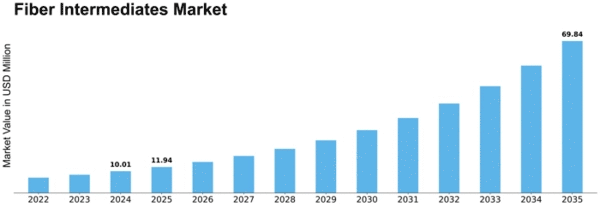
Fiber Intermediates Market Size Graph
Author
Priya Nagrale
Senior Research Analyst

With an experience of over five years in market research industry (Chemicals & Materials domain), I gather and analyze market data from diverse sources to produce results, which are then presented back to a client. Also, provide recommendations based on the findings. As a Senior Research Analyst, I perform quality checks (QC) for market estimations, QC for reports, and handle queries and work extensively on client customizations. Also, handle the responsibilities of client proposals, report planning, report finalization, and execution

Leave a Comment

FAQs

What are the major types and application areas of fiber intermediates?

Paraxylene, cyclohexanone, acrylonitrile, ethylene glycol, polyethylene, and ethylene glycol, others are some of the major types of fiber intermediates, which find applications in fabrics, anti-freeze, pet resin, and others.

What are the major driving forces behind the growth of the global fiber intermediates market?

Increasing use in the manufacturing of synthetic fibers such as polyester & nylon, fabrics, plastic, and disinfectants.

Which region holds the largest share in the global fiber intermediates market?

Asia Pacific holds the largest share in the global fiber intermediates market followed by North America and Europe, respectively.

Who are the top players in the global fiber intermediates market?

Aareydrugs & Pharmaceuticals Ltd (India), Reliance Industries Limited (India), Ferromet SA (Argentina), DowDuPont (US), BASF SE (Germany), INVISTA (US), Daicel Corporation (Japan), Chevron Phillips Chemical Company (US), and Fiber Intermediate Products Company (Iran), are some of the leading players in the global fiber intermediates market.

What are the key growth strategies of fiber intermediates industry players?

Strategic initiatives such as mergers & acquisitions, collaborations, expansion, and technology/ product launch are some of the growth strategies that players operating in the global fiber intermediates market adopt to gain a larger competitive advantage.

Market Summary

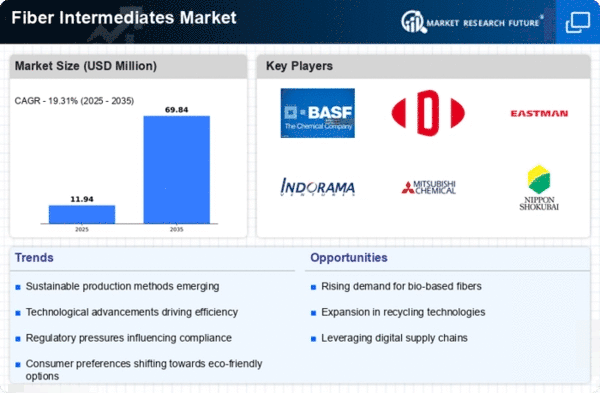
As per MRFR analysis, the Fiber Intermediates Market Size was estimated at 10.01 USD Million in 2024. The Fiber Intermediates industry is projected to grow from 11.95 USD Million in 2025 to 69.84 USD Million by 2035, exhibiting a compound annual growth rate (CAGR) of 19.31 during the forecast period 2025 - 2035.

Key Market Trends & Highlights

The Fiber Intermediates Market is poised for growth driven by sustainability and technological advancements.

  • North America remains the largest market for fiber intermediates, reflecting robust demand across various sectors.
  • Asia-Pacific is emerging as the fastest-growing region, fueled by increasing industrialization and consumer demand.
  • The textiles segment continues to dominate the market, while the medical segment is experiencing rapid growth due to innovative applications.
  • Rising demand for sustainable products and regulatory support for sustainable practices are key drivers propelling market expansion.

Market Size & Forecast

2024 Market Size 10.01 (USD Million)
2035 Market Size 69.84 (USD Million)
CAGR (2025 - 2035) 19.31%
Largest Regional Market Share in 2024 Asia-Pacific

Major Players

<p>BASF (DE), DuPont (US), Invista (US), Eastman Chemical Company (US), Mitsubishi Chemical Corporation (JP), Teijin Limited (JP), Lenzing AG (AT), SABIC (SA), Solvay (BE)</p>

Market Trends

The Fiber Intermediates Market is currently experiencing a dynamic evolution, driven by various factors that influence demand and supply. The increasing focus on sustainability and eco-friendly materials is prompting manufacturers to explore innovative production methods. This shift is likely to enhance the market's growth trajectory, as consumers and industries alike prioritize environmentally responsible options. Furthermore, advancements in technology are facilitating the development of new fiber intermediates, which may lead to enhanced performance characteristics and broader applications across diverse sectors. In addition, The Fiber Intermediates landscape. Companies are increasingly investing in research and development to create more efficient and sustainable products. This trend not only aligns with regulatory requirements but also meets the evolving preferences of consumers who are becoming more environmentally conscious. As a result, the market is poised for continued growth, with potential opportunities emerging in various regions as stakeholders adapt to changing demands and preferences.

Sustainability Initiatives

The Fiber Intermediates Market is witnessing a notable shift towards sustainability initiatives. Manufacturers are increasingly adopting eco-friendly practices and materials, responding to consumer demand for greener products. This trend is likely to drive innovation in production processes, leading to the development of sustainable fiber intermediates that minimize environmental impact.

Technological Advancements

Technological advancements are playing a crucial role in shaping the Fiber Intermediates Market. Innovations in production techniques and materials are enabling the creation of high-performance intermediates. These advancements may enhance the efficiency and versatility of fiber intermediates, expanding their applications across various industries.

Regulatory Compliance

Regulatory compliance is becoming increasingly important within the Fiber Intermediates Market. Stricter environmental regulations are prompting manufacturers to adapt their processes and products to meet new standards. This trend may lead to the development of more sustainable and compliant fiber intermediates, aligning with global efforts to reduce environmental impact.

Fiber Intermediates Market Market Drivers

Market Growth Projections

The Global Fiber Intermediates Market Industry is poised for substantial growth, with projections indicating a market value of 8.49 USD Million in 2024 and an anticipated increase to 20.6 USD Million by 2035. This growth trajectory suggests a compound annual growth rate of 8.37% from 2025 to 2035, reflecting the industry's resilience and adaptability to changing market conditions. The increasing demand for innovative and sustainable fiber solutions is likely to drive this growth, positioning the industry favorably in the global textile landscape.

Growth in the Apparel Sector

The apparel sector is a significant driver of the Global Fiber Intermediates Market Industry, as it accounts for a substantial portion of fiber consumption. With the global population projected to increase, the demand for clothing is expected to rise correspondingly. This growth is further fueled by changing fashion trends and the rise of fast fashion, which emphasizes rapid production cycles. As the market evolves, it is anticipated to reach 20.6 USD Million by 2035, highlighting the apparel sector's critical role in sustaining fiber intermediate demand and driving industry growth.

Expansion of Emerging Markets

Emerging markets are becoming increasingly important in the Global Fiber Intermediates Market Industry. Countries in Asia-Pacific and Latin America are witnessing rapid industrialization and urbanization, leading to heightened demand for textiles and fibers. As these regions develop, local manufacturers are likely to invest in fiber production capabilities, thereby enhancing market dynamics. This expansion is expected to contribute significantly to the overall growth of the industry, as emerging markets represent a substantial opportunity for fiber intermediates, potentially reshaping global supply chains.

Rising Demand for Sustainable Textiles

The Global Fiber Intermediates Market Industry is experiencing a notable shift towards sustainable textiles, driven by increasing consumer awareness regarding environmental issues. As brands and manufacturers prioritize eco-friendly materials, the demand for bio-based fibers is expected to rise. This trend is reflected in the projected market growth, with the industry anticipated to reach 8.49 USD Million in 2024. The shift towards sustainability not only aligns with consumer preferences but also encourages innovation in fiber production processes, potentially leading to a more circular economy in textiles.

Increasing Urbanization and Lifestyle Changes

Urbanization is a key factor influencing the Global Fiber Intermediates Market Industry. As more people migrate to urban areas, lifestyle changes lead to increased consumption of textiles and apparel. This urban shift often correlates with higher disposable incomes, allowing consumers to spend more on quality and fashionable clothing. Consequently, the demand for various fiber intermediates is expected to rise, supporting the industry's growth trajectory. The interplay between urbanization and changing consumer preferences suggests a robust future for the fiber intermediates market.

Technological Advancements in Fiber Production

Technological innovations are playing a crucial role in shaping the Global Fiber Intermediates Market Industry. Advanced manufacturing techniques, such as biotechnology and nanotechnology, are enhancing the efficiency and quality of fiber production. These advancements enable the development of high-performance fibers that meet diverse application needs, from apparel to industrial uses. As a result, the market is likely to witness a compound annual growth rate of 8.37% from 2025 to 2035, reflecting the industry's adaptability to evolving technological landscapes and consumer demands.

Market Segment Insights

By Application: Textiles (Largest) vs. Medical (Fastest-Growing)

<p>The Fiber Intermediates Market showcases a diverse range of applications, prominently featuring Textiles, which dominate the market share. Textiles account for a substantial portion due to their widespread use in apparel and home furnishings. Conversely, the Medical application, while smaller in comparison, exhibits rapid growth, driven by advancements in healthcare technologies and an increasing demand for specialized fabrics and materials that meet rigorous hygiene and safety standards.</p>

<p>Textiles: Dominant vs. Medical: Emerging</p>

<p>The Textiles segment of the Fiber Intermediates Market is characterized by its extensive use in both fashion and functional applications, making it the primary driving force in the market. This segment benefits from innovation in synthetic fibers, enhancing durability and functionality. In contrast, the Medical segment is emerging as a significant player, propelled by trends in biocompatibility and the demand for technical textiles in medical devices. The growth in healthcare spending and the emphasis on patient safety create a conducive environment for rapid advancements and expansion in this sector.</p>

By End Use: Apparel (Largest) vs. Industrial Fabrics (Fastest-Growing)

<p>The Fiber Intermediates Market is primarily driven by the apparel segment, which holds a significant portion of the market share. This segment benefits from continuous demand for natural and synthetic fibers in clothing, contributing to its establishment as the largest end-use category. Following apparel, the home furnishings and industrial fabrics categories are also noteworthy, showcasing a steady market presence fueled by increasing consumer spending on home decor and technical applications in manufacturing. On the growth front, industrial fabrics are emerging as the fastest-growing segment, propelled by advancements in manufacturing technology and a rising demand for performance textiles in various industries, including automotive and aerospace. Geotextiles and technical textiles are witnessing an upward trend, driven by infrastructure development and the need for specialized materials that support various environmental applications. These factors collectively influence the dynamic landscape of the Fiber Intermediates Market.</p>

<p>Apparel (Dominant) vs. Technical Textiles (Emerging)</p>

<p>The apparel segment stands as a dominant force within the Fiber Intermediates Market, characterized by a robust demand for diverse materials ranging from cotton to advanced synthetic fibers. This category remains crucial due to its alignment with fashion trends and the increasing preference for sustainable and eco-friendly textiles. On the other hand, technical textiles represent an emerging segment, gaining traction due to their applications in specialized fields such as healthcare, automotive, and construction. These textiles are designed for performance and functionality, often incorporating innovative technologies. As consumer needs evolve towards durability and utility, the technical textiles segment is set to expand, complementing the more traditional variety of fibers found in apparel.</p>

By Material Type: Polyester (Largest) vs. Nylon (Fastest-Growing)

<p>In the Fiber Intermediates Market, the distribution of market share among material types showcases Polyester as the largest segment. Polyester remains the most widely utilized fiber due to its versatility and strong demand across various industries, including textiles and industrial applications. Following closely, Nylon emerges as a significant contender, capturing attention as it is heralded for its increased adoption in high-performance applications such as activewear and automotive materials.</p>

<p>Polyester (Dominant) vs. Nylon (Emerging)</p>

<p>Polyester fibers, known for their durability and resistance to wrinkles, are a staple in the textile industry, making them the dominant force in the Fiber Intermediates Market. Their reputation for high strength and low moisture absorbency contributes to their extensive use across numerous applications, including clothing, home furnishings, and industrial textiles. On the other hand, Nylon is rapidly emerging due to its ability to offer superior elasticity and resilience, making it increasingly popular in the production of sportswear and technical textiles. The rising trend of sustainable and high-performance materials further accelerates Nylon's growth within the sector, signaling a shift towards innovative fiber solutions.</p>

By Production Process: Spinning (Largest) vs. Polymerization (Fastest-Growing)

<p>In the Fiber Intermediates Market, the production process can be segmented into five key areas: Polymerization, Spinning, Weaving, Knitting, and Finishing. Among these, Spinning holds the largest market share, attributed to its extensive application in producing various types of fibers. This process enables the transformation of raw materials into yarns that serve as fundamental inputs for fabric production, making it a cornerstone of the market.</p>

<p>Spinning (Dominant) vs. Polymerization (Emerging)</p>

<p>Spinning, as the dominant production process in the Fiber Intermediates Market, focuses on converting staple fibers into continuous yarns, which are essential for subsequent stages like weaving and knitting. This process leverages advanced technologies to ensure high quality and efficiency, catering to a demand for various applications, from apparel to industrial textiles. On the other hand, Polymerization, categorized as an emerging process, is gaining traction due to the increasing importance of synthetic fibers and their versatility. It serves as the foundational method for creating polymers that are subsequently spun into fibers, with innovations driving its rapid growth and adoption in various sectors.</p>

By Distribution Channel: Direct Sales (Largest) vs. Online Sales (Fastest-Growing)

<p>In the Fiber Intermediates Market, the distribution channel landscape reveals a varied structure, with Direct Sales emerging as the dominant channel. This channel holds significant market share due to established relationships between manufacturers and end-users. Distributors and Retail are also notable contributors, yet they command comparatively lesser slices of the market. Online Sales, while still developing, are beginning to make their mark and show potential for a larger share as digital trends advance. In terms of growth trends, Online Sales appear to be the fastest-growing distribution channel, propelled by increasing consumer comfort with e-commerce platforms and the rising demand for convenient purchasing options. Direct Sales maintain steady growth due to their traditional appeal and reliability. As manufacturers shift strategies to adapt to changing consumer preferences, the emphasis on utilizing a combination of distribution channels is becoming a significant driver in this market.</p>

<p>Distributors (Dominant) vs. Retail (Emerging)</p>

<p>Distributors represent a dominant force within the Fiber Intermediates Market, characterized by their ability to efficiently link manufacturers and end-users. They offer a wide range of products and services, ensuring a consistent supply chain and enhanced customer relationships. Their established networks allow for effective inventory management, positioning them as key players in facilitating market transactions. In contrast, Retail serves as an emerging channel influenced by shifting consumer behaviors towards accessible purchasing. Retailers leverage their local presence and customer engagement strategies to tap into niche markets, although they face scalability challenges compared to distributors. Together, these channels illustrate a blend of traditional and innovative approaches in reaching diverse customer bases.</p>

Get more detailed insights about Fiber Intermediates Market Research Report- Forecast to 2035

Regional Insights

North America : Innovation and Sustainability Focus

The North American Fiber Intermediates market is poised for growth, driven by increasing demand for sustainable materials and innovations in production technologies. With a market size of $2.0 billion, the region is focusing on regulatory frameworks that promote eco-friendly practices. The push for sustainability is further supported by government initiatives aimed at reducing carbon footprints, which is expected to enhance market dynamics significantly. Leading countries such as the US and Canada are home to major players like DuPont and Invista, who are investing heavily in R&D to develop advanced fiber intermediates. The competitive landscape is characterized by strategic partnerships and collaborations among key players, ensuring a robust supply chain. The presence of established companies fosters innovation, making North America a critical hub for fiber intermediates.

Europe : Sustainable Practices and Innovation

Europe's Fiber Intermediates market, valued at $2.5 billion, is experiencing a surge driven by stringent environmental regulations and a strong emphasis on sustainability. The region is witnessing a shift towards bio-based fibers and recycling initiatives, which are supported by EU policies aimed at reducing waste and promoting circular economy practices. This regulatory environment is catalyzing innovation and attracting investments in sustainable fiber technologies. Countries like Germany, France, and the UK are leading the charge, with key players such as BASF and Solvay actively participating in the market. The competitive landscape is marked by a focus on R&D and collaborations to enhance product offerings. The presence of established companies and a strong regulatory framework positions Europe as a leader in the fiber intermediates sector, driving growth and innovation.

Asia-Pacific : Dominating Global Market Share

The Asia-Pacific region dominates the Fiber Intermediates market with a substantial market size of $5.5 billion, accounting for the majority share in 2024. This growth is fueled by rapid industrialization, increasing consumer demand for textiles, and a shift towards synthetic fibers. Regulatory support for sustainable practices is also emerging, as governments in the region recognize the importance of environmental stewardship in manufacturing processes. Leading countries such as China, Japan, and India are at the forefront, with major players like Mitsubishi Chemical and Teijin Limited driving innovation and production capacity. The competitive landscape is characterized by a mix of local and international companies, fostering a dynamic market environment. The presence of these key players ensures a steady supply of fiber intermediates, catering to both domestic and global markets.

Middle East and Africa : Emerging Market Potential

The Fiber Intermediates market in the Middle East and Africa is still in its nascent stages, with a market size of only $0.01 billion. However, the region presents significant growth potential driven by increasing investments in the textile and manufacturing sectors. Governments are beginning to recognize the importance of developing local industries, which could lead to favorable regulatory changes and support for fiber production initiatives. Countries like South Africa and the UAE are exploring opportunities to enhance their manufacturing capabilities. The competitive landscape is currently limited, but the presence of The Fiber Intermediates growth. As local industries develop, the region may become an attractive destination for fiber intermediates, leveraging its strategic location and resources.

Key Players and Competitive Insights

The Fiber Intermediates Market is currently characterized by a dynamic competitive landscape, driven by innovation, sustainability, and strategic partnerships. Key players such as BASF (DE), DuPont (US), and Invista (US) are actively shaping the market through their distinct operational focuses. BASF (DE) emphasizes innovation in sustainable fiber production, while DuPont (US) is concentrating on expanding its product portfolio to include bio-based intermediates. Invista (US) appears to be leveraging its extensive supply chain capabilities to enhance operational efficiency. Collectively, these strategies contribute to a moderately fragmented market structure, where competition is increasingly defined by technological advancements and sustainability initiatives.

In terms of business tactics, companies are localizing manufacturing to reduce lead times and optimize supply chains. This approach not only enhances responsiveness to market demands but also mitigates risks associated with global supply chain disruptions. The competitive structure of the Fiber Intermediates Market is moderately fragmented, with several key players exerting influence through their innovative practices and strategic collaborations. This fragmentation allows for a diverse range of products and services, catering to various customer needs across different regions.

In November 2025, BASF (DE) announced a partnership with a leading textile manufacturer to develop a new line of biodegradable fibers. This strategic move underscores BASF's commitment to sustainability and positions the company as a frontrunner in eco-friendly fiber solutions. The collaboration is expected to enhance BASF's market share while addressing the growing consumer demand for sustainable products.

In October 2025, DuPont (US) launched a new bio-based fiber that utilizes renewable resources, marking a significant step in its sustainability journey. This innovation not only diversifies DuPont's product offerings but also aligns with global trends towards environmentally friendly materials. The introduction of this fiber is likely to attract environmentally conscious consumers and strengthen DuPont's competitive edge in the market.

In September 2025, Invista (US) expanded its production capacity for nylon intermediates in response to increasing global demand. This expansion is strategically important as it allows Invista to meet the rising needs of the automotive and apparel sectors, which are increasingly reliant on high-performance fibers. By enhancing its production capabilities, Invista positions itself to capitalize on market growth opportunities while reinforcing its supply chain reliability.

As of December 2025, the Fiber Intermediates Market is witnessing trends such as digitalization, sustainability, and AI integration, which are redefining competitive dynamics. Strategic alliances are becoming increasingly prevalent, enabling companies to pool resources and expertise to drive innovation. The competitive landscape is shifting from price-based competition to a focus on technological advancements and supply chain reliability. As companies navigate these trends, differentiation through innovation and sustainable practices will likely become paramount for success in the evolving market.

Key Companies in the Fiber Intermediates Market market include

Industry Developments

June 2021 - Teijin Ltd. reported that their Tenax carbon fiber prepreg had been used in a nacelle (a streamlined housing or tank) for Airbus' next-generation aviation engine demonstration, the UltraFan. Airbus will receive a prototype of the nacelle part developed by Nikkiso Co., Ltd. for the Propulsion of Tomorrow project before the end of 2021. Teijin plans to strengthen its carbon fiber and intermediate material operations to contribute to greater global sustainability, to become a firm that supports the future society.

May 2021 - CCM Hockey, a global designer, manufacturer, and marketer of hockey equipment, has renewed its relationship with Sigmatex, a developer of carbon fiber fabrics. For many years, Sigmatex and CCM have been exclusive partners. The alliance, which is focused on performance and innovation, has helped CCM maintain its leadership position in the hockey stick category while also positioning Sigmatex as a vital supplier in top sports performance.

Intended Audience

    • Fiber intermediates manufacturers
    • Traders and distributors of fiber intermediates
    • Research and development institutes
    • Potential investors
    • Raw material suppliers
    • Nationalized laboratories

Future Outlook

Fiber Intermediates Market Future Outlook

<p>The Fiber Intermediates Market is projected to grow at a 19.31% CAGR from 2024 to 2035, driven by increasing demand for sustainable materials and technological advancements.</p>

New opportunities lie in:

  • <p>Expansion into bio-based fiber intermediates for eco-conscious consumers.</p>
  • <p>Development of advanced recycling technologies to enhance sustainability.</p>
  • <p>Strategic partnerships with textile manufacturers to integrate innovative fiber solutions.</p>

<p>By 2035, the Fiber Intermediates Market is expected to achieve substantial growth, reflecting evolving industry dynamics.</p>

Market Segmentation

Fiber Intermediates Market End Use Outlook

  • Apparel
  • Home Furnishings
  • Industrial Fabrics
  • Geotextiles
  • Technical Textiles

Fiber Intermediates Market Application Outlook

  • Textiles
  • Automotive
  • Construction
  • Consumer Goods
  • Medical

Fiber Intermediates Market Material Type Outlook

  • Polyester
  • Nylon
  • Acrylic
  • Aramid
  • Cellulosic

Fiber Intermediates Market Production Process Outlook

  • Polymerization
  • Spinning
  • Weaving
  • Knitting
  • Finishing

Fiber Intermediates Market Distribution Channel Outlook

  • Direct Sales
  • Distributors
  • Online Sales
  • Retail

Report Scope

MARKET SIZE 202410.01(USD Million)
MARKET SIZE 202511.95(USD Million)
MARKET SIZE 203569.84(USD Million)
COMPOUND ANNUAL GROWTH RATE (CAGR)19.31% (2024 - 2035)
REPORT COVERAGERevenue Forecast, Competitive Landscape, Growth Factors, and Trends
BASE YEAR2024
Market Forecast Period2025 - 2035
Historical Data2019 - 2024
Market Forecast UnitsUSD Million
Key Companies ProfiledBASF (DE), DuPont (US), Invista (US), Eastman Chemical Company (US), Mitsubishi Chemical Corporation (JP), Teijin Limited (JP), Lenzing AG (AT), SABIC (SA), Solvay (BE)
Segments CoveredApplication, End Use, Material Type, Production Process, Distribution Channel
Key Market OpportunitiesGrowing demand for sustainable materials drives innovation in the Fiber Intermediates Market.
Key Market DynamicsRising demand for sustainable fibers drives innovation and competition in the Fiber Intermediates Market.
Countries CoveredNorth America, Europe, APAC, South America, MEA

FAQs

What are the major types and application areas of fiber intermediates?

Paraxylene, cyclohexanone, acrylonitrile, ethylene glycol, polyethylene, and ethylene glycol, others are some of the major types of fiber intermediates, which find applications in fabrics, anti-freeze, pet resin, and others.

What are the major driving forces behind the growth of the global fiber intermediates market?

Increasing use in the manufacturing of synthetic fibers such as polyester &amp; nylon, fabrics, plastic, and disinfectants.

Which region holds the largest share in the global fiber intermediates market?

Asia Pacific holds the largest share in the global fiber intermediates market followed by North America and Europe, respectively.

Who are the top players in the global fiber intermediates market?

Aareydrugs &amp; Pharmaceuticals Ltd (India), Reliance Industries Limited (India), Ferromet SA (Argentina), DowDuPont (US), BASF SE (Germany), INVISTA (US), Daicel Corporation (Japan), Chevron Phillips Chemical Company (US), and Fiber Intermediate Products Company (Iran), are some of the leading players in the global fiber intermediates market.

What are the key growth strategies of fiber intermediates industry players?

Strategic initiatives such as mergers &amp; acquisitions, collaborations, expansion, and technology/ product launch are some of the growth strategies that players operating in the global fiber intermediates market adopt to gain a larger competitive advantage.

  1. Executive Summary
  2. Scope of the Report
    1. Market Definition
    2. Scope of the
      1. Research Objectives
      2. Assumptions & Limitations
    3. Study
    4. Market Structure
  3. Market
    1. Research Methodology
    2. Research Process
    3. Secondary Research
    4. Primary Research
    5. Forecast Model
  4. Market Landscape
    1. Five Forces Analysis
    2. of New Entrants
    3. of Buyers
    4. Segment Rivalry
    5. Chain of Global Fiber Intermediates Market
  5. Threat
  6. Bargaining Power
  7. Bargaining Power of Suppliers
  8. Threat of Substitutes
    1. Value Chain/Supply
  9. Industry Overview
    1. of Global Fiber Intermediates Market
    2. Introduction
    3. Growth Drivers
    4. Impact Analysis
    5. Market Challenges
  10. Market Trends
    1. Introduction
    2. Growth Trends
    3. Impact Analysis
  11. Global Fiber Intermediates Market, by Type
    1. Introduction
    2. Paraxylene
      1. Market Estimates & Forecast, 2020–2027
      2. Market Estimates & Forecast, by Region, 2020–2027
      3. Market Estimates & Forecast,
      4. Market Estimates & Forecast, by Region, 2020–2027
    3. Acrylonitrile
    4. Cyclohexanone
      1. Market Estimates &
    5. Market Estimates & Forecast, 2020–2027
    6. Forecast, by Region, 2020–2027
    7. Ethylene glycol
      1. Market Estimates & Forecast, 2020–2027
  12. Market Estimates & Forecast, by Region, 2020–2027
    1. Ethylene Oxide
    2. & Forecast, 2020–2027
    3. Market Estimates & Forecast, 2020–2027
    4. Forecast, by Region, 2020–2027
    5. & Forecast, by Region, 2020–2027
    6. & Forecast, by Region, 2020–2027
  13. Market Estimates & Forecast,
  14. Market Estimates & Forecast, by Region, 2020–2027
    1. Polyethylene
      1. Market Estimates
      2. Market Estimates & Forecast, by Region,
    2. Others
      1. Market Estimates &
      2. Purified Terephthalic Acid (PTA)
      3. Dimethyl Terephthalyte (DMT)
  15. Global Fiber
  16. Intermediates Market, by Application
    1. Introduction
    2. Fabrics
      1. Market Estimates & Forecast, 2020–2027
      2. Market Estimates & Forecast, by Region, 2020–2027
      3. Polyester
      4. Nylon
      5. Spandex Fibers
      6. Other
    3. & Forecast, by Region, 2020–2027
    4. Estimates & Forecast, 2020–2027
    5. by Region, 2020–2027
    6. & Forecast, 2020–2027
    7. Region, 2020–2027
    8. PET Resin
      1. Market Estimates &
      2. Market Estimates & Forecast, by Region,
    9. Forecast, 2020–2027
    10. Anti-Freeze
      1. Market Estimates
      2. Market Estimates & Forecast, by Region,
    11. & Forecast, 2020–2027
    12. Detergents
      1. Market Estimates
      2. Market Estimates & Forecast, by Region,
    13. & Forecast, 2020–2027
    14. Upholstery
      1. Market Estimates
      2. Market Estimates & Forecast, by Region,
    15. & Forecast, 2020–2027
    16. Bactericides
      1. Market Estimates
      2. Market Estimates & Forecast, by Region,
      3. Disinfectants
      4. Antiseptics
    17. & Forecast, 2020–2027
    18. Other
  17. Market Estimates & Forecast, by Region, 2020–2027
    1. Others
  18. Market Estimates & Forecast, 2020–2027
  19. Market Estimates & Forecast, by Region, 2020–2027
  20. Global Fiber Intermediates Market, by Region
    1. Introduction
    2. North America
      1. Market Estimates & Forecast,
      2. Market Estimates & Forecast, by Type, 2020–2027
      3. Market Estimates & Forecast, by Application, 2020–2027
    3. US
  21. Market Estimates & Forecast, by Type, 2020–2027
    1. & Forecast, by Application, 2020–2027
    2. & Forecast, by Type, 2020–2027
    3. by Application, 2020–2027
    4. Estimates & Forecast, 2020–2027
    5. by Type, 2020–2027
    6. & Forecast, 2020–2027
    7. Type, 2020–2027
    8. & Forecast, 2020–2027
    9. Type, 2020–2027
    10. & Forecast, 2020–2027
    11. Type, 2020–2027
    12. & Forecast, 2020–2027
    13. Type, 2020–2027
    14. Forecast, 2020–2027
  22. Market Estimates
  23. Canada
  24. Market Estimates & Forecast, 2020–2027
  25. Market Estimates
  26. Market Estimates & Forecast,
    1. Europe
      1. Market
      2. Market Estimates & Forecast,
      3. Market Estimates & Forecast, by Application,
      4. Germany
      5. France
      6. Italy
      7. Spain
      8. UK
      9. Russia
  27. Market Estimates & Forecast, by Application, 2020–2027
    1. Poland
  28. Market Estimates & Forecast, 2020–2027
  29. Market Estimates & Forecast, by Type, 2020–2027
    1. & Forecast, by Application, 2020–2027
    2. & Forecast, by Type, 2020–2027
    3. by Application, 2020–2027
    4. Market Estimates & Forecast, 2020–2027
    5. Forecast, by Type, 2020–2027
    6. by Application, 2020–2027
    7. Market Estimates & Forecast, 2020–2027
    8. Forecast, by Type, 2020–2027
    9. by Application, 2020–2027
    10. Market Estimates & Forecast, 2020–2027
    11. Forecast, by Type, 2020–2027
    12. by Application, 2020–2027
    13. Market Estimates & Forecast, 2020–2027
    14. Forecast, by Type, 2020–2027
    15. by Application, 2020–2027
    16. Market Estimates & Forecast, 2020–2027
    17. Forecast, by Type, 2020–2027
    18. by Application, 2020–2027
    19. & Forecast, by Type, 2020–2027
    20. by Application, 2020–2027
    21. & Forecast, by Type, 2020–2027
    22. by Application, 2020–2027
    23. & Forecast, 2020–2027
    24. Type, 2020–2027
    25. North Africa
  30. Market Estimates
    1. Asia-Pacific
      1. Market Estimates & Forecast, 2020–2027
      2. Market Estimates
      3. Market Estimates & Forecast,
      4. China
      5. India
      6. Japan
      7. Australia
      8. New Zealand
      9. Rest of Asia-Pacific
    2. Middle East & Africa
      1. Market Estimates & Forecast, 2020–2027
      2. Market Estimates
      3. Market Estimates & Forecast,
      4. Turkey
      5. Israel
  31. Market Estimates & Forecast, by Application, 2020–2027
    1. & Forecast, by Type, 2020–2027
    2. by Application, 2020–2027
    3. & Forecast, by Type, 2020–2027
    4. by Application, 2020–2027
    5. Market Estimates & Forecast, 2020–2027
    6. Forecast, by Type, 2020–2027
    7. Application, 2020–2027
    8. & Forecast, 2020–2027
    9. Type, 2020–2027
    10. Mexico
  32. GCC
  33. Market Estimates & Forecast, 2020–2027
  34. Market Estimates
  35. Market Estimates & Forecast,
  36. Rest of the Middle East & Africa
  37. Market Estimates & Forecast, 2020–2027
  38. Market Estimates
  39. Market Estimates & Forecast,
    1. Latin America
      1. Market Estimates &
      2. Market Estimates & Forecast, by
      3. Brazil
      4. Argentina
  40. Market Estimates & Forecast, by Type, 2020–2027
    1. & Forecast, by Application, 2020–2027
    2. & Forecast, by Type, 2020–2027
    3. by Application, 2020–2027
  41. Market Estimates
  42. Rest of Latin America
  43. Market Estimates & Forecast, 2020–2027
  44. Market Estimates
  45. Market Estimates & Forecast,
  46. Company Landscape
  47. Company Profiles
    1. Reliance Industries Limited
    2. Financial Updates
    3. Aareydrugs & Pharmaceuticals Ltd
    4. Overview
    5. Financial Updates
    6. Ferromet SA
    7. Type/Business Segment Overview
    8. SE
    9. Segment Overview
    10. Key Developments
    11. Company Overview
    12. Financial Updates
    13. Chevron Phillips Chemical Company
    14. Financial Updates
    15. Daicel Corporation
    16. Type/Business Segment Overview
    17. Products Company
    18. Type/Business Segment Overview
  48. Company Overview
  49. Type/Business Segment Overview
  50. Key Developments
  51. Company
  52. Type/Business Segment Overview
  53. Key Developments
  54. Company Overview
  55. Financial Updates
  56. Key Developments
    1. BASF
      1. Company Overview
      2. Type/Business
      3. Financial Updates
    2. DowDuPont
      1. Type/Business Segment Overview
      2. Financial Updates
      3. Key Developments
    3. INVISTA
      1. Company Overview
      2. Type/Business Segment Overview
      3. Key Developments
      4. Company Overview
      5. Type/Business Segment Overview
      6. Key Developments
      7. Company Overview
      8. Financial Updates
      9. Key Developments
    4. Fiber Intermediate
      1. Company Overview
      2. Financial Updates
      3. Key Developments
  57. Conclusion
  58. LIST OF TABLES
  59. World Population in
    1. Major Regions (2020–2030)
  60. Global Fiber
  61. Intermediates Market, by Region, 2020–2027
  62. North
  63. America: Fiber Intermediates Market, by Country, 2020–2027
    1. Table 4
  64. Europe: Fiber Intermediates Market, by Country, 2020–2027
    1. Table
  65. Asia-Pacific: Fiber Intermediates Market, by Country, 2020–2027
  66. Middle East & Africa: Fiber Intermediates Market,
    1. by Country, 2020–2027
  67. Latin America: Fiber
  68. Intermediates Market, by Country, 2020–2027
  69. Global
  70. Fiber Intermediates Type Market, by Region, 2020–2027
    1. Table 9
  71. North America: Fiber Intermediates Type Market, by Country, 2020–2027
  72. Europe: Fiber Intermediates Type Market, by Country,
    1. Table11 Asia-Pacific: Fiber Intermediates
  73. Type Market, by Country, 2020–2027
    1. Table13 Middle East
  74. & Africa: Fiber Intermediates Type Market, by Country, 2020–2027
    1. Table12
  75. Latin America: Fiber Intermediates Type Market, by Country, 2020–2027
    1. Table14 North America: Fiber Intermediates Application Market,
    2. by Country, 2020–2027
    3. Table13 Europe: Fiber Intermediates
  76. Application Market, by Country, 2020–2027
    1. Table14 Asia-Pacific:
  77. Fiber Intermediates Application Market, by Country, 2020–2027
    1. Table16
  78. Middle East & Africa: Fiber Intermediates Application Market, by Country,
    1. Table15 Latin America: Fiber Intermediates
  79. Application Market, by Country, 2020–2027
    1. Table23 Global
  80. Type Market, by Region, 2020–2027
    1. Table24 Global Application
  81. Market, by Region, 2020–2027
    1. Table25 North America:
  82. Fiber Intermediates Market, by Country, 2020–2027
    1. Table26
  83. North America: Fiber Intermediates Market, by Type, 2020–2027
  84. Table27 North America: Fiber Intermediates Market, by Application,
    1. Table28 Europe: Fiber Intermediates Market,
    2. by Country, 2020–2027
    3. Table29 Europe: Fiber
  85. Intermediates Market, by Type, 2020–2027
    1. Table30
  86. Europe: Fiber Intermediates Market, by Application, 2020–2027
  87. Table31 Asia-Pacific: Fiber Intermediates Market, by Country,
    1. Table32 Asia-Pacific: Fiber Intermediates
  88. Market, by Type, 2020–2027
    1. Table33 Asia-Pacific:
  89. Fiber Intermediates Market, by Application, 2020–2027
    1. Table36
  90. Middle East & Africa: Fiber Intermediates Market, by Country, 2020–2027
    1. Table37 Middle East & Africa Fiber Intermediates
  91. Market, by Type, 2020–2027
    1. Table33 Middle
  92. East & Africa: Fiber Intermediates Market, by Application, 2020–2027
  93. Table34 Latin America: Fiber Intermediates Market, by Country,
    1. Table35 Latin America Fiber
  94. Intermediates Market, by Type, 2020–2027
    1. Table33
  95. Latin America: Fiber Intermediates Market, by Application, 2020–2027
  96. LIST OF FIGURES
  97. Global Fiber Intermediates
    1. Market Segmentation
  98. Forecast Methodology
  99. Five
    1. Forces Analysis of Global Fiber Intermediates Market
  100. Value Chain
    1. of Global Fiber Intermediates Market
  101. Share of Global Fiber
  102. Intermediates Market in 2020, by Country (%)
  103. Global Fiber Intermediates
    1. Market, 2020–2027,
  104. Sub-Segments of Type, 2020
    1. FIGURE
  105. Global Fiber Intermediates Market Size, by Type, 2020
    1. FIGURE 9
  106. Share of Global Fiber Intermediates Market, by Type, 2020–2027
    1. FIGURE
  107. Sub-Segments of Application
  108. Global Fiber Intermediates
  109. Market Size, by Application, 2020
  110. Share of Global Fiber Intermediates
  111. Market, by Application, 2020–2027

Fiber Intermediates Market Segmentation

Market Segmentation Overview

  • Detailed segmentation data will be available in the full report
  • Comprehensive analysis by multiple parameters
  • Regional and country-level breakdowns
  • Market size forecasts by segment
Infographic

Free Sample Request

Kindly complete the form below to receive a free sample of this Report

Get Free Sample

Customer Strories

Compare Licence

×
Features License Type
Single User Multiuser License Enterprise User
Price $4,950 $5,950 $7,250
Maximum User Access Limit 1 User Upto 10 Users Unrestricted Access Throughout the Organization
Free Customization
Direct Access to Analyst
Deliverable Format
Platform Access
Discount on Next Purchase 10% 15% 15%
Printable Versions