Request Free Sample ×

Kindly complete the form below to receive a free sample of this Report

* Please use a valid business email

Leading companies partner with us for data-driven Insights

clients tt-cursor
Hero Background
English
Chinese
French
Japanese
Korean
German
Spanish

Fencing Market Analysis

ID: MRFR/PCM/5919-HCR
111 Pages
Snehal Singh
December 2024

Fencing Market Research Report Information By Material (Concrete, Plastic & Composites, Wood, Metal, and others), By Product (Hinge-joint Fence, Electric Fence, Welded Fence, and others) By End-user (Residential, Commercial, Industrial, and Agricultural), And By Region (North America, Europe, Asia-Pacific, And Rest Of The World) – Market Forecast Till 2035

Share:
Download PDF ×

We do not share your information with anyone. However, we may send you emails based on your report interest from time to time. You may contact us at any time to opt-out.

Fencing Market Infographic
Purchase Options

Market Analysis

In-depth Analysis of Fencing Market Industry Landscape

The fencing market is a sector which is very dynamic and is diversified and has dynamic forces which account for its development and transformation. Security and privacy is becoming the primary motivation for the homeowners and business operators when deciding to build or purchase/lease new homes and offices. With the worldwide population increasing rate, the demand for secure boundaries is also promoted putting all the way the fencing market. Furthermore, such intense building activities, resulting from cities' growing populations and infrastructure expansion, remain the defining elements of the market processes. Fencing goes in in many of such projects and hence the whole demand for fencing materials increases.

A lot of governments worldwide are quite keen to place their money on different construction firms and their works. They take the form of parks, public buildings, and other public locations. Many worldwide fencing companies are also waking up to the fact that there is a fair amount of money that is to be made in this field. That is to say, those privately financened entities are attracted by higher CAGR as well. This is why they are putting loads of money on research and developments of high-quality fences as they want to have an element of rationalization for the extra cost of the products.

The second important aspect is that environmental issues regarding sustainability have been identified as vital factors on the fencing market. An important aspect if we consider the developments in the construction industry is the shift from the traditional fencing to greener and eco- friendly materials. As consumers become more and more interested in the environmental matters, the market opens up more eco-friendly designs with the use of materials and methods which reduce the environmental footprint of fencing solutions.

Similarly, technology has definitely created the dynamics of the fencing market for quite some time. Smart fencing systems integration that rely on sensors, surveillance cameras and automation are among the latest technical advances which have become the subject of debate. Besides, these modern functionalities are not only about boosting the security but are also for blending with the pervasive digital revolution. The application of information technology in the sphere of security does not only respond to the increasing requirements for security but also shows the degree of economic and social integration of our world today.

Worldwide economic factors have significant power in impacting the fencing market dynamics. Construction activities are indirectly affected by economic growth, industrialization, and ability to pay among other factors which eventually leads to increase in demand for fencing. As a direct consequence of a period of economic upswing there will be an elevation of construction projects, which implies that demand for construction materials will grow as well. On the one side economic slowdowns can make contracting activities to decelerate being that this indirectly impacts the fencing market negatively.


Author
Author Profile
Snehal Singh
Manager - Research

High acumen in analyzing complex macro & micro markets with more than 6 years of work experience in the field of market research. By implementing her analytical skills in forecasting and estimation into market research reports, she has expertise in Packaging, Construction, and Equipment domains. She handles a team size of 20-25 resources and ensures smooth running of the projects, associated marketing activities, and client servicing.

Leave a Comment

FAQs

What is the current valuation of the Fencing Market as of 2024?

<p>The Fencing Market was valued at 33.92 USD Billion in 2024.</p>

What is the projected market valuation for the Fencing Market in 2035?

<p>The Fencing Market is projected to reach 67.95 USD Billion by 2035.</p>

What is the expected CAGR for the Fencing Market during the forecast period 2025 - 2035?

<p>The expected CAGR for the Fencing Market during 2025 - 2035 is 6.52%.</p>

Which material segment holds the highest valuation in the Fencing Market?

<p>The Metal segment holds the highest valuation, ranging from 15.0 to 30.0 USD Billion.</p>

What are the projected valuations for the Wood segment in the Fencing Market?

<p>The Wood segment is projected to range from 6.0 to 12.0 USD Billion.</p>

Which product segment is expected to grow significantly in the Fencing Market?

<p>The Welded Fences segment is expected to grow significantly, with valuations between 9.09 and 18.18 USD Billion.</p>

What is the valuation range for the Electric Fences product segment?

<p>The Electric Fences product segment is projected to range from 5.09 to 10.18 USD Billion.</p>

Which end-user segment has the highest projected valuation in the Fencing Market?

<p>The Residential end-user segment has the highest projected valuation, ranging from 10.0 to 20.0 USD Billion.</p>

What is the projected valuation for the Agricultural end-user segment?

<p>The Agricultural end-user segment is projected to range from 8.92 to 17.95 USD Billion.</p>

Who are the key players in the Fencing Market?

<p>Key players in the Fencing Market include Ameristar Fence Products Inc, Master Halco Inc, and Betafence, among others.</p>

Market Summary

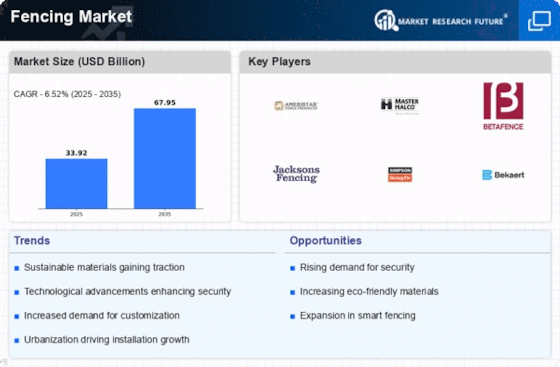
As per Market Research Future analysis, the Fencing Market Size was estimated at 33.92 USD Billion in 2024. The Fencing industry is projected to grow from 36.13 USD Billion in 2025 to 67.95 USD Billion by 2035, exhibiting a compound annual growth rate (CAGR) of 6.52% during the forecast period 2025 - 2035

Key Market Trends & Highlights

The fencing market is experiencing a dynamic shift towards sustainability and technological innovation.

  • North America remains the largest market for fencing solutions, driven by robust infrastructure development. Asia-Pacific is emerging as the fastest-growing region, fueled by increasing urbanization and security concerns. Wood fencing continues to dominate the market, while metal fencing is rapidly gaining traction due to its durability and modern appeal. Rising demand for security solutions and sustainability trends in material selection are key drivers influencing market growth.

Market Size & Forecast

2024 Market Size 33.92 (USD Billion)
2035 Market Size 67.95 (USD Billion)
CAGR (2025 - 2035) 6.52%
Largest Regional Market Share in 2024 Asia Pacific

Major Players

Ameristar Fence Products Inc (US), Master Halco Inc (US), Betafence (BE), Jacksons Fencing (GB), Simpson Strong-Tie Company Inc (US), Meridian Fencing (AU), Bekaert (BE), Hercules Fence (US), Vinyl Fencing (US)

Market Trends

The Fencing Market is currently experiencing a dynamic evolution, driven by various factors that influence consumer preferences and industry practices. The increasing emphasis on security and safety across residential, commercial, and industrial sectors appears to be a primary catalyst for growth. As urbanization continues to rise, the demand for fencing solutions that offer both protection and aesthetic appeal seems to be gaining momentum. Additionally, advancements in materials and technology are likely enhancing the durability and functionality of fencing products, making them more appealing to a broader audience. Moreover, sustainability is becoming a focal point within the Fencing Market, as consumers increasingly seek eco-friendly options. This shift towards environmentally responsible materials and practices indicates a potential transformation in how fencing products are manufactured and marketed. Companies that adapt to these changing preferences may find themselves at a competitive advantage. Overall, the Fencing Market is poised for continued growth, influenced by evolving consumer demands and innovative solutions that address both practical and aesthetic considerations.

Sustainable Materials Adoption

The trend towards sustainability is becoming increasingly prominent in the Fencing Market. Consumers are showing a preference for eco-friendly materials, such as recycled plastics and sustainably sourced wood. This shift not only reflects a growing environmental consciousness but also encourages manufacturers to innovate in their product offerings.

Technological Advancements

Technological innovations are reshaping the Fencing Market, with smart fencing solutions gaining traction. Features such as integrated security systems and automated gates are appealing to consumers seeking enhanced safety and convenience. This trend suggests a potential shift in consumer expectations regarding fencing functionality.

Aesthetic Customization

Customization is emerging as a key trend within the Fencing Market, as consumers increasingly desire unique designs that reflect their personal style. This demand for aesthetic variety is prompting manufacturers to offer a wider range of colors, styles, and finishes, allowing for greater personalization in fencing solutions.

Fencing Market Market Drivers

Increased Focus on Aesthetic Appeal

The Fencing Market is witnessing a shift towards aesthetic appeal, as consumers increasingly prioritize the visual aspects of fencing solutions. This trend is particularly pronounced in residential applications, where homeowners seek to enhance the curb appeal of their properties. Data indicates that decorative fencing options, such as wrought iron and vinyl, are gaining popularity, with a projected market share increase of 15% in the coming years. This focus on aesthetics not only drives sales but also encourages manufacturers to innovate and diversify their product offerings. As a result, the Fencing Market is evolving to meet consumer preferences for stylish and functional fencing solutions, reflecting broader trends in home improvement and landscaping.

Rising Demand for Security Solutions

The Fencing Market experiences a notable increase in demand for security solutions, driven by heightened concerns regarding safety and property protection. As urbanization continues to rise, the need for effective perimeter security becomes paramount. According to recent data, the fencing market is projected to grow at a compound annual growth rate of approximately 5.2% over the next five years. This growth is largely attributed to the increasing installation of fencing systems in residential, commercial, and industrial sectors. The emphasis on securing properties against theft and vandalism propels the demand for robust fencing solutions, thereby shaping the Fencing Market. Furthermore, government initiatives promoting safety regulations further bolster this trend, indicating a sustained interest in enhancing security measures across various regions.

Infrastructure Development Initiatives

Infrastructure development initiatives significantly influence the Fencing Market, as governments and private entities invest in various construction projects. The expansion of transportation networks, urban development, and public facilities necessitates the installation of fencing for safety and delineation purposes. Recent statistics suggest that the construction sector is expected to witness a growth rate of around 4.5% annually, which directly correlates with the demand for fencing solutions. This trend is particularly evident in emerging economies, where rapid urbanization and infrastructure projects create a robust market for fencing products. The Fencing Market stands to benefit from these developments, as the need for durable and aesthetically pleasing fencing solutions becomes increasingly critical in new construction projects.

Sustainability Trends in Material Selection

Sustainability trends are increasingly influencing the Fencing Market, as consumers and businesses alike seek eco-friendly materials for their fencing solutions. The demand for sustainable fencing options, such as recycled materials and sustainably sourced wood, is on the rise, reflecting a broader societal shift towards environmental responsibility. Recent reports indicate that the market for sustainable fencing materials is expected to grow by approximately 10% annually. This trend not only aligns with consumer preferences but also encourages manufacturers to adopt greener practices in their production processes. As sustainability becomes a key consideration in purchasing decisions, the Fencing Market is likely to adapt, offering a wider range of environmentally friendly fencing solutions to meet this growing demand.

Technological Innovations in Fencing Solutions

Technological innovations play a crucial role in shaping the Fencing Market, as advancements in materials and manufacturing processes enhance product performance and durability. The introduction of smart fencing solutions, which incorporate technology for security and monitoring, is gaining traction among consumers. Recent market analyses suggest that the segment for technologically advanced fencing products could grow by 20% over the next few years. These innovations not only improve the functionality of fencing systems but also cater to the growing demand for integrated security solutions. As technology continues to evolve, the Fencing Market is likely to see an influx of new products that combine traditional fencing with modern technology, appealing to a tech-savvy consumer base.

Market Segment Insights

By Material: Wood (Largest) vs. Metal (Fastest-Growing)

<p>The fencing market is characterized by diverse material segments, with wood holding the largest market share. This preference for wood is attributed to its natural aesthetic appeal, affordability, and versatility in various applications, making it a favored choice among consumers. On the other hand, metal fencing is gaining traction due to its durability, low maintenance requirements, and modern appearance, which cater to the evolving tastes of consumers. The increasing demand for security solutions is further enhancing the appeal of both materials in the market.</p>

<p>Wood (Dominant) vs. Metal (Emerging)</p>

<p>Wood fencing continues to dominate the market due to its traditional appeal and ease of installation, making it a preferred choice for residential and agricultural applications. Its natural insulation properties also make it desirable for maintaining privacy and enhancing curb appeal. Conversely, metal fencing is emerging due to its resistance to weathering and pests, offering a long-lasting alternative that appeals to various demographics. As urbanization progresses, consumers are becoming more inclined towards the sleek, contemporary look of metal fencing, driven by a need for security and durability for both commercial and residential uses.</p>

By Product: Hinge-joint Fences (Largest) vs. Electric Fences (Fastest-Growing)

<p>In the fencing market, Hinge-joint Fences dominate the product segment, reflecting their traditional application and widespread adoption in agricultural and residential settings. This type of fencing is favored for its affordability and efficiency in keeping livestock contained and protecting properties. <a href="https://www.marketresearchfuture.com/reports/electric-fence-market-23733" target="_blank" title="electric fence">Electric Fences</a>, while smaller in market share, have emerged as a vital player, particularly in security applications. They offer advanced deterrent features, attracting a niche market of consumers looking for enhanced safety measures. As consumer preferences evolve, growth in the Electric Fences segment has accelerated due to increased concerns over security and the technological advancements in fencing solutions. Innovations such as smartphone connectivity and automated functionalities contribute significantly to their appeal, positioning Electric Fences as a leading choice for both commercial and residential consumers. The overall fencing market is witnessing an increase in demand for more versatile and secure solutions, propelling Electric Fences towards rapid growth.</p>

<p>Hinge-joint Fences (Dominant) vs. Electric Fences (Emerging)</p>

<p>Hinge-joint Fences are well-established in the fencing market, recognized for their durability and cost-effectiveness. Commonly used in agricultural settings, these fences provide a reliable solution for livestock containment and demarcation of boundaries. Their construction allows for easy installation and maintenance, making them a preferred choice for many farmers and landowners. In contrast, Electric Fences represent an emerging segment, appealing to tech-savvy consumers who prioritize security. The ability to integrate with modern security systems and offer real-time alerts enhances their functionality. While Hinge-joint Fences continue to dominate in terms of volume, the growth trajectory of Electric Fences reveals a shift towards innovation and enhanced designs, allowing them to gain momentum in the market.</p>

By End User: Residential (Largest) vs. Agricultural (Fastest-Growing)

<p>In the fencing market, the residential segment dominates the overall market share, representing a significant portion of demand due to high consumer interest in <a href="https://www.marketresearchfuture.com/reports/home-improvement-market-20673" target="_blank" title="home improvement">home improvement</a> and property aesthetics. Following this, the commercial and industrial segments contribute notably, driven by requirements for security and durability. Agricultural fencing holds a smaller, yet crucial role, mainly in rural areas where livestock management is essential. Growth trends in the fencing market are being propelled by increased urbanization, with residential fencing seeing significant investments as homeowners seek improved privacy and security features. The agricultural segment, although currently smaller, is emerging as the fastest-growing due to a rising focus on sustainable farming practices and land management strategies, creating new fencing solutions tailored to these needs.</p>

<p>Residential (Dominant) vs. Agricultural (Emerging)</p>

<p>The residential fencing segment stands out as the dominant force in the fencing market, characterized by a broad range of products designed for aesthetics, security, and property demarcation. Homeowners increasingly opt for decorative and durable materials such as vinyl, wood, and wrought iron, reflecting a growing trend towards enhancing outdoor spaces. In contrast, the agricultural fencing segment is marked as an emerging area, driven by the need for effective livestock containment and crop protection. This segment is innovating with solutions that cater to specific agricultural needs, such as electrified fencing and eco-friendly materials, addressing the growing demand for efficiency and sustainability in farming practices.</p>

Get more detailed insights about Fencing Market Research Report – Global Forecast till 2035

Regional Insights

North America : Market Leader in Fencing

The North American fencing market is driven by increasing construction activities and a growing emphasis on security. The U.S. holds the largest market share at approximately 65%, followed by Canada at around 20%. Regulatory support for infrastructure development and safety standards further catalyzes market growth. The demand for residential and commercial fencing solutions is on the rise, fueled by urbanization and safety concerns. Key players like Ameristar Fence Products Inc and Master Halco Inc dominate the landscape, offering a variety of fencing solutions. The competitive environment is characterized by innovation and quality, with companies investing in advanced materials and technologies. The presence of established brands ensures a robust supply chain, catering to diverse customer needs across the region.

Europe : Emerging Fencing Innovations

Europe's fencing market is witnessing significant growth, driven by increasing investments in infrastructure and a rising focus on security. Germany and the UK are the largest markets, holding approximately 30% and 25% market shares, respectively. Regulatory frameworks promoting sustainable construction practices are also influencing demand trends. The market is expected to expand as urban areas grow and the need for effective boundary solutions increases. Leading countries like Germany, the UK, and France are home to key players such as Betafence and Jacksons Fencing. The competitive landscape is marked by innovation, with companies focusing on eco-friendly materials and smart fencing solutions. The presence of established brands and a growing number of startups contribute to a dynamic market environment, enhancing customer choices and driving growth.

Asia-Pacific : Rapidly Growing Market

The Asia-Pacific fencing market is rapidly expanding, driven by urbanization and increasing investments in infrastructure. China and India are the largest markets, accounting for approximately 40% and 25% of the market share, respectively. The region's growth is supported by government initiatives aimed at enhancing security and safety in urban areas. Rising disposable incomes and a growing middle class are also contributing to increased demand for fencing solutions. Countries like Australia and Japan are also significant players in the market, with companies such as Meridian Fencing and Bekaert leading the way. The competitive landscape is characterized by a mix of local and international players, focusing on innovation and quality. The presence of key players ensures a diverse range of products, catering to various customer needs across the region.

Middle East and Africa : Emerging Market Potential

The Middle East and Africa fencing market is emerging, driven by increasing construction activities and a focus on security. The UAE and South Africa are the largest markets, holding approximately 30% and 20% market shares, respectively. Government initiatives aimed at enhancing safety and security in urban areas are key growth drivers. The market is expected to grow as infrastructure projects increase and urbanization continues to rise. Countries like Saudi Arabia and Kenya are also significant players, with a growing number of local and international companies entering the market. The competitive landscape is evolving, with key players focusing on innovative solutions and quality products. The presence of established brands and new entrants is enhancing market dynamics, providing customers with a variety of fencing options.

Key Players and Competitive Insights

The Fencing Market is currently characterized by a dynamic competitive landscape, driven by factors such as increasing demand for security solutions, residential development, and advancements in fencing materials. Key players like Ameristar Fence Products Inc (US), Master Halco Inc (US), and Betafence (BE) are strategically positioned to leverage these growth drivers. Ameristar Fence Products Inc (US) focuses on innovation in ornamental fencing solutions, while Master Halco Inc (US) emphasizes regional expansion and a robust distribution network. Betafence (BE) is enhancing its operational focus on sustainability and eco-friendly materials, which collectively shapes a competitive environment that is increasingly oriented towards quality and innovation.

The market structure appears moderately fragmented, with numerous players vying for market share. Key business tactics such as localizing manufacturing and optimizing supply chains are prevalent among leading companies. This fragmentation allows for a diverse range of products and services, catering to various customer needs. The collective influence of these key players fosters a competitive atmosphere where differentiation is crucial for success.

In August 2025, Ameristar Fence Products Inc (US) launched a new line of eco-friendly fencing solutions, which underscores its commitment to sustainability and innovation. This strategic move not only aligns with current consumer preferences for environmentally responsible products but also positions the company as a leader in the sustainable fencing segment. The introduction of these products is likely to enhance Ameristar's market share and appeal to a broader customer base.

In September 2025, Master Halco Inc (US) announced a partnership with a leading technology firm to integrate smart technology into its fencing solutions. This collaboration aims to develop smart fencing systems that enhance security and monitoring capabilities. By embracing digital transformation, Master Halco is poised to meet the evolving demands of consumers seeking advanced security solutions, thereby strengthening its competitive position in the market.

In July 2025, Betafence (BE) expanded its operations into the Asia-Pacific region, establishing a manufacturing facility in Australia. This strategic expansion is indicative of Betafence's intent to tap into emerging markets and diversify its revenue streams. The move not only enhances its global footprint but also allows the company to cater to the growing demand for fencing solutions in the region, potentially increasing its market share significantly.

As of October 2025, the Fencing Market is witnessing trends such as digitalization, sustainability, and the integration of artificial intelligence in product offerings. Strategic alliances are increasingly shaping the competitive landscape, enabling companies to pool resources and expertise. Looking ahead, competitive differentiation is likely to evolve from traditional price-based competition to a focus on innovation, technology integration, and supply chain reliability. Companies that can effectively navigate these trends will likely secure a competitive advantage in the marketplace.

Key Companies in the Fencing Market include

Industry Developments

  • Q2 2024: Ameristar Perimeter Security USA Announces New High-Security Fencing Market Product Line Ameristar Perimeter Security USA launched a new line of high-security fencing products designed for critical infrastructure protection, featuring advanced anti-climb and anti-cut technologies.
  • Q1 2024: Betafence Acquires US-Based Fencing Market Manufacturer SecureTech Betafence, a global leader in perimeter security solutions, completed the acquisition of SecureTech, a US-based fencing manufacturer, to expand its North American footprint and product portfolio.
  • Q2 2024: Bekaert Announces Strategic Partnership with SolarFence Solutions Bekaert entered into a strategic partnership with SolarFence Solutions to co-develop and market solar-powered fencing systems for agricultural and commercial applications.
  • Q3 2024: Jacksons Fencing Market Wins Major UK Government Contract for Prison Security Upgrades Jacksons Fencing Market secured a multi-million-pound contract from the UK Ministry of Justice to supply and install high-security fencing at several correctional facilities as part of a national security upgrade program.
  • Q2 2024: ASSA ABLOY Appoints New CEO for Perimeter Security Division ASSA ABLOY announced the appointment of Maria Lindholm as CEO of its Perimeter Security Division, effective May 2024, to drive innovation and growth in fencing and access control solutions.
  • Q1 2024: Long Fence Opens New Manufacturing Facility in Texas Long Fence, a leading US fencing contractor, inaugurated a new manufacturing facility in Houston, Texas, to increase production capacity and better serve the southern US market.
  • Q4 2024: Trex Company Launches Eco-Friendly Composite Fencing Market Product Trex Company introduced a new line of eco-friendly composite fencing made from recycled materials, targeting residential and commercial customers seeking sustainable perimeter solutions.
  • Q3 2024: Valmont Industries Expands Fencing Market Operations with New Plant in Poland Valmont Industries opened a new manufacturing plant in Poland to expand its fencing production capacity and meet growing demand in Central and Eastern Europe.
  • Q2 2025: Australian Fencing Market Group IPOs on ASX, Raises AUD 120 Million Australian Fencing Market Group successfully completed its initial public offering on the Australian Securities Exchange, raising AUD 120 million to fund expansion and new product development.
  • Q1 2025: Fortress Fence Australia Secures Major Contract for Sydney Metro Expansion Fortress Fence Australia was awarded a significant contract to supply and install security fencing for the Sydney Metro rail expansion project, enhancing perimeter safety for new transit infrastructure.
  • Q4 2024: Betafence Launches Smart Fencing Market System with Integrated Sensors Betafence unveiled a new smart fencing system featuring integrated motion and vibration sensors, enabling real-time perimeter monitoring for industrial and government clients.
  • Q3 2024: Master Halco Partners with DroneShield for Automated Perimeter Security Master Halco announced a partnership with DroneShield to integrate drone detection and response technology into its fencing solutions, offering automated perimeter security for critical infrastructure.

Future Outlook

Fencing Market Future Outlook

The Fencing Market is projected to grow at a 6.52% CAGR from 2024 to 2035, driven by increasing demand for security solutions and innovative materials.

New opportunities lie in:

  • Expansion into smart fencing technologies for enhanced security features.
  • Development of eco-friendly fencing materials to meet sustainability demands.
  • Partnerships with construction firms for integrated fencing solutions in new developments.

By 2035, the Fencing Market is expected to achieve robust growth, reflecting evolving consumer needs and technological advancements.

Market Segmentation

Fencing Market Product Outlook

  • Hinge-joint Fences
  • Electric Fences
  • Welded Fences
  • Others

Fencing Market End User Outlook

  • Residential
  • Commercial
  • Industrial
  • Agricultural

Fencing Market Material Outlook

  • Concrete
  • Plastic & Composites
  • Wood
  • Metal
  • Others

Report Scope

MARKET SIZE 202433.92(USD Billion)
MARKET SIZE 202536.13(USD Billion)
MARKET SIZE 203567.95(USD Billion)
COMPOUND ANNUAL GROWTH RATE (CAGR)6.52% (2024 - 2035)
REPORT COVERAGERevenue Forecast, Competitive Landscape, Growth Factors, and Trends
BASE YEAR2024
Market Forecast Period2025 - 2035
Historical Data2019 - 2024
Market Forecast UnitsUSD Billion
Key Companies ProfiledMarket analysis in progress
Segments CoveredMarket segmentation analysis in progress
Key Market OpportunitiesIntegration of smart technology in fencing solutions enhances security and consumer engagement.
Key Market DynamicsRising demand for sustainable fencing materials drives innovation and competition among manufacturers in the fencing market.
Countries CoveredNorth America, Europe, APAC, South America, MEA

FAQs

What is the current valuation of the Fencing Market as of 2024?

<p>The Fencing Market was valued at 33.92 USD Billion in 2024.</p>

What is the projected market valuation for the Fencing Market in 2035?

<p>The Fencing Market is projected to reach 67.95 USD Billion by 2035.</p>

What is the expected CAGR for the Fencing Market during the forecast period 2025 - 2035?

<p>The expected CAGR for the Fencing Market during 2025 - 2035 is 6.52%.</p>

Which material segment holds the highest valuation in the Fencing Market?

<p>The Metal segment holds the highest valuation, ranging from 15.0 to 30.0 USD Billion.</p>

What are the projected valuations for the Wood segment in the Fencing Market?

<p>The Wood segment is projected to range from 6.0 to 12.0 USD Billion.</p>

Which product segment is expected to grow significantly in the Fencing Market?

<p>The Welded Fences segment is expected to grow significantly, with valuations between 9.09 and 18.18 USD Billion.</p>

What is the valuation range for the Electric Fences product segment?

<p>The Electric Fences product segment is projected to range from 5.09 to 10.18 USD Billion.</p>

Which end-user segment has the highest projected valuation in the Fencing Market?

<p>The Residential end-user segment has the highest projected valuation, ranging from 10.0 to 20.0 USD Billion.</p>

What is the projected valuation for the Agricultural end-user segment?

<p>The Agricultural end-user segment is projected to range from 8.92 to 17.95 USD Billion.</p>

Who are the key players in the Fencing Market?

<p>Key players in the Fencing Market include Ameristar Fence Products Inc, Master Halco Inc, and Betafence, among others.</p>

  1. SECTION I: EXECUTIVE SUMMARY AND KEY HIGHLIGHTS
    1. | 1.1 EXECUTIVE SUMMARY
    2. | | 1.1.1 Market Overview
    3. | | 1.1.2 Key Findings
    4. | | 1.1.3 Market Segmentation
    5. | | 1.1.4 Competitive Landscape
    6. | | 1.1.5 Challenges and Opportunities
    7. | | 1.1.6 Future Outlook
  2. SECTION II: SCOPING, METHODOLOGY AND MARKET STRUCTURE
    1. | 2.1 MARKET INTRODUCTION
    2. | | 2.1.1 Definition
    3. | | 2.1.2 Scope of the study
    4. | | | 2.1.2.1 Research Objective
    5. | | | 2.1.2.2 Assumption
    6. | | | 2.1.2.3 Limitations
    7. | 2.2 RESEARCH METHODOLOGY
    8. | | 2.2.1 Overview
    9. | | 2.2.2 Data Mining
    10. | | 2.2.3 Secondary Research
    11. | | 2.2.4 Primary Research
    12. | | | 2.2.4.1 Primary Interviews and Information Gathering Process
    13. | | | 2.2.4.2 Breakdown of Primary Respondents
    14. | | 2.2.5 Forecasting Model
    15. | | 2.2.6 Market Size Estimation
    16. | | | 2.2.6.1 Bottom-Up Approach
    17. | | | 2.2.6.2 Top-Down Approach
    18. | | 2.2.7 Data Triangulation
    19. | | 2.2.8 Validation
  3. SECTION III: QUALITATIVE ANALYSIS
    1. | 3.1 MARKET DYNAMICS
    2. | | 3.1.1 Overview
    3. | | 3.1.2 Drivers
    4. | | 3.1.3 Restraints
    5. | | 3.1.4 Opportunities
    6. | 3.2 MARKET FACTOR ANALYSIS
    7. | | 3.2.1 Value chain Analysis
    8. | | 3.2.2 Porter's Five Forces Analysis
    9. | | | 3.2.2.1 Bargaining Power of Suppliers
    10. | | | 3.2.2.2 Bargaining Power of Buyers
    11. | | | 3.2.2.3 Threat of New Entrants
    12. | | | 3.2.2.4 Threat of Substitutes
    13. | | | 3.2.2.5 Intensity of Rivalry
    14. | | 3.2.3 COVID-19 Impact Analysis
    15. | | | 3.2.3.1 Market Impact Analysis
    16. | | | 3.2.3.2 Regional Impact
    17. | | | 3.2.3.3 Opportunity and Threat Analysis
  4. SECTION IV: QUANTITATIVE ANALYSIS
    1. | 4.1 Packaging & Transport, BY Material (USD Billion)
    2. | | 4.1.1 Concrete
    3. | | 4.1.2 Plastic & Composites
    4. | | 4.1.3 Wood
    5. | | 4.1.4 Metal
    6. | | 4.1.5 Others
    7. | 4.2 Packaging & Transport, BY Product (USD Billion)
    8. | | 4.2.1 Hinge-joint Fences
    9. | | 4.2.2 Electric Fences
    10. | | 4.2.3 Welded Fences
    11. | | 4.2.4 Others
    12. | 4.3 Packaging & Transport, BY End User (USD Billion)
    13. | | 4.3.1 Residential
    14. | | 4.3.2 Commercial
    15. | | 4.3.3 Industrial
    16. | | 4.3.4 Agricultural
    17. | 4.4 Packaging & Transport, BY Region (USD Billion)
    18. | | 4.4.1 North America
    19. | | | 4.4.1.1 US
    20. | | | 4.4.1.2 Canada
    21. | | 4.4.2 Europe
    22. | | | 4.4.2.1 Germany
    23. | | | 4.4.2.2 UK
    24. | | | 4.4.2.3 France
    25. | | | 4.4.2.4 Russia
    26. | | | 4.4.2.5 Italy
    27. | | | 4.4.2.6 Spain
    28. | | | 4.4.2.7 Rest of Europe
    29. | | 4.4.3 APAC
    30. | | | 4.4.3.1 China
    31. | | | 4.4.3.2 India
    32. | | | 4.4.3.3 Japan
    33. | | | 4.4.3.4 South Korea
    34. | | | 4.4.3.5 Malaysia
    35. | | | 4.4.3.6 Thailand
    36. | | | 4.4.3.7 Indonesia
    37. | | | 4.4.3.8 Rest of APAC
    38. | | 4.4.4 South America
    39. | | | 4.4.4.1 Brazil
    40. | | | 4.4.4.2 Mexico
    41. | | | 4.4.4.3 Argentina
    42. | | | 4.4.4.4 Rest of South America
    43. | | 4.4.5 MEA
    44. | | | 4.4.5.1 GCC Countries
    45. | | | 4.4.5.2 South Africa
    46. | | | 4.4.5.3 Rest of MEA
  5. SECTION V: COMPETITIVE ANALYSIS
    1. | 5.1 Competitive Landscape
    2. | | 5.1.1 Overview
    3. | | 5.1.2 Competitive Analysis
    4. | | 5.1.3 Market share Analysis
    5. | | 5.1.4 Major Growth Strategy in the Packaging & Transport
    6. | | 5.1.5 Competitive Benchmarking
    7. | | 5.1.6 Leading Players in Terms of Number of Developments in the Packaging & Transport
    8. | | 5.1.7 Key developments and growth strategies
    9. | | | 5.1.7.1 New Product Launch/Service Deployment
    10. | | | 5.1.7.2 Merger & Acquisitions
    11. | | | 5.1.7.3 Joint Ventures
    12. | | 5.1.8 Major Players Financial Matrix
    13. | | | 5.1.8.1 Sales and Operating Income
    14. | | | 5.1.8.2 Major Players R&D Expenditure. 2023
    15. | 5.2 Company Profiles
    16. | | 5.2.1 Ameristar Fence Products Inc (US)
    17. | | | 5.2.1.1 Financial Overview
    18. | | | 5.2.1.2 Products Offered
    19. | | | 5.2.1.3 Key Developments
    20. | | | 5.2.1.4 SWOT Analysis
    21. | | | 5.2.1.5 Key Strategies
    22. | | 5.2.2 Master Halco Inc (US)
    23. | | | 5.2.2.1 Financial Overview
    24. | | | 5.2.2.2 Products Offered
    25. | | | 5.2.2.3 Key Developments
    26. | | | 5.2.2.4 SWOT Analysis
    27. | | | 5.2.2.5 Key Strategies
    28. | | 5.2.3 Betafence (BE)
    29. | | | 5.2.3.1 Financial Overview
    30. | | | 5.2.3.2 Products Offered
    31. | | | 5.2.3.3 Key Developments
    32. | | | 5.2.3.4 SWOT Analysis
    33. | | | 5.2.3.5 Key Strategies
    34. | | 5.2.4 Jacksons Fencing (GB)
    35. | | | 5.2.4.1 Financial Overview
    36. | | | 5.2.4.2 Products Offered
    37. | | | 5.2.4.3 Key Developments
    38. | | | 5.2.4.4 SWOT Analysis
    39. | | | 5.2.4.5 Key Strategies
    40. | | 5.2.5 Simpson Strong-Tie Company Inc (US)
    41. | | | 5.2.5.1 Financial Overview
    42. | | | 5.2.5.2 Products Offered
    43. | | | 5.2.5.3 Key Developments
    44. | | | 5.2.5.4 SWOT Analysis
    45. | | | 5.2.5.5 Key Strategies
    46. | | 5.2.6 Meridian Fencing (AU)
    47. | | | 5.2.6.1 Financial Overview
    48. | | | 5.2.6.2 Products Offered
    49. | | | 5.2.6.3 Key Developments
    50. | | | 5.2.6.4 SWOT Analysis
    51. | | | 5.2.6.5 Key Strategies
    52. | | 5.2.7 Bekaert (BE)
    53. | | | 5.2.7.1 Financial Overview
    54. | | | 5.2.7.2 Products Offered
    55. | | | 5.2.7.3 Key Developments
    56. | | | 5.2.7.4 SWOT Analysis
    57. | | | 5.2.7.5 Key Strategies
    58. | | 5.2.8 Hercules Fence (US)
    59. | | | 5.2.8.1 Financial Overview
    60. | | | 5.2.8.2 Products Offered
    61. | | | 5.2.8.3 Key Developments
    62. | | | 5.2.8.4 SWOT Analysis
    63. | | | 5.2.8.5 Key Strategies
    64. | | 5.2.9 Vinyl Fencing (US)
    65. | | | 5.2.9.1 Financial Overview
    66. | | | 5.2.9.2 Products Offered
    67. | | | 5.2.9.3 Key Developments
    68. | | | 5.2.9.4 SWOT Analysis
    69. | | | 5.2.9.5 Key Strategies
    70. | 5.3 Appendix
    71. | | 5.3.1 References
    72. | | 5.3.2 Related Reports
  6. LIST OF FIGURES
    1. | 6.1 MARKET SYNOPSIS
    2. | 6.2 NORTH AMERICA MARKET ANALYSIS
    3. | 6.3 US MARKET ANALYSIS BY MATERIAL
    4. | 6.4 US MARKET ANALYSIS BY PRODUCT
    5. | 6.5 US MARKET ANALYSIS BY END USER
    6. | 6.6 CANADA MARKET ANALYSIS BY MATERIAL
    7. | 6.7 CANADA MARKET ANALYSIS BY PRODUCT
    8. | 6.8 CANADA MARKET ANALYSIS BY END USER
    9. | 6.9 EUROPE MARKET ANALYSIS
    10. | 6.10 GERMANY MARKET ANALYSIS BY MATERIAL
    11. | 6.11 GERMANY MARKET ANALYSIS BY PRODUCT
    12. | 6.12 GERMANY MARKET ANALYSIS BY END USER
    13. | 6.13 UK MARKET ANALYSIS BY MATERIAL
    14. | 6.14 UK MARKET ANALYSIS BY PRODUCT
    15. | 6.15 UK MARKET ANALYSIS BY END USER
    16. | 6.16 FRANCE MARKET ANALYSIS BY MATERIAL
    17. | 6.17 FRANCE MARKET ANALYSIS BY PRODUCT
    18. | 6.18 FRANCE MARKET ANALYSIS BY END USER
    19. | 6.19 RUSSIA MARKET ANALYSIS BY MATERIAL
    20. | 6.20 RUSSIA MARKET ANALYSIS BY PRODUCT
    21. | 6.21 RUSSIA MARKET ANALYSIS BY END USER
    22. | 6.22 ITALY MARKET ANALYSIS BY MATERIAL
    23. | 6.23 ITALY MARKET ANALYSIS BY PRODUCT
    24. | 6.24 ITALY MARKET ANALYSIS BY END USER
    25. | 6.25 SPAIN MARKET ANALYSIS BY MATERIAL
    26. | 6.26 SPAIN MARKET ANALYSIS BY PRODUCT
    27. | 6.27 SPAIN MARKET ANALYSIS BY END USER
    28. | 6.28 REST OF EUROPE MARKET ANALYSIS BY MATERIAL
    29. | 6.29 REST OF EUROPE MARKET ANALYSIS BY PRODUCT
    30. | 6.30 REST OF EUROPE MARKET ANALYSIS BY END USER
    31. | 6.31 APAC MARKET ANALYSIS
    32. | 6.32 CHINA MARKET ANALYSIS BY MATERIAL
    33. | 6.33 CHINA MARKET ANALYSIS BY PRODUCT
    34. | 6.34 CHINA MARKET ANALYSIS BY END USER
    35. | 6.35 INDIA MARKET ANALYSIS BY MATERIAL
    36. | 6.36 INDIA MARKET ANALYSIS BY PRODUCT
    37. | 6.37 INDIA MARKET ANALYSIS BY END USER
    38. | 6.38 JAPAN MARKET ANALYSIS BY MATERIAL
    39. | 6.39 JAPAN MARKET ANALYSIS BY PRODUCT
    40. | 6.40 JAPAN MARKET ANALYSIS BY END USER
    41. | 6.41 SOUTH KOREA MARKET ANALYSIS BY MATERIAL
    42. | 6.42 SOUTH KOREA MARKET ANALYSIS BY PRODUCT
    43. | 6.43 SOUTH KOREA MARKET ANALYSIS BY END USER
    44. | 6.44 MALAYSIA MARKET ANALYSIS BY MATERIAL
    45. | 6.45 MALAYSIA MARKET ANALYSIS BY PRODUCT
    46. | 6.46 MALAYSIA MARKET ANALYSIS BY END USER
    47. | 6.47 THAILAND MARKET ANALYSIS BY MATERIAL
    48. | 6.48 THAILAND MARKET ANALYSIS BY PRODUCT
    49. | 6.49 THAILAND MARKET ANALYSIS BY END USER
    50. | 6.50 INDONESIA MARKET ANALYSIS BY MATERIAL
    51. | 6.51 INDONESIA MARKET ANALYSIS BY PRODUCT
    52. | 6.52 INDONESIA MARKET ANALYSIS BY END USER
    53. | 6.53 REST OF APAC MARKET ANALYSIS BY MATERIAL
    54. | 6.54 REST OF APAC MARKET ANALYSIS BY PRODUCT
    55. | 6.55 REST OF APAC MARKET ANALYSIS BY END USER
    56. | 6.56 SOUTH AMERICA MARKET ANALYSIS
    57. | 6.57 BRAZIL MARKET ANALYSIS BY MATERIAL
    58. | 6.58 BRAZIL MARKET ANALYSIS BY PRODUCT
    59. | 6.59 BRAZIL MARKET ANALYSIS BY END USER
    60. | 6.60 MEXICO MARKET ANALYSIS BY MATERIAL
    61. | 6.61 MEXICO MARKET ANALYSIS BY PRODUCT
    62. | 6.62 MEXICO MARKET ANALYSIS BY END USER
    63. | 6.63 ARGENTINA MARKET ANALYSIS BY MATERIAL
    64. | 6.64 ARGENTINA MARKET ANALYSIS BY PRODUCT
    65. | 6.65 ARGENTINA MARKET ANALYSIS BY END USER
    66. | 6.66 REST OF SOUTH AMERICA MARKET ANALYSIS BY MATERIAL
    67. | 6.67 REST OF SOUTH AMERICA MARKET ANALYSIS BY PRODUCT
    68. | 6.68 REST OF SOUTH AMERICA MARKET ANALYSIS BY END USER
    69. | 6.69 MEA MARKET ANALYSIS
    70. | 6.70 GCC COUNTRIES MARKET ANALYSIS BY MATERIAL
    71. | 6.71 GCC COUNTRIES MARKET ANALYSIS BY PRODUCT
    72. | 6.72 GCC COUNTRIES MARKET ANALYSIS BY END USER
    73. | 6.73 SOUTH AFRICA MARKET ANALYSIS BY MATERIAL
    74. | 6.74 SOUTH AFRICA MARKET ANALYSIS BY PRODUCT
    75. | 6.75 SOUTH AFRICA MARKET ANALYSIS BY END USER
    76. | 6.76 REST OF MEA MARKET ANALYSIS BY MATERIAL
    77. | 6.77 REST OF MEA MARKET ANALYSIS BY PRODUCT
    78. | 6.78 REST OF MEA MARKET ANALYSIS BY END USER
    79. | 6.79 KEY BUYING CRITERIA OF PACKAGING & TRANSPORT
    80. | 6.80 RESEARCH PROCESS OF MRFR
    81. | 6.81 DRO ANALYSIS OF PACKAGING & TRANSPORT
    82. | 6.82 DRIVERS IMPACT ANALYSIS: PACKAGING & TRANSPORT
    83. | 6.83 RESTRAINTS IMPACT ANALYSIS: PACKAGING & TRANSPORT
    84. | 6.84 SUPPLY / VALUE CHAIN: PACKAGING & TRANSPORT
    85. | 6.85 PACKAGING & TRANSPORT, BY MATERIAL, 2024 (% SHARE)
    86. | 6.86 PACKAGING & TRANSPORT, BY MATERIAL, 2024 TO 2035 (USD Billion)
    87. | 6.87 PACKAGING & TRANSPORT, BY PRODUCT, 2024 (% SHARE)
    88. | 6.88 PACKAGING & TRANSPORT, BY PRODUCT, 2024 TO 2035 (USD Billion)
    89. | 6.89 PACKAGING & TRANSPORT, BY END USER, 2024 (% SHARE)
    90. | 6.90 PACKAGING & TRANSPORT, BY END USER, 2024 TO 2035 (USD Billion)
    91. | 6.91 BENCHMARKING OF MAJOR COMPETITORS
  7. LIST OF TABLES
    1. | 7.1 LIST OF ASSUMPTIONS
    2. | | 7.1.1
    3. | 7.2 North America MARKET SIZE ESTIMATES; FORECAST
    4. | | 7.2.1 BY MATERIAL, 2025-2035 (USD Billion)
    5. | | 7.2.2 BY PRODUCT, 2025-2035 (USD Billion)
    6. | | 7.2.3 BY END USER, 2025-2035 (USD Billion)
    7. | 7.3 US MARKET SIZE ESTIMATES; FORECAST
    8. | | 7.3.1 BY MATERIAL, 2025-2035 (USD Billion)
    9. | | 7.3.2 BY PRODUCT, 2025-2035 (USD Billion)
    10. | | 7.3.3 BY END USER, 2025-2035 (USD Billion)
    11. | 7.4 Canada MARKET SIZE ESTIMATES; FORECAST
    12. | | 7.4.1 BY MATERIAL, 2025-2035 (USD Billion)
    13. | | 7.4.2 BY PRODUCT, 2025-2035 (USD Billion)
    14. | | 7.4.3 BY END USER, 2025-2035 (USD Billion)
    15. | 7.5 Europe MARKET SIZE ESTIMATES; FORECAST
    16. | | 7.5.1 BY MATERIAL, 2025-2035 (USD Billion)
    17. | | 7.5.2 BY PRODUCT, 2025-2035 (USD Billion)
    18. | | 7.5.3 BY END USER, 2025-2035 (USD Billion)
    19. | 7.6 Germany MARKET SIZE ESTIMATES; FORECAST
    20. | | 7.6.1 BY MATERIAL, 2025-2035 (USD Billion)
    21. | | 7.6.2 BY PRODUCT, 2025-2035 (USD Billion)
    22. | | 7.6.3 BY END USER, 2025-2035 (USD Billion)
    23. | 7.7 UK MARKET SIZE ESTIMATES; FORECAST
    24. | | 7.7.1 BY MATERIAL, 2025-2035 (USD Billion)
    25. | | 7.7.2 BY PRODUCT, 2025-2035 (USD Billion)
    26. | | 7.7.3 BY END USER, 2025-2035 (USD Billion)
    27. | 7.8 France MARKET SIZE ESTIMATES; FORECAST
    28. | | 7.8.1 BY MATERIAL, 2025-2035 (USD Billion)
    29. | | 7.8.2 BY PRODUCT, 2025-2035 (USD Billion)
    30. | | 7.8.3 BY END USER, 2025-2035 (USD Billion)
    31. | 7.9 Russia MARKET SIZE ESTIMATES; FORECAST
    32. | | 7.9.1 BY MATERIAL, 2025-2035 (USD Billion)
    33. | | 7.9.2 BY PRODUCT, 2025-2035 (USD Billion)
    34. | | 7.9.3 BY END USER, 2025-2035 (USD Billion)
    35. | 7.10 Italy MARKET SIZE ESTIMATES; FORECAST
    36. | | 7.10.1 BY MATERIAL, 2025-2035 (USD Billion)
    37. | | 7.10.2 BY PRODUCT, 2025-2035 (USD Billion)
    38. | | 7.10.3 BY END USER, 2025-2035 (USD Billion)
    39. | 7.11 Spain MARKET SIZE ESTIMATES; FORECAST
    40. | | 7.11.1 BY MATERIAL, 2025-2035 (USD Billion)
    41. | | 7.11.2 BY PRODUCT, 2025-2035 (USD Billion)
    42. | | 7.11.3 BY END USER, 2025-2035 (USD Billion)
    43. | 7.12 Rest of Europe MARKET SIZE ESTIMATES; FORECAST
    44. | | 7.12.1 BY MATERIAL, 2025-2035 (USD Billion)
    45. | | 7.12.2 BY PRODUCT, 2025-2035 (USD Billion)
    46. | | 7.12.3 BY END USER, 2025-2035 (USD Billion)
    47. | 7.13 APAC MARKET SIZE ESTIMATES; FORECAST
    48. | | 7.13.1 BY MATERIAL, 2025-2035 (USD Billion)
    49. | | 7.13.2 BY PRODUCT, 2025-2035 (USD Billion)
    50. | | 7.13.3 BY END USER, 2025-2035 (USD Billion)
    51. | 7.14 China MARKET SIZE ESTIMATES; FORECAST
    52. | | 7.14.1 BY MATERIAL, 2025-2035 (USD Billion)
    53. | | 7.14.2 BY PRODUCT, 2025-2035 (USD Billion)
    54. | | 7.14.3 BY END USER, 2025-2035 (USD Billion)
    55. | 7.15 India MARKET SIZE ESTIMATES; FORECAST
    56. | | 7.15.1 BY MATERIAL, 2025-2035 (USD Billion)
    57. | | 7.15.2 BY PRODUCT, 2025-2035 (USD Billion)
    58. | | 7.15.3 BY END USER, 2025-2035 (USD Billion)
    59. | 7.16 Japan MARKET SIZE ESTIMATES; FORECAST
    60. | | 7.16.1 BY MATERIAL, 2025-2035 (USD Billion)
    61. | | 7.16.2 BY PRODUCT, 2025-2035 (USD Billion)
    62. | | 7.16.3 BY END USER, 2025-2035 (USD Billion)
    63. | 7.17 South Korea MARKET SIZE ESTIMATES; FORECAST
    64. | | 7.17.1 BY MATERIAL, 2025-2035 (USD Billion)
    65. | | 7.17.2 BY PRODUCT, 2025-2035 (USD Billion)
    66. | | 7.17.3 BY END USER, 2025-2035 (USD Billion)
    67. | 7.18 Malaysia MARKET SIZE ESTIMATES; FORECAST
    68. | | 7.18.1 BY MATERIAL, 2025-2035 (USD Billion)
    69. | | 7.18.2 BY PRODUCT, 2025-2035 (USD Billion)
    70. | | 7.18.3 BY END USER, 2025-2035 (USD Billion)
    71. | 7.19 Thailand MARKET SIZE ESTIMATES; FORECAST
    72. | | 7.19.1 BY MATERIAL, 2025-2035 (USD Billion)
    73. | | 7.19.2 BY PRODUCT, 2025-2035 (USD Billion)
    74. | | 7.19.3 BY END USER, 2025-2035 (USD Billion)
    75. | 7.20 Indonesia MARKET SIZE ESTIMATES; FORECAST
    76. | | 7.20.1 BY MATERIAL, 2025-2035 (USD Billion)
    77. | | 7.20.2 BY PRODUCT, 2025-2035 (USD Billion)
    78. | | 7.20.3 BY END USER, 2025-2035 (USD Billion)
    79. | 7.21 Rest of APAC MARKET SIZE ESTIMATES; FORECAST
    80. | | 7.21.1 BY MATERIAL, 2025-2035 (USD Billion)
    81. | | 7.21.2 BY PRODUCT, 2025-2035 (USD Billion)
    82. | | 7.21.3 BY END USER, 2025-2035 (USD Billion)
    83. | 7.22 South America MARKET SIZE ESTIMATES; FORECAST
    84. | | 7.22.1 BY MATERIAL, 2025-2035 (USD Billion)
    85. | | 7.22.2 BY PRODUCT, 2025-2035 (USD Billion)
    86. | | 7.22.3 BY END USER, 2025-2035 (USD Billion)
    87. | 7.23 Brazil MARKET SIZE ESTIMATES; FORECAST
    88. | | 7.23.1 BY MATERIAL, 2025-2035 (USD Billion)
    89. | | 7.23.2 BY PRODUCT, 2025-2035 (USD Billion)
    90. | | 7.23.3 BY END USER, 2025-2035 (USD Billion)
    91. | 7.24 Mexico MARKET SIZE ESTIMATES; FORECAST
    92. | | 7.24.1 BY MATERIAL, 2025-2035 (USD Billion)
    93. | | 7.24.2 BY PRODUCT, 2025-2035 (USD Billion)
    94. | | 7.24.3 BY END USER, 2025-2035 (USD Billion)
    95. | 7.25 Argentina MARKET SIZE ESTIMATES; FORECAST
    96. | | 7.25.1 BY MATERIAL, 2025-2035 (USD Billion)
    97. | | 7.25.2 BY PRODUCT, 2025-2035 (USD Billion)
    98. | | 7.25.3 BY END USER, 2025-2035 (USD Billion)
    99. | 7.26 Rest of South America MARKET SIZE ESTIMATES; FORECAST
    100. | | 7.26.1 BY MATERIAL, 2025-2035 (USD Billion)
    101. | | 7.26.2 BY PRODUCT, 2025-2035 (USD Billion)
    102. | | 7.26.3 BY END USER, 2025-2035 (USD Billion)
    103. | 7.27 MEA MARKET SIZE ESTIMATES; FORECAST
    104. | | 7.27.1 BY MATERIAL, 2025-2035 (USD Billion)
    105. | | 7.27.2 BY PRODUCT, 2025-2035 (USD Billion)
    106. | | 7.27.3 BY END USER, 2025-2035 (USD Billion)
    107. | 7.28 GCC Countries MARKET SIZE ESTIMATES; FORECAST
    108. | | 7.28.1 BY MATERIAL, 2025-2035 (USD Billion)
    109. | | 7.28.2 BY PRODUCT, 2025-2035 (USD Billion)
    110. | | 7.28.3 BY END USER, 2025-2035 (USD Billion)
    111. | 7.29 South Africa MARKET SIZE ESTIMATES; FORECAST
    112. | | 7.29.1 BY MATERIAL, 2025-2035 (USD Billion)
    113. | | 7.29.2 BY PRODUCT, 2025-2035 (USD Billion)
    114. | | 7.29.3 BY END USER, 2025-2035 (USD Billion)
    115. | 7.30 Rest of MEA MARKET SIZE ESTIMATES; FORECAST
    116. | | 7.30.1 BY MATERIAL, 2025-2035 (USD Billion)
    117. | | 7.30.2 BY PRODUCT, 2025-2035 (USD Billion)
    118. | | 7.30.3 BY END USER, 2025-2035 (USD Billion)
    119. | 7.31 PRODUCT LAUNCH/PRODUCT DEVELOPMENT/APPROVAL
    120. | | 7.31.1
    121. | 7.32 ACQUISITION/PARTNERSHIP
    122. | | 7.32.1

Packaging & Transport Market Segmentation

Packaging & Transport By Material (USD Billion, 2025-2035)

  • Concrete
  • Plastic & Composites
  • Wood
  • Metal
  • Others

Packaging & Transport By Product (USD Billion, 2025-2035)

  • Hinge-joint Fences
  • Electric Fences
  • Welded Fences
  • Others

Packaging & Transport By End User (USD Billion, 2025-2035)

  • Residential
  • Commercial
  • Industrial
  • Agricultural
Infographic

Free Sample Request

Kindly complete the form below to receive a free sample of this Report

Get Free Sample

Customer Strories

Compare Licence

×
Features License Type
Single User Multiuser License Enterprise User
Price $4,950 $5,950 $7,250
Maximum User Access Limit 1 User Upto 10 Users Unrestricted Access Throughout the Organization
Free Customization
Direct Access to Analyst
Deliverable Format
Platform Access
Discount on Next Purchase 10% 15% 15%
Printable Versions