
×
Hero Background
English
Chinese
French
Japanese
Korean
German
Spanish

Feeding System Market Analysis

ID: MRFR/SEM/2491-HCR
100 Pages
Shubham Munde
October 2025

Feeding System Market Research Report Information By Offering (Hardware, Software, Services), By Product (Self-Propelled System, Rail Guided System, Conveyor Belt System), By End-User (Swine Farm, Equine Farm, Dairy Farm, Poultry Farm) And By Region (North America, Europe, Asia-Pacific, And Rest Of The World) –Industry Forecast Till 2035

Share:
Download PDF ×

We do not share your information with anyone. However, we may send you emails based on your report interest from time to time. You may contact us at any time to opt-out.

Feeding System Market Infographic
Purchase Options

Market Analysis

In-depth Analysis of Feeding System Market Industry Landscape

The Feeding System Market is characterized by a complex interplay of market dynamics that shape its overall landscape. One of the key driving forces is the ever-growing global population, leading to an increased demand for food products. This surge in demand places considerable pressure on the agricultural sector, driving the adoption of advanced feeding systems to enhance efficiency in livestock and poultry farming. As the world strives to produce more food to meet the needs of a growing population, the Feeding System Market experiences a continuous push for innovation and technological advancements to optimize feeding practices.

Moreover, changing consumer preferences and awareness about the quality of animal products have become influential factors in the market dynamics. Consumers are increasingly concerned about the source and nutritional content of the food they consume. This heightened awareness translates into a demand for high-quality and responsibly produced meat, milk, and other animal products. In response, the Feeding System Market witnesses a shift towards precision feeding and nutritional customization, where farmers and livestock producers utilize advanced feeding systems to ensure the health and optimal growth of their animals. This trend aligns with broader consumer expectations for transparency and ethical practices in the agricultural industry.

Technological advancements play a pivotal role in shaping the dynamics of the Feeding System Market. The integration of automation, smart sensors, and data analytics has revolutionized feeding practices in agriculture. Automated feeding systems not only streamline the feeding process but also contribute to resource efficiency and cost-effectiveness. Precision feeding, enabled by technology, allows farmers to tailor nutritional plans for different livestock, minimizing waste and optimizing resource utilization. The constant evolution of technology in the Feeding System Market reflects the industry's commitment to staying at the forefront of innovation to meet the challenges of modern agriculture.

Economic factors also significantly influence the market dynamics of the Feeding System Market. Fluctuations in commodity prices, availability of feed ingredients, and overall economic conditions impact the purchasing power of farmers and livestock producers. Economic challenges can lead to shifts in buying behavior, with an emphasis on cost-effective solutions. Therefore, market players need to navigate these economic factors strategically, offering feeding systems that balance affordability with performance to cater to the diverse needs of the agricultural community.

Government policies and regulations are additional factors shaping the dynamics of the Feeding System Market. Subsidies, incentives, and regulatory frameworks related to agriculture and animal husbandry can either spur or impede the adoption of advanced feeding systems. The alignment of feeding practices with governmental guidelines and sustainability initiatives becomes crucial for market players to thrive in a regulatory environment that emphasizes responsible farming practices.

Environmental considerations also play a growing role in market dynamics. Sustainable and eco-friendly feeding systems are becoming increasingly popular as the agricultural industry faces scrutiny for its environmental impact. Market players are responding by developing solutions that promote efficient resource utilization, minimize waste, and reduce the carbon footprint. This emphasis on environmental responsibility reflects a broader trend towards sustainable agriculture and influences the choices made by farmers and livestock producers in selecting feeding systems.


Author
Shubham Munde
Research Analyst Level II

With a technical background in information technology & semiconductors, Shubham has 4.5+ years of experience in market research and analytics with the tasks of data mining, analysis, and project execution. He is the POC for our clients, for their consulting projects running under the ICT/Semiconductor domain. Shubham holds a Bachelor’s in Information and Technology and a Master of Business Administration (MBA). Shubham has executed over 150 research projects for our clients under the brand name Market Research Future in the last 2 years. His core skill is building the research respondent relation for gathering the primary information from industry and market estimation for niche markets. He is having expertise in conducting secondary & primary research, market estimations, market projections, competitive analysis, analysing current market trends and market dynamics, deep-dive analysis on market scenarios, consumer behaviour, technological impact analysis, consulting, analytics, etc. He has worked on fortune 500 companies' syndicate and consulting projects along with several government projects. He has worked on the projects of top tech brands such as IBM, Google, Microsoft, AWS, Meta, Oracle, Cisco Systems, Samsung, Accenture, VMware, Schneider Electric, Dell, HP, Ericsson, and so many others. He has worked on Metaverse, Web 3.0, Zero-Trust security, cyber-security, blockchain, quantum computing, robotics, 5G technology, High-Performance computing, data centers, AI, automation, IT equipment, sensors, semiconductors, consumer electronics and so many tech domain projects.

Leave a Comment

FAQs

What is the current valuation of the Feeding System Market as of 2024?

The Feeding System Market was valued at 1.292 USD Billion in 2024.

What is the projected market valuation for the Feeding System Market in 2035?

The market is projected to reach 2.855 USD Billion by 2035.

What is the expected CAGR for the Feeding System Market during the forecast period 2025 - 2035?

The expected CAGR for the Feeding System Market during 2025 - 2035 is 7.47%.

Which segments are included in the Feeding System Market offerings?

The market offerings include Hardware, Software, and Services, with valuations ranging from 0.387 to 1.071 USD Billion.

What are the key product types in the Feeding System Market?

Key product types include Self-Propelled Systems, Rail Guided Systems, and Conveyor Belt Systems, with valuations from 0.387 to 1.033 USD Billion.

Which end-user segments are driving the Feeding System Market?

The end-user segments include Swine Farms, Equine Farms, Dairy Farms, and Poultry Farms, with valuations between 0.129 and 0.865 USD Billion.

Market Summary

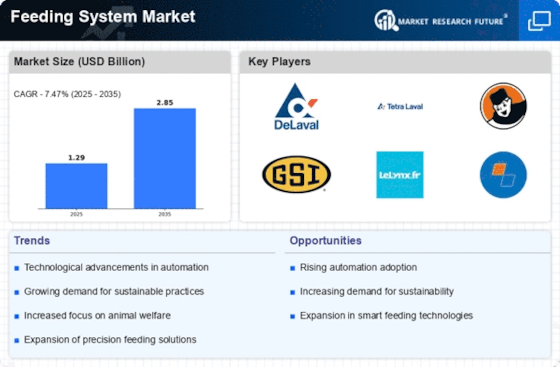
As per MRFR analysis, the Feeding System Market Size was estimated at 1.292 USD Billion in 2024. The Feeding System industry is projected to grow from 1.389 USD Billion in 2025 to 2.855 USD Billion by 2035, exhibiting a compound annual growth rate (CAGR) of 7.47 during the forecast period 2025 - 2035.

Key Market Trends & Highlights

The Feeding System Market is experiencing a dynamic shift towards technological integration and sustainability.

  • Technological integration is reshaping the Feeding System Market, particularly in North America, which remains the largest market.
  • A strong focus on sustainability is driving innovations in feeding systems, especially in the rapidly growing Asia-Pacific region.
  • Customization and diversification are becoming essential as consumers demand tailored solutions in the hardware segment, which is currently the largest.
  • Technological advancements and rising demand for animal protein are key drivers propelling market growth across various segments.

Market Size & Forecast

2024 Market Size 1.292 (USD Billion)
2035 Market Size 2.855 (USD Billion)
CAGR (2025 - 2035) 7.47%
Largest Regional Market Share in 2024 North America

Major Players

<p>DeLaval (SE), Tetra Laval (SE), Big Dutchman (DE), GSI (US), Lely (NL), BouMatic (US), Petersime (BE), Farming Technologies (US), HerdStar (US)</p>

Market Trends

The Feeding System Market is currently experiencing a transformative phase, driven by advancements in technology and increasing demand for efficient agricultural practices. Innovations in automation and precision farming are reshaping traditional feeding systems, allowing for enhanced productivity and sustainability. As farmers seek to optimize their operations, the integration of smart technologies, such as IoT devices and data analytics, appears to be a key factor in this evolution. Furthermore, the growing emphasis on animal welfare and environmental sustainability is prompting stakeholders to adopt more humane and eco-friendly feeding solutions. This shift not only addresses consumer preferences but also aligns with regulatory frameworks aimed at promoting responsible farming practices. In addition, the Feeding System Market is witnessing a diversification of product offerings, catering to various segments within the agricultural sector. Companies are increasingly focusing on developing customized solutions that meet the specific needs of different livestock types, thereby enhancing overall efficiency. The rise of vertical farming and urban agriculture is also influencing market dynamics, as these innovative approaches require tailored feeding systems to support their unique operational models. Overall, the Feeding System Market is poised for continued growth, driven by technological advancements and evolving consumer expectations, which may lead to a more sustainable and efficient agricultural landscape.

Technological Integration

The Feeding System Market is increasingly characterized by the integration of advanced technologies. Automation, artificial intelligence, and IoT devices are becoming commonplace, enabling farmers to monitor and manage feeding processes with greater precision. This trend not only enhances operational efficiency but also contributes to improved animal health and productivity.

Sustainability Focus

There is a notable shift towards sustainable feeding practices within the Feeding System Market. Stakeholders are prioritizing eco-friendly solutions that minimize environmental impact. This trend reflects a broader societal demand for responsible farming, as consumers become more conscious of the origins of their food and the practices involved in its production.

Customization and Diversification

The market is witnessing a trend towards customization and diversification of feeding systems. Companies are developing tailored solutions to meet the specific requirements of various livestock types. This approach allows for enhanced efficiency and productivity, catering to the unique needs of different agricultural operations.

Feeding System Market Market Drivers

Regulatory Compliance

Regulatory compliance is a critical driver in the Feeding System Market, as governments worldwide implement stricter guidelines for animal welfare and food safety. These regulations necessitate the adoption of advanced feeding systems that ensure compliance while maintaining productivity. The need for traceability and transparency in the supply chain is prompting producers to invest in technologies that facilitate monitoring and reporting. As a result, the Feeding System Market is adapting to these regulatory changes, which could lead to increased demand for innovative feeding solutions that meet compliance standards.

Sustainability Initiatives

Sustainability initiatives are reshaping the Feeding System Market as stakeholders increasingly prioritize environmentally friendly practices. The push for sustainable agriculture has led to the development of feeding systems that minimize waste and reduce carbon footprints. Innovations such as precision feeding and alternative feed sources are gaining traction, aligning with global sustainability goals. Data suggests that implementing sustainable feeding practices can reduce feed costs by up to 20%, making them economically viable. Consequently, the Feeding System Market is likely to witness a shift towards more sustainable solutions that cater to both economic and environmental concerns.

Technological Advancements

The Feeding System Market is experiencing a surge in technological advancements that enhance efficiency and productivity. Automation and smart feeding systems are becoming increasingly prevalent, allowing for precise control over feeding processes. These innovations not only reduce labor costs but also improve feed conversion ratios, which is crucial for livestock producers. According to recent data, the integration of IoT devices in feeding systems has shown to increase operational efficiency by up to 30%. As technology continues to evolve, the Feeding System Market is likely to see further enhancements that could redefine traditional feeding practices.

Rising Demand for Animal Protein

The Feeding System Market is significantly influenced by the rising demand for animal protein. As populations grow and dietary preferences shift towards protein-rich foods, the need for efficient feeding systems becomes paramount. Reports indicate that the global consumption of meat is projected to increase by 15% over the next decade, necessitating advanced feeding solutions to meet this demand. This trend drives investments in feeding technologies that optimize feed utilization and enhance animal health, thereby supporting the overall growth of the Feeding System Market.

Customization and Diversification

Customization and diversification are becoming essential components of the Feeding System Market. As producers seek to optimize their operations, tailored feeding solutions that cater to specific livestock needs are gaining popularity. This trend is driven by the recognition that different species and production systems require unique feeding strategies. Market data indicates that customized feeding systems can enhance growth rates and feed efficiency, leading to improved profitability. Consequently, the Feeding System Market is likely to expand as manufacturers develop more diverse and adaptable feeding solutions to meet the varied demands of the agricultural sector.

Market Segment Insights

By Offering: Hardware (Largest) vs. Software (Fastest-Growing)

<p>The Feeding System Market is currently dominated by the Hardware segment, known for its robust presence and essential role in feeding operations. Hardware solutions encompass a wide range of equipment and machinery necessary for effective feeding systems, translating to significant market share. In contrast, the Software segment, although smaller, is rapidly gaining traction, driven by the increasing demand for automation and data-driven decision-making in feeding processes. This shift towards technology integration is reshaping the competitive landscape of the market.</p>

<p>Hardware (Dominant) vs. Software (Emerging)</p>

<p>The Hardware segment is characterized by its extensive range of physical products that form the backbone of feeding systems. This includes feeders, hoppers, and control mechanisms, which are vital for operational efficiency. On the other hand, the Software segment is emerging as a critical player, focusing on enhancing feeding system performance through smart solutions. These software tools provide advanced analytics, real-time monitoring, and integration with IoT devices, enabling a more intelligent approach to feeding management. As companies increasingly prioritize optimization and efficiency, the adoption of software solutions is expected to accelerate significantly.</p>

By Product: Self-Propelled System (Largest) vs. Conveyor Belt System (Fastest-Growing)

<p>In the Feeding System Market, the Self-Propelled System holds the largest market share, attributed to its advanced technology and ability to enhance efficiency in feeding operations. This segment is favored for its flexibility and autonomy, making it suitable for various agricultural applications. Meanwhile, the Conveyor Belt System is rapidly gaining traction, owing to increasing automation in feeding processes and its adaptability in different environments, marking it as the fastest-growing segment. Growth trends within the Feeding System Market indicate a strong shift towards automation and precision. The rising need for efficient resource utilization and labor cost reduction is driving the adoption of self-propelled systems. Concurrently, the Conveyor Belt System is benefitting from innovations in design and technology that improve speed and reliability, aligning with the industry's broader trend towards sophisticated feeding solutions.</p>

<p>Self-Propelled System (Dominant) vs. Conveyor Belt System (Emerging)</p>

<p>The Self-Propelled System is regarded as the dominant force within the Feeding System Market due to its unparalleled ability to operate autonomously, optimizing feeding efficiency across large agricultural landscapes. It offers significant advantages like reduced labor costs and increased operational efficiency. On the other hand, the Conveyor Belt System, classified as an emerging segment, showcases promising growth potential with its versatility. These systems are designed to accommodate various feed types and can be integrated into existing operations with ease. As technology advances, conveyor systems are becoming more sophisticated, offering enhanced features such as automated control and smart technology integration, which cater to a wider range of feeding applications in both livestock and crop cultivation.</p>

By End-User: Dairy Farm (Largest) vs. Poultry Farm (Fastest-Growing)

<p>In the Feeding System Market, the Dairy Farm segment holds the largest share due to the increasing demand for dairy products globally. This segment benefits from advanced feeding technologies that enhance productivity and efficiency. Meanwhile, the Poultry Farm segment is rapidly gaining traction as consumer preferences shift towards poultry for its health benefits and lower environmental impact compared to red meat. The overall market is characterized by diverse end-users, with Swine and Equine Farms also contributing significantly to the dynamics of the sector.</p>

<p>Dairy Farm (Dominant) vs. Poultry Farm (Emerging)</p>

<p>The Dairy Farm segment stands out as a dominant player in the Feeding System Market, leveraging the high demand for milk and dairy products. Dairy farms typically utilize sophisticated feeding systems that optimize nutritional intake for livestock, driving higher milk yields and quality. In contrast, Poultry Farms represent an emerging market segment, increasingly adopting innovative feeding technologies to cater to the growing global appetite for poultry meat. These farms focus on sustainability and animal welfare, implementing precise feeding practices to enhance growth rates, feed conversion efficiency, and overall health of the birds, thereby achieving competitive advantages in this vibrant market.</p>

Get more detailed insights about Global Feeding System Market Research Report- Forecast 2035

Regional Insights

North America : Technological Innovation Leader

North America is the largest market for feeding systems, holding approximately 40% of the global share. The region's growth is driven by advancements in agricultural technology, increasing demand for automation, and supportive government policies promoting sustainable farming practices. Regulatory frameworks are evolving to enhance food safety and animal welfare, further boosting market demand. The United States and Canada are the leading countries in this market, with significant investments in research and development. Key players like DeLaval, GSI, and BouMatic are at the forefront, offering innovative solutions that cater to the needs of modern farms. The competitive landscape is characterized by a mix of established companies and emerging startups, all striving to enhance efficiency and productivity in feeding systems.

Europe : Sustainable Agriculture Focus

Europe is the second-largest market for feeding systems, accounting for around 30% of the global market share. The region's growth is fueled by a strong emphasis on sustainable agriculture, regulatory support for eco-friendly practices, and increasing consumer demand for high-quality food products. The European Union's Common Agricultural Policy plays a crucial role in shaping market dynamics, promoting innovation and efficiency in farming. Leading countries in this region include Germany, France, and the Netherlands, where companies like Tetra Laval and Big Dutchman are prominent. The competitive landscape is marked by a focus on technological advancements and sustainability, with many firms investing in research to develop smarter feeding solutions. The presence of key players ensures a robust market environment, driving continuous improvement in feeding systems.

Asia-Pacific : Rapid Growth and Adoption

Asia-Pacific is witnessing rapid growth in the feeding system market, holding approximately 20% of the global share. The region's expansion is driven by increasing livestock production, rising disposable incomes, and a growing population demanding higher food quality. Government initiatives aimed at modernizing agriculture and enhancing food security are also significant growth catalysts, fostering a favorable regulatory environment. Countries like China, India, and Australia are leading the charge, with a mix of local and international players competing for market share. Companies such as Lely and Petersime are making strides in this region, focusing on innovative feeding solutions tailored to local needs. The competitive landscape is evolving, with an increasing number of startups entering the market, contributing to a dynamic and diverse ecosystem.

Middle East and Africa : Emerging Market Potential

The Middle East and Africa represent an emerging market for feeding systems, accounting for about 10% of the global share. The region's growth is driven by increasing investments in agriculture, a rising population, and the need for improved food security. Governments are implementing policies to enhance agricultural productivity, which is creating a favorable environment for feeding system adoption. Leading countries in this region include South Africa, Egypt, and the UAE, where there is a growing interest in modern farming techniques. The competitive landscape features both local and international players, with companies like Farming Technologies and HerdStar making significant contributions. The market is characterized by a focus on innovation and sustainability, as stakeholders seek to address the challenges of food production in a resource-constrained environment.

Key Players and Competitive Insights

The Feeding System Market is currently characterized by a dynamic competitive landscape, driven by technological advancements and increasing demand for efficient agricultural practices. Key players such as DeLaval (SE), Tetra Laval (SE), and Big Dutchman (DE) are at the forefront, each adopting distinct strategies to enhance their market positioning. DeLaval (SE) focuses on innovation through the development of automated feeding systems, which streamline operations and reduce labor costs. Tetra Laval (SE) emphasizes sustainability, integrating eco-friendly practices into its product offerings, thereby appealing to environmentally conscious consumers. Meanwhile, Big Dutchman (DE) is expanding its global footprint by entering emerging markets, which reflects a strategic focus on regional diversification and growth.

The Feeding System Market exhibits a moderately fragmented structure, with several players vying for market share. Key business tactics include localizing manufacturing to reduce costs and optimize supply chains, which is crucial in maintaining competitive pricing. The collective influence of these major players shapes the market dynamics, as they continuously innovate and adapt to changing consumer preferences and regulatory requirements.

In August 2025, DeLaval (SE) launched a new line of precision feeding systems designed to enhance feed efficiency and animal health. This strategic move is significant as it aligns with the growing trend towards precision agriculture, where data-driven decisions are paramount. By investing in advanced technology, DeLaval (SE) positions itself as a leader in the market, catering to the increasing demand for smart farming solutions.

In September 2025, Tetra Laval (SE) announced a partnership with a leading agricultural technology firm to develop AI-driven feeding solutions. This collaboration is indicative of the company's commitment to integrating cutting-edge technology into its offerings, which could potentially revolutionize feeding practices in the industry. The partnership not only enhances Tetra Laval's product portfolio but also strengthens its competitive edge in a rapidly evolving market.

In July 2025, Big Dutchman (DE) acquired a regional competitor to bolster its presence in the North American market. This acquisition is strategically important as it allows Big Dutchman (DE) to leverage existing distribution networks and customer relationships, thereby accelerating its growth trajectory. Such consolidation efforts reflect a broader trend in the market where companies seek to enhance their operational capabilities and market reach through strategic mergers and acquisitions.

As of October 2025, the Feeding System Market is witnessing a shift towards digitalization, sustainability, and AI integration. These trends are reshaping competitive dynamics, as companies increasingly prioritize innovation over traditional price-based competition. Strategic alliances are becoming more prevalent, enabling firms to pool resources and expertise to develop advanced solutions. Looking ahead, competitive differentiation will likely hinge on the ability to innovate and deliver reliable supply chains, as the market continues to evolve in response to technological advancements and consumer demands.

Key Companies in the Feeding System Market market include

Industry Developments

  • Q2 2024: Trioliet launches new Solomix 3 feed mixer for large-scale dairy farms Trioliet, a leading manufacturer of feeding systems, announced the launch of its new Solomix 3 feed mixer designed for large-scale dairy operations. The new model features enhanced automation and capacity to improve feed efficiency and reduce labor requirements.
  • Q1 2024: DeLaval introduces OptiDuo 2.0 automated feed pusher DeLaval unveiled the OptiDuo 2.0, an upgraded automated feed pusher for dairy farms, featuring improved navigation and feed mixing capabilities to optimize animal nutrition and reduce feed waste.
  • Q2 2024: Lely opens new manufacturing facility for automated feeding systems in the Netherlands Lely inaugurated a new production facility dedicated to its automated feeding systems, aiming to meet growing demand in Europe and accelerate innovation in livestock automation.
  • Q2 2024: GEA Group launches DairyFeed F4500, a next-generation automated feeding robot GEA Group introduced the DairyFeed F4500, an advanced automated feeding robot for dairy farms, offering improved precision, energy efficiency, and integration with digital farm management platforms.
  • Q1 2025: Big Dutchman announces partnership with Bosch Rexroth for smart feeding solutions Big Dutchman entered a strategic partnership with Bosch Rexroth to co-develop smart, connected feeding systems for poultry and pig farms, leveraging IoT and automation technologies.
  • Q2 2025: ROXELL launches Fortena chain feeding system for broiler breeders ROXELL introduced the Fortena chain feeding system, designed to improve feed distribution and animal welfare in broiler breeder operations, with a focus on durability and ease of cleaning.
  • Q2 2024: WEDA Dammann & Westerkamp unveils Nutrix+ liquid feeding system for piglets WEDA Dammann & Westerkamp launched Nutrix+, a new liquid feeding system tailored for piglets, aiming to enhance early nutrition and support healthy growth in swine production.
  • Q1 2024: Schauer Agrotronic introduces Spotmix Vario 2.0 for multi-phase pig feeding Schauer Agrotronic released the Spotmix Vario 2.0, an upgraded multi-phase feeding system for pigs, enabling precise, individualized feed rations and improved feed conversion rates.
  • Q2 2025: AgriHub secures €15 million Series B funding to expand automated feeding technology AgriHub, a European agri-tech startup specializing in automated livestock feeding systems, raised €15 million in Series B funding to accelerate product development and expand into new markets.
  • Q1 2025: VDL Agrotech launches new FlexMix Pro feed mill automation platform VDL Agrotech introduced the FlexMix Pro, a feed mill automation platform designed to optimize feed formulation, mixing, and delivery processes for commercial livestock producers.
  • Q2 2024: Munters acquires MTech Systems to strengthen digital livestock feeding solutions Munters, a global provider of climate solutions, acquired MTech Systems, a developer of digital feeding and farm management software, to enhance its portfolio of precision livestock feeding technologies.
  • Q1 2024: Fancom launches Inno+ smart feeding control system for pig and poultry farms Fancom introduced the Inno+ smart feeding control system, enabling real-time monitoring and adjustment of feed delivery to optimize animal health and production efficiency.

Future Outlook

Feeding System Market Future Outlook

<p>The Feeding System Market is projected to grow at a 7.47% CAGR from 2024 to 2035, driven by technological advancements, increasing automation, and rising demand for efficient feeding solutions.</p>

New opportunities lie in:

  • <p>Integration of AI-driven analytics for optimized feeding schedules.</p>
  • <p>Development of mobile feeding applications for real-time monitoring.</p>
  • <p>Expansion into emerging markets with tailored feeding solutions.</p>

<p>By 2035, the Feeding System Market is expected to achieve substantial growth, reflecting evolving industry needs.</p>

Market Segmentation

Feeding System Market Product Outlook

  • Self-Propelled System
  • Rail Guided System
  • Conveyor Belt System

Feeding System Market End-User Outlook

  • Swine Farm
  • Equine Farm
  • Dairy Farm
  • Poultry Farm

Feeding System Market Offering Outlook

  • Hardware
  • Software
  • Services

Report Scope

MARKET SIZE 20241.292(USD Billion)
MARKET SIZE 20251.389(USD Billion)
MARKET SIZE 20352.855(USD Billion)
COMPOUND ANNUAL GROWTH RATE (CAGR)7.47% (2024 - 2035)
REPORT COVERAGERevenue Forecast, Competitive Landscape, Growth Factors, and Trends
BASE YEAR2024
Market Forecast Period2025 - 2035
Historical Data2019 - 2024
Market Forecast UnitsUSD Billion
Key Companies ProfiledMarket analysis in progress
Segments CoveredMarket segmentation analysis in progress
Key Market OpportunitiesIntegration of automation and smart technology in Feeding System Market enhances efficiency and precision in livestock management.
Key Market DynamicsTechnological advancements and regulatory changes drive innovation and efficiency in the Feeding System Market.
Countries CoveredNorth America, Europe, APAC, South America, MEA

FAQs

What is the current valuation of the Feeding System Market as of 2024?

The Feeding System Market was valued at 1.292 USD Billion in 2024.

What is the projected market valuation for the Feeding System Market in 2035?

The market is projected to reach 2.855 USD Billion by 2035.

What is the expected CAGR for the Feeding System Market during the forecast period 2025 - 2035?

The expected CAGR for the Feeding System Market during 2025 - 2035 is 7.47%.

Which segments are included in the Feeding System Market offerings?

The market offerings include Hardware, Software, and Services, with valuations ranging from 0.387 to 1.071 USD Billion.

What are the key product types in the Feeding System Market?

Key product types include Self-Propelled Systems, Rail Guided Systems, and Conveyor Belt Systems, with valuations from 0.387 to 1.033 USD Billion.

Which end-user segments are driving the Feeding System Market?

The end-user segments include Swine Farms, Equine Farms, Dairy Farms, and Poultry Farms, with valuations between 0.129 and 0.865 USD Billion.

  1. SECTION I: EXECUTIVE SUMMARY AND KEY HIGHLIGHTS
    1. EXECUTIVE SUMMARY
      1. Market Overview
      2. Key Findings
      3. Market Segmentation
      4. Competitive Landscape
      5. Challenges and Opportunities
      6. Future Outlook
  2. SECTION II: SCOPING, METHODOLOGY AND MARKET STRUCTURE
    1. MARKET INTRODUCTION
      1. Definition
      2. Scope of the study
    2. RESEARCH METHODOLOGY
      1. Overview
      2. Data Mining
      3. Secondary Research
      4. Primary Research
      5. Forecasting Model
      6. Market Size Estimation
      7. Data Triangulation
      8. Validation
  3. SECTION III: QUALITATIVE ANALYSIS
    1. MARKET DYNAMICS
      1. Overview
      2. Drivers
      3. Restraints
      4. Opportunities
    2. MARKET FACTOR ANALYSIS
      1. Value chain Analysis
      2. Porter's Five Forces Analysis
      3. COVID-19 Impact Analysis
  4. SECTION IV: QUANTITATIVE ANALYSIS
    1. Semiconductor & Electronics, BY Offering (USD Billion)
      1. Hardware
      2. Software
      3. Services
    2. Semiconductor & Electronics, BY Product (USD Billion)
      1. Self-Propelled System
      2. Rail Guided System
      3. Conveyor Belt System
    3. Semiconductor & Electronics, BY End-User (USD Billion)
      1. Swine Farm
      2. Equine Farm
      3. Dairy Farm
      4. Poultry Farm
    4. Semiconductor & Electronics, BY Region (USD Billion)
      1. North America
      2. Europe
      3. APAC
      4. South America
      5. MEA
  5. SECTION V: COMPETITIVE ANALYSIS
    1. Competitive Landscape
      1. Overview
      2. Competitive Analysis
      3. Market share Analysis
      4. Major Growth Strategy in the Semiconductor & Electronics
      5. Competitive Benchmarking
      6. Leading Players in Terms of Number of Developments in the Semiconductor & Electronics
      7. Key developments and growth strategies
      8. Major Players Financial Matrix
    2. Company Profiles
      1. DeLaval (SE)
      2. Tetra Laval (SE)
      3. Big Dutchman (DE)
      4. GSI (US)
      5. Lely (NL)
      6. BouMatic (US)
      7. Petersime (BE)
      8. Farming Technologies (US)
      9. HerdStar (US)
    3. Appendix
      1. References
      2. Related Reports
  6. LIST OF FIGURES
    1. MARKET SYNOPSIS
    2. NORTH AMERICA MARKET ANALYSIS
    3. US MARKET ANALYSIS BY OFFERING
    4. US MARKET ANALYSIS BY PRODUCT
    5. US MARKET ANALYSIS BY END-USER
    6. CANADA MARKET ANALYSIS BY OFFERING
    7. CANADA MARKET ANALYSIS BY PRODUCT
    8. CANADA MARKET ANALYSIS BY END-USER
    9. EUROPE MARKET ANALYSIS
    10. GERMANY MARKET ANALYSIS BY OFFERING
    11. GERMANY MARKET ANALYSIS BY PRODUCT
    12. GERMANY MARKET ANALYSIS BY END-USER
    13. UK MARKET ANALYSIS BY OFFERING
    14. UK MARKET ANALYSIS BY PRODUCT
    15. UK MARKET ANALYSIS BY END-USER
    16. FRANCE MARKET ANALYSIS BY OFFERING
    17. FRANCE MARKET ANALYSIS BY PRODUCT
    18. FRANCE MARKET ANALYSIS BY END-USER
    19. RUSSIA MARKET ANALYSIS BY OFFERING
    20. RUSSIA MARKET ANALYSIS BY PRODUCT
    21. RUSSIA MARKET ANALYSIS BY END-USER
    22. ITALY MARKET ANALYSIS BY OFFERING
    23. ITALY MARKET ANALYSIS BY PRODUCT
    24. ITALY MARKET ANALYSIS BY END-USER
    25. SPAIN MARKET ANALYSIS BY OFFERING
    26. SPAIN MARKET ANALYSIS BY PRODUCT
    27. SPAIN MARKET ANALYSIS BY END-USER
    28. REST OF EUROPE MARKET ANALYSIS BY OFFERING
    29. REST OF EUROPE MARKET ANALYSIS BY PRODUCT
    30. REST OF EUROPE MARKET ANALYSIS BY END-USER
    31. APAC MARKET ANALYSIS
    32. CHINA MARKET ANALYSIS BY OFFERING
    33. CHINA MARKET ANALYSIS BY PRODUCT
    34. CHINA MARKET ANALYSIS BY END-USER
    35. INDIA MARKET ANALYSIS BY OFFERING
    36. INDIA MARKET ANALYSIS BY PRODUCT
    37. INDIA MARKET ANALYSIS BY END-USER
    38. JAPAN MARKET ANALYSIS BY OFFERING
    39. JAPAN MARKET ANALYSIS BY PRODUCT
    40. JAPAN MARKET ANALYSIS BY END-USER
    41. SOUTH KOREA MARKET ANALYSIS BY OFFERING
    42. SOUTH KOREA MARKET ANALYSIS BY PRODUCT
    43. SOUTH KOREA MARKET ANALYSIS BY END-USER
    44. MALAYSIA MARKET ANALYSIS BY OFFERING
    45. MALAYSIA MARKET ANALYSIS BY PRODUCT
    46. MALAYSIA MARKET ANALYSIS BY END-USER
    47. THAILAND MARKET ANALYSIS BY OFFERING
    48. THAILAND MARKET ANALYSIS BY PRODUCT
    49. THAILAND MARKET ANALYSIS BY END-USER
    50. INDONESIA MARKET ANALYSIS BY OFFERING
    51. INDONESIA MARKET ANALYSIS BY PRODUCT
    52. INDONESIA MARKET ANALYSIS BY END-USER
    53. REST OF APAC MARKET ANALYSIS BY OFFERING
    54. REST OF APAC MARKET ANALYSIS BY PRODUCT
    55. REST OF APAC MARKET ANALYSIS BY END-USER
    56. SOUTH AMERICA MARKET ANALYSIS
    57. BRAZIL MARKET ANALYSIS BY OFFERING
    58. BRAZIL MARKET ANALYSIS BY PRODUCT
    59. BRAZIL MARKET ANALYSIS BY END-USER
    60. MEXICO MARKET ANALYSIS BY OFFERING
    61. MEXICO MARKET ANALYSIS BY PRODUCT
    62. MEXICO MARKET ANALYSIS BY END-USER
    63. ARGENTINA MARKET ANALYSIS BY OFFERING
    64. ARGENTINA MARKET ANALYSIS BY PRODUCT
    65. ARGENTINA MARKET ANALYSIS BY END-USER
    66. REST OF SOUTH AMERICA MARKET ANALYSIS BY OFFERING
    67. REST OF SOUTH AMERICA MARKET ANALYSIS BY PRODUCT
    68. REST OF SOUTH AMERICA MARKET ANALYSIS BY END-USER
    69. MEA MARKET ANALYSIS
    70. GCC COUNTRIES MARKET ANALYSIS BY OFFERING
    71. GCC COUNTRIES MARKET ANALYSIS BY PRODUCT
    72. GCC COUNTRIES MARKET ANALYSIS BY END-USER
    73. SOUTH AFRICA MARKET ANALYSIS BY OFFERING
    74. SOUTH AFRICA MARKET ANALYSIS BY PRODUCT
    75. SOUTH AFRICA MARKET ANALYSIS BY END-USER
    76. REST OF MEA MARKET ANALYSIS BY OFFERING
    77. REST OF MEA MARKET ANALYSIS BY PRODUCT
    78. REST OF MEA MARKET ANALYSIS BY END-USER
    79. KEY BUYING CRITERIA OF SEMICONDUCTOR & ELECTRONICS
    80. RESEARCH PROCESS OF MRFR
    81. DRO ANALYSIS OF SEMICONDUCTOR & ELECTRONICS
    82. DRIVERS IMPACT ANALYSIS: SEMICONDUCTOR & ELECTRONICS
    83. RESTRAINTS IMPACT ANALYSIS: SEMICONDUCTOR & ELECTRONICS
    84. SUPPLY / VALUE CHAIN: SEMICONDUCTOR & ELECTRONICS
    85. SEMICONDUCTOR & ELECTRONICS, BY OFFERING, 2024 (% SHARE)
    86. SEMICONDUCTOR & ELECTRONICS, BY OFFERING, 2024 TO 2035 (USD Billion)
    87. SEMICONDUCTOR & ELECTRONICS, BY PRODUCT, 2024 (% SHARE)
    88. SEMICONDUCTOR & ELECTRONICS, BY PRODUCT, 2024 TO 2035 (USD Billion)
    89. SEMICONDUCTOR & ELECTRONICS, BY END-USER, 2024 (% SHARE)
    90. SEMICONDUCTOR & ELECTRONICS, BY END-USER, 2024 TO 2035 (USD Billion)
    91. BENCHMARKING OF MAJOR COMPETITORS
  7. LIST OF TABLES
    1. LIST OF ASSUMPTIONS
    2. North America MARKET SIZE ESTIMATES; FORECAST
      1. BY OFFERING, 2025-2035 (USD Billion)
      2. BY PRODUCT, 2025-2035 (USD Billion)
      3. BY END-USER, 2025-2035 (USD Billion)
    3. US MARKET SIZE ESTIMATES; FORECAST
      1. BY OFFERING, 2025-2035 (USD Billion)
      2. BY PRODUCT, 2025-2035 (USD Billion)
      3. BY END-USER, 2025-2035 (USD Billion)
    4. Canada MARKET SIZE ESTIMATES; FORECAST
      1. BY OFFERING, 2025-2035 (USD Billion)
      2. BY PRODUCT, 2025-2035 (USD Billion)
      3. BY END-USER, 2025-2035 (USD Billion)
    5. Europe MARKET SIZE ESTIMATES; FORECAST
      1. BY OFFERING, 2025-2035 (USD Billion)
      2. BY PRODUCT, 2025-2035 (USD Billion)
      3. BY END-USER, 2025-2035 (USD Billion)
    6. Germany MARKET SIZE ESTIMATES; FORECAST
      1. BY OFFERING, 2025-2035 (USD Billion)
      2. BY PRODUCT, 2025-2035 (USD Billion)
      3. BY END-USER, 2025-2035 (USD Billion)
    7. UK MARKET SIZE ESTIMATES; FORECAST
      1. BY OFFERING, 2025-2035 (USD Billion)
      2. BY PRODUCT, 2025-2035 (USD Billion)
      3. BY END-USER, 2025-2035 (USD Billion)
    8. France MARKET SIZE ESTIMATES; FORECAST
      1. BY OFFERING, 2025-2035 (USD Billion)
      2. BY PRODUCT, 2025-2035 (USD Billion)
      3. BY END-USER, 2025-2035 (USD Billion)
    9. Russia MARKET SIZE ESTIMATES; FORECAST
      1. BY OFFERING, 2025-2035 (USD Billion)
      2. BY PRODUCT, 2025-2035 (USD Billion)
      3. BY END-USER, 2025-2035 (USD Billion)
    10. Italy MARKET SIZE ESTIMATES; FORECAST
      1. BY OFFERING, 2025-2035 (USD Billion)
      2. BY PRODUCT, 2025-2035 (USD Billion)
      3. BY END-USER, 2025-2035 (USD Billion)
    11. Spain MARKET SIZE ESTIMATES; FORECAST
      1. BY OFFERING, 2025-2035 (USD Billion)
      2. BY PRODUCT, 2025-2035 (USD Billion)
      3. BY END-USER, 2025-2035 (USD Billion)
    12. Rest of Europe MARKET SIZE ESTIMATES; FORECAST
      1. BY OFFERING, 2025-2035 (USD Billion)
      2. BY PRODUCT, 2025-2035 (USD Billion)
      3. BY END-USER, 2025-2035 (USD Billion)
    13. APAC MARKET SIZE ESTIMATES; FORECAST
      1. BY OFFERING, 2025-2035 (USD Billion)
      2. BY PRODUCT, 2025-2035 (USD Billion)
      3. BY END-USER, 2025-2035 (USD Billion)
    14. China MARKET SIZE ESTIMATES; FORECAST
      1. BY OFFERING, 2025-2035 (USD Billion)
      2. BY PRODUCT, 2025-2035 (USD Billion)
      3. BY END-USER, 2025-2035 (USD Billion)
    15. India MARKET SIZE ESTIMATES; FORECAST
      1. BY OFFERING, 2025-2035 (USD Billion)
      2. BY PRODUCT, 2025-2035 (USD Billion)
      3. BY END-USER, 2025-2035 (USD Billion)
    16. Japan MARKET SIZE ESTIMATES; FORECAST
      1. BY OFFERING, 2025-2035 (USD Billion)
      2. BY PRODUCT, 2025-2035 (USD Billion)
      3. BY END-USER, 2025-2035 (USD Billion)
    17. South Korea MARKET SIZE ESTIMATES; FORECAST
      1. BY OFFERING, 2025-2035 (USD Billion)
      2. BY PRODUCT, 2025-2035 (USD Billion)
      3. BY END-USER, 2025-2035 (USD Billion)
    18. Malaysia MARKET SIZE ESTIMATES; FORECAST
      1. BY OFFERING, 2025-2035 (USD Billion)
      2. BY PRODUCT, 2025-2035 (USD Billion)
      3. BY END-USER, 2025-2035 (USD Billion)
    19. Thailand MARKET SIZE ESTIMATES; FORECAST
      1. BY OFFERING, 2025-2035 (USD Billion)
      2. BY PRODUCT, 2025-2035 (USD Billion)
      3. BY END-USER, 2025-2035 (USD Billion)
    20. Indonesia MARKET SIZE ESTIMATES; FORECAST
      1. BY OFFERING, 2025-2035 (USD Billion)
      2. BY PRODUCT, 2025-2035 (USD Billion)
      3. BY END-USER, 2025-2035 (USD Billion)
    21. Rest of APAC MARKET SIZE ESTIMATES; FORECAST
      1. BY OFFERING, 2025-2035 (USD Billion)
      2. BY PRODUCT, 2025-2035 (USD Billion)
      3. BY END-USER, 2025-2035 (USD Billion)
    22. South America MARKET SIZE ESTIMATES; FORECAST
      1. BY OFFERING, 2025-2035 (USD Billion)
      2. BY PRODUCT, 2025-2035 (USD Billion)
      3. BY END-USER, 2025-2035 (USD Billion)
    23. Brazil MARKET SIZE ESTIMATES; FORECAST
      1. BY OFFERING, 2025-2035 (USD Billion)
      2. BY PRODUCT, 2025-2035 (USD Billion)
      3. BY END-USER, 2025-2035 (USD Billion)
    24. Mexico MARKET SIZE ESTIMATES; FORECAST
      1. BY OFFERING, 2025-2035 (USD Billion)
      2. BY PRODUCT, 2025-2035 (USD Billion)
      3. BY END-USER, 2025-2035 (USD Billion)
    25. Argentina MARKET SIZE ESTIMATES; FORECAST
      1. BY OFFERING, 2025-2035 (USD Billion)
      2. BY PRODUCT, 2025-2035 (USD Billion)
      3. BY END-USER, 2025-2035 (USD Billion)
    26. Rest of South America MARKET SIZE ESTIMATES; FORECAST
      1. BY OFFERING, 2025-2035 (USD Billion)
      2. BY PRODUCT, 2025-2035 (USD Billion)
      3. BY END-USER, 2025-2035 (USD Billion)
    27. MEA MARKET SIZE ESTIMATES; FORECAST
      1. BY OFFERING, 2025-2035 (USD Billion)
      2. BY PRODUCT, 2025-2035 (USD Billion)
      3. BY END-USER, 2025-2035 (USD Billion)
    28. GCC Countries MARKET SIZE ESTIMATES; FORECAST
      1. BY OFFERING, 2025-2035 (USD Billion)
      2. BY PRODUCT, 2025-2035 (USD Billion)
      3. BY END-USER, 2025-2035 (USD Billion)
    29. South Africa MARKET SIZE ESTIMATES; FORECAST
      1. BY OFFERING, 2025-2035 (USD Billion)
      2. BY PRODUCT, 2025-2035 (USD Billion)
      3. BY END-USER, 2025-2035 (USD Billion)
    30. Rest of MEA MARKET SIZE ESTIMATES; FORECAST
      1. BY OFFERING, 2025-2035 (USD Billion)
      2. BY PRODUCT, 2025-2035 (USD Billion)
      3. BY END-USER, 2025-2035 (USD Billion)
    31. PRODUCT LAUNCH/PRODUCT DEVELOPMENT/APPROVAL
    32. ACQUISITION/PARTNERSHIP

Feeding System Market Segmentation

Feeding System Market By Offering Outlook (USD Billion, 2018-2032)

Hardware

Software

Services

Feeding System Market By Product Outlook (USD Billion, 2018-2032)

Self-Propelled System

Rail Guided System

Conveyor Belt System

Feeding System Market By End-User Outlook (USD Billion, 2018-2032)

Swine Farm

Equine Farm

Dairy Farm

Poultry Farm

Feeding System Market Regional Outlook (USD Billion, 2018-2032)

North America Outlook (USD Billion, 2018-2032)

North America Feeding System Market By Offering

Hardware

Software

Services

North America Feeding System Market by Product

Self-Propelled System

Rail Guided System

Conveyor Belt System

North America Feeding System Market By End-User

Swine Farm

Equine Farm

Dairy Farm

Poultry Farm

US Outlook (USD Billion, 2018-2032)

US Feeding System Market By Offering

Hardware

Software

Services

US Feeding System Market by Product

Self-Propelled System

Rail Guided System

Conveyor Belt System

US Feeding System Market By End-User

Swine Farm

Equine Farm

Dairy Farm

Poultry Farm

CANADA Outlook (USD Billion, 2018-2032)

CANADA Feeding System Market By Offering

Hardware

Software

Services

CANADA Feeding System Market by Product

Self-Propelled System

Rail Guided System

Conveyor Belt System

CANADA Feeding System Market By End-User

Swine Farm

Equine Farm

Dairy Farm

Poultry Farm

Europe Outlook (USD Billion, 2018-2032)

Europe Feeding System Market By Offering

Hardware

Software

Services

Europe Feeding System Market by Product

Self-Propelled System

Rail Guided System

Conveyor Belt System

Europe Feeding System Market By End-User

Swine Farm

Equine Farm

Dairy Farm

Poultry Farm

Germany Outlook (USD Billion, 2018-2032)

Germany Feeding System Market By Offering

Hardware

Software

Services

Germany Feeding System Market by Product

Self-Propelled System

Rail Guided System

Conveyor Belt System

Germany Feeding System Market By End-User

Swine Farm

Equine Farm

Dairy Farm

Poultry Farm

France Outlook (USD Billion, 2018-2032)

France Feeding System Market By Offering

Hardware

Software

Services

France Feeding System Market by Product

Self-Propelled System

Rail Guided System

Conveyor Belt System

France Feeding System Market By End-User

Swine Farm

Equine Farm

Dairy Farm

Poultry Farm

UK Outlook (USD Billion, 2018-2032)

UK Feeding System Market By Offering

Hardware

Software

Services

UK Feeding System Market by Product

Self-Propelled System

Rail Guided System

Conveyor Belt System

UK Feeding System Market By End-User

Swine Farm

Equine Farm

Dairy Farm

Poultry Farm

ITALY Outlook (USD Billion, 2018-2032)

ITALY Feeding System Market By Offering

Hardware

Software

Services

ITALY Feeding System Market by Product

Self-Propelled System

Rail Guided System

Conveyor Belt System

ITALY Feeding System Market By End-User

Swine Farm

Equine Farm

Dairy Farm

Poultry Farm

SPAIN Outlook (USD Billion, 2018-2032)

Spain Feeding System Market By Offering

Hardware

Software

Services

Spain Feeding System Market by Product

Self-Propelled System

Rail Guided System

Conveyor Belt System

Spain Feeding System Market By End-User

Swine Farm

Equine Farm

Dairy Farm

Poultry Farm

Rest Of Europe Outlook (USD Billion, 2018-2032)

Rest Of Europe Feeding System Market By Offering

Hardware

Software

Services

REST OF EUROPE Feeding System Market by Product

Self-Propelled System

Rail Guided System

Conveyor Belt System

REST OF EUROPE Feeding System Market By End-User

Swine Farm

Equine Farm

Dairy Farm

Poultry Farm

Asia-Pacific Outlook (USD Billion, 2018-2032)

Asia-Pacific Feeding System Market By Offering

Hardware

Software

Services

Asia-Pacific Feeding System Market by Product

Self-Propelled System

Rail Guided System

Conveyor Belt System

Asia-Pacific Feeding System Market By End-User

Swine Farm

Equine Farm

Dairy Farm

Poultry Farm

China Outlook (USD Billion, 2018-2032)

China Feeding System Market By Offering

Hardware

Software

Services

China Feeding System Market by Product

Self-Propelled System

Rail Guided System

Conveyor Belt System

China Feeding System Market By End-User

Swine Farm

Equine Farm

Dairy Farm

Poultry Farm

Japan Outlook (USD Billion, 2018-2032)

Japan Feeding System Market By Offering

Hardware

Software

Services

Japan Feeding System Market by Product

Self-Propelled System

Rail Guided System

Conveyor Belt System

Japan Feeding System Market By End-User

Swine Farm

Equine Farm

Dairy Farm

Poultry Farm

India Outlook (USD Billion, 2018-2032)

India Feeding System Market By Offering

Hardware

Software

Services

India Feeding System Market by Product

Self-Propelled System

Rail Guided System

Conveyor Belt System

India Feeding System Market By End-User

Swine Farm

Equine Farm

Dairy Farm

Poultry Farm

Australia Outlook (USD Billion, 2018-2032)

Australia Feeding System Market By Offering

Hardware

Software

Services

Australia Feeding System Market by Product

Self-Propelled System

Rail Guided System

Conveyor Belt System

Australia Feeding System Market By End-User

Swine Farm

Equine Farm

Dairy Farm

Poultry Farm

Rest of Asia-Pacific Outlook (USD Billion, 2018-2032)

Rest of Asia-Pacific Feeding System Market By Offering

Hardware

Software

Services

Rest of Asia-Pacific Feeding System Market by Product

Self-Propelled System

Rail Guided System

Conveyor Belt System

Rest of Asia-Pacific Feeding System Market By End-User

Swine Farm

Equine Farm

Dairy Farm

Poultry Farm

Rest of the World Outlook (USD Billion, 2018-2032)

Rest of the World Feeding System Market By Offering

Hardware

Software

Services

Rest of the World Feeding System Market by Product

Self-Propelled System

Rail Guided System

Conveyor Belt System

Rest of the World Feeding System Market By End-User

Swine Farm

Equine Farm

Dairy Farm

Poultry Farm

Middle East Outlook (USD Billion, 2018-2032)

Middle East Feeding System Market By Offering

Hardware

Software

Services

Middle East Feeding System Market by Product

Self-Propelled System

Rail Guided System

Conveyor Belt System

Middle East Feeding System Market By End-User

Swine Farm

Equine Farm

Dairy Farm

Poultry Farm

Africa Outlook (USD Billion, 2018-2032)

Africa Feeding System Market By Offering

Hardware

Software

Services

Africa Feeding System Market by Product

Self-Propelled System

Rail Guided System

Conveyor Belt System

Africa Feeding System Market By End-User

Swine Farm

Equine Farm

Dairy Farm

Poultry Farm

Latin America Outlook (USD Billion, 2018-2032)

Latin America Feeding System Market By Offering

Hardware

Software

Services

Latin America Feeding System Market by Product

Self-Propelled System

Rail Guided System

Conveyor Belt System

Latin America Feeding System Market By End-User

Swine Farm

Equine Farm

Dairy Farm

Poultry Farm

Infographic

Free Sample Request

Kindly complete the form below to receive a free sample of this Report

Get Free Sample

Customer Strories

Compare Licence

×
Features License Type
Single User Multiuser License Enterprise User
Price $4,950 $5,950 $7,250
Maximum User Access Limit 1 User Upto 10 Users Unrestricted Access Throughout the Organization
Free Customization
Direct Access to Analyst
Deliverable Format
Platform Access
Discount on Next Purchase 10% 15% 15%
Printable Versions