×
Request Free Sample ×

Kindly complete the form below to receive a free sample of this Report

* Please use a valid business email

Leading companies partner with us for data-driven Insights

clients tt-cursor
Hero Background
English
Chinese
French
Japanese
Korean
German
Spanish

Feed Mycotoxin Detoxifiers Market Size

ID: MRFR/CnM/9334-HCR
100 Pages
Anshula Mandaokar
October 2025

Feed Mycotoxin Detoxifiers Market Research Report Information By Type (Binder, Modifiers) Animal Type (Farm Animals, Pets, Aquatic Animals, Zoo Animals) Forecast till 2035

Share:
Download PDF ×

We do not share your information with anyone. However, we may send you emails based on your report interest from time to time. You may contact us at any time to opt-out.

Feed Mycotoxin Detoxifiers Market Infographic
Purchase Options

Feed Mycotoxin Detoxifiers Size

Feed Mycotoxin Detoxifiers Market Growth Projections and Opportunities

The Market for Mycotoxin Detoxifiers is affected by many things that, together, decide how it grows and changes. These factors also play a big part in its overall workings within the industry. It is very important for those who work in the field to understand these market factors. This helps them make right choices, overcome difficulties and use new chances from detoxifiers for mycotoxin treatment sector properly. The spread and bad effects of mycotoxin in animal food have a big impact on the market. High levels of dirt make animals need strong ways to get rid of bad effects on their health and performance. Weather conditions are very important in making mycotoxins. Things like heat, moisture and the weather help fungi grow more. This impacts how much we want detox things in different places based on these factors too. Farming methods, like growing crops and keeping track of them affect how much mycotoxin happens. Certain plants, ways of planting and storing food stuffs can change mycotoxin levels. This means we need special cleaners to keep animal feed safe from harmful things. People learning more about safe food and making stricter rules for mycotoxins in foods make us need better cleaners. Following the rules and making customers happy are important things for this business. Changes in how farms work and ways of caring for animals that are part of the livestock business impact demand for mycotoxin cleaners. As the animal farming area changes, so does our need for new ways to clean up. Keep in mind, improvements to feed technology change how detoxifiers are made. Changes in making things, ways to give them and knowing how mycotoxins work help the growth of solutions for getting rid of harmful stuff. This is found in markets nowadays. Trade worldwide laws, such as buying and selling rules affect how feed mycotoxin detoxifiers are found and given out. Altered trade rules and worldwide teamwork can affect how easy it is to enter markets and compete. The mycotoxin types found in different areas or linked to specific plants affect how detoxifier medicines are made. We need to make detoxifiers that can deal with all kinds of mycotoxins found in food. This will keep everything safe from harm. Finding and taking advantage of new market chances is very important. As new problems with mycotoxins come up or more areas get a lot of contamination, there is a bigger need for good ways to clean out the bad stuff. Continued research in mycotoxin detoxification makes the market progress by improving things. Companies that put money into new methods help make better and more useful cleaners. This makes them stronger compared to others.
Feed Mycotoxin Detoxifiers Market Size Graph
Author
Anshula Mandaokar
Team Lead - Research

Anshula Mandaokar holds an academic degree in Chemical Engineering and has been contributing to the field for more than 5 years. She has expertise in Market Research and Business Consulting and serves as a Team Lead for a reputed Market Research firm under the Chemicals and Materials domain spectrum. She has worked on multiple projects, generating explicit results in a quick turnaround time. Her understanding of data interpretation justifies her role as a leader.

Leave a Comment

FAQs

1. What growth rate global Feed Mycotoxin Detoxifiers market would register in the future?

Global Feed Mycotoxin Detoxifiers market would register a growth of 3.50%.

2. Which industry will play a crucial role in taking the Feed Mycotoxin Detoxifiers market ahead??

Livestock industry will play prominent role in taking the market forward.

3. What is the key driving restraining factor for the global Feed Mycotoxin Detoxifiers market?

Presence of potential substitutescould restrain the market.

4. Which region would enjoy the upper hand in the Feed Mycotoxin Detoxifiers market?

The North America Feed Mycotoxin Detoxifiers market would enjoy the upper hand in the Feed Mycotoxin Detoxifiers market.

5. Which Asia Pacific country would set the trend in the Feed Mycotoxin Detoxifiers market?

China, as the largest consumer, would set the trend.

Market Summary

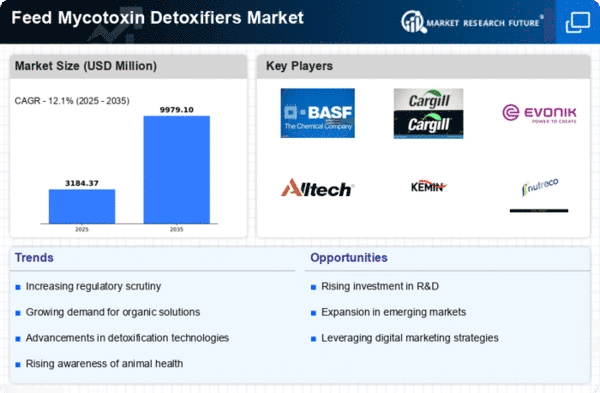
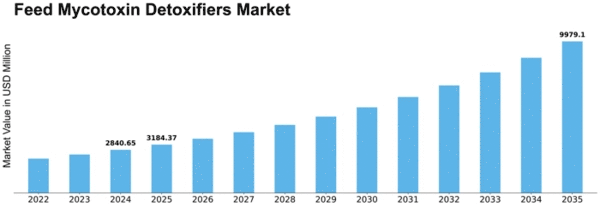
As per MRFR analysis, the Feed Mycotoxin Detoxifiers Market Size was estimated at 2840.65 USD Million in 2024. The Feed Mycotoxin Detoxifiers industry is projected to grow from 3184.38 in 2025 to 9979.1 by 2035, exhibiting a compound annual growth rate (CAGR) of 12.1 during the forecast period 2025 - 2035.

Key Market Trends & Highlights

The Feed Mycotoxin Detoxifiers Market is experiencing notable growth driven by increasing awareness and demand for safe animal products.

  • Rising awareness of mycotoxin risks is prompting livestock producers to seek effective detoxification solutions.
  • The market is witnessing a shift towards natural solutions, particularly in the animal feed segment, which remains the largest.
  • Technological advancements are being integrated into feed management practices, enhancing detoxification processes.
  • The increasing demand for animal protein and regulatory compliance are key drivers propelling market growth, especially in North America and the rapidly expanding aquaculture segment in Asia-Pacific.

Market Size & Forecast

2024 Market Size 2840.65 (USD Million)
2035 Market Size 9979.1 (USD Million)
CAGR (2025 - 2035) 12.1%
Largest Regional Market Share in 2024 North America

Major Players

BASF SE (DE), Cargill, Incorporated (US), Evonik Industries AG (DE), Alltech, Inc. (US), Kemin Industries, Inc. (US), Nutreco N.V. (NL), Adisseo France S.A.S. (FR), Biomin Holding GmbH (AT), Novus International, Inc. (US)

Market Trends

The Feed Mycotoxin Detoxifiers Market is currently experiencing a notable evolution, driven by increasing awareness regarding the adverse effects of mycotoxins on animal health and productivity. As livestock producers and feed manufacturers become more cognizant of the potential risks associated with contaminated feed, there is a growing demand for effective detoxification solutions. This market appears to be influenced by regulatory frameworks that emphasize food safety and animal welfare, prompting stakeholders to seek innovative products that can mitigate mycotoxin risks. Furthermore, advancements in technology and research are likely to enhance the efficacy of detoxifiers, thereby expanding their application across various animal species. In addition, the Feed Mycotoxin Detoxifiers Market seems to be characterized by a shift towards natural and organic solutions, as consumers increasingly prefer products that align with sustainable practices. This trend may lead to the development of new formulations that utilize plant-based ingredients and enzymes, which could appeal to a broader audience. Moreover, the integration of digital tools and data analytics in feed management is anticipated to optimize the use of detoxifiers, ensuring that livestock receive the appropriate levels of these additives. Overall, the market is poised for growth, driven by a combination of health consciousness, regulatory pressures, and technological advancements.

Rising Awareness of Mycotoxin Risks

There is a growing recognition among livestock producers regarding the detrimental effects of mycotoxins on animal health. This awareness is prompting an increased demand for effective detoxification solutions, as stakeholders seek to protect their animals and ensure productivity.

Shift Towards Natural Solutions

The Feed Mycotoxin Detoxifiers Market is witnessing a trend towards natural and organic detoxification products. Consumers are increasingly favoring solutions that align with sustainable practices, leading to the development of formulations that utilize plant-based ingredients.

Integration of Technology in Feed Management

The incorporation of digital tools and data analytics in feed management is becoming more prevalent. This trend is likely to optimize the application of detoxifiers, ensuring that livestock receive appropriate levels of these additives for enhanced health outcomes.

Feed Mycotoxin Detoxifiers Market Market Drivers

Market Growth Projections

The Global Feed Mycotoxin Detoxifiers Market Industry is poised for substantial growth, with projections indicating a market size of 2.03 USD Billion in 2024 and an anticipated increase to 3.87 USD Billion by 2035. This growth trajectory suggests a compound annual growth rate of 6.04% from 2025 to 2035. Such figures reflect the increasing recognition of the importance of mycotoxin management in feed production. As stakeholders across the supply chain prioritize safety and quality, the demand for effective detoxification solutions is likely to rise, further driving market expansion.

Rising Demand for Animal Protein

The escalating global demand for animal protein is significantly influencing the Global Feed Mycotoxin Detoxifiers Market Industry. As populations grow and dietary preferences shift towards protein-rich foods, the livestock sector is under pressure to enhance production efficiency. Mycotoxins can severely impact livestock health and productivity, leading to economic losses. Therefore, the adoption of mycotoxin detoxifiers is becoming essential for producers aiming to maintain high productivity levels. This trend is expected to drive the market forward, with a projected compound annual growth rate of 6.04% from 2025 to 2035, indicating a robust growth trajectory in response to rising protein demands.

Regulatory Compliance and Standards

Stringent regulations and standards imposed by various governments regarding feed safety are driving the Global Feed Mycotoxin Detoxifiers Market Industry. Regulatory frameworks necessitate the monitoring and control of mycotoxin levels in animal feed to ensure consumer safety and animal welfare. Compliance with these regulations often requires the use of effective detoxifiers, thereby increasing their demand. As the market evolves, producers are likely to invest in detoxification solutions to meet these standards. This trend is anticipated to contribute to the market's growth, with projections indicating a rise to 3.87 USD Billion by 2035, reflecting the increasing importance of regulatory compliance in feed production.

Global Trade and Export Opportunities

The expansion of global trade in animal feed is a crucial driver for the Global Feed Mycotoxin Detoxifiers Market Industry. As countries engage in international trade, the need for high-quality feed products that meet safety standards becomes paramount. Mycotoxin contamination poses a significant risk to trade, prompting exporters to adopt detoxification measures to ensure compliance with importing countries' regulations. This trend is likely to bolster the demand for mycotoxin detoxifiers, as producers aim to enhance the safety and quality of their products for global markets. The interplay between trade dynamics and feed safety is expected to shape the market landscape in the coming years.

Increasing Awareness of Mycotoxin Risks

The growing awareness regarding the health risks associated with mycotoxins in animal feed is a primary driver for the Global Feed Mycotoxin Detoxifiers Market Industry. As livestock producers and feed manufacturers recognize the detrimental effects of mycotoxins on animal health and productivity, the demand for detoxifiers is likely to rise. This awareness is further fueled by regulatory bodies emphasizing the need for safe feed practices. The market is projected to reach 2.03 USD Billion in 2024, reflecting a significant shift towards safer feed solutions. Consequently, the adoption of mycotoxin detoxifiers is expected to become a standard practice in the industry.

Technological Advancements in Detoxification

Innovations in detoxification technologies are reshaping the Global Feed Mycotoxin Detoxifiers Market Industry. Advances in biotechnological methods and the development of novel detoxifying agents are enhancing the effectiveness of mycotoxin removal from feed. These technological improvements not only increase the efficiency of detoxifiers but also expand their application across various feed types. As producers seek to optimize feed safety and quality, the integration of advanced detoxification solutions is likely to become more prevalent. This trend may contribute to the overall market growth, as stakeholders increasingly prioritize innovative solutions to combat mycotoxin contamination.

Market Segment Insights

By Application: Animal Feed (Largest) vs. Aquaculture (Fastest-Growing)

The Feed Mycotoxin Detoxifiers Market is witnessing varying degrees of market share across its application segments. Animal feed constitutes the largest portion of this market, primarily driven by the increasing awareness regarding animal health and safety. Aquaculture, while smaller, represents the fastest-growing segment, attributed to the rising demand for fish protein and the need for improved aquaculture practices to combat mycotoxin toxicity in feed materials. Pet food and dairy production also contribute to the landscape, each holding a significant share as consumer preferences for health and wellness continue to rise.

Animal Feed (Dominant) vs. Pet Food (Emerging)

Animal feed stands out as the dominant application segment in the Feed Mycotoxin Detoxifiers Market, characterized by a robust demand for high-quality feed to ensure livestock health and productivity. The focus on sustainable practices has pushed manufacturers to adopt advanced detoxification techniques, enriching the quality of feed. On the other hand, the pet food segment is emerging, driven by increasing pet ownership and a growing preference for premium and natural pet food options. This segment is witnessing innovations to formulate pet food that is both nutritious and free from harmful mycotoxins, catering to the discerning pet owner. As these segments evolve, the emphasis remains on safety, quality, and animal welfare.

By Type: Bentonite (Largest) vs. Activated Carbon (Fastest-Growing)

The Feed Mycotoxin Detoxifiers Market is currently dominated by the Bentonite segment, which holds the largest market share due to its efficient absorption properties and wide acceptance in the livestock industry. Following closely is Activated Carbon, recognized for its rapid uptake in the market due to its enhanced efficacy in mycotoxin removal and increasing consumer awareness about animal health. Silicates and Organic Acids follow as emerging options, attracting interest for their unique benefits and potential applications in various livestock segments.

Bentonite (Dominant) vs. Activated Carbon (Emerging)

Bentonite has established itself as the dominant player in the Feed Mycotoxin Detoxifiers Market, known for its substantial absorption capabilities and cost-effectiveness. Its market position is further strengthened by the growing demands for livestock health and safety. On the other hand, Activated Carbon is emerging rapidly as a preferred choice due to its superior adsorption properties and effectiveness in treating a wider range of mycotoxins. This segment is poised for growth as advancements in carbon technology enhance its applications and performance in feed formulations, making it a viable alternative to traditional detoxifiers.

By Form: Powder (Largest) vs. Liquid (Fastest-Growing)

In the Feed Mycotoxin Detoxifiers Market, the segment values exhibit distinct market share distributions. Powder detoxifiers currently hold the largest share, accounting for a significant portion of overall market demand. Meanwhile, the liquid form, although smaller in share, is gaining traction among consumers due to its easier application and incorporation into various feed formulations. Granular detoxifiers, while present, have a more limited footprint compared to their powdered and liquid counterparts, making them the least preferred option.

Powder (Dominant) vs. Liquid (Emerging)

The powder form of mycotoxin detoxifiers is recognized for its versatility and high efficacy, making it the dominant choice among livestock feed producers. Its ability to be easily mixed with feed and its long shelf life contribute to its popularity. Conversely, the liquid form is emerging as a strong alternative due to its quick absorption rates and convenience in application. Liquid detoxifiers cater to a growing demand for innovative feeding solutions, appealing particularly to modern farming techniques focused on maximizing feed efficiency and animal health.

By End Use: Livestock (Largest) vs. Poultry (Fastest-Growing)

In the Feed Mycotoxin Detoxifiers Market, the end use segment is predominantly driven by livestock, which holds a significant share. Livestock applications utilize these detoxifiers to enhance feed quality and ensure animal health, thereby minimizing the impact of mycotoxins. Following closely is the poultry sector, where the need for safe and healthy feed is critical due to rising consumer demands for chicken and eggs. This segment's focus on sustainability and safety has accelerated growth, making it a key player in the market.

Livestock (Dominant) vs. Poultry (Emerging)

The livestock segment stands out as the dominant force in the Feed Mycotoxin Detoxifiers Market. With extensive use in cattle and swine feeds, this segment ensures optimal performance and health of animals, directly contributing to meat quality. Conversely, the poultry segment is emerging rapidly due to increasing health concerns and consumer preferences for antibiotic-free products. Poultry operations are implementing detoxifiers more frequently to safeguard their feeding practices against mycotoxins, leading to robust growth. This reflects a shift towards preventative measures that enhance safety and productivity in poultry farming.

Get more detailed insights about Feed Mycotoxin Detoxifiers Market Research Report—Global Forecast till 2035

Regional Insights

North America : Market Leader in Detoxifiers

North America is poised to maintain its leadership in the Feed Mycotoxin Detoxifiers Market, holding a significant market share of 1420.39 million. The region's growth is driven by increasing awareness of animal health, stringent regulations on feed safety, and rising demand for high-quality livestock products. Regulatory bodies are emphasizing the need for effective mycotoxin management, further propelling market growth. The United States and Canada are the leading countries in this sector, with major players like Cargill, BASF, and Kemin Industries driving innovation and competition. The presence of advanced research facilities and a robust agricultural sector enhances the competitive landscape, ensuring a steady supply of effective detoxifiers to meet the growing demand.

Europe : Regulatory Focus on Safety

Europe, with a market size of €850.0 million, is experiencing a surge in demand for feed mycotoxin detoxifiers, driven by stringent EU regulations on feed safety and animal welfare. The increasing prevalence of mycotoxins in feed has prompted regulatory bodies to enforce stricter guidelines, fostering a proactive approach to mycotoxin management across the region. This regulatory landscape is a key driver for market growth. Leading countries such as Germany, France, and the Netherlands are at the forefront of this market, with key players like Evonik Industries and Alltech actively participating in research and development. The competitive landscape is characterized by innovation and collaboration among industry stakeholders, ensuring the availability of effective detoxification solutions to meet regulatory standards.

Asia-Pacific : Emerging Market Potential

The Asia-Pacific region, valued at $480.0 million, is witnessing rapid growth in the Feed Mycotoxin Detoxifiers Market, driven by increasing livestock production and rising awareness of mycotoxin risks. Countries like China and India are experiencing a surge in demand for high-quality feed, prompting the adoption of detoxifiers to enhance animal health and productivity. Regulatory initiatives are also beginning to address feed safety, further supporting market expansion. China is the dominant player in this market, with significant contributions from local and international companies. Key players such as Nutreco and Kemin Industries are expanding their presence, focusing on innovative solutions tailored to regional needs. The competitive landscape is evolving, with a growing emphasis on research and development to address specific mycotoxin challenges in the region.

Middle East and Africa : Developing Market Landscape

The Middle East and Africa region, with a market size of $90.26 million, presents significant growth opportunities in the Feed Mycotoxin Detoxifiers Market. The increasing demand for livestock products and the rising awareness of mycotoxin contamination are driving market growth. Regulatory frameworks are gradually evolving, with governments recognizing the importance of feed safety and animal health, which is expected to catalyze market expansion in the coming years. Countries like South Africa and the UAE are leading the way in adopting mycotoxin detoxification solutions. The competitive landscape is characterized by a mix of local and international players, with companies like Biomin and Adisseo actively participating in the market. As awareness grows, the demand for effective detoxifiers is likely to increase, paving the way for new entrants and innovations in the sector.

Key Players and Competitive Insights

The Feed Mycotoxin Detoxifiers Market is characterized by a dynamic competitive landscape, driven by increasing awareness of mycotoxin risks in animal feed and the growing demand for safe livestock products. Key players such as BASF SE (DE), Cargill, Incorporated (US), and Kemin Industries, Inc. (US) are strategically positioned to leverage innovation and sustainability in their operations. BASF SE (DE) focuses on developing advanced detoxification solutions, while Cargill, Incorporated (US) emphasizes regional expansion and partnerships to enhance its market presence. Kemin Industries, Inc. (US) is investing in digital transformation to optimize its product offerings, collectively shaping a competitive environment that prioritizes safety and efficacy in feed additives.The market structure appears moderately fragmented, with several players vying for market share through localized manufacturing and supply chain optimization. This competitive structure allows for a diverse range of products and solutions, catering to various regional needs and regulatory requirements. The collective influence of these key players fosters innovation and drives the market towards more effective detoxification solutions, ensuring compliance with stringent safety standards.

In November Cargill, Incorporated (US) announced a strategic partnership with a leading agricultural technology firm to enhance its feed safety solutions. This collaboration aims to integrate advanced analytics and AI-driven insights into their detoxification processes, potentially improving the efficacy of their products. Such a move underscores Cargill's commitment to innovation and positions it favorably in a market increasingly focused on technological advancements.

In October Kemin Industries, Inc. (US) launched a new line of mycotoxin binders designed specifically for poultry feed. This product introduction reflects Kemin's ongoing investment in research and development, aiming to address the unique challenges posed by mycotoxins in avian species. The strategic importance of this launch lies in Kemin's ability to cater to a niche market segment, thereby enhancing its competitive edge and reinforcing its reputation as a leader in feed safety solutions.

In September BASF SE (DE) expanded its production capacity for mycotoxin detoxifiers in Europe, responding to the rising demand for safe animal feed. This expansion not only signifies BASF's commitment to meeting market needs but also highlights the importance of regional manufacturing capabilities in ensuring supply chain reliability. Such strategic actions are likely to bolster BASF's market position and enhance its ability to serve a growing customer base.

As of December current trends in the Feed Mycotoxin Detoxifiers Market indicate a strong emphasis on digitalization, sustainability, and AI integration. Strategic alliances among key players are shaping the competitive landscape, fostering innovation and collaboration. The shift from price-based competition to a focus on technological advancements and supply chain reliability is evident, suggesting that future differentiation will hinge on the ability to innovate and adapt to evolving market demands.

Key Companies in the Feed Mycotoxin Detoxifiers Market include

Industry Developments

Future Outlook

Feed Mycotoxin Detoxifiers Market Future Outlook

The Feed Mycotoxin Detoxifiers Market is projected to grow at a 12.1% CAGR from 2025 to 2035, driven by increasing awareness of animal health and stringent regulations.

New opportunities lie in:

  • Development of customized detoxifier blends for specific feed types.
  • Expansion into emerging markets with tailored marketing strategies.
  • Investment in R&D for innovative detoxification technologies.

By 2035, the market is expected to be robust, reflecting significant advancements and increased adoption.

Market Segmentation

Feed Mycotoxin Detoxifiers Market Form Outlook

  • Powder
  • Liquid
  • Granular

Feed Mycotoxin Detoxifiers Market Type Outlook

  • Bentonite
  • Activated Carbon
  • Silicates
  • Organic Acids

Feed Mycotoxin Detoxifiers Market End Use Outlook

  • Livestock
  • Poultry
  • Aquaculture
  • Pets

Feed Mycotoxin Detoxifiers Market Application Outlook

  • Animal Feed
  • Aquaculture
  • Pet Food
  • Dairy Production

Report Scope

MARKET SIZE 20242840.65(USD Million)
MARKET SIZE 20253184.38(USD Million)
MARKET SIZE 20359979.1(USD Million)
COMPOUND ANNUAL GROWTH RATE (CAGR)12.1% (2025 - 2035)
REPORT COVERAGERevenue Forecast, Competitive Landscape, Growth Factors, and Trends
BASE YEAR2024
Market Forecast Period2025 - 2035
Historical Data2019 - 2024
Market Forecast UnitsUSD Million
Key Companies ProfiledBASF SE (DE), Cargill, Incorporated (US), Evonik Industries AG (DE), Alltech, Inc. (US), Kemin Industries, Inc. (US), Nutreco N.V. (NL), Adisseo France S.A.S. (FR), Biomin Holding GmbH (AT), Novus International, Inc. (US)
Segments CoveredApplication, Type, Form, End Use
Key Market OpportunitiesGrowing demand for natural feed additives drives innovation in the Feed Mycotoxin Detoxifiers Market.
Key Market DynamicsRising regulatory scrutiny on feed safety drives demand for innovative mycotoxin detoxifiers in livestock production.
Countries CoveredNorth America, Europe, APAC, South America, MEA

FAQs

1. What growth rate global Feed Mycotoxin Detoxifiers market would register in the future?

Global Feed Mycotoxin Detoxifiers market would register a growth of 3.50%.

2. Which industry will play a crucial role in taking the Feed Mycotoxin Detoxifiers market ahead??

Livestock industry will play prominent role in taking the market forward.

3. What is the key driving restraining factor for the global Feed Mycotoxin Detoxifiers market?

Presence of potential substitutescould restrain the market.

4. Which region would enjoy the upper hand in the Feed Mycotoxin Detoxifiers market?

The North America Feed Mycotoxin Detoxifiers market would enjoy the upper hand in the Feed Mycotoxin Detoxifiers market.

5. Which Asia Pacific country would set the trend in the Feed Mycotoxin Detoxifiers market?

China, as the largest consumer, would set the trend.

  1. SECTION I: EXECUTIVE SUMMARY AND KEY HIGHLIGHTS
    1. | 1.1 EXECUTIVE SUMMARY
    2. | 1.1.1 Market Overview
    3. | 1.1.2 Key Findings
    4. | 1.1.3 Market Segmentation
    5. | 1.1.4 Competitive Landscape
    6. | 1.1.5 Challenges and Opportunities
    7. | 1.1.6 Future Outlook
  2. SECTION II: SCOPING, METHODOLOGY AND MARKET STRUCTURE
    1. | 2.1 MARKET INTRODUCTION
    2. | 2.1.1 Definition
    3. | 2.1.2 Scope of the study
    4. |-- 2.1.2.1 Research Objective
    5. |-- 2.1.2.2 Assumption
    6. |-- 2.1.2.3 Limitations
    7. | 2.2 RESEARCH METHODOLOGY
    8. | 2.2.1 Overview
    9. | 2.2.2 Data Mining
    10. | 2.2.3 Secondary Research
    11. | 2.2.4 Primary Research
    12. |-- 2.2.4.1 Primary Interviews and Information Gathering Process
    13. |-- 2.2.4.2 Breakdown of Primary Respondents
    14. | 2.2.5 Forecasting Model
    15. | 2.2.6 Market Size Estimation
    16. |-- 2.2.6.1 Bottom-Up Approach
    17. |-- 2.2.6.2 Top-Down Approach
    18. | 2.2.7 Data Triangulation
    19. | 2.2.8 Validation
  3. SECTION III: QUALITATIVE ANALYSIS
    1. | 3.1 MARKET DYNAMICS
    2. | 3.1.1 Overview
    3. | 3.1.2 Drivers
    4. | 3.1.3 Restraints
    5. | 3.1.4 Opportunities
    6. | 3.2 MARKET FACTOR ANALYSIS
    7. | 3.2.1 Value chain Analysis
    8. | 3.2.2 Porter's Five Forces Analysis
    9. |-- 3.2.2.1 Bargaining Power of Suppliers
    10. |-- 3.2.2.2 Bargaining Power of Buyers
    11. |-- 3.2.2.3 Threat of New Entrants
    12. |-- 3.2.2.4 Threat of Substitutes
    13. |-- 3.2.2.5 Intensity of Rivalry
    14. | 3.2.3 COVID-19 Impact Analysis
    15. |-- 3.2.3.1 Market Impact Analysis
    16. |-- 3.2.3.2 Regional Impact
    17. |-- 3.2.3.3 Opportunity and Threat Analysis
  4. SECTION IV: QUANTITATIVE ANALYSIS
    1. | 4.1 Chemicals and Materials, BY Application (USD Million)
    2. | 4.1.1 Animal Feed
    3. | 4.1.2 Aquaculture
    4. | 4.1.3 Pet Food
    5. | 4.1.4 Dairy Production
    6. | 4.2 Chemicals and Materials, BY Type (USD Million)
    7. | 4.2.1 Bentonite
    8. | 4.2.2 Activated Carbon
    9. | 4.2.3 Silicates
    10. | 4.2.4 Organic Acids
    11. | 4.3 Chemicals and Materials, BY Form (USD Million)
    12. | 4.3.1 Powder
    13. | 4.3.2 Liquid
    14. | 4.3.3 Granular
    15. | 4.4 Chemicals and Materials, BY End Use (USD Million)
    16. | 4.4.1 Livestock
    17. | 4.4.2 Poultry
    18. | 4.4.3 Aquaculture
    19. | 4.4.4 Pets
    20. | 4.5 Chemicals and Materials, BY Region (USD Million)
    21. | 4.5.1 North America
    22. |-- 4.5.1.1 US
    23. |-- 4.5.1.2 Canada
    24. | 4.5.2 Europe
    25. |-- 4.5.2.1 Germany
    26. |-- 4.5.2.2 UK
    27. |-- 4.5.2.3 France
    28. |-- 4.5.2.4 Russia
    29. |-- 4.5.2.5 Italy
    30. |-- 4.5.2.6 Spain
    31. |-- 4.5.2.7 Rest of Europe
    32. | 4.5.3 APAC
    33. |-- 4.5.3.1 China
    34. |-- 4.5.3.2 India
    35. |-- 4.5.3.3 Japan
    36. |-- 4.5.3.4 South Korea
    37. |-- 4.5.3.5 Malaysia
    38. |-- 4.5.3.6 Thailand
    39. |-- 4.5.3.7 Indonesia
    40. |-- 4.5.3.8 Rest of APAC
    41. | 4.5.4 South America
    42. |-- 4.5.4.1 Brazil
    43. |-- 4.5.4.2 Mexico
    44. |-- 4.5.4.3 Argentina
    45. |-- 4.5.4.4 Rest of South America
    46. | 4.5.5 MEA
    47. |-- 4.5.5.1 GCC Countries
    48. |-- 4.5.5.2 South Africa
    49. |-- 4.5.5.3 Rest of MEA
  5. SECTION V: COMPETITIVE ANALYSIS
    1. | 5.1 Competitive Landscape
    2. | 5.1.1 Overview
    3. | 5.1.2 Competitive Analysis
    4. | 5.1.3 Market share Analysis
    5. | 5.1.4 Major Growth Strategy in the Chemicals and Materials
    6. | 5.1.5 Competitive Benchmarking
    7. | 5.1.6 Leading Players in Terms of Number of Developments in the Chemicals and Materials
    8. | 5.1.7 Key developments and growth strategies
    9. |-- 5.1.7.1 New Product Launch/Service Deployment
    10. |-- 5.1.7.2 Merger & Acquisitions
    11. |-- 5.1.7.3 Joint Ventures
    12. | 5.1.8 Major Players Financial Matrix
    13. |-- 5.1.8.1 Sales and Operating Income
    14. |-- 5.1.8.2 Major Players R&D Expenditure. 2023
    15. | 5.2 Company Profiles
    16. | 5.2.1 BASF SE (DE)
    17. |-- 5.2.1.1 Financial Overview
    18. |-- 5.2.1.2 Products Offered
    19. |-- 5.2.1.3 Key Developments
    20. |-- 5.2.1.4 SWOT Analysis
    21. |-- 5.2.1.5 Key Strategies
    22. | 5.2.2 Cargill, Incorporated (US)
    23. |-- 5.2.2.1 Financial Overview
    24. |-- 5.2.2.2 Products Offered
    25. |-- 5.2.2.3 Key Developments
    26. |-- 5.2.2.4 SWOT Analysis
    27. |-- 5.2.2.5 Key Strategies
    28. | 5.2.3 Evonik Industries AG (DE)
    29. |-- 5.2.3.1 Financial Overview
    30. |-- 5.2.3.2 Products Offered
    31. |-- 5.2.3.3 Key Developments
    32. |-- 5.2.3.4 SWOT Analysis
    33. |-- 5.2.3.5 Key Strategies
    34. | 5.2.4 Alltech, Inc. (US)
    35. |-- 5.2.4.1 Financial Overview
    36. |-- 5.2.4.2 Products Offered
    37. |-- 5.2.4.3 Key Developments
    38. |-- 5.2.4.4 SWOT Analysis
    39. |-- 5.2.4.5 Key Strategies
    40. | 5.2.5 Kemin Industries, Inc. (US)
    41. |-- 5.2.5.1 Financial Overview
    42. |-- 5.2.5.2 Products Offered
    43. |-- 5.2.5.3 Key Developments
    44. |-- 5.2.5.4 SWOT Analysis
    45. |-- 5.2.5.5 Key Strategies
    46. | 5.2.6 Nutreco N.V. (NL)
    47. |-- 5.2.6.1 Financial Overview
    48. |-- 5.2.6.2 Products Offered
    49. |-- 5.2.6.3 Key Developments
    50. |-- 5.2.6.4 SWOT Analysis
    51. |-- 5.2.6.5 Key Strategies
    52. | 5.2.7 Adisseo France S.A.S. (FR)
    53. |-- 5.2.7.1 Financial Overview
    54. |-- 5.2.7.2 Products Offered
    55. |-- 5.2.7.3 Key Developments
    56. |-- 5.2.7.4 SWOT Analysis
    57. |-- 5.2.7.5 Key Strategies
    58. | 5.2.8 Biomin Holding GmbH (AT)
    59. |-- 5.2.8.1 Financial Overview
    60. |-- 5.2.8.2 Products Offered
    61. |-- 5.2.8.3 Key Developments
    62. |-- 5.2.8.4 SWOT Analysis
    63. |-- 5.2.8.5 Key Strategies
    64. | 5.2.9 Novus International, Inc. (US)
    65. |-- 5.2.9.1 Financial Overview
    66. |-- 5.2.9.2 Products Offered
    67. |-- 5.2.9.3 Key Developments
    68. |-- 5.2.9.4 SWOT Analysis
    69. |-- 5.2.9.5 Key Strategies
    70. | 5.3 Appendix
    71. | 5.3.1 References
    72. | 5.3.2 Related Reports

Chemicals and Materials Market Segmentation

Chemicals and Materials By Application (USD Million, 2025-2035)

  • Animal Feed
  • Aquaculture
  • Pet Food
  • Dairy Production

Chemicals and Materials By Type (USD Million, 2025-2035)

  • Bentonite
  • Activated Carbon
  • Silicates
  • Organic Acids

Chemicals and Materials By Form (USD Million, 2025-2035)

  • Powder
  • Liquid
  • Granular

Chemicals and Materials By End Use (USD Million, 2025-2035)

  • Livestock
  • Poultry
  • Aquaculture
  • Pets
Infographic

Free Sample Request

Kindly complete the form below to receive a free sample of this Report

Get Free Sample

Customer Strories

Compare Licence

×
Features License Type
Single User Multiuser License Enterprise User
Price $4,950 $5,950 $7,250
Maximum User Access Limit 1 User Upto 10 Users Unrestricted Access Throughout the Organization
Free Customization
Direct Access to Analyst
Deliverable Format
Platform Access
Discount on Next Purchase 10% 15% 15%
Printable Versions