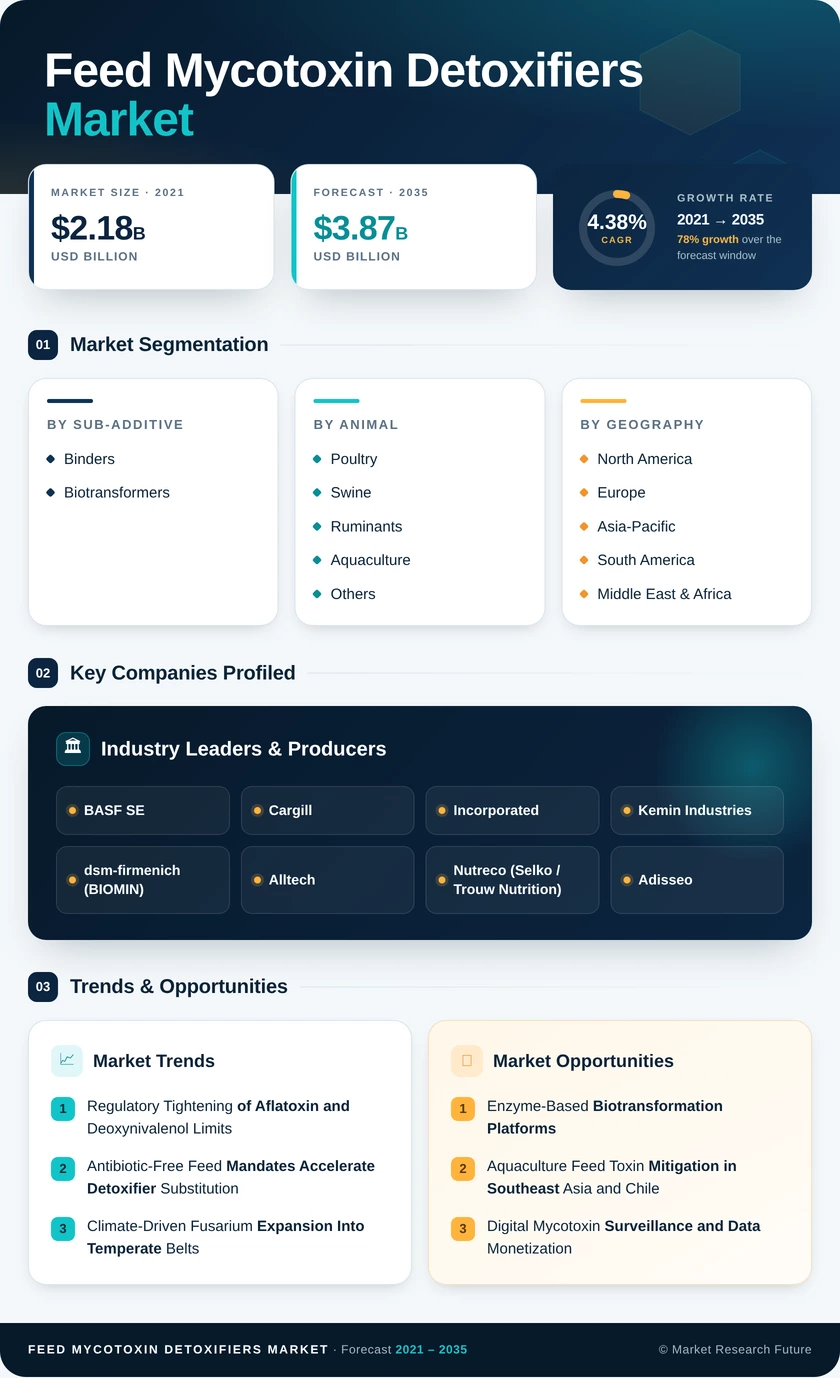
Segmentation Quick Reference
| Dimension | Sub-Segments | Dominant Segment | Fastest Growing Segment |
| By Sub-Additive | Binders, Biotransformers | Binders (71.5% share, 2025) | Biotransformers (4.5% CAGR) |
| By Animal | Poultry, Swine, Ruminants, Aquaculture, Others | Poultry (50.2% share, 2025) | Poultry (4.6% CAGR) |
| By Geography | North America, Europe, Asia-Pacific, South America, Middle East & Africa | Asia-Pacific (33.4% share, 2025) | North America (5.2% CAGR) |
Market Segmentation Overview
By Sub-Additive
| Sub-Segment | Key Trend |
| Binders | Shift from pure bentonite to yeast-glucomannan blends with selective aflatoxin adsorption |
| Biotransformers | EU and Brazilian regulatory approvals are accelerating enzyme-based DON and fumonisin degradation |
Binders remain the volume backbone of the market, though their composition is evolving. Traditional sodium bentonite and activated charcoal products are being reformulated with yeast cell wall feed additives and organic acid co-factors to improve selectivity and reduce nutrient sequestration. Biotransformers are the innovation frontier, with at least five new enzymatic feed additives entering the EU regulatory pipeline between 2024 and 2026.
By Animal
| Sub-Segment | Key Trend |
| Poultry | Dual-action binder-enzyme blends are becoming standard in integrated broiler operations |
| Swine | DON and zearalenone mitigation driving premium product adoption in breeding herds |
| Ruminants | Dairy aflatoxin M1 carry-over regulations compelling binder inclusion in TMR |
| Aquaculture | Shrimp and salmon sensitivity positioning aquafeed detoxifiers as a growth niche |
| Others | Equine and pet-food segments adopting mycotoxin monitoring as a premiumization signal |
Poultry leads across both value and growth, reflecting the biological vulnerability of broilers and layers to low-level mycotoxin exposure. Swine and ruminant segments follow, each driven by distinct toxin profiles — zearalenone in sow rations and aflatoxin M1 transfer in dairy cattle — that require targeted detoxifier formulations. Aquaculture is the highest-potential emerging segment as tropical aquafeed mills formalize mycotoxin quality controls.
By Geography
| Sub-Segment | Key Trend |
| North America | FDA action-level revisions and prairie Fusarium expansion sustaining above-average growth |
| Europe | Directive 2002/32/EC and antibiotic bans anchoring premium detoxifier adoption |
| Asia-Pacific | China's GB 13078 enforcement and ASEAN aquafeed regulation are driving regional dominance |
| South America | Brazil's AGP ban redirects additive spending toward mycotoxin management |
| Middle East & Africa | Development-finance programs and feed industrialization, opening new demand pools |
Asia-Pacific's leadership reflects the convergence of massive grain-import dependency, hot-humid storage conditions that amplify contamination, and rapidly formalizing regulatory frameworks in China, India, and ASEAN. North America's growth premium stems from proactive FDA enforcement, climate-driven mycotoxin pressure in temperate grain belts, and integrator willingness to pay for biotransformation solutions that align with antibiotic-free production claims.

 Noah Malgeri
Co-Founder
Noah Malgeri
Co-Founder

 Peter Groot koerkamp
Account and Business Manager
Peter Groot koerkamp
Account and Business Manager

 Younghwan Choi
Senior Retail Manager
Younghwan Choi
Senior Retail Manager

 Mark Irwin
Management Consultant
Mark Irwin
Management Consultant

 Akif Moroglu
Strategy & Business Development Director
Akif Moroglu
Strategy & Business Development Director

 Guilherme Gomes Martins
Product Management Director
Guilherme Gomes Martins
Product Management Director

 Joseph Aguayo
Sales Operations & Pricing Manager
Joseph Aguayo
Sales Operations & Pricing Manager

 La Terria Dodd
Program Support Specialist
La Terria Dodd
Program Support Specialist

 Rob Kooiker
Group Product Manager HVAC & Fire Protection GMA
Rob Kooiker
Group Product Manager HVAC & Fire Protection GMA