×
Request Free Sample ×

Kindly complete the form below to receive a free sample of this Report

* Please use a valid business email

Leading companies partner with us for data-driven Insights

clients tt-cursor
Hero Background
English
Chinese
French
Japanese
Korean
German
Spanish

Feed Acidifiers Market Analysis

ID: MRFR/Agri/4063-CR
128 Pages
Tejas Chaudhary
September 2020

Global Feed Acidifiers Market Size, Share, Industry Trend & Analysis Research Report Information By Type (Propionic Acid, Formic Acid, Lactic Acid, Sorbic Acid, Citric Acid, Malic Acid, Butyric Acid, Lauric Acid and Others), Form (Dry and Liquid), Compound (Blends and Single), Livestock (Poultry, Swine, Ruminants, Aquaculture and Others) and Region (North America, Europe, Asia-Pacific and Rest of the World) - Forecast till 2035

Share:
Download PDF ×

We do not share your information with anyone. However, we may send you emails based on your report interest from time to time. You may contact us at any time to opt-out.

Feed Acidifiers Market Infographic
×
Feed Acidifiers Market Infographic Full View
Purchase Options

Market Analysis

In-depth Analysis of Feed Acidifiers Market Industry Landscape

Feed Acidifiers Market has been witnessing notable trends driven by various factors influencing the global agriculture and animal husbandry sectors. With a growing focus on improving animal health, performance, and feed efficiency, the demand for feed acidifiers has been on the rise. One significant trend is the increasing adoption of natural and organic feed additives, including organic acidifiers, to meet consumer preferences for chemical-free products. This shift towards natural solutions aligns with the broader trend of sustainability and animal welfare in agriculture.

Furthermore, the rising awareness about the detrimental effects of antibiotic growth promoters (AGPs) in animal feed has led to regulatory restrictions and consumer demand for alternatives. Feed acidifiers have emerged as viable substitutes for AGPs, as they can help improve gut health, enhance nutrient absorption, and boost immunity in animals without the risk of antibiotic resistance. This regulatory push towards reducing antibiotic usage in animal agriculture has significantly contributed to the market growth of feed acidifiers.

Another key trend driving the feed acidifiers market is the increasing emphasis on livestock performance and productivity. Livestock producers are continuously seeking ways to optimize feed efficiency and maximize production outputs to meet the growing global demand for animal-derived products. Feed acidifiers play a crucial role in achieving these objectives by promoting better digestion, nutrient utilization, and overall gut health in animals. As a result, there has been a growing preference for feed acidifier formulations tailored to specific livestock species and production goals.

Moreover, the escalating concerns surrounding food safety and hygiene have propelled the demand for feed acidifiers as feed hygiene management tools. Acidifiers exhibit antimicrobial properties that inhibit the growth of harmful pathogens and molds in animal feed, thereby reducing the risk of feed contamination and associated diseases. This application of feed acidifiers in feed preservation and mold inhibition has gained traction among feed manufacturers and livestock producers alike, especially in regions where feed hygiene is a significant concern.

Additionally, the rapid expansion of the animal feed industry, particularly in developing regions, has fueled the growth of the feed acidifiers market. As the global population continues to grow, there is an increasing need to enhance livestock production efficiency to meet the rising demand for animal protein. This has led to greater investments in animal feed production infrastructure and technologies, driving the demand for feed acidifiers as essential additives to optimize feed quality and animal performance.

Furthermore, advancements in feed acidifier formulations and delivery systems have expanded the application scope of these additives across various livestock species and production systems. Manufacturers are continuously innovating to develop novel acidifier products with improved efficacy, stability, and palatability, catering to the diverse needs of livestock producers worldwide. These innovations have enabled the integration of feed acidifiers into feed formulations more seamlessly, enhancing their effectiveness in promoting animal health and performance.

Author
Tejas Chaudhary
Research Analyst Level II

I have a degree in Engineering (Civil), with masters in Business Administration (Marketing). With more than 4 years of experience in market research and consulting, I am involved in end-to-end process of market research, proposals, project kickoffs and delivery. I have research knowledge and expertise in consumer goods/packaging domain. Also I have worked for various other domains like construction & equipment. Effectively managed and delivered more than 60 report studies for regional as well as global clientele.

Leave a Comment

FAQs

What would be the feed acidifiers market valuation by 2027?

The projected feed acidifiers market valuation would be USD 3,109.11 Million by 2027.

What would be the feed acidifiers market CAGR during the forecast period (2020-2027)?

The feed acidifiers market CAGR would be 4.9% during the forecast period.

What are the types included in the feed acidifiers market report?

The types discussed in the feed acidifiers market report are lactic acid, formic acid, sorbic acid, citric acid, malic acid, propionic acid, and others.

What are the live stocks included in the feed acidifiers market report?

The live stocks studied in the feed acidifiers market report are ruminants, poultry, swine, aquaculture, and others.

What are the compounds discussed in the feed acidifiers market report?

The feed acidifiers market report includes single compound and blended compound.

Market Summary

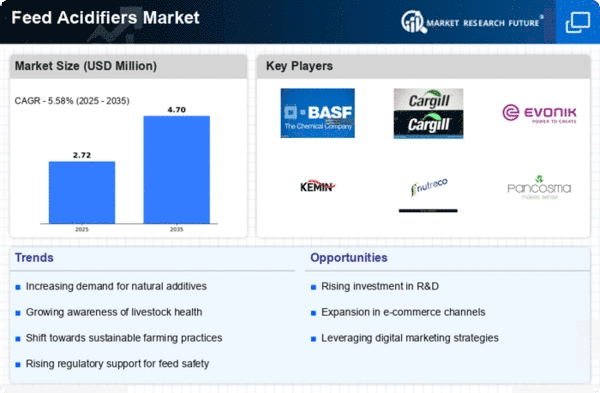
As per MRFR analysis, the Feed Acidifiers Market Size was estimated at 2.58 USD Million in 2024. The Feed Acidifiers industry is projected to grow from 2.75 in 2025 to 4.7 by 2035, exhibiting a compound annual growth rate (CAGR) of 5.58 during the forecast period 2025 - 2035.

Key Market Trends & Highlights

The Feed Acidifiers Market is poised for growth driven by evolving consumer preferences and technological advancements.

  • The demand for natural additives in feed formulations is rising, reflecting a broader trend towards health-conscious livestock management.
  • North America remains the largest market for feed acidifiers, while the Asia-Pacific region is recognized as the fastest-growing market.
  • Poultry continues to dominate the feed acidifiers segment, whereas the swine segment is experiencing the most rapid growth.
  • Key market drivers include increasing livestock production and a shift towards sustainable farming practices, which are shaping industry dynamics.

Market Size & Forecast

2024 Market Size 2.58 (USD Million)
2035 Market Size 4.7 (USD Million)
CAGR (2025 - 2035) 5.58%
Largest Regional Market Share in 2024 North America

Major Players

BASF SE (DE), Cargill, Incorporated (US), Evonik Industries AG (DE), Kemin Industries, Inc. (US), Nutreco N.V. (NL), Pancosma S.A. (CH), Perstorp Holding AB (SE), Adisseo France S.A.S. (FR), Alltech, Inc. (US)

Market Trends

The Feed Acidifiers Market is currently experiencing a notable transformation, driven by the increasing demand for high-quality animal feed and the growing awareness of animal health. This market encompasses a variety of organic and inorganic acidifiers that enhance feed quality, improve gut health, and promote nutrient absorption in livestock. As consumers become more conscious of food safety and quality, the emphasis on using feed additives that can potentially reduce the reliance on antibiotics is becoming more pronounced. Furthermore, the rising trend towards sustainable farming practices is influencing the adoption of feed acidifiers, as they are perceived to contribute to more efficient feed utilization and reduced environmental impact. In addition, the Feed Acidifiers Market is likely to benefit from advancements in technology and research, which may lead to the development of innovative products tailored to specific livestock needs. The integration of feed acidifiers into animal nutrition strategies appears to be gaining traction among producers, as they seek to enhance productivity while maintaining animal welfare standards. Overall, the market seems poised for growth, with various factors converging to create a favorable environment for the adoption of feed acidifiers in the coming years.

Rising Demand for Natural Additives

There is a growing preference for natural feed acidifiers among livestock producers. This trend reflects a broader shift towards organic farming and the desire to minimize chemical additives in animal feed. As consumers increasingly seek transparency in food production, the demand for products that align with natural and sustainable practices is likely to rise.

Focus on Animal Health and Welfare

The emphasis on animal health and welfare is becoming more pronounced in the Feed Acidifiers Market. Producers are recognizing the importance of gut health in livestock, which can be supported by the use of acidifiers. This focus may lead to increased investment in research and development to create products that enhance animal well-being.

Technological Advancements in Feed Formulation

Innovations in feed formulation technology are influencing the Feed Acidifiers Market. Enhanced understanding of animal nutrition and digestive processes is driving the development of more effective acidifiers. These advancements could lead to improved feed efficiency and overall livestock performance, making them attractive to producers.

Feed Acidifiers Market Market Drivers

Rising Demand for Animal Protein

The increasing global population and the corresponding rise in demand for animal protein are pivotal drivers of the Global Feed Acidifiers Market Industry. As consumers seek higher protein diets, livestock production intensifies, necessitating efficient feed formulations. Feed acidifiers play a crucial role in enhancing feed digestibility and nutrient absorption, thereby supporting livestock health and productivity. In 2024, the market is valued at 2.73 USD Billion, reflecting the industry's response to this growing demand. Projections indicate that by 2035, the market could reach 4.56 USD Billion, with a compound annual growth rate of 4.78% from 2025 to 2035, underscoring the importance of feed acidifiers in meeting protein needs.

Market Segment Insights

By Application: Poultry (Largest) vs. Swine (Fastest-Growing)

In the Feed Acidifiers Market, the application segment exhibits significant diversity, with poultry leading in market share due to the increasing demand for poultry products worldwide. This segment is dominated by the need for improved feed efficiency and disease prevention, driving its substantial presence. Following poultry, ruminants and aquaculture show notable shares, serving the significant livestock industries. The pet food segment, while smaller, showcases unique growth potential within this diverse market landscape.

Poultry: Dominant vs. Swine: Emerging

The poultry sector represents the dominant application in the Feed Acidifiers Market, attributed to the industry's focus on enhancing feed quality and animal health. Poultry farmers increasingly adopt feed acidifiers to optimize feed efficiency and reduce pathogen load. On the other hand, the swine segment is emerging rapidly as the fastest-growing area, driven by increased pork consumption and the rising need for efficient production practices. Both segments are influenced by trends toward sustainable livestock management, emphasizing nutrition and health.

By Type: Organic Acid (Largest) vs. Blends (Fastest-Growing)

In the Feed Acidifiers Market, the segment is primarily dominated by Organic Acids, which hold a significant share due to their effectiveness in promoting gut health and enhancing feed efficiency. In contrast, Blends, which combine various acids, are gaining traction and are increasingly preferred by feed manufacturers seeking tailored solutions for livestock nutrition. This dynamic shift reflects a growing recognition of the importance of feed quality in ensuring animal health. Growth trends within the Feed Acidifiers Market indicate a rising demand for Natural Acidifiers, driven by the trend towards clean-label and organic products. These Natural Acidifiers are being embraced for their perceived safety and nutritional benefits. As regulations on synthetic additives tighten, the focus on innovative formulations continues to boost the growth of Blends, positioning them as a fast-growing segment amid changing consumer preferences.

Organic Acid (Dominant) vs. Natural Acidifiers (Emerging)

Organic Acids represent the dominant force within the Feed Acidifiers Market, recognized for their proven benefits in improving feed preservation and livestock health. These acids, derived from natural sources, offer effective solutions for controlling pathogens while enhancing nutrient absorption. On the other hand, Natural Acidifiers, although currently an emerging segment, showcase significant potential due to the increasing consumer demand for organic and natural ingredients in livestock feeds. The shift towards sustainability and animal welfare is driving the interest in Natural Acidifiers, which are perceived as safe and beneficial alternatives to synthetic options. As farmers and producers prioritize quality and health, both segments are poised for distinct yet impactful trajectories in the market.

By Form: Liquid (Largest) vs. Powder (Fastest-Growing)

In the Feed Acidifiers Market, the liquid form has emerged as the largest segment, capturing significant market share due to its ease of use and effectiveness in animal feed applications. Liquid feed acidifiers are preferred by many producers for their ability to mix easily with feed and their immediate bioavailability, which enhances their appeal in the market. In contrast, the powder form is gaining traction as a fastest-growing segment as it offers easy storage and handling, catering to a different set of consumer preferences and applications.

Form: Liquid (Dominant) vs. Powder (Emerging)

The liquid form of feed acidifiers is dominant in the market, primarily due to its convenience and high penetration in various livestock sectors. With its ability to integrate seamlessly into liquid feeding systems, it enhances the palatability and overall health of livestock. In contrast, the powder form is emerging as a popular choice, especially among producers who value its flexibility in formulations and storage efficiency. Powdered feed acidifiers typically have a longer shelf life and are adaptable to various feeding regimes, making them attractive to a growing number of holistic animal health advocates.

By Functionality: Antimicrobial Agent (Largest) vs. Nutritional Enhancer (Fastest-Growing)

In the Feed Acidifiers Market, the functionality segment showcases a diverse portfolio, with Antimicrobial Agents holding a significant share as the largest segment. This category has been extensively adopted in livestock feed formulations to inhibit pathogenic bacteria, ensuring animal health and enhancing feed efficiency. Meanwhile, the Nutritional Enhancer segment is gaining traction, emerging as the fastest-growing category, driven by the increasing focus on animal nutrition and health optimization. Growing consumer awareness regarding livestock health and product quality is driving manufacturers to innovate and introduce nutritional enhancements into their formulations.

Antimicrobial Agent (Dominant) vs. Nutritional Enhancer (Emerging)

The Antimicrobial Agent segment is recognized as the dominant force within the Feed Acidifiers Market, primarily due to its essential role in promoting animal health and preventing disease outbreaks. These agents are widely used in various livestock sectors such as poultry, swine, and ruminants, providing a protective advantage by reducing harmful microbial populations. In contrast, the Nutritional Enhancer segment is poised as an emerging market player, focusing on animal growth performance and nutrient absorption. This segment is rapidly adopting innovative products that are fortified with vitamins, minerals, and organic acids, catering to the rising demand for healthier and more sustainable animal husbandry practices. As such, both segments play crucial roles but cater to distinct market needs.

By End Use: Animal Feed (Largest) vs. Pet Food (Fastest-Growing)

In the Feed Acidifiers Market, the 'End Use' segment is primarily characterized by its distribution among Animal Feed, Pet Food, and Nutritional Supplements. Animal Feed holds the largest share, driven by the growing demand for efficient livestock production. The stability of this segment is supported by traditional agricultural practices focusing on enhancing the health and growth of animals, which in turn ensures a consistent requirement for acidifiers. On the other hand, the Pet Food segment, while smaller, represents a significant opportunity for growth as pet ownership rises and consumers become more aware of their pets' nutritional needs, thereby creating a robust demand for specialized feed additives.

Animal Feed (Dominant) vs. Nutritional Supplements (Emerging)

The Animal Feed segment stands as the dominant force in the Feed Acidifiers Market, thanks to its essential role in enhancing livestock health and productivity. This segment benefits from longstanding practices in animal husbandry and a focus on nutritional efficiency. In contrast, the Nutritional Supplements segment emerges as a new frontier, capturing attention from a market perspective due to increasing consumer awareness about health and wellness. This segment is characterized by a growing emphasis on tailored formulations that cater to specific animal health needs, leveraging scientific advancements to improve functionality and bioavailability of feed acidifiers in products intended for both livestock and companion animals.

Get more detailed insights about Feed Acidifiers Market Research Report - Global Forecast till 2035

Regional Insights

North America : Market Leader in Feed Acidifiers

North America is poised to maintain its leadership in the Feed Acidifiers market, holding a significant market share of 1.03 in 2024. The region's growth is driven by increasing livestock production, rising consumer demand for high-quality animal products, and stringent regulations promoting animal health. Additionally, the adoption of innovative feed solutions is enhancing market dynamics, making it a hub for advancements in feed acidification technology. The United States and Canada are the leading countries in this region, with major players like Cargill, Incorporated and Kemin Industries, Inc. driving competition. The presence of established companies such as BASF SE and Alltech, Inc. further strengthens the market landscape. As the demand for sustainable and efficient feed solutions grows, North America is expected to continue its upward trajectory in the Feed Acidifiers market.

Europe : Emerging Market with Growth Potential

Europe's Feed Acidifiers market is on a growth trajectory, with a market size of 0.78 in 2024. The region benefits from increasing awareness of animal health and nutrition, alongside regulatory frameworks that support the use of feed acidifiers. The European Union's stringent regulations on animal welfare and food safety are driving demand for innovative feed solutions, making it a key player in the global market. Leading countries such as Germany, France, and the Netherlands are at the forefront of this market, with key players like Evonik Industries AG and Nutreco N.V. actively participating. The competitive landscape is characterized by a mix of established companies and emerging startups, fostering innovation. As the market evolves, Europe is expected to leverage its regulatory advantages to enhance its position in the Feed Acidifiers sector.

Asia-Pacific : Rapidly Growing Market Region

The Asia-Pacific region is witnessing rapid growth in the Feed Acidifiers market, with a market size of 0.55 in 2024. This growth is fueled by increasing livestock production, rising disposable incomes, and a growing awareness of animal nutrition. Additionally, supportive government policies aimed at enhancing food security are acting as catalysts for market expansion, making this region a focal point for investment in feed acidification technologies. Countries like China, India, and Australia are leading the charge in this market, with significant contributions from local and international players. Companies such as Kemin Industries, Inc. and Pancosma S.A. are actively involved in this burgeoning market. The competitive landscape is becoming increasingly dynamic, with a focus on innovation and sustainability as key drivers for growth in the Asia-Pacific Feed Acidifiers market.

Middle East and Africa : Emerging Market with Untapped Potential

The Middle East and Africa region is emerging as a potential market for Feed Acidifiers, with a market size of 0.22 in 2024. The growth in this region is driven by increasing livestock farming and a rising demand for quality animal products. Additionally, government initiatives aimed at improving food security and animal health are fostering a conducive environment for market growth, making it an attractive area for investment in feed solutions. Countries such as South Africa and the UAE are leading the market, with a growing presence of international players. Companies like Adisseo France S.A.S. and Perstorp Holding AB are expanding their footprint in this region. The competitive landscape is evolving, with a focus on innovative solutions to meet the unique challenges faced by the livestock sector in the Middle East and Africa.

Key Players and Competitive Insights

The Feed Acidifiers Market is currently characterized by a dynamic competitive landscape, driven by increasing demand for animal nutrition and the need for sustainable farming practices. Key players such as BASF SE (DE), Cargill, Incorporated (US), and Evonik Industries AG (DE) are strategically positioned to leverage innovation and technological advancements. These companies are focusing on product development and regional expansion to enhance their market presence. For instance, BASF SE (DE) has been investing in research and development to create more effective acidifier formulations, which appears to be a response to the growing consumer demand for healthier livestock products.In terms of business tactics, companies are increasingly localizing manufacturing and optimizing supply chains to improve efficiency and reduce costs. The competitive structure of the market is moderately fragmented, with several players vying for market share. However, the collective influence of major companies like Kemin Industries, Inc. (US) and Nutreco N.V. (NL) is significant, as they continue to innovate and expand their product offerings, thereby shaping the competitive environment.

In November Cargill, Incorporated (US) announced a strategic partnership with a leading agricultural technology firm to enhance its feed acidifier product line. This collaboration is expected to integrate advanced analytics and AI-driven solutions into their manufacturing processes, potentially improving product efficacy and operational efficiency. Such strategic moves indicate a shift towards technology-driven solutions in the market.

In October Evonik Industries AG (DE) launched a new range of organic acidifiers aimed at improving gut health in livestock. This product launch is particularly noteworthy as it aligns with the increasing consumer preference for natural and organic products. The introduction of these acidifiers may not only enhance animal health but also position Evonik as a leader in the organic segment of the market.

In September Kemin Industries, Inc. (US) expanded its global footprint by establishing a new manufacturing facility in Southeast Asia. This expansion is likely to enhance Kemin's ability to meet the growing demand for feed acidifiers in the region, reflecting a strategic focus on regional growth and supply chain optimization. Such initiatives are crucial for maintaining competitive advantage in a rapidly evolving market.

As of December current trends in the Feed Acidifiers Market indicate a strong emphasis on digitalization, sustainability, and AI integration. Strategic alliances are increasingly shaping the competitive landscape, allowing companies to pool resources and expertise. The shift from price-based competition to a focus on innovation, technology, and supply chain reliability is evident. Moving forward, competitive differentiation will likely hinge on the ability to innovate and adapt to changing consumer preferences, underscoring the importance of strategic foresight in this evolving market.

Key Companies in the Feed Acidifiers Market include

Industry Developments

  • Kemin Industries acquires Proteus Industries Inc
  • Kemin owns most of the shares in MEVAC
  • Kemin launches dry cellulase dryocell
  • Kemin expands its North American market
  • Kemin launches Kemtrace. This gives its chromium portfolio a real boost


Future Outlook

Feed Acidifiers Market Future Outlook

The Feed Acidifiers Market is projected to grow at a 5.58% CAGR from 2025 to 2035, driven by increasing livestock production and demand for feed efficiency.

New opportunities lie in:

  • Development of customized feed acidifier blends for specific livestock needs.
  • Expansion into emerging markets with tailored marketing strategies.
  • Investment in R&D for innovative acidifier formulations to enhance gut health.

By 2035, the Feed Acidifiers Market is expected to achieve robust growth, reflecting evolving industry demands.

Market Segmentation

Feed Acidifiers Market Form Outlook

  • Liquid
  • Powder
  • Granular

Feed Acidifiers Market Type Outlook

  • Organic Acid
  • Inorganic Acid
  • Blends
  • Natural Acidifiers

Feed Acidifiers Market End Use Outlook

  • Animal Feed
  • Pet Food
  • Nutritional Supplements

Feed Acidifiers Market Application Outlook

  • Swine
  • Poultry
  • Ruminants
  • Aquaculture
  • Pet Food

Feed Acidifiers Market Functionality Outlook

  • Preservative
  • pH Regulator
  • Nutritional Enhancer
  • Antimicrobial Agent

Report Scope

MARKET SIZE 20242.58(USD Million)
MARKET SIZE 20252.75(USD Million)
MARKET SIZE 20354.7(USD Million)
COMPOUND ANNUAL GROWTH RATE (CAGR)5.58% (2025 - 2035)
REPORT COVERAGERevenue Forecast, Competitive Landscape, Growth Factors, and Trends
BASE YEAR2024
Market Forecast Period2025 - 2035
Historical Data2019 - 2024
Market Forecast UnitsUSD Million
Key Companies ProfiledBASF SE (DE), Cargill, Incorporated (US), Evonik Industries AG (DE), Kemin Industries, Inc. (US), Nutreco N.V. (NL), Pancosma S.A. (CH), Perstorp Holding AB (SE), Adisseo France S.A.S. (FR), Alltech, Inc. (US)
Segments CoveredApplication, Type, Form, Functionality, End Use
Key Market OpportunitiesGrowing demand for natural feed acidifiers driven by consumer preference for sustainable livestock production.
Key Market DynamicsRising demand for natural feed acidifiers driven by regulatory shifts and consumer preference for sustainable livestock practices.
Countries CoveredNorth America, Europe, APAC, South America, MEA

FAQs

What would be the feed acidifiers market valuation by 2027?

The projected feed acidifiers market valuation would be USD 3,109.11 Million by 2027.

What would be the feed acidifiers market CAGR during the forecast period (2020-2027)?

The feed acidifiers market CAGR would be 4.9% during the forecast period.

What are the types included in the feed acidifiers market report?

The types discussed in the feed acidifiers market report are lactic acid, formic acid, sorbic acid, citric acid, malic acid, propionic acid, and others.

What are the live stocks included in the feed acidifiers market report?

The live stocks studied in the feed acidifiers market report are ruminants, poultry, swine, aquaculture, and others.

What are the compounds discussed in the feed acidifiers market report?

The feed acidifiers market report includes single compound and blended compound.

  1. SECTION I: EXECUTIVE SUMMARY AND KEY HIGHLIGHTS
    1. | 1.1 EXECUTIVE SUMMARY
    2. | 1.1.1 Market Overview
    3. | 1.1.2 Key Findings
    4. | 1.1.3 Market Segmentation
    5. | 1.1.4 Competitive Landscape
    6. | 1.1.5 Challenges and Opportunities
    7. | 1.1.6 Future Outlook
  2. SECTION II: SCOPING, METHODOLOGY AND MARKET STRUCTURE
    1. | 2.1 MARKET INTRODUCTION
    2. | 2.1.1 Definition
    3. | 2.1.2 Scope of the study
    4. |-- 2.1.2.1 Research Objective
    5. |-- 2.1.2.2 Assumption
    6. |-- 2.1.2.3 Limitations
    7. | 2.2 RESEARCH METHODOLOGY
    8. | 2.2.1 Overview
    9. | 2.2.2 Data Mining
    10. | 2.2.3 Secondary Research
    11. | 2.2.4 Primary Research
    12. |-- 2.2.4.1 Primary Interviews and Information Gathering Process
    13. |-- 2.2.4.2 Breakdown of Primary Respondents
    14. | 2.2.5 Forecasting Model
    15. | 2.2.6 Market Size Estimation
    16. |-- 2.2.6.1 Bottom-Up Approach
    17. |-- 2.2.6.2 Top-Down Approach
    18. | 2.2.7 Data Triangulation
    19. | 2.2.8 Validation
  3. SECTION III: QUALITATIVE ANALYSIS
    1. | 3.1 MARKET DYNAMICS
    2. | 3.1.1 Overview
    3. | 3.1.2 Drivers
    4. | 3.1.3 Restraints
    5. | 3.1.4 Opportunities
    6. | 3.2 MARKET FACTOR ANALYSIS
    7. | 3.2.1 Value chain Analysis
    8. | 3.2.2 Porter's Five Forces Analysis
    9. |-- 3.2.2.1 Bargaining Power of Suppliers
    10. |-- 3.2.2.2 Bargaining Power of Buyers
    11. |-- 3.2.2.3 Threat of New Entrants
    12. |-- 3.2.2.4 Threat of Substitutes
    13. |-- 3.2.2.5 Intensity of Rivalry
    14. | 3.2.3 COVID-19 Impact Analysis
    15. |-- 3.2.3.1 Market Impact Analysis
    16. |-- 3.2.3.2 Regional Impact
    17. |-- 3.2.3.3 Opportunity and Threat Analysis
  4. SECTION IV: QUANTITATIVE ANALYSIS
    1. | 4.1 Industrial Automation & Equipment, BY Application (USD Million)
    2. | 4.1.1 Swine
    3. | 4.1.2 Poultry
    4. | 4.1.3 Ruminants
    5. | 4.1.4 Aquaculture
    6. | 4.1.5 Pet Food
    7. | 4.2 Industrial Automation & Equipment, BY Type (USD Million)
    8. | 4.2.1 Organic Acid
    9. | 4.2.2 Inorganic Acid
    10. | 4.2.3 Blends
    11. | 4.2.4 Natural Acidifiers
    12. | 4.3 Industrial Automation & Equipment, BY Form (USD Million)
    13. | 4.3.1 Liquid
    14. | 4.3.2 Powder
    15. | 4.3.3 Granular
    16. | 4.4 Industrial Automation & Equipment, BY Functionality (USD Million)
    17. | 4.4.1 Preservative
    18. | 4.4.2 pH Regulator
    19. | 4.4.3 Nutritional Enhancer
    20. | 4.4.4 Antimicrobial Agent
    21. | 4.5 Industrial Automation & Equipment, BY End Use (USD Million)
    22. | 4.5.1 Animal Feed
    23. | 4.5.2 Pet Food
    24. | 4.5.3 Nutritional Supplements
    25. | 4.6 Industrial Automation & Equipment, BY Region (USD Million)
    26. | 4.6.1 North America
    27. |-- 4.6.1.1 US
    28. |-- 4.6.1.2 Canada
    29. | 4.6.2 Europe
    30. |-- 4.6.2.1 Germany
    31. |-- 4.6.2.2 UK
    32. |-- 4.6.2.3 France
    33. |-- 4.6.2.4 Russia
    34. |-- 4.6.2.5 Italy
    35. |-- 4.6.2.6 Spain
    36. |-- 4.6.2.7 Rest of Europe
    37. | 4.6.3 APAC
    38. |-- 4.6.3.1 China
    39. |-- 4.6.3.2 India
    40. |-- 4.6.3.3 Japan
    41. |-- 4.6.3.4 South Korea
    42. |-- 4.6.3.5 Malaysia
    43. |-- 4.6.3.6 Thailand
    44. |-- 4.6.3.7 Indonesia
    45. |-- 4.6.3.8 Rest of APAC
    46. | 4.6.4 South America
    47. |-- 4.6.4.1 Brazil
    48. |-- 4.6.4.2 Mexico
    49. |-- 4.6.4.3 Argentina
    50. |-- 4.6.4.4 Rest of South America
    51. | 4.6.5 MEA
    52. |-- 4.6.5.1 GCC Countries
    53. |-- 4.6.5.2 South Africa
    54. |-- 4.6.5.3 Rest of MEA
  5. SECTION V: COMPETITIVE ANALYSIS
    1. | 5.1 Competitive Landscape
    2. | 5.1.1 Overview
    3. | 5.1.2 Competitive Analysis
    4. | 5.1.3 Market share Analysis
    5. | 5.1.4 Major Growth Strategy in the Industrial Automation & Equipment
    6. | 5.1.5 Competitive Benchmarking
    7. | 5.1.6 Leading Players in Terms of Number of Developments in the Industrial Automation & Equipment
    8. | 5.1.7 Key developments and growth strategies
    9. |-- 5.1.7.1 New Product Launch/Service Deployment
    10. |-- 5.1.7.2 Merger & Acquisitions
    11. |-- 5.1.7.3 Joint Ventures
    12. | 5.1.8 Major Players Financial Matrix
    13. |-- 5.1.8.1 Sales and Operating Income
    14. |-- 5.1.8.2 Major Players R&D Expenditure. 2023
    15. | 5.2 Company Profiles
    16. | 5.2.1 BASF SE (DE)
    17. |-- 5.2.1.1 Financial Overview
    18. |-- 5.2.1.2 Products Offered
    19. |-- 5.2.1.3 Key Developments
    20. |-- 5.2.1.4 SWOT Analysis
    21. |-- 5.2.1.5 Key Strategies
    22. | 5.2.2 Cargill, Incorporated (US)
    23. |-- 5.2.2.1 Financial Overview
    24. |-- 5.2.2.2 Products Offered
    25. |-- 5.2.2.3 Key Developments
    26. |-- 5.2.2.4 SWOT Analysis
    27. |-- 5.2.2.5 Key Strategies
    28. | 5.2.3 Evonik Industries AG (DE)
    29. |-- 5.2.3.1 Financial Overview
    30. |-- 5.2.3.2 Products Offered
    31. |-- 5.2.3.3 Key Developments
    32. |-- 5.2.3.4 SWOT Analysis
    33. |-- 5.2.3.5 Key Strategies
    34. | 5.2.4 Kemin Industries, Inc. (US)
    35. |-- 5.2.4.1 Financial Overview
    36. |-- 5.2.4.2 Products Offered
    37. |-- 5.2.4.3 Key Developments
    38. |-- 5.2.4.4 SWOT Analysis
    39. |-- 5.2.4.5 Key Strategies
    40. | 5.2.5 Nutreco N.V. (NL)
    41. |-- 5.2.5.1 Financial Overview
    42. |-- 5.2.5.2 Products Offered
    43. |-- 5.2.5.3 Key Developments
    44. |-- 5.2.5.4 SWOT Analysis
    45. |-- 5.2.5.5 Key Strategies
    46. | 5.2.6 Pancosma S.A. (CH)
    47. |-- 5.2.6.1 Financial Overview
    48. |-- 5.2.6.2 Products Offered
    49. |-- 5.2.6.3 Key Developments
    50. |-- 5.2.6.4 SWOT Analysis
    51. |-- 5.2.6.5 Key Strategies
    52. | 5.2.7 Perstorp Holding AB (SE)
    53. |-- 5.2.7.1 Financial Overview
    54. |-- 5.2.7.2 Products Offered
    55. |-- 5.2.7.3 Key Developments
    56. |-- 5.2.7.4 SWOT Analysis
    57. |-- 5.2.7.5 Key Strategies
    58. | 5.2.8 Adisseo France S.A.S. (FR)
    59. |-- 5.2.8.1 Financial Overview
    60. |-- 5.2.8.2 Products Offered
    61. |-- 5.2.8.3 Key Developments
    62. |-- 5.2.8.4 SWOT Analysis
    63. |-- 5.2.8.5 Key Strategies
    64. | 5.2.9 Alltech, Inc. (US)
    65. |-- 5.2.9.1 Financial Overview
    66. |-- 5.2.9.2 Products Offered
    67. |-- 5.2.9.3 Key Developments
    68. |-- 5.2.9.4 SWOT Analysis
    69. |-- 5.2.9.5 Key Strategies
    70. | 5.3 Appendix
    71. | 5.3.1 References
    72. | 5.3.2 Related Reports

Industrial Automation & Equipment Market Segmentation

Industrial Automation & Equipment By Application (USD Million, 2025-2035)

  • Swine
  • Poultry
  • Ruminants
  • Aquaculture
  • Pet Food

Industrial Automation & Equipment By Type (USD Million, 2025-2035)

  • Organic Acid
  • Inorganic Acid
  • Blends
  • Natural Acidifiers

Industrial Automation & Equipment By Form (USD Million, 2025-2035)

  • Liquid
  • Powder
  • Granular

Industrial Automation & Equipment By Functionality (USD Million, 2025-2035)

  • Preservative
  • pH Regulator
  • Nutritional Enhancer
  • Antimicrobial Agent

Industrial Automation & Equipment By End Use (USD Million, 2025-2035)

  • Animal Feed
  • Pet Food
  • Nutritional Supplements
Infographic

Free Sample Request

Kindly complete the form below to receive a free sample of this Report

Get Free Sample

Customer Strories

Compare Licence

×
Features License Type
Single User Multiuser License Enterprise User
Price $4,950 $5,950 $7,250
Maximum User Access Limit 1 User Upto 10 Users Unrestricted Access Throughout the Organization
Free Customization
Direct Access to Analyst
Deliverable Format
Platform Access
Discount on Next Purchase 10% 15% 15%
Printable Versions