
Request Free Sample ×

Kindly complete the form below to receive a free sample of this Report

* Please use a valid business email

Leading companies partner with us for data-driven Insights

clients tt-cursor
Hero Background
English
Chinese
French
Japanese
Korean
German
Spanish

Fantasy Sports Market Analysis

ID: MRFR/ICT/10019-HCR
200 Pages
Aarti Dhapte
March 2026

Fantasy Sports Market Size, Share and Research Report: By Game Type (Daily Fantasy Sports, Season-Long Fantasy Sports, Weekly Fantasy Sports), By Platform (Web-based, Mobile Applications, Social Media), By Participants (Casual Players, Professional Players, Fantasy Sports Enthusiasts) and By Regional (North America, Europe, South America, Asia Pacific, Middle East and Africa) - Industry Forecast to 2035

Share:
Download PDF ×

We do not share your information with anyone. However, we may send you emails based on your report interest from time to time. You may contact us at any time to opt-out.

Fantasy Sports Market Infographic
Purchase Options

Market Analysis

In-depth Analysis of Fantasy Sports Market Industry Landscape

The global fantasy sports market has witnessed dynamic shifts and substantial growth in recent years, reshaping the landscape of sports entertainment and fan engagement. Fantasy Sports is a game where fans make pretend teams using real players from different sports leagues. They get points when their players do well in the real world games. The world of Fantasy Sports mixes new technology, growing love for sports and smart deals. Technology has been very important in how the Fantasy Sports market has changed. Mobile apps and easy-to-use sites have made it simple for fans to join fantasy leagues.

This has helped fun games get very popular among people. The easy way to get real-time data and combining facts have made Fantasy Sports better. Now, it's more fun for people all over the world. Also, the market is greatly affected by the increasing love for sports around the world. Fantasy Sports use the excitement of sports fans to give them a special chance to be part of the games they enjoy. Fans of fantasy teams have strong feelings for the games they follow.

This builds a better bond among fans and makes them feel like brothers or sisters in sports. This emotional connection has helped the Fantasy Sports market to grow, drawing in both easy-going and serious sports fans. Working together and team-up are now big factors that shape how the Fantasy Sports market operates. Fantasy Sports is seen as a great way to connect with fans by leagues and teams, since they know how much potential it has. So, it's become really normal for big sports groups to team up with Fantasy Sports platforms. These teams not only make Fantasy Sports more trustworthy, they also bring in new ways to earn money from sponsors and ads. They can even create special content together.

Making real sports games part of fantasy play has helped both the sports world and Fantasy Sports earn more money together. The ways to make money in the Fantasy Sports market have seen big changes. Some games let people play for free with extra things to buy, while others use a pay-to-play system or charges for fantasy leagues. The diversity in monetization approaches caters to a broad spectrum of users, accommodating both casual players and those seeking a more competitive experience. This flexibility has contributed to the sustained growth of the Fantasy Sports market, attracting a diverse user base and fostering a thriving ecosystem.


Author
Author Profile
Aarti Dhapte
AVP - Research

A consulting professional focused on helping businesses navigate complex markets through structured research and strategic insights. I partner with clients to solve high-impact business problems across market entry strategy, competitive intelligence, and opportunity assessment. Over the course of my experience, I have led and contributed to 100+ market research and consulting engagements, delivering insights across multiple industries and geographies, and supporting strategic decisions linked to $500M+ market opportunities. My core expertise lies in building robust market sizing, forecasting, and commercial models (top-down and bottom-up), alongside deep-dive competitive and industry analysis. I have played a key role in shaping go-to-market strategies, investment cases, and growth roadmaps, enabling clients to make confident, data-backed decisions in dynamic markets.

Leave a Comment

FAQs

What is the current valuation of the Fantasy Sports Market as of 2024?

<p>The Fantasy Sports Market was valued at 32.86 USD Billion in 2024.</p>

What is the projected market valuation for the Fantasy Sports Market in 2035?

<p>The market is projected to reach 145.76 USD Billion by 2035.</p>

What is the expected CAGR for the Fantasy Sports Market during the forecast period 2025 - 2035?

<p>The expected CAGR for the Fantasy Sports Market during 2025 - 2035 is 14.5%.</p>

Which companies are considered key players in the Fantasy Sports Market?

<p>Key players include DraftKings, FanDuel, Yahoo Fantasy Sports, ESPN Fantasy, CBS Sports Fantasy, Sleeper, Fantasy Premier League, MyFantasyLeague, and Fantrax.</p>

How does the market segment for Daily Fantasy Sports perform in terms of valuation?

<p>The Daily Fantasy Sports segment was valued at 10.0 USD Billion in 2024 and is projected to grow to 45.0 USD Billion by 2035.</p>

What is the valuation trend for Season-Long Fantasy Sports from 2024 to 2035?

<p>Season-Long Fantasy Sports had a valuation of 15.0 USD Billion in 2024, expected to rise to 65.0 USD Billion by 2035.</p>

What are the projected valuations for Mobile Applications in the Fantasy Sports Market?

<p>Mobile Applications were valued at 15.0 USD Billion in 2024 and are anticipated to reach 65.0 USD Billion by 2035.</p>

What is the market size for Fantasy Sports Enthusiasts as participants?

<p>Fantasy Sports Enthusiasts were valued at 14.86 USD Billion in 2024, with projections of 65.76 USD Billion by 2035.</p>

How do Casual Players compare to Professional Players in terms of market valuation?

<p>Casual Players had a valuation of 10.0 USD Billion in 2024, while Professional Players were valued at 8.0 USD Billion.</p>

What platforms are driving growth in the Fantasy Sports Market?

<p>Web-based platforms were valued at 10.0 USD Billion in 2024, with expectations to grow to 45.0 USD Billion by 2035.</p>

Market Summary

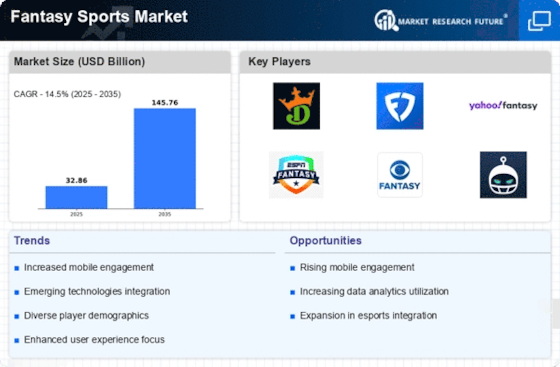
As per Market Research Future analysis, the Fantasy Sports Market Size was estimated at 32.86 USD Billion in 2024. The Fantasy Sports industry is projected to grow from 37.63 USD Billion in 2025 to 145.76 USD Billion by 2035, exhibiting a compound annual growth rate (CAGR) of 14.5% during the forecast period 2025 - 2035

Key Market Trends & Highlights

The Fantasy Sports Market is experiencing robust growth driven by technological advancements and increasing user engagement.

  • North America remains the largest market for fantasy sports, characterized by a high level of user participation and revenue generation. Asia-Pacific is emerging as the fastest-growing region, with a notable increase in mobile application usage among younger demographics. Daily Fantasy Sports Market continues to dominate the market, while Season-Long Fantasy Sports Market is witnessing rapid growth due to changing consumer preferences. Key market drivers include increased mobile penetration and enhanced user engagement strategies, which are vital for sustaining market momentum.

Market Size & Forecast

2024 Market Size 32.86 (USD Billion)
2035 Market Size 145.76 (USD Billion)
CAGR (2025 - 2035) 14.5%
Largest Regional Market Share in 2024 North America

Major Players

DraftKings (US), FanDuel (US), Yahoo Fantasy Sports (US), ESPN Fantasy (US), CBS Sports Fantasy (US), Sleeper (US), Fantasy Premier League (GB), MyFantasyLeague (US), Fantrax (US)

Market Trends

The Fantasy Sports Market is currently experiencing a dynamic evolution, driven by technological advancements and changing consumer preferences. The proliferation of mobile applications and online platforms has made participation in fantasy sports more accessible than ever. This accessibility appears to attract a diverse demographic, including younger audiences who are increasingly engaged in digital entertainment. Furthermore, the integration of social media into fantasy sports platforms fosters community interaction, enhancing user experience and retention. As a result, the market seems poised for continued growth, with innovations likely to shape its future landscape. In addition to technological influences, the Fantasy Sports Market is also witnessing a shift in regulatory frameworks across various regions. This evolving legal landscape may create both opportunities and challenges for operators within the industry. As more jurisdictions recognize the potential economic benefits of regulated fantasy sports, the market could expand further. However, compliance with varying regulations may require significant adjustments from companies. Overall, the Fantasy Sports Market appears to be on a trajectory of growth, influenced by both technological advancements and regulatory changes.

The global fantasy sports market is expanding rapidly as digital engagement and mobile accessibility reshape how users participate in interactive sports entertainment. The expanding fantasy market reflects strong consumer demand for competitive digital sports experiences. Consumer interest in sports fantasy platforms continues to rise due to improved analytics and social gaming features. Each fantasy sports platform is evolving with real-time analytics, AI-driven insights, and mobile-first interfaces. Rising fantasy sports app revenue highlights the monetization potential of mobile-based gaming ecosystems. Online fantasy sports participation is accelerating as broadband access and smartphone usage increase globally. The popularity of fantasy sports games continues to grow across daily and season-long formats. Real fantasy sports platforms are attracting competitive players seeking performance-driven gameplay. Real sports fantasy environments simulate real-world player performance, enhancing user immersion. Access to daily fantasy sports stats improves decision-making and player engagement. Detailed daily fantasy sports statistics enable more strategic participation.

Technological Integration

The integration of advanced technologies, such as artificial intelligence and machine learning, is transforming the Fantasy Sports Market. These innovations enhance user experience by providing personalized recommendations and real-time analytics, which may lead to increased engagement and participation.

The daily fantasy sports market remains a major growth driver within the broader industry. Emerging daily fantasy sports networks are enhancing community interaction and content distribution. Fantasy sports leagues for money are expanding under evolving regulatory frameworks.  Fantasy sport leagues continue to diversify participation models to attract broader demographics. Fantasy sports soccer platforms are seeing strong engagement, particularly in football-centric regions. Fantasy research insights highlight evolving player behavior and monetization trends. Research fantasy market dynamics reveal increasing platform innovation. This sports market report outlines key growth drivers shaping the fantasy ecosystem. Fantasy platforms are contributing significantly to overall sports industry revenue growth. Each fantasy sports company is investing heavily in analytics and platform differentiation. Several fantasy sports co operators are expanding globally through partnerships.

Regulatory Developments

The evolving regulatory environment surrounding fantasy sports is shaping the market landscape. As more regions establish clear guidelines, operators may find new opportunities for expansion while navigating the complexities of compliance and legal requirements.

Social Media Engagement

The role of social media in the Fantasy Sports Market is becoming increasingly prominent. Platforms that facilitate community interaction and sharing of experiences are likely to enhance user retention and attract new participants, thereby driving market growth.

Fantasy Sports Market Market Drivers

Diverse Revenue Streams

The Fantasy Sports Market is diversifying its revenue streams, moving beyond traditional entry fees and advertising. Companies are increasingly exploring partnerships with brands for sponsorships, merchandise sales, and premium subscription models. This shift is indicative of a broader trend where platforms seek to create multiple income sources to enhance financial stability. For instance, premium subscriptions that offer exclusive content and features are gaining traction, with some platforms reporting a 15% increase in revenue from this segment. Additionally, collaborations with sports leagues and teams for branded fantasy leagues are becoming more common, providing unique experiences for users. This diversification not only strengthens the financial foundation of companies within the Fantasy Sports Market but also enhances user engagement through varied offerings.

Emerging Markets Expansion

The Fantasy Sports Market is witnessing a notable expansion into emerging markets, where sports enthusiasm is on the rise. Countries in Asia and Latin America are increasingly adopting fantasy sports platforms, driven by a growing middle class and increased internet accessibility. For instance, the number of fantasy sports users in these regions is projected to grow by over 30% annually, indicating a robust market potential. This expansion is further fueled by local partnerships and tailored offerings that resonate with regional sports preferences. As these markets mature, they present lucrative opportunities for companies in the Fantasy Sports Market to diversify their user base and revenue streams. The influx of new users from these regions may also lead to innovative game formats and localized content, enhancing the overall appeal of fantasy sports.

Increased Mobile Penetration

The rise in mobile device usage has transformed the Fantasy Sports Market, enabling users to engage with fantasy sports on-the-go. As of 2025, mobile devices account for over 70% of all fantasy sports interactions, indicating a shift towards mobile-first platforms. This trend is likely to continue, as advancements in mobile technology enhance user experience through improved graphics and faster load times. The convenience of mobile applications allows users to draft teams, make trades, and monitor player performance in real-time, thereby increasing user engagement. Consequently, companies within the Fantasy Sports Market are investing heavily in mobile app development to capture this growing audience. The integration of features such as live scoring and push notifications further enhances user retention, suggesting that mobile penetration is a critical driver for the industry's growth.

Enhanced User Engagement Strategies

User engagement strategies are evolving within the Fantasy Sports Market, as companies seek to retain and attract players. Innovative features such as gamification, social sharing, and interactive content are being implemented to enhance user experience. For example, the introduction of leaderboards, challenges, and rewards systems has proven effective in increasing user participation. Data suggests that platforms employing these strategies see a 25% increase in user retention rates. Furthermore, the integration of social media functionalities allows users to share their achievements and compete with friends, fostering a sense of community. As competition intensifies, companies in the Fantasy Sports Market are likely to continue refining their engagement strategies to maintain user interest and loyalty.

Technological Advancements in Data Analytics

Technological advancements in data analytics are reshaping the Fantasy Sports Market, providing users with deeper insights and enhanced decision-making capabilities. The integration of artificial intelligence and machine learning algorithms allows platforms to analyze vast amounts of player data, offering predictive analytics that can inform user strategies. As of 2025, approximately 60% of fantasy sports platforms utilize advanced analytics tools, indicating a significant trend towards data-driven decision-making. This capability not only improves user experience but also increases the competitiveness of the platforms. Users are more likely to engage with platforms that provide sophisticated analytics, as it enhances their chances of success. Consequently, the emphasis on data analytics is likely to remain a pivotal driver in the evolution of the Fantasy Sports Market.

Market Segment Insights

By Game Type: Daily Fantasy Sports (Largest) vs. Season-Long Fantasy Sports (Fastest-Growing)

<p>In the Fantasy Sports Market, Daily Fantasy Sports (DFS) holds the largest market share among various game types, driven by its appeal for quick engagement and frequent play. On the other hand, Season-Long Fantasy Sports is rapidly gaining traction, particularly among traditional sports enthusiasts who appreciate the long-term commitment and strategic depth of the game. Weekly Fantasy Sports, although present, accounts for a smaller share as it competes with the more established formats.</p>

<p>Game Type: Daily Fantasy Sports (Dominant) vs. Season-Long Fantasy Sports (Emerging)</p>

<p>Daily Fantasy Sports is characterized by its fast-paced, immediate gameplay where participants create teams based on real-time player performance, making it particularly appealing to casual gamers and those looking for quick entertainment. Its dominance is supported by multiple platforms offering various sports and formats. Conversely, Season-Long Fantasy Sports cultivates a more engaged community as players manage their teams over an entire season, focusing on strategy and long-term player performance. This segment is increasingly popular due to the recent shift towards deeper fan engagement and the rise of online platforms that provide user-friendly interfaces and enhanced functionalities for drafting and managing teams.</p>

By Platform: Web-based (Largest) vs. Mobile Applications (Fastest-Growing)

The Fantasy Sports Market is segmented into three key platforms: Web-based, Mobile Applications, and Social Media. Among these,<a href="https://www.marketresearchfuture.com/reports/e-commerce-platform-market-11670"> Web-based platforms</a> hold the largest market share due to their established user base and accessibility. They provide a comprehensive range of features for fantasy sports enthusiasts, enabling detailed analysis, drafting, and trading functionalities. Mobile Applications are gaining traction rapidly, appealing especially to younger demographics who prefer gaming on the go, thus making them the fastest-growing segment.

Web-based (Dominant) vs. Mobile Applications (Emerging)

Web-based platforms have emerged as the dominant choice in the Fantasy Sports Market, offering expansive functionalities and a user-friendly interface which tends to engage serious fantasy players. These platforms typically host a wider variety of fantasy games, enhancing user retention. In contrast, Mobile Applications are recognized as the emerging force, capitalizing on the shift towards mobile gaming. The convenience of participating in fantasy sports through mobile devices has lead to an increase in user engagement. As technology evolves, Mobile Applications are likely to introduce innovative features that enhance user interactivity and retention.

By Participants: Casual Players (Largest) vs. Professional Players (Fastest-Growing)

In the Fantasy Sports Market, the participants are categorized into Casual Players, Professional Players, and Fantasy Sports Market Enthusiasts. Currently, Casual Players represent a significant share of the market, as they engage in fantasy sports primarily for fun and leisure. This demographic usually participates in easy-to-join leagues that require minimal commitment, which makes them the largest segment. <a href="https://www.marketresearchfuture.com/reports/player-tracking-system-market-40568">Professional Players,</a> on the other hand, are rapidly increasing in numbers, driven by a blend of competition and potential monetary gains that fantasy sports offer. They are more serious about their participation, often engaging in multiple leagues with detailed strategic approaches. The growth trends in this segment indicate a rising interest in Fantasy Sports Market among the Professional Players, driven by advancements in technology and the increased accessibility of platforms that facilitate gameplay. The allure of potential earnings in competitive leagues, combined with the overall expansion of fantasy sports leagues, has helped these players gain traction. Casual Players, while still dominant, face a challenge in retaining their numbers as they contend with the more engaged and actively participating Professional Players who are attracting more media attention and sponsorships. Overall, the segment continues to show promise as the brand of Fantasy Sports Market evolves.

Casual Players (Dominant) vs. Professional Players (Emerging)

Casual Players are the backbone of the Fantasy Sports Market, characterized by their laid-back approach to gameplay. They typically participate in leagues with friends and family, prioritize enjoyment over competition, and often engage during key sporting events. This segment's appeal lies in its accessibility and the fun factor, making it highly engaging for a diverse range of individuals. On the other hand, Professional Players are emerging strongly, marked by a more strategic and analytical mindset toward the game. They invest significant time researching player statistics and strategies, often participating in high-stakes leagues. This segment's growth is fueled by technological advancements and marketing efforts that target more serious gamers, thus reshaping the competitive landscape of the fantasy sports experience.

Get more detailed insights about Fantasy Sports Market Research Report - Global Forecast till 2035

Regional Insights

North America : Leading Market for Fantasy Sports Market

North America is the largest market for fantasy sports, accounting for approximately 70% of the global market share. The region's growth is driven by increasing internet penetration, the popularity of sports, and favorable regulations. The demand for fantasy sports is further fueled by technological advancements and the rise of mobile applications, making it more accessible to users. The regulatory environment is supportive, with many states legalizing online sports betting, which enhances market growth potential. The United States is the leading country in this region, with key players like DraftKings, FanDuel, and Yahoo Fantasy Sports Market dominating the landscape. The competitive environment is characterized by continuous innovation and marketing strategies aimed at attracting new users. Canada also plays a significant role, contributing to the market with its growing interest in fantasy sports. The presence of major platforms ensures a robust competitive landscape, fostering further growth in the sector.

Europe : Emerging Fantasy Sports Market Hub

Europe is rapidly emerging as a significant player in the fantasy sports market, holding approximately 15% of the global market share. The growth is driven by increasing engagement in sports, particularly football, and the rise of digital platforms. Regulatory frameworks are evolving, with several countries implementing laws that support online gaming and fantasy sports, thus creating a conducive environment for market expansion. The increasing popularity of sports leagues and tournaments also contributes to the growing demand for fantasy sports in the region. The United Kingdom is the leading country in Europe, with platforms like Fantasy Premier League and Fantrax gaining substantial traction. Other countries, such as Germany and France, are also witnessing growth, driven by local leagues and sports events. The competitive landscape is marked by both established players and new entrants, fostering innovation and diverse offerings. The presence of key players enhances the market's vibrancy, making Europe a promising region for future growth. UK daily fantasy sports platforms are benefiting from increased regulatory clarity and consumer adoption.

Asia-Pacific : Rapidly Growing Fantasy Market

Asia-Pacific is witnessing a rapid surge in the fantasy sports market, currently holding about 10% of the global market share. The growth is primarily driven by the increasing popularity of sports like cricket and football, coupled with the rise of mobile technology. Countries like India and Australia are leading this growth, with favorable regulations and a young, tech-savvy population driving demand. The region's regulatory landscape is gradually becoming more supportive, allowing for the expansion of online gaming and fantasy sports platforms. India stands out as a key player in the region, with platforms like Dream11 leading the market. Australia also contributes significantly, with a growing interest in various sports leagues. The competitive landscape is characterized by a mix of local and international players, fostering innovation and diverse offerings. The increasing investment in technology and marketing strategies is expected to further enhance the market's growth in the coming years.

Middle East and Africa : Emerging Fantasy Sports Market Frontier

The Middle East and Africa (MEA) region is an emerging frontier for the fantasy sports market, currently holding around 5% of the global market share. The growth is driven by increasing interest in sports, particularly football, and the rise of digital platforms. Regulatory frameworks are evolving, with several countries beginning to recognize and regulate online gaming, which is expected to catalyze market growth. The region's young population and increasing internet penetration are also significant factors contributing to the demand for fantasy sports. Countries like South Africa and the UAE are leading the charge in this region, with a growing number of platforms catering to local sports interests. The competitive landscape is still developing, with both local and international players entering the market. The presence of key players and the increasing investment in marketing and technology are expected to drive further growth in the MEA fantasy sports market.

Key Players and Competitive Insights

The Fantasy Sports Market is currently characterized by a dynamic competitive landscape, driven by technological advancements and an increasing consumer appetite for interactive gaming experiences. Major players such as DraftKings (US), FanDuel (US), and Fantasy Premier League (GB) are at the forefront, each employing distinct strategies to capture market share. DraftKings (US) focuses on innovation through the integration of advanced analytics and user-friendly interfaces, while FanDuel (US) emphasizes partnerships with sports leagues to enhance its brand visibility and user engagement. Meanwhile, Fantasy Premier League (GB) leverages its established brand within the football community to attract a dedicated user base, indicating a trend towards brand loyalty in the market.The business tactics employed by these companies reflect a moderately fragmented market structure, where localized strategies and supply chain optimization play crucial roles. Companies are increasingly localizing their offerings to cater to regional preferences, which appears to enhance user retention and engagement. The collective influence of these key players shapes a competitive environment that is both challenging and ripe for innovation, as they vie for dominance in a rapidly evolving landscape.
In August DraftKings (US) announced a strategic partnership with a leading sports analytics firm to enhance its predictive modeling capabilities. This move is likely to bolster its competitive edge by providing users with more accurate insights and personalized experiences, thereby increasing user engagement and retention. Such partnerships may also signal a broader trend towards data-driven decision-making in the fantasy sports sector, as companies seek to leverage analytics to refine their offerings.
In September FanDuel (US) launched a new mobile application designed to streamline user experience and integrate social features, allowing users to engage with friends and share their fantasy teams. This initiative seems to reflect a growing emphasis on community-building within fantasy sports, suggesting that social interaction may become a key differentiator in attracting and retaining users. By enhancing the social aspect of fantasy sports, FanDuel (US) appears to be positioning itself as a leader in user engagement.
In July Fantasy Premier League (GB) introduced a new feature that allows users to create custom leagues with unique scoring systems. This strategic move may cater to the diverse preferences of users, potentially increasing participation rates and enhancing user satisfaction. By offering customization options, Fantasy Premier League (GB) seems to recognize the importance of personalization in driving user engagement and loyalty.
As of October the competitive trends in the Fantasy Sports Market are increasingly defined by digitalization, AI integration, and a focus on sustainability. Strategic alliances are becoming more prevalent, as companies recognize the value of collaboration in enhancing their technological capabilities and market reach. Looking ahead, competitive differentiation is likely to evolve from traditional price-based competition towards innovation, technology, and supply chain reliability, as companies strive to offer unique and engaging experiences that resonate with users.

Key Companies in the Fantasy Sports Market include

Industry Developments

The Fantasy Sports Market has witnessed significant developments in recent months, particularly in the landscape of major players like DraftKings, FanDuel, and ESPN. DraftKings recently reported substantial growth in user engagement, leading to increased market valuation fueled by their strategic marketing and innovative features. In the past year, FanDuel has made significant strides in its media integration strategy. This includes the rebranding of 16 regional sports networks as FanDuel Sports Network in 2024 and the establishment of 2025 partnerships with SB Nation and Yahoo Sports to enhance DTC content connections and fantasy ecosystem integrations.

In August 2023, Fantasy News Network was not acquired by RTSports, as reported. Nevertheless, Yahoo and Sleeper persist in their leadership in mobile-first product innovation, which is bolstered by strategic app development and positive user experiences. Additionally, the Fantasy Sports Market & Gaming Association (formerly FSIA) has maintained a significant level of regulatory lobbying to guarantee the integrity of the industry. Furthermore, the rapid expansion of the fantasy sports market is being actively facilitated by the global increase in smartphone utilization and the strengthening of online gaming regulations.

Future Outlook

Fantasy Sports Market Future Outlook

The Fantasy Sports Market is projected to grow at a 14.5% CAGR from 2025 to 2035, driven by technological advancements, increasing user engagement, and expanding demographics.

New opportunities lie in:

  • <p>Development of AI-driven analytics tools for player performance insights.</p>
  • <p> </p>
  • <p>Expansion into emerging markets with localized fantasy sports platforms.</p>
  • <p>Partnerships with major sports leagues for exclusive content and promotions.</p>

By 2035, the Fantasy Sports Market is expected to be robust, reflecting substantial growth and innovation.

Market Segmentation

Fantasy Sports Market Platform Outlook

  • Web-based
  • Mobile Applications
  • Social Media

Fantasy Sports Market Game Type Outlook

  • Daily Fantasy Sports
  • Season-Long Fantasy Sports
  • Weekly Fantasy Sports

Fantasy Sports Market Participants Outlook

  • Casual Players
  • Professional Players
  • Fantasy Sports Enthusiasts

Report Scope

MARKET SIZE 2024 32.86(USD Billion)
MARKET SIZE 2025 37.63(USD Billion)
MARKET SIZE 2035 145.76(USD Billion)
COMPOUND ANNUAL GROWTH RATE (CAGR) 14.5% (2025 - 2035)
REPORT COVERAGE Revenue Forecast, Competitive Landscape, Growth Factors, and Trends
BASE YEAR 2024
Market Forecast Period 2025 - 2035
Historical Data 2019 - 2024
Market Forecast Units USD Billion
Key Companies Profiled DraftKings (US), FanDuel (US), Yahoo Fantasy Sports (US), ESPN Fantasy (US), CBS Sports Fantasy (US), Sleeper (US), Fantasy Premier League (GB), MyFantasyLeague (US), Fantrax (US)
Segments Covered Game Type, Platform, Participants, Regional
Key Market Opportunities Integration of augmented reality and artificial intelligence enhances user engagement in the Fantasy Sports Market.
Key Market Dynamics Rising consumer engagement and technological advancements drive competitive dynamics in the Fantasy Sports Market.
Countries Covered North America, Europe, APAC, South America, MEA

FAQs

What is the current valuation of the Fantasy Sports Market as of 2024?

<p>The Fantasy Sports Market was valued at 32.86 USD Billion in 2024.</p>

What is the projected market valuation for the Fantasy Sports Market in 2035?

<p>The market is projected to reach 145.76 USD Billion by 2035.</p>

What is the expected CAGR for the Fantasy Sports Market during the forecast period 2025 - 2035?

<p>The expected CAGR for the Fantasy Sports Market during 2025 - 2035 is 14.5%.</p>

Which companies are considered key players in the Fantasy Sports Market?

<p>Key players include DraftKings, FanDuel, Yahoo Fantasy Sports, ESPN Fantasy, CBS Sports Fantasy, Sleeper, Fantasy Premier League, MyFantasyLeague, and Fantrax.</p>

How does the market segment for Daily Fantasy Sports perform in terms of valuation?

<p>The Daily Fantasy Sports segment was valued at 10.0 USD Billion in 2024 and is projected to grow to 45.0 USD Billion by 2035.</p>

What is the valuation trend for Season-Long Fantasy Sports from 2024 to 2035?

<p>Season-Long Fantasy Sports had a valuation of 15.0 USD Billion in 2024, expected to rise to 65.0 USD Billion by 2035.</p>

What are the projected valuations for Mobile Applications in the Fantasy Sports Market?

<p>Mobile Applications were valued at 15.0 USD Billion in 2024 and are anticipated to reach 65.0 USD Billion by 2035.</p>

What is the market size for Fantasy Sports Enthusiasts as participants?

<p>Fantasy Sports Enthusiasts were valued at 14.86 USD Billion in 2024, with projections of 65.76 USD Billion by 2035.</p>

How do Casual Players compare to Professional Players in terms of market valuation?

<p>Casual Players had a valuation of 10.0 USD Billion in 2024, while Professional Players were valued at 8.0 USD Billion.</p>

What platforms are driving growth in the Fantasy Sports Market?

<p>Web-based platforms were valued at 10.0 USD Billion in 2024, with expectations to grow to 45.0 USD Billion by 2035.</p>

  1. SECTION I: EXECUTIVE SUMMARY AND KEY HIGHLIGHTS
    1. | 1.1 EXECUTIVE SUMMARY
    2. | | 1.1.1 Market Overview
    3. | | 1.1.2 Key Findings
    4. | | 1.1.3 Market Segmentation
    5. | | 1.1.4 Competitive Landscape
    6. | | 1.1.5 Challenges and Opportunities
    7. | | 1.1.6 Future Outlook
  2. SECTION II: SCOPING, METHODOLOGY AND MARKET STRUCTURE
    1. | 2.1 MARKET INTRODUCTION
    2. | | 2.1.1 Definition
    3. | | 2.1.2 Scope of the study
    4. | | | 2.1.2.1 Research Objective
    5. | | | 2.1.2.2 Assumption
    6. | | | 2.1.2.3 Limitations
    7. | 2.2 RESEARCH METHODOLOGY
    8. | | 2.2.1 Overview
    9. | | 2.2.2 Data Mining
    10. | | 2.2.3 Secondary Research
    11. | | 2.2.4 Primary Research
    12. | | | 2.2.4.1 Primary Interviews and Information Gathering Process
    13. | | | 2.2.4.2 Breakdown of Primary Respondents
    14. | | 2.2.5 Forecasting Model
    15. | | 2.2.6 Market Size Estimation
    16. | | | 2.2.6.1 Bottom-Up Approach
    17. | | | 2.2.6.2 Top-Down Approach
    18. | | 2.2.7 Data Triangulation
    19. | | 2.2.8 Validation
  3. SECTION III: QUALITATIVE ANALYSIS
    1. | 3.1 MARKET DYNAMICS
    2. | | 3.1.1 Overview
    3. | | 3.1.2 Drivers
    4. | | 3.1.3 Restraints
    5. | | 3.1.4 Opportunities
    6. | 3.2 MARKET FACTOR ANALYSIS
    7. | | 3.2.1 Value chain Analysis
    8. | | 3.2.2 Porter's Five Forces Analysis
    9. | | | 3.2.2.1 Bargaining Power of Suppliers
    10. | | | 3.2.2.2 Bargaining Power of Buyers
    11. | | | 3.2.2.3 Threat of New Entrants
    12. | | | 3.2.2.4 Threat of Substitutes
    13. | | | 3.2.2.5 Intensity of Rivalry
    14. | | 3.2.3 COVID-19 Impact Analysis
    15. | | | 3.2.3.1 Market Impact Analysis
    16. | | | 3.2.3.2 Regional Impact
    17. | | | 3.2.3.3 Opportunity and Threat Analysis
  4. SECTION IV: QUANTITATIVE ANALYSIS
    1. | 4.1 Information and Communications Technology, BY Game Type (USD Billion)
    2. | | 4.1.1 Daily Fantasy Sports
    3. | | 4.1.2 Season-Long Fantasy Sports
    4. | | 4.1.3 Weekly Fantasy Sports
    5. | 4.2 Information and Communications Technology, BY Platform (USD Billion)
    6. | | 4.2.1 Web-based
    7. | | 4.2.2 Mobile Applications
    8. | | 4.2.3 Social Media
    9. | 4.3 Information and Communications Technology, BY Participants (USD Billion)
    10. | | 4.3.1 Casual Players
    11. | | 4.3.2 Professional Players
    12. | | 4.3.3 Fantasy Sports Enthusiasts
    13. | 4.4 Information and Communications Technology, BY Region (USD Billion)
    14. | | 4.4.1 North America
    15. | | | 4.4.1.1 US
    16. | | | 4.4.1.2 Canada
    17. | | 4.4.2 Europe
    18. | | | 4.4.2.1 Germany
    19. | | | 4.4.2.2 UK
    20. | | | 4.4.2.3 France
    21. | | | 4.4.2.4 Russia
    22. | | | 4.4.2.5 Italy
    23. | | | 4.4.2.6 Spain
    24. | | | 4.4.2.7 Rest of Europe
    25. | | 4.4.3 APAC
    26. | | | 4.4.3.1 China
    27. | | | 4.4.3.2 India
    28. | | | 4.4.3.3 Japan
    29. | | | 4.4.3.4 South Korea
    30. | | | 4.4.3.5 Malaysia
    31. | | | 4.4.3.6 Thailand
    32. | | | 4.4.3.7 Indonesia
    33. | | | 4.4.3.8 Rest of APAC
    34. | | 4.4.4 South America
    35. | | | 4.4.4.1 Brazil
    36. | | | 4.4.4.2 Mexico
    37. | | | 4.4.4.3 Argentina
    38. | | | 4.4.4.4 Rest of South America
    39. | | 4.4.5 MEA
    40. | | | 4.4.5.1 GCC Countries
    41. | | | 4.4.5.2 South Africa
    42. | | | 4.4.5.3 Rest of MEA
  5. SECTION V: COMPETITIVE ANALYSIS
    1. | 5.1 Competitive Landscape
    2. | | 5.1.1 Overview
    3. | | 5.1.2 Competitive Analysis
    4. | | 5.1.3 Market share Analysis
    5. | | 5.1.4 Major Growth Strategy in the Information and Communications Technology
    6. | | 5.1.5 Competitive Benchmarking
    7. | | 5.1.6 Leading Players in Terms of Number of Developments in the Information and Communications Technology
    8. | | 5.1.7 Key developments and growth strategies
    9. | | | 5.1.7.1 New Product Launch/Service Deployment
    10. | | | 5.1.7.2 Merger & Acquisitions
    11. | | | 5.1.7.3 Joint Ventures
    12. | | 5.1.8 Major Players Financial Matrix
    13. | | | 5.1.8.1 Sales and Operating Income
    14. | | | 5.1.8.2 Major Players R&D Expenditure. 2023
    15. | 5.2 Company Profiles
    16. | | 5.2.1 DraftKings (US)
    17. | | | 5.2.1.1 Financial Overview
    18. | | | 5.2.1.2 Products Offered
    19. | | | 5.2.1.3 Key Developments
    20. | | | 5.2.1.4 SWOT Analysis
    21. | | | 5.2.1.5 Key Strategies
    22. | | 5.2.2 FanDuel (US)
    23. | | | 5.2.2.1 Financial Overview
    24. | | | 5.2.2.2 Products Offered
    25. | | | 5.2.2.3 Key Developments
    26. | | | 5.2.2.4 SWOT Analysis
    27. | | | 5.2.2.5 Key Strategies
    28. | | 5.2.3 Yahoo Fantasy Sports (US)
    29. | | | 5.2.3.1 Financial Overview
    30. | | | 5.2.3.2 Products Offered
    31. | | | 5.2.3.3 Key Developments
    32. | | | 5.2.3.4 SWOT Analysis
    33. | | | 5.2.3.5 Key Strategies
    34. | | 5.2.4 ESPN Fantasy (US)
    35. | | | 5.2.4.1 Financial Overview
    36. | | | 5.2.4.2 Products Offered
    37. | | | 5.2.4.3 Key Developments
    38. | | | 5.2.4.4 SWOT Analysis
    39. | | | 5.2.4.5 Key Strategies
    40. | | 5.2.5 CBS Sports Fantasy (US)
    41. | | | 5.2.5.1 Financial Overview
    42. | | | 5.2.5.2 Products Offered
    43. | | | 5.2.5.3 Key Developments
    44. | | | 5.2.5.4 SWOT Analysis
    45. | | | 5.2.5.5 Key Strategies
    46. | | 5.2.6 Sleeper (US)
    47. | | | 5.2.6.1 Financial Overview
    48. | | | 5.2.6.2 Products Offered
    49. | | | 5.2.6.3 Key Developments
    50. | | | 5.2.6.4 SWOT Analysis
    51. | | | 5.2.6.5 Key Strategies
    52. | | 5.2.7 Fantasy Premier League (GB)
    53. | | | 5.2.7.1 Financial Overview
    54. | | | 5.2.7.2 Products Offered
    55. | | | 5.2.7.3 Key Developments
    56. | | | 5.2.7.4 SWOT Analysis
    57. | | | 5.2.7.5 Key Strategies
    58. | | 5.2.8 MyFantasyLeague (US)
    59. | | | 5.2.8.1 Financial Overview
    60. | | | 5.2.8.2 Products Offered
    61. | | | 5.2.8.3 Key Developments
    62. | | | 5.2.8.4 SWOT Analysis
    63. | | | 5.2.8.5 Key Strategies
    64. | | 5.2.9 Fantrax (US)
    65. | | | 5.2.9.1 Financial Overview
    66. | | | 5.2.9.2 Products Offered
    67. | | | 5.2.9.3 Key Developments
    68. | | | 5.2.9.4 SWOT Analysis
    69. | | | 5.2.9.5 Key Strategies
    70. | 5.3 Appendix
    71. | | 5.3.1 References
    72. | | 5.3.2 Related Reports
  6. LIST OF FIGURES
    1. | 6.1 MARKET SYNOPSIS
    2. | 6.2 NORTH AMERICA MARKET ANALYSIS
    3. | 6.3 US MARKET ANALYSIS BY GAME TYPE
    4. | 6.4 US MARKET ANALYSIS BY PLATFORM
    5. | 6.5 US MARKET ANALYSIS BY PARTICIPANTS
    6. | 6.6 CANADA MARKET ANALYSIS BY GAME TYPE
    7. | 6.7 CANADA MARKET ANALYSIS BY PLATFORM
    8. | 6.8 CANADA MARKET ANALYSIS BY PARTICIPANTS
    9. | 6.9 EUROPE MARKET ANALYSIS
    10. | 6.10 GERMANY MARKET ANALYSIS BY GAME TYPE
    11. | 6.11 GERMANY MARKET ANALYSIS BY PLATFORM
    12. | 6.12 GERMANY MARKET ANALYSIS BY PARTICIPANTS
    13. | 6.13 UK MARKET ANALYSIS BY GAME TYPE
    14. | 6.14 UK MARKET ANALYSIS BY PLATFORM
    15. | 6.15 UK MARKET ANALYSIS BY PARTICIPANTS
    16. | 6.16 FRANCE MARKET ANALYSIS BY GAME TYPE
    17. | 6.17 FRANCE MARKET ANALYSIS BY PLATFORM
    18. | 6.18 FRANCE MARKET ANALYSIS BY PARTICIPANTS
    19. | 6.19 RUSSIA MARKET ANALYSIS BY GAME TYPE
    20. | 6.20 RUSSIA MARKET ANALYSIS BY PLATFORM
    21. | 6.21 RUSSIA MARKET ANALYSIS BY PARTICIPANTS
    22. | 6.22 ITALY MARKET ANALYSIS BY GAME TYPE
    23. | 6.23 ITALY MARKET ANALYSIS BY PLATFORM
    24. | 6.24 ITALY MARKET ANALYSIS BY PARTICIPANTS
    25. | 6.25 SPAIN MARKET ANALYSIS BY GAME TYPE
    26. | 6.26 SPAIN MARKET ANALYSIS BY PLATFORM
    27. | 6.27 SPAIN MARKET ANALYSIS BY PARTICIPANTS
    28. | 6.28 REST OF EUROPE MARKET ANALYSIS BY GAME TYPE
    29. | 6.29 REST OF EUROPE MARKET ANALYSIS BY PLATFORM
    30. | 6.30 REST OF EUROPE MARKET ANALYSIS BY PARTICIPANTS
    31. | 6.31 APAC MARKET ANALYSIS
    32. | 6.32 CHINA MARKET ANALYSIS BY GAME TYPE
    33. | 6.33 CHINA MARKET ANALYSIS BY PLATFORM
    34. | 6.34 CHINA MARKET ANALYSIS BY PARTICIPANTS
    35. | 6.35 INDIA MARKET ANALYSIS BY GAME TYPE
    36. | 6.36 INDIA MARKET ANALYSIS BY PLATFORM
    37. | 6.37 INDIA MARKET ANALYSIS BY PARTICIPANTS
    38. | 6.38 JAPAN MARKET ANALYSIS BY GAME TYPE
    39. | 6.39 JAPAN MARKET ANALYSIS BY PLATFORM
    40. | 6.40 JAPAN MARKET ANALYSIS BY PARTICIPANTS
    41. | 6.41 SOUTH KOREA MARKET ANALYSIS BY GAME TYPE
    42. | 6.42 SOUTH KOREA MARKET ANALYSIS BY PLATFORM
    43. | 6.43 SOUTH KOREA MARKET ANALYSIS BY PARTICIPANTS
    44. | 6.44 MALAYSIA MARKET ANALYSIS BY GAME TYPE
    45. | 6.45 MALAYSIA MARKET ANALYSIS BY PLATFORM
    46. | 6.46 MALAYSIA MARKET ANALYSIS BY PARTICIPANTS
    47. | 6.47 THAILAND MARKET ANALYSIS BY GAME TYPE
    48. | 6.48 THAILAND MARKET ANALYSIS BY PLATFORM
    49. | 6.49 THAILAND MARKET ANALYSIS BY PARTICIPANTS
    50. | 6.50 INDONESIA MARKET ANALYSIS BY GAME TYPE
    51. | 6.51 INDONESIA MARKET ANALYSIS BY PLATFORM
    52. | 6.52 INDONESIA MARKET ANALYSIS BY PARTICIPANTS
    53. | 6.53 REST OF APAC MARKET ANALYSIS BY GAME TYPE
    54. | 6.54 REST OF APAC MARKET ANALYSIS BY PLATFORM
    55. | 6.55 REST OF APAC MARKET ANALYSIS BY PARTICIPANTS
    56. | 6.56 SOUTH AMERICA MARKET ANALYSIS
    57. | 6.57 BRAZIL MARKET ANALYSIS BY GAME TYPE
    58. | 6.58 BRAZIL MARKET ANALYSIS BY PLATFORM
    59. | 6.59 BRAZIL MARKET ANALYSIS BY PARTICIPANTS
    60. | 6.60 MEXICO MARKET ANALYSIS BY GAME TYPE
    61. | 6.61 MEXICO MARKET ANALYSIS BY PLATFORM
    62. | 6.62 MEXICO MARKET ANALYSIS BY PARTICIPANTS
    63. | 6.63 ARGENTINA MARKET ANALYSIS BY GAME TYPE
    64. | 6.64 ARGENTINA MARKET ANALYSIS BY PLATFORM
    65. | 6.65 ARGENTINA MARKET ANALYSIS BY PARTICIPANTS
    66. | 6.66 REST OF SOUTH AMERICA MARKET ANALYSIS BY GAME TYPE
    67. | 6.67 REST OF SOUTH AMERICA MARKET ANALYSIS BY PLATFORM
    68. | 6.68 REST OF SOUTH AMERICA MARKET ANALYSIS BY PARTICIPANTS
    69. | 6.69 MEA MARKET ANALYSIS
    70. | 6.70 GCC COUNTRIES MARKET ANALYSIS BY GAME TYPE
    71. | 6.71 GCC COUNTRIES MARKET ANALYSIS BY PLATFORM
    72. | 6.72 GCC COUNTRIES MARKET ANALYSIS BY PARTICIPANTS
    73. | 6.73 SOUTH AFRICA MARKET ANALYSIS BY GAME TYPE
    74. | 6.74 SOUTH AFRICA MARKET ANALYSIS BY PLATFORM
    75. | 6.75 SOUTH AFRICA MARKET ANALYSIS BY PARTICIPANTS
    76. | 6.76 REST OF MEA MARKET ANALYSIS BY GAME TYPE
    77. | 6.77 REST OF MEA MARKET ANALYSIS BY PLATFORM
    78. | 6.78 REST OF MEA MARKET ANALYSIS BY PARTICIPANTS
    79. | 6.79 KEY BUYING CRITERIA OF INFORMATION AND COMMUNICATIONS TECHNOLOGY
    80. | 6.80 RESEARCH PROCESS OF MRFR
    81. | 6.81 DRO ANALYSIS OF INFORMATION AND COMMUNICATIONS TECHNOLOGY
    82. | 6.82 DRIVERS IMPACT ANALYSIS: INFORMATION AND COMMUNICATIONS TECHNOLOGY
    83. | 6.83 RESTRAINTS IMPACT ANALYSIS: INFORMATION AND COMMUNICATIONS TECHNOLOGY
    84. | 6.84 SUPPLY / VALUE CHAIN: INFORMATION AND COMMUNICATIONS TECHNOLOGY
    85. | 6.85 INFORMATION AND COMMUNICATIONS TECHNOLOGY, BY GAME TYPE, 2024 (% SHARE)
    86. | 6.86 INFORMATION AND COMMUNICATIONS TECHNOLOGY, BY GAME TYPE, 2024 TO 2035 (USD Billion)
    87. | 6.87 INFORMATION AND COMMUNICATIONS TECHNOLOGY, BY PLATFORM, 2024 (% SHARE)
    88. | 6.88 INFORMATION AND COMMUNICATIONS TECHNOLOGY, BY PLATFORM, 2024 TO 2035 (USD Billion)
    89. | 6.89 INFORMATION AND COMMUNICATIONS TECHNOLOGY, BY PARTICIPANTS, 2024 (% SHARE)
    90. | 6.90 INFORMATION AND COMMUNICATIONS TECHNOLOGY, BY PARTICIPANTS, 2024 TO 2035 (USD Billion)
    91. | 6.91 BENCHMARKING OF MAJOR COMPETITORS
  7. LIST OF TABLES
    1. | 7.1 LIST OF ASSUMPTIONS
    2. | | 7.1.1
    3. | 7.2 North America MARKET SIZE ESTIMATES; FORECAST
    4. | | 7.2.1 BY GAME TYPE, 2025-2035 (USD Billion)
    5. | | 7.2.2 BY PLATFORM, 2025-2035 (USD Billion)
    6. | | 7.2.3 BY PARTICIPANTS, 2025-2035 (USD Billion)
    7. | 7.3 US MARKET SIZE ESTIMATES; FORECAST
    8. | | 7.3.1 BY GAME TYPE, 2025-2035 (USD Billion)
    9. | | 7.3.2 BY PLATFORM, 2025-2035 (USD Billion)
    10. | | 7.3.3 BY PARTICIPANTS, 2025-2035 (USD Billion)
    11. | 7.4 Canada MARKET SIZE ESTIMATES; FORECAST
    12. | | 7.4.1 BY GAME TYPE, 2025-2035 (USD Billion)
    13. | | 7.4.2 BY PLATFORM, 2025-2035 (USD Billion)
    14. | | 7.4.3 BY PARTICIPANTS, 2025-2035 (USD Billion)
    15. | 7.5 Europe MARKET SIZE ESTIMATES; FORECAST
    16. | | 7.5.1 BY GAME TYPE, 2025-2035 (USD Billion)
    17. | | 7.5.2 BY PLATFORM, 2025-2035 (USD Billion)
    18. | | 7.5.3 BY PARTICIPANTS, 2025-2035 (USD Billion)
    19. | 7.6 Germany MARKET SIZE ESTIMATES; FORECAST
    20. | | 7.6.1 BY GAME TYPE, 2025-2035 (USD Billion)
    21. | | 7.6.2 BY PLATFORM, 2025-2035 (USD Billion)
    22. | | 7.6.3 BY PARTICIPANTS, 2025-2035 (USD Billion)
    23. | 7.7 UK MARKET SIZE ESTIMATES; FORECAST
    24. | | 7.7.1 BY GAME TYPE, 2025-2035 (USD Billion)
    25. | | 7.7.2 BY PLATFORM, 2025-2035 (USD Billion)
    26. | | 7.7.3 BY PARTICIPANTS, 2025-2035 (USD Billion)
    27. | 7.8 France MARKET SIZE ESTIMATES; FORECAST
    28. | | 7.8.1 BY GAME TYPE, 2025-2035 (USD Billion)
    29. | | 7.8.2 BY PLATFORM, 2025-2035 (USD Billion)
    30. | | 7.8.3 BY PARTICIPANTS, 2025-2035 (USD Billion)
    31. | 7.9 Russia MARKET SIZE ESTIMATES; FORECAST
    32. | | 7.9.1 BY GAME TYPE, 2025-2035 (USD Billion)
    33. | | 7.9.2 BY PLATFORM, 2025-2035 (USD Billion)
    34. | | 7.9.3 BY PARTICIPANTS, 2025-2035 (USD Billion)
    35. | 7.10 Italy MARKET SIZE ESTIMATES; FORECAST
    36. | | 7.10.1 BY GAME TYPE, 2025-2035 (USD Billion)
    37. | | 7.10.2 BY PLATFORM, 2025-2035 (USD Billion)
    38. | | 7.10.3 BY PARTICIPANTS, 2025-2035 (USD Billion)
    39. | 7.11 Spain MARKET SIZE ESTIMATES; FORECAST
    40. | | 7.11.1 BY GAME TYPE, 2025-2035 (USD Billion)
    41. | | 7.11.2 BY PLATFORM, 2025-2035 (USD Billion)
    42. | | 7.11.3 BY PARTICIPANTS, 2025-2035 (USD Billion)
    43. | 7.12 Rest of Europe MARKET SIZE ESTIMATES; FORECAST
    44. | | 7.12.1 BY GAME TYPE, 2025-2035 (USD Billion)
    45. | | 7.12.2 BY PLATFORM, 2025-2035 (USD Billion)
    46. | | 7.12.3 BY PARTICIPANTS, 2025-2035 (USD Billion)
    47. | 7.13 APAC MARKET SIZE ESTIMATES; FORECAST
    48. | | 7.13.1 BY GAME TYPE, 2025-2035 (USD Billion)
    49. | | 7.13.2 BY PLATFORM, 2025-2035 (USD Billion)
    50. | | 7.13.3 BY PARTICIPANTS, 2025-2035 (USD Billion)
    51. | 7.14 China MARKET SIZE ESTIMATES; FORECAST
    52. | | 7.14.1 BY GAME TYPE, 2025-2035 (USD Billion)
    53. | | 7.14.2 BY PLATFORM, 2025-2035 (USD Billion)
    54. | | 7.14.3 BY PARTICIPANTS, 2025-2035 (USD Billion)
    55. | 7.15 India MARKET SIZE ESTIMATES; FORECAST
    56. | | 7.15.1 BY GAME TYPE, 2025-2035 (USD Billion)
    57. | | 7.15.2 BY PLATFORM, 2025-2035 (USD Billion)
    58. | | 7.15.3 BY PARTICIPANTS, 2025-2035 (USD Billion)
    59. | 7.16 Japan MARKET SIZE ESTIMATES; FORECAST
    60. | | 7.16.1 BY GAME TYPE, 2025-2035 (USD Billion)
    61. | | 7.16.2 BY PLATFORM, 2025-2035 (USD Billion)
    62. | | 7.16.3 BY PARTICIPANTS, 2025-2035 (USD Billion)
    63. | 7.17 South Korea MARKET SIZE ESTIMATES; FORECAST
    64. | | 7.17.1 BY GAME TYPE, 2025-2035 (USD Billion)
    65. | | 7.17.2 BY PLATFORM, 2025-2035 (USD Billion)
    66. | | 7.17.3 BY PARTICIPANTS, 2025-2035 (USD Billion)
    67. | 7.18 Malaysia MARKET SIZE ESTIMATES; FORECAST
    68. | | 7.18.1 BY GAME TYPE, 2025-2035 (USD Billion)
    69. | | 7.18.2 BY PLATFORM, 2025-2035 (USD Billion)
    70. | | 7.18.3 BY PARTICIPANTS, 2025-2035 (USD Billion)
    71. | 7.19 Thailand MARKET SIZE ESTIMATES; FORECAST
    72. | | 7.19.1 BY GAME TYPE, 2025-2035 (USD Billion)
    73. | | 7.19.2 BY PLATFORM, 2025-2035 (USD Billion)
    74. | | 7.19.3 BY PARTICIPANTS, 2025-2035 (USD Billion)
    75. | 7.20 Indonesia MARKET SIZE ESTIMATES; FORECAST
    76. | | 7.20.1 BY GAME TYPE, 2025-2035 (USD Billion)
    77. | | 7.20.2 BY PLATFORM, 2025-2035 (USD Billion)
    78. | | 7.20.3 BY PARTICIPANTS, 2025-2035 (USD Billion)
    79. | 7.21 Rest of APAC MARKET SIZE ESTIMATES; FORECAST
    80. | | 7.21.1 BY GAME TYPE, 2025-2035 (USD Billion)
    81. | | 7.21.2 BY PLATFORM, 2025-2035 (USD Billion)
    82. | | 7.21.3 BY PARTICIPANTS, 2025-2035 (USD Billion)
    83. | 7.22 South America MARKET SIZE ESTIMATES; FORECAST
    84. | | 7.22.1 BY GAME TYPE, 2025-2035 (USD Billion)
    85. | | 7.22.2 BY PLATFORM, 2025-2035 (USD Billion)
    86. | | 7.22.3 BY PARTICIPANTS, 2025-2035 (USD Billion)
    87. | 7.23 Brazil MARKET SIZE ESTIMATES; FORECAST
    88. | | 7.23.1 BY GAME TYPE, 2025-2035 (USD Billion)
    89. | | 7.23.2 BY PLATFORM, 2025-2035 (USD Billion)
    90. | | 7.23.3 BY PARTICIPANTS, 2025-2035 (USD Billion)
    91. | 7.24 Mexico MARKET SIZE ESTIMATES; FORECAST
    92. | | 7.24.1 BY GAME TYPE, 2025-2035 (USD Billion)
    93. | | 7.24.2 BY PLATFORM, 2025-2035 (USD Billion)
    94. | | 7.24.3 BY PARTICIPANTS, 2025-2035 (USD Billion)
    95. | 7.25 Argentina MARKET SIZE ESTIMATES; FORECAST
    96. | | 7.25.1 BY GAME TYPE, 2025-2035 (USD Billion)
    97. | | 7.25.2 BY PLATFORM, 2025-2035 (USD Billion)
    98. | | 7.25.3 BY PARTICIPANTS, 2025-2035 (USD Billion)
    99. | 7.26 Rest of South America MARKET SIZE ESTIMATES; FORECAST
    100. | | 7.26.1 BY GAME TYPE, 2025-2035 (USD Billion)
    101. | | 7.26.2 BY PLATFORM, 2025-2035 (USD Billion)
    102. | | 7.26.3 BY PARTICIPANTS, 2025-2035 (USD Billion)
    103. | 7.27 MEA MARKET SIZE ESTIMATES; FORECAST
    104. | | 7.27.1 BY GAME TYPE, 2025-2035 (USD Billion)
    105. | | 7.27.2 BY PLATFORM, 2025-2035 (USD Billion)
    106. | | 7.27.3 BY PARTICIPANTS, 2025-2035 (USD Billion)
    107. | 7.28 GCC Countries MARKET SIZE ESTIMATES; FORECAST
    108. | | 7.28.1 BY GAME TYPE, 2025-2035 (USD Billion)
    109. | | 7.28.2 BY PLATFORM, 2025-2035 (USD Billion)
    110. | | 7.28.3 BY PARTICIPANTS, 2025-2035 (USD Billion)
    111. | 7.29 South Africa MARKET SIZE ESTIMATES; FORECAST
    112. | | 7.29.1 BY GAME TYPE, 2025-2035 (USD Billion)
    113. | | 7.29.2 BY PLATFORM, 2025-2035 (USD Billion)
    114. | | 7.29.3 BY PARTICIPANTS, 2025-2035 (USD Billion)
    115. | 7.30 Rest of MEA MARKET SIZE ESTIMATES; FORECAST
    116. | | 7.30.1 BY GAME TYPE, 2025-2035 (USD Billion)
    117. | | 7.30.2 BY PLATFORM, 2025-2035 (USD Billion)
    118. | | 7.30.3 BY PARTICIPANTS, 2025-2035 (USD Billion)
    119. | 7.31 PRODUCT LAUNCH/PRODUCT DEVELOPMENT/APPROVAL
    120. | | 7.31.1
    121. | 7.32 ACQUISITION/PARTNERSHIP
    122. | | 7.32.1

Information and Communications Technology Market Segmentation

Information and Communications Technology By Game Type (USD Billion, 2025-2035)

  • Daily Fantasy Sports
  • Season-Long Fantasy Sports
  • Weekly Fantasy Sports

Information and Communications Technology By Platform (USD Billion, 2025-2035)

  • Web-based
  • Mobile Applications
  • Social Media

Information and Communications Technology By Participants (USD Billion, 2025-2035)

  • Casual Players
  • Professional Players
  • Fantasy Sports Enthusiasts
Infographic

Free Sample Request

Kindly complete the form below to receive a free sample of this Report

Get Free Sample

Customer Strories

Compare Licence

×
Features License Type
Single User Multiuser License Enterprise User
Price $4,950 $5,950 $7,250
Maximum User Access Limit 1 User Upto 10 Users Unrestricted Access Throughout the Organization
Free Customization
Direct Access to Analyst
Deliverable Format
Platform Access
Discount on Next Purchase 10% 15% 15%
Printable Versions