Request Free Sample ×

Kindly complete the form below to receive a free sample of this Report

* Please use a valid business email

Leading companies partner with us for data-driven Insights

clients tt-cursor
Hero Background
English
Chinese
French
Japanese
Korean
German
Spanish

False Eyelashes Market Size

ID: MRFR/CG/2145-CR
128 Pages
Pradeep Nandi
November 2022

False Eyelashes Market Size, Share, Industry Trend & Analysis Research Report: By Type (Strip Lashes, Individual Lashes, Magnetic Lashes, Self-Adhesive Lashes), By Material (Synthetic Hair, Natural Hair, Silk, Mink), By Application (Personal Use, Professional Use, Cosmetic Industry), By Length (Short, Medium, Long, Extra Long) andBy Regional (North America, Europe, South America, Asia Pacific, Middle East and Africa)- Forecast to 2035

Share:
Download PDF ×

We do not share your information with anyone. However, we may send you emails based on your report interest from time to time. You may contact us at any time to opt-out.

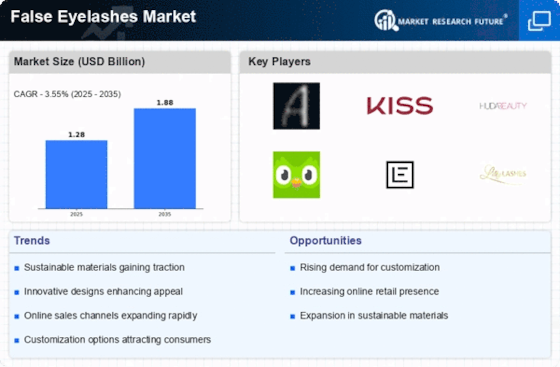
False Eyelashes Market Infographic
Purchase Options

False Eyelashes Size

False Eyelashes Market Growth Projections and Opportunities

The demand for false eyelashes has surged worldwide in recent years, driven by noteworthy innovations within the cosmetic product lines. These innovations have significantly influenced consumer interest, drawing attention to this burgeoning market. The trade of eye-makeup products, particularly false eyelashes, has witnessed a notable upswing, propelled by the alluring product ranges offered by cosmetic companies. This global upsurge in the export volume of luxury eye makeup underscores the substantial demand emanating from consumers across diverse regions. Consequently, the sales of eye cosmetics, specifically false eyelashes, are poised to emerge as a key market driver in the foreseeable future.

The pervasive influence of social media coupled with innovative marketing strategies is anticipated to unlock lucrative opportunities for market players operating within the false eyelashes market. Social media platforms serve as a powerful catalyst, enabling brands to reach wider audiences and engage with consumers on a more personal level. Through creative marketing approaches, companies can leverage these platforms to showcase their false eyelash offerings, engage customers, and foster brand loyalty. This intersection of social media influence and strategic marketing initiatives is poised to create a fertile ground for market expansion and brand visibility within the false eyelashes sector.

However, amidst this rapid growth, an impediment to the global market is anticipated in the form of an escalating demand for permanent natural eyelash extensions. This growing preference for permanent extensions poses a potential restriction on the growth trajectory of false eyelashes in the forecast period. The allure of a longer-term solution that emulates the appearance of natural lashes could divert consumer interest away from traditional false eyelashes. This shift in preferences towards more permanent solutions within the eye cosmetics segment might exert a limiting influence on the expansive growth potential of the global false eyelashes market.

In summary, the global market for false eyelashes is witnessing a remarkable surge fueled by cosmetic innovations and a robust trade in eye-makeup products. The escalating demand for luxury eye makeup, driven by appealing product ranges, positions false eyelashes as a significant market driver. Furthermore, the amalgamation of social media impact and innovative marketing strategies offers substantial growth avenues for industry players. However, the concurrent rise in demand for permanent natural eyelash extensions presents a potential challenge, potentially impeding the soaring trajectory of false eyelashes in the market landscape.
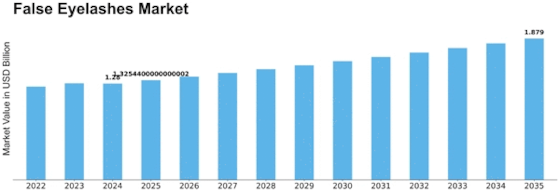

False Eyelashes Market Size Graph
Author
Author Profile
Pradeep Nandi
Senior Research Analyst

I have a bachelor's degree in mechanical engineering and an MBA. I have more than two years of expertise in the retail, food, and beverage, chemical, and material industries, and hence have developed a sound cross-domain expertise. A firm believer in lifelong learning and sharing of knowledge. Having a proclivity for hatching ideas and trying to absorb as much information as possible in a short amount of time. Introducing corporates to the data and insight, which enables them to move from probability to possibility, has been my key areas of interest. 

Leave a Comment

FAQs

What is the current valuation of the False Eyelashes Market as of 2024?

The global false eyelashes market was valued at USD 1.89 billion in 2024, reflecting steady consumer demand driven by the growing influence of social media beauty culture, rising adoption of eye-centric makeup routines, and expanding retail accessibility across both online and offline channels.

What is the projected market valuation for the False Eyelashes Market in 2035?

The global false eyelashes market is projected to reach USD 3.8 billion by 2035, growing at a CAGR of 6.5% from USD 2.0 billion in 2025. This growth is underpinned by the accelerating shift toward magnetic and adhesive-free lash formats, the mainstreaming of false lashes as a daily-wear product among younger demographics, and the rapid expansion of social commerce channels — particularly TikTok Shop — which are bringing new consumers into the category at scale. 

What is the expected CAGR for the False Eyelashes Market during the forecast period 2025 - 2035?

The global false eyelashes market is expected to grow at a compound annual growth rate (CAGR) of 6.5% during the forecast period from 2025 to 2035, expanding from USD 2.0 billion in 2025 to USD 3.8 billion by 2035. Among individual segments, magnetic lashes lead growth at approximately 8.2% CAGR, followed by the professional use application segment at 7.4% CAGR and mink material at 7.8% CAGR — all growing meaningfully faster than the overall market rate. Regionally, Asia-Pacific outpaces the global average at approximately 8.1% CAGR, driven by rising disposable incomes, K-beauty cultural influence, and the rapid expansion of beauty e-commerce across China, India, and Southeast Asia.

Which segment of false eyelashes had the highest valuation in 2024?

Strip lashes held the highest valuation among all false eyelash segments in 2024, accounting for approximately 58% of type-segment revenues, making them the dominant product format by a significant margin. Their market leadership is driven by broad price accessibility — typically retailing between USD 5 and USD 25 — wide availability across drug stores, beauty supply retailers, and e-commerce platforms, and an extensive range of styles catering to every occasion from everyday wear to high-glam events. While magnetic lashes are the fastest-growing format at approximately 8.2% CAGR, strip lashes continue to serve as the entry point into the false eyelash category for the majority of consumers globally, sustaining their volume dominance through the forecast period.

What are the projected valuations for Individual Lashes by 2035?

Individual lashes are projected to reach a valuation of USD 1.37 billion by 2035, rising from USD 0.65 billion in 2024 — representing more than a doubling of segment value over the forecast period. 

Which material segment is expected to grow the most in the False Eyelashes Market?

Natural hair lashes — encompassing mink, silk, sable, and human hair — are expected to grow at the fastest rate among all material segments in the false eyelashes market, driven by rising consumer preference for lightweight, flexible lashes that closely mimic the appearance and feel of natural eyelashes. Demand for natural false eyelashes is estimated to grow at a CAGR of 6.8% during the forecast period, as these products are relatively lighter, finer in texture, and more flexible than synthetic equivalents — making them easier to wear regularly and less likely to cause lash irritation.

What is the market valuation for Professional Use of false eyelashes in 2024?

The professional use segment of the false eyelashes market was valued at approximately USD 0.34 billion in 2024, representing around 18% of the total market valuation of USD 1.89 billion. This segment encompasses false eyelashes used by professional makeup artists, beauty salons, bridal studios, and the film and television industry — channels where high-quality, reusable formats such as mink alternatives, silk, and individual lash styles are the standard of choice. 

How do the valuations of Long and Medium-length lashes compare in 2024?

Long lashes held the higher valuation in 2024, commanding approximately 38% of the length segment's revenue share — reflecting their established dominance as the go-to format for occasions, events, and social media-ready looks where dramatic eye enhancement is the primary goal. Medium lashes followed closely at approximately 34% revenue share, making the gap between the two the narrowest of any adjacent length sub-segments in the market. 

Which key players are leading the False Eyelashes Market?

The global false eyelashes market is led by a core group of established brands — Ardell International, Kiss Products, Huda Beauty, Lilly Lashes, Velour Lashes, Eylure, Tarte Cosmetics, House of Lashes, and L'Oréal — that collectively hold the majority of global market revenues through a combination of wide retail distribution, strong brand recognition, and continuous product innovation. 

What is the projected valuation for Self-Adhesive Lashes by 2035?

Self-Adhesive Lashes are projected to reach 0.193 USD Billion by 2035, effectively doubling in value over the forecast period as improvements in bond technology, wear longevity, and lash quality continue to accelerate mainstream consumer adoption. 

Market Summary

The global false eyelashes market was valued at USD 1.89 billion in 2024 and is projected to reach USD 3.8 billion by 2035, growing at a CAGR of 6.5%. Growth is driven by social media influence, the rise of cruelty-free beauty, and magnetic lash innovation. North America leads with a 36% share, while Asia-Pacific is the fastest-growing region.

Key Market Trends & Highlights

The False Eyelashes Market is experiencing dynamic growth driven by evolving consumer preferences and technological advancements.

  • North America remains the largest market for false eyelashes, driven by a robust beauty industry and consumer spending. Asia-Pacific is emerging as the fastest-growing region, fueled by increasing beauty consciousness and rising disposable incomes. Strip lashes continue to dominate the market, while magnetic lashes are gaining traction due to their convenience and ease of use. The rising demand for beauty products and the influence of social media trends are key drivers propelling market expansion.

Market Size & Forecast

2024 Market Size 1.89 (USD Billion)
2035 Market Size 3,8 (USD Billion)
CAGR (2025 - 2035) 6.5%
Largest Regional Market Share in 2024 North America

Major Players

<a href="https://ardellshop.com/collections/lashes">Ardell</a> (US), Kiss Products (US), Huda Beauty (AE), Duo (US), Eylure (GB), Lilly Lashes (US), Velour Lashes (CA), Tarte Cosmetics (US), <a href="https://houseoflashes.com/collections/lashes">House of Lashes</a> (US)

Market Trends

The False Eyelashes Market is currently experiencing a dynamic evolution, driven by shifting consumer preferences and the increasing popularity of beauty enhancement products. As individuals seek to elevate their appearance, the demand for false eyelashes has surged, reflecting a broader trend towards personal grooming and self-expression. This market encompasses a diverse range of products, from natural-looking options to more dramatic styles, including the growing false eyelash strips market which continues to attract mass consumer adoption due to ease of use. The rise of social media influencers and beauty tutorials has further amplified interest, as consumers are inspired by the latest trends and techniques showcased online.

Moreover, the market is witnessing a notable shift towards sustainability, with brands increasingly focusing on eco-friendly materials and ethical production practices. This trend aligns with a growing consumer awareness regarding environmental issues, prompting companies to innovate and adapt their offerings. As the False Eyelashes Market continues to expand, it appears poised for further growth, driven by both aesthetic desires and a commitment to responsible consumption. The interplay of these factors suggests a vibrant future for this segment of the beauty industry, where creativity and sustainability coexist harmoniously while strengthening overall false eyelashes market share development globally.

Sustainability Initiatives

Consumer demand for vegan, cruelty-free, and reusable false eyelashes has become a mainstream market requirement. In 2024, approximately 47% of false eyelash buyers in North America and Europe actively sought cruelty-free certification before purchasing, up from 29% in 2021. Leading brands have responded with concrete action:

1. Ardell launched a plant-fiber eco lash line in late 2023.

2. Velour Lashes achieved B-Corp certification in 2024 and repositioned its entire range around a '30-wear reusable' sustainability platform.

3. Eylure partnered with Boots UK to introduce a recyclable-packaging lash range in 2024.

On the regulatory side, the European Union in Q1 2025 mandated full ingredient disclosure and allergen labeling for all false eyelash products sold in EU territories — a compliance requirement that is accelerating market consolidation toward established, certified brands and creating a meaningful barrier for counterfeit and low-quality imports. Reusable lash formats directly benefit from this trend. Brands marketing lashes as reusable up to 25 wears are achieving 15–20% higher price

Customization and Personalization

The false eyelashes category is shifting from a standardised shelf product to a personalised beauty tool, driven by three converging developments:

1. AR-powered digital try-on: Lilly Lashes co-developed an augmented reality try-on lens on Instagram with Meta in Q4 2024, enabling users to virtually test 12 lash styles before purchase. Sephora reported a 22% higher conversion rate for lash products featuring virtual try-on versus those without, establishing digital preview as a meaningful purchase catalyst.

2. 3D-printed custom lash kits: OPT Industries partnered with TAD Beauty in Q3 2024 to pilot a first-of-its-kind programme offering lashes printed to match individual eye curvature measurements. While still in early adoption, this signals the direction of the premium tier through 2030.

3. Fit and format innovation: Stretch-fit lash bands (Velour, 2024), no-trim designs, and pre-curved bands targeting specific eye shapes — almond, monolid, hooded — are moving personalisation from a digital feature to a physical product attribute. Brands offering eye-shape-specific collections are reporting 18–24% higher repeat purchase rates versus one-size-fits-all ranges.

Influencer Marketing Impact

Social media has evolved from a brand awareness channel into the primary purchase trigger for false eyelashes. TikTok Shop lash category sales grew an estimated 42% year-over-year in 2024, making it the single fastest-growing retail channel for the segment globally.

Instagram Reels and YouTube beauty tutorials collectively drive purchase intent for approximately 35% of false eyelash buyers in the 18–34 demographic. The mechanism is direct: a beauty influencer demonstrates a full lash application in a 60-second Reel; the product is tagged and purchasable in-app within seconds, compressing the consideration cycle from days to minutes.

Huda Beauty's native TikTok Shop integration — launched Q1 2024 — drove 38% year-over-year growth in its lash category revenue, demonstrating the concrete sales impact of social commerce versus traditional digital advertising.

Micro-influencers in the 50,000–500,000 follower range deliver the highest engagement-to-cost ratio for this category, and brands using data-driven influencer strategies grew revenues at 2.3× the rate of those relying on traditional advertising in 2024.

False Eyelashes Market Market Drivers

Expansion of Retail Channels

Online retail now accounts for approximately 38% of global false eyelash sales — up from 22% in 2019 — and is the fastest-growing distribution channel, expanding at ~9.4% CAGR. Amazon, Nykaa (India), and Tmall (China) are the three largest individual online platforms for lash sales globally, each benefiting from broad product selection, competitive pricing, and consumer review infrastructure that builds purchase confidence.
TikTok Shop has emerged as the most disruptive new channel, combining content and commerce in a single native experience. US TikTok Shop beauty and personal care gross merchandise value grew over 100% in 2024, with lashes among the top five most-purchased beauty sub-categories. The zero-friction path from a tutorial video to an in-app purchase is compressing the conversion funnel in ways that traditional e-commerce cannot replicate.
Brick-and-mortar channels — drug stores, beauty supply retailers, and department stores — still contribute approximately 62% of global lash sales, but are growing at a slower ~4.1% rate as consumers under 35 shift purchasing online. CVS, Walgreens, and Walmart collectively distribute over 60% of mass-market false lashes in the US, making physical retail indispensable for volume-stage brands even as the growth margin shifts digital.
The strategic implication: brands that operate omnichannel — with consistent pricing, content-linked product pages, and TikTok-native commerce — are achieving 2.3× the revenue growth of single-channel operators.

Growing Interest in Eye Makeup

The growing interest in eye makeup is a notable driver of the False Eyelashes Market. As consumers increasingly prioritize eye makeup as a key component of their beauty routines, the demand for products that enhance eye appearance has surged. False eyelashes have become a staple in many makeup kits, as they provide an easy way to achieve a dramatic look. Industry expert's indicates that eye makeup products, including false eyelashes, are projected to witness a steady increase in sales, driven by the rising popularity of eye-centric makeup trends. This trend is particularly evident among younger consumers, who are more inclined to experiment with bold eye looks. As the focus on eye makeup continues to grow, the false eyelashes market is likely to benefit from this shift in consumer preferences.

Rising Demand for Beauty Products

The global false eyelashes market is projected to grow at a compound annual growth rate (CAGR) of 6.5% from 2025 to 2035, reaching USD 3.8 billion by 2035 from a base of USD 2.0 billion in 2025. This growth rate reflects the convergence of social media-driven beauty culture, the shift toward sustainable and reusable beauty products, and continued product innovation in magnetic and adhesive-free lash formats.
This demand exists within the context of a broader global beauty and personal care market growing toward USD 800 billion by 2030, with eye makeup as a sub-category growing at ~6.8% CAGR — slightly above the false eyelashes market's overall rate, confirming that the lash segment is keeping pace with, and in premium tiers outpacing, its category.

Influence of Social Media and Beauty Trends

The influence of social media and evolving beauty trends significantly impacts the False Eyelashes Market. Platforms such as Instagram, TikTok, and YouTube have become vital channels for beauty brands to showcase their products. Influencers and beauty gurus often promote false eyelashes, leading to increased visibility and consumer interest. The rise of beauty challenges and tutorials on these platforms has further popularized the use of false eyelashes among younger demographics. Market data suggests that brands leveraging social media marketing strategies have experienced higher sales growth compared to those relying solely on traditional advertising. This trend indicates that the false eyelashes market is increasingly driven by digital engagement and the desire for trendy beauty solutions. As social media continues to evolve, its impact on consumer behavior in the beauty sector is expected to grow.

Technological Advancements in Product Development

Product innovation is a measurable demand driver in this market, with technology directly expanding the addressable consumer base by reducing application difficulty — the #1 stated barrier to false eyelash trial.
Magnetic lash technology is the clearest proof point. By eliminating adhesive entirely, magnetic formats directly address the concern that prevents 40–50% of non-users from trying false lashes. Magnetic lash sub-segment is growing at ~8.2% CAGR — significantly ahead of the overall market's 6.5% — and is disproportionately popular among the 18–28 age cohort. Kiss Products has filed multiple nano-fiber adhesive-adjacent patents covering hybrid magnetic-adhesive systems, with commercial products expected by late 2025.
Advanced synthetic fibres: Third-generation synthetic materials now replicate the taper, weight, and optical sheen of natural mink and silk within a fully vegan, cruelty-free production process. These fibres have reduced the quality gap that previously justified mink's price premium by an estimated 70–80%, accelerating consumer migration to synthetic options without a perceived quality sacrifice.
Nano-fibre adhesive innovation: New ultra-thin adhesive formulations reduce dry time from 30–60 seconds to under 10 seconds and deliver all-day hold for up to 16 hours — directly resolving the two most frequently reported pain points in consumer surveys: application difficulty and premature lift.

Influencer Marketing Impact

3D-printed custom lashes: OPT Industries and TAD Beauty's 2024 pilot programme demonstrates that additive manufacturing can produce lashes matched to individual eye curvature. While commercially early-stage, this signals the direction of the premium tier through 2030.

Market Segment Insights

By Type: Strip Lashes (Largest) vs. Magnetic Lashes (Fastest-Growing)

In the False Eyelashes Market, the segment is highly diversified, with Strip Lashes commanding the majority share due to their widespread popularity and ease of use, further strengthening the false eyelash strips market segment globally. Individual Lashes and Self-Adhesive Lashes follow, catering to niche segments with specific user preferences. Magnetic Lashes, however, are gaining traction, appealing particularly to consumers seeking convenience and the ability to reuse lashes with minimal effort, contributing significantly to the expanding magnetic false eyelashes market.

Strip Lashes (Dominant) vs. Magnetic Lashes (Emerging)

Strip Lashes are the dominant segment in the False Eyelashes Market, celebrated for their affordability, accessibility, and diverse style options that cater to a wide consumer base. They offer relatively quick application and are ideal for those who want a dramatic look without the commitment of individual lashes. Conversely, Magnetic Lashes are emerging as a strong contender due to their unique application method, which utilizes magnets instead of adhesive, appealing to users concerned about eye health and ease of application. Their reusable nature also adds to their appeal among consumers who prefer sustainable beauty products, accelerating growth in the magnetic false eyelashes market.<br>→ Strip Lashes: ~58% revenue share (2024) | CAGR 5.8%<br>→ Magnetic Lashes: ~14% revenue share | CAGR 8.2% (fastest-growing)

By Material: Synthetic Hair (Largest) vs. Mink (Fastest-Growing)

In the False Eyelashes Market, the material composition plays a crucial role in defining product appeal and market dynamics. Synthetic hair dominates the segment, as it offers a budget-friendly option favored by consumers looking for versatile, durable lashes. Other materials like natural hair and silk also cater to specific consumer preferences, but they hold a smaller market share compared to synthetic options. Mink lashes, on the other hand, have gained considerable traction due to their luxurious appeal and lightweight feel, making them a popular choice among premium users.

Synthetic Hair (Dominant) vs. Mink (Emerging)

Synthetic hair lashes dominate the False Eyelashes Market due to their affordability, wide availability, and diverse styles. They cater to a broad audience, making them a staple in many beauty routines. Their durability allows for multiple uses, appealing to cost-conscious customers. In contrast, mink lashes are viewed as an emerging luxury product, gaining popularity for their natural look and feel. These lashes offer a lightweight option that enhances comfort, attracting a high-end clientele. Despite being more expensive, the growing demand for premium beauty products positions mink lashes as a significant competitor in the market.<br>→ Synthetic Hair: ~67% revenue share | CAGR 6.0%<br>→ Mink: ~11% revenue share | CAGR 7.8% (fastest-growing)

By Application: Personal Use (Largest) vs. Professional Use (Fastest-Growing)

The False Eyelashes Market is primarily segmented into Personal Use, Professional Use, and the Cosmetic Industry. Personal Use holds the largest share, driven by consumers' growing inclination towards self-beautification and enhancing their look for various occasions. The segment's popularity is amplified through social media influencers showcasing the ease and versatility of false eyelashes, appealing to a broad demographic. On the other hand, the Professional Use segment is witnessing rapid growth as makeup artists increasingly rely on high-quality false eyelashes to meet client demands for glamourous looks on special occasions, further elevating the segment’s visibility in the market.

Personal Use: Dominant vs. Professional Use: Emerging

In the False Eyelashes Market, Personal Use stands out as a dominant segment characterized by a wide adoption among regular consumers. The ease of online shopping and a plethora of choices cater significantly to individual preferences. This segment thrives on factors such as brand loyalty and marketing strategies targeting everyday consumers. Conversely, the Professional Use segment is emerging rapidly, propelled by professional makeup services and high event turnover rates, such as weddings and parties. As makeup artists embrace innovative products to create bespoke looks, this segment leverages quality and uniqueness, positioning itself as a key player in elevating the overall allure of false eyelashes in the market.<br>→ Personal Use: ~72% revenue share | CAGR 6.3%<br>→ Professional Use: ~18% revenue share | CAGR 7.4% (fastest-growing)

By Length: Long (Largest) vs. Medium (Fastest-Growing)

In the False Eyelashes Market, the length segment is segmented into short, medium, long, and extra long. Long false eyelashes hold the largest market share, appealing to consumers seeking dramatic looks for special occasions. In contrast, medium-length lashes are gaining traction due to their versatility, fitting a wide range of occasions from everyday wear to events. This distribution showcases consumer preference towards bold, attention-grabbing styles, while also leaning towards practicality with medium options. The growth trends in this segment reflect changing beauty standards and the influence of social media beauty trends. Long lashes are often favored for their ability to enhance eye appearance, which continues to attract consumers. Meanwhile, medium lashes are emerging as the fastest-growing option as they align with modern-day demands for comfort and subtlety, driven by influencers and makeup artists who advocate for a more natural look with just a hint of glamour.

Long (Dominant) vs. Medium (Emerging)

Long false eyelashes are a staple in the beauty industry, symbolizing glamour and elegance. Their dominance in the market is bolstered by their appeal for various occasions, from evening events to bridal looks. They offer dramatic volume and length, significantly enhancing the eyes, thus being a preferred choice for many consumers. On the other hand, medium false eyelashes represent an emerging trend that caters to a growing demand for natural yet defined looks. They strike a balance between boldness and subtlety, making them perfect for daily wear or less formal events. This emerging segment is gaining popularity as more consumers seek versatility and comfort, which helps them stand out while still being understated.<br>→ Long: ~38% revenue share | CAGR 6.0%<br>→ Medium: ~34% revenue share | CAGR 7.1% (fastest-growing)<br>→ Short: ~17% revenue share | CAGR 5.8%<br>→ Extra Long: ~11% revenue share | CAGR 6.3%

Get more detailed insights about False Eyelashes Market Research Report - Global Forecast till 2035

Regional Insights

North America : Beauty Innovation Hub

North America dominates the false eyelashes market, accounting for approximately 40% of global sales. The region's growth is driven by increasing consumer interest in beauty products, particularly among millennials and Gen Z. Regulatory support for cosmetic safety and innovation further fuels market expansion. The U.S. is the largest market, followed by Canada, which holds about 10% of the market share. The competitive landscape in North America is robust, featuring key players like Ardell, Kiss Products, and Lilly Lashes. These brands leverage social media marketing and influencer partnerships to enhance visibility and drive sales. The presence of major beauty retailers and e-commerce platforms also contributes to the market's growth, making false eyelashes more accessible to consumers.

Europe : Emerging Beauty Powerhouse

Europe is witnessing a significant rise in the false eyelashes market, with a market share of around 30%. The demand is driven by increasing beauty consciousness and the influence of social media trends. Countries like the UK and Germany are leading the market, supported by favorable regulations on cosmetic products that ensure safety and quality. The European market is characterized by a growing preference for cruelty-free and sustainable products. The competitive landscape is marked by established brands such as Eylure and emerging players focusing on innovative designs and materials. The presence of beauty trade shows and exhibitions in Europe fosters collaboration and innovation among manufacturers. This dynamic environment is expected to propel further growth in the coming years.

Asia-Pacific : Rapidly Expanding Market

Asia-Pacific is rapidly emerging as a key player in the false eyelashes market, holding approximately 20% of the global share. The region's growth is fueled by rising disposable incomes, urbanization, and a growing beauty culture, particularly in countries like China and Japan. Regulatory frameworks are evolving to support cosmetic safety, which enhances consumer confidence in beauty products. Leading brands like Huda Beauty and local manufacturers are capitalizing on the growing demand for false eyelashes. The competitive landscape is diverse, with a mix of international and regional players. E-commerce platforms are increasingly popular, providing consumers with easy access to a wide range of products, further driving market growth.

Middle East and Africa : Emerging Market Potential

The Middle East and Africa region is gradually establishing itself in the false eyelashes market, accounting for about 10% of global sales. The growth is driven by increasing beauty awareness and the influence of social media. Countries like the UAE and South Africa are leading the market, supported by a young population eager to adopt beauty trends. Regulatory frameworks are becoming more supportive, enhancing product safety and quality. The competitive landscape features both international brands and local manufacturers, with key players like Huda Beauty making significant inroads. The region's unique cultural influences also shape product preferences, leading to a diverse range of offerings. As beauty standards evolve, the market is expected to grow steadily in the coming years.

Key Players and Competitive Insights

The global false eyelashes market is moderately fragmented, with the leading brands competing across three distinct battlegrounds: product format innovation, channel strategy, and brand positioning. The market is characterised by a high level of competition, with the majority of businesses prioritising new product launches and growing their manufacturing footprint, while deploying strategies centred on partnerships, strategic alliances, and the expansion of regional and international distribution networks.
Ardell — market volume leader undergoing structural transformation. In 2025, Ardell led the global false eyelashes market with over 120 million units sold worldwide, offering more than 250 styles and serving 35+ countries across both retail and salon channels. However, the brand's product mix is shifting markedly. Ardell once made 95% of its sales from strip lashes; now almost half of the products on shelf and almost half of sales are dedicated to underlash formats — cluster and magnetic styles that are growing at 62.6% and 37.6% year-on-year respectively in the US market. The brand is also pioneering the category's next frontier: in October 2025 it introduced its Nourish collection, fortified with skincare ingredients including peptides, niacinamide, and biotin — lashes designed to nourish the natural lash line as they are worn, a direct response to consumer anxiety about the long-term effects of frequent false lash use.
Kiss Products — distribution scale and patent enforcement. Kiss Products holds the second-largest US market position by volume. In April 2025, Kiss introduced its Spring 2025 lash collections, featuring innovative designs and enhanced formulations, as the company continues to maintain its focus on product development and market expansion amid increasing competition from magnetic lash manufacturers. The brand's most consequential move, however, was legal rather than product-driven: Kiss filed a patent infringement complaint against Velour Cosmetics in early 2025, alleging that Velour's self-adhesive lash cluster product infringed Kiss's pre-applied adhesive eyelash patent. The two brands subsequently reached a confidential settlement with a permanent injunction preventing Velour from selling competing products. The case demonstrates that application technology has become the most actively contested intellectual property frontier in the category.
Tatti Lashes — the breakout challenger. The most commercially striking competitive story of 2024 was the surge of Liverpool-founded Tatti Lashes into the upper tier of the global market. The brand reported a turnover of £27.2 million in the financial year ending 2024, representing 43% year-on-year growth, with one lash selling every six seconds globally. The brand counts Kim Kardashian, Ariana Grande, Christina Aguilera, and Cardi B among its organic celebrity fans, and in 2024 converted that affinity into a formal commercial partnership, launching a co-created collection with Khloé Kardashian on 28 May 2024 — timed to coincide with the brand's official entry into US retail distribution. The collection spans strip lashes, individual cluster lashes, a bond-and-seal adhesive lasting up to seven days, and a rose oil-infused lash remover, priced from $11.95 to $44.95. The business is projected to reach sales of over £40 million in the financial year ending 2025, making Tatti Lashes one of the fastest-growing brands in the global market.
Velour Lashes — premium reusability and new format innovation. Velour occupies the premium-sustainable position in the market. In September 2024, the brand unveiled V by Velour — a new masstige lash line featuring eLASHtic lashes, the industry's first lashes made with stretch-fit lash bands, using an ultra-flex elastic band that contours to the individual eye shape for a custom fit. The launch simultaneously addressed two consumer priorities: fit innovation through the eLASHtic collection, and sustainability through the everGREEN collection, made from biodegradable plant-based fibres and reusable 15 or more wears with proper care. Velour's positioning as a premium, reusable, ethically-produced lash — rather than a disposable fashion accessory — is directly aligned with the two consumer trends most reshaping the market: sustainability credentials and per-wear value.
Eylure — European retail leader expanding globally. Eylure registered sales of approximately 68 million units in 2025, offering more than 150 lash styles across professional and personal use segments in 25 countries. The brand reinforced its consumer convenience credentials with new packaging: in September 2024, Eylure unveiled its C-Lash packaging, designed specifically with lash replacement in mind. Eylure's competitive advantage is structural: as a UK-founded brand with a long-standing European retail presence, it holds established compliance infrastructure ahead of the EU's expanded allergen labeling requirements effective July 2026 — a regulatory hurdle that less-established international brands entering European markets will find significantly more burdensome.
TAD Beauty — the innovation outlier. The smallest brand in the competitive set but arguably the most strategically significant in terms of category direction: TAD Beauty partnered with OPT Industries to launch the world's first 3D-printed DIY eyelashes in October 2024 — durable, flexible lashes manufactured entirely in the United States using a specialised photopolymer engineered for optimal performance at human body temperatures. The product is not yet a volume play, but it represents the clearest signal of where the premium tier of the false eyelash market is heading: fully customisable, technology-manufactured, domestically produced, and positioned as a durable beauty tool rather than a disposable cosmetic.

Key Companies in the False Eyelashes Market include

Industry Developments

The most technologically significant development was the launch of the world's first 3D-printed false eyelashes. TAD Beauty — a brand created by professional lash artist and PLA founder Michelle Nguyen — partnered with OPT Industries to launch the world's first 3D-printed DIY lashes on September 23, 2024. 

The product is substantively different from anything previously on the market. TAD's lashes are composed of a specialized photopolymer engineered to work best at human body temperatures — distinct from the Korean PBT (polybutylene terephthalate) used in most conventional false lashes, which loses curl over time with exposure to heat and humidity. Avenue Z

OPT's platform uses shape-memory materials and soft, flexible microstructures, with no need for tooling, hand assembly, gluing, or heat fusing — enabling faster lead times, lower upfront costs, and design flexibility not achievable through conventional lash manufacturing. Wikipedia

In the application technology and intellectual property space, the competitive stakes around pre-applied adhesive lash systems rose sharply. Kiss Nail Products filed a patent infringement complaint in March 2025 against Velour Cosmetics, alleging that Velour's self-adhesive lash clusters infringed a patent covering an artificial eyelash extension system with adhesive applied directly to the eyelash filaments — a patent whose Notice of Allowance dates to October 30, 2024. Wikipedia

Kiss and Velour subsequently resolved the dispute, with the companies agreeing to a confidential settlement and a permanent injunction preventing Velour from selling products competing with Kiss's ready-to-use eyelash extensions. Shopify

The case is a clear signal that pre-applied and self-adhesive lash technology has become a genuine competitive battleground, with patent protection now being actively enforced between major players. On the product innovation side, Velour launched one of the most discussed new formats of the year. In September 2024, Velour Beauty launched V by Velour — a new masstige false lash line featuring eLASHtic™ lashes, the first lashes ever made with stretch-fit lash bands, using an ultra-flex elastic band that contours to the individual eye shape for a custom fit. Cruelty-Free Kitty

The launch also included the everGREEN collection, made with biodegradable plant-based fibres, with both collections reusable 15 or more wears with proper care. The dual launch — one collection focused on fit technology, one on sustainability materials — reflects Velour's deliberate positioning at the intersection of the two most commercially significant consumer trends in the category. WebFX

Separately, an updated EU glossary of cosmetic ingredient names — adding 348 new ingredient entities and bringing the total to 30,418 INCI names — becomes mandatory from 30 July 2026. These requirements create a meaningful compliance burden that established brands with documented supply chains are better positioned to absorb than counterfeit or grey-market competitors — effectively functioning as a regulatory moat for the certified players. OPT Industries

Future Outlook

False Eyelashes Market Future Outlook

The False Eyelashes Market is projected to grow at a 6.5% CAGR from 2025 to 2035, driven by increasing consumer demand and innovative product offerings.

New opportunities lie in:

  • <p>Expansion into eco-friendly materials for sustainable product lines. Development of subscription-based models for regular consumers. Collaboration with beauty influencers for targeted marketing campaigns.</p>

By 2035, the market is expected to solidify its position as a key player in the beauty industry.

Market Segmentation

False Eyelashes Market Type Outlook

  • Strip Lashes
  • Individual Lashes
  • Magnetic Lashes
  • Self-Adhesive Lashes

False Eyelashes Market Length Outlook

  • Short
  • Medium
  • Long
  • Extra Long

False Eyelashes Market Material Outlook

  • Synthetic Hair
  • Natural Hair
  • Silk
  • Mink

False Eyelashes Market Application Outlook

  • Personal Use
  • Professional Use
  • Cosmetic Industry

Report Scope

MARKET SIZE 2024 1.89 (USD Billion)
MARKET SIZE 2025 2.0 (USD Billion)
MARKET SIZE 2035  3.8 (USD Billion)
COMPOUND ANNUAL GROWTH RATE (CAGR) 6.5% (2025 - 2035)
REPORT COVERAGE Revenue Forecast, Competitive Landscape, Growth Factors, and Trends
BASE YEAR 2024
Market Forecast Period 2025 - 2035
Historical Data 2019 - 2024
Market Forecast Units USD Billion
Key Companies Profiled Ardell (US), Kiss Products (US), Huda Beauty (AE), Duo (US), Eylure (GB), Lilly Lashes (US), Velour Lashes (CA), Tarte Cosmetics (US), House of Lashes (US)
Segments Covered Type, Material, Application, Length, Regional
Key Market Opportunities Growing demand for sustainable and cruelty-free options in the False Eyelashes Market presents significant opportunities.
Key Market Dynamics Rising consumer preference for sustainable materials drives innovation and competition in the false eyelashes market.
Countries Covered North America, Europe, APAC, South America, MEA

FAQs

What is the current valuation of the False Eyelashes Market as of 2024?

The global false eyelashes market was valued at USD 1.89 billion in 2024, reflecting steady consumer demand driven by the growing influence of social media beauty culture, rising adoption of eye-centric makeup routines, and expanding retail accessibility across both online and offline channels.

What is the projected market valuation for the False Eyelashes Market in 2035?

The global false eyelashes market is projected to reach USD 3.8 billion by 2035, growing at a CAGR of 6.5% from USD 2.0 billion in 2025. This growth is underpinned by the accelerating shift toward magnetic and adhesive-free lash formats, the mainstreaming of false lashes as a daily-wear product among younger demographics, and the rapid expansion of social commerce channels — particularly TikTok Shop — which are bringing new consumers into the category at scale. 

What is the expected CAGR for the False Eyelashes Market during the forecast period 2025 - 2035?

The global false eyelashes market is expected to grow at a compound annual growth rate (CAGR) of 6.5% during the forecast period from 2025 to 2035, expanding from USD 2.0 billion in 2025 to USD 3.8 billion by 2035. Among individual segments, magnetic lashes lead growth at approximately 8.2% CAGR, followed by the professional use application segment at 7.4% CAGR and mink material at 7.8% CAGR — all growing meaningfully faster than the overall market rate. Regionally, Asia-Pacific outpaces the global average at approximately 8.1% CAGR, driven by rising disposable incomes, K-beauty cultural influence, and the rapid expansion of beauty e-commerce across China, India, and Southeast Asia.

Which segment of false eyelashes had the highest valuation in 2024?

Strip lashes held the highest valuation among all false eyelash segments in 2024, accounting for approximately 58% of type-segment revenues, making them the dominant product format by a significant margin. Their market leadership is driven by broad price accessibility — typically retailing between USD 5 and USD 25 — wide availability across drug stores, beauty supply retailers, and e-commerce platforms, and an extensive range of styles catering to every occasion from everyday wear to high-glam events. While magnetic lashes are the fastest-growing format at approximately 8.2% CAGR, strip lashes continue to serve as the entry point into the false eyelash category for the majority of consumers globally, sustaining their volume dominance through the forecast period.

What are the projected valuations for Individual Lashes by 2035?

Individual lashes are projected to reach a valuation of USD 1.37 billion by 2035, rising from USD 0.65 billion in 2024 — representing more than a doubling of segment value over the forecast period. 

Which material segment is expected to grow the most in the False Eyelashes Market?

Natural hair lashes — encompassing mink, silk, sable, and human hair — are expected to grow at the fastest rate among all material segments in the false eyelashes market, driven by rising consumer preference for lightweight, flexible lashes that closely mimic the appearance and feel of natural eyelashes. Demand for natural false eyelashes is estimated to grow at a CAGR of 6.8% during the forecast period, as these products are relatively lighter, finer in texture, and more flexible than synthetic equivalents — making them easier to wear regularly and less likely to cause lash irritation.

What is the market valuation for Professional Use of false eyelashes in 2024?

The professional use segment of the false eyelashes market was valued at approximately USD 0.34 billion in 2024, representing around 18% of the total market valuation of USD 1.89 billion. This segment encompasses false eyelashes used by professional makeup artists, beauty salons, bridal studios, and the film and television industry — channels where high-quality, reusable formats such as mink alternatives, silk, and individual lash styles are the standard of choice. 

How do the valuations of Long and Medium-length lashes compare in 2024?

Long lashes held the higher valuation in 2024, commanding approximately 38% of the length segment's revenue share — reflecting their established dominance as the go-to format for occasions, events, and social media-ready looks where dramatic eye enhancement is the primary goal. Medium lashes followed closely at approximately 34% revenue share, making the gap between the two the narrowest of any adjacent length sub-segments in the market. 

Which key players are leading the False Eyelashes Market?

The global false eyelashes market is led by a core group of established brands — Ardell International, Kiss Products, Huda Beauty, Lilly Lashes, Velour Lashes, Eylure, Tarte Cosmetics, House of Lashes, and L'Oréal — that collectively hold the majority of global market revenues through a combination of wide retail distribution, strong brand recognition, and continuous product innovation. 

What is the projected valuation for Self-Adhesive Lashes by 2035?

Self-Adhesive Lashes are projected to reach 0.193 USD Billion by 2035, effectively doubling in value over the forecast period as improvements in bond technology, wear longevity, and lash quality continue to accelerate mainstream consumer adoption. 

  1. SECTION I: EXECUTIVE SUMMARY AND KEY HIGHLIGHTS
    1. | 1.1 EXECUTIVE SUMMARY
    2. | | 1.1.1 Market Overview
    3. | | 1.1.2 Key Findings
    4. | | 1.1.3 Market Segmentation
    5. | | 1.1.4 Competitive Landscape
    6. | | 1.1.5 Challenges and Opportunities
    7. | | 1.1.6 Future Outlook
  2. SECTION II: SCOPING, METHODOLOGY AND MARKET STRUCTURE
    1. | 2.1 MARKET INTRODUCTION
    2. | | 2.1.1 Definition
    3. | | 2.1.2 Scope of the study
    4. | | | 2.1.2.1 Research Objective
    5. | | | 2.1.2.2 Assumption
    6. | | | 2.1.2.3 Limitations
    7. | 2.2 RESEARCH METHODOLOGY
    8. | | 2.2.1 Overview
    9. | | 2.2.2 Data Mining
    10. | | 2.2.3 Secondary Research
    11. | | 2.2.4 Primary Research
    12. | | | 2.2.4.1 Primary Interviews and Information Gathering Process
    13. | | | 2.2.4.2 Breakdown of Primary Respondents
    14. | | 2.2.5 Forecasting Model
    15. | | 2.2.6 Market Size Estimation
    16. | | | 2.2.6.1 Bottom-Up Approach
    17. | | | 2.2.6.2 Top-Down Approach
    18. | | 2.2.7 Data Triangulation
    19. | | 2.2.8 Validation
  3. SECTION III: QUALITATIVE ANALYSIS
    1. | 3.1 MARKET DYNAMICS
    2. | | 3.1.1 Overview
    3. | | 3.1.2 Drivers
    4. | | 3.1.3 Restraints
    5. | | 3.1.4 Opportunities
    6. | 3.2 MARKET FACTOR ANALYSIS
    7. | | 3.2.1 Value chain Analysis
    8. | | 3.2.2 Porter's Five Forces Analysis
    9. | | | 3.2.2.1 Bargaining Power of Suppliers
    10. | | | 3.2.2.2 Bargaining Power of Buyers
    11. | | | 3.2.2.3 Threat of New Entrants
    12. | | | 3.2.2.4 Threat of Substitutes
    13. | | | 3.2.2.5 Intensity of Rivalry
    14. | | 3.2.3 COVID-19 Impact Analysis
    15. | | | 3.2.3.1 Market Impact Analysis
    16. | | | 3.2.3.2 Regional Impact
    17. | | | 3.2.3.3 Opportunity and Threat Analysis
  4. SECTION IV: QUANTITATIVE ANALYSIS
    1. | 4.1 Consumer and Retail, BY Type (USD Billion)
    2. | | 4.1.1 Strip Lashes
    3. | | 4.1.2 Individual Lashes
    4. | | 4.1.3 Magnetic Lashes
    5. | | 4.1.4 Self-Adhesive Lashes
    6. | 4.2 Consumer and Retail, BY Material (USD Billion)
    7. | | 4.2.1 Synthetic Hair
    8. | | 4.2.2 Natural Hair
    9. | | 4.2.3 Silk
    10. | | 4.2.4 Mink
    11. | 4.3 Consumer and Retail, BY Application (USD Billion)
    12. | | 4.3.1 Personal Use
    13. | | 4.3.2 Professional Use
    14. | | 4.3.3 Cosmetic Industry
    15. | 4.4 Consumer and Retail, BY Length (USD Billion)
    16. | | 4.4.1 Short
    17. | | 4.4.2 Medium
    18. | | 4.4.3 Long
    19. | | 4.4.4 Extra Long
    20. | 4.5 Consumer and Retail, BY Region (USD Billion)
    21. | | 4.5.1 North America
    22. | | | 4.5.1.1 US
    23. | | | 4.5.1.2 Canada
    24. | | 4.5.2 Europe
    25. | | | 4.5.2.1 Germany
    26. | | | 4.5.2.2 UK
    27. | | | 4.5.2.3 France
    28. | | | 4.5.2.4 Russia
    29. | | | 4.5.2.5 Italy
    30. | | | 4.5.2.6 Spain
    31. | | | 4.5.2.7 Rest of Europe
    32. | | 4.5.3 APAC
    33. | | | 4.5.3.1 China
    34. | | | 4.5.3.2 India
    35. | | | 4.5.3.3 Japan
    36. | | | 4.5.3.4 South Korea
    37. | | | 4.5.3.5 Malaysia
    38. | | | 4.5.3.6 Thailand
    39. | | | 4.5.3.7 Indonesia
    40. | | | 4.5.3.8 Rest of APAC
    41. | | 4.5.4 South America
    42. | | | 4.5.4.1 Brazil
    43. | | | 4.5.4.2 Mexico
    44. | | | 4.5.4.3 Argentina
    45. | | | 4.5.4.4 Rest of South America
    46. | | 4.5.5 MEA
    47. | | | 4.5.5.1 GCC Countries
    48. | | | 4.5.5.2 South Africa
    49. | | | 4.5.5.3 Rest of MEA
  5. SECTION V: COMPETITIVE ANALYSIS
    1. | 5.1 Competitive Landscape
    2. | | 5.1.1 Overview
    3. | | 5.1.2 Competitive Analysis
    4. | | 5.1.3 Market share Analysis
    5. | | 5.1.4 Major Growth Strategy in the Consumer and Retail
    6. | | 5.1.5 Competitive Benchmarking
    7. | | 5.1.6 Leading Players in Terms of Number of Developments in the Consumer and Retail
    8. | | 5.1.7 Key developments and growth strategies
    9. | | | 5.1.7.1 New Product Launch/Service Deployment
    10. | | | 5.1.7.2 Merger & Acquisitions
    11. | | | 5.1.7.3 Joint Ventures
    12. | | 5.1.8 Major Players Financial Matrix
    13. | | | 5.1.8.1 Sales and Operating Income
    14. | | | 5.1.8.2 Major Players R&D Expenditure. 2023
    15. | 5.2 Company Profiles
    16. | | 5.2.1 Ardell (US)
    17. | | | 5.2.1.1 Financial Overview
    18. | | | 5.2.1.2 Products Offered
    19. | | | 5.2.1.3 Key Developments
    20. | | | 5.2.1.4 SWOT Analysis
    21. | | | 5.2.1.5 Key Strategies
    22. | | 5.2.2 Kiss Products (US)
    23. | | | 5.2.2.1 Financial Overview
    24. | | | 5.2.2.2 Products Offered
    25. | | | 5.2.2.3 Key Developments
    26. | | | 5.2.2.4 SWOT Analysis
    27. | | | 5.2.2.5 Key Strategies
    28. | | 5.2.3 Huda Beauty (AE)
    29. | | | 5.2.3.1 Financial Overview
    30. | | | 5.2.3.2 Products Offered
    31. | | | 5.2.3.3 Key Developments
    32. | | | 5.2.3.4 SWOT Analysis
    33. | | | 5.2.3.5 Key Strategies
    34. | | 5.2.4 Duo (US)
    35. | | | 5.2.4.1 Financial Overview
    36. | | | 5.2.4.2 Products Offered
    37. | | | 5.2.4.3 Key Developments
    38. | | | 5.2.4.4 SWOT Analysis
    39. | | | 5.2.4.5 Key Strategies
    40. | | 5.2.5 Eylure (GB)
    41. | | | 5.2.5.1 Financial Overview
    42. | | | 5.2.5.2 Products Offered
    43. | | | 5.2.5.3 Key Developments
    44. | | | 5.2.5.4 SWOT Analysis
    45. | | | 5.2.5.5 Key Strategies
    46. | | 5.2.6 Lilly Lashes (US)
    47. | | | 5.2.6.1 Financial Overview
    48. | | | 5.2.6.2 Products Offered
    49. | | | 5.2.6.3 Key Developments
    50. | | | 5.2.6.4 SWOT Analysis
    51. | | | 5.2.6.5 Key Strategies
    52. | | 5.2.7 Velour Lashes (CA)
    53. | | | 5.2.7.1 Financial Overview
    54. | | | 5.2.7.2 Products Offered
    55. | | | 5.2.7.3 Key Developments
    56. | | | 5.2.7.4 SWOT Analysis
    57. | | | 5.2.7.5 Key Strategies
    58. | | 5.2.8 Tarte Cosmetics (US)
    59. | | | 5.2.8.1 Financial Overview
    60. | | | 5.2.8.2 Products Offered
    61. | | | 5.2.8.3 Key Developments
    62. | | | 5.2.8.4 SWOT Analysis
    63. | | | 5.2.8.5 Key Strategies
    64. | | 5.2.9 House of Lashes (US)
    65. | | | 5.2.9.1 Financial Overview
    66. | | | 5.2.9.2 Products Offered
    67. | | | 5.2.9.3 Key Developments
    68. | | | 5.2.9.4 SWOT Analysis
    69. | | | 5.2.9.5 Key Strategies
    70. | 5.3 Appendix
    71. | | 5.3.1 References
    72. | | 5.3.2 Related Reports
  6. LIST OF FIGURES
    1. | 6.1 MARKET SYNOPSIS
    2. | 6.2 NORTH AMERICA MARKET ANALYSIS
    3. | 6.3 US MARKET ANALYSIS BY TYPE
    4. | 6.4 US MARKET ANALYSIS BY MATERIAL
    5. | 6.5 US MARKET ANALYSIS BY APPLICATION
    6. | 6.6 US MARKET ANALYSIS BY LENGTH
    7. | 6.7 CANADA MARKET ANALYSIS BY TYPE
    8. | 6.8 CANADA MARKET ANALYSIS BY MATERIAL
    9. | 6.9 CANADA MARKET ANALYSIS BY APPLICATION
    10. | 6.10 CANADA MARKET ANALYSIS BY LENGTH
    11. | 6.11 EUROPE MARKET ANALYSIS
    12. | 6.12 GERMANY MARKET ANALYSIS BY TYPE
    13. | 6.13 GERMANY MARKET ANALYSIS BY MATERIAL
    14. | 6.14 GERMANY MARKET ANALYSIS BY APPLICATION
    15. | 6.15 GERMANY MARKET ANALYSIS BY LENGTH
    16. | 6.16 UK MARKET ANALYSIS BY TYPE
    17. | 6.17 UK MARKET ANALYSIS BY MATERIAL
    18. | 6.18 UK MARKET ANALYSIS BY APPLICATION
    19. | 6.19 UK MARKET ANALYSIS BY LENGTH
    20. | 6.20 FRANCE MARKET ANALYSIS BY TYPE
    21. | 6.21 FRANCE MARKET ANALYSIS BY MATERIAL
    22. | 6.22 FRANCE MARKET ANALYSIS BY APPLICATION
    23. | 6.23 FRANCE MARKET ANALYSIS BY LENGTH
    24. | 6.24 RUSSIA MARKET ANALYSIS BY TYPE
    25. | 6.25 RUSSIA MARKET ANALYSIS BY MATERIAL
    26. | 6.26 RUSSIA MARKET ANALYSIS BY APPLICATION
    27. | 6.27 RUSSIA MARKET ANALYSIS BY LENGTH
    28. | 6.28 ITALY MARKET ANALYSIS BY TYPE
    29. | 6.29 ITALY MARKET ANALYSIS BY MATERIAL
    30. | 6.30 ITALY MARKET ANALYSIS BY APPLICATION
    31. | 6.31 ITALY MARKET ANALYSIS BY LENGTH
    32. | 6.32 SPAIN MARKET ANALYSIS BY TYPE
    33. | 6.33 SPAIN MARKET ANALYSIS BY MATERIAL
    34. | 6.34 SPAIN MARKET ANALYSIS BY APPLICATION
    35. | 6.35 SPAIN MARKET ANALYSIS BY LENGTH
    36. | 6.36 REST OF EUROPE MARKET ANALYSIS BY TYPE
    37. | 6.37 REST OF EUROPE MARKET ANALYSIS BY MATERIAL
    38. | 6.38 REST OF EUROPE MARKET ANALYSIS BY APPLICATION
    39. | 6.39 REST OF EUROPE MARKET ANALYSIS BY LENGTH
    40. | 6.40 APAC MARKET ANALYSIS
    41. | 6.41 CHINA MARKET ANALYSIS BY TYPE
    42. | 6.42 CHINA MARKET ANALYSIS BY MATERIAL
    43. | 6.43 CHINA MARKET ANALYSIS BY APPLICATION
    44. | 6.44 CHINA MARKET ANALYSIS BY LENGTH
    45. | 6.45 INDIA MARKET ANALYSIS BY TYPE
    46. | 6.46 INDIA MARKET ANALYSIS BY MATERIAL
    47. | 6.47 INDIA MARKET ANALYSIS BY APPLICATION
    48. | 6.48 INDIA MARKET ANALYSIS BY LENGTH
    49. | 6.49 JAPAN MARKET ANALYSIS BY TYPE
    50. | 6.50 JAPAN MARKET ANALYSIS BY MATERIAL
    51. | 6.51 JAPAN MARKET ANALYSIS BY APPLICATION
    52. | 6.52 JAPAN MARKET ANALYSIS BY LENGTH
    53. | 6.53 SOUTH KOREA MARKET ANALYSIS BY TYPE
    54. | 6.54 SOUTH KOREA MARKET ANALYSIS BY MATERIAL
    55. | 6.55 SOUTH KOREA MARKET ANALYSIS BY APPLICATION
    56. | 6.56 SOUTH KOREA MARKET ANALYSIS BY LENGTH
    57. | 6.57 MALAYSIA MARKET ANALYSIS BY TYPE
    58. | 6.58 MALAYSIA MARKET ANALYSIS BY MATERIAL
    59. | 6.59 MALAYSIA MARKET ANALYSIS BY APPLICATION
    60. | 6.60 MALAYSIA MARKET ANALYSIS BY LENGTH
    61. | 6.61 THAILAND MARKET ANALYSIS BY TYPE
    62. | 6.62 THAILAND MARKET ANALYSIS BY MATERIAL
    63. | 6.63 THAILAND MARKET ANALYSIS BY APPLICATION
    64. | 6.64 THAILAND MARKET ANALYSIS BY LENGTH
    65. | 6.65 INDONESIA MARKET ANALYSIS BY TYPE
    66. | 6.66 INDONESIA MARKET ANALYSIS BY MATERIAL
    67. | 6.67 INDONESIA MARKET ANALYSIS BY APPLICATION
    68. | 6.68 INDONESIA MARKET ANALYSIS BY LENGTH
    69. | 6.69 REST OF APAC MARKET ANALYSIS BY TYPE
    70. | 6.70 REST OF APAC MARKET ANALYSIS BY MATERIAL
    71. | 6.71 REST OF APAC MARKET ANALYSIS BY APPLICATION
    72. | 6.72 REST OF APAC MARKET ANALYSIS BY LENGTH
    73. | 6.73 SOUTH AMERICA MARKET ANALYSIS
    74. | 6.74 BRAZIL MARKET ANALYSIS BY TYPE
    75. | 6.75 BRAZIL MARKET ANALYSIS BY MATERIAL
    76. | 6.76 BRAZIL MARKET ANALYSIS BY APPLICATION
    77. | 6.77 BRAZIL MARKET ANALYSIS BY LENGTH
    78. | 6.78 MEXICO MARKET ANALYSIS BY TYPE
    79. | 6.79 MEXICO MARKET ANALYSIS BY MATERIAL
    80. | 6.80 MEXICO MARKET ANALYSIS BY APPLICATION
    81. | 6.81 MEXICO MARKET ANALYSIS BY LENGTH
    82. | 6.82 ARGENTINA MARKET ANALYSIS BY TYPE
    83. | 6.83 ARGENTINA MARKET ANALYSIS BY MATERIAL
    84. | 6.84 ARGENTINA MARKET ANALYSIS BY APPLICATION
    85. | 6.85 ARGENTINA MARKET ANALYSIS BY LENGTH
    86. | 6.86 REST OF SOUTH AMERICA MARKET ANALYSIS BY TYPE
    87. | 6.87 REST OF SOUTH AMERICA MARKET ANALYSIS BY MATERIAL
    88. | 6.88 REST OF SOUTH AMERICA MARKET ANALYSIS BY APPLICATION
    89. | 6.89 REST OF SOUTH AMERICA MARKET ANALYSIS BY LENGTH
    90. | 6.90 MEA MARKET ANALYSIS
    91. | 6.91 GCC COUNTRIES MARKET ANALYSIS BY TYPE
    92. | 6.92 GCC COUNTRIES MARKET ANALYSIS BY MATERIAL
    93. | 6.93 GCC COUNTRIES MARKET ANALYSIS BY APPLICATION
    94. | 6.94 GCC COUNTRIES MARKET ANALYSIS BY LENGTH
    95. | 6.95 SOUTH AFRICA MARKET ANALYSIS BY TYPE
    96. | 6.96 SOUTH AFRICA MARKET ANALYSIS BY MATERIAL
    97. | 6.97 SOUTH AFRICA MARKET ANALYSIS BY APPLICATION
    98. | 6.98 SOUTH AFRICA MARKET ANALYSIS BY LENGTH
    99. | 6.99 REST OF MEA MARKET ANALYSIS BY TYPE
    100. | 6.100 REST OF MEA MARKET ANALYSIS BY MATERIAL
    101. | 6.101 REST OF MEA MARKET ANALYSIS BY APPLICATION
    102. | 6.102 REST OF MEA MARKET ANALYSIS BY LENGTH
    103. | 6.103 KEY BUYING CRITERIA OF CONSUMER AND RETAIL
    104. | 6.104 RESEARCH PROCESS OF MRFR
    105. | 6.105 DRO ANALYSIS OF CONSUMER AND RETAIL
    106. | 6.106 DRIVERS IMPACT ANALYSIS: CONSUMER AND RETAIL
    107. | 6.107 RESTRAINTS IMPACT ANALYSIS: CONSUMER AND RETAIL
    108. | 6.108 SUPPLY / VALUE CHAIN: CONSUMER AND RETAIL
    109. | 6.109 CONSUMER AND RETAIL, BY TYPE, 2024 (% SHARE)
    110. | 6.110 CONSUMER AND RETAIL, BY TYPE, 2024 TO 2035 (USD Billion)
    111. | 6.111 CONSUMER AND RETAIL, BY MATERIAL, 2024 (% SHARE)
    112. | 6.112 CONSUMER AND RETAIL, BY MATERIAL, 2024 TO 2035 (USD Billion)
    113. | 6.113 CONSUMER AND RETAIL, BY APPLICATION, 2024 (% SHARE)
    114. | 6.114 CONSUMER AND RETAIL, BY APPLICATION, 2024 TO 2035 (USD Billion)
    115. | 6.115 CONSUMER AND RETAIL, BY LENGTH, 2024 (% SHARE)
    116. | 6.116 CONSUMER AND RETAIL, BY LENGTH, 2024 TO 2035 (USD Billion)
    117. | 6.117 BENCHMARKING OF MAJOR COMPETITORS
  7. LIST OF TABLES
    1. | 7.1 LIST OF ASSUMPTIONS
    2. | | 7.1.1
    3. | 7.2 North America MARKET SIZE ESTIMATES; FORECAST
    4. | | 7.2.1 BY TYPE, 2025-2035 (USD Billion)
    5. | | 7.2.2 BY MATERIAL, 2025-2035 (USD Billion)
    6. | | 7.2.3 BY APPLICATION, 2025-2035 (USD Billion)
    7. | | 7.2.4 BY LENGTH, 2025-2035 (USD Billion)
    8. | 7.3 US MARKET SIZE ESTIMATES; FORECAST
    9. | | 7.3.1 BY TYPE, 2025-2035 (USD Billion)
    10. | | 7.3.2 BY MATERIAL, 2025-2035 (USD Billion)
    11. | | 7.3.3 BY APPLICATION, 2025-2035 (USD Billion)
    12. | | 7.3.4 BY LENGTH, 2025-2035 (USD Billion)
    13. | 7.4 Canada MARKET SIZE ESTIMATES; FORECAST
    14. | | 7.4.1 BY TYPE, 2025-2035 (USD Billion)
    15. | | 7.4.2 BY MATERIAL, 2025-2035 (USD Billion)
    16. | | 7.4.3 BY APPLICATION, 2025-2035 (USD Billion)
    17. | | 7.4.4 BY LENGTH, 2025-2035 (USD Billion)
    18. | 7.5 Europe MARKET SIZE ESTIMATES; FORECAST
    19. | | 7.5.1 BY TYPE, 2025-2035 (USD Billion)
    20. | | 7.5.2 BY MATERIAL, 2025-2035 (USD Billion)
    21. | | 7.5.3 BY APPLICATION, 2025-2035 (USD Billion)
    22. | | 7.5.4 BY LENGTH, 2025-2035 (USD Billion)
    23. | 7.6 Germany MARKET SIZE ESTIMATES; FORECAST
    24. | | 7.6.1 BY TYPE, 2025-2035 (USD Billion)
    25. | | 7.6.2 BY MATERIAL, 2025-2035 (USD Billion)
    26. | | 7.6.3 BY APPLICATION, 2025-2035 (USD Billion)
    27. | | 7.6.4 BY LENGTH, 2025-2035 (USD Billion)
    28. | 7.7 UK MARKET SIZE ESTIMATES; FORECAST
    29. | | 7.7.1 BY TYPE, 2025-2035 (USD Billion)
    30. | | 7.7.2 BY MATERIAL, 2025-2035 (USD Billion)
    31. | | 7.7.3 BY APPLICATION, 2025-2035 (USD Billion)
    32. | | 7.7.4 BY LENGTH, 2025-2035 (USD Billion)
    33. | 7.8 France MARKET SIZE ESTIMATES; FORECAST
    34. | | 7.8.1 BY TYPE, 2025-2035 (USD Billion)
    35. | | 7.8.2 BY MATERIAL, 2025-2035 (USD Billion)
    36. | | 7.8.3 BY APPLICATION, 2025-2035 (USD Billion)
    37. | | 7.8.4 BY LENGTH, 2025-2035 (USD Billion)
    38. | 7.9 Russia MARKET SIZE ESTIMATES; FORECAST
    39. | | 7.9.1 BY TYPE, 2025-2035 (USD Billion)
    40. | | 7.9.2 BY MATERIAL, 2025-2035 (USD Billion)
    41. | | 7.9.3 BY APPLICATION, 2025-2035 (USD Billion)
    42. | | 7.9.4 BY LENGTH, 2025-2035 (USD Billion)
    43. | 7.10 Italy MARKET SIZE ESTIMATES; FORECAST
    44. | | 7.10.1 BY TYPE, 2025-2035 (USD Billion)
    45. | | 7.10.2 BY MATERIAL, 2025-2035 (USD Billion)
    46. | | 7.10.3 BY APPLICATION, 2025-2035 (USD Billion)
    47. | | 7.10.4 BY LENGTH, 2025-2035 (USD Billion)
    48. | 7.11 Spain MARKET SIZE ESTIMATES; FORECAST
    49. | | 7.11.1 BY TYPE, 2025-2035 (USD Billion)
    50. | | 7.11.2 BY MATERIAL, 2025-2035 (USD Billion)
    51. | | 7.11.3 BY APPLICATION, 2025-2035 (USD Billion)
    52. | | 7.11.4 BY LENGTH, 2025-2035 (USD Billion)
    53. | 7.12 Rest of Europe MARKET SIZE ESTIMATES; FORECAST
    54. | | 7.12.1 BY TYPE, 2025-2035 (USD Billion)
    55. | | 7.12.2 BY MATERIAL, 2025-2035 (USD Billion)
    56. | | 7.12.3 BY APPLICATION, 2025-2035 (USD Billion)
    57. | | 7.12.4 BY LENGTH, 2025-2035 (USD Billion)
    58. | 7.13 APAC MARKET SIZE ESTIMATES; FORECAST
    59. | | 7.13.1 BY TYPE, 2025-2035 (USD Billion)
    60. | | 7.13.2 BY MATERIAL, 2025-2035 (USD Billion)
    61. | | 7.13.3 BY APPLICATION, 2025-2035 (USD Billion)
    62. | | 7.13.4 BY LENGTH, 2025-2035 (USD Billion)
    63. | 7.14 China MARKET SIZE ESTIMATES; FORECAST
    64. | | 7.14.1 BY TYPE, 2025-2035 (USD Billion)
    65. | | 7.14.2 BY MATERIAL, 2025-2035 (USD Billion)
    66. | | 7.14.3 BY APPLICATION, 2025-2035 (USD Billion)
    67. | | 7.14.4 BY LENGTH, 2025-2035 (USD Billion)
    68. | 7.15 India MARKET SIZE ESTIMATES; FORECAST
    69. | | 7.15.1 BY TYPE, 2025-2035 (USD Billion)
    70. | | 7.15.2 BY MATERIAL, 2025-2035 (USD Billion)
    71. | | 7.15.3 BY APPLICATION, 2025-2035 (USD Billion)
    72. | | 7.15.4 BY LENGTH, 2025-2035 (USD Billion)
    73. | 7.16 Japan MARKET SIZE ESTIMATES; FORECAST
    74. | | 7.16.1 BY TYPE, 2025-2035 (USD Billion)
    75. | | 7.16.2 BY MATERIAL, 2025-2035 (USD Billion)
    76. | | 7.16.3 BY APPLICATION, 2025-2035 (USD Billion)
    77. | | 7.16.4 BY LENGTH, 2025-2035 (USD Billion)
    78. | 7.17 South Korea MARKET SIZE ESTIMATES; FORECAST
    79. | | 7.17.1 BY TYPE, 2025-2035 (USD Billion)
    80. | | 7.17.2 BY MATERIAL, 2025-2035 (USD Billion)
    81. | | 7.17.3 BY APPLICATION, 2025-2035 (USD Billion)
    82. | | 7.17.4 BY LENGTH, 2025-2035 (USD Billion)
    83. | 7.18 Malaysia MARKET SIZE ESTIMATES; FORECAST
    84. | | 7.18.1 BY TYPE, 2025-2035 (USD Billion)
    85. | | 7.18.2 BY MATERIAL, 2025-2035 (USD Billion)
    86. | | 7.18.3 BY APPLICATION, 2025-2035 (USD Billion)
    87. | | 7.18.4 BY LENGTH, 2025-2035 (USD Billion)
    88. | 7.19 Thailand MARKET SIZE ESTIMATES; FORECAST
    89. | | 7.19.1 BY TYPE, 2025-2035 (USD Billion)
    90. | | 7.19.2 BY MATERIAL, 2025-2035 (USD Billion)
    91. | | 7.19.3 BY APPLICATION, 2025-2035 (USD Billion)
    92. | | 7.19.4 BY LENGTH, 2025-2035 (USD Billion)
    93. | 7.20 Indonesia MARKET SIZE ESTIMATES; FORECAST
    94. | | 7.20.1 BY TYPE, 2025-2035 (USD Billion)
    95. | | 7.20.2 BY MATERIAL, 2025-2035 (USD Billion)
    96. | | 7.20.3 BY APPLICATION, 2025-2035 (USD Billion)
    97. | | 7.20.4 BY LENGTH, 2025-2035 (USD Billion)
    98. | 7.21 Rest of APAC MARKET SIZE ESTIMATES; FORECAST
    99. | | 7.21.1 BY TYPE, 2025-2035 (USD Billion)
    100. | | 7.21.2 BY MATERIAL, 2025-2035 (USD Billion)
    101. | | 7.21.3 BY APPLICATION, 2025-2035 (USD Billion)
    102. | | 7.21.4 BY LENGTH, 2025-2035 (USD Billion)
    103. | 7.22 South America MARKET SIZE ESTIMATES; FORECAST
    104. | | 7.22.1 BY TYPE, 2025-2035 (USD Billion)
    105. | | 7.22.2 BY MATERIAL, 2025-2035 (USD Billion)
    106. | | 7.22.3 BY APPLICATION, 2025-2035 (USD Billion)
    107. | | 7.22.4 BY LENGTH, 2025-2035 (USD Billion)
    108. | 7.23 Brazil MARKET SIZE ESTIMATES; FORECAST
    109. | | 7.23.1 BY TYPE, 2025-2035 (USD Billion)
    110. | | 7.23.2 BY MATERIAL, 2025-2035 (USD Billion)
    111. | | 7.23.3 BY APPLICATION, 2025-2035 (USD Billion)
    112. | | 7.23.4 BY LENGTH, 2025-2035 (USD Billion)
    113. | 7.24 Mexico MARKET SIZE ESTIMATES; FORECAST
    114. | | 7.24.1 BY TYPE, 2025-2035 (USD Billion)
    115. | | 7.24.2 BY MATERIAL, 2025-2035 (USD Billion)
    116. | | 7.24.3 BY APPLICATION, 2025-2035 (USD Billion)
    117. | | 7.24.4 BY LENGTH, 2025-2035 (USD Billion)
    118. | 7.25 Argentina MARKET SIZE ESTIMATES; FORECAST
    119. | | 7.25.1 BY TYPE, 2025-2035 (USD Billion)
    120. | | 7.25.2 BY MATERIAL, 2025-2035 (USD Billion)
    121. | | 7.25.3 BY APPLICATION, 2025-2035 (USD Billion)
    122. | | 7.25.4 BY LENGTH, 2025-2035 (USD Billion)
    123. | 7.26 Rest of South America MARKET SIZE ESTIMATES; FORECAST
    124. | | 7.26.1 BY TYPE, 2025-2035 (USD Billion)
    125. | | 7.26.2 BY MATERIAL, 2025-2035 (USD Billion)
    126. | | 7.26.3 BY APPLICATION, 2025-2035 (USD Billion)
    127. | | 7.26.4 BY LENGTH, 2025-2035 (USD Billion)
    128. | 7.27 MEA MARKET SIZE ESTIMATES; FORECAST
    129. | | 7.27.1 BY TYPE, 2025-2035 (USD Billion)
    130. | | 7.27.2 BY MATERIAL, 2025-2035 (USD Billion)
    131. | | 7.27.3 BY APPLICATION, 2025-2035 (USD Billion)
    132. | | 7.27.4 BY LENGTH, 2025-2035 (USD Billion)
    133. | 7.28 GCC Countries MARKET SIZE ESTIMATES; FORECAST
    134. | | 7.28.1 BY TYPE, 2025-2035 (USD Billion)
    135. | | 7.28.2 BY MATERIAL, 2025-2035 (USD Billion)
    136. | | 7.28.3 BY APPLICATION, 2025-2035 (USD Billion)
    137. | | 7.28.4 BY LENGTH, 2025-2035 (USD Billion)
    138. | 7.29 South Africa MARKET SIZE ESTIMATES; FORECAST
    139. | | 7.29.1 BY TYPE, 2025-2035 (USD Billion)
    140. | | 7.29.2 BY MATERIAL, 2025-2035 (USD Billion)
    141. | | 7.29.3 BY APPLICATION, 2025-2035 (USD Billion)
    142. | | 7.29.4 BY LENGTH, 2025-2035 (USD Billion)
    143. | 7.30 Rest of MEA MARKET SIZE ESTIMATES; FORECAST
    144. | | 7.30.1 BY TYPE, 2025-2035 (USD Billion)
    145. | | 7.30.2 BY MATERIAL, 2025-2035 (USD Billion)
    146. | | 7.30.3 BY APPLICATION, 2025-2035 (USD Billion)
    147. | | 7.30.4 BY LENGTH, 2025-2035 (USD Billion)
    148. | 7.31 PRODUCT LAUNCH/PRODUCT DEVELOPMENT/APPROVAL
    149. | | 7.31.1
    150. | 7.32 ACQUISITION/PARTNERSHIP
    151. | | 7.32.1

Consumer and Retail Market Segmentation

Consumer and Retail By Type (USD Billion, 2025-2035)

  • Strip Lashes
  • Individual Lashes
  • Magnetic Lashes
  • Self-Adhesive Lashes

Consumer and Retail By Material (USD Billion, 2025-2035)

  • Synthetic Hair
  • Natural Hair
  • Silk
  • Mink

Consumer and Retail By Application (USD Billion, 2025-2035)

  • Personal Use
  • Professional Use
  • Cosmetic Industry

Consumer and Retail By Length (USD Billion, 2025-2035)

  • Short
  • Medium
  • Long
  • Extra Long
Infographic

Free Sample Request

Kindly complete the form below to receive a free sample of this Report

Get Free Sample

Customer Strories

Compare Licence

×
Features License Type
Single User Multiuser License Enterprise User
Price $4,950 $5,950 $7,250
Maximum User Access Limit 1 User Upto 10 Users Unrestricted Access Throughout the Organization
Free Customization
Direct Access to Analyst
Deliverable Format
Platform Access
Discount on Next Purchase 10% 15% 15%
Printable Versions