Request Free Sample ×

Kindly complete the form below to receive a free sample of this Report

* Please use a valid business email

Leading companies partner with us for data-driven Insights

clients tt-cursor
Hero Background
English
Chinese
French
Japanese
Korean
German
Spanish

eVTOL Aircraft Market Size

ID: MRFR/AD/6480-CR
136 Pages
Abbas Raut
March 2026

EVTOL Aircraft Market Research Report Information by Platform Type (Multi-Copter, Tilt Rotor, Lift Cruise, Ducted Vector Thrust (DVT)), By Operation (Piloted, Autonomous), By MTOW (Less than 1,000 Kg, 1,001-2,000 Kg, 2,001 Kg and Above), By Range (Less than 160 Km, more than 160 Km), By propulsion (Electric Batteries, Hybrid Electric, Hydrogen Fuel Cell Powered), By Application (Passenger, Cargo), By End-Use(Ride Sharing Companies, Private & Scheduled Operators, Hospitals and Medical Agencies, E-Commerce Companies, Personal Ownership and Use, Military) By Region (North America, Europe, Asia Pacific, South America, Middle East & Africa) - Forecast to 2035

Share:
Download PDF ×

We do not share your information with anyone. However, we may send you emails based on your report interest from time to time. You may contact us at any time to opt-out.

eVTOL Aircraft Market Infographic
Purchase Options

Evtol Aircraft Size

eVTOL Aircraft Market Growth Projections and Opportunities

The Electric Vertical Takeoff and Landing (eVTOL) aircraft market is influenced by several key factors driving its growth and evolution. One of the primary factors is the increasing urbanization and congestion in major cities worldwide. As urban populations continue to grow, cities face challenges related to traffic congestion, air pollution, and the need for efficient transportation solutions. eVTOL aircraft offer a promising solution to these challenges by providing a mode of transportation that can bypass traditional road infrastructure, offering direct point-to-point flights and reducing travel times within urban areas. This potential for alleviating congestion and improving mobility is driving significant interest and investment in the development of eVTOL aircraft.

Moreover, technological advancements play a crucial role in shaping the eVTOL aircraft market. Advances in electric propulsion, battery technology, materials science, and autonomous flight systems have made it possible to develop eVTOL aircraft with improved performance, efficiency, and safety. Electric propulsion systems offer advantages such as reduced noise, lower emissions, and lower operating costs compared to traditional combustion engines, making them well-suited for urban air mobility applications. Additionally, advancements in battery technology enable eVTOL aircraft to achieve longer flight ranges and durations, making them viable for a wide range of missions, from short urban hops to longer regional routes. Furthermore, the development of autonomous flight systems and air traffic management solutions is paving the way for safe and efficient operation of eVTOL aircraft in urban airspace.

Furthermore, market demand for eVTOL aircraft is driven by factors such as increasing consumer demand for on-demand mobility services, growing environmental concerns, and the need for sustainable transportation solutions. With the rise of the sharing economy and the popularity of ride-hailing services, consumers are increasingly seeking convenient and efficient transportation options for urban travel. eVTOL aircraft offer the potential to provide fast, on-demand aerial transportation services that bypass traffic congestion and offer a unique travel experience. Additionally, growing environmental awareness and concerns about climate change are driving demand for cleaner, greener transportation alternatives. eVTOL aircraft, powered by electric propulsion systems, offer a more sustainable mode of transportation with lower carbon emissions compared to traditional vehicles, aligning with consumer preferences for environmentally friendly travel options.

Moreover, regulatory frameworks and government initiatives significantly influence market dynamics in the eVTOL aircraft market. Aviation authorities and regulatory agencies are working to develop standards and regulations to ensure the safe and efficient integration of eVTOL aircraft into urban airspace. This includes certification requirements for eVTOL aircraft design, performance, and operational safety, as well as rules for pilot training, air traffic management, and infrastructure development. Additionally, governments and local authorities are implementing initiatives to support the development and deployment of eVTOL aircraft, such as investment incentives, research grants, and infrastructure development programs. These regulatory frameworks and government initiatives are essential for fostering innovation, ensuring safety, and creating an enabling environment for the growth of the eVTOL aircraft market.

Furthermore, market factors such as infrastructure development, public acceptance, and industry collaboration influence market dynamics in the eVTOL aircraft market. The successful deployment of eVTOL aircraft depends on the availability of suitable infrastructure, including vertiports, charging stations, and air traffic management systems. Governments, airports, and urban planners are working to develop the necessary infrastructure to support eVTOL operations in urban areas, including the design and construction of vertiports and the integration of eVTOL airspace management systems. Additionally, public acceptance and perception of eVTOL aircraft play a crucial role in market adoption and commercial success. Industry stakeholders are engaging with communities, policymakers, and regulators to build trust, address concerns, and demonstrate the safety, reliability, and benefits of eVTOL aircraft.

Moreover, market factors such as competition, industry partnerships, and investment trends drive innovation and collaboration in the eVTOL aircraft market. A growing number of companies, ranging from startups to established aerospace manufacturers, are entering the eVTOL market, leading to increased competition and innovation. Industry partnerships and collaborations are becoming more common as companies seek to leverage complementary capabilities, resources, and expertise to accelerate the development and commercialization of eVTOL aircraft. Additionally, investment trends in the eVTOL market are indicative of growing investor interest and confidence in the future potential of urban air mobility. Venture capital firms, private equity investors, and strategic partners are investing significant capital in eVTOL startups and technology developers, driving market growth and fueling innovation in the eVTOL aircraft market.

eVTOL Aircraft Market Size Graph
Author
Author Profile
Abbas Raut
Research Analyst

Abbas Raut is a Senior Research Analyst with 5+ years of experience delivering data-driven insights and strategic recommendations across the Automotive and Aerospace & Defense sectors. He specializes in emerging technologies, industry value chains, and global market dynamics shaping the future of mobility and defense. In automotive, Abbas has led studies on EVs, charging stations, BMS, superchargers, and more, guiding stakeholders through electrification and regulatory shifts. In Aerospace & Defense, he has analyzed markets for military electronics, drones, radars, and electronic warfare solutions, supporting procurement and investment strategies. With expertise in market sizing, forecasting, benchmarking, and technology adoption, Abbas is known for transforming complex datasets into actionable insights that drive strategy, innovation, and growth.

Leave a Comment

FAQs

How much is the EVTOL Aircraft Market?

USD 16,467.27 Million (2035)

What is the growth rate of the EVTOL Aircraft Market?

26.3%

Which region held the largest market share in the EVTOL Aircraft Market?

APAC

Who are the key players in the EVTOL Aircraft Market?

Joby Aviation, Archer Aviation Inc, Lilium, Volocopter GmbH, Wisk Aero, Vertical Aerospace, EHANG, BETA Technologies, Supernal, LLC, Eve Air Mobility, Dufour Aerospace, MightyFly, Workhorse, Textron Inc., Shanghai Volant Aviation Technology Co., Ltd.

Which Application had the largest market share in the EVTOL Aircraft Market?

Passenger

Market Summary

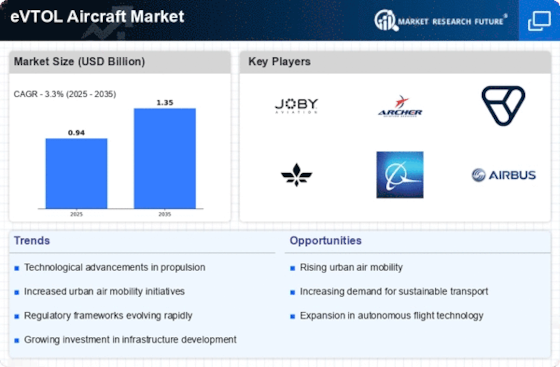
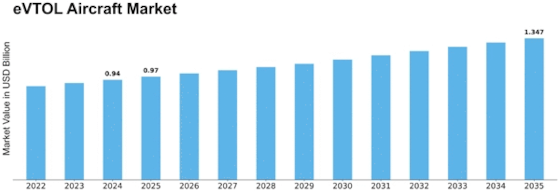
As per Market Research Future analysis, the EVTOL Aircraft Market Size was valued at USD 549.25 million in 2024. The EVTOL Aircraft Industry is projected to grow from USD 831.40 million in 2025 to USD 16,467.27 million by 2035, exhibiting a compound annual growth rate (CAGR) of 26.3% during the forecast period 2025 - 2035

Key Market Trends & Highlights

The EVTOL Aircraft Market is transforming urban air mobility with sustainable, efficient short-haul flight options. Rapid commercialization, technological leaps, and infrastructure builds amid regulatory progress

  • Battery energy density improvements enable longer ranges, with segments like 200-500 km dominating for intercity use. Hybrid options emerge for extended range, but fully electric remains core for urban viability. Demand surges from urban congestion, positioning eVTOLs for air taxis and regional hops. Commercial passenger services lead applications, alongside cargo and medical uses like rescue missions. Zero-emission electric propulsion cuts noise and pollution versus helicopters, aligning with green mandates. Venture funding flows to startups, with deals like Volare's Lilium addition Vertiports and air traffic management systems are key enablers for dense operations. Investments target urban hubs for seamless integration.

Market Size & Forecast

2024 Market Size 549.25 (USD Million)
2035 Market Size 16,467.27 (USD Million)
CAGR (2025 - 2035) 26.3%

Major Players

Joby Aviation, Archer Aviation Inc, Lilium, Volocopter GmbH, Wisk Aero, Vertical Aerospace, EHANG, BETA Technologies, Supernal, LLC, Eve Air Mobility, Dufour Aerospace, MightyFly, Workhorse, Textron Inc., Shanghai Volant Aviation Technology Co., Ltd.

Market Trends

The eVTOL Aircraft Market is shaped by a complex interplay of drivers, restraints, opportunities, and trends that influence its development and adoption. Urban mobility challenges, technological advancements, and supportive regulatory frameworks propel the market forward, while high costs and infrastructure limitations present significant hurdles. Opportunities arise from integration with urban ecosystems and sustainability initiatives, aligning with global environmental goals. Emerging trends in autonomy, battery technology, and infrastructure development further define the market’s trajectory, fostering innovation and scalability. The impact of COVID-19 has introduced additional complexities, affecting production, supply chains, demand, and pricing dynamics. This section explores these factors, providing a comprehensive overview of the forces driving and shaping the eVTOL aircraft market’s evolution across urban, regional, and specialized applications.

eVTOL Aircraft Market Market Drivers

Urban Air Mobility Demand

Urban air mobility demand is a primary driver for the eVTOL Aircraft Market, fueled by escalating congestion in megacities and the need for efficient short-haul transport. With over half the world's population residing in urban areas, cities like New York, Shanghai, and London face severe traffic bottlenecks, where traditional ground transport fails to meet the pace of modern lifestyles. eVTOLs address this by enabling on-demand air taxis for intra-city trips of 25-50 km, offering vertical takeoff and landing capabilities that bypass road networks entirely. Prototypes like Joby's S4 and Archer's Midnight, with capacities for 2-4 passengers and speeds up to 322 km/h, exemplify how eVTOLs can reduce commute times dramatically, such as a 55-mile journey in 31 minutes compared to hours by car. Moreover, the integration of eVTOLs into multimodal systems, connecting with trains and buses, further boosts demand by creating seamless door-to-door experiences. The appeal of quieter, emission-free flights also resonates with environmentally conscious city dwellers, positioning eVTOLs as a practical evolution of urban transport. As vertiports emerge on rooftops and parking lots, this demand propels manufacturers to refine designs for high-frequency operations, ensuring eVTOLs become integral to daily urban life across global hubs.

Technological Advancements in Battery and Power Systems

Technological advancements in battery and power systems are accelerating the eVTOL Aircraft Market by enhancing range, efficiency, and safety for practical applications. Lithium-ion batteries with energy densities of 300 Wh/kg, as in MagniX's Samson line, enable short urban flights of 200 km, while emerging solid-state batteries promise 500 Wh/kg, eliminating flammable electrolytes and extending operational endurance. These innovations address key limitations, such as battery degradation under intense cycles, through silicon nanowire anodes that resist cracking and maintain capacity at -40°C to 70°C. Fast-charging capabilities, achieving 80% in 15 minutes via advanced electrolytes, minimize downtime, crucial for high-turnover air taxi services. Globally, patents for propulsion and battery designs foster competition, with manufacturers like Amprius and QuantumScape pushing boundaries. This progress not only shortens certification timelines under FAA and EASA rules but also lowers operational costs through efficient thermal management, driving widespread adoption for diverse missions from cargo to medical evacuations.

Government Regulations and Support for Evtol Development

 Government regulations and support are pivotal drivers for the eVTOL Aircraft Market, providing clear pathways for certification and integration into airspace. In the United States, the FAA's powered-lift category rule establishes standards for pilot training and operations, enabling commercial launches by 2026-2028 through public-private partnerships in the eVTOL Integration Pilot Program. Europe's EASA special conditions for VTOL aircraft, including noise and propulsion standards, streamline approvals for urban operations, fostering collaborations like Volocopter's Paris plans. China's CAAC certifications for unmanned eVTOLs, such as EHang's EH216-S, accelerate autonomous deployments, supporting low-altitude economy initiatives. The UK's adoption of European standards and NAA Network harmonization with the US, Canada, and others reduces cross-border barriers, easing global scaling.

Market Segment Insights

By Operations: Piloted (largest market) vs Autonomous (fastest-growing)

Based on Operations, the EVTOL Aircraft Market has been segmented into Piloted, Autonomous. Piloted operations remain a cornerstone in the eVTOL Aircraft Market, ensuring human oversight for safety during initial commercialization phases. Designs like Archer's Midnight, with single-pilot IFR capabilities, support 2-passenger urban shuttles, leveraging fly-by-wire for simplified controls. FAA's powered-lift rules mandate pilot training with single flight controls, facilitating certification by 2026. Investments such as United's orders for Eve's piloted eVTOLs highlight airline integration for hub services. 

Autonomous operations are emerging as a transformative force in the eVTOL Aircraft Market, enabling scalable, cost-effective unmanned flights. Wisk's Cora, with AI for detect-and-avoid, supports cargo and medical missions over 100 km. China's CAAC certifications for EHang's EH216-S pave the way for pilotless services in Hefei hubs. Investments like Boeing's $450 million in Wisk accelerate Gen6 development.

By MTOW: 1,001-2,000 Kg (largest market) vs Less than 1,000 Kg (fastest-Growing)

Based on MTOW, the EVTOL Aircraft Market has been segmented into Less than 1,000 Kg, 1,001-2,000 Kg, 2,001 Kg and Above. 2,001 kg and above eVTOLs enable larger payloads for cargo and medical uses. BETA's ALIA at 3,174 kg handles 460 km logistics. GE's $300 million partnership develops hybrids. This segment's role in offshore and disaster relief, with 5+1 capacity, addresses heavy-duty needs. Challenges include infrastructure for high MTOW, but autonomy enhances scalability. Globally, Auto flight’s V1500M at 1,500 kg (borderline) supports 250 km cargo. 1,001-2,000 kg eVTOLs balance capacity and efficiency for passenger transport. Joby's S4 at 1,815 kg carries 4+1 passengers over 241 km. Toyota's $500 million investment aids certification. 

This segment's role in regional shuttles, with tilt rotors, supports urban-regional links. Challenges include certification costs, but hybrid propulsion extends range. Globally, Vertical's VX4 at unknown weight targets 161 km, integrating with Bristow for ops. 1,001-2,000 kg eVTOLs balance capacity and efficiency for passenger transport. Joby's S4 at 1,815 kg carries 4+1 passengers over 241 km. Toyota's $500 million investment aids certification. This segment's role in regional shuttles, with tilt rotors, supports urban-regional links. Challenges include certification costs, but hybrid propulsion extends range. Globally, Vertical's VX4 at unknown weight targets 161 km, integrating with Bristow for ops.

By Range: Less than 160 Km (largest market) vs More than 160 Km (fastest-Growing)

Based on Range, the EVTOL Aircraft Market has been segmented into Less than 160 Km, more than 160 Km. Less than 160 km eVTOLs focus on intra-city air taxis. Volocopter's VeloCity at 35 km suits urban hops. Bruchsal production targets 50 units yearly. This segment's role in congestion relief, with quiet ops, drives adoption. Challenges include charging, but 15-min fast charge supports frequency. Globally, EHang's EH216-S at 30 km enables unmanned sightseeing. 

More than 160 km eVTOLs target regional connectivity. Lilium's Jet at 300 km uses ducted fans. Thales partnership for antennas ensures navigation. This segment's role in inter-city, with tilt rotors, expands applications. Challenges include battery density, but SSBs extend endurance. Globally, BETA's ALIA at 460 km supports cargo.

By Propulsion: Electric Batteries (largest market) Hybrid Electric (fastest-Growing)

Based on Propulsion the EVTOL Aircraft Market has been segmented into Electric Batteries, Hybrid Electric, Hydrogen Fuel Cell Powered. Electric battery propulsion powers most eVTOLs for zero-emission flights. MagniX's Samson at 300 Wh/kg supports 1,000 cycles. ALE's Nano-Si at 350 Wh/kg enables -40°C ops. This propulsion's role in urban, with fast charging, reduces noise 90%. Challenges include degradation, but silicon anodes mitigate. Globally, Amprius' 500 Wh/kg advances ranges. 

Hybrid electric propulsion combines batteries with turbines for extended range. GE-BETA's $300 million turbogenerators boost payload. Dufour's Aero2 at 600 miles uses hybrid for cargo. This propulsion's role in regional, balancing efficiency, supports 200+ km. Challenges include complexity, but FAA rules facilitate. Globally, Jaunt's Journey integrates ROSA for transitions.

By Application: Passenger (largest market) vs Cargo (fastest-Growing)

Based on Application, the EVTOL Aircraft Market has been segmented into Passenger, Cargo. Passenger applications drive eVTOL adoption for urban shuttles. Archer's Midnight for 2 passengers over 97 km. United's 400-unit order with Eve targets hubs. This application's role in air taxis, with piloted autonomy, reduces times. Challenges include trust, but eIPP trials build confidence. Globally, Lilium's Jet for 4+1 supports regional. 

Cargo applications leverage eVTOLs for logistics. BETA's ALIA at 3,174 kg for 460 km. MightyFly's Cento at 100 kg uses ALMS for autonomous handling. This application's role in e-commerce, with unmanned ops, bypasses roads. Challenges include payload, but fast charging enhances. Globally, EHang's EH216-S for offshore.

By End-Use: Ride Sharing Companies (largest market) vs Private & Scheduled Operators (fastest-Growing)

Based on End Use, the EVTOL Aircraft Market has been segmented into Ride Sharing Companies, Private & Scheduled Operators, Hospitals and Medical Agencies, E-Commerce Companies, Personal Ownership and Use, Military. Ride sharing companies integrate eVTOLs for on-demand air taxis. Uber Elevate (Joby) patents autonomous navigation for urban. This end use's role in app-based booking, with 2-4 seats, scales services. Challenges include pricing, but partnerships like United-Eve lower costs. 

Globally, Volocopter's Paris ops target sharing. Private and scheduled operators deploy eVTOLs for fixed routes. Bristow's 50 VX4 order with Vertical for regional. This end use's role in scheduled shuttles, with piloted ops, ensures reliability. Challenges include certification, but EASA standards aid. Globally, JetSetGo's Eve partnership for India schedules.

By Platform Type: Multi-Copter largest market) vs Tilt Rotor (fastest growing)

Based on Platform type, the EVTOL Aircraft Market has been segmented into Multi-Copter, Tilt Rotor, Lift Cruise, Ducted Vector Thrust (DVT). Multi-copter platforms dominate the early stages of the eVTOL Aircraft Market due to their simplicity, maneuverability, and inherent safety features, making them ideal for short-range urban operations. These designs, characterized by multiple rotors arranged symmetrically, provide superior hovering and low-speed control, as seen in LIFT Aircraft's HEXA with 18 motors and batteries enabling ultralight classification without FAA certification. The distributed propulsion ensures redundancy, where failure of one rotor does not compromise flight stability, aligning with aviation's stringent safety mandates. Tilt rotor platforms offer versatile performance in the global eVTOL market, combining vertical takeoff capabilities with efficient high-speed cruise through tilting propulsion systems. 

Designs like Joby's S4, with six tilting rotors, achieve 322 km/h speeds and 241 km ranges, ideal for inter-city missions. The platform's negative twist rotor blades enhance hovering efficiency, though mechanical complexity raises certification costs under FAA powered-lift rules. Globally, Vertical Aerospace's VX4, with four tilting rotors, targets 161 km ranges for regional transport, integrating with vertiports for seamless operations. Challenges include unsteady aerodynamics during mode shifts, addressed through advanced fly-by-wire systems from Honeywell. Tilt rotors support hybrid applications, blending passenger and cargo roles, as in military trials.

Get more detailed insights about eVTOL Aircraft Market Research Report - Forecast Till 2035

Regional Insights

North America: Expanding eVTOL aircraft

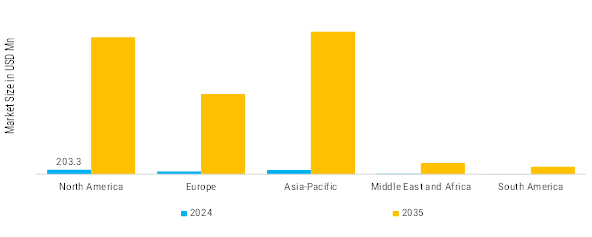
North America leads the eVTOL Aircraft Market through robust regulatory frameworks and substantial investments from aerospace giants. The FAA's powered-lift category rule and eVTOL Integration Pilot Program facilitate pre-certification trials, enabling companies like Joby Aviation and Archer Aviation to conduct real-world operations for air taxis and cargo. Investments such as Boeing's $450 million in Wisk Aero and United Airlines' orders for Eve's eVTOLs underscore confidence in urban mobility solutions. Growth is driven by urban demand in megacities like New York, where eVTOLs offer congestion relief, supported by NDAA-compliant supply chains ensuring secure sourcing. Autonomous advancements, as in Wisk's Cora, align with military applications under Agility Prime. This region's harmonized standards via NAA Network influence global adoption, positioning North America as a hub for innovation in sustainable aviation.

EVTOL Aircraft Market Regional Insights

Europe: Strong Production eVTOL aircraft

Europe's eVTOL market grows through stringent yet supportive regulations emphasizing sustainability and urban integration. EASA's special conditions for VTOL aircraft and noise standards enable certifications by 2026, as seen in Volocopter's Velocity production at Bruchsal for 50 units annually. Investments in Lilium's Jet power system testing in Munich highlight focus on ducted thrust for quiet operations.  Prototypes like Vertical Aerospace's VX4, with Bristow partnerships, target regional shuttles. Challenges include cross-border harmonization, addressed by NAA Network collaborations with the UK and US. Urban demand in cities like Paris drives air taxi pilots, with vertiports at Olympics showcasing multimodal links. Growth stems from net-zero initiatives, favoring electric propulsion with 90% noise reduction. Europe's emphasis on safety, with 10^-9 failure rates, fosters trust, supporting diverse applications from medical to cargo.

Asia Pacific: Fastest Growing eVTOL aircraft

Asia-Pacific's eVTOL market expands rapidly via government-backed low-altitude economies and manufacturing prowess. China's CAAC certifications for EHang's EH216-S enable unmanned flights in Hefei hubs, supporting cargo and tourism. Investments in Eve-JetSetGo partnerships target India's regional connectivity. Prototypes like Autoflight's V1500M at 1,500 kg handle 250 km logistics. Challenges include airspace management, mitigated by UTM systems in Singapore. Urban demand in Shanghai and Mumbai fuels air taxi growth, with vertiports integrating smart cities. This region's hybrid propulsion advancements, like Dufour's Aero2, extend ranges for inter-island ops. Policy support, such as Japan's public-private councils, accelerates adoption, positioning Asia-Pacific as a production leader.

South America: Growing clinical quality

South America's eVTOL market emerges via partnerships addressing regional isolation. Eve's collaboration with JetSetGo in Brazil targets 60-mile ranges for Amazon logistics. Embraer's backing supports prototype unveilings at Farnborough. Challenges include terrain variability, mitigated by VTOL in BETA-like designs. Urban demand in São Paulo drives shuttles, with vertiports integrating riverside ops. Growth leverages biofuel expertise for hybrids, enhancing cargo for e-commerce.

Middle East & Africa: Emerging eVTOL aircraft

In Middle East & Africa, the landscape is less uniform. Most countries still lack clear or enforceable The Middle East and Africa's eVTOL market grows through strategic infrastructure investments and tourism-driven demand. UAE's Joby flights in Dubai test high-heat performance, with Skyports vertiports at Al Bateen Airport. Archer's Midnight trials under UAE conditions advance urban shuttles. Challenges include desert climates stressing batteries, addressed by thermal management in designs like Supernal's S-A2. Africa's remote logistics, as in EHang's Indonesia expansions, leverage unmanned ops for medical deliveries. Growth stems from oil-rich funding for vertiports, supporting regional connectivity. This area's hybrid applications for offshore wind servicing enhance sustainability.

Key Players and Competitive Insights

Many global, regional, and local vendors characterize the EVTOL Aircraft Market. The market is highly competitive, with all the players competing to gain market share. Intense competition, rapid advances in technology, frequent changes in government policies, and environmental regulations are key factors that confront market growth. The vendors compete based on cost, product quality, reliability, and government regulations. Vendors must provide cost-efficient, high-quality products to survive and succeed in an intensely competitive market. The major players in the market Include Joby Aviation, Archer Aviation Inc, Lilium, Volocopter GmbH, Wisk Aero, Vertical Aerospace, EHANG, BETA Technologies, Supernal, LLC, Eve Air Mobility, Dufour Aerospace, MightyFly, Workhorse, Textron Inc., Shanghai Volant Aviation Technology Co., Ltd, strategic market developments and decisions to improve operational effectiveness.

Key Companies in the eVTOL Aircraft Market include

Industry Developments

June 2025: BETA Technologies’ ALIA became the first U.S. electric aircraft to land at New York’s JFK Airport, completing a 45-minute flight with a pilot and four passengers. Backed by $318 million in funding, BETA advances urban air mobility, aiming to reduce congestion, emissions, and improve city transportation accessibility.

July 2025: Vertical Aerospace is a UK-based aerospace and technology company pioneering electric aviation through its VX4 eVTOL aircraft. Proceeds from the public offering will fund R&D, testing, and certification expansion, alongside working capital needs. Vertical aims to advance sustainable urban air mobility, targeting global certification and commercial deployment of its zero-emission aircraft.

November 2024: EHang launched a new Urban Air Mobility (UAM) Hub at Luogang Central Park in Hefei, supporting EH216-S eVTOL operations. The hub, spanning 1,963 m², provides flight, maintenance, and educational facilities, enabling sightseeing, air shuttle, and logistics services. This initiative advances Hefei’s low-altitude economy and eVTOL commercial operations.

Future Outlook

eVTOL Aircraft Market Future Outlook

The EVTOL Aircraft Market is projected to grow at a 26.3CAGR from 2025 to 2035, driven by increasing demand for high-performance computing and enhanced security features.

New opportunities lie in:

  • <p>Integration with Smart City Infrastructure</p>
  • <p>Net-Zero Emissions Initiatives in Aviation.</p>
  • <p>Urban Air Mobility Demand.</p>

By 2035, the eVTOL Aircraft Market is poised for substantial growth and innovation.

Market Segmentation

EVTOL Aircraft Market by MTOW Outlook

  • Less than 1000 Kg
  • 1001-2000 Kg
  • 2001 Kg and Above

EVTOL Aircraft Market by Range Outlook

  • Less than 160 Km
  • more than 160 Km

EVTOL Aircraft Market by End Use Outlook

  • Ride Sharing Companies
  • Private & Scheduled Operators
  • Hospitals and Medical Agencies
  • E-Commerce Companies
  • Personal Ownership and Use
  • Military

EVTOL Aircraft Market by Operation Outlook

  • Piloted
  • Autonomous

EVTOL Aircraft Market by Propulsion Outlook

  • Electric Batteries
  • Hybrid Electric
  • Hydrogen Fuel Cell Powered

EVTOL Aircraft Market by Application Outlook

  • Passenger
  • Cargo

EVTOL Aircraft Market by Platform Type Outlook

  • Multi-Copter
  • Tilt Rotor
  • Lift Cruise
  • Ducted Vector Thrust

Report Scope

Market Size 2024

549.25 (USD Million)

Market Size 2025

831.40 (USD Million)

Market Size 2035

16,467.27 (USD Million)

Compound Annual Growth Rate (CAGR)

26.3% (2025 - 2035)

Report Coverage

Revenue Forecast, Competitive Landscape, Growth Factors, and Trends

Base Year

2024

Market Forecast Period

2025 - 2035

Historical Data

2019 - 2023

Market Forecast Units

USD Million

Key Companies Profiled

Joby Aviation, Archer Aviation Inc, Lilium, Volocopter GmbH, Wisk Aero, Vertical Aerospace, EHANG, BETA Technologies, Supernal, LLC, Eve Air Mobility, Dufour Aerospace, MightyFly, Workhorse, Textron Inc., Shanghai Volant Aviation Technology Co., Ltd.

Segments Covered

By Platform Type, By Operation, By MTOW, By Range, By Propulsion, By Application, By End Use

Key Market Opportunities

Integration with Smart City Infrastructure.

Net-Zero Emissions Initiatives in Aviation.

Urban Air Mobility Demand.

Key Market Dynamics

Technological Advancements in Battery and Power Systems.

Government Regulations and Support for eVTOL Development.

Region Covered

North America, Europe, Asia Pacific, South America, Middle East & Africa.


FAQs

How much is the EVTOL Aircraft Market?

USD 16,467.27 Million (2035)

What is the growth rate of the EVTOL Aircraft Market?

26.3%

Which region held the largest market share in the EVTOL Aircraft Market?

APAC

Who are the key players in the EVTOL Aircraft Market?

Joby Aviation, Archer Aviation Inc, Lilium, Volocopter GmbH, Wisk Aero, Vertical Aerospace, EHANG, BETA Technologies, Supernal, LLC, Eve Air Mobility, Dufour Aerospace, MightyFly, Workhorse, Textron Inc., Shanghai Volant Aviation Technology Co., Ltd.

Which Application had the largest market share in the EVTOL Aircraft Market?

Passenger

  1. SECTION I: EXECUTIVE SUMMARY AND KEY HIGHLIGHTS |
    1. EXECUTIVE SUMMARY | |
      1. Market Overview | |
      2. Key Findings | |
      3. Market Segmentation | |
      4. Competitive Landscape | |
      5. Challenges and Opportunities | |
      6. Future Outlook 2
  2. SECTION II: SCOPING, METHODOLOGY AND MARKET STRUCTURE |
    1. MARKET INTRODUCTION | |
      1. Definition | |
      2. Scope of the study | | |
    2. RESEARCH METHODOLOGY | |
      1. Overview | |
      2. Data Mining | |
      3. Secondary Research | |
      4. Primary Research | | |
      5. Forecasting Model | |
      6. Market Size Estimation | | |
      7. Data Triangulation | |
      8. Validation 3
  3. SECTION III: QUALITATIVE ANALYSIS |
    1. MARKET DYNAMICS | |
      1. Overview | |
      2. Drivers | |
      3. Restraints | |
      4. Opportunities |
    2. MARKET FACTOR ANALYSIS | |
      1. Value chain Analysis | |
      2. Porter's Five Forces Analysis | | |
      3. COVID-19 Impact Analysis | | |
  4. SECTION IV: QUANTITATIVE ANALYSIS |
    1. Aerospace & Defense, BY Type (USD Billion) | |
      1. Air Taxis | |
      2. Delivery Drones | |
      3. Others |
    2. Aerospace & Defense, BY Battery Type (USD Billion) | |
      1. Lithium-Ion Batteries | |
      2. Solid-State Batteries | |
      3. Hydrogen Fuel Cells |
    3. Aerospace & Defense, BY Lift Technology (USD Billion) | |
      1. Multirotor | |
      2. Vectored Thrust | |
      3. Lift Plus Cruise | |
      4. Others |
    4. Aerospace & Defense, BY Type of Propulsion (USD Billion) | |
      1. Fully Electric | |
      2. Hybrid | |
      3. Electric Hydrogen |
    5. Aerospace & Defense, BY Mode of Operation (USD Billion) | |
      1. Piloted | |
      2. Optionally Piloted |
    6. Aerospace & Defense, BY Region (USD Billion) | |
      1. North America | | |
      2. Europe | | |
      3. APAC | | |
      4. South America | | |
      5. MEA | | |
  5. SECTION V: COMPETITIVE ANALYSIS |
    1. Competitive Landscape | |
      1. Overview | |
      2. Competitive Analysis | |
      3. Market share Analysis | |
      4. Major Growth Strategy in the Aerospace & Defense | |
      5. Competitive Benchmarking | |
      6. Leading Players in Terms of Number of Developments in the Aerospace & Defense | |
      7. Key developments and growth strategies | | |
      8. Major Players Financial Matrix | | |
    2. Company Profiles | |
      1. Joby Aviation (US) | | |
      2. Archer Aviation (US) | | |
      3. Volocopter (DE) | | |
      4. Lilium (DE) | | |
      5. Boeing (US) | | |
      6. Airbus (FR) | | |
      7. Bell Textron (US) | | |
      8. Hyundai (KR) | | |
      9. Kitty Hawk (US) | | |
      10. EHang (CN) | | |
    3. Appendix | |
      1. References | |
      2. Related Reports 6 LIST OF FIGURES |
    4. MARKET SYNOPSIS |
    5. NORTH AMERICA MARKET ANALYSIS |
    6. US MARKET ANALYSIS BY TYPE |
    7. US MARKET ANALYSIS BY BATTERY TYPE |
    8. US MARKET ANALYSIS BY LIFT TECHNOLOGY |
    9. US MARKET ANALYSIS BY TYPE OF PROPULSION |
    10. US MARKET ANALYSIS BY MODE OF OPERATION |
    11. CANADA MARKET ANALYSIS BY TYPE |
    12. CANADA MARKET ANALYSIS BY BATTERY TYPE |
    13. CANADA MARKET ANALYSIS BY LIFT TECHNOLOGY |
    14. CANADA MARKET ANALYSIS BY TYPE OF PROPULSION |
    15. CANADA MARKET ANALYSIS BY MODE OF OPERATION |
    16. EUROPE MARKET ANALYSIS |
    17. GERMANY MARKET ANALYSIS BY TYPE |
    18. GERMANY MARKET ANALYSIS BY BATTERY TYPE |
    19. GERMANY MARKET ANALYSIS BY LIFT TECHNOLOGY |
    20. GERMANY MARKET ANALYSIS BY TYPE OF PROPULSION |
    21. GERMANY MARKET ANALYSIS BY MODE OF OPERATION |
    22. UK MARKET ANALYSIS BY TYPE |
    23. UK MARKET ANALYSIS BY BATTERY TYPE |
    24. UK MARKET ANALYSIS BY LIFT TECHNOLOGY |
    25. UK MARKET ANALYSIS BY TYPE OF PROPULSION |
    26. UK MARKET ANALYSIS BY MODE OF OPERATION |
    27. FRANCE MARKET ANALYSIS BY TYPE |
    28. FRANCE MARKET ANALYSIS BY BATTERY TYPE |
    29. FRANCE MARKET ANALYSIS BY LIFT TECHNOLOGY |
    30. FRANCE MARKET ANALYSIS BY TYPE OF PROPULSION |
    31. FRANCE MARKET ANALYSIS BY MODE OF OPERATION |
    32. RUSSIA MARKET ANALYSIS BY TYPE |
    33. RUSSIA MARKET ANALYSIS BY BATTERY TYPE |
    34. RUSSIA MARKET ANALYSIS BY LIFT TECHNOLOGY |
    35. RUSSIA MARKET ANALYSIS BY TYPE OF PROPULSION |
    36. RUSSIA MARKET ANALYSIS BY MODE OF OPERATION |
    37. ITALY MARKET ANALYSIS BY TYPE |
    38. ITALY MARKET ANALYSIS BY BATTERY TYPE |
    39. ITALY MARKET ANALYSIS BY LIFT TECHNOLOGY |
    40. ITALY MARKET ANALYSIS BY TYPE OF PROPULSION |
    41. ITALY MARKET ANALYSIS BY MODE OF OPERATION |
    42. SPAIN MARKET ANALYSIS BY TYPE |
    43. SPAIN MARKET ANALYSIS BY BATTERY TYPE |
    44. SPAIN MARKET ANALYSIS BY LIFT TECHNOLOGY |
    45. SPAIN MARKET ANALYSIS BY TYPE OF PROPULSION |
    46. SPAIN MARKET ANALYSIS BY MODE OF OPERATION |
    47. REST OF EUROPE MARKET ANALYSIS BY TYPE |
    48. REST OF EUROPE MARKET ANALYSIS BY BATTERY TYPE |
    49. REST OF EUROPE MARKET ANALYSIS BY LIFT TECHNOLOGY |
    50. REST OF EUROPE MARKET ANALYSIS BY TYPE OF PROPULSION |
    51. REST OF EUROPE MARKET ANALYSIS BY MODE OF OPERATION |
    52. APAC MARKET ANALYSIS |
    53. CHINA MARKET ANALYSIS BY TYPE |
    54. CHINA MARKET ANALYSIS BY BATTERY TYPE |
    55. CHINA MARKET ANALYSIS BY LIFT TECHNOLOGY |
    56. CHINA MARKET ANALYSIS BY TYPE OF PROPULSION |
    57. CHINA MARKET ANALYSIS BY MODE OF OPERATION |
    58. INDIA MARKET ANALYSIS BY TYPE |
    59. INDIA MARKET ANALYSIS BY BATTERY TYPE |
    60. INDIA MARKET ANALYSIS BY LIFT TECHNOLOGY |
    61. INDIA MARKET ANALYSIS BY TYPE OF PROPULSION |
    62. INDIA MARKET ANALYSIS BY MODE OF OPERATION |
    63. JAPAN MARKET ANALYSIS BY TYPE |
    64. JAPAN MARKET ANALYSIS BY BATTERY TYPE |
    65. JAPAN MARKET ANALYSIS BY LIFT TECHNOLOGY |
    66. JAPAN MARKET ANALYSIS BY TYPE OF PROPULSION |
    67. JAPAN MARKET ANALYSIS BY MODE OF OPERATION |
    68. SOUTH KOREA MARKET ANALYSIS BY TYPE |
    69. SOUTH KOREA MARKET ANALYSIS BY BATTERY TYPE |
    70. SOUTH KOREA MARKET ANALYSIS BY LIFT TECHNOLOGY |
    71. SOUTH KOREA MARKET ANALYSIS BY TYPE OF PROPULSION |
    72. SOUTH KOREA MARKET ANALYSIS BY MODE OF OPERATION |
    73. MALAYSIA MARKET ANALYSIS BY TYPE |
    74. MALAYSIA MARKET ANALYSIS BY BATTERY TYPE |
    75. MALAYSIA MARKET ANALYSIS BY LIFT TECHNOLOGY |
    76. MALAYSIA MARKET ANALYSIS BY TYPE OF PROPULSION |
    77. MALAYSIA MARKET ANALYSIS BY MODE OF OPERATION |
    78. THAILAND MARKET ANALYSIS BY TYPE |
    79. THAILAND MARKET ANALYSIS BY BATTERY TYPE |
    80. THAILAND MARKET ANALYSIS BY LIFT TECHNOLOGY |
    81. THAILAND MARKET ANALYSIS BY TYPE OF PROPULSION |
    82. THAILAND MARKET ANALYSIS BY MODE OF OPERATION |
    83. INDONESIA MARKET ANALYSIS BY TYPE |
    84. INDONESIA MARKET ANALYSIS BY BATTERY TYPE |
    85. INDONESIA MARKET ANALYSIS BY LIFT TECHNOLOGY |
    86. INDONESIA MARKET ANALYSIS BY TYPE OF PROPULSION |
    87. INDONESIA MARKET ANALYSIS BY MODE OF OPERATION |
    88. REST OF APAC MARKET ANALYSIS BY TYPE |
    89. REST OF APAC MARKET ANALYSIS BY BATTERY TYPE |
    90. REST OF APAC MARKET ANALYSIS BY LIFT TECHNOLOGY |
    91. REST OF APAC MARKET ANALYSIS BY TYPE OF PROPULSION |
    92. REST OF APAC MARKET ANALYSIS BY MODE OF OPERATION |
    93. SOUTH AMERICA MARKET ANALYSIS |
    94. BRAZIL MARKET ANALYSIS BY TYPE |
    95. BRAZIL MARKET ANALYSIS BY BATTERY TYPE |
    96. BRAZIL MARKET ANALYSIS BY LIFT TECHNOLOGY |
    97. BRAZIL MARKET ANALYSIS BY TYPE OF PROPULSION |
    98. BRAZIL MARKET ANALYSIS BY MODE OF OPERATION |
    99. MEXICO MARKET ANALYSIS BY TYPE |
    100. MEXICO MARKET ANALYSIS BY BATTERY TYPE |
    101. MEXICO MARKET ANALYSIS BY LIFT TECHNOLOGY |
    102. MEXICO MARKET ANALYSIS BY TYPE OF PROPULSION |
    103. MEXICO MARKET ANALYSIS BY MODE OF OPERATION |
    104. ARGENTINA MARKET ANALYSIS BY TYPE |
    105. ARGENTINA MARKET ANALYSIS BY BATTERY TYPE |
    106. ARGENTINA MARKET ANALYSIS BY LIFT TECHNOLOGY |
    107. ARGENTINA MARKET ANALYSIS BY TYPE OF PROPULSION |
    108. ARGENTINA MARKET ANALYSIS BY MODE OF OPERATION |
    109. REST OF SOUTH AMERICA MARKET ANALYSIS BY TYPE |
    110. REST OF SOUTH AMERICA MARKET ANALYSIS BY BATTERY TYPE |
    111. REST OF SOUTH AMERICA MARKET ANALYSIS BY LIFT TECHNOLOGY |
    112. REST OF SOUTH AMERICA MARKET ANALYSIS BY TYPE OF PROPULSION |
    113. REST OF SOUTH AMERICA MARKET ANALYSIS BY MODE OF OPERATION |
    114. MEA MARKET ANALYSIS |
    115. GCC COUNTRIES MARKET ANALYSIS BY TYPE |
    116. GCC COUNTRIES MARKET ANALYSIS BY BATTERY TYPE |
    117. GCC COUNTRIES MARKET ANALYSIS BY LIFT TECHNOLOGY |
    118. GCC COUNTRIES MARKET ANALYSIS BY TYPE OF PROPULSION |
    119. GCC COUNTRIES MARKET ANALYSIS BY MODE OF OPERATION |
    120. SOUTH AFRICA MARKET ANALYSIS BY TYPE |
    121. SOUTH AFRICA MARKET ANALYSIS BY BATTERY TYPE |
    122. SOUTH AFRICA MARKET ANALYSIS BY LIFT TECHNOLOGY |
    123. SOUTH AFRICA MARKET ANALYSIS BY TYPE OF PROPULSION |
    124. SOUTH AFRICA MARKET ANALYSIS BY MODE OF OPERATION |
    125. REST OF MEA MARKET ANALYSIS BY TYPE |
    126. REST OF MEA MARKET ANALYSIS BY BATTERY TYPE |
    127. REST OF MEA MARKET ANALYSIS BY LIFT TECHNOLOGY |
    128. REST OF MEA MARKET ANALYSIS BY TYPE OF PROPULSION |
    129. REST OF MEA MARKET ANALYSIS BY MODE OF OPERATION |
    130. KEY BUYING CRITERIA OF AEROSPACE & DEFENSE |
    131. RESEARCH PROCESS OF MRFR |
    132. DRO ANALYSIS OF AEROSPACE & DEFENSE |
    133. DRIVERS IMPACT ANALYSIS: AEROSPACE & DEFENSE |
    134. RESTRAINTS IMPACT ANALYSIS: AEROSPACE & DEFENSE |
    135. SUPPLY / VALUE CHAIN: AEROSPACE & DEFENSE |
    136. AEROSPACE & DEFENSE, BY TYPE, 2024 (% SHARE) |
    137. AEROSPACE & DEFENSE, BY TYPE, 2024 TO 2035 (USD Billion) |
    138. AEROSPACE & DEFENSE, BY BATTERY TYPE, 2024 (% SHARE) |
    139. AEROSPACE & DEFENSE, BY BATTERY TYPE, 2024 TO 2035 (USD Billion) |
    140. AEROSPACE & DEFENSE, BY LIFT TECHNOLOGY, 2024 (% SHARE) |
    141. AEROSPACE & DEFENSE, BY LIFT TECHNOLOGY, 2024 TO 2035 (USD Billion) |
    142. AEROSPACE & DEFENSE, BY TYPE OF PROPULSION, 2024 (% SHARE) |
    143. AEROSPACE & DEFENSE, BY TYPE OF PROPULSION, 2024 TO 2035 (USD Billion) |
    144. AEROSPACE & DEFENSE, BY MODE OF OPERATION, 2024 (% SHARE) |
    145. AEROSPACE & DEFENSE, BY MODE OF OPERATION, 2024 TO 2035 (USD Billion) |
    146. BENCHMARKING OF MAJOR COMPETITORS 7 LIST OF TABLES |
    147. LIST OF ASSUMPTIONS | |
      1. |
    148. North America MARKET SIZE ESTIMATES; FORECAST | |
      1. BY TYPE, 2025-2035 (USD Billion) | |
      2. BY BATTERY TYPE, 2025-2035 (USD Billion) | |
      3. BY LIFT TECHNOLOGY, 2025-2035 (USD Billion) | |
      4. BY TYPE OF PROPULSION, 2025-2035 (USD Billion) | |
      5. BY MODE OF OPERATION, 2025-2035 (USD Billion) |
    149. US MARKET SIZE ESTIMATES; FORECAST | |
      1. BY TYPE, 2025-2035 (USD Billion) | |
      2. BY BATTERY TYPE, 2025-2035 (USD Billion) | |
      3. BY LIFT TECHNOLOGY, 2025-2035 (USD Billion) | |
      4. BY TYPE OF PROPULSION, 2025-2035 (USD Billion) | |
      5. BY MODE OF OPERATION, 2025-2035 (USD Billion) |
    150. Canada MARKET SIZE ESTIMATES; FORECAST | |
      1. BY TYPE, 2025-2035 (USD Billion) | |
      2. BY BATTERY TYPE, 2025-2035 (USD Billion) | |
      3. BY LIFT TECHNOLOGY, 2025-2035 (USD Billion) | |
      4. BY TYPE OF PROPULSION, 2025-2035 (USD Billion) | |
      5. BY MODE OF OPERATION, 2025-2035 (USD Billion) |
    151. Europe MARKET SIZE ESTIMATES; FORECAST | |
      1. BY TYPE, 2025-2035 (USD Billion) | |
      2. BY BATTERY TYPE, 2025-2035 (USD Billion) | |
      3. BY LIFT TECHNOLOGY, 2025-2035 (USD Billion) | |
      4. BY TYPE OF PROPULSION, 2025-2035 (USD Billion) | |
      5. BY MODE OF OPERATION, 2025-2035 (USD Billion) |
    152. Germany MARKET SIZE ESTIMATES; FORECAST | |
      1. BY TYPE, 2025-2035 (USD Billion) | |
      2. BY BATTERY TYPE, 2025-2035 (USD Billion) | |
      3. BY LIFT TECHNOLOGY, 2025-2035 (USD Billion) | |
      4. BY TYPE OF PROPULSION, 2025-2035 (USD Billion) | |
      5. BY MODE OF OPERATION, 2025-2035 (USD Billion) |
    153. UK MARKET SIZE ESTIMATES; FORECAST | |
      1. BY TYPE, 2025-2035 (USD Billion) | |
      2. BY BATTERY TYPE, 2025-2035 (USD Billion) | |
      3. BY LIFT TECHNOLOGY, 2025-2035 (USD Billion) | |
      4. BY TYPE OF PROPULSION, 2025-2035 (USD Billion) | |
      5. BY MODE OF OPERATION, 2025-2035 (USD Billion) |
    154. France MARKET SIZE ESTIMATES; FORECAST | |
      1. BY TYPE, 2025-2035 (USD Billion) | |
      2. BY BATTERY TYPE, 2025-2035 (USD Billion) | |
      3. BY LIFT TECHNOLOGY, 2025-2035 (USD Billion) | |
      4. BY TYPE OF PROPULSION, 2025-2035 (USD Billion) | |
      5. BY MODE OF OPERATION, 2025-2035 (USD Billion) |
    155. Russia MARKET SIZE ESTIMATES; FORECAST | |
      1. BY TYPE, 2025-2035 (USD Billion) | |
      2. BY BATTERY TYPE, 2025-2035 (USD Billion) | |
      3. BY LIFT TECHNOLOGY, 2025-2035 (USD Billion) | |
      4. BY TYPE OF PROPULSION, 2025-2035 (USD Billion) | |
      5. BY MODE OF OPERATION, 2025-2035 (USD Billion) |
    156. Italy MARKET SIZE ESTIMATES; FORECAST | |
      1. BY TYPE, 2025-2035 (USD Billion) | |
      2. BY BATTERY TYPE, 2025-2035 (USD Billion) | |
      3. BY LIFT TECHNOLOGY, 2025-2035 (USD Billion) | |
      4. BY TYPE OF PROPULSION, 2025-2035 (USD Billion) | |
      5. BY MODE OF OPERATION, 2025-2035 (USD Billion) |
    157. Spain MARKET SIZE ESTIMATES; FORECAST | |
      1. BY TYPE, 2025-2035 (USD Billion) | |
      2. BY BATTERY TYPE, 2025-2035 (USD Billion) | |
      3. BY LIFT TECHNOLOGY, 2025-2035 (USD Billion) | |
      4. BY TYPE OF PROPULSION, 2025-2035 (USD Billion) | |
      5. BY MODE OF OPERATION, 2025-2035 (USD Billion) |
    158. Rest of Europe MARKET SIZE ESTIMATES; FORECAST | |
      1. BY TYPE, 2025-2035 (USD Billion) | |
      2. BY BATTERY TYPE, 2025-2035 (USD Billion) | |
      3. BY LIFT TECHNOLOGY, 2025-2035 (USD Billion) | |
      4. BY TYPE OF PROPULSION, 2025-2035 (USD Billion) | |
      5. BY MODE OF OPERATION, 2025-2035 (USD Billion) |
    159. APAC MARKET SIZE ESTIMATES; FORECAST | |
      1. BY TYPE, 2025-2035 (USD Billion) | |
      2. BY BATTERY TYPE, 2025-2035 (USD Billion) | |
      3. BY LIFT TECHNOLOGY, 2025-2035 (USD Billion) | |
      4. BY TYPE OF PROPULSION, 2025-2035 (USD Billion) | |
      5. BY MODE OF OPERATION, 2025-2035 (USD Billion) |
    160. China MARKET SIZE ESTIMATES; FORECAST | |
      1. BY TYPE, 2025-2035 (USD Billion) | |
      2. BY BATTERY TYPE, 2025-2035 (USD Billion) | |
      3. BY LIFT TECHNOLOGY, 2025-2035 (USD Billion) | |
      4. BY TYPE OF PROPULSION, 2025-2035 (USD Billion) | |
      5. BY MODE OF OPERATION, 2025-2035 (USD Billion) |
    161. India MARKET SIZE ESTIMATES; FORECAST | |
      1. BY TYPE, 2025-2035 (USD Billion) | |
      2. BY BATTERY TYPE, 2025-2035 (USD Billion) | |
      3. BY LIFT TECHNOLOGY, 2025-2035 (USD Billion) | |
      4. BY TYPE OF PROPULSION, 2025-2035 (USD Billion) | |
      5. BY MODE OF OPERATION, 2025-2035 (USD Billion) |
    162. Japan MARKET SIZE ESTIMATES; FORECAST | |
      1. BY TYPE, 2025-2035 (USD Billion) | |
      2. BY BATTERY TYPE, 2025-2035 (USD Billion) | |
      3. BY LIFT TECHNOLOGY, 2025-2035 (USD Billion) | |
      4. BY TYPE OF PROPULSION, 2025-2035 (USD Billion) | |
      5. BY MODE OF OPERATION, 2025-2035 (USD Billion) |
    163. South Korea MARKET SIZE ESTIMATES; FORECAST | |
      1. BY TYPE, 2025-2035 (USD Billion) | |
      2. BY BATTERY TYPE, 2025-2035 (USD Billion) | |
      3. BY LIFT TECHNOLOGY, 2025-2035 (USD Billion) | |
      4. BY TYPE OF PROPULSION, 2025-2035 (USD Billion) | |
      5. BY MODE OF OPERATION, 2025-2035 (USD Billion) |
    164. Malaysia MARKET SIZE ESTIMATES; FORECAST | |
      1. BY TYPE, 2025-2035 (USD Billion) | |
      2. BY BATTERY TYPE, 2025-2035 (USD Billion) | |
      3. BY LIFT TECHNOLOGY, 2025-2035 (USD Billion) | |
      4. BY TYPE OF PROPULSION, 2025-2035 (USD Billion) | |
      5. BY MODE OF OPERATION, 2025-2035 (USD Billion) |
    165. Thailand MARKET SIZE ESTIMATES; FORECAST | |
      1. BY TYPE, 2025-2035 (USD Billion) | |
      2. BY BATTERY TYPE, 2025-2035 (USD Billion) | |
      3. BY LIFT TECHNOLOGY, 2025-2035 (USD Billion) | |
      4. BY TYPE OF PROPULSION, 2025-2035 (USD Billion) | |
      5. BY MODE OF OPERATION, 2025-2035 (USD Billion) |
    166. Indonesia MARKET SIZE ESTIMATES; FORECAST | |
      1. BY TYPE, 2025-2035 (USD Billion) | |
      2. BY BATTERY TYPE, 2025-2035 (USD Billion) | |
      3. BY LIFT TECHNOLOGY, 2025-2035 (USD Billion) | |
      4. BY TYPE OF PROPULSION, 2025-2035 (USD Billion) | |
      5. BY MODE OF OPERATION, 2025-2035 (USD Billion) |
    167. Rest of APAC MARKET SIZE ESTIMATES; FORECAST | |
      1. BY TYPE, 2025-2035 (USD Billion) | |
      2. BY BATTERY TYPE, 2025-2035 (USD Billion) | |
      3. BY LIFT TECHNOLOGY, 2025-2035 (USD Billion) | |
      4. BY TYPE OF PROPULSION, 2025-2035 (USD Billion) | |
      5. BY MODE OF OPERATION, 2025-2035 (USD Billion) |
    168. South America MARKET SIZE ESTIMATES; FORECAST | |
      1. BY TYPE, 2025-2035 (USD Billion) | |
      2. BY BATTERY TYPE, 2025-2035 (USD Billion) | |
      3. BY LIFT TECHNOLOGY, 2025-2035 (USD Billion) | |
      4. BY TYPE OF PROPULSION, 2025-2035 (USD Billion) | |
      5. BY MODE OF OPERATION, 2025-2035 (USD Billion) |
    169. Brazil MARKET SIZE ESTIMATES; FORECAST | |
      1. BY TYPE, 2025-2035 (USD Billion) | |
      2. BY BATTERY TYPE, 2025-2035 (USD Billion) | |
      3. BY LIFT TECHNOLOGY, 2025-2035 (USD Billion) | |
      4. BY TYPE OF PROPULSION, 2025-2035 (USD Billion) | |
      5. BY MODE OF OPERATION, 2025-2035 (USD Billion) |
    170. Mexico MARKET SIZE ESTIMATES; FORECAST | |
      1. BY TYPE, 2025-2035 (USD Billion) | |
      2. BY BATTERY TYPE, 2025-2035 (USD Billion) | |
      3. BY LIFT TECHNOLOGY, 2025-2035 (USD Billion) | |
      4. BY TYPE OF PROPULSION, 2025-2035 (USD Billion) | |
      5. BY MODE OF OPERATION, 2025-2035 (USD Billion) |
    171. Argentina MARKET SIZE ESTIMATES; FORECAST | |
      1. BY TYPE, 2025-2035 (USD Billion) | |
      2. BY BATTERY TYPE, 2025-2035 (USD Billion) | |
      3. BY LIFT TECHNOLOGY, 2025-2035 (USD Billion) | |
      4. BY TYPE OF PROPULSION, 2025-2035 (USD Billion) | |
      5. BY MODE OF OPERATION, 2025-2035 (USD Billion) |
    172. Rest of South America MARKET SIZE ESTIMATES; FORECAST | |
      1. BY TYPE, 2025-2035 (USD Billion) | |
      2. BY BATTERY TYPE, 2025-2035 (USD Billion) | |
      3. BY LIFT TECHNOLOGY, 2025-2035 (USD Billion) | |
      4. BY TYPE OF PROPULSION, 2025-2035 (USD Billion) | |
      5. BY MODE OF OPERATION, 2025-2035 (USD Billion) |
    173. MEA MARKET SIZE ESTIMATES; FORECAST | |
      1. BY TYPE, 2025-2035 (USD Billion) | |
      2. BY BATTERY TYPE, 2025-2035 (USD Billion) | |
      3. BY LIFT TECHNOLOGY, 2025-2035 (USD Billion) | |
      4. BY TYPE OF PROPULSION, 2025-2035 (USD Billion) | |
      5. BY MODE OF OPERATION, 2025-2035 (USD Billion) |
    174. GCC Countries MARKET SIZE ESTIMATES; FORECAST | |
      1. BY TYPE, 2025-2035 (USD Billion) | |
      2. BY BATTERY TYPE, 2025-2035 (USD Billion) | |
      3. BY LIFT TECHNOLOGY, 2025-2035 (USD Billion) | |
      4. BY TYPE OF PROPULSION, 2025-2035 (USD Billion) | |
      5. BY MODE OF OPERATION, 2025-2035 (USD Billion) |
    175. South Africa MARKET SIZE ESTIMATES; FORECAST | |
      1. BY TYPE, 2025-2035 (USD Billion) | |
      2. BY BATTERY TYPE, 2025-2035 (USD Billion) | |
      3. BY LIFT TECHNOLOGY, 2025-2035 (USD Billion) | |
      4. BY TYPE OF PROPULSION, 2025-2035 (USD Billion) | |
      5. BY MODE OF OPERATION, 2025-2035 (USD Billion) |
    176. Rest of MEA MARKET SIZE ESTIMATES; FORECAST | |
      1. BY TYPE, 2025-2035 (USD Billion) | |
      2. BY BATTERY TYPE, 2025-2035 (USD Billion) | |
      3. BY LIFT TECHNOLOGY, 2025-2035 (USD Billion) | |
      4. BY TYPE OF PROPULSION, 2025-2035 (USD Billion) | |
      5. BY MODE OF OPERATION, 2025-2035 (USD Billion) |
    177. PRODUCT LAUNCH/PRODUCT DEVELOPMENT/APPROVAL | |
      1. |
    178. ACQUISITION/PARTNERSHIP | |

Aerospace & Defense Market Segmentation

Aerospace & Defense By Type (USD Billion, 2025-2035)

  • Air Taxis
  • Delivery Drones
  • Others

Aerospace & Defense By Battery Type (USD Billion, 2025-2035)

  • Lithium-Ion Batteries
  • Solid-State Batteries
  • Hydrogen Fuel Cells

Aerospace & Defense By Lift Technology (USD Billion, 2025-2035)

  • Multirotor
  • Vectored Thrust
  • Lift Plus Cruise
  • Others

Aerospace & Defense By Type of Propulsion (USD Billion, 2025-2035)

  • Fully Electric
  • Hybrid
  • Electric Hydrogen

Aerospace & Defense By Mode of Operation (USD Billion, 2025-2035)

  • Piloted
  • Optionally Piloted
Infographic

Free Sample Request

Kindly complete the form below to receive a free sample of this Report

Get Free Sample

Customer Strories

Compare Licence

×
Features License Type
Single User Multiuser License Enterprise User
Price $4,950 $5,950 $7,250
Maximum User Access Limit 1 User Upto 10 Users Unrestricted Access Throughout the Organization
Free Customization
Direct Access to Analyst
Deliverable Format
Platform Access
Discount on Next Purchase 10% 15% 15%
Printable Versions