Ev Battery Reuse Market (2026 - 2035)

ID: MRFR/EnP/28416-HCR 128 Pages Priya Nagrale Last Updated: November 07, 2026
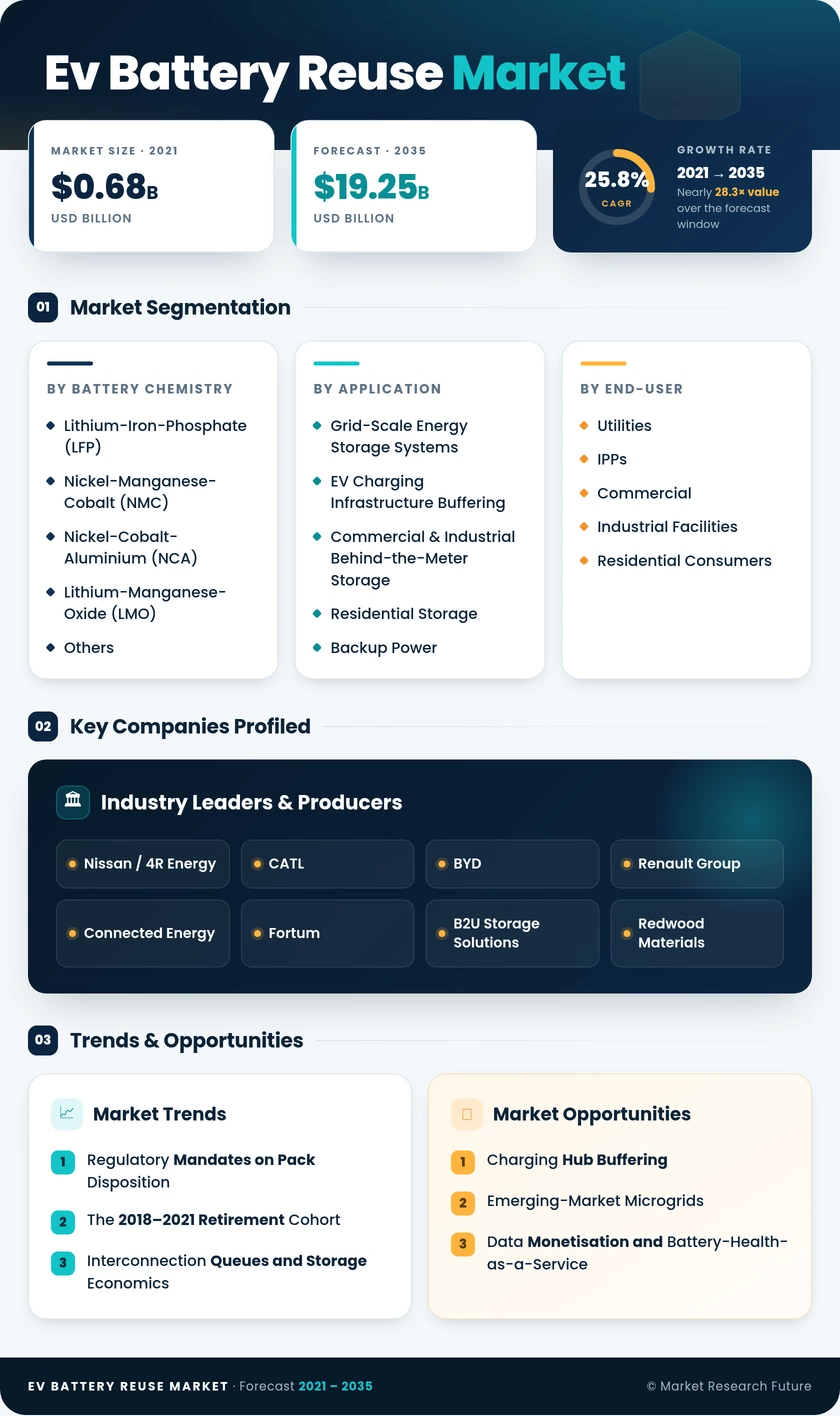
EV Battery Reuse Market Research Report By Battery Chemistry (Lithium-Iron-Phosphate (LFP), Nickel-Manganese-Cobalt (NMC), Nickel-Cobalt-Aluminium (NCA), Lithium-Manganese-Oxide (LMO), Lead-Acid, Solid-State, Others), By Application (Grid-Scale Energy Storage Systems, EV Charging Infrastructure Buffering, Commercial & Industrial Behind-the-Meter Storage, Residential Storage, Backup Power, UPS and Telecom, Telecom Towers / Remote BTS, Off-Grid Solar and Microgrids, Marine and Light-Rail Auxiliary Power, Others), By End-User (Utilities and IPPs, Commercial and Industrial Facilities, Residential Consumers, Telecom Operators, Others) and By Regional (North America, Europe, South America, Asia Pacific, Middle East and Africa) - Growth & Industry Forecast to 2035
Ev Battery Reuse Market
Market Size
Forecast Period2026-2035
CAGR (2026-2035)25.8%
2025 Market SizeUSD 1.94 Billion
2035 Market SizeUSD 19.25 Billion
Key Players
Nissan / 4R Energy
CATL
BYD
Renault Group
Connected Energy
Fortum
Opportunities
  • Charging Hub Buffering
  • Emerging-Market Microgrids
  • Data Monetisation and Battery-Health-as-a-Service
  1. 1 Market Summary |
    1. 1.1 Study Assumptions & Market Definition |
    2. 1.2 Scope of the Study |
    3. 1.3 Research Methodology
  2. 2 Key Report Takeaways |
    1. 2.1 By Battery Chemistry |
    2. 2.2 By Application |
    3. 2.3 By Region
  3. 3 Market Size & Forecast (2021–2035) |
    1. 3.1 Historical Market Size (2021–2025) |
    2. 3.2 Current & Forecast Market Size (2026–2035) |
    3. 3.3 Year-over-Year Growth Analysis
  4. 4 Driver Impact Analysis |
    1. 4.1 Regulatory Mandates on Pack Disposition |
    2. 4.2 The 2018–2021 Retirement Cohort |
    3. 4.3 Interconnection Queues and Storage Economics |
    4. 4.4 Falling Diagnostic Cost
  5. 5 Restraints Impact Analysis |
    1. 5.1 Pack Architecture Fragmentation |
    2. 5.2 Transport and Classification Cost |
    3. 5.3 New-Cell Price Deflation
  6. 6 Opportunity Analysis |
    1. 6.1 Charging Hub Buffering |
    2. 6.2 Emerging-Market Microgrids |
    3. 6.3 Data Monetisation and Battery-Health-as-a-Service |
    4. 6.4 Telecom and Data-Centre Cascade |
    5. 6.5 OEM Residual-Value Underwriting |
    6. 6.6 Industry Value Chain Analysis |
    7. 6.7 Porter's Five Forces Analysis
  7. 7 Regional Market Share & Country-Level Analysis |
    1. 7.1 North America | |
      1. 7.1.1 US | |
      2. 7.1.2 Canada | |
      3. 7.1.3 Mexico |
    2. 7.2 Europe | |
      1. 7.2.1 Germany | |
      2. 7.2.2 UK | |
      3. 7.2.3 France | |
      4. 7.2.4 Italy | |
      5. 7.2.5 Spain | |
      6. 7.2.6 Nordic Countries | |
      7. 7.2.7 Russia | |
      8. 7.2.8 Rest of Europe |
    3. 7.3 Asia-Pacific | |
      1. 7.3.1 China | |
      2. 7.3.2 India | |
      3. 7.3.3 Japan | |
      4. 7.3.4 South Korea | |
      5. 7.3.5 ASEAN | |
      6. 7.3.6 Rest of Asia-Pacific |
    4. 7.4 South America | |
      1. 7.4.1 Brazil | |
      2. 7.4.2 Argentina | |
      3. 7.4.3 Rest of South America |
    5. 7.5 Middle East & Africa | |
      1. 7.5.1 Saudi Arabia | |
      2. 7.5.2 UAE | |
      3. 7.5.3 South Africa | |
      4. 7.5.4 Egypt | |
      5. 7.5.5 Rest of Middle East & Africa
  8. 8 Future Outlook (2026–2035) |
    1. 8.1 Machine Learning Moves From Grading to Dispatch |
    2. 8.2 Standardisation Arrives Through Procurement |
    3. 8.3 The Retirement Supercycle Peaks |
    4. 8.4 Circularity Reporting Becomes Financial
  9. 9 Market Segmentation Analysis |
    1. 9.1 By Battery Chemistry | |
      1. 9.1.1 Lithium-Iron-Phosphate (LFP) | |
      2. 9.1.2 Nickel-Manganese-Cobalt (NMC) | |
      3. 9.1.3 Nickel-Cobalt-Aluminium (NCA) | |
      4. 9.1.4 Lithium-Manganese-Oxide (LMO) | |
      5. 9.1.5 Lead-acid | |
      6. 9.1.6 Solid-state | |
      7. 9.1.7 Others |
    2. 9.2 By Application | |
      1. 9.2.1 Grid-Scale Energy Storage Systems | |
      2. 9.2.2 EV Charging Infrastructure Buffering | |
      3. 9.2.3 Commercial & Industrial Behind-the-Meter Storage | |
      4. 9.2.4 Residential Storage | |
      5. 9.2.5 Backup Power, UPS and Telecom | |
      6. 9.2.5 Telecom Towers / Remote BTS | |
      7. 9.2.6 Off-grid Solar and Microgrids | |
      8. 9.2.7 Marine and Light-Rail Auxiliary Power | |
      9. 9.2.8 Others |
    3. 9.3 By End-User | |
      1. 9.3.1 Utilities and IPPs | |
      2. 9.3.2 Commercial and Industrial Facilities | |
      3. 9.3.3 Residential Consumers | |
      4. 9.3.4 Telecom Operators | |
      5. 9.3.5 Others
  10. 10 Competitive Landscape |
    1. 10.1 Market Share Analysis (2026) |
    2. 10.2 Competitive Benchmarking Matrix |
    3. 10.3 Company Profiles | |
      1. 10.3.1 Nissan / 4R Energy | |
      2. 10.3.2 CATL | |
      3. 10.3.3 BYD | |
      4. 10.3.4 Renault Group | |
      5. 10.3.5 Connected Energy | |
      6. 10.3.6 Fortum | |
      7. 10.3.7 B2U Storage Solutions | |
      8. 10.3.8 Redwood Materials | |
      9. 10.3.9 RePurpose Energy | |
      10. 10.3.10 Smartville | |
      11. 10.3.11 Relectrify | |
      12. 10.3.12 Element Energy
  11. 11 Recent News & Developments
  12. 12 Report Scope & Methodology |
    1. 12.1 Study Period & Base Year |
    2. 12.2 Data Sources & Citations |
    3. 12.3 Abbreviations
  13. 13 Detailed Sources & Citations
  14. 14 Frequently Asked Questions
  15. 15 LIST OF TABLES
  16. 16 LIST OF FIGURES

Segmentation Quick Reference

DimensionSub-SegmentsDominant SegmentFastest Growing Segment
By Battery ChemistryLithium-Iron-Phosphate (LFP); Nickel-Manganese-Cobalt (NMC); Nickel-Cobalt-Aluminium (NCA); Lithium-Manganese-Oxide (LMO); OthersLithium-Iron-Phosphate (LFP)Nickel-Manganese-Cobalt (NMC)
By ApplicationGrid-Scale Energy Storage Systems; EV Charging Infrastructure Buffering; Commercial & Industrial Behind-the-Meter Storage; Residential Storage; Backup Power, UPS and Telecom; OthersGrid-Scale Energy Storage SystemsEV Charging Infrastructure Buffering
By End-UserUtilities and IPPs; Commercial and Industrial Facilities; Residential Consumers; Telecom Operators; OthersUtilities and IPPsCommercial and Industrial Facilities
By RegionNorth America; Europe; Asia-Pacific; South America; Middle East & AfricaAsia-PacificAsia-Pacific


Market Segmentation Overview

By Battery Chemistry

Sub-SegmentKey Trend
Lithium-Iron-Phosphate (LFP)Flat degradation curve makes warranty underwriting straightforward
Nickel-Manganese-Cobalt (NMC)Retirement volumes surging as first mass-market cohort ages out
Nickel-Cobalt-Aluminium (NCA)Preferred where enclosure footprint is constrained
Lithium-Manganese-Oxide (LMO)Legacy commercial vehicle packs entering final disposition
OthersSodium-ion and hybrid chemistries beginning to enter reuse channels


Chemistry determines the economics of every downstream decision — grading time, thermal system cost, insurance premium, and warranty reserve. LFP's tolerance profile explains why it has become the default for stationary redeployment even though it carries less residual energy per module than nickel-rich alternatives.

By Application

Sub-SegmentKey Trend
Grid-Scale Energy Storage SystemsAbsorbs container-scale volumes with minimal per-unit engineering
EV Charging Infrastructure BufferingFastest expansion; avoids multi-year utility upgrade timelines
Commercial & Industrial Behind-the-Meter StorageDemand-charge savings plus circularity disclosure value
Residential StorageCertification cost per kilowatt-hour remains the constraint
Backup Power, UPS and TelecomLead-acid replacement cycle creates standardised high-volume demand
OthersMarine, rail auxiliary and construction site power emerging


Application choice maps directly onto duty cycle tolerance. Shallow, predictable cycling preserves repurposed capacity for a decade or more, which is why buffering and backup applications outperform aggressive arbitrage use cases on lifetime cost.

By End-User

Sub-SegmentKey Trend
Utilities and IPPsBuy on delivered cost per megawatt-hour; accept efficiency trade-offs
Commercial and Industrial FacilitiesFastest growth; resilience plus sustainability reporting motive
Residential ConsumersRooftop solar pairing drives modest but steady volume
Telecom OperatorsSite-level opex reduction across very large installed bases
OthersTransit depots and municipal facilities entering procurement


Buyer motivation splits cleanly between cost-led and disclosure-led purchasing. Utilities anchor volume, but commercial and industrial buyers are setting the pace on specification quality, and their requirements are gradually becoming the de facto standard for the sector.




Download PDF ×

We do not share your information with anyone. However, we may send you emails based on your report interest from time to time. You may contact us at any time to opt-out.