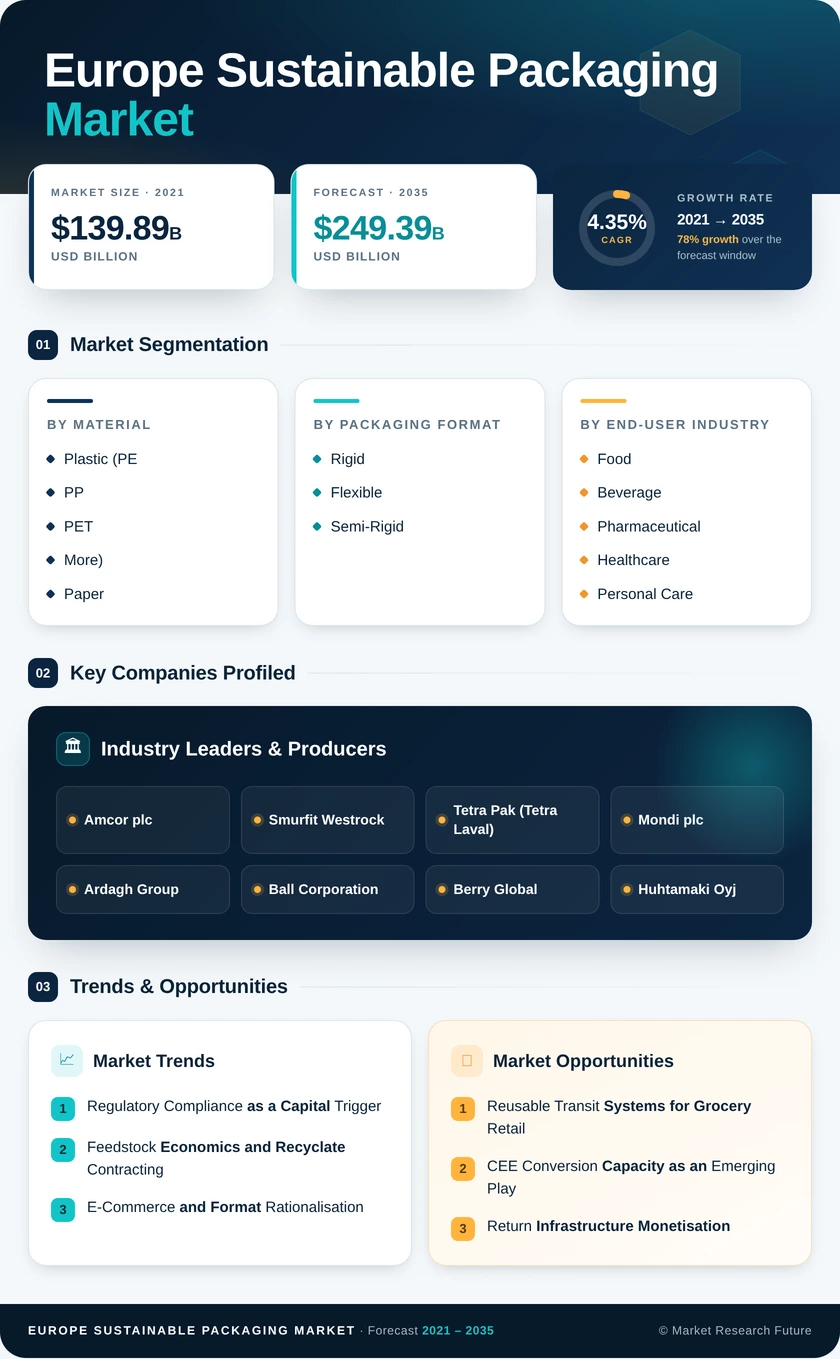
Segmentation Quick Reference
| Dimension | Sub-Segments | Dominant Segment | Fastest Growing Segment |
| By Material | Plastic (PE, PP, PET, and More); Paper and Board (Cartonboard, Molded Fibre, and More); Glass; Metal (Cans, Caps and Closures, Tubes, and More) | Paper and Board | Metal (Cans, Caps and Closures, Tubes, and More) |
| By Packaging Format | Rigid; Flexible; Semi-Rigid | Rigid | Rigid |
| By End-User Industry | Food; Beverage; Pharmaceutical and Healthcare; Personal Care and Cosmetics; Household Care; Other End-User Industries | Food | Pharmaceutical and Healthcare |
| By Country | Germany; United Kingdom; France; Italy; Spain; Nordic Countries; Poland; Russia; Rest of Europe | Germany | Poland |
Market Segmentation Overview
By Material
| Sub-Segment | Key Trend |
| Plastic (PE, PP, PET, and More) | Redesign toward single-polymer structures to preserve sortability |
| Paper and Board (Cartonboard, Molded Fibre, and More) | Barrier-coated fibre displacing laminate trays and pouches |
| Glass | Lightweighting and electric melting pilots to offset energy exposure |
| Metal (Cans, Caps and Closures, Tubes, and More) | Beverage can substitution supported by high remelt yields |
Material selection now carries regulatory consequences, not just cost consequences. Fibre gains where barrier requirements are modest, metal gains in beverage, and polymer retains ground only where redesign delivers verifiable sortability at European recovery facilities.
By Packaging Format
| Sub-Segment | Key Trend |
| Rigid | Reuse quotas favour durable geometries surviving 30-plus cycles |
| Flexible | Material efficiency per protected unit remains unmatched |
| Semi-Rigid | Fibre thermoforms replacing plastic ready-meal trays |
Format economics are separating. Rigid structures capture the reuse mandate, flexibles depend on weight efficiency, and semi-rigid sits in between as the primary battleground for fibre substitution in chilled retail.
By End-User Industry
| Sub-Segment | Key Trend |
| Food | Shelf-life constraints gate every material substitution decision |
| Beverage | Container return systems deliver verifiable closed loops |
| Pharmaceutical and Healthcare | Barrier and serialisation requirements drive premium formats |
| Personal Care and Cosmetics | Refill architectures and fibre tubes gain retail shelf space |
| Household Care | Concentrate dosing shrinks pack size and material intensity |
| Other End-User Industries | Protective and electronics packaging shifting to moulded fibre |
End-market behaviour explains adoption speed better than material science does. Beverage moves first because its loop is closed and measurable; food moves cautiously because failure costs are borne in spoilage; regulated categories move last but pay the most for qualified solutions.


 Noah Malgeri
Co-Founder

 Peter Groot koerkamp
Account and Business Manager

 Younghwan Choi
Senior Retail Manager

 Mark Irwin
Management Consultant

 Akif Moroglu
Strategy & Business Development Director

 Guilherme Gomes Martins
Product Management Director

 Joseph Aguayo
Sales Operations & Pricing Manager

 La Terria Dodd
Program Support Specialist

 Rob Kooiker
Group Product Manager HVAC & Fire Protection GMA