Enterprise WLAN Market

ID: MRFR/ICT/40684-HCR
200 Pages
Nirmit Biswas
Last Updated: June 24, 2026
Enterprise WLAN Market Size, Share and Research Report By Component (Hardware, Software, Services), By Organization Size (Large Enterprises, Small and Medium-Sized Enterprises), By End-User Vertical (IT and Telecommunications, Healthcare, Retail, Banking, Financial Services and Insurance, Manufacturing, Education, Others), By Deployment Mode (On-Premises, Cloud-Managed) and By Regional (North America, Europe, South America, Asia Pacific, Middle East and Africa) - Industry Forecast to 2035.
Download PDF ×

We do not share your information with anyone. However, we may send you emails based on your report interest from time to time. You may contact us at any time to opt-out.

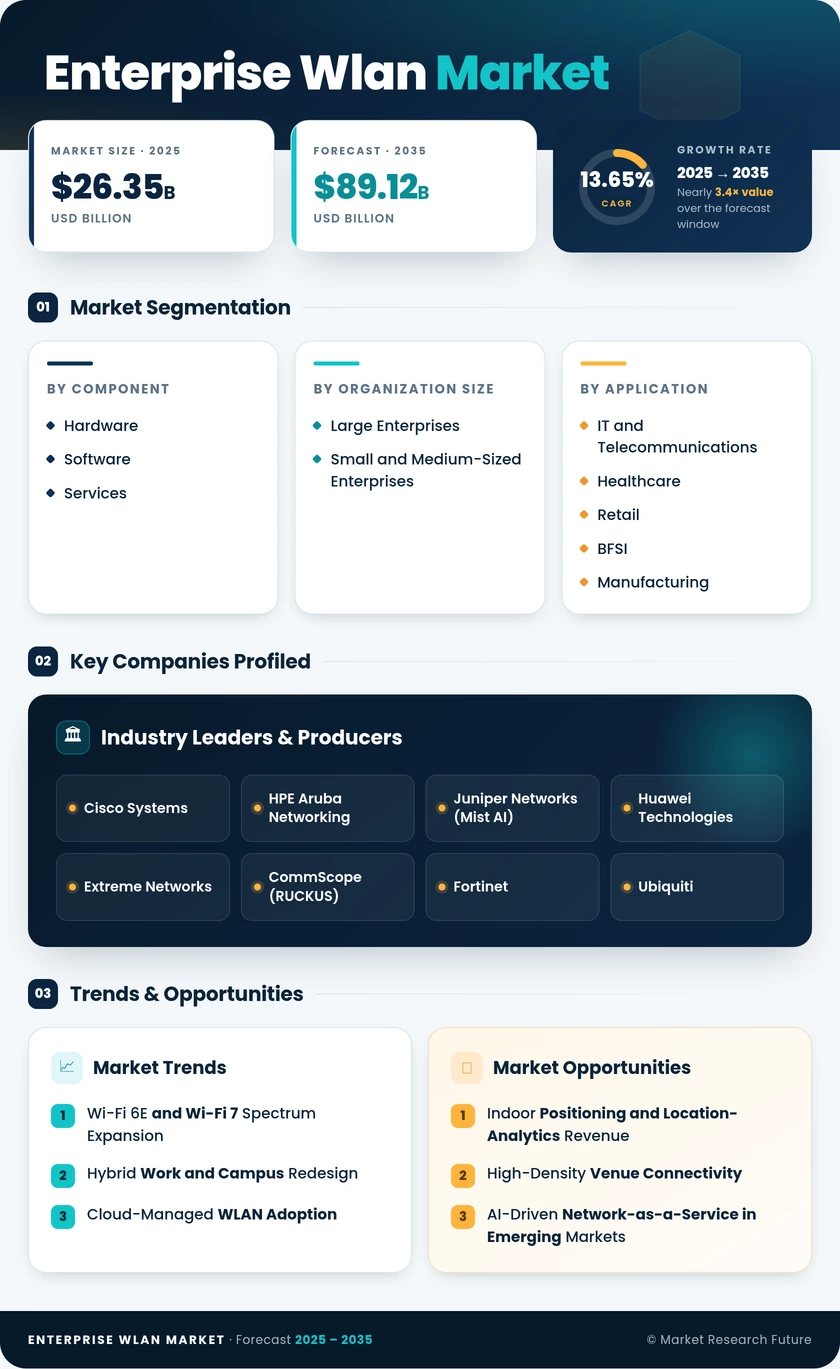
Enterprise WLAN Market

Market Size

Forecast Period2026-2035
CAGR (2026-2035)13.65%
2025 Market SizeUSD 26.35 Billion
2035 Market SizeUSD 89.12 Billion

Key Players

Cisco Systems
HPE Aruba Networking
Juniper Networks
Huawei Technologies
Extreme Networks
CommScope
Opportunities
  • Indoor Positioning and Location-Analytics Revenue
  • High-Density Venue Connectivity
  • AI-Driven Network-as-a-Service in Emerging Markets
  1. 1 Market Overview |
    1. 1.1 Study Assumptions & Market Definition |
    2. 1.2 Scope of the Study |
    3. 1.3 Research Methodology
  2. 2 Market Summary & Key Takeaways
  3. 3 Market Dynamics |
    1. 3.1 Market Drivers Analysis | |
      1. 3.1.1 Wi-Fi 6E/7 Spectrum Expansion | |
      2. 3.1.2 Hybrid Work and Campus Redesign | |
      3. 3.1.3 Cloud-Managed WLAN Adoption | |
      4. 3.1.4 Zero-Trust Network Access Mandates | |
      5. 3.1.5 IoT & High-Density Venue Connectivity | |
      6. 3.1.6 Indoor Positioning & Location Analytics | |
      7. 3.1.7 AI-Driven Network Management |
    2. 3.2 Market Restraints Analysis | |
      1. 3.2.1 Spectrum Fragmentation Across Regions | |
      2. 3.2.2 High Upfront Cost of Wi-Fi 6E/7 Upgrades | |
      3. 3.2.3 Security Vulnerabilities in Legacy APs | |
      4. 3.2.4 Skilled Wireless Engineer Shortage | |
      5. 3.2.5 Interference in Dense Urban Environments |
    3. 3.3 Market Opportunity Analysis | |
      1. 3.3.1 Indoor Positioning and Location-Analytics Revenue | |
      2. 3.3.2 High-Density Venue Connectivity | |
      3. 3.3.3 AI-Driven Network-as-a-Service in Emerging Markets | |
      4. 3.3.4 Private 5G–Wi-Fi Convergence | |
      5. 3.3.5 Zero-Trust Monetization for MSSPs |
    4. 3.4 Industry Value Chain Analysis |
    5. 3.5 Porter's Five Forces Analysis
  4. 4 Global Enterprise WLAN Market Size & Forecast (2021–2035) |
    1. 4.1 Historical Market Size (2021–2025) |
    2. 4.2 Current & Forecast Market Size (2026–2035) |
    3. 4.3 Market Size by Revenue (USD Billion) |
    4. 4.4 Year-over-Year Growth Analysis
  5. 5 Segmentation Analysis |
    1. 5.1 By Component | |
      1. 5.1.1 Hardware | |
      2. 5.1.2 Software | |
      3. 5.1.3 Services |
    2. 5.2 By Organization Size | |
      1. 5.2.1 Large Enterprises | |
      2. 5.2.2 Small and Medium-Sized Enterprises |
    3. 5.3 By End-User Vertical | |
      1. 5.3.1 IT and Telecommunications | |
      2. 5.3.2 Healthcare | |
      3. 5.3.3 Retail | |
      4. 5.3.4 Banking, Financial Services, and Insurance | |
      5. 5.3.5 Manufacturing | |
      6. 5.3.6 Education | |
      7. 5.3.7 Others |
    4. 5.4 By Deployment Mode | |
      1. 5.4.1 On-Premises | |
      2. 5.4.2 Cloud-Managed
  6. 6 Regional Analysis |
    1. 6.1 North America | |
      1. 6.1.1 United States | |
      2. 6.1.2 Canada | |
      3. 6.1.3 Mexico |
    2. 6.2 Europe | |
      1. 6.2.1 Germany | |
      2. 6.2.2 United Kingdom | |
      3. 6.2.3 France | |
      4. 6.2.4 Italy | |
      5. 6.2.5 Spain | |
      6. 6.2.6 Nordic Countries | |
      7. 6.2.7 Russia | |
      8. 6.2.8 Rest of Europe |
    3. 6.3 Asia-Pacific | |
      1. 6.3.1 China | |
      2. 6.3.2 India | |
      3. 6.3.3 Japan | |
      4. 6.3.4 South Korea | |
      5. 6.3.5 ASEAN | |
      6. 6.3.6 Rest of Asia-Pacific |
    4. 6.4 South America | |
      1. 6.4.1 Brazil | |
      2. 6.4.2 Argentina | |
      3. 6.4.3 Rest of South America |
    5. 6.5 Middle East & Africa | |
      1. 6.5.1 Saudi Arabia | |
      2. 6.5.2 UAE | |
      3. 6.5.3 South Africa | |
      4. 6.5.4 Egypt | |
      5. 6.5.5 Rest of MEA
  7. 7 Competitive Landscape |
    1. 7.1 Market Share Analysis (2025) |
    2. 7.2 Competitive Benchmarking Matrix |
    3. 7.3 Company Profiles | |
      1. 7.3.1 Cisco Systems | |
      2. 7.3.2 HPE Aruba Networking | |
      3. 7.3.3 Juniper Networks (Mist AI) | |
      4. 7.3.4 Huawei Technologies | |
      5. 7.3.5 Extreme Networks | |
      6. 7.3.6 CommScope (RUCKUS) | |
      7. 7.3.7 Fortinet | |
      8. 7.3.8 Ubiquiti | |
      9. 7.3.9 H3C Technologies | |
      10. 7.3.10 Cambium Networks
  8. 8 Future Outlook & Strategic Recommendations (2026–2035) |
    1. 8.1 AI-Autonomous Wireless Operations |
    2. 8.2 Wi-Fi 7 and the Deterministic-Latency Enterprise |
    3. 8.3 Converged Indoor Intelligence Platforms |
    4. 8.4 Sustainability and Circular-Economy Pressures
  9. 9 Recent Developments & News
  10. 10 Frequently Asked Questions (FAQs)
  11. 11 Report Scope & Methodology |
    1. 11.1 Study Period & Base Year |
    2. 11.2 Data Sources & Citations |
    3. 11.3 Abbreviations
  12. 12 LIST OF TABLES |
  13. TABLE 1 Global Enterprise WLAN Market Size & Forecast, by Revenue (USD Billion), 2021–2035 |
  14. TABLE 2 Global Enterprise WLAN Market – Year-over-Year Growth Analysis, 2021–2035 |
  15. TABLE 3 Global Enterprise WLAN Market – Driver Impact Analysis, 2026–2035 |
  16. TABLE 4 Global Enterprise WLAN Market – Restraint Impact Analysis, 2026–2035 |
  17. TABLE 5 Global Enterprise WLAN Market Size, by Component, 2021–2035 (USD Billion) |
  18. TABLE 6 Global Enterprise WLAN Market Size, by Organization Size, 2021–2035 (USD Billion) |
  19. TABLE 7 Global Enterprise WLAN Market Size, by End-User Vertical, 2021–2035 (USD Billion) |
  20. TABLE 8 Global Enterprise WLAN Market Size, by Deployment Mode, 2021–2035 (USD Billion) |
  21. TABLE 9 Global Enterprise WLAN Market Size, by Region, 2021–2035 (USD Billion) |
  22. TABLE 10 North America Enterprise WLAN Market Size, by Country, 2021–2035 (USD Billion) |
  23. TABLE 11 Europe Enterprise WLAN Market Size, by Country, 2021–2035 (USD Billion) |
  24. TABLE 12 Asia-Pacific Enterprise WLAN Market Size, by Country, 2021–2035 (USD Billion) |
  25. TABLE 13 South America Enterprise WLAN Market Size, by Country, 2021–2035 (USD Billion) |
  26. TABLE 14 Middle East & Africa Enterprise WLAN Market Size, by Country, 2021–2035 (USD Billion) |
  27. TABLE 15 North America Enterprise WLAN Market Size, by Component, 2021–2035 (USD Billion) |
  28. TABLE 16 North America Enterprise WLAN Market Size, by Organization Size, 2021–2035 (USD Billion) |
  29. TABLE 17 North America Enterprise WLAN Market Size, by End-User Vertical, 2021–2035 (USD Billion) |
  30. TABLE 18 North America Enterprise WLAN Market Size, by Deployment Mode, 2021–2035 (USD Billion) |
  31. TABLE 19 Europe Enterprise WLAN Market Size, by Component, 2021–2035 (USD Billion) |
  32. TABLE 20 Europe Enterprise WLAN Market Size, by Organization Size, 2021–2035 (USD Billion) |
  33. TABLE 21 Europe Enterprise WLAN Market Size, by End-User Vertical, 2021–2035 (USD Billion) |
  34. TABLE 22 Europe Enterprise WLAN Market Size, by Deployment Mode, 2021–2035 (USD Billion) |
  35. TABLE 23 Asia-Pacific Enterprise WLAN Market Size, by Component, 2021–2035 (USD Billion) |
  36. TABLE 24 Asia-Pacific Enterprise WLAN Market Size, by Organization Size, 2021–2035 (USD Billion) |
  37. TABLE 25 Asia-Pacific Enterprise WLAN Market Size, by End-User Vertical, 2021–2035 (USD Billion) |
  38. TABLE 26 Asia-Pacific Enterprise WLAN Market Size, by Deployment Mode, 2021–2035 (USD Billion) |
  39. TABLE 27 South America Enterprise WLAN Market Size, by Component, 2021–2035 (USD Billion) |
  40. TABLE 28 South America Enterprise WLAN Market Size, by Organization Size, 2021–2035 (USD Billion) |
  41. TABLE 29 South America Enterprise WLAN Market Size, by End-User Vertical, 2021–2035 (USD Billion) |
  42. TABLE 30 South America Enterprise WLAN Market Size, by Deployment Mode, 2021–2035 (USD Billion) |
  43. TABLE 31 Middle East & Africa Enterprise WLAN Market Size, by Component, 2021–2035 (USD Billion) |
  44. TABLE 32 Middle East & Africa Enterprise WLAN Market Size, by Organization Size, 2021–2035 (USD Billion) |
  45. TABLE 33 Middle East & Africa Enterprise WLAN Market Size, by End-User Vertical, 2021–2035 (USD Billion) |
  46. TABLE 34 Middle East & Africa Enterprise WLAN Market Size, by Deployment Mode, 2021–2035 (USD Billion) |
  47. TABLE 35 Competitive Benchmarking Matrix – Enterprise WLAN Market, 2025 |
  48. TABLE 36 Company Profiles – Key Players, Enterprise WLAN Market |
  49. TABLE 37 Recent Developments & Strategic Announcements, 2023–2025 |
  50. TABLE 38 Report Scope & Methodology Summary
  51. 13 LIST OF FIGURES |
  52. FIGURE 1 Enterprise WLAN Market Dynamics — Drivers, Restraints, Opportunities |
  53. FIGURE 2 Enterprise WLAN Market Value Chain Analysis |
  54. FIGURE 3 Porter's Five Forces Analysis — Enterprise WLAN Market |
  55. FIGURE 4 Enterprise WLAN Market Size Trend & Forecast (USD Billion), 2021–2035 |
  56. FIGURE 5 Enterprise WLAN Market Share, by Component, 2025 (%) |
  57. FIGURE 6 Enterprise WLAN Market Share, by Organization Size, 2025 (%) |
  58. FIGURE 7 Enterprise WLAN Market Share, by End-User Vertical, 2025 (%) |
  59. FIGURE 8 Enterprise WLAN Market Share, by Deployment Mode, 2025 (%) |
  60. FIGURE 9 Enterprise WLAN Market Share, by Region, 2025 (%) |
  61. FIGURE 10 North America Enterprise WLAN Market Size, by Country, 2021–2035 (USD Billion) |
  62. FIGURE 11 Europe Enterprise WLAN Market Size, by Country, 2021–2035 (USD Billion) |
  63. FIGURE 12 Asia-Pacific Enterprise WLAN Market Size, by Country, 2021–2035 (USD Billion) |
  64. FIGURE 13 South America Enterprise WLAN Market Size, by Country, 2021–2035 (USD Billion) |
  65. FIGURE 14 Middle East & Africa Enterprise WLAN Market Size, by Country, 2021–2035 (USD Billion) |
  66. FIGURE 15 Competitive Landscape — Enterprise WLAN Market Revenue Share, 2025 (%) |
  67. FIGURE 16 Key Company Positioning Matrix — Enterprise WLAN Market, 2025

Segmentation Quick Reference

DimensionSub-SegmentsDominant SegmentFastest Growing Segment
ComponentHardware, Software, ServicesHardware (64.80% share, 2025)Software (14.95% CAGR)
Organization SizeLarge Enterprises, Small and Medium-Sized EnterprisesLarge Enterprises (USD 15.88 B, 2025)SMEs (14.10% CAGR)
End-User VerticalIT & Telecom, Healthcare, Retail, BFSI, Manufacturing, Education, OthersIT & Telecom (31.20% share, 2025)Healthcare (14.35% CAGR)
Deployment ModeOn-Premises, Cloud-ManagedOn-Premises (69.75% share, 2025)Cloud-Managed (15.20% CAGR)
GeographyNorth America, Europe, Asia-Pacific, South America, Middle East & AfricaNorth America (41.50% share, 2025)Asia-Pacific (14.25% CAGR)


Market Segmentation Overview

By Component

Sub-SegmentKey Trend
HardwareWi-Fi 6E/7 AP refresh cycle driving volume; integrated IoT and BLE radios
SoftwareCloud-managed dashboards with AIOps; subscription-based licensing models
ServicesProfessional deployment, site surveys, and managed NaaS bundles for SMEs


Hardware revenue is propelled by the largest standards-driven AP replacement cycle in a decade, as enterprises migrate from Wi-Fi 5 to Wi-Fi 6E and early Wi-Fi 7 platforms. Software and services are growing faster in percentage terms because cloud-managed architectures convert one-time license fees into recurring subscriptions.

By Organization Size

Sub-SegmentKey Trend
Large EnterprisesMulti-campus refresh programs; zero-trust compliance mandates
Small and Medium-Sized EnterprisesNaaS adoption; subscription-based cloud-managed WLAN entry


Large enterprises dominate absolute spending due to multi-thousand-AP estates and complex security requirements, while SMEs are the fastest-growing segment as vendor-hosted cloud management eliminates the need for dedicated wireless controllers and on-site expertise.

By End-User Vertical

Sub-SegmentKey Trend
IT and TelecommunicationsHighest density campus environments; 3-year AP refresh cycles
HealthcareConnected medical devices; indoor positioning for patient and asset tracking
RetailWi-Fi-based indoor analytics and proximity marketing
BFSIBranch modernization; regulatory-driven zero-trust adoption
ManufacturingOT/IT convergence; deterministic-latency Wi-Fi for robotics
Education1:1 device initiatives; smart-classroom and lecture-hall deployments


IT and Telecom leads on density-driven demand, while healthcare and education represent the fastest-growing verticals as clinical IoT and digital-classroom mandates accelerate wireless infrastructure investment.

By Deployment Mode

Sub-SegmentKey Trend
On-PremisesPreferred for data-sovereign and ultra-low-latency environments
Cloud-ManagedCentralized policy, continuous firmware updates, zero-trust integration


On-premises retains the majority share in regulated industries, but cloud-managed is rapidly closing the gap as vendors demonstrate compliance-grade security and data-residency options within hosted management platforms.