×
Hero Background
English
Chinese
French
Japanese
Korean
German
Spanish

Engineering Resins Market Analysis

ID: MRFR/CnM/11030-HCR
128 Pages
Garvit Vyas
October 2025

Engineering Resins Market Research Report Information By Type (Polycarbonate, Acetal Copolymer Polyoxymethylene, Acetal Homopolymer Polyoxymethylene, Acrylic, Nylon, Polyethylene, Polypropylene, Polyvinylchloride, Teflon); Application (Bumpers, Chemical Tanks, Electrical Insulators, Inhalers, Others); End Use Industry (Automotive, Building and Construction, Electrical Engineering, Healthcare, Packaging, Others) And By Region (North America, Europe, Asia-Pacific, And Rest of The World) –Market Forecast Till 2035.

Share:
Download PDF ×

We do not share your information with anyone. However, we may send you emails based on your report interest from time to time. You may contact us at any time to opt-out.

Engineering Resins Market Infographic
Purchase Options

Market Analysis

In-depth Analysis of Engineering Resins Market Industry Landscape

The combined effect of various factors impacting demand, supply, and overall performance of Engineering Resins across different industries shapes the Engineering Resin Market dynamics. Lightweight materials have been increasingly demanded in industries such as automotive and aerospace, which are among those driving these dynamics. Engineering resins provide options that make components lighter yet retain their strength and durability. Additionally , strict fuel efficiency and emission laws lead manufacturers to adopt lightweight materials, hence creating more demand for this plastic type. Technological breakthroughs also play a significant role in defining what happens within the engineering resins market, especially in the unending efforts to improve mechanical properties like chemical resistance, heat resistance, and flame retardancy. At the global level, awareness about environmental issues has increased significantly over time, leading to an emphasis on sustainability. Many sectors are now seeking alternative green materials so as to reduce their environmental footprint. It is against this backdrop that industries look at recyclable and energy-efficient products, such as engineering resins, which fit most of the sustainability criteria. Market dynamics are also influenced by the economic landscape, with factors such as raw material prices, currency fluctuations, and trade policies impacting the cost structure of engineering resins. Costs of production, including those making up the pricing of engineering resins in the market, could be influenced by availability or scarcity and cost price for raw materials that come from petrochemical sources. Finally, economic uncertainties and geopolitical factors can increase volatility, thus affecting market players' investment decisions and strategies. Moreover, there is intense rivalry in the Engineering Resins Market, with companies seeking to gain market share through alliances. Thus, most of these firms might adopt strategic moves such as partnering, collaborating, or merging to achieve this objective, among others. These actions bring in new opportunities for expanding product lines and entering into fresh geographical markets. This dynamism is brought about by consumer likes and dislikes coupled with industrial trends. As users develop a preference for specific aspects of engineering resins, such as bio-based content, high-performance additives, or flame retardancy, manufacturers respond by aligning their products according to requirements desired by end-users. Companies must understand and adapt to changing preferences if they are to remain competitive in the Engineering Resins Market.


Author
Garvit Vyas
Analyst

Explore the profile of Garvit Vyas, one of our esteemed authors at Market Research Future, and access their expert research contributions in the field of market research and industry analysis

Leave a Comment

FAQs

What is the projected market valuation of the Engineering Resins Market by 2035?

The Engineering Resins Market is projected to reach approximately 209.95 USD Billion by 2035.

What was the market valuation of the Engineering Resins Market in 2024?

In 2024, the Engineering Resins Market was valued at 118.2 USD Billion.

What is the expected CAGR for the Engineering Resins Market during the forecast period 2025 - 2035?

The expected CAGR for the Engineering Resins Market during the forecast period 2025 - 2035 is 5.36%.

Which segment is projected to have the highest valuation in the Engineering Resins Market by 2035?

The Polyethylene segment is projected to reach a valuation of 35.0 USD Billion by 2035.

What are the key applications driving the Engineering Resins Market?

Key applications include Bumpers, Electrical Insulators, and Chemical Tanks, with Electrical Insulators projected to reach 40.0 USD Billion by 2035.

Which end-use industry is expected to contribute the most to the Engineering Resins Market?

The Automotive industry is expected to contribute significantly, with a projected valuation of 45.0 USD Billion by 2035.

Market Summary

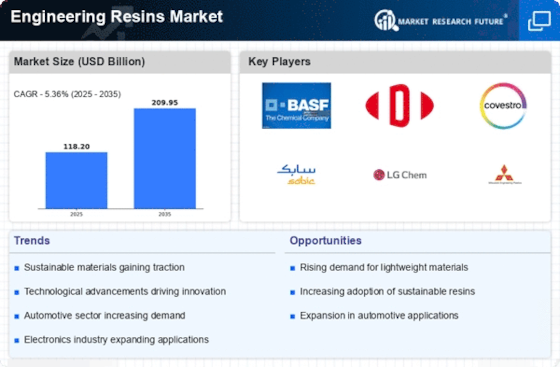
As per MRFR analysis, the Engineering Resins Market Size was estimated at 118.2 USD Billion in 2024. The Engineering Resins industry is projected to grow from 124.53 USD Billion in 2025 to 209.95 USD Billion by 2035, exhibiting a compound annual growth rate (CAGR) of 5.36 during the forecast period 2025 - 2035.

Key Market Trends & Highlights

The Engineering Resins Market is poised for robust growth driven by sustainability and technological advancements.

  • North America remains the largest market for engineering resins, reflecting a strong demand across various industries.
  • The Asia-Pacific region is emerging as the fastest-growing market, fueled by rapid industrialization and urbanization.
  • Polycarbonate continues to dominate as the largest segment, while nylon is recognized as the fastest-growing segment due to its versatility.
  • Key market drivers include rising automotive production and an increased focus on sustainability, which are shaping the future of engineering resins.

Market Size & Forecast

2024 Market Size 118.2 (USD Billion)
2035 Market Size 209.95 (USD Billion)
CAGR (2025 - 2035) 5.36%
Largest Regional Market Share in 2024 Europe

Major Players

<p>BASF SE (DE), DuPont de Nemours Inc (US), Covestro AG (DE), SABIC (SA), LG Chem Ltd (KR), Mitsubishi Engineering-Plastics Corporation (JP), Solvay SA (BE), Evonik Industries AG (DE), Celanese Corporation (US)</p>

Market Trends

The Engineering Resins Market is currently experiencing a dynamic evolution, driven by advancements in technology and increasing demand across various industries. These resins, known for their superior mechanical properties and thermal stability, are finding applications in automotive, electronics, and consumer goods. The shift towards lightweight materials in automotive manufacturing is particularly noteworthy, as manufacturers seek to enhance fuel efficiency and reduce emissions. Additionally, the growing trend of miniaturization in electronics is propelling the need for high-performance engineering resins that can withstand demanding conditions while maintaining functionality. Moreover, sustainability is becoming a pivotal factor influencing the Engineering Resins Market. As environmental concerns gain prominence, manufacturers are exploring bio-based and recyclable resin options. This shift not only aligns with global sustainability goals but also caters to the evolving preferences of consumers who are increasingly inclined towards eco-friendly products. The interplay between innovation, sustainability, and market demand suggests a promising trajectory for the Engineering Resins Market, with potential for further growth and diversification in the coming years.

Sustainability Initiatives

The Engineering Resins Market is witnessing a notable shift towards sustainable practices. Manufacturers are increasingly focusing on developing bio-based and recyclable resins to meet environmental standards and consumer preferences. This trend reflects a broader commitment to reducing carbon footprints and promoting eco-friendly solutions.

Technological Advancements

Innovations in material science are significantly impacting the Engineering Resins Market. Enhanced processing techniques and the introduction of high-performance resins are enabling applications in demanding sectors such as aerospace and automotive. These advancements are likely to drive market growth by improving product performance and expanding application possibilities.

Growing Demand in Electronics

The electronics sector is emerging as a key driver for the Engineering Resins Market. The trend towards miniaturization and the need for durable, high-performance materials are propelling the adoption of engineering resins in electronic components. This demand is expected to continue as technology evolves and consumer electronics become more sophisticated.

Engineering Resins Market Market Drivers

Rising Automotive Production

The Engineering Resins Market is experiencing a notable surge due to the increasing production of automobiles. As manufacturers strive for lightweight and durable materials, engineering resins are becoming essential in automotive applications. In 2025, the automotive sector is projected to account for a significant share of the engineering resins market, driven by the need for improved fuel efficiency and performance. The shift towards electric vehicles further amplifies this demand, as these vehicles require advanced materials to meet stringent safety and performance standards. Consequently, the engineering resins market is likely to witness robust growth, as automotive manufacturers increasingly adopt these materials to enhance vehicle design and functionality.

Expansion in Consumer Electronics

The Engineering Resins Market is poised for growth, particularly in the consumer electronics sector. With the proliferation of smart devices and the Internet of Things, there is a heightened demand for high-performance materials that can withstand rigorous usage. Engineering resins, known for their excellent thermal stability and mechanical properties, are increasingly utilized in the production of smartphones, tablets, and wearables. In 2025, the consumer electronics segment is expected to contribute significantly to the overall market, as manufacturers seek to innovate and differentiate their products. This trend indicates a promising trajectory for the engineering resins market, as it aligns with the evolving needs of technology-driven consumers.

Increased Focus on Sustainability

The Engineering Resins Market is witnessing a paradigm shift towards sustainability, as manufacturers and consumers alike prioritize eco-friendly materials. The demand for bio-based and recyclable engineering resins is on the rise, driven by regulatory pressures and consumer preferences for sustainable products. In 2025, it is anticipated that a substantial portion of the engineering resins market will be influenced by these sustainability initiatives. Companies are investing in research and development to create innovative materials that not only meet performance standards but also minimize environmental impact. This focus on sustainability is likely to reshape the engineering resins market, fostering growth opportunities for manufacturers who can adapt to these changing dynamics.

Technological Innovations in Material Science

The Engineering Resins Market is significantly impacted by ongoing technological advancements in material science. Innovations such as enhanced polymerization techniques and the development of new resin formulations are enabling the creation of superior engineering resins with improved properties. These advancements are crucial for industries such as aerospace, automotive, and electronics, where performance and reliability are paramount. In 2025, the engineering resins market is expected to benefit from these technological breakthroughs, as manufacturers seek to leverage cutting-edge materials to enhance product performance. This trend suggests a dynamic landscape for the engineering resins market, where continuous innovation will play a pivotal role in driving growth.

Growth in Construction and Infrastructure Development

The Engineering Resins Market is experiencing growth fueled by the expansion of construction and infrastructure projects. As urbanization accelerates, there is an increasing demand for durable and lightweight materials that can withstand harsh environmental conditions. Engineering resins are increasingly being utilized in construction applications, such as piping, insulation, and structural components. In 2025, the construction sector is projected to be a key driver of the engineering resins market, as it seeks to adopt advanced materials that enhance the longevity and performance of structures. This trend indicates a robust outlook for the engineering resins market, as it aligns with the broader trends of modernization and infrastructure development.

Market Segment Insights

By Type: Polycarbonate (Largest) vs. Nylon (Fastest-Growing)

<p>In the Engineering Resins Market, Polycarbonate emerges as the largest segment, commanding a significant market share. Known for its high impact resistance and transparency, it is widely utilized in applications ranging from automotive to electronics. Meanwhile, Nylon is gaining traction rapidly, characterized by its excellent tensile strength and versatility. It is increasingly adopted in various industries, including consumer goods and automotive, contributing to its status as the fastest-growing resin type.</p>

<p>Polycarbonate (Dominant) vs. Nylon (Emerging)</p>

<p>Polycarbonate is recognized for its robust performance and ability to withstand extreme temperatures, making it a preferred choice in demanding applications. Its dominance in the market is supported by a growing demand from sectors such as automotive, where lightweight and durable materials are prioritized. Conversely, Nylon is emerging strongly, known for its durability and flexibility, which allows for a broad range of applications. The shift towards lightweight, high-strength materials in the automotive and consumer goods industries drives its growth, making it a key player in the market.</p>

By Application: Bumpers (Largest) vs. Inhalers (Fastest-Growing)

<p>The Engineering Resins Market showcases a dynamic distribution of application segments, with bumpers taking a commanding lead. This segment benefits from robust demand across automotive applications, leveraging properties that enhance durability and aesthetic appeal. Following bumpers, chemical tanks and electrical insulators account for substantial portions of the market, catering to specific industrial needs, while inhalers are carving a niche with their innovative designs and specialized uses in healthcare. The growth trends within the Engineering Resins Market are influenced by advancements in material technologies and increasing demand for lightweight and high-performance products. Bumpers remain a solid choice due to their essential role in vehicle safety and design. In contrast, inhalers are witnessing a surge as health-conscious consumers seek advanced delivery systems for medications, driven by an increasing focus on chronic health conditions.</p>

<p>Bumpers: Dominant vs. Inhalers: Emerging</p>

<p>Bumpers serve as a dominant application within the Engineering Resins Market, primarily due to their critical role in vehicle design and safety. They utilize high-performance resins that not only provide structural integrity but also enhance aesthetic value, making them essential for manufacturers aiming for competitive edge. Conversely, inhalers are emerging as a significant segment driven by advancements in pharmaceuticals and patient preferences for more efficient drug delivery systems. This growth is further propelled by increasing awareness of respiratory health and innovative product designs that promise better user experiences. The contrast between these two segments highlights a balancing act in the market, where traditional applications face competition from rapidly evolving healthcare demands.</p>

By End Use Industry: Automotive (Largest) vs. Healthcare (Fastest-Growing)

<p>The Engineering Resins Market showcases a diverse distribution among various end-use industries. The automotive sector stands as the largest segment, significantly utilizing engineering resins for components such as dashboards, bumpers, and structural parts. The building and construction industry also holds a considerable share, driven by the demand for durable materials in construction applications. Other notable segments include electrical engineering, healthcare, packaging, and others, each contributing to the market with their unique resin requirements.</p>

<p>Automotive: Dominant vs. Healthcare: Emerging</p>

<p>In the Engineering Resins Market, the automotive sector is a dominant player, leveraging engineering resins for their high-performance attributes and ability to enhance vehicle safety and aesthetics. The widespread adoption of lightweight materials for fuel efficiency has seen the use of engineered plastics soar. Conversely, the healthcare sector is emerging rapidly, driven by innovation in medical devices and packaging requirements for pharmaceuticals. The demand for biocompatible and sterilizable materials is reshaping the landscape, with engineering resins playing a crucial role in developing advanced healthcare applications, thereby fostering growth in this segment.</p>

Get more detailed insights about Engineering Resins Market Research Report - Global Forecast by 2035

Regional Insights

North America : Innovation and Demand Surge

North America is the largest market for engineering resins, holding approximately 40% of the global share. The region's growth is driven by increasing demand in automotive, aerospace, and electronics sectors, alongside stringent regulations promoting lightweight materials. The U.S. and Canada are the primary contributors, with a focus on sustainability and advanced manufacturing technologies. The competitive landscape is robust, featuring key players like DuPont, BASF, and Celanese. These companies are investing in R&D to innovate and meet the evolving needs of industries. The presence of established manufacturing facilities and a skilled workforce further enhances the region's market position, making it a hub for engineering resin production.

Europe : Sustainability and Innovation Focus

Europe is the second-largest market for engineering resins, accounting for around 30% of the global market share. The region's growth is propelled by stringent environmental regulations and a strong push towards sustainable materials. Countries like Germany and France are at the forefront, emphasizing recycling and eco-friendly production processes to meet consumer demand for greener products. The competitive landscape is characterized by major players such as BASF and Covestro, who are leading innovations in bio-based and recycled resins. The European market is also witnessing collaborations between manufacturers and research institutions to develop advanced materials. This synergy is crucial for maintaining competitiveness in a rapidly evolving market.

Asia-Pacific : Rapid Growth and Expansion

Asia-Pacific is witnessing rapid growth in the engineering resins market, holding approximately 25% of the global share. The region's expansion is driven by increasing industrialization, urbanization, and a booming automotive sector, particularly in countries like China and India. Government initiatives to boost manufacturing capabilities and infrastructure development are also significant growth catalysts. China is the largest market in the region, with a strong presence of local and international players. Companies like LG Chem and Mitsubishi Engineering-Plastics are investing heavily in production capacity and innovation. The competitive landscape is evolving, with a focus on high-performance materials to cater to diverse applications across various industries, including electronics and consumer goods.

Middle East and Africa : Resource-Rich and Growing Market

The Middle East and Africa region is gradually emerging in the engineering resins market, holding about 5% of the global share. The growth is primarily driven by increasing investments in infrastructure and construction, alongside a rising demand for lightweight materials in automotive and consumer goods. Countries like Saudi Arabia and South Africa are leading this growth, supported by government initiatives to diversify economies and enhance manufacturing capabilities. The competitive landscape is still developing, with key players like SABIC and local manufacturers expanding their product offerings. The region's potential is significant, as it seeks to leverage its natural resources and invest in advanced manufacturing technologies to meet the growing demand for engineering resins across various sectors.

Key Players and Competitive Insights

Leading market players are investing heavily in research and development to expand their product lines, which will help the Engineering Resins Market, grow even more. Market participants are also undertaking a variety of strategic activities to expand their footprint, with important market developments including new product launches, contractual agreements, mergers and acquisitions, higher investments, and collaboration with other organizations. To expand and survive in a more competitive and rising market climate, the Engineering Resins industry must offer cost-effective items.

Manufacturing locally to minimize operational costs is one of the key business tactics used by manufacturers in the Engineering Resins industry to benefit clients and increase the market sector. In recent years, the Engineering Resins industry has offered some of the most significant advantages to the manufacturing and materials sector, including enhanced product performance, lightweight solutions, and environmentally sustainable materials. Major players in the Engineering Resins Market, including ARKEMA GROUP, BASF S.E., E.I. Dupont de Numeours and Company, Honeywell International Inc, Innovative Plastics, LG Chemicals, Mitsubishi Chemical Corporation, SABIC, Solvay SA, Sumitomo Chemical Co.

Ltd. are attempting to increase market demand by investing in research and development operations.

BASF SE is a prominent chemical company engaged in the production, marketing, and sales of a diverse range of products, including chemicals, plastics, crop protection solutions, and performance products. Its extensive product portfolio encompasses items like solvents, adhesives, surfactants, fuel additives, electronic chemicals, pigments, paints, food additives, fungicides, and herbicides. BASF serves multiple industries, such as construction, furniture, agriculture, electronics, automotive, paints and coatings, and more. The company actively collaborates on research and development initiatives with customers, scientists, and partners. BASF operates a network of manufacturing facilities and maintains a strong presence in various regions around the world.

Its headquarters are located in Ludwigshafen, Germany.

Mitsubishi Chemical Group Corp (MCGC), formerly known as Mitsubishi Chemical Holdings Corp, is a diversified chemical company offering a wide array of products and services. These encompass advanced polymers, high-performance chemicals, high-performance films, advanced moldings and composites, petrochemicals, carbon-related products, industrial gases, methyl methacrylate, and solutions focused on environmental and daily living needs. MCGC also provides ethical pharmaceuticals, diagnostic reagents and instruments, capsules and pharmaceutical equipment, active pharmaceutical ingredients and intermediates, and self-health check services.

The company caters to various sectors, including mobility, environmental and new energy initiatives, information technology, electronics and displays, medical applications, food and bioproducts, packaging, labels, and films, as well as healthcare solutions. MCGC maintains a presence with operations spanning Europe, Africa, Asia-Pacific, North America, and Latin America. Its headquarters are situated in Chiyoda-Ku, Tokyo, Japan.

Key Companies in the Engineering Resins Market market include

Industry Developments

November 2021: In 2021, DuPont a key player in plastic manufacturing is employing high-performance polymers and elastomers to develop automotive components, this further reduces the weight, space, and carbon di oxide emissions and increases fuel efficiency. Key players in automobile manufacturing are expected to employ similar best practices to meet environmental and consumer needs.

February 2017: In February 2017, Joint ventures have started to meet the future demands, AsahiKASEI and China national Bluestar have started a joint venture to meet the future requirements in Engineering resins. The usage of engineering resins in various industries like automobile, electric, and construction industry is driving the market. The automotive industry is expected to further strengthen the market because the metal parts are being replaced with Plastic which has high stability, strength, and other factors. Recently usage of engineering resins has started in the packing industry as well because resins create outstanding durability and decorating flexibility.

In February 2024, the RAMPF Group, based in Grafenberg, Germany, will showcase three of its six main areas of expertise: RAMPF Composite Solutions, RAMPF Tooling Solutions, and RAMPF Group Inc. The company will present its extensive range of products and services for the efficient manufacturing of high-performance composite parts. RAMPF Composite Solutions is presenting comprehensive engineering solutions for technologically advanced composite design in the aerospace, defense, transportation, medical, and green technology sectors. The company's specialists employ customized fiber placement (TFP), improved tooling materials with enhanced mechanical qualities, and high-performance liquid resin systems to automate composites manufacturing and save costs.

RAMPF Composites Solutions claims that it can produce subsystems and prototypes that can be scaled up quickly, within a matter of days or weeks from the design stage, by using a one-shot approach that incorporates material qualifying and built-in quality assurance. RAMPF Tooling Solutions is showcasing high-performance epoxy boards designed for the manufacturing of prepreg layup tools and vacuum forming molds. This division offers four cutting-edge board materials, namely Raku Tool WB-0691, WB-0700, and WB-0890, designed specifically for use in racing sports, maritime, aerospace, and medical technology applications.

RAMPF Tooling Solutions offers a range of products for manufacturing composites, including liquid systems made from epoxy such as infusion resins, laminating resins, and gelcoats. They also provide close contour materials like close contour paste, castings, and blocks.

Future Outlook

Engineering Resins Market Future Outlook

<p>The Engineering Resins Market is projected to grow at a 5.36% CAGR from 2024 to 2035, driven by advancements in automotive and electronics sectors, along with increasing demand for lightweight materials.</p>

New opportunities lie in:

  • <p>Development of bio-based engineering resins for sustainable applications.</p>
  • <p>Expansion into emerging markets with tailored product offerings.</p>
  • <p>Investment in advanced recycling technologies for resin recovery.</p>

<p>By 2035, the Engineering Resins Market is expected to achieve robust growth, reflecting evolving industry demands.</p>

Market Segmentation

Engineering Resins Market Type Outlook

  • Polycarbonate
  • Acetal Copolymer Polyoxymethylene
  • Acetal Homopolymer Polyoxymethylene
  • Acrylic
  • Nylon
  • Polyethylene
  • Polypropylene
  • Polyvinylchloride
  • Teflon

Engineering Resins Market Application Outlook

  • Bumpers
  • Chemical Tanks
  • Electrical Insulators
  • Inhalers
  • Others

Engineering Resins Market End Use Industry Outlook

  • Automotive
  • Building and Construction
  • Electrical Engineering
  • Healthcare
  • Packaging
  • Others

Report Scope

MARKET SIZE 2024118.2(USD Billion)
MARKET SIZE 2025124.53(USD Billion)
MARKET SIZE 2035209.95(USD Billion)
COMPOUND ANNUAL GROWTH RATE (CAGR)5.36% (2024 - 2035)
REPORT COVERAGERevenue Forecast, Competitive Landscape, Growth Factors, and Trends
BASE YEAR2024
Market Forecast Period2025 - 2035
Historical Data2019 - 2024
Market Forecast UnitsUSD Billion
Key Companies ProfiledMarket analysis in progress
Segments CoveredMarket segmentation analysis in progress
Key Market OpportunitiesGrowing demand for lightweight materials in automotive and aerospace sectors drives Engineering Resins Market expansion.
Key Market DynamicsRising demand for lightweight materials drives innovation and competition in the Engineering Resins Market.

Countries CoveredNorth America, Europe, APAC, South America, MEA

FAQs

What is the projected market valuation of the Engineering Resins Market by 2035?

The Engineering Resins Market is projected to reach approximately 209.95 USD Billion by 2035.

What was the market valuation of the Engineering Resins Market in 2024?

In 2024, the Engineering Resins Market was valued at 118.2 USD Billion.

What is the expected CAGR for the Engineering Resins Market during the forecast period 2025 - 2035?

The expected CAGR for the Engineering Resins Market during the forecast period 2025 - 2035 is 5.36%.

Which segment is projected to have the highest valuation in the Engineering Resins Market by 2035?

The Polyethylene segment is projected to reach a valuation of 35.0 USD Billion by 2035.

What are the key applications driving the Engineering Resins Market?

Key applications include Bumpers, Electrical Insulators, and Chemical Tanks, with Electrical Insulators projected to reach 40.0 USD Billion by 2035.

Which end-use industry is expected to contribute the most to the Engineering Resins Market?

The Automotive industry is expected to contribute significantly, with a projected valuation of 45.0 USD Billion by 2035.

  1. SECTION I: EXECUTIVE SUMMARY AND KEY HIGHLIGHTS
    1. EXECUTIVE SUMMARY
      1. Market Overview
      2. Key Findings
      3. Market Segmentation
      4. Competitive Landscape
      5. Challenges and Opportunities
      6. Future Outlook
  2. SECTION II: SCOPING, METHODOLOGY AND MARKET STRUCTURE
    1. MARKET INTRODUCTION
      1. Definition
      2. Scope of the study
    2. RESEARCH METHODOLOGY
      1. Overview
      2. Data Mining
      3. Secondary Research
      4. Primary Research
      5. Forecasting Model
      6. Market Size Estimation
      7. Data Triangulation
      8. Validation
  3. SECTION III: QUALITATIVE ANALYSIS
    1. MARKET DYNAMICS
      1. Overview
      2. Drivers
      3. Restraints
      4. Opportunities
    2. MARKET FACTOR ANALYSIS
      1. Value chain Analysis
      2. Porter's Five Forces Analysis
      3. COVID-19 Impact Analysis
  4. SECTION IV: QUANTITATIVE ANALYSIS
    1. Chemicals and Materials, BY Type (USD Billion)
      1. Polycarbonate
      2. Acetal Copolymer Polyoxymethylene
      3. Acetal Homopolymer Polyoxymethylene
      4. Acrylic
      5. Nylon
      6. Polyethylene
      7. Polypropylene
      8. Polyvinylchloride
      9. Teflon
    2. Chemicals and Materials, BY Application (USD Billion)
      1. Bumpers
      2. Chemical Tanks
      3. Electrical Insulators
      4. Inhalers
      5. Others
    3. Chemicals and Materials, BY End Use Industry (USD Billion)
      1. Automotive
      2. Building and Construction
      3. Electrical Engineering
      4. Healthcare
      5. Packaging
      6. Others
    4. Chemicals and Materials, BY Region (USD Billion)
      1. North America
      2. Europe
      3. APAC
      4. South America
      5. MEA
  5. SECTION V: COMPETITIVE ANALYSIS
    1. Competitive Landscape
      1. Overview
      2. Competitive Analysis
      3. Market share Analysis
      4. Major Growth Strategy in the Chemicals and Materials
      5. Competitive Benchmarking
      6. Leading Players in Terms of Number of Developments in the Chemicals and Materials
      7. Key developments and growth strategies
      8. Major Players Financial Matrix
    2. Company Profiles
      1. BASF SE (DE)
      2. DuPont de Nemours Inc (US)
      3. Covestro AG (DE)
      4. SABIC (SA)
      5. LG Chem Ltd (KR)
      6. Mitsubishi Engineering-Plastics Corporation (JP)
      7. Solvay SA (BE)
      8. Evonik Industries AG (DE)
      9. Celanese Corporation (US)
    3. Appendix
      1. References
      2. Related Reports
  6. LIST OF FIGURES
    1. MARKET SYNOPSIS
    2. NORTH AMERICA MARKET ANALYSIS
    3. US MARKET ANALYSIS BY TYPE
    4. US MARKET ANALYSIS BY APPLICATION
    5. US MARKET ANALYSIS BY END USE INDUSTRY
    6. CANADA MARKET ANALYSIS BY TYPE
    7. CANADA MARKET ANALYSIS BY APPLICATION
    8. CANADA MARKET ANALYSIS BY END USE INDUSTRY
    9. EUROPE MARKET ANALYSIS
    10. GERMANY MARKET ANALYSIS BY TYPE
    11. GERMANY MARKET ANALYSIS BY APPLICATION
    12. GERMANY MARKET ANALYSIS BY END USE INDUSTRY
    13. UK MARKET ANALYSIS BY TYPE
    14. UK MARKET ANALYSIS BY APPLICATION
    15. UK MARKET ANALYSIS BY END USE INDUSTRY
    16. FRANCE MARKET ANALYSIS BY TYPE
    17. FRANCE MARKET ANALYSIS BY APPLICATION
    18. FRANCE MARKET ANALYSIS BY END USE INDUSTRY
    19. RUSSIA MARKET ANALYSIS BY TYPE
    20. RUSSIA MARKET ANALYSIS BY APPLICATION
    21. RUSSIA MARKET ANALYSIS BY END USE INDUSTRY
    22. ITALY MARKET ANALYSIS BY TYPE
    23. ITALY MARKET ANALYSIS BY APPLICATION
    24. ITALY MARKET ANALYSIS BY END USE INDUSTRY
    25. SPAIN MARKET ANALYSIS BY TYPE
    26. SPAIN MARKET ANALYSIS BY APPLICATION
    27. SPAIN MARKET ANALYSIS BY END USE INDUSTRY
    28. REST OF EUROPE MARKET ANALYSIS BY TYPE
    29. REST OF EUROPE MARKET ANALYSIS BY APPLICATION
    30. REST OF EUROPE MARKET ANALYSIS BY END USE INDUSTRY
    31. APAC MARKET ANALYSIS
    32. CHINA MARKET ANALYSIS BY TYPE
    33. CHINA MARKET ANALYSIS BY APPLICATION
    34. CHINA MARKET ANALYSIS BY END USE INDUSTRY
    35. INDIA MARKET ANALYSIS BY TYPE
    36. INDIA MARKET ANALYSIS BY APPLICATION
    37. INDIA MARKET ANALYSIS BY END USE INDUSTRY
    38. JAPAN MARKET ANALYSIS BY TYPE
    39. JAPAN MARKET ANALYSIS BY APPLICATION
    40. JAPAN MARKET ANALYSIS BY END USE INDUSTRY
    41. SOUTH KOREA MARKET ANALYSIS BY TYPE
    42. SOUTH KOREA MARKET ANALYSIS BY APPLICATION
    43. SOUTH KOREA MARKET ANALYSIS BY END USE INDUSTRY
    44. MALAYSIA MARKET ANALYSIS BY TYPE
    45. MALAYSIA MARKET ANALYSIS BY APPLICATION
    46. MALAYSIA MARKET ANALYSIS BY END USE INDUSTRY
    47. THAILAND MARKET ANALYSIS BY TYPE
    48. THAILAND MARKET ANALYSIS BY APPLICATION
    49. THAILAND MARKET ANALYSIS BY END USE INDUSTRY
    50. INDONESIA MARKET ANALYSIS BY TYPE
    51. INDONESIA MARKET ANALYSIS BY APPLICATION
    52. INDONESIA MARKET ANALYSIS BY END USE INDUSTRY
    53. REST OF APAC MARKET ANALYSIS BY TYPE
    54. REST OF APAC MARKET ANALYSIS BY APPLICATION
    55. REST OF APAC MARKET ANALYSIS BY END USE INDUSTRY
    56. SOUTH AMERICA MARKET ANALYSIS
    57. BRAZIL MARKET ANALYSIS BY TYPE
    58. BRAZIL MARKET ANALYSIS BY APPLICATION
    59. BRAZIL MARKET ANALYSIS BY END USE INDUSTRY
    60. MEXICO MARKET ANALYSIS BY TYPE
    61. MEXICO MARKET ANALYSIS BY APPLICATION
    62. MEXICO MARKET ANALYSIS BY END USE INDUSTRY
    63. ARGENTINA MARKET ANALYSIS BY TYPE
    64. ARGENTINA MARKET ANALYSIS BY APPLICATION
    65. ARGENTINA MARKET ANALYSIS BY END USE INDUSTRY
    66. REST OF SOUTH AMERICA MARKET ANALYSIS BY TYPE
    67. REST OF SOUTH AMERICA MARKET ANALYSIS BY APPLICATION
    68. REST OF SOUTH AMERICA MARKET ANALYSIS BY END USE INDUSTRY
    69. MEA MARKET ANALYSIS
    70. GCC COUNTRIES MARKET ANALYSIS BY TYPE
    71. GCC COUNTRIES MARKET ANALYSIS BY APPLICATION
    72. GCC COUNTRIES MARKET ANALYSIS BY END USE INDUSTRY
    73. SOUTH AFRICA MARKET ANALYSIS BY TYPE
    74. SOUTH AFRICA MARKET ANALYSIS BY APPLICATION
    75. SOUTH AFRICA MARKET ANALYSIS BY END USE INDUSTRY
    76. REST OF MEA MARKET ANALYSIS BY TYPE
    77. REST OF MEA MARKET ANALYSIS BY APPLICATION
    78. REST OF MEA MARKET ANALYSIS BY END USE INDUSTRY
    79. KEY BUYING CRITERIA OF CHEMICALS AND MATERIALS
    80. RESEARCH PROCESS OF MRFR
    81. DRO ANALYSIS OF CHEMICALS AND MATERIALS
    82. DRIVERS IMPACT ANALYSIS: CHEMICALS AND MATERIALS
    83. RESTRAINTS IMPACT ANALYSIS: CHEMICALS AND MATERIALS
    84. SUPPLY / VALUE CHAIN: CHEMICALS AND MATERIALS
    85. CHEMICALS AND MATERIALS, BY TYPE, 2024 (% SHARE)
    86. CHEMICALS AND MATERIALS, BY TYPE, 2024 TO 2035 (USD Billion)
    87. CHEMICALS AND MATERIALS, BY APPLICATION, 2024 (% SHARE)
    88. CHEMICALS AND MATERIALS, BY APPLICATION, 2024 TO 2035 (USD Billion)
    89. CHEMICALS AND MATERIALS, BY END USE INDUSTRY, 2024 (% SHARE)
    90. CHEMICALS AND MATERIALS, BY END USE INDUSTRY, 2024 TO 2035 (USD Billion)
    91. BENCHMARKING OF MAJOR COMPETITORS
  7. LIST OF TABLES
    1. LIST OF ASSUMPTIONS
    2. North America MARKET SIZE ESTIMATES; FORECAST
      1. BY TYPE, 2025-2035 (USD Billion)
      2. BY APPLICATION, 2025-2035 (USD Billion)
      3. BY END USE INDUSTRY, 2025-2035 (USD Billion)
    3. US MARKET SIZE ESTIMATES; FORECAST
      1. BY TYPE, 2025-2035 (USD Billion)
      2. BY APPLICATION, 2025-2035 (USD Billion)
      3. BY END USE INDUSTRY, 2025-2035 (USD Billion)
    4. Canada MARKET SIZE ESTIMATES; FORECAST
      1. BY TYPE, 2025-2035 (USD Billion)
      2. BY APPLICATION, 2025-2035 (USD Billion)
      3. BY END USE INDUSTRY, 2025-2035 (USD Billion)
    5. Europe MARKET SIZE ESTIMATES; FORECAST
      1. BY TYPE, 2025-2035 (USD Billion)
      2. BY APPLICATION, 2025-2035 (USD Billion)
      3. BY END USE INDUSTRY, 2025-2035 (USD Billion)
    6. Germany MARKET SIZE ESTIMATES; FORECAST
      1. BY TYPE, 2025-2035 (USD Billion)
      2. BY APPLICATION, 2025-2035 (USD Billion)
      3. BY END USE INDUSTRY, 2025-2035 (USD Billion)
    7. UK MARKET SIZE ESTIMATES; FORECAST
      1. BY TYPE, 2025-2035 (USD Billion)
      2. BY APPLICATION, 2025-2035 (USD Billion)
      3. BY END USE INDUSTRY, 2025-2035 (USD Billion)
    8. France MARKET SIZE ESTIMATES; FORECAST
      1. BY TYPE, 2025-2035 (USD Billion)
      2. BY APPLICATION, 2025-2035 (USD Billion)
      3. BY END USE INDUSTRY, 2025-2035 (USD Billion)
    9. Russia MARKET SIZE ESTIMATES; FORECAST
      1. BY TYPE, 2025-2035 (USD Billion)
      2. BY APPLICATION, 2025-2035 (USD Billion)
      3. BY END USE INDUSTRY, 2025-2035 (USD Billion)
    10. Italy MARKET SIZE ESTIMATES; FORECAST
      1. BY TYPE, 2025-2035 (USD Billion)
      2. BY APPLICATION, 2025-2035 (USD Billion)
      3. BY END USE INDUSTRY, 2025-2035 (USD Billion)
    11. Spain MARKET SIZE ESTIMATES; FORECAST
      1. BY TYPE, 2025-2035 (USD Billion)
      2. BY APPLICATION, 2025-2035 (USD Billion)
      3. BY END USE INDUSTRY, 2025-2035 (USD Billion)
    12. Rest of Europe MARKET SIZE ESTIMATES; FORECAST
      1. BY TYPE, 2025-2035 (USD Billion)
      2. BY APPLICATION, 2025-2035 (USD Billion)
      3. BY END USE INDUSTRY, 2025-2035 (USD Billion)
    13. APAC MARKET SIZE ESTIMATES; FORECAST
      1. BY TYPE, 2025-2035 (USD Billion)
      2. BY APPLICATION, 2025-2035 (USD Billion)
      3. BY END USE INDUSTRY, 2025-2035 (USD Billion)
    14. China MARKET SIZE ESTIMATES; FORECAST
      1. BY TYPE, 2025-2035 (USD Billion)
      2. BY APPLICATION, 2025-2035 (USD Billion)
      3. BY END USE INDUSTRY, 2025-2035 (USD Billion)
    15. India MARKET SIZE ESTIMATES; FORECAST
      1. BY TYPE, 2025-2035 (USD Billion)
      2. BY APPLICATION, 2025-2035 (USD Billion)
      3. BY END USE INDUSTRY, 2025-2035 (USD Billion)
    16. Japan MARKET SIZE ESTIMATES; FORECAST
      1. BY TYPE, 2025-2035 (USD Billion)
      2. BY APPLICATION, 2025-2035 (USD Billion)
      3. BY END USE INDUSTRY, 2025-2035 (USD Billion)
    17. South Korea MARKET SIZE ESTIMATES; FORECAST
      1. BY TYPE, 2025-2035 (USD Billion)
      2. BY APPLICATION, 2025-2035 (USD Billion)
      3. BY END USE INDUSTRY, 2025-2035 (USD Billion)
    18. Malaysia MARKET SIZE ESTIMATES; FORECAST
      1. BY TYPE, 2025-2035 (USD Billion)
      2. BY APPLICATION, 2025-2035 (USD Billion)
      3. BY END USE INDUSTRY, 2025-2035 (USD Billion)
    19. Thailand MARKET SIZE ESTIMATES; FORECAST
      1. BY TYPE, 2025-2035 (USD Billion)
      2. BY APPLICATION, 2025-2035 (USD Billion)
      3. BY END USE INDUSTRY, 2025-2035 (USD Billion)
    20. Indonesia MARKET SIZE ESTIMATES; FORECAST
      1. BY TYPE, 2025-2035 (USD Billion)
      2. BY APPLICATION, 2025-2035 (USD Billion)
      3. BY END USE INDUSTRY, 2025-2035 (USD Billion)
    21. Rest of APAC MARKET SIZE ESTIMATES; FORECAST
      1. BY TYPE, 2025-2035 (USD Billion)
      2. BY APPLICATION, 2025-2035 (USD Billion)
      3. BY END USE INDUSTRY, 2025-2035 (USD Billion)
    22. South America MARKET SIZE ESTIMATES; FORECAST
      1. BY TYPE, 2025-2035 (USD Billion)
      2. BY APPLICATION, 2025-2035 (USD Billion)
      3. BY END USE INDUSTRY, 2025-2035 (USD Billion)
    23. Brazil MARKET SIZE ESTIMATES; FORECAST
      1. BY TYPE, 2025-2035 (USD Billion)
      2. BY APPLICATION, 2025-2035 (USD Billion)
      3. BY END USE INDUSTRY, 2025-2035 (USD Billion)
    24. Mexico MARKET SIZE ESTIMATES; FORECAST
      1. BY TYPE, 2025-2035 (USD Billion)
      2. BY APPLICATION, 2025-2035 (USD Billion)
      3. BY END USE INDUSTRY, 2025-2035 (USD Billion)
    25. Argentina MARKET SIZE ESTIMATES; FORECAST
      1. BY TYPE, 2025-2035 (USD Billion)
      2. BY APPLICATION, 2025-2035 (USD Billion)
      3. BY END USE INDUSTRY, 2025-2035 (USD Billion)
    26. Rest of South America MARKET SIZE ESTIMATES; FORECAST
      1. BY TYPE, 2025-2035 (USD Billion)
      2. BY APPLICATION, 2025-2035 (USD Billion)
      3. BY END USE INDUSTRY, 2025-2035 (USD Billion)
    27. MEA MARKET SIZE ESTIMATES; FORECAST
      1. BY TYPE, 2025-2035 (USD Billion)
      2. BY APPLICATION, 2025-2035 (USD Billion)
      3. BY END USE INDUSTRY, 2025-2035 (USD Billion)
    28. GCC Countries MARKET SIZE ESTIMATES; FORECAST
      1. BY TYPE, 2025-2035 (USD Billion)
      2. BY APPLICATION, 2025-2035 (USD Billion)
      3. BY END USE INDUSTRY, 2025-2035 (USD Billion)
    29. South Africa MARKET SIZE ESTIMATES; FORECAST
      1. BY TYPE, 2025-2035 (USD Billion)
      2. BY APPLICATION, 2025-2035 (USD Billion)
      3. BY END USE INDUSTRY, 2025-2035 (USD Billion)
    30. Rest of MEA MARKET SIZE ESTIMATES; FORECAST
      1. BY TYPE, 2025-2035 (USD Billion)
      2. BY APPLICATION, 2025-2035 (USD Billion)
      3. BY END USE INDUSTRY, 2025-2035 (USD Billion)
    31. PRODUCT LAUNCH/PRODUCT DEVELOPMENT/APPROVAL
    32. ACQUISITION/PARTNERSHIP

Engineering Resins Market Segmentation

Market Segmentation Overview

  • Detailed segmentation data will be available in the full report
  • Comprehensive analysis by multiple parameters
  • Regional and country-level breakdowns
  • Market size forecasts by segment
Infographic

Free Sample Request

Kindly complete the form below to receive a free sample of this Report

Get Free Sample

Customer Strories

Compare Licence

×
Features License Type
Single User Multiuser License Enterprise User
Price $4,950 $5,950 $7,250
Maximum User Access Limit 1 User Upto 10 Users Unrestricted Access Throughout the Organization
Free Customization
Direct Access to Analyst
Deliverable Format
Platform Access
Discount on Next Purchase 10% 15% 15%
Printable Versions