×
Hero Background
English
Chinese
French
Japanese
Korean
German
Spanish

Engineered Plastics Market Analysis

ID: MRFR/CnM/9303-HCR
100 Pages
Anshula Mandaokar
October 2025

Engineered Plastics Market Research Report Information By Type (Acrylonitrile Butadiene Styrene (ABS), Polyamides, Polycarbonates, Thermoplastic Polyester, Polyacetales, Fluoropolymers, Polyphenylene Sulfide (PPS), Polymethyl Methacrylate (PMMA), Polyphenylene Oxide (PPO), Polyetheretherketone (PEEK), Polyethylene Terephthalate (PET)), By End-Use (Automotive & Transportation, Consumer Appliances, Electrical & Electronics, Industrial & Machinery, Packaging, Medical), And By Region – Market Forecast Till 2035

Share:
Download PDF ×

We do not share your information with anyone. However, we may send you emails based on your report interest from time to time. You may contact us at any time to opt-out.

Engineered Plastics Market Infographic
Purchase Options

Market Analysis

In-depth Analysis of Engineered Plastics Market Industry Landscape

The engineered Plastics market landscape has been shaped by dynamic multidimensional forces characterized by its multilateral nature. These are polymer materials with enhanced properties designed to meet specific requirements; hence, they can also be termed high-performance plastics or engineered plastics. One driver that underpins The Engineered Plastics market growth trajectory is the constant demand for lightweight and durable materials in different sectors. For example, sectors such as automotive, aerospace, and electronics are on the lookout for materials that have a high strength-to-weight ratio, corrosion resistance, and enhanced performance levels. Market dynamics are significantly influenced by innovation, with manufacturers seeking new formulations and applications for engineered plastics. In this regard, research and development focus on improving the material's thermal stability, chemical resistance, and flame retardancy, thus expanding its use in more industries. Moreover, engineered plastics can replace traditional materials like glass or metal in critical applications, which further stimulate their marketability worldwide. Furthermore, the Engineered Plastics market has also been impacted by the global push towards sustainability. Accordingly, they carry out research on bio-based engineered plastics due to the increasing preference for eco-friendly and recyclable components. Growing awareness about the environment and regulations that protect it has influenced both customer preferences and industrial practices, too. Despite these changing market conditions, there are several challenges associated with them. Fluctuations in raw material prices often related to the petrochemical industry may affect the overall cost of producing engineered plastics. These issues can lead to price volatility because of economic uncertainty or geopolitical factors, thereby influencing the profitability of players in the sector, much as stringent regulation limiting the use of specific chemicals in plastic manufacturing could pose compliance challenges calling for investments into alternative formulations meeting regulatory standards. Again, its dynamic characteristics are due to how the engineered plastics market is geographically distributed. The expanding manufacturing sectors in emerging economies offer substantial growth prospects fueled by industrialization and infrastructure development. Hence, market participants should negotiate through a wide range of rules and regulations that differ from one country to another, as well as cultural differences and a variety of consumer demands, so as to create a strong presence in these areas.

Author
Anshula Mandaokar
Team Lead - Research

Anshula Mandaokar holds an academic degree in Chemical Engineering and has been contributing to the field for more than 5 years. She has expertise in Market Research and Business Consulting and serves as a Team Lead for a reputed Market Research firm under the Chemicals and Materials domain spectrum. She has worked on multiple projects, generating explicit results in a quick turnaround time. Her understanding of data interpretation justifies her role as a leader.

Leave a Comment

FAQs

What is the projected market valuation of the Engineered Plastics Market by 2035?

The Engineered Plastics Market is projected to reach a valuation of 297.31 USD Billion by 2035.

What was the market valuation of the Engineered Plastics Market in 2024?

In 2024, the Engineered Plastics Market was valued at 121.91 USD Billion.

What is the expected CAGR for the Engineered Plastics Market during the forecast period 2025 - 2035?

The expected CAGR for the Engineered Plastics Market during the forecast period 2025 - 2035 is 8.44%.

Which segment is projected to have the highest valuation in the Engineered Plastics Market by 2035?

The Polyethylene Terephthalate (PET) segment is projected to reach a valuation of 60.0 USD Billion by 2035.

What are the key players in the Engineered Plastics Market?

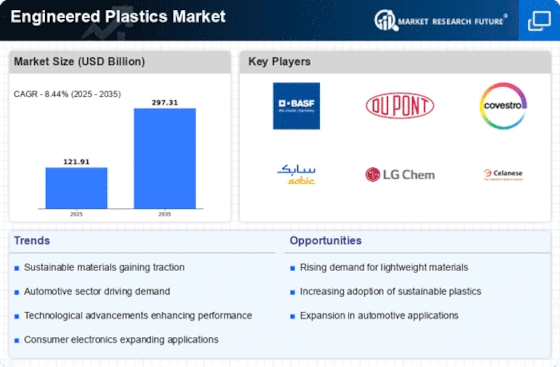
Key players in the Engineered Plastics Market include BASF, DuPont, Covestro, SABIC, and LG Chem.

How much is the Automotive & Transportation segment expected to be valued by 2035?

The Automotive & Transportation segment is expected to be valued at 70.0 USD Billion by 2035.

Market Summary

As per MRFR analysis, the Engineered Plastics Market Size was estimated at 121.91 USD Billion in 2024. The Engineered Plastics industry is projected to grow from 132.2 in 2025 to 297.31 by 2035, exhibiting a compound annual growth rate (CAGR) of 8.44 during the forecast period 2025 - 2035.

Key Market Trends & Highlights

The Engineered Plastics Market is poised for robust growth driven by sustainability and technological advancements.

  • North America remains the largest market for engineered plastics, driven by diverse industrial applications.
  • The Asia-Pacific region is emerging as the fastest-growing market, fueled by increasing manufacturing capabilities and demand.
  • Acrylonitrile Butadiene Styrene (ABS) dominates the market, while polyamides are witnessing rapid growth due to their superior properties.
  • Rising demand in the automotive sector and a focus on sustainable materials are key drivers propelling market expansion.

Market Size & Forecast

2024 Market Size 121.91 (USD Billion)
2035 Market Size 297.31 (USD Billion)
CAGR (2025 - 2035) 8.44%
Largest Regional Market Share in 2024 North America

Major Players

<p>BASF (DE), DuPont (US), Covestro (DE), SABIC (SA), LG Chem (KR), Celanese (US), Mitsubishi Chemical (JP), Solvay (BE), Eastman Chemical (US), Teijin (JP)</p>

Market Trends

The Engineered Plastics Market is currently experiencing a dynamic evolution, driven by advancements in technology and increasing demand across various sectors. Industries such as automotive, aerospace, and electronics are increasingly adopting engineered plastics due to their superior properties, including lightweight characteristics, durability, and resistance to chemicals. This shift towards lightweight materials is particularly notable as manufacturers seek to enhance fuel efficiency and reduce emissions. Furthermore, the growing emphasis on sustainability is prompting companies to explore bio-based engineered plastics, which may offer a more environmentally friendly alternative to traditional materials. In addition to sustainability, the Engineered Plastics Market is witnessing innovations in processing techniques, which could lead to enhanced performance and functionality of these materials. The integration of smart technologies into engineered plastics is also emerging, potentially enabling new applications in sectors like healthcare and consumer electronics. As the market continues to evolve, it appears that the interplay between technological advancements and environmental considerations will shape the future landscape of engineered plastics, presenting both challenges and opportunities for stakeholders in this sector.

Sustainability Initiatives

The Engineered Plastics Market is increasingly influenced by sustainability initiatives, as companies strive to reduce their environmental footprint. This trend involves the development of bio-based and recyclable engineered plastics, which may align with global efforts to promote eco-friendly practices. As consumers become more environmentally conscious, manufacturers are likely to prioritize sustainable materials in their product offerings.

Technological Advancements

Technological advancements are playing a crucial role in the Engineered Plastics Market, with innovations in processing methods and material formulations. These developments may enhance the performance characteristics of engineered plastics, making them suitable for a wider range of applications. The integration of smart technologies could also lead to the creation of intelligent materials that respond to environmental stimuli.

Market Diversification

Market diversification is becoming increasingly apparent within the Engineered Plastics Market, as companies explore new applications across various industries. This trend suggests a shift from traditional uses towards innovative applications in sectors such as healthcare, electronics, and construction. As industries evolve, the demand for specialized engineered plastics is likely to grow, creating new opportunities for manufacturers.

Engineered Plastics Market Market Drivers

Expansion in Medical Applications

The Engineered Plastics Market is experiencing a significant expansion in medical applications, driven by the increasing demand for advanced medical devices and equipment. Engineered plastics are favored in the healthcare sector due to their biocompatibility, sterilization capabilities, and ease of manufacturing. In 2025, the medical segment is projected to account for approximately 15% of the market share, as healthcare providers seek materials that ensure patient safety and product reliability. The versatility of engineered plastics allows for the production of a wide range of medical products, including surgical instruments, drug delivery systems, and diagnostic devices. As the healthcare industry continues to innovate, the reliance on engineered plastics is expected to grow, thereby contributing to the overall market growth.

Rising Demand in Automotive Sector

The Engineered Plastics Market is experiencing a notable surge in demand, particularly from the automotive sector. As manufacturers increasingly prioritize lightweight materials to enhance fuel efficiency and reduce emissions, engineered plastics are becoming a preferred choice. In 2025, the automotive segment is projected to account for approximately 30% of the total market share, driven by the need for durable and lightweight components. This shift not only aligns with regulatory standards but also caters to consumer preferences for eco-friendly vehicles. Furthermore, the versatility of engineered plastics allows for innovative designs, which can lead to improved performance and safety features in vehicles. As the automotive industry continues to evolve, the reliance on engineered plastics is likely to intensify, thereby propelling the market forward.

Increased Focus on Sustainable Materials

The Engineered Plastics Market is increasingly influenced by the global emphasis on sustainability and eco-friendly materials. As industries strive to reduce their carbon footprint, the demand for engineered plastics that are recyclable and made from renewable resources is on the rise. In 2025, it is estimated that sustainable engineered plastics will constitute approximately 20% of the market, reflecting a shift towards greener alternatives. Companies are investing in research and development to create bio-based engineered plastics that meet performance standards while minimizing environmental impact. This trend not only aligns with consumer expectations but also complies with stringent regulations aimed at reducing plastic waste. The growing focus on sustainability is likely to reshape the landscape of the engineered plastics market, encouraging innovation and responsible sourcing.

Growth in Electronics and Electrical Applications

The Engineered Plastics Market is witnessing substantial growth due to the increasing utilization of engineered plastics in electronics and electrical applications. With the rise of smart devices and the Internet of Things, there is a growing need for materials that offer excellent electrical insulation and thermal stability. In 2025, the electronics segment is expected to represent around 25% of the market, as manufacturers seek lightweight and durable materials for components such as housings, connectors, and circuit boards. The inherent properties of engineered plastics, such as resistance to heat and chemicals, make them ideal for these applications. As technology advances, the demand for high-performance engineered plastics in the electronics sector is anticipated to escalate, further driving the market's expansion.

Technological Innovations in Manufacturing Processes

The Engineered Plastics Market is significantly influenced by technological innovations in manufacturing processes. Advances in techniques such as 3D printing and injection molding are enhancing the efficiency and precision of engineered plastics production. In 2025, it is anticipated that these innovations will lead to a reduction in production costs by up to 15%, making engineered plastics more accessible to various industries. Furthermore, the ability to create complex geometries and customized solutions is likely to attract new applications across sectors such as aerospace, automotive, and consumer goods. As manufacturers adopt these cutting-edge technologies, the Engineered Plastics Market is expected to witness accelerated growth, driven by increased productivity and enhanced product offerings.

Market Segment Insights

By Type: Acrylonitrile Butadiene Styrene (ABS) (Largest) vs. Polyamides (Fastest-Growing)

<p>The Engineered Plastics Market is diverse, with Acrylonitrile Butadiene Styrene (ABS) holding the largest market share due to its versatile applications across automotive, consumer goods, and electronics. Other notable players include Polyamides, known for their strength and thermal stability, aligning well with modern manufacturing needs. Thermoplastic Polyester and Polycarbonate also command significant shares, catering to specialized sectors like packaging and optical components, respectively. Growth trends indicate a strong upward trajectory for Polyamides, driven by increasing demand from the automotive and aerospace sectors. Innovations in material formulations are enhancing the performance of engineering plastics, making them appealing for new applications. Additionally, rising environmental awareness is boosting interest in sustainable options, further propelling the growth of these engineered plastic types in the marketplace.</p>

<p>Acrylonitrile Butadiene Styrene (ABS) (Dominant) vs. Polyamides (Emerging)</p>

<p>Acrylonitrile Butadiene Styrene (ABS) is recognized for its excellent impact resistance and ability to be molded into intricate shapes, making it dominant in consumer product applications. Its widespread use in the automotive and electronic industries underlines its adaptability and performance efficiency. On the other hand, Polyamides, due to their high-shock resistance, chemical stability, and lightweight characteristics, are emerging rapidly, particularly in high-demand sectors such as automotive and industrial applications. They are increasingly being integrated into components that require durability and high performance, paving the way for innovative uses as manufacturers continue to prioritize efficiency and sustainability.</p>

By End-Use: Automotive & Transportation (Largest) vs. Medical (Fastest-Growing)

<p>The engineered plastics market prominently features the 'Automotive & Transportation' segment, which holds the largest market share due to the increasing demand for lightweight and durable materials in vehicle production. This sector benefits from the ongoing transition towards electric vehicles, which require advanced engineered plastics for critical components, thus driving a significant portion of the market. Meanwhile, the 'Medical' segment, while smaller, demonstrates rapid growth, fueled by the rising demand for innovative medical devices and packaging solutions that utilize engineered plastics for their sterilization properties and biocompatibility.</p>

<p>Automotive & Transportation: Dominant vs. Medical: Emerging</p>

<p>The 'Automotive & Transportation' segment is characterized by its substantial reliance on engineered plastics for components such as dashboards, bumpers, and fuel systems. This segment remains dominant due to continuous advancements in automotive design and safety regulations that favor lightweight materials. Conversely, the 'Medical' segment is emerging swiftly, driven by the need for advanced medical devices and equipment that enhance patient care. Engineered plastics in this sector offer benefits such as increased safety and efficacy, alongside compliance with stringent regulatory standards, making them essential in the development of innovative healthcare solutions.</p>

Get more detailed insights about Engineered Plastics Market Research Report—Global Forecast till 2035

Regional Insights

North America : Innovation and Demand Surge

North America is the largest market for engineered plastics, holding approximately 40% of the global share. The region's growth is driven by increasing demand in automotive, aerospace, and consumer goods sectors, alongside stringent regulations promoting lightweight materials. The U.S. leads this market, followed closely by Canada, as manufacturers seek to enhance product performance and sustainability. Key players such as DuPont, BASF, and Eastman Chemical dominate the landscape, leveraging advanced technologies and R&D capabilities. The competitive environment is characterized by strategic partnerships and innovations aimed at meeting evolving consumer needs. The presence of major automotive and electronics manufacturers further fuels demand, ensuring North America's pivotal role in the engineered plastics market.

Europe : Sustainability and Innovation Focus

Europe is the second-largest market for engineered plastics, accounting for around 30% of the global share. The region's growth is propelled by a strong emphasis on sustainability and innovation, with regulations such as the EU Plastics Strategy driving demand for eco-friendly materials. Countries like Germany and France are at the forefront, fostering a robust market environment through investments in research and development. Leading companies, including Covestro and SABIC, are actively engaged in developing advanced engineered plastics that meet stringent environmental standards. The competitive landscape is marked by collaborations between manufacturers and research institutions, aimed at enhancing product performance and reducing environmental impact. This focus on sustainability positions Europe as a key player in The Engineered Plastics Market.

Asia-Pacific : Rapid Growth and Expansion

Asia-Pacific is witnessing rapid growth in the engineered plastics market, holding approximately 25% of the global share. The region's expansion is driven by increasing industrialization, urbanization, and rising consumer demand in countries like China and India. Government initiatives promoting manufacturing and infrastructure development further catalyze market growth, making it a significant player in the global landscape. China stands out as the largest market, supported by a strong manufacturing base and investments in advanced technologies. Key players such as LG Chem and Mitsubishi Chemical are expanding their operations to meet the growing demand. The competitive landscape is characterized by a mix of local and international companies, all vying for market share in this dynamic environment, ensuring a robust future for engineered plastics in Asia-Pacific.

Middle East and Africa : Resource-Rich and Growing Market

The Middle East and Africa region is emerging as a significant player in the engineered plastics market, holding about 5% of the global share. The growth is driven by increasing investments in infrastructure and manufacturing, particularly in countries like Saudi Arabia and the UAE. The region's abundant natural resources and government initiatives to diversify economies are key catalysts for market expansion. Saudi Arabia is leading the market, with major companies like SABIC investing heavily in advanced materials. The competitive landscape is evolving, with both local and international players entering the market to capitalize on growth opportunities. As the region continues to develop its industrial capabilities, the demand for engineered plastics is expected to rise, positioning it as a frontier for future growth.

Key Players and Competitive Insights

The Engineered Plastics Market is currently characterized by a dynamic competitive landscape, driven by innovation, sustainability, and strategic partnerships. Key players such as BASF (Germany), DuPont (United States), and Covestro (Germany) are actively shaping the market through their distinct operational focuses. BASF (Germany) emphasizes sustainability in its product development, aiming to reduce carbon footprints while enhancing performance. DuPont (United States) is heavily investing in advanced materials and digital transformation, positioning itself as a leader in high-performance engineered plastics. Covestro (Germany) is pursuing aggressive regional expansion, particularly in Asia, to capitalize on the growing demand for engineered plastics in automotive and electronics sectors. Collectively, these strategies not only enhance their competitive positioning but also contribute to a more innovative and sustainable market environment.

In terms of business tactics, companies are increasingly localizing manufacturing and optimizing supply chains to enhance efficiency and responsiveness to market demands. The Engineered Plastics Market appears moderately fragmented, with a mix of established players and emerging companies. The collective influence of these key players is significant, as they drive technological advancements and set industry standards, thereby shaping the overall market structure.

In August 2025, BASF (Germany) announced a partnership with a leading automotive manufacturer to develop bio-based engineered plastics aimed at reducing vehicle weight and enhancing fuel efficiency. This strategic move underscores BASF's commitment to sustainability and innovation, potentially positioning it as a frontrunner in the eco-friendly materials segment of the automotive industry. The collaboration is expected to leverage both companies' strengths, fostering advancements in material science and application.

In September 2025, DuPont (United States) launched a new line of high-performance polymers designed for use in electronic applications, emphasizing their durability and thermal stability. This introduction reflects DuPont's strategic focus on digital transformation and innovation, catering to the increasing demand for advanced materials in the electronics sector. The launch is likely to enhance DuPont's market share and reinforce its reputation as a leader in engineered plastics.

In July 2025, Covestro (Germany) expanded its production capacity for polycarbonate materials in Asia, responding to the rising demand from the automotive and electronics industries. This expansion not only signifies Covestro's commitment to regional growth but also highlights its strategic focus on meeting the needs of high-growth markets. The increased capacity is expected to strengthen Covestro's competitive edge in the rapidly evolving landscape of engineered plastics.

As of October 2025, the Engineered Plastics Market is witnessing trends such as digitalization, sustainability, and the integration of artificial intelligence in production processes. Strategic alliances are becoming increasingly pivotal, as companies collaborate to enhance innovation and sustainability efforts. Looking ahead, competitive differentiation is likely to evolve, shifting from traditional price-based competition to a focus on innovation, technological advancements, and supply chain reliability. This transition may redefine market dynamics, compelling companies to invest in R&D and sustainable practices to maintain their competitive edge.

Key Companies in the Engineered Plastics Market market include

Industry Developments

In May 2024, Polyplastics, a multinational engineering plastics leader, unveiled a new PPS grade that is highly resistant to thermal shock and can be recycled during post-consumer recycling without sorting.

October 2023: In an announcement made by 3M Company, it said that the firm will increase its environmental endeavors, such as being carbon neutral by 2050, and spend $1 billion over the next two decades for this purpose.

Celanese Corp announced in November 2023 the global commercial launch of two new grades of polyamides, namely Frianyl PA W-Series and Celanyl PA B3 GF30 E, for manufacturers of electric vehicle (EV) powertrain components and batteries.

In May 2023, Stelora was launched by Borealis, which is one of the leading players in advanced & circular plastic solutions, base chemicals & fertilizers in Europe, plus mechanical recycling of plastics based on sound sustainability principles.

In July 2022, Vaski entered the US industrial machine service and sales market, as well as Mexico. It offers punching, bending, and shearing technologies along with high-level automation developments. This development will boost the production of various engineered plastic resins.

In March 2022, Celanese Corporation, the global chemical and specialty materials company, completed the restructuring of Korea Engineering Plastics Co. This support will provide access to world-scale POM polymerization capabilities and thus enhance Celenese products worldwide in polyoxymethylene (POM) via globally renowned Korean acetals manufacture.

In March 2021, the US-based specialty polymers manufacturer Victrex Plc invested $1 million into its Asian Innovation and Technology Centre (AITC) located in Shanghai. This move is aimed at speeding up innovation and shortening design-to-mass production workflow cycle times for advanced engineering designs within Asia.

In February 2020, Royal DSM, the company out of Evansville in the state of Indiana, in the USA, announced that it was upgrading and expanding its high-performance materials compounding facility. This calls for the expansion of DSM’s facility to produce advanced new-generation materials such as bio-based thermoplastic formulations

Future Outlook

Engineered Plastics Market Future Outlook

<p>The Engineered Plastics Market is projected to grow at an 8.44% CAGR from 2024 to 2035, driven by advancements in technology, increasing demand in automotive, and sustainable material innovations.</p>

New opportunities lie in:

  • <p>Development of bio-based engineered plastics for eco-friendly applications.</p>
  • <p>Investment in advanced recycling technologies to enhance material recovery.</p>
  • <p>Expansion into emerging markets with tailored product offerings.</p>

<p>By 2035, the Engineered Plastics Market is expected to achieve substantial growth and innovation.</p>

Market Segmentation

Engineered Plastics Market Type Outlook

  • Acrylonitrile Butadiene Styrene (ABS)
  • Polyamides
  • Polycarbonates
  • Thermoplastic Polyester
  • Polyacetals
  • Fluoropolymers
  • Polyphenylene Sulfide (PPS)
  • Polymethyl Methacrylate (PMMA)
  • Polyphenylene Oxide (PPO)
  • Polyetheretherketone (PEEK)
  • Polyethylene Terephthalate (PET)

Engineered Plastics Market End-Use Outlook

  • Automotive & Transportation
  • Consumer Appliances
  • Electrical & Electronics
  • Industrial & Machinery
  • Packaging
  • Medical

Report Scope

MARKET SIZE 2024121.91(USD Billion)
MARKET SIZE 2025132.2(USD Billion)
MARKET SIZE 2035297.31(USD Billion)
COMPOUND ANNUAL GROWTH RATE (CAGR)8.44% (2024 - 2035)
REPORT COVERAGERevenue Forecast, Competitive Landscape, Growth Factors, and Trends
BASE YEAR2024
Market Forecast Period2025 - 2035
Historical Data2019 - 2024
Market Forecast UnitsUSD Billion
Key Companies ProfiledMarket analysis in progress
Segments CoveredMarket segmentation analysis in progress
Key Market OpportunitiesGrowing demand for lightweight materials in automotive and aerospace sectors drives Engineered Plastics Market expansion.
Key Market DynamicsRising demand for lightweight materials drives innovation and competition in the engineered plastics sector.
Countries CoveredNorth America, Europe, APAC, South America, MEA

FAQs

What is the projected market valuation of the Engineered Plastics Market by 2035?

The Engineered Plastics Market is projected to reach a valuation of 297.31 USD Billion by 2035.

What was the market valuation of the Engineered Plastics Market in 2024?

In 2024, the Engineered Plastics Market was valued at 121.91 USD Billion.

What is the expected CAGR for the Engineered Plastics Market during the forecast period 2025 - 2035?

The expected CAGR for the Engineered Plastics Market during the forecast period 2025 - 2035 is 8.44%.

Which segment is projected to have the highest valuation in the Engineered Plastics Market by 2035?

The Polyethylene Terephthalate (PET) segment is projected to reach a valuation of 60.0 USD Billion by 2035.

What are the key players in the Engineered Plastics Market?

Key players in the Engineered Plastics Market include BASF, DuPont, Covestro, SABIC, and LG Chem.

How much is the Automotive & Transportation segment expected to be valued by 2035?

The Automotive & Transportation segment is expected to be valued at 70.0 USD Billion by 2035.

  1. SECTION I: EXECUTIVE SUMMARY AND KEY HIGHLIGHTS
    1. EXECUTIVE SUMMARY
      1. Market Overview
      2. Key Findings
      3. Market Segmentation
      4. Competitive Landscape
      5. Challenges and Opportunities
      6. Future Outlook
  2. SECTION II: SCOPING, METHODOLOGY AND MARKET STRUCTURE
    1. MARKET INTRODUCTION
      1. Definition
      2. Scope of the study
    2. RESEARCH METHODOLOGY
      1. Overview
      2. Data Mining
      3. Secondary Research
      4. Primary Research
      5. Forecasting Model
      6. Market Size Estimation
      7. Data Triangulation
      8. Validation
  3. SECTION III: QUALITATIVE ANALYSIS
    1. MARKET DYNAMICS
      1. Overview
      2. Drivers
      3. Restraints
      4. Opportunities
    2. MARKET FACTOR ANALYSIS
      1. Value chain Analysis
      2. Porter's Five Forces Analysis
      3. COVID-19 Impact Analysis
  4. SECTION IV: QUANTITATIVE ANALYSIS
    1. Chemicals and Materials, BY Type (USD Billion)
      1. Acrylonitrile Butadiene Styrene (ABS)
      2. Polyamides
      3. Polycarbonates
      4. Thermoplastic Polyester
      5. Polyacetals
      6. Fluoropolymers
      7. Polyphenylene Sulfide (PPS)
      8. Polymethyl Methacrylate (PMMA)
      9. Polyphenylene Oxide (PPO)
      10. Polyetheretherketone (PEEK)
      11. Polyethylene Terephthalate (PET)
    2. Chemicals and Materials, BY End-Use (USD Billion)
      1. Automotive & Transportation
      2. Consumer Appliances
      3. Electrical & Electronics
      4. Industrial & Machinery
      5. Packaging
      6. Medical
    3. Chemicals and Materials, BY Region (USD Billion)
      1. North America
      2. Europe
      3. APAC
      4. South America
      5. MEA
  5. SECTION V: COMPETITIVE ANALYSIS
    1. Competitive Landscape
      1. Overview
      2. Competitive Analysis
      3. Market share Analysis
      4. Major Growth Strategy in the Chemicals and Materials
      5. Competitive Benchmarking
      6. Leading Players in Terms of Number of Developments in the Chemicals and Materials
      7. Key developments and growth strategies
      8. Major Players Financial Matrix
    2. Company Profiles
      1. BASF (DE)
      2. DuPont (US)
      3. Covestro (DE)
      4. SABIC (SA)
      5. LG Chem (KR)
      6. Celanese (US)
      7. Mitsubishi Chemical (JP)
      8. Solvay (BE)
      9. Eastman Chemical (US)
      10. Teijin (JP)
    3. Appendix
      1. References
      2. Related Reports
  6. LIST OF FIGURES
    1. MARKET SYNOPSIS
    2. NORTH AMERICA MARKET ANALYSIS
    3. US MARKET ANALYSIS BY TYPE
    4. US MARKET ANALYSIS BY END-USE
    5. CANADA MARKET ANALYSIS BY TYPE
    6. CANADA MARKET ANALYSIS BY END-USE
    7. EUROPE MARKET ANALYSIS
    8. GERMANY MARKET ANALYSIS BY TYPE
    9. GERMANY MARKET ANALYSIS BY END-USE
    10. UK MARKET ANALYSIS BY TYPE
    11. UK MARKET ANALYSIS BY END-USE
    12. FRANCE MARKET ANALYSIS BY TYPE
    13. FRANCE MARKET ANALYSIS BY END-USE
    14. RUSSIA MARKET ANALYSIS BY TYPE
    15. RUSSIA MARKET ANALYSIS BY END-USE
    16. ITALY MARKET ANALYSIS BY TYPE
    17. ITALY MARKET ANALYSIS BY END-USE
    18. SPAIN MARKET ANALYSIS BY TYPE
    19. SPAIN MARKET ANALYSIS BY END-USE
    20. REST OF EUROPE MARKET ANALYSIS BY TYPE
    21. REST OF EUROPE MARKET ANALYSIS BY END-USE
    22. APAC MARKET ANALYSIS
    23. CHINA MARKET ANALYSIS BY TYPE
    24. CHINA MARKET ANALYSIS BY END-USE
    25. INDIA MARKET ANALYSIS BY TYPE
    26. INDIA MARKET ANALYSIS BY END-USE
    27. JAPAN MARKET ANALYSIS BY TYPE
    28. JAPAN MARKET ANALYSIS BY END-USE
    29. SOUTH KOREA MARKET ANALYSIS BY TYPE
    30. SOUTH KOREA MARKET ANALYSIS BY END-USE
    31. MALAYSIA MARKET ANALYSIS BY TYPE
    32. MALAYSIA MARKET ANALYSIS BY END-USE
    33. THAILAND MARKET ANALYSIS BY TYPE
    34. THAILAND MARKET ANALYSIS BY END-USE
    35. INDONESIA MARKET ANALYSIS BY TYPE
    36. INDONESIA MARKET ANALYSIS BY END-USE
    37. REST OF APAC MARKET ANALYSIS BY TYPE
    38. REST OF APAC MARKET ANALYSIS BY END-USE
    39. SOUTH AMERICA MARKET ANALYSIS
    40. BRAZIL MARKET ANALYSIS BY TYPE
    41. BRAZIL MARKET ANALYSIS BY END-USE
    42. MEXICO MARKET ANALYSIS BY TYPE
    43. MEXICO MARKET ANALYSIS BY END-USE
    44. ARGENTINA MARKET ANALYSIS BY TYPE
    45. ARGENTINA MARKET ANALYSIS BY END-USE
    46. REST OF SOUTH AMERICA MARKET ANALYSIS BY TYPE
    47. REST OF SOUTH AMERICA MARKET ANALYSIS BY END-USE
    48. MEA MARKET ANALYSIS
    49. GCC COUNTRIES MARKET ANALYSIS BY TYPE
    50. GCC COUNTRIES MARKET ANALYSIS BY END-USE
    51. SOUTH AFRICA MARKET ANALYSIS BY TYPE
    52. SOUTH AFRICA MARKET ANALYSIS BY END-USE
    53. REST OF MEA MARKET ANALYSIS BY TYPE
    54. REST OF MEA MARKET ANALYSIS BY END-USE
    55. KEY BUYING CRITERIA OF CHEMICALS AND MATERIALS
    56. RESEARCH PROCESS OF MRFR
    57. DRO ANALYSIS OF CHEMICALS AND MATERIALS
    58. DRIVERS IMPACT ANALYSIS: CHEMICALS AND MATERIALS
    59. RESTRAINTS IMPACT ANALYSIS: CHEMICALS AND MATERIALS
    60. SUPPLY / VALUE CHAIN: CHEMICALS AND MATERIALS
    61. CHEMICALS AND MATERIALS, BY TYPE, 2024 (% SHARE)
    62. CHEMICALS AND MATERIALS, BY TYPE, 2024 TO 2035 (USD Billion)
    63. CHEMICALS AND MATERIALS, BY END-USE, 2024 (% SHARE)
    64. CHEMICALS AND MATERIALS, BY END-USE, 2024 TO 2035 (USD Billion)
    65. BENCHMARKING OF MAJOR COMPETITORS
  7. LIST OF TABLES
    1. LIST OF ASSUMPTIONS
    2. North America MARKET SIZE ESTIMATES; FORECAST
      1. BY TYPE, 2025-2035 (USD Billion)
      2. BY END-USE, 2025-2035 (USD Billion)
    3. US MARKET SIZE ESTIMATES; FORECAST
      1. BY TYPE, 2025-2035 (USD Billion)
      2. BY END-USE, 2025-2035 (USD Billion)
    4. Canada MARKET SIZE ESTIMATES; FORECAST
      1. BY TYPE, 2025-2035 (USD Billion)
      2. BY END-USE, 2025-2035 (USD Billion)
    5. Europe MARKET SIZE ESTIMATES; FORECAST
      1. BY TYPE, 2025-2035 (USD Billion)
      2. BY END-USE, 2025-2035 (USD Billion)
    6. Germany MARKET SIZE ESTIMATES; FORECAST
      1. BY TYPE, 2025-2035 (USD Billion)
      2. BY END-USE, 2025-2035 (USD Billion)
    7. UK MARKET SIZE ESTIMATES; FORECAST
      1. BY TYPE, 2025-2035 (USD Billion)
      2. BY END-USE, 2025-2035 (USD Billion)
    8. France MARKET SIZE ESTIMATES; FORECAST
      1. BY TYPE, 2025-2035 (USD Billion)
      2. BY END-USE, 2025-2035 (USD Billion)
    9. Russia MARKET SIZE ESTIMATES; FORECAST
      1. BY TYPE, 2025-2035 (USD Billion)
      2. BY END-USE, 2025-2035 (USD Billion)
    10. Italy MARKET SIZE ESTIMATES; FORECAST
      1. BY TYPE, 2025-2035 (USD Billion)
      2. BY END-USE, 2025-2035 (USD Billion)
    11. Spain MARKET SIZE ESTIMATES; FORECAST
      1. BY TYPE, 2025-2035 (USD Billion)
      2. BY END-USE, 2025-2035 (USD Billion)
    12. Rest of Europe MARKET SIZE ESTIMATES; FORECAST
      1. BY TYPE, 2025-2035 (USD Billion)
      2. BY END-USE, 2025-2035 (USD Billion)
    13. APAC MARKET SIZE ESTIMATES; FORECAST
      1. BY TYPE, 2025-2035 (USD Billion)
      2. BY END-USE, 2025-2035 (USD Billion)
    14. China MARKET SIZE ESTIMATES; FORECAST
      1. BY TYPE, 2025-2035 (USD Billion)
      2. BY END-USE, 2025-2035 (USD Billion)
    15. India MARKET SIZE ESTIMATES; FORECAST
      1. BY TYPE, 2025-2035 (USD Billion)
      2. BY END-USE, 2025-2035 (USD Billion)
    16. Japan MARKET SIZE ESTIMATES; FORECAST
      1. BY TYPE, 2025-2035 (USD Billion)
      2. BY END-USE, 2025-2035 (USD Billion)
    17. South Korea MARKET SIZE ESTIMATES; FORECAST
      1. BY TYPE, 2025-2035 (USD Billion)
      2. BY END-USE, 2025-2035 (USD Billion)
    18. Malaysia MARKET SIZE ESTIMATES; FORECAST
      1. BY TYPE, 2025-2035 (USD Billion)
      2. BY END-USE, 2025-2035 (USD Billion)
    19. Thailand MARKET SIZE ESTIMATES; FORECAST
      1. BY TYPE, 2025-2035 (USD Billion)
      2. BY END-USE, 2025-2035 (USD Billion)
    20. Indonesia MARKET SIZE ESTIMATES; FORECAST
      1. BY TYPE, 2025-2035 (USD Billion)
      2. BY END-USE, 2025-2035 (USD Billion)
    21. Rest of APAC MARKET SIZE ESTIMATES; FORECAST
      1. BY TYPE, 2025-2035 (USD Billion)
      2. BY END-USE, 2025-2035 (USD Billion)
    22. South America MARKET SIZE ESTIMATES; FORECAST
      1. BY TYPE, 2025-2035 (USD Billion)
      2. BY END-USE, 2025-2035 (USD Billion)
    23. Brazil MARKET SIZE ESTIMATES; FORECAST
      1. BY TYPE, 2025-2035 (USD Billion)
      2. BY END-USE, 2025-2035 (USD Billion)
    24. Mexico MARKET SIZE ESTIMATES; FORECAST
      1. BY TYPE, 2025-2035 (USD Billion)
      2. BY END-USE, 2025-2035 (USD Billion)
    25. Argentina MARKET SIZE ESTIMATES; FORECAST
      1. BY TYPE, 2025-2035 (USD Billion)
      2. BY END-USE, 2025-2035 (USD Billion)
    26. Rest of South America MARKET SIZE ESTIMATES; FORECAST
      1. BY TYPE, 2025-2035 (USD Billion)
      2. BY END-USE, 2025-2035 (USD Billion)
    27. MEA MARKET SIZE ESTIMATES; FORECAST
      1. BY TYPE, 2025-2035 (USD Billion)
      2. BY END-USE, 2025-2035 (USD Billion)
    28. GCC Countries MARKET SIZE ESTIMATES; FORECAST
      1. BY TYPE, 2025-2035 (USD Billion)
      2. BY END-USE, 2025-2035 (USD Billion)
    29. South Africa MARKET SIZE ESTIMATES; FORECAST
      1. BY TYPE, 2025-2035 (USD Billion)
      2. BY END-USE, 2025-2035 (USD Billion)
    30. Rest of MEA MARKET SIZE ESTIMATES; FORECAST
      1. BY TYPE, 2025-2035 (USD Billion)
      2. BY END-USE, 2025-2035 (USD Billion)
    31. PRODUCT LAUNCH/PRODUCT DEVELOPMENT/APPROVAL
    32. ACQUISITION/PARTNERSHIP

Engineered Plastics Market Type Outlook (USD Billion, 2018-2032)

  • Acrylonitrile Butadiene Styrene (ABS)
  • Polyamides
  • Polycarbonates
  • Thermoplastic Polyester
  • Polyacetales
  • Fluoropolymers
  • Polyphenylene Sulfide (PPS)
  • Polymethyl Methacrylate (PMMA)
  • Polyphenylene Oxide (PPO)
  • Polyetheretherketone (PEEK)
  • Polyethylene Terephthalate (PET)

Engineered Plastics Market End-Use Outlook (USD Billion, 2018-2032)

  • Automotive & Transportation
  • Consumer Appliances
  • Electrical & Electronics
  • Industrial & Machinery
  • Packaging
  • Medical

Engineered Plastics Market Regional Outlook (USD Billion, 2018-2032)

  • North America Outlook (USD Billion, 2018-2032)

    • North America Engineered Plastics Market by Type
      • Acrylonitrile Butadiene Styrene (ABS)
      • Polyamides
      • Polycarbonates
      • Thermoplastic Polyester
      • Polyacetales
      • Fluoropolymers
      • Polyphenylene Sulfide (PPS)
      • Polymethyl Methacrylate (PMMA)
      • Polyphenylene Oxide (PPO)
      • Polyetheretherketone (PEEK)
    • North America Engineered Plastics Market by End-Use
      • Automotive & Transportation
      • Consumer Appliances
      • Electrical & Electronics
      • Industrial & Machinery
      • Packaging
      • Medical
    • US Outlook (USD Billion, 2018-2032)

    • US Engineered Plastics Market by Type
      • Acrylonitrile Butadiene Styrene (ABS)
      • Polyamides
      • Polycarbonates
      • Thermoplastic Polyester
      • Polyacetales
      • Fluoropolymers
      • Polyphenylene Sulfide (PPS)
      • Polymethyl Methacrylate (PMMA)
      • Polyphenylene Oxide (PPO)
      • Polyetheretherketone (PEEK)
    • US Engineered Plastics Market by End-Use
      • Automotive & Transportation
      • Consumer Appliances
      • Electrical & Electronics
      • Industrial & Machinery
      • Packaging
      • Medical
    • CANADA Outlook (USD Billion, 2018-2032)

    • CANADA Engineered Plastics Market by Type
      • Acrylonitrile Butadiene Styrene (ABS)
      • Polyamides
      • Polycarbonates
      • Thermoplastic Polyester
      • Polyacetales
      • Fluoropolymers
      • Polyphenylene Sulfide (PPS)
      • Polymethyl Methacrylate (PMMA)
      • Polyphenylene Oxide (PPO)
      • Polyetheretherketone (PEEK)
    • CANADA Engineered Plastics Market by End-Use
      • Automotive & Transportation
      • Consumer Appliances
      • Electrical & Electronics
      • Industrial & Machinery
      • Packaging
      • Medical

  • Europe Outlook (USD Billion, 2018-2032)

    • Europe Engineered Plastics Market by Type
      • Acrylonitrile Butadiene Styrene (ABS)
      • Polyamides
      • Polycarbonates
      • Thermoplastic Polyester
      • Polyacetales
      • Fluoropolymers
      • Polyphenylene Sulfide (PPS)
      • Polymethyl Methacrylate (PMMA)
      • Polyphenylene Oxide (PPO)
      • Polyetheretherketone (PEEK)
    • Europe Engineered Plastics Market by End-Use
      • Automotive & Transportation
      • Consumer Appliances
      • Electrical & Electronics
      • Industrial & Machinery
      • Packaging
      • Medical
    • Germany Outlook (USD Billion, 2018-2032)

    • Germany Engineered Plastics Market by Type
      • Acrylonitrile Butadiene Styrene (ABS)
      • Polyamides
      • Polycarbonates
      • Thermoplastic Polyester
      • Polyacetales
      • Fluoropolymers
      • Polyphenylene Sulfide (PPS)
      • Polymethyl Methacrylate (PMMA)
      • Polyphenylene Oxide (PPO)
      • Polyetheretherketone (PEEK)
    • Germany Engineered Plastics Market by End-Use
      • Automotive & Transportation
      • Consumer Appliances
      • Electrical & Electronics
      • Industrial & Machinery
      • Packaging
      • Medical
    • France Outlook (USD Billion, 2018-2032)

    • France Engineered Plastics Market by Type
      • Acrylonitrile Butadiene Styrene (ABS)
      • Polyamides
      • Polycarbonates
      • Thermoplastic Polyester
      • Polyacetales
      • Fluoropolymers
      • Polyphenylene Sulfide (PPS)
      • Polymethyl Methacrylate (PMMA)
      • Polyphenylene Oxide (PPO)
      • Polyetheretherketone (PEEK)
    • France Engineered Plastics Market by End-Use
      • Automotive & Transportation
      • Consumer Appliances
      • Electrical & Electronics
      • Industrial & Machinery
      • Packaging
      • Medical
    • UK Outlook (USD Billion, 2018-2032)

    • UK Engineered Plastics Market by Type
      • Acrylonitrile Butadiene Styrene (ABS)
      • Polyamides
      • Polycarbonates
      • Thermoplastic Polyester
      • Polyacetales
      • Fluoropolymers
      • Polyphenylene Sulfide (PPS)
      • Polymethyl Methacrylate (PMMA)
      • Polyphenylene Oxide (PPO)
      • Polyetheretherketone (PEEK)
    • UK Engineered Plastics Market by End-Use
      • Automotive & Transportation
      • Consumer Appliances
      • Electrical & Electronics
      • Industrial & Machinery
      • Packaging
      • Medical
    • ITALY Outlook (USD Billion, 2018-2032)

    • ITALY Engineered Plastics Market by Type
      • Acrylonitrile Butadiene Styrene (ABS)
      • Polyamides
      • Polycarbonates
      • Thermoplastic Polyester
      • Polyacetales
      • Fluoropolymers
      • Polyphenylene Sulfide (PPS)
      • Polymethyl Methacrylate (PMMA)
      • Polyphenylene Oxide (PPO)
      • Polyetheretherketone (PEEK)
    • ITALY Engineered Plastics Market by End-Use
      • Automotive & Transportation
      • Consumer Appliances
      • Electrical & Electronics
      • Industrial & Machinery
      • Packaging
      • Medical
    • SPAIN Outlook (USD Billion, 2018-2032)

    • SPAIN Engineered Plastics Market by Type
      • Acrylonitrile Butadiene Styrene (ABS)
      • Polyamides
      • Polycarbonates
      • Thermoplastic Polyester
      • Polyacetales
      • Fluoropolymers
      • Polyphenylene Sulfide (PPS)
      • Polymethyl Methacrylate (PMMA)
      • Polyphenylene Oxide (PPO)
      • Polyetheretherketone (PEEK)
    • SPAIN Engineered Plastics Market by End-Use
      • Automotive & Transportation
      • Consumer Appliances
      • Electrical & Electronics
      • Industrial & Machinery
      • Packaging
      • Medical
    • Rest Of Europe Outlook (USD Billion, 2018-2032)

    • Rest Of Europe Engineered Plastics Market by Type
      • Acrylonitrile Butadiene Styrene (ABS)
      • Polyamides
      • Polycarbonates
      • Thermoplastic Polyester
      • Polyacetales
      • Fluoropolymers
      • Polyphenylene Sulfide (PPS)
      • Polymethyl Methacrylate (PMMA)
      • Polyphenylene Oxide (PPO)
      • Polyetheretherketone (PEEK)
    • Rest Of Europe Engineered Plastics Market by End-Use
      • Automotive & Transportation
      • Consumer Appliances
      • Electrical & Electronics
      • Industrial & Machinery
      • Packaging
      • Medical
  • Asia-Pacific Outlook (USD Billion, 2018-2032)

    • Asia-Pacific Engineered Plastics Market by Type
      • Acrylonitrile Butadiene Styrene (ABS)
      • Polyamides
      • Polycarbonates
      • Thermoplastic Polyester
      • Polyacetales
      • Fluoropolymers
      • Polyphenylene Sulfide (PPS)
      • Polymethyl Methacrylate (PMMA)
      • Polyphenylene Oxide (PPO)
      • Polyetheretherketone (PEEK)
    • Asia-Pacific Engineered Plastics Market by End-Use
      • Automotive & Transportation
      • Consumer Appliances
      • Electrical & Electronics
      • Industrial & Machinery
      • Packaging
      • Medical
    • China Outlook (USD Billion, 2018-2032)

    • China Engineered Plastics Market by Type
      • Acrylonitrile Butadiene Styrene (ABS)
      • Polyamides
      • Polycarbonates
      • Thermoplastic Polyester
      • Polyacetales
      • Fluoropolymers
      • Polyphenylene Sulfide (PPS)
      • Polymethyl Methacrylate (PMMA)
      • Polyphenylene Oxide (PPO)
      • Polyetheretherketone (PEEK)
    • China Engineered Plastics Market by End-Use
      • Automotive & Transportation
      • Consumer Appliances
      • Electrical & Electronics
      • Industrial & Machinery
      • Packaging
      • Medical
    • Japan Outlook (USD Billion, 2018-2032)

    • Japan Engineered Plastics Market by Type
      • Acrylonitrile Butadiene Styrene (ABS)
      • Polyamides
      • Polycarbonates
      • Thermoplastic Polyester
      • Polyacetales
      • Fluoropolymers
      • Polyphenylene Sulfide (PPS)
      • Polymethyl Methacrylate (PMMA)
      • Polyphenylene Oxide (PPO)
      • Polyetheretherketone (PEEK)
    • Japan Engineered Plastics Market by End-Use
      • Automotive & Transportation
      • Consumer Appliances
      • Electrical & Electronics
      • Industrial & Machinery
      • Packaging
      • Medical
    • India Outlook (USD Billion, 2018-2032)

    • India Engineered Plastics Market by Type
      • Acrylonitrile Butadiene Styrene (ABS)
      • Polyamides
      • Polycarbonates
      • Thermoplastic Polyester
      • Polyacetales
      • Fluoropolymers
      • Polyphenylene Sulfide (PPS)
      • Polymethyl Methacrylate (PMMA)
      • Polyphenylene Oxide (PPO)
      • Polyetheretherketone (PEEK)
    • India Engineered Plastics Market by End-Use
      • Automotive & Transportation
      • Consumer Appliances
      • Electrical & Electronics
      • Industrial & Machinery
      • Packaging
      • Medical
    • Australia Outlook (USD Billion, 2018-2032)

    • Australia Engineered Plastics Market by Type
      • Acrylonitrile Butadiene Styrene (ABS)
      • Polyamides
      • Polycarbonates
      • Thermoplastic Polyester
      • Polyacetales
      • Fluoropolymers
      • Polyphenylene Sulfide (PPS)
      • Polymethyl Methacrylate (PMMA)
      • Polyphenylene Oxide (PPO)
      • Polyetheretherketone (PEEK)
    • Australia Engineered Plastics Market by End-Use
      • Automotive & Transportation
      • Consumer Appliances
      • Electrical & Electronics
      • Industrial & Machinery
      • Packaging
      • Medical
    • Rest of Asia-Pacific Outlook (USD Billion, 2018-2032)

    • Rest of Asia-Pacific Engineered Plastics Market by Type
      • Acrylonitrile Butadiene Styrene (ABS)
      • Polyamides
      • Polycarbonates
      • Thermoplastic Polyester
      • Polyacetales
      • Fluoropolymers
      • Polyphenylene Sulfide (PPS)
      • Polymethyl Methacrylate (PMMA)
      • Polyphenylene Oxide (PPO)
      • Polyetheretherketone (PEEK)
    • Rest of Asia-Pacific Engineered Plastics Market by End-Use
      • Automotive & Transportation
      • Consumer Appliances
      • Electrical & Electronics
      • Industrial & Machinery
      • Packaging
      • Medical
  • Rest of the World Outlook (USD Billion, 2018-2032)

    • Rest of the World Engineered Plastics Market by Type

      • Acrylonitrile Butadiene Styrene (ABS)
      • Polyamides
      • Polycarbonates
      • Thermoplastic Polyester
      • Polyacetales
      • Fluoropolymers
      • Polyphenylene Sulfide (PPS)
      • Polymethyl Methacrylate (PMMA)
      • Polyphenylene Oxide (PPO)
      • Polyetheretherketone (PEEK)
    • Rest of the World Engineered Plastics Market by End-Use
      • Automotive & Transportation
      • Consumer Appliances
      • Electrical & Electronics
      • Industrial & Machinery
      • Packaging
      • Medical
    • Middle East Outlook (USD Billion, 2018-2032)

    • Middle East Engineered Plastics Market by Type
      • Acrylonitrile Butadiene Styrene (ABS)
      • Polyamides
      • Polycarbonates
      • Thermoplastic Polyester
      • Polyacetales
      • Fluoropolymers
      • Polyphenylene Sulfide (PPS)
      • Polymethyl Methacrylate (PMMA)
      • Polyphenylene Oxide (PPO)
      • Polyetheretherketone (PEEK)
    • Middle East Engineered Plastics Market by End-Use
      • Automotive & Transportation
      • Consumer Appliances
      • Electrical & Electronics
      • Industrial & Machinery
      • Packaging
      • Medical
    • Africa Outlook (USD Billion, 2018-2032)

    • Africa Engineered Plastics Market by Type
      • Acrylonitrile Butadiene Styrene (ABS)
      • Polyamides
      • Polycarbonates
      • Thermoplastic Polyester
      • Polyacetales
      • Fluoropolymers
      • Polyphenylene Sulfide (PPS)
      • Polymethyl Methacrylate (PMMA)
      • Polyphenylene Oxide (PPO)
      • Polyetheretherketone (PEEK)
    • Africa Engineered Plastics Market by End-Use
      • Automotive & Transportation
      • Consumer Appliances
      • Electrical & Electronics
      • Industrial & Machinery
      • Packaging
      • Medical
    • Latin America Outlook (USD Billion, 2018-2032)

    • Latin America Engineered Plastics Market by Type
      • Acrylonitrile Butadiene Styrene (ABS)
      • Polyamides
      • Polycarbonates
      • Thermoplastic Polyester
      • Polyacetales
      • Fluoropolymers
      • Polyphenylene Sulfide (PPS)
      • Polymethyl Methacrylate (PMMA)
      • Polyphenylene Oxide (PPO)
      • Polyetheretherketone (PEEK)
    • America Engineered Plastics Market by End-Use
      • Automotive & Transportation
      • Consumer Appliances
      • Electrical & Electronics
      • Industrial & Machinery
      • Packaging
      • Medical
Infographic

Free Sample Request

Kindly complete the form below to receive a free sample of this Report

Get Free Sample

Customer Strories

Compare Licence

×
Features License Type
Single User Multiuser License Enterprise User
Price $4,950 $5,950 $7,250
Maximum User Access Limit 1 User Upto 10 Users Unrestricted Access Throughout the Organization
Free Customization
Direct Access to Analyst
Deliverable Format
Platform Access
Discount on Next Purchase 10% 15% 15%
Printable Versions