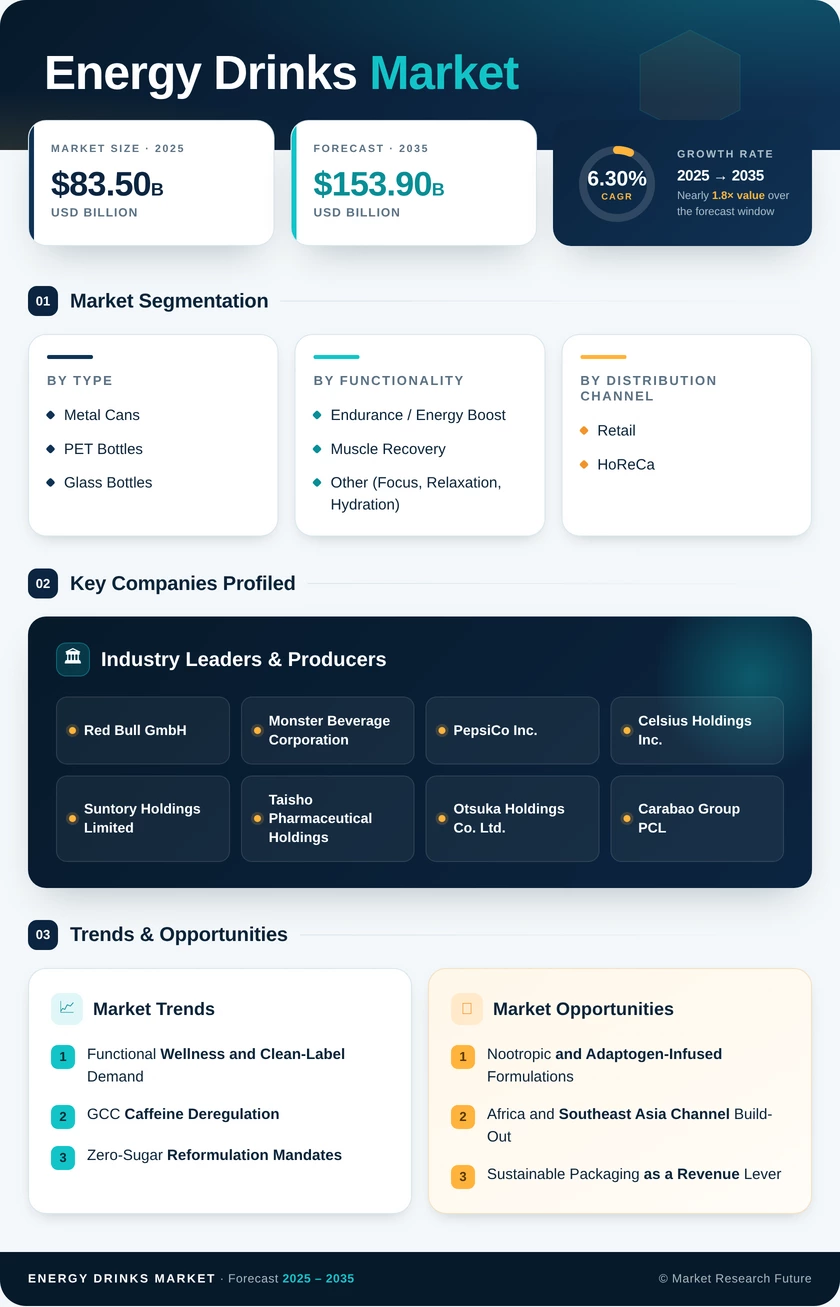
Energy Drinks Market

ID: MRFR/FnB/1384-CR
200 Pages
Snehal Singh
Last Updated: June 26, 2026
Energy Drinks Market Size, Share, Industry Trend & Analysis Research Report By Type (Traditional, Sugar-Free / Low-Calorie, Natural / Organic), By Packaging Type (Metal Cans, PET Bottles, Glass Bottles), By Functionality (Endurance / Energy Boost, Muscle Recovery, Other), By Distribution Channel (Retail, HoReCa), By Geography (North America, Europe, Asia-Pacific, South America, Middle East & Africa) -Forecast to 2035
Download PDF ×

We do not share your information with anyone. However, we may send you emails based on your report interest from time to time. You may contact us at any time to opt-out.

Energy Drinks Market

Market Size

Forecast Period2025-2035
CAGR (2025-2035)6.30%
2025 Market SizeUSD 83.50 Billion
2035 Market SizeUSD 153.90 Billion

Key Players

Red Bull GmbH
Monster Beverage Corporation
PepsiCo Inc.
Celsius Holdings Inc.
Suntory Holdings Limited
Taisho Pharmaceutical Holdings
Opportunities
  • Nootropic and Adaptogen-Infused Formulations
  • Africa and Southeast Asia Channel Build-Out
  • Sustainable Packaging as a Revenue Lever
  1. 1 Market Overview |
    1. 1.1 Study Assumptions & Market Definition |
    2. 1.2 Scope of the Study |
    3. 1.3 Research Methodology
  2. 2 Market Summary & Key Takeaways
  3. 3 Market Dynamics |
    1. 3.1 Market Drivers Analysis | |
      1. 3.1.1 Functional Wellness and Clean-Label Demand | |
      2. 3.1.2 GCC Caffeine Deregulation | |
      3. 3.1.3 Zero-Sugar Reformulation Mandates | |
      4. 3.1.4 E-Commerce and Direct-to-Consumer Channel Growth | |
      5. 3.1.5 Youth Demographic Expansion in Emerging Economies | |
      6. 3.1.6 Premiumization via Glass Packaging | |
      7. 3.1.7 Sports and Fitness Culture Mainstreaming |
    2. 3.2 Market Restraints Analysis | |
      1. 3.2.1 Youth-Access Restrictions and Advertising Bans | |
      2. 3.2.2 Input-Cost Volatility for Specialty Ingredients | |
      3. 3.2.3 Negative Health Perception and Media Scrutiny | |
      4. 3.2.4 Sugar and Excise Tax Escalation | |
      5. 3.2.5 Private-Label Price Compression |
    3. 3.3 Market Opportunity Analysis | |
      1. 3.3.1 Nootropic and Adaptogen-Infused Formulations | |
      2. 3.3.2 Africa and Southeast Asia Channel Build-Out | |
      3. 3.3.3 Sustainable Packaging as a Revenue Lever | |
      4. 3.3.4 Data-Driven Personalization and Subscription Models | |
      5. 3.3.5 Ready-to-Mix and Powder Formats |
    4. 3.4 Industry Value Chain Analysis |
    5. 3.5 Porter's Five Forces Analysis
  4. 4 Global Energy Drinks Market Size & Forecast (2021–2035) |
    1. 4.1 Historical Market Size (2021–2025) |
    2. 4.2 Current & Forecast Market Size (2026–2035) |
    3. 4.3 Market Size by Revenue (USD Billion) |
    4. 4.4 Year-over-Year Growth Analysis
  5. 5 Segmentation Analysis |
    1. 5.1 By Type | |
      1. 5.1.1 Traditional | |
      2. 5.1.2 Sugar-Free / Low-Calorie | |
      3. 5.1.3 Natural / Organic |
    2. 5.2 By Packaging Type | |
      1. 5.2.1 Metal Cans | |
      2. 5.2.2 PET Bottles | |
      3. 5.2.3 Glass Bottles | |
      4. 5.2.4 Aseptic packages (tetra pak, cartons, pouches) | |
      5. 5.2.5 Disposable Cups |
    3. 5.3 By Functionality | |
      1. 5.3.1 Endurance / Energy Boost | |
      2. 5.3.2 Muscle Recovery | |
      3. 5.3.3 Other (Focus, Relaxation, Hydration) |
    4. 5.4 By Distribution Channel | |
      1. 5.4.1 Retail | |
      2. 5.4.2 HoReCa
  6. 6 Regional Analysis |
    1. 6.1 North America | |
      1. 6.1.1 United States | |
      2. 6.1.2 Canada | |
      3. 6.1.3 Mexico |
    2. 6.2 Europe | |
      1. 6.2.1 Germany | |
      2. 6.2.2 United Kingdom | |
      3. 6.2.3 France | |
      4. 6.2.4 Italy | |
      5. 6.2.5 Spain | |
      6. 6.2.6 Nordic Countries | |
      7. 6.2.7 Russia | |
      8. 6.2.8 Rest of Europe |
    3. 6.3 Asia-Pacific | |
      1. 6.3.1 China | |
      2. 6.3.2 India | |
      3. 6.3.3 Japan | |
      4. 6.3.4 South Korea | |
      5. 6.3.5 ASEAN | |
      6. 6.3.6 Rest of Asia-Pacific |
    4. 6.4 South America | |
      1. 6.4.1 Brazil | |
      2. 6.4.2 Argentina | |
      3. 6.4.3 Rest of South America |
    5. 6.5 Middle East & Africa | |
      1. 6.5.1 Saudi Arabia | |
      2. 6.5.2 UAE | |
      3. 6.5.3 South Africa | |
      4. 6.5.4 Egypt | |
      5. 6.5.5 Rest of MEA
  7. 7 Competitive Landscape |
    1. 7.1 Market Share Analysis (2025) |
    2. 7.2 Competitive Benchmarking Matrix |
    3. 7.3 Company Profiles | |
      1. 7.3.1 Red Bull GmbH | |
      2. 7.3.2 Monster Beverage Corporation | |
      3. 7.3.3 PepsiCo Inc. | |
      4. 7.3.4 The Coca-Cola Company | |
      5. 7.3.5 Celsius Holdings Inc. | |
      6. 7.3.6 Suntory Holdings Limited | |
      7. 7.3.7 Taisho Pharmaceutical Holdings | |
      8. 7.3.8 Otsuka Holdings Co. Ltd. | |
      9. 7.3.9 Carabao Group PCL | |
      10. 7.3.10 National Beverage Corp.
  8. 8 Future Outlook & Strategic Recommendations (2026–2035) |
    1. 8.1 AI-Driven Formulation and Supply-Chain Optimization |
    2. 8.2 Platform Economics and Creator-Led Brands |
    3. 8.3 Sustainability Reporting and ESG Compliance |
    4. 8.4 Convergence with Pharmaceutical and Nutraceutical Sectors
  9. 9 Recent Developments & News
  10. 10 Frequently Asked Questions (FAQs)
  11. 11 Report Scope & Methodology |
    1. 11.1 Study Period & Base Year |
    2. 11.2 Data Sources & Citations |
    3. 11.3 Abbreviations
  12. 12 LIST OF TABLES |
  13. TABLE 1 Global Energy Drinks Market Size & Forecast, by Revenue (USD Billion), 2021–2035 |
  14. TABLE 2 Global Energy Drinks Market — Year-over-Year Growth Analysis, 2021–2035 |
  15. TABLE 3 Global Energy Drinks Market — Driver Impact Analysis |
  16. TABLE 4 Global Energy Drinks Market — Restraint Impact Analysis |
  17. TABLE 5 Global Energy Drinks Market Size, by Type, 2021–2035 (USD Billion) |
  18. TABLE 6 Global Energy Drinks Market Size, by Packaging Type, 2021–2035 (USD Billion) |
  19. TABLE 7 Global Energy Drinks Market Size, by Functionality, 2021–2035 (USD Billion) |
  20. TABLE 8 Global Energy Drinks Market Size, by Distribution Channel, 2021–2035 (USD Billion) |
  21. TABLE 9 Global Energy Drinks Market Size, by Region, 2021–2035 (USD Billion) |
  22. TABLE 10 North America Energy Drinks Market Size, by Country, 2021–2035 (USD Billion) |
  23. TABLE 11 Europe Energy Drinks Market Size, by Country, 2021–2035 (USD Billion) |
  24. TABLE 12 Asia-Pacific Energy Drinks Market Size, by Country, 2021–2035 (USD Billion) |
  25. TABLE 13 South America Energy Drinks Market Size, by Country, 2021–2035 (USD Billion) |
  26. TABLE 14 Middle East & Africa Energy Drinks Market Size, by Country, 2021–2035 (USD Billion) |
  27. TABLE 15 Competitive Benchmarking Matrix — Global Energy Drinks Market, 2025 |
  28. TABLE 16 Company Profiles — Key Players, Global Energy Drinks Market |
  29. TABLE 17 Recent Developments & Strategic Announcements, 2023–2025 |
  30. TABLE 18 Report Scope & Methodology Summary |
  31. TABLE 19 Detailed Sources and Citations |
  32. TABLE 20 North America Energy Drinks Market Size, by Type, 2021–2035 (USD Billion) |
  33. TABLE 21 North America Energy Drinks Market Size, by Packaging Type, 2021–2035 (USD Billion) |
  34. TABLE 22 North America Energy Drinks Market Size, by Functionality, 2021–2035 (USD Billion) |
  35. TABLE 23 North America Energy Drinks Market Size, by Distribution Channel, 2021–2035 (USD Billion) |
  36. TABLE 24 Europe Energy Drinks Market Size, by Type, 2021–2035 (USD Billion) |
  37. TABLE 25 Europe Energy Drinks Market Size, by Packaging Type, 2021–2035 (USD Billion) |
  38. TABLE 26 Europe Energy Drinks Market Size, by Functionality, 2021–2035 (USD Billion) |
  39. TABLE 27 Europe Energy Drinks Market Size, by Distribution Channel, 2021–2035 (USD Billion) |
  40. TABLE 28 Asia-Pacific Energy Drinks Market Size, by Type, 2021–2035 (USD Billion) |
  41. TABLE 29 Asia-Pacific Energy Drinks Market Size, by Packaging Type, 2021–2035 (USD Billion) |
  42. TABLE 30 Asia-Pacific Energy Drinks Market Size, by Functionality, 2021–2035 (USD Billion) |
  43. TABLE 31 Asia-Pacific Energy Drinks Market Size, by Distribution Channel, 2021–2035 (USD Billion) |
  44. TABLE 32 South America Energy Drinks Market Size, by Type, 2021–2035 (USD Billion) |
  45. TABLE 33 South America Energy Drinks Market Size, by Packaging Type, 2021–2035 (USD Billion) |
  46. TABLE 34 South America Energy Drinks Market Size, by Functionality, 2021–2035 (USD Billion) |
  47. TABLE 35 South America Energy Drinks Market Size, by Distribution Channel, 2021–2035 (USD Billion) |
  48. TABLE 36 Middle East & Africa Energy Drinks Market Size, by Type, 2021–2035 (USD Billion) |
  49. TABLE 37 Middle East & Africa Energy Drinks Market Size, by Packaging Type, 2021–2035 (USD Billion) |
  50. TABLE 38 Middle East & Africa Energy Drinks Market Size, by Functionality, 2021–2035 (USD Billion) |
  51. TABLE 39 Middle East & Africa Energy Drinks Market Size, by Distribution Channel, 2021–2035 (USD Billion)
  52. 13 LIST OF FIGURES |
  53. FIGURE 1 Energy Drinks Market Dynamics — Drivers, Restraints, and Opportunities |
  54. FIGURE 2 Industry Value Chain Analysis — Global Energy Drinks Market |
  55. FIGURE 3 Porter's Five Forces Analysis — Energy Drinks Market |
  56. FIGURE 4 Global Energy Drinks Market Size Trend, 2021–2035 (USD Billion) |
  57. FIGURE 5 Energy Drinks Market Share, by Type, 2025 (%) |
  58. FIGURE 6 Energy Drinks Market Share, by Packaging Type, 2025 (%) |
  59. FIGURE 7 Energy Drinks Market Share, by Functionality, 2025 (%) |
  60. FIGURE 8 Energy Drinks Market Share, by Distribution Channel, 2025 (%) |
  61. FIGURE 9 Energy Drinks Market Share, by Region, 2025 (%) |
  62. FIGURE 10 North America Energy Drinks Market Size, by Country, 2025 (USD Billion) |
  63. FIGURE 11 Europe Energy Drinks Market Size, by Country, 2025 (USD Billion) |
  64. FIGURE 12 Asia-Pacific Energy Drinks Market Size, by Country, 2025 (USD Billion) |
  65. FIGURE 13 South America Energy Drinks Market Size, by Country, 2025 (USD Billion) |
  66. FIGURE 14 Middle East & Africa Energy Drinks Market Size, by Country, 2025 (USD Billion) |
  67. FIGURE 15 Competitive Landscape — Market Share of Top 10 Players, 2025 (%) |
  68. FIGURE 16 Competitive Positioning Matrix — Global Energy Drinks Market

Segmentation Quick Reference

DimensionSub-SegmentsDominant SegmentFastest Growing Segment
TypeTraditional; Sugar-Free / Low-Calorie; Natural / OrganicTraditionalSugar-Free / Low-Calorie
Packaging TypeMetal Cans; PET Bottles; Glass BottlesMetal CansGlass Bottles
FunctionalityEndurance / Energy Boost; Muscle Recovery; OtherEndurance / Energy BoostMuscle Recovery
Distribution ChannelRetail; HoReCaRetailHoReCa
GeographyNorth America; Europe; Asia-Pacific; South America; Middle East & AfricaAsia-PacificMiddle East & Africa


Market Segmentation Overview

By Type

Sub-SegmentKey Trend
TraditionalSustained dominance via flagship SKUs; incremental reformulation to reduce sugar
Sugar-Free / Low-CalorieRapid adoption driven by sugar-tax policies and fitness-conscious demographics
Natural / OrganicPremium positioning built on plant-based caffeine and clean-label transparency


Traditional energy drinks continue to account for the largest share of global volume, supported by decades of brand investment from Red Bull and Monster. Sugar-free and natural variants are capturing incremental demand as regulatory pressure and consumer preference converge around healthier formulations.

By Packaging Type

Sub-SegmentKey Trend
Metal CansIndustry standard for single-serve convenience; high recyclability rates
PET BottlesPreferred in emerging markets for multi-serve and value formats
Glass BottlesPremium on-premise positioning; sustainability-driven differentiation


Metal cans remain the default packaging across most geographies, while glass bottles are carving a premium niche in Western European and North American on-premise channels where sustainability credentials drive purchasing decisions.

By Functionality

Sub-SegmentKey Trend
Endurance / Energy BoostCore category driver; broadest demographic appeal
Muscle RecoveryFastest-growing subsegment; convergence with sports-nutrition category
Other (Focus, Relaxation, Hydration)Emerging nootropic and adaptogen-infused formulations


Endurance and energy-boost products define the category's center of gravity. Muscle recovery drinks represent the fastest-growing functional subsegment, fueled by expanding gym culture and protein-fortification trends.

By Distribution Channel

Sub-SegmentKey Trend
RetailConvenience stores, supermarkets, and gas stations drive the majority of transactions
HoReCaNightlife and mixology integration creates faster growth from a smaller base


Retail dominates volume and value, but HoReCa channels are expanding as bartenders and restaurant operators incorporate energy drinks into cocktail programs and branded promotions.