Endpoint Detection and Response Market

ID: MRFR/SEM/4011-HCR
100 Pages
Ankit Gupta
Last Updated: June 24, 2026
Endpoint Detection And Response Market Size, Share and Research Report By Solution Type (Endpoint Prevention Platform, Cloud-Native EDR / CWP-Integrated, Identity-Threat Detection and Response), By Deployment Model (Cloud-Delivered, On-Prem / Air-Gapped), By End-User Vertical (BFSI, Healthcare, IT and Telecom, Government and Defense, Others (Manufacturing, Retail, Education)), By Enterprise Size (Large Enterprises, Small and Medium Enterprises) and By Regional (North America, Europe, South America, Asia Pacific, Middle East and Africa) - Industry Forecast to 2035.
Download PDF ×

We do not share your information with anyone. However, we may send you emails based on your report interest from time to time. You may contact us at any time to opt-out.

Endpoint Detection and Response Market

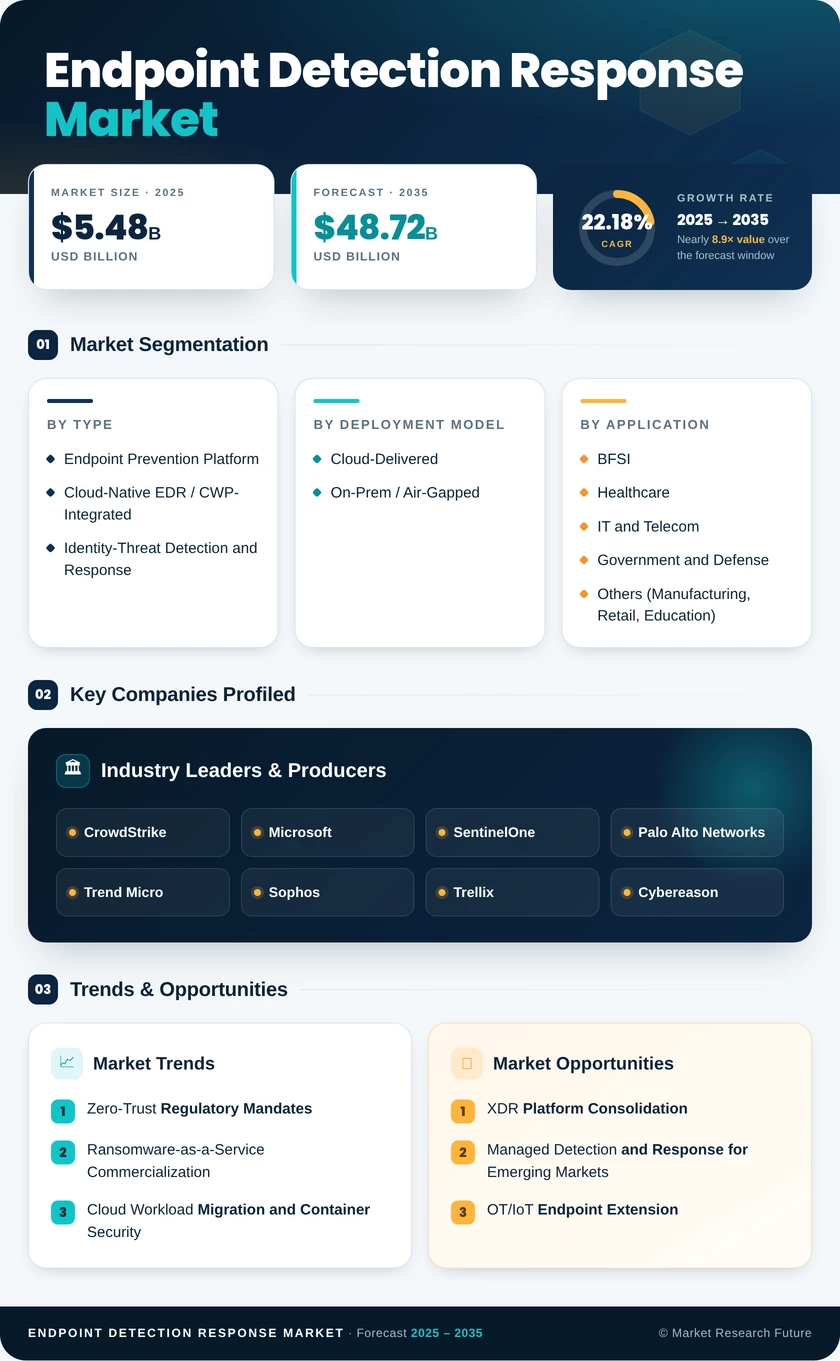
Market Size

Forecast Period2026-2035
CAGR (2026-2035)22.18%
2025 Market SizeUSD 5.48 Billion
2035 Market SizeUSD 48.72 Billion

Key Players

CrowdStrike
Microsoft
SentinelOne
Palo Alto Networks
Trend Micro
Sophos
Opportunities
  • XDR Platform Consolidation
  • Managed Detection and Response for Emerging Markets
  • OT/IoT Endpoint Extension
  1. 1 Market Overview |
    1. 1.1 Study Assumptions & Market Definition |
    2. 1.2 Scope of the Study |
    3. 1.3 Research Methodology
  2. 2 Market Summary & Key Takeaways
  3. 3 Market Dynamics |
    1. 3.1 Market Drivers Analysis | |
      1. 3.1.1 Zero-Trust Regulatory Mandates | |
      2. 3.1.2 Ransomware-as-a-Service Commercialization | |
      3. 3.1.3 Cloud Workload Migration and Container Security | |
      4. 3.1.4 Managed EDR Services for SME Penetration | |
      5. 3.1.5 AI/ML-Driven Autonomous Response | |
      6. 3.1.6 IoT/OT Endpoint Proliferation | |
      7. 3.1.7 Cyber Insurance Underwriting Requirements |
    2. 3.2 Market Restraints Analysis | |
      1. 3.2.1 Agent Fatigue and Endpoint Performance Overhead | |
      2. 3.2.2 Data Residency and Cross-Border Telemetry Restrictions | |
      3. 3.2.3 Cybersecurity Talent Shortage | |
      4. 3.2.4 Vendor Lock-In and Single-Agent Operational Risk | |
      5. 3.2.5 Budget Constraints in Public-Sector Organizations |
    3. 3.3 Market Opportunity Analysis | |
      1. 3.3.1 XDR Platform Consolidation | |
      2. 3.3.2 Managed Detection and Response for Emerging Markets | |
      3. 3.3.3 OT/IoT Endpoint Extension | |
      4. 3.3.4 Cyber Insurance Premium Optimization | |
      5. 3.3.5 Data Monetization Through Threat Intelligence |
    4. 3.4 Industry Value Chain Analysis |
    5. 3.5 Porter's Five Forces Analysis
  4. 4 Global Endpoint Detection and Response Market Size & Forecast (2021–2035) |
    1. 4.1 Historical Market Size (2021–2025) |
    2. 4.2 Current & Forecast Market Size (2026–2035) |
    3. 4.3 Market Size by Revenue (USD Billion) |
    4. 4.4 Year-over-Year Growth Analysis
  5. 5 Segmentation Analysis |
    1. 5.1 By Solution Type | |
      1. 5.1.1 Endpoint Prevention Platform | |
      2. 5.1.2 Cloud-Native EDR / CWP-Integrated | |
      3. 5.1.3 Identity-Threat Detection and Response |
    2. 5.2 By Deployment Model | |
      1. 5.2.1 Cloud-Delivered | |
      2. 5.2.2 On-Prem / Air-Gapped |
    3. 5.3 By End-User Vertical | |
      1. 5.3.1 BFSI | |
      2. 5.3.2 Healthcare | |
      3. 5.3.3 IT and Telecom | |
      4. 5.3.4 Government and Defense | |
      5. 5.3.5 Others (Manufacturing, Retail, Education) |
    4. 5.4 By Enterprise Size | |
      1. 5.4.1 Large Enterprises | |
      2. 5.4.2 Small and Medium Enterprises
  6. 6 Regional Analysis |
    1. 6.1 North America | |
      1. 6.1.1 United States | |
      2. 6.1.2 Canada | |
      3. 6.1.3 Mexico |
    2. 6.2 Europe | |
      1. 6.2.1 Germany | |
      2. 6.2.2 United Kingdom | |
      3. 6.2.3 France | |
      4. 6.2.4 Italy | |
      5. 6.2.5 Spain | |
      6. 6.2.6 Nordic Countries | |
      7. 6.2.7 Russia | |
      8. 6.2.8 Rest of Europe |
    3. 6.3 Asia-Pacific | |
      1. 6.3.1 China | |
      2. 6.3.2 India | |
      3. 6.3.3 Japan | |
      4. 6.3.4 South Korea | |
      5. 6.3.5 ASEAN | |
      6. 6.3.6 Rest of Asia-Pacific |
    4. 6.4 South America | |
      1. 6.4.1 Brazil | |
      2. 6.4.2 Argentina | |
      3. 6.4.3 Rest of South America |
    5. 6.5 Middle East & Africa | |
      1. 6.5.1 Saudi Arabia | |
      2. 6.5.2 UAE | |
      3. 6.5.3 South Africa | |
      4. 6.5.4 Egypt | |
      5. 6.5.5 Rest of MEA
  7. 7 Competitive Landscape |
    1. 7.1 Market Share Analysis (2025) |
    2. 7.2 Competitive Benchmarking Matrix |
    3. 7.3 Company Profiles | |
      1. 7.3.1 CrowdStrike | |
      2. 7.3.2 Microsoft | |
      3. 7.3.3 SentinelOne | |
      4. 7.3.4 Palo Alto Networks | |
      5. 7.3.5 Trend Micro | |
      6. 7.3.6 Sophos | |
      7. 7.3.7 Trellix | |
      8. 7.3.8 Cybereason | |
      9. 7.3.9 VMware (Broadcom) | |
      10. 7.3.10 Fortinet
  8. 8 Future Outlook & Strategic Recommendations (2026–2035) |
    1. 8.1 AI-Autonomous Threat Response |
    2. 8.2 Platform Economics and Vendor Consolidation |
    3. 8.3 Identity-Endpoint Convergence |
    4. 8.4 Regulatory Supercycle and Compliance-Driven Refresh
  9. 9 Recent Developments & News
  10. 10 Frequently Asked Questions (FAQs)
  11. 11 Report Scope & Methodology |
    1. 11.1 Study Period & Base Year |
    2. 11.2 Data Sources & Citations |
    3. 11.3 Abbreviations
  12. 12 LIST OF TABLES |
  13. TABLE 1 Global Endpoint Detection and Response Market Size & Forecast, by Revenue (USD Billion), 2021–2035 |
  14. TABLE 2 Global Endpoint Detection and Response Market – Year-over-Year Growth Analysis, 2021–2035 |
  15. TABLE 3 Market Driver Impact Analysis, 2026–2035 |
  16. TABLE 4 Market Restraint Impact Analysis, 2026–2035 |
  17. TABLE 5 Global Endpoint Detection and Response Market Size, by Solution Type, 2021–2035 (USD Billion) |
  18. TABLE 6 Global Endpoint Detection and Response Market Size, by Deployment Model, 2021–2035 (USD Billion) |
  19. TABLE 7 Global Endpoint Detection and Response Market Size, by End-User Vertical, 2021–2035 (USD Billion) |
  20. TABLE 8 Global Endpoint Detection and Response Market Size, by Enterprise Size, 2021–2035 (USD Billion) |
  21. TABLE 9 Global Endpoint Detection and Response Market Size, by Region, 2021–2035 (USD Billion) |
  22. TABLE 10 North America Endpoint Detection and Response Market Size, by Country, 2021–2035 (USD Billion) |
  23. TABLE 11 Europe Endpoint Detection and Response Market Size, by Country, 2021–2035 (USD Billion) |
  24. TABLE 12 Asia-Pacific Endpoint Detection and Response Market Size, by Country, 2021–2035 (USD Billion) |
  25. TABLE 13 South America Endpoint Detection and Response Market Size, by Country, 2021–2035 (USD Billion) |
  26. TABLE 14 Middle East & Africa Endpoint Detection and Response Market Size, by Country, 2021–2035 (USD Billion) |
  27. TABLE 15 Competitive Benchmarking Matrix – Global Endpoint Detection and Response Market, 2025 |
  28. TABLE 16 Company Profiles – Key Players, Global Endpoint Detection and Response Market |
  29. TABLE 17 Recent Developments & Strategic Announcements, 2023–2025 |
  30. TABLE 18 Report Scope and Methodology Summary |
  31. TABLE 19 Detailed Sources and Citations
  32. 13 LIST OF FIGURES |
  33. FIGURE 1 Global Endpoint Detection and Response Market Dynamics (Drivers, Restraints, Opportunities) |
  34. FIGURE 2 Industry Value Chain Analysis — Endpoint Detection and Response Market |
  35. FIGURE 3 Porter's Five Forces Analysis — Endpoint Detection and Response Market |
  36. FIGURE 4 Global Endpoint Detection and Response Market Size Trend (USD Billion), 2021–2035 |
  37. FIGURE 5 Endpoint Detection and Response Market Share, by Solution Type, 2025 |
  38. FIGURE 6 Endpoint Detection and Response Market Share, by Deployment Model, 2025 |
  39. FIGURE 7 Endpoint Detection and Response Market Share, by End-User Vertical, 2025 |
  40. FIGURE 8 Endpoint Detection and Response Market Share, by Enterprise Size, 2025 |
  41. FIGURE 9 Endpoint Detection and Response Market Share, by Region, 2025 |
  42. FIGURE 10 North America Endpoint Detection and Response Market Size, by Country, 2025 |
  43. FIGURE 11 Europe Endpoint Detection and Response Market Size, by Country, 2025 |
  44. FIGURE 12 Asia-Pacific Endpoint Detection and Response Market Size, by Country, 2025 |
  45. FIGURE 13 South America Endpoint Detection and Response Market Size, by Country, 2025 |
  46. FIGURE 14 Middle East & Africa Endpoint Detection and Response Market Size, by Country, 2025 |
  47. FIGURE 15 Competitive Landscape — Market Share Analysis, 2025

Segmentation Quick Reference

DimensionSub-SegmentsDominant SegmentFastest Growing Segment
Solution TypeEndpoint Prevention Platform; Cloud-Native EDR / CWP-Integrated; Identity-Threat Detection and ResponseEndpoint Prevention PlatformIdentity-Threat Detection and Response
Deployment ModelCloud-Delivered; On-Prem / Air-GappedCloud-DeliveredOn-Prem / Air-Gapped
End-User VerticalBFSI; Healthcare; IT and Telecom; Government and Defense; OthersBFSIHealthcare
Enterprise SizeLarge Enterprises; Small and Medium EnterprisesLarge EnterprisesSmall and Medium Enterprises
GeographyNorth America; Europe; Asia-Pacific; South America; Middle East & AfricaNorth AmericaMiddle East & Africa


Market Segmentation Overview

By Solution Type

Sub-SegmentKey Trend
Endpoint Prevention PlatformConsolidation with next-gen AV and device control into unified lightweight agents
Cloud-Native EDR / CWP-IntegratedeBPF-based container sensors replacing sidecar architectures for Kubernetes-native visibility
Identity-Threat Detection and ResponseCredential-abuse detection merging with traditional endpoint telemetry for lateral-movement prevention


Endpoint prevention platforms remain the entry point for most organizations upgrading from legacy antivirus, while cloud-native EDR is expanding rapidly as enterprises migrate workloads to public cloud environments. Identity-threat detection and response is the newest category, reflecting the growing dominance of credential-based attack vectors over traditional malware delivery.

By Deployment Model

Sub-SegmentKey Trend
Cloud-DeliveredSaaS-based management consoles with auto-updating agent architectures reducing deployment friction
On-Prem / Air-GappedPurpose-built appliances for defense, intelligence, and critical infrastructure environments requiring sovereign data processing


Cloud-delivered agents dominate new deployments, but air-gapped configurations are seeing renewed interest from defense and critical-infrastructure operators who require complete data sovereignty and cannot depend on external connectivity for threat detection.

By End-User Vertical

Sub-SegmentKey Trend
BFSIRegulatory-driven refresh cycles and transaction-monitoring integration with EDR telemetry
HealthcareConnected medical device security and HIPAA breach-notification compliance
IT and Telecom5G edge infrastructure protection and managed service provider bundling
Government and DefenseZero-trust architecture mandates and classified-environment EDR deployments
Others (Manufacturing, Retail, Education)OT/IoT convergence driving EDR extension to non-traditional endpoint classes


BFSI and healthcare together represent over 40% of vertical spending, while manufacturing and retail are emerging as high-growth segments as operational technology environments increasingly connect to enterprise IT networks.

By Enterprise Size

Sub-SegmentKey Trend
Large EnterprisesPlatform consolidation reducing tool sprawl and improving cross-domain detection correlation
Small and Medium EnterprisesMDR-bundled EDR-as-a-service lowering the cost barrier for organizations with limited security staffing


Large enterprises continue to account for the majority of EDR spending, but SME adoption is accelerating faster in percentage terms as managed detection and response providers make enterprise-grade protection accessible at per-endpoint-per-month pricing.