Request Free Sample ×

Kindly complete the form below to receive a free sample of this Report

* Please use a valid business email

Leading companies partner with us for data-driven Insights

clients tt-cursor
Hero Background
English
Chinese
French
Japanese
Korean
German
Spanish

Emphysema Market Size

ID: MRFR/Pharma/4354-HCR
100 Pages
Vikita Thakur
March 2026

Emphysema Market Research Report By Type (Centrilobular, Panlobular), By Diagnosis (Imaging Test (X-Ray, Ct Scan), Lung Function Test), by Treatment (Medication (Antibiotics, Bronchodilators), Therapy, Surgery), by End-User-Global Forecast till 2035

Share:
Download PDF ×

We do not share your information with anyone. However, we may send you emails based on your report interest from time to time. You may contact us at any time to opt-out.

Emphysema Market Infographic
Purchase Options

Emphysema Size

Emphysema Market Growth Projections and Opportunities

A significant role in the healthcare landscape is played by Emphysema Market which manages a long-lasting respiratory illness that seriously affects lung function. Emphysema, one of the chronic obstructive pulmonary disease subtypes, gradually destroys lung tissues causing enlargement of the air sacs making difficult for patients to breathe. These components include diagnostics, treatment options and continued research to address emphysema’s challenges.

The Emphysema Market relies heavily on diagnostics as well, which ensure early detection and accurate assessment of the disease. Ranging from pulmonary function tests like spirometry that evaluate lung function and imaging techniques such as chest x-rays and computed tomography (CT) scans giving a visual breakdown into how lungs are faring. It is important to diagnose timely and accurately so as to begin intervening properly then implementing strategies aimed at effectively managing emphysema.

This variety of treatments emphasizes symptom alleviation, improvement of breathing problems, and improvement in overall health status for people suffering from the disorder within Emphysema Market. Bronchodilators also known as short acting or long-acting beta agonists may be prescribed to alleviate narrowing of airways by doctors while anticholinergic drugs can also help open up airways among others. Inhaled corticosteroids may be used against airway inflammation. Pulmonary rehabilitation programs combining exercise with education offer an opportunity for physical fitness improvement and teach patients adaptation skills when dealing with emphysema.

The future development of the market depends on continuous research about novel therapeutic approaches, targeted treatments as well as advancements in disease management among others. Various studies focus on uncovering what brings about emphysema such as genetic factors, environmental causes that trigger it or even inflammatory processes that take place within lungs respectively; this will help deal with other diseases caused by similar circumstances but have different names like chronic bronchitis (“Emphysema Diagnosis”).

Challenges experienced in the Emphysema Market include the chronic nature of emphysema and its enormous impact on patients’ daily lives. People suffering from emphysema experience high disability rates, which make their quality of life to be affected since they cannot perform their normal activities similar to other people that are healthy. This is one of the principal risk factors for developing emphysema hence smoking cessation programs and awareness campaigns have been included in disease prevention and management.

Efforts aimed at improving patient education and self-management strategies also shape Emphysema Market. Optimal outcomes can only be achieved if individuals with emphysema are given a chance to actively participate in their health care, recognize symptoms early enough and adhere to treatment plans. Ongoing care including telemedicine and remote monitoring technologies assist medical practitioners who can always monitor lung function remotely then intervene when necessary.
Emphysema Market Size Graph
Author
Author Profile
Vikita Thakur
Senior Research Analyst

She holds an experience of about 5+ years in market research and business consulting projects for sectors such as life sciences, medical devices, and healthcare IT. She possesses a robust background in data analysis, market estimation, competitive intelligence, pipeline analysis market trend identification, and consumer behavior insights. Her expertise lies in technical Sales support, client interaction and project management, designing and implementing market research studies, conducting competitive analysis, and synthesizing complex data into actionable recommendations that drive business growth.

Leave a Comment

FAQs

What is the projected market valuation of The Global Emphysema by 2035?

<p>The projected market valuation of The Global Emphysema is 22.73 USD Billion by 2035.</p>

What was the market valuation of The Global Emphysema in 2024?

<p>The market valuation of The Global Emphysema was 13.53 USD Billion in 2024.</p>

What is the expected CAGR for The Global Emphysema during the forecast period 2025 - 2035?

<p>The expected CAGR for The Global Emphysema during the forecast period 2025 - 2035 is 4.83%.</p>

Which companies are considered key players in The Global Emphysema?

<p>Key players in The Global Emphysema include GlaxoSmithKline, Boehringer Ingelheim, AstraZeneca, Novartis, Roche, Pfizer, Teva Pharmaceutical Industries, Mylan, and Sanofi.</p>

What are the projected valuations for the centrilobular and panlobular segments by 2035?

<p>The projected valuations for the centrilobular and panlobular segments are 11.36 USD Billion and 11.37 USD Billion, respectively, by 2035.</p>

How do the imaging test and lung function test segments compare in terms of projected valuation by 2035?

By 2035, the lung function test segment is projected to reach 11.0 USD Billion, while the imaging test segment is expected to reach 5.0 USD Billion.

What is the expected valuation for the medications segment in The Global Emphysema by 2035?

The expected valuation for the medications segment in The Global Emphysema is 8.5 USD Billion by 2035.

What are the projected valuations for hospitals and clinics as end-users by 2035?

The projected valuation for hospitals and clinics as end-users is 9.14 USD Billion by 2035.

What is the expected growth trend for the therapy segment in The Global Emphysema?

The therapy segment is expected to grow to 6.5 USD Billion by 2035.

How does the projected valuation for surgical centers compare to other end-user segments by 2035?

By 2035, the projected valuation for surgical centers is 6.06 USD Billion, which is lower than hospitals and clinics but higher than other end-user segments.

Market Summary

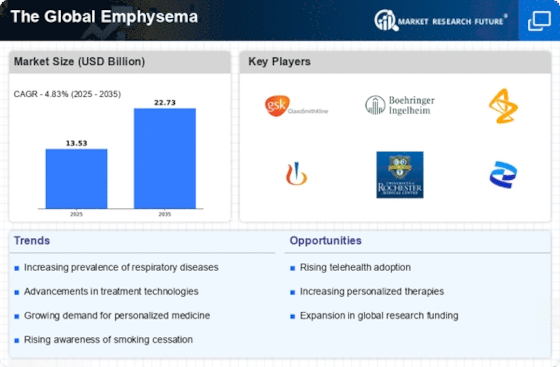
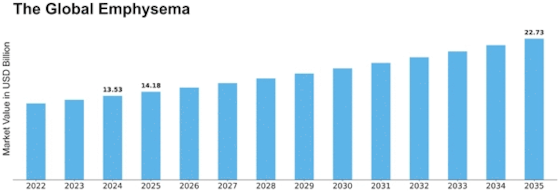
As per Market Research Future analysis, The Global Emphysema Market Size was estimated at 13.53 USD Billion in 2024. The emphysema industry is projected to grow from 14.18 USD Billion in 2025 to 22.73 USD Billion by 2035, exhibiting a compound annual growth rate (CAGR) of 4.83% during the forecast period 2025 - 2035

Key Market Trends & Highlights

The Global Emphysema Market is poised for growth driven by technological advancements and increasing awareness.

  • Technological advancements in treatment are reshaping the landscape of The Global Emphysema Market. North America remains the largest market, while Asia-Pacific is emerging as the fastest-growing region. Centrilobular emphysema represents the largest segment, whereas panlobular emphysema is witnessing the fastest growth. Rising prevalence of emphysema and advancements in pharmaceutical treatments are key drivers propelling market expansion.

Market Size & Forecast

2024 Market Size 13.53 (USD Billion)
2035 Market Size 22.73 (USD Billion)
CAGR (2025 - 2035) 4.83%
Largest Regional Market Share in 2024 North America

Major Players

GlaxoSmithKline (GB), Boehringer Ingelheim (DE), AstraZeneca (GB), Novartis (CH), Roche (CH), <a href="https://www.pfizer.com/products/product-list">Pfizer </a>(US), Teva Pharmaceutical Industries (IL), Mylan (US), Sanofi (FR)

Market Trends

The Global Emphysema Market is currently experiencing notable transformations driven by advancements in medical technology and an increasing understanding of the disease. As healthcare systems evolve, there is a growing emphasis on early diagnosis and personalized treatment plans. This shift is likely to enhance patient outcomes and improve quality of life for individuals affected by emphysema. Furthermore, the integration of telemedicine and digital health solutions appears to be gaining traction, allowing for better management of chronic conditions and facilitating remote consultations between patients and healthcare providers.

In addition to technological advancements, The Global Emphysema Market is influenced by rising awareness regarding the impact of environmental factors on respiratory health. Public health campaigns and educational initiatives are fostering a deeper understanding of the disease, which may lead to increased demand for effective therapies and interventions. Moreover, the collaboration between pharmaceutical companies and research institutions is likely to yield innovative treatment options, potentially reshaping the landscape of care for emphysema patients. As the Emphysema Market continues to evolve, stakeholders must remain vigilant to emerging trends and adapt strategies accordingly.

Technological Advancements in Treatment

The Global Emphysema Market is witnessing a surge in innovative treatment modalities, including the development of targeted therapies and advanced inhalation devices. These advancements aim to enhance drug delivery and improve patient adherence to treatment regimens.

Increased Focus on Preventive Care

There is a growing emphasis on preventive measures within The Global Emphysema Market. Healthcare providers are prioritizing education and awareness campaigns to reduce risk factors associated with emphysema, such as smoking cessation and air quality improvement.

Integration of Telehealth Solutions

The incorporation of telehealth services is transforming patient management in The Global Emphysema Market. Remote monitoring and virtual consultations are becoming more prevalent, allowing for continuous care and timely interventions.

Emphysema Market Market Drivers

Rising Prevalence of Emphysema

The increasing prevalence of emphysema is a primary driver for The Global Emphysema Industry. According to recent data, the number of individuals diagnosed with chronic obstructive pulmonary disease (COPD), which includes emphysema, is projected to rise significantly. This trend is attributed to factors such as aging populations and lifestyle choices, including smoking and air pollution. As the global population ages, the incidence of respiratory diseases is expected to escalate, leading to a higher demand for treatment options. The World Health Organization estimates that COPD will become the third leading cause of death by 2030, underscoring the urgent need for effective management strategies within The Global Emphysema Industry.

Growing Awareness and Education

There is a notable increase in awareness and education regarding emphysema and its management, which serves as a significant driver for The Global Emphysema Industry. Public health campaigns and educational initiatives are effectively informing individuals about the risks associated with smoking and environmental factors contributing to emphysema. This heightened awareness is leading to earlier diagnosis and treatment, which is crucial for managing the disease effectively. Furthermore, healthcare professionals are increasingly emphasizing the importance of patient education in managing chronic respiratory conditions. As a result, the demand for resources and treatment options within The Global Emphysema Industry is likely to rise.

Integration of Digital Health Solutions

The integration of digital health solutions is reshaping The Global Emphysema Industry. Telehealth services and mobile health applications are becoming essential tools for managing chronic respiratory diseases, including emphysema. These technologies facilitate remote monitoring, enabling healthcare providers to track patient progress and adjust treatment plans accordingly. Market Research Future suggests that the telehealth market is expected to grow significantly, with projections indicating a value of over USD 250 billion by 2028. This trend not only enhances patient engagement but also improves access to care, particularly in underserved areas. Consequently, the adoption of digital health solutions is likely to drive growth within The Global Emphysema Industry.

Advancements in Pharmaceutical Treatments

Innovations in pharmaceutical treatments are transforming the landscape of The Global Emphysema Industry. Recent developments in bronchodilators and anti-inflammatory medications have shown promise in improving lung function and quality of life for patients. The introduction of novel therapies, such as biologics, is also gaining traction, potentially offering targeted treatment options for individuals with severe emphysema. Market data indicates that the global market for COPD medications is expected to reach approximately USD 20 billion by 2026, driven by these advancements. As healthcare providers increasingly adopt these innovative therapies, The Global Emphysema Industry is likely to experience substantial growth.

Increased Investment in Research and Development

The surge in investment in research and development (R&D) is a crucial driver for The Global Emphysema Industry. Pharmaceutical companies and research institutions are allocating substantial resources to explore new treatment modalities and improve existing therapies for emphysema. This focus on R&D is expected to yield innovative solutions that address unmet medical needs, thereby enhancing patient outcomes. Recent data indicates that global spending on R&D in the healthcare sector is projected to exceed USD 200 billion annually by 2025. As new therapies emerge from this investment, The Global Emphysema Industry is poised for significant advancements and growth.

Market Segment Insights

By Type: Centrilobular (Largest) vs. Panlobular (Fastest-Growing)

In The Global Emphysema Market, the segment of centrilobular emphysema holds a significant share, highlighting its prevalence among patients suffering from this respiratory condition. It is characterized by damage primarily affecting the central areas of the acini, leading to both airflow limitation and inflammation. This segment has been traditionally recognized for its impact on individuals, often associated with smoking and occupational dust exposure, contributing to its substantial market presence. On the other hand, panlobular emphysema is emerging as a rapidly growing segment due to increasing awareness of its unique impact on respiratory health, particularly among older adults and those with a genetic predisposition. This type of emphysema affects the entire acinus uniformly and is often associated with alpha-1 antitrypsin deficiency. Factors driving its growth include enhanced diagnostic capabilities and a rise in targeted therapies, drawing attention to its clinical significance.

Centrilobular (Dominant) vs. Panlobular (Emerging)

Centrilobular emphysema is characterized by the destruction of the respiratory bronchioles, a process often exacerbated by long-term cigarette smoking and environmental triggers. It typically manifests early in the disease continuum, establishing a strong market presence due to the large number of affected patients. In contrast, panlobular emphysema, while less prevalent, is gaining recognition as an emerging segment in the market. This type typically presents in a later stage of the disease and poses significant risks for patients, especially those with alpha-1 antitrypsin deficiency. The increasing emphasis on comprehensive disease management and patient education is propelling growth in this segment, leading to rising demand for innovative treatment options.

By Diagnosis: Lung Function Test (Largest) vs. Imaging Test (Fastest-Growing)

In The Global Emphysema Market, the 'Diagnosis' segment comprises various modalities including imaging tests and lung function tests. The lung function tests currently hold the largest market share, primarily due to their crucial role in evaluating airflow limitations and overall lung health. Imaging tests, while not holding the largest share, are gaining traction as they provide critical visual insights for diagnosis, thereby attracting increasing adoption among healthcare providers.

Diagnosis Methods: Lung Function Test (Dominant) vs. Imaging Test (Emerging)

Lung function tests are essential in diagnosing emphysema as they measure the lungs' ability to take in and utilize air. This method not only aids in confirming emphysema but also in assessing the severity and progression of the disease. Conversely, imaging tests, such as CT scans and X-rays, are emerging as vital diagnostic tools that offer detailed images of the lungs, thus enhancing the accuracy of diagnoses. As technology progresses, imaging tests are increasingly integrated with advanced analytics, suggesting a promising growth trajectory in the healthcare sector.

By Treatment: Medications (Largest) vs. Therapy (Fastest-Growing)

In The Global Emphysema Market, the Treatment segment is delineated primarily into medications, therapy, and surgery. Medications hold the largest share of the market, driven by their established efficacy in managing <a href="https://www.marketresearchfuture.com/reports/vasomotor-symptoms-market-9810">symptoms</a> and improving quality of life for patients. On the other hand, therapy options, including pulmonary rehabilitation and other innovative treatments, are gaining traction, showcasing significant growth as healthcare providers focus on comprehensive patient care. The surgical interventions, while critical, represent a smaller portion of the market, typically reserved for advanced stages of the disease.

Medications: Dominant vs. Therapy: Emerging

Medications remain the dominant force in the Treatment segment, encompassing bronchodilators, corticosteroids, and combination therapies that significantly alleviate symptoms of emphysema. These pharmacological approaches are deeply embedded in treatment protocols and endorsed by healthcare professionals. Emerging therapies, on the other hand, focus on holistic patient management, emphasizing lifestyle changes and rehabilitation programs that enhance lung function and overall wellbeing. While medications are crucial for immediate disease management, therapy options are becoming increasingly recognized for their role in long-term patient health and quality of life, thus presenting a complementary route to traditional medication-based treatments.

By End-User: Hospitals and Clinics (Largest) vs. Surgical Centers (Fastest-Growing)

The Global Emphysema Market showcases a diverse distribution among its end-user segments, with hospitals and clinics holding a significant share owing to their comprehensive treatment capabilities for patients suffering from emphysema. This segment serves as a primary point of care, providing advanced therapies and interventions for this chronic lung condition. Whereas surgical centers are gaining traction, attributed to their specialization in procedures such as lung volume reduction surgery, leading to an uptick in their market presence.

Hospitals and Clinics (Dominant) vs. Surgical Centers (Emerging)

The 'Hospitals and Clinics' segment remains the dominant force in The Global Emphysema Market, primarily due to their well-established infrastructure, availability of specialized healthcare professionals, and comprehensive patient management systems. This segment is characterized by a holistic approach to treatment, incorporating both pharmaceuticals and therapeutic interventions. On the other hand, 'Surgical Centers' are emerging at a rapid pace, driven by increased patient awareness and demand for surgical options. These centers focus on minimally invasive techniques and personalized care, attracting patients seeking specialized treatments, thus reflecting a changing landscape in emphysema management.

Get more detailed insights about Emphysema Market Research Report - Forecast to 2035

Regional Insights

North America : Healthcare Innovation Leader

North America is the largest market for emphysema treatments, accounting for approximately 45% of the global market share. The region's growth is driven by advanced healthcare infrastructure, increasing prevalence of respiratory diseases, and significant investments in research and development. Regulatory support from agencies like the FDA further catalyzes market expansion, ensuring timely access to innovative therapies. The United States and Canada are the leading countries in this region, with a competitive landscape dominated by major pharmaceutical companies such as GlaxoSmithKline, Pfizer, and AstraZeneca. These companies are actively involved in developing new therapies and improving existing treatments, contributing to a robust market environment. The presence of well-established healthcare systems and a high level of awareness among patients also bolster demand for effective emphysema management solutions.

Europe : Regulatory Framework and Innovation

Europe is the second-largest market for emphysema treatments, holding around 30% of the global market share. The region benefits from a strong regulatory framework that encourages innovation and ensures patient safety. Increasing awareness of chronic respiratory diseases and a growing aging population are key drivers of market growth. The European Medicines Agency (EMA) plays a crucial role in facilitating the approval of new therapies, thus enhancing market dynamics. Leading countries in Europe include Germany, France, and the United Kingdom, where the presence of major pharmaceutical players like Boehringer Ingelheim and Novartis is significant. The competitive landscape is characterized by a mix of established companies and emerging biotech firms, all striving to develop novel treatment options. Collaborative efforts between public and private sectors further enhance research initiatives, ensuring a steady pipeline of innovative therapies for emphysema.

Asia-Pacific : Emerging Market Potential

Asia-Pacific is an emerging powerhouse in The Global Emphysema, accounting for approximately 20% of the market share. The region's growth is fueled by rising healthcare expenditures, increasing awareness of respiratory diseases, and a growing population. Countries like China and India are witnessing a surge in demand for effective treatment options, driven by urbanization and lifestyle changes that contribute to respiratory issues. China and Japan are the leading markets in this region, with a competitive landscape that includes both local and international players. Companies such as Teva Pharmaceutical Industries and Mylan are expanding their presence, focusing on affordable treatment options. The region's regulatory bodies are also becoming more supportive of innovative therapies, paving the way for new entrants and enhancing competition in the market.

Middle East and Africa : Untapped Market Opportunities

The Middle East and Africa represent a growing market for emphysema treatments, holding about 5% of the global market share. The region is characterized by a rising prevalence of respiratory diseases, driven by factors such as pollution and smoking. Governments are increasingly recognizing the need for improved healthcare services, leading to regulatory initiatives aimed at enhancing access to treatment options for chronic respiratory conditions. Countries like South Africa and the United Arab Emirates are at the forefront of this market, with a competitive landscape that includes both multinational corporations and local manufacturers. Key players such as Sanofi and Roche are actively involved in expanding their product offerings in the region. The focus on public health initiatives and partnerships with healthcare providers is expected to drive market growth in the coming years.

Key Players and Competitive Insights

The Global Emphysema is characterized by a competitive landscape that is increasingly shaped by innovation, strategic partnerships, and a focus on patient-centric solutions. Key players such as GlaxoSmithKline (GB), Boehringer Ingelheim (DE), and AstraZeneca (GB) are actively engaged in enhancing their product portfolios and expanding their market reach. GlaxoSmithKline (GB) has positioned itself as a leader in respiratory therapies, emphasizing the development of novel inhalation devices and combination therapies. Meanwhile, Boehringer Ingelheim (DE) focuses on biologics and personalized medicine, aiming to tailor treatments to individual patient needs. AstraZeneca (GB) is leveraging its strong pipeline of biologics and small molecules to address unmet medical needs in emphysema, thereby enhancing its competitive edge. Collectively, these strategies indicate a market that is not only competitive but also increasingly collaborative, as companies seek to combine their strengths to deliver comprehensive solutions.

In terms of business tactics, companies are increasingly localizing manufacturing and optimizing their supply chains to enhance efficiency and responsiveness to market demands. The Global Emphysema appears moderately fragmented, with several key players exerting significant influence. This structure allows for a diverse range of products and innovations, while also fostering competition that drives advancements in treatment options. The collective influence of these major players is pivotal in shaping market dynamics, as they navigate regulatory landscapes and adapt to evolving patient needs.

In August 2025, Boehringer Ingelheim (DE) announced a strategic partnership with a leading digital health company to develop a comprehensive digital platform aimed at improving patient adherence to treatment regimens. This initiative is significant as it reflects a growing trend towards integrating technology with healthcare solutions, potentially enhancing patient outcomes and engagement. By leveraging digital tools, Boehringer Ingelheim (DE) is likely to strengthen its market position and foster loyalty among healthcare providers and patients alike.

In September 2025, AstraZeneca (GB) launched a new inhalation therapy specifically designed for patients with severe emphysema. This product introduction is crucial as it addresses a significant gap in the current treatment landscape, offering a novel solution that could improve the quality of life for patients. The launch not only reinforces AstraZeneca's commitment to innovation but also positions the company to capture a larger share of the market by meeting the specific needs of this patient population.

In October 2025, GlaxoSmithKline (GB) unveiled a new initiative focused on sustainability in its manufacturing processes, aiming to reduce carbon emissions by 30% over the next five years. This move is indicative of a broader trend within the industry towards sustainable practices, which are becoming increasingly important to stakeholders. By prioritizing sustainability, GlaxoSmithKline (GB) is likely to enhance its brand reputation and appeal to environmentally conscious consumers, thereby differentiating itself in a competitive market.

As of October 2025, the competitive trends within The Global Emphysema are increasingly defined by digitalization, sustainability, and the integration of artificial intelligence in treatment protocols. Strategic alliances are becoming more prevalent, as companies recognize the value of collaboration in driving innovation and improving patient outcomes. Looking ahead, it is anticipated that competitive differentiation will evolve from traditional price-based strategies to a focus on innovation, technological advancements, and the reliability of supply chains. This shift underscores the importance of adaptability and forward-thinking in maintaining a competitive edge in the dynamic landscape of The Global Emphysema.

Key Companies in the Emphysema Market include

Industry Developments

Future Outlook

Emphysema Market Future Outlook

The Global Emphysema Market is projected to grow at a 4.83% CAGR from 2025 to 2035, driven by increasing prevalence, advancements in treatment options, and rising healthcare expenditure.

New opportunities lie in:

  • <p>Development of personalized inhalation therapies for targeted treatment.</p>
  • <p> </p>
  • <p>Expansion of telehealth services for remote patient monitoring.</p>
  • <p>Investment in AI-driven diagnostic tools for early detection.</p>

By 2035, the Emphysema Market is expected to achieve substantial growth, reflecting evolving treatment paradigms and increased patient access.

Market Segmentation

Emphysema Market Type Outlook

  • centrilobular
  • panlobular

Emphysema Market End-User Outlook

  • hospitals and clinics
  • surgical centers
  • others

Emphysema Market Diagnosis Outlook

  • imaging test
  • lung function test
  • others

Emphysema Market Treatment Outlook

  • medications
  • therapy
  • surgery

Report Scope

MARKET SIZE 2024 13.53(USD Billion)
MARKET SIZE 2025 14.18(USD Billion)
MARKET SIZE 2035 22.73(USD Billion)
COMPOUND ANNUAL GROWTH RATE (CAGR) 4.83% (2025 - 2035)
REPORT COVERAGE Revenue Forecast, Competitive Landscape, Growth Factors, and Trends
BASE YEAR 2024
Market Forecast Period 2025 - 2035
Historical Data 2019 - 2024
Market Forecast Units USD Billion
Key Companies Profiled GlaxoSmithKline (GB), Boehringer Ingelheim (DE), AstraZeneca (GB), Novartis (CH), Roche (CH), Pfizer (US), Teva Pharmaceutical Industries (IL), Mylan (US), Sanofi (FR)
Segments Covered Type, Diagnosis, Treatment, End-User-Global Forecast till 2035
Key Market Opportunities Advancements in targeted therapies and personalized medicine enhance treatment options in The Global Emphysema.
Key Market Dynamics Rising demand for innovative therapies drives competitive dynamics in the emphysema treatment landscape.
Countries Covered North America, Europe, APAC, South America, MEA

FAQs

What is the projected market valuation of The Global Emphysema by 2035?

<p>The projected market valuation of The Global Emphysema is 22.73 USD Billion by 2035.</p>

What was the market valuation of The Global Emphysema in 2024?

<p>The market valuation of The Global Emphysema was 13.53 USD Billion in 2024.</p>

What is the expected CAGR for The Global Emphysema during the forecast period 2025 - 2035?

<p>The expected CAGR for The Global Emphysema during the forecast period 2025 - 2035 is 4.83%.</p>

Which companies are considered key players in The Global Emphysema?

<p>Key players in The Global Emphysema include GlaxoSmithKline, Boehringer Ingelheim, AstraZeneca, Novartis, Roche, Pfizer, Teva Pharmaceutical Industries, Mylan, and Sanofi.</p>

What are the projected valuations for the centrilobular and panlobular segments by 2035?

<p>The projected valuations for the centrilobular and panlobular segments are 11.36 USD Billion and 11.37 USD Billion, respectively, by 2035.</p>

How do the imaging test and lung function test segments compare in terms of projected valuation by 2035?

By 2035, the lung function test segment is projected to reach 11.0 USD Billion, while the imaging test segment is expected to reach 5.0 USD Billion.

What is the expected valuation for the medications segment in The Global Emphysema by 2035?

The expected valuation for the medications segment in The Global Emphysema is 8.5 USD Billion by 2035.

What are the projected valuations for hospitals and clinics as end-users by 2035?

The projected valuation for hospitals and clinics as end-users is 9.14 USD Billion by 2035.

What is the expected growth trend for the therapy segment in The Global Emphysema?

The therapy segment is expected to grow to 6.5 USD Billion by 2035.

How does the projected valuation for surgical centers compare to other end-user segments by 2035?

By 2035, the projected valuation for surgical centers is 6.06 USD Billion, which is lower than hospitals and clinics but higher than other end-user segments.

  1. SECTION I: EXECUTIVE SUMMARY AND KEY HIGHLIGHTS
    1. | 1.1 EXECUTIVE SUMMARY
    2. | | 1.1.1 Market Overview
    3. | | 1.1.2 Key Findings
    4. | | 1.1.3 Market Segmentation
    5. | | 1.1.4 Competitive Landscape
    6. | | 1.1.5 Challenges and Opportunities
    7. | | 1.1.6 Future Outlook
  2. SECTION II: SCOPING, METHODOLOGY AND MARKET STRUCTURE
    1. | 2.1 MARKET INTRODUCTION
    2. | | 2.1.1 Definition
    3. | | 2.1.2 Scope of the study
    4. | | | 2.1.2.1 Research Objective
    5. | | | 2.1.2.2 Assumption
    6. | | | 2.1.2.3 Limitations
    7. | 2.2 RESEARCH METHODOLOGY
    8. | | 2.2.1 Overview
    9. | | 2.2.2 Data Mining
    10. | | 2.2.3 Secondary Research
    11. | | 2.2.4 Primary Research
    12. | | | 2.2.4.1 Primary Interviews and Information Gathering Process
    13. | | | 2.2.4.2 Breakdown of Primary Respondents
    14. | | 2.2.5 Forecasting Model
    15. | | 2.2.6 Market Size Estimation
    16. | | | 2.2.6.1 Bottom-Up Approach
    17. | | | 2.2.6.2 Top-Down Approach
    18. | | 2.2.7 Data Triangulation
    19. | | 2.2.8 Validation
  3. SECTION III: QUALITATIVE ANALYSIS
    1. | 3.1 MARKET DYNAMICS
    2. | | 3.1.1 Overview
    3. | | 3.1.2 Drivers
    4. | | 3.1.3 Restraints
    5. | | 3.1.4 Opportunities
    6. | 3.2 MARKET FACTOR ANALYSIS
    7. | | 3.2.1 Value chain Analysis
    8. | | 3.2.2 Porter's Five Forces Analysis
    9. | | | 3.2.2.1 Bargaining Power of Suppliers
    10. | | | 3.2.2.2 Bargaining Power of Buyers
    11. | | | 3.2.2.3 Threat of New Entrants
    12. | | | 3.2.2.4 Threat of Substitutes
    13. | | | 3.2.2.5 Intensity of Rivalry
    14. | | 3.2.3 COVID-19 Impact Analysis
    15. | | | 3.2.3.1 Market Impact Analysis
    16. | | | 3.2.3.2 Regional Impact
    17. | | | 3.2.3.3 Opportunity and Threat Analysis
  4. SECTION IV: QUANTITATIVE ANALYSIS
    1. | 4.1 Healthcare, BY Type (USD Billion)
    2. | | 4.1.1 centrilobular
    3. | | 4.1.2 panlobular
    4. | 4.2 Healthcare, BY Diagnosis (USD Billion)
    5. | | 4.2.1 imaging test
    6. | | 4.2.2 lung function test
    7. | | 4.2.3 others
    8. | 4.3 Healthcare, BY Treatment (USD Billion)
    9. | | 4.3.1 medications
    10. | | 4.3.2 therapy
    11. | | 4.3.3 surgery
    12. | 4.4 Healthcare, BY End-User (USD Billion)
    13. | | 4.4.1 hospitals and clinics
    14. | | 4.4.2 surgical centers
    15. | | 4.4.3 others
    16. | 4.5 Healthcare, BY Region (USD Billion)
    17. | | 4.5.1 North America
    18. | | | 4.5.1.1 US
    19. | | | 4.5.1.2 Canada
    20. | | 4.5.2 Europe
    21. | | | 4.5.2.1 Germany
    22. | | | 4.5.2.2 UK
    23. | | | 4.5.2.3 France
    24. | | | 4.5.2.4 Russia
    25. | | | 4.5.2.5 Italy
    26. | | | 4.5.2.6 Spain
    27. | | | 4.5.2.7 Rest of Europe
    28. | | 4.5.3 APAC
    29. | | | 4.5.3.1 China
    30. | | | 4.5.3.2 India
    31. | | | 4.5.3.3 Japan
    32. | | | 4.5.3.4 South Korea
    33. | | | 4.5.3.5 Malaysia
    34. | | | 4.5.3.6 Thailand
    35. | | | 4.5.3.7 Indonesia
    36. | | | 4.5.3.8 Rest of APAC
    37. | | 4.5.4 South America
    38. | | | 4.5.4.1 Brazil
    39. | | | 4.5.4.2 Mexico
    40. | | | 4.5.4.3 Argentina
    41. | | | 4.5.4.4 Rest of South America
    42. | | 4.5.5 MEA
    43. | | | 4.5.5.1 GCC Countries
    44. | | | 4.5.5.2 South Africa
    45. | | | 4.5.5.3 Rest of MEA
  5. SECTION V: COMPETITIVE ANALYSIS
    1. | 5.1 Competitive Landscape
    2. | | 5.1.1 Overview
    3. | | 5.1.2 Competitive Analysis
    4. | | 5.1.3 Market share Analysis
    5. | | 5.1.4 Major Growth Strategy in the Healthcare
    6. | | 5.1.5 Competitive Benchmarking
    7. | | 5.1.6 Leading Players in Terms of Number of Developments in the Healthcare
    8. | | 5.1.7 Key developments and growth strategies
    9. | | | 5.1.7.1 New Product Launch/Service Deployment
    10. | | | 5.1.7.2 Merger & Acquisitions
    11. | | | 5.1.7.3 Joint Ventures
    12. | | 5.1.8 Major Players Financial Matrix
    13. | | | 5.1.8.1 Sales and Operating Income
    14. | | | 5.1.8.2 Major Players R&D Expenditure. 2023
    15. | 5.2 Company Profiles
    16. | | 5.2.1 GlaxoSmithKline (GB)
    17. | | | 5.2.1.1 Financial Overview
    18. | | | 5.2.1.2 Products Offered
    19. | | | 5.2.1.3 Key Developments
    20. | | | 5.2.1.4 SWOT Analysis
    21. | | | 5.2.1.5 Key Strategies
    22. | | 5.2.2 Boehringer Ingelheim (DE)
    23. | | | 5.2.2.1 Financial Overview
    24. | | | 5.2.2.2 Products Offered
    25. | | | 5.2.2.3 Key Developments
    26. | | | 5.2.2.4 SWOT Analysis
    27. | | | 5.2.2.5 Key Strategies
    28. | | 5.2.3 AstraZeneca (GB)
    29. | | | 5.2.3.1 Financial Overview
    30. | | | 5.2.3.2 Products Offered
    31. | | | 5.2.3.3 Key Developments
    32. | | | 5.2.3.4 SWOT Analysis
    33. | | | 5.2.3.5 Key Strategies
    34. | | 5.2.4 Novartis (CH)
    35. | | | 5.2.4.1 Financial Overview
    36. | | | 5.2.4.2 Products Offered
    37. | | | 5.2.4.3 Key Developments
    38. | | | 5.2.4.4 SWOT Analysis
    39. | | | 5.2.4.5 Key Strategies
    40. | | 5.2.5 Roche (CH)
    41. | | | 5.2.5.1 Financial Overview
    42. | | | 5.2.5.2 Products Offered
    43. | | | 5.2.5.3 Key Developments
    44. | | | 5.2.5.4 SWOT Analysis
    45. | | | 5.2.5.5 Key Strategies
    46. | | 5.2.6 Pfizer (US)
    47. | | | 5.2.6.1 Financial Overview
    48. | | | 5.2.6.2 Products Offered
    49. | | | 5.2.6.3 Key Developments
    50. | | | 5.2.6.4 SWOT Analysis
    51. | | | 5.2.6.5 Key Strategies
    52. | | 5.2.7 Teva Pharmaceutical Industries (IL)
    53. | | | 5.2.7.1 Financial Overview
    54. | | | 5.2.7.2 Products Offered
    55. | | | 5.2.7.3 Key Developments
    56. | | | 5.2.7.4 SWOT Analysis
    57. | | | 5.2.7.5 Key Strategies
    58. | | 5.2.8 Mylan (US)
    59. | | | 5.2.8.1 Financial Overview
    60. | | | 5.2.8.2 Products Offered
    61. | | | 5.2.8.3 Key Developments
    62. | | | 5.2.8.4 SWOT Analysis
    63. | | | 5.2.8.5 Key Strategies
    64. | | 5.2.9 Sanofi (FR)
    65. | | | 5.2.9.1 Financial Overview
    66. | | | 5.2.9.2 Products Offered
    67. | | | 5.2.9.3 Key Developments
    68. | | | 5.2.9.4 SWOT Analysis
    69. | | | 5.2.9.5 Key Strategies
    70. | 5.3 Appendix
    71. | | 5.3.1 References
    72. | | 5.3.2 Related Reports
  6. LIST OF FIGURES
    1. | 6.1 MARKET SYNOPSIS
    2. | 6.2 NORTH AMERICA MARKET ANALYSIS
    3. | 6.3 US MARKET ANALYSIS BY TYPE
    4. | 6.4 US MARKET ANALYSIS BY DIAGNOSIS
    5. | 6.5 US MARKET ANALYSIS BY TREATMENT
    6. | 6.6 US MARKET ANALYSIS BY END-USER
    7. | 6.7 CANADA MARKET ANALYSIS BY TYPE
    8. | 6.8 CANADA MARKET ANALYSIS BY DIAGNOSIS
    9. | 6.9 CANADA MARKET ANALYSIS BY TREATMENT
    10. | 6.10 CANADA MARKET ANALYSIS BY END-USER
    11. | 6.11 EUROPE MARKET ANALYSIS
    12. | 6.12 GERMANY MARKET ANALYSIS BY TYPE
    13. | 6.13 GERMANY MARKET ANALYSIS BY DIAGNOSIS
    14. | 6.14 GERMANY MARKET ANALYSIS BY TREATMENT
    15. | 6.15 GERMANY MARKET ANALYSIS BY END-USER
    16. | 6.16 UK MARKET ANALYSIS BY TYPE
    17. | 6.17 UK MARKET ANALYSIS BY DIAGNOSIS
    18. | 6.18 UK MARKET ANALYSIS BY TREATMENT
    19. | 6.19 UK MARKET ANALYSIS BY END-USER
    20. | 6.20 FRANCE MARKET ANALYSIS BY TYPE
    21. | 6.21 FRANCE MARKET ANALYSIS BY DIAGNOSIS
    22. | 6.22 FRANCE MARKET ANALYSIS BY TREATMENT
    23. | 6.23 FRANCE MARKET ANALYSIS BY END-USER
    24. | 6.24 RUSSIA MARKET ANALYSIS BY TYPE
    25. | 6.25 RUSSIA MARKET ANALYSIS BY DIAGNOSIS
    26. | 6.26 RUSSIA MARKET ANALYSIS BY TREATMENT
    27. | 6.27 RUSSIA MARKET ANALYSIS BY END-USER
    28. | 6.28 ITALY MARKET ANALYSIS BY TYPE
    29. | 6.29 ITALY MARKET ANALYSIS BY DIAGNOSIS
    30. | 6.30 ITALY MARKET ANALYSIS BY TREATMENT
    31. | 6.31 ITALY MARKET ANALYSIS BY END-USER
    32. | 6.32 SPAIN MARKET ANALYSIS BY TYPE
    33. | 6.33 SPAIN MARKET ANALYSIS BY DIAGNOSIS
    34. | 6.34 SPAIN MARKET ANALYSIS BY TREATMENT
    35. | 6.35 SPAIN MARKET ANALYSIS BY END-USER
    36. | 6.36 REST OF EUROPE MARKET ANALYSIS BY TYPE
    37. | 6.37 REST OF EUROPE MARKET ANALYSIS BY DIAGNOSIS
    38. | 6.38 REST OF EUROPE MARKET ANALYSIS BY TREATMENT
    39. | 6.39 REST OF EUROPE MARKET ANALYSIS BY END-USER
    40. | 6.40 APAC MARKET ANALYSIS
    41. | 6.41 CHINA MARKET ANALYSIS BY TYPE
    42. | 6.42 CHINA MARKET ANALYSIS BY DIAGNOSIS
    43. | 6.43 CHINA MARKET ANALYSIS BY TREATMENT
    44. | 6.44 CHINA MARKET ANALYSIS BY END-USER
    45. | 6.45 INDIA MARKET ANALYSIS BY TYPE
    46. | 6.46 INDIA MARKET ANALYSIS BY DIAGNOSIS
    47. | 6.47 INDIA MARKET ANALYSIS BY TREATMENT
    48. | 6.48 INDIA MARKET ANALYSIS BY END-USER
    49. | 6.49 JAPAN MARKET ANALYSIS BY TYPE
    50. | 6.50 JAPAN MARKET ANALYSIS BY DIAGNOSIS
    51. | 6.51 JAPAN MARKET ANALYSIS BY TREATMENT
    52. | 6.52 JAPAN MARKET ANALYSIS BY END-USER
    53. | 6.53 SOUTH KOREA MARKET ANALYSIS BY TYPE
    54. | 6.54 SOUTH KOREA MARKET ANALYSIS BY DIAGNOSIS
    55. | 6.55 SOUTH KOREA MARKET ANALYSIS BY TREATMENT
    56. | 6.56 SOUTH KOREA MARKET ANALYSIS BY END-USER
    57. | 6.57 MALAYSIA MARKET ANALYSIS BY TYPE
    58. | 6.58 MALAYSIA MARKET ANALYSIS BY DIAGNOSIS
    59. | 6.59 MALAYSIA MARKET ANALYSIS BY TREATMENT
    60. | 6.60 MALAYSIA MARKET ANALYSIS BY END-USER
    61. | 6.61 THAILAND MARKET ANALYSIS BY TYPE
    62. | 6.62 THAILAND MARKET ANALYSIS BY DIAGNOSIS
    63. | 6.63 THAILAND MARKET ANALYSIS BY TREATMENT
    64. | 6.64 THAILAND MARKET ANALYSIS BY END-USER
    65. | 6.65 INDONESIA MARKET ANALYSIS BY TYPE
    66. | 6.66 INDONESIA MARKET ANALYSIS BY DIAGNOSIS
    67. | 6.67 INDONESIA MARKET ANALYSIS BY TREATMENT
    68. | 6.68 INDONESIA MARKET ANALYSIS BY END-USER
    69. | 6.69 REST OF APAC MARKET ANALYSIS BY TYPE
    70. | 6.70 REST OF APAC MARKET ANALYSIS BY DIAGNOSIS
    71. | 6.71 REST OF APAC MARKET ANALYSIS BY TREATMENT
    72. | 6.72 REST OF APAC MARKET ANALYSIS BY END-USER
    73. | 6.73 SOUTH AMERICA MARKET ANALYSIS
    74. | 6.74 BRAZIL MARKET ANALYSIS BY TYPE
    75. | 6.75 BRAZIL MARKET ANALYSIS BY DIAGNOSIS
    76. | 6.76 BRAZIL MARKET ANALYSIS BY TREATMENT
    77. | 6.77 BRAZIL MARKET ANALYSIS BY END-USER
    78. | 6.78 MEXICO MARKET ANALYSIS BY TYPE
    79. | 6.79 MEXICO MARKET ANALYSIS BY DIAGNOSIS
    80. | 6.80 MEXICO MARKET ANALYSIS BY TREATMENT
    81. | 6.81 MEXICO MARKET ANALYSIS BY END-USER
    82. | 6.82 ARGENTINA MARKET ANALYSIS BY TYPE
    83. | 6.83 ARGENTINA MARKET ANALYSIS BY DIAGNOSIS
    84. | 6.84 ARGENTINA MARKET ANALYSIS BY TREATMENT
    85. | 6.85 ARGENTINA MARKET ANALYSIS BY END-USER
    86. | 6.86 REST OF SOUTH AMERICA MARKET ANALYSIS BY TYPE
    87. | 6.87 REST OF SOUTH AMERICA MARKET ANALYSIS BY DIAGNOSIS
    88. | 6.88 REST OF SOUTH AMERICA MARKET ANALYSIS BY TREATMENT
    89. | 6.89 REST OF SOUTH AMERICA MARKET ANALYSIS BY END-USER
    90. | 6.90 MEA MARKET ANALYSIS
    91. | 6.91 GCC COUNTRIES MARKET ANALYSIS BY TYPE
    92. | 6.92 GCC COUNTRIES MARKET ANALYSIS BY DIAGNOSIS
    93. | 6.93 GCC COUNTRIES MARKET ANALYSIS BY TREATMENT
    94. | 6.94 GCC COUNTRIES MARKET ANALYSIS BY END-USER
    95. | 6.95 SOUTH AFRICA MARKET ANALYSIS BY TYPE
    96. | 6.96 SOUTH AFRICA MARKET ANALYSIS BY DIAGNOSIS
    97. | 6.97 SOUTH AFRICA MARKET ANALYSIS BY TREATMENT
    98. | 6.98 SOUTH AFRICA MARKET ANALYSIS BY END-USER
    99. | 6.99 REST OF MEA MARKET ANALYSIS BY TYPE
    100. | 6.100 REST OF MEA MARKET ANALYSIS BY DIAGNOSIS
    101. | 6.101 REST OF MEA MARKET ANALYSIS BY TREATMENT
    102. | 6.102 REST OF MEA MARKET ANALYSIS BY END-USER
    103. | 6.103 KEY BUYING CRITERIA OF HEALTHCARE
    104. | 6.104 RESEARCH PROCESS OF MRFR
    105. | 6.105 DRO ANALYSIS OF HEALTHCARE
    106. | 6.106 DRIVERS IMPACT ANALYSIS: HEALTHCARE
    107. | 6.107 RESTRAINTS IMPACT ANALYSIS: HEALTHCARE
    108. | 6.108 SUPPLY / VALUE CHAIN: HEALTHCARE
    109. | 6.109 HEALTHCARE, BY TYPE, 2024 (% SHARE)
    110. | 6.110 HEALTHCARE, BY TYPE, 2024 TO 2035 (USD Billion)
    111. | 6.111 HEALTHCARE, BY DIAGNOSIS, 2024 (% SHARE)
    112. | 6.112 HEALTHCARE, BY DIAGNOSIS, 2024 TO 2035 (USD Billion)
    113. | 6.113 HEALTHCARE, BY TREATMENT, 2024 (% SHARE)
    114. | 6.114 HEALTHCARE, BY TREATMENT, 2024 TO 2035 (USD Billion)
    115. | 6.115 HEALTHCARE, BY END-USER, 2024 (% SHARE)
    116. | 6.116 HEALTHCARE, BY END-USER, 2024 TO 2035 (USD Billion)
    117. | 6.117 BENCHMARKING OF MAJOR COMPETITORS
  7. LIST OF TABLES
    1. | 7.1 LIST OF ASSUMPTIONS
    2. | | 7.1.1
    3. | 7.2 North America MARKET SIZE ESTIMATES; FORECAST
    4. | | 7.2.1 BY TYPE, 2025-2035 (USD Billion)
    5. | | 7.2.2 BY DIAGNOSIS, 2025-2035 (USD Billion)
    6. | | 7.2.3 BY TREATMENT, 2025-2035 (USD Billion)
    7. | | 7.2.4 BY END-USER, 2025-2035 (USD Billion)
    8. | 7.3 US MARKET SIZE ESTIMATES; FORECAST
    9. | | 7.3.1 BY TYPE, 2025-2035 (USD Billion)
    10. | | 7.3.2 BY DIAGNOSIS, 2025-2035 (USD Billion)
    11. | | 7.3.3 BY TREATMENT, 2025-2035 (USD Billion)
    12. | | 7.3.4 BY END-USER, 2025-2035 (USD Billion)
    13. | 7.4 Canada MARKET SIZE ESTIMATES; FORECAST
    14. | | 7.4.1 BY TYPE, 2025-2035 (USD Billion)
    15. | | 7.4.2 BY DIAGNOSIS, 2025-2035 (USD Billion)
    16. | | 7.4.3 BY TREATMENT, 2025-2035 (USD Billion)
    17. | | 7.4.4 BY END-USER, 2025-2035 (USD Billion)
    18. | 7.5 Europe MARKET SIZE ESTIMATES; FORECAST
    19. | | 7.5.1 BY TYPE, 2025-2035 (USD Billion)
    20. | | 7.5.2 BY DIAGNOSIS, 2025-2035 (USD Billion)
    21. | | 7.5.3 BY TREATMENT, 2025-2035 (USD Billion)
    22. | | 7.5.4 BY END-USER, 2025-2035 (USD Billion)
    23. | 7.6 Germany MARKET SIZE ESTIMATES; FORECAST
    24. | | 7.6.1 BY TYPE, 2025-2035 (USD Billion)
    25. | | 7.6.2 BY DIAGNOSIS, 2025-2035 (USD Billion)
    26. | | 7.6.3 BY TREATMENT, 2025-2035 (USD Billion)
    27. | | 7.6.4 BY END-USER, 2025-2035 (USD Billion)
    28. | 7.7 UK MARKET SIZE ESTIMATES; FORECAST
    29. | | 7.7.1 BY TYPE, 2025-2035 (USD Billion)
    30. | | 7.7.2 BY DIAGNOSIS, 2025-2035 (USD Billion)
    31. | | 7.7.3 BY TREATMENT, 2025-2035 (USD Billion)
    32. | | 7.7.4 BY END-USER, 2025-2035 (USD Billion)
    33. | 7.8 France MARKET SIZE ESTIMATES; FORECAST
    34. | | 7.8.1 BY TYPE, 2025-2035 (USD Billion)
    35. | | 7.8.2 BY DIAGNOSIS, 2025-2035 (USD Billion)
    36. | | 7.8.3 BY TREATMENT, 2025-2035 (USD Billion)
    37. | | 7.8.4 BY END-USER, 2025-2035 (USD Billion)
    38. | 7.9 Russia MARKET SIZE ESTIMATES; FORECAST
    39. | | 7.9.1 BY TYPE, 2025-2035 (USD Billion)
    40. | | 7.9.2 BY DIAGNOSIS, 2025-2035 (USD Billion)
    41. | | 7.9.3 BY TREATMENT, 2025-2035 (USD Billion)
    42. | | 7.9.4 BY END-USER, 2025-2035 (USD Billion)
    43. | 7.10 Italy MARKET SIZE ESTIMATES; FORECAST
    44. | | 7.10.1 BY TYPE, 2025-2035 (USD Billion)
    45. | | 7.10.2 BY DIAGNOSIS, 2025-2035 (USD Billion)
    46. | | 7.10.3 BY TREATMENT, 2025-2035 (USD Billion)
    47. | | 7.10.4 BY END-USER, 2025-2035 (USD Billion)
    48. | 7.11 Spain MARKET SIZE ESTIMATES; FORECAST
    49. | | 7.11.1 BY TYPE, 2025-2035 (USD Billion)
    50. | | 7.11.2 BY DIAGNOSIS, 2025-2035 (USD Billion)
    51. | | 7.11.3 BY TREATMENT, 2025-2035 (USD Billion)
    52. | | 7.11.4 BY END-USER, 2025-2035 (USD Billion)
    53. | 7.12 Rest of Europe MARKET SIZE ESTIMATES; FORECAST
    54. | | 7.12.1 BY TYPE, 2025-2035 (USD Billion)
    55. | | 7.12.2 BY DIAGNOSIS, 2025-2035 (USD Billion)
    56. | | 7.12.3 BY TREATMENT, 2025-2035 (USD Billion)
    57. | | 7.12.4 BY END-USER, 2025-2035 (USD Billion)
    58. | 7.13 APAC MARKET SIZE ESTIMATES; FORECAST
    59. | | 7.13.1 BY TYPE, 2025-2035 (USD Billion)
    60. | | 7.13.2 BY DIAGNOSIS, 2025-2035 (USD Billion)
    61. | | 7.13.3 BY TREATMENT, 2025-2035 (USD Billion)
    62. | | 7.13.4 BY END-USER, 2025-2035 (USD Billion)
    63. | 7.14 China MARKET SIZE ESTIMATES; FORECAST
    64. | | 7.14.1 BY TYPE, 2025-2035 (USD Billion)
    65. | | 7.14.2 BY DIAGNOSIS, 2025-2035 (USD Billion)
    66. | | 7.14.3 BY TREATMENT, 2025-2035 (USD Billion)
    67. | | 7.14.4 BY END-USER, 2025-2035 (USD Billion)
    68. | 7.15 India MARKET SIZE ESTIMATES; FORECAST
    69. | | 7.15.1 BY TYPE, 2025-2035 (USD Billion)
    70. | | 7.15.2 BY DIAGNOSIS, 2025-2035 (USD Billion)
    71. | | 7.15.3 BY TREATMENT, 2025-2035 (USD Billion)
    72. | | 7.15.4 BY END-USER, 2025-2035 (USD Billion)
    73. | 7.16 Japan MARKET SIZE ESTIMATES; FORECAST
    74. | | 7.16.1 BY TYPE, 2025-2035 (USD Billion)
    75. | | 7.16.2 BY DIAGNOSIS, 2025-2035 (USD Billion)
    76. | | 7.16.3 BY TREATMENT, 2025-2035 (USD Billion)
    77. | | 7.16.4 BY END-USER, 2025-2035 (USD Billion)
    78. | 7.17 South Korea MARKET SIZE ESTIMATES; FORECAST
    79. | | 7.17.1 BY TYPE, 2025-2035 (USD Billion)
    80. | | 7.17.2 BY DIAGNOSIS, 2025-2035 (USD Billion)
    81. | | 7.17.3 BY TREATMENT, 2025-2035 (USD Billion)
    82. | | 7.17.4 BY END-USER, 2025-2035 (USD Billion)
    83. | 7.18 Malaysia MARKET SIZE ESTIMATES; FORECAST
    84. | | 7.18.1 BY TYPE, 2025-2035 (USD Billion)
    85. | | 7.18.2 BY DIAGNOSIS, 2025-2035 (USD Billion)
    86. | | 7.18.3 BY TREATMENT, 2025-2035 (USD Billion)
    87. | | 7.18.4 BY END-USER, 2025-2035 (USD Billion)
    88. | 7.19 Thailand MARKET SIZE ESTIMATES; FORECAST
    89. | | 7.19.1 BY TYPE, 2025-2035 (USD Billion)
    90. | | 7.19.2 BY DIAGNOSIS, 2025-2035 (USD Billion)
    91. | | 7.19.3 BY TREATMENT, 2025-2035 (USD Billion)
    92. | | 7.19.4 BY END-USER, 2025-2035 (USD Billion)
    93. | 7.20 Indonesia MARKET SIZE ESTIMATES; FORECAST
    94. | | 7.20.1 BY TYPE, 2025-2035 (USD Billion)
    95. | | 7.20.2 BY DIAGNOSIS, 2025-2035 (USD Billion)
    96. | | 7.20.3 BY TREATMENT, 2025-2035 (USD Billion)
    97. | | 7.20.4 BY END-USER, 2025-2035 (USD Billion)
    98. | 7.21 Rest of APAC MARKET SIZE ESTIMATES; FORECAST
    99. | | 7.21.1 BY TYPE, 2025-2035 (USD Billion)
    100. | | 7.21.2 BY DIAGNOSIS, 2025-2035 (USD Billion)
    101. | | 7.21.3 BY TREATMENT, 2025-2035 (USD Billion)
    102. | | 7.21.4 BY END-USER, 2025-2035 (USD Billion)
    103. | 7.22 South America MARKET SIZE ESTIMATES; FORECAST
    104. | | 7.22.1 BY TYPE, 2025-2035 (USD Billion)
    105. | | 7.22.2 BY DIAGNOSIS, 2025-2035 (USD Billion)
    106. | | 7.22.3 BY TREATMENT, 2025-2035 (USD Billion)
    107. | | 7.22.4 BY END-USER, 2025-2035 (USD Billion)
    108. | 7.23 Brazil MARKET SIZE ESTIMATES; FORECAST
    109. | | 7.23.1 BY TYPE, 2025-2035 (USD Billion)
    110. | | 7.23.2 BY DIAGNOSIS, 2025-2035 (USD Billion)
    111. | | 7.23.3 BY TREATMENT, 2025-2035 (USD Billion)
    112. | | 7.23.4 BY END-USER, 2025-2035 (USD Billion)
    113. | 7.24 Mexico MARKET SIZE ESTIMATES; FORECAST
    114. | | 7.24.1 BY TYPE, 2025-2035 (USD Billion)
    115. | | 7.24.2 BY DIAGNOSIS, 2025-2035 (USD Billion)
    116. | | 7.24.3 BY TREATMENT, 2025-2035 (USD Billion)
    117. | | 7.24.4 BY END-USER, 2025-2035 (USD Billion)
    118. | 7.25 Argentina MARKET SIZE ESTIMATES; FORECAST
    119. | | 7.25.1 BY TYPE, 2025-2035 (USD Billion)
    120. | | 7.25.2 BY DIAGNOSIS, 2025-2035 (USD Billion)
    121. | | 7.25.3 BY TREATMENT, 2025-2035 (USD Billion)
    122. | | 7.25.4 BY END-USER, 2025-2035 (USD Billion)
    123. | 7.26 Rest of South America MARKET SIZE ESTIMATES; FORECAST
    124. | | 7.26.1 BY TYPE, 2025-2035 (USD Billion)
    125. | | 7.26.2 BY DIAGNOSIS, 2025-2035 (USD Billion)
    126. | | 7.26.3 BY TREATMENT, 2025-2035 (USD Billion)
    127. | | 7.26.4 BY END-USER, 2025-2035 (USD Billion)
    128. | 7.27 MEA MARKET SIZE ESTIMATES; FORECAST
    129. | | 7.27.1 BY TYPE, 2025-2035 (USD Billion)
    130. | | 7.27.2 BY DIAGNOSIS, 2025-2035 (USD Billion)
    131. | | 7.27.3 BY TREATMENT, 2025-2035 (USD Billion)
    132. | | 7.27.4 BY END-USER, 2025-2035 (USD Billion)
    133. | 7.28 GCC Countries MARKET SIZE ESTIMATES; FORECAST
    134. | | 7.28.1 BY TYPE, 2025-2035 (USD Billion)
    135. | | 7.28.2 BY DIAGNOSIS, 2025-2035 (USD Billion)
    136. | | 7.28.3 BY TREATMENT, 2025-2035 (USD Billion)
    137. | | 7.28.4 BY END-USER, 2025-2035 (USD Billion)
    138. | 7.29 South Africa MARKET SIZE ESTIMATES; FORECAST
    139. | | 7.29.1 BY TYPE, 2025-2035 (USD Billion)
    140. | | 7.29.2 BY DIAGNOSIS, 2025-2035 (USD Billion)
    141. | | 7.29.3 BY TREATMENT, 2025-2035 (USD Billion)
    142. | | 7.29.4 BY END-USER, 2025-2035 (USD Billion)
    143. | 7.30 Rest of MEA MARKET SIZE ESTIMATES; FORECAST
    144. | | 7.30.1 BY TYPE, 2025-2035 (USD Billion)
    145. | | 7.30.2 BY DIAGNOSIS, 2025-2035 (USD Billion)
    146. | | 7.30.3 BY TREATMENT, 2025-2035 (USD Billion)
    147. | | 7.30.4 BY END-USER, 2025-2035 (USD Billion)
    148. | 7.31 PRODUCT LAUNCH/PRODUCT DEVELOPMENT/APPROVAL
    149. | | 7.31.1
    150. | 7.32 ACQUISITION/PARTNERSHIP
    151. | | 7.32.1

Healthcare Market Segmentation

Healthcare By Type (USD Billion, 2025-2035)

  • centrilobular
  • panlobular

Healthcare By Diagnosis (USD Billion, 2025-2035)

  • imaging test
  • lung function test
  • others

Healthcare By Treatment (USD Billion, 2025-2035)

  • medications
  • therapy
  • surgery

Healthcare By End-User (USD Billion, 2025-2035)

  • hospitals and clinics
  • surgical centers
  • others
Infographic

Free Sample Request

Kindly complete the form below to receive a free sample of this Report

Get Free Sample

Customer Strories

Compare Licence

×
Features License Type
Single User Multiuser License Enterprise User
Price $4,950 $5,950 $7,250
Maximum User Access Limit 1 User Upto 10 Users Unrestricted Access Throughout the Organization
Free Customization
Direct Access to Analyst
Deliverable Format
Platform Access
Discount on Next Purchase 10% 15% 15%
Printable Versions