×
Hero Background
English
Chinese
French
Japanese
Korean
German
Spanish

Elevators and Escalators Market Size

ID: MRFR/PCM/4070-HCR
111 Pages
Snehal Singh
October 2025

Elevators and Escalators Market Research Report Information By Type (Elevators, Escalators, Moving Walkways), Service (New Installation, Maintenance & Repair), Elevator Technology (Traction, Machine room-Less, Hydraulic), And By Region (North America, Europe, Asia-Pacific, And Rest Of The World) – Market Forecast Till 2035

Share:
Download PDF ×

We do not share your information with anyone. However, we may send you emails based on your report interest from time to time. You may contact us at any time to opt-out.

Elevators and Escalators Market Infographic
Purchase Options

Elevators And Escalators Size

Elevators and Escalators Market Growth Projections and Opportunities

Elevators and Escalators Market Size was valued at USD 90.67 Billion in 2021. The Elevator and Escalators industry is expected to grow from USD 102.85 Billion in the year 2022 to USD 200.32 Billion by the year 2030, with a CAGR of 8.69% for the period of 2022-2030. A variety of market factors are responsible for changing the dynamics of the Elevators and Escalators market. One of the driving forces behind this market is the ongoing global urbanization trend, which results in significant growth in demand for elevators and escalators as vertical mobility solutions since more people relocate to cities in search of better mouthfuls and even job opportunities. Urbanization also leads to the construction of tall buildings, shopping malls, and residential apartments, leading to high demand for highly effective and reliable vertical movement devices. Additionally, technological advancements are reshaping Elevator and Escalators markets. Innovations such as smart lifts and energy-saving escalator systems are being introduced. Smart elevators incorporate features like predictive maintenance, destination dispatch systems, and touchless controls, among others, which improve user experience as well as operational efficiency. In addition, government regulations, along with building codes, play an important role in creating a framework within which the market can be shaped. Tight safety measures plus quality standards specified by regulatory agencies affect how designs are made; elevators are manufactured while escalator installation works are undertaken. The physical-economic factors that directly impact the Elevators and escalators market include GDP growth rate/investment in infrastructure projects. As a result, countries experiencing increased economic prosperity often witness augmented construction activities, thus leading to increased demand for vertical transportation solutions. The competitive landscape is another factor that affects market dynamics significantly. Key Player's Presence & Market Share – Key players contribute to the overall competitiveness of the industry through their presence & market share and strategic initiatives. Customer preferences and changing lifestyles also influence the market for elevators and escalators. There is a growing demand for luxury, high-speed lifts with advanced features as customers seek convenience and comfort. The COVID-19 pandemic has presented a set of unique challenges and opportunities to the Elevators and Escalators market. Various factors, including global urbanization trends, technological advancement, economic situation, regulatory issues, and customer preferences, shape this market.

Elevators and Escalators Market Size Graph
Author
Snehal Singh
Assistant Manager - Research

High acumen in analyzing complex macro & micro markets with more than 6 years of work experience in the field of market research. By implementing her analytical skills in forecasting and estimation into market research reports, she has expertise in Packaging, Construction, and Equipment domains. She handles a team size of 20-25 resources and ensures smooth running of the projects, associated marketing activities, and client servicing.

Leave a Comment

FAQs

What is the current valuation of the Elevators and Escalators Market as of 2024?

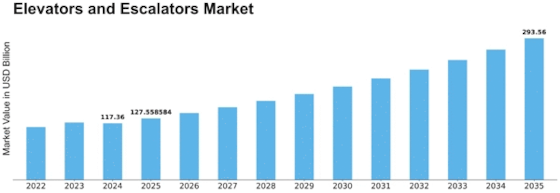
The Elevators and Escalators Market was valued at 117.36 USD Billion in 2024.

What is the projected market valuation for the Elevators and Escalators Market in 2035?

The market is projected to reach a valuation of 293.56 USD Billion by 2035.

What is the expected CAGR for the Elevators and Escalators Market during the forecast period 2025 - 2035?

The expected CAGR for the market during the forecast period 2025 - 2035 is 8.69%.

Which segments are included in the Elevators and Escalators Market?

The market segments include Elevators, Escalators, Moving Walkways, New Installation, Maintenance & Repair, and various technologies.

What was the market size for Elevators in 2024?

In 2024, the market size for Elevators was between 70.0 and 170.0 USD Billion.

How much was the Escalators segment valued at in 2024?

The Escalators segment was valued between 30.0 and 80.0 USD Billion in 2024.

Market Summary

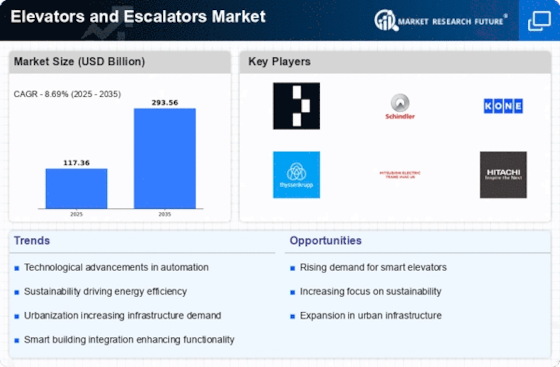
As per MRFR analysis, the Elevators and Escalators Market Size was estimated at 117.36 USD Billion in 2024. The Elevators and Escalators industry is projected to grow from 127.56 USD Billion in 2025 to 293.56 USD Billion by 2035, exhibiting a compound annual growth rate (CAGR) of 8.69 during the forecast period 2025 - 2035.

Key Market Trends & Highlights

The Elevators and Escalators Market is poised for substantial growth driven by technological advancements and urbanization.

  • Smart technology integration is transforming the elevators and escalators market, enhancing user experience and operational efficiency. Sustainability initiatives are gaining traction, with manufacturers focusing on energy-efficient solutions to meet regulatory demands. The modernization and retrofitting segment is witnessing increased investment, particularly in aging infrastructure across North America. Urbanization and infrastructure development are major drivers, propelling demand for new installations in elevators and maintenance and repair services in escalators.

Market Size & Forecast

2024 Market Size 117.36 (USD Billion)
2035 Market Size 293.56 (USD Billion)
CAGR (2025 - 2035) 8.69%
Largest Regional Market Share in 2024 Asia Pacific

Major Players

<p>Otis (US), Schindler (CH), Kone (FI), Thyssenkrupp (DE), Mitsubishi Electric (JP), Hitachi (JP), Toshiba (JP), Fujitec (JP), Hyundai Elevator (KR)</p>

Market Trends

The Elevators and Escalators Market is currently experiencing a transformative phase, driven by advancements in technology and increasing urbanization. As cities expand and vertical construction becomes more prevalent, the demand for efficient and reliable vertical transportation solutions is on the rise. Innovations such as smart elevators, which utilize IoT technology for enhanced performance and maintenance, are becoming more commonplace. Additionally, sustainability concerns are influencing design choices, with manufacturers focusing on energy-efficient systems that reduce environmental impact. This shift towards greener solutions is likely to shape the future landscape of the industry. Moreover, the Elevators and Escalators Market is witnessing a growing trend towards modernization and retrofitting of existing systems. Many building owners are opting to upgrade their current installations to improve safety, efficiency, and user experience. This trend is particularly evident in older structures that require compliance with updated safety regulations. As a result, the market is poised for growth, with opportunities for both new installations and modernization projects. The interplay of technology, sustainability, and modernization is expected to define the trajectory of the Elevators and Escalators Market in the coming years.

Smart Technology Integration

The integration of smart technology into elevators and escalators is reshaping the market. These systems utilize IoT connectivity to enhance operational efficiency, predictive maintenance, and user experience. Smart elevators can optimize travel routes and reduce wait times, thereby improving overall building functionality.

Sustainability Initiatives

Sustainability is becoming a central theme in the Elevators and Escalators Market. Manufacturers are increasingly focusing on energy-efficient designs and eco-friendly materials. This trend reflects a broader commitment to reducing carbon footprints and promoting environmentally responsible practices within the industry.

Modernization and Retrofitting

The trend towards modernization and retrofitting of existing elevators and escalators is gaining momentum. Building owners are investing in upgrades to enhance safety, efficiency, and compliance with current regulations. This approach not only improves performance but also extends the lifespan of older systems.

Elevators and Escalators Market Market Drivers

Technological Advancements

Technological innovations play a crucial role in shaping the Elevators and Escalators Market. The integration of smart technologies, such as IoT and AI, enhances the functionality and efficiency of elevators and escalators. These advancements not only improve user experience but also optimize energy consumption and maintenance processes. For instance, predictive maintenance systems can reduce downtime and operational costs. The market for smart elevators is projected to grow at a compound annual growth rate of over 10% in the coming years, indicating a strong shift towards technology-driven solutions in the Elevators and Escalators Market.

Sustainability and Energy Efficiency

Sustainability initiatives are becoming increasingly important in the Elevators and Escalators Market. As environmental concerns grow, there is a push for energy-efficient solutions that minimize carbon footprints. Manufacturers are developing elevators and escalators that utilize regenerative drives and energy-efficient components, which can significantly reduce energy consumption. The market for energy-efficient elevators is projected to expand as building codes and standards evolve to prioritize sustainability. This trend aligns with the broader movement towards green building practices, making sustainability a key driver for the Elevators and Escalators Market.

Increased Focus on Safety Regulations

The Elevators and Escalators Market is also influenced by heightened safety regulations and standards. Governments and regulatory bodies are implementing stricter safety measures to ensure the safe operation of elevators and escalators. This focus on safety is prompting building owners and operators to invest in compliant systems and technologies. As a result, the demand for safety-enhanced elevators and escalators is likely to rise, driving growth in the market. The emphasis on safety not only protects users but also enhances the reputation of building owners, making it a critical driver for the Elevators and Escalators Market.

Urbanization and Infrastructure Development

The rapid pace of urbanization is a primary driver for the Elevators and Escalators Market. As populations migrate to urban areas, the demand for high-rise buildings and multi-story complexes increases. This trend necessitates the installation of elevators and escalators to facilitate efficient vertical transportation. According to recent data, urban areas are expected to house approximately 68% of the world's population by 2050, which could lead to a substantial rise in the construction of skyscrapers and commercial buildings. Consequently, the Elevators and Escalators Market is likely to experience significant growth as developers seek to meet the needs of densely populated urban environments.

Aging Infrastructure and Modernization Needs

Many regions are grappling with aging infrastructure, which presents a significant opportunity for the Elevators and Escalators Market. As older buildings require upgrades to meet safety standards and improve accessibility, the demand for modernization and retrofitting of existing elevator systems is on the rise. This trend is particularly evident in developed nations, where regulatory frameworks increasingly mandate compliance with modern safety and accessibility standards. The modernization segment of the Elevators and Escalators Market is expected to witness robust growth, driven by the need to enhance the performance and reliability of outdated systems.

Market Segment Insights

By Type: Elevators (Largest) vs. Escalators (Fastest-Growing)

<p>The Elevators and Escalators Market is segmented primarily into elevators, escalators, and moving walkways. Among these, elevators hold the largest market share, providing vital vertical transportation solutions in high-rise buildings, commercial spaces, and <a href="https://www.marketresearchfuture.com/reports/residential-real-estate-market-11577">residential</a> properties. Escalators, though a comparatively smaller player in terms of overall share, are gaining more traction due to increasing urbanization and the need for efficient, continuous transportation in crowded areas such as malls, airports, and public transit systems.</p>

<p>Elevators (Dominant) vs. Escalators (Emerging)</p>

<p>Elevators are recognized as the dominant force within the Elevators and Escalators Market. They are integral in multi-story structures, often characterized by their capability to manage substantial loads efficiently while ensuring safety and reliability. This segment has a long-standing presence, evolving with advancements in technology such as machine-room-less (MRL) designs and smart elevator systems that cater to energy efficiency and user accessibility. On the other hand, escalators represent an emerging segment, rapidly expanding due to heightened demand in public infrastructure, commercial services, and the ongoing trend of smart city developments. Their ability to facilitate high passenger throughput at lower operational costs makes them increasingly attractive to investors and developers alike.</p>

By Services: New Installation (Largest) vs. Maintenance & Repair (Fastest-Growing)

<p>In the Elevators and Escalators Market, the Services segment is significantly segmented into New Installation and Maintenance &amp; Repair. New Installation currently holds the largest market share, driven by ongoing construction projects and the demand for modernizing aging infrastructure. In contrast, the Maintenance &amp; Repair segment is rapidly gaining traction, reflecting a growing focus on operational efficiency and safety compliance among building managers and facility operators. This shift indicates a balanced investment in both new technologies and the upkeep of existing systems.</p>

<p>New Installation (Dominant) vs. Maintenance &amp; Repair (Emerging)</p>

<p>In the Elevators and Escalators Market, New Installation serves as the dominant segment, largely fueled by urbanization and the escalating demand for taller buildings requiring efficient vertical transportation solutions. This segment capitalizes on innovative designs and energy-efficient technologies, positioning itself as a frontrunner. Meanwhile, the Maintenance &amp; Repair segment emerges as essential, focusing on extending the lifecycle of existing systems through regular service contracts and emergency repairs. With advancements in IoT and predictive maintenance technologies, this segment is becoming increasingly important, addressing user concerns related to reliability and operational downtime.</p>

By Technology: Traction (Largest) vs. Machine room-Less (Fastest-Growing)

<p>The Elevators and Escalators Market reveals a clear distribution among its technology segments, with Traction elevators holding the largest share due to their efficiency and suitability for high-rise buildings. Machine room-less elevators are rapidly gaining traction, appealing to modern construction trends that prioritize space-saving designs. Hydraulic systems, while critical in specific applications, have a smaller market presence relative to these two innovations. In terms of growth trends, the accelerating urbanization and construction activities worldwide are driving demand for efficient vertical transportation solutions. The increasing adoption of <a href="https://www.marketresearchfuture.com/reports/energy-efficient-windows-market-2516">energy-efficient</a> technologies and a shift towards smart building solutions further propel the rise of machine room-less elevators. Additionally, stringent safety regulations enhance the appeal of hydraulic elevators in certain segments of the market.</p>

<p>Technology: Traction (Dominant) vs. Hydraulic (Emerging)</p>

<p>Traction technology represents the dominant force in the Elevators and Escalators Market, renowned for its energy efficiency and ability to serve high-rise structures effectively. Its design allows for significant weight savings and smoother rides, making it the preferred choice for large commercial buildings. Conversely, hydraulic elevators, although emerging and suited for low- to mid-rise applications, offer unique advantages, such as lower installation costs and simpler mechanics. They operate using liquid pressure, which can be beneficial in specific situations, such as places with high load capacities or where space is constrained. While traction remains the leader, the continuous innovation in hydraulic technology keeps it relevant and competitive.</p>

Get more detailed insights about Elevators and Escalators Market Research Report– Forecast 2035

Regional Insights

North America : Innovation and Sustainability Focus

The North American elevators and escalators market is driven by urbanization, infrastructure development, and a growing emphasis on sustainability. The U.S. holds the largest market share at approximately 60%, followed by Canada at around 25%. Regulatory initiatives promoting energy-efficient technologies are further catalyzing market growth, as cities invest in modernizing their transportation systems to meet increasing urban demands. Leading the market are key players such as Otis, Kone, and Thyssenkrupp, who are innovating with smart technologies and eco-friendly solutions. The competitive landscape is characterized by strategic partnerships and acquisitions aimed at enhancing service offerings. The presence of established companies ensures a robust supply chain, while emerging players are also gaining traction by focusing on niche markets and specialized services.

Europe : Regulatory-Driven Market Expansion

Europe's elevators and escalators market is experiencing significant growth, driven by stringent safety regulations and a push for modernization in aging infrastructure. Germany and France are the largest markets, holding approximately 35% and 20% market shares, respectively. The European Union's directives on energy efficiency and safety standards are key regulatory catalysts that are shaping the market landscape, encouraging investments in advanced technologies. Countries like the UK, Italy, and Spain are also contributing to market growth, with a competitive landscape dominated by players such as Schindler and Kone. The presence of major manufacturers and a focus on innovation in smart elevators are enhancing operational efficiency. The market is characterized by a mix of established firms and new entrants, all vying for a share in this evolving sector.

Asia-Pacific : Rapid Urbanization and Growth

The Asia-Pacific region is witnessing explosive growth in the elevators and escalators market, fueled by rapid urbanization and increasing construction activities. China is the largest market, accounting for approximately 50% of the regional share, followed by Japan at around 20%. Government initiatives aimed at enhancing urban infrastructure and smart city projects are significant growth drivers, leading to a surge in demand for vertical transportation solutions. Key players like Mitsubishi Electric and Hitachi dominate the market, focusing on innovation and technology integration. The competitive landscape is marked by a mix of local and international companies, with many investing in R&D to develop advanced, energy-efficient systems. The region's diverse market dynamics present both challenges and opportunities for growth, as companies adapt to varying regulatory environments and consumer preferences.

Middle East and Africa : Emerging Market Potential

The Middle East and Africa region is emerging as a significant market for elevators and escalators, driven by rapid urbanization and infrastructure development projects. The UAE and South Africa are the largest markets, holding approximately 30% and 20% market shares, respectively. Government investments in mega projects and smart city initiatives are key growth drivers, creating a favorable environment for market expansion and innovation in vertical transportation solutions. Countries like Saudi Arabia and Egypt are also witnessing increased demand, with a competitive landscape featuring both global and regional players. Companies such as Fujitec and Hyundai Elevator are focusing on expanding their presence through strategic partnerships and localized solutions. The region's unique challenges, including regulatory variations and economic fluctuations, require companies to be agile and responsive to market needs.

Key Players and Competitive Insights

The Elevators and Escalators Market is currently characterized by a dynamic competitive landscape, driven by technological advancements, urbanization, and increasing demand for efficient vertical transportation solutions. Major players such as Otis (US), Schindler (CH), and Kone (FI) are strategically positioned to leverage innovation and digital transformation to enhance their market presence. Otis (US) focuses on integrating smart technologies into its products, while Schindler (CH) emphasizes sustainability and energy efficiency in its offerings. Kone (FI) is actively pursuing partnerships to expand its digital services, indicating a collective shift towards enhancing customer experience and operational efficiency, which shapes the competitive environment significantly.

Key business tactics within the Elevators and Escalators Market include localizing manufacturing and optimizing supply chains to enhance responsiveness to regional demands. The market appears moderately fragmented, with a mix of established players and emerging companies vying for market share. The collective influence of key players is substantial, as they not only set industry standards but also drive innovation through competitive practices that prioritize customer-centric solutions and sustainability.

In August 2025, Otis (US) announced a strategic partnership with a leading technology firm to develop advanced predictive maintenance solutions for its elevator systems. This initiative is likely to enhance operational efficiency and reduce downtime, thereby improving customer satisfaction. The integration of IoT technologies into their systems may also position Otis as a leader in smart building solutions, reflecting a broader trend towards digitalization in the industry.

In July 2025, Schindler (CH) launched a new energy-efficient escalator model designed to reduce energy consumption by up to 30%. This move underscores Schindler's commitment to sustainability and aligns with global trends towards greener technologies. By prioritizing energy efficiency, Schindler not only meets regulatory demands but also appeals to environmentally conscious consumers, potentially enhancing its competitive edge in the market.

In September 2025, Kone (FI) expanded its operations in Asia by opening a new manufacturing facility in Vietnam. This strategic expansion is indicative of Kone's focus on localizing production to better serve the rapidly growing Asian market. By establishing a presence in Vietnam, Kone aims to reduce lead times and enhance supply chain efficiency, which could significantly bolster its competitive position in the region.

As of October 2025, the Elevators and Escalators Market is witnessing trends such as digitalization, sustainability, and the integration of artificial intelligence. Strategic alliances among key players are increasingly shaping the competitive landscape, fostering innovation and enhancing service offerings. The shift from price-based competition to a focus on technological advancement and supply chain reliability is becoming evident. Companies that prioritize innovation and sustainability are likely to differentiate themselves in this evolving market, suggesting a future where competitive advantage hinges on the ability to adapt to changing consumer expectations and technological advancements.

Key Companies in the Elevators and Escalators Market market include

Industry Developments

  • Q2 2024: Otis Installs 26 Vertical Transportation Units at One Exchange Square, London In June 2024, Otis completed the installation of 26 vertical transportation units—including four LinkTM escalators, seven platform lifts, and fifteen Gen2 lifts—at the 13-story One Exchange Square office building in London's Broadgate Campus. The project features advanced systems such as Compass 360 destination-dispatch and IoT connectivity with Otis ONETM.[3]
  • Q4 2024: KONE Awarded $1.1 Million Contract to Replace Escalators at McGhee Tyson Airport In October 2024, McGhee Tyson Airport's board awarded a $1.1 million contract to KONE to replace its aging escalators. The downward escalator will be replaced in late 2025, followed by the upward escalator in early 2026.[4]
  • Q1 2025: New York City Mandates Escalator Skirt Deflectors by January 2025 A retroactive code in New York City requires building owners and managers to integrate escalator skirt deflectors by January 1, 2025, to enhance passenger safety and prevent entrapment incidents.[4]

Future Outlook

Elevators and Escalators Market Future Outlook

<p>The Elevators and Escalators Market is projected to grow at an 8.69% CAGR from 2024 to 2035, driven by urbanization, technological advancements, and sustainability initiatives.</p>

New opportunities lie in:

  • <p>Integration of IoT for predictive maintenance solutions.</p>
  • <p>Development of energy-efficient elevator systems for green buildings.</p>
  • <p>Expansion into emerging markets with tailored product offerings.</p>

<p>By 2035, the market is expected to be robust, driven by innovation and increased demand.</p>

Market Segmentation

Elevators and Escalators Market Type Outlook

  • Elevators
  • Escalators
  • Moving Walkways

Elevators and Escalators Market Services Outlook

  • New Installation
  • Maintenance & Repair

Elevators and Escalators Market Technology Outlook

  • Traction
  • Machine room-Less
  • Hydraulic

Report Scope

MARKET SIZE 2024 117.36(USD Billion)
MARKET SIZE 2025 127.56(USD Billion)
MARKET SIZE 2035 293.56(USD Billion)
COMPOUND ANNUAL GROWTH RATE (CAGR) 8.69% (2024 - 2035)
REPORT COVERAGE Revenue Forecast, Competitive Landscape, Growth Factors, and Trends
BASE YEAR 2024
Market Forecast Period 2025 - 2035
Historical Data 2019 - 2024
Market Forecast Units USD Billion
Key Companies Profiled Market analysis in progress
Segments Covered Market segmentation analysis in progress
Key Market Opportunities Integration of smart technology and sustainability initiatives in the Elevators and Escalators Market.
Key Market Dynamics Technological advancements and urbanization drive demand for innovative elevators and escalators in modern infrastructure.
Countries Covered North America, Europe, APAC, South America, MEA

FAQs

What is the current valuation of the Elevators and Escalators Market as of 2024?

The Elevators and Escalators Market was valued at 117.36 USD Billion in 2024.

What is the projected market valuation for the Elevators and Escalators Market in 2035?

The market is projected to reach a valuation of 293.56 USD Billion by 2035.

What is the expected CAGR for the Elevators and Escalators Market during the forecast period 2025 - 2035?

The expected CAGR for the market during the forecast period 2025 - 2035 is 8.69%.

Which segments are included in the Elevators and Escalators Market?

The market segments include Elevators, Escalators, Moving Walkways, New Installation, Maintenance &amp; Repair, and various technologies.

What was the market size for Elevators in 2024?

In 2024, the market size for Elevators was between 70.0 and 170.0 USD Billion.

How much was the Escalators segment valued at in 2024?

The Escalators segment was valued between 30.0 and 80.0 USD Billion in 2024.

  1. SECTION I: EXECUTIVE SUMMARY AND KEY HIGHLIGHTS
    1. EXECUTIVE SUMMARY
      1. Market Overview
      2. Key Findings
      3. Market Segmentation
      4. Competitive Landscape
      5. Challenges and Opportunities
      6. Future Outlook 2
  2. SECTION II: SCOPING, METHODOLOGY AND MARKET STRUCTURE
    1. MARKET INTRODUCTION
      1. Definition
      2. Scope of the study
    2. RESEARCH METHODOLOGY
      1. Overview
      2. Data Mining
      3. Secondary Research
      4. Primary Research
      5. Forecasting Model
      6. Market Size Estimation
      7. Data Triangulation
      8. Validation 3
  3. SECTION III: QUALITATIVE ANALYSIS
    1. MARKET DYNAMICS
      1. Overview
      2. Drivers
      3. Restraints
      4. Opportunities
    2. MARKET FACTOR ANALYSIS
      1. Value chain Analysis
      2. Porter's Five Forces Analysis
      3. COVID-19 Impact Analysis
  4. SECTION IV: QUANTITATIVE ANALYSIS
    1. Packaging & Transport, BY Type (USD Billion)
      1. Elevators
      2. Escalators
      3. Moving Walkways
    2. Packaging & Transport, BY Services (USD Billion)
      1. New Installation
      2. Maintenance & Repair
    3. Packaging & Transport, BY Technology (USD Billion)
      1. Traction
      2. Machine room-Less
      3. Hydraulic
    4. Packaging & Transport, BY Region (USD Billion)
      1. North America
      2. Europe
      3. APAC
      4. South America
      5. MEA
  5. SECTION V: COMPETITIVE ANALYSIS
    1. Competitive Landscape
      1. Overview
      2. Competitive Analysis
      3. Market share Analysis
      4. Major Growth Strategy in the Packaging & Transport
      5. Competitive Benchmarking
      6. Leading Players in Terms of Number of Developments in the Packaging & Transport
      7. Key developments and growth strategies
      8. Major Players Financial Matrix
    2. Company Profiles
      1. Otis (US)
      2. Schindler (CH)
      3. Kone (FI)
      4. Thyssenkrupp (DE)
      5. Mitsubishi Electric (JP)
      6. Hitachi (JP)
      7. Toshiba (JP)
      8. Fujitec (JP)
      9. Hyundai Elevator (KR)
    3. Appendix
      1. References
      2. Related Reports 6 LIST OF FIGURES
    4. MARKET SYNOPSIS
    5. NORTH AMERICA MARKET ANALYSIS
    6. US MARKET ANALYSIS BY TYPE
    7. US MARKET ANALYSIS BY SERVICES
    8. US MARKET ANALYSIS BY TECHNOLOGY
    9. CANADA MARKET ANALYSIS BY TYPE
    10. CANADA MARKET ANALYSIS BY SERVICES
    11. CANADA MARKET ANALYSIS BY TECHNOLOGY
    12. EUROPE MARKET ANALYSIS
    13. GERMANY MARKET ANALYSIS BY TYPE
    14. GERMANY MARKET ANALYSIS BY SERVICES
    15. GERMANY MARKET ANALYSIS BY TECHNOLOGY
    16. UK MARKET ANALYSIS BY TYPE
    17. UK MARKET ANALYSIS BY SERVICES
    18. UK MARKET ANALYSIS BY TECHNOLOGY
    19. FRANCE MARKET ANALYSIS BY TYPE
    20. FRANCE MARKET ANALYSIS BY SERVICES
    21. FRANCE MARKET ANALYSIS BY TECHNOLOGY
    22. RUSSIA MARKET ANALYSIS BY TYPE
    23. RUSSIA MARKET ANALYSIS BY SERVICES
    24. RUSSIA MARKET ANALYSIS BY TECHNOLOGY
    25. ITALY MARKET ANALYSIS BY TYPE
    26. ITALY MARKET ANALYSIS BY SERVICES
    27. ITALY MARKET ANALYSIS BY TECHNOLOGY
    28. SPAIN MARKET ANALYSIS BY TYPE
    29. SPAIN MARKET ANALYSIS BY SERVICES
    30. SPAIN MARKET ANALYSIS BY TECHNOLOGY
    31. REST OF EUROPE MARKET ANALYSIS BY TYPE
    32. REST OF EUROPE MARKET ANALYSIS BY SERVICES
    33. REST OF EUROPE MARKET ANALYSIS BY TECHNOLOGY
    34. APAC MARKET ANALYSIS
    35. CHINA MARKET ANALYSIS BY TYPE
    36. CHINA MARKET ANALYSIS BY SERVICES
    37. CHINA MARKET ANALYSIS BY TECHNOLOGY
    38. INDIA MARKET ANALYSIS BY TYPE
    39. INDIA MARKET ANALYSIS BY SERVICES
    40. INDIA MARKET ANALYSIS BY TECHNOLOGY
    41. JAPAN MARKET ANALYSIS BY TYPE
    42. JAPAN MARKET ANALYSIS BY SERVICES
    43. JAPAN MARKET ANALYSIS BY TECHNOLOGY
    44. SOUTH KOREA MARKET ANALYSIS BY TYPE
    45. SOUTH KOREA MARKET ANALYSIS BY SERVICES
    46. SOUTH KOREA MARKET ANALYSIS BY TECHNOLOGY
    47. MALAYSIA MARKET ANALYSIS BY TYPE
    48. MALAYSIA MARKET ANALYSIS BY SERVICES
    49. MALAYSIA MARKET ANALYSIS BY TECHNOLOGY
    50. THAILAND MARKET ANALYSIS BY TYPE
    51. THAILAND MARKET ANALYSIS BY SERVICES
    52. THAILAND MARKET ANALYSIS BY TECHNOLOGY
    53. INDONESIA MARKET ANALYSIS BY TYPE
    54. INDONESIA MARKET ANALYSIS BY SERVICES
    55. INDONESIA MARKET ANALYSIS BY TECHNOLOGY
    56. REST OF APAC MARKET ANALYSIS BY TYPE
    57. REST OF APAC MARKET ANALYSIS BY SERVICES
    58. REST OF APAC MARKET ANALYSIS BY TECHNOLOGY
    59. SOUTH AMERICA MARKET ANALYSIS
    60. BRAZIL MARKET ANALYSIS BY TYPE
    61. BRAZIL MARKET ANALYSIS BY SERVICES
    62. BRAZIL MARKET ANALYSIS BY TECHNOLOGY
    63. MEXICO MARKET ANALYSIS BY TYPE
    64. MEXICO MARKET ANALYSIS BY SERVICES
    65. MEXICO MARKET ANALYSIS BY TECHNOLOGY
    66. ARGENTINA MARKET ANALYSIS BY TYPE
    67. ARGENTINA MARKET ANALYSIS BY SERVICES
    68. ARGENTINA MARKET ANALYSIS BY TECHNOLOGY
    69. REST OF SOUTH AMERICA MARKET ANALYSIS BY TYPE
    70. REST OF SOUTH AMERICA MARKET ANALYSIS BY SERVICES
    71. REST OF SOUTH AMERICA MARKET ANALYSIS BY TECHNOLOGY
    72. MEA MARKET ANALYSIS
    73. GCC COUNTRIES MARKET ANALYSIS BY TYPE
    74. GCC COUNTRIES MARKET ANALYSIS BY SERVICES
    75. GCC COUNTRIES MARKET ANALYSIS BY TECHNOLOGY
    76. SOUTH AFRICA MARKET ANALYSIS BY TYPE
    77. SOUTH AFRICA MARKET ANALYSIS BY SERVICES
    78. SOUTH AFRICA MARKET ANALYSIS BY TECHNOLOGY
    79. REST OF MEA MARKET ANALYSIS BY TYPE
    80. REST OF MEA MARKET ANALYSIS BY SERVICES
    81. REST OF MEA MARKET ANALYSIS BY TECHNOLOGY
    82. KEY BUYING CRITERIA OF PACKAGING & TRANSPORT
    83. RESEARCH PROCESS OF MRFR
    84. DRO ANALYSIS OF PACKAGING & TRANSPORT
    85. DRIVERS IMPACT ANALYSIS: PACKAGING & TRANSPORT
    86. RESTRAINTS IMPACT ANALYSIS: PACKAGING & TRANSPORT
    87. SUPPLY / VALUE CHAIN: PACKAGING & TRANSPORT
    88. PACKAGING & TRANSPORT, BY TYPE, 2024 (% SHARE)
    89. PACKAGING & TRANSPORT, BY TYPE, 2024 TO 2035 (USD Billion)
    90. PACKAGING & TRANSPORT, BY SERVICES, 2024 (% SHARE)
    91. PACKAGING & TRANSPORT, BY SERVICES, 2024 TO 2035 (USD Billion)
    92. PACKAGING & TRANSPORT, BY TECHNOLOGY, 2024 (% SHARE)
    93. PACKAGING & TRANSPORT, BY TECHNOLOGY, 2024 TO 2035 (USD Billion)
    94. BENCHMARKING OF MAJOR COMPETITORS 7 LIST OF TABLES
    95. LIST OF ASSUMPTIONS
    96. North America MARKET SIZE ESTIMATES; FORECAST
      1. BY TYPE, 2025-2035 (USD Billion)
      2. BY SERVICES, 2025-2035 (USD Billion)
      3. BY TECHNOLOGY, 2025-2035 (USD Billion)
    97. US MARKET SIZE ESTIMATES; FORECAST
      1. BY TYPE, 2025-2035 (USD Billion)
      2. BY SERVICES, 2025-2035 (USD Billion)
      3. BY TECHNOLOGY, 2025-2035 (USD Billion)
    98. Canada MARKET SIZE ESTIMATES; FORECAST
      1. BY TYPE, 2025-2035 (USD Billion)
      2. BY SERVICES, 2025-2035 (USD Billion)
      3. BY TECHNOLOGY, 2025-2035 (USD Billion)
    99. Europe MARKET SIZE ESTIMATES; FORECAST
      1. BY TYPE, 2025-2035 (USD Billion)
      2. BY SERVICES, 2025-2035 (USD Billion)
      3. BY TECHNOLOGY, 2025-2035 (USD Billion)
    100. Germany MARKET SIZE ESTIMATES; FORECAST
      1. BY TYPE, 2025-2035 (USD Billion)
      2. BY SERVICES, 2025-2035 (USD Billion)
      3. BY TECHNOLOGY, 2025-2035 (USD Billion)
    101. UK MARKET SIZE ESTIMATES; FORECAST
      1. BY TYPE, 2025-2035 (USD Billion)
      2. BY SERVICES, 2025-2035 (USD Billion)
      3. BY TECHNOLOGY, 2025-2035 (USD Billion)
    102. France MARKET SIZE ESTIMATES; FORECAST
      1. BY TYPE, 2025-2035 (USD Billion)
      2. BY SERVICES, 2025-2035 (USD Billion)
      3. BY TECHNOLOGY, 2025-2035 (USD Billion)
    103. Russia MARKET SIZE ESTIMATES; FORECAST
      1. BY TYPE, 2025-2035 (USD Billion)
      2. BY SERVICES, 2025-2035 (USD Billion)
      3. BY TECHNOLOGY, 2025-2035 (USD Billion)
    104. Italy MARKET SIZE ESTIMATES; FORECAST
      1. BY TYPE, 2025-2035 (USD Billion)
      2. BY SERVICES, 2025-2035 (USD Billion)
      3. BY TECHNOLOGY, 2025-2035 (USD Billion)
    105. Spain MARKET SIZE ESTIMATES; FORECAST
      1. BY TYPE, 2025-2035 (USD Billion)
      2. BY SERVICES, 2025-2035 (USD Billion)
      3. BY TECHNOLOGY, 2025-2035 (USD Billion)
    106. Rest of Europe MARKET SIZE ESTIMATES; FORECAST
      1. BY TYPE, 2025-2035 (USD Billion)
      2. BY SERVICES, 2025-2035 (USD Billion)
      3. BY TECHNOLOGY, 2025-2035 (USD Billion)
    107. APAC MARKET SIZE ESTIMATES; FORECAST
      1. BY TYPE, 2025-2035 (USD Billion)
      2. BY SERVICES, 2025-2035 (USD Billion)
      3. BY TECHNOLOGY, 2025-2035 (USD Billion)
    108. China MARKET SIZE ESTIMATES; FORECAST
      1. BY TYPE, 2025-2035 (USD Billion)
      2. BY SERVICES, 2025-2035 (USD Billion)
      3. BY TECHNOLOGY, 2025-2035 (USD Billion)
    109. India MARKET SIZE ESTIMATES; FORECAST
      1. BY TYPE, 2025-2035 (USD Billion)
      2. BY SERVICES, 2025-2035 (USD Billion)
      3. BY TECHNOLOGY, 2025-2035 (USD Billion)
    110. Japan MARKET SIZE ESTIMATES; FORECAST
      1. BY TYPE, 2025-2035 (USD Billion)
      2. BY SERVICES, 2025-2035 (USD Billion)
      3. BY TECHNOLOGY, 2025-2035 (USD Billion)
    111. South Korea MARKET SIZE ESTIMATES; FORECAST
      1. BY TYPE, 2025-2035 (USD Billion)
      2. BY SERVICES, 2025-2035 (USD Billion)
      3. BY TECHNOLOGY, 2025-2035 (USD Billion)
    112. Malaysia MARKET SIZE ESTIMATES; FORECAST
      1. BY TYPE, 2025-2035 (USD Billion)
      2. BY SERVICES, 2025-2035 (USD Billion)
      3. BY TECHNOLOGY, 2025-2035 (USD Billion)
    113. Thailand MARKET SIZE ESTIMATES; FORECAST
      1. BY TYPE, 2025-2035 (USD Billion)
      2. BY SERVICES, 2025-2035 (USD Billion)
      3. BY TECHNOLOGY, 2025-2035 (USD Billion)
    114. Indonesia MARKET SIZE ESTIMATES; FORECAST
      1. BY TYPE, 2025-2035 (USD Billion)
      2. BY SERVICES, 2025-2035 (USD Billion)
      3. BY TECHNOLOGY, 2025-2035 (USD Billion)
    115. Rest of APAC MARKET SIZE ESTIMATES; FORECAST
      1. BY TYPE, 2025-2035 (USD Billion)
      2. BY SERVICES, 2025-2035 (USD Billion)
      3. BY TECHNOLOGY, 2025-2035 (USD Billion)
    116. South America MARKET SIZE ESTIMATES; FORECAST
      1. BY TYPE, 2025-2035 (USD Billion)
      2. BY SERVICES, 2025-2035 (USD Billion)
      3. BY TECHNOLOGY, 2025-2035 (USD Billion)
    117. Brazil MARKET SIZE ESTIMATES; FORECAST
      1. BY TYPE, 2025-2035 (USD Billion)
      2. BY SERVICES, 2025-2035 (USD Billion)
      3. BY TECHNOLOGY, 2025-2035 (USD Billion)
    118. Mexico MARKET SIZE ESTIMATES; FORECAST
      1. BY TYPE, 2025-2035 (USD Billion)
      2. BY SERVICES, 2025-2035 (USD Billion)
      3. BY TECHNOLOGY, 2025-2035 (USD Billion)
    119. Argentina MARKET SIZE ESTIMATES; FORECAST
      1. BY TYPE, 2025-2035 (USD Billion)
      2. BY SERVICES, 2025-2035 (USD Billion)
      3. BY TECHNOLOGY, 2025-2035 (USD Billion)
    120. Rest of South America MARKET SIZE ESTIMATES; FORECAST
      1. BY TYPE, 2025-2035 (USD Billion)
      2. BY SERVICES, 2025-2035 (USD Billion)
      3. BY TECHNOLOGY, 2025-2035 (USD Billion)
    121. MEA MARKET SIZE ESTIMATES; FORECAST
      1. BY TYPE, 2025-2035 (USD Billion)
      2. BY SERVICES, 2025-2035 (USD Billion)
      3. BY TECHNOLOGY, 2025-2035 (USD Billion)
    122. GCC Countries MARKET SIZE ESTIMATES; FORECAST
      1. BY TYPE, 2025-2035 (USD Billion)
      2. BY SERVICES, 2025-2035 (USD Billion)
      3. BY TECHNOLOGY, 2025-2035 (USD Billion)
    123. South Africa MARKET SIZE ESTIMATES; FORECAST
      1. BY TYPE, 2025-2035 (USD Billion)
      2. BY SERVICES, 2025-2035 (USD Billion)
      3. BY TECHNOLOGY, 2025-2035 (USD Billion)
    124. Rest of MEA MARKET SIZE ESTIMATES; FORECAST
      1. BY TYPE, 2025-2035 (USD Billion)
      2. BY SERVICES, 2025-2035 (USD Billion)
      3. BY TECHNOLOGY, 2025-2035 (USD Billion)
    125. PRODUCT LAUNCH/PRODUCT DEVELOPMENT/APPROVAL
    126. ACQUISITION/PARTNERSHIP

Elevators and Escalators Market Segmentation

Market Segmentation Overview

  • Detailed segmentation data will be available in the full report
  • Comprehensive analysis by multiple parameters
  • Regional and country-level breakdowns
  • Market size forecasts by segment
Infographic

Free Sample Request

Kindly complete the form below to receive a free sample of this Report

Get Free Sample

Customer Strories

Compare Licence

×
Features License Type
Single User Multiuser License Enterprise User
Price $4,950 $5,950 $7,250
Maximum User Access Limit 1 User Upto 10 Users Unrestricted Access Throughout the Organization
Free Customization
Direct Access to Analyst
Deliverable Format
Platform Access
Discount on Next Purchase 10% 15% 15%
Printable Versions