
Request Free Sample ×

Kindly complete the form below to receive a free sample of this Report

* Please use a valid business email

Leading companies partner with us for data-driven Insights

clients tt-cursor
Hero Background
English
Chinese
French
Japanese
Korean
German
Spanish

Electronic Weighing Scale Market Size

ID: MRFR/SEM/6135-HCR
100 Pages
Ankit Gupta
March 2026

Electronic Weighing Scale Market Size, Share and Research Report By Type (Table Top Scale, Platform Scale, Precision Scale, Pocket Scale), By End-User (Industrial, Veterinary, Scientific/Laboratory, Jewelry, Food & Beverages, Health & Fitness, Industrial, Education) And By Region (North America, Europe, Asia-Pacific, And Rest Of The World) –Industry Forecast Till 2035

Share:
Download PDF ×

We do not share your information with anyone. However, we may send you emails based on your report interest from time to time. You may contact us at any time to opt-out.

Electronic Weighing Scale Market Infographic
Purchase Options

Electronic Weighing Scale Size

Electronic Weighing Scale Market Growth Projections and Opportunities

The Electronic Weighing Scale Market is shaped by many factors in the market. Together, these forces determine how it works. One main reason for this market is the growing need in many businesses to accurately and quickly measure weight. Companies in areas like health care, food and drink, shipping goods or services, and selling things need careful weight details to run their businesses. This need is pushing the increase in demand for electronic weighing scales. Companies want to use these advanced tools to improve their operations and decision making processes. Technology improvements are very important in changing the market for electronic scales. The changes in sensor tech, screens and ways to connect have made fancy electronic scales with better features. These improvements make electronic weighing scales more precise and helpful. They also help them work better overall. Makers want to stay ahead in technology change for many different needs of industries and people. Another important thing affecting the market for electronic weighing scales is following rules. Governments and groups that set rules for businesses make strong laws so weighing tools work well, can be trusted, and are safe. These rules are very important for makers to get trust in the market and meet laws of different jobs. Sticking to rules for electronic weighing machines not only makes them good quality, but also increases trust in people who use them. This helps the market get bigger too. Competition in the market is a big part that changes how businesses work in electronic scales industry. The business has big, long-lasting companies and newcomers using creativity. Strong competition makes companies keep doing research and creating new products. This helps to bring better items into the market all the time. Big firms work on growing their range of things they sell. Newcomers try to change the market with fresh ideas, making a lively and competitive world for everyone.
Electronic Weighing Scale Market Size Graph
Author
Author Profile
Ankit Gupta
Team Lead - Research

Ankit Gupta is a seasoned market intelligence and strategic research professional with over six plus years of experience in the ICT and Semiconductor industries. With academic roots in Telecom, Marketing, and Electronics, he blends technical insight with business strategy. Ankit has led 200+ projects, including work for Fortune 500 clients like Microsoft and Rio Tinto, covering market sizing, tech forecasting, and go-to-market strategies. Known for bridging engineering and enterprise decision-making, his insights support growth, innovation, and investment planning across diverse technology markets.

Leave a Comment

FAQs

What is the projected market valuation of the Electronic Weighing Scale Market by 2035?

<p>The Electronic Weighing Scale Market is projected to reach a valuation of 16.67 USD Billion by 2035.</p>

What was the market valuation of the Electronic Weighing Scale Market in 2024?

<p>In 2024, the market valuation of the Electronic Weighing Scale Market was 9.24 USD Billion.</p>

What is the expected CAGR for the Electronic Weighing Scale Market from 2025 to 2035?

<p>The expected CAGR for the Electronic Weighing Scale Market during the forecast period 2025 - 2035 is 5.51%.</p>

Which segment is projected to have the highest growth in the Electronic Weighing Scale Market?

<p>The Table Top Scale segment is projected to grow from 2.77 USD Billion in 2024 to 5.0 USD Billion by 2035.</p>

What are the key players in the Electronic Weighing Scale Market?

<p>Key players in the market include Mettler Toledo, A&D Company, Ohaus Corporation, and Sartorius AG.</p>

How does the Industrial segment perform in the Electronic Weighing Scale Market?

The Industrial segment was valued at 2.77 USD Billion in 2024 and is expected to reach 5.05 USD Billion by 2035.

What is the projected valuation for the Food & Beverages segment by 2035?

The Food &amp; Beverages segment is projected to grow from 2.0 USD Billion in 2024 to 3.6 USD Billion by 2035.

What is the expected growth for the Veterinary segment in the Electronic Weighing Scale Market?

The Veterinary segment is anticipated to increase from 0.45 USD Billion in 2024 to 0.85 USD Billion by 2035.

What is the projected market size for the Precision Scale segment by 2035?

The Precision Scale segment is expected to grow from 2.12 USD Billion in 2024 to 3.8 USD Billion by 2035.

How does the Jewelry segment compare in growth to other segments in the market?

The Jewelry segment is projected to grow from 0.6 USD Billion in 2024 to 1.1 USD Billion by 2035, indicating moderate growth compared to other segments.

Market Summary

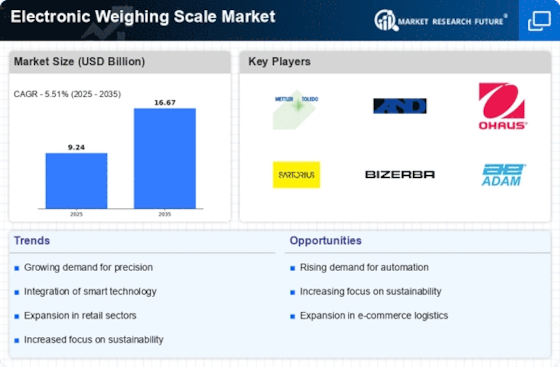
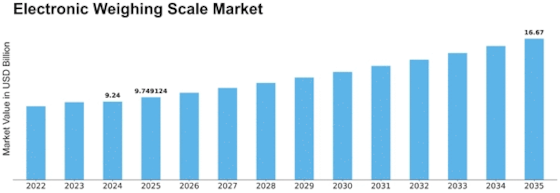
As per Market Research Future analysis, the Electronic Weighing Scale Market Size was estimated at 9.24 USD Billion in 2024. The Electronic Weighing Scale industry is projected to grow from 9.749 USD Billion in 2025 to 16.67 USD Billion by 2035, exhibiting a compound annual growth rate (CAGR) of 5.51% during the forecast period 2025 - 2035

Key Market Trends & Highlights

The Electronic Weighing Scale Market is poised for substantial growth driven by technological advancements and increasing demand across various sectors.

  • North America remains the largest market for electronic weighing scales, driven by robust retail and healthcare sectors. The Asia-Pacific region is currently the fastest-growing market, reflecting a surge in e-commerce and logistics activities. Table top scales dominate the market, while precision scales are experiencing rapid growth due to advancements in technology. Key market drivers include rising demand in the retail sector and increasing adoption in healthcare, which are shaping market dynamics.

Market Size & Forecast

2024 Market Size 9.24 (USD Billion)
2035 Market Size 16.67 (USD Billion)
CAGR (2025 - 2035) 5.51%
Largest Regional Market Share in 2024 North America

Major Players

Mettler Toledo (CH), A&amp;D Company (JP), Ohaus Corporation (US), Sartorius AG (DE), Bizerba GmbH (DE), Adam Equipment (GB), CAS Corporation (KR), Rice Lake Weighing Systems (US), Kern &amp; Sohn GmbH (DE)

Market Trends

The Electronic Weighing Scale Market is currently experiencing a dynamic evolution, driven by advancements in technology and increasing demand across various sectors. The integration of digital technologies has led to the development of more precise and user-friendly weighing solutions. Industries such as healthcare, retail, and logistics are increasingly adopting electronic scales due to their efficiency and accuracy. Furthermore, the growing emphasis on automation and data analytics is reshaping the landscape, as businesses seek to enhance operational efficiency and reduce human error. This trend suggests a shift towards smart weighing solutions that can seamlessly integrate with existing systems, providing real-time data and insights. In addition, sustainability concerns are influencing the Electronic Weighing Scale Market. Manufacturers are exploring eco-friendly materials and energy-efficient designs to meet regulatory standards and consumer preferences. The rise of e-commerce has also contributed to the demand for portable and versatile weighing solutions, as businesses require adaptable tools to manage inventory and shipping processes. Overall, the market appears poised for continued growth, with innovations likely to play a pivotal role in shaping its future trajectory.

Technological Advancements

The Electronic Weighing Scale Market is witnessing rapid technological advancements, particularly in the realm of digital integration. Scales equipped with smart features, such as connectivity options and data analytics capabilities, are becoming increasingly prevalent. This trend indicates a move towards more sophisticated weighing solutions that enhance user experience and operational efficiency.

Sustainability Initiatives

Sustainability initiatives are gaining traction within the Electronic Weighing Scale Market. Manufacturers are focusing on eco-friendly materials and energy-efficient designs to align with environmental regulations and consumer expectations. This shift suggests a growing awareness of the need for sustainable practices in product development.

E-commerce Growth

The growth of e-commerce is significantly impacting the Electronic Weighing Scale Market. As online retail expands, there is a rising demand for portable and versatile weighing solutions. Businesses require adaptable tools to efficiently manage inventory and shipping, indicating a shift towards more flexible weighing technologies.

Electronic Weighing Scale Market Market Drivers

Technological Innovations

Technological advancements play a crucial role in shaping the Electronic Weighing Scale Market. Innovations such as digital displays, connectivity features, and integration with inventory management systems are becoming increasingly prevalent. These advancements not only enhance the user experience but also improve accuracy and efficiency in weighing processes. The market is expected to grow at a compound annual growth rate of around 5% over the next few years, driven by the introduction of smart scales that offer real-time data analytics. As businesses recognize the value of data-driven decision-making, the demand for technologically advanced electronic weighing scales is likely to rise, further propelling the Electronic Weighing Scale Market.

Rising Demand in Retail Sector

The Electronic Weighing Scale Market experiences a notable surge in demand driven by the retail sector. As retailers increasingly adopt advanced weighing solutions to enhance operational efficiency, the need for precise and reliable scales becomes paramount. In 2025, the retail sector is projected to account for a significant share of the market, with estimates suggesting a growth rate of approximately 6% annually. This trend is largely attributed to the growing emphasis on customer satisfaction and the need for accurate pricing. Retailers are investing in electronic weighing scales to streamline their processes, reduce errors, and improve inventory management. Consequently, the Electronic Weighing Scale Market is likely to witness substantial growth as retailers seek to leverage technology for competitive advantage.

Increasing Adoption in Healthcare

The healthcare sector is emerging as a vital contributor to the Electronic Weighing Scale Market. With the growing focus on patient care and accurate health monitoring, the demand for electronic weighing scales in hospitals and clinics is on the rise. In 2025, the healthcare segment is projected to grow at a rate of approximately 5% annually, driven by the need for precise weight measurements in patient assessments and medication dosing. The integration of electronic scales with electronic health records is also becoming more common, enhancing the efficiency of healthcare delivery. As a result, the Electronic Weighing Scale Market is likely to benefit from the increasing adoption of these devices in healthcare settings.

Regulatory Compliance and Standards

Regulatory compliance is a driving force in the Electronic Weighing Scale Market. Governments and regulatory bodies worldwide are establishing stringent standards for weighing accuracy and safety. This regulatory landscape compels businesses across various sectors, including food and pharmaceuticals, to invest in high-quality electronic weighing scales. In 2025, the market is expected to see a rise in demand as companies strive to meet these compliance requirements. The need for certified scales that adhere to legal standards is likely to propel growth, as non-compliance can lead to significant penalties. Thus, the emphasis on regulatory adherence is a key factor influencing the Electronic Weighing Scale Market.

Growth in Logistics and Supply Chain

The logistics and supply chain sector significantly influences the Electronic Weighing Scale Market. With the increasing complexity of supply chains, accurate weighing solutions are essential for optimizing operations. In 2025, the logistics sector is anticipated to contribute substantially to market growth, with a projected increase of approximately 7% in demand for electronic weighing scales. Companies are increasingly adopting these scales to ensure compliance with regulations, reduce shipping costs, and enhance overall efficiency. The integration of electronic weighing scales into logistics operations not only streamlines processes but also minimizes errors, thereby reinforcing the importance of this technology in the Electronic Weighing Scale Market.

Market Segment Insights

By Type: Table Top Scale (Largest) vs. Precision Scale (Fastest-Growing)

<p>The electronic weighing scale market is witnessing a diverse distribution across different types. Among these, the Table Top Scale holds the largest market share due to its versatility and widespread application in retail and food industries. Meanwhile, the Precision Scale, known for its high accuracy, is rapidly gaining traction, particularly in laboratories and research institutions, contributing to its fast growth in the market.</p>

<p>Table Top Scale (Dominant) vs. Precision Scale (Emerging)</p>

<p>The Table Top Scale is a dominant player in the electronic weighing scale market, favored for its compact design and user-friendly interface, making it a preferred choice for grocery stores and small businesses. In contrast, the Precision Scale, marked as an emerging segment, is increasingly sought after in fields requiring meticulous measurements. Its ability to provide high precision measurements set it apart, and factors like the growing demand for accuracy in laboratories and stricter regulations in industries are driving its rapid market adoption.</p>

By End-User: Industrial (Largest) vs. Veterinary (Fastest-Growing)

<p>In the Electronic Weighing Scale Market, the distribution of market share among end-user segments reveals that the Industrial sector holds the largest share, primarily due to its extensive application in manufacturing and logistics operations. Following behind are segments such as Food & Beverages and Scientific/Laboratory, which also contribute significantly to the overall market. Veterinary and Health & Fitness segments, while smaller in share, showcase significant demand driven by their unique applications in animal care and fitness tracking, respectively.</p>

<p>Industrial (Dominant) vs. Veterinary (Emerging)</p>

<p>The Industrial segment stands as the dominant force in the Electronic Weighing Scale Market, characterized by its robust application across various manufacturing processes, including production and quality assurance. These scales are essential for ensuring compliance with industry standards and optimizing operational efficiency. On the other hand, the Veterinary segment is emerging rapidly, driven by increased awareness of animal health and the adoption of advanced weighing technologies in veterinary practices. This sector is characterized by a growing need for precise weight measurements to monitor animal health effectively and administer appropriate care, showcasing a trend toward more specialized and technologically adept weighing solutions.</p>

Get more detailed insights about Electronic Weighing Scale Market Research Report – Global Forecast till 2035

Regional Insights

North America : Market Leader in Innovation

North America is the largest market for electronic weighing scales, holding approximately 40% of the global market share. The region's growth is driven by technological advancements, increasing demand in healthcare, and stringent regulations on product accuracy. The U.S. and Canada are the primary contributors, with a focus on innovation and quality standards that enhance operational efficiency in various sectors. The competitive landscape in North America is robust, featuring key players like Mettler Toledo and Ohaus Corporation. These companies leverage advanced technologies to meet the diverse needs of industries such as pharmaceuticals, food processing, and logistics. The presence of established manufacturers and a strong distribution network further solidify North America's position as a leader in the electronic weighing scale market.

Europe : Regulatory Compliance Drives Growth

Europe is the second-largest market for electronic weighing scales, accounting for approximately 30% of the global market share. The region's growth is fueled by stringent regulations regarding product safety and accuracy, particularly in the food and pharmaceutical sectors. Countries like Germany and the UK are at the forefront, with increasing investments in technology and innovation to meet regulatory standards. Leading countries in Europe include Germany, the UK, and France, where companies like Sartorius AG and Bizerba GmbH dominate the market. The competitive landscape is characterized by a mix of established players and emerging startups, all striving to innovate and comply with EU regulations. The emphasis on sustainability and efficiency in manufacturing processes is also shaping the market dynamics in this region.

Asia-Pacific : Emerging Markets Fuel Demand

Asia-Pacific is witnessing significant growth in the electronic weighing scale market, holding about 25% of the global market share. The region's expansion is driven by increasing industrialization, urbanization, and a growing focus on quality control in manufacturing. Countries like China and India are leading this growth, supported by government initiatives aimed at enhancing manufacturing capabilities and standards. The competitive landscape in Asia-Pacific is diverse, with key players such as A&D Company and CAS Corporation making substantial inroads. The presence of a large number of small and medium enterprises also contributes to market dynamics, as they adopt advanced weighing technologies to improve operational efficiency. The region's focus on innovation and cost-effective solutions is expected to further boost market growth in the coming years.

Middle East and Africa : Untapped Potential in Weighing Solutions

The Middle East and Africa region is gradually emerging in the electronic weighing scale market, holding around 5% of the global market share. The growth is primarily driven by increasing investments in infrastructure and industrial sectors, alongside a rising demand for accurate weighing solutions in retail and logistics. Countries like South Africa and the UAE are leading this growth, with government initiatives promoting technological advancements. The competitive landscape is still developing, with a mix of local and international players. Companies like Adam Equipment are establishing a foothold in the region, focusing on providing tailored solutions to meet local market needs. The potential for growth is significant, as more industries recognize the importance of precision in weighing applications, paving the way for future investments and innovations.

Key Players and Competitive Insights

The Electronic Weighing Scale Market is currently characterized by a dynamic competitive landscape, driven by technological advancements and increasing demand across various sectors, including healthcare, retail, and industrial applications. Key players such as Mettler Toledo (CH), A&D Company (JP), and Sartorius AG (DE) are at the forefront, each adopting distinct strategies to enhance their market positioning. Mettler Toledo (CH) emphasizes innovation through continuous product development, focusing on precision and user-friendly interfaces, while A&D Company (JP) is leveraging its strong R&D capabilities to introduce advanced weighing solutions tailored for specific industries. Sartorius AG (DE) appears to be concentrating on expanding its global footprint, particularly in emerging markets, thereby enhancing its competitive edge.The market structure is moderately fragmented, with a mix of established players and emerging companies vying for market share. Key business tactics include localizing manufacturing to reduce costs and optimize supply chains, which is becoming increasingly vital in a globalized economy. The collective influence of these major players shapes the competitive environment, as they engage in strategic partnerships and collaborations to enhance their product offerings and market reach.

In August Mettler Toledo (CH) announced the launch of a new line of high-precision electronic balances designed specifically for laboratory applications. This strategic move is significant as it not only reinforces the company's commitment to innovation but also addresses the growing demand for accurate and reliable weighing solutions in scientific research. By enhancing its product portfolio, Mettler Toledo (CH) positions itself to capture a larger share of the laboratory market, which is expected to grow in the coming years.

In September A&D Company (JP) unveiled a new digital weighing scale equipped with IoT capabilities, allowing for real-time data monitoring and analysis. This development is particularly noteworthy as it aligns with the increasing trend towards digitalization in the weighing industry. By integrating IoT technology, A&D Company (JP) enhances its product's value proposition, catering to customers seeking advanced features that improve operational efficiency and data management.

In July Sartorius AG (DE) entered into a strategic partnership with a leading software provider to develop integrated solutions that combine weighing technology with data analytics. This collaboration is indicative of a broader trend towards the integration of software and hardware in the weighing sector. By offering comprehensive solutions that encompass both weighing and data analysis, Sartorius AG (DE) is likely to differentiate itself in a competitive market, appealing to customers looking for holistic solutions.

As of October the Electronic Weighing Scale Market is witnessing a shift towards digitalization, sustainability, and the integration of artificial intelligence. These trends are reshaping competitive dynamics, as companies increasingly focus on developing innovative solutions that meet evolving customer needs. Strategic alliances are becoming more prevalent, enabling firms to leverage complementary strengths and enhance their market offerings. Looking ahead, competitive differentiation is expected to evolve from traditional price-based competition to a focus on innovation, technology integration, and supply chain reliability, positioning companies to better respond to market demands.

Key Companies in the Electronic Weighing Scale Market include

Industry Developments

September 2023: the Indian government launched a program to crack down on black market fraud in ration shops through e-POS weighing machines. It was intended to check weight tampering and alternatives to measuring. This initiative intends to eradicate the underground trade system.

Italians espresso machine maker Victoria Arduino introduced VIS (Virtual Intelligent Scale) for use in its commercial espresso machines like Eagle One commercial espresso machines in July 2023. The firm has developed the VIS model to assist Eagle One Owners to have a relatively faster workflow than its previous version.

Eufy, an Anker sub-brand, entered India with its Smart Weighing Scale C1 in December 2020. The unit is designed with smartphone connectivity, among other smart functions that help users monitor their health, record physical activity and achieve fitness goals. By syncing it to your EufyHome app on your phone, this scale will give you twelve different parameters such as Muscle Mass, Visceral Fat, Lean Body Mass etc.

In June 2020, For applications requiring precision weighing, Mettler-Toledo has unveiled a new line of washdown-resistant checkweighers. This new series includes features including eliminating the risk of bacterial contamination, slanted surfaces to prevent debris and liquid buildup, and easily removable conveyor belts for effective cleaning.


Future Outlook

Electronic Weighing Scale Market Future Outlook

The Electronic Weighing Scale Market is projected to grow at a 5.51% CAGR from 2025 to 2035, driven by technological advancements, increasing automation, and rising demand across various industries.

New opportunities lie in:

  • Integration of IoT for real-time data analytics in weighing systems.</p><p>Development of portable weighing solutions for field applications.</p><p>Expansion into emerging markets with tailored product offerings.

By 2035, the market is expected to achieve robust growth, reflecting evolving industry needs.

Market Segmentation

Electronic Weighing Scale Market Type Outlook

  • Table Top Scale
  • Platform Scale
  • Precision Scale
  • Pocket Scale

Electronic Weighing Scale Market End-User Outlook

  • Industrial
  • Veterinary
  • Scientific/Laboratory
  • Jewelry
  • Food & Beverages
  • Health & Fitness
  • Education

Report Scope

MARKET SIZE 2024 9.24(USD Billion)
MARKET SIZE 2025 9.749(USD Billion)
MARKET SIZE 2035 16.67(USD Billion)
COMPOUND ANNUAL GROWTH RATE (CAGR) 5.51% (2025 - 2035)
REPORT COVERAGE Revenue Forecast, Competitive Landscape, Growth Factors, and Trends
BASE YEAR 2024
Market Forecast Period 2025 - 2035
Historical Data 2019 - 2024
Market Forecast Units USD Billion
Key Companies Profiled Mettler Toledo (CH), A&D Company (JP), Ohaus Corporation (US), Sartorius AG (DE), Bizerba GmbH (DE), Adam Equipment (GB), CAS Corporation (KR), Rice Lake Weighing Systems (US), Kern & Sohn GmbH (DE)
Segments Covered Type, End-User, Region
Key Market Opportunities Integration of smart technology enhances precision and connectivity in the Electronic Weighing Scale Market.
Key Market Dynamics Technological advancements and regulatory changes drive innovation and competition in the Electronic Weighing Scale Market.
Countries Covered North America, Europe, APAC, South America, MEA

FAQs

What is the projected market valuation of the Electronic Weighing Scale Market by 2035?

<p>The Electronic Weighing Scale Market is projected to reach a valuation of 16.67 USD Billion by 2035.</p>

What was the market valuation of the Electronic Weighing Scale Market in 2024?

<p>In 2024, the market valuation of the Electronic Weighing Scale Market was 9.24 USD Billion.</p>

What is the expected CAGR for the Electronic Weighing Scale Market from 2025 to 2035?

<p>The expected CAGR for the Electronic Weighing Scale Market during the forecast period 2025 - 2035 is 5.51%.</p>

Which segment is projected to have the highest growth in the Electronic Weighing Scale Market?

<p>The Table Top Scale segment is projected to grow from 2.77 USD Billion in 2024 to 5.0 USD Billion by 2035.</p>

What are the key players in the Electronic Weighing Scale Market?

<p>Key players in the market include Mettler Toledo, A&D Company, Ohaus Corporation, and Sartorius AG.</p>

How does the Industrial segment perform in the Electronic Weighing Scale Market?

The Industrial segment was valued at 2.77 USD Billion in 2024 and is expected to reach 5.05 USD Billion by 2035.

What is the projected valuation for the Food & Beverages segment by 2035?

The Food &amp; Beverages segment is projected to grow from 2.0 USD Billion in 2024 to 3.6 USD Billion by 2035.

What is the expected growth for the Veterinary segment in the Electronic Weighing Scale Market?

The Veterinary segment is anticipated to increase from 0.45 USD Billion in 2024 to 0.85 USD Billion by 2035.

What is the projected market size for the Precision Scale segment by 2035?

The Precision Scale segment is expected to grow from 2.12 USD Billion in 2024 to 3.8 USD Billion by 2035.

How does the Jewelry segment compare in growth to other segments in the market?

The Jewelry segment is projected to grow from 0.6 USD Billion in 2024 to 1.1 USD Billion by 2035, indicating moderate growth compared to other segments.

  1. SECTION I: EXECUTIVE SUMMARY AND KEY HIGHLIGHTS
    1. | 1.1 EXECUTIVE SUMMARY
    2. | | 1.1.1 Market Overview
    3. | | 1.1.2 Key Findings
    4. | | 1.1.3 Market Segmentation
    5. | | 1.1.4 Competitive Landscape
    6. | | 1.1.5 Challenges and Opportunities
    7. | | 1.1.6 Future Outlook
  2. SECTION II: SCOPING, METHODOLOGY AND MARKET STRUCTURE
    1. | 2.1 MARKET INTRODUCTION
    2. | | 2.1.1 Definition
    3. | | 2.1.2 Scope of the study
    4. | | | 2.1.2.1 Research Objective
    5. | | | 2.1.2.2 Assumption
    6. | | | 2.1.2.3 Limitations
    7. | 2.2 RESEARCH METHODOLOGY
    8. | | 2.2.1 Overview
    9. | | 2.2.2 Data Mining
    10. | | 2.2.3 Secondary Research
    11. | | 2.2.4 Primary Research
    12. | | | 2.2.4.1 Primary Interviews and Information Gathering Process
    13. | | | 2.2.4.2 Breakdown of Primary Respondents
    14. | | 2.2.5 Forecasting Model
    15. | | 2.2.6 Market Size Estimation
    16. | | | 2.2.6.1 Bottom-Up Approach
    17. | | | 2.2.6.2 Top-Down Approach
    18. | | 2.2.7 Data Triangulation
    19. | | 2.2.8 Validation
  3. SECTION III: QUALITATIVE ANALYSIS
    1. | 3.1 MARKET DYNAMICS
    2. | | 3.1.1 Overview
    3. | | 3.1.2 Drivers
    4. | | 3.1.3 Restraints
    5. | | 3.1.4 Opportunities
    6. | 3.2 MARKET FACTOR ANALYSIS
    7. | | 3.2.1 Value chain Analysis
    8. | | 3.2.2 Porter's Five Forces Analysis
    9. | | | 3.2.2.1 Bargaining Power of Suppliers
    10. | | | 3.2.2.2 Bargaining Power of Buyers
    11. | | | 3.2.2.3 Threat of New Entrants
    12. | | | 3.2.2.4 Threat of Substitutes
    13. | | | 3.2.2.5 Intensity of Rivalry
    14. | | 3.2.3 COVID-19 Impact Analysis
    15. | | | 3.2.3.1 Market Impact Analysis
    16. | | | 3.2.3.2 Regional Impact
    17. | | | 3.2.3.3 Opportunity and Threat Analysis
  4. SECTION IV: QUANTITATIVE ANALYSIS
    1. | 4.1 Semiconductor & Electronics, BY Type (USD Billion)
    2. | | 4.1.1 Table Top Scale
    3. | | 4.1.2 Platform Scale
    4. | | 4.1.3 Precision Scale
    5. | | 4.1.4 Pocket Scale
    6. | 4.2 Semiconductor & Electronics, BY End-User (USD Billion)
    7. | | 4.2.1 Industrial
    8. | | 4.2.2 Veterinary
    9. | | 4.2.3 Scientific/Laboratory
    10. | | 4.2.4 Jewelry
    11. | | 4.2.5 Food & Beverages
    12. | | 4.2.6 Health & Fitness
    13. | | 4.2.7 Education
    14. | 4.3 Semiconductor & Electronics, BY Region (USD Billion)
    15. | | 4.3.1 North America
    16. | | | 4.3.1.1 US
    17. | | | 4.3.1.2 Canada
    18. | | 4.3.2 Europe
    19. | | | 4.3.2.1 Germany
    20. | | | 4.3.2.2 UK
    21. | | | 4.3.2.3 France
    22. | | | 4.3.2.4 Russia
    23. | | | 4.3.2.5 Italy
    24. | | | 4.3.2.6 Spain
    25. | | | 4.3.2.7 Rest of Europe
    26. | | 4.3.3 APAC
    27. | | | 4.3.3.1 China
    28. | | | 4.3.3.2 India
    29. | | | 4.3.3.3 Japan
    30. | | | 4.3.3.4 South Korea
    31. | | | 4.3.3.5 Malaysia
    32. | | | 4.3.3.6 Thailand
    33. | | | 4.3.3.7 Indonesia
    34. | | | 4.3.3.8 Rest of APAC
    35. | | 4.3.4 South America
    36. | | | 4.3.4.1 Brazil
    37. | | | 4.3.4.2 Mexico
    38. | | | 4.3.4.3 Argentina
    39. | | | 4.3.4.4 Rest of South America
    40. | | 4.3.5 MEA
    41. | | | 4.3.5.1 GCC Countries
    42. | | | 4.3.5.2 South Africa
    43. | | | 4.3.5.3 Rest of MEA
  5. SECTION V: COMPETITIVE ANALYSIS
    1. | 5.1 Competitive Landscape
    2. | | 5.1.1 Overview
    3. | | 5.1.2 Competitive Analysis
    4. | | 5.1.3 Market share Analysis
    5. | | 5.1.4 Major Growth Strategy in the Semiconductor & Electronics
    6. | | 5.1.5 Competitive Benchmarking
    7. | | 5.1.6 Leading Players in Terms of Number of Developments in the Semiconductor & Electronics
    8. | | 5.1.7 Key developments and growth strategies
    9. | | | 5.1.7.1 New Product Launch/Service Deployment
    10. | | | 5.1.7.2 Merger & Acquisitions
    11. | | | 5.1.7.3 Joint Ventures
    12. | | 5.1.8 Major Players Financial Matrix
    13. | | | 5.1.8.1 Sales and Operating Income
    14. | | | 5.1.8.2 Major Players R&D Expenditure. 2023
    15. | 5.2 Company Profiles
    16. | | 5.2.1 Mettler Toledo (CH)
    17. | | | 5.2.1.1 Financial Overview
    18. | | | 5.2.1.2 Products Offered
    19. | | | 5.2.1.3 Key Developments
    20. | | | 5.2.1.4 SWOT Analysis
    21. | | | 5.2.1.5 Key Strategies
    22. | | 5.2.2 A&D Company (JP)
    23. | | | 5.2.2.1 Financial Overview
    24. | | | 5.2.2.2 Products Offered
    25. | | | 5.2.2.3 Key Developments
    26. | | | 5.2.2.4 SWOT Analysis
    27. | | | 5.2.2.5 Key Strategies
    28. | | 5.2.3 Ohaus Corporation (US)
    29. | | | 5.2.3.1 Financial Overview
    30. | | | 5.2.3.2 Products Offered
    31. | | | 5.2.3.3 Key Developments
    32. | | | 5.2.3.4 SWOT Analysis
    33. | | | 5.2.3.5 Key Strategies
    34. | | 5.2.4 Sartorius AG (DE)
    35. | | | 5.2.4.1 Financial Overview
    36. | | | 5.2.4.2 Products Offered
    37. | | | 5.2.4.3 Key Developments
    38. | | | 5.2.4.4 SWOT Analysis
    39. | | | 5.2.4.5 Key Strategies
    40. | | 5.2.5 Bizerba GmbH (DE)
    41. | | | 5.2.5.1 Financial Overview
    42. | | | 5.2.5.2 Products Offered
    43. | | | 5.2.5.3 Key Developments
    44. | | | 5.2.5.4 SWOT Analysis
    45. | | | 5.2.5.5 Key Strategies
    46. | | 5.2.6 Adam Equipment (GB)
    47. | | | 5.2.6.1 Financial Overview
    48. | | | 5.2.6.2 Products Offered
    49. | | | 5.2.6.3 Key Developments
    50. | | | 5.2.6.4 SWOT Analysis
    51. | | | 5.2.6.5 Key Strategies
    52. | | 5.2.7 CAS Corporation (KR)
    53. | | | 5.2.7.1 Financial Overview
    54. | | | 5.2.7.2 Products Offered
    55. | | | 5.2.7.3 Key Developments
    56. | | | 5.2.7.4 SWOT Analysis
    57. | | | 5.2.7.5 Key Strategies
    58. | | 5.2.8 Rice Lake Weighing Systems (US)
    59. | | | 5.2.8.1 Financial Overview
    60. | | | 5.2.8.2 Products Offered
    61. | | | 5.2.8.3 Key Developments
    62. | | | 5.2.8.4 SWOT Analysis
    63. | | | 5.2.8.5 Key Strategies
    64. | | 5.2.9 Kern & Sohn GmbH (DE)
    65. | | | 5.2.9.1 Financial Overview
    66. | | | 5.2.9.2 Products Offered
    67. | | | 5.2.9.3 Key Developments
    68. | | | 5.2.9.4 SWOT Analysis
    69. | | | 5.2.9.5 Key Strategies
    70. | 5.3 Appendix
    71. | | 5.3.1 References
    72. | | 5.3.2 Related Reports
  6. LIST OF FIGURES
    1. | 6.1 MARKET SYNOPSIS
    2. | 6.2 NORTH AMERICA MARKET ANALYSIS
    3. | 6.3 US MARKET ANALYSIS BY TYPE
    4. | 6.4 US MARKET ANALYSIS BY END-USER
    5. | 6.5 CANADA MARKET ANALYSIS BY TYPE
    6. | 6.6 CANADA MARKET ANALYSIS BY END-USER
    7. | 6.7 EUROPE MARKET ANALYSIS
    8. | 6.8 GERMANY MARKET ANALYSIS BY TYPE
    9. | 6.9 GERMANY MARKET ANALYSIS BY END-USER
    10. | 6.10 UK MARKET ANALYSIS BY TYPE
    11. | 6.11 UK MARKET ANALYSIS BY END-USER
    12. | 6.12 FRANCE MARKET ANALYSIS BY TYPE
    13. | 6.13 FRANCE MARKET ANALYSIS BY END-USER
    14. | 6.14 RUSSIA MARKET ANALYSIS BY TYPE
    15. | 6.15 RUSSIA MARKET ANALYSIS BY END-USER
    16. | 6.16 ITALY MARKET ANALYSIS BY TYPE
    17. | 6.17 ITALY MARKET ANALYSIS BY END-USER
    18. | 6.18 SPAIN MARKET ANALYSIS BY TYPE
    19. | 6.19 SPAIN MARKET ANALYSIS BY END-USER
    20. | 6.20 REST OF EUROPE MARKET ANALYSIS BY TYPE
    21. | 6.21 REST OF EUROPE MARKET ANALYSIS BY END-USER
    22. | 6.22 APAC MARKET ANALYSIS
    23. | 6.23 CHINA MARKET ANALYSIS BY TYPE
    24. | 6.24 CHINA MARKET ANALYSIS BY END-USER
    25. | 6.25 INDIA MARKET ANALYSIS BY TYPE
    26. | 6.26 INDIA MARKET ANALYSIS BY END-USER
    27. | 6.27 JAPAN MARKET ANALYSIS BY TYPE
    28. | 6.28 JAPAN MARKET ANALYSIS BY END-USER
    29. | 6.29 SOUTH KOREA MARKET ANALYSIS BY TYPE
    30. | 6.30 SOUTH KOREA MARKET ANALYSIS BY END-USER
    31. | 6.31 MALAYSIA MARKET ANALYSIS BY TYPE
    32. | 6.32 MALAYSIA MARKET ANALYSIS BY END-USER
    33. | 6.33 THAILAND MARKET ANALYSIS BY TYPE
    34. | 6.34 THAILAND MARKET ANALYSIS BY END-USER
    35. | 6.35 INDONESIA MARKET ANALYSIS BY TYPE
    36. | 6.36 INDONESIA MARKET ANALYSIS BY END-USER
    37. | 6.37 REST OF APAC MARKET ANALYSIS BY TYPE
    38. | 6.38 REST OF APAC MARKET ANALYSIS BY END-USER
    39. | 6.39 SOUTH AMERICA MARKET ANALYSIS
    40. | 6.40 BRAZIL MARKET ANALYSIS BY TYPE
    41. | 6.41 BRAZIL MARKET ANALYSIS BY END-USER
    42. | 6.42 MEXICO MARKET ANALYSIS BY TYPE
    43. | 6.43 MEXICO MARKET ANALYSIS BY END-USER
    44. | 6.44 ARGENTINA MARKET ANALYSIS BY TYPE
    45. | 6.45 ARGENTINA MARKET ANALYSIS BY END-USER
    46. | 6.46 REST OF SOUTH AMERICA MARKET ANALYSIS BY TYPE
    47. | 6.47 REST OF SOUTH AMERICA MARKET ANALYSIS BY END-USER
    48. | 6.48 MEA MARKET ANALYSIS
    49. | 6.49 GCC COUNTRIES MARKET ANALYSIS BY TYPE
    50. | 6.50 GCC COUNTRIES MARKET ANALYSIS BY END-USER
    51. | 6.51 SOUTH AFRICA MARKET ANALYSIS BY TYPE
    52. | 6.52 SOUTH AFRICA MARKET ANALYSIS BY END-USER
    53. | 6.53 REST OF MEA MARKET ANALYSIS BY TYPE
    54. | 6.54 REST OF MEA MARKET ANALYSIS BY END-USER
    55. | 6.55 KEY BUYING CRITERIA OF SEMICONDUCTOR & ELECTRONICS
    56. | 6.56 RESEARCH PROCESS OF MRFR
    57. | 6.57 DRO ANALYSIS OF SEMICONDUCTOR & ELECTRONICS
    58. | 6.58 DRIVERS IMPACT ANALYSIS: SEMICONDUCTOR & ELECTRONICS
    59. | 6.59 RESTRAINTS IMPACT ANALYSIS: SEMICONDUCTOR & ELECTRONICS
    60. | 6.60 SUPPLY / VALUE CHAIN: SEMICONDUCTOR & ELECTRONICS
    61. | 6.61 SEMICONDUCTOR & ELECTRONICS, BY TYPE, 2024 (% SHARE)
    62. | 6.62 SEMICONDUCTOR & ELECTRONICS, BY TYPE, 2024 TO 2035 (USD Billion)
    63. | 6.63 SEMICONDUCTOR & ELECTRONICS, BY END-USER, 2024 (% SHARE)
    64. | 6.64 SEMICONDUCTOR & ELECTRONICS, BY END-USER, 2024 TO 2035 (USD Billion)
    65. | 6.65 BENCHMARKING OF MAJOR COMPETITORS
  7. LIST OF TABLES
    1. | 7.1 LIST OF ASSUMPTIONS
    2. | | 7.1.1
    3. | 7.2 North America MARKET SIZE ESTIMATES; FORECAST
    4. | | 7.2.1 BY TYPE, 2025-2035 (USD Billion)
    5. | | 7.2.2 BY END-USER, 2025-2035 (USD Billion)
    6. | 7.3 US MARKET SIZE ESTIMATES; FORECAST
    7. | | 7.3.1 BY TYPE, 2025-2035 (USD Billion)
    8. | | 7.3.2 BY END-USER, 2025-2035 (USD Billion)
    9. | 7.4 Canada MARKET SIZE ESTIMATES; FORECAST
    10. | | 7.4.1 BY TYPE, 2025-2035 (USD Billion)
    11. | | 7.4.2 BY END-USER, 2025-2035 (USD Billion)
    12. | 7.5 Europe MARKET SIZE ESTIMATES; FORECAST
    13. | | 7.5.1 BY TYPE, 2025-2035 (USD Billion)
    14. | | 7.5.2 BY END-USER, 2025-2035 (USD Billion)
    15. | 7.6 Germany MARKET SIZE ESTIMATES; FORECAST
    16. | | 7.6.1 BY TYPE, 2025-2035 (USD Billion)
    17. | | 7.6.2 BY END-USER, 2025-2035 (USD Billion)
    18. | 7.7 UK MARKET SIZE ESTIMATES; FORECAST
    19. | | 7.7.1 BY TYPE, 2025-2035 (USD Billion)
    20. | | 7.7.2 BY END-USER, 2025-2035 (USD Billion)
    21. | 7.8 France MARKET SIZE ESTIMATES; FORECAST
    22. | | 7.8.1 BY TYPE, 2025-2035 (USD Billion)
    23. | | 7.8.2 BY END-USER, 2025-2035 (USD Billion)
    24. | 7.9 Russia MARKET SIZE ESTIMATES; FORECAST
    25. | | 7.9.1 BY TYPE, 2025-2035 (USD Billion)
    26. | | 7.9.2 BY END-USER, 2025-2035 (USD Billion)
    27. | 7.10 Italy MARKET SIZE ESTIMATES; FORECAST
    28. | | 7.10.1 BY TYPE, 2025-2035 (USD Billion)
    29. | | 7.10.2 BY END-USER, 2025-2035 (USD Billion)
    30. | 7.11 Spain MARKET SIZE ESTIMATES; FORECAST
    31. | | 7.11.1 BY TYPE, 2025-2035 (USD Billion)
    32. | | 7.11.2 BY END-USER, 2025-2035 (USD Billion)
    33. | 7.12 Rest of Europe MARKET SIZE ESTIMATES; FORECAST
    34. | | 7.12.1 BY TYPE, 2025-2035 (USD Billion)
    35. | | 7.12.2 BY END-USER, 2025-2035 (USD Billion)
    36. | 7.13 APAC MARKET SIZE ESTIMATES; FORECAST
    37. | | 7.13.1 BY TYPE, 2025-2035 (USD Billion)
    38. | | 7.13.2 BY END-USER, 2025-2035 (USD Billion)
    39. | 7.14 China MARKET SIZE ESTIMATES; FORECAST
    40. | | 7.14.1 BY TYPE, 2025-2035 (USD Billion)
    41. | | 7.14.2 BY END-USER, 2025-2035 (USD Billion)
    42. | 7.15 India MARKET SIZE ESTIMATES; FORECAST
    43. | | 7.15.1 BY TYPE, 2025-2035 (USD Billion)
    44. | | 7.15.2 BY END-USER, 2025-2035 (USD Billion)
    45. | 7.16 Japan MARKET SIZE ESTIMATES; FORECAST
    46. | | 7.16.1 BY TYPE, 2025-2035 (USD Billion)
    47. | | 7.16.2 BY END-USER, 2025-2035 (USD Billion)
    48. | 7.17 South Korea MARKET SIZE ESTIMATES; FORECAST
    49. | | 7.17.1 BY TYPE, 2025-2035 (USD Billion)
    50. | | 7.17.2 BY END-USER, 2025-2035 (USD Billion)
    51. | 7.18 Malaysia MARKET SIZE ESTIMATES; FORECAST
    52. | | 7.18.1 BY TYPE, 2025-2035 (USD Billion)
    53. | | 7.18.2 BY END-USER, 2025-2035 (USD Billion)
    54. | 7.19 Thailand MARKET SIZE ESTIMATES; FORECAST
    55. | | 7.19.1 BY TYPE, 2025-2035 (USD Billion)
    56. | | 7.19.2 BY END-USER, 2025-2035 (USD Billion)
    57. | 7.20 Indonesia MARKET SIZE ESTIMATES; FORECAST
    58. | | 7.20.1 BY TYPE, 2025-2035 (USD Billion)
    59. | | 7.20.2 BY END-USER, 2025-2035 (USD Billion)
    60. | 7.21 Rest of APAC MARKET SIZE ESTIMATES; FORECAST
    61. | | 7.21.1 BY TYPE, 2025-2035 (USD Billion)
    62. | | 7.21.2 BY END-USER, 2025-2035 (USD Billion)
    63. | 7.22 South America MARKET SIZE ESTIMATES; FORECAST
    64. | | 7.22.1 BY TYPE, 2025-2035 (USD Billion)
    65. | | 7.22.2 BY END-USER, 2025-2035 (USD Billion)
    66. | 7.23 Brazil MARKET SIZE ESTIMATES; FORECAST
    67. | | 7.23.1 BY TYPE, 2025-2035 (USD Billion)
    68. | | 7.23.2 BY END-USER, 2025-2035 (USD Billion)
    69. | 7.24 Mexico MARKET SIZE ESTIMATES; FORECAST
    70. | | 7.24.1 BY TYPE, 2025-2035 (USD Billion)
    71. | | 7.24.2 BY END-USER, 2025-2035 (USD Billion)
    72. | 7.25 Argentina MARKET SIZE ESTIMATES; FORECAST
    73. | | 7.25.1 BY TYPE, 2025-2035 (USD Billion)
    74. | | 7.25.2 BY END-USER, 2025-2035 (USD Billion)
    75. | 7.26 Rest of South America MARKET SIZE ESTIMATES; FORECAST
    76. | | 7.26.1 BY TYPE, 2025-2035 (USD Billion)
    77. | | 7.26.2 BY END-USER, 2025-2035 (USD Billion)
    78. | 7.27 MEA MARKET SIZE ESTIMATES; FORECAST
    79. | | 7.27.1 BY TYPE, 2025-2035 (USD Billion)
    80. | | 7.27.2 BY END-USER, 2025-2035 (USD Billion)
    81. | 7.28 GCC Countries MARKET SIZE ESTIMATES; FORECAST
    82. | | 7.28.1 BY TYPE, 2025-2035 (USD Billion)
    83. | | 7.28.2 BY END-USER, 2025-2035 (USD Billion)
    84. | 7.29 South Africa MARKET SIZE ESTIMATES; FORECAST
    85. | | 7.29.1 BY TYPE, 2025-2035 (USD Billion)
    86. | | 7.29.2 BY END-USER, 2025-2035 (USD Billion)
    87. | 7.30 Rest of MEA MARKET SIZE ESTIMATES; FORECAST
    88. | | 7.30.1 BY TYPE, 2025-2035 (USD Billion)
    89. | | 7.30.2 BY END-USER, 2025-2035 (USD Billion)
    90. | 7.31 PRODUCT LAUNCH/PRODUCT DEVELOPMENT/APPROVAL
    91. | | 7.31.1
    92. | 7.32 ACQUISITION/PARTNERSHIP
    93. | | 7.32.1

Semiconductor & Electronics Market Segmentation

Semiconductor & Electronics By Type (USD Billion, 2025-2035)

  • Table Top Scale
  • Platform Scale
  • Precision Scale
  • Pocket Scale

Semiconductor & Electronics By End-User (USD Billion, 2025-2035)

  • Industrial
  • Veterinary
  • Scientific/Laboratory
  • Jewelry
  • Food & Beverages
  • Health & Fitness
  • Education
Infographic

Free Sample Request

Kindly complete the form below to receive a free sample of this Report

Get Free Sample

Customer Strories

Compare Licence

×
Features License Type
Single User Multiuser License Enterprise User
Price $4,950 $5,950 $7,250
Maximum User Access Limit 1 User Upto 10 Users Unrestricted Access Throughout the Organization
Free Customization
Direct Access to Analyst
Deliverable Format
Platform Access
Discount on Next Purchase 10% 15% 15%
Printable Versions