
Request Free Sample ×

Kindly complete the form below to receive a free sample of this Report

* Please use a valid business email

Leading companies partner with us for data-driven Insights

clients tt-cursor
Hero Background
English
Chinese
French
Japanese
Korean
German
Spanish

Electronic Toll Collection Market Trends

ID: MRFR/SEM/3536-CR
200 Pages
Shubham Munde
July 2025

Electronic Toll Collection Market Size, Share and Research Report By Technology (Radio Frequency Identification, Automatic Number Plate Recognition, Smartphone Applications, Contactless Payment Systems), By Component (On-Board Units, Back Office Systems, Roadside Equipment, Payment Processing Solutions), By Application (Highway Tolling, Urban Tolling, Congestion Pricing), By End Use (Government, Private Operators, Transport Authorities) and By Regional (North America, Europe, South America, Asia Pacific, Middle East and Africa) - Industry Forecast Till 2035

Share:
Download PDF ×

We do not share your information with anyone. However, we may send you emails based on your report interest from time to time. You may contact us at any time to opt-out.

Electronic Toll Collection Market Infographic
Purchase Options

Market Trends

Key Emerging Trends in the Electronic Toll Collection Market

Commuting has become a pressing concern for highway authorities due to the increasing number of vehicles, leading to elevated traffic congestion at toll booths and heightened fuel consumption. In response, there is a growing need for an electronic toll collection system to mitigate these challenges. The implementation of an electronic toll collection system brings about a significant improvement in traffic flow by reducing transaction and wait times at toll booths. Vehicles equipped with this system can swiftly pass through dedicated lanes without the need to halt at toll booths for payment.

The deployment of electronic toll booths has yielded numerous advantages for government bodies, toll facility operators, and vehicle owners alike. The automated toll collection process has diminished human intervention, resulting in an overall reduction in operating costs, particularly a decrease in the staffing requirements for toll operators. Additionally, the introduction of digital payment options (prepaid or postpaid) within electronic toll collection systems enables governments to monitor operational activities effectively, curbing fraudulent practices. Overhead toll facilities utilizing Dedicated Short Range Communications (DSRC) technology allow vehicles to enter the readable zone at any speed. The system reads the tag, deducts the toll amount, and notifies the driver within seconds, eliminating the need for vehicles to stop at toll facilities. This has substantially curtailed fuel consumption during waiting periods in toll queues. The United States and Belgium were pioneers in installing Radio Frequency Identification (RFID)-based electronic toll systems on highways, tunnels, and bridges, gaining preference among vehicle owners over traditional tolling systems.

While the market for Electronic Toll Collection (ETC) has matured in many parts of Europe and the United States, there are extensive opportunities in Asian countries such as Singapore, Malaysia, and India. The Indian government has allocated significant capital to enhance road infrastructure, inviting contractors and operators globally to construct multi-lane highways and expressways equipped with electronic tolling systems. This large-scale initiative aims to address the challenges posed by the increasing number of vehicles, fuel consumption, and the resultant air pollution. The adoption of ETC systems is pivotal in aligning with the evolving transportation landscape in India.


Author
Shubham Munde
Team Lead - Research

Shubham brings over 7 years of expertise in Market Intelligence and Strategic Consulting, with a strong focus on the Automotive, Aerospace, and Defense sectors. Backed by a solid foundation in semiconductors, electronics, and software, he has successfully delivered high-impact syndicated and custom research on a global scale. His core strengths include market sizing, forecasting, competitive intelligence, consumer insights, and supply chain mapping. Widely recognized for developing scalable growth strategies, Shubham empowers clients to navigate complex markets and achieve a lasting competitive edge. Trusted by start-ups and Fortune 500 companies alike, he consistently converts challenges into strategic opportunities that drive sustainable growth.

Leave a Comment

FAQs

What is the current valuation of the Electronic Toll Collection Market?

<p>As of 2024, the Electronic Toll Collection Market was valued at 9.4 USD Billion.</p>

What is the projected market size for the Electronic Toll Collection Market by 2035?

<p>The market is projected to reach 17.99 USD Billion by 2035.</p>

What is the expected CAGR for the Electronic Toll Collection Market during the forecast period 2025 - 2035?

<p>The expected CAGR for the market during the forecast period 2025 - 2035 is 6.08%.</p>

Which technology segments are driving growth in the Electronic Toll Collection Market?

<p>Key technology segments include Radio Frequency Identification, Automatic Number Plate Recognition, and Smartphone Applications, with valuations ranging from 2.0 to 5.5 USD Billion.</p>

What are the main components contributing to the Electronic Toll Collection Market?

<p>Main components include On-Board Units, Back Office Systems, and Payment Processing Solutions, with valuations between 2.0 and 5.0 USD Billion.</p>

How does the application of highway tolling compare to urban tolling in terms of market valuation?

<p>Highway tolling is projected to reach 7.06 USD Billion, while urban tolling is expected to reach 5.24 USD Billion by 2035.</p>

Who are the key players in the Electronic Toll Collection Market?

<p>Key players include TransCore, Kapsch TrafficCom, Cubic Corporation, and Thales Group, among others.</p>

What end-use segments are influencing the Electronic Toll Collection Market?

<p>End-use segments include Government, Private Operators, and Transport Authorities, with valuations ranging from 2.82 to 7.12 USD Billion.</p>

What is the projected growth for contactless payment systems within the Electronic Toll Collection Market?

<p>Contactless payment systems are expected to grow from 1.9 USD Billion to 4.5 USD Billion by 2035.</p>

How does the Electronic Toll Collection Market's growth potential compare across different regions?

<p>While specific regional data is not provided, the overall market growth suggests a robust expansion potential across various regions, driven by technological advancements and increasing urbanization.</p>

Market Summary

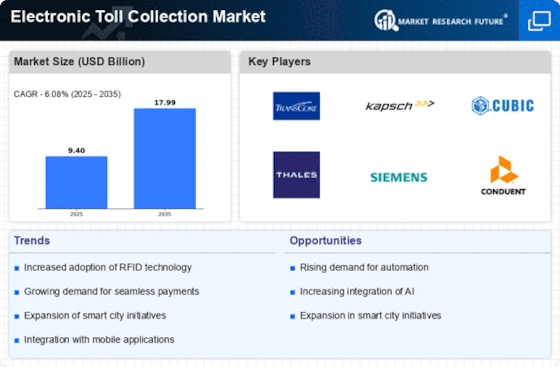
As per Market Research Future analysis, the Electronic Toll Collection Market Size was estimated at 9.4 USD Billion in 2024. The Electronic Toll Collection industry is projected to grow from 9.972 USD Billion in 2025 to 17.99 USD Billion by 2035, exhibiting a compound annual growth rate (CAGR) of 6.08% during the forecast period 2025 - 2035

Key Market Trends & Highlights

The Electronic Toll Collection Market is poised for substantial growth driven by technological advancements and evolving consumer preferences.

  • Technological advancements are reshaping the Electronic Toll Collection Market, enhancing efficiency and user experience. The shift towards contactless payments is gaining momentum, particularly in North America, where convenience is paramount. Public-private partnerships are increasingly facilitating the development of tolling infrastructure, especially in the Asia-Pacific region. Key market drivers include rising urbanization and government initiatives aimed at promoting smart transportation solutions.

Market Size & Forecast

2024 Market Size 9.4 (USD Billion)
2035 Market Size 17.99 (USD Billion)
CAGR (2025 - 2035) 6.08%
Largest Regional Market Share in 2024 North America

Major Players

TransCore (US), Kapsch TrafficCom (AT), Cubic Corporation (US), Thales Group (FR), Siemens Mobility (DE), Conduent (US), Abertis (ES), E-ZPass (US), TollPlus (IN) — representing leading electronic toll collection companies and global electronic toll collection company innovators.

Market Trends

The Electronic Toll Collection Market is currently experiencing a transformative phase, driven by advancements in technology and increasing demand for efficient transportation solutions. The integration of automated toll collection systems and smart technologies is reshaping how tolling is managed, enhancing user experience while streamlining operations. As urbanization accelerates and traffic congestion becomes a pressing issue, stakeholders across the toll industry are increasingly recognizing the necessity of adopting electronic toll collection solutions. This shift not only facilitates smoother traffic flow but also contributes to reduced emissions, aligning with global sustainability goals. Moreover, the growing emphasis on contactless payment methods and mobile-based electronic toll collection systems is enhancing user convenience. Collaboration between public authorities and private electronic toll collection companies is enabling standardized toll collection system deployment across regions. As the electronic toll collection market evolves, it is expected to play a central role in shaping future transportation infrastructure.

Technological Advancements

The Electronic Toll Collection Market is witnessing rapid innovation in electronic toll collection systems, improving efficiency, reducing congestion, and enhancing system interoperability. These advancements are enhancing the efficiency of toll collection processes, reducing wait times, and improving overall user satisfaction.

Shift Towards Contactless Payments

There is a noticeable trend toward contactless transactions within electronic toll collection, supporting seamless operation of modern toll collection systems. This shift is driven by consumer preferences for convenience and speed, allowing users to complete transactions seamlessly without physical interaction.

Public-Private Partnerships

Public-private collaboration is accelerating the deployment of advanced electronic toll collection solutions, improving infrastructure scalability and operational consistency. Such partnerships are fostering the development of integrated tolling solutions, which may lead to standardized practices and improved infrastructure.

Electronic Toll Collection Market Market Drivers

Increasing Urbanization

The trend of increasing urbanization appears to be a significant driver for the Electronic Toll Collection Industry. As more individuals migrate to urban areas, the demand for efficient transportation systems intensifies. Urban centers often experience heightened traffic congestion, necessitating the implementation of advanced toll collection systems to manage vehicle flow effectively. In many regions, urbanization has led to a rise in vehicle ownership, which correlates with increased toll revenues. For instance, studies indicate that urban areas with electronic tolling systems can reduce congestion by up to 30%, thereby enhancing the overall efficiency of transportation networks. This growing urban population is likely to propel the adoption of electronic toll collection solutions, as municipalities seek to modernize their infrastructure and improve traffic management.

Government Initiatives and Regulations

Government initiatives and regulations are pivotal in shaping the Electronic Toll Collection Market. Many governments are actively promoting the adoption of electronic tolling systems as part of broader transportation policies aimed at reducing congestion and improving road safety. For example, regulatory frameworks that mandate the use of electronic toll collection in new infrastructure projects can significantly boost market growth. In certain regions, government incentives for adopting smart transportation technologies have led to a marked increase in electronic tolling installations. Data suggests that regions with supportive government policies have witnessed a 25% increase in electronic toll collection usage over the past few years. Such initiatives not only facilitate smoother traffic flow but also contribute to enhanced revenue generation for public infrastructure.

Environmental Concerns and Sustainability

Environmental concerns and sustainability are becoming increasingly relevant in the Electronic Toll Collection Industry. As awareness of climate change and pollution rises, there is a growing push for transportation solutions that minimize environmental impact. Electronic toll collection systems can contribute to sustainability efforts by promoting the use of public transportation and reducing vehicle emissions through efficient traffic management. Studies indicate that implementing electronic tolling can lead to a reduction in greenhouse gas emissions by up to 20% in heavily trafficked areas. This alignment with sustainability goals is likely to attract investments from both public and private sectors, as stakeholders seek to enhance their environmental credentials. The integration of eco-friendly practices within the electronic toll collection framework may also lead to the development of innovative solutions that further support sustainable transportation initiatives.

Technological Innovations in Tolling Systems

Technological innovations in tolling systems are a driving force behind the growth of the Electronic Toll Collection Industry. Advancements in technology, such as the development of RFID tags, license plate recognition, and mobile payment solutions, have revolutionized the way tolls are collected. These innovations not only enhance the efficiency of toll collection but also improve user convenience, as drivers can pass through toll booths without stopping. The market for electronic toll collection technologies is expected to witness substantial growth, with projections indicating a potential increase of 20% in adoption rates over the next few years. As technology continues to evolve, the integration of artificial intelligence and data analytics into tolling systems may further optimize operations and enhance revenue collection. This ongoing technological evolution is likely to play a crucial role in shaping the future landscape of the electronic toll collection market.

Rising Demand for Smart Transportation Solutions

The rising demand for smart transportation solutions is a crucial driver for the Electronic Toll Collection Market. As cities evolve, there is a growing emphasis on integrating technology into transportation systems to enhance efficiency and user experience. Smart transportation solutions, including electronic toll collection, are increasingly viewed as essential components of modern infrastructure. The market for smart transportation is projected to grow at a compound annual growth rate of approximately 15% over the next five years, indicating a robust appetite for innovative solutions. This trend is likely to encourage investments in electronic tolling technologies, as stakeholders recognize the potential for improved traffic management and reduced operational costs. Consequently, the integration of electronic toll collection systems into smart city initiatives is expected to gain momentum, further driving market expansion.

Market Segment Insights

By Technology: Radio Frequency Identification (Largest) vs. Automatic Number Plate Recognition (Fastest-Growing)

The Electronic Toll Collection Market is primarily driven by technologies such as Radio Frequency Identification (RFID) and Automatic Number Plate Recognition (ANPR). RFID remains dominant within electronic toll collection systems, while ANPR adoption is accelerating as part of advanced toll collection solutions.. In comparison, ANPR has garnered significant attention and uptake, emerging as the fastest-growing segment as more regions seek to modernize their toll collection systems with advanced imaging technologies.

Technology: RFID (Dominant) vs. ANPR (Emerging)

Radio Frequency Identification (RFID) has established itself as the dominant technology in the Electronic Toll Collection Market, offering seamless and instantaneous toll collection with minimal user intervention. This technology depends on tag-reader communication, enabling vehicles equipped with RFID tags to pass through toll points without stopping. Emerging as a challenger, Automatic Number Plate Recognition (ANPR) technology focuses on capturing vehicle license plates using high-resolution cameras, making it particularly attractive for its adaptability in various environments, including urban tolling solutions. As smart cities evolve, both technologies will likely coexist, complementing each other by combining speed with enhanced surveillance capabilities.

By Component: On-Board Units (Largest) vs. Payment Processing Solutions (Fastest-Growing)

In the Electronic Toll Collection Industry, the On-Board Units remain critical to electronic toll collection, while Payment Processing Solutions are emerging as essential digital enablers of modern toll collection systems.. They enable seamless toll collection, providing value to both operators and drivers. The Back Office Systems and Roadside Equipment follow closely, playing critical roles in supporting the infrastructure and operational needs of toll collection. Payment Processing Solutions, while smaller, are crucial for facilitating frictionless transactions and enhancing user experience. The growth trends within this segment are propelling On-Board Units to dominate, largely due to technological advancements and increased adoption of smart transportation systems. Payment Processing Solutions are emerging rapidly, driven by the rising demand for contactless payments and the shift towards digital solutions. As more regions adopt electronic tolling, the necessity for efficient and integrated systems will further boost growth in these component areas.

On-Board Units (Dominant) vs. Payment Processing Solutions (Emerging)

On-Board Units (OBUs) serve as the backbone of the Electronic Toll Collection Market systems, acting as the primary interface between vehicles and toll infrastructure. Their dominance is fueled by extensive installation in vehicles across various regions, ensuring reliable and efficient functionality for toll collection processes. As technology evolves, OBUs are being integrated with navigation and telematics systems to enhance user experience and operational efficiency. In contrast, Payment Processing Solutions represent an emerging segment responding to the growing need for flexible and secure payment methods in tolling systems. The rapid increase in digital payment adoption has led to innovative solutions tailored for toll collection, such as mobile payments and cloud-based processing. This segment is characterized by high adaptability, focusing on user convenience and operational efficiency.

By Application: Highway Tolling (Largest) vs. Urban Tolling (Fastest-Growing)

The Electronic Toll Collection Market showcases a diverse application landscape with Highway Tolling dominates due to established electronic toll collection systems, while Urban Tolling and Congestion Pricing are expanding through smart city initiatives. With the increasing number of vehicles on highways, this segment enables efficient tolling solutions that streamline traffic and enhance revenue collection for government bodies. Following closely is Urban Tolling which, as cities face mounting congestion challenges, presents a critical solution to manage urban traffic flows effectively. Moreover, the growth trends indicate that Urban Tolling is rapidly gaining traction, being the fastest-growing segment in the market. Urban centers are investing heavily in smart infrastructure to reduce congestion and improve traffic management through technologies such as automatic number plate recognition and real-time traffic monitoring. As these investments continue, Urban Tolling is positioned to significantly expand its footprint in the coming years.

Highway Tolling (Dominant) vs. Congestion Pricing (Emerging)

Highway Tolling stands as the dominant application in the Electronic Toll Collection Market, primarily due to its maturity and widespread implementation across numerous highways. This segment effectively reduces traffic congestion and enhances travel efficiency, making it integral to national transport systems. In contrast, Congestion Pricing is an emerging application gaining momentum within urban areas aiming to alleviate traffic by incentivizing off-peak travel. This strategy involves charging drivers during peak hours to encourage alternative transport modes or carpooling. While still developing, Congestion Pricing benefits from advancements in technology and public policy shifts focused on sustainable urban mobility. As congestion in cities grows, this segment is expected to grow rapidly, especially as cities look to innovative solutions to manage urban traffic.

By End Use: Government (Largest) vs. Private Operators (Fastest-Growing)

The Electronic Toll Collection Market is primarily segmented into Government, Private Operators, and Transport Authorities. Among these segments, Government bodies lead adoption, while Private Operators are emerging as agile providers of electronic toll collection solutions. In recent years, Private Operators have been emerging as significant players, capitalizing on advancements in technology and a growing demand for efficient toll collection systems. Transport Authorities, while crucial for operation, play a supplementary role in this dynamic market, often collaborating with government and private entities.

End Use: Government (Dominant) vs. Private Operators (Emerging)

Government entities dominate the Electronic Toll Collection Market due to their extensive infrastructure and regulatory authority. They implement large-scale toll systems, ensuring seamless traffic flow while generating revenue for public projects. This segment is characterized by long-term contracts and partnerships with technology providers. On the other hand, Private Operators are rapidly emerging, driven by innovation and consumer demands for more flexible and user-friendly tolling solutions. They are adopting advanced technologies, such as mobile apps and RFID, to enhance user experience and improve collection efficiency. The synergy between Government and Private Operators is expected to shape the future of this market.

Get more detailed insights about Electronic Toll Collection Market Research Report -Forecast to 2035

Regional Insights

North America : Leading Market for Innovation

North America leads the electronic toll collection market, with widespread implementation of electronic toll collection USA systems supported by strong regulatory frameworks. The growth is driven by increasing vehicle ownership, urbanization, and the need for efficient traffic management. Regulatory support, such as the Federal Highway Administration's initiatives, further catalyzes market expansion. The U.S. and Canada are the primary contributors, with a strong push towards smart transportation solutions. The competitive landscape is robust, featuring key players like TransCore, Cubic Corporation, and E-ZPass. These companies are at the forefront of technological advancements, offering innovative solutions that enhance user experience and operational efficiency. The presence of established firms and ongoing investments in infrastructure development solidify North America's position as a leader in the ETC market.

Europe : Emerging Market with Regulations

Europe’s adoption of standardized electronic toll collection systems is driven by regulatory mandates and cross-border interoperability initiatives. The demand is driven by stringent regulations aimed at reducing traffic congestion and promoting sustainable transport solutions. Countries like Germany and France are leading the charge, implementing advanced tolling systems that integrate with smart city initiatives. The European Union's directives on transport efficiency further bolster market growth. Leading countries in this region include Germany, France, and the UK, where companies like Kapsch TrafficCom and Thales Group are prominent. The competitive landscape is characterized by a mix of established players and innovative startups, all vying for market share. The focus on interoperability and user-friendly solutions is shaping the future of ETC in Europe.

Asia-Pacific : Rapid Growth in Emerging Economies

The Asia-Pacific region is rapidly emerging as a significant player in the electronic toll collection market, holding around 20% of the global share. Asia-Pacific is experiencing rapid growth in electronic toll collection, particularly in China, India, and electronic toll collection Japan, where advanced Japanese toll infrastructure and automation technologies are shaping regional leadership. Countries like China and India are at the forefront, implementing advanced tolling systems to manage their growing traffic demands effectively. China is the largest market in the region, with substantial investments in smart transportation technologies. Key players such as TollPlus and local firms are actively participating in this competitive landscape. The focus on integrating ETC with mobile payment solutions and enhancing user convenience is driving innovation and market penetration in Asia-Pacific, making it a dynamic region for future growth.

Middle East and Africa : Emerging Market with Potential

The Middle East and Africa region is gradually developing its electronic toll collection market, currently holding about 5% of the global share. MEA is emerging as a growth market, investing in modern toll collection systems to support smart mobility initiatives. Countries like South Africa and the UAE are leading the way, implementing modern tolling systems to address urban congestion and enhance revenue collection. The competitive landscape is still in its nascent stages, with a mix of local and international players entering the market. Companies are focusing on developing user-friendly solutions that cater to the unique needs of the region. The potential for growth is significant, especially as governments prioritize smart city initiatives and sustainable transport solutions, paving the way for future advancements in ETC.

Key Players and Competitive Insights

The Electronic Toll Collection Market is characterized by strong competition among established electronic toll collection companies focused on innovation, localization, and strategic partnerships. Players are enhancing electronic toll collection solutions through AI integration, cloud platforms, and mobile-enabled toll collection systems to improve user experience and revenue efficiency. Key players such as TransCore (US), Kapsch TrafficCom (AT), and Cubic Corporation (US) are at the forefront, each adopting distinct strategies to enhance their market positioning. TransCore (US) focuses on innovation through the development of advanced tolling technologies, while Kapsch TrafficCom (AT) emphasizes regional expansion, particularly in Europe and North America. Cubic Corporation (US) is leveraging partnerships to integrate smart city solutions into its tolling systems, thereby enhancing user experience and operational efficiency. Collectively, these strategies contribute to a competitive environment that is increasingly centered around technological innovation and customer-centric solutions.
In terms of business tactics, companies are increasingly localizing manufacturing and optimizing supply chains to enhance operational efficiency. The market structure appears moderately fragmented, with several players vying for market share. However, the influence of key players is substantial, as they set industry standards and drive technological advancements that smaller companies often follow. This competitive structure fosters an environment where innovation is paramount, and companies must continuously adapt to maintain their market positions. 
In August 2025, Kapsch TrafficCom (AT) announced a strategic partnership with a leading technology firm to develop AI-driven tolling solutions. This collaboration is poised to enhance the efficiency of toll collection processes and improve traffic management systems. The integration of AI technology is likely to provide Kapsch with a competitive edge, enabling it to offer more sophisticated solutions that meet the evolving needs of transportation authorities. 
In September 2025, Cubic Corporation (US) launched a new cloud-based tolling platform designed to streamline operations for transportation agencies. This platform is expected to facilitate real-time data analytics and improve revenue collection efficiency. The strategic importance of this launch lies in Cubic's ability to position itself as a leader in digital transformation within the tolling sector, potentially attracting new clients seeking modernized solutions.
In October 2025, TransCore (US) unveiled a new suite of mobile applications aimed at enhancing user engagement and providing real-time toll information. This initiative reflects TransCore's commitment to customer-centric innovation, which is increasingly vital in a market where user experience can significantly influence adoption rates. By prioritizing mobile technology, TransCore is likely to strengthen its market presence and appeal to a broader audience. 
As of October 2025, the Electronic Toll Collection Market is witnessing trends that emphasize digitalization, sustainability, and the integration of artificial intelligence. Strategic alliances are becoming more prevalent, as companies recognize the value of collaboration in driving innovation. Looking ahead, competitive differentiation is expected to evolve, shifting from traditional price-based competition to a focus on technological innovation, supply chain reliability, and enhanced customer experiences. This transition underscores the necessity for companies to invest in cutting-edge technologies and strategic partnerships to remain competitive in an increasingly complex market.

Key Companies in the Electronic Toll Collection Market include

Industry Developments

Recent developments reflect increased investments by global electronic toll collection companies, enhancing system scalability, digital payment integration, and operational efficiency across the toll industry. Jabil Inc. is indeed expanding; however, the company's primary focus is on strategic growth in photonics, AI infrastructure, and sustainable operations, rather than explicit "sustainable electronics manufacturing processes." Jabil announced the establishment of a new photonics factory in Gujarat, India, in March 2025.

The facility will support silicon photonics and co-packaged optics, and it was established in accordance with an MoU that was signed in November 2024. In March 2025, they also published a Sustainability Progress Report for FY 2024, which included a 46% decrease in GHG emissions from 2019 levels, landfill diversion milestones, the acquisition of Mikros Technologies for energy-efficient liquid refrigeration, and the membership of the Circular Electronics Partnership.Universal Scientific Industrial (USI) has experienced growth as a result of the increasing demand for high-performance computing modules, particularly in the server and networking sectors.

However, the majority of this growth is associated with 5G and networking infrastructure, rather than HPC alone. There were no recent announcements that were specifically relevant to that context.In September 2023, Foxconn Technology Group did not acquire a controlling stake in a local semiconductor firm. In July 2023, Foxconn terminated its joint venture with Vedanta and redirected its attention to the mobile and component assembly facilities in Chennai, Bangalore, and Hyderabad in India. They have ongoing investments; however, there has been no confirmed acquisition of a local semiconductor stake.

Future Outlook

Electronic Toll Collection Market Future Outlook

The Electronic Toll Collection Market share is projected to grow at a 6.08% CAGR from 2025 to 2035, driven by technological advancements, increased urbanization, and the need for efficient traffic management.

New opportunities lie in:

  • <p>Integration of AI-driven analytics for traffic flow optimization. Development of mobile payment solutions for seamless toll transactions. Expansion of cross-border tolling systems to enhance regional connectivity.</p>

By 2035, the market is expected to be robust, driven by innovation and increased adoption.

Market Segmentation

Electronic Toll Collection Market End Use Outlook

  • Government
  • Private Operators
  • Transport Authorities

Electronic Toll Collection Market Component Outlook

  • On-Board Units
  • Back Office Systems
  • Roadside Equipment
  • Payment Processing Solutions

Electronic Toll Collection Market Technology Outlook

  • Radio Frequency Identification
  • Automatic Number Plate Recognition
  • Smartphone Applications
  • Contactless Payment Systems

Electronic Toll Collection Market Application Outlook

  • Highway Tolling
  • Urban Tolling
  • Congestion Pricing

Report Scope

MARKET SIZE 2024 9.4(USD Billion)
MARKET SIZE 2025 9.972(USD Billion)
MARKET SIZE 2035 17.99(USD Billion)
COMPOUND ANNUAL GROWTH RATE (CAGR) 6.08% (2025 - 2035)
REPORT COVERAGE Revenue Forecast, Competitive Landscape, Growth Factors, and Trends
BASE YEAR 2024
Market Forecast Period 2025 - 2035
Historical Data 2019 - 2024
Market Forecast Units USD Billion
Key Companies Profiled TransCore (US), Kapsch TrafficCom (AT), Cubic Corporation (US), Thales Group (FR), Siemens Mobility (DE), Conduent (US), Abertis (ES), E-ZPass (US), TollPlus (IN)
Segments Covered Technology, Component, Application, End Use, Regional
Key Market Opportunities Integration of advanced technologies enhances efficiency in the Electronic Toll Collection Market.
Key Market Dynamics Technological advancements and regulatory changes drive the evolution of Electronic Toll Collection systems worldwide.
Countries Covered North America, Europe, APAC, South America, MEA

FAQs

What is the current valuation of the Electronic Toll Collection Market?

<p>As of 2024, the Electronic Toll Collection Market was valued at 9.4 USD Billion.</p>

What is the projected market size for the Electronic Toll Collection Market by 2035?

<p>The market is projected to reach 17.99 USD Billion by 2035.</p>

What is the expected CAGR for the Electronic Toll Collection Market during the forecast period 2025 - 2035?

<p>The expected CAGR for the market during the forecast period 2025 - 2035 is 6.08%.</p>

Which technology segments are driving growth in the Electronic Toll Collection Market?

<p>Key technology segments include Radio Frequency Identification, Automatic Number Plate Recognition, and Smartphone Applications, with valuations ranging from 2.0 to 5.5 USD Billion.</p>

What are the main components contributing to the Electronic Toll Collection Market?

<p>Main components include On-Board Units, Back Office Systems, and Payment Processing Solutions, with valuations between 2.0 and 5.0 USD Billion.</p>

How does the application of highway tolling compare to urban tolling in terms of market valuation?

<p>Highway tolling is projected to reach 7.06 USD Billion, while urban tolling is expected to reach 5.24 USD Billion by 2035.</p>

Who are the key players in the Electronic Toll Collection Market?

<p>Key players include TransCore, Kapsch TrafficCom, Cubic Corporation, and Thales Group, among others.</p>

What end-use segments are influencing the Electronic Toll Collection Market?

<p>End-use segments include Government, Private Operators, and Transport Authorities, with valuations ranging from 2.82 to 7.12 USD Billion.</p>

What is the projected growth for contactless payment systems within the Electronic Toll Collection Market?

<p>Contactless payment systems are expected to grow from 1.9 USD Billion to 4.5 USD Billion by 2035.</p>

How does the Electronic Toll Collection Market's growth potential compare across different regions?

<p>While specific regional data is not provided, the overall market growth suggests a robust expansion potential across various regions, driven by technological advancements and increasing urbanization.</p>

  1. SECTION I: EXECUTIVE SUMMARY AND KEY HIGHLIGHTS
    1. | 1.1 EXECUTIVE SUMMARY
    2. | | 1.1.1 Market Overview
    3. | | 1.1.2 Key Findings
    4. | | 1.1.3 Market Segmentation
    5. | | 1.1.4 Competitive Landscape
    6. | | 1.1.5 Challenges and Opportunities
    7. | | 1.1.6 Future Outlook
  2. SECTION II: SCOPING, METHODOLOGY AND MARKET STRUCTURE
    1. | 2.1 MARKET INTRODUCTION
    2. | | 2.1.1 Definition
    3. | | 2.1.2 Scope of the study
    4. | | | 2.1.2.1 Research Objective
    5. | | | 2.1.2.2 Assumption
    6. | | | 2.1.2.3 Limitations
    7. | 2.2 RESEARCH METHODOLOGY
    8. | | 2.2.1 Overview
    9. | | 2.2.2 Data Mining
    10. | | 2.2.3 Secondary Research
    11. | | 2.2.4 Primary Research
    12. | | | 2.2.4.1 Primary Interviews and Information Gathering Process
    13. | | | 2.2.4.2 Breakdown of Primary Respondents
    14. | | 2.2.5 Forecasting Model
    15. | | 2.2.6 Market Size Estimation
    16. | | | 2.2.6.1 Bottom-Up Approach
    17. | | | 2.2.6.2 Top-Down Approach
    18. | | 2.2.7 Data Triangulation
    19. | | 2.2.8 Validation
  3. SECTION III: QUALITATIVE ANALYSIS
    1. | 3.1 MARKET DYNAMICS
    2. | | 3.1.1 Overview
    3. | | 3.1.2 Drivers
    4. | | 3.1.3 Restraints
    5. | | 3.1.4 Opportunities
    6. | 3.2 MARKET FACTOR ANALYSIS
    7. | | 3.2.1 Value chain Analysis
    8. | | 3.2.2 Porter's Five Forces Analysis
    9. | | | 3.2.2.1 Bargaining Power of Suppliers
    10. | | | 3.2.2.2 Bargaining Power of Buyers
    11. | | | 3.2.2.3 Threat of New Entrants
    12. | | | 3.2.2.4 Threat of Substitutes
    13. | | | 3.2.2.5 Intensity of Rivalry
    14. | | 3.2.3 COVID-19 Impact Analysis
    15. | | | 3.2.3.1 Market Impact Analysis
    16. | | | 3.2.3.2 Regional Impact
    17. | | | 3.2.3.3 Opportunity and Threat Analysis
  4. SECTION IV: QUANTITATIVE ANALYSIS
    1. | 4.1 Semiconductor & Electronics, BY Technology (USD Billion)
    2. | | 4.1.1 Radio Frequency Identification
    3. | | 4.1.2 Automatic Number Plate Recognition
    4. | | 4.1.3 Smartphone Applications
    5. | | 4.1.4 Contactless Payment Systems
    6. | 4.2 Semiconductor & Electronics, BY Component (USD Billion)
    7. | | 4.2.1 On-Board Units
    8. | | 4.2.2 Back Office Systems
    9. | | 4.2.3 Roadside Equipment
    10. | | 4.2.4 Payment Processing Solutions
    11. | 4.3 Semiconductor & Electronics, BY Application (USD Billion)
    12. | | 4.3.1 Highway Tolling
    13. | | 4.3.2 Urban Tolling
    14. | | 4.3.3 Congestion Pricing
    15. | 4.4 Semiconductor & Electronics, BY End Use (USD Billion)
    16. | | 4.4.1 Government
    17. | | 4.4.2 Private Operators
    18. | | 4.4.3 Transport Authorities
    19. | 4.5 Semiconductor & Electronics, BY Region (USD Billion)
    20. | | 4.5.1 North America
    21. | | | 4.5.1.1 US
    22. | | | 4.5.1.2 Canada
    23. | | 4.5.2 Europe
    24. | | | 4.5.2.1 Germany
    25. | | | 4.5.2.2 UK
    26. | | | 4.5.2.3 France
    27. | | | 4.5.2.4 Russia
    28. | | | 4.5.2.5 Italy
    29. | | | 4.5.2.6 Spain
    30. | | | 4.5.2.7 Rest of Europe
    31. | | 4.5.3 APAC
    32. | | | 4.5.3.1 China
    33. | | | 4.5.3.2 India
    34. | | | 4.5.3.3 Japan
    35. | | | 4.5.3.4 South Korea
    36. | | | 4.5.3.5 Malaysia
    37. | | | 4.5.3.6 Thailand
    38. | | | 4.5.3.7 Indonesia
    39. | | | 4.5.3.8 Rest of APAC
    40. | | 4.5.4 South America
    41. | | | 4.5.4.1 Brazil
    42. | | | 4.5.4.2 Mexico
    43. | | | 4.5.4.3 Argentina
    44. | | | 4.5.4.4 Rest of South America
    45. | | 4.5.5 MEA
    46. | | | 4.5.5.1 GCC Countries
    47. | | | 4.5.5.2 South Africa
    48. | | | 4.5.5.3 Rest of MEA
  5. SECTION V: COMPETITIVE ANALYSIS
    1. | 5.1 Competitive Landscape
    2. | | 5.1.1 Overview
    3. | | 5.1.2 Competitive Analysis
    4. | | 5.1.3 Market share Analysis
    5. | | 5.1.4 Major Growth Strategy in the Semiconductor & Electronics
    6. | | 5.1.5 Competitive Benchmarking
    7. | | 5.1.6 Leading Players in Terms of Number of Developments in the Semiconductor & Electronics
    8. | | 5.1.7 Key developments and growth strategies
    9. | | | 5.1.7.1 New Product Launch/Service Deployment
    10. | | | 5.1.7.2 Merger & Acquisitions
    11. | | | 5.1.7.3 Joint Ventures
    12. | | 5.1.8 Major Players Financial Matrix
    13. | | | 5.1.8.1 Sales and Operating Income
    14. | | | 5.1.8.2 Major Players R&D Expenditure. 2023
    15. | 5.2 Company Profiles
    16. | | 5.2.1 TransCore (US)
    17. | | | 5.2.1.1 Financial Overview
    18. | | | 5.2.1.2 Products Offered
    19. | | | 5.2.1.3 Key Developments
    20. | | | 5.2.1.4 SWOT Analysis
    21. | | | 5.2.1.5 Key Strategies
    22. | | 5.2.2 Kapsch TrafficCom (AT)
    23. | | | 5.2.2.1 Financial Overview
    24. | | | 5.2.2.2 Products Offered
    25. | | | 5.2.2.3 Key Developments
    26. | | | 5.2.2.4 SWOT Analysis
    27. | | | 5.2.2.5 Key Strategies
    28. | | 5.2.3 Cubic Corporation (US)
    29. | | | 5.2.3.1 Financial Overview
    30. | | | 5.2.3.2 Products Offered
    31. | | | 5.2.3.3 Key Developments
    32. | | | 5.2.3.4 SWOT Analysis
    33. | | | 5.2.3.5 Key Strategies
    34. | | 5.2.4 Thales Group (FR)
    35. | | | 5.2.4.1 Financial Overview
    36. | | | 5.2.4.2 Products Offered
    37. | | | 5.2.4.3 Key Developments
    38. | | | 5.2.4.4 SWOT Analysis
    39. | | | 5.2.4.5 Key Strategies
    40. | | 5.2.5 Siemens Mobility (DE)
    41. | | | 5.2.5.1 Financial Overview
    42. | | | 5.2.5.2 Products Offered
    43. | | | 5.2.5.3 Key Developments
    44. | | | 5.2.5.4 SWOT Analysis
    45. | | | 5.2.5.5 Key Strategies
    46. | | 5.2.6 Conduent (US)
    47. | | | 5.2.6.1 Financial Overview
    48. | | | 5.2.6.2 Products Offered
    49. | | | 5.2.6.3 Key Developments
    50. | | | 5.2.6.4 SWOT Analysis
    51. | | | 5.2.6.5 Key Strategies
    52. | | 5.2.7 Abertis (ES)
    53. | | | 5.2.7.1 Financial Overview
    54. | | | 5.2.7.2 Products Offered
    55. | | | 5.2.7.3 Key Developments
    56. | | | 5.2.7.4 SWOT Analysis
    57. | | | 5.2.7.5 Key Strategies
    58. | | 5.2.8 E-ZPass (US)
    59. | | | 5.2.8.1 Financial Overview
    60. | | | 5.2.8.2 Products Offered
    61. | | | 5.2.8.3 Key Developments
    62. | | | 5.2.8.4 SWOT Analysis
    63. | | | 5.2.8.5 Key Strategies
    64. | | 5.2.9 TollPlus (IN)
    65. | | | 5.2.9.1 Financial Overview
    66. | | | 5.2.9.2 Products Offered
    67. | | | 5.2.9.3 Key Developments
    68. | | | 5.2.9.4 SWOT Analysis
    69. | | | 5.2.9.5 Key Strategies
    70. | 5.3 Appendix
    71. | | 5.3.1 References
    72. | | 5.3.2 Related Reports
  6. LIST OF FIGURES
    1. | 6.1 MARKET SYNOPSIS
    2. | 6.2 NORTH AMERICA MARKET ANALYSIS
    3. | 6.3 US MARKET ANALYSIS BY TECHNOLOGY
    4. | 6.4 US MARKET ANALYSIS BY COMPONENT
    5. | 6.5 US MARKET ANALYSIS BY APPLICATION
    6. | 6.6 US MARKET ANALYSIS BY END USE
    7. | 6.7 CANADA MARKET ANALYSIS BY TECHNOLOGY
    8. | 6.8 CANADA MARKET ANALYSIS BY COMPONENT
    9. | 6.9 CANADA MARKET ANALYSIS BY APPLICATION
    10. | 6.10 CANADA MARKET ANALYSIS BY END USE
    11. | 6.11 EUROPE MARKET ANALYSIS
    12. | 6.12 GERMANY MARKET ANALYSIS BY TECHNOLOGY
    13. | 6.13 GERMANY MARKET ANALYSIS BY COMPONENT
    14. | 6.14 GERMANY MARKET ANALYSIS BY APPLICATION
    15. | 6.15 GERMANY MARKET ANALYSIS BY END USE
    16. | 6.16 UK MARKET ANALYSIS BY TECHNOLOGY
    17. | 6.17 UK MARKET ANALYSIS BY COMPONENT
    18. | 6.18 UK MARKET ANALYSIS BY APPLICATION
    19. | 6.19 UK MARKET ANALYSIS BY END USE
    20. | 6.20 FRANCE MARKET ANALYSIS BY TECHNOLOGY
    21. | 6.21 FRANCE MARKET ANALYSIS BY COMPONENT
    22. | 6.22 FRANCE MARKET ANALYSIS BY APPLICATION
    23. | 6.23 FRANCE MARKET ANALYSIS BY END USE
    24. | 6.24 RUSSIA MARKET ANALYSIS BY TECHNOLOGY
    25. | 6.25 RUSSIA MARKET ANALYSIS BY COMPONENT
    26. | 6.26 RUSSIA MARKET ANALYSIS BY APPLICATION
    27. | 6.27 RUSSIA MARKET ANALYSIS BY END USE
    28. | 6.28 ITALY MARKET ANALYSIS BY TECHNOLOGY
    29. | 6.29 ITALY MARKET ANALYSIS BY COMPONENT
    30. | 6.30 ITALY MARKET ANALYSIS BY APPLICATION
    31. | 6.31 ITALY MARKET ANALYSIS BY END USE
    32. | 6.32 SPAIN MARKET ANALYSIS BY TECHNOLOGY
    33. | 6.33 SPAIN MARKET ANALYSIS BY COMPONENT
    34. | 6.34 SPAIN MARKET ANALYSIS BY APPLICATION
    35. | 6.35 SPAIN MARKET ANALYSIS BY END USE
    36. | 6.36 REST OF EUROPE MARKET ANALYSIS BY TECHNOLOGY
    37. | 6.37 REST OF EUROPE MARKET ANALYSIS BY COMPONENT
    38. | 6.38 REST OF EUROPE MARKET ANALYSIS BY APPLICATION
    39. | 6.39 REST OF EUROPE MARKET ANALYSIS BY END USE
    40. | 6.40 APAC MARKET ANALYSIS
    41. | 6.41 CHINA MARKET ANALYSIS BY TECHNOLOGY
    42. | 6.42 CHINA MARKET ANALYSIS BY COMPONENT
    43. | 6.43 CHINA MARKET ANALYSIS BY APPLICATION
    44. | 6.44 CHINA MARKET ANALYSIS BY END USE
    45. | 6.45 INDIA MARKET ANALYSIS BY TECHNOLOGY
    46. | 6.46 INDIA MARKET ANALYSIS BY COMPONENT
    47. | 6.47 INDIA MARKET ANALYSIS BY APPLICATION
    48. | 6.48 INDIA MARKET ANALYSIS BY END USE
    49. | 6.49 JAPAN MARKET ANALYSIS BY TECHNOLOGY
    50. | 6.50 JAPAN MARKET ANALYSIS BY COMPONENT
    51. | 6.51 JAPAN MARKET ANALYSIS BY APPLICATION
    52. | 6.52 JAPAN MARKET ANALYSIS BY END USE
    53. | 6.53 SOUTH KOREA MARKET ANALYSIS BY TECHNOLOGY
    54. | 6.54 SOUTH KOREA MARKET ANALYSIS BY COMPONENT
    55. | 6.55 SOUTH KOREA MARKET ANALYSIS BY APPLICATION
    56. | 6.56 SOUTH KOREA MARKET ANALYSIS BY END USE
    57. | 6.57 MALAYSIA MARKET ANALYSIS BY TECHNOLOGY
    58. | 6.58 MALAYSIA MARKET ANALYSIS BY COMPONENT
    59. | 6.59 MALAYSIA MARKET ANALYSIS BY APPLICATION
    60. | 6.60 MALAYSIA MARKET ANALYSIS BY END USE
    61. | 6.61 THAILAND MARKET ANALYSIS BY TECHNOLOGY
    62. | 6.62 THAILAND MARKET ANALYSIS BY COMPONENT
    63. | 6.63 THAILAND MARKET ANALYSIS BY APPLICATION
    64. | 6.64 THAILAND MARKET ANALYSIS BY END USE
    65. | 6.65 INDONESIA MARKET ANALYSIS BY TECHNOLOGY
    66. | 6.66 INDONESIA MARKET ANALYSIS BY COMPONENT
    67. | 6.67 INDONESIA MARKET ANALYSIS BY APPLICATION
    68. | 6.68 INDONESIA MARKET ANALYSIS BY END USE
    69. | 6.69 REST OF APAC MARKET ANALYSIS BY TECHNOLOGY
    70. | 6.70 REST OF APAC MARKET ANALYSIS BY COMPONENT
    71. | 6.71 REST OF APAC MARKET ANALYSIS BY APPLICATION
    72. | 6.72 REST OF APAC MARKET ANALYSIS BY END USE
    73. | 6.73 SOUTH AMERICA MARKET ANALYSIS
    74. | 6.74 BRAZIL MARKET ANALYSIS BY TECHNOLOGY
    75. | 6.75 BRAZIL MARKET ANALYSIS BY COMPONENT
    76. | 6.76 BRAZIL MARKET ANALYSIS BY APPLICATION
    77. | 6.77 BRAZIL MARKET ANALYSIS BY END USE
    78. | 6.78 MEXICO MARKET ANALYSIS BY TECHNOLOGY
    79. | 6.79 MEXICO MARKET ANALYSIS BY COMPONENT
    80. | 6.80 MEXICO MARKET ANALYSIS BY APPLICATION
    81. | 6.81 MEXICO MARKET ANALYSIS BY END USE
    82. | 6.82 ARGENTINA MARKET ANALYSIS BY TECHNOLOGY
    83. | 6.83 ARGENTINA MARKET ANALYSIS BY COMPONENT
    84. | 6.84 ARGENTINA MARKET ANALYSIS BY APPLICATION
    85. | 6.85 ARGENTINA MARKET ANALYSIS BY END USE
    86. | 6.86 REST OF SOUTH AMERICA MARKET ANALYSIS BY TECHNOLOGY
    87. | 6.87 REST OF SOUTH AMERICA MARKET ANALYSIS BY COMPONENT
    88. | 6.88 REST OF SOUTH AMERICA MARKET ANALYSIS BY APPLICATION
    89. | 6.89 REST OF SOUTH AMERICA MARKET ANALYSIS BY END USE
    90. | 6.90 MEA MARKET ANALYSIS
    91. | 6.91 GCC COUNTRIES MARKET ANALYSIS BY TECHNOLOGY
    92. | 6.92 GCC COUNTRIES MARKET ANALYSIS BY COMPONENT
    93. | 6.93 GCC COUNTRIES MARKET ANALYSIS BY APPLICATION
    94. | 6.94 GCC COUNTRIES MARKET ANALYSIS BY END USE
    95. | 6.95 SOUTH AFRICA MARKET ANALYSIS BY TECHNOLOGY
    96. | 6.96 SOUTH AFRICA MARKET ANALYSIS BY COMPONENT
    97. | 6.97 SOUTH AFRICA MARKET ANALYSIS BY APPLICATION
    98. | 6.98 SOUTH AFRICA MARKET ANALYSIS BY END USE
    99. | 6.99 REST OF MEA MARKET ANALYSIS BY TECHNOLOGY
    100. | 6.100 REST OF MEA MARKET ANALYSIS BY COMPONENT
    101. | 6.101 REST OF MEA MARKET ANALYSIS BY APPLICATION
    102. | 6.102 REST OF MEA MARKET ANALYSIS BY END USE
    103. | 6.103 KEY BUYING CRITERIA OF SEMICONDUCTOR & ELECTRONICS
    104. | 6.104 RESEARCH PROCESS OF MRFR
    105. | 6.105 DRO ANALYSIS OF SEMICONDUCTOR & ELECTRONICS
    106. | 6.106 DRIVERS IMPACT ANALYSIS: SEMICONDUCTOR & ELECTRONICS
    107. | 6.107 RESTRAINTS IMPACT ANALYSIS: SEMICONDUCTOR & ELECTRONICS
    108. | 6.108 SUPPLY / VALUE CHAIN: SEMICONDUCTOR & ELECTRONICS
    109. | 6.109 SEMICONDUCTOR & ELECTRONICS, BY TECHNOLOGY, 2024 (% SHARE)
    110. | 6.110 SEMICONDUCTOR & ELECTRONICS, BY TECHNOLOGY, 2024 TO 2035 (USD Billion)
    111. | 6.111 SEMICONDUCTOR & ELECTRONICS, BY COMPONENT, 2024 (% SHARE)
    112. | 6.112 SEMICONDUCTOR & ELECTRONICS, BY COMPONENT, 2024 TO 2035 (USD Billion)
    113. | 6.113 SEMICONDUCTOR & ELECTRONICS, BY APPLICATION, 2024 (% SHARE)
    114. | 6.114 SEMICONDUCTOR & ELECTRONICS, BY APPLICATION, 2024 TO 2035 (USD Billion)
    115. | 6.115 SEMICONDUCTOR & ELECTRONICS, BY END USE, 2024 (% SHARE)
    116. | 6.116 SEMICONDUCTOR & ELECTRONICS, BY END USE, 2024 TO 2035 (USD Billion)
    117. | 6.117 BENCHMARKING OF MAJOR COMPETITORS
  7. LIST OF TABLES
    1. | 7.1 LIST OF ASSUMPTIONS
    2. | | 7.1.1
    3. | 7.2 North America MARKET SIZE ESTIMATES; FORECAST
    4. | | 7.2.1 BY TECHNOLOGY, 2025-2035 (USD Billion)
    5. | | 7.2.2 BY COMPONENT, 2025-2035 (USD Billion)
    6. | | 7.2.3 BY APPLICATION, 2025-2035 (USD Billion)
    7. | | 7.2.4 BY END USE, 2025-2035 (USD Billion)
    8. | 7.3 US MARKET SIZE ESTIMATES; FORECAST
    9. | | 7.3.1 BY TECHNOLOGY, 2025-2035 (USD Billion)
    10. | | 7.3.2 BY COMPONENT, 2025-2035 (USD Billion)
    11. | | 7.3.3 BY APPLICATION, 2025-2035 (USD Billion)
    12. | | 7.3.4 BY END USE, 2025-2035 (USD Billion)
    13. | 7.4 Canada MARKET SIZE ESTIMATES; FORECAST
    14. | | 7.4.1 BY TECHNOLOGY, 2025-2035 (USD Billion)
    15. | | 7.4.2 BY COMPONENT, 2025-2035 (USD Billion)
    16. | | 7.4.3 BY APPLICATION, 2025-2035 (USD Billion)
    17. | | 7.4.4 BY END USE, 2025-2035 (USD Billion)
    18. | 7.5 Europe MARKET SIZE ESTIMATES; FORECAST
    19. | | 7.5.1 BY TECHNOLOGY, 2025-2035 (USD Billion)
    20. | | 7.5.2 BY COMPONENT, 2025-2035 (USD Billion)
    21. | | 7.5.3 BY APPLICATION, 2025-2035 (USD Billion)
    22. | | 7.5.4 BY END USE, 2025-2035 (USD Billion)
    23. | 7.6 Germany MARKET SIZE ESTIMATES; FORECAST
    24. | | 7.6.1 BY TECHNOLOGY, 2025-2035 (USD Billion)
    25. | | 7.6.2 BY COMPONENT, 2025-2035 (USD Billion)
    26. | | 7.6.3 BY APPLICATION, 2025-2035 (USD Billion)
    27. | | 7.6.4 BY END USE, 2025-2035 (USD Billion)
    28. | 7.7 UK MARKET SIZE ESTIMATES; FORECAST
    29. | | 7.7.1 BY TECHNOLOGY, 2025-2035 (USD Billion)
    30. | | 7.7.2 BY COMPONENT, 2025-2035 (USD Billion)
    31. | | 7.7.3 BY APPLICATION, 2025-2035 (USD Billion)
    32. | | 7.7.4 BY END USE, 2025-2035 (USD Billion)
    33. | 7.8 France MARKET SIZE ESTIMATES; FORECAST
    34. | | 7.8.1 BY TECHNOLOGY, 2025-2035 (USD Billion)
    35. | | 7.8.2 BY COMPONENT, 2025-2035 (USD Billion)
    36. | | 7.8.3 BY APPLICATION, 2025-2035 (USD Billion)
    37. | | 7.8.4 BY END USE, 2025-2035 (USD Billion)
    38. | 7.9 Russia MARKET SIZE ESTIMATES; FORECAST
    39. | | 7.9.1 BY TECHNOLOGY, 2025-2035 (USD Billion)
    40. | | 7.9.2 BY COMPONENT, 2025-2035 (USD Billion)
    41. | | 7.9.3 BY APPLICATION, 2025-2035 (USD Billion)
    42. | | 7.9.4 BY END USE, 2025-2035 (USD Billion)
    43. | 7.10 Italy MARKET SIZE ESTIMATES; FORECAST
    44. | | 7.10.1 BY TECHNOLOGY, 2025-2035 (USD Billion)
    45. | | 7.10.2 BY COMPONENT, 2025-2035 (USD Billion)
    46. | | 7.10.3 BY APPLICATION, 2025-2035 (USD Billion)
    47. | | 7.10.4 BY END USE, 2025-2035 (USD Billion)
    48. | 7.11 Spain MARKET SIZE ESTIMATES; FORECAST
    49. | | 7.11.1 BY TECHNOLOGY, 2025-2035 (USD Billion)
    50. | | 7.11.2 BY COMPONENT, 2025-2035 (USD Billion)
    51. | | 7.11.3 BY APPLICATION, 2025-2035 (USD Billion)
    52. | | 7.11.4 BY END USE, 2025-2035 (USD Billion)
    53. | 7.12 Rest of Europe MARKET SIZE ESTIMATES; FORECAST
    54. | | 7.12.1 BY TECHNOLOGY, 2025-2035 (USD Billion)
    55. | | 7.12.2 BY COMPONENT, 2025-2035 (USD Billion)
    56. | | 7.12.3 BY APPLICATION, 2025-2035 (USD Billion)
    57. | | 7.12.4 BY END USE, 2025-2035 (USD Billion)
    58. | 7.13 APAC MARKET SIZE ESTIMATES; FORECAST
    59. | | 7.13.1 BY TECHNOLOGY, 2025-2035 (USD Billion)
    60. | | 7.13.2 BY COMPONENT, 2025-2035 (USD Billion)
    61. | | 7.13.3 BY APPLICATION, 2025-2035 (USD Billion)
    62. | | 7.13.4 BY END USE, 2025-2035 (USD Billion)
    63. | 7.14 China MARKET SIZE ESTIMATES; FORECAST
    64. | | 7.14.1 BY TECHNOLOGY, 2025-2035 (USD Billion)
    65. | | 7.14.2 BY COMPONENT, 2025-2035 (USD Billion)
    66. | | 7.14.3 BY APPLICATION, 2025-2035 (USD Billion)
    67. | | 7.14.4 BY END USE, 2025-2035 (USD Billion)
    68. | 7.15 India MARKET SIZE ESTIMATES; FORECAST
    69. | | 7.15.1 BY TECHNOLOGY, 2025-2035 (USD Billion)
    70. | | 7.15.2 BY COMPONENT, 2025-2035 (USD Billion)
    71. | | 7.15.3 BY APPLICATION, 2025-2035 (USD Billion)
    72. | | 7.15.4 BY END USE, 2025-2035 (USD Billion)
    73. | 7.16 Japan MARKET SIZE ESTIMATES; FORECAST
    74. | | 7.16.1 BY TECHNOLOGY, 2025-2035 (USD Billion)
    75. | | 7.16.2 BY COMPONENT, 2025-2035 (USD Billion)
    76. | | 7.16.3 BY APPLICATION, 2025-2035 (USD Billion)
    77. | | 7.16.4 BY END USE, 2025-2035 (USD Billion)
    78. | 7.17 South Korea MARKET SIZE ESTIMATES; FORECAST
    79. | | 7.17.1 BY TECHNOLOGY, 2025-2035 (USD Billion)
    80. | | 7.17.2 BY COMPONENT, 2025-2035 (USD Billion)
    81. | | 7.17.3 BY APPLICATION, 2025-2035 (USD Billion)
    82. | | 7.17.4 BY END USE, 2025-2035 (USD Billion)
    83. | 7.18 Malaysia MARKET SIZE ESTIMATES; FORECAST
    84. | | 7.18.1 BY TECHNOLOGY, 2025-2035 (USD Billion)
    85. | | 7.18.2 BY COMPONENT, 2025-2035 (USD Billion)
    86. | | 7.18.3 BY APPLICATION, 2025-2035 (USD Billion)
    87. | | 7.18.4 BY END USE, 2025-2035 (USD Billion)
    88. | 7.19 Thailand MARKET SIZE ESTIMATES; FORECAST
    89. | | 7.19.1 BY TECHNOLOGY, 2025-2035 (USD Billion)
    90. | | 7.19.2 BY COMPONENT, 2025-2035 (USD Billion)
    91. | | 7.19.3 BY APPLICATION, 2025-2035 (USD Billion)
    92. | | 7.19.4 BY END USE, 2025-2035 (USD Billion)
    93. | 7.20 Indonesia MARKET SIZE ESTIMATES; FORECAST
    94. | | 7.20.1 BY TECHNOLOGY, 2025-2035 (USD Billion)
    95. | | 7.20.2 BY COMPONENT, 2025-2035 (USD Billion)
    96. | | 7.20.3 BY APPLICATION, 2025-2035 (USD Billion)
    97. | | 7.20.4 BY END USE, 2025-2035 (USD Billion)
    98. | 7.21 Rest of APAC MARKET SIZE ESTIMATES; FORECAST
    99. | | 7.21.1 BY TECHNOLOGY, 2025-2035 (USD Billion)
    100. | | 7.21.2 BY COMPONENT, 2025-2035 (USD Billion)
    101. | | 7.21.3 BY APPLICATION, 2025-2035 (USD Billion)
    102. | | 7.21.4 BY END USE, 2025-2035 (USD Billion)
    103. | 7.22 South America MARKET SIZE ESTIMATES; FORECAST
    104. | | 7.22.1 BY TECHNOLOGY, 2025-2035 (USD Billion)
    105. | | 7.22.2 BY COMPONENT, 2025-2035 (USD Billion)
    106. | | 7.22.3 BY APPLICATION, 2025-2035 (USD Billion)
    107. | | 7.22.4 BY END USE, 2025-2035 (USD Billion)
    108. | 7.23 Brazil MARKET SIZE ESTIMATES; FORECAST
    109. | | 7.23.1 BY TECHNOLOGY, 2025-2035 (USD Billion)
    110. | | 7.23.2 BY COMPONENT, 2025-2035 (USD Billion)
    111. | | 7.23.3 BY APPLICATION, 2025-2035 (USD Billion)
    112. | | 7.23.4 BY END USE, 2025-2035 (USD Billion)
    113. | 7.24 Mexico MARKET SIZE ESTIMATES; FORECAST
    114. | | 7.24.1 BY TECHNOLOGY, 2025-2035 (USD Billion)
    115. | | 7.24.2 BY COMPONENT, 2025-2035 (USD Billion)
    116. | | 7.24.3 BY APPLICATION, 2025-2035 (USD Billion)
    117. | | 7.24.4 BY END USE, 2025-2035 (USD Billion)
    118. | 7.25 Argentina MARKET SIZE ESTIMATES; FORECAST
    119. | | 7.25.1 BY TECHNOLOGY, 2025-2035 (USD Billion)
    120. | | 7.25.2 BY COMPONENT, 2025-2035 (USD Billion)
    121. | | 7.25.3 BY APPLICATION, 2025-2035 (USD Billion)
    122. | | 7.25.4 BY END USE, 2025-2035 (USD Billion)
    123. | 7.26 Rest of South America MARKET SIZE ESTIMATES; FORECAST
    124. | | 7.26.1 BY TECHNOLOGY, 2025-2035 (USD Billion)
    125. | | 7.26.2 BY COMPONENT, 2025-2035 (USD Billion)
    126. | | 7.26.3 BY APPLICATION, 2025-2035 (USD Billion)
    127. | | 7.26.4 BY END USE, 2025-2035 (USD Billion)
    128. | 7.27 MEA MARKET SIZE ESTIMATES; FORECAST
    129. | | 7.27.1 BY TECHNOLOGY, 2025-2035 (USD Billion)
    130. | | 7.27.2 BY COMPONENT, 2025-2035 (USD Billion)
    131. | | 7.27.3 BY APPLICATION, 2025-2035 (USD Billion)
    132. | | 7.27.4 BY END USE, 2025-2035 (USD Billion)
    133. | 7.28 GCC Countries MARKET SIZE ESTIMATES; FORECAST
    134. | | 7.28.1 BY TECHNOLOGY, 2025-2035 (USD Billion)
    135. | | 7.28.2 BY COMPONENT, 2025-2035 (USD Billion)
    136. | | 7.28.3 BY APPLICATION, 2025-2035 (USD Billion)
    137. | | 7.28.4 BY END USE, 2025-2035 (USD Billion)
    138. | 7.29 South Africa MARKET SIZE ESTIMATES; FORECAST
    139. | | 7.29.1 BY TECHNOLOGY, 2025-2035 (USD Billion)
    140. | | 7.29.2 BY COMPONENT, 2025-2035 (USD Billion)
    141. | | 7.29.3 BY APPLICATION, 2025-2035 (USD Billion)
    142. | | 7.29.4 BY END USE, 2025-2035 (USD Billion)
    143. | 7.30 Rest of MEA MARKET SIZE ESTIMATES; FORECAST
    144. | | 7.30.1 BY TECHNOLOGY, 2025-2035 (USD Billion)
    145. | | 7.30.2 BY COMPONENT, 2025-2035 (USD Billion)
    146. | | 7.30.3 BY APPLICATION, 2025-2035 (USD Billion)
    147. | | 7.30.4 BY END USE, 2025-2035 (USD Billion)
    148. | 7.31 PRODUCT LAUNCH/PRODUCT DEVELOPMENT/APPROVAL
    149. | | 7.31.1
    150. | 7.32 ACQUISITION/PARTNERSHIP
    151. | | 7.32.1

Semiconductor & Electronics Market Segmentation

Semiconductor & Electronics By Technology (USD Billion, 2025-2035)

  • Radio Frequency Identification
  • Automatic Number Plate Recognition
  • Smartphone Applications
  • Contactless Payment Systems

Semiconductor & Electronics By Component (USD Billion, 2025-2035)

  • On-Board Units
  • Back Office Systems
  • Roadside Equipment
  • Payment Processing Solutions

Semiconductor & Electronics By Application (USD Billion, 2025-2035)

  • Highway Tolling
  • Urban Tolling
  • Congestion Pricing

Semiconductor & Electronics By End Use (USD Billion, 2025-2035)

  • Government
  • Private Operators
  • Transport Authorities
Infographic

Free Sample Request

Kindly complete the form below to receive a free sample of this Report

Get Free Sample

Customer Strories

Compare Licence

×
Features License Type
Single User Multiuser License Enterprise User
Price $4,950 $5,950 $7,250
Maximum User Access Limit 1 User Upto 10 Users Unrestricted Access Throughout the Organization
Free Customization
Direct Access to Analyst
Deliverable Format
Platform Access
Discount on Next Purchase 10% 15% 15%
Printable Versions