Request Free Sample ×

Kindly complete the form below to receive a free sample of this Report

* Please use a valid business email

Leading companies partner with us for data-driven Insights

clients tt-cursor
Hero Background
English
Chinese
French
Japanese
Korean
German
Spanish

Electronic Grade Isopropyl Alcohol Market Share

ID: MRFR/CnM/10415-HCR
110 Pages
Anshula Mandaokar
April 2026

Electronic Grade Isopropyl Alcohol Market Research Report Information By Purity (99.99%, Less than 99.99%), By Application (Integrated chips, Printed Circuit boards, Semiconductors, LCD Cleaning, and Others), and By Region (North America, Europe, Asia-Pacific, Latin America, Middle East & Africa) - Forecast Till 2035

Share:
Download PDF ×

We do not share your information with anyone. However, we may send you emails based on your report interest from time to time. You may contact us at any time to opt-out.

Electronic Grade Isopropyl Alcohol Market Infographic
Purchase Options

Market Share

Electronic Grade Isopropyl Alcohol Market Share Analysis

Market share positioning strategies play a crucial role in the success of any product or industry, and the Electronic Grade Isopropyl Alcohol (IPA) market is no exception. IPA is a critical ingredient used in the electronics industry for cleaning and as a solvent. To effectively position itself in the market and gain a competitive edge, companies employ various strategies.

Firstly, product differentiation is key. Companies can differentiate their Electronic Grade IPA products by focusing on factors such as purity levels, packaging, and certifications. By offering higher purity levels and ensuring compliance with industry standards, companies can attract customers who prioritize quality and reliability. Additionally, innovative packaging solutions that improve convenience and safety can also help companies stand out in the market.

Secondly, pricing strategies play a significant role in market share positioning. Companies can adopt competitive pricing strategies to gain market share by offering Electronic Grade IPA at lower prices compared to competitors. This approach can be particularly effective in price-sensitive markets where customers prioritize cost savings. However, companies must also ensure that lower prices do not compromise product quality or profitability in the long run.

Moreover, effective marketing and branding are essential for market share positioning. Companies can invest in marketing efforts to create awareness about their Electronic Grade IPA products and build a strong brand reputation. This can include targeted advertising campaigns, participation in industry events and trade shows, and leveraging digital marketing channels. By effectively communicating the value proposition of their products, companies can attract and retain customers in a competitive market environment.

Furthermore, distribution channels play a critical role in reaching target customers and gaining market share. Companies can strategically partner with distributors and suppliers to ensure widespread availability of their Electronic Grade IPA products. This includes establishing partnerships with key players in the electronics manufacturing industry and expanding distribution networks to reach new markets and customers. By optimizing distribution channels, companies can increase their market penetration and gain a competitive advantage over rivals.

Additionally, companies can focus on customer relationships and service to enhance their market share positioning. Providing excellent customer service, technical support, and after-sales assistance can help companies build strong relationships with customers and foster loyalty. This can lead to repeat purchases and positive word-of-mouth referrals, further strengthening the company's market position.

Lastly, continuous innovation is essential for maintaining market share positioning in the Electronic Grade IPA market. Companies should invest in research and development to develop new and improved products that meet evolving customer needs and industry standards. This can include developing eco-friendly formulations, enhancing product performance, and exploring new applications for Electronic Grade IPA. By staying ahead of the curve and offering innovative solutions, companies can differentiate themselves from competitors and solidify their position in the market.

Author
Author Profile
Anshula Mandaokar
Team Lead - Research

Anshula Mandaokar holds an academic degree in Chemical Engineering and has been contributing to the field for more than 5 years. She has expertise in Market Research and Business Consulting and serves as a Team Lead for a reputed Market Research firm under the Chemicals and Materials domain spectrum. She has worked on multiple projects, generating explicit results in a quick turnaround time. Her understanding of data interpretation justifies her role as a leader.

Leave a Comment

FAQs

What is the projected market valuation for The Global Electronic Grade Isopropyl Alcohol in 2035?

<p>The projected market valuation for The Global Electronic Grade Isopropyl Alcohol in 2035 is 110.55 USD Million.</p>

What was the market valuation for The Global Electronic Grade Isopropyl Alcohol in 2024?

<p>The market valuation for The Global Electronic Grade Isopropyl Alcohol in 2024 was 62.83 USD Million.</p>

What is the expected CAGR for The Global Electronic Grade Isopropyl Alcohol during the forecast period 2025 - 2035?

<p>The expected CAGR for The Global Electronic Grade Isopropyl Alcohol during the forecast period 2025 - 2035 is 5.27%.</p>

Which companies are considered key players in The Global Electronic Grade Isopropyl Alcohol?

<p>Key players in The Global Electronic Grade Isopropyl Alcohol include BASF SE, Dow Inc., Mitsubishi Gas Chemical Company, Linde plc, Shell Chemicals, Tokuyama Corporation, Huntsman Corporation, and Eastman Chemical Company.</p>

What are the market segments for The Global Electronic Grade Isopropyl Alcohol based on purity?

<p>The market segments based on purity include 99.99% purity, valued at 66.0 USD Million, and less than 99.99% purity, valued at 44.55 USD Million.</p>

What applications are driving the demand for Electronic Grade Isopropyl Alcohol?

<p>Applications driving demand include integrated chips, semiconductors, printed circuit boards, and LCD cleaning, with respective valuations of 27.0 USD Million, 30.0 USD Million, 20.0 USD Million, and 18.0 USD Million.</p>

How does the market valuation for 99.99% purity compare to less than 99.99% purity?

<p>The market valuation for 99.99% purity is higher at 66.0 USD Million compared to less than 99.99% purity, which stands at 44.55 USD Million.</p>

What is the expected growth trend for The Global Electronic Grade Isopropyl Alcohol?

<p>The expected growth trend for The Global Electronic Grade Isopropyl Alcohol indicates a steady increase, with a projected valuation rise from 62.83 USD Million in 2024 to 110.55 USD Million by 2035.</p>

Which application segment has the highest valuation in The Global Electronic Grade Isopropyl Alcohol?

<p>The semiconductor application segment has the highest valuation at 30.0 USD Million within The Global Electronic Grade Isopropyl Alcohol.</p>

What is the valuation range for the 'Others' application segment in The Global Electronic Grade Isopropyl Alcohol?

<p>The valuation range for the 'Others' application segment in The Global Electronic Grade Isopropyl Alcohol is between 7.83 USD Million and 15.55 USD Million.</p>

Market Summary

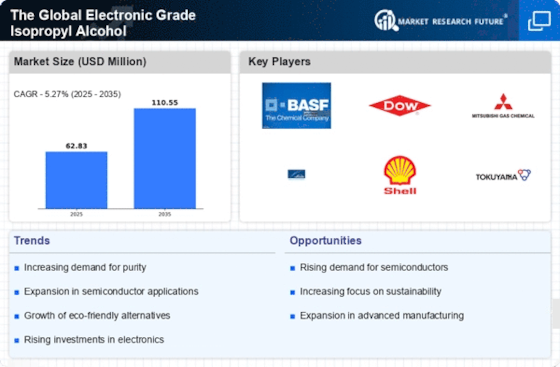
As per Market Research Future analysis, The Global Electronic Grade Isopropyl Alcohol Market Size was estimated at 62.83 USD Million in 2024. The electronic grade isopropyl alcohol industry is projected to grow from 66.14 USD Million in 2025 to 110.55 USD Million by 2035, exhibiting a compound annual growth rate (CAGR) of 5.27% during the forecast period 2025 - 2035

Key Market Trends & Highlights

The Global Electronic Grade Isopropyl Alcohol Market is poised for robust growth driven by increasing demand for high-purity solvents and technological advancements.

  • North America remains the largest market for electronic grade isopropyl alcohol, driven by its established electronics sector.
  • Asia-Pacific is emerging as the fastest-growing region, reflecting a surge in semiconductor manufacturing and innovation.
  • The 99.99% purity segment dominates the market, while the less than 99.99% segment is experiencing rapid growth due to evolving production needs.
  • Key market drivers include the rising demand for high-purity solvents and the expansion of the electronics sector, particularly in integrated chips and semiconductors.

Market Size & Forecast

2024 Market Size 62.83 (USD Million)
2035 Market Size 110.55 (USD Million)
CAGR (2025 - 2035) 5.27%
Largest Regional Market Share in 2024 Asia Pacific

Major Players

BASF SE (DE), Dow Inc. (US), Mitsubishi Gas Chemical Company, Inc. (JP), Linde plc (IE), Shell Chemicals (GB), Tokuyama Corporation (JP), Huntsman Corporation (US), Eastman Chemical Company (US)

Market Trends

The Global Electronic Grade Isopropyl Alcohol Market is currently experiencing notable growth, driven by the increasing demand for high-purity solvents in the electronics sector. This market is characterized by its essential role in the manufacturing and cleaning processes of semiconductors, printed circuit boards, and other electronic components. As technology advances, the need for cleaner and more efficient production methods becomes paramount, leading to a heightened focus on the quality of solvents used. Furthermore, the rising trend of miniaturization in electronic devices necessitates the use of ultra-pure solvents, which is likely to bolster the demand for electronic grade isopropyl alcohol. In addition to the technological advancements, environmental regulations are influencing The Global Electronic Grade Isopropyl Alcohol Market. Manufacturers are increasingly seeking eco-friendly alternatives and sustainable practices, which may lead to innovations in production methods. The market appears to be shifting towards products that not only meet stringent purity standards but also align with environmental sustainability goals. This dual focus on quality and sustainability suggests a dynamic landscape where companies must adapt to evolving consumer preferences and regulatory frameworks. Overall, the market is poised for continued expansion as it responds to these multifaceted drivers.

Rising Demand for High-Purity Solvents

The need for high-purity solvents in electronics manufacturing is escalating, driven by advancements in technology and the miniaturization of devices. This trend emphasizes the importance of using solvents that meet stringent purity standards, thereby enhancing the overall quality of electronic components.

Focus on Environmental Sustainability

Manufacturers are increasingly prioritizing eco-friendly practices in response to regulatory pressures and consumer preferences. This trend indicates a shift towards sustainable production methods and the development of greener alternatives in The Global Electronic Grade Isopropyl Alcohol Market.

Technological Innovations in Production

Ongoing innovations in production techniques are likely to enhance the efficiency and quality of electronic grade isopropyl alcohol. These advancements may lead to improved purification processes, ensuring that the solvents meet the rigorous demands of the electronics industry.

Electronic Grade Isopropyl Alcohol Market Market Drivers

Expansion of the Electronics Sector

The rapid expansion of the electronics sector is a crucial driver for The Global Electronic Grade Isopropyl Alcohol Industry. With the proliferation of consumer electronics, including smartphones, tablets, and wearable devices, the demand for high-quality solvents is surging. This growth is further fueled by advancements in technologies such as 5G and the Internet of Things, which require sophisticated electronic components. As manufacturers strive to meet the increasing production demands, the need for electronic grade isopropyl alcohol becomes more pronounced. Market analysts predict that the electronics sector will continue to expand, thereby propelling the growth of The Global Electronic Grade Isopropyl Alcohol Industry in the coming years.

Focus on Environmental Sustainability

Environmental sustainability has emerged as a pivotal driver in The Global Electronic Grade Isopropyl Alcohol Industry. As regulatory frameworks tighten around chemical usage, manufacturers are increasingly adopting eco-friendly practices. This includes the development of bio-based isopropyl alcohol, which not only meets purity standards but also reduces the carbon footprint associated with traditional production methods. The market is witnessing a shift towards sustainable sourcing and production techniques, which could potentially enhance brand reputation and customer loyalty. Companies that prioritize sustainability may find themselves at a competitive advantage, as consumers and businesses alike become more environmentally conscious. This trend is likely to shape the future landscape of The Global Electronic Grade Isopropyl Alcohol Industry.

Rising Demand for High-Purity Solvents

The increasing need for high-purity solvents in various electronic applications drives The Global Electronic Grade Isopropyl Alcohol Industry. As semiconductor manufacturing processes become more intricate, the demand for solvents with minimal impurities escalates. This trend is particularly evident in the production of integrated circuits, where even trace contaminants can compromise product quality. The market for electronic grade isopropyl alcohol is projected to grow at a compound annual growth rate of approximately 6% over the next five years, reflecting the industry's shift towards higher purity standards. Manufacturers are responding by enhancing their purification processes to meet these stringent requirements, thereby expanding their market share in The Global Electronic Grade Isopropyl Alcohol Industry.

Technological Innovations in Production

Technological advancements in the production of electronic grade isopropyl alcohol are significantly influencing The Global Electronic Grade Isopropyl Alcohol Industry. Innovations such as advanced distillation techniques and membrane filtration are enhancing the efficiency and purity of the final product. These technologies not only reduce production costs but also minimize waste, aligning with the industry's sustainability goals. Furthermore, the integration of automation and real-time monitoring systems in manufacturing processes is expected to improve quality control, ensuring that the solvents meet the rigorous standards required for electronic applications. As these technologies continue to evolve, they may lead to increased market penetration and growth opportunities within The Global Electronic Grade Isopropyl Alcohol Industry.

Increasing Investment in Research and Development

Investment in research and development is playing a pivotal role in shaping The Global Electronic Grade Isopropyl Alcohol Industry. Companies are allocating substantial resources to innovate and improve the quality of electronic grade solvents. This focus on R&D is driven by the need to meet evolving industry standards and customer expectations. Enhanced formulations and production methods are being developed to ensure that isopropyl alcohol meets the stringent requirements of high-tech applications. Furthermore, collaborations between industry players and research institutions are fostering innovation, leading to the introduction of new products that cater to specific market needs. This trend is likely to sustain the growth momentum of The Global Electronic Grade Isopropyl Alcohol Industry.

Market Segment Insights

By Purity: 99.99% (Largest) vs. Less than 99.99% (Fastest-Growing)

In The Global Electronic Grade Isopropyl Alcohol Market, the purity levels are categorized into two primary segments: 99.99% and less than 99.99%. The 99.99% purity segment holds the largest share in the market, as it is highly preferred for sensitive electronic applications that require exceptional cleanliness and minimal impurities. This segment is crucial for manufacturers, particularly in the semiconductor and electronics sectors, where the quality of cleaning agents is paramount. Conversely, the less than 99.99% segment is rapidly gaining traction due to its cost-effectiveness and sufficient purity levels for a range of applications, making it attractive to various end-users.

Purity: 99.99% (Dominant) vs. Less than 99.99% (Emerging)

The 99.99% purity segment is recognized as the dominant force in The Global Electronic Grade Isopropyl Alcohol Market. This high-purity variant is essential for high-tech processes, ensuring that contaminants are kept to a minimum, which is particularly important in semiconductor manufacturing. Additionally, the stringent quality requirements and regulations drive demand, solidifying its market position. In contrast, the less than 99.99% purity segment is emerging as a viable alternative for less critical applications where cleanliness is still important, but cost considerations are a priority. This segment caters to a growing base of manufacturers looking for competitive pricing without significantly compromising on quality.

By Application: Integrated Chips (Largest) vs. Semiconductors (Fastest-Growing)

The Global Electronic Grade Isopropyl Alcohol Market exhibits a diverse application landscape, with integrated chips commanding the largest share due to their extensive use in various electronic devices. This segment remains paramount as industries increasingly rely on integrated chips for enhanced functionality in consumer electronics and computing devices. Following closely are semiconductors, which are rapidly gaining traction, particularly due to the burgeoning demand for advanced technology that demands extremely high purity isopropyl alcohol for cleaning and manufacturing applications.

Technology: Integrated Chips (Dominant) vs. Semiconductors (Emerging)

Integrated chips play a dominant role in The Global Electronic Grade Isopropyl Alcohol Market, primarily due to their wide applicability in devices such as smartphones, tablets, and computers. Their extensive utilization drives demand for high-purity isopropyl alcohol, essential for cleaning and application processes during manufacturing. On the other hand, the semiconductor segment is emerging rapidly, driven by developments in technology and increasing sophistication in manufacturing processes. The rising trend towards miniaturization and enhanced performance is fueling the growth of this segment, highlighting the necessity for high-grade solvents like isopropyl alcohol to ensure product quality and operational efficiency.

Get more detailed insights about Electronic Grade Isopropyl Alcohol Market Research Report—Global Forecast till 2035

Regional Insights

North America : Innovation and Demand Surge

North America is the largest market for electronic grade isopropyl alcohol, holding approximately 40% of the global market share. The region's growth is driven by the increasing demand from the semiconductor and electronics industries, alongside stringent regulatory standards promoting high-purity chemicals. The presence of major players like Dow Inc. and Eastman Chemical Company further fuels market expansion. The United States is the leading country in this region, with significant contributions from Canada as well. The competitive landscape is characterized by a mix of established companies and emerging players, all vying for market share. The focus on innovation and sustainability is evident, as companies invest in advanced production technologies to meet the growing demand for high-quality isopropyl alcohol.

Europe : Regulatory Framework and Growth

Europe is witnessing a robust growth trajectory in the electronic grade isopropyl alcohol market, accounting for approximately 30% of the global share. The region's growth is propelled by stringent regulations aimed at ensuring product purity and safety, particularly in the electronics and pharmaceutical sectors. Countries like Germany and France are at the forefront, driving demand through their advanced manufacturing capabilities. Germany stands out as the leading country in Europe, with significant contributions from France and the UK. The competitive landscape is marked by the presence of key players such as BASF SE and Linde plc, who are investing in sustainable practices and innovative solutions. The European market is characterized by a strong emphasis on compliance with environmental regulations, which shapes the strategies of market participants.

Asia-Pacific : Rapid Growth and Expansion

Asia-Pacific is rapidly emerging as a significant player in the electronic grade isopropyl alcohol market, holding around 25% of the global market share. The region's growth is driven by the booming electronics manufacturing sector, particularly in countries like China, Japan, and South Korea. The increasing demand for high-purity solvents in semiconductor production is a key catalyst for market expansion. China is the largest market in this region, followed closely by Japan and South Korea. The competitive landscape is evolving, with both local and international players striving to capture market share. Companies like Mitsubishi Gas Chemical and Tokuyama Corporation are investing heavily in production capabilities to meet the rising demand for electronic grade isopropyl alcohol, ensuring they remain competitive in this dynamic market.

Middle East and Africa : Emerging Market with Potential

The Middle East and Africa region is gradually emerging in the electronic grade isopropyl alcohol market, currently holding about 5% of the global share. The growth is primarily driven by increasing investments in the electronics sector and the rising demand for high-purity solvents. Countries like the UAE and South Africa are beginning to establish themselves as key players in this market, supported by government initiatives to boost manufacturing capabilities. The competitive landscape is still developing, with a mix of local and international companies entering the market. The presence of key players is limited, but there is a growing interest from global firms looking to expand their footprint in this region. As the electronics industry continues to grow, the demand for electronic grade isopropyl alcohol is expected to rise, presenting significant opportunities for market participants.

Key Players and Competitive Insights

Companies are spending a lot of money on R&D to increase their product lines, which will help the electronic grade isopropyl alcohol market grow even more. Companies are also taking various strategic initiatives to grow their worldwide footprint, including new product launches, contractual agreements, mergers & acquisitions, increased investments, and collaboration with other organizations. As competitive landscape, players in the electronic grade isopropyl alcohol market must offer cost-effective items to expand and survive in an increasingly competitive and rising market environment.
One of the primary business strategies manufacturers adopt in the Electronic Grade Isopropyl Alcohol Market to benefit clients and expand the electronic grade isopropyl alcohol market sector is manufacturing locally to reduce operating costs. Also, growing advancement in the production process eventually help to boost the market.

Key Companies in the Electronic Grade Isopropyl Alcohol Market include

Industry Developments

Future Outlook

Electronic Grade Isopropyl Alcohol Market Future Outlook

The Global Electronic Grade Isopropyl Alcohol Market is projected to grow at a 5.27% CAGR from 2025 to 2035, driven by increasing demand in semiconductor manufacturing and electronics cleaning applications.

New opportunities lie in:

  • Expansion into emerging markets with tailored product offerings.
  • Development of eco-friendly isopropyl alcohol formulations.
  • Investment in automated dispensing technologies for precision and efficiency.

By 2035, the market is expected to solidify its position as a critical component in electronics manufacturing.

Market Segmentation

Electronic Grade Isopropyl Alcohol Market Purity Outlook

  • 99.99%
  • Less than 99.99%

Electronic Grade Isopropyl Alcohol Market Application Outlook

  • Integrated chips
  • Printed Circuit boards
  • Semiconductors
  • LCD Cleaning
  • Others

Report Scope

MARKET SIZE 2024 62.83(USD Million)
MARKET SIZE 2025 66.14(USD Million)
MARKET SIZE 2035 110.55(USD Million)
COMPOUND ANNUAL GROWTH RATE (CAGR) 5.27% (2025 - 2035)
REPORT COVERAGE Revenue Forecast, Competitive Landscape, Growth Factors, and Trends
BASE YEAR 2024
Market Forecast Period 2025 - 2035
Historical Data 2019 - 2024
Market Forecast Units USD Million
Key Companies Profiled BASF SE (DE), Dow Inc. (US), Mitsubishi Gas Chemical Company, Inc. (JP), Linde plc (IE), Shell Chemicals (GB), Tokuyama Corporation (JP), Huntsman Corporation (US), Eastman Chemical Company (US)
Segments Covered Purity, Application, Region
Key Market Opportunities Rising demand for high-purity solvents in semiconductor manufacturing drives growth in The Global Electronic Grade Isopropyl Alcohol.
Key Market Dynamics Rising demand for high-purity solvents in semiconductor manufacturing drives growth in the electronic grade isopropyl alcohol market.
Countries Covered North America, Europe, APAC, South America, MEA

FAQs

What is the projected market valuation for The Global Electronic Grade Isopropyl Alcohol in 2035?

<p>The projected market valuation for The Global Electronic Grade Isopropyl Alcohol in 2035 is 110.55 USD Million.</p>

What was the market valuation for The Global Electronic Grade Isopropyl Alcohol in 2024?

<p>The market valuation for The Global Electronic Grade Isopropyl Alcohol in 2024 was 62.83 USD Million.</p>

What is the expected CAGR for The Global Electronic Grade Isopropyl Alcohol during the forecast period 2025 - 2035?

<p>The expected CAGR for The Global Electronic Grade Isopropyl Alcohol during the forecast period 2025 - 2035 is 5.27%.</p>

Which companies are considered key players in The Global Electronic Grade Isopropyl Alcohol?

<p>Key players in The Global Electronic Grade Isopropyl Alcohol include BASF SE, Dow Inc., Mitsubishi Gas Chemical Company, Linde plc, Shell Chemicals, Tokuyama Corporation, Huntsman Corporation, and Eastman Chemical Company.</p>

What are the market segments for The Global Electronic Grade Isopropyl Alcohol based on purity?

<p>The market segments based on purity include 99.99% purity, valued at 66.0 USD Million, and less than 99.99% purity, valued at 44.55 USD Million.</p>

What applications are driving the demand for Electronic Grade Isopropyl Alcohol?

<p>Applications driving demand include integrated chips, semiconductors, printed circuit boards, and LCD cleaning, with respective valuations of 27.0 USD Million, 30.0 USD Million, 20.0 USD Million, and 18.0 USD Million.</p>

How does the market valuation for 99.99% purity compare to less than 99.99% purity?

<p>The market valuation for 99.99% purity is higher at 66.0 USD Million compared to less than 99.99% purity, which stands at 44.55 USD Million.</p>

What is the expected growth trend for The Global Electronic Grade Isopropyl Alcohol?

<p>The expected growth trend for The Global Electronic Grade Isopropyl Alcohol indicates a steady increase, with a projected valuation rise from 62.83 USD Million in 2024 to 110.55 USD Million by 2035.</p>

Which application segment has the highest valuation in The Global Electronic Grade Isopropyl Alcohol?

<p>The semiconductor application segment has the highest valuation at 30.0 USD Million within The Global Electronic Grade Isopropyl Alcohol.</p>

What is the valuation range for the 'Others' application segment in The Global Electronic Grade Isopropyl Alcohol?

<p>The valuation range for the 'Others' application segment in The Global Electronic Grade Isopropyl Alcohol is between 7.83 USD Million and 15.55 USD Million.</p>

  1. SECTION I: EXECUTIVE SUMMARY AND KEY HIGHLIGHTS
    1. | 1.1 EXECUTIVE SUMMARY
    2. | | 1.1.1 Market Overview
    3. | | 1.1.2 Key Findings
    4. | | 1.1.3 Market Segmentation
    5. | | 1.1.4 Competitive Landscape
    6. | | 1.1.5 Challenges and Opportunities
    7. | | 1.1.6 Future Outlook
  2. SECTION II: SCOPING, METHODOLOGY AND MARKET STRUCTURE
    1. | 2.1 MARKET INTRODUCTION
    2. | | 2.1.1 Definition
    3. | | 2.1.2 Scope of the study
    4. | | | 2.1.2.1 Research Objective
    5. | | | 2.1.2.2 Assumption
    6. | | | 2.1.2.3 Limitations
    7. | 2.2 RESEARCH METHODOLOGY
    8. | | 2.2.1 Overview
    9. | | 2.2.2 Data Mining
    10. | | 2.2.3 Secondary Research
    11. | | 2.2.4 Primary Research
    12. | | | 2.2.4.1 Primary Interviews and Information Gathering Process
    13. | | | 2.2.4.2 Breakdown of Primary Respondents
    14. | | 2.2.5 Forecasting Model
    15. | | 2.2.6 Market Size Estimation
    16. | | | 2.2.6.1 Bottom-Up Approach
    17. | | | 2.2.6.2 Top-Down Approach
    18. | | 2.2.7 Data Triangulation
    19. | | 2.2.8 Validation
  3. SECTION III: QUALITATIVE ANALYSIS
    1. | 3.1 MARKET DYNAMICS
    2. | | 3.1.1 Overview
    3. | | 3.1.2 Drivers
    4. | | 3.1.3 Restraints
    5. | | 3.1.4 Opportunities
    6. | 3.2 MARKET FACTOR ANALYSIS
    7. | | 3.2.1 Value chain Analysis
    8. | | 3.2.2 Porter's Five Forces Analysis
    9. | | | 3.2.2.1 Bargaining Power of Suppliers
    10. | | | 3.2.2.2 Bargaining Power of Buyers
    11. | | | 3.2.2.3 Threat of New Entrants
    12. | | | 3.2.2.4 Threat of Substitutes
    13. | | | 3.2.2.5 Intensity of Rivalry
    14. | | 3.2.3 COVID-19 Impact Analysis
    15. | | | 3.2.3.1 Market Impact Analysis
    16. | | | 3.2.3.2 Regional Impact
    17. | | | 3.2.3.3 Opportunity and Threat Analysis
  4. SECTION IV: QUANTITATIVE ANALYSIS
    1. | 4.1 Chemicals and Materials, BY Purity (USD Million)
    2. | | 4.1.1 99.99%
    3. | | 4.1.2 Less than 99.99%
    4. | 4.2 Chemicals and Materials, BY Application (USD Million)
    5. | | 4.2.1 Integrated chips
    6. | | 4.2.2 Printed Circuit boards
    7. | | 4.2.3 Semiconductors
    8. | | 4.2.4 LCD Cleaning
    9. | | 4.2.5 Others
    10. | 4.3 Chemicals and Materials, BY Region (USD Million)
    11. | | 4.3.1 North America
    12. | | | 4.3.1.1 US
    13. | | | 4.3.1.2 Canada
    14. | | 4.3.2 Europe
    15. | | | 4.3.2.1 Germany
    16. | | | 4.3.2.2 UK
    17. | | | 4.3.2.3 France
    18. | | | 4.3.2.4 Russia
    19. | | | 4.3.2.5 Italy
    20. | | | 4.3.2.6 Spain
    21. | | | 4.3.2.7 Rest of Europe
    22. | | 4.3.3 APAC
    23. | | | 4.3.3.1 China
    24. | | | 4.3.3.2 India
    25. | | | 4.3.3.3 Japan
    26. | | | 4.3.3.4 South Korea
    27. | | | 4.3.3.5 Malaysia
    28. | | | 4.3.3.6 Thailand
    29. | | | 4.3.3.7 Indonesia
    30. | | | 4.3.3.8 Rest of APAC
    31. | | 4.3.4 South America
    32. | | | 4.3.4.1 Brazil
    33. | | | 4.3.4.2 Mexico
    34. | | | 4.3.4.3 Argentina
    35. | | | 4.3.4.4 Rest of South America
    36. | | 4.3.5 MEA
    37. | | | 4.3.5.1 GCC Countries
    38. | | | 4.3.5.2 South Africa
    39. | | | 4.3.5.3 Rest of MEA
  5. SECTION V: COMPETITIVE ANALYSIS
    1. | 5.1 Competitive Landscape
    2. | | 5.1.1 Overview
    3. | | 5.1.2 Competitive Analysis
    4. | | 5.1.3 Market share Analysis
    5. | | 5.1.4 Major Growth Strategy in the Chemicals and Materials
    6. | | 5.1.5 Competitive Benchmarking
    7. | | 5.1.6 Leading Players in Terms of Number of Developments in the Chemicals and Materials
    8. | | 5.1.7 Key developments and growth strategies
    9. | | | 5.1.7.1 New Product Launch/Service Deployment
    10. | | | 5.1.7.2 Merger & Acquisitions
    11. | | | 5.1.7.3 Joint Ventures
    12. | | 5.1.8 Major Players Financial Matrix
    13. | | | 5.1.8.1 Sales and Operating Income
    14. | | | 5.1.8.2 Major Players R&D Expenditure. 2023
    15. | 5.2 Company Profiles
    16. | | 5.2.1 BASF SE (DE)
    17. | | | 5.2.1.1 Financial Overview
    18. | | | 5.2.1.2 Products Offered
    19. | | | 5.2.1.3 Key Developments
    20. | | | 5.2.1.4 SWOT Analysis
    21. | | | 5.2.1.5 Key Strategies
    22. | | 5.2.2 Dow Inc. (US)
    23. | | | 5.2.2.1 Financial Overview
    24. | | | 5.2.2.2 Products Offered
    25. | | | 5.2.2.3 Key Developments
    26. | | | 5.2.2.4 SWOT Analysis
    27. | | | 5.2.2.5 Key Strategies
    28. | | 5.2.3 Mitsubishi Gas Chemical Company, Inc. (JP)
    29. | | | 5.2.3.1 Financial Overview
    30. | | | 5.2.3.2 Products Offered
    31. | | | 5.2.3.3 Key Developments
    32. | | | 5.2.3.4 SWOT Analysis
    33. | | | 5.2.3.5 Key Strategies
    34. | | 5.2.4 Linde plc (IE)
    35. | | | 5.2.4.1 Financial Overview
    36. | | | 5.2.4.2 Products Offered
    37. | | | 5.2.4.3 Key Developments
    38. | | | 5.2.4.4 SWOT Analysis
    39. | | | 5.2.4.5 Key Strategies
    40. | | 5.2.5 Shell Chemicals (GB)
    41. | | | 5.2.5.1 Financial Overview
    42. | | | 5.2.5.2 Products Offered
    43. | | | 5.2.5.3 Key Developments
    44. | | | 5.2.5.4 SWOT Analysis
    45. | | | 5.2.5.5 Key Strategies
    46. | | 5.2.6 Tokuyama Corporation (JP)
    47. | | | 5.2.6.1 Financial Overview
    48. | | | 5.2.6.2 Products Offered
    49. | | | 5.2.6.3 Key Developments
    50. | | | 5.2.6.4 SWOT Analysis
    51. | | | 5.2.6.5 Key Strategies
    52. | | 5.2.7 Huntsman Corporation (US)
    53. | | | 5.2.7.1 Financial Overview
    54. | | | 5.2.7.2 Products Offered
    55. | | | 5.2.7.3 Key Developments
    56. | | | 5.2.7.4 SWOT Analysis
    57. | | | 5.2.7.5 Key Strategies
    58. | | 5.2.8 Eastman Chemical Company (US)
    59. | | | 5.2.8.1 Financial Overview
    60. | | | 5.2.8.2 Products Offered
    61. | | | 5.2.8.3 Key Developments
    62. | | | 5.2.8.4 SWOT Analysis
    63. | | | 5.2.8.5 Key Strategies
    64. | 5.3 Appendix
    65. | | 5.3.1 References
    66. | | 5.3.2 Related Reports
  6. LIST OF FIGURES
    1. | 6.1 MARKET SYNOPSIS
    2. | 6.2 NORTH AMERICA MARKET ANALYSIS
    3. | 6.3 US MARKET ANALYSIS BY PURITY
    4. | 6.4 US MARKET ANALYSIS BY APPLICATION
    5. | 6.5 CANADA MARKET ANALYSIS BY PURITY
    6. | 6.6 CANADA MARKET ANALYSIS BY APPLICATION
    7. | 6.7 EUROPE MARKET ANALYSIS
    8. | 6.8 GERMANY MARKET ANALYSIS BY PURITY
    9. | 6.9 GERMANY MARKET ANALYSIS BY APPLICATION
    10. | 6.10 UK MARKET ANALYSIS BY PURITY
    11. | 6.11 UK MARKET ANALYSIS BY APPLICATION
    12. | 6.12 FRANCE MARKET ANALYSIS BY PURITY
    13. | 6.13 FRANCE MARKET ANALYSIS BY APPLICATION
    14. | 6.14 RUSSIA MARKET ANALYSIS BY PURITY
    15. | 6.15 RUSSIA MARKET ANALYSIS BY APPLICATION
    16. | 6.16 ITALY MARKET ANALYSIS BY PURITY
    17. | 6.17 ITALY MARKET ANALYSIS BY APPLICATION
    18. | 6.18 SPAIN MARKET ANALYSIS BY PURITY
    19. | 6.19 SPAIN MARKET ANALYSIS BY APPLICATION
    20. | 6.20 REST OF EUROPE MARKET ANALYSIS BY PURITY
    21. | 6.21 REST OF EUROPE MARKET ANALYSIS BY APPLICATION
    22. | 6.22 APAC MARKET ANALYSIS
    23. | 6.23 CHINA MARKET ANALYSIS BY PURITY
    24. | 6.24 CHINA MARKET ANALYSIS BY APPLICATION
    25. | 6.25 INDIA MARKET ANALYSIS BY PURITY
    26. | 6.26 INDIA MARKET ANALYSIS BY APPLICATION
    27. | 6.27 JAPAN MARKET ANALYSIS BY PURITY
    28. | 6.28 JAPAN MARKET ANALYSIS BY APPLICATION
    29. | 6.29 SOUTH KOREA MARKET ANALYSIS BY PURITY
    30. | 6.30 SOUTH KOREA MARKET ANALYSIS BY APPLICATION
    31. | 6.31 MALAYSIA MARKET ANALYSIS BY PURITY
    32. | 6.32 MALAYSIA MARKET ANALYSIS BY APPLICATION
    33. | 6.33 THAILAND MARKET ANALYSIS BY PURITY
    34. | 6.34 THAILAND MARKET ANALYSIS BY APPLICATION
    35. | 6.35 INDONESIA MARKET ANALYSIS BY PURITY
    36. | 6.36 INDONESIA MARKET ANALYSIS BY APPLICATION
    37. | 6.37 REST OF APAC MARKET ANALYSIS BY PURITY
    38. | 6.38 REST OF APAC MARKET ANALYSIS BY APPLICATION
    39. | 6.39 SOUTH AMERICA MARKET ANALYSIS
    40. | 6.40 BRAZIL MARKET ANALYSIS BY PURITY
    41. | 6.41 BRAZIL MARKET ANALYSIS BY APPLICATION
    42. | 6.42 MEXICO MARKET ANALYSIS BY PURITY
    43. | 6.43 MEXICO MARKET ANALYSIS BY APPLICATION
    44. | 6.44 ARGENTINA MARKET ANALYSIS BY PURITY
    45. | 6.45 ARGENTINA MARKET ANALYSIS BY APPLICATION
    46. | 6.46 REST OF SOUTH AMERICA MARKET ANALYSIS BY PURITY
    47. | 6.47 REST OF SOUTH AMERICA MARKET ANALYSIS BY APPLICATION
    48. | 6.48 MEA MARKET ANALYSIS
    49. | 6.49 GCC COUNTRIES MARKET ANALYSIS BY PURITY
    50. | 6.50 GCC COUNTRIES MARKET ANALYSIS BY APPLICATION
    51. | 6.51 SOUTH AFRICA MARKET ANALYSIS BY PURITY
    52. | 6.52 SOUTH AFRICA MARKET ANALYSIS BY APPLICATION
    53. | 6.53 REST OF MEA MARKET ANALYSIS BY PURITY
    54. | 6.54 REST OF MEA MARKET ANALYSIS BY APPLICATION
    55. | 6.55 KEY BUYING CRITERIA OF CHEMICALS AND MATERIALS
    56. | 6.56 RESEARCH PROCESS OF MRFR
    57. | 6.57 DRO ANALYSIS OF CHEMICALS AND MATERIALS
    58. | 6.58 DRIVERS IMPACT ANALYSIS: CHEMICALS AND MATERIALS
    59. | 6.59 RESTRAINTS IMPACT ANALYSIS: CHEMICALS AND MATERIALS
    60. | 6.60 SUPPLY / VALUE CHAIN: CHEMICALS AND MATERIALS
    61. | 6.61 CHEMICALS AND MATERIALS, BY PURITY, 2024 (% SHARE)
    62. | 6.62 CHEMICALS AND MATERIALS, BY PURITY, 2024 TO 2035 (USD Million)
    63. | 6.63 CHEMICALS AND MATERIALS, BY APPLICATION, 2024 (% SHARE)
    64. | 6.64 CHEMICALS AND MATERIALS, BY APPLICATION, 2024 TO 2035 (USD Million)
    65. | 6.65 BENCHMARKING OF MAJOR COMPETITORS
  7. LIST OF TABLES
    1. | 7.1 LIST OF ASSUMPTIONS
    2. | | 7.1.1
    3. | 7.2 North America MARKET SIZE ESTIMATES; FORECAST
    4. | | 7.2.1 BY PURITY, 2025-2035 (USD Million)
    5. | | 7.2.2 BY APPLICATION, 2025-2035 (USD Million)
    6. | 7.3 US MARKET SIZE ESTIMATES; FORECAST
    7. | | 7.3.1 BY PURITY, 2025-2035 (USD Million)
    8. | | 7.3.2 BY APPLICATION, 2025-2035 (USD Million)
    9. | 7.4 Canada MARKET SIZE ESTIMATES; FORECAST
    10. | | 7.4.1 BY PURITY, 2025-2035 (USD Million)
    11. | | 7.4.2 BY APPLICATION, 2025-2035 (USD Million)
    12. | 7.5 Europe MARKET SIZE ESTIMATES; FORECAST
    13. | | 7.5.1 BY PURITY, 2025-2035 (USD Million)
    14. | | 7.5.2 BY APPLICATION, 2025-2035 (USD Million)
    15. | 7.6 Germany MARKET SIZE ESTIMATES; FORECAST
    16. | | 7.6.1 BY PURITY, 2025-2035 (USD Million)
    17. | | 7.6.2 BY APPLICATION, 2025-2035 (USD Million)
    18. | 7.7 UK MARKET SIZE ESTIMATES; FORECAST
    19. | | 7.7.1 BY PURITY, 2025-2035 (USD Million)
    20. | | 7.7.2 BY APPLICATION, 2025-2035 (USD Million)
    21. | 7.8 France MARKET SIZE ESTIMATES; FORECAST
    22. | | 7.8.1 BY PURITY, 2025-2035 (USD Million)
    23. | | 7.8.2 BY APPLICATION, 2025-2035 (USD Million)
    24. | 7.9 Russia MARKET SIZE ESTIMATES; FORECAST
    25. | | 7.9.1 BY PURITY, 2025-2035 (USD Million)
    26. | | 7.9.2 BY APPLICATION, 2025-2035 (USD Million)
    27. | 7.10 Italy MARKET SIZE ESTIMATES; FORECAST
    28. | | 7.10.1 BY PURITY, 2025-2035 (USD Million)
    29. | | 7.10.2 BY APPLICATION, 2025-2035 (USD Million)
    30. | 7.11 Spain MARKET SIZE ESTIMATES; FORECAST
    31. | | 7.11.1 BY PURITY, 2025-2035 (USD Million)
    32. | | 7.11.2 BY APPLICATION, 2025-2035 (USD Million)
    33. | 7.12 Rest of Europe MARKET SIZE ESTIMATES; FORECAST
    34. | | 7.12.1 BY PURITY, 2025-2035 (USD Million)
    35. | | 7.12.2 BY APPLICATION, 2025-2035 (USD Million)
    36. | 7.13 APAC MARKET SIZE ESTIMATES; FORECAST
    37. | | 7.13.1 BY PURITY, 2025-2035 (USD Million)
    38. | | 7.13.2 BY APPLICATION, 2025-2035 (USD Million)
    39. | 7.14 China MARKET SIZE ESTIMATES; FORECAST
    40. | | 7.14.1 BY PURITY, 2025-2035 (USD Million)
    41. | | 7.14.2 BY APPLICATION, 2025-2035 (USD Million)
    42. | 7.15 India MARKET SIZE ESTIMATES; FORECAST
    43. | | 7.15.1 BY PURITY, 2025-2035 (USD Million)
    44. | | 7.15.2 BY APPLICATION, 2025-2035 (USD Million)
    45. | 7.16 Japan MARKET SIZE ESTIMATES; FORECAST
    46. | | 7.16.1 BY PURITY, 2025-2035 (USD Million)
    47. | | 7.16.2 BY APPLICATION, 2025-2035 (USD Million)
    48. | 7.17 South Korea MARKET SIZE ESTIMATES; FORECAST
    49. | | 7.17.1 BY PURITY, 2025-2035 (USD Million)
    50. | | 7.17.2 BY APPLICATION, 2025-2035 (USD Million)
    51. | 7.18 Malaysia MARKET SIZE ESTIMATES; FORECAST
    52. | | 7.18.1 BY PURITY, 2025-2035 (USD Million)
    53. | | 7.18.2 BY APPLICATION, 2025-2035 (USD Million)
    54. | 7.19 Thailand MARKET SIZE ESTIMATES; FORECAST
    55. | | 7.19.1 BY PURITY, 2025-2035 (USD Million)
    56. | | 7.19.2 BY APPLICATION, 2025-2035 (USD Million)
    57. | 7.20 Indonesia MARKET SIZE ESTIMATES; FORECAST
    58. | | 7.20.1 BY PURITY, 2025-2035 (USD Million)
    59. | | 7.20.2 BY APPLICATION, 2025-2035 (USD Million)
    60. | 7.21 Rest of APAC MARKET SIZE ESTIMATES; FORECAST
    61. | | 7.21.1 BY PURITY, 2025-2035 (USD Million)
    62. | | 7.21.2 BY APPLICATION, 2025-2035 (USD Million)
    63. | 7.22 South America MARKET SIZE ESTIMATES; FORECAST
    64. | | 7.22.1 BY PURITY, 2025-2035 (USD Million)
    65. | | 7.22.2 BY APPLICATION, 2025-2035 (USD Million)
    66. | 7.23 Brazil MARKET SIZE ESTIMATES; FORECAST
    67. | | 7.23.1 BY PURITY, 2025-2035 (USD Million)
    68. | | 7.23.2 BY APPLICATION, 2025-2035 (USD Million)
    69. | 7.24 Mexico MARKET SIZE ESTIMATES; FORECAST
    70. | | 7.24.1 BY PURITY, 2025-2035 (USD Million)
    71. | | 7.24.2 BY APPLICATION, 2025-2035 (USD Million)
    72. | 7.25 Argentina MARKET SIZE ESTIMATES; FORECAST
    73. | | 7.25.1 BY PURITY, 2025-2035 (USD Million)
    74. | | 7.25.2 BY APPLICATION, 2025-2035 (USD Million)
    75. | 7.26 Rest of South America MARKET SIZE ESTIMATES; FORECAST
    76. | | 7.26.1 BY PURITY, 2025-2035 (USD Million)
    77. | | 7.26.2 BY APPLICATION, 2025-2035 (USD Million)
    78. | 7.27 MEA MARKET SIZE ESTIMATES; FORECAST
    79. | | 7.27.1 BY PURITY, 2025-2035 (USD Million)
    80. | | 7.27.2 BY APPLICATION, 2025-2035 (USD Million)
    81. | 7.28 GCC Countries MARKET SIZE ESTIMATES; FORECAST
    82. | | 7.28.1 BY PURITY, 2025-2035 (USD Million)
    83. | | 7.28.2 BY APPLICATION, 2025-2035 (USD Million)
    84. | 7.29 South Africa MARKET SIZE ESTIMATES; FORECAST
    85. | | 7.29.1 BY PURITY, 2025-2035 (USD Million)
    86. | | 7.29.2 BY APPLICATION, 2025-2035 (USD Million)
    87. | 7.30 Rest of MEA MARKET SIZE ESTIMATES; FORECAST
    88. | | 7.30.1 BY PURITY, 2025-2035 (USD Million)
    89. | | 7.30.2 BY APPLICATION, 2025-2035 (USD Million)
    90. | 7.31 PRODUCT LAUNCH/PRODUCT DEVELOPMENT/APPROVAL
    91. | | 7.31.1
    92. | 7.32 ACQUISITION/PARTNERSHIP
    93. | | 7.32.1

Chemicals and Materials Market Segmentation

Chemicals and Materials By Purity (USD Million, 2025-2035)

  • 99.99%
  • Less than 99.99%

Chemicals and Materials By Application (USD Million, 2025-2035)

  • Integrated chips
  • Printed Circuit boards
  • Semiconductors
  • LCD Cleaning
  • Others
Infographic

Free Sample Request

Kindly complete the form below to receive a free sample of this Report

Get Free Sample

Customer Strories

Compare Licence

×
Features License Type
Single User Multiuser License Enterprise User
Price $4,950 $5,950 $7,250
Maximum User Access Limit 1 User Upto 10 Users Unrestricted Access Throughout the Organization
Free Customization
Direct Access to Analyst
Deliverable Format
Platform Access
Discount on Next Purchase 10% 15% 15%
Printable Versions