×
Request Free Sample ×

Kindly complete the form below to receive a free sample of this Report

* Please use a valid business email

Leading companies partner with us for data-driven Insights

clients tt-cursor
Hero Background
English
Chinese
French
Japanese
Korean
German
Spanish

Electrical Hospital Beds Market Size

ID: MRFR/HC/5090-CR
100 Pages
Kinjoll Dey
October 2018

Electrical Hospital Beds Market Research Report Information by Type (Semi-automatic, Automatic), By Treatment (Critical Care, Acute Care, Long Term Care), By Application (General Purpose, Psychiatric), by End-user (Hospitals & Clinics, Reproductive Care Centers, Dentistry, Home Care) - Growth & Industry Forecast 2025 To 2035

Share:
Download PDF ×

We do not share your information with anyone. However, we may send you emails based on your report interest from time to time. You may contact us at any time to opt-out.

Electrical Hospital Beds Market Infographic
×
Electrical Hospital Beds Market Infographic Full View
Purchase Options

Electrical Hospital Beds Size

Electrical Hospital Beds Market Growth Projections and Opportunities

In certain situations, patients encounter difficulties in maneuvering in and out of beds, prompting the significant role played by electrical hospital beds in addressing this challenge. These beds come equipped with features designed to facilitate patients in comfortably sitting up and exiting the bed. Moreover, electrical hospital beds have proven highly advantageous for medical practitioners during critical procedures and treatments. The market for these beds is fueled by various factors including a rise in acute and chronic illnesses, an increasing elderly population, a growing number of individuals dealing with obesity, ongoing advancements in hospital bed designs prioritizing patient comfort and improvement, and a surge in healthcare spending. However, the higher costs associated with electrical hospital beds pose a potential hindrance to market growth.

Projections suggest that the global electrical hospital beds market is expected to experience a Compound Annual Growth Rate (CAGR) of 7.25% from 2018 to 2023. In 2017, Europe led this market, securing a dominant share of 34.5%, closely followed by the Americas at 30.8% and Asia-Pacific at 24.6%. This growth is primarily driven by escalating demand for electrical hospital beds, advancements in healthcare technologies, and the expanding elderly population globally.

The global market for electrical hospital beds is categorized based on bed types, treatment variations, applications, end-users, and regions. Regarding bed types, the semi-automatic bed segment held the largest market share of 45% in 2017, amounting to a market value of USD 760.3 million. This segment is projected to maintain a steady growth with a forecasted CAGR of 5.07% during the estimation period.

Analyzing treatment types, the critical care segment accounted for the highest market share of 38% in 2017, with a market value of USD 647.4 million. Projections indicate a prospective growth rate of 8.03% during the forecast period for this segment.

In terms of application, the general-purpose segment dominated the market with a share of 32% in 2017, valuing USD 547.5 million. This segment is anticipated to exhibit a CAGR of 7.29% during the forecast period.

When considering end-users, hospitals and clinics claimed the largest market share at 40% in 2017, representing a market value of USD 674.5 million. Forecasts suggest a steady growth with a projected CAGR of 7.25%.

The demand for electrical hospital beds is propelled by their ability to address patient mobility issues. The market's growth is driven by various factors including healthcare advancements, an aging population, and the persistent need for enhanced patient comfort and treatment efficacy. Despite potential cost concerns, the market for electrical hospital beds is projected to exhibit significant growth across various bed types, treatment categories, applications, and end-users globally.
Electrical Hospital Beds Market Size Graph
Author
Kinjoll Dey
Research Analyst Level I

He is an extremely curious individual currently working in Healthcare and Medical Devices Domain. Kinjoll is comfortably versed in data centric research backed by healthcare educational background. He leverages extensive data mining and analytics tools such as Primary and Secondary Research, Statistical Analysis, Machine Learning, Data Modelling. His key role also involves Technical Sales Support, Client Interaction and Project management within the Healthcare team. Lastly, he showcases extensive affinity towards learning new skills and remain fascinated in implementing them.

Leave a Comment

FAQs

At what CAGR is the electrical hospital beds market projected to grow during the forecast period?

The electrical hospital beds market is projected to grow at a 4.88% CAGR between 2024-2032.

What will be the value of the electrical hospital beds market during the forecast period?

The electrical hospital beds market predicted to touch USD 5.28 Billion by 2032.

Which region is projected to command the largest share in the electrical hospital beds market?

US is projected to command the largest share in the electrical hospital beds market.

Which application segment will dominate the electrical hospital beds market?

General purpose segment will dominate the electrical hospital beds market.

Which end user segment will have the largest share in the electrical hospital beds market?

Hospitals and clinics will have the largest share in the electrical hospital beds market.

Market Summary

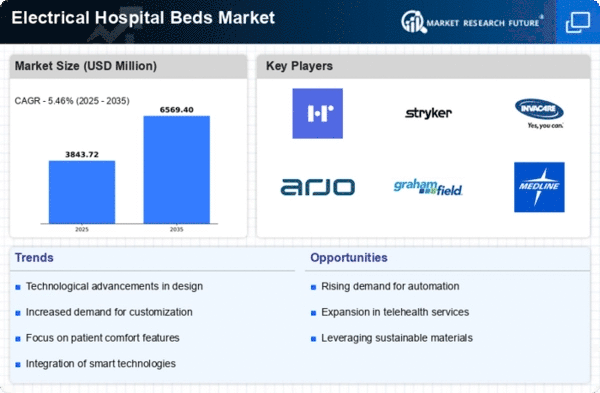
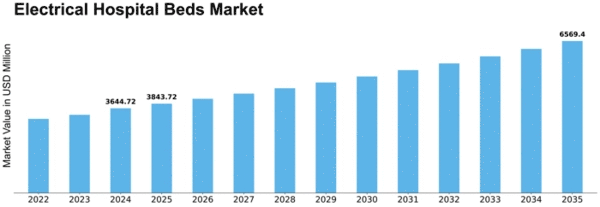
As per MRFR analysis, the Electrical Hospital Beds Market Size was estimated at 3644.72 USD Million in 2024. The Electrical Hospital Beds industry is projected to grow from 3885.49 USD Million in 2025 to 6569.4 USD Million by 2035, exhibiting a compound annual growth rate (CAGR) of 5.46 during the forecast period 2025 - 2035.

Key Market Trends & Highlights

The Electrical Hospital Beds Market is poised for substantial growth driven by technological advancements and evolving patient care needs.

  • The integration of smart technology in electrical hospital beds enhances patient monitoring and operational efficiency.
  • A growing emphasis on patient comfort and safety is reshaping design standards across the market.
  • Sustainability in design and manufacturing is becoming increasingly relevant, particularly in North America.
  • The rising demand for advanced healthcare facilities and an aging population are key drivers propelling market expansion.

Market Size & Forecast

2024 Market Size 3644.72 (USD Million)
2035 Market Size 6569.4 (USD Million)
CAGR (2025 - 2035) 5.46%
Largest Regional Market Share in 2024 North America

Major Players

Hill-Rom (US), Stryker (US), Invacare (US), Arjo (SE), Graham-Field (US), Medline Industries (US), Drive DeVilbiss Healthcare (US), Joerns Healthcare (US), Linet (CZ)

Market Trends

The Electrical Hospital Beds Market is currently experiencing a notable transformation, driven by advancements in technology and an increasing emphasis on patient comfort and safety. Manufacturers are integrating innovative features such as smart technology, which allows for remote monitoring and adjustments, thereby enhancing the overall patient experience. Additionally, the growing demand for healthcare services, particularly in aging populations, is propelling the need for more sophisticated hospital beds that cater to diverse medical requirements. This shift not only reflects a response to evolving healthcare needs but also indicates a broader trend towards personalized patient care in medical facilities. Moreover, sustainability is becoming a focal point within the Electrical Hospital Beds Market. Companies are increasingly prioritizing eco-friendly materials and energy-efficient designs, aligning with global efforts to reduce environmental impact. This trend suggests a dual benefit: improving patient care while also addressing ecological concerns. As healthcare providers seek to optimize their operations, the integration of sustainable practices into the design and manufacturing of hospital beds appears to be a strategic move that could enhance brand reputation and attract environmentally conscious consumers. Overall, the Electrical Hospital Beds Market is poised for growth, characterized by innovation, sustainability, and a commitment to improving patient outcomes.

Integration of Smart Technology

The Electrical Hospital Beds Market is witnessing a surge in the incorporation of smart technology. This trend involves the use of advanced features such as remote monitoring, automated adjustments, and connectivity with healthcare systems. Such innovations aim to enhance patient care by allowing healthcare providers to monitor patients' conditions in real-time, thereby improving response times and overall treatment efficacy.

Focus on Patient Comfort and Safety

There is a growing emphasis on patient comfort and safety within the Electrical Hospital Beds Market. Manufacturers are designing beds that not only provide essential medical functionalities but also prioritize ergonomic features. This trend reflects a broader understanding of the importance of patient experience in healthcare settings, suggesting that comfort can significantly influence recovery outcomes.

Sustainability in Design and Manufacturing

Sustainability is emerging as a critical consideration in the Electrical Hospital Beds Market. Companies are increasingly adopting eco-friendly materials and energy-efficient manufacturing processes. This trend indicates a shift towards environmentally responsible practices, which not only meet regulatory requirements but also appeal to a more environmentally conscious consumer base.

Electrical Hospital Beds Market Market Drivers

Market Growth Projections

The Global Electrical Hospital Beds Market Industry is projected to experience robust growth in the coming years. With a market value of 3.44 USD Billion in 2024, it is expected to reach 6.09 USD Billion by 2035. This growth trajectory suggests a compound annual growth rate (CAGR) of 5.33% from 2025 to 2035. Such projections indicate a strong demand for electrical hospital beds driven by factors such as technological advancements, an aging population, and increased government funding for healthcare infrastructure. The market's expansion reflects the ongoing evolution of healthcare practices and the necessity for hospitals to adapt to changing patient needs.

Growing Awareness of Patient Comfort and Safety

The emphasis on patient comfort and safety is becoming increasingly prominent within the Global Electrical Hospital Beds Market Industry. Healthcare providers recognize that comfortable patients are more likely to experience positive outcomes and shorter recovery times. As such, there is a growing trend towards the adoption of electrical hospital beds that offer adjustable features, enhanced support, and safety mechanisms. This shift is indicative of a broader movement towards patient-centered care, where the quality of the patient experience is prioritized. Hospitals that invest in these advanced beds are likely to see improved patient satisfaction scores, which can positively impact their reputation and operational success.

Technological Advancements in Medical Equipment

Technological innovation plays a crucial role in the expansion of the Global Electrical Hospital Beds Market Industry. The introduction of features such as smart beds equipped with sensors, remote monitoring capabilities, and adjustable settings enhances patient care and safety. Hospitals are increasingly investing in these advanced beds to improve operational efficiency and patient satisfaction. The anticipated growth of the market, projected to reach 6.09 USD Billion by 2035, indicates a strong correlation between technological advancements and market expansion. As healthcare providers seek to optimize their services, the integration of cutting-edge technology into hospital beds becomes a priority, thus driving market growth.

Rising Demand for Advanced Healthcare Facilities

The Global Electrical Hospital Beds Market Industry is experiencing a surge in demand due to the increasing focus on advanced healthcare facilities. Hospitals are increasingly adopting electrical hospital beds to enhance patient comfort and care efficiency. As of 2024, the market is valued at approximately 3.44 USD Billion, reflecting a growing recognition of the importance of modern medical equipment. This trend is likely driven by the need for improved patient outcomes and the integration of technology in healthcare settings. The shift towards patient-centered care models further emphasizes the necessity for hospitals to invest in advanced equipment, thereby propelling the market forward.

Aging Population and Increased Hospitalization Rates

The demographic shift towards an aging population is a significant driver of the Global Electrical Hospital Beds Market Industry. As the elderly population grows, there is a corresponding increase in hospitalization rates, necessitating the need for more hospital beds. This trend is particularly evident in developed countries where healthcare systems are adapting to cater to the needs of older adults. The market is expected to grow at a CAGR of 5.33% from 2025 to 2035, reflecting the increasing demand for specialized hospital equipment. Consequently, healthcare facilities are compelled to invest in electrical hospital beds that offer enhanced functionality and comfort for elderly patients.

Government Initiatives and Funding for Healthcare Infrastructure

Government initiatives aimed at improving healthcare infrastructure significantly influence the Global Electrical Hospital Beds Market Industry. Many governments are allocating funds to upgrade hospital facilities, which includes the procurement of modern medical equipment such as electrical hospital beds. These initiatives often focus on enhancing patient care quality and ensuring that healthcare systems are equipped to handle increasing patient loads. As a result, hospitals are more likely to invest in advanced beds that align with government standards and regulations. This trend not only supports market growth but also ensures that healthcare providers can meet the evolving needs of their patient populations.

Market Segment Insights

By Application: Intensive Care Unit (Largest) vs. General Ward (Fastest-Growing)

The Electrical Hospital Beds Market is predominantly driven by the Intensive Care Unit (ICU) segment, which accounts for the largest market share. ICU beds are essential for patient management in critical conditions, leading to a surge in demand as healthcare facilities expand services. The General Ward segment follows, holding a significant share but with increasing competition from emerging segments, notably the Emergency Room and Rehabilitation. These differences highlight the varying needs and investment capabilities of healthcare facilities, reflecting their strategic priorities.

General Ward (Dominant) vs. Pediatric Care (Emerging)

The General Ward remains a dominant segment within the Electrical Hospital Beds Market, characterized by its consistent utilization in standard patient care. These beds are designed for ease of use and comfort, catering to a large patient base. Conversely, Pediatric Care is emerging as a vital segment, with a growing focus on specialized hospital beds designed for children. These beds offer unique features such as adjustable sizes, safety railings, and child-friendly designs, reflecting the increasing recognition of pediatric healthcare needs. The rise in pediatric patient admission rates and tailored treatments indicates that this segment is poised for substantial growth, supported by advancements in technology and healthcare policies.

By End Use: Hospitals (Largest) vs. Home Care (Fastest-Growing)

In the Electrical Hospital Beds Market, the distribution of market share reveals that hospitals are the most significant end-use segment, dominating the market due to the high demand for sophisticated healthcare solutions in acute care settings. Hospitals require advanced electrical hospital beds that enhance patient mobility and comfort while ensuring precise medical care. Nursing homes and long-term care facilities also contribute to market share as they require specialized beds for elderly patients with varying health needs. On the other hand, the home care segment is rapidly emerging, fueled by the growing trend of aging in place. The need for portable and versatile hospital beds suitable for home environments is driving this segment's growth. Ambulatory surgical centers are witnessing increased adoption too, focusing on outpatient care where high-quality electrical beds enhance patient recovery. As healthcare models shift towards more personalized care, the dynamics within these segments will continue to evolve.

Hospitals: Dominant vs. Home Care: Emerging

In the Electrical Hospital Beds Market, hospitals represent the dominant segment, characterized by their extensive use of advanced hospital beds equipped with cutting-edge technology to support critical care. These beds are often adjustable and designed to accommodate various patient requirements, making them essential in medical settings. Conversely, the home care segment is emerging as a vital player, driven by the growing preference for home-based healthcare solutions among elderly patients. Home care beds focus on mobility, safety, and convenience, allowing patients to receive care in the comfort of their homes. This shift reflects broader healthcare trends prioritizing individualized care, where the home environment is increasingly seen as a feasible option for medical rehabilitation and management.

By Type: Fully Electric Hospital Beds (Largest) vs. Semi-Electric Hospital Beds (Fastest-Growing)

In the Electrical Hospital Beds Market, Fully Electric Hospital Beds hold the largest share, dominating the segment due to their advanced features and user-friendly operations. This segment appeals particularly to hospitals that prioritize patient comfort and staff efficiency, resulting in a significant demand for these beds. Semi-Electric Hospital Beds, while not as broadly adopted, are emerging rapidly as a cost-effective alternative, capturing a growing section of the market as healthcare facilities seek budget-friendly options without compromising on essential functionalities.

Bed Types: Fully Electric (Dominant) vs. Semi-Electric (Emerging)

Fully Electric Hospital Beds are characterized by their electric control mechanisms, allowing for easy adjustment of the bed's height and position with minimal effort. This technology significantly enhances patient comfort and supports healthcare providers in improving workflow efficiency. On the other hand, Semi-Electric Hospital Beds offer a blend of manual and electric features, typically allowing electric adjustment for head and foot sections while requiring manual controls for height adjustments. This flexibility makes them an attractive option for budget-conscious facilities seeking to balance cost and functionality while catering to patient needs.

By Features: Height Adjustment (Largest) vs. Integrated Weighing Scale (Fastest-Growing)

In the Electrical Hospital Beds Market, the Height Adjustment feature represents the largest share among various segment values. It is crucial for providing comfort and accessibility to patients during their medical treatment, making it a fundamental aspect that many hospitals prioritize in their purchasing decisions. Following closely are features like Trendelenburg Positioning and Patient Control Panels, which also contribute significantly to market dynamics. However, integrated Weighing Scales are emerging swiftly as healthcare facilities increasingly prioritize patient monitoring.

Height Adjustment (Dominant) vs. Integrated Weighing Scale (Emerging)

Height Adjustment functions as the cornerstone feature in electrical hospital beds, ensuring that caregivers can easily adjust the bed's height to facilitate patient access and comfort, which is essential in critical care environments. On the other hand, Integrated Weighing Scales are gaining traction as an emerging feature, as hospitals seek to optimize efficiency in patient care. This capability enables real-time weight measurement without necessitating additional equipment, thus streamlining processes. The growing focus on patient-centric care and the need for advancements in technology are significant drivers propelling the demand for integrated weighing scales in hospital settings.

By Distribution Channel: Direct Sales (Largest) vs. Online Sales (Fastest-Growing)

In the Electrical Hospital Beds Market, Direct Sales remains the largest distribution channel, solidifying its dominance due to established relationships with healthcare facilities and the ability to provide tailored solutions directly through manufacturers. Online Sales, while smaller in size, is rapidly gaining traction, driven by the growing trend towards digital healthcare solutions and the increasing convenience offered to buyers in acquiring hospital beds remotely.

Direct Sales (Dominant) vs. Online Sales (Emerging)

Direct Sales leads the market as the most predictable and reliable channel, primarily benefiting from strong personal interactions and a deep understanding of customer needs within the healthcare industry. On the other hand, Online Sales is on the rise, appealing particularly to tech-savvy buyers and organizations looking for swift procurement processes. The shift toward digital platforms allows for broader market reach and increased accessibility to product information. As hospitals increasingly adapt to e-commerce strategies, the Online Sales segment is expected to experience significant expansion.

Get more detailed insights about Electrical Hospital Beds Market Research Report – Forecast to 2035

Regional Insights

North America : Market Leader in Innovation

North America is poised to maintain its leadership in the electrical hospital beds market, holding a significant share of 1820.0 million in 2024. The region's growth is driven by an aging population, increasing hospital admissions, and advancements in healthcare technology. Regulatory support, including initiatives to improve patient care and safety standards, further catalyzes market expansion. The demand for smart hospital beds that enhance patient comfort and operational efficiency is on the rise, reflecting a shift towards more integrated healthcare solutions. The competitive landscape in North America is robust, featuring key players such as Hill-Rom, Stryker, and Invacare, which are at the forefront of innovation. The U.S. remains the largest market, supported by substantial healthcare expenditure and a focus on improving hospital infrastructure. Companies are increasingly investing in R&D to develop advanced features in hospital beds, such as automated adjustments and integrated monitoring systems, ensuring they meet the evolving needs of healthcare providers and patients alike.

Europe : Emerging Market with Growth Potential

Europe's electrical hospital beds market is projected to grow significantly, with a market size of 1090.0 million. The region benefits from a well-established healthcare system and increasing investments in hospital infrastructure. Factors such as the rising prevalence of chronic diseases and the need for advanced medical equipment are driving demand. Regulatory frameworks across European countries are becoming more supportive, promoting innovations that enhance patient care and safety, which is crucial for market growth. Leading countries in this region include Germany, France, and the UK, where healthcare spending is robust. The competitive landscape features major players like Arjo and Linet, who are innovating to meet the demands of modern healthcare facilities. The European market is characterized by a focus on sustainability and efficiency, with companies increasingly adopting eco-friendly practices in manufacturing and product design. This trend is expected to shape the future of the market significantly.

Asia-Pacific : Rapid Growth in Healthcare Investments

The Asia-Pacific region is witnessing rapid growth in the electrical hospital beds market, with a market size of 600.0 million. This growth is fueled by increasing healthcare expenditures, a rising population, and a surge in hospital construction projects. Governments are investing heavily in healthcare infrastructure, driven by the need to improve patient care and accommodate growing healthcare demands. Regulatory bodies are also enhancing standards for medical equipment, which is expected to further boost market growth in the coming years. Countries like China, India, and Japan are leading the charge in this market, with significant investments in healthcare technology. The competitive landscape is becoming increasingly dynamic, with both local and international players vying for market share. Companies such as Drive DeVilbiss Healthcare and Joerns Healthcare are expanding their presence in the region, focusing on innovative solutions that cater to the unique needs of healthcare providers and patients in diverse settings. This trend is indicative of a broader shift towards modernization in healthcare across Asia-Pacific.

Middle East and Africa : Emerging Market with Unique Challenges

The Middle East and Africa region is gradually emerging in the electrical hospital beds market, with a market size of 134.72 million. The growth is primarily driven by increasing healthcare investments and a rising demand for advanced medical equipment. Governments are focusing on improving healthcare infrastructure, particularly in countries like the UAE and South Africa, where there is a push for modernization and better patient care. Regulatory frameworks are evolving to support the introduction of innovative healthcare solutions, which is essential for market growth. Leading countries in this region include the UAE, South Africa, and Saudi Arabia, where healthcare spending is on the rise. The competitive landscape is characterized by a mix of local and international players, with companies looking to establish a foothold in this developing market. The presence of key players is growing, and there is a notable trend towards partnerships and collaborations to enhance product offerings and meet the specific needs of healthcare facilities in the region.

Key Players and Competitive Insights

The Electrical Hospital Beds Market is characterized by a dynamic competitive landscape, driven by technological advancements, an increasing aging population, and a growing emphasis on patient comfort and safety. Key players such as Hill-Rom (US), Stryker (US), and Invacare (US) are strategically positioned to leverage innovation and operational efficiency. Hill-Rom (US) focuses on enhancing patient care through advanced technology integration, while Stryker (US) emphasizes a robust product portfolio and strategic acquisitions to expand its market reach. Invacare (US) is concentrating on product diversification and regional expansion, which collectively shapes a competitive environment that is increasingly reliant on technological differentiation and customer-centric solutions.In terms of business tactics, companies are localizing manufacturing to reduce costs and optimize supply chains, which is particularly relevant in a moderately fragmented market. The competitive structure is influenced by the collective actions of these key players, who are increasingly adopting strategies that enhance operational efficiency and responsiveness to market demands. This localized approach not only mitigates supply chain disruptions but also aligns with the growing trend of sustainability in manufacturing processes.

In November Hill-Rom (US) announced the launch of a new line of smart hospital beds equipped with AI-driven monitoring systems. This strategic move is significant as it positions the company at the forefront of digital health solutions, catering to the increasing demand for integrated healthcare technologies. The introduction of these smart beds is likely to enhance patient outcomes and streamline hospital operations, thereby reinforcing Hill-Rom's competitive edge.Similarly, in October 2025, Stryker (US) completed the acquisition of a leading telehealth technology firm, which is expected to bolster its product offerings in the hospital bed segment. This acquisition reflects Stryker's commitment to expanding its technological capabilities and enhancing patient care through remote monitoring solutions. The integration of telehealth features into hospital beds could potentially transform patient management and operational efficiency in healthcare settings.

In September Invacare (US) launched a new initiative aimed at increasing the sustainability of its manufacturing processes, which includes the use of recycled materials in its hospital beds. This initiative not only addresses environmental concerns but also aligns with the growing consumer preference for sustainable products. By prioritizing sustainability, Invacare is likely to enhance its brand reputation and appeal to environmentally conscious healthcare providers.

As of December current trends in the Electrical Hospital Beds Market indicate a strong shift towards digitalization, sustainability, and AI integration. Strategic alliances among key players are shaping the competitive landscape, fostering innovation and collaborative solutions. The evolution of competitive differentiation appears to be moving away from price-based competition towards a focus on technological innovation, enhanced patient care, and supply chain reliability. This shift suggests that companies that prioritize these aspects will likely gain a competitive advantage in the increasingly complex healthcare environment.

Key Companies in the Electrical Hospital Beds Market include

Industry Developments

Future Outlook

Electrical Hospital Beds Market Future Outlook

The Electrical Hospital Beds Market is projected to grow at a 5.46% CAGR from 2025 to 2035, driven by technological advancements, increasing healthcare demands, and an aging population.

New opportunities lie in:

  • Integration of IoT for real-time patient monitoring
  • Development of customizable bed features for diverse patient needs
  • Expansion into emerging markets with tailored product offerings

By 2035, the market is expected to be robust, reflecting substantial growth and innovation.

Market Segmentation

Electrical Hospital Beds Market Type Outlook

  • Manual Electrical Hospital Beds
  • Semi-Electric Hospital Beds
  • Fully Electric Hospital Beds
  • Bariatric Hospital Beds
  • Adjustable Hospital Beds

Electrical Hospital Beds Market End Use Outlook

  • Hospitals
  • Nursing Homes
  • Home Care
  • Long-term Care Facilities
  • Ambulatory Surgical Centers

Electrical Hospital Beds Market Features Outlook

  • Height Adjustment
  • Trendelenburg Positioning
  • Side Rails
  • Patient Control Panels
  • Integrated Weighing Scale

Electrical Hospital Beds Market Application Outlook

  • Intensive Care Unit
  • General Ward
  • Emergency Room
  • Pediatric Care
  • Rehabilitation

Electrical Hospital Beds Market Distribution Channel Outlook

  • Direct Sales
  • Online Sales
  • Distributors
  • Retailers
  • Healthcare Equipment Suppliers

Report Scope

MARKET SIZE 20243644.72(USD Million)
MARKET SIZE 20253885.49(USD Million)
MARKET SIZE 20356569.4(USD Million)
COMPOUND ANNUAL GROWTH RATE (CAGR)5.46% (2025 - 2035)
REPORT COVERAGERevenue Forecast, Competitive Landscape, Growth Factors, and Trends
BASE YEAR2024
Market Forecast Period2025 - 2035
Historical Data2019 - 2024
Market Forecast UnitsUSD Million
Key Companies ProfiledHill-Rom (US), Stryker (US), Invacare (US), Arjo (SE), Graham-Field (US), Medline Industries (US), Drive DeVilbiss Healthcare (US), Joerns Healthcare (US), Linet (CZ)
Segments CoveredApplication, End Use, Type, Features, Distribution Channel
Key Market OpportunitiesIntegration of smart technology enhances patient care in the Electrical Hospital Beds Market.
Key Market DynamicsTechnological advancements and regulatory changes drive innovation and competition in the Electrical Hospital Beds Market.
Countries CoveredNorth America, Europe, APAC, South America, MEA

FAQs

At what CAGR is the electrical hospital beds market projected to grow during the forecast period?

The electrical hospital beds market is projected to grow at a 4.88% CAGR between 2024-2032.

What will be the value of the electrical hospital beds market during the forecast period?

The electrical hospital beds market predicted to touch USD 5.28 Billion by 2032.

Which region is projected to command the largest share in the electrical hospital beds market?

US is projected to command the largest share in the electrical hospital beds market.

Which application segment will dominate the electrical hospital beds market?

General purpose segment will dominate the electrical hospital beds market.

Which end user segment will have the largest share in the electrical hospital beds market?

Hospitals and clinics will have the largest share in the electrical hospital beds market.

  1. SECTION I: EXECUTIVE SUMMARY AND KEY HIGHLIGHTS
    1. | 1.1 EXECUTIVE SUMMARY
    2. | 1.1.1 Market Overview
    3. | 1.1.2 Key Findings
    4. | 1.1.3 Market Segmentation
    5. | 1.1.4 Competitive Landscape
    6. | 1.1.5 Challenges and Opportunities
    7. | 1.1.6 Future Outlook
  2. SECTION II: SCOPING, METHODOLOGY AND MARKET STRUCTURE
    1. | 2.1 MARKET INTRODUCTION
    2. | 2.1.1 Definition
    3. | 2.1.2 Scope of the study
    4. |-- 2.1.2.1 Research Objective
    5. |-- 2.1.2.2 Assumption
    6. |-- 2.1.2.3 Limitations
    7. | 2.2 RESEARCH METHODOLOGY
    8. | 2.2.1 Overview
    9. | 2.2.2 Data Mining
    10. | 2.2.3 Secondary Research
    11. | 2.2.4 Primary Research
    12. |-- 2.2.4.1 Primary Interviews and Information Gathering Process
    13. |-- 2.2.4.2 Breakdown of Primary Respondents
    14. | 2.2.5 Forecasting Model
    15. | 2.2.6 Market Size Estimation
    16. |-- 2.2.6.1 Bottom-Up Approach
    17. |-- 2.2.6.2 Top-Down Approach
    18. | 2.2.7 Data Triangulation
    19. | 2.2.8 Validation
  3. SECTION III: QUALITATIVE ANALYSIS
    1. | 3.1 MARKET DYNAMICS
    2. | 3.1.1 Overview
    3. | 3.1.2 Drivers
    4. | 3.1.3 Restraints
    5. | 3.1.4 Opportunities
    6. | 3.2 MARKET FACTOR ANALYSIS
    7. | 3.2.1 Value chain Analysis
    8. | 3.2.2 Porter's Five Forces Analysis
    9. |-- 3.2.2.1 Bargaining Power of Suppliers
    10. |-- 3.2.2.2 Bargaining Power of Buyers
    11. |-- 3.2.2.3 Threat of New Entrants
    12. |-- 3.2.2.4 Threat of Substitutes
    13. |-- 3.2.2.5 Intensity of Rivalry
    14. | 3.2.3 COVID-19 Impact Analysis
    15. |-- 3.2.3.1 Market Impact Analysis
    16. |-- 3.2.3.2 Regional Impact
    17. |-- 3.2.3.3 Opportunity and Threat Analysis
  4. SECTION IV: QUANTITATIVE ANALYSIS
    1. | 4.1 Healthcare, BY Application (USD Million)
    2. | 4.1.1 Intensive Care Unit
    3. | 4.1.2 General Ward
    4. | 4.1.3 Emergency Room
    5. | 4.1.4 Pediatric Care
    6. | 4.1.5 Rehabilitation
    7. | 4.2 Healthcare, BY End Use (USD Million)
    8. | 4.2.1 Hospitals
    9. | 4.2.2 Nursing Homes
    10. | 4.2.3 Home Care
    11. | 4.2.4 Long-term Care Facilities
    12. | 4.2.5 Ambulatory Surgical Centers
    13. | 4.3 Healthcare, BY Type (USD Million)
    14. | 4.3.1 Manual Electrical Hospital Beds
    15. | 4.3.2 Semi-Electric Hospital Beds
    16. | 4.3.3 Fully Electric Hospital Beds
    17. | 4.3.4 Bariatric Hospital Beds
    18. | 4.3.5 Adjustable Hospital Beds
    19. | 4.4 Healthcare, BY Features (USD Million)
    20. | 4.4.1 Height Adjustment
    21. | 4.4.2 Trendelenburg Positioning
    22. | 4.4.3 Side Rails
    23. | 4.4.4 Patient Control Panels
    24. | 4.4.5 Integrated Weighing Scale
    25. | 4.5 Healthcare, BY Distribution Channel (USD Million)
    26. | 4.5.1 Direct Sales
    27. | 4.5.2 Online Sales
    28. | 4.5.3 Distributors
    29. | 4.5.4 Retailers
    30. | 4.5.5 Healthcare Equipment Suppliers
    31. | 4.6 Healthcare, BY Region (USD Million)
    32. | 4.6.1 North America
    33. |-- 4.6.1.1 US
    34. |-- 4.6.1.2 Canada
    35. | 4.6.2 Europe
    36. |-- 4.6.2.1 Germany
    37. |-- 4.6.2.2 UK
    38. |-- 4.6.2.3 France
    39. |-- 4.6.2.4 Russia
    40. |-- 4.6.2.5 Italy
    41. |-- 4.6.2.6 Spain
    42. |-- 4.6.2.7 Rest of Europe
    43. | 4.6.3 APAC
    44. |-- 4.6.3.1 China
    45. |-- 4.6.3.2 India
    46. |-- 4.6.3.3 Japan
    47. |-- 4.6.3.4 South Korea
    48. |-- 4.6.3.5 Malaysia
    49. |-- 4.6.3.6 Thailand
    50. |-- 4.6.3.7 Indonesia
    51. |-- 4.6.3.8 Rest of APAC
    52. | 4.6.4 South America
    53. |-- 4.6.4.1 Brazil
    54. |-- 4.6.4.2 Mexico
    55. |-- 4.6.4.3 Argentina
    56. |-- 4.6.4.4 Rest of South America
    57. | 4.6.5 MEA
    58. |-- 4.6.5.1 GCC Countries
    59. |-- 4.6.5.2 South Africa
    60. |-- 4.6.5.3 Rest of MEA
  5. SECTION V: COMPETITIVE ANALYSIS
    1. | 5.1 Competitive Landscape
    2. | 5.1.1 Overview
    3. | 5.1.2 Competitive Analysis
    4. | 5.1.3 Market share Analysis
    5. | 5.1.4 Major Growth Strategy in the Healthcare
    6. | 5.1.5 Competitive Benchmarking
    7. | 5.1.6 Leading Players in Terms of Number of Developments in the Healthcare
    8. | 5.1.7 Key developments and growth strategies
    9. |-- 5.1.7.1 New Product Launch/Service Deployment
    10. |-- 5.1.7.2 Merger & Acquisitions
    11. |-- 5.1.7.3 Joint Ventures
    12. | 5.1.8 Major Players Financial Matrix
    13. |-- 5.1.8.1 Sales and Operating Income
    14. |-- 5.1.8.2 Major Players R&D Expenditure. 2023
    15. | 5.2 Company Profiles
    16. | 5.2.1 Hill-Rom (US)
    17. |-- 5.2.1.1 Financial Overview
    18. |-- 5.2.1.2 Products Offered
    19. |-- 5.2.1.3 Key Developments
    20. |-- 5.2.1.4 SWOT Analysis
    21. |-- 5.2.1.5 Key Strategies
    22. | 5.2.2 Stryker (US)
    23. |-- 5.2.2.1 Financial Overview
    24. |-- 5.2.2.2 Products Offered
    25. |-- 5.2.2.3 Key Developments
    26. |-- 5.2.2.4 SWOT Analysis
    27. |-- 5.2.2.5 Key Strategies
    28. | 5.2.3 Invacare (US)
    29. |-- 5.2.3.1 Financial Overview
    30. |-- 5.2.3.2 Products Offered
    31. |-- 5.2.3.3 Key Developments
    32. |-- 5.2.3.4 SWOT Analysis
    33. |-- 5.2.3.5 Key Strategies
    34. | 5.2.4 Arjo (SE)
    35. |-- 5.2.4.1 Financial Overview
    36. |-- 5.2.4.2 Products Offered
    37. |-- 5.2.4.3 Key Developments
    38. |-- 5.2.4.4 SWOT Analysis
    39. |-- 5.2.4.5 Key Strategies
    40. | 5.2.5 Graham-Field (US)
    41. |-- 5.2.5.1 Financial Overview
    42. |-- 5.2.5.2 Products Offered
    43. |-- 5.2.5.3 Key Developments
    44. |-- 5.2.5.4 SWOT Analysis
    45. |-- 5.2.5.5 Key Strategies
    46. | 5.2.6 Medline Industries (US)
    47. |-- 5.2.6.1 Financial Overview
    48. |-- 5.2.6.2 Products Offered
    49. |-- 5.2.6.3 Key Developments
    50. |-- 5.2.6.4 SWOT Analysis
    51. |-- 5.2.6.5 Key Strategies
    52. | 5.2.7 Drive DeVilbiss Healthcare (US)
    53. |-- 5.2.7.1 Financial Overview
    54. |-- 5.2.7.2 Products Offered
    55. |-- 5.2.7.3 Key Developments
    56. |-- 5.2.7.4 SWOT Analysis
    57. |-- 5.2.7.5 Key Strategies
    58. | 5.2.8 Joerns Healthcare (US)
    59. |-- 5.2.8.1 Financial Overview
    60. |-- 5.2.8.2 Products Offered
    61. |-- 5.2.8.3 Key Developments
    62. |-- 5.2.8.4 SWOT Analysis
    63. |-- 5.2.8.5 Key Strategies
    64. | 5.2.9 Linet (CZ)
    65. |-- 5.2.9.1 Financial Overview
    66. |-- 5.2.9.2 Products Offered
    67. |-- 5.2.9.3 Key Developments
    68. |-- 5.2.9.4 SWOT Analysis
    69. |-- 5.2.9.5 Key Strategies
    70. | 5.3 Appendix
    71. | 5.3.1 References
    72. | 5.3.2 Related Reports

Healthcare Market Segmentation

Healthcare By Application (USD Million, 2025-2035)

  • Intensive Care Unit
  • General Ward
  • Emergency Room
  • Pediatric Care
  • Rehabilitation

Healthcare By End Use (USD Million, 2025-2035)

  • Hospitals
  • Nursing Homes
  • Home Care
  • Long-term Care Facilities
  • Ambulatory Surgical Centers

Healthcare By Type (USD Million, 2025-2035)

  • Manual Electrical Hospital Beds
  • Semi-Electric Hospital Beds
  • Fully Electric Hospital Beds
  • Bariatric Hospital Beds
  • Adjustable Hospital Beds

Healthcare By Features (USD Million, 2025-2035)

  • Height Adjustment
  • Trendelenburg Positioning
  • Side Rails
  • Patient Control Panels
  • Integrated Weighing Scale

Healthcare By Distribution Channel (USD Million, 2025-2035)

  • Direct Sales
  • Online Sales
  • Distributors
  • Retailers
  • Healthcare Equipment Suppliers
Infographic

Free Sample Request

Kindly complete the form below to receive a free sample of this Report

Get Free Sample

Customer Strories

Compare Licence

×
Features License Type
Single User Multiuser License Enterprise User
Price $4,950 $5,950 $7,250
Maximum User Access Limit 1 User Upto 10 Users Unrestricted Access Throughout the Organization
Free Customization
Direct Access to Analyst
Deliverable Format
Platform Access
Discount on Next Purchase 10% 15% 15%
Printable Versions