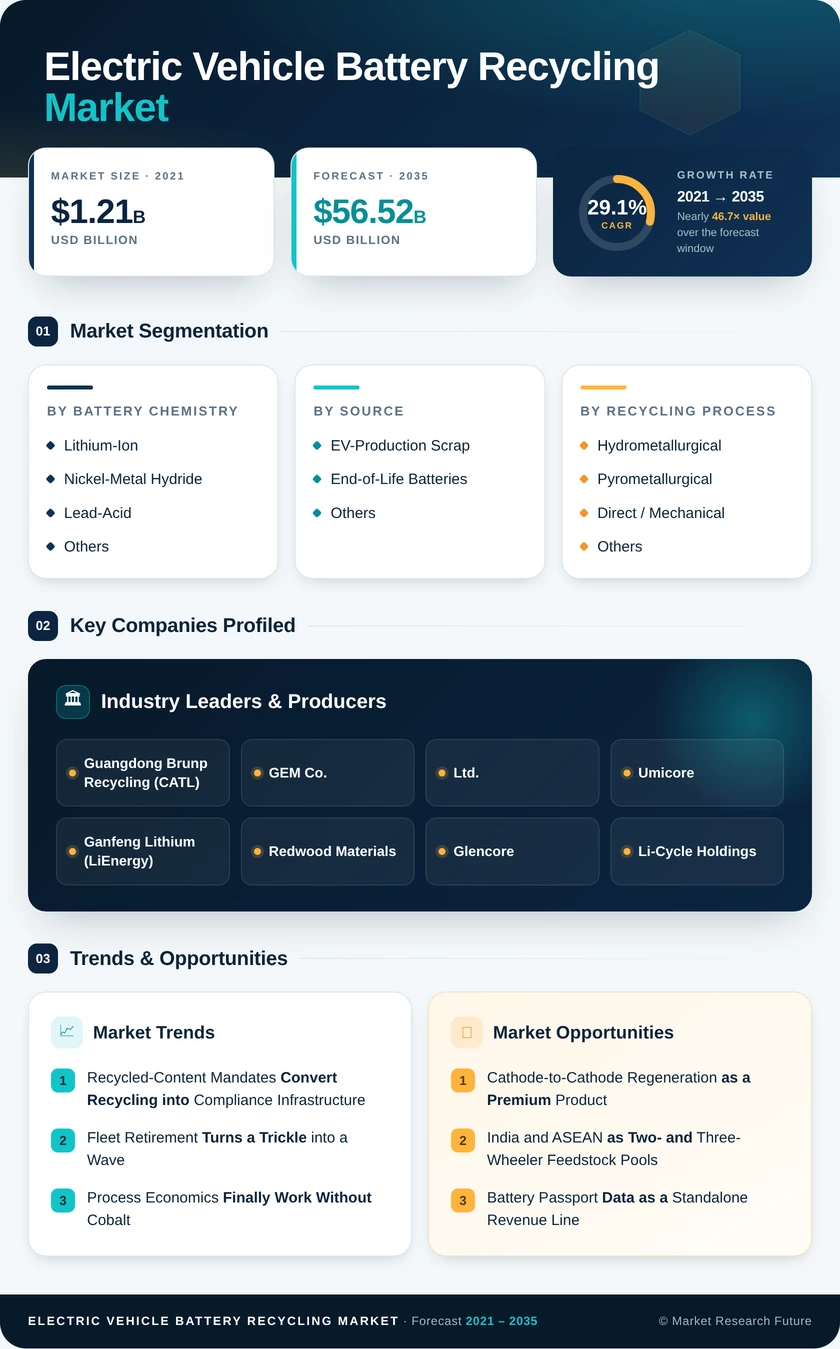
Segmentation Quick Reference
| Dimension | Sub-Segments | Dominant Segment | Fastest Growing Segment |
| By Battery Chemistry | Lithium-Ion; Nickel-Metal Hydride; Lead-Acid; Others | Lithium-Ion | Lithium-Ion |
| By Source | EV-Production Scrap; End-of-Life Batteries; Others | EV-Production Scrap | End-of-Life Batteries |
| By Recycling Process | Hydrometallurgical; Pyrometallurgical; Direct / Mechanical; Others | Hydrometallurgical | Direct / Mechanical |
| By Vehicle Type | Two-Wheelers; Three-Wheelers; Passenger Cars; Commercial Vehicles | Passenger Cars | Commercial Vehicles |
| By Recovered Material | Lithium; Cobalt; Nickel; Manganese; Copper, Aluminium & Others | Nickel | Lithium |
| By Geography | North America; Europe; Asia-Pacific; South America; Middle East & Africa | Asia-Pacific | Asia-Pacific |
Market Segmentation Overview
By Battery Chemistry
| Sub-Segment | Key Trend |
| Lithium-Ion | Share widens as EV parc composition shifts; LFP subset requires tolling economics |
| Nickel-Metal Hydride | Volume peaks near 2029 as legacy hybrid fleets clear, then declines |
| Lead-Acid (EV Auxiliary) | Stable collection rates above 95% via mature infrastructure |
| Others | Solid-state and sodium-ion pilot scrap creates early process R&D demand |
Chemistry mix determines revenue per tonne more than any other variable. Processors designed exclusively around cobalt-rich NMC feed are retooling for lithium-first recovery, because that is where both the regulatory target and the residual value now sit.
By Source
| Sub-Segment | Key Trend |
| EV-Production Scrap | Declining scrap rates per GWh as gigafactory yields mature |
| End-of-Life Batteries | Volume inflection from 2031 as 2019-cohort vehicles retire |
| Others | Recall events create episodic, high-volume feedstock spikes |
Feedstock origin dictates plant design. Clean single-chemistry offcuts suit direct recycling routes, while mixed retired packs demand robust pre-treatment and flexible wet-chemistry back ends.
By Recycling Process
| Sub-Segment | Key Trend |
| Hydrometallurgical | Standard route for compliance-grade lithium recovery above 90% |
| Pyrometallurgical | Repositioned as front-end handler for contaminated material |
| Direct / Mechanical | Fastest growth; constrained by need for sorted feedstock |
| Others | Bioleaching and solvent-free routes remain pre-commercial |
Process selection is increasingly a regulatory decision rather than an engineering preference, since recovery-efficiency thresholds effectively rule out routes that lose lithium to slag.
By Vehicle Type
| Sub-Segment | Key Trend |
| Passenger Cars | Largest pack capacity per unit; dominant tonnage contributor |
| Two-Wheelers | Short five-to-seven-year cycles deliver early end-of-life volume |
| Three-Wheelers | Commercial duty cycles accelerate degradation in South Asia |
| Commercial Vehicles | High-utilisation fleets generate predictable, contractable arisings |
Vehicle class shapes collection logistics. Fleet operators offer consolidated, scheduled returns, whereas private passenger vehicles disperse packs across independent workshops and salvage yards.
By Recovered Material
| Sub-Segment | Key Trend |
| Lithium | Recovery yields climbing from sub-50% to above 90% with modern circuits |
| Cobalt | Regulatory thresholds sustain premium despite chemistry thrifting |
| Nickel | Largest revenue contributor; benefits from stainless-steel offtake optionality |
| Manganese | Rising relevance with LMFP and high-manganese cathode adoption |
| Copper, Aluminium & Others | Reliable base-load revenue from current collectors and casings |
Output mix, not input tonnage, ultimately determines profitability. Operators able to deliver battery-grade rather than technical-grade salts capture materially higher realised pricing from cathode manufacturers.


 Noah Malgeri
Co-Founder

 Peter Groot koerkamp
Account and Business Manager

 Younghwan Choi
Senior Retail Manager

 Mark Irwin
Management Consultant

 Akif Moroglu
Strategy & Business Development Director

 Guilherme Gomes Martins
Product Management Director

 Joseph Aguayo
Sales Operations & Pricing Manager

 La Terria Dodd
Program Support Specialist

 Rob Kooiker
Group Product Manager HVAC & Fire Protection GMA