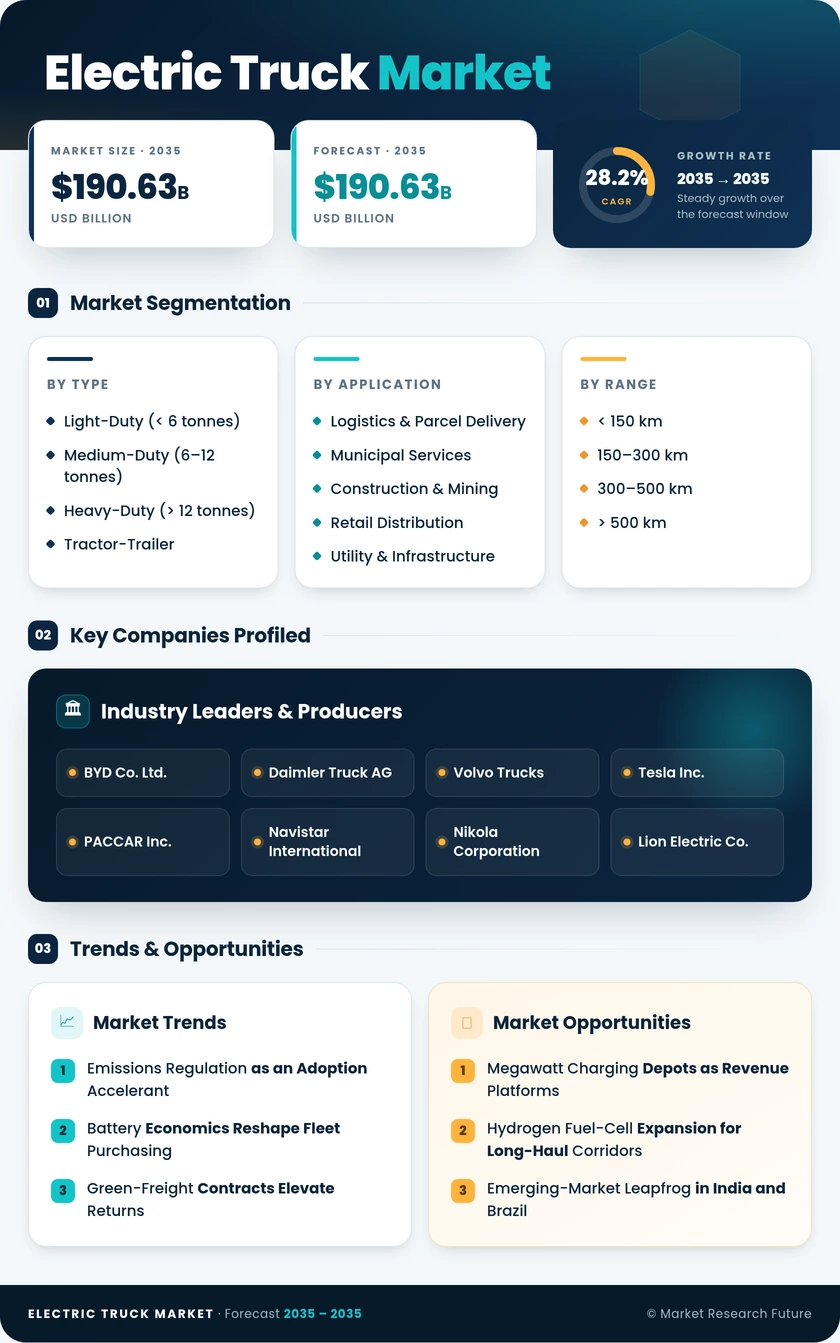
SEGMENTATION QUICK REFERENCE
| Dimension | Sub-Segments | Dominant Segment | Fastest Growing Segment |
| Propulsion Type | BEV, FCEV, PHEV | BEV (51% share, 2025) | FCEV (32.5% CAGR) |
| Truck Type | Light-Duty, Medium-Duty, Heavy-Duty, Tractor-Trailer | Heavy-Duty (47% share, 2025) | Tractor-Trailer |
| Application | Logistics, Municipal, Construction, Retail, Utility | Logistics & Parcel Delivery (42% share, 2025) | Construction & Mining (32.8% CAGR) |
| Range | < 150 km, 150–300 km, 300–500 km, > 500 km | 150–300 km (48% share, 2025) | > 500 km (32.7% CAGR) |
| Battery Capacity | < 150 kWh, 150–300 kWh, 301–500 kWh, > 500 kWh | 301–500 kWh (42% share, 2025) | > 500 kWh |
| Geography | North America, Europe, Asia-Pacific, South America, MEA | Europe (38% share, 2025) | Middle East & Africa (33.1% CAGR) |
MARKET SEGMENTATION OVERVIEW
By Propulsion Type
| Sub-Segment | Key Trend |
| Battery Electric Vehicle (BEV) | Dominant platform for urban and regional routes; declining battery costs reinforce TCO advantage |
| Fuel-Cell Electric Vehicle (FCEV) | Gaining traction for long-haul and alpine duty cycles; hydrogen corridor build-out accelerating |
| Plug-in Hybrid Electric Vehicle (PHEV) | Transitional technology; adoption plateauing as BEV ranges extend beyond 300 km |
BEV platforms continue to absorb the largest share of OEM investment as lithium-ion pack prices decline and charging networks densify. FCEV trucks are carving a niche on weight-sensitive long-haul routes where battery mass erodes payload, while PHEVs serve as a bridge technology for operators not yet ready to commit fully to zero-emission powertrains.
By Truck Type
| Sub-Segment | Key Trend |
| Light-Duty (< 6 tonnes) | High-volume last-mile delivery; rapid adoption in urban zero-emission zones |
| Medium-Duty (6–12 tonnes) | Municipal and regional distribution; growing share of refuse and utility fleets |
| Heavy-Duty (> 12 tonnes) | Largest revenue contributor; port drayage and logistics dominate demand |
| Tractor-Trailer | Emerging segment; megawatt charging enabling viability for inter-regional freight |
Heavy-duty trucks generate the highest per-unit revenue in the market due to their large battery packs and premium pricing. Tractor-trailers are the emerging growth frontier, driven by OEM launches such as the Tesla Semi and Daimler eActros 600 that demonstrate 500+ km range capability.
By Application
| Sub-Segment | Key Trend |
| Logistics & Parcel Delivery | E-commerce growth and Scope 3 mandates drive sustained demand |
| Municipal Services | Zero-emission fleet mandates in 40+ cities guarantee procurement pipelines |
| Construction & Mining | Site-electrification grants and diesel displacement targets fuel fastest growth |
| Retail Distribution | Cold-chain electrification and brand sustainability commitments expand adoption |
| Utility & Infrastructure | Grid maintenance and rights-of-way access requirements support niche demand |
Logistics dominates demand because e-commerce fulfillment centers require predictable, high-frequency deliveries that align perfectly with depot-charged electric truck operations. Construction and mining are accelerating as off-road electrification grants de-risk heavy-duty purchases.
By Range
| Sub-Segment | Key Trend |
| < 150 km | Urban last-mile and port drayage; mature and well-served by current battery technology |
| 150–300 km | Regional return-to-depot routes; largest demand segment |
| 300–500 km | Inter-city corridors; growing as public fast-charging expands |
| > 500 km | Long-haul freight; fastest-growing segment tied to megawatt charging rollout |
The 150–300 km segment dominates because the majority of commercial truck trips fall within this distance band and can be served by overnight depot charging alone. Trucks exceeding 500 km range represent the highest-growth opportunity as en-route megawatt charging stations reduce downtime penalties.
By Battery Capacity
| Sub-Segment | Key Trend |
| < 150 kWh | Compact urban delivery vehicles; cost-optimized for short routes |
| 150–300 kWh | Medium-duty regional trucks; balanced weight and range |
| 301–500 kWh | Heavy-duty mainstream; optimal cost-per-km for freight logistics |
| > 500 kWh | Extreme-duty tractor-trailers and mining trucks; premium segment |
The 301–500 kWh bracket captures the majority of demand as it balances sufficient range for most commercial duty cycles with acceptable weight penalties. Packs exceeding 500 kWh are growing rapidly as cell energy density improvements allow larger capacity without proportional weight increases.

 Noah Malgeri
Co-Founder
Noah Malgeri
Co-Founder

 Peter Groot koerkamp
Account and Business Manager
Peter Groot koerkamp
Account and Business Manager

 Younghwan Choi
Senior Retail Manager
Younghwan Choi
Senior Retail Manager

 Mark Irwin
Management Consultant
Mark Irwin
Management Consultant

 Akif Moroglu
Strategy & Business Development Director
Akif Moroglu
Strategy & Business Development Director

 Guilherme Gomes Martins
Product Management Director
Guilherme Gomes Martins
Product Management Director

 Joseph Aguayo
Sales Operations & Pricing Manager
Joseph Aguayo
Sales Operations & Pricing Manager

 La Terria Dodd
Program Support Specialist
La Terria Dodd
Program Support Specialist

 Rob Kooiker
Group Product Manager HVAC & Fire Protection GMA
Rob Kooiker
Group Product Manager HVAC & Fire Protection GMA