
×
Request Free Sample ×

Kindly complete the form below to receive a free sample of this Report

* Please use a valid business email

Leading companies partner with us for data-driven Insights

clients tt-cursor
Hero Background
English
Chinese
French
Japanese
Korean
German
Spanish

Electric Commercial Vehicle Market Trends

ID: MRFR/AT/5456-CR
128 Pages
Sejal Akre
September 2022

Electric commercial vehicle Market Size, Share & Growth Analysis Report by Propulsion (BEV, PHEV, FCEV) By Component (Electric Motor, Electric Vehicle Battery, Hydrogen Fuel Cell, Others) By Vehicle Type (Bus, Truck, Others), And By Region (North America, Europe, Asia-Pacific, Middle East & Africa, and South America) –Market Forecast Till 2035

Share:
Download PDF ×

We do not share your information with anyone. However, we may send you emails based on your report interest from time to time. You may contact us at any time to opt-out.

Electric Commercial Vehicle Market Infographic
Purchase Options

Market Trends

Key Emerging Trends in the Electric Commercial Vehicle Market

The electric commercial vehicle market is currently having a very high rate of growth and transformative trends outpaced by global sustainability shift heads toward sustainable transportation way. As environmental sustainability becomes more central to both personal and work life, companies are beginning to view even the inclusion of electric commercial vehicles as a part of their fleet policies. A key issue in the business sector is to minimise carbon emissions, follow government regulations and fulfil corporate ecological goals. All over the globe, governments have introduced strict emission standards and forced companies to consider electric counterparts. This regulatory climate has created greater emphasis on electric commercial vehicles because of their environmental benefits. Moreover, several fiscal incentives and subsidies offered by governments on electric vehicle adoption are also contributing to its growth. Such incentives not only have environmental benefits but also provide economic advantages by making electric commercial vehicles more profitable to businesses. The rising demand for electricity commercial vehicles is caused by the growth of e-commerce and last mile delivery services. There is also a growing need for quick and green delivery as online shopping continues to become more popular. In addition, the electric delivery vans and trucks are becoming increasingly popular as businesses seek to improve their logistics performance while simultaneously reducing environmental pollution. The trends of market are greatly influenced by technological progress. The challenges presented by electric commercial vehicles, such as the need for increased energy density and faster charging capabilities are partly being solved through continuous development of battery technology. As the battery technology progresses further allowing for longer driving ranges, range anxiety, a frequent worry in earlier stages of electric vehicle adoption recedes gradually. Smart and connected technologies integration is one of other notable trends in the electric commercial vehicle market. The use of live data and analysis in fleet management systems also facilitate optimal routing, vehicle tracking, as well as the minimization of operational costs. Apart from improving overall fleet efficiency, these technologies also lead to cost reduction in operational expenses. Indeed, collaborations and partnerships in the car industry have grown more common as businesses look to capitalize on each other’s strengths. Car manufacturers team up with technology firms and energy suppliers to develop full solutions that cover the whole range of electric vehicle environment. These partnerships enhance the charging infrastructure, battery technologies and promote market growth.


Author
Sejal Akre
Senior Research Analyst

She has over 5 years of rich experience, in market research and consulting providing valuable market insights to client. Hands on expertise in management consulting, and extensive knowledge in domain including ICT, Automotive & Transportation and Aerospace & Defense. She is skilled in Go-to market strategy, industry analysis, market sizing, in depth company profiling, competitive intelligence & benchmarking and value chain amongst others.

Leave a Comment

FAQs

How much is the Electric commercial vehicle market?

The Electric commercial vehicle Market size is expected to be valued at USD 8,788.5 Million in 2022.

What is the growth rate of the Electric commercial vehicle market?

The global market is projected to grow at a CAGR of 20.87% during the forecast period, 2024-2032.

Which region held the largest market share in the Electric commercial vehicle market?

Asia pacific had the largest share of the global market.

Who are the key players in the Electric commercial vehicle market?

The key players in the market are AB VOLVO, TESLA INC, DAIMLER TRUCK AG, PACCAR INC., BYD COMPANY LIMITED, PROTERRA, EBUSCO, ANHUI ANKAI AUTOMOBILE CO., LTD, YUTONG, NFI GROUP INC., SCANIA, VDL, CAF, KING LONG, RENAULT TRUCKS and Others.

Which Propulsion led the Electric commercial vehicle market?

The BEV category dominated the market in 2022.

Market Summary

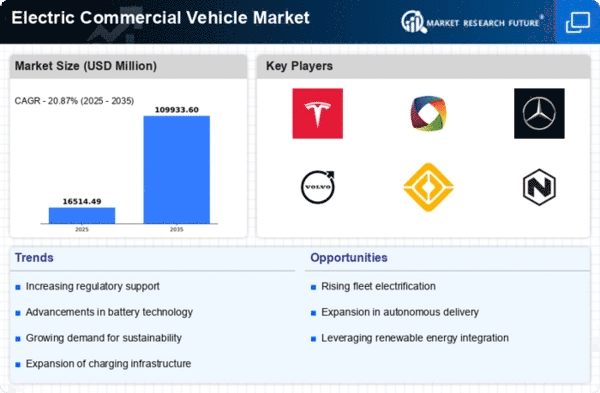
As per MRFR analysis, the Electric Commercial Vehicle Market Size was estimated at 13663.02 USD Million in 2024. The Electric Commercial Vehicle industry is projected to grow from 16514.77 USD Million in 2025 to 109933.6 USD Million by 2035, exhibiting a compound annual growth rate (CAGR) of 20.87 during the forecast period 2025 - 2035.

Key Market Trends & Highlights

The Electric Commercial Vehicle Market is poised for substantial growth driven by technological advancements and regulatory support.

  • Technological advancements in battery systems are enhancing the efficiency and range of electric commercial vehicles.
  • North America remains the largest market, while the Asia-Pacific region is emerging as the fastest-growing area for electric commercial vehicles.
  • The logistics segment dominates the market, whereas the delivery services segment is experiencing rapid growth.
  • Rising fuel prices and growing environmental awareness are significant drivers propelling the adoption of electric commercial vehicles.

Market Size & Forecast

2024 Market Size 13663.02 (USD Million)
2035 Market Size 109933.6 (USD Million)
CAGR (2025 - 2035) 20.87%
Largest Regional Market Share in 2024 North America

Major Players

<p>Tesla (US), BYD (CN), Mercedes-Benz (DE), Volvo (SE), Rivian (US), Nikola (US), MAN (DE), Scania (SE), Workhorse (US)</p>

Market Trends

The Electric Commercial Vehicle Market is currently experiencing a transformative phase, driven by a confluence of technological advancements and regulatory support. As governments worldwide implement stricter emissions standards, the demand for electric vehicles in commercial applications is on the rise. This shift is not merely a trend but appears to be a fundamental change in how businesses approach transportation. Companies are increasingly recognizing the potential for electric vehicles to reduce operational costs while enhancing their sustainability profiles. Furthermore, advancements in battery technology and charging infrastructure are likely to play a pivotal role in shaping the future landscape of this market. In addition to regulatory influences, consumer preferences are evolving, with a growing emphasis on environmentally friendly practices. Businesses are seeking to align their operations with these values, which may lead to increased investments in electric commercial vehicles. The market seems poised for growth, as manufacturers innovate to meet the diverse needs of various sectors, including logistics, public transport, and delivery services. As the Electric Commercial Vehicle Market continues to expand, it is essential to monitor these trends closely, as they will likely dictate the trajectory of the industry in the coming years.

Technological Advancements in Battery Systems

Recent innovations in battery technology are enhancing the performance and efficiency of electric commercial vehicles. These advancements may lead to longer ranges and shorter charging times, making electric options more appealing to businesses.

Regulatory Support and Incentives

Governments are increasingly implementing policies that favor electric vehicles, including tax incentives and subsidies. This regulatory support could accelerate the adoption of electric commercial vehicles across various industries.

Shift in Consumer Preferences

There is a noticeable shift in consumer attitudes towards sustainability, prompting businesses to adopt greener practices. This trend may drive the demand for electric commercial vehicles as companies seek to improve their environmental impact.

Electric Commercial Vehicle Market Market Drivers

Rising Fuel Prices

Rising fuel prices are a significant driver for the Global Electric Commercial Vehicle Market Industry. As traditional fuel costs continue to escalate, businesses are increasingly looking for cost-effective alternatives. Electric commercial vehicles present a viable solution, offering lower operational costs due to reduced fuel expenses. The financial benefits of electric vehicles become more pronounced as fuel prices rise, prompting fleet operators to consider the long-term savings associated with electric vehicle adoption. This trend is likely to accelerate the market's growth, as companies seek to mitigate the impact of fluctuating fuel prices on their operational budgets.

Market Growth Projections

The Global Electric Commercial Vehicle Market Industry is poised for substantial growth, with projections indicating a market value of 13.7 USD Billion in 2024 and an anticipated increase to 109.9 USD Billion by 2035. This growth trajectory suggests a robust compound annual growth rate (CAGR) of 20.87% from 2025 to 2035. Such figures reflect the increasing adoption of electric commercial vehicles across various sectors, driven by factors such as government incentives, technological advancements, and rising environmental awareness. The market's expansion is indicative of a broader shift towards sustainable transportation solutions on a global scale.

Growing Environmental Concerns

Growing environmental concerns are driving the transition towards electric commercial vehicles within the Global Electric Commercial Vehicle Market Industry. As climate change becomes an increasingly pressing issue, businesses are seeking sustainable solutions to reduce their carbon footprints. Electric commercial vehicles offer a cleaner alternative, emitting zero tailpipe emissions. This shift is supported by public sentiment favoring eco-friendly practices, which encourages companies to invest in electric fleets. The market is expected to grow at a CAGR of 20.87% from 2025 to 2035, reflecting the urgency to adopt sustainable transportation solutions that align with global environmental goals.

Expansion of Charging Infrastructure

The expansion of charging infrastructure is crucial for the growth of the Global Electric Commercial Vehicle Market Industry. As more charging stations become available, the practicality of using electric commercial vehicles increases, alleviating range anxiety among fleet operators. Governments and private entities are investing in the development of robust charging networks, which is essential for supporting the widespread adoption of electric vehicles. This infrastructure growth is expected to facilitate a smoother transition to electric fleets, contributing to the market's projected growth to 109.9 USD Billion by 2035. A well-established charging network enhances the overall viability of electric commercial vehicles.

Government Incentives and Regulations

Government incentives and regulations play a pivotal role in shaping the Global Electric Commercial Vehicle Market Industry. Many countries are implementing stringent emission regulations, which compel businesses to transition to electric vehicles. For instance, in 2024, the market is projected to reach 13.7 USD Billion, driven by favorable policies such as tax credits and grants for electric vehicle purchases. These incentives not only reduce the initial cost of electric commercial vehicles but also encourage fleet operators to adopt greener technologies. As regulations become more stringent, the demand for electric commercial vehicles is likely to increase, further propelling market growth.

Technological Advancements in Battery Technology

Technological advancements in battery technology are significantly influencing the Global Electric Commercial Vehicle Market Industry. Innovations such as solid-state batteries and improved lithium-ion technologies are enhancing the efficiency and range of electric commercial vehicles. As battery costs decline, the total cost of ownership for electric vehicles becomes more competitive compared to traditional combustion engines. This trend is expected to contribute to the market's growth, with projections indicating a surge to 109.9 USD Billion by 2035. Enhanced battery performance not only extends vehicle range but also reduces charging times, making electric commercial vehicles more appealing to fleet operators.

Market Segment Insights

By Application: Logistics (Largest) vs. Delivery Services (Fastest-Growing)

<p>The Electric Commercial Vehicle Market exhibits a diverse application segment with Logistics commanding the largest market share. This sector's dominance is driven by its critical role in transportation and supply chain operations, which increasingly prioritize sustainability and efficiency. Following closely, segments like Public Transport and Waste Management also hold significant shares, showcasing a balanced distribution among various applications. Each segment’s adoption of electric vehicles reflects a broader commitment towards reducing carbon emissions and enhancing operational efficiencies, catering to growing environmental regulations and consumer preferences. In parallel, the Delivery Services segment emerges as the fastest-growing application area, propelled by the boom in e-commerce and last-mile delivery demands. Growth in this sector is further supported by technological advancements and the adoption of electric vehicles that offer cost-effective and eco-friendly solutions. As urban populations expand and demand for efficient delivery systems skyrockets, investments in electric delivery fleets are expected to surge, making it a focal point for innovation and development in the electric commercial vehicle landscape.</p>

<p>Logistics: Dominant vs. Delivery Services: Emerging</p>

<p>The Logistics segment stands as a dominant force within the Electric Commercial Vehicle Market, characterized by established players optimizing their operations with electric fleets. This sector prioritizes efficiency and cost savings, leveraging electric vehicles to lower fuel expenditures while adhering to strict regulatory standards on emissions. In contrast, Delivery Services are emerging rapidly, driven by the e-commerce explosion and the necessity for fast, reliable shipping solutions. This segment is appealing to both startups and established companies seeking to capitalize on the growing demand for eco-friendly delivery options. Both segments are pivotal in shaping the market, but Logistics remains firmly entrenched in its leadership role, while Delivery Services showcase significant potential for future growth.</p>

By Vehicle Type: Light Commercial Vehicle (Largest) vs. Buses (Fastest-Growing)

<p>The electric commercial vehicle market is primarily driven by light commercial vehicles, which hold the largest market share due to their prevalence in urban logistics, delivery services, and last-mile operations. They are favored for their smaller size, maneuverability, and suitability for environmental regulations. Following closely are buses, which have rapidly gained traction as cities look to electrify public transport and reduce emissions, thus showcasing a significant share in the overall market distribution.</p>

<p>Light Commercial Vehicle (Dominant) vs. Buses (Emerging)</p>

<p>Light commercial vehicles (LCVs) are characterized by their versatility and efficiency in urban environments. As the dominant segment, LCVs are ideal for e-commerce and distribution businesses that require quick deliveries and operational flexibility. On the other hand, buses represent the emerging trend in the electric commercial vehicle landscape, as many cities invest in electric fleets to enhance public transport sustainability. The emphasis on reducing urban air pollution and the rise in government subsidies for electric buses are powerful motivators, signaling their rapid growth potential and importance in future urban mobility solutions.</p>

By Power Source: Battery Electric Vehicle (Largest) vs. Fuel Cell Electric Vehicle (Fastest-Growing)

<p>The Electric Commercial Vehicle Market is witnessing a significant distribution in its power source segments. Battery Electric Vehicles (BEVs) currently dominate the market, holding a substantial share compared to other power sources. Plug-in Hybrid Electric Vehicles (PHEVs) and Hybrid Electric Vehicles (HEVs) are also present, but their market presence pales in comparison to BEVs, while Fuel Cell Electric Vehicles (FCEVs), although lesser in share, are exhibiting rapid growth as they emerge in the industry. Growth trends indicate a robust push towards electric mobility, with BEVs leading due to advancements in battery technology and decreasing costs. FCEVs are gaining momentum, driven by supportive government policies and increasing investments in hydrogen infrastructure. The combined efforts in sustainability and innovation are shaping the future of the Electric Commercial Vehicle Market, making it a dynamic and exciting space for growth in the coming years.</p>

<p>Battery Electric Vehicle (Dominant) vs. Hybrid Electric Vehicle (Emerging)</p>

<p>Battery Electric Vehicles (BEVs) represent the dominant force in the Electric Commercial Vehicle Market, characterized by their fully electric operation and zero emissions. They benefit from an expanding charging infrastructure and advancements in battery technology, catering to a growing demand for sustainable transportation solutions. In contrast, Hybrid Electric Vehicles (HEVs) are emerging as a versatile option, integrating both conventional and electric power sources to enhance efficiency and reduce fuel consumption. HEVs appeal to a broader market segment, especially where charging infrastructure is still developing. The combination of these two segments highlights a transitional phase in the industry, with BEVs paving the way for an electrified future while HEVs provide an immediate solution for current transportation needs.</p>

By End Use: Urban Transport (Largest) vs. Freight Transport (Fastest-Growing)

<p>The Electric Commercial Vehicle Market is characterized by a diverse range of end-use segments, with Urban Transport holding the largest share. This segment includes electric buses and vans that facilitate public transportation within urban areas, reflecting a strong demand for eco-friendly solutions that minimize emissions. Freight Transport follows closely behind, recognized as the fastest-growing segment as businesses increasingly adopt electric trucks for logistics, driven by stringent environmental regulations and a shift toward sustainable practices.</p>

<p>Freight Transport (Dominant) vs. Construction Activities (Emerging)</p>

<p>Freight Transport is currently the dominant segment within the Electric Commercial Vehicle Market. It encompasses a variety of electric trucks designed for delivery and logistics purposes, catering to an expanding online shopping culture that requires efficient, eco-friendly transportation. On the other hand, Construction Activities represent an emerging segment, with electric vehicles specifically tailored for construction sites gaining traction. These vehicles are designed for heavy-duty operations and offer reduced emissions, thus aligning with the construction industry's push towards sustainable practices. While Freight Transport thrives on established logistics networks, Construction Activities are expected to grow as builders seek greener alternatives.</p>

By Charging Infrastructure: Fast Charging Stations (Largest) vs. Battery Swapping Stations (Fastest-Growing)

<p>In the Electric Commercial Vehicle Market, the distribution of market share among charging infrastructure types shows a definitive preference for fast charging stations, which currently hold the largest share. Fast charging stations are increasingly favored for their ability to significantly reduce downtime, making them ideal for commercial operators who rely on efficiency. In contrast, battery swapping stations represent an emerging trend, appealing particularly to fleet operators seeking to minimize charging wait times, although they currently occupy a smaller market share compared to their fast-charging counterparts. The growth trends in the charging infrastructure segment are largely driven by the increasing adoption of electric commercial vehicles and the urgent need for efficient charging solutions. Fast charging stations are rapidly expanding, supported by ongoing advancements in charging technology and a push from governments to improve EV infrastructure. Meanwhile, battery swapping stations are gaining traction due to their potential to alleviate one of the most significant barriers to EV adoption in commercial fleets, showcasing an innovative approach to charging that minimizes vehicle downtime and enhances operational efficiency.</p>

<p>Charging Infrastructure: Fast Charging Stations (Dominant) vs. Wireless Charging Solutions (Emerging)</p>

<p>Fast charging stations dominate the electric commercial vehicle market as they offer rapid replenishment of energy, making them the preferred choice for fleet operators with time-sensitive logistics. Their infrastructure is being deployed at strategic locations, allowing users to minimize downtime significantly. On the other hand, wireless charging solutions, while currently in the emerging phase, present an innovative alternative that promises to streamline the charging process further. This technology is being explored for its potential convenience, offering a hands-free approach that aligns with future urban mobility trends. As infrastructure develops and technological advancements improve efficiency, wireless charging solutions could become a more competitive option in the market, reflecting the broader adaptation of electric technologies.</p>

Get more detailed insights about Electric Commercial Vehicle Market Research Report—Global Forecast till 2035

Regional Insights

North America : Leading Market for EVs

North America is poised to maintain its leadership in the Electric Commercial Vehicle (ECV) market, with a projected market size of $6000.0 million by December 2025. Key growth drivers include stringent emissions regulations, increasing fuel prices, and a growing emphasis on sustainability. The region's robust infrastructure for electric vehicles and government incentives further catalyze demand, making it a prime market for ECVs. The competitive landscape is dominated by major players such as Tesla, Rivian, and Nikola, which are innovating rapidly to capture market share. The U.S. leads the charge, supported by favorable policies and investments in charging infrastructure. Canada is also emerging as a significant player, with initiatives aimed at reducing carbon emissions and promoting electric mobility. Overall, North America is set to remain a pivotal region in the ECV market.

Europe : Sustainable Mobility Leader

Europe is rapidly evolving into a hub for electric commercial vehicles, with a market size of $4000.0 million anticipated by December 2025. The region's growth is driven by ambitious climate goals, stringent regulations on emissions, and substantial investments in EV infrastructure. The European Union's Green Deal aims to make Europe climate-neutral by 2050, further accelerating the transition to electric mobility. Leading countries like Germany, France, and the Netherlands are at the forefront of this transformation, with key players such as Mercedes-Benz and MAN leading the charge. The competitive landscape is characterized by innovation and collaboration among manufacturers, governments, and technology providers. As Europe continues to prioritize sustainability, the electric commercial vehicle market is expected to flourish, supported by a strong regulatory framework.

Asia-Pacific : Emerging Market Potential

The Asia-Pacific region is witnessing significant growth in the electric commercial vehicle market, projected to reach $3000.0 million by December 2025. Key drivers include rapid urbanization, increasing environmental awareness, and government initiatives promoting electric mobility. Countries like China and Japan are leading the charge, with policies aimed at reducing pollution and enhancing energy efficiency. China, in particular, is home to major players like BYD, which is revolutionizing the ECV landscape with innovative solutions. The competitive environment is intensifying as more manufacturers enter the market, driven by the demand for sustainable transport solutions. As the region continues to invest in EV infrastructure, the electric commercial vehicle market is set for robust growth, aligning with global sustainability goals.

Middle East and Africa : Emerging Market Opportunities

The Middle East and Africa region is gradually embracing electric commercial vehicles, with a market size of $1663.02 million expected by December 2025. The growth is fueled by increasing urbanization, government initiatives to promote clean energy, and rising fuel costs. Countries like South Africa and the UAE are beginning to implement policies that support the adoption of electric vehicles, creating a conducive environment for market expansion. The competitive landscape is still developing, with a few key players starting to establish their presence. Local manufacturers are exploring partnerships with global companies to enhance their offerings. As infrastructure for electric vehicles improves and awareness grows, the region is poised for significant growth in the electric commercial vehicle market, aligning with global trends towards sustainability.

Key Players and Competitive Insights

The Electric Commercial Vehicle Market is currently characterized by a dynamic competitive landscape, driven by technological advancements, regulatory support for sustainability, and increasing demand for efficient logistics solutions. Major players such as Tesla (US), BYD (CN), and Mercedes-Benz (DE) are at the forefront, each adopting distinct strategies to enhance their market positioning. Tesla (US) continues to innovate with its cutting-edge battery technology and autonomous driving capabilities, while BYD (CN) focuses on expanding its manufacturing footprint globally, particularly in emerging markets. Mercedes-Benz (DE) emphasizes luxury and performance in its electric offerings, aiming to capture a premium segment of the market. Collectively, these strategies contribute to a competitive environment that is increasingly focused on innovation and sustainability.

Key business tactics within the Electric Commercial Vehicle Market include localizing manufacturing and optimizing supply chains to enhance efficiency and reduce costs. The market structure appears moderately fragmented, with several key players exerting influence over various segments. This fragmentation allows for niche players to emerge, while larger companies leverage their scale to dominate in terms of technology and distribution. The collective influence of these key players shapes the market dynamics, fostering a competitive atmosphere that encourages continuous improvement and adaptation.

In November 2025, Tesla (US) announced the opening of a new Gigafactory in Texas, aimed at ramping up production of its electric commercial vehicles. This strategic move is likely to enhance Tesla's production capacity and reduce lead times, positioning the company to better meet the growing demand for electric trucks and vans. The establishment of this facility underscores Tesla's commitment to scaling its operations and maintaining its competitive edge in the market.

In October 2025, BYD (CN) secured a significant contract with a major logistics company in Europe to supply a fleet of electric delivery trucks. This partnership not only expands BYD's presence in the European market but also highlights the increasing acceptance of electric vehicles in logistics operations. Such strategic alliances are crucial for BYD as they enhance its credibility and market share in a region that is rapidly transitioning towards sustainable transportation solutions.

In September 2025, Mercedes-Benz (DE) unveiled its latest electric commercial vehicle model, which features advanced AI integration for fleet management. This innovation is indicative of the company's focus on digital transformation, aiming to provide customers with enhanced operational efficiency and data-driven insights. The introduction of AI capabilities may serve to differentiate Mercedes-Benz in a competitive landscape where technology plays a pivotal role in customer decision-making.

As of December 2025, current trends in the Electric Commercial Vehicle Market are heavily influenced by digitalization, sustainability, and the integration of AI technologies. Strategic alliances are increasingly shaping the competitive landscape, enabling companies to pool resources and expertise to accelerate innovation. Looking ahead, it appears that competitive differentiation will evolve from traditional price-based competition to a focus on technological innovation, supply chain reliability, and sustainability initiatives. This shift may redefine how companies position themselves in the market, emphasizing the importance of adaptability and forward-thinking strategies.

Key Companies in the Electric Commercial Vehicle Market include

Industry Developments

  • Q2 2025: Daimler Truck and Toyota Finalize Merger of Commercial Vehicle Units Daimler Truck and Toyota completed the merger of their commercial vehicle businesses, creating a new entity focused on electric and hydrogen-powered trucks to accelerate decarbonization in the sector.
  • Q2 2025: Volvo Group Opens New Electric Truck Manufacturing Facility in Belgium Volvo Group inaugurated a new plant in Ghent, Belgium, dedicated to the production of electric heavy-duty trucks for the European market, expanding its manufacturing footprint for zero-emission vehicles.
  • Q2 2025: BYD Wins Major Electric Bus Contract in Brazil BYD secured a contract to supply 1,000 electric buses to the city of São Paulo, marking one of the largest single orders for electric commercial vehicles in Latin America.
  • Q1 2025: Rivian Announces Launch of All-Electric Commercial Van for European Market Rivian unveiled its first all-electric commercial delivery van tailored for European logistics companies, with production set to begin in the second half of 2025.
  • Q1 2025: Tata Motors Receives Indian Government Approval for Electric Truck Production Tata Motors obtained regulatory approval from the Indian government to begin mass production of its new line of electric medium- and heavy-duty trucks.
  • Q4 2024: Mercedes-Benz eEconic Electric Truck Begins Series Production Mercedes-Benz announced the start of series production for its eEconic electric truck at the Wörth plant, targeting municipal and urban logistics customers.
  • Q4 2024: Nikola Appoints New CEO to Accelerate Electric Truck Strategy Nikola Corporation named a new Chief Executive Officer, aiming to strengthen its position in the electric commercial vehicle market and drive upcoming product launches.
  • Q3 2024: Ford Pro Launches E-Transit Custom Electric Van in Europe Ford Pro officially launched the E-Transit Custom, its next-generation electric van, in key European markets, expanding its commercial EV lineup.
  • Q3 2024: Xos Secures $50 Million Contract for Electric Delivery Trucks with Major US Retailer Xos, a US-based electric truck manufacturer, won a $50 million contract to supply electric delivery vehicles to a leading national retailer, supporting the retailer’s fleet electrification goals.
  • Q2 2024: Isuzu Motors and Gatik Announce Autonomous Electric Truck Partnership Isuzu Motors and Gatik announced a partnership to co-develop autonomous electric medium-duty trucks for North American logistics and delivery applications.
  • Q2 2024: Hyundai Unveils XCIENT Fuel Cell Electric Truck for US Market Hyundai introduced its XCIENT Fuel Cell electric truck in the United States, marking the company’s entry into the North American zero-emission commercial vehicle segment.
  • Q1 2024: Lion Electric Opens Largest All-Electric Medium and Heavy-Duty Vehicle Plant in US Lion Electric inaugurated its new manufacturing facility in Joliet, Illinois, which is now the largest dedicated plant for all-electric medium and heavy-duty commercial vehicles in the United States.

Future Outlook

Electric Commercial Vehicle Market Future Outlook

<p>The Electric Commercial Vehicle Market is projected to grow at a 20.87% CAGR from 2024 to 2035, driven by technological advancements, regulatory support, and increasing demand for sustainable transport solutions.</p>

New opportunities lie in:

  • <p>Development of integrated telematics for fleet management</p>
  • <p>Expansion of charging infrastructure partnerships</p>
  • <p>Investment in battery recycling and second-life applications</p>

<p>By 2035, the market is poised for substantial growth, reflecting a robust transition to electric commercial vehicles.</p>

Market Segmentation

Electric Commercial Vehicle Market End Use Outlook

  • Urban Transport
  • Freight Transport
  • Construction Activities
  • Public Services

Electric Commercial Vehicle Market Application Outlook

  • Logistics
  • Public Transport
  • Construction
  • Delivery Services
  • Waste Management

Electric Commercial Vehicle Market Power Source Outlook

  • Battery Electric Vehicle
  • Plug-in Hybrid Electric Vehicle
  • Fuel Cell Electric Vehicle
  • Hybrid Electric Vehicle

Electric Commercial Vehicle Market Vehicle Type Outlook

  • Light Commercial Vehicle
  • Medium Commercial Vehicle
  • Heavy Commercial Vehicle
  • Buses
  • Vans

Electric Commercial Vehicle Market Charging Infrastructure Outlook

  • Fast Charging Stations
  • Standard Charging Stations
  • Wireless Charging Solutions
  • Battery Swapping Stations

Report Scope

MARKET SIZE 202413663.02(USD Million)
MARKET SIZE 202516514.77(USD Million)
MARKET SIZE 2035109933.6(USD Million)
COMPOUND ANNUAL GROWTH RATE (CAGR)20.87% (2024 - 2035)
REPORT COVERAGERevenue Forecast, Competitive Landscape, Growth Factors, and Trends
BASE YEAR2024
Market Forecast Period2025 - 2035
Historical Data2019 - 2024
Market Forecast UnitsUSD Million
Key Companies ProfiledTesla (US), BYD (CN), Mercedes-Benz (DE), Volvo (SE), Rivian (US), Nikola (US), MAN (DE), Scania (SE), Workhorse (US)
Segments CoveredApplication, Vehicle Type, Power Source, End Use, Charging Infrastructure
Key Market OpportunitiesIntegration of advanced battery technologies enhances efficiency in the Electric Commercial Vehicle Market.
Key Market DynamicsRising regulatory pressures and technological advancements drive the transition to electric commercial vehicles across various sectors.
Countries CoveredNorth America, Europe, APAC, South America, MEA

FAQs

How much is the Electric commercial vehicle market?

The Electric commercial vehicle Market size is expected to be valued at USD 8,788.5 Million in 2022.

What is the growth rate of the Electric commercial vehicle market?

The global market is projected to grow at a CAGR of 20.87% during the forecast period, 2024-2032.

Which region held the largest market share in the Electric commercial vehicle market?

Asia pacific had the largest share of the global market.

Who are the key players in the Electric commercial vehicle market?

The key players in the market are AB VOLVO, TESLA INC, DAIMLER TRUCK AG, PACCAR INC., BYD COMPANY LIMITED, PROTERRA, EBUSCO, ANHUI ANKAI AUTOMOBILE CO., LTD, YUTONG, NFI GROUP INC., SCANIA, VDL, CAF, KING LONG, RENAULT TRUCKS and Others.

Which Propulsion led the Electric commercial vehicle market?

The BEV category dominated the market in 2022.

  1. EXECUTIVE SUMMARY 15
    1. GLOBAL ELECTRIC COMMERCIAL VEHICLE MARKET, BY PROPULSION 17
    2. GLOBAL ELECTRIC COMMERCIAL VEHICLE MARKET, BY COMPONENT 18
    3. GLOBAL ELECTRIC COMMERCIAL VEHICLE MARKET, BY VEHICLE TYPE 19
    4. GLOBAL ELECTRIC COMMERCIAL VEHICLE MARKET, BY REGION 20
  2. MARKET INTRODUCTION 21
    1. DEFINITION 21
    2. SCOPE OF THE STUDY 21
    3. RESEARCH OBJECTIVE 21
    4. MARKET STRUCTURE 22
  3. RESEARCH METHODOLOGY 23
    1. RESEARCH PROCESS 23
    2. PRIMARY RESEARCH 24
    3. SECONDARY RESEARCH 25
    4. MARKET SIZE ESTIMATION 26
    5. FORECAST MODEL 27
    6. LIST OF ASSUMPTIONS 28
  4. MARKET DYNAMICS 29
    1. INTRODUCTION 29
    2. DRIVERS 30
      1. GOVERNMENT INITIATIVES TO ENCOURAGE ADOPTION OF ELECTRIC COMMERCIAL VEHICLES 30
      2. LOW OPERATING COST 30
      3. DRIVERS IMPACT ANALYSIS 31
    3. RESTRAINTS 31
      1. UNDERDEVELOPED CHARGING INFRASTRUCTURE AND POOR AFTERMARKET SERVICES 31
      2. HIGH PRICE AND LIMITED CAPACITY OF BATTERIES 32
      3. RESTRAINT IMPACT ANALYSIS 32
    4. OPPORTUNITIES 33
      1. INCREASING LOGISTIC ACTIVITIES 33
      2. GROWTH IN DEMAND WITHIN FLEETS 33
    5. COVID 19 IMPACT ANALYSIS 34
      1. ECONOMIC IMPACT ON AUTOMOTIVE INDUSTRY 34
      2. IMPACT ON AUTOMOTIVE PRODUCTION 34
      3. IMPACT ON ELECTRIC COMMERCIAL VEHICLE MARKET 36
      4. IMPACT ON WORLD TRADE 36
  5. MARKET FACTOR ANALYSIS 37
    1. SUPPLY CHAIN ANALYSIS: GLOBAL ELECTRIC COMMERCIAL VEHICLE MARKET 37
      1. DESIGN AND DEVELOPMENT 37
      2. RAW MATERIAL SUPPLY 38
      3. ASSEMBLY 38
      4. DISTRIBUTION 38
      5. END USER 38
    2. PORTER'S FIVE FORCES MODEL 39
      1. THREAT OF NEW ENTRANTS 39
      2. BARGAINING POWER OF SUPPLIERS 40
      3. THREAT OF SUBSTITUTES 40
      4. BARGAINING POWER OF BUYERS 40
      5. INTENSITY OF RIVALRY 40
  6. GLOBAL ELECTRIC COMMERCIAL VEHICLE MARKET, BY PROPULSION 41
    1. OVERVIEW 41
    2. BEV 42
    3. PHEV 42
    4. FCEV 43
  7. GLOBAL ELECTRIC COMMERCIAL VEHICLE MARKET, BY COMPONENT 44
    1. OVERVIEW 44
    2. ELECTRIC MOTOR 45
    3. ELECTRIC VEHICLE BATTERY 45
    4. HYDROGEN FUEL CELL 46
    5. OTHERS 46
  8. GLOBAL ELECTRIC COMMERCIAL VEHICLE MARKET, BY VEHICLE TYPE 47
    1. OVERVIEW 47
    2. BUS 48
    3. TRUCK 48
    4. OTHERS 49
  9. GLOBAL ELECTRIC COMMERCIAL VEHICLE MARKET, BY REGION 50
    1. OVERVIEW 50
    2. NORTH AMERICA 52
      1. US 54
      2. CANADA 55
      3. MEXICO 56
    3. EUROPE 57
      1. GERMANY 59
      2. UK 60
      3. FRANCE 61
      4. ITALY 62
      5. REST OF EUROPE 63
    4. ASIA-PACIFIC 65
      1. CHINA 67
      2. JAPAN 68
      3. INDIA 69
      4. REST OF ASIA-PACIFIC 70
    5. REST OF WORLD 72
      1. MIDDLE EAST & AFRICA 74
      2. SOUTH AMERICA 75
  10. COMPETITIVE LANDSCAPE 76
    1. COMPETITIVE OVERVIEW 76
    2. COMPETITIVE BENCHMARKING 77
    3. MARKET SHARE ANALYSIS 78
    4. KEY DEVELOPMENTS IN THE GLOBAL ELECTRIC COMMERCIAL VEHICLE MARKET 78
      1. KEY DEVELOPMENTS: CONTRACTS & AGREEMENTS 78
      2. KEY DEVELOPMENTS: PARTNERSHIPS & COLLABORATIONS 80
      3. KEY DEVELOPMENTS: EXPANSIONS 80
      4. KEY DEVELOPMENTS: PRODUCT DEVELOPMENTS/LAUNCHES 81
      5. KEY DEVELOPMENTS: 82
  11. COMPANY PROFILE 83
    1. AB VOLVO 83
      1. COMPANY OVERVIEW 83
      2. FINANCIAL OVERVIEW 84
      3. PRODUCTS OFFERED 85
      4. KEY DEVELOPMENTS 85
      5. SWOT ANALYSIS 86
      6. KEY STRATEGIES 86
    2. TESLA INC 87
      1. COMPANY OVERVIEW 87
      2. FINANCIAL OVERVIEW 88
      3. PRODUCTS OFFERED 88
      4. KEY DEVELOPMENTS 89
      5. SWOT ANALYSIS 89
      6. KEY STRATEGIES 90
    3. DAIMLER TRUCK AG 91
      1. COMPANY OVERVIEW 91
      2. FINANCIAL OVERVIEW 92
      3. PRODUCTS OFFERED 92
      4. KEY DEVELOPMENTS 93
      5. SWOT ANALYSIS 94
      6. KEY STRATEGIES 94
    4. PACCAR INC. 95
      1. COMPANY OVERVIEW 95
      2. FINANCIAL OVERVIEW 96
      3. PRODUCTS OFFERED 97
      4. KEY DEVELOPMENTS 97
      5. SWOT ANALYSIS 98
      6. KEY STRATEGIES 98
    5. BYD COMPANY LIMITED 99
      1. COMPANY OVERVIEW 99
      2. FINANCIAL OVERVIEW 100
      3. PRODUCTS OFFERED 100
      4. KEY DEVELOPMENTS 101
      5. SWOT ANALYSIS 102
      6. KEY STRATEGIES 102
    6. PROTERRA 103
      1. COMPANY OVERVIEW 103
      2. FINANCIAL OVERVIEW 104
      3. PRODUCTS OFFERED 104
      4. KEY DEVELOPMENTS 105
      5. SWOT ANALYSIS 106
      6. KEY STRATEGIES 106
    7. EBUSCO 107
      1. COMPANY OVERVIEW 107
      2. FINANCIAL OVERVIEW 108
      3. PRODUCTS OFFERED 108
      4. KEY DEVELOPMENTS 109
      5. SWOT ANALYSIS 109
      6. KEY STRATEGIES 109
    8. ANHUI ANKAI AUTOMOBILE CO., LTD 111
      1. COMPANY OVERVIEW 111
      2. FINANCIAL OVERVIEW 111
      3. PRODUCTS OFFERED 112
      4. KEY DEVELOPMENTS 112
      5. SWOT ANALYSIS 113
      6. KEY STRATEGIES 113
    9. YUTONG 114
      1. COMPANY OVERVIEW 114
      2. FINANCIAL OVERVIEW 114
      3. PRODUCTS OFFERED 115
      4. KEY DEVELOPMENTS 115
      5. SWOT ANALYSIS 116
      6. KEY STRATEGIES 116
    10. NFI GROUP INC. 117
      1. COMPANY OVERVIEW 117
      2. FINANCIAL OVERVIEW 118
      3. PRODUCTS OFFERED 119
      4. KEY DEVELOPMENTS 119
      5. SWOT ANALYSIS 120
      6. KEY STRATEGIES 120
    11. SCANIA 121
      1. COMPANY OVERVIEW 121
      2. FINANCIAL OVERVIEW 122
      3. PRODUCTS OFFERED 122
      4. KEY DEVELOPMENTS 123
    12. VDL 124
      1. COMPANY OVERVIEW 124
      2. FINANCIAL OVERVIEW 125
      3. PRODUCTS OFFERED 125
      4. KEY DEVELOPMENTS 126
    13. CAF 127
      1. COMPANY OVERVIEW 127
      2. FINANCIAL OVERVIEW 128
      3. PRODUCTS OFFERED 128
      4. KEY DEVELOPMENTS 129
    14. KING LONG 130
      1. COMPANY OVERVIEW 130
      2. FINANCIAL OVERVIEW 130
      3. PRODUCTS OFFERED 130
      4. KEY DEVELOPMENTS 131
    15. RENAULT TRUCKS 132
      1. COMPANY OVERVIEW 132
      2. FINANCIAL OVERVIEW 132
      3. PRODUCTS OFFERED 132
      4. KEY DEVELOPMENTS 133
  12. LIST OF TABLES
  13. LIST OF ASSUMPTIONS 28
  14. GLOBAL ELECTRIC COMMERCIAL VEHICLE MARKET ESTIMATES & FORECAST, BY PROPULSION, 2018-2030 (USD MILLION) 42
  15. GLOBAL ELECTRIC COMMERCIAL VEHICLE MARKET ESTIMATES & FORECAST, BY COMPONENT, 2018-2030 (USD MILLION) 45
  16. GLOBAL ELECTRIC COMMERCIAL VEHICLE MARKET ESTIMATES & FORECAST, BY VEHICLE TYPE, 2018-2030 (USD MILLION) 48
  17. GLOBAL ELECTRIC COMMERCIAL VEHICLE MARKET SIZE, BY REGION, 2018-2030 (USD MILLION) 51
  18. NORTH AMERICA: ELECTRIC COMMERCIAL VEHICLE MARKET SIZE, BY COUNTRY, 2018-2030 (USD MILLION) 52
  19. NORTH AMERICA ELECTRIC COMMERCIAL VEHICLE MARKET ESTIMATES & FORECAST, BY PROPULSION,
  20. NORTH AMERICA ELECTRIC COMMERCIAL VEHICLE MARKET ESTIMATES & FORECAST, BY COMPONENT,
  21. NORTH AMERICA ELECTRIC COMMERCIAL VEHICLE MARKET ESTIMATES & FORECAST, BY VEHICLE TYPE,
  22. US ELECTRIC COMMERCIAL VEHICLE MARKET ESTIMATES & FORECAST, BY PROPULSION, 2018-2030 (USD MILLION) 54
  23. US ELECTRIC COMMERCIAL VEHICLE MARKET ESTIMATES & FORECAST, BY COMPONENT, 2018-2030 (USD MILLION) 54
  24. US ELECTRIC COMMERCIAL VEHICLE MARKET ESTIMATES & FORECAST, BY VEHICLE TYPE, 2018-2030 (USD MILLION) 54
  25. CANADA ELECTRIC COMMERCIAL VEHICLE MARKET ESTIMATES & FORECAST, BY PROPULSION, 2018-2030 (USD MILLION) 55
  26. CANADA ELECTRIC COMMERCIAL VEHICLE MARKET ESTIMATES & FORECAST, BY COMPONENT, 2018-2030 (USD MILLION) 55
  27. CANADA ELECTRIC COMMERCIAL VEHICLE MARKET ESTIMATES & FORECAST, BY VEHICLE TYPE, 2018-2030 (USD MILLION) 55
  28. MEXICO ELECTRIC COMMERCIAL VEHICLE MARKET ESTIMATES & FORECAST, BY PROPULSION, 2018-2030 (USD MILLION) 56
  29. MEXICO ELECTRIC COMMERCIAL VEHICLE MARKET ESTIMATES & FORECAST, BY COMPONENT, 2018-2030 (USD MILLION) 56
  30. MEXICO ELECTRIC COMMERCIAL VEHICLE MARKET ESTIMATES & FORECAST, BY VEHICLE TYPE, 2018-2030 (USD MILLION) 56
  31. EUROPE: ELECTRIC COMMERCIAL VEHICLE MARKET SIZE, BY COUNTRY, 2018-2030 (USD MILLION) 58
  32. EUROPE ELECTRIC COMMERCIAL VEHICLE MARKET ESTIMATES & FORECAST, BY PROPULSION, 2018-2030 (USD MILLION) 58
  33. EUROPE ELECTRIC COMMERCIAL VEHICLE MARKET ESTIMATES & FORECAST, BY COMPONENT, 2018-2030 (USD MILLION) 58
  34. EUROPE ELECTRIC COMMERCIAL VEHICLE MARKET ESTIMATES & FORECAST, BY VEHICLE TYPE, 2018-2030 (USD MILLION) 59
  35. GERMANY ELECTRIC COMMERCIAL VEHICLE MARKET ESTIMATES & FORECAST, BY PROPULSION, 2018-2030 (USD MILLION) 59
  36. GERMANY ELECTRIC COMMERCIAL VEHICLE MARKET ESTIMATES & FORECAST, BY COMPONENT, 2018-2030 (USD MILLION) 59
  37. GERMANY ELECTRIC COMMERCIAL VEHICLE MARKET ESTIMATES & FORECAST, BY VEHICLE TYPE, 2018-2030 (USD MILLION) 60
  38. UK ELECTRIC COMMERCIAL VEHICLE MARKET ESTIMATES & FORECAST, BY PROPULSION, 2018-2030 (USD MILLION) 60
  39. UK ELECTRIC COMMERCIAL VEHICLE MARKET ESTIMATES & FORECAST, BY COMPONENT, 2018-2030 (USD MILLION) 60
  40. UK ELECTRIC COMMERCIAL VEHICLE MARKET ESTIMATES & FORECAST, BY VEHICLE TYPE, 2018-2030 (USD MILLION) 61
  41. FRANCE ELECTRIC COMMERCIAL VEHICLE MARKET ESTIMATES & FORECAST, BY PROPULSION, 2018-2030 (USD MILLION) 61
  42. FRANCE ELECTRIC COMMERCIAL VEHICLE MARKET ESTIMATES & FORECAST, BY COMPONENT, 2018-2030 (USD MILLION) 61
  43. FRANCE ELECTRIC COMMERCIAL VEHICLE MARKET ESTIMATES & FORECAST, BY VEHICLE TYPE, 2018-2030 (USD MILLION) 62
  44. ITALY ELECTRIC COMMERCIAL VEHICLE MARKET ESTIMATES & FORECAST, BY PROPULSION, 2018-2030 (USD MILLION) 62
  45. ITALY ELECTRIC COMMERCIAL VEHICLE MARKET ESTIMATES & FORECAST, BY COMPONENT, 2018-2030 (USD MILLION) 62
  46. ITALY ELECTRIC COMMERCIAL VEHICLE MARKET ESTIMATES & FORECAST, BY VEHICLE TYPE, 2018-2030 (USD MILLION) 63
  47. REST OF EUROPE ELECTRIC COMMERCIAL VEHICLE MARKET ESTIMATES & FORECAST, BY PROPULSION,
  48. REST OF EUROPE ELECTRIC COMMERCIAL VEHICLE MARKET ESTIMATES & FORECAST, BY COMPONENT,
  49. REST OF EUROPE ELECTRIC COMMERCIAL VEHICLE MARKET ESTIMATES & FORECAST, BY VEHICLE TYPE,
  50. ASIA-PACIFIC: ELECTRIC COMMERCIAL VEHICLE MARKET SIZE, BY COUNTRY, 2018-2030 (USD MILLION) 66
  51. ASIA-PACIFIC ELECTRIC COMMERCIAL VEHICLE MARKET ESTIMATES & FORECAST, BY PROPULSION, 2018-2030 (USD MILLION) 66
  52. ASIA-PACIFIC ELECTRIC COMMERCIAL VEHICLE MARKET ESTIMATES & FORECAST, BY COMPONENT, 2018-2030 (USD MILLION) 66
  53. ASIA-PACIFIC ELECTRIC COMMERCIAL VEHICLE MARKET ESTIMATES & FORECAST, BY VEHICLE TYPE, 2018-2030 (USD MILLION) 67
  54. CHINA ELECTRIC COMMERCIAL VEHICLE MARKET ESTIMATES & FORECAST, BY PROPULSION, 2018-2030 (USD MILLION) 67
  55. CHINA ELECTRIC COMMERCIAL VEHICLE MARKET ESTIMATES & FORECAST, BY COMPONENT, 2018-2030 (USD MILLION) 67
  56. CHINA ELECTRIC COMMERCIAL VEHICLE MARKET ESTIMATES & FORECAST, BY VEHICLE TYPE, 2018-2030 (USD MILLION) 68
  57. JAPAN ELECTRIC COMMERCIAL VEHICLE MARKET ESTIMATES & FORECAST, BY PROPULSION, 2018-2030 (USD MILLION) 68
  58. JAPAN ELECTRIC COMMERCIAL VEHICLE MARKET ESTIMATES & FORECAST, BY COMPONENT, 2018-2030 (USD MILLION) 68
  59. JAPAN ELECTRIC COMMERCIAL VEHICLE MARKET ESTIMATES & FORECAST, BY VEHICLE TYPE, 2018-2030 (USD MILLION) 69
  60. INDIA ELECTRIC COMMERCIAL VEHICLE MARKET ESTIMATES & FORECAST, BY PROPULSION, 2018-2030 (USD MILLION) 69
  61. INDIA ELECTRIC COMMERCIAL VEHICLE MARKET ESTIMATES & FORECAST, BY COMPONENT, 2018-2030 (USD MILLION) 69
  62. INDIA ELECTRIC COMMERCIAL VEHICLE MARKET ESTIMATES & FORECAST, BY VEHICLE TYPE, 2018-2030 (USD MILLION) 70
  63. REST OF ASIA-PACIFIC ELECTRIC COMMERCIAL VEHICLE MARKET ESTIMATES & FORECAST, BY PROPULSION,
  64. REST OF ASIA-PACIFIC ELECTRIC COMMERCIAL VEHICLE MARKET ESTIMATES & FORECAST, BY COMPONENT,
  65. REST OF ASIA-PACIFIC ELECTRIC COMMERCIAL VEHICLE MARKET ESTIMATES & FORECAST, BY VEHICLE TYPE,
  66. REST OF WORLD: ELECTRIC COMMERCIAL VEHICLE MARKET SIZE, BY REGION, 2018-2030 (USD MILLION) 72
  67. REST OF WORLD ELECTRIC COMMERCIAL VEHICLE MARKET ESTIMATES & FORECAST, BY PROPULSION,
  68. REST OF WORLD ELECTRIC COMMERCIAL VEHICLE MARKET ESTIMATES & FORECAST, BY COMPONENT,
  69. REST OF WORLD ELECTRIC COMMERCIAL VEHICLE MARKET ESTIMATES & FORECAST, BY VEHICLE TYPE,
  70. MIDDLE EAST & AFRICA ELECTRIC COMMERCIAL VEHICLE MARKET ESTIMATES & FORECAST, BY PROPULSION,
  71. MIDDLE EAST & AFRICA ELECTRIC COMMERCIAL VEHICLE MARKET ESTIMATES & FORECAST, BY COMPONENT,
  72. MIDDLE EAST & AFRICA ELECTRIC COMMERCIAL VEHICLE MARKET ESTIMATES & FORECAST, BY VEHICLE TYPE,
  73. SOUTH AMERICA ELECTRIC COMMERCIAL VEHICLE MARKET ESTIMATES & FORECAST, BY PROPULSION,
  74. SOUTH AMERICA ELECTRIC COMMERCIAL VEHICLE MARKET ESTIMATES & FORECAST, BY COMPONENT,
  75. SOUTH AMERICA ELECTRIC COMMERCIAL VEHICLE MARKET ESTIMATES & FORECAST, BY VEHICLE TYPE,
  76. KEY DEVELOPMENTS: CONTRACTS & AGREEMENTS 78
  77. KEY DEVELOPMENTS: PARTNERSHIPS & COLLABORATIONS 80
  78. KEY DEVELOPMENTS: EXPANSIONS 80
  79. KEY DEVELOPMENTS: PRODUCT DEVELOPMENTS/LAUNCHES 81
  80. KEY DEVELOPMENTS: ACQUISITION 82
  81. AB VOLVO: PRODUCTS OFFERED 85
  82. AB VOLVO: KEY DEVELOPMENTS 85
  83. TESLA: PRODUCTS OFFERED 88
  84. TESLA: KEY DEVELOPMENTS 89
  85. DAIMLER TRUCK AG: PRODUCTS OFFERED 92
  86. DAIMLER TRUCK AG: KEY DEVELOPMENTS 93
  87. PACCAR INC.: PRODUCTS OFFERED 97
  88. PACCAR INC.: KEY DEVELOPMENTS 97
  89. BYD COMPANY LIMITED: PRODUCTS OFFERED 100
  90. BYD COMPANY LIMITED: KEY DEVELOPMENTS 101
  91. PROTERRA: PRODUCTS OFFERED 104
  92. PROTERRA: KEY DEVELOPMENTS 105
  93. EBUSCO: PRODUCTS OFFERED 108
  94. EBUSCO: KEY DEVELOPMENTS 109
  95. ANHUI ANKAI AUTOMOBILE CO., LTD.: PRODUCTS OFFERED 112
  96. ANHUI ANKAI AUTOMOBILE CO., LTD.: KEY DEVELOPMENTS 112
  97. YUTONG: PRODUCTS OFFERED 115
  98. YUTONG: KEY DEVELOPMENTS 115
  99. NFI GROUP INC.: PRODUCTS OFFERED 119
  100. NFI GROUP INC.: KEY DEVELOPMENTS 119
  101. SCANIA: PRODUCTS OFFERED 122
  102. SCANIA: KEY DEVELOPMENTS 123
  103. VDL: PRODUCTS OFFERED 125
  104. VDL: KEY DEVELOPMENTS 126
  105. CAF: PRODUCTS OFFERED 128
  106. CAF: KEY DEVELOPMENTS 129
  107. KING LONG: PRODUCTS OFFERED 130
  108. KING LONG: KEY DEVELOPMENTS 131
  109. RENAULT TRUCKS: PRODUCTS OFFERED 132
  110. RENAULT TRUCKS: KEY DEVELOPMENTS 133
  111. LIST OF FIGURES
  112. MARKET SYNOPSIS 16
  113. GLOBAL ELECTRIC COMMERCIAL VEHICLE MARKET ANALYSIS, BY PROPULSION, 2022 (%) 17
  114. GLOBAL ELECTRIC COMMERCIAL VEHICLE MARKET ANALYSIS, BY COMPONENT, 2022 (%) 18
  115. GLOBAL ELECTRIC COMMERCIAL VEHICLE MARKET ANALYSIS, BY VEHICLE TYPE, 2022 (%) 19
  116. GLOBAL ELECTRIC COMMERCIAL VEHICLE MARKET ANALYSIS, BY REGION, 2022 (%) 20
  117. GLOBAL ELECTRIC COMMERCIAL VEHICLE MARKET: STRUCTURE 22
  118. RESEARCH PROCESS 23
  119. TOP-DOWN & BOTTOM-UP APPROACHES 26
  120. MARKET DYNAMICS OVERVIEW 29
  121. DRIVERS IMPACT ANALYSIS: GLOBAL ELECTRIC COMMERCIAL VEHICLE MARKET 31
  122. RESTRAINT IMPACT ANALYSIS: GLOBAL ELECTRIC COMMERCIAL VEHICLE MARKET 32
  123. SUPPLY CHAIN: GLOBAL ELECTRIC COMMERCIAL VEHICLE MARKET 37
  124. PORTER'S FIVE FORCES ANALYSIS OF THE ELECTRIC COMMERCIAL VEHICLE MARKET 39
  125. GLOBAL ELECTRIC COMMERCIAL VEHICLE MARKET, BY PROPULSION, 2022 (% SHARE) 41
  126. GLOBAL ELECTRIC COMMERCIAL VEHICLE MARKET, BY PROPULSION, 2018 TO 2030 (USD MILLION) 41
  127. GLOBAL ELECTRIC COMMERCIAL VEHICLE MARKET, BY COMPONENT, 2022 (% SHARE) 44
  128. GLOBAL ELECTRIC COMMERCIAL VEHICLE MARKET, BY COMPONENT, 2018 TO 2030 (USD MILLION) 44
  129. GLOBAL ELECTRIC COMMERCIAL VEHICLE MARKET, BY VEHICLE TYPE, 2022 (% SHARE) 47
  130. GLOBAL ELECTRIC COMMERCIAL VEHICLE MARKET, BY VEHICLE TYPE, 2018 TO 2030 (USD MILLION) 47
  131. GLOBAL ELECTRIC COMMERCIAL VEHICLE MARKET, BY REGION, 2022 (% SHARE) 50
  132. GLOBAL ELECTRIC COMMERCIAL VEHICLE MARKET, BY REGION, 2018 TO 2030 (USD MILLION) 51
  133. NORTH AMERICA: ELECTRIC COMMERCIAL VEHICLE MARKET SHARE, BY COUNTRY, 2022 (% SHARE) 52
  134. EUROPE: ELECTRIC COMMERCIAL VEHICLE MARKET SHARE, BY COUNTRY, 2022 (% SHARE) 57
  135. ASIA-PACIFIC: ELECTRIC COMMERCIAL VEHICLE MARKET SHARE, BY COUNTRY, 2022 (% SHARE) 65
  136. REST OF WORLD: ELECTRIC COMMERCIAL VEHICLE MARKET SHARE, BY REGION, 2022 (% SHARE) 72
  137. BENCHMARKING OF MAJOR COMPETITORS 77
  138. GLOBAL ELECTRIC COMMERCIAL VEHICLE MARKET SHARE ANALYSIS, 2022 78
  139. AB VOLVO: FINANCIAL OVERVIEW SNAPSHOT 84
  140. AB VOLVO: SWOT ANALYSIS 86
  141. TESLA: FINANCIAL OVERVIEW SNAPSHOT 88
  142. TESLA: SWOT ANALYSIS 89
  143. DAIMLER TRUCK AG: FINANCIAL OVERVIEW SNAPSHOT 92
  144. DAIMLER TRUCK AG: SWOT ANALYSIS 94
  145. PACCAR INC.: FINANCIAL OVERVIEW SNAPSHOT 96
  146. PACCAR INC.: SWOT ANALYSIS 98
  147. BYD COMPANY LIMITED: FINANCIAL OVERVIEW SNAPSHOT 100
  148. BYD COMPANY LIMITED: SWOT ANALYSIS 102
  149. PROTERRA: FINANCIAL OVERVIEW SNAPSHOT 104
  150. PROTERRA: SWOT ANALYSIS 106
  151. EBUSCO: FINANCIAL OVERVIEW SNAPSHOT 108
  152. EBUSCO: SWOT ANALYSIS 109
  153. ANHUI ANKAI AUTOMOBILE CO., LTD.: FINANCIAL OVERVIEW SNAPSHOT 111
  154. ANHUI ANKAI AUTOMOBILE CO., LTD.: SWOT ANALYSIS 113
  155. YUTONG: FINANCIAL OVERVIEW SNAPSHOT 114
  156. YUTONG: SWOT ANALYSIS 116
  157. NFI GROUP INC.: FINANCIAL OVERVIEW SNAPSHOT 118
  158. NFI GROUP INC: SWOT ANALYSIS 120
  159. SCANIA: FINANCIAL OVERVIEW SNAPSHOT 122
  160. VDL: FINANCIAL OVERVIEW SNAPSHOT 125
  161. CAF: FINANCIAL OVERVIEW SNAPSHOT 128

Electric Commercial Vehicle Market Segmentation

Market Segmentation Overview

  • Detailed segmentation data will be available in the full report
  • Comprehensive analysis by multiple parameters
  • Regional and country-level breakdowns
  • Market size forecasts by segment
Infographic

Free Sample Request

Kindly complete the form below to receive a free sample of this Report

Get Free Sample

Customer Strories

Compare Licence

×
Features License Type
Single User Multiuser License Enterprise User
Price $4,950 $5,950 $7,250
Maximum User Access Limit 1 User Upto 10 Users Unrestricted Access Throughout the Organization
Free Customization
Direct Access to Analyst
Deliverable Format
Platform Access
Discount on Next Purchase 10% 15% 15%
Printable Versions