×
Request Free Sample ×

Kindly complete the form below to receive a free sample of this Report

* Please use a valid business email

Leading companies partner with us for data-driven Insights

clients tt-cursor
Hero Background
English
Chinese
French
Japanese
Korean
German
Spanish

Elastomeric Sealants Market Trends

ID: MRFR/CnM/4318-HCR
140 Pages
Priya Nagrale
October 2025

Elastomeric Sealants Market Research Report Information by Type (Silicone, Polysulfide, Polyurethane, Silane Modified Polymers, and Others), End-Use Industry (Building & Construction, Automotive, Electrical & Electronics, Aerospace & Defense, Marine, and Others), Region (North America, Asia-Pacific, Europe, Latin America, and Middle East & Africa)—Forecast till 2035

Share:
Download PDF ×

We do not share your information with anyone. However, we may send you emails based on your report interest from time to time. You may contact us at any time to opt-out.

Elastomeric Sealants Market Infographic
×
Elastomeric Sealants Market Infographic Full View
Purchase Options

Market Trends

Key Emerging Trends in the Elastomeric Sealants Market

Elastomeric Sealant Market which manifested significant trends proving its dynamism influenced by multiple factors. The global reliance on elastomeric sealants persistently rise across various industries because they are known for their flexibility and ability to withstand diverse environmental conditions. The recently growing demand for environmentally safe or sustainable sealants cannot be ignored as it continues to top conversations around the world on issues regarding pollution prevention or intervention strategies. The focus is now shifting towards manufacturing elastometric seals with low levels of environmental pollution so as not affect human life negatively this has led the use recyclable materials alongside lesser Volatile organic compounds (VOCs) content being vital too.

Another significant market trend is rising prominence of silicone based elastomeric sealant materials. Silicone additives give them exceptional durability, weathering resistance and versatility such that they have become popular choice in construction industry or even automotive applications. Consequently, there has been a growing reliance on silicone elastomeric sealants by the construction industry as they provide strong seals for gaps and joints thereby improving the overall integrity of buildings. Furthermore, automobile sector uses silicone sealants which are capable of surviving in extreme temperatures or harsh conditions thus enhancing durability and reliability in motor vehicle assemblies.

Moreover, the Elastomeric Sealants Market is witnessing a shift towards customized solutions. The need to meet specific industry requirements has led to the development of personalized elastomeric sealants by manufacturers. One such example is aerospace where custom sealant formulations have to be used due to unique specifications in order to enhance their performance under stringent circumstances. Customization also helps create stronger bonds between producers and consumers based on product performance.

Additionally, market trends are shaped by technology advancements in the sector. The efficiency and effectiveness of elastomeric sealants can be seen from innovations done on formulation, application methods and packaging among others. For instance one component type of elastomeric sealant that does not require mixing prior to application was developed simplifying the installation process for end-users saving time hence labor costs.Reducing environmental footprint further by using user friendly dispensing systems for packaging enhances applicability across various industries thereby promoting adoption of elastometric sealer.

Author
Priya Nagrale
Senior Research Analyst

With an experience of over five years in market research industry (Chemicals & Materials domain), I gather and analyze market data from diverse sources to produce results, which are then presented back to a client. Also, provide recommendations based on the findings. As a Senior Research Analyst, I perform quality checks (QC) for market estimations, QC for reports, and handle queries and work extensively on client customizations. Also, handle the responsibilities of client proposals, report planning, report finalization, and execution

Leave a Comment

FAQs

What is the valuation of the elastomeric sealants market?

The global elastomeric sealants market is expected to reach a valuation of USD 6.8 billion by 2035.

What is the CAGR of the elastomeric sealants market?

The global elastomeric sealants market is expected to exhibit a strong6.22% CAGR over the forecast period.

What are the leading end use industries for elastomeric sealants?

The leading end users of elastomeric sealants are the construction industry and automotive industry.

What is the major driver for the elastomeric sealants market?

The long lasting sealing effect provided by elastomeric sealants has driven their demand in the automotive and construction industries.

What is the key restraint on the elastomeric sealants market?

Regulations concerning VOC emissions and the threat of substitution by construction foam tapes are the major restraints on the global elastomeric sealants market.

Market Summary

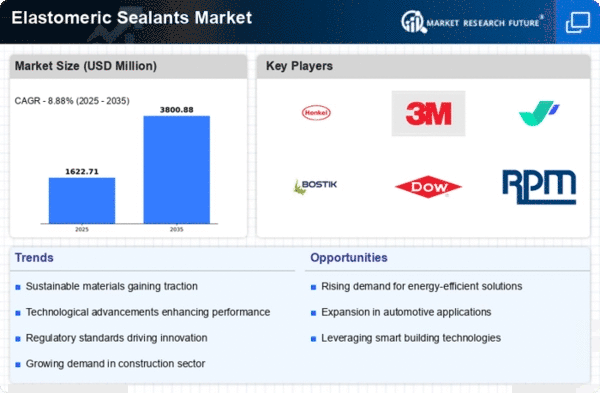
As per MRFR analysis, the Elastomeric Sealants Market Size was estimated at 1490.37 USD Million in 2024. The Elastomeric Sealants industry is projected to grow from 1622.77 USD Million in 2025 to 3800.88 USD Million by 2035, exhibiting a compound annual growth rate (CAGR) of 8.88 during the forecast period 2025 - 2035.

Key Market Trends & Highlights

The elastomeric sealants market is poised for robust growth driven by sustainability and technological advancements.

  • The North American region remains the largest market for elastomeric sealants, primarily due to rising construction activities.
  • Asia-Pacific is emerging as the fastest-growing region, fueled by increasing urbanization and infrastructure development.
  • The construction segment dominates the market, while the automotive segment is witnessing the fastest growth due to innovations in sealant formulations.
  • Key market drivers include rising construction activities and growing awareness of energy efficiency, which are propelling demand across various sectors.

Market Size & Forecast

2024 Market Size 1490.37 (USD Million)
2035 Market Size 3800.88 (USD Million)
CAGR (2025 - 2035) 8.88%
Largest Regional Market Share in 2024 North America

Major Players

Henkel (DE), 3M (US), Sika (CH), Bostik (FR), Dow (US), RPM International (US), ITW (US), Momentive (US), Tremco (US), BASF (DE)

Market Trends

The Elastomeric Sealants Market is currently experiencing a dynamic evolution, driven by various factors that influence demand across multiple sectors. These sealants, known for their flexibility and durability, are increasingly utilized in construction, automotive, and industrial applications. The growing emphasis on energy efficiency and sustainable building practices appears to be propelling the adoption of advanced sealant technologies. Furthermore, the rising awareness regarding the importance of effective sealing solutions in enhancing product longevity and performance is likely to contribute to market expansion. As industries seek to improve operational efficiency, the demand for high-performance elastomeric sealants is expected to rise, reflecting a shift towards innovative materials that meet stringent regulatory standards. In addition, the Elastomeric Sealants Market seems to be benefiting from technological advancements that enhance product properties, such as adhesion, weather resistance, and ease of application. Manufacturers are increasingly focusing on developing eco-friendly formulations that align with global sustainability goals. This trend indicates a potential shift in consumer preferences towards products that not only perform well but also minimize environmental impact. As the market continues to evolve, it is essential for stakeholders to remain attuned to these trends, as they may shape the future landscape of elastomeric sealants and influence strategic decision-making across various industries.

Sustainability Focus

The growing emphasis on environmentally friendly products is shaping the Elastomeric Sealants Market. Manufacturers are increasingly developing formulations that reduce environmental impact, aligning with global sustainability initiatives. This trend reflects a broader consumer preference for eco-conscious solutions.

Technological Advancements

Innovations in sealant technology are enhancing product performance and application methods. New formulations are being introduced that offer improved adhesion, flexibility, and resistance to environmental factors. This trend indicates a shift towards high-performance materials in various applications.

Regulatory Compliance

Stricter regulations regarding building materials and construction practices are influencing the Elastomeric Sealants Market. Compliance with these standards is driving demand for sealants that meet specific performance criteria, thereby encouraging manufacturers to innovate and improve their product offerings.

Elastomeric Sealants Market Market Drivers

Market Growth Projections

The Global Elastomeric Sealants Market Industry is poised for substantial growth, with projections indicating a compound annual growth rate (CAGR) of 7.3% from 2025 to 2035. This growth is driven by various factors, including rising construction activities, technological advancements, and increasing demand from multiple sectors. As the market evolves, it is expected to reach 9.03 USD Billion by 2035, reflecting the expanding applications and innovations within the industry. The anticipated growth trajectory suggests a robust future for elastomeric sealants, positioning them as a critical component in various industrial applications.

Technological Advancements

Technological advancements in the formulation and application of elastomeric sealants are propelling the Global Elastomeric Sealants Market Industry forward. Innovations such as improved adhesion properties, enhanced weather resistance, and environmentally friendly formulations are becoming increasingly prevalent. These advancements not only improve the performance of sealants but also expand their applicability across various sectors, including automotive, aerospace, and construction. As manufacturers invest in research and development, the market is anticipated to grow, with projections indicating a rise to 9.03 USD Billion by 2035. This growth is indicative of the industry's commitment to meeting evolving consumer demands and regulatory standards.

Rising Construction Activities

The Global Elastomeric Sealants Market Industry is experiencing growth driven by increasing construction activities worldwide. As urbanization accelerates, the demand for residential and commercial buildings rises, leading to a heightened need for effective sealing solutions. Elastomeric sealants are favored for their flexibility and durability, making them ideal for various applications in construction. In 2024, the market is projected to reach 4.16 USD Billion, reflecting the growing reliance on these materials in new builds and renovations. This trend is likely to continue, as the construction sector is expected to expand significantly, further boosting the demand for elastomeric sealants.

Increasing Demand from Automotive Sector

The automotive sector is a significant driver for the Global Elastomeric Sealants Market Industry, as these materials are essential for vehicle assembly and maintenance. Elastomeric sealants provide critical functions such as noise reduction, vibration dampening, and protection against environmental factors. With the automotive industry focusing on lightweight materials and improved fuel efficiency, the demand for high-performance sealants is likely to increase. As the market evolves, the integration of elastomeric sealants in electric vehicles and advanced automotive designs may further enhance growth prospects, contributing to the overall market expansion.

Environmental Regulations and Sustainability

Growing environmental regulations and a shift towards sustainability are influencing the Global Elastomeric Sealants Market Industry. Governments worldwide are implementing stricter regulations regarding the use of volatile organic compounds (VOCs) in sealants, prompting manufacturers to develop eco-friendly alternatives. This shift not only aligns with global sustainability goals but also opens new market opportunities for innovative products. The increasing consumer preference for green building materials is likely to drive the adoption of low-VOC elastomeric sealants, thereby expanding the market. As a result, the industry is expected to witness a robust growth trajectory in the coming years.

Market Segment Insights

By Application: Construction (Largest) vs. Automotive (Fastest-Growing)

In the elastomeric sealants market, the application segment showcases a diverse distribution across various sectors. Construction holds the largest share, driven by extensive use in building exteriors, roofs, and foundations, necessitating strong, flexible sealants to withstand various weather conditions. Automotive follows, where sealants are crucial for enhancing vehicle durability, yet it remains behind construction in market share. Aerospace, electronics, and marine applications, while smaller, are growing steadily as companies recognize the benefits of elastomeric sealants in sealing and bonding solutions in high-performance environments. Growth trends in the elastomeric sealants application segment are significantly influenced by the expansion of the construction and automotive industries. The construction sector's continuous evolution towards sustainable and energy-efficient buildings is driving demand for high-performance sealants. Conversely, the automotive industry is rapidly adopting elastomeric materials to meet stricter regulations regarding emissions and safety, fostering innovation and increasing demand for these sealants in new vehicle designs.

Construction (Dominant) vs. Marine (Emerging)

The construction application of elastomeric sealants remains dominant due to its widespread usage in residential and commercial buildings, ensuring structures' integrity by providing weatherproofing and flexibility in construction joints. Materials in this segment are specifically formulated for durability and resistance to environmental factors, making them indispensable for builders. In contrast, the marine application is emerging as a key player, bolstered by advancements in sealant technologies that cater to extreme marine conditions. The growing focus on recreational boating and marine infrastructure enhancements fuels this segment's demand, leading manufacturers to innovate water-resistant and anti-corrosive properties in elastomeric sealants, aiding in the protection of vessels and installations.

By End Use: Residential (Largest) vs. Industrial (Fastest-Growing)

In the Elastomeric Sealants Market, the distribution of market share among the end-use segments reveals that the residential sector holds the largest share. This is primarily driven by rising urbanization and increasing construction activities in residential buildings, leading to a heightened demand for sealants. The commercial sector also occupies a significant portion, driven by ongoing developments in infrastructure projects and renovation activities. In contrast, while the industrial sector currently holds a smaller share, its growth trajectory is impressive, indicating a rapidly increasing demand for elastomeric sealants in manufacturing and industrial applications.

Residential (Dominant) vs. Industrial (Emerging)

The residential segment is characterized by its broad application in homes, emphasizing the need for protection against environmental factors like moisture and air leakage. It dominates the market due to increasing homeowner awareness regarding energy efficiency and sustainability. On the other hand, the industrial segment is emerging rapidly, fueled by advancements in manufacturing processes and enhanced durability requirements. Industrial applications prioritize high-performance sealants that can withstand extreme conditions, leading to innovation in formulations. As manufacturers continue to develop specialized elastomeric sealants, this segment is poised for significant growth, appealing to diverse industrial sectors.

By Type: Silicone Sealants (Largest) vs. Polyurethane Sealants (Fastest-Growing)

In the Elastomeric Sealants Market, Silicone Sealants have established themselves as the dominant segment, commanding a significant share due to their versatility in usage across various applications including construction and automotive industries. Polyurethane Sealants, while a smaller segment, have gained traction due to their excellent adhesion properties and are seeing increasing adoption in specialized applications. Other segments like Acrylic and Butyl Sealants play important roles but lag behind Silicone and Polyurethane in terms of market share.

Silicone Sealants (Dominant) vs. Polyurethane Sealants (Emerging)

Silicone Sealants are widely recognized for their durability and flexibility, making them the preferred choice in many weatherproofing applications. They exhibit excellent resistance to moisture, UV light, and extreme temperatures, thus contributing to their dominant market position. On the other hand, Polyurethane Sealants have emerged as a crucial segment owing to their excellent bonding capabilities and versatility. While still growing, they are becoming increasingly popular in construction and automotive sectors, competing head-to-head with Silicone Sealants. The balance of preferences shifts as end-users begin to realize the potential of these emerging sealants.

By Formulation: One-Part Sealants (Largest) vs. Two-Part Sealants (Fastest-Growing)

The Formulation segment in the Elastomeric Sealants Market showcases a competitive landscape with One-Part Sealants leading in market share due to their ease of use and versatility across various applications. These sealants are extensively utilized in construction, automotive, and consumer goods sectors, providing significant adhesion and flexibility. In contrast, Two-Part Sealants are emerging as the fastest-growing segment, fueled by increasing demand in high-performance applications that require superior durability and chemical resistance.

One-Part Sealants (Dominant) vs. Two-Part Sealants (Emerging)

One-Part Sealants dominate the Elastomeric Sealants Market, appealing to a broad range of users for their simplicity and ready-to-use formulation. These sealants cure upon exposure to moisture, allowing for quick application and immediate bonding, which makes them suitable for various projects, including building maintenance and automotive repairs. On the other hand, Two-Part Sealants are gaining traction as emerging solutions that provide enhanced performance and strength, especially in demanding environments. These sealants require a mixing process before application, resulting in a higher degree of customization and robustness, making them ideal for industrial applications requiring long-lasting adhesion and resilience against environmental stressors.

Get more detailed insights about Elastomeric Sealants Market Research Report - Global Forecast till 2035

Regional Insights

North America : Market Leader in Sealants

North America is poised to maintain its leadership in the elastomeric sealants market, holding a significant share of $745.19M in 2024. The growth is driven by increasing construction activities, stringent building codes, and a rising demand for energy-efficient solutions. Regulatory support for sustainable building practices further fuels market expansion, as companies seek to comply with environmental standards and consumer preferences for eco-friendly products. The competitive landscape is robust, with key players like 3M, Dow, and Henkel leading the charge. The U.S. is the primary market, benefiting from advanced manufacturing capabilities and innovation. Companies are investing in R&D to develop high-performance sealants that meet diverse application needs, ensuring a dynamic market environment. The presence of established brands and a growing focus on infrastructure projects are expected to sustain growth in this region.

Europe : Emerging Market Dynamics

Europe's elastomeric sealants market is projected to reach $420.11M by 2025, driven by increasing demand in construction and automotive sectors. The region is witnessing a shift towards sustainable materials, supported by EU regulations promoting eco-friendly construction practices. This regulatory landscape is a catalyst for innovation, pushing manufacturers to develop advanced sealants that comply with stringent environmental standards. Leading countries such as Germany, France, and the UK are at the forefront of this market, with companies like Sika and BASF playing pivotal roles. The competitive environment is characterized by a mix of established players and emerging startups focusing on niche applications. The emphasis on energy efficiency and durability in construction materials is expected to further enhance market growth, making Europe a key player in the global elastomeric sealants landscape.

Asia-Pacific : Rapid Growth Potential

The Asia-Pacific elastomeric sealants market is anticipated to grow significantly, reaching $250.0M by 2025. This growth is fueled by rapid urbanization, increasing infrastructure development, and a rising demand for high-performance sealants in various applications. Countries like China and India are leading this growth, supported by government initiatives aimed at enhancing construction quality and sustainability. The region's regulatory environment is gradually evolving to support these trends, encouraging the adoption of advanced materials. China stands out as the largest market, driven by its booming construction sector and investments in infrastructure. Key players such as Momentive and ITW are expanding their presence, focusing on innovation and product differentiation. The competitive landscape is becoming increasingly dynamic, with local manufacturers emerging to meet the growing demand for elastomeric sealants, positioning Asia-Pacific as a vital region for future market expansion.

Middle East and Africa : Emerging Market Opportunities

The Middle East and Africa (MEA) elastomeric sealants market is projected to reach $75.07M by 2025, driven by increasing construction activities and infrastructure development across the region. The demand for high-quality sealants is rising, particularly in the UAE and South Africa, where government initiatives are promoting sustainable building practices. Regulatory frameworks are gradually evolving, encouraging the use of advanced materials that meet international standards, thus enhancing market growth potential. In the MEA region, the competitive landscape is characterized by a mix of local and international players. Companies are focusing on expanding their product offerings to cater to diverse applications in construction and automotive sectors. The presence of key players like Bostik and RPM International is notable, as they leverage their global expertise to tap into the growing demand for elastomeric sealants, making MEA a promising market for future investments.

Key Players and Competitive Insights

The Elastomeric Sealants Market is characterized by a dynamic competitive landscape, driven by increasing demand across various sectors such as construction, automotive, and aerospace. Key players are actively engaging in strategies that emphasize innovation, sustainability, and regional expansion. For instance, Henkel (DE) has positioned itself as a leader in sustainable solutions, focusing on eco-friendly formulations that cater to the growing consumer preference for environmentally responsible products. Similarly, 3M (US) is leveraging its extensive research capabilities to enhance product performance, particularly in high-demand applications like automotive and industrial sealing. These strategic focuses collectively shape a competitive environment that is increasingly oriented towards meeting diverse customer needs while adhering to regulatory standards.In terms of business tactics, companies are localizing manufacturing to reduce lead times and optimize supply chains. This approach is particularly relevant in a moderately fragmented market where the collective influence of key players is significant. The competitive structure allows for both established firms and emerging players to coexist, fostering innovation and driving market growth. The emphasis on supply chain optimization is evident as companies seek to mitigate risks and enhance operational efficiency, which is crucial in maintaining competitive advantage.

In November Sika (CH) announced the acquisition of a regional sealant manufacturer, which is expected to bolster its market presence in Europe. This strategic move not only enhances Sika's product portfolio but also allows for greater penetration into local markets, aligning with its growth strategy focused on regional expansion. The acquisition is likely to provide Sika with increased access to innovative technologies and customer bases, thereby strengthening its competitive position.

In October Dow (US) launched a new line of elastomeric sealants designed specifically for the construction industry, emphasizing energy efficiency and durability. This product introduction reflects Dow's commitment to innovation and sustainability, catering to the rising demand for high-performance materials in construction applications. The strategic importance of this launch lies in its potential to capture market share in a sector that increasingly prioritizes energy-efficient solutions.

In September Momentive (US) entered into a strategic partnership with a leading technology firm to integrate AI-driven analytics into its product development processes. This collaboration aims to enhance product customization and improve customer engagement, indicating a shift towards digital transformation in the elastomeric sealants sector. The integration of AI is likely to streamline operations and foster innovation, positioning Momentive as a forward-thinking player in the market.

As of December current trends in the Elastomeric Sealants Market are heavily influenced by digitalization, sustainability, and the integration of advanced technologies. Strategic alliances are increasingly shaping the competitive landscape, enabling companies to leverage complementary strengths and enhance their market offerings. The evolution of competitive differentiation appears to be shifting from price-based competition towards a focus on innovation, technology, and supply chain reliability. This transition suggests that companies that prioritize these aspects are likely to thrive in an increasingly complex and demanding market environment.

Key Companies in the Elastomeric Sealants Market include

Industry Developments

July 2021 : Bostik reveals its latest range of Polyurethane sealants for the sealing and bonding construction sector. With large-scale manufacturing units across Asia Pacific and Europe, along with advanced technologies, Bostik, a renowned firm is working on creating an extensive line of elastomeric sealants with significant technical characteristics as well as impressive performance including solvent-free formulations, low isocyanates, easiness, and bubble-free. This launch is expected to bolster the company’s position in the construction market, especially across developing countries.

October 2021 : Dana Inc., an eminent manufacturer of sealing technology, has launched Victor Reinz Reinzosil room-temperature vulcanizing (RTV) silicone in North America. The silicone-based sealant, Reinzosil offers outstanding resistance to various types of fluids as well as adverse temperatures. Reinzosil is a fast-curing, easy-to-apply, and a highly durable sealant, which remains thermally stable even in extreme temperatures while its quality remains intact in rough and uneven surfaces.

Target Audience:

    • Elastomeric sealants manufacturers
    • Traders and distributors of elastomeric sealants
    • Research and development institute
    • Potential investors
    • Raw material suppliers
    • National laboratory

Future Outlook

Elastomeric Sealants Market Future Outlook

The Elastomeric Sealants Market is projected to grow at an 8.88% CAGR from 2025 to 2035, driven by increasing construction activities, demand for energy-efficient buildings, and advancements in sealant technology.

New opportunities lie in:

  • Development of eco-friendly sealant formulations
  • Expansion into emerging markets with tailored products
  • Integration of smart technology in sealant applications

By 2035, the market is expected to achieve robust growth, positioning itself as a leader in the construction materials sector.

Market Segmentation

Elastomeric Sealants Market Type Outlook

  • Silicone Sealants
  • Polyurethane Sealants
  • Acrylic Sealants
  • Butyl Sealants

Elastomeric Sealants Market End Use Outlook

  • Residential
  • Commercial
  • Industrial
  • Infrastructure

Elastomeric Sealants Market Application Outlook

  • Construction
  • Automotive
  • Aerospace
  • Electronics
  • Marine

Elastomeric Sealants Market Formulation Outlook

  • One-Part Sealants
  • Two-Part Sealants
  • Pre-Cured Sealants

Report Scope

MARKET SIZE 20241490.37(USD Million)
MARKET SIZE 20251622.77(USD Million)
MARKET SIZE 20353800.88(USD Million)
COMPOUND ANNUAL GROWTH RATE (CAGR)8.88% (2025 - 2035)
REPORT COVERAGERevenue Forecast, Competitive Landscape, Growth Factors, and Trends
BASE YEAR2024
Market Forecast Period2025 - 2035
Historical Data2019 - 2024
Market Forecast UnitsUSD Million
Key Companies ProfiledHenkel (DE), 3M (US), Sika (CH), Bostik (FR), Dow (US), RPM International (US), ITW (US), Momentive (US), Tremco (US), BASF (DE)
Segments CoveredApplication, End Use, Type, Formulation
Key Market OpportunitiesGrowing demand for sustainable construction materials drives innovation in the Elastomeric Sealants Market.
Key Market DynamicsRising demand for sustainable construction materials drives innovation in elastomeric sealants and enhances competitive dynamics.
Countries CoveredNorth America, Europe, APAC, South America, MEA

FAQs

What is the valuation of the elastomeric sealants market?

The global elastomeric sealants market is expected to reach a valuation of USD 6.8 billion by 2035.

What is the CAGR of the elastomeric sealants market?

The global elastomeric sealants market is expected to exhibit a strong6.22% CAGR over the forecast period.

What are the leading end use industries for elastomeric sealants?

The leading end users of elastomeric sealants are the construction industry and automotive industry.

What is the major driver for the elastomeric sealants market?

The long lasting sealing effect provided by elastomeric sealants has driven their demand in the automotive and construction industries.

What is the key restraint on the elastomeric sealants market?

Regulations concerning VOC emissions and the threat of substitution by construction foam tapes are the major restraints on the global elastomeric sealants market.

  1. SECTION I: EXECUTIVE SUMMARY AND KEY HIGHLIGHTS
    1. | 1.1 EXECUTIVE SUMMARY
    2. | 1.1.1 Market Overview
    3. | 1.1.2 Key Findings
    4. | 1.1.3 Market Segmentation
    5. | 1.1.4 Competitive Landscape
    6. | 1.1.5 Challenges and Opportunities
    7. | 1.1.6 Future Outlook
  2. SECTION II: SCOPING, METHODOLOGY AND MARKET STRUCTURE
    1. | 2.1 MARKET INTRODUCTION
    2. | 2.1.1 Definition
    3. | 2.1.2 Scope of the study
    4. |-- 2.1.2.1 Research Objective
    5. |-- 2.1.2.2 Assumption
    6. |-- 2.1.2.3 Limitations
    7. | 2.2 RESEARCH METHODOLOGY
    8. | 2.2.1 Overview
    9. | 2.2.2 Data Mining
    10. | 2.2.3 Secondary Research
    11. | 2.2.4 Primary Research
    12. |-- 2.2.4.1 Primary Interviews and Information Gathering Process
    13. |-- 2.2.4.2 Breakdown of Primary Respondents
    14. | 2.2.5 Forecasting Model
    15. | 2.2.6 Market Size Estimation
    16. |-- 2.2.6.1 Bottom-Up Approach
    17. |-- 2.2.6.2 Top-Down Approach
    18. | 2.2.7 Data Triangulation
    19. | 2.2.8 Validation
  3. SECTION III: QUALITATIVE ANALYSIS
    1. | 3.1 MARKET DYNAMICS
    2. | 3.1.1 Overview
    3. | 3.1.2 Drivers
    4. | 3.1.3 Restraints
    5. | 3.1.4 Opportunities
    6. | 3.2 MARKET FACTOR ANALYSIS
    7. | 3.2.1 Value chain Analysis
    8. | 3.2.2 Porter's Five Forces Analysis
    9. |-- 3.2.2.1 Bargaining Power of Suppliers
    10. |-- 3.2.2.2 Bargaining Power of Buyers
    11. |-- 3.2.2.3 Threat of New Entrants
    12. |-- 3.2.2.4 Threat of Substitutes
    13. |-- 3.2.2.5 Intensity of Rivalry
    14. | 3.2.3 COVID-19 Impact Analysis
    15. |-- 3.2.3.1 Market Impact Analysis
    16. |-- 3.2.3.2 Regional Impact
    17. |-- 3.2.3.3 Opportunity and Threat Analysis
  4. SECTION IV: QUANTITATIVE ANALYSIS
    1. | 4.1 Chemicals and Materials, BY Application (USD Million)
    2. | 4.1.1 Construction
    3. | 4.1.2 Automotive
    4. | 4.1.3 Aerospace
    5. | 4.1.4 Electronics
    6. | 4.1.5 Marine
    7. | 4.2 Chemicals and Materials, BY End Use (USD Million)
    8. | 4.2.1 Residential
    9. | 4.2.2 Commercial
    10. | 4.2.3 Industrial
    11. | 4.2.4 Infrastructure
    12. | 4.3 Chemicals and Materials, BY Type (USD Million)
    13. | 4.3.1 Silicone Sealants
    14. | 4.3.2 Polyurethane Sealants
    15. | 4.3.3 Acrylic Sealants
    16. | 4.3.4 Butyl Sealants
    17. | 4.4 Chemicals and Materials, BY Formulation (USD Million)
    18. | 4.4.1 One-Part Sealants
    19. | 4.4.2 Two-Part Sealants
    20. | 4.4.3 Pre-Cured Sealants
    21. | 4.5 Chemicals and Materials, BY Region (USD Million)
    22. | 4.5.1 North America
    23. |-- 4.5.1.1 US
    24. |-- 4.5.1.2 Canada
    25. | 4.5.2 Europe
    26. |-- 4.5.2.1 Germany
    27. |-- 4.5.2.2 UK
    28. |-- 4.5.2.3 France
    29. |-- 4.5.2.4 Russia
    30. |-- 4.5.2.5 Italy
    31. |-- 4.5.2.6 Spain
    32. |-- 4.5.2.7 Rest of Europe
    33. | 4.5.3 APAC
    34. |-- 4.5.3.1 China
    35. |-- 4.5.3.2 India
    36. |-- 4.5.3.3 Japan
    37. |-- 4.5.3.4 South Korea
    38. |-- 4.5.3.5 Malaysia
    39. |-- 4.5.3.6 Thailand
    40. |-- 4.5.3.7 Indonesia
    41. |-- 4.5.3.8 Rest of APAC
    42. | 4.5.4 South America
    43. |-- 4.5.4.1 Brazil
    44. |-- 4.5.4.2 Mexico
    45. |-- 4.5.4.3 Argentina
    46. |-- 4.5.4.4 Rest of South America
    47. | 4.5.5 MEA
    48. |-- 4.5.5.1 GCC Countries
    49. |-- 4.5.5.2 South Africa
    50. |-- 4.5.5.3 Rest of MEA
  5. SECTION V: COMPETITIVE ANALYSIS
    1. | 5.1 Competitive Landscape
    2. | 5.1.1 Overview
    3. | 5.1.2 Competitive Analysis
    4. | 5.1.3 Market share Analysis
    5. | 5.1.4 Major Growth Strategy in the Chemicals and Materials
    6. | 5.1.5 Competitive Benchmarking
    7. | 5.1.6 Leading Players in Terms of Number of Developments in the Chemicals and Materials
    8. | 5.1.7 Key developments and growth strategies
    9. |-- 5.1.7.1 New Product Launch/Service Deployment
    10. |-- 5.1.7.2 Merger & Acquisitions
    11. |-- 5.1.7.3 Joint Ventures
    12. | 5.1.8 Major Players Financial Matrix
    13. |-- 5.1.8.1 Sales and Operating Income
    14. |-- 5.1.8.2 Major Players R&D Expenditure. 2023
    15. | 5.2 Company Profiles
    16. | 5.2.1 Henkel (DE)
    17. |-- 5.2.1.1 Financial Overview
    18. |-- 5.2.1.2 Products Offered
    19. |-- 5.2.1.3 Key Developments
    20. |-- 5.2.1.4 SWOT Analysis
    21. |-- 5.2.1.5 Key Strategies
    22. | 5.2.2 3M (US)
    23. |-- 5.2.2.1 Financial Overview
    24. |-- 5.2.2.2 Products Offered
    25. |-- 5.2.2.3 Key Developments
    26. |-- 5.2.2.4 SWOT Analysis
    27. |-- 5.2.2.5 Key Strategies
    28. | 5.2.3 Sika (CH)
    29. |-- 5.2.3.1 Financial Overview
    30. |-- 5.2.3.2 Products Offered
    31. |-- 5.2.3.3 Key Developments
    32. |-- 5.2.3.4 SWOT Analysis
    33. |-- 5.2.3.5 Key Strategies
    34. | 5.2.4 Bostik (FR)
    35. |-- 5.2.4.1 Financial Overview
    36. |-- 5.2.4.2 Products Offered
    37. |-- 5.2.4.3 Key Developments
    38. |-- 5.2.4.4 SWOT Analysis
    39. |-- 5.2.4.5 Key Strategies
    40. | 5.2.5 Dow (US)
    41. |-- 5.2.5.1 Financial Overview
    42. |-- 5.2.5.2 Products Offered
    43. |-- 5.2.5.3 Key Developments
    44. |-- 5.2.5.4 SWOT Analysis
    45. |-- 5.2.5.5 Key Strategies
    46. | 5.2.6 RPM International (US)
    47. |-- 5.2.6.1 Financial Overview
    48. |-- 5.2.6.2 Products Offered
    49. |-- 5.2.6.3 Key Developments
    50. |-- 5.2.6.4 SWOT Analysis
    51. |-- 5.2.6.5 Key Strategies
    52. | 5.2.7 ITW (US)
    53. |-- 5.2.7.1 Financial Overview
    54. |-- 5.2.7.2 Products Offered
    55. |-- 5.2.7.3 Key Developments
    56. |-- 5.2.7.4 SWOT Analysis
    57. |-- 5.2.7.5 Key Strategies
    58. | 5.2.8 Momentive (US)
    59. |-- 5.2.8.1 Financial Overview
    60. |-- 5.2.8.2 Products Offered
    61. |-- 5.2.8.3 Key Developments
    62. |-- 5.2.8.4 SWOT Analysis
    63. |-- 5.2.8.5 Key Strategies
    64. | 5.2.9 Tremco (US)
    65. |-- 5.2.9.1 Financial Overview
    66. |-- 5.2.9.2 Products Offered
    67. |-- 5.2.9.3 Key Developments
    68. |-- 5.2.9.4 SWOT Analysis
    69. |-- 5.2.9.5 Key Strategies
    70. | 5.2.10 BASF (DE)
    71. |-- 5.2.10.1 Financial Overview
    72. |-- 5.2.10.2 Products Offered
    73. |-- 5.2.10.3 Key Developments
    74. |-- 5.2.10.4 SWOT Analysis
    75. |-- 5.2.10.5 Key Strategies
    76. | 5.3 Appendix
    77. | 5.3.1 References
    78. | 5.3.2 Related Reports

Chemicals and Materials Market Segmentation

Chemicals and Materials By Application (USD Million, 2025-2035)

  • Construction
  • Automotive
  • Aerospace
  • Electronics
  • Marine

Chemicals and Materials By End Use (USD Million, 2025-2035)

  • Residential
  • Commercial
  • Industrial
  • Infrastructure

Chemicals and Materials By Type (USD Million, 2025-2035)

  • Silicone Sealants
  • Polyurethane Sealants
  • Acrylic Sealants
  • Butyl Sealants

Chemicals and Materials By Formulation (USD Million, 2025-2035)

  • One-Part Sealants
  • Two-Part Sealants
  • Pre-Cured Sealants
Infographic

Free Sample Request

Kindly complete the form below to receive a free sample of this Report

Get Free Sample

Customer Strories

Compare Licence

×
Features License Type
Single User Multiuser License Enterprise User
Price $4,950 $5,950 $7,250
Maximum User Access Limit 1 User Upto 10 Users Unrestricted Access Throughout the Organization
Free Customization
Direct Access to Analyst
Deliverable Format
Platform Access
Discount on Next Purchase 10% 15% 15%
Printable Versions