Economizer Market (2026 - 2035)

ID: MRFR/EnP/8438-HCR 128 Pages Priya Nagrale Last Updated: October 31, 2026
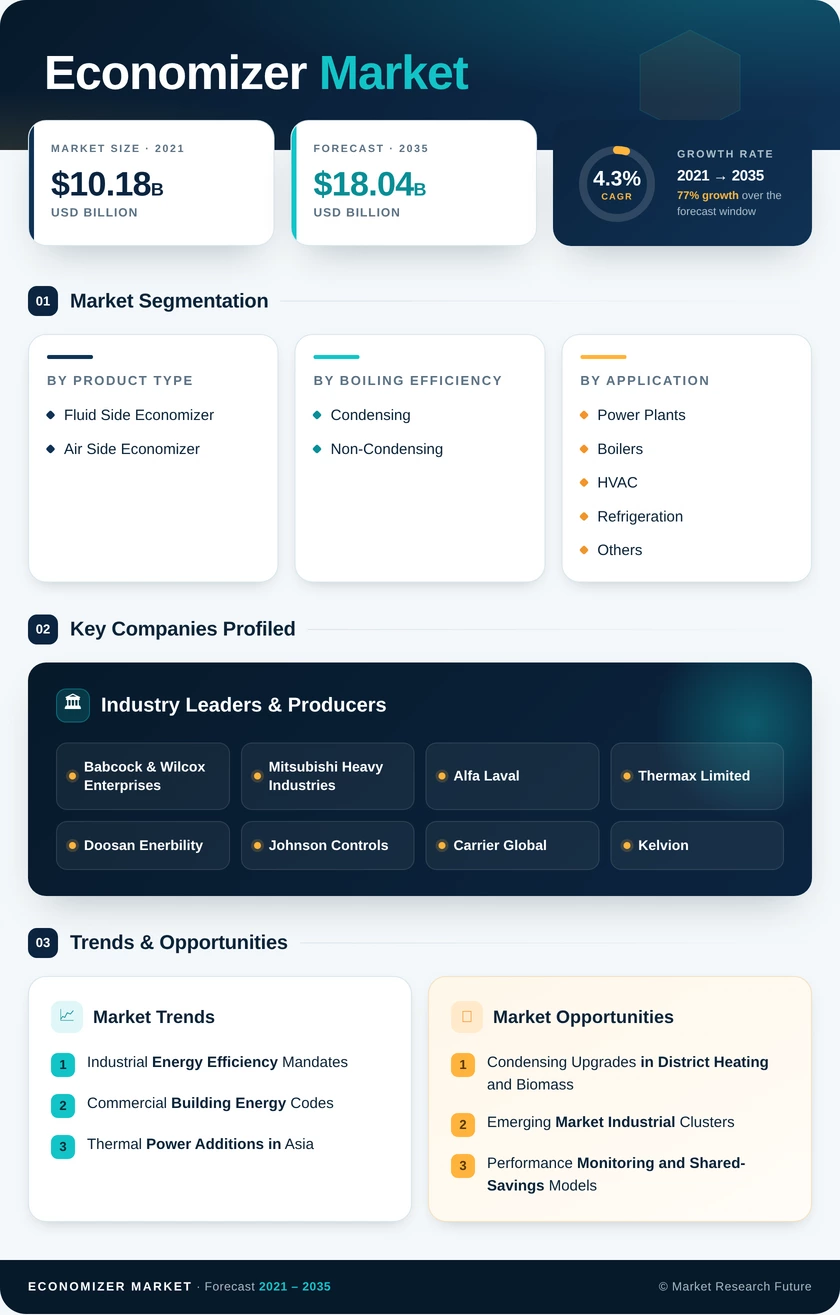
Economizer Market Research Report By Product Type (Fluid Side Economizer, Air Side Economizer), By Boiling Efficiency (Condensing, Non-Condensing), By Application (Power Plants, Boilers, HVAC, Refrigeration, Others) - Forecast to 2035
Economizer Market
Market Size
Forecast Period2026-2035
CAGR (2026-2035)5.16%
2025 Market SizeUSD 5.55 Billion
2035 Market SizeUSD 9.19 Billion
Key Players
Babcock & Wilcox Enterprises
Mitsubishi Heavy Industries
Alfa Laval
Thermax Limited
Doosan Enerbility
Johnson Controls
Opportunities
  • Condensing Upgrades in District Heating and Biomass
  • Emerging Market Industrial Clusters
  • Performance Monitoring and Shared-Savings Models
  1. 1 Market Summary | |
  2. 2 Key Report Takeaways | |
    1. 2.1 By Product Type | |
    2. 2.2 By Boiling Efficiency | |
    3. 2.3 By Application | |
    4. 2.4 By Region | |
  3. 3 Market Size and Forecast (2021–2035) | |
  4. 4 Driver Impact Analysis | |
    1. 4.1 Industrial Energy Efficiency Mandates | |
    2. 4.2 Commercial Building Energy Codes | |
    3. 4.3 Thermal Power Additions in Asia | |
    4. 4.4 Data Center Cooling Expansion | |
    5. 4.5 Carbon Pricing Coverage | |
    6. 4.6 Federal Decarbonization Funding | |
    7. 4.7 Fuel Price Volatility | |
  5. 5 Restraints Impact Analysis | |
    1. 5.1 Coal Phase-Down in OECD Economies | |
    2. 5.2 High Retrofit Capital and Downtime Costs | |
    3. 5.3 Electrification of Process and Space Heat | |
    4. 5.4 Corrosion and Fouling Risk | |
    5. 5.5 Alloy and Steel Price Volatility | |
  6. 6 Opportunities | |
    1. 6.1 Condensing Upgrades in District Heating and Biomass | |
    2. 6.2 Emerging Market Industrial Clusters | |
    3. 6.3 Performance Monitoring and Shared-Savings Models | |
    4. 6.4 Data Center Economization in Hot Climates | |
    5. 6.5 Hybrid Economizer–Heat Pump Packages | |
  7. 7 Regional Market Share and Country-Level Analysis | |
    1. 7.1 Asia-Pacific | | |
      1. 7.1.1 China | | |
      2. 7.1.2 India | | |
      3. 7.1.3 Japan | | |
      4. 7.1.4 South Korea | | |
      5. 7.1.5 Rest of Asia-Pacific | |
    2. 7.2 North America | | |
      1. 7.2.1 United States | | |
      2. 7.2.2 Canada | | |
      3. 7.2.3 Mexico | |
    3. 7.3 Europe | | |
      1. 7.3.1 Germany | | |
      2. 7.3.2 United Kingdom | | |
      3. 7.3.3 France | | |
      4. 7.3.4 Italy | | |
      5. 7.3.5 Rest of Europe | |
    4. 7.4 South America | | |
      1. 7.4.1 Brazil | | |
      2. 7.4.2 Argentina | | |
      3. 7.4.3 Rest of South America | |
    5. 7.5 Middle East and Africa | | |
      1. 7.5.1 Saudi Arabia | | |
      2. 7.5.2 South Africa | | |
      3. 7.5.3 Rest of Middle East and Africa | |
  8. 8 Future Outlook (2026–2035) | |
    1. 8.1 Digital Twins and Predictive Maintenance | |
    2. 8.2 Decarbonized Thermal Fleets | |
    3. 8.3 Electrification Meets Heat Reclamation | |
    4. 8.4 Mandatory Sustainability Disclosure | |
  9. 9 Segmentation Analysis | |
    1. 9.1 By Product Type | | |
      1. 9.1.1 Fluid Side Economizer | | |
      2. 9.1.2 Air Side Economizer | |
    2. 9.2 By Boiling Efficiency | | |
      1. 9.2.1 Condensing | | |
      2. 9.2.2 Non-Condensing | |
    3. 9.3 By Application | | |
      1. 9.3.1 Power Plants | | |
      2. 9.3.2 Boilers | | |
      3. 9.3.3 HVAC | | |
      4. 9.3.4 Refrigeration | | |
      5. 9.3.5 Others | |
  10. 10 Competitive Landscape | |
  11. 11 Recent News & Developments | |
  12. 12 Report Scope and Methodology | |
  13. 13 Detailed Sources and Citations | |
  14. 14 Frequently Asked Questions (FAQs) | | LIST OF TABLES | |
  15. TABLE 1 Report Summary Snapshot, 2025–2035 | |
  16. TABLE 2 Global Market Size and Forecast, by Revenue (USD Billion), 2021–2035 | |
  17. TABLE 3 Driver Impact Analysis, 2026–2035 | |
  18. TABLE 4 Restraints Impact Analysis, 2026–2035 | |
  19. TABLE 5 Regional Summary, by Share, 2025 | |
  20. TABLE 6 Asia-Pacific Country-Level Analysis | |
  21. TABLE 7 North America Country-Level Analysis | |
  22. TABLE 8 Europe Country-Level Analysis | |
  23. TABLE 9 South America Country-Level Analysis | |
  24. TABLE 10 Middle East and Africa Country-Level Analysis | |
  25. TABLE 11 Segmentation by Product Type | |
  26. TABLE 12 Segmentation by Boiling Efficiency | |
  27. TABLE 13 Segmentation by Application | |
  28. TABLE 14 Competitive Benchmarking Matrix | |
  29. TABLE 15 Report Scope and Methodology | |
  30. TABLE 16 Detailed Sources and Citations | |
  31. TABLE 17 Segmentation Quick Reference | | LIST OF FIGURES | |
  32. FIGURE 1 Market Dynamics Overview — Drivers, Restraints, and Opportunities | |
  33. FIGURE 2 Industry Value Chain Analysis | |
  34. FIGURE 3 Porter's Five Forces Analysis | |
  35. FIGURE 4 Global Market Size Trend, 2021–2035 (USD Billion) | |
  36. FIGURE 5 Share by Product Type, 2025 | |
  37. FIGURE 6 Share by Boiling Efficiency, 2025 | |
  38. FIGURE 7 Share by Application, 2025 | |
  39. FIGURE 8 Regional Share, 2025 | |
  40. FIGURE 9 Asia-Pacific Country Share, 2025 | |
  41. FIGURE 10 Competitive Landscape — Estimated Revenue Share Ranges

Segmentation Quick Reference

DimensionSub-SegmentsDominant SegmentFastest Growing Segment
By Product TypeFluid Side Economizer, Air Side EconomizerFluid Side Economizer (63.8% share)Air Side Economizer (5.1% CAGR)
By Boiling EfficiencyCondensing, Non-CondensingNon-Condensing (58.4% share)Condensing (5.6% CAGR)
By ApplicationPower Plants, Boilers, HVAC, Refrigeration, OthersPower Plants (41.7% share)HVAC (5.4% CAGR)
By RegionAsia-Pacific, North America, Europe, South America, Middle East and AfricaAsia-Pacific (44.6%)Asia-Pacific (44.6%)


Market Segmentation Overview

By Product Type

Sub-SegmentKey Trend
Fluid Side EconomizerExtended-surface finned tubes replacing bare-tube banks on gas-fired boilers
Air Side EconomizerIntegrated controls with fault detection becoming standard in rooftop units


Fluid Side Economizer leads with a 63.8% share because feedwater preheating is standard on nearly every utility and industrial boiler. Air Side Economizer grows fastest at a 5.1% CAGR, since commercial energy codes mandate outside-air cooling and data center operators chase free-cooling hours. Control sophistication, not heat transfer hardware, now separates air-side competitors.

By Boiling Efficiency

Sub-SegmentKey Trend
CondensingStainless steel designs capturing latent heat on gas and biomass boilers
Non-CondensingAcid-dew-point-safe designs retained for coal and high-sulfur fuels


Non-Condensing units hold a 58.4% share because Asian coal boilers must keep flue gas above the acid dew point to prevent corrosion. Condensing economizers grow at a 5.6% CAGR as gas and biomass users capture latent heat for efficiency gains approaching 10 percentage points. Nordic district heating shows how low return-water temperatures unlock condensing economics.

By Application

Sub-SegmentKey Trend
Power PlantsSupercritical coal and gas additions in China and India
BoilersAudit-driven retrofits in food, chemicals, and pulp.
HVACCode enforcement and data center cooling demand
RefrigerationCold chain expansion and industrial refrigeration efficiency
OthersMarine engines, refinery heaters, and process furnaces


Power Plants lead with a 41.7% share, reflecting large economizer banks on new Asian utility boilers. HVAC grows fastest at a 5.4% CAGR because building codes require air-side economization and hyperscale data centers depend on it to control cooling energy. Boilers remain a steady retrofit base as European audits and carbon prices reward stack-loss reduction.




Download PDF ×

We do not share your information with anyone. However, we may send you emails based on your report interest from time to time. You may contact us at any time to opt-out.