
×
Hero Background
English
Chinese
French
Japanese
Korean
German
Spanish

E reader Market Trends

ID: MRFR/CG/6711-HCR
128 Pages
Pradeep Nandi
October 2025

E-reader Market Research Report Information by Screen Size (Below 6 Inch, 6 to 8 Inch, 8 to 10 Inch and Above 10 Inch), Distribution Channel (Store-based and Non-store based) and Region (North America, Europe, Asia-Pacific and Rest of the World) - Forecast till 2032

Share:
Download PDF ×

We do not share your information with anyone. However, we may send you emails based on your report interest from time to time. You may contact us at any time to opt-out.

E reader Market Infographic
Purchase Options

Market Trends

Key Emerging Trends in the E reader Market

In the digital age, the E-reader Market has transformed the way people read and consume books, offering convenience, portability, and access to vast libraries at their fingertips. Within this rapidly evolving industry, companies employ various strategies to capture market share and appeal to readers seeking versatile and immersive reading experiences. These strategies encompass a range of approaches, from product differentiation to pricing tactics and innovative marketing techniques.

Product differentiation is a key strategy employed by companies in the E-reader Market. With numerous brands and models available, companies strive to distinguish their e-readers from competitors by highlighting unique features, specifications, and user experiences. Whether it's high-resolution displays, adjustable lighting for comfortable reading in any environment, or waterproof designs for reading by the pool or at the beach, these distinctive elements help brands carve out their niche and attract consumers looking for specific functionalities.

Pricing plays a crucial role in market positioning within the e-reader industry. Some companies position their devices as premium offerings, pricing them higher to reflect advanced features, premium materials, and sleek designs. These brands often target avid readers, professionals, or enthusiasts willing to invest in top-of-the-line e-readers for an enhanced reading experience. Conversely, other companies focus on affordability, offering budget-friendly e-readers with basic features to appeal to price-sensitive consumers and encourage wider adoption of digital reading.

Distribution channels are another critical aspect of market share positioning. Companies strategically expand their presence across various retail channels, including electronics stores, online marketplaces, bookstores, and e-commerce platforms. By ensuring widespread availability, brands can reach a diverse range of consumers and increase their market share. Additionally, partnerships with publishers, libraries, and educational institutions can provide brands with exposure to new customer segments and drive sales through bundled content offerings or promotional campaigns.

Marketing and branding efforts are instrumental in shaping consumer perceptions and driving market share within the e-reader industry. Companies invest in advertising campaigns to showcase the benefits of digital reading, such as access to millions of books, customizable reading settings, and seamless syncing across devices. Social media platforms serve as powerful tools for engaging with readers, sharing user-generated content, and building brand communities centered around a love for literature and digital innovation.

Customer experience and satisfaction are paramount in retaining market share. Companies prioritize intuitive interfaces, responsive touchscreens, and long battery life to ensure a seamless reading experience for users. By offering access to a wide selection of e-books, personalized recommendations, and user-friendly features such as note-taking and highlighting, brands can enhance reader engagement and loyalty. Additionally, responsive customer support and regular software updates help build trust and confidence among users.

Innovation is a driving force in market share positioning within the e-reader industry. Companies invest in research and development to introduce new technologies, such as color e-ink displays, eye-friendly screens, and enhanced connectivity options. Whether it's the development of e-readers with larger screens for immersive reading experiences, or devices with advanced features for audiobook integration and multimedia content, innovation enables brands to stay ahead of the competition and meet the evolving needs of readers.

Partnerships and collaborations can also provide strategic advantages in market positioning. Brands often team up with publishers, authors, and literary influencers to promote their e-readers and expand their digital content offerings. Collaborations with educational institutions, book clubs, and reading communities can generate buzz and excitement, driving engagement and increasing brand visibility within the literary community.

Ultimately, the success of market share positioning strategies in the E-reader Market relies on a deep understanding of reader preferences, habits, and digital lifestyles. By leveraging product differentiation, pricing strategies, distribution channels, marketing efforts, customer experience, innovation, and strategic partnerships, companies can carve out their place in this competitive landscape and play a pivotal role in shaping the future of reading in the digital age.


Author
Pradeep Nandi
Senior Research Analyst

I have a bachelor's degree in mechanical engineering and an MBA. I have more than two years of expertise in the retail, food, and beverage, chemical, and material industries, and hence have developed a sound cross-domain expertise. A firm believer in lifelong learning and sharing of knowledge. Having a proclivity for hatching ideas and trying to absorb as much information as possible in a short amount of time. Introducing corporates to the data and insight, which enables them to move from probability to possibility, has been my key areas of interest. 

Leave a Comment

FAQs

What is the current valuation of the E-Reader Market as of 2024?

The E-Reader Market was valued at 10.67 USD Billion in 2024.

What is the projected market valuation for the E-Reader Market in 2035?

The E-Reader Market is projected to reach a valuation of 22.05 USD Billion by 2035.

What is the expected CAGR for the E-Reader Market during the forecast period 2025 - 2035?

The expected CAGR for the E-Reader Market during the forecast period 2025 - 2035 is 6.82%.

Which companies are considered key players in the E-Reader Market?

Key players in the E-Reader Market include Amazon, Kobo, Barnes & Noble, PocketBook, Onyx Boox, Sony, Bookeen, and Tolino.

How does the E-ink screen type perform in terms of market valuation?

The E-ink screen type had a market valuation of 7.47 USD Billion in 2024, with projections indicating growth to 15.55 USD Billion.

What are the market valuations for different screen sizes in the E-Reader Market?

In 2024, the market valuations for screen sizes were 1.5 USD Billion for below 6-inch, 3.0 USD Billion for 6 to 8-inch, 2.5 USD Billion for 8 to 10-inch, and 3.67 USD Billion for above 10-inch.

Market Summary

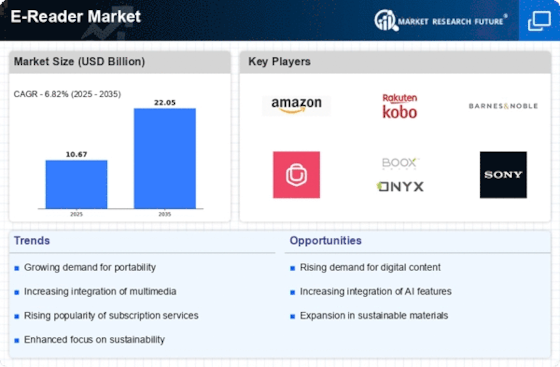
As per MRFR analysis, the E-Reader Market Size was estimated at 10.67 USD Billion in 2024. The E-Reader industry is projected to grow from 11.4 USD Billion in 2025 to 22.05 USD Billion by 2035, exhibiting a compound annual growth rate (CAGR) of 6.82 during the forecast period 2025 - 2035.

Key Market Trends & Highlights

The E-Reader Market is experiencing a dynamic shift driven by technological advancements and changing consumer preferences.

  • North America remains the largest market for e-readers, characterized by a strong demand for portable reading solutions.
  • The Asia-Pacific region is emerging as the fastest-growing market, fueled by increasing smartphone penetration and digital literacy.
  • The 6 to 8-inch segment continues to dominate sales, while the 8 to 10-inch segment is witnessing rapid growth due to consumer preference for larger displays.
  • Key market drivers include the rising popularity of e-books and the integration of advanced features, which enhance user experience and accessibility.

Market Size & Forecast

2024 Market Size 10.67 (USD Billion)
2035 Market Size 22.05 (USD Billion)
CAGR (2025 - 2035) 6.82%
Largest Regional Market Share in 2024 North America

Major Players

<p>Amazon (US), Kobo (CA), Barnes & Noble (US), PocketBook (UA), Onyx Boox (CN), Sony (JP), Bookeen (FR), Tolino (DE)</p>

Market Trends

The E-Reader Market is currently experiencing a dynamic evolution, characterized by a growing demand for portable reading devices that offer convenience and accessibility. As consumers increasingly seek alternatives to traditional print media, e-readers are becoming more appealing due to their lightweight design and extensive storage capabilities. This shift in consumer behavior appears to be driven by a desire for instant access to a vast array of literature, coupled with the benefits of adjustable font sizes and backlighting features that enhance reading comfort. Furthermore, the integration of advanced technologies, such as e-ink displays and long-lasting batteries, seems to be elevating the user experience, making these devices more attractive to a broader audience. In addition to technological advancements, the E-Reader Market is witnessing a notable trend towards sustainability. Manufacturers are increasingly focusing on eco-friendly materials and energy-efficient production processes, which may resonate with environmentally conscious consumers. This emphasis on sustainability could potentially influence purchasing decisions, as buyers become more aware of the environmental impact of their choices. Overall, the E-Reader Market appears poised for continued growth, driven by innovation, consumer preferences, and a commitment to sustainability.

Technological Advancements

The E-Reader Market is seeing rapid technological progress, with innovations such as improved e-ink displays and enhanced battery life. These advancements are likely to provide users with a more enjoyable reading experience, making devices more appealing.

Sustainability Focus

There is a growing emphasis on sustainability within the E-Reader Market, as manufacturers adopt eco-friendly materials and production methods. This trend may attract environmentally conscious consumers who prioritize sustainable products.

Content Accessibility

The demand for diverse content is increasing, with e-readers offering access to a wide range of digital books, magazines, and other media. This trend suggests that consumers are seeking more options and flexibility in their reading materials.

E reader Market Market Drivers

Environmental Considerations

The E-Reader Market is increasingly shaped by environmental considerations as consumers become more conscious of sustainability. E-readers offer a more eco-friendly alternative to traditional paper books, as they reduce the demand for paper production and the associated environmental impact. This aspect resonates particularly well with environmentally aware consumers, who are seeking ways to minimize their carbon footprint. Market Research Future indicates that e-readers can save an estimated 100 trees per year for every 1,000 users, highlighting their potential positive impact on the environment. As awareness of environmental issues continues to grow, the E-Reader Market may see a rise in demand from consumers who prioritize sustainable choices in their purchasing decisions.

Growing Popularity of E-Books

The E-Reader Market is significantly influenced by the growing popularity of e-books. As more readers embrace digital formats, the demand for e-readers has surged. Recent statistics reveal that e-book sales have increased by over 20% in the past year, indicating a robust market for digital literature. This trend is further supported by the increasing availability of diverse genres and titles in e-book format, making it easier for consumers to find content that suits their interests. The convenience of purchasing and downloading e-books instantly contributes to the appeal of e-readers, as users can access new releases without delay. Consequently, the E-Reader Market is likely to benefit from this expanding ecosystem of digital content, fostering a symbiotic relationship between e-readers and e-books.

Integration of Advanced Features

The E-Reader Market is witnessing a transformation due to the integration of advanced features in e-readers. Manufacturers are increasingly incorporating functionalities such as adjustable lighting, touch screens, and waterproof designs, which enhance the user experience. For instance, the introduction of e-ink technology has significantly improved readability in various lighting conditions, making e-readers more versatile. Additionally, features like built-in dictionaries and note-taking capabilities are becoming standard, appealing to a broader audience, including students and professionals. Market data suggests that e-readers with these advanced features are experiencing higher sales growth, indicating a shift in consumer expectations. As technology continues to evolve, the E-Reader Market is poised to adapt, potentially leading to further innovations that could redefine how users interact with digital content.

Expansion of Educational Applications

The E-Reader Market is experiencing growth due to the expansion of educational applications. Educational institutions are increasingly adopting e-readers as tools for enhancing learning experiences. The ability to access a vast array of educational materials, including textbooks, research papers, and interactive content, makes e-readers an attractive option for students and educators alike. Recent data suggests that the adoption of e-readers in educational settings has increased by approximately 30% in the last year, reflecting a shift towards digital learning solutions. This trend is likely to continue as schools and universities seek to integrate technology into their curricula. Consequently, the E-Reader Market stands to benefit from this educational focus, potentially leading to increased sales and a broader user base.

Rising Demand for Portable Reading Solutions

The E-Reader Market experiences a notable increase in demand for portable reading solutions. As lifestyles become more mobile, consumers seek devices that allow them to carry an extensive library without the bulk of physical books. This trend is reflected in the sales data, which indicates a steady growth in e-reader shipments, reaching approximately 15 million units in 2025. The convenience of having multiple titles accessible at one's fingertips is a compelling factor driving this market. Furthermore, the lightweight design and long battery life of modern e-readers enhance their appeal, making them a preferred choice for avid readers and casual users alike. As more individuals prioritize convenience in their reading habits, the E-Reader Market is likely to expand further, catering to the evolving preferences of consumers.

Market Segment Insights

By Screen Size: 6 to 8-inch (Largest) vs. 8 to 10-inch (Fastest-Growing)

<p>In the E-Reader market, the screen size segment displays varied preferences, with the 6 to 8-inch category commanding the largest share due to its balance between portability and usability. This segment is particularly favored by everyday readers and those who enjoy casual reading experiences. Meanwhile, the 8 to 10-inch segment is catching up rapidly, owing to its growing appeal among avid readers who prefer a larger display for enhanced reading comfort and immersive experiences. The growth trends within the screen size segment indicate a shift towards larger displays, as technological advances have made it feasible for manufacturers to offer high-quality e-ink screens in these sizes. The increasing popularity of digital content, coupled with consumer demand for a more engaging reading experience, is driving this growth trend. Additionally, new features such as adjustable backlighting and customizable fonts are enhancing user experiences, thereby supporting the emergence of the 8 to 10-inch segment as the fastest-growing category in the E-Reader market.</p>

<p>6 to 8-inch (Dominant) vs. 8 to 10-inch (Emerging)</p>

<p>The 6 to 8-inch screen size segment is currently the dominant force in the E-Reader market, known for its portability and user-friendly design. It appeals to a broad range of consumers, including casual readers and students looking for a lightweight solution for reading e-books on the go. Devices within this category often emphasize battery efficiency and ease of handling, contributing to their widespread adoption. On the other hand, the 8 to 10-inch segment is emerging rapidly as consumers increasingly seek more substantial displays for a richer reading experience. This segment tends to attract dedicated readers and professionals who appreciate detailed visual content and enhanced features. Both segments, while distinct in their user bases and functionalities, showcase the evolving preferences in the E-Reader market.</p>

By Screen Type: E-ink (Largest) vs. LCD (Fastest-Growing)

<p>In the E-Reader Market, E-ink screens hold the largest market share due to their superior readability and battery life compared to LCD screens. As the preferred choice for avid readers, E-ink technology provides a paper-like experience, minimizing eye strain during prolonged reading sessions. This preference is reflected in consumer behavior, where many users gravitate towards devices equipped with E-ink displays, solidifying its market dominance. On the other hand, the demand for LCD screens is rapidly increasing, making them the fastest-growing segment in the E-Reader Market. LCD technology appeals to users seeking multifunctionality, offering the ability to support color displays and rich media content. As digital content consumption evolves, the versatility of LCD screens presents a compelling option, driving their growth in the competitive landscape of e-readers.</p>

<p>Screen Technology: E-ink (Dominant) vs. LCD (Emerging)</p>

<p>E-ink technology stands out as the dominant player in the E-Reader Market, primarily due to its unique characteristics that cater specifically to reading. With a display that mimics the look of ink on paper, E-ink achieves exceptionally low glare and excellent visibility in sunlight, making it the preferred option for outdoor readers. Additionally, its energy efficiency allows for extended battery life, further enhancing its appeal among users looking for longevity in their devices. In contrast, LCD screens are emerging as a significant option for modern e-readers. While typically offering vibrant colors and interactive capabilities, LCD displays are more energy-consuming and can result in more glare, which can be a disadvantage for extended reading. Despite these drawbacks, the growing trend towards multimedia content is positioning LCD technology to capture a larger audience seeking multifunctional devices.</p>

By Connectivity: Wi-Fi (Largest) vs. 3/4G (Fastest-Growing)

<p>In the E-Reader market, connectivity options such as Wi-Fi, 3G/4G, and combined 3G/4G and Wi-Fi play crucial roles in product appeal and user experience. Wi-Fi dominates the connectivity segment, favored for its widespread availability and cost-effectiveness, resulting in a significant market share. Conversely, 3G/4G connectivity is an emerging segment driven by the demand for on-the-go access, catering to users who seek more flexible options beyond Wi-Fi accessibility. The combined 3G/4G and Wi-Fi option also attracts users looking for versatile connectivity solutions.</p>

<p>Connectivity: Wi-Fi (Dominant) vs. 3/4G (Emerging)</p>

<p>Wi-Fi connectivity remains the dominant force in the E-Reader market due to its accessibility and efficiency, allowing users to download books and content without incurring data charges. As e-readers continue to evolve, manufacturers are focusing on enhancing Wi-Fi capabilities to improve download speeds and connectivity stability. Meanwhile, 3G/4G connectivity is recognized as an emerging segment, appealing to users who require internet access in areas without Wi-Fi. This segment is characterised by its rapid growth, as on-the-go reading and instant access to online libraries become essential to a modern e-reader experience. Many brands are beginning to offer models that support 3G/4G, enhancing their market position by catering to diverse consumer needs.</p>

By Application: Workers (Largest) vs. Students (Fastest-Growing)

<p>In the E-Reader Market, the application segment is primarily divided among Workers, Students, Kids, and Senior People. Currently, Workers occupy the largest share of the market, driven by the growing demand for digital solutions that enhance productivity and efficiency in work-related tasks. Students, on the other hand, represent a rapidly expanding segment as educational institutions increasingly adopt e-reading technologies to facilitate learning and provide easy access to digital resources.</p>

<p>Workers (Dominant) vs. Students (Emerging)</p>

<p>The Workers segment is characterized by professionals who utilize e-readers to access documents, reports, and digital content that enhance their workflow. This segment thrives on the benefits of portability and convenience. Meanwhile, the Students segment is emerging strongly, as the younger generation gravitates towards e-readers for educational purposes. This segment is marked by features that cater specifically to interactive learning, note-taking, and accessibility to an array of educational materials, making it a key driver of innovation in the market.</p>

By Distribution Channel: E-commerce (Largest) vs. Specialty Stores (Fastest-Growing)

<p>The E-Reader market has been significantly influenced by various distribution channels. E-commerce presently holds the largest share, dominating sales with its extensive reach and convenience for consumers. Specialty stores, while smaller in market share, are emerging strongly by catering to specific consumer needs and preferences, offering a personalized shopping experience that appeals to dedicated readers. They have become increasingly important in reaching niche markets and enhancing overall consumer engagement. In terms of growth trends, E-commerce is expected to continue its upward trajectory, driven by advancements in digital payment systems and the consumer shift towards online shopping. Meanwhile, specialty stores are rising faster, capitalizing on the growing trend of experiencing physical products before purchase, and offering expert guidance. This hybrid model of selling suggests a dynamic future for both channels as they adapt to shifting consumer behaviors and preferences in the E-Reader sector.</p>

<p>Distribution Channels: E-commerce (Dominant) vs. Specialty Stores (Emerging)</p>

<p>E-commerce has established itself as the dominant distribution channel in the E-Reader market, primarily due to its user-friendly platforms and the convenience it offers, allowing customers to shop from the comfort of their homes. This channel provides a broad assortment of products, often featuring user reviews and competitive prices, which enhances the purchasing decision process. On the other hand, specialty stores represent an emerging segment characterized by their focus on individualized customer service and expert advice. These stores often host events, offer promotional deals, and create communities around reading, which not only attract loyal customers but also build brand affinity. As consumer preferences evolve, both channels will play critical roles in shaping the future landscape of the E-Reader market.</p>

Get more detailed insights about E-reader Market Research Report - Global Forecast till 2035

Regional Insights

North America : Digital Reading Dominance

North America is the largest market for e-readers, accounting for approximately 45% of global sales. The region's growth is driven by high consumer spending on digital content, increasing adoption of e-readers among students, and a robust infrastructure for e-commerce. Regulatory support for digital publishing and copyright laws further catalyze market expansion. The United States and Canada are the leading countries in this region, with major players like Amazon and Barnes & Noble dominating the market. The competitive landscape is characterized by continuous innovation, with companies focusing on enhancing user experience through features like adjustable lighting and waterproof designs. Kobo and PocketBook also contribute to a diverse market offering.

Europe : Emerging E-Reader Hub

Europe is witnessing a significant rise in e-reader adoption, holding about 30% of the global market share. Factors such as increasing literacy rates, a strong emphasis on sustainability, and the popularity of digital libraries are driving this growth. Countries like Germany and the UK are at the forefront, supported by favorable regulations promoting digital reading and publishing. Germany leads the European market, with Tolino and Bookeen being key players alongside Amazon. The competitive landscape is marked by a variety of offerings catering to different consumer preferences, including budget-friendly options and premium devices. The presence of local brands enhances competition, fostering innovation and improving product quality.

Asia-Pacific : Rapid Growth and Innovation

Asia-Pacific is emerging as a powerhouse in the e-reader market, accounting for approximately 20% of global sales. The region's growth is fueled by increasing smartphone penetration, rising disposable incomes, and a growing interest in digital education. Countries like China and Japan are leading this trend, supported by government initiatives promoting digital literacy and access to e-books. China is the largest market in this region, with Onyx Boox and Sony being prominent players. The competitive landscape is dynamic, with local manufacturers rapidly innovating to meet consumer demands. The presence of diverse content platforms further enhances the appeal of e-readers, making them a popular choice among tech-savvy consumers.

Middle East and Africa : Untapped Market Potential

The Middle East and Africa represent an emerging frontier for the e-reader market, holding about 5% of global sales. The growth is driven by increasing internet penetration, a young population eager for digital content, and government initiatives aimed at promoting literacy. Countries like South Africa and the UAE are leading the charge, with efforts to enhance digital infrastructure and access to e-books. South Africa is the largest market in this region, with a growing presence of international brands like Amazon and local players. The competitive landscape is still developing, with opportunities for innovation in content delivery and device affordability. As digital literacy initiatives gain momentum, the e-reader market is poised for significant growth.

Key Players and Competitive Insights

The E-Reader Market is currently characterized by a dynamic competitive landscape, driven by technological advancements and evolving consumer preferences. Major players such as Amazon (US), Kobo (CA), and Onyx Boox (CN) are at the forefront, each adopting distinct strategies to enhance their market positioning. Amazon (US) continues to leverage its extensive ecosystem, integrating Kindle devices with its vast content library, thereby reinforcing customer loyalty. Kobo (CA), on the other hand, emphasizes a user-centric approach, focusing on personalized reading experiences and partnerships with local bookstores to expand its reach. Meanwhile, Onyx Boox (CN) is innovating through advanced hardware features, appealing to tech-savvy consumers seeking multifunctional devices. Collectively, these strategies contribute to a competitive environment that is increasingly focused on differentiation through technology and user experience.

In terms of business tactics, companies are increasingly localizing manufacturing and optimizing supply chains to enhance efficiency and reduce costs. The E-Reader Market appears moderately fragmented, with a mix of established brands and emerging players. This structure allows for a diverse range of offerings, catering to various consumer segments. The influence of key players is significant, as their strategic decisions often set industry standards and trends, shaping the overall market dynamics.

In August 2025, Amazon (US) announced the launch of its latest Kindle model, featuring enhanced display technology and improved battery life. This move is strategically important as it not only reinforces Amazon's commitment to innovation but also aims to capture a larger share of the premium segment of the market. By continuously upgrading its product line, Amazon (US) seeks to maintain its competitive edge and attract new customers.

In September 2025, Kobo (CA) unveiled a new partnership with a leading audiobook platform, allowing users to seamlessly switch between reading and listening. This strategic alliance is indicative of Kobo's focus on enhancing the reading experience and expanding its ecosystem. By integrating audiobooks, Kobo (CA) positions itself as a versatile platform, appealing to a broader audience and potentially increasing user engagement.

In October 2025, Onyx Boox (CN) launched a new line of e-readers equipped with AI-driven features, such as personalized reading recommendations and adaptive brightness settings. This innovation reflects Onyx Boox's commitment to leveraging technology to enhance user experience. The introduction of AI capabilities may attract tech enthusiasts and position the brand as a leader in the integration of advanced features in e-readers.

As of October 2025, current trends in the E-Reader Market include a strong emphasis on digitalization, sustainability, and the integration of artificial intelligence. Strategic alliances are increasingly shaping the competitive landscape, as companies seek to enhance their offerings through collaboration. Looking ahead, competitive differentiation is likely to evolve, shifting from price-based competition to a focus on innovation, technology, and supply chain reliability. This transition suggests that companies will need to invest in research and development to stay ahead in a rapidly changing market.

Key Companies in the E reader Market market include

Industry Developments

  • In November 2020, it came to know that Amazon Kindle Paperwhite E-readers come with E Ink Carta 1200 EPD display technology. This offers smoother animations, handwriting, and a 20 percent faster response. 
  • Arta Tech, a leading manufacturer of E-ink readers, joined EDRLab to expand its business. This has helped the company offer inkBook users an easy way to integrate into any e-book service across the globe. 

Report Overview

The e-reader market analysis report includes a comprehensive analysis of the E-reader market. This latest report offers a deep insight into the market, covering all the crucial market aspects that can positively and negatively influence the market during the forecast period. For example, the experts have covered micro and macro-overview, industry performance, major market drivers, value chain analysis, market trends, and more. Besides, Porter's Five Forces analysis, SWOT analysis, and challenges are also covered in this report.

So that users can easily understand the competitive intensity of the market, this report is a must-read for consultants, investors, industry players, and people who are planning to enter into the global e-book reader industry. This detailed report will offer them all the information one needs for business expansion. 

Major E-Reader Industrial Segments

By Screen Size

  • Below 6-inch
  • 6 to 8-inch
  • 8 to 10-inch
  • Above 10-inch

By Screen Type

  • LCD
  • E-ink

By Connectivity

  • 3/4G
  • Wi-Fi
  • 3/4g ad Wi-Fi

By Application

  • Workers
  • Students
  • Kids
  • Senior People

By Distribution Chanel

  • E-commerce
  • Specialty Stores

Future Outlook

E reader Market Future Outlook

<p>The E-Reader Market is projected to grow at a 6.82% CAGR from 2024 to 2035, driven by technological advancements, increasing digital content consumption, and rising demand for portable reading solutions.</p>

New opportunities lie in:

  • <p>Development of subscription-based e-book services for steady revenue streams.</p>
  • <p>Integration of AI-driven personalized reading recommendations to enhance user engagement.</p>
  • <p>Expansion into emerging markets with affordable, feature-rich e-readers.</p>

<p>By 2035, the E-Reader Market is expected to achieve substantial growth, reflecting evolving consumer preferences.</p>

Market Segmentation

E reader Market Application Outlook

  • Workers
  • Students
  • Kids
  • Senior People

E reader Market Screen Size Outlook

  • Below 6-inch
  • 6 to 8-inch
  • 8 to 10-inch
  • Above 10-inch

E reader Market Screen Type Outlook

  • LCD
  • E-ink

E reader Market Connectivity Outlook

  • 3/4G
  • Wi-Fi
  • 3/4G and Wi-Fi

E reader Market Distribution Channel Outlook

  • E-commerce
  • Specialty Stores

Report Scope

MARKET SIZE 202410.67(USD Billion)
MARKET SIZE 202511.4(USD Billion)
MARKET SIZE 203522.05(USD Billion)
COMPOUND ANNUAL GROWTH RATE (CAGR)6.82% (2024 - 2035)
REPORT COVERAGERevenue Forecast, Competitive Landscape, Growth Factors, and Trends
BASE YEAR2024
Market Forecast Period2025 - 2035
Historical Data2019 - 2024
Market Forecast UnitsUSD Billion
Key Companies ProfiledMarket analysis in progress
Segments CoveredMarket segmentation analysis in progress
Key Market OpportunitiesIntegration of advanced display technologies enhances user experience in the E-Reader Market.
Key Market DynamicsRising consumer preference for digital reading drives innovation and competition in the E-Reader market.
Countries CoveredNorth America, Europe, APAC, South America, MEA

FAQs

What is the current valuation of the E-Reader Market as of 2024?

The E-Reader Market was valued at 10.67 USD Billion in 2024.

What is the projected market valuation for the E-Reader Market in 2035?

The E-Reader Market is projected to reach a valuation of 22.05 USD Billion by 2035.

What is the expected CAGR for the E-Reader Market during the forecast period 2025 - 2035?

The expected CAGR for the E-Reader Market during the forecast period 2025 - 2035 is 6.82%.

Which companies are considered key players in the E-Reader Market?

Key players in the E-Reader Market include Amazon, Kobo, Barnes & Noble, PocketBook, Onyx Boox, Sony, Bookeen, and Tolino.

How does the E-ink screen type perform in terms of market valuation?

The E-ink screen type had a market valuation of 7.47 USD Billion in 2024, with projections indicating growth to 15.55 USD Billion.

What are the market valuations for different screen sizes in the E-Reader Market?

In 2024, the market valuations for screen sizes were 1.5 USD Billion for below 6-inch, 3.0 USD Billion for 6 to 8-inch, 2.5 USD Billion for 8 to 10-inch, and 3.67 USD Billion for above 10-inch.

  1. Executive Summary
  2. Scope of the Report
    1. Market Definition
    2. Scope of the Study
      1. Research Objectives
      2. Assumptions & Limitations
    3. Markets Structure
  3. Market Research Methodology
    1. Research Function
    2. Secondary Research
    3. Primary Research
    4. Forecast Model
  4. Market Landscape
    1. Supply Chain Analysis
      1. Raw Material Suppliers
      2. Manufacturers/Producers
      3. Distributors/Retailers/Wholesalers/E-Commerce
      4. End-Users
    2. Porter’s Five Forces Analysis
      1. Threat of New Entrants
      2. Bargaining Power of Buyers
      3. Bargaining Power of Suppliers
      4. Threat of Substitutes
      5. Internal Rivalry
  5. Market Dynamics of Global E-reader Market
    1. Introduction
    2. Drivers
    3. Restraints
    4. Opportunities
    5. Challenges
  6. Global E-reader Market, by Screen Size
    1. Introduction
    2. Below 6 Inch
      1. Market Estimates & Forecast, 2024-2032
      2. Market Estimates & Forecast, by Region, 2024-2032
    3. 6-8 Inch
      1. Market Estimates & Forecast, 2024-2032
      2. Market Estimates & Forecast, by Region, 2024-2032
    4. 8-10 Inch
      1. Market Estimates & Forecast, 2024-2032
      2. Market Estimates & Forecast, by Region, 2024-2032
    5. Above 10 Inch
      1. Market Estimates & Forecast, 2024-2032
      2. Market Estimates & Forecast, by Region, 2024-2032
  7. Global E-reader Market, by Distribution Channel
    1. Introduction
    2. Store-based
      1. Market Estimates & Forecast, 2024-2032
      2. Market Estimates & Forecast, by Region, 2024-2032
      3. Hypermarkets and Supermarkets
      4. Specialty Stores
      5. Others
    3. Non-store based
      1. Market Estimates & Forecast, 2024-2032
      2. Market Estimates & Forecast, by Region, 2024-2032
  8. Global E-reader Market, by Region
    1. Introduction
    2. North America
      1. Market Estimates & Forecast, 2024-2032
      2. Market Estimates & Forecast, by Screen Size, 2024-2032
      3. Market Estimates & Forecast, by Distribution Channel, 2024-2032
      4. US
      5. Canada
      6. Mexico
    3. Europe
      1. Market Estimates & Forecast, 2024-2032
      2. Market Estimates & Forecast, by Screen Size, 2024-2032
      3. Market Estimates & Forecast, by Distribution Channel, 2024-2032
      4. Germany
      5. France
      6. Italy
      7. Spain
      8. Rest of Europe
    4. Asia-Pacific
      1. Market Estimates & Forecast, 2024-2032
      2. Market Estimates & Forecast, by Screen Size, 2024-2032
      3. Market Estimates & Forecast, by Distribution Channel, 2024-2032
      4. China
      5. India
      6. Japan
      7. Australia & New Zealand
      8. Rest of Asia-Pacific
    5. Rest of the World (RoW)
      1. Market Estimates & Forecast, 2024-2032
      2. Market Estimates & Forecast, by Screen Size, 2024-2032
      3. Market Estimates & Forecast, by Distribution Channel, 2024-2032
      4. South America
      5. The Middle East
      6. Africa
  9. Company Landscape
    1. Introduction
    2. Market Strategy
    3. Key Development Analysis
    4. (Expansions/ Mergers and Acquisitions/ Joint Ventures/ New Product Developments/ Agreements/ Investments)
  10. Company Profiles
    1. Amazon.com, Inc.
      1. Company Overview
      2. Financial Updates
      3. Product/Business Segment Overview
      4. Strategy
      5. Key Developments
      6. SWOT Analysis
    2. Barnes & Noble, Inc.
      1. Company Overview
      2. Financial Updates
      3. Product/Business Segment Overview
      4. Strategy
      5. Key Developments
      6. SWOT Analysis
    3. Rakuten Kobo, Inc.
      1. Company Overview
      2. Financial Updates
      3. Product/Business Segment Overview
      4. Strategy
      5. Key Developments
      6. SWOT Analysis
    4. Hanvon Technology Co. Ltd.
      1. Company Overview
      2. Financial Updates
      3. Product/Business Segment Overview
      4. Strategy
      5. Key Developments
      6. SWOT Analysis
    5. Onyx International Inc.
      1. Company Overview
      2. Financial Updates
      3. Product/Business Segment Overview
      4. Strategy
      5. Key Developments
      6. SWOT Analysis
    6. Bookeen
      1. Company Overview
      2. Financial Updates
      3. Product/Business Segment Overview
      4. Strategy
      5. Key Developments
      6. SWOT Analysis
    7. Aluratek Inc.
      1. Company Overview
      2. Financial Updates
      3. Product/Business Segment Overview
      4. Strategy
      5. Key Developments
      6. SWOT Analysis
    8. PocketBook International SA
      1. Company Overview
      2. Financial Updates
      3. Product/Business Segment Overview
      4. Strategy
      5. Key Developments
      6. SWOT Analysis
    9. Arta Tech
      1. Company Overview
      2. Financial Updates
      3. Product/Business Segment Overview
      4. Strategy
      5. Key Developments
      6. SWOT Analysis
    10. Wexler Flex
      1. Company Overview
      2. Financial Updates
      3. Product/Business Segment Overview
      4. Strategy
      5. Key Developments
      6. SWOT Analysis
    11. ECTACO Inc.
      1. Company Overview
      2. Financial Updates
      3. Product/Business Segment Overview
      4. Strategy
      5. Key Developments
      6. SWOT Analysis
    12. Ematic
      1. Company Overview
      2. Financial Updates
      3. Product/Business Segment Overview
      4. Strategy
      5. Key Developments
      6. SWOT Analysis
    13. News Corporation
      1. Company Overview
      2. Financial Updates
      3. Product/Business Segment Overview
      4. Strategy
      5. Key Developments
      6. SWOT Analysis
    14. Sony Corporation
      1. Company Overview
      2. Financial Updates
      3. Product/Business Segment Overview
      4. Strategy
      5. Key Developments
      6. SWOT Analysis
    15. FlexEnable Ltd
      1. Company Overview
      2. Financial Updates
      3. Product/Business Segment Overview
      4. Strategy
      5. Key Developments
      6. SWOT Analysis
  11. Conclusion
  12. LIST OF TABLES
  13. Global E-Reader Market, by Region, 2024-2032 (USD Million)
  14. Global E-Reader Market, by Screen Size, 2024-2032 (USD Million)
  15. Global E-Reader Market, by Distribution Channel, 2024-2032 (USD Million)
  16. North America: E-Reader Market, by Country, 2024-2032 (USD Million)
  17. North America: E-Reader Market, by Screen Size, 2024-2032 (USD Million)
  18. North America: E-Reader Market, by Distribution Channel, 2024-2032 (USD Million)
  19. US: E-Reader Market, by Screen Size, 2024-2032 (USD Million)
  20. US: E-Reader Market, by Distribution Channel, 2024-2032 (USD Million)
  21. Canada: E-Reader Market, by Screen Size, 2024-2032 (USD Million)
  22. Canada: E-Reader Market, by Distribution Channel, 2024-2032 (USD Million)
  23. Mexico: E-Reader Market, by Screen Size, 2024-2032 (USD Million)
  24. Mexico: E-Reader Market, by Distribution Channel, 2024-2032 (USD Million)
  25. Europe: E-Reader Market, by Country, 2024-2032 (USD Million)
  26. Europe: E-Reader Market, by Screen Size, 2024-2032 (USD Million)
  27. Europe: E-Reader Market, by Distribution Channel, 2024-2032 (USD Million)
  28. Germany: E-Reader Market, by Screen Size, 2024-2032 (USD Million)
  29. Germany: E-Reader Market, by Distribution Channel, 2024-2032 (USD Million)
  30. France: E-Reader Market, by Screen Size, 2024-2032 (USD Million)
  31. France: E-Reader Market, by Distribution Channel, 2024-2032 (USD Million)
  32. Italy: E-Reader Market, by Screen Size, 2024-2032 (USD Million)
  33. Italy: E-Reader Market, by Distribution Channel, 2024-2032 (USD Million)
  34. Spain: E-Reader Market, by Screen Size, 2024-2032 (USD Million)
  35. Spain: E-Reader Market, by Distribution Channel, 2024-2032 (USD Million)
  36. UK: E-Reader Market, by Screen Size, 2024-2032 (USD Million)
  37. UK: E-Reader Market, by Distribution Channel, 2024-2032 (USD Million)
  38. Rest of Europe: E-Reader Market, by Screen Size, 2024-2032 (USD Million)
  39. Rest of Europe: E-Reader Market, by Distribution Channel, 2024-2032 (USD Million)
  40. Asia-Pacific: E-Reader Market, by Country, 2024-2032 (USD Million)
  41. Asia-Pacific: E-Reader Market, by Screen Size, 2024-2032 (USD Million)
  42. Asia-Pacific: E-Reader Market, by Distribution Channel, 2024-2032 (USD Million)
  43. China: E-Reader Market, by Screen Size, 2024-2032 (USD Million)
  44. China: E-Reader Market, by Distribution Channel, 2024-2032 (USD Million)
  45. India: E-Reader Market, by Screen Size, 2024-2032 (USD Million)
  46. India: E-Reader Market, by Distribution Channel, 2024-2032 (USD Million)
  47. Japan: E-Reader Market, by Screen Size, 2024-2032 (USD Million)
  48. Japan: E-Reader Market, by Distribution Channel, 2024-2032 (USD Million)
  49. Australia & New Zealand: E-Reader Market, by Screen Size, 2024-2032 (USD Million)
  50. Australia & New Zealand: E-Reader Market, by Distribution Channel, 2024-2032 (USD Million)
  51. Rest of Asia-Pacific: E-Reader Market, by Screen Size, 2024-2032 (USD Million)
  52. Rest of Asia-Pacific: E-Reader Market, by Distribution Channel, 2024-2032 (USD Million)
  53. Rest of the World (RoW): E-Reader Market, by Country, 2024-2032 (USD Million)
  54. Rest of the World (RoW): E-Reader Market, by Screen Size, 2024-2032 (USD Million)
  55. Rest of the World (RoW): E-Reader Market, by Distribution Channel, 2024-2032 (USD Million)
  56. South America: E-Reader Market, by Screen Size, 2024-2032 (USD Million)
  57. South America: E-Reader Market, by Distribution Channel, 2024-2032 (USD Million)
  58. Middle East: E-Reader Market, by Screen Size, 2024-2032 (USD Million)
  59. Middle East: E-Reader Market, by Distribution Channel, 2024-2032 (USD Million)
  60. Africa: E-Reader Market, by Screen Size, 2024-2032 (USD Million)
  61. Africa: E-Reader Market, by Distribution Channel, 2024-2032 (USD Million)
  62. LIST OF FIGURES
  63. Global Shoe Care Product Market Segmentation
  64. Forecast Research Methodology
  65. Five Forces Analysis of Global Shoe Care Product Market
  66. Value Chain of Global Shoe Care Product Market
  67. Share of Global Shoe Care Product Market in 2020, by Country (%)
  68. Global Shoe Care Product Market, by Region, 2024-2032
  69. Global Shoe Care Product Market Size, by Screen Size, 2020
  70. Share of Global Shoe Care Product Market, by Screen Size, 2024-2032 (%)
  71. Global Shoe Care Product Market Size, by Distribution Channel, 2020
  72. Share of Global Shoe Care Product Market, by Distribution Channel, 2024-2032 (%)

E-reader Market Segmentation

Market Segmentation Overview

  • Detailed segmentation data will be available in the full report
  • Comprehensive analysis by multiple parameters
  • Regional and country-level breakdowns
  • Market size forecasts by segment
Infographic

Free Sample Request

Kindly complete the form below to receive a free sample of this Report

Get Free Sample

Customer Strories

Compare Licence

×
Features License Type
Single User Multiuser License Enterprise User
Price $4,950 $5,950 $7,250
Maximum User Access Limit 1 User Upto 10 Users Unrestricted Access Throughout the Organization
Free Customization
Direct Access to Analyst
Deliverable Format
Platform Access
Discount on Next Purchase 10% 15% 15%
Printable Versions