×
Request Free Sample ×

Kindly complete the form below to receive a free sample of this Report

Leading companies partner with us for data-driven Insights

clients tt-cursor
Hero Background

Glycerol Monostearate Market

ID: MRFR/CnM/21012-HCR
111 Pages
Pradeep Nandi
October 2025

Glycerol Monostearate Market Research Report By Application (Food and Beverages, Pharmaceuticals and Personal Care, Chemical and Industrial), By Grade (40-42, 45-47, 48-50, 52-54, 56-58), By Emulsifier Type (Anionic, Nonionic, Cationic) and By Regional (North America, Europe, South America, Asia Pacific, Middle East and Africa) - Forecast to 2035.

Share:
Download PDF ×

We do not share your information with anyone. However, we may send you emails based on your report interest from time to time. You may contact us at any time to opt-out.

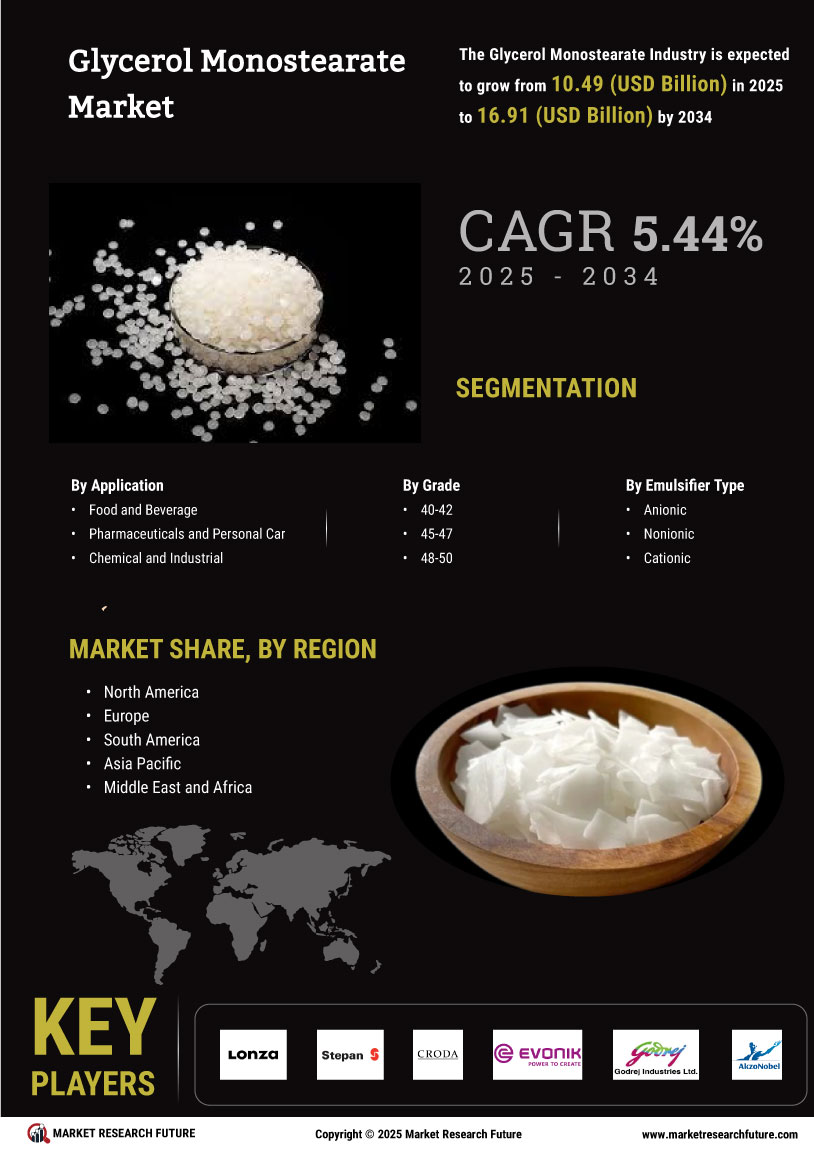
Glycerol Monostearate Market Infographic
Purchase Options

Glycerol Monostearate Market Summary

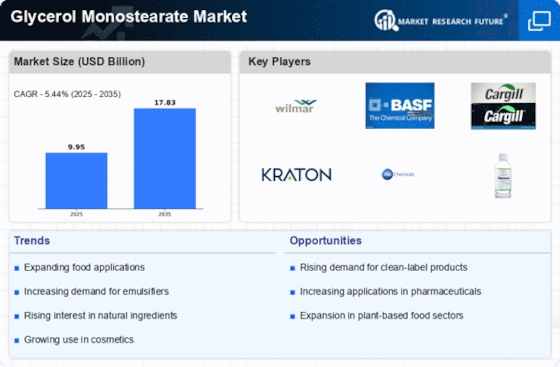
As per MRFR analysis, the Glycerol Monostearate Market Size was estimated at 9.953 USD Billion in 2024. The Glycerol Monostearate industry is projected to grow from 10.49 USD Billion in 2025 to 17.83 USD Billion by 2035, exhibiting a compound annual growth rate (CAGR) of 5.44 during the forecast period 2025 - 2035.

Key Market Trends & Highlights

The Glycerol Monostearate Market is experiencing robust growth driven by diverse applications and evolving consumer preferences.

  • The demand for clean label products is rising, influencing formulations across various sectors.
  • North America remains the largest market, while Asia-Pacific is emerging as the fastest-growing region for glycerol monostearate.
  • The food and beverages segment continues to dominate, whereas the pharmaceuticals and personal care segment is witnessing rapid expansion.
  • Key market drivers include increasing demand in the food industry and advancements in food technology, which are shaping market dynamics.

Market Size & Forecast

2024 Market Size 9.953 (USD Billion)
2035 Market Size 17.83 (USD Billion)
CAGR (2025 - 2035) 5.44%

Major Players

Wilmar International Limited (SG), BASF SE (DE), Cargill, Incorporated (US), Kraton Corporation (US), P&G Chemicals (US), Glycerin Products, LLC (US), MGP Ingredients, Inc. (US), SABIC (SA), Kao Corporation (JP)

Glycerol Monostearate Market Trends

The Glycerol Monostearate Market is currently experiencing notable growth, driven by its diverse applications across various industries. This compound, primarily utilized as an emulsifier, stabilizer, and thickening agent, finds its place in food, cosmetics, and pharmaceuticals. The increasing demand for natural and organic ingredients in these sectors appears to be a significant factor influencing market dynamics. Furthermore, the rising awareness regarding health and wellness is prompting manufacturers to seek alternatives that align with consumer preferences for cleaner labels and sustainable products. In addition to the food and beverage industry, the Glycerol Monostearate Market is witnessing expansion in personal care and cosmetic formulations. The versatility of glycerol monostearate in enhancing product texture and stability makes it a preferred choice among formulators. As consumers continue to prioritize quality and efficacy in their personal care products, the demand for this ingredient is likely to rise. Moreover, the ongoing trend towards eco-friendly and biodegradable materials may further bolster the market, as manufacturers strive to meet regulatory standards and consumer expectations for sustainability. Overall, the Glycerol Monostearate Market is poised for continued growth, driven by evolving consumer preferences and industry innovations.

Rising Demand for Clean Label Products

The Glycerol Monostearate Market is witnessing an increasing preference for clean label products. Consumers are becoming more discerning about ingredient transparency, leading manufacturers to incorporate natural emulsifiers like glycerol monostearate. This trend reflects a broader movement towards healthier and more sustainable food options.

Expansion in Personal Care Applications

The versatility of glycerol monostearate is driving its adoption in personal care formulations. As consumers seek high-quality cosmetic products, the ingredient's ability to enhance texture and stability is becoming increasingly valued. This trend suggests a growing intersection between food-grade and cosmetic applications.

Focus on Sustainable Practices

Sustainability is emerging as a critical factor in the Glycerol Monostearate Market. Manufacturers are exploring eco-friendly sourcing and production methods to align with consumer expectations. This focus on sustainability may influence product development and marketing strategies in the coming years.

Glycerol Monostearate Market Drivers

Advancements in Food Technology

The Glycerol Monostearate Market is poised for growth due to advancements in food technology. Innovations in food processing techniques are leading to the development of new applications for Glycerol Monostearate Market, particularly in the realm of functional foods and nutraceuticals. This compound is increasingly recognized for its ability to improve the texture and mouthfeel of food products, which is essential in meeting consumer expectations for quality. Data suggests that the integration of Glycerol Monostearate Market in food technology is expanding, as manufacturers strive to create healthier and more appealing food options. As the food industry continues to evolve, the demand for Glycerol Monostearate Market is likely to rise, reflecting the ongoing transformation in food production and consumption.

Increasing Demand in Food Industry

The Glycerol Monostearate Market is experiencing a notable surge in demand from the food sector. This compound is widely utilized as an emulsifier and stabilizer in various food products, including baked goods, margarine, and confectionery. The increasing consumer preference for processed foods, coupled with the rising trend of convenience eating, is propelling the growth of this market. According to recent data, the food industry accounts for a substantial share of the Glycerol Monostearate Market, indicating its critical role in enhancing texture and shelf life. As manufacturers seek to improve product quality and consumer appeal, the demand for Glycerol Monostearate Market is likely to continue its upward trajectory, reflecting the evolving dynamics of the food sector.

Growth in Pharmaceutical Applications

The Glycerol Monostearate Market is witnessing significant growth due to its applications in the pharmaceutical sector. This compound serves as an excipient in drug formulations, enhancing the bioavailability and stability of active ingredients. The increasing focus on developing innovative drug delivery systems is driving the demand for Glycerol Monostearate Market, as it aids in the formulation of various dosage forms, including tablets and capsules. Recent statistics suggest that the pharmaceutical industry is a key contributor to the Glycerol Monostearate Market, with a projected growth rate that aligns with the overall expansion of the healthcare sector. As the need for effective and safe pharmaceutical products rises, the relevance of Glycerol Monostearate Market in this industry is expected to grow, highlighting its importance in modern medicine.

Sustainability Trends in Manufacturing

The Glycerol Monostearate Market is influenced by the growing emphasis on sustainability in manufacturing processes. As consumers become more environmentally conscious, manufacturers are increasingly seeking sustainable ingredients, including Glycerol Monostearate Market, which can be derived from renewable sources. This shift towards eco-friendly practices is prompting companies to reformulate products to align with consumer values. Recent trends indicate that sustainability is becoming a key driver in the Glycerol Monostearate Market, as businesses aim to reduce their carbon footprint and enhance their brand image. The potential for Glycerol Monostearate Market to be produced sustainably positions it favorably in a market that is progressively prioritizing environmental responsibility, suggesting a promising future for its adoption across various industries.

Rising Popularity of Personal Care Products

The Glycerol Monostearate Market is benefiting from the increasing popularity of personal care and cosmetic products. This compound is often incorporated into formulations for creams, lotions, and hair care products due to its emulsifying properties. The growing consumer awareness regarding skin health and the demand for high-quality personal care items are driving this trend. Market analysis indicates that the personal care sector is a significant segment of the Glycerol Monostearate Market, with a consistent rise in product launches featuring this ingredient. As consumers seek products that offer both efficacy and safety, the role of Glycerol Monostearate Market in enhancing product performance is likely to become more pronounced, further solidifying its position in the personal care industry.

Market Segment Insights

By Application: Food and Beverages (Largest) vs. Pharmaceuticals and Personal Care (Fastest-Growing)

The Glycerol Monostearate Market is significantly influenced by its application across various industries, with Food and Beverages accounting for the largest share. This application harnesses Glycerol Monostearate Market for its emulsifying properties, which enhance texture and stability in food products. The Pharmaceuticals and Personal Care segment, although smaller in market share, showcases rapid growth due to increasing demand for natural and effective emulsifiers in creams, lotions, and therapeutic products. Currently, the market is observing a shift toward the incorporation of Glycerol Monostearate Market in health-focused food items, driven by consumer trends favoring clean labels and natural ingredients. Furthermore, the growth in the personal care sector is propelled by rising awareness of the benefits of glycerol-based emulsifiers for skin health, indicating a robust future for this segment.

Food and Beverages (Dominant) vs. Pharmaceuticals and Personal Care (Emerging)

The Food and Beverages application of Glycerol Monostearate Market stands as the dominant segment due to its critical role in providing excellent emulsification, stability, and texture enhancement in a wide variety of food products, including baked goods, dairy, and sauces. Its ability to improve mouthfeel and extend shelf life is driving consistent demand within this sector. In contrast, the Pharmaceuticals and Personal Care segment is emerging rapidly, leveraging trends towards organic ingredients and the need for effective emulsifiers that support product performance and consumer safety. Companies are focusing on innovative formulations and clean label strategies, positioning Glycerol Monostearate Market as a desirable choice for manufacturers committed to quality and efficacy in health and beauty products.

By Grade: 45-47 (Largest) vs. 48-50 (Fastest-Growing)

In the Glycerol Monostearate Market, the distribution of segment values showcases the 45-47 grade as the largest segment, capturing significant market share. Conversely, the 48-50 grade is gaining traction as the fastest-growing segment, indicating a shift in consumer preferences towards higher purity and performance products. The growing demand for clean-label and natural ingredients is driving this trend, as consumers become increasingly health-conscious and environmentally aware. As market trends evolve, the 45-47 grade continues to meet existing demand levels while the 48-50 grade benefits from the rise in applications across food, cosmetics, and pharmaceutical sectors. This surge is attributed to the enhanced emulsifying and stabilizing properties of the 48-50 grade, which provides a sustainable edge in various formulations and product innovation within the industry.

45-47 (Dominant) vs. 48-50 (Emerging)

The 45-47 grade of Glycerol Monostearate Market remains dominant in the market, valued for its versatility and effectiveness as an emulsifier and stabilizer in a variety of applications from food products to personal care items. This grade benefits from a well-established position, having catered to a wide range of industrial requirements, making it a preferred choice among manufacturers. In contrast, the 48-50 grade represents an emerging segment, highly sought after for its superior quality and performance characteristics. As industries push for higher purity formulations, the 48-50 grade is becoming integral in niche applications where product quality and consumer safety are paramount. This dynamic not only suggests a robust future for the 48-50 grade but highlights the ongoing evolution of market preferences towards more refined ingredient profiles.

By Emulsifier Type: Cationic (Largest) vs. Anionic (Fastest-Growing)

In the Glycerol Monostearate Market, the emulsifier type segment exhibits a diverse market share distribution among cationic, anionic, and nonionic types. The cationic emulsifiers hold the largest share due to their extensive applications in food, cosmetics, and pharmaceuticals. Nonionic emulsifiers also play a significant role but remain secondary to cationic types, with anionic segments rapidly catching up in market traction and demand. The distribution emphasizes the strategic positioning of cationic emulsifiers as foundational elements in various formulations, reflecting their long-standing acceptance and performance across industries. The growth trends within the emulsifier type segment are particularly notable for anionic emulsifiers, which are emerging as a significant force due to their versatility and effectiveness. Factors driving this growth include the rising demand for clean-label and natural products, fueling the popularity of anionic emulsifiers in food and cosmetic applications. Market players are increasingly focusing on product innovations and sustainability, enhancing the appeal of anionic types while cationic emulsifiers maintain their market dominance through entrenched industry usage and established relationships with manufacturers, ensuring sustained competitive advantage.

Cationic (Dominant) vs. Anionic (Emerging)

Cationic emulsifiers in the Glycerol Monostearate Market are recognized for their ability to provide stability and texture, making them essential in formulations across various industries, including pharmaceuticals and cosmetics. Their positive charge enhances compatibility with negatively charged substances, promoting effective emulsification. While cationic types dominate the market due to their established presence and trust in performance, anionic emulsifiers are rapidly gaining traction as an emerging option. Anionic emulsifiers are valued for their effectiveness in stabilizing oil-in-water emulsions and their growing appeal in natural and organic product formulations. This shift in consumer preferences towards sustainable and clean-label products is contributing to the rise of anionic emulsifiers, setting the stage for a dynamic evolution within the Glycerol Monostearate Market.

Get more detailed insights about Glycerol Monostearate Market

Regional Insights

North America : Innovation and Demand Growth

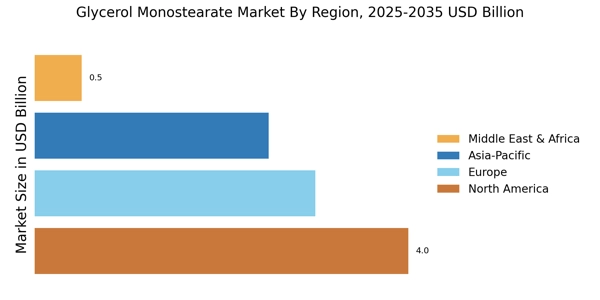
The North American glycerol monostearate market is driven by increasing demand in food, cosmetics, and pharmaceuticals. The region holds approximately 40% of the global market share, making it the largest market. Regulatory support for food safety and quality standards further catalyzes growth. The rising trend of clean-label products is also influencing demand, as consumers seek natural ingredients in their food and personal care products. The United States is the leading country in this region, with major players like Cargill, Incorporated and P&G Chemicals dominating the market. The competitive landscape is characterized by innovation and strategic partnerships among key players. Additionally, the presence of established distribution networks enhances market accessibility, ensuring a steady supply of glycerol monostearate to various industries.

Europe : Regulatory Framework and Growth

Europe is a significant player in the glycerol monostearate market, holding around 30% of the global share, making it the second largest region. The market is driven by stringent regulations on food safety and quality, which encourage the use of glycerol monostearate in various applications. The increasing demand for natural and organic products is also a key growth driver, as consumers become more health-conscious and environmentally aware. Germany and France are the leading countries in this region, with a strong presence of key players like BASF SE and Kao Corporation. The competitive landscape is marked by innovation and sustainability initiatives, as companies strive to meet regulatory standards and consumer preferences. The collaboration between industry stakeholders and regulatory bodies further enhances market growth, ensuring compliance and quality assurance.

Asia-Pacific : Emerging Markets and Opportunities

The Asia-Pacific region is witnessing rapid growth in the glycerol monostearate market, driven by increasing industrialization and urbanization. This region holds approximately 25% of the global market share, with countries like China and India leading the demand. The growing food and beverage industry, along with rising disposable incomes, is propelling the market forward. Additionally, favorable government policies supporting manufacturing and exports are acting as catalysts for growth. China is the largest market in this region, with significant contributions from local manufacturers and international players. The competitive landscape is evolving, with companies focusing on product innovation and sustainability. Key players like Wilmar International Limited and SABIC are expanding their operations to meet the growing demand, ensuring a robust supply chain and market presence.

Middle East and Africa : Resource-Rich and Growing Demand

The Middle East and Africa region is emerging as a potential market for glycerol monostearate, holding about 5% of the global share. The growth is driven by increasing demand in the food and cosmetics sectors, alongside a rise in local manufacturing capabilities. The region's rich natural resources and strategic location enhance its attractiveness for investment and production, while government initiatives to boost local industries are also contributing to market growth. Countries like South Africa and the UAE are leading the market in this region, with a growing number of local and international players entering the space. The competitive landscape is characterized by a mix of established companies and new entrants, focusing on innovation and quality. As the market matures, the presence of key players will likely expand, fostering a more competitive environment.

Glycerol Monostearate Market Regional Image

Key Players and Competitive Insights

The Glycerol Monostearate Market is currently characterized by a dynamic competitive landscape, driven by increasing demand across various sectors, including food, pharmaceuticals, and cosmetics. Key players such as Wilmar International Limited (Singapore), BASF SE (Germany), and Cargill, Incorporated (United States) are strategically positioned to leverage their extensive product portfolios and global reach. These companies are focusing on innovation and sustainability, which appear to be pivotal in shaping their operational strategies. For instance, Wilmar International Limited (Singapore) emphasizes sustainable sourcing and production methods, while BASF SE (Germany) invests heavily in research and development to enhance product efficacy and application versatility. Collectively, these strategies foster a competitive environment that is increasingly oriented towards sustainability and technological advancement.

In terms of business tactics, companies are localizing manufacturing to reduce lead times and optimize supply chains, which is particularly relevant in the context of fluctuating global trade dynamics. The Glycerol Monostearate Market is moderately fragmented, with several players vying for market share. However, the influence of major companies like Cargill, Incorporated (United States) and P&G Chemicals (United States) is substantial, as they command significant resources and market presence, thereby shaping the competitive structure.

In August 2025, Cargill, Incorporated (United States) announced a strategic partnership with a leading biotechnology firm to develop bio-based glycerol monostearate, which is expected to enhance their product offerings in the food industry. This move not only aligns with the growing consumer preference for natural ingredients but also positions Cargill as a frontrunner in sustainable product development. The partnership underscores the importance of innovation in maintaining competitive advantage in a rapidly evolving market.

Similarly, in September 2025, BASF SE (Germany) launched a new line of glycerol monostearate products designed specifically for the cosmetics sector, focusing on enhanced skin compatibility and performance. This strategic initiative reflects BASF's commitment to meeting the diverse needs of its customers while reinforcing its market position through product differentiation. The introduction of these specialized products is likely to attract a broader customer base, thereby increasing market share.

Moreover, in July 2025, P&G Chemicals (United States) expanded its production capacity for glycerol monostearate in response to rising global demand. This expansion not only demonstrates P&G's proactive approach to market trends but also highlights the importance of supply chain reliability in ensuring product availability. By increasing production capacity, P&G is well-positioned to meet the needs of its clients while maintaining competitive pricing.

As of October 2025, the Glycerol Monostearate Market is witnessing trends such as digitalization and sustainability becoming increasingly central to competitive strategies. Companies are forming strategic alliances to enhance their technological capabilities and market reach. The shift from price-based competition to a focus on innovation, technology, and supply chain reliability is evident. Moving forward, competitive differentiation will likely hinge on the ability to innovate and adapt to changing consumer preferences, with sustainability at the forefront of strategic initiatives.

Key Companies in the Glycerol Monostearate Market market include

Industry Developments

In March 2023, Croda International plc, through its Indian arm ‘Croda India’, announced an investment in greenfield manufacturing at Dahej, Gujarat, worth USD 5.4 million. The new setup will also help meet the increasing demand for the pharma and consumer care products. In May 2022, Evonik Industries AG launched its Applied Technology Center (ATC) in Sao Paulo, Brazil. The new setup would be equipped with laboratories and two pilot plants that would boost its interface & performance business line. Agro business of Interface & Performance includes emulsifiers, wetting agents, antifoams and dispersants.

The center is Evonik's third regional Agro Hub after those located in the U.S. and Germany. In February 2023, Palsgaard, a leading global provider of plant-based additives for plastics, established a research project in Malaysia to qualify its Einar 201 mold release agent for automotive PP applications. Einar 201, which is not petroleum-based and can be sourced renewably, offers excellent performance features coupled with easy denesting as well as sustainability features, which will assist in lowering carbon footprints for the plastics industry.

In February 2023, Palsgaard, a major company focusing on the use of plant-based additives, collaborated with automotive manufacturers in Malaysia on the application of its renewable high-performance Einar 201 mold release agent on automotive components. In July of 2023, Evonik began offering GMS, broadening its catalog of environmentally friendly emulsifiers in response to demand from the food sector for cleaner plant-based options. In September of 2023, BASF worked with cosmetic manufacturers around the world on the use of GMS in spell care products, improving the consistency and thickness of such products.

In November of 2023, together with a number of personal care brands, Croda developed GMS with a focus on biodegradable formulations that met the growing demand for green beauty products from consumers.

Future Outlook

Glycerol Monostearate Market Future Outlook

The Glycerol Monostearate Market is projected to grow at a 5.44% CAGR from 2024 to 2035, driven by increasing demand in food and cosmetics industries.

New opportunities lie in:

  • Expansion into emerging markets with tailored product formulations.
  • Development of sustainable glycerol monostearate from renewable sources.
  • Strategic partnerships with food manufacturers for innovative applications.

By 2035, the market is expected to solidify its position as a key ingredient across multiple industries.

Market Segmentation

Glycerol Monostearate Market Grade Outlook

  • 40-42
  • 45-47
  • 48-50
  • 52-54
  • 56-58

Glycerol Monostearate Market Application Outlook

  • Food and Beverages
  • Pharmaceuticals and Personal Care
  • Chemical and Industrial

Glycerol Monostearate Market Emulsifier Type Outlook

  • Anionic
  • Nonionic
  • Cationic

Report Scope

MARKET SIZE 20249.953(USD Billion)
MARKET SIZE 202510.49(USD Billion)
MARKET SIZE 203517.83(USD Billion)
COMPOUND ANNUAL GROWTH RATE (CAGR)5.44% (2024 - 2035)
REPORT COVERAGERevenue Forecast, Competitive Landscape, Growth Factors, and Trends
BASE YEAR2024
Market Forecast Period2025 - 2035
Historical Data2019 - 2024
Market Forecast UnitsUSD Billion
Key Companies ProfiledMarket analysis in progress
Segments CoveredMarket segmentation analysis in progress
Key Market OpportunitiesGrowing demand for clean label products enhances opportunities in the Glycerol Monostearate Market.
Key Market DynamicsRising demand for clean label products drives growth in the Glycerol Monostearate Market amid evolving consumer preferences.
Countries CoveredNorth America, Europe, APAC, South America, MEA

Leave a Comment

FAQs

What is the projected market valuation of the Glycerol Monostearate Market by 2035?

The Glycerol Monostearate Market is projected to reach a valuation of 17.83 USD Billion by 2035.

What was the market valuation of Glycerol Monostearate in 2024?

In 2024, the Glycerol Monostearate Market was valued at 9.953 USD Billion.

What is the expected CAGR for the Glycerol Monostearate Market during the forecast period 2025 - 2035?

The expected CAGR for the Glycerol Monostearate Market during the forecast period 2025 - 2035 is 5.44%.

Which companies are considered key players in the Glycerol Monostearate Market?

Key players in the Glycerol Monostearate Market include Wilmar International Limited, BASF SE, Cargill, Incorporated, and P&G Chemicals.

What are the projected valuations for the Food and Beverages segment by 2035?

The Food and Beverages segment is projected to grow from 3.5 USD Billion to 6.2 USD Billion by 2035.

How does the valuation of the Pharmaceuticals and Personal Care segment change by 2035?

The Pharmaceuticals and Personal Care segment is expected to increase from 2.5 USD Billion to 4.5 USD Billion by 2035.

What is the projected growth for the Chemical and Industrial segment by 2035?

The Chemical and Industrial segment is anticipated to rise from 3.953 USD Billion to 7.13 USD Billion by 2035.

What are the projected valuations for different grades of Glycerol Monostearate by 2035?

By 2035, the 40-42 grade is expected to reach 2.5 USD Billion, while the 48-50 grade may grow to 4.0 USD Billion.

What is the expected growth in the Nonionic emulsifier type segment by 2035?

The Nonionic emulsifier type segment is projected to grow from 3.5 USD Billion to 6.5 USD Billion by 2035.

How does the market for Cationic emulsifiers change by 2035?

The Cationic emulsifier type segment is expected to increase from 3.953 USD Billion to 6.83 USD Billion by 2035.

Download Free Sample

Kindly complete the form below to receive a free sample of this Report

Compare Licence

×
Features License Type
Single User Multiuser License Enterprise User
Price $4,950 $ $7,250
Maximum User Access Limit 1 User Upto 10 Users Unrestricted Access Throughout the Organization
Free Customization
Direct Access to Analyst
Deliverable Format
Platform Access
Discount on Next Purchase 10% 15% 15%
Printable Versions