Request Free Sample ×

Kindly complete the form below to receive a free sample of this Report

* Please use a valid business email

Leading companies partner with us for data-driven Insights

clients tt-cursor
Hero Background
English
Chinese
French
Japanese
Korean
German
Spanish

Dry Mouth Relief Market Share

ID: MRFR/HC/8103-CR
110 Pages
Rahul Gotadki
April 2020

Dry Mouth Relief Market Research Report information by Type (Over the Counter (OTC), Prescribed) by Product (Spray, Mouthwash, Gel, Lozenges, and Device), by Distribution Channel (Pharmacies [Hospital Pharmacies and Retail Pharmacies], E-Commerce, and Supermarket), by Region (U.S., Europe, China, Middle East & North Africa (MENA), and ROW) - Forecast till 2035

Share:
Download PDF ×

We do not share your information with anyone. However, we may send you emails based on your report interest from time to time. You may contact us at any time to opt-out.

Dry Mouth Relief Market Infographic
Purchase Options

Market Share

Dry Mouth Relief Market Share Analysis

The global dry mouth relief market is poised for advancements and innovation driven by the continuous progress in technology. This evolution presents an exciting opportunity for the development of more effective, user-friendly products, and solutions for dry mouth relief. Technological strides encompass innovations in product formulations, delivery mechanisms, and monitoring tools, with the aim of enhancing the overall experience for individuals grappling with dry mouth. As technology advances, there is potential for the creation of novel dry mouth relief products that provide longer-lasting effects, swifter relief, and heightened user comfort. An example of this potential is the prospect of smart oral care devices capable of monitoring and adjusting saliva levels or offering real-time feedback to users about their oral health. Additionally, the integration of digital health technologies, such as mobile apps and wearable devices, with dry mouth relief solutions can yield personalized recommendations and track progress over time. These technological advancements not only enhance the effectiveness of dry mouth relief products but also contribute to a more proactive and engaged approach to oral health management. Smart devices, for instance, can empower individuals to monitor their oral health, receive real-time insights, and make informed decisions about their well-being. Furthermore, these technologies can facilitate communication with healthcare professionals, enabling a more personalized and targeted approach to care. Investing in research and development (R&D) and fostering collaborations with technology companies are key strategies for businesses in the dry mouth relief market to stay at the forefront of innovation. Embracing these technological opportunities allows companies to offer differentiated products and services that align with the evolving needs of consumers and healthcare providers. Ultimately, this proactive approach to innovation is expected to drive growth in the global dry mouth relief market, providing individuals with more effective and technologically advanced solutions to address the challenges posed by dry mouth symptoms.


Author
Author Profile
Rahul Gotadki
Research Manager

He holds an experience of about 9+ years in Market Research and Business Consulting, working under the spectrum of Life Sciences and Healthcare domains. Rahul conceptualizes and implements a scalable business strategy and provides strategic leadership to the clients. His expertise lies in market estimation, competitive intelligence, pipeline analysis, customer assessment, etc.

Leave a Comment

FAQs

What is the current valuation of the Dry Mouth Relief Market in 2024?

<p>The Dry Mouth Relief Market was valued at 2.39 USD Billion in 2024.</p>

What is the projected market size for the Dry Mouth Relief Market by 2035?

<p>The market is projected to reach 4.638 USD Billion by 2035.</p>

What is the expected CAGR for the Dry Mouth Relief Market during the forecast period 2025 - 2035?

<p>The expected CAGR for the Dry Mouth Relief Market during 2025 - 2035 is 6.21%.</p>

Which companies are considered key players in the Dry Mouth Relief Market?

<p>Key players include GlaxoSmithKline, Procter & Gamble, Colgate-Palmolive, Johnson & Johnson, and others.</p>

What are the main product segments in the Dry Mouth Relief Market?

<p>Main product segments include Spray, Mouthwash, Gel, Lozenges, and Device.</p>

How did the Over The Counter (OTC) segment perform in 2024?

<p>The Over The Counter (OTC) segment was valued at 1.19 USD Billion in 2024.</p>

What is the projected value of the Mouthwash segment by 2035?

<p>The Mouthwash segment is projected to reach 1.2 USD Billion by 2035.</p>

What distribution channels are utilized in the Dry Mouth Relief Market?

Distribution channels include Pharmacies, E-Commerce, and Supermarkets.

What was the value of the E-Commerce segment in 2024?

The E-Commerce segment was valued at 0.75 USD Billion in 2024.

How does the performance of the Gel segment compare to other product segments?

The Gel segment was valued at 0.4 USD Billion in 2024, indicating a moderate position compared to others.

Market Summary

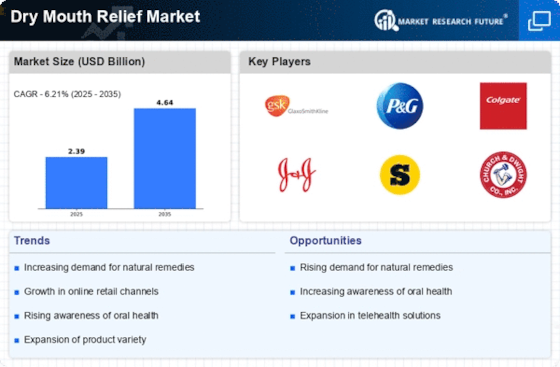
As per Market Research Future analysis, the Dry Mouth Relief Market Size was estimated at 2.39 USD Billion in 2024. The Dry Mouth Relief industry is projected to grow from 2.538 USD Billion in 2025 to 4.638 USD Billion by 2035, exhibiting a compound annual growth rate (CAGR) of 6.21% during the forecast period 2025 - 2035

Key Market Trends & Highlights

The Dry Mouth Relief Market is experiencing a dynamic shift towards natural solutions and technological advancements.

  • Consumer awareness regarding dry mouth conditions is on the rise, leading to increased demand for effective relief products. There is a notable shift towards natural ingredients, particularly in the Asia-Pacific region, which is driving innovation in product formulations. The Over The Counter (OTC) segment remains the largest, while the prescribed segment is emerging as the fastest-growing category. Rising incidence of dry mouth conditions and a heightened focus on oral health are key drivers propelling market growth.

Market Size & Forecast

2024 Market Size 2.39 (USD Billion)
2035 Market Size 4.638 (USD Billion)
CAGR (2025 - 2035) 6.21%
Largest Regional Market Share in 2024 Europe

Major Players

GlaxoSmithKline (GB), Procter &amp; Gamble (US), <a href="https://www.colgate.com/en-us/oral-health/dry-mouth/dry-mouth-products">Colgate-Palmolive</a> (US), Johnson &amp; Johnson (US), Sunstar (JP), Church &amp; Dwight (US), Eurapharma (FR), Pernod Ricard (FR), MediNiche (US)

Market Trends

The Dry Mouth Relief Market is currently experiencing notable transformations driven by various factors. An increasing awareness of oral health and the implications of dry mouth conditions has led to a surge in demand for effective relief products. Consumers are becoming more informed about the potential causes of xerostomia, such as medication side effects and certain health conditions, which has prompted a shift towards seeking specialized solutions. This heightened awareness is likely to foster innovation in product development, as manufacturers strive to meet the evolving needs of consumers. Moreover, the market appears to be influenced by the growing trend of natural and organic products. Many consumers are gravitating towards solutions that utilize natural ingredients, reflecting a broader shift in consumer preferences towards health-conscious choices. This inclination may encourage companies to explore alternative formulations that align with these values, potentially expanding their market reach. As the Dry Mouth Relief Market continues to evolve, it seems poised for growth, driven by both consumer demand and the ongoing development of new, effective products.

Increased Consumer Awareness

There is a growing recognition among consumers regarding the importance of oral health, particularly concerning dry mouth conditions. This awareness is likely to drive demand for products specifically designed to alleviate xerostomia, as individuals seek effective solutions to manage their symptoms.

Shift Towards Natural Ingredients

A noticeable trend within the Dry Mouth Relief Market is the increasing preference for products that incorporate natural and organic ingredients. Consumers appear to be more inclined to choose solutions that align with their health-conscious lifestyles, prompting manufacturers to innovate and adapt their offerings.

Technological Advancements in Product Development

The Dry Mouth Relief Market is witnessing advancements in technology that enhance product efficacy. Innovations in formulation and delivery methods may lead to more effective solutions, catering to the diverse needs of consumers suffering from dry mouth.

Dry Mouth Relief Market Market Drivers

Expansion of Retail Channels

The expansion of retail channels is a crucial driver for the Dry Mouth Relief Market. With the rise of e-commerce and the increasing presence of health and wellness products in pharmacies, supermarkets, and online platforms, consumers have greater access to dry mouth relief products. This accessibility is likely to enhance consumer purchasing behavior, as individuals can easily find and compare various options. Market analysis suggests that the online retail segment is experiencing rapid growth, with consumers preferring the convenience of shopping from home. This trend not only broadens the market reach for manufacturers but also fosters competition, leading to improved product offerings in the Dry Mouth Relief Market. As more retailers recognize the demand for these products, the market is expected to witness further expansion.

Increased Focus on Oral Health

The heightened emphasis on oral health and hygiene is significantly influencing the Dry Mouth Relief Market. Consumers are becoming increasingly aware of the importance of maintaining oral moisture for overall health. Dry mouth can lead to various complications, including dental decay and gum disease, which are serious concerns for many individuals. As a result, there is a growing market for products that not only alleviate dry mouth symptoms but also promote oral health. Market data indicates that the oral care segment is expanding, with consumers willing to invest in products that ensure their oral well-being. This trend is likely to encourage manufacturers to develop multifunctional products that address both dry mouth relief and oral hygiene, thereby enhancing their market presence in the Dry Mouth Relief Market.

Rising Incidence of Dry Mouth Conditions

The increasing prevalence of dry mouth conditions, also known as xerostomia, is a notable driver for the Dry Mouth Relief Market. Factors such as aging populations and the rise in chronic diseases contribute to this trend. According to health statistics, approximately 10 to 30% of adults experience dry mouth symptoms, which can be exacerbated by medications, health conditions, and lifestyle choices. This growing incidence creates a heightened demand for effective relief products, thereby propelling the market forward. As awareness of the condition increases, consumers are more likely to seek solutions, further stimulating growth in the Dry Mouth Relief Market. The need for innovative and effective products is likely to drive research and development efforts, leading to a broader range of offerings in the market.

Growing Demand for Natural and Organic Products

The increasing consumer preference for natural and organic products is shaping the Dry Mouth Relief Market. As individuals become more health-conscious, they are seeking products that are free from artificial ingredients and chemicals. This trend is evident in the rising sales of natural dry mouth relief solutions, which are perceived as safer and more effective. Market data indicates that consumers are willing to pay a premium for products that align with their values regarding health and sustainability. Consequently, manufacturers are responding by developing innovative formulations that utilize natural ingredients, thereby catering to this demand. This shift towards natural products is likely to drive growth in the Dry Mouth Relief Market, as consumers increasingly prioritize their health and well-being.

Technological Innovations in Product Development

Technological advancements in product development are playing a pivotal role in the Dry Mouth Relief Market. Innovations such as improved formulations, delivery systems, and packaging are enhancing the effectiveness and appeal of dry mouth relief products. For instance, the introduction of moisture-retaining technologies and flavor-enhancing agents is making products more user-friendly and enjoyable. Market Research Future indicates that consumers are more inclined to choose products that offer superior performance and convenience. As a result, companies are investing in research and development to create cutting-edge solutions that meet evolving consumer needs. This focus on innovation is likely to drive competition and growth within the Dry Mouth Relief Market, as brands strive to differentiate themselves in a crowded marketplace.

Market Segment Insights

By Type: Over The Counter (OTC) (Largest) vs. Prescribed (Fastest-Growing)

<p>In the Dry Mouth Relief Market, the Over The Counter (OTC) segment holds a prominent position as the largest contributor, driven by the increasing accessibility and awareness among consumers regarding dry mouth conditions. This segment appeals to a broad demographic as OTC products are available without the need for a prescription. On the other hand, the Prescribed segment is emerging rapidly, benefiting from advancements in medical treatments and a growing recognition of severe dry mouth as a health concern, which bolsters demand for prescription therapies.</p>

<p>Dry Mouth Relief: OTC (Dominant) vs. Prescribed (Emerging)</p>

<p>The Over The Counter (OTC) segment stands out in the Dry Mouth Relief Market as the dominant force, offering consumers a range of solutions that include lozenges, sprays, and gels aimed at alleviating symptoms of dry mouth conveniently and cost-effectively. Consumers favor OTC products due to their easy availability and the autonomy they offer in managing mild to moderate symptoms. Conversely, the Prescribed segment is emerging as healthcare providers increasingly recommend pharmaceutical-grade products for patients with severe conditions. This segment is characterized by specialized formulations that provide faster relief and longer-lasting effects, becoming a crucial option for those with chronic dry mouth related to medications or medical conditions.</p>

By Product: Gel (Largest) vs. Lozenges (Fastest-Growing)

<p>In the Dry Mouth Relief Market, product segmentation showcases Gel as the largest contributing segment, capturing a substantial portion of the market. Following closely are Lozenges, Spray, Mouthwash, and Device categories, each contributing to the overall landscape of dry mouth solutions. The variety in products caters to different consumer preferences, enhancing accessibility and choice for users seeking relief from dry mouth symptoms. The market for dry mouth relief is experiencing noticeable evolution driven by increasing awareness of oral health and rising incidences of dry mouth stemming from various health conditions and medications. Innovative formulations and convenience-oriented products, such as Lozenges and Gels, are attracting consumers and fostering growth. The advancement in product types is largely influenced by consumer demand for user-friendly solutions, propelling new entrants and extending the market appeal.</p>

<p>Gel (Dominant) vs. Lozenges (Emerging)</p>

<p>The Gel segment stands as the dominant force in the Dry Mouth Relief Market, characterized by its easy application, effective moisture retention, and prolonged relief capabilities. Gels are favored by users who seek convenience and immediate relief. In contrast, Lozenges represent the emerging segment, rapidly gaining traction due to their portability and palatable flavors, which appeal to varying consumer demographics. As more individuals seek discreet and manageable options for dry mouth relief, Lozenges are becoming increasingly popular, enhancing their growth potential. This dynamic pairing of Gel and Lozenges indicates shifts in consumer preferences, with innovation and targeted marketing playing key roles in their respective market positions.</p>

By Distribution Channel: Pharmacies (Largest) vs. E-Commerce (Fastest-Growing)

<p>The Dry Mouth Relief Market is primarily dominated by pharmacies, which constitute the largest segment in the distribution channel of the market. They provide a critical touchpoint for consumers seeking immediate relief solutions, reinforcing their position as a preferred purchasing location. E-commerce channels, on the other hand, have emerged as a significant player due to the convenience and accessibility they offer, appealing to a growing number of consumers who prefer online shopping over physical retail experiences.</p>

<p>Pharmacies: Traditional (Dominant) vs. E-Commerce: Innovative (Emerging)</p>

<p>Pharmacies continue to hold a dominant position in the Dry Mouth Relief Market due to their established trust and direct interaction with consumers. They offer a wide range of products that cater to varying customer preferences and needs. In contrast, the E-Commerce channel is rapidly becoming an emerging force, fueled by technological advancements and changing consumer behaviors. This channel provides an expansive selection of products at competitive prices, making it particularly appealing to consumers looking for convenience and a seamless shopping experience. This evolving landscape reflects the growing influence of digital platforms in the retail space.</p>

Get more detailed insights about Dry Mouth Relief Market Research Report - Forecast till 2035

Regional Insights

North America : Market Leader in Dry Mouth Relief Market

North America is the largest market for dry mouth relief products, accounting for approximately 45% of the global market share. The growth is driven by increasing awareness of oral health, a rise in the aging population, and a growing prevalence of conditions like diabetes and Sjögren's syndrome. Regulatory support from agencies like the FDA has also catalyzed product innovation and market entry, enhancing consumer access to effective solutions. The United States leads the North American market, with significant contributions from Canada. Key players such as GlaxoSmithKline, Procter & Gamble, and Johnson & Johnson dominate the competitive landscape, offering a range of products from mouthwashes to lozenges. The presence of these established companies fosters innovation and ensures a steady supply of effective dry mouth relief solutions, catering to diverse consumer needs.

Europe : Emerging Market with Growth Potential

Europe is witnessing a growing demand for dry mouth relief products, holding approximately 30% of the global market share. Factors such as an increasing elderly population, rising awareness of oral health, and the prevalence of medication-induced dry mouth are driving this growth. Regulatory frameworks in the EU encourage the development of innovative products, ensuring safety and efficacy for consumers, which further stimulates market expansion. Leading countries in this region include Germany, France, and the UK, where companies like Colgate-Palmolive and Eurapharma are making significant strides. The competitive landscape is characterized by a mix of established brands and emerging players, all vying for market share. The presence of key players enhances product availability and variety, catering to the diverse needs of consumers across Europe.

Asia-Pacific : Rapidly Growing Market Segment

Asia-Pacific is rapidly emerging as a significant market for dry mouth relief products, accounting for about 20% of the global market share. The growth is fueled by increasing urbanization, changing lifestyles, and a rise in health awareness among consumers. Additionally, the region's regulatory bodies are becoming more supportive of innovative health products, which is expected to further enhance market growth in the coming years. Countries like Japan, China, and Australia are leading the charge in this market. Key players such as Sunstar and Church & Dwight are actively expanding their product lines to meet the growing demand. The competitive landscape is becoming increasingly dynamic, with both local and international brands striving to capture market share, thus providing consumers with a wider array of options for dry mouth relief.

Middle East and Africa : Untapped Market with Opportunities

The Middle East and Africa region represents an untapped market for dry mouth relief products, holding approximately 5% of the global market share. The growth potential is significant, driven by increasing awareness of oral health and a rising prevalence of conditions that cause dry mouth. Regulatory bodies in various countries are beginning to recognize the importance of oral health, which is expected to catalyze market growth in the near future. Leading countries in this region include South Africa and the UAE, where the demand for dry mouth relief products is gradually increasing. The competitive landscape is still developing, with a mix of local and international players entering the market. Companies are focusing on educating consumers about dry mouth conditions and the available relief options, paving the way for future growth in this sector.

Key Players and Competitive Insights

The Dry Mouth Relief Market is characterized by the presence of many global, regional, and local vendors. Developments in the healthcare industry and growing research and development make the dry mouth relief market lucrative. To expand their reach and optimize their operational costs, the major players focus on obtaining regulatory authorizations from government agencies for their products and emphasize acquisitions and product launches to gain a substantial market share. The market comprises tier-1, tier-2, and local players. The tier-1 and tier-2 players have reach across the globe with diverse product portfolios. Companies such as Colgate-Palmolive Company (US), Haleon Group of Companies (England), Johnson & Johnson Services, Inc (US), and Sunstar (Switzerland)dominate the Dry Mouth Relief Market due to product differentiation, financial stability, strategic developments, and diversified regional presence. The players are focused on investing in research and development. Furthermore, they adopt strategic growth initiatives, such as expansion, product launches, joint ventures, and partnerships, to strengthen their market position and capture a large customer base. One of the primary business strategies adopted by manufacturers in the global dry mouth relief industry to benefit clients and expand the dry mouth relief market sector is to manufacture locally to reduce operating costs. Sunstar (Switzerland) is a manufacturer and distributor of oral care health & beauty products. The business sells products for dental care, engineering, holistic health, and oral care. Toothpaste, mouthwashes, interdentals, floss, tablets, gels and sprays, and accessories are among the company's oral care goods. GUM, Butler, and Ora2 are among the company's brands. The state-of-the-art products from Sunstar improve overall health. Sunstar keeps creating oral care solutions for patients and consumers, from care to prevention, in collaboration with dental and medical experts. The company is dedicated to working in collaboration with experts and researchers to improve the health and wellbeing of everyone. Sunstar offers products and services to almost 100 nations. Additionally, it operates in Asia, Europe, and America. Also, 3M (US) is a diversified global manufacturer, technology innovator, and marketer of a wide variety of products and services across several industries. The company uses scientific concepts to manufacture products that help solve problems across all industries, from improving air quality & worker safety to advancing healthcare and enabling transportation. The company has operations in 70 countries, and its products are sold in 200 countries. It easily qualifies to be among the most reputed and popular companies in the modern world.

Key Companies in the Dry Mouth Relief Market include

Industry Developments

February 2022: Sunstar (Switzerland) launched Gum Hydral Dry Mouth Products. Modern hydrating and moisturizing ingredients in Gum Hydral resemble natural saliva to treat a range of illnesses. The line is being created in response to a clear patient need, as the majority of dry mouth sufferers would benefit from additional treatment alternatives.

Future Outlook

Dry Mouth Relief Market Future Outlook

The Dry Mouth Relief Market is projected to grow at a 6.21% CAGR from 2025 to 2035, driven by increasing awareness and demand for oral health products.

New opportunities lie in:

  • <p>Development of subscription-based <a href="https://www.marketresearchfuture.com/reports/oral-care-market-6526" target="_blank" title="oral care">oral care</a> kits Expansion into telehealth consultations for dry mouth management Innovative partnerships with dental professionals for product endorsements</p>

By 2035, the market is expected to achieve robust growth, solidifying its position in the healthcare sector.

Market Segmentation

Dry Mouth Relief Market Type Outlook

  • Over The Counter (OTC)
  • Prescribed

Dry Mouth Relief Market Product Outlook

  • Spray
  • Mouthwash
  • Gel
  • Lozenges
  • Device

Dry Mouth Relief Market Distribution Channel Outlook

  • Pharmacies
  • E-Commerce
  • Supermarket

Report Scope

MARKET SIZE 2024 2.39(USD Billion)
MARKET SIZE 2025 2.538(USD Billion)
MARKET SIZE 2035 4.638(USD Billion)
COMPOUND ANNUAL GROWTH RATE (CAGR) 6.21% (2025 - 2035)
REPORT COVERAGE Revenue Forecast, Competitive Landscape, Growth Factors, and Trends
BASE YEAR 2024
Market Forecast Period 2025 - 2035
Historical Data 2019 - 2024
Market Forecast Units USD Billion
Key Companies Profiled GlaxoSmithKline (GB), Procter & Gamble (US), Colgate-Palmolive (US), Johnson & Johnson (US), Sunstar (JP), Church & Dwight (US), Eurapharma (FR), Pernod Ricard (FR), MediNiche (US)
Segments Covered Type, Product, Distribution Channel, Region
Key Market Opportunities Emerging natural ingredients and innovative formulations enhance consumer appeal in the Dry Mouth Relief Market.
Key Market Dynamics Rising consumer awareness drives demand for innovative dry mouth relief products amid evolving regulatory standards.
Countries Covered North America, Europe, APAC, South America, MEA

FAQs

What is the current valuation of the Dry Mouth Relief Market in 2024?

<p>The Dry Mouth Relief Market was valued at 2.39 USD Billion in 2024.</p>

What is the projected market size for the Dry Mouth Relief Market by 2035?

<p>The market is projected to reach 4.638 USD Billion by 2035.</p>

What is the expected CAGR for the Dry Mouth Relief Market during the forecast period 2025 - 2035?

<p>The expected CAGR for the Dry Mouth Relief Market during 2025 - 2035 is 6.21%.</p>

Which companies are considered key players in the Dry Mouth Relief Market?

<p>Key players include GlaxoSmithKline, Procter & Gamble, Colgate-Palmolive, Johnson & Johnson, and others.</p>

What are the main product segments in the Dry Mouth Relief Market?

<p>Main product segments include Spray, Mouthwash, Gel, Lozenges, and Device.</p>

How did the Over The Counter (OTC) segment perform in 2024?

<p>The Over The Counter (OTC) segment was valued at 1.19 USD Billion in 2024.</p>

What is the projected value of the Mouthwash segment by 2035?

<p>The Mouthwash segment is projected to reach 1.2 USD Billion by 2035.</p>

What distribution channels are utilized in the Dry Mouth Relief Market?

Distribution channels include Pharmacies, E-Commerce, and Supermarkets.

What was the value of the E-Commerce segment in 2024?

The E-Commerce segment was valued at 0.75 USD Billion in 2024.

How does the performance of the Gel segment compare to other product segments?

The Gel segment was valued at 0.4 USD Billion in 2024, indicating a moderate position compared to others.

  1. SECTION I: EXECUTIVE SUMMARY AND KEY HIGHLIGHTS
    1. | 1.1 EXECUTIVE SUMMARY
    2. | | 1.1.1 Market Overview
    3. | | 1.1.2 Key Findings
    4. | | 1.1.3 Market Segmentation
    5. | | 1.1.4 Competitive Landscape
    6. | | 1.1.5 Challenges and Opportunities
    7. | | 1.1.6 Future Outlook
  2. SECTION II: SCOPING, METHODOLOGY AND MARKET STRUCTURE
    1. | 2.1 MARKET INTRODUCTION
    2. | | 2.1.1 Definition
    3. | | 2.1.2 Scope of the study
    4. | | | 2.1.2.1 Research Objective
    5. | | | 2.1.2.2 Assumption
    6. | | | 2.1.2.3 Limitations
    7. | 2.2 RESEARCH METHODOLOGY
    8. | | 2.2.1 Overview
    9. | | 2.2.2 Data Mining
    10. | | 2.2.3 Secondary Research
    11. | | 2.2.4 Primary Research
    12. | | | 2.2.4.1 Primary Interviews and Information Gathering Process
    13. | | | 2.2.4.2 Breakdown of Primary Respondents
    14. | | 2.2.5 Forecasting Model
    15. | | 2.2.6 Market Size Estimation
    16. | | | 2.2.6.1 Bottom-Up Approach
    17. | | | 2.2.6.2 Top-Down Approach
    18. | | 2.2.7 Data Triangulation
    19. | | 2.2.8 Validation
  3. SECTION III: QUALITATIVE ANALYSIS
    1. | 3.1 MARKET DYNAMICS
    2. | | 3.1.1 Overview
    3. | | 3.1.2 Drivers
    4. | | 3.1.3 Restraints
    5. | | 3.1.4 Opportunities
    6. | 3.2 MARKET FACTOR ANALYSIS
    7. | | 3.2.1 Value chain Analysis
    8. | | 3.2.2 Porter's Five Forces Analysis
    9. | | | 3.2.2.1 Bargaining Power of Suppliers
    10. | | | 3.2.2.2 Bargaining Power of Buyers
    11. | | | 3.2.2.3 Threat of New Entrants
    12. | | | 3.2.2.4 Threat of Substitutes
    13. | | | 3.2.2.5 Intensity of Rivalry
    14. | | 3.2.3 COVID-19 Impact Analysis
    15. | | | 3.2.3.1 Market Impact Analysis
    16. | | | 3.2.3.2 Regional Impact
    17. | | | 3.2.3.3 Opportunity and Threat Analysis
  4. SECTION IV: QUANTITATIVE ANALYSIS
    1. | 4.1 Healthcare, BY Type (USD Billion)
    2. | | 4.1.1 Over The Counter (OTC)
    3. | | 4.1.2 Prescribed
    4. | 4.2 Healthcare, BY Product (USD Billion)
    5. | | 4.2.1 Spray
    6. | | 4.2.2 Mouthwash
    7. | | 4.2.3 Gel
    8. | | 4.2.4 Lozenges
    9. | | 4.2.5 Device
    10. | 4.3 Healthcare, BY Distribution Channel (USD Billion)
    11. | | 4.3.1 Pharmacies
    12. | | 4.3.2 E-Commerce
    13. | | 4.3.3 Supermarket
    14. | 4.4 Healthcare, BY Region (USD Billion)
    15. | | 4.4.1 North America
    16. | | | 4.4.1.1 US
    17. | | | 4.4.1.2 Canada
    18. | | 4.4.2 Europe
    19. | | | 4.4.2.1 Germany
    20. | | | 4.4.2.2 UK
    21. | | | 4.4.2.3 France
    22. | | | 4.4.2.4 Russia
    23. | | | 4.4.2.5 Italy
    24. | | | 4.4.2.6 Spain
    25. | | | 4.4.2.7 Rest of Europe
    26. | | 4.4.3 APAC
    27. | | | 4.4.3.1 China
    28. | | | 4.4.3.2 India
    29. | | | 4.4.3.3 Japan
    30. | | | 4.4.3.4 South Korea
    31. | | | 4.4.3.5 Malaysia
    32. | | | 4.4.3.6 Thailand
    33. | | | 4.4.3.7 Indonesia
    34. | | | 4.4.3.8 Rest of APAC
    35. | | 4.4.4 South America
    36. | | | 4.4.4.1 Brazil
    37. | | | 4.4.4.2 Mexico
    38. | | | 4.4.4.3 Argentina
    39. | | | 4.4.4.4 Rest of South America
    40. | | 4.4.5 MEA
    41. | | | 4.4.5.1 GCC Countries
    42. | | | 4.4.5.2 South Africa
    43. | | | 4.4.5.3 Rest of MEA
  5. SECTION V: COMPETITIVE ANALYSIS
    1. | 5.1 Competitive Landscape
    2. | | 5.1.1 Overview
    3. | | 5.1.2 Competitive Analysis
    4. | | 5.1.3 Market share Analysis
    5. | | 5.1.4 Major Growth Strategy in the Healthcare
    6. | | 5.1.5 Competitive Benchmarking
    7. | | 5.1.6 Leading Players in Terms of Number of Developments in the Healthcare
    8. | | 5.1.7 Key developments and growth strategies
    9. | | | 5.1.7.1 New Product Launch/Service Deployment
    10. | | | 5.1.7.2 Merger & Acquisitions
    11. | | | 5.1.7.3 Joint Ventures
    12. | | 5.1.8 Major Players Financial Matrix
    13. | | | 5.1.8.1 Sales and Operating Income
    14. | | | 5.1.8.2 Major Players R&D Expenditure. 2023
    15. | 5.2 Company Profiles
    16. | | 5.2.1 GlaxoSmithKline (GB)
    17. | | | 5.2.1.1 Financial Overview
    18. | | | 5.2.1.2 Products Offered
    19. | | | 5.2.1.3 Key Developments
    20. | | | 5.2.1.4 SWOT Analysis
    21. | | | 5.2.1.5 Key Strategies
    22. | | 5.2.2 Procter & Gamble (US)
    23. | | | 5.2.2.1 Financial Overview
    24. | | | 5.2.2.2 Products Offered
    25. | | | 5.2.2.3 Key Developments
    26. | | | 5.2.2.4 SWOT Analysis
    27. | | | 5.2.2.5 Key Strategies
    28. | | 5.2.3 Colgate-Palmolive (US)
    29. | | | 5.2.3.1 Financial Overview
    30. | | | 5.2.3.2 Products Offered
    31. | | | 5.2.3.3 Key Developments
    32. | | | 5.2.3.4 SWOT Analysis
    33. | | | 5.2.3.5 Key Strategies
    34. | | 5.2.4 Johnson & Johnson (US)
    35. | | | 5.2.4.1 Financial Overview
    36. | | | 5.2.4.2 Products Offered
    37. | | | 5.2.4.3 Key Developments
    38. | | | 5.2.4.4 SWOT Analysis
    39. | | | 5.2.4.5 Key Strategies
    40. | | 5.2.5 Sunstar (JP)
    41. | | | 5.2.5.1 Financial Overview
    42. | | | 5.2.5.2 Products Offered
    43. | | | 5.2.5.3 Key Developments
    44. | | | 5.2.5.4 SWOT Analysis
    45. | | | 5.2.5.5 Key Strategies
    46. | | 5.2.6 Church & Dwight (US)
    47. | | | 5.2.6.1 Financial Overview
    48. | | | 5.2.6.2 Products Offered
    49. | | | 5.2.6.3 Key Developments
    50. | | | 5.2.6.4 SWOT Analysis
    51. | | | 5.2.6.5 Key Strategies
    52. | | 5.2.7 Eurapharma (FR)
    53. | | | 5.2.7.1 Financial Overview
    54. | | | 5.2.7.2 Products Offered
    55. | | | 5.2.7.3 Key Developments
    56. | | | 5.2.7.4 SWOT Analysis
    57. | | | 5.2.7.5 Key Strategies
    58. | | 5.2.8 Pernod Ricard (FR)
    59. | | | 5.2.8.1 Financial Overview
    60. | | | 5.2.8.2 Products Offered
    61. | | | 5.2.8.3 Key Developments
    62. | | | 5.2.8.4 SWOT Analysis
    63. | | | 5.2.8.5 Key Strategies
    64. | | 5.2.9 MediNiche (US)
    65. | | | 5.2.9.1 Financial Overview
    66. | | | 5.2.9.2 Products Offered
    67. | | | 5.2.9.3 Key Developments
    68. | | | 5.2.9.4 SWOT Analysis
    69. | | | 5.2.9.5 Key Strategies
    70. | 5.3 Appendix
    71. | | 5.3.1 References
    72. | | 5.3.2 Related Reports
  6. LIST OF FIGURES
    1. | 6.1 MARKET SYNOPSIS
    2. | 6.2 NORTH AMERICA MARKET ANALYSIS
    3. | 6.3 US MARKET ANALYSIS BY TYPE
    4. | 6.4 US MARKET ANALYSIS BY PRODUCT
    5. | 6.5 US MARKET ANALYSIS BY DISTRIBUTION CHANNEL
    6. | 6.6 CANADA MARKET ANALYSIS BY TYPE
    7. | 6.7 CANADA MARKET ANALYSIS BY PRODUCT
    8. | 6.8 CANADA MARKET ANALYSIS BY DISTRIBUTION CHANNEL
    9. | 6.9 EUROPE MARKET ANALYSIS
    10. | 6.10 GERMANY MARKET ANALYSIS BY TYPE
    11. | 6.11 GERMANY MARKET ANALYSIS BY PRODUCT
    12. | 6.12 GERMANY MARKET ANALYSIS BY DISTRIBUTION CHANNEL
    13. | 6.13 UK MARKET ANALYSIS BY TYPE
    14. | 6.14 UK MARKET ANALYSIS BY PRODUCT
    15. | 6.15 UK MARKET ANALYSIS BY DISTRIBUTION CHANNEL
    16. | 6.16 FRANCE MARKET ANALYSIS BY TYPE
    17. | 6.17 FRANCE MARKET ANALYSIS BY PRODUCT
    18. | 6.18 FRANCE MARKET ANALYSIS BY DISTRIBUTION CHANNEL
    19. | 6.19 RUSSIA MARKET ANALYSIS BY TYPE
    20. | 6.20 RUSSIA MARKET ANALYSIS BY PRODUCT
    21. | 6.21 RUSSIA MARKET ANALYSIS BY DISTRIBUTION CHANNEL
    22. | 6.22 ITALY MARKET ANALYSIS BY TYPE
    23. | 6.23 ITALY MARKET ANALYSIS BY PRODUCT
    24. | 6.24 ITALY MARKET ANALYSIS BY DISTRIBUTION CHANNEL
    25. | 6.25 SPAIN MARKET ANALYSIS BY TYPE
    26. | 6.26 SPAIN MARKET ANALYSIS BY PRODUCT
    27. | 6.27 SPAIN MARKET ANALYSIS BY DISTRIBUTION CHANNEL
    28. | 6.28 REST OF EUROPE MARKET ANALYSIS BY TYPE
    29. | 6.29 REST OF EUROPE MARKET ANALYSIS BY PRODUCT
    30. | 6.30 REST OF EUROPE MARKET ANALYSIS BY DISTRIBUTION CHANNEL
    31. | 6.31 APAC MARKET ANALYSIS
    32. | 6.32 CHINA MARKET ANALYSIS BY TYPE
    33. | 6.33 CHINA MARKET ANALYSIS BY PRODUCT
    34. | 6.34 CHINA MARKET ANALYSIS BY DISTRIBUTION CHANNEL
    35. | 6.35 INDIA MARKET ANALYSIS BY TYPE
    36. | 6.36 INDIA MARKET ANALYSIS BY PRODUCT
    37. | 6.37 INDIA MARKET ANALYSIS BY DISTRIBUTION CHANNEL
    38. | 6.38 JAPAN MARKET ANALYSIS BY TYPE
    39. | 6.39 JAPAN MARKET ANALYSIS BY PRODUCT
    40. | 6.40 JAPAN MARKET ANALYSIS BY DISTRIBUTION CHANNEL
    41. | 6.41 SOUTH KOREA MARKET ANALYSIS BY TYPE
    42. | 6.42 SOUTH KOREA MARKET ANALYSIS BY PRODUCT
    43. | 6.43 SOUTH KOREA MARKET ANALYSIS BY DISTRIBUTION CHANNEL
    44. | 6.44 MALAYSIA MARKET ANALYSIS BY TYPE
    45. | 6.45 MALAYSIA MARKET ANALYSIS BY PRODUCT
    46. | 6.46 MALAYSIA MARKET ANALYSIS BY DISTRIBUTION CHANNEL
    47. | 6.47 THAILAND MARKET ANALYSIS BY TYPE
    48. | 6.48 THAILAND MARKET ANALYSIS BY PRODUCT
    49. | 6.49 THAILAND MARKET ANALYSIS BY DISTRIBUTION CHANNEL
    50. | 6.50 INDONESIA MARKET ANALYSIS BY TYPE
    51. | 6.51 INDONESIA MARKET ANALYSIS BY PRODUCT
    52. | 6.52 INDONESIA MARKET ANALYSIS BY DISTRIBUTION CHANNEL
    53. | 6.53 REST OF APAC MARKET ANALYSIS BY TYPE
    54. | 6.54 REST OF APAC MARKET ANALYSIS BY PRODUCT
    55. | 6.55 REST OF APAC MARKET ANALYSIS BY DISTRIBUTION CHANNEL
    56. | 6.56 SOUTH AMERICA MARKET ANALYSIS
    57. | 6.57 BRAZIL MARKET ANALYSIS BY TYPE
    58. | 6.58 BRAZIL MARKET ANALYSIS BY PRODUCT
    59. | 6.59 BRAZIL MARKET ANALYSIS BY DISTRIBUTION CHANNEL
    60. | 6.60 MEXICO MARKET ANALYSIS BY TYPE
    61. | 6.61 MEXICO MARKET ANALYSIS BY PRODUCT
    62. | 6.62 MEXICO MARKET ANALYSIS BY DISTRIBUTION CHANNEL
    63. | 6.63 ARGENTINA MARKET ANALYSIS BY TYPE
    64. | 6.64 ARGENTINA MARKET ANALYSIS BY PRODUCT
    65. | 6.65 ARGENTINA MARKET ANALYSIS BY DISTRIBUTION CHANNEL
    66. | 6.66 REST OF SOUTH AMERICA MARKET ANALYSIS BY TYPE
    67. | 6.67 REST OF SOUTH AMERICA MARKET ANALYSIS BY PRODUCT
    68. | 6.68 REST OF SOUTH AMERICA MARKET ANALYSIS BY DISTRIBUTION CHANNEL
    69. | 6.69 MEA MARKET ANALYSIS
    70. | 6.70 GCC COUNTRIES MARKET ANALYSIS BY TYPE
    71. | 6.71 GCC COUNTRIES MARKET ANALYSIS BY PRODUCT
    72. | 6.72 GCC COUNTRIES MARKET ANALYSIS BY DISTRIBUTION CHANNEL
    73. | 6.73 SOUTH AFRICA MARKET ANALYSIS BY TYPE
    74. | 6.74 SOUTH AFRICA MARKET ANALYSIS BY PRODUCT
    75. | 6.75 SOUTH AFRICA MARKET ANALYSIS BY DISTRIBUTION CHANNEL
    76. | 6.76 REST OF MEA MARKET ANALYSIS BY TYPE
    77. | 6.77 REST OF MEA MARKET ANALYSIS BY PRODUCT
    78. | 6.78 REST OF MEA MARKET ANALYSIS BY DISTRIBUTION CHANNEL
    79. | 6.79 KEY BUYING CRITERIA OF HEALTHCARE
    80. | 6.80 RESEARCH PROCESS OF MRFR
    81. | 6.81 DRO ANALYSIS OF HEALTHCARE
    82. | 6.82 DRIVERS IMPACT ANALYSIS: HEALTHCARE
    83. | 6.83 RESTRAINTS IMPACT ANALYSIS: HEALTHCARE
    84. | 6.84 SUPPLY / VALUE CHAIN: HEALTHCARE
    85. | 6.85 HEALTHCARE, BY TYPE, 2024 (% SHARE)
    86. | 6.86 HEALTHCARE, BY TYPE, 2024 TO 2035 (USD Billion)
    87. | 6.87 HEALTHCARE, BY PRODUCT, 2024 (% SHARE)
    88. | 6.88 HEALTHCARE, BY PRODUCT, 2024 TO 2035 (USD Billion)
    89. | 6.89 HEALTHCARE, BY DISTRIBUTION CHANNEL, 2024 (% SHARE)
    90. | 6.90 HEALTHCARE, BY DISTRIBUTION CHANNEL, 2024 TO 2035 (USD Billion)
    91. | 6.91 BENCHMARKING OF MAJOR COMPETITORS
  7. LIST OF TABLES
    1. | 7.1 LIST OF ASSUMPTIONS
    2. | | 7.1.1
    3. | 7.2 North America MARKET SIZE ESTIMATES; FORECAST
    4. | | 7.2.1 BY TYPE, 2025-2035 (USD Billion)
    5. | | 7.2.2 BY PRODUCT, 2025-2035 (USD Billion)
    6. | | 7.2.3 BY DISTRIBUTION CHANNEL, 2025-2035 (USD Billion)
    7. | 7.3 US MARKET SIZE ESTIMATES; FORECAST
    8. | | 7.3.1 BY TYPE, 2025-2035 (USD Billion)
    9. | | 7.3.2 BY PRODUCT, 2025-2035 (USD Billion)
    10. | | 7.3.3 BY DISTRIBUTION CHANNEL, 2025-2035 (USD Billion)
    11. | 7.4 Canada MARKET SIZE ESTIMATES; FORECAST
    12. | | 7.4.1 BY TYPE, 2025-2035 (USD Billion)
    13. | | 7.4.2 BY PRODUCT, 2025-2035 (USD Billion)
    14. | | 7.4.3 BY DISTRIBUTION CHANNEL, 2025-2035 (USD Billion)
    15. | 7.5 Europe MARKET SIZE ESTIMATES; FORECAST
    16. | | 7.5.1 BY TYPE, 2025-2035 (USD Billion)
    17. | | 7.5.2 BY PRODUCT, 2025-2035 (USD Billion)
    18. | | 7.5.3 BY DISTRIBUTION CHANNEL, 2025-2035 (USD Billion)
    19. | 7.6 Germany MARKET SIZE ESTIMATES; FORECAST
    20. | | 7.6.1 BY TYPE, 2025-2035 (USD Billion)
    21. | | 7.6.2 BY PRODUCT, 2025-2035 (USD Billion)
    22. | | 7.6.3 BY DISTRIBUTION CHANNEL, 2025-2035 (USD Billion)
    23. | 7.7 UK MARKET SIZE ESTIMATES; FORECAST
    24. | | 7.7.1 BY TYPE, 2025-2035 (USD Billion)
    25. | | 7.7.2 BY PRODUCT, 2025-2035 (USD Billion)
    26. | | 7.7.3 BY DISTRIBUTION CHANNEL, 2025-2035 (USD Billion)
    27. | 7.8 France MARKET SIZE ESTIMATES; FORECAST
    28. | | 7.8.1 BY TYPE, 2025-2035 (USD Billion)
    29. | | 7.8.2 BY PRODUCT, 2025-2035 (USD Billion)
    30. | | 7.8.3 BY DISTRIBUTION CHANNEL, 2025-2035 (USD Billion)
    31. | 7.9 Russia MARKET SIZE ESTIMATES; FORECAST
    32. | | 7.9.1 BY TYPE, 2025-2035 (USD Billion)
    33. | | 7.9.2 BY PRODUCT, 2025-2035 (USD Billion)
    34. | | 7.9.3 BY DISTRIBUTION CHANNEL, 2025-2035 (USD Billion)
    35. | 7.10 Italy MARKET SIZE ESTIMATES; FORECAST
    36. | | 7.10.1 BY TYPE, 2025-2035 (USD Billion)
    37. | | 7.10.2 BY PRODUCT, 2025-2035 (USD Billion)
    38. | | 7.10.3 BY DISTRIBUTION CHANNEL, 2025-2035 (USD Billion)
    39. | 7.11 Spain MARKET SIZE ESTIMATES; FORECAST
    40. | | 7.11.1 BY TYPE, 2025-2035 (USD Billion)
    41. | | 7.11.2 BY PRODUCT, 2025-2035 (USD Billion)
    42. | | 7.11.3 BY DISTRIBUTION CHANNEL, 2025-2035 (USD Billion)
    43. | 7.12 Rest of Europe MARKET SIZE ESTIMATES; FORECAST
    44. | | 7.12.1 BY TYPE, 2025-2035 (USD Billion)
    45. | | 7.12.2 BY PRODUCT, 2025-2035 (USD Billion)
    46. | | 7.12.3 BY DISTRIBUTION CHANNEL, 2025-2035 (USD Billion)
    47. | 7.13 APAC MARKET SIZE ESTIMATES; FORECAST
    48. | | 7.13.1 BY TYPE, 2025-2035 (USD Billion)
    49. | | 7.13.2 BY PRODUCT, 2025-2035 (USD Billion)
    50. | | 7.13.3 BY DISTRIBUTION CHANNEL, 2025-2035 (USD Billion)
    51. | 7.14 China MARKET SIZE ESTIMATES; FORECAST
    52. | | 7.14.1 BY TYPE, 2025-2035 (USD Billion)
    53. | | 7.14.2 BY PRODUCT, 2025-2035 (USD Billion)
    54. | | 7.14.3 BY DISTRIBUTION CHANNEL, 2025-2035 (USD Billion)
    55. | 7.15 India MARKET SIZE ESTIMATES; FORECAST
    56. | | 7.15.1 BY TYPE, 2025-2035 (USD Billion)
    57. | | 7.15.2 BY PRODUCT, 2025-2035 (USD Billion)
    58. | | 7.15.3 BY DISTRIBUTION CHANNEL, 2025-2035 (USD Billion)
    59. | 7.16 Japan MARKET SIZE ESTIMATES; FORECAST
    60. | | 7.16.1 BY TYPE, 2025-2035 (USD Billion)
    61. | | 7.16.2 BY PRODUCT, 2025-2035 (USD Billion)
    62. | | 7.16.3 BY DISTRIBUTION CHANNEL, 2025-2035 (USD Billion)
    63. | 7.17 South Korea MARKET SIZE ESTIMATES; FORECAST
    64. | | 7.17.1 BY TYPE, 2025-2035 (USD Billion)
    65. | | 7.17.2 BY PRODUCT, 2025-2035 (USD Billion)
    66. | | 7.17.3 BY DISTRIBUTION CHANNEL, 2025-2035 (USD Billion)
    67. | 7.18 Malaysia MARKET SIZE ESTIMATES; FORECAST
    68. | | 7.18.1 BY TYPE, 2025-2035 (USD Billion)
    69. | | 7.18.2 BY PRODUCT, 2025-2035 (USD Billion)
    70. | | 7.18.3 BY DISTRIBUTION CHANNEL, 2025-2035 (USD Billion)
    71. | 7.19 Thailand MARKET SIZE ESTIMATES; FORECAST
    72. | | 7.19.1 BY TYPE, 2025-2035 (USD Billion)
    73. | | 7.19.2 BY PRODUCT, 2025-2035 (USD Billion)
    74. | | 7.19.3 BY DISTRIBUTION CHANNEL, 2025-2035 (USD Billion)
    75. | 7.20 Indonesia MARKET SIZE ESTIMATES; FORECAST
    76. | | 7.20.1 BY TYPE, 2025-2035 (USD Billion)
    77. | | 7.20.2 BY PRODUCT, 2025-2035 (USD Billion)
    78. | | 7.20.3 BY DISTRIBUTION CHANNEL, 2025-2035 (USD Billion)
    79. | 7.21 Rest of APAC MARKET SIZE ESTIMATES; FORECAST
    80. | | 7.21.1 BY TYPE, 2025-2035 (USD Billion)
    81. | | 7.21.2 BY PRODUCT, 2025-2035 (USD Billion)
    82. | | 7.21.3 BY DISTRIBUTION CHANNEL, 2025-2035 (USD Billion)
    83. | 7.22 South America MARKET SIZE ESTIMATES; FORECAST
    84. | | 7.22.1 BY TYPE, 2025-2035 (USD Billion)
    85. | | 7.22.2 BY PRODUCT, 2025-2035 (USD Billion)
    86. | | 7.22.3 BY DISTRIBUTION CHANNEL, 2025-2035 (USD Billion)
    87. | 7.23 Brazil MARKET SIZE ESTIMATES; FORECAST
    88. | | 7.23.1 BY TYPE, 2025-2035 (USD Billion)
    89. | | 7.23.2 BY PRODUCT, 2025-2035 (USD Billion)
    90. | | 7.23.3 BY DISTRIBUTION CHANNEL, 2025-2035 (USD Billion)
    91. | 7.24 Mexico MARKET SIZE ESTIMATES; FORECAST
    92. | | 7.24.1 BY TYPE, 2025-2035 (USD Billion)
    93. | | 7.24.2 BY PRODUCT, 2025-2035 (USD Billion)
    94. | | 7.24.3 BY DISTRIBUTION CHANNEL, 2025-2035 (USD Billion)
    95. | 7.25 Argentina MARKET SIZE ESTIMATES; FORECAST
    96. | | 7.25.1 BY TYPE, 2025-2035 (USD Billion)
    97. | | 7.25.2 BY PRODUCT, 2025-2035 (USD Billion)
    98. | | 7.25.3 BY DISTRIBUTION CHANNEL, 2025-2035 (USD Billion)
    99. | 7.26 Rest of South America MARKET SIZE ESTIMATES; FORECAST
    100. | | 7.26.1 BY TYPE, 2025-2035 (USD Billion)
    101. | | 7.26.2 BY PRODUCT, 2025-2035 (USD Billion)
    102. | | 7.26.3 BY DISTRIBUTION CHANNEL, 2025-2035 (USD Billion)
    103. | 7.27 MEA MARKET SIZE ESTIMATES; FORECAST
    104. | | 7.27.1 BY TYPE, 2025-2035 (USD Billion)
    105. | | 7.27.2 BY PRODUCT, 2025-2035 (USD Billion)
    106. | | 7.27.3 BY DISTRIBUTION CHANNEL, 2025-2035 (USD Billion)
    107. | 7.28 GCC Countries MARKET SIZE ESTIMATES; FORECAST
    108. | | 7.28.1 BY TYPE, 2025-2035 (USD Billion)
    109. | | 7.28.2 BY PRODUCT, 2025-2035 (USD Billion)
    110. | | 7.28.3 BY DISTRIBUTION CHANNEL, 2025-2035 (USD Billion)
    111. | 7.29 South Africa MARKET SIZE ESTIMATES; FORECAST
    112. | | 7.29.1 BY TYPE, 2025-2035 (USD Billion)
    113. | | 7.29.2 BY PRODUCT, 2025-2035 (USD Billion)
    114. | | 7.29.3 BY DISTRIBUTION CHANNEL, 2025-2035 (USD Billion)
    115. | 7.30 Rest of MEA MARKET SIZE ESTIMATES; FORECAST
    116. | | 7.30.1 BY TYPE, 2025-2035 (USD Billion)
    117. | | 7.30.2 BY PRODUCT, 2025-2035 (USD Billion)
    118. | | 7.30.3 BY DISTRIBUTION CHANNEL, 2025-2035 (USD Billion)
    119. | 7.31 PRODUCT LAUNCH/PRODUCT DEVELOPMENT/APPROVAL
    120. | | 7.31.1
    121. | 7.32 ACQUISITION/PARTNERSHIP
    122. | | 7.32.1

Healthcare Market Segmentation

Healthcare By Type (USD Billion, 2025-2035)

  • Over The Counter (OTC)
  • Prescribed

Healthcare By Product (USD Billion, 2025-2035)

  • Spray
  • Mouthwash
  • Gel
  • Lozenges
  • Device

Healthcare By Distribution Channel (USD Billion, 2025-2035)

  • Pharmacies
  • E-Commerce
  • Supermarket
Infographic

Free Sample Request

Kindly complete the form below to receive a free sample of this Report

Get Free Sample

Customer Strories

Compare Licence

×
Features License Type
Single User Multiuser License Enterprise User
Price $4,950 $5,950 $7,250
Maximum User Access Limit 1 User Upto 10 Users Unrestricted Access Throughout the Organization
Free Customization
Direct Access to Analyst
Deliverable Format
Platform Access
Discount on Next Purchase 10% 15% 15%
Printable Versions
%>