Request Free Sample ×

Kindly complete the form below to receive a free sample of this Report

* Please use a valid business email

Leading companies partner with us for data-driven Insights

clients tt-cursor
Hero Background
English
Chinese
French
Japanese
Korean
German
Spanish

Drilling Waste Management Market Analysis

ID: MRFR/EnP/4554-HCR
100 Pages
Priya Nagrale
Last Updated: April 06, 2026

Drilling Waste Management Market Size, Share & Growth Analysis Report By Service Type (Waste Treatment, Waste Disposal, Waste Recycling, Consulting), By Source of Waste (Drilling Operations, Reservoir Fluids, Completion and Workover Waste, Production Waste), By Technology (Solids Control, Cuttings Treatment, Thermal Desorption, Bioremediation), By End User (Onshore, Offshore, Geothermal, Mining) and By Regional (North America, Europe, South America, Asia Pacific, Middle East and Africa) - Trends & Industry Forecast to 2035

Share:
Download PDF ×

We do not share your information with anyone. However, we may send you emails based on your report interest from time to time. You may contact us at any time to opt-out.

Drilling Waste Management Market Infographic
Purchase Options

Market Analysis

In-depth Analysis of Drilling Waste Management Market Industry Landscape

The drilling waste management market is significantly influenced by various market factors that shape its dynamics and growth trajectory. One crucial factor is the global increase in drilling activities, driven by the demand for oil and gas. As energy consumption rises worldwide, the need for efficient drilling operations intensifies, leading to an uptick in drilling waste generation. This surge in drilling activities, particularly in regions rich in hydrocarbons, acts as a primary driver for the drilling waste management market.

Environmental regulations play a pivotal role in shaping the market landscape. Governments and international bodies are implementing stringent environmental policies to curb the adverse impact of drilling activities on ecosystems. Regulations addressing the proper disposal and treatment of drilling waste are propelling the demand for advanced waste management solutions. Companies operating in the drilling waste management sector are compelled to adhere to these regulations, fostering the development and adoption of innovative technologies for waste treatment and disposal.

Technological advancements also significantly impact the drilling waste management market. Continuous research and development efforts lead to the introduction of cutting-edge technologies that enhance the efficiency of waste management processes. The integration of technologies such as solid control systems, centrifuges, and thermal desorption units contributes to the market's growth by providing more effective and sustainable solutions for drilling waste treatment. Companies that invest in research and development to stay at the forefront of technological innovation often gain a competitive edge in the market.

Market trends related to sustainability and corporate responsibility are influencing the drilling waste management landscape. With an increasing emphasis on sustainable practices, stakeholders in the oil and gas industry are seeking environmentally friendly waste management solutions. This shift in mindset encourages the adoption of technologies that reduce the environmental impact of drilling activities. As sustainability becomes a key consideration for industry players, the drilling waste management market is witnessing a rise in demand for eco-friendly and cost-effective solutions.

The economic landscape also plays a pivotal role in shaping the drilling waste management market. Fluctuations in oil prices, geopolitical factors, and economic uncertainties impact the investment decisions of oil and gas companies. Periods of low oil prices may lead to reduced exploration and drilling activities, affecting the demand for waste management services. Conversely, during periods of high oil prices, there is an increased focus on exploration and production, leading to higher demand for drilling waste management solutions.

Furthermore, the geographical distribution of drilling activities contributes to market variations. Regions with extensive oil and gas reserves, such as the Middle East and North America, witness higher drilling waste generation, thereby driving the demand for effective waste management solutions. On the other hand, regions with limited drilling activities may experience slower market growth.

In conclusion, the drilling waste management market is intricately linked to a myriad of factors, including global drilling trends, environmental regulations, technological advancements, sustainability considerations, economic conditions, and geographical variations. Companies operating in this market must navigate these factors strategically to capitalize on emerging opportunities and address potential challenges, ensuring sustainable growth in this dynamic sector.


Author
Author Profile
Priya Nagrale
Senior Research Analyst

With an experience of over five years in market research industry (Chemicals & Materials domain), I gather and analyze market data from diverse sources to produce results, which are then presented back to a client. Also, provide recommendations based on the findings. As a Senior Research Analyst, I perform quality checks (QC) for market estimations, QC for reports, and handle queries and work extensively on client customizations. Also, handle the responsibilities of client proposals, report planning, report finalization, and execution

Leave a Comment

FAQs

What is the projected market valuation of the Drilling Waste Management Market by 2035?

<p>The projected market valuation for the Drilling Waste Management Market is 6.972 USD Billion by 2035.</p>

What was the overall market valuation of the Drilling Waste Management Market in 2024?

<p>The overall market valuation of the Drilling Waste Management Market was 5.394 USD Billion in 2024.</p>

What is the expected CAGR for the Drilling Waste Management Market during the forecast period 2025 - 2035?

<p>The expected CAGR for the Drilling Waste Management Market during the forecast period 2025 - 2035 is 2.36%.</p>

Which companies are considered key players in the Drilling Waste Management Market?

<p>Key players in the Drilling Waste Management Market include Halliburton, Schlumberger, Baker Hughes, and Weatherford International.</p>

What segment of the Drilling Waste Management Market had the highest valuation in 2024?

<p>In 2024, the Waste Disposal segment had the highest valuation at 1.8 USD Billion.</p>

How much is the Waste Treatment segment projected to grow by 2035?

<p>The Waste Treatment segment is projected to grow from 1.5 USD Billion in 2024 to 1.9 USD Billion by 2035.</p>

What is the valuation of the Bioremediation technology segment in 2024?

<p>The Bioremediation technology segment was valued at 2.116 USD Billion in 2024.</p>

Which end user segment is expected to show the most growth by 2035?

<p>The Onshore end user segment is expected to grow from 2.5 USD Billion in 2024 to 3.2 USD Billion by 2035.</p>

What was the valuation of the Production Waste source in 2024?

<p>The valuation of the Production Waste source was 1.694 USD Billion in 2024.</p>

How does the projected growth of the Drilling Waste Management Market compare to its 2024 valuation?

<p>The market is expected to grow from 5.394 USD Billion in 2024 to 6.972 USD Billion by 2035, indicating a positive trend.</p>

How is the market for Waste Recycling expected to evolve by 2032?

The Waste Recycling segment is expected to grow to 1.1 USD Billion by 2035.

Market Summary

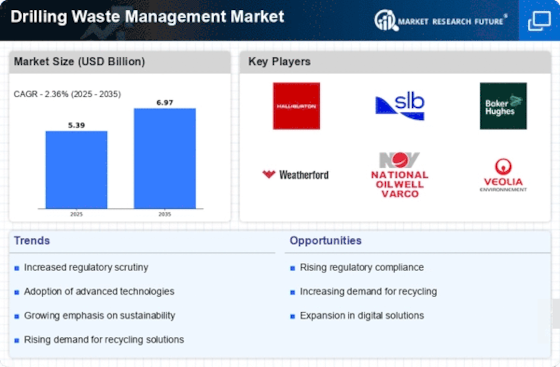
As per Market Research Future analysis, the Drilling Waste Management Market was estimated at 5.394 USD Billion in 2024. The drilling waste management industry is projected to grow from 5.522 USD Billion in 2025 to 6.972 USD Billion by 2035, exhibiting a compound annual growth rate (CAGR) of 2.36% during the forecast period 2025 - 2035

Key Market Trends & Highlights

The Drilling Waste Management Market is poised for growth driven by technological advancements and increasing regulatory pressures.

  • Technological advancements in waste management are reshaping operational efficiencies in North America, the largest market. Regulatory compliance and environmental standards are becoming increasingly stringent, particularly in the Asia-Pacific region, the fastest-growing market. Sustainability and corporate social responsibility initiatives are gaining traction, influencing practices across the industry. Economic growth and increased drilling activities, alongside technological innovations in drilling waste management, are key drivers of market expansion.

Market Size & Forecast

2024 Market Size 5.394 (USD Billion)
2035 Market Size 6.972 (USD Billion)
CAGR (2025 - 2035) 2.36%
Largest Regional Market Share in 2024 North America

Major Players

<a href="https://www.halliburton.com/en/well-construction/drilling">Halliburton </a>(US), Schlumberger (US), Baker Hughes (US), Weatherford International (US), National Oilwell Varco (US), Veolia Environnement (FR), Clean Harbors (US), SUEZ (FR), Tervita Corporation (CA)

Market Trends

The Drilling Waste Management Market is currently experiencing a transformative phase, driven by increasing regulatory pressures and a growing emphasis on environmental sustainability. Companies are compelled to adopt innovative waste management solutions that not only comply with stringent regulations but also minimize ecological footprints. This shift is evident as organizations seek to enhance operational efficiency while addressing the challenges posed by drilling waste. The integration of advanced technologies, such as real-time monitoring systems and automated waste treatment processes, appears to be gaining traction, suggesting a potential evolution in industry practices. Moreover, the rising awareness of the environmental impacts associated with drilling activities is prompting stakeholders to invest in more sustainable waste management strategies. This trend indicates a broader commitment to corporate social responsibility, as firms recognize the importance of maintaining a positive public image. As the Drilling Waste Management Market continues to evolve, it is likely that collaboration among industry players, regulatory bodies, and environmental organizations will play a crucial role in shaping future practices and standards. The focus on innovation and sustainability may lead to the development of new methodologies that enhance waste reduction and resource recovery, ultimately benefiting both the industry and the environment.

Technological Advancements in Waste Management

The Drilling Waste Management Market is witnessing a surge in the adoption of advanced technologies. Innovations such as automated waste treatment systems and real-time monitoring tools are becoming increasingly prevalent. These technologies not only enhance operational efficiency but also ensure compliance with environmental regulations, thereby reducing the ecological impact of drilling activities.

Regulatory Compliance and Environmental Standards

There is a growing emphasis on regulatory compliance within the Drilling Waste Management Market. Stricter environmental regulations are compelling companies to adopt more sustainable waste management practices. This trend indicates a shift towards greater accountability and transparency in waste disposal, as firms strive to meet the expectations of regulatory bodies and the public.

Sustainability and Corporate Social Responsibility

The focus on sustainability is becoming a defining characteristic of the Drilling Waste Management Market. Companies are increasingly recognizing the importance of corporate social responsibility, leading to investments in eco-friendly waste management solutions. This trend reflects a broader commitment to minimizing environmental impacts and promoting sustainable practices within the industry.

Drilling Waste Management Market Market Drivers

Growing Environmental Awareness

The Drilling Waste Management Market is witnessing a growing awareness of environmental issues among stakeholders, including consumers, investors, and regulatory agencies. This heightened awareness is prompting drilling companies to adopt more sustainable waste management practices. As public scrutiny increases, companies are compelled to demonstrate their commitment to environmental stewardship. This trend is reflected in the rising demand for eco-friendly waste management solutions, which are expected to capture a larger share of the market. The industry's shift towards sustainability is likely to be supported by initiatives aimed at reducing carbon footprints and promoting responsible resource use. Consequently, the market may see a significant increase in investments in innovative waste management technologies that align with these environmental goals.

Stringent Regulatory Frameworks

The Drilling Waste Management Market is significantly influenced by stringent regulatory frameworks that govern waste disposal and environmental protection. Governments and regulatory bodies are increasingly enforcing laws that require drilling companies to manage waste responsibly. Compliance with these regulations is not only a legal obligation but also a critical factor in maintaining a company's reputation. The market is projected to grow as companies invest in compliant waste management solutions to avoid penalties and enhance their operational sustainability. For example, the implementation of the Resource Conservation and Recovery Act (RCRA) in various regions mandates proper waste handling, which drives demand for advanced waste management technologies. This regulatory pressure is likely to propel the market forward, as companies seek to align with evolving environmental standards.

Corporate Social Responsibility Initiatives

The Drilling Waste Management Market is increasingly influenced by corporate social responsibility (CSR) initiatives adopted by drilling companies. As stakeholders demand greater accountability and transparency, companies are recognizing the importance of sustainable waste management practices as part of their CSR strategies. This shift is leading to the development of comprehensive waste management programs that prioritize environmental protection and community engagement. Companies that actively promote their waste management efforts are likely to enhance their brand image and attract environmentally conscious investors. The integration of CSR into business operations is expected to drive demand for innovative waste management solutions, as companies strive to meet both regulatory requirements and societal expectations. This trend may result in a more competitive landscape within the drilling waste management sector.

Economic Growth and Increased Drilling Activities

The Drilling Waste Management Market is poised for growth due to economic expansion and increased drilling activities across various sectors, including oil and gas, mining, and geothermal energy. As economies recover and energy demands rise, drilling operations are expected to increase, leading to a corresponding rise in drilling waste generation. This trend necessitates effective waste management solutions to handle the anticipated increase in waste volumes. The market is projected to expand as companies seek to implement efficient waste management practices to mitigate environmental impacts and comply with regulations. Furthermore, the rise in unconventional drilling techniques, such as hydraulic fracturing, is likely to contribute to the growth of the drilling waste management sector, as these methods generate substantial waste that requires specialized handling.

Technological Innovations in Drilling Waste Management

The Drilling Waste Management Market is experiencing a surge in technological innovations that enhance waste treatment processes. Advanced technologies such as centrifuges, thermal desorption units, and bioremediation techniques are being increasingly adopted. These innovations not only improve the efficiency of waste management but also reduce the environmental footprint of drilling operations. For instance, the implementation of automated systems for monitoring waste can lead to significant cost savings and improved compliance with environmental regulations. As a result, companies are likely to invest in these technologies to optimize their operations and minimize waste disposal costs, which are projected to reach USD 10 billion by 2026. This trend indicates a shift towards more sustainable practices within the drilling sector.

Market Segment Insights

By Service Type: Waste Treatment (Largest) vs. Waste Recycling (Fastest-Growing)

In the Drilling Waste Management Market, the service type segment is characterized by a diverse range of offerings, with waste treatment being the most prominent due to its essential role in ensuring compliance with environmental regulations and operational efficiency. Other significant services, including waste disposal and waste recycling, also play crucial roles, catering to different needs of the drilling industry. Consulting services, while smaller in share, provide critical expertise in optimizing drilling waste management processes. Growth trends in this segment indicate a robust shift towards more sustainable practices, which drives the demand for waste recycling services. The ongoing emphasis on environmental protection and regulatory compliance often leads companies to seek out effective waste treatment solutions, resulting in the solidification of waste treatment as a major service. Additionally, the increasing focus on circular economy principles boosts waste recycling activities, making it the fastest-growing segment as firms strive to minimize their environmental footprint.

Waste Treatment (Dominant) vs. Waste Recycling (Emerging)

Waste treatment services are characterized by systematic processes designed to manage and minimize drilling waste to meet environmental standards. This segment predominates in the market due to its necessity for compliance and operational efficiency, often involving chemical treatment, physical separation, and thermal treatment methods. On the other hand, waste recycling services represent an emerging trend as companies are increasingly looking to recover valuable materials from drilling waste, significantly reducing landfill dependency. Innovative recycling techniques and technologies are being developed to enhance recovery rates and resource utilization. While waste treatment secures its position as the dominant force, <a href="https://www.marketresearchfuture.com/reports/waste-recycling-service-market-25949">waste recycling</a> is rapidly becoming integral to sustainable drilling practices, signaling a shift in industry priorities towards more eco-friendly operations.

By Source of Waste: Drilling Operations (Largest) vs. Production Waste (Fastest-Growing)

In the Drilling Waste Management Market, the distribution of waste sources reveals that drilling operations account for the largest share, driven by continuous exploration and extraction activities. This segment generates substantial amounts of waste, primarily due to the drilling processes, resulting in significant management needs. On the other hand, production waste is rapidly emerging, reflecting the ever-increasing efficiency in production processes and greater focus on environmental sustainability, prompting the need for effective management solutions.

Drilling Operations: Dominant vs. Production Waste: Emerging

Drilling operations are characterized by their substantial contribution to the overall waste generated in oil and gas extraction. This segment dominates the market due to ongoing drilling activities and adherence to regulatory compliance regarding waste management. In contrast, production waste is emerging as a key focus area, gaining importance with advancements in recovery and production techniques. Companies are increasingly prioritizing innovative waste management strategies to handle this type efficiently. As production processes become more streamlined, the necessity for effective treatment and disposal methods for production waste is driving growth in this segment, showcasing its potential to reshape the dynamics of the market.

By Technology: Solids Control (Largest) vs. Thermal Desorption (Fastest-Growing)

In the Drilling Waste Management Market, the Technology segment is primarily dominated by Solids Control, reflecting substantial market share due to its essential role in enhancing drilling efficiency and ensuring compliance with environmental regulations. Following closely, Cuttings Treatment plays a significant part, yet it is Thermal Desorption that is making waves as the fastest-growing segment, supported by increased emphasis on eco-friendly waste disposal methods and innovative processing technologies. Bioremediation remains a vital segment, offering sustainable alternatives, although it shows slower growth relative to its peers.

Technology: Solids Control (Dominant) vs. Thermal Desorption (Emerging)

Solids Control leads the way in the Drilling Waste Management Market, showcasing its importance by minimizing waste and optimizing resource usage during drilling operations. This technology effectively segregates solids from liquids, ensuring cleaner disposal processes. Conversely, Thermal Desorption is emerging rapidly due to its high efficiency in treating drill cuttings, allowing for the recovery of hydrocarbons, which appeals to environmentally conscious stakeholders. Both technologies focus on sustainable practices, yet Solids Control is preferred for traditional operations while Thermal Desorption gains traction as the industry shifts towards more innovative and greener solutions.

By End User: Onshore (Largest) vs. Offshore (Fastest-Growing)

The end user segment of the drilling waste management market is prominently led by the Onshore sector, which captures a substantial share owing to the widespread drilling operations across various regions. This segment benefits from a greater number of active drilling sites and robust waste management regulations, leading to significant investments in efficient waste disposal solutions. Conversely, the Offshore segment is gaining momentum and rapidly growing as a result of increased drilling activities in offshore oil and gas exploration, which demands specialized waste management approaches and innovative technologies to address complex waste disposal challenges efficiently.

Onshore (Dominant) vs. Offshore (Emerging)

The Onshore segment stands out as the dominant player in the drilling waste management market, characterized by extensive infrastructure that supports a variety of drilling operations. This segment enjoys advantages such as easier access to waste management facilities and well-established practices for handling drilling waste. In contrast, the Offshore segment is emerging as a critical player due to its inherent challenges, including regulatory requirements and the need for tailored waste management solutions to address unique environmental concerns. As more companies venture into offshore drilling, the demand for advanced waste management systems grows, pushing innovation and investment in this segment.

Get more detailed insights about Drilling Waste Management Market Research Report – Forecast to 2035

Regional Insights

The Regional segment of the Drilling Waste Management Market shows considerable value, with the market expected to be valued at 5.27 USD Billion in 2023, escalating to 6.5 USD Billion by 2032. North America holds a major share, valued at 2.0 USD Billion in 2023 and projected to grow to 2.5 USD Billion, reflecting its strong demand for efficient waste management due to extensive drilling activities. Europe follows, contributing 1.3 USD Billion in 2023 and reaching 1.6 USD Billion by 2032, driven by stringent environmental regulations.

The APAC region, valued at 1.0 USD Billion in 2023 and expected to reach 1.2 USD Billion, shows significant growth potential owing to increasing exploration activities in countries like India and China.

South America and MEA contribute smaller yet important shares, with South America valued at 0.6 USD Billion, growing to 0.7 USD Billion, and MEA at 0.37 USD Billion, projected to increase to 0.5 USD Billion, indicating a gradual rise in importance as exploration activities expand. Overall, the market statistics highlight diverse growth opportunities across these regions, influenced by market trends, technological advancements, and environmental awareness.

Key Players and Competitive Insights

The Drilling Waste Management Market is characterized by its rapid growth and evolving dynamics, driven by the increasing focus on environmental sustainability and regulatory compliance in the oil and gas sector. As drilling operations generate a significant amount of waste, companies operating in this market are continually innovating and enhancing their service offerings to efficiently manage drilling waste. Competitive insights within this market highlight the necessity for companies to adopt advanced technologies and sustainable practices to maintain their market positions.
Analyzing competitors reveals valuable trends, such as consolidation within the sector and the growing importance of strategic partnerships, which have become essential for delivering comprehensive waste management solutions. Overall, understanding the competitive landscape of this market is crucial for stakeholders aiming to navigate its complexities and capitalize on emerging opportunities.
Tetra Tech stands out in the Drilling Waste Management Market due to its extensive expertise in environmental consulting and engineering systems. The company leverages its strong technical capabilities and innovative waste management solutions to address the unique challenges faced by the drilling industry. With its focus on sustainability and regulatory compliance, Tetra Tech enhances its market presence by offering tailored services that align with the specific requirements of drilling operations. Its commitment to leveraging advanced technologies for waste treatment, reduction, and disposal underscores its competitive edge.
By fostering strategic collaborations and maintaining a dedicated workforce, Tetra Tech continues to strengthen its position as a leader in the drilling waste management domain, ensuring efficient and environmentally responsible practices in waste handling.
DuraShell has established itself as a key player in the Drilling Waste Management Market through its specialized focus on providing high-quality containment solutions. The company's innovative products are designed to cater to the demanding needs of the drilling industry, ensuring compliance with environmental regulations while promoting operational efficiency. DuraShell is recognized for its superior engineering and manufacturing capabilities, allowing it to produce durable waste containment systems that enhance site safety and reduce environmental impact. By prioritizing customer satisfaction and environmental stewardship, DuraShell maintains a strong reputation within the market.
The company's emphasis on research and development enables it to continually improve its offerings, adapting to the evolving needs of the drilling waste management sector and strengthening its competitive advantage.

Key Companies in the Drilling Waste Management Market include

Industry Developments

The Drilling Waste Management Market is experiencing significant advancements with increasing regulatory pressure for sustainable practices and waste reduction. Recent developments include companies such as Tetra Tech and Clean Harbors expanding their service offerings to address the growing demand for effective waste management solutions in the drilling sector. Notable growth has been reported among major players, including Halliburton and Schlumberger, as they invest in innovative technologies and processes to enhance efficiency and environmental compliance.

Furthermore, recent mergers and acquisitions have reshaped the landscape, with companies like National Oilwell Varco acquiring smaller firms to broaden their portfolio and strengthen their market position. Ecolab's recent initiatives to integrate more eco-friendly practices into waste management strategies highlight the ongoing trend towards sustainability. As the market continues to evolve, companies like Baker Hughes and Veolia are focusing on advanced waste treatment methods, driving market valuation upward while mitigating environmental impacts. Such developments underscore the crucial role of effective drilling waste management in reducing operational costs and enhancing overall system performance across the industry.

Future Outlook

Drilling Waste Management Market Future Outlook

The Drilling Waste Management Market is projected to grow at a 2.36% CAGR from 2025 to 2035, driven by regulatory pressures, technological advancements, and increasing environmental awareness.

New opportunities lie in:

  • Development of advanced bioremediation technologies for waste treatment.
  • Integration of IoT for real-time waste monitoring and management.
  • Expansion of recycling facilities for drilling fluids and solids.

By 2035, the market is expected to achieve robust growth, driven by innovation and sustainability initiatives.

Market Segmentation

Drilling Waste Management Market End User Outlook

  • Onshore
  • Offshore
  • Geothermal
  • Mining

Drilling Waste Management Market Technology Outlook

  • Solids Control
  • Cuttings Treatment
  • Thermal Desorption
  • Bioremediation

Drilling Waste Management Market Service Type Outlook

  • Waste Treatment
  • Waste Disposal
  • Waste Recycling
  • Consulting

Drilling Waste Management Market Source of Waste Outlook

  • Drilling Operations
  • Reservoir Fluids
  • Completion and Workover Waste
  • Production Waste

Report Scope

MARKET SIZE 2024 5.394(USD Billion)
MARKET SIZE 2025 5.522(USD Billion)
MARKET SIZE 2035 6.972(USD Billion)
COMPOUND ANNUAL GROWTH RATE (CAGR) 2.36% (2025 - 2035)
REPORT COVERAGE Revenue Forecast, Competitive Landscape, Growth Factors, and Trends
BASE YEAR 2024
Market Forecast Period 2025 - 2035
Historical Data 2019 - 2024
Market Forecast Units USD Billion
Key Companies Profiled Halliburton (US), Schlumberger (US), Baker Hughes (US), Weatherford International (US), National Oilwell Varco (US), Veolia Environnement (FR), Clean Harbors (US), SUEZ (FR), Tervita Corporation (CA)
Segments Covered Service Type, Source of Waste, Technology, End User, Regional
Key Market Opportunities Adoption of advanced treatment technologies enhances efficiency in the Drilling Waste Management Market.
Key Market Dynamics Rising regulatory pressures and technological advancements drive innovation in drilling waste management solutions.
Countries Covered North America, Europe, APAC, South America, MEA

FAQs

What is the projected market valuation of the Drilling Waste Management Market by 2035?

<p>The projected market valuation for the Drilling Waste Management Market is 6.972 USD Billion by 2035.</p>

What was the overall market valuation of the Drilling Waste Management Market in 2024?

<p>The overall market valuation of the Drilling Waste Management Market was 5.394 USD Billion in 2024.</p>

What is the expected CAGR for the Drilling Waste Management Market during the forecast period 2025 - 2035?

<p>The expected CAGR for the Drilling Waste Management Market during the forecast period 2025 - 2035 is 2.36%.</p>

Which companies are considered key players in the Drilling Waste Management Market?

<p>Key players in the Drilling Waste Management Market include Halliburton, Schlumberger, Baker Hughes, and Weatherford International.</p>

What segment of the Drilling Waste Management Market had the highest valuation in 2024?

<p>In 2024, the Waste Disposal segment had the highest valuation at 1.8 USD Billion.</p>

How much is the Waste Treatment segment projected to grow by 2035?

<p>The Waste Treatment segment is projected to grow from 1.5 USD Billion in 2024 to 1.9 USD Billion by 2035.</p>

What is the valuation of the Bioremediation technology segment in 2024?

<p>The Bioremediation technology segment was valued at 2.116 USD Billion in 2024.</p>

Which end user segment is expected to show the most growth by 2035?

<p>The Onshore end user segment is expected to grow from 2.5 USD Billion in 2024 to 3.2 USD Billion by 2035.</p>

What was the valuation of the Production Waste source in 2024?

<p>The valuation of the Production Waste source was 1.694 USD Billion in 2024.</p>

How does the projected growth of the Drilling Waste Management Market compare to its 2024 valuation?

<p>The market is expected to grow from 5.394 USD Billion in 2024 to 6.972 USD Billion by 2035, indicating a positive trend.</p>

How is the market for Waste Recycling expected to evolve by 2032?

The Waste Recycling segment is expected to grow to 1.1 USD Billion by 2035.

  1. SECTION I: EXECUTIVE SUMMARY AND KEY HIGHLIGHTS
    1. | 1.1 EXECUTIVE SUMMARY
    2. | | 1.1.1 Market Overview
    3. | | 1.1.2 Key Findings
    4. | | 1.1.3 Market Segmentation
    5. | | 1.1.4 Competitive Landscape
    6. | | 1.1.5 Challenges and Opportunities
    7. | | 1.1.6 Future Outlook
  2. SECTION II: SCOPING, METHODOLOGY AND MARKET STRUCTURE
    1. | 2.1 MARKET INTRODUCTION
    2. | | 2.1.1 Definition
    3. | | 2.1.2 Scope of the study
    4. | | | 2.1.2.1 Research Objective
    5. | | | 2.1.2.2 Assumption
    6. | | | 2.1.2.3 Limitations
    7. | 2.2 RESEARCH METHODOLOGY
    8. | | 2.2.1 Overview
    9. | | 2.2.2 Data Mining
    10. | | 2.2.3 Secondary Research
    11. | | 2.2.4 Primary Research
    12. | | | 2.2.4.1 Primary Interviews and Information Gathering Process
    13. | | | 2.2.4.2 Breakdown of Primary Respondents
    14. | | 2.2.5 Forecasting Model
    15. | | 2.2.6 Market Size Estimation
    16. | | | 2.2.6.1 Bottom-Up Approach
    17. | | | 2.2.6.2 Top-Down Approach
    18. | | 2.2.7 Data Triangulation
    19. | | 2.2.8 Validation
  3. SECTION III: QUALITATIVE ANALYSIS
    1. | 3.1 MARKET DYNAMICS
    2. | | 3.1.1 Overview
    3. | | 3.1.2 Drivers
    4. | | 3.1.3 Restraints
    5. | | 3.1.4 Opportunities
    6. | 3.2 MARKET FACTOR ANALYSIS
    7. | | 3.2.1 Value chain Analysis
    8. | | 3.2.2 Porter's Five Forces Analysis
    9. | | | 3.2.2.1 Bargaining Power of Suppliers
    10. | | | 3.2.2.2 Bargaining Power of Buyers
    11. | | | 3.2.2.3 Threat of New Entrants
    12. | | | 3.2.2.4 Threat of Substitutes
    13. | | | 3.2.2.5 Intensity of Rivalry
    14. | | 3.2.3 COVID-19 Impact Analysis
    15. | | | 3.2.3.1 Market Impact Analysis
    16. | | | 3.2.3.2 Regional Impact
    17. | | | 3.2.3.3 Opportunity and Threat Analysis
  4. SECTION IV: QUANTITATIVE ANALYSIS
    1. | 4.1 Energy & Power, BY Service Type (USD Billion)
    2. | | 4.1.1 Waste Treatment
    3. | | 4.1.2 Waste Disposal
    4. | | 4.1.3 Waste Recycling
    5. | | 4.1.4 Consulting
    6. | 4.2 Energy & Power, BY Source of Waste (USD Billion)
    7. | | 4.2.1 Drilling Operations
    8. | | 4.2.2 Reservoir Fluids
    9. | | 4.2.3 Completion and Workover Waste
    10. | | 4.2.4 Production Waste
    11. | 4.3 Energy & Power, BY Technology (USD Billion)
    12. | | 4.3.1 Solids Control
    13. | | 4.3.2 Cuttings Treatment
    14. | | 4.3.3 Thermal Desorption
    15. | | 4.3.4 Bioremediation
    16. | 4.4 Energy & Power, BY End User (USD Billion)
    17. | | 4.4.1 Onshore
    18. | | 4.4.2 Offshore
    19. | | 4.4.3 Geothermal
    20. | | 4.4.4 Mining
    21. | 4.5 Energy & Power, BY Region (USD Billion)
    22. | | 4.5.1 North America
    23. | | | 4.5.1.1 US
    24. | | | 4.5.1.2 Canada
    25. | | 4.5.2 Europe
    26. | | | 4.5.2.1 Germany
    27. | | | 4.5.2.2 UK
    28. | | | 4.5.2.3 France
    29. | | | 4.5.2.4 Russia
    30. | | | 4.5.2.5 Italy
    31. | | | 4.5.2.6 Spain
    32. | | | 4.5.2.7 Rest of Europe
    33. | | 4.5.3 APAC
    34. | | | 4.5.3.1 China
    35. | | | 4.5.3.2 India
    36. | | | 4.5.3.3 Japan
    37. | | | 4.5.3.4 South Korea
    38. | | | 4.5.3.5 Malaysia
    39. | | | 4.5.3.6 Thailand
    40. | | | 4.5.3.7 Indonesia
    41. | | | 4.5.3.8 Rest of APAC
    42. | | 4.5.4 South America
    43. | | | 4.5.4.1 Brazil
    44. | | | 4.5.4.2 Mexico
    45. | | | 4.5.4.3 Argentina
    46. | | | 4.5.4.4 Rest of South America
    47. | | 4.5.5 MEA
    48. | | | 4.5.5.1 GCC Countries
    49. | | | 4.5.5.2 South Africa
    50. | | | 4.5.5.3 Rest of MEA
  5. SECTION V: COMPETITIVE ANALYSIS
    1. | 5.1 Competitive Landscape
    2. | | 5.1.1 Overview
    3. | | 5.1.2 Competitive Analysis
    4. | | 5.1.3 Market share Analysis
    5. | | 5.1.4 Major Growth Strategy in the Energy & Power
    6. | | 5.1.5 Competitive Benchmarking
    7. | | 5.1.6 Leading Players in Terms of Number of Developments in the Energy & Power
    8. | | 5.1.7 Key developments and growth strategies
    9. | | | 5.1.7.1 New Product Launch/Service Deployment
    10. | | | 5.1.7.2 Merger & Acquisitions
    11. | | | 5.1.7.3 Joint Ventures
    12. | | 5.1.8 Major Players Financial Matrix
    13. | | | 5.1.8.1 Sales and Operating Income
    14. | | | 5.1.8.2 Major Players R&D Expenditure. 2023
    15. | 5.2 Company Profiles
    16. | | 5.2.1 Halliburton (US)
    17. | | | 5.2.1.1 Financial Overview
    18. | | | 5.2.1.2 Products Offered
    19. | | | 5.2.1.3 Key Developments
    20. | | | 5.2.1.4 SWOT Analysis
    21. | | | 5.2.1.5 Key Strategies
    22. | | 5.2.2 Schlumberger (US)
    23. | | | 5.2.2.1 Financial Overview
    24. | | | 5.2.2.2 Products Offered
    25. | | | 5.2.2.3 Key Developments
    26. | | | 5.2.2.4 SWOT Analysis
    27. | | | 5.2.2.5 Key Strategies
    28. | | 5.2.3 Baker Hughes (US)
    29. | | | 5.2.3.1 Financial Overview
    30. | | | 5.2.3.2 Products Offered
    31. | | | 5.2.3.3 Key Developments
    32. | | | 5.2.3.4 SWOT Analysis
    33. | | | 5.2.3.5 Key Strategies
    34. | | 5.2.4 Weatherford International (US)
    35. | | | 5.2.4.1 Financial Overview
    36. | | | 5.2.4.2 Products Offered
    37. | | | 5.2.4.3 Key Developments
    38. | | | 5.2.4.4 SWOT Analysis
    39. | | | 5.2.4.5 Key Strategies
    40. | | 5.2.5 National Oilwell Varco (US)
    41. | | | 5.2.5.1 Financial Overview
    42. | | | 5.2.5.2 Products Offered
    43. | | | 5.2.5.3 Key Developments
    44. | | | 5.2.5.4 SWOT Analysis
    45. | | | 5.2.5.5 Key Strategies
    46. | | 5.2.6 Veolia Environnement (FR)
    47. | | | 5.2.6.1 Financial Overview
    48. | | | 5.2.6.2 Products Offered
    49. | | | 5.2.6.3 Key Developments
    50. | | | 5.2.6.4 SWOT Analysis
    51. | | | 5.2.6.5 Key Strategies
    52. | | 5.2.7 Clean Harbors (US)
    53. | | | 5.2.7.1 Financial Overview
    54. | | | 5.2.7.2 Products Offered
    55. | | | 5.2.7.3 Key Developments
    56. | | | 5.2.7.4 SWOT Analysis
    57. | | | 5.2.7.5 Key Strategies
    58. | | 5.2.8 SUEZ (FR)
    59. | | | 5.2.8.1 Financial Overview
    60. | | | 5.2.8.2 Products Offered
    61. | | | 5.2.8.3 Key Developments
    62. | | | 5.2.8.4 SWOT Analysis
    63. | | | 5.2.8.5 Key Strategies
    64. | | 5.2.9 Tervita Corporation (CA)
    65. | | | 5.2.9.1 Financial Overview
    66. | | | 5.2.9.2 Products Offered
    67. | | | 5.2.9.3 Key Developments
    68. | | | 5.2.9.4 SWOT Analysis
    69. | | | 5.2.9.5 Key Strategies
    70. | 5.3 Appendix
    71. | | 5.3.1 References
    72. | | 5.3.2 Related Reports
  6. LIST OF FIGURES
    1. | 6.1 MARKET SYNOPSIS
    2. | 6.2 NORTH AMERICA MARKET ANALYSIS
    3. | 6.3 US MARKET ANALYSIS BY SERVICE TYPE
    4. | 6.4 US MARKET ANALYSIS BY SOURCE OF WASTE
    5. | 6.5 US MARKET ANALYSIS BY TECHNOLOGY
    6. | 6.6 US MARKET ANALYSIS BY END USER
    7. | 6.7 CANADA MARKET ANALYSIS BY SERVICE TYPE
    8. | 6.8 CANADA MARKET ANALYSIS BY SOURCE OF WASTE
    9. | 6.9 CANADA MARKET ANALYSIS BY TECHNOLOGY
    10. | 6.10 CANADA MARKET ANALYSIS BY END USER
    11. | 6.11 EUROPE MARKET ANALYSIS
    12. | 6.12 GERMANY MARKET ANALYSIS BY SERVICE TYPE
    13. | 6.13 GERMANY MARKET ANALYSIS BY SOURCE OF WASTE
    14. | 6.14 GERMANY MARKET ANALYSIS BY TECHNOLOGY
    15. | 6.15 GERMANY MARKET ANALYSIS BY END USER
    16. | 6.16 UK MARKET ANALYSIS BY SERVICE TYPE
    17. | 6.17 UK MARKET ANALYSIS BY SOURCE OF WASTE
    18. | 6.18 UK MARKET ANALYSIS BY TECHNOLOGY
    19. | 6.19 UK MARKET ANALYSIS BY END USER
    20. | 6.20 FRANCE MARKET ANALYSIS BY SERVICE TYPE
    21. | 6.21 FRANCE MARKET ANALYSIS BY SOURCE OF WASTE
    22. | 6.22 FRANCE MARKET ANALYSIS BY TECHNOLOGY
    23. | 6.23 FRANCE MARKET ANALYSIS BY END USER
    24. | 6.24 RUSSIA MARKET ANALYSIS BY SERVICE TYPE
    25. | 6.25 RUSSIA MARKET ANALYSIS BY SOURCE OF WASTE
    26. | 6.26 RUSSIA MARKET ANALYSIS BY TECHNOLOGY
    27. | 6.27 RUSSIA MARKET ANALYSIS BY END USER
    28. | 6.28 ITALY MARKET ANALYSIS BY SERVICE TYPE
    29. | 6.29 ITALY MARKET ANALYSIS BY SOURCE OF WASTE
    30. | 6.30 ITALY MARKET ANALYSIS BY TECHNOLOGY
    31. | 6.31 ITALY MARKET ANALYSIS BY END USER
    32. | 6.32 SPAIN MARKET ANALYSIS BY SERVICE TYPE
    33. | 6.33 SPAIN MARKET ANALYSIS BY SOURCE OF WASTE
    34. | 6.34 SPAIN MARKET ANALYSIS BY TECHNOLOGY
    35. | 6.35 SPAIN MARKET ANALYSIS BY END USER
    36. | 6.36 REST OF EUROPE MARKET ANALYSIS BY SERVICE TYPE
    37. | 6.37 REST OF EUROPE MARKET ANALYSIS BY SOURCE OF WASTE
    38. | 6.38 REST OF EUROPE MARKET ANALYSIS BY TECHNOLOGY
    39. | 6.39 REST OF EUROPE MARKET ANALYSIS BY END USER
    40. | 6.40 APAC MARKET ANALYSIS
    41. | 6.41 CHINA MARKET ANALYSIS BY SERVICE TYPE
    42. | 6.42 CHINA MARKET ANALYSIS BY SOURCE OF WASTE
    43. | 6.43 CHINA MARKET ANALYSIS BY TECHNOLOGY
    44. | 6.44 CHINA MARKET ANALYSIS BY END USER
    45. | 6.45 INDIA MARKET ANALYSIS BY SERVICE TYPE
    46. | 6.46 INDIA MARKET ANALYSIS BY SOURCE OF WASTE
    47. | 6.47 INDIA MARKET ANALYSIS BY TECHNOLOGY
    48. | 6.48 INDIA MARKET ANALYSIS BY END USER
    49. | 6.49 JAPAN MARKET ANALYSIS BY SERVICE TYPE
    50. | 6.50 JAPAN MARKET ANALYSIS BY SOURCE OF WASTE
    51. | 6.51 JAPAN MARKET ANALYSIS BY TECHNOLOGY
    52. | 6.52 JAPAN MARKET ANALYSIS BY END USER
    53. | 6.53 SOUTH KOREA MARKET ANALYSIS BY SERVICE TYPE
    54. | 6.54 SOUTH KOREA MARKET ANALYSIS BY SOURCE OF WASTE
    55. | 6.55 SOUTH KOREA MARKET ANALYSIS BY TECHNOLOGY
    56. | 6.56 SOUTH KOREA MARKET ANALYSIS BY END USER
    57. | 6.57 MALAYSIA MARKET ANALYSIS BY SERVICE TYPE
    58. | 6.58 MALAYSIA MARKET ANALYSIS BY SOURCE OF WASTE
    59. | 6.59 MALAYSIA MARKET ANALYSIS BY TECHNOLOGY
    60. | 6.60 MALAYSIA MARKET ANALYSIS BY END USER
    61. | 6.61 THAILAND MARKET ANALYSIS BY SERVICE TYPE
    62. | 6.62 THAILAND MARKET ANALYSIS BY SOURCE OF WASTE
    63. | 6.63 THAILAND MARKET ANALYSIS BY TECHNOLOGY
    64. | 6.64 THAILAND MARKET ANALYSIS BY END USER
    65. | 6.65 INDONESIA MARKET ANALYSIS BY SERVICE TYPE
    66. | 6.66 INDONESIA MARKET ANALYSIS BY SOURCE OF WASTE
    67. | 6.67 INDONESIA MARKET ANALYSIS BY TECHNOLOGY
    68. | 6.68 INDONESIA MARKET ANALYSIS BY END USER
    69. | 6.69 REST OF APAC MARKET ANALYSIS BY SERVICE TYPE
    70. | 6.70 REST OF APAC MARKET ANALYSIS BY SOURCE OF WASTE
    71. | 6.71 REST OF APAC MARKET ANALYSIS BY TECHNOLOGY
    72. | 6.72 REST OF APAC MARKET ANALYSIS BY END USER
    73. | 6.73 SOUTH AMERICA MARKET ANALYSIS
    74. | 6.74 BRAZIL MARKET ANALYSIS BY SERVICE TYPE
    75. | 6.75 BRAZIL MARKET ANALYSIS BY SOURCE OF WASTE
    76. | 6.76 BRAZIL MARKET ANALYSIS BY TECHNOLOGY
    77. | 6.77 BRAZIL MARKET ANALYSIS BY END USER
    78. | 6.78 MEXICO MARKET ANALYSIS BY SERVICE TYPE
    79. | 6.79 MEXICO MARKET ANALYSIS BY SOURCE OF WASTE
    80. | 6.80 MEXICO MARKET ANALYSIS BY TECHNOLOGY
    81. | 6.81 MEXICO MARKET ANALYSIS BY END USER
    82. | 6.82 ARGENTINA MARKET ANALYSIS BY SERVICE TYPE
    83. | 6.83 ARGENTINA MARKET ANALYSIS BY SOURCE OF WASTE
    84. | 6.84 ARGENTINA MARKET ANALYSIS BY TECHNOLOGY
    85. | 6.85 ARGENTINA MARKET ANALYSIS BY END USER
    86. | 6.86 REST OF SOUTH AMERICA MARKET ANALYSIS BY SERVICE TYPE
    87. | 6.87 REST OF SOUTH AMERICA MARKET ANALYSIS BY SOURCE OF WASTE
    88. | 6.88 REST OF SOUTH AMERICA MARKET ANALYSIS BY TECHNOLOGY
    89. | 6.89 REST OF SOUTH AMERICA MARKET ANALYSIS BY END USER
    90. | 6.90 MEA MARKET ANALYSIS
    91. | 6.91 GCC COUNTRIES MARKET ANALYSIS BY SERVICE TYPE
    92. | 6.92 GCC COUNTRIES MARKET ANALYSIS BY SOURCE OF WASTE
    93. | 6.93 GCC COUNTRIES MARKET ANALYSIS BY TECHNOLOGY
    94. | 6.94 GCC COUNTRIES MARKET ANALYSIS BY END USER
    95. | 6.95 SOUTH AFRICA MARKET ANALYSIS BY SERVICE TYPE
    96. | 6.96 SOUTH AFRICA MARKET ANALYSIS BY SOURCE OF WASTE
    97. | 6.97 SOUTH AFRICA MARKET ANALYSIS BY TECHNOLOGY
    98. | 6.98 SOUTH AFRICA MARKET ANALYSIS BY END USER
    99. | 6.99 REST OF MEA MARKET ANALYSIS BY SERVICE TYPE
    100. | 6.100 REST OF MEA MARKET ANALYSIS BY SOURCE OF WASTE
    101. | 6.101 REST OF MEA MARKET ANALYSIS BY TECHNOLOGY
    102. | 6.102 REST OF MEA MARKET ANALYSIS BY END USER
    103. | 6.103 KEY BUYING CRITERIA OF ENERGY & POWER
    104. | 6.104 RESEARCH PROCESS OF MRFR
    105. | 6.105 DRO ANALYSIS OF ENERGY & POWER
    106. | 6.106 DRIVERS IMPACT ANALYSIS: ENERGY & POWER
    107. | 6.107 RESTRAINTS IMPACT ANALYSIS: ENERGY & POWER
    108. | 6.108 SUPPLY / VALUE CHAIN: ENERGY & POWER
    109. | 6.109 ENERGY & POWER, BY SERVICE TYPE, 2024 (% SHARE)
    110. | 6.110 ENERGY & POWER, BY SERVICE TYPE, 2024 TO 2035 (USD Billion)
    111. | 6.111 ENERGY & POWER, BY SOURCE OF WASTE, 2024 (% SHARE)
    112. | 6.112 ENERGY & POWER, BY SOURCE OF WASTE, 2024 TO 2035 (USD Billion)
    113. | 6.113 ENERGY & POWER, BY TECHNOLOGY, 2024 (% SHARE)
    114. | 6.114 ENERGY & POWER, BY TECHNOLOGY, 2024 TO 2035 (USD Billion)
    115. | 6.115 ENERGY & POWER, BY END USER, 2024 (% SHARE)
    116. | 6.116 ENERGY & POWER, BY END USER, 2024 TO 2035 (USD Billion)
    117. | 6.117 BENCHMARKING OF MAJOR COMPETITORS
  7. LIST OF TABLES
    1. | 7.1 LIST OF ASSUMPTIONS
    2. | | 7.1.1
    3. | 7.2 North America MARKET SIZE ESTIMATES; FORECAST
    4. | | 7.2.1 BY SERVICE TYPE, 2025-2035 (USD Billion)
    5. | | 7.2.2 BY SOURCE OF WASTE, 2025-2035 (USD Billion)
    6. | | 7.2.3 BY TECHNOLOGY, 2025-2035 (USD Billion)
    7. | | 7.2.4 BY END USER, 2025-2035 (USD Billion)
    8. | 7.3 US MARKET SIZE ESTIMATES; FORECAST
    9. | | 7.3.1 BY SERVICE TYPE, 2025-2035 (USD Billion)
    10. | | 7.3.2 BY SOURCE OF WASTE, 2025-2035 (USD Billion)
    11. | | 7.3.3 BY TECHNOLOGY, 2025-2035 (USD Billion)
    12. | | 7.3.4 BY END USER, 2025-2035 (USD Billion)
    13. | 7.4 Canada MARKET SIZE ESTIMATES; FORECAST
    14. | | 7.4.1 BY SERVICE TYPE, 2025-2035 (USD Billion)
    15. | | 7.4.2 BY SOURCE OF WASTE, 2025-2035 (USD Billion)
    16. | | 7.4.3 BY TECHNOLOGY, 2025-2035 (USD Billion)
    17. | | 7.4.4 BY END USER, 2025-2035 (USD Billion)
    18. | 7.5 Europe MARKET SIZE ESTIMATES; FORECAST
    19. | | 7.5.1 BY SERVICE TYPE, 2025-2035 (USD Billion)
    20. | | 7.5.2 BY SOURCE OF WASTE, 2025-2035 (USD Billion)
    21. | | 7.5.3 BY TECHNOLOGY, 2025-2035 (USD Billion)
    22. | | 7.5.4 BY END USER, 2025-2035 (USD Billion)
    23. | 7.6 Germany MARKET SIZE ESTIMATES; FORECAST
    24. | | 7.6.1 BY SERVICE TYPE, 2025-2035 (USD Billion)
    25. | | 7.6.2 BY SOURCE OF WASTE, 2025-2035 (USD Billion)
    26. | | 7.6.3 BY TECHNOLOGY, 2025-2035 (USD Billion)
    27. | | 7.6.4 BY END USER, 2025-2035 (USD Billion)
    28. | 7.7 UK MARKET SIZE ESTIMATES; FORECAST
    29. | | 7.7.1 BY SERVICE TYPE, 2025-2035 (USD Billion)
    30. | | 7.7.2 BY SOURCE OF WASTE, 2025-2035 (USD Billion)
    31. | | 7.7.3 BY TECHNOLOGY, 2025-2035 (USD Billion)
    32. | | 7.7.4 BY END USER, 2025-2035 (USD Billion)
    33. | 7.8 France MARKET SIZE ESTIMATES; FORECAST
    34. | | 7.8.1 BY SERVICE TYPE, 2025-2035 (USD Billion)
    35. | | 7.8.2 BY SOURCE OF WASTE, 2025-2035 (USD Billion)
    36. | | 7.8.3 BY TECHNOLOGY, 2025-2035 (USD Billion)
    37. | | 7.8.4 BY END USER, 2025-2035 (USD Billion)
    38. | 7.9 Russia MARKET SIZE ESTIMATES; FORECAST
    39. | | 7.9.1 BY SERVICE TYPE, 2025-2035 (USD Billion)
    40. | | 7.9.2 BY SOURCE OF WASTE, 2025-2035 (USD Billion)
    41. | | 7.9.3 BY TECHNOLOGY, 2025-2035 (USD Billion)
    42. | | 7.9.4 BY END USER, 2025-2035 (USD Billion)
    43. | 7.10 Italy MARKET SIZE ESTIMATES; FORECAST
    44. | | 7.10.1 BY SERVICE TYPE, 2025-2035 (USD Billion)
    45. | | 7.10.2 BY SOURCE OF WASTE, 2025-2035 (USD Billion)
    46. | | 7.10.3 BY TECHNOLOGY, 2025-2035 (USD Billion)
    47. | | 7.10.4 BY END USER, 2025-2035 (USD Billion)
    48. | 7.11 Spain MARKET SIZE ESTIMATES; FORECAST
    49. | | 7.11.1 BY SERVICE TYPE, 2025-2035 (USD Billion)
    50. | | 7.11.2 BY SOURCE OF WASTE, 2025-2035 (USD Billion)
    51. | | 7.11.3 BY TECHNOLOGY, 2025-2035 (USD Billion)
    52. | | 7.11.4 BY END USER, 2025-2035 (USD Billion)
    53. | 7.12 Rest of Europe MARKET SIZE ESTIMATES; FORECAST
    54. | | 7.12.1 BY SERVICE TYPE, 2025-2035 (USD Billion)
    55. | | 7.12.2 BY SOURCE OF WASTE, 2025-2035 (USD Billion)
    56. | | 7.12.3 BY TECHNOLOGY, 2025-2035 (USD Billion)
    57. | | 7.12.4 BY END USER, 2025-2035 (USD Billion)
    58. | 7.13 APAC MARKET SIZE ESTIMATES; FORECAST
    59. | | 7.13.1 BY SERVICE TYPE, 2025-2035 (USD Billion)
    60. | | 7.13.2 BY SOURCE OF WASTE, 2025-2035 (USD Billion)
    61. | | 7.13.3 BY TECHNOLOGY, 2025-2035 (USD Billion)
    62. | | 7.13.4 BY END USER, 2025-2035 (USD Billion)
    63. | 7.14 China MARKET SIZE ESTIMATES; FORECAST
    64. | | 7.14.1 BY SERVICE TYPE, 2025-2035 (USD Billion)
    65. | | 7.14.2 BY SOURCE OF WASTE, 2025-2035 (USD Billion)
    66. | | 7.14.3 BY TECHNOLOGY, 2025-2035 (USD Billion)
    67. | | 7.14.4 BY END USER, 2025-2035 (USD Billion)
    68. | 7.15 India MARKET SIZE ESTIMATES; FORECAST
    69. | | 7.15.1 BY SERVICE TYPE, 2025-2035 (USD Billion)
    70. | | 7.15.2 BY SOURCE OF WASTE, 2025-2035 (USD Billion)
    71. | | 7.15.3 BY TECHNOLOGY, 2025-2035 (USD Billion)
    72. | | 7.15.4 BY END USER, 2025-2035 (USD Billion)
    73. | 7.16 Japan MARKET SIZE ESTIMATES; FORECAST
    74. | | 7.16.1 BY SERVICE TYPE, 2025-2035 (USD Billion)
    75. | | 7.16.2 BY SOURCE OF WASTE, 2025-2035 (USD Billion)
    76. | | 7.16.3 BY TECHNOLOGY, 2025-2035 (USD Billion)
    77. | | 7.16.4 BY END USER, 2025-2035 (USD Billion)
    78. | 7.17 South Korea MARKET SIZE ESTIMATES; FORECAST
    79. | | 7.17.1 BY SERVICE TYPE, 2025-2035 (USD Billion)
    80. | | 7.17.2 BY SOURCE OF WASTE, 2025-2035 (USD Billion)
    81. | | 7.17.3 BY TECHNOLOGY, 2025-2035 (USD Billion)
    82. | | 7.17.4 BY END USER, 2025-2035 (USD Billion)
    83. | 7.18 Malaysia MARKET SIZE ESTIMATES; FORECAST
    84. | | 7.18.1 BY SERVICE TYPE, 2025-2035 (USD Billion)
    85. | | 7.18.2 BY SOURCE OF WASTE, 2025-2035 (USD Billion)
    86. | | 7.18.3 BY TECHNOLOGY, 2025-2035 (USD Billion)
    87. | | 7.18.4 BY END USER, 2025-2035 (USD Billion)
    88. | 7.19 Thailand MARKET SIZE ESTIMATES; FORECAST
    89. | | 7.19.1 BY SERVICE TYPE, 2025-2035 (USD Billion)
    90. | | 7.19.2 BY SOURCE OF WASTE, 2025-2035 (USD Billion)
    91. | | 7.19.3 BY TECHNOLOGY, 2025-2035 (USD Billion)
    92. | | 7.19.4 BY END USER, 2025-2035 (USD Billion)
    93. | 7.20 Indonesia MARKET SIZE ESTIMATES; FORECAST
    94. | | 7.20.1 BY SERVICE TYPE, 2025-2035 (USD Billion)
    95. | | 7.20.2 BY SOURCE OF WASTE, 2025-2035 (USD Billion)
    96. | | 7.20.3 BY TECHNOLOGY, 2025-2035 (USD Billion)
    97. | | 7.20.4 BY END USER, 2025-2035 (USD Billion)
    98. | 7.21 Rest of APAC MARKET SIZE ESTIMATES; FORECAST
    99. | | 7.21.1 BY SERVICE TYPE, 2025-2035 (USD Billion)
    100. | | 7.21.2 BY SOURCE OF WASTE, 2025-2035 (USD Billion)
    101. | | 7.21.3 BY TECHNOLOGY, 2025-2035 (USD Billion)
    102. | | 7.21.4 BY END USER, 2025-2035 (USD Billion)
    103. | 7.22 South America MARKET SIZE ESTIMATES; FORECAST
    104. | | 7.22.1 BY SERVICE TYPE, 2025-2035 (USD Billion)
    105. | | 7.22.2 BY SOURCE OF WASTE, 2025-2035 (USD Billion)
    106. | | 7.22.3 BY TECHNOLOGY, 2025-2035 (USD Billion)
    107. | | 7.22.4 BY END USER, 2025-2035 (USD Billion)
    108. | 7.23 Brazil MARKET SIZE ESTIMATES; FORECAST
    109. | | 7.23.1 BY SERVICE TYPE, 2025-2035 (USD Billion)
    110. | | 7.23.2 BY SOURCE OF WASTE, 2025-2035 (USD Billion)
    111. | | 7.23.3 BY TECHNOLOGY, 2025-2035 (USD Billion)
    112. | | 7.23.4 BY END USER, 2025-2035 (USD Billion)
    113. | 7.24 Mexico MARKET SIZE ESTIMATES; FORECAST
    114. | | 7.24.1 BY SERVICE TYPE, 2025-2035 (USD Billion)
    115. | | 7.24.2 BY SOURCE OF WASTE, 2025-2035 (USD Billion)
    116. | | 7.24.3 BY TECHNOLOGY, 2025-2035 (USD Billion)
    117. | | 7.24.4 BY END USER, 2025-2035 (USD Billion)
    118. | 7.25 Argentina MARKET SIZE ESTIMATES; FORECAST
    119. | | 7.25.1 BY SERVICE TYPE, 2025-2035 (USD Billion)
    120. | | 7.25.2 BY SOURCE OF WASTE, 2025-2035 (USD Billion)
    121. | | 7.25.3 BY TECHNOLOGY, 2025-2035 (USD Billion)
    122. | | 7.25.4 BY END USER, 2025-2035 (USD Billion)
    123. | 7.26 Rest of South America MARKET SIZE ESTIMATES; FORECAST
    124. | | 7.26.1 BY SERVICE TYPE, 2025-2035 (USD Billion)
    125. | | 7.26.2 BY SOURCE OF WASTE, 2025-2035 (USD Billion)
    126. | | 7.26.3 BY TECHNOLOGY, 2025-2035 (USD Billion)
    127. | | 7.26.4 BY END USER, 2025-2035 (USD Billion)
    128. | 7.27 MEA MARKET SIZE ESTIMATES; FORECAST
    129. | | 7.27.1 BY SERVICE TYPE, 2025-2035 (USD Billion)
    130. | | 7.27.2 BY SOURCE OF WASTE, 2025-2035 (USD Billion)
    131. | | 7.27.3 BY TECHNOLOGY, 2025-2035 (USD Billion)
    132. | | 7.27.4 BY END USER, 2025-2035 (USD Billion)
    133. | 7.28 GCC Countries MARKET SIZE ESTIMATES; FORECAST
    134. | | 7.28.1 BY SERVICE TYPE, 2025-2035 (USD Billion)
    135. | | 7.28.2 BY SOURCE OF WASTE, 2025-2035 (USD Billion)
    136. | | 7.28.3 BY TECHNOLOGY, 2025-2035 (USD Billion)
    137. | | 7.28.4 BY END USER, 2025-2035 (USD Billion)
    138. | 7.29 South Africa MARKET SIZE ESTIMATES; FORECAST
    139. | | 7.29.1 BY SERVICE TYPE, 2025-2035 (USD Billion)
    140. | | 7.29.2 BY SOURCE OF WASTE, 2025-2035 (USD Billion)
    141. | | 7.29.3 BY TECHNOLOGY, 2025-2035 (USD Billion)
    142. | | 7.29.4 BY END USER, 2025-2035 (USD Billion)
    143. | 7.30 Rest of MEA MARKET SIZE ESTIMATES; FORECAST
    144. | | 7.30.1 BY SERVICE TYPE, 2025-2035 (USD Billion)
    145. | | 7.30.2 BY SOURCE OF WASTE, 2025-2035 (USD Billion)
    146. | | 7.30.3 BY TECHNOLOGY, 2025-2035 (USD Billion)
    147. | | 7.30.4 BY END USER, 2025-2035 (USD Billion)
    148. | 7.31 PRODUCT LAUNCH/PRODUCT DEVELOPMENT/APPROVAL
    149. | | 7.31.1
    150. | 7.32 ACQUISITION/PARTNERSHIP
    151. | | 7.32.1

Energy & Power Market Segmentation

Energy & Power By Service Type (USD Billion, 2025-2035)

  • Waste Treatment
  • Waste Disposal
  • Waste Recycling
  • Consulting

Energy & Power By Source of Waste (USD Billion, 2025-2035)

  • Drilling Operations
  • Reservoir Fluids
  • Completion and Workover Waste
  • Production Waste

Energy & Power By Technology (USD Billion, 2025-2035)

  • Solids Control
  • Cuttings Treatment
  • Thermal Desorption
  • Bioremediation

Energy & Power By End User (USD Billion, 2025-2035)

  • Onshore
  • Offshore
  • Geothermal
  • Mining
Infographic

Free Sample Request

Kindly complete the form below to receive a free sample of this Report

Get Free Sample

Customer Strories

Compare Licence

×
Features License Type
Single User Multiuser License Enterprise User
Price $4,950 $5,950 $7,250
Maximum User Access Limit 1 User Upto 10 Users Unrestricted Access Throughout the Organization
Free Customization
Direct Access to Analyst
Deliverable Format
Platform Access
Discount on Next Purchase 10% 15% 15%
Printable Versions