
Request Free Sample ×

Kindly complete the form below to receive a free sample of this Report

* Please use a valid business email

Leading companies partner with us for data-driven Insights

clients tt-cursor
Hero Background
English
Chinese
French
Japanese
Korean
German
Spanish

Door Intercom Market Analysis

ID: MRFR/SEM/7174-CR
202 Pages
Apoorva Priyadarshi
April 2023

Door Intercom Market Size, Share and Research Report By Product Type (Outdoor Intercom System & Indoor Intercom System), By Sales Channel (Installers/Third-Party Service Providers, Builders, Electrical Wholesalers & Do-It-Yourself/Online), By Connectivity (Wired Systems [2-Wire Systems, Cat-5 Systems] & Wireless Systems [Wi-Fi, Radio Frequencies]), By Application (Apartments (Multi-Family Homes), Houses, Hotels, Offices, and Others) and Region (North America, Europe, Asia-Pacific & Rest of the World) - Industry Forecast Till 2035

Share:
Download PDF ×

We do not share your information with anyone. However, we may send you emails based on your report interest from time to time. You may contact us at any time to opt-out.

Door Intercom Market Infographic
Purchase Options

Market Analysis

In-depth Analysis of Door Intercom Market Industry Landscape

The Door Intercom marketplace is a dynamic and evolving zone driven by the increasing demand for protection solutions in both residential and industrial settings. As the era advances, Door Intercom structures have come to be more state-of-the-art, providing more suitable capabilities and functionalities. One of the key market dynamics is the developing attention to the importance of protection, leading to an uptick in demand for dependable and advanced Door Intercom answers. The residential segment plays a vital role in the Door Intercom market dynamics, with homeowners searching for structures that provide now not only the best fundamental communique but also advanced safety capabilities. The integration of video abilities, biometric authentication, and remote access to control has come to be a trend within the market, catering to the growing concerns about safety and convenience. This evolution in generation is fostering competition among producers to expand modern solutions, riding the market ahead. Furthermore, the market dynamics are encouraged by the growing adoption of cloud-based total solutions. Cloud integration allows for far-flung tracking and management of Door Intercom systems, offering extra flexibility and scalability. This shift towards cloud-primarily based answers is driven by the want for centralized manipulation and real-time right of entry to information, permitting customers to reply right away to security events and manage to get the right of entry to permissions effectively. Another noteworthy aspect of the Door Intercom market dynamics is the effect of the Internet of Things (IoT). The integration of Door Intercom structures with IoT technology permits seamless connectivity with different clever gadgets, creating a complete environment for domestic automation and protection. This interconnectivity now not only enhances user experience but also opens new avenues for innovation within the marketplace. Market opposition is a driving force in shaping the dynamics of the Door Intercom industry. Key players are continuously investing in studies and improvement to live ahead of the curve, introducing products with superior functions and progress performance. This opposition fosters innovation, blessings customers with a much wider variety of alternatives, and contributes to the overall boom of the market.


Author
Author Profile
Apoorva Priyadarshi
Research Analyst

With 4+ years of experience in Market Intelligence and Strategic Research, Apoorv specializes in ICT, Semiconductor, and BFSI markets. Combining strong analytical capabilities with a deep understanding of technology-driven industries, he focuses on delivering data-driven insights that support strategic decision-making. With a background in technology and business research, Apoorv has contributed to numerous global market studies, competitive landscape analyses, and opportunity assessments across sectors such as semiconductors, digital banking, cybersecurity, and telecommunications.

Leave a Comment

FAQs

What is the projected market valuation of the Door Intercom Market by 2035?

<p>The Door Intercom Market is projected to reach approximately 8.358 USD Million by 2035.</p>

What was the market valuation of the Door Intercom Market in 2024?

<p>In 2024, the Door Intercom Market was valued at 3.4 USD Million.</p>

What is the expected CAGR for the Door Intercom Market during the forecast period 2025 - 2035?

<p>The expected CAGR for the Door Intercom Market during the forecast period 2025 - 2035 is 8.52%.</p>

Which companies are considered key players in the Door Intercom Market?

<p>Key players in the Door Intercom Market include Aiphone, TMEZON, AMOCAM, Samcom, 1byone, Ring, Nest, and Toshiba.</p>

What are the main types of door intercom systems available in the market?

<p>The main types of door intercom systems are Outdoor Intercom Systems and Indoor Intercom Systems, with valuations of 3.2 USD Million and 5.158 USD Million respectively.</p>

How do sales channels impact the Door Intercom Market?

Sales channels such as Installers, Builders, and Do-It-Yourself/Online options are projected to generate revenues of 2.5 USD Million, 3.2 USD Million, and 1.1 USD Million respectively.

What is the valuation of wired versus wireless door intercom systems?

Wired Systems are valued at 4.2 USD Million, while Wireless Systems are valued at 4.158 USD Million.

Which applications are driving growth in the Door Intercom Market?

Applications such as Apartments, Houses, and Hotels are driving growth, with valuations of 2.5 USD Million, 2.0 USD Million, and 1.5 USD Million respectively.

What segment shows the highest revenue potential in the Door Intercom Market?

The Builders segment appears to show the highest revenue potential, with a projected valuation of 3.2 USD Million.

How does the Door Intercom Market's growth compare across different applications?

The growth across applications varies, with Apartments leading at 2.5 USD Million, followed by Houses at 2.0 USD Million.

Market Summary

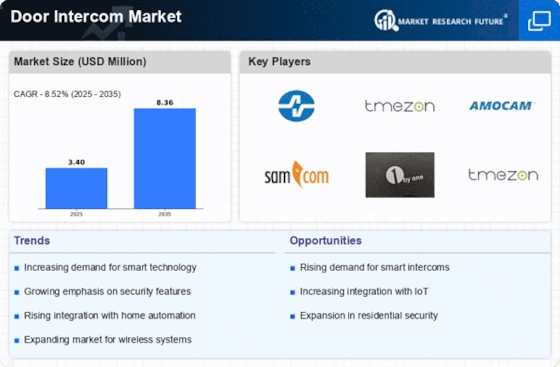
As per Market Research Future analysis, the Door Intercom Market Size was estimated at 3.4 USD Million in 2024. The Door Intercom industry is projected to grow from USD 3.69 Million in 2025 to USD 8.358 Million by 2035, exhibiting a compound annual growth rate (CAGR) of 8.52% during the forecast period 2025 - 2035

Key Market Trends & Highlights

The Door Intercom Market is experiencing a dynamic shift towards smart integration and enhanced security features.

  • The market is witnessing a notable integration with smart home systems, particularly in North America.
  • Wireless solutions are increasingly preferred, reflecting a trend towards convenience and flexibility in the Asia-Pacific region.
  • Enhanced security features are becoming a focal point, driven by rising consumer awareness and demand for safety.
  • The growing demand for security solutions and technological advancements in communication are key drivers propelling market growth.

Market Size & Forecast

2024 Market Size 3.4 (USD Million)
2035 Market Size 8.358 (USD Million)
CAGR (2025 - 2035) 8.52%
Largest Regional Market Share in 2024 Asia Pacific

Major Players

Aiphone (JP), TMEZON (US), AMOCAM (US), Samcom (US), 1byone (CN), TMEZON (US), Ring (US), Nest (US), Toshiba (JP)

Market Trends

The Door Intercom Market is currently experiencing a notable transformation, driven by advancements in technology and increasing consumer demand for enhanced security solutions. As urbanization continues to rise, the need for effective communication systems in residential and commercial properties becomes more pronounced. This market appears to be evolving towards smart intercom systems that integrate seamlessly with other home automation devices, thereby providing users with greater convenience and control. Furthermore, the growing emphasis on safety and security is likely to propel the adoption of video intercoms, which offer visual verification of visitors, thus enhancing peace of mind for users. In addition to technological advancements, the Door Intercom Market is also influenced by changing consumer preferences. There seems to be a shift towards wireless intercom systems, which offer flexibility and ease of installation compared to traditional wired options. This trend may be further supported by the increasing availability of mobile applications that allow users to monitor and control their intercom systems remotely. As the market continues to expand, manufacturers are likely to focus on developing innovative features that cater to the evolving needs of consumers, ensuring that the Door Intercom Market remains competitive and dynamic.

Integration with Smart Home Systems

The trend towards integrating door intercoms with smart home systems is gaining traction. This integration allows users to control their intercoms through mobile applications, enhancing convenience and accessibility. As smart home technology becomes more prevalent, the demand for intercoms that can seamlessly connect with other devices is likely to increase.

Rise of Wireless Solutions

There is a noticeable shift towards wireless door intercom systems, which offer ease of installation and flexibility. These systems eliminate the need for extensive wiring, making them appealing to both homeowners and businesses. The convenience of wireless technology may drive further adoption in various settings.

Focus on Enhanced Security Features

The Door Intercom Market is witnessing a growing emphasis on enhanced security features, such as video capabilities and remote access. Consumers are increasingly prioritizing safety, leading to a demand for intercoms that provide visual verification and real-time monitoring. This focus on security is likely to shape future product developments.

Door Intercom Market Market Drivers

Increased Focus on Aesthetic Design

The Door Intercom Market is also witnessing a growing emphasis on aesthetic design and customization. As consumers become more discerning about the appearance of their home and office environments, manufacturers are responding by offering intercom systems that blend functionality with style. Data reveals that nearly 30% of consumers consider design as a critical factor when selecting intercom systems. This trend suggests that companies that prioritize aesthetic appeal alongside technological features may gain a competitive edge in the market. By providing customizable options, such as various finishes and styles, the Door Intercom Market can cater to diverse consumer preferences, thereby enhancing market attractiveness and driving sales.

Growing Demand for Security Solutions

The increasing concern for safety and security in residential and commercial properties drives the Door Intercom Market. As urbanization continues to rise, the need for effective security measures becomes paramount. According to recent data, the demand for security systems, including door intercoms, is projected to grow at a compound annual growth rate of approximately 10% over the next five years. This trend indicates that consumers are increasingly investing in technologies that enhance their security, thereby propelling the Door Intercom Market forward. Furthermore, the integration of advanced features such as video surveillance and remote access capabilities is likely to attract more customers, as they seek comprehensive security solutions that provide peace of mind.

Regulatory Support for Security Systems

Regulatory frameworks and government initiatives aimed at enhancing public safety are likely to bolster the Door Intercom Market. Many regions are implementing stricter building codes and safety regulations that mandate the installation of security systems in new constructions. This regulatory support creates a favorable environment for the adoption of door intercom systems, as builders and property developers seek to comply with these requirements. Recent reports indicate that regions with stringent safety regulations have seen a 15% increase in the installation of security systems, including intercoms. As such, the Door Intercom Market stands to benefit from these regulatory trends, which encourage investment in security technologies and promote consumer confidence in the effectiveness of intercom solutions.

Rising Adoption of Smart Home Technologies

The increasing adoption of smart home technologies significantly influences the Door Intercom Market. As homeowners seek to enhance convenience and security, the integration of door intercom systems with smart home ecosystems becomes more prevalent. Recent statistics suggest that approximately 40% of households are now equipped with at least one smart device, creating a fertile ground for the expansion of smart intercom solutions. This trend indicates a shift towards interconnected devices that can be controlled remotely, allowing users to manage their home security more effectively. Consequently, the Door Intercom Market is likely to experience substantial growth as manufacturers innovate to meet the demands of tech-savvy consumers who prioritize seamless integration and user-friendly interfaces.

Technological Advancements in Communication

Technological innovations play a crucial role in shaping the Door Intercom Market. The advent of high-definition video technology, improved audio clarity, and the integration of mobile applications have transformed traditional intercom systems into sophisticated communication devices. As of October 2025, the market is witnessing a shift towards smart intercom systems that allow users to communicate with visitors via their smartphones, regardless of their location. This trend is supported by data indicating that nearly 60% of consumers prefer intercom systems that offer mobile connectivity. Such advancements not only enhance user experience but also drive the demand for modern intercom solutions, thereby contributing to the growth of the Door Intercom Market.

Market Segment Insights

By Type: Outdoor Intercom System (Largest) vs. Indoor Intercom System (Fastest-Growing)

<p>In the Door Intercom Market, the Outdoor Intercom System holds the largest share, catering to the growing demand for exterior security solutions. Consumers prioritize outdoor intercoms for enhanced security at entry points, contributing to their leading position. Meanwhile, the Indoor Intercom System has garnered significant attention, aligning with trends in smart home technology and rising demand for seamless communication within households. This has allowed indoor systems to establish a substantial presence, captivating consumers with features such as video integration and smartphone connectivity.</p>

<p>Intercom Systems: Outdoor (Dominant) vs. Indoor (Emerging)</p>

<p>The Outdoor Intercom System is recognized for its robust construction and comprehensive safety features, making it a dominant choice among consumers focused on enhancing their property’s security. These systems often incorporate weather-resistant materials, high-definition cameras, and advanced communication technology, ensuring reliable performance in various environmental conditions. Conversely, the Indoor Intercom System is emerging rapidly, driven by increasing consumer preference for smart home integration. These systems are characterized by user-friendly interfaces, interconnectivity with other smart devices, and innovative features, such as mobile app control, catering to the growing demand for easy, efficient communication within the home.</p>

By Sales Channel: Installers/ Third-Party Service Providers (Largest) vs. Do-It-Yourself/Online (Fastest-Growing)

<p>In the Door Intercom Market, the distribution of market share among sales channels reveals that Installers and Third-Party Service Providers hold the largest share, attributed to their established relationships with consumers and expertise in installation. Builders also play a significant role, capitalizing on new construction developments. However, the Do-It-Yourself and Online segment is rapidly gaining traction, appealing particularly to tech-savvy consumers looking for flexible and cost-effective solutions.</p>

<p>Installers/Third-Party Service Providers (Dominant) vs. Do-It-Yourself/Online (Emerging)</p>

<p>The Installers and Third-Party Service Providers segment is characterized by strong customer relationships and trusted expertise, enabling them to dominate the Door Intercom Market. This channel benefits from providing tailored solutions and professional installation, which reassures consumers of the product's quality and performance. On the other hand, the Do-It-Yourself and Online segment represents an emerging trend driven by the growing popularity of e-commerce and consumer empowerment. With a focus on convenience and competitive pricing, this segment is appealing to a younger demographic that prefers self-installation. The online availability of door intercom systems is fostering a new range of product offerings that cater to various customer preferences.</p>

By Connectivity: Wired Systems (Largest) vs. Wireless Systems (Fastest-Growing)

<p>In the Door Intercom Market, wired systems currently hold the largest market share, favored for their reliability and minimal interference. Many businesses and residential complexes continue to opt for wired solutions due to their durability and consistent performance. Conversely, wireless systems, while holding a smaller share, are rapidly gaining traction due to their ease of installation and flexibility in expanding security measures. This shift towards wireless technology reflects a change in consumer preferences towards more adaptable solutions.</p>

<p>Connectivity: Wired Systems (Dominant) vs. Wireless Systems (Emerging)</p>

<p>Wired systems in the Door Intercom Market are characterized by their robust infrastructure, providing consistent audio and video quality. This makes them the preferred choice for larger properties, as they require less maintenance and have a proven track record of reliability. On the contrary, wireless systems are emerging strongly, driven by advancements in technology and consumer demand for convenience. These systems offer easier installation and the ability to integrate with existing smart home systems, appealing to tech-savvy consumers. As connectivity needs evolve, the wireless segment is projected to expand significantly, positioning itself as a vital player in the market.</p>

By Application: Apartments (Largest) vs. Offices (Fastest-Growing)

<p>In the Door Intercom Market, the application segments showcase a dynamic distribution of market share. Apartments, which include multi-family homes, are currently the largest segment due to the increasing urbanization and the need for security in residential complexes. Houses, being single-family homes, follow closely but do not match the increasing trend of apartment construction. Hotels and offices are also significant contributors, albeit at a smaller scale, with offices seeing a notable surge in installation as businesses prioritize employee safety and access control.</p>

<p>Residential: Apartments (Dominant) vs. Offices (Emerging)</p>

<p>The dominance of apartments in the Door Intercom Market is attributed to multifamily living trends that emphasize security and convenience. This sector drives demand for advanced intercom systems capable of managing numerous access points effectively. On the other hand, the office segment is emerging rapidly, fueled by shifts in work environments post-pandemic that push for enhanced security measures. Offices are integrating intercom systems to streamline visitor management and upgrade security protocols, thus creating a growing opportunity for innovative intercom solutions designed for business needs.</p>

Get more detailed insights about Door Intercom Market Research Report - Global Forecast till 2035

Regional Insights

North America : Technological Innovation Leader

North America is witnessing significant growth in the door intercom market, driven by increasing demand for smart home technologies and enhanced security solutions. The region holds approximately 45% of the global market share, making it the largest market. Regulatory support for smart technology integration and consumer preference for advanced security systems are key growth drivers. The United States is the leading country in this market, with major players like Ring, Nest, and TMEZON dominating the landscape. The competitive environment is characterized by continuous innovation and the introduction of new features, such as video capabilities and mobile integration. Canada also contributes significantly, focusing on energy-efficient and user-friendly intercom solutions, further enhancing market dynamics.

Europe : Emerging Market for Security Solutions

Europe is emerging as a significant player in the door intercom market, driven by increasing security concerns and regulatory support for smart technologies. The region accounts for approximately 30% of the global market share, with Germany and the UK being the largest contributors. The European Union's initiatives to enhance digital security and promote smart home technologies are pivotal in driving market growth. Germany leads the market with a strong presence of key players like Aiphone and Toshiba, focusing on innovative solutions that meet stringent regulatory standards. The UK follows closely, with a growing demand for integrated security systems in residential and commercial sectors. The competitive landscape is marked by collaborations and technological advancements, ensuring a robust market environment.

Asia-Pacific : Rapidly Growing Market Potential

Asia-Pacific is rapidly becoming a key player in the door intercom market, driven by urbanization and increasing disposable incomes. The region holds about 20% of the global market share, with China and Japan leading the way. The growing trend of smart cities and government initiatives to enhance urban security are significant factors contributing to market growth. China is the largest market in the region, with a strong presence of local manufacturers like 1byone and AMOCAM. Japan follows closely, with established brands like Aiphone focusing on high-quality and innovative intercom solutions. The competitive landscape is characterized by a mix of local and international players, fostering innovation and affordability in the market.

Middle East and Africa : Emerging Security Solutions Market

The Middle East and Africa region is witnessing a gradual increase in the door intercom market, driven by urbanization and rising security concerns. The region holds approximately 5% of the global market share, with the UAE and South Africa being the largest markets. Government initiatives to improve urban infrastructure and enhance security measures are key growth drivers. The UAE is leading the market, with a focus on luxury residential developments and smart home technologies. South Africa follows, with increasing demand for affordable security solutions. The competitive landscape is evolving, with both local and international players entering the market, aiming to meet the growing demand for advanced intercom systems.

Key Players and Competitive Insights

Major market players are spending a lot of money on R&D to increase their product lines, which will help the Door Intercom Market grow even more. Market participants are also taking a range of strategic initiatives to grow their worldwide footprint, including new product launches, contractual agreements, mergers and acquisitions, increased investments, and collaboration with other organizations. Competitors in the Door Intercom industry must offer cost-effective items to expand and survive in an increasingly competitive and rising market environment.Dahua Technology Co., Ltd’s strategy focuses on AIoT and the IoT Digital Intelligence Platform, strengthening the fundamental research system. At the same time, the company is gaining insights into industry scenarios and has an in-depth understanding of client needs. With its partners, the company aims to build a smart IoT ecosystem featuring co-construction to provide clients with improved smart IoT solutions, facilitate the digital innovation of cities and the intelligent digital upgrade of enterprises, and boost the sustainable, green, and high-quality development of the economy and society.

Key Companies in the Door Intercom Market include

Industry Developments

April 2022: Hager Group expanded its production capacity with a new production facility in Obernai, France. The company inaugurated its 2,600 m² production facility. The facility is set to increase gradual capacity by over 40% in the first year, doubling it in the coming years.

March 2022: Gira launched its official YouTube channel, providing a full range of content related to intelligent building design and management. The channel provides the latest ideas to enable smart home living while underlining the quality and utility of its extensive product range.

January 2020: Samsung Electronics acquired TeleWorld Solutions (TWS), a network services provider in the United States, as a part of its plans to boost 5G network business revenue. The acquisition of TWS will address the need for end-to-end support in delivering network solutions. The service offerings and customers of TWS complement Samsung’s growth among network infrastructure clients.

Intended Audience

  • Technology Investors
  • Regulatory Industries
  • Government Bodies
  • Defense industry
  • Public Safety Industry
  • Architects
  • Contractors
  • Security system integrators
  • Property managers
  • Building owners
  • Homeowners
  • Businesses such as hotels
  • Apartment complexes
  • Office buildings

Future Outlook

Door Intercom Market Future Outlook

The Door Intercom Market is projected to grow at an 8.52% CAGR from 2025 to 2035, driven by technological advancements, increased security concerns, and urbanization.

New opportunities lie in:

  • Integration of AI-driven <a href="https://www.marketresearchfuture.com/reports/facial-recognition-market-1250" target="_blank" title="facial recognition">facial recognition</a> technology
  • Expansion into smart home ecosystems
  • Development of subscription-based maintenance services

By 2035, the market is expected to be robust, reflecting substantial growth and innovation.

Market Segmentation

Door Intercom Market Type Outlook

  • Outdoor Intercom System
  • Indoor Intercom System

Door Intercom Market Application Outlook

  • Apartments (Multi Family Homes)
  • Houses (Single Family Homes)
  • Hotels
  • Offices
  • Others

Door Intercom Market Connectivity Outlook

  • Wired Systems
  • Wireless Systems

Door Intercom Market Sales Channel Outlook

  • Installers/ Third-Party Service Providers
  • Builders
  • Electrical Wholesalers
  • Do-It-Yourself/Online

Report Scope

MARKET SIZE 2024 3.4(USD Million)
MARKET SIZE 2025 3.69(USD Million)
MARKET SIZE 2035 8.358(USD Million)
COMPOUND ANNUAL GROWTH RATE (CAGR) 8.52% (2025 - 2035)
REPORT COVERAGE Revenue Forecast, Competitive Landscape, Growth Factors, and Trends
BASE YEAR 2024
Market Forecast Period 2025 - 2035
Historical Data 2019 - 2024
Market Forecast Units USD Million
Key Companies Profiled Aiphone (JP), TMEZON (US), AMOCAM (US), Samcom (US), 1byone (CN), TMEZON (US), Ring (US), Nest (US), Toshiba (JP)
Segments Covered Product Type, Sales Channel, Connectivity, Application
Key Market Opportunities Integration of smart technology and enhanced security features in the Door Intercom Market.
Key Market Dynamics Rising consumer demand for smart home integration drives innovation and competition in the door intercom market.
Countries Covered North America, Europe, APAC, South America, MEA

FAQs

What is the projected market valuation of the Door Intercom Market by 2035?

<p>The Door Intercom Market is projected to reach approximately 8.358 USD Million by 2035.</p>

What was the market valuation of the Door Intercom Market in 2024?

<p>In 2024, the Door Intercom Market was valued at 3.4 USD Million.</p>

What is the expected CAGR for the Door Intercom Market during the forecast period 2025 - 2035?

<p>The expected CAGR for the Door Intercom Market during the forecast period 2025 - 2035 is 8.52%.</p>

Which companies are considered key players in the Door Intercom Market?

<p>Key players in the Door Intercom Market include Aiphone, TMEZON, AMOCAM, Samcom, 1byone, Ring, Nest, and Toshiba.</p>

What are the main types of door intercom systems available in the market?

<p>The main types of door intercom systems are Outdoor Intercom Systems and Indoor Intercom Systems, with valuations of 3.2 USD Million and 5.158 USD Million respectively.</p>

How do sales channels impact the Door Intercom Market?

Sales channels such as Installers, Builders, and Do-It-Yourself/Online options are projected to generate revenues of 2.5 USD Million, 3.2 USD Million, and 1.1 USD Million respectively.

What is the valuation of wired versus wireless door intercom systems?

Wired Systems are valued at 4.2 USD Million, while Wireless Systems are valued at 4.158 USD Million.

Which applications are driving growth in the Door Intercom Market?

Applications such as Apartments, Houses, and Hotels are driving growth, with valuations of 2.5 USD Million, 2.0 USD Million, and 1.5 USD Million respectively.

What segment shows the highest revenue potential in the Door Intercom Market?

The Builders segment appears to show the highest revenue potential, with a projected valuation of 3.2 USD Million.

How does the Door Intercom Market's growth compare across different applications?

The growth across applications varies, with Apartments leading at 2.5 USD Million, followed by Houses at 2.0 USD Million.

  1. SECTION I: EXECUTIVE SUMMARY AND KEY HIGHLIGHTS
    1. | 1.1 EXECUTIVE SUMMARY
    2. | | 1.1.1 Market Overview
    3. | | 1.1.2 Key Findings
    4. | | 1.1.3 Market Segmentation
    5. | | 1.1.4 Competitive Landscape
    6. | | 1.1.5 Challenges and Opportunities
    7. | | 1.1.6 Future Outlook
  2. SECTION II: SCOPING, METHODOLOGY AND MARKET STRUCTURE
    1. | 2.1 MARKET INTRODUCTION
    2. | | 2.1.1 Definition
    3. | | 2.1.2 Scope of the study
    4. | | | 2.1.2.1 Research Objective
    5. | | | 2.1.2.2 Assumption
    6. | | | 2.1.2.3 Limitations
    7. | 2.2 RESEARCH METHODOLOGY
    8. | | 2.2.1 Overview
    9. | | 2.2.2 Data Mining
    10. | | 2.2.3 Secondary Research
    11. | | 2.2.4 Primary Research
    12. | | | 2.2.4.1 Primary Interviews and Information Gathering Process
    13. | | | 2.2.4.2 Breakdown of Primary Respondents
    14. | | 2.2.5 Forecasting Model
    15. | | 2.2.6 Market Size Estimation
    16. | | | 2.2.6.1 Bottom-Up Approach
    17. | | | 2.2.6.2 Top-Down Approach
    18. | | 2.2.7 Data Triangulation
    19. | | 2.2.8 Validation
  3. SECTION III: QUALITATIVE ANALYSIS
    1. | 3.1 MARKET DYNAMICS
    2. | | 3.1.1 Overview
    3. | | 3.1.2 Drivers
    4. | | 3.1.3 Restraints
    5. | | 3.1.4 Opportunities
    6. | 3.2 MARKET FACTOR ANALYSIS
    7. | | 3.2.1 Value chain Analysis
    8. | | 3.2.2 Porter's Five Forces Analysis
    9. | | | 3.2.2.1 Bargaining Power of Suppliers
    10. | | | 3.2.2.2 Bargaining Power of Buyers
    11. | | | 3.2.2.3 Threat of New Entrants
    12. | | | 3.2.2.4 Threat of Substitutes
    13. | | | 3.2.2.5 Intensity of Rivalry
    14. | | 3.2.3 COVID-19 Impact Analysis
    15. | | | 3.2.3.1 Market Impact Analysis
    16. | | | 3.2.3.2 Regional Impact
    17. | | | 3.2.3.3 Opportunity and Threat Analysis
  4. SECTION IV: QUANTITATIVE ANALYSIS
    1. | 4.1 Semiconductor & Electronics, BY Type (USD Million)
    2. | | 4.1.1 Outdoor Intercom System
    3. | | 4.1.2 Indoor Intercom System
    4. | 4.2 Semiconductor & Electronics, BY Sales Channel (USD Million)
    5. | | 4.2.1 Installers/ Third-Party Service Providers
    6. | | 4.2.2 Builders
    7. | | 4.2.3 Electrical Wholesalers
    8. | | 4.2.4 Do-It-Yourself/Online
    9. | 4.3 Semiconductor & Electronics, BY Connectivity (USD Million)
    10. | | 4.3.1 Wired Systems
    11. | | 4.3.2 Wireless Systems
    12. | 4.4 Semiconductor & Electronics, BY Application (USD Million)
    13. | | 4.4.1 Apartments (Multi Family Homes)
    14. | | 4.4.2 Houses (Single Family Homes)
    15. | | 4.4.3 Hotels
    16. | | 4.4.4 Offices
    17. | | 4.4.5 Others
    18. | 4.5 Semiconductor & Electronics, BY Region (USD Million)
    19. | | 4.5.1 North America
    20. | | | 4.5.1.1 US
    21. | | | 4.5.1.2 Canada
    22. | | 4.5.2 Europe
    23. | | | 4.5.2.1 Germany
    24. | | | 4.5.2.2 UK
    25. | | | 4.5.2.3 France
    26. | | | 4.5.2.4 Russia
    27. | | | 4.5.2.5 Italy
    28. | | | 4.5.2.6 Spain
    29. | | | 4.5.2.7 Rest of Europe
    30. | | 4.5.3 APAC
    31. | | | 4.5.3.1 China
    32. | | | 4.5.3.2 India
    33. | | | 4.5.3.3 Japan
    34. | | | 4.5.3.4 South Korea
    35. | | | 4.5.3.5 Malaysia
    36. | | | 4.5.3.6 Thailand
    37. | | | 4.5.3.7 Indonesia
    38. | | | 4.5.3.8 Rest of APAC
    39. | | 4.5.4 South America
    40. | | | 4.5.4.1 Brazil
    41. | | | 4.5.4.2 Mexico
    42. | | | 4.5.4.3 Argentina
    43. | | | 4.5.4.4 Rest of South America
    44. | | 4.5.5 MEA
    45. | | | 4.5.5.1 GCC Countries
    46. | | | 4.5.5.2 South Africa
    47. | | | 4.5.5.3 Rest of MEA
  5. SECTION V: COMPETITIVE ANALYSIS
    1. | 5.1 Competitive Landscape
    2. | | 5.1.1 Overview
    3. | | 5.1.2 Competitive Analysis
    4. | | 5.1.3 Market share Analysis
    5. | | 5.1.4 Major Growth Strategy in the Semiconductor & Electronics
    6. | | 5.1.5 Competitive Benchmarking
    7. | | 5.1.6 Leading Players in Terms of Number of Developments in the Semiconductor & Electronics
    8. | | 5.1.7 Key developments and growth strategies
    9. | | | 5.1.7.1 New Product Launch/Service Deployment
    10. | | | 5.1.7.2 Merger & Acquisitions
    11. | | | 5.1.7.3 Joint Ventures
    12. | | 5.1.8 Major Players Financial Matrix
    13. | | | 5.1.8.1 Sales and Operating Income
    14. | | | 5.1.8.2 Major Players R&D Expenditure. 2023
    15. | 5.2 Company Profiles
    16. | | 5.2.1 Aiphone (JP)
    17. | | | 5.2.1.1 Financial Overview
    18. | | | 5.2.1.2 Products Offered
    19. | | | 5.2.1.3 Key Developments
    20. | | | 5.2.1.4 SWOT Analysis
    21. | | | 5.2.1.5 Key Strategies
    22. | | 5.2.2 TMEZON (US)
    23. | | | 5.2.2.1 Financial Overview
    24. | | | 5.2.2.2 Products Offered
    25. | | | 5.2.2.3 Key Developments
    26. | | | 5.2.2.4 SWOT Analysis
    27. | | | 5.2.2.5 Key Strategies
    28. | | 5.2.3 AMOCAM (US)
    29. | | | 5.2.3.1 Financial Overview
    30. | | | 5.2.3.2 Products Offered
    31. | | | 5.2.3.3 Key Developments
    32. | | | 5.2.3.4 SWOT Analysis
    33. | | | 5.2.3.5 Key Strategies
    34. | | 5.2.4 Samcom (US)
    35. | | | 5.2.4.1 Financial Overview
    36. | | | 5.2.4.2 Products Offered
    37. | | | 5.2.4.3 Key Developments
    38. | | | 5.2.4.4 SWOT Analysis
    39. | | | 5.2.4.5 Key Strategies
    40. | | 5.2.5 1byone (CN)
    41. | | | 5.2.5.1 Financial Overview
    42. | | | 5.2.5.2 Products Offered
    43. | | | 5.2.5.3 Key Developments
    44. | | | 5.2.5.4 SWOT Analysis
    45. | | | 5.2.5.5 Key Strategies
    46. | | 5.2.6 TMEZON (US)
    47. | | | 5.2.6.1 Financial Overview
    48. | | | 5.2.6.2 Products Offered
    49. | | | 5.2.6.3 Key Developments
    50. | | | 5.2.6.4 SWOT Analysis
    51. | | | 5.2.6.5 Key Strategies
    52. | | 5.2.7 Ring (US)
    53. | | | 5.2.7.1 Financial Overview
    54. | | | 5.2.7.2 Products Offered
    55. | | | 5.2.7.3 Key Developments
    56. | | | 5.2.7.4 SWOT Analysis
    57. | | | 5.2.7.5 Key Strategies
    58. | | 5.2.8 Nest (US)
    59. | | | 5.2.8.1 Financial Overview
    60. | | | 5.2.8.2 Products Offered
    61. | | | 5.2.8.3 Key Developments
    62. | | | 5.2.8.4 SWOT Analysis
    63. | | | 5.2.8.5 Key Strategies
    64. | | 5.2.9 Toshiba (JP)
    65. | | | 5.2.9.1 Financial Overview
    66. | | | 5.2.9.2 Products Offered
    67. | | | 5.2.9.3 Key Developments
    68. | | | 5.2.9.4 SWOT Analysis
    69. | | | 5.2.9.5 Key Strategies
    70. | 5.3 Appendix
    71. | | 5.3.1 References
    72. | | 5.3.2 Related Reports
  6. LIST OF FIGURES
    1. | 6.1 MARKET SYNOPSIS
    2. | 6.2 NORTH AMERICA MARKET ANALYSIS
    3. | 6.3 US MARKET ANALYSIS BY TYPE
    4. | 6.4 US MARKET ANALYSIS BY SALES CHANNEL
    5. | 6.5 US MARKET ANALYSIS BY CONNECTIVITY
    6. | 6.6 US MARKET ANALYSIS BY APPLICATION
    7. | 6.7 CANADA MARKET ANALYSIS BY TYPE
    8. | 6.8 CANADA MARKET ANALYSIS BY SALES CHANNEL
    9. | 6.9 CANADA MARKET ANALYSIS BY CONNECTIVITY
    10. | 6.10 CANADA MARKET ANALYSIS BY APPLICATION
    11. | 6.11 EUROPE MARKET ANALYSIS
    12. | 6.12 GERMANY MARKET ANALYSIS BY TYPE
    13. | 6.13 GERMANY MARKET ANALYSIS BY SALES CHANNEL
    14. | 6.14 GERMANY MARKET ANALYSIS BY CONNECTIVITY
    15. | 6.15 GERMANY MARKET ANALYSIS BY APPLICATION
    16. | 6.16 UK MARKET ANALYSIS BY TYPE
    17. | 6.17 UK MARKET ANALYSIS BY SALES CHANNEL
    18. | 6.18 UK MARKET ANALYSIS BY CONNECTIVITY
    19. | 6.19 UK MARKET ANALYSIS BY APPLICATION
    20. | 6.20 FRANCE MARKET ANALYSIS BY TYPE
    21. | 6.21 FRANCE MARKET ANALYSIS BY SALES CHANNEL
    22. | 6.22 FRANCE MARKET ANALYSIS BY CONNECTIVITY
    23. | 6.23 FRANCE MARKET ANALYSIS BY APPLICATION
    24. | 6.24 RUSSIA MARKET ANALYSIS BY TYPE
    25. | 6.25 RUSSIA MARKET ANALYSIS BY SALES CHANNEL
    26. | 6.26 RUSSIA MARKET ANALYSIS BY CONNECTIVITY
    27. | 6.27 RUSSIA MARKET ANALYSIS BY APPLICATION
    28. | 6.28 ITALY MARKET ANALYSIS BY TYPE
    29. | 6.29 ITALY MARKET ANALYSIS BY SALES CHANNEL
    30. | 6.30 ITALY MARKET ANALYSIS BY CONNECTIVITY
    31. | 6.31 ITALY MARKET ANALYSIS BY APPLICATION
    32. | 6.32 SPAIN MARKET ANALYSIS BY TYPE
    33. | 6.33 SPAIN MARKET ANALYSIS BY SALES CHANNEL
    34. | 6.34 SPAIN MARKET ANALYSIS BY CONNECTIVITY
    35. | 6.35 SPAIN MARKET ANALYSIS BY APPLICATION
    36. | 6.36 REST OF EUROPE MARKET ANALYSIS BY TYPE
    37. | 6.37 REST OF EUROPE MARKET ANALYSIS BY SALES CHANNEL
    38. | 6.38 REST OF EUROPE MARKET ANALYSIS BY CONNECTIVITY
    39. | 6.39 REST OF EUROPE MARKET ANALYSIS BY APPLICATION
    40. | 6.40 APAC MARKET ANALYSIS
    41. | 6.41 CHINA MARKET ANALYSIS BY TYPE
    42. | 6.42 CHINA MARKET ANALYSIS BY SALES CHANNEL
    43. | 6.43 CHINA MARKET ANALYSIS BY CONNECTIVITY
    44. | 6.44 CHINA MARKET ANALYSIS BY APPLICATION
    45. | 6.45 INDIA MARKET ANALYSIS BY TYPE
    46. | 6.46 INDIA MARKET ANALYSIS BY SALES CHANNEL
    47. | 6.47 INDIA MARKET ANALYSIS BY CONNECTIVITY
    48. | 6.48 INDIA MARKET ANALYSIS BY APPLICATION
    49. | 6.49 JAPAN MARKET ANALYSIS BY TYPE
    50. | 6.50 JAPAN MARKET ANALYSIS BY SALES CHANNEL
    51. | 6.51 JAPAN MARKET ANALYSIS BY CONNECTIVITY
    52. | 6.52 JAPAN MARKET ANALYSIS BY APPLICATION
    53. | 6.53 SOUTH KOREA MARKET ANALYSIS BY TYPE
    54. | 6.54 SOUTH KOREA MARKET ANALYSIS BY SALES CHANNEL
    55. | 6.55 SOUTH KOREA MARKET ANALYSIS BY CONNECTIVITY
    56. | 6.56 SOUTH KOREA MARKET ANALYSIS BY APPLICATION
    57. | 6.57 MALAYSIA MARKET ANALYSIS BY TYPE
    58. | 6.58 MALAYSIA MARKET ANALYSIS BY SALES CHANNEL
    59. | 6.59 MALAYSIA MARKET ANALYSIS BY CONNECTIVITY
    60. | 6.60 MALAYSIA MARKET ANALYSIS BY APPLICATION
    61. | 6.61 THAILAND MARKET ANALYSIS BY TYPE
    62. | 6.62 THAILAND MARKET ANALYSIS BY SALES CHANNEL
    63. | 6.63 THAILAND MARKET ANALYSIS BY CONNECTIVITY
    64. | 6.64 THAILAND MARKET ANALYSIS BY APPLICATION
    65. | 6.65 INDONESIA MARKET ANALYSIS BY TYPE
    66. | 6.66 INDONESIA MARKET ANALYSIS BY SALES CHANNEL
    67. | 6.67 INDONESIA MARKET ANALYSIS BY CONNECTIVITY
    68. | 6.68 INDONESIA MARKET ANALYSIS BY APPLICATION
    69. | 6.69 REST OF APAC MARKET ANALYSIS BY TYPE
    70. | 6.70 REST OF APAC MARKET ANALYSIS BY SALES CHANNEL
    71. | 6.71 REST OF APAC MARKET ANALYSIS BY CONNECTIVITY
    72. | 6.72 REST OF APAC MARKET ANALYSIS BY APPLICATION
    73. | 6.73 SOUTH AMERICA MARKET ANALYSIS
    74. | 6.74 BRAZIL MARKET ANALYSIS BY TYPE
    75. | 6.75 BRAZIL MARKET ANALYSIS BY SALES CHANNEL
    76. | 6.76 BRAZIL MARKET ANALYSIS BY CONNECTIVITY
    77. | 6.77 BRAZIL MARKET ANALYSIS BY APPLICATION
    78. | 6.78 MEXICO MARKET ANALYSIS BY TYPE
    79. | 6.79 MEXICO MARKET ANALYSIS BY SALES CHANNEL
    80. | 6.80 MEXICO MARKET ANALYSIS BY CONNECTIVITY
    81. | 6.81 MEXICO MARKET ANALYSIS BY APPLICATION
    82. | 6.82 ARGENTINA MARKET ANALYSIS BY TYPE
    83. | 6.83 ARGENTINA MARKET ANALYSIS BY SALES CHANNEL
    84. | 6.84 ARGENTINA MARKET ANALYSIS BY CONNECTIVITY
    85. | 6.85 ARGENTINA MARKET ANALYSIS BY APPLICATION
    86. | 6.86 REST OF SOUTH AMERICA MARKET ANALYSIS BY TYPE
    87. | 6.87 REST OF SOUTH AMERICA MARKET ANALYSIS BY SALES CHANNEL
    88. | 6.88 REST OF SOUTH AMERICA MARKET ANALYSIS BY CONNECTIVITY
    89. | 6.89 REST OF SOUTH AMERICA MARKET ANALYSIS BY APPLICATION
    90. | 6.90 MEA MARKET ANALYSIS
    91. | 6.91 GCC COUNTRIES MARKET ANALYSIS BY TYPE
    92. | 6.92 GCC COUNTRIES MARKET ANALYSIS BY SALES CHANNEL
    93. | 6.93 GCC COUNTRIES MARKET ANALYSIS BY CONNECTIVITY
    94. | 6.94 GCC COUNTRIES MARKET ANALYSIS BY APPLICATION
    95. | 6.95 SOUTH AFRICA MARKET ANALYSIS BY TYPE
    96. | 6.96 SOUTH AFRICA MARKET ANALYSIS BY SALES CHANNEL
    97. | 6.97 SOUTH AFRICA MARKET ANALYSIS BY CONNECTIVITY
    98. | 6.98 SOUTH AFRICA MARKET ANALYSIS BY APPLICATION
    99. | 6.99 REST OF MEA MARKET ANALYSIS BY TYPE
    100. | 6.100 REST OF MEA MARKET ANALYSIS BY SALES CHANNEL
    101. | 6.101 REST OF MEA MARKET ANALYSIS BY CONNECTIVITY
    102. | 6.102 REST OF MEA MARKET ANALYSIS BY APPLICATION
    103. | 6.103 KEY BUYING CRITERIA OF SEMICONDUCTOR & ELECTRONICS
    104. | 6.104 RESEARCH PROCESS OF MRFR
    105. | 6.105 DRO ANALYSIS OF SEMICONDUCTOR & ELECTRONICS
    106. | 6.106 DRIVERS IMPACT ANALYSIS: SEMICONDUCTOR & ELECTRONICS
    107. | 6.107 RESTRAINTS IMPACT ANALYSIS: SEMICONDUCTOR & ELECTRONICS
    108. | 6.108 SUPPLY / VALUE CHAIN: SEMICONDUCTOR & ELECTRONICS
    109. | 6.109 SEMICONDUCTOR & ELECTRONICS, BY TYPE, 2024 (% SHARE)
    110. | 6.110 SEMICONDUCTOR & ELECTRONICS, BY TYPE, 2024 TO 2035 (USD Million)
    111. | 6.111 SEMICONDUCTOR & ELECTRONICS, BY SALES CHANNEL, 2024 (% SHARE)
    112. | 6.112 SEMICONDUCTOR & ELECTRONICS, BY SALES CHANNEL, 2024 TO 2035 (USD Million)
    113. | 6.113 SEMICONDUCTOR & ELECTRONICS, BY CONNECTIVITY, 2024 (% SHARE)
    114. | 6.114 SEMICONDUCTOR & ELECTRONICS, BY CONNECTIVITY, 2024 TO 2035 (USD Million)
    115. | 6.115 SEMICONDUCTOR & ELECTRONICS, BY APPLICATION, 2024 (% SHARE)
    116. | 6.116 SEMICONDUCTOR & ELECTRONICS, BY APPLICATION, 2024 TO 2035 (USD Million)
    117. | 6.117 BENCHMARKING OF MAJOR COMPETITORS
  7. LIST OF TABLES
    1. | 7.1 LIST OF ASSUMPTIONS
    2. | | 7.1.1
    3. | 7.2 North America MARKET SIZE ESTIMATES; FORECAST
    4. | | 7.2.1 BY TYPE, 2025-2035 (USD Million)
    5. | | 7.2.2 BY SALES CHANNEL, 2025-2035 (USD Million)
    6. | | 7.2.3 BY CONNECTIVITY, 2025-2035 (USD Million)
    7. | | 7.2.4 BY APPLICATION, 2025-2035 (USD Million)
    8. | 7.3 US MARKET SIZE ESTIMATES; FORECAST
    9. | | 7.3.1 BY TYPE, 2025-2035 (USD Million)
    10. | | 7.3.2 BY SALES CHANNEL, 2025-2035 (USD Million)
    11. | | 7.3.3 BY CONNECTIVITY, 2025-2035 (USD Million)
    12. | | 7.3.4 BY APPLICATION, 2025-2035 (USD Million)
    13. | 7.4 Canada MARKET SIZE ESTIMATES; FORECAST
    14. | | 7.4.1 BY TYPE, 2025-2035 (USD Million)
    15. | | 7.4.2 BY SALES CHANNEL, 2025-2035 (USD Million)
    16. | | 7.4.3 BY CONNECTIVITY, 2025-2035 (USD Million)
    17. | | 7.4.4 BY APPLICATION, 2025-2035 (USD Million)
    18. | 7.5 Europe MARKET SIZE ESTIMATES; FORECAST
    19. | | 7.5.1 BY TYPE, 2025-2035 (USD Million)
    20. | | 7.5.2 BY SALES CHANNEL, 2025-2035 (USD Million)
    21. | | 7.5.3 BY CONNECTIVITY, 2025-2035 (USD Million)
    22. | | 7.5.4 BY APPLICATION, 2025-2035 (USD Million)
    23. | 7.6 Germany MARKET SIZE ESTIMATES; FORECAST
    24. | | 7.6.1 BY TYPE, 2025-2035 (USD Million)
    25. | | 7.6.2 BY SALES CHANNEL, 2025-2035 (USD Million)
    26. | | 7.6.3 BY CONNECTIVITY, 2025-2035 (USD Million)
    27. | | 7.6.4 BY APPLICATION, 2025-2035 (USD Million)
    28. | 7.7 UK MARKET SIZE ESTIMATES; FORECAST
    29. | | 7.7.1 BY TYPE, 2025-2035 (USD Million)
    30. | | 7.7.2 BY SALES CHANNEL, 2025-2035 (USD Million)
    31. | | 7.7.3 BY CONNECTIVITY, 2025-2035 (USD Million)
    32. | | 7.7.4 BY APPLICATION, 2025-2035 (USD Million)
    33. | 7.8 France MARKET SIZE ESTIMATES; FORECAST
    34. | | 7.8.1 BY TYPE, 2025-2035 (USD Million)
    35. | | 7.8.2 BY SALES CHANNEL, 2025-2035 (USD Million)
    36. | | 7.8.3 BY CONNECTIVITY, 2025-2035 (USD Million)
    37. | | 7.8.4 BY APPLICATION, 2025-2035 (USD Million)
    38. | 7.9 Russia MARKET SIZE ESTIMATES; FORECAST
    39. | | 7.9.1 BY TYPE, 2025-2035 (USD Million)
    40. | | 7.9.2 BY SALES CHANNEL, 2025-2035 (USD Million)
    41. | | 7.9.3 BY CONNECTIVITY, 2025-2035 (USD Million)
    42. | | 7.9.4 BY APPLICATION, 2025-2035 (USD Million)
    43. | 7.10 Italy MARKET SIZE ESTIMATES; FORECAST
    44. | | 7.10.1 BY TYPE, 2025-2035 (USD Million)
    45. | | 7.10.2 BY SALES CHANNEL, 2025-2035 (USD Million)
    46. | | 7.10.3 BY CONNECTIVITY, 2025-2035 (USD Million)
    47. | | 7.10.4 BY APPLICATION, 2025-2035 (USD Million)
    48. | 7.11 Spain MARKET SIZE ESTIMATES; FORECAST
    49. | | 7.11.1 BY TYPE, 2025-2035 (USD Million)
    50. | | 7.11.2 BY SALES CHANNEL, 2025-2035 (USD Million)
    51. | | 7.11.3 BY CONNECTIVITY, 2025-2035 (USD Million)
    52. | | 7.11.4 BY APPLICATION, 2025-2035 (USD Million)
    53. | 7.12 Rest of Europe MARKET SIZE ESTIMATES; FORECAST
    54. | | 7.12.1 BY TYPE, 2025-2035 (USD Million)
    55. | | 7.12.2 BY SALES CHANNEL, 2025-2035 (USD Million)
    56. | | 7.12.3 BY CONNECTIVITY, 2025-2035 (USD Million)
    57. | | 7.12.4 BY APPLICATION, 2025-2035 (USD Million)
    58. | 7.13 APAC MARKET SIZE ESTIMATES; FORECAST
    59. | | 7.13.1 BY TYPE, 2025-2035 (USD Million)
    60. | | 7.13.2 BY SALES CHANNEL, 2025-2035 (USD Million)
    61. | | 7.13.3 BY CONNECTIVITY, 2025-2035 (USD Million)
    62. | | 7.13.4 BY APPLICATION, 2025-2035 (USD Million)
    63. | 7.14 China MARKET SIZE ESTIMATES; FORECAST
    64. | | 7.14.1 BY TYPE, 2025-2035 (USD Million)
    65. | | 7.14.2 BY SALES CHANNEL, 2025-2035 (USD Million)
    66. | | 7.14.3 BY CONNECTIVITY, 2025-2035 (USD Million)
    67. | | 7.14.4 BY APPLICATION, 2025-2035 (USD Million)
    68. | 7.15 India MARKET SIZE ESTIMATES; FORECAST
    69. | | 7.15.1 BY TYPE, 2025-2035 (USD Million)
    70. | | 7.15.2 BY SALES CHANNEL, 2025-2035 (USD Million)
    71. | | 7.15.3 BY CONNECTIVITY, 2025-2035 (USD Million)
    72. | | 7.15.4 BY APPLICATION, 2025-2035 (USD Million)
    73. | 7.16 Japan MARKET SIZE ESTIMATES; FORECAST
    74. | | 7.16.1 BY TYPE, 2025-2035 (USD Million)
    75. | | 7.16.2 BY SALES CHANNEL, 2025-2035 (USD Million)
    76. | | 7.16.3 BY CONNECTIVITY, 2025-2035 (USD Million)
    77. | | 7.16.4 BY APPLICATION, 2025-2035 (USD Million)
    78. | 7.17 South Korea MARKET SIZE ESTIMATES; FORECAST
    79. | | 7.17.1 BY TYPE, 2025-2035 (USD Million)
    80. | | 7.17.2 BY SALES CHANNEL, 2025-2035 (USD Million)
    81. | | 7.17.3 BY CONNECTIVITY, 2025-2035 (USD Million)
    82. | | 7.17.4 BY APPLICATION, 2025-2035 (USD Million)
    83. | 7.18 Malaysia MARKET SIZE ESTIMATES; FORECAST
    84. | | 7.18.1 BY TYPE, 2025-2035 (USD Million)
    85. | | 7.18.2 BY SALES CHANNEL, 2025-2035 (USD Million)
    86. | | 7.18.3 BY CONNECTIVITY, 2025-2035 (USD Million)
    87. | | 7.18.4 BY APPLICATION, 2025-2035 (USD Million)
    88. | 7.19 Thailand MARKET SIZE ESTIMATES; FORECAST
    89. | | 7.19.1 BY TYPE, 2025-2035 (USD Million)
    90. | | 7.19.2 BY SALES CHANNEL, 2025-2035 (USD Million)
    91. | | 7.19.3 BY CONNECTIVITY, 2025-2035 (USD Million)
    92. | | 7.19.4 BY APPLICATION, 2025-2035 (USD Million)
    93. | 7.20 Indonesia MARKET SIZE ESTIMATES; FORECAST
    94. | | 7.20.1 BY TYPE, 2025-2035 (USD Million)
    95. | | 7.20.2 BY SALES CHANNEL, 2025-2035 (USD Million)
    96. | | 7.20.3 BY CONNECTIVITY, 2025-2035 (USD Million)
    97. | | 7.20.4 BY APPLICATION, 2025-2035 (USD Million)
    98. | 7.21 Rest of APAC MARKET SIZE ESTIMATES; FORECAST
    99. | | 7.21.1 BY TYPE, 2025-2035 (USD Million)
    100. | | 7.21.2 BY SALES CHANNEL, 2025-2035 (USD Million)
    101. | | 7.21.3 BY CONNECTIVITY, 2025-2035 (USD Million)
    102. | | 7.21.4 BY APPLICATION, 2025-2035 (USD Million)
    103. | 7.22 South America MARKET SIZE ESTIMATES; FORECAST
    104. | | 7.22.1 BY TYPE, 2025-2035 (USD Million)
    105. | | 7.22.2 BY SALES CHANNEL, 2025-2035 (USD Million)
    106. | | 7.22.3 BY CONNECTIVITY, 2025-2035 (USD Million)
    107. | | 7.22.4 BY APPLICATION, 2025-2035 (USD Million)
    108. | 7.23 Brazil MARKET SIZE ESTIMATES; FORECAST
    109. | | 7.23.1 BY TYPE, 2025-2035 (USD Million)
    110. | | 7.23.2 BY SALES CHANNEL, 2025-2035 (USD Million)
    111. | | 7.23.3 BY CONNECTIVITY, 2025-2035 (USD Million)
    112. | | 7.23.4 BY APPLICATION, 2025-2035 (USD Million)
    113. | 7.24 Mexico MARKET SIZE ESTIMATES; FORECAST
    114. | | 7.24.1 BY TYPE, 2025-2035 (USD Million)
    115. | | 7.24.2 BY SALES CHANNEL, 2025-2035 (USD Million)
    116. | | 7.24.3 BY CONNECTIVITY, 2025-2035 (USD Million)
    117. | | 7.24.4 BY APPLICATION, 2025-2035 (USD Million)
    118. | 7.25 Argentina MARKET SIZE ESTIMATES; FORECAST
    119. | | 7.25.1 BY TYPE, 2025-2035 (USD Million)
    120. | | 7.25.2 BY SALES CHANNEL, 2025-2035 (USD Million)
    121. | | 7.25.3 BY CONNECTIVITY, 2025-2035 (USD Million)
    122. | | 7.25.4 BY APPLICATION, 2025-2035 (USD Million)
    123. | 7.26 Rest of South America MARKET SIZE ESTIMATES; FORECAST
    124. | | 7.26.1 BY TYPE, 2025-2035 (USD Million)
    125. | | 7.26.2 BY SALES CHANNEL, 2025-2035 (USD Million)
    126. | | 7.26.3 BY CONNECTIVITY, 2025-2035 (USD Million)
    127. | | 7.26.4 BY APPLICATION, 2025-2035 (USD Million)
    128. | 7.27 MEA MARKET SIZE ESTIMATES; FORECAST
    129. | | 7.27.1 BY TYPE, 2025-2035 (USD Million)
    130. | | 7.27.2 BY SALES CHANNEL, 2025-2035 (USD Million)
    131. | | 7.27.3 BY CONNECTIVITY, 2025-2035 (USD Million)
    132. | | 7.27.4 BY APPLICATION, 2025-2035 (USD Million)
    133. | 7.28 GCC Countries MARKET SIZE ESTIMATES; FORECAST
    134. | | 7.28.1 BY TYPE, 2025-2035 (USD Million)
    135. | | 7.28.2 BY SALES CHANNEL, 2025-2035 (USD Million)
    136. | | 7.28.3 BY CONNECTIVITY, 2025-2035 (USD Million)
    137. | | 7.28.4 BY APPLICATION, 2025-2035 (USD Million)
    138. | 7.29 South Africa MARKET SIZE ESTIMATES; FORECAST
    139. | | 7.29.1 BY TYPE, 2025-2035 (USD Million)
    140. | | 7.29.2 BY SALES CHANNEL, 2025-2035 (USD Million)
    141. | | 7.29.3 BY CONNECTIVITY, 2025-2035 (USD Million)
    142. | | 7.29.4 BY APPLICATION, 2025-2035 (USD Million)
    143. | 7.30 Rest of MEA MARKET SIZE ESTIMATES; FORECAST
    144. | | 7.30.1 BY TYPE, 2025-2035 (USD Million)
    145. | | 7.30.2 BY SALES CHANNEL, 2025-2035 (USD Million)
    146. | | 7.30.3 BY CONNECTIVITY, 2025-2035 (USD Million)
    147. | | 7.30.4 BY APPLICATION, 2025-2035 (USD Million)
    148. | 7.31 PRODUCT LAUNCH/PRODUCT DEVELOPMENT/APPROVAL
    149. | | 7.31.1
    150. | 7.32 ACQUISITION/PARTNERSHIP
    151. | | 7.32.1

Semiconductor & Electronics Market Segmentation

Semiconductor & Electronics By Type (USD Million, 2025-2035)

  • Outdoor Intercom System
  • Indoor Intercom System

Semiconductor & Electronics By Sales Channel (USD Million, 2025-2035)

  • Installers/ Third-Party Service Providers
  • Builders
  • Electrical Wholesalers
  • Do-It-Yourself/Online

Semiconductor & Electronics By Connectivity (USD Million, 2025-2035)

  • Wired Systems
  • Wireless Systems

Semiconductor & Electronics By Application (USD Million, 2025-2035)

  • Apartments (Multi Family Homes)
  • Houses (Single Family Homes)
  • Hotels
  • Offices
  • Others
Infographic

Free Sample Request

Kindly complete the form below to receive a free sample of this Report

Get Free Sample

Customer Strories

Compare Licence

×
Features License Type
Single User Multiuser License Enterprise User
Price $4,950 $5,950 $7,250
Maximum User Access Limit 1 User Upto 10 Users Unrestricted Access Throughout the Organization
Free Customization
Direct Access to Analyst
Deliverable Format
Platform Access
Discount on Next Purchase 10% 15% 15%
Printable Versions