×
Request Free Sample ×

Kindly complete the form below to receive a free sample of this Report

* Please use a valid business email

Leading companies partner with us for data-driven Insights

clients tt-cursor
Hero Background
English
Chinese
French
Japanese
Korean
German
Spanish

Disposable Gloves Market Trends

ID: MRFR/Equip/8867-CR
145 Pages
Snehal Singh
November 2020

Disposable Gloves Market Size, Share & Growth Analysis Report By Type (Natural Rubber, Nitrile, Vinyl, and Others), By Application (Medical, Examination, Surgical, Food Service, Clean Room, and Others), And By Region (North America, Europe, Asia-Pacific, And Rest Of The World) – Trends & Industry Forecast to 2035

Share:
Download PDF ×

We do not share your information with anyone. However, we may send you emails based on your report interest from time to time. You may contact us at any time to opt-out.

Disposable Gloves Market Infographic
Purchase Options

Market Trends

Key Emerging Trends in the Disposable Gloves Market

Given worldwide health concerns, non-invasive temperature sensors, such as infrared thermometers, are increasingly being employed for temperature screening and temperature assessment in public areas, workplaces, and medical settings. This pattern corresponds to the increased focus on health and security, which is pushing the integration of advanced temperature detection solutions to screen and mitigate any health risks. Furthermore, the Modern Internet of Things (IIoT) is assuming a significant part in molding the Temperature Sensors Market. Ventures are utilizing sensor information to streamline processes, further develop proficiency, and upgrade by and large functional execution. Temperature sensors, coordinated with IoT stages, empower constant examination and information scrutiny, working with predictive upkeep and guaranteeing ideal working circumstances in modern conditions. This pattern is especially noticeable in areas like assembling, energy, and coordinated factors, where temperature- sensitive cycles and resources require exact temperature control. Additionally, the interest for scaled down and remote temperature detecting arrangements is on the rise. As gadgets and applications become more modest and more versatile, there is a requirement for reduced and subtle temperature sensors. Producers are creating small sensors with remote availability to empower consistent joining into different customer hardware, clinical gadgets, and wearables. This pattern mirrors the continuous quest for improved usefulness without compromising space and plan inspections. Temperature sensors are utilized in weather conditions stations, satellite-based checking frameworks, and environment research drives to assemble essential temperature information, adding to a superior comprehension of global environment designs. The joining of smart elements and artificial intelligence capacities in temperature sensors is another vital pattern. Smart temperature sensors can independently acclimate to evolving conditions, upgrade energy utilization, and give predictive traces of knowledge in view of verifiable information. The blend of temperature detecting with simulated intelligence calculations empowers more savvy and versatile control of air conditioning frameworks, environment control in brilliant structures, and energy-proficient temperature the board across different applications.


Author
Snehal Singh
Assistant Manager - Research

High acumen in analyzing complex macro & micro markets with more than 6 years of work experience in the field of market research. By implementing her analytical skills in forecasting and estimation into market research reports, she has expertise in Packaging, Construction, and Equipment domains. She handles a team size of 20-25 resources and ensures smooth running of the projects, associated marketing activities, and client servicing.

Leave a Comment

FAQs

What is the current valuation of the Disposable Gloves Market as of 2024?

<p>The Disposable Gloves Market was valued at approximately 28149.2 USD Million in 2024.</p>

What is the projected market valuation for the Disposable Gloves Market in 2035?

<p>The market is projected to reach a valuation of around 58164.12 USD Million by 2035.</p>

What is the expected CAGR for the Disposable Gloves Market during the forecast period 2025 - 2035?

<p>The expected CAGR for the Disposable Gloves Market during the forecast period 2025 - 2035 is 6.82%.</p>

Which companies are considered key players in the Disposable Gloves Market?

<p>Key players in the market include Top Glove Corporation Berhad, Hartalega Holdings Berhad, and Ansell Limited, among others.</p>

What are the main application segments of the Disposable Gloves Market?

<p>The main application segments include Medical, Industrial, Food Service, Cleanroom, and Household.</p>

How does the market size for Medical gloves compare to Industrial gloves?

<p>The market size for Medical gloves ranges from 11200.0 to 24000.0 USD Million, whereas Industrial gloves range from 6000.0 to 12000.0 USD Million.</p>

What are the different material types used in Disposable Gloves?

Disposable gloves are primarily made from Nitrile, Latex, Vinyl, Polyethylene, and Neoprene.

What is the market valuation range for Nitrile gloves?

The market valuation for Nitrile gloves is projected to be between 11200.0 and 24000.0 USD Million.

What thickness categories are available in the Disposable Gloves Market?

The thickness categories include Thin, Medium, Thick, and Extra Thick gloves.

What color options are available for Disposable Gloves?

Disposable gloves are available in various colors, including Clear, Blue, Black, Green, and Yellow.

Market Summary

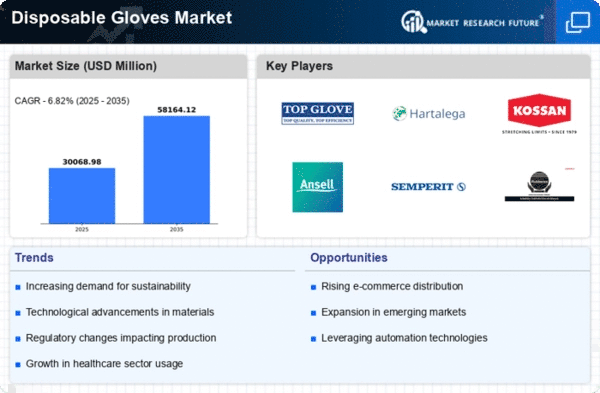
As per MRFR analysis, the Global Disposable Gloves Market Size was estimated at 28149.2 USD Million in 2024. The Disposable Gloves industry is projected to grow from 30069.04 USD Million in 2025 to 58164.12 USD Million by 2035, exhibiting a compound annual growth rate (CAGR) of 6.82% during the forecast period 2025 - 2035.

Key Market Trends & Highlights

The Disposable Gloves Market is experiencing robust growth driven by sustainability and health awareness.

  • North America remains the largest market for disposable gloves, driven by stringent health regulations and high demand in the medical sector. The Asia-Pacific region is the fastest-growing market, reflecting increasing industrial applications and rising health consciousness. The medical segment continues to dominate the market, while the food service segment is witnessing rapid growth due to heightened food safety standards. Key market drivers include rising health awareness and food safety regulations, which are propelling demand across various sectors.

Market Size & Forecast

2024 Market Size 28149.2 (USD Million)
2035 Market Size 58164.12 (USD Million)
CAGR (2025 - 2035) 6.82%
Largest Regional Market Share in 2024 North America

Major Players

Top Glove Corporation Berhad (MY), Hartalega Holdings Berhad (MY), Kossan Rubber Industries Bhd (MY), Ansell Limited (AU), <a href="https://www.sempermed.com/products/personal-protective-gloves/">Semperit </a>AG Holding (AT), Rubberex Corporation (M) Berhad (MY), Supermax Corporation Berhad (MY), Medline Industries, Inc. (US), <a href="https://www.cardinalhealth.com/en/product-solutions/medical/gloves.html">Cardinal Health</a>, Inc. (US)

Market Trends

The Disposable Gloves Market is currently experiencing a notable transformation, driven by evolving consumer preferences and heightened awareness regarding hygiene and safety. As industries such as healthcare, food service, and manufacturing increasingly prioritize protective measures, the demand for disposable gloves appears to be on an upward trajectory. This shift is further influenced by regulatory changes and the introduction of innovative materials that enhance comfort and dexterity. Consequently, manufacturers are adapting their product offerings to meet the diverse needs of various sectors, indicating a dynamic landscape characterized by continuous improvement and adaptation. In addition, sustainability concerns are becoming more prominent within the Disposable Gloves. Stakeholders are increasingly seeking eco-friendly alternatives, prompting manufacturers to explore biodegradable and recyclable options. This trend suggests a potential shift towards more sustainable practices, which may reshape the competitive landscape. As the market evolves, it is essential for companies to remain agile and responsive to these changes, ensuring they align with consumer expectations and regulatory requirements. Overall, the Disposable Gloves is poised for growth, driven by innovation, sustainability, and a commitment to safety across multiple industries.

Sustainability Initiatives

The Disposable Gloves Market is witnessing a growing emphasis on sustainability, as consumers and businesses alike seek environmentally friendly options, including Polyethylene disposable gloves. Manufacturers are exploring biodegradable materials and recyclable products, which may lead to a significant shift in production practices. This trend indicates a potential redefinition of industry standards, as companies strive to balance performance with ecological responsibility.

Technological Advancements

Technological innovations are playing a crucial role in shaping the Disposable Gloves . Enhanced manufacturing processes and the development of new materials are improving glove performance, comfort, and safety. These advancements suggest that the market may continue to evolve, with products that better meet the specific needs of various industries.

Regulatory Changes

Regulatory frameworks are increasingly influencing the Disposable Gloves Market, as governments implement stricter safety and health standards. This trend may compel manufacturers to adapt their offerings to comply with new regulations, potentially leading to increased product quality and safety. As a result, companies that proactively address these changes could gain a competitive edge.

Disposable Gloves Market Market Drivers

Rising Healthcare Expenditure

The Disposable Gloves Market is experiencing growth driven by increasing healthcare expenditure across various nations. Governments are allocating substantial budgets to healthcare, which enhances the demand for Industrial Hand Gloves in hospitals and clinics. For instance, in 2024, the market is projected to reach 28.1 USD Billion, reflecting the rising need for protective equipment. This trend is likely to continue as healthcare systems evolve and expand, necessitating the use of disposable gloves to ensure safety and hygiene. As healthcare expenditure rises, the Global Disposable Gloves Industry is poised for sustained growth.

Expansion of Food Safety Regulations

The Global Disposable Gloves Industry is influenced by the expansion of food safety regulations worldwide. Governments are implementing stringent regulations to ensure food safety, which necessitates the use of disposable gloves in food handling and preparation. This regulatory environment is likely to propel the market forward, as compliance with these regulations becomes mandatory for food businesses. The increasing focus on food safety, along with the growing use of Powdered disposable gloves, is expected to contribute to the projected compound annual growth rate of 6.8% from 2025 to 2035, further solidifying the role of disposable gloves in the Industrial Hand Gloves Industry.


Emerging Markets and Increased Demand

Emerging markets are contributing significantly to the growth of the Disposable Gloves Market. As economies develop, there is a rising demand for disposable gloves in healthcare, food service, and industrial applications. Countries in Asia-Pacific and Latin America are witnessing rapid urbanization and industrialization, which are likely to boost the consumption of disposable gloves. This trend is indicative of a broader global shift towards enhanced safety and hygiene standards. The increasing demand from these regions is expected to play a crucial role in the market's expansion, further solidifying its position in the Global Disposable Gloves Market Industry.

Growing Awareness of Hygiene Practices

There is a notable increase in awareness regarding hygiene practices among consumers and businesses, which significantly impacts the Disposable Gloves Industry. The emphasis on cleanliness and safety in various sectors, including food service and healthcare, drives the demand for disposable gloves. This heightened awareness is likely to lead to a projected market value of 58.0 USD Billion by 2035. As organizations prioritize hygiene protocols, the adoption of disposable gloves becomes essential, thereby fostering growth in the Global Disposable Gloves Market Industry.

Technological Advancements in Material Science

Technological advancements in material science are playing a pivotal role in shaping the Disposable Gloves Market. Innovations in glove materials, such as the development of more durable and flexible synthetic options, enhance user experience and safety. These advancements not only improve the performance of disposable gloves but also cater to diverse industry needs. As manufacturers invest in research and development, the market is likely to benefit from improved product offerings, which could lead to increased adoption rates across various sectors, thus driving growth in the Global Disposable Gloves Market Industry.

Market Segment Insights

By Application: Medical (Largest) vs. Food Service (Fastest-Growing)

The Disposable Gloves Market showcases diverse applications, with the medical sector holding the largest share due to increasing health and safety regulations in healthcare. This segment is characterized by high demand for surgical and examination gloves among hospitals, clinics, and laboratories. Following the medical application, the food service sector is witnessing substantial growth, driven by a rising emphasis on hygiene standards and food safety regulations in restaurants and food processing industries. Emerging trends in the Disposable Gloves Market indicate that the food service application is expanding rapidly, reflecting changing consumer preferences for safer and more hygienic food handling practices. The rise in takeout and delivery services, accelerated by the pandemic, has further propelled this demand, while the industrial and household sectors continue to hold steady, driven by consistent use in maintenance and cleaning tasks.

Medical (Dominant) vs. Chemical (Emerging)

In the Disposable Gloves Market, the medical application stands out as the dominant sector due to the unrelenting demand for protective gear in healthcare settings. Medical gloves are crucial for infection prevention and safety, thus forming the backbone of this market. In contrast, the chemical sector is emerging rapidly as industries recognize the importance of protective gloves when handling hazardous chemicals. Chemical-resistant gloves provide crucial protection, leading to their increased adoption in manufacturing and laboratory environments. As regulatory measures strengthen around chemical safety, the demand for high-quality disposable gloves in this segment is expected to grow, making it a noteworthy player in the Disposable Gloves.

By Material Type: Nitrile (Largest) vs. Latex (Fastest-Growing)

The Disposable Gloves Market exhibits a diverse landscape in the 'Material Type' segment. Nitrile gloves hold the largest market share due to their superior puncture resistance and versatility in various applications, including healthcare and food handling. In contrast, latex gloves, long favored for their elasticity and comfort, have seen a resurgence and are now recognized as the fastest-growing segment due to rising demand in medical settings and increasing awareness of their performance in sensitivity-critical situations. Growth trends in the Disposable Gloves Market are influenced by several key factors. The increasing awareness of hygiene and infection control in healthcare settings has propelled the growth of latex gloves, particularly in surgical and examination applications. Additionally, the shift toward synthetic materials like nitrile is driven by <a href="https://www.marketresearchfuture.com/reports/latex-gloves-market-10124">latex gloves</a> allergies among healthcare workers and consumers, leading to an expanded use of nitrile in various industries, ensuring robust overall segment performance.

Nitrile (Dominant) vs. Vinyl (Emerging)

Nitrile gloves continue to dominate the Disposable Gloves Market, characterized by their exceptional durability, chemical resistance, and hypoallergenic properties. These gloves are particularly favored in medical, industrial, and food processing applications, where safety and protection are paramount. In contrast, vinyl gloves represent an emerging alternative, especially in low-risk settings due to their cost-effectiveness and ease of use. Although vinyl does not match nitrile's durability, it is increasingly adopted for non-hazardous tasks owing to its lower price point, catering to budget-conscious enterprises while the latter remains the preferred choice for critical applications.

By End Use: Healthcare (Largest) vs. Food Processing (Fastest-Growing)

The Disposable Gloves Market exhibits a diverse range of end-use applications, with healthcare being the largest segment. This sector significantly contributes to overall glove consumption due to the heightened awareness of hygiene and safety standards in medical environments. <a href="https://www.marketresearchfuture.com/reports/global-food-processing-blades-market-23287">Food processing blades</a> follows, utilizing disposable gloves extensively to maintain food safety and prevent contamination, while a combination of manufacturing, cleaning services, and laboratories collectively captures the remaining market share, underscoring the multifaceted nature of glove usage across industries.

Healthcare (Dominant) vs. Food Processing (Emerging)

The healthcare sector stands tall as the dominant force in the Disposable Gloves Market, driven by stringent infection control measures and the rising prevalence of contagious diseases. This segment includes hospitals, clinics, and long-term care facilities, where gloves are essential for safeguarding both patients and healthcare workers. In contrast, the food processing segment is emerging rapidly as awareness of food hygiene and safety regulations increase. The growing demand for pre-packaged food and takeout services further propels this segment, highlighting an evolving consumer preference for safety in food handling, making it a key player in the market.

By Thickness: Medium (Largest) vs. Thick (Fastest-Growing)

<p>The Disposable Gloves Market shows a diverse segmentation based on thickness, with medium thickness gloves holding the largest market share. Medium gloves are favored across various industries for their optimal balance between protection and dexterity. Thin gloves, while also popular, cater primarily to sectors requiring high tactile sensitivity, resulting in a smaller share comparatively. Meanwhile, thick gloves, often preferred in more hazardous environments, are witnessing an upswing in demand, driven by increased awareness around safety standards and the need for superior durability.</p>

<p>Medium: (Dominant) vs. Thick (Emerging)</p>

<p>Medium thickness gloves are currently dominating the Disposable Gloves Market due to their versatile characteristics, providing adequate protection without sacrificing tactile sensitivity. They find extensive application in healthcare, food service, and general industrial use, where flexibility and comfort are essential. In contrast, thick gloves are emerging rapidly, becoming a vital choice for industries that prioritize maximum hand protection in potentially hazardous environments. Their robust construction offers an added layer of safety, making them increasingly sought after in sectors like construction and chemical handling. As safety protocols evolve, the appeal for thicker options is likely to grow, positioning them as a significant trend in the market.</p>

By Color: Blue (Largest) vs. Clear (Fastest-Growing)

<p>In the Disposable Gloves Market, the color segment exhibits a diverse range of preferences, with blue gloves commanding the largest market share. This is primarily due to their association with healthcare, where they are perceived as a reliable choice for protection against contamination. Clear gloves, while initially not dominant, have shown remarkable potential and are recognized as the fastest-growing color segment, largely driven by their increasing use in various industries, including food services and beauty sectors.</p>

<p>Blue (Dominant) vs. Clear (Emerging)</p>

<p>Blue disposable gloves have become the dominant choice in medical and industrial settings due to their strength and versatility. Their visibility and reliability make them a favorite among healthcare workers who prioritize safety without compromising dexterity. On the other hand, clear disposable gloves are emerging as a popular alternative, particularly in food handling and customer-facing roles where transparency is essential. They provide essential protection without altering the appearance of products, which is particularly appealing in the retail environment. As consumers increasingly favor hygiene and safety, both blue and clear gloves are poised to hold significant market relevance.</p>

Get more detailed insights about Disposable Gloves Market Research Report - Global Forecast till 2035

Regional Insights

North America : Market Leader in Disposable Gloves

North America is poised to maintain its leadership in the disposable gloves market, holding a significant share of $11,200.0 million in 2024. The growth is driven by increasing healthcare demands, stringent regulations on safety standards, and a rising awareness of hygiene practices. The region's robust healthcare infrastructure and the ongoing expansion of the food service industry further fuel demand for disposable gloves. The United States stands out as the leading country in this market, with major players like Medline Industries, Inc. and Cardinal Health, Inc. dominating the landscape. The competitive environment is characterized by innovation and strategic partnerships among key manufacturers, including Top Glove Corporation and Ansell Limited. This dynamic landscape is expected to continue evolving as companies invest in advanced technologies and sustainable practices.

Europe : Emerging Market with Growth Potential

Europe's disposable gloves market is projected to reach $8,000.0 million by 2025, driven by increasing healthcare expenditures and a growing emphasis on safety regulations. The region is witnessing a surge in demand for high-quality gloves, particularly in the medical and food sectors. Regulatory frameworks, such as the EU Medical Device Regulation, are catalyzing market growth by ensuring product safety and efficacy. Leading countries in this region include Germany, France, and the UK, where key players like Semperit AG and Ansell Limited are making significant inroads. The competitive landscape is marked by a focus on innovation and sustainability, with manufacturers investing in eco-friendly materials. The presence of established companies and a growing number of startups are contributing to a vibrant market environment.

Asia-Pacific : Rapid Growth in Emerging Economies

The Asia-Pacific region is set to reach a market size of $8,000.0 million by 2025, driven by rapid industrialization and increasing healthcare needs. Countries like China and India are experiencing a surge in demand for disposable gloves, fueled by rising awareness of hygiene and safety standards. Government initiatives aimed at improving healthcare infrastructure are also contributing to market growth, alongside a growing population. Key players in this region include Top Glove Corporation and Hartalega Holdings, which are leading the charge in production capacity and innovation. The competitive landscape is characterized by a mix of established manufacturers and emerging companies, all vying for market share. As the region continues to develop, the demand for high-quality disposable gloves is expected to rise significantly, creating opportunities for growth.

Middle East and Africa : Developing Market with Unique Challenges

The Middle East and Africa region is projected to reach a market size of $1,949.2 million by 2025, driven by increasing healthcare investments and a growing awareness of hygiene practices. The demand for disposable gloves is rising, particularly in the healthcare and food sectors, as regulatory bodies emphasize safety standards. However, challenges such as economic disparities and varying regulatory environments may impact growth. Countries like South Africa and the UAE are leading the market, with key players such as Rubberex Corporation and Supermax Corporation making significant contributions. The competitive landscape is evolving, with both local and international companies striving to meet the growing demand. As the region continues to develop, the disposable gloves market is expected to expand, albeit at a slower pace compared to other regions.

Key Players and Competitive Insights

The Disposable Gloves Market is currently characterized by a dynamic competitive landscape, driven by increasing demand across healthcare, food service, and industrial sectors. Key players are actively pursuing strategies that emphasize innovation, sustainability, and regional expansion. For instance, Top Glove Corporation Berhad (Malaysia) has focused on enhancing its production capabilities through automation and digital transformation, which appears to position the company favorably against its competitors. Similarly, Ansell Limited (Australia) has been investing in research and development to create advanced materials that improve glove performance, thereby reinforcing its market presence. In terms of business tactics, companies are increasingly localizing manufacturing to mitigate supply chain disruptions and optimize logistics. The market structure is moderately fragmented, with several key players exerting considerable influence. This fragmentation allows for niche players to thrive, while larger companies leverage economies of scale to maintain competitive pricing. The collective actions of these companies shape a landscape where innovation and operational efficiency are paramount. In November 2025, Hartalega Holdings Berhad (Malaysia) announced the launch of a new line of biodegradable gloves, which reflects a growing trend towards sustainability in the industry. This strategic move not only caters to environmentally conscious consumers but also positions Hartalega as a leader in eco-friendly solutions, potentially attracting new market segments. The introduction of biodegradable products may also compel competitors to adapt their offerings in response to changing consumer preferences. In October 2025, Kossan Rubber Industries Bhd (Malaysia) expanded its manufacturing footprint by opening a new facility in Vietnam. This expansion is likely to enhance Kossan's production capacity and reduce lead times for customers in the Asia-Pacific region. Such strategic investments in manufacturing capabilities may provide Kossan with a competitive edge, particularly as demand continues to rise in emerging markets. In September 2025, Medline Industries, Inc. (US) entered into a strategic partnership with a leading healthcare provider to supply a range of disposable gloves tailored for surgical applications. This collaboration underscores Medline's commitment to enhancing its product offerings and strengthening its position in the healthcare sector. By aligning with healthcare providers, Medline may gain valuable insights into market needs, further refining its product development strategies. As of December 2025, the competitive trends in the Disposable Gloves Market are increasingly defined by digitalization, sustainability, and the integration of advanced technologies such as AI. Strategic alliances are becoming more prevalent, enabling companies to pool resources and expertise to innovate more effectively. The shift from price-based competition to a focus on innovation and supply chain reliability is evident, suggesting that future differentiation will hinge on the ability to deliver high-quality, sustainable products that meet evolving consumer demands.

Key Companies in the Disposable Gloves Market include

Industry Developments

  • Q1 2024: Top Glove appoints new CEO to drive post-pandemic recovery Top Glove Corporation, the world's largest disposable glove maker, announced the appointment of Lim Wee Chai as CEO, aiming to steer the company through post-pandemic market normalization and operational challenges.
  • Q2 2024: Hartalega launches new eco-friendly nitrile glove line Hartalega Holdings Berhad introduced a new line of biodegradable nitrile disposable gloves, targeting healthcare and food service sectors seeking sustainable alternatives.
  • Q2 2024: Ansell opens new manufacturing facility in India to expand glove production Ansell Limited inaugurated a new disposable glove manufacturing plant in Tamil Nadu, India, increasing its global production capacity to meet rising demand in healthcare and industrial markets.
  • Q2 2024: Supermax secures multi-year supply contract with UK NHS Supermax Corporation signed a multi-year agreement to supply disposable gloves to the UK National Health Service, strengthening its presence in the European healthcare market.
  • Q3 2024: Medline Industries announces $100M investment in new US glove distribution center Medline Industries revealed plans to invest $100 million in a new distribution center in Georgia, USA, to streamline disposable glove logistics and improve supply chain resilience.
  • Q3 2024: Sri Trang Gloves acquires Malaysian glove manufacturer for $120M Thailand-based Sri Trang Gloves completed the acquisition of a major Malaysian disposable glove producer, expanding its manufacturing footprint in Southeast Asia.
  • Q3 2024: Cardinal Health launches antimicrobial disposable glove for US hospitals Cardinal Health introduced a new antimicrobial disposable glove designed to reduce hospital-acquired infections, following FDA clearance for clinical use.
  • Q4 2024: Intco Medical raises $200M in Hong Kong secondary listing Chinese disposable glove manufacturer Intco Medical completed a $200 million secondary listing on the Hong Kong Stock Exchange to fund global expansion and R&D.
  • Q4 2024: Kimberly-Clark Professional partners with Clean Harbors for glove recycling program Kimberly-Clark Professional announced a partnership with Clean Harbors to launch a nationwide disposable glove recycling initiative targeting laboratories and healthcare facilities.
  • Q1 2025: Malaysia's Careplus secures FDA approval for new nitrile glove line Careplus Group Berhad received US FDA approval for its latest nitrile disposable glove product, enabling expanded exports to the American healthcare market.
  • Q2 2025: Top Glove signs strategic partnership with Siemens for smart factory automation Top Glove entered a strategic partnership with Siemens to implement advanced automation and digitalization technologies across its glove manufacturing facilities.
  • Q2 2025: US imposes new tariffs on Chinese-made nitrile gloves The US government enacted new tariffs on Chinese-made nitrile disposable gloves, impacting importers and prompting supply chain shifts to Southeast Asia.

Future Outlook

Disposable Gloves Market Future Outlook

The Disposable Gloves Market is projected to grow at a 6.82% CAGR from 2025 to 2035, driven by increasing healthcare demands, regulatory changes, and rising hygiene awareness.

New opportunities lie in:

  • <p>Expansion into biodegradable glove production lines Development of smart gloves with integrated sensors Partnerships with e-commerce platforms for direct-to-consumer sales</p>

By 2035, the Disposable Gloves Market is expected to achieve robust growth, reflecting evolving consumer and industry needs.

Market Segmentation

Disposable Gloves Market End Use Outlook

  • Healthcare
  • Food Processing
  • Manufacturing
  • Cleaning Services
  • Laboratories

Disposable Gloves Market Application Outlook

  • Medical
  • Industrial
  • Food Service
  • Household
  • Chemical

Disposable Gloves Market Material Type Outlook

  • Nitrile
  • Latex
  • Vinyl
  • Polyethylene
  • Neoprene

Report Scope

MARKET SIZE 2024 28149.2(USD Million)
MARKET SIZE 2025 30069.04(USD Million)
MARKET SIZE 2035 58164.12(USD Million)
COMPOUND ANNUAL GROWTH RATE (CAGR) 6.82% (2025 - 2035)
REPORT COVERAGE Revenue Forecast, Competitive Landscape, Growth Factors, and Trends
BASE YEAR 2024
Market Forecast Period 2025 - 2035
Historical Data 2019 - 2024
Market Forecast Units USD Million
Key Companies Profiled Top Glove Corporation Berhad (MY), Hartalega Holdings Berhad (MY), Kossan Rubber Industries Bhd (MY), Ansell Limited (AU), Semperit AG Holding (AT), Rubberex Corporation (M) Berhad (MY), Supermax Corporation Berhad (MY), Medline Industries, Inc. (US), Cardinal Health, Inc. (US)
Segments Covered Application, Material Type, End Use
Key Market Opportunities Growing demand for sustainable materials in the Disposable Gloves Market presents significant innovation opportunities.
Key Market Dynamics Rising demand for sustainable materials drives innovation and competition in the disposable gloves market.
Countries Covered North America, Europe, APAC, South America, MEA

FAQs

What is the current valuation of the Disposable Gloves Market as of 2024?

<p>The Disposable Gloves Market was valued at approximately 28149.2 USD Million in 2024.</p>

What is the projected market valuation for the Disposable Gloves Market in 2035?

<p>The market is projected to reach a valuation of around 58164.12 USD Million by 2035.</p>

What is the expected CAGR for the Disposable Gloves Market during the forecast period 2025 - 2035?

<p>The expected CAGR for the Disposable Gloves Market during the forecast period 2025 - 2035 is 6.82%.</p>

Which companies are considered key players in the Disposable Gloves Market?

<p>Key players in the market include Top Glove Corporation Berhad, Hartalega Holdings Berhad, and Ansell Limited, among others.</p>

What are the main application segments of the Disposable Gloves Market?

<p>The main application segments include Medical, Industrial, Food Service, Cleanroom, and Household.</p>

How does the market size for Medical gloves compare to Industrial gloves?

<p>The market size for Medical gloves ranges from 11200.0 to 24000.0 USD Million, whereas Industrial gloves range from 6000.0 to 12000.0 USD Million.</p>

What are the different material types used in Disposable Gloves?

Disposable gloves are primarily made from Nitrile, Latex, Vinyl, Polyethylene, and Neoprene.

What is the market valuation range for Nitrile gloves?

The market valuation for Nitrile gloves is projected to be between 11200.0 and 24000.0 USD Million.

What thickness categories are available in the Disposable Gloves Market?

The thickness categories include Thin, Medium, Thick, and Extra Thick gloves.

What color options are available for Disposable Gloves?

Disposable gloves are available in various colors, including Clear, Blue, Black, Green, and Yellow.

  1. SECTION I: EXECUTIVE SUMMARY AND KEY HIGHLIGHTS
    1. | 1.1 EXECUTIVE SUMMARY
    2. | | 1.1.1 Market Overview
    3. | | 1.1.2 Key Findings
    4. | | 1.1.3 Market Segmentation
    5. | | 1.1.4 Competitive Landscape
    6. | | 1.1.5 Challenges and Opportunities
    7. | | 1.1.6 Future Outlook
  2. SECTION II: SCOPING, METHODOLOGY AND MARKET STRUCTURE
    1. | 2.1 MARKET INTRODUCTION
    2. | | 2.1.1 Definition
    3. | | 2.1.2 Scope of the study
    4. | | | 2.1.2.1 Research Objective
    5. | | | 2.1.2.2 Assumption
    6. | | | 2.1.2.3 Limitations
    7. | 2.2 RESEARCH METHODOLOGY
    8. | | 2.2.1 Overview
    9. | | 2.2.2 Data Mining
    10. | | 2.2.3 Secondary Research
    11. | | 2.2.4 Primary Research
    12. | | | 2.2.4.1 Primary Interviews and Information Gathering Process
    13. | | | 2.2.4.2 Breakdown of Primary Respondents
    14. | | 2.2.5 Forecasting Model
    15. | | 2.2.6 Market Size Estimation
    16. | | | 2.2.6.1 Bottom-Up Approach
    17. | | | 2.2.6.2 Top-Down Approach
    18. | | 2.2.7 Data Triangulation
    19. | | 2.2.8 Validation
  3. SECTION III: QUALITATIVE ANALYSIS
    1. | 3.1 MARKET DYNAMICS
    2. | | 3.1.1 Overview
    3. | | 3.1.2 Drivers
    4. | | 3.1.3 Restraints
    5. | | 3.1.4 Opportunities
    6. | 3.2 MARKET FACTOR ANALYSIS
    7. | | 3.2.1 Value chain Analysis
    8. | | 3.2.2 Porter's Five Forces Analysis
    9. | | | 3.2.2.1 Bargaining Power of Suppliers
    10. | | | 3.2.2.2 Bargaining Power of Buyers
    11. | | | 3.2.2.3 Threat of New Entrants
    12. | | | 3.2.2.4 Threat of Substitutes
    13. | | | 3.2.2.5 Intensity of Rivalry
    14. | | 3.2.3 COVID-19 Impact Analysis
    15. | | | 3.2.3.1 Market Impact Analysis
    16. | | | 3.2.3.2 Regional Impact
    17. | | | 3.2.3.3 Opportunity and Threat Analysis
  4. SECTION IV: QUANTITATIVE ANALYSIS
    1. | 4.1 Healthcare, BY Application (USD Million)
    2. | | 4.1.1 Medical
    3. | | 4.1.2 Industrial
    4. | | 4.1.3 Food Service
    5. | | 4.1.4 Cleanroom
    6. | | 4.1.5 Household
    7. | 4.2 Healthcare, BY Material Type (USD Million)
    8. | | 4.2.1 Nitrile
    9. | | 4.2.2 Latex
    10. | | 4.2.3 Vinyl
    11. | | 4.2.4 Polyethylene
    12. | | 4.2.5 Neoprene
    13. | 4.3 Healthcare, BY End Use (USD Million)
    14. | | 4.3.1 Healthcare
    15. | | 4.3.2 Food Processing
    16. | | 4.3.3 Manufacturing
    17. | | 4.3.4 Automotive
    18. | | 4.3.5 Laboratories
    19. | 4.4 Healthcare, BY Thickness (USD Million)
    20. | | 4.4.1 Thin
    21. | | 4.4.2 Medium
    22. | | 4.4.3 Thick
    23. | | 4.4.4 Extra Thick
    24. | 4.5 Healthcare, BY Color (USD Million)
    25. | | 4.5.1 Clear
    26. | | 4.5.2 Blue
    27. | | 4.5.3 Black
    28. | | 4.5.4 Green
    29. | | 4.5.5 Yellow
    30. | 4.6 Healthcare, BY Region (USD Million)
    31. | | 4.6.1 North America
    32. | | | 4.6.1.1 US
    33. | | | 4.6.1.2 Canada
    34. | | 4.6.2 Europe
    35. | | | 4.6.2.1 Germany
    36. | | | 4.6.2.2 UK
    37. | | | 4.6.2.3 France
    38. | | | 4.6.2.4 Russia
    39. | | | 4.6.2.5 Italy
    40. | | | 4.6.2.6 Spain
    41. | | | 4.6.2.7 Rest of Europe
    42. | | 4.6.3 APAC
    43. | | | 4.6.3.1 China
    44. | | | 4.6.3.2 India
    45. | | | 4.6.3.3 Japan
    46. | | | 4.6.3.4 South Korea
    47. | | | 4.6.3.5 Malaysia
    48. | | | 4.6.3.6 Thailand
    49. | | | 4.6.3.7 Indonesia
    50. | | | 4.6.3.8 Rest of APAC
    51. | | 4.6.4 South America
    52. | | | 4.6.4.1 Brazil
    53. | | | 4.6.4.2 Mexico
    54. | | | 4.6.4.3 Argentina
    55. | | | 4.6.4.4 Rest of South America
    56. | | 4.6.5 MEA
    57. | | | 4.6.5.1 GCC Countries
    58. | | | 4.6.5.2 South Africa
    59. | | | 4.6.5.3 Rest of MEA
  5. SECTION V: COMPETITIVE ANALYSIS
    1. | 5.1 Competitive Landscape
    2. | | 5.1.1 Overview
    3. | | 5.1.2 Competitive Analysis
    4. | | 5.1.3 Market share Analysis
    5. | | 5.1.4 Major Growth Strategy in the Healthcare
    6. | | 5.1.5 Competitive Benchmarking
    7. | | 5.1.6 Leading Players in Terms of Number of Developments in the Healthcare
    8. | | 5.1.7 Key developments and growth strategies
    9. | | | 5.1.7.1 New Product Launch/Service Deployment
    10. | | | 5.1.7.2 Merger & Acquisitions
    11. | | | 5.1.7.3 Joint Ventures
    12. | | 5.1.8 Major Players Financial Matrix
    13. | | | 5.1.8.1 Sales and Operating Income
    14. | | | 5.1.8.2 Major Players R&D Expenditure. 2023
    15. | 5.2 Company Profiles
    16. | | 5.2.1 Top Glove Corporation Berhad (MY)
    17. | | | 5.2.1.1 Financial Overview
    18. | | | 5.2.1.2 Products Offered
    19. | | | 5.2.1.3 Key Developments
    20. | | | 5.2.1.4 SWOT Analysis
    21. | | | 5.2.1.5 Key Strategies
    22. | | 5.2.2 Hartalega Holdings Berhad (MY)
    23. | | | 5.2.2.1 Financial Overview
    24. | | | 5.2.2.2 Products Offered
    25. | | | 5.2.2.3 Key Developments
    26. | | | 5.2.2.4 SWOT Analysis
    27. | | | 5.2.2.5 Key Strategies
    28. | | 5.2.3 Kossan Rubber Industries Bhd (MY)
    29. | | | 5.2.3.1 Financial Overview
    30. | | | 5.2.3.2 Products Offered
    31. | | | 5.2.3.3 Key Developments
    32. | | | 5.2.3.4 SWOT Analysis
    33. | | | 5.2.3.5 Key Strategies
    34. | | 5.2.4 Ansell Limited (AU)
    35. | | | 5.2.4.1 Financial Overview
    36. | | | 5.2.4.2 Products Offered
    37. | | | 5.2.4.3 Key Developments
    38. | | | 5.2.4.4 SWOT Analysis
    39. | | | 5.2.4.5 Key Strategies
    40. | | 5.2.5 Semperit AG Holding (AT)
    41. | | | 5.2.5.1 Financial Overview
    42. | | | 5.2.5.2 Products Offered
    43. | | | 5.2.5.3 Key Developments
    44. | | | 5.2.5.4 SWOT Analysis
    45. | | | 5.2.5.5 Key Strategies
    46. | | 5.2.6 Rubberex Corporation (M) Berhad (MY)
    47. | | | 5.2.6.1 Financial Overview
    48. | | | 5.2.6.2 Products Offered
    49. | | | 5.2.6.3 Key Developments
    50. | | | 5.2.6.4 SWOT Analysis
    51. | | | 5.2.6.5 Key Strategies
    52. | | 5.2.7 Supermax Corporation Berhad (MY)
    53. | | | 5.2.7.1 Financial Overview
    54. | | | 5.2.7.2 Products Offered
    55. | | | 5.2.7.3 Key Developments
    56. | | | 5.2.7.4 SWOT Analysis
    57. | | | 5.2.7.5 Key Strategies
    58. | | 5.2.8 Medline Industries, Inc. (US)
    59. | | | 5.2.8.1 Financial Overview
    60. | | | 5.2.8.2 Products Offered
    61. | | | 5.2.8.3 Key Developments
    62. | | | 5.2.8.4 SWOT Analysis
    63. | | | 5.2.8.5 Key Strategies
    64. | | 5.2.9 Cardinal Health, Inc. (US)
    65. | | | 5.2.9.1 Financial Overview
    66. | | | 5.2.9.2 Products Offered
    67. | | | 5.2.9.3 Key Developments
    68. | | | 5.2.9.4 SWOT Analysis
    69. | | | 5.2.9.5 Key Strategies
    70. | 5.3 Appendix
    71. | | 5.3.1 References
    72. | | 5.3.2 Related Reports
  6. LIST OF FIGURES
    1. | 6.1 MARKET SYNOPSIS
    2. | 6.2 NORTH AMERICA MARKET ANALYSIS
    3. | 6.3 US MARKET ANALYSIS BY APPLICATION
    4. | 6.4 US MARKET ANALYSIS BY MATERIAL TYPE
    5. | 6.5 US MARKET ANALYSIS BY END USE
    6. | 6.6 US MARKET ANALYSIS BY THICKNESS
    7. | 6.7 US MARKET ANALYSIS BY COLOR
    8. | 6.8 CANADA MARKET ANALYSIS BY APPLICATION
    9. | 6.9 CANADA MARKET ANALYSIS BY MATERIAL TYPE
    10. | 6.10 CANADA MARKET ANALYSIS BY END USE
    11. | 6.11 CANADA MARKET ANALYSIS BY THICKNESS
    12. | 6.12 CANADA MARKET ANALYSIS BY COLOR
    13. | 6.13 EUROPE MARKET ANALYSIS
    14. | 6.14 GERMANY MARKET ANALYSIS BY APPLICATION
    15. | 6.15 GERMANY MARKET ANALYSIS BY MATERIAL TYPE
    16. | 6.16 GERMANY MARKET ANALYSIS BY END USE
    17. | 6.17 GERMANY MARKET ANALYSIS BY THICKNESS
    18. | 6.18 GERMANY MARKET ANALYSIS BY COLOR
    19. | 6.19 UK MARKET ANALYSIS BY APPLICATION
    20. | 6.20 UK MARKET ANALYSIS BY MATERIAL TYPE
    21. | 6.21 UK MARKET ANALYSIS BY END USE
    22. | 6.22 UK MARKET ANALYSIS BY THICKNESS
    23. | 6.23 UK MARKET ANALYSIS BY COLOR
    24. | 6.24 FRANCE MARKET ANALYSIS BY APPLICATION
    25. | 6.25 FRANCE MARKET ANALYSIS BY MATERIAL TYPE
    26. | 6.26 FRANCE MARKET ANALYSIS BY END USE
    27. | 6.27 FRANCE MARKET ANALYSIS BY THICKNESS
    28. | 6.28 FRANCE MARKET ANALYSIS BY COLOR
    29. | 6.29 RUSSIA MARKET ANALYSIS BY APPLICATION
    30. | 6.30 RUSSIA MARKET ANALYSIS BY MATERIAL TYPE
    31. | 6.31 RUSSIA MARKET ANALYSIS BY END USE
    32. | 6.32 RUSSIA MARKET ANALYSIS BY THICKNESS
    33. | 6.33 RUSSIA MARKET ANALYSIS BY COLOR
    34. | 6.34 ITALY MARKET ANALYSIS BY APPLICATION
    35. | 6.35 ITALY MARKET ANALYSIS BY MATERIAL TYPE
    36. | 6.36 ITALY MARKET ANALYSIS BY END USE
    37. | 6.37 ITALY MARKET ANALYSIS BY THICKNESS
    38. | 6.38 ITALY MARKET ANALYSIS BY COLOR
    39. | 6.39 SPAIN MARKET ANALYSIS BY APPLICATION
    40. | 6.40 SPAIN MARKET ANALYSIS BY MATERIAL TYPE
    41. | 6.41 SPAIN MARKET ANALYSIS BY END USE
    42. | 6.42 SPAIN MARKET ANALYSIS BY THICKNESS
    43. | 6.43 SPAIN MARKET ANALYSIS BY COLOR
    44. | 6.44 REST OF EUROPE MARKET ANALYSIS BY APPLICATION
    45. | 6.45 REST OF EUROPE MARKET ANALYSIS BY MATERIAL TYPE
    46. | 6.46 REST OF EUROPE MARKET ANALYSIS BY END USE
    47. | 6.47 REST OF EUROPE MARKET ANALYSIS BY THICKNESS
    48. | 6.48 REST OF EUROPE MARKET ANALYSIS BY COLOR
    49. | 6.49 APAC MARKET ANALYSIS
    50. | 6.50 CHINA MARKET ANALYSIS BY APPLICATION
    51. | 6.51 CHINA MARKET ANALYSIS BY MATERIAL TYPE
    52. | 6.52 CHINA MARKET ANALYSIS BY END USE
    53. | 6.53 CHINA MARKET ANALYSIS BY THICKNESS
    54. | 6.54 CHINA MARKET ANALYSIS BY COLOR
    55. | 6.55 INDIA MARKET ANALYSIS BY APPLICATION
    56. | 6.56 INDIA MARKET ANALYSIS BY MATERIAL TYPE
    57. | 6.57 INDIA MARKET ANALYSIS BY END USE
    58. | 6.58 INDIA MARKET ANALYSIS BY THICKNESS
    59. | 6.59 INDIA MARKET ANALYSIS BY COLOR
    60. | 6.60 JAPAN MARKET ANALYSIS BY APPLICATION
    61. | 6.61 JAPAN MARKET ANALYSIS BY MATERIAL TYPE
    62. | 6.62 JAPAN MARKET ANALYSIS BY END USE
    63. | 6.63 JAPAN MARKET ANALYSIS BY THICKNESS
    64. | 6.64 JAPAN MARKET ANALYSIS BY COLOR
    65. | 6.65 SOUTH KOREA MARKET ANALYSIS BY APPLICATION
    66. | 6.66 SOUTH KOREA MARKET ANALYSIS BY MATERIAL TYPE
    67. | 6.67 SOUTH KOREA MARKET ANALYSIS BY END USE
    68. | 6.68 SOUTH KOREA MARKET ANALYSIS BY THICKNESS
    69. | 6.69 SOUTH KOREA MARKET ANALYSIS BY COLOR
    70. | 6.70 MALAYSIA MARKET ANALYSIS BY APPLICATION
    71. | 6.71 MALAYSIA MARKET ANALYSIS BY MATERIAL TYPE
    72. | 6.72 MALAYSIA MARKET ANALYSIS BY END USE
    73. | 6.73 MALAYSIA MARKET ANALYSIS BY THICKNESS
    74. | 6.74 MALAYSIA MARKET ANALYSIS BY COLOR
    75. | 6.75 THAILAND MARKET ANALYSIS BY APPLICATION
    76. | 6.76 THAILAND MARKET ANALYSIS BY MATERIAL TYPE
    77. | 6.77 THAILAND MARKET ANALYSIS BY END USE
    78. | 6.78 THAILAND MARKET ANALYSIS BY THICKNESS
    79. | 6.79 THAILAND MARKET ANALYSIS BY COLOR
    80. | 6.80 INDONESIA MARKET ANALYSIS BY APPLICATION
    81. | 6.81 INDONESIA MARKET ANALYSIS BY MATERIAL TYPE
    82. | 6.82 INDONESIA MARKET ANALYSIS BY END USE
    83. | 6.83 INDONESIA MARKET ANALYSIS BY THICKNESS
    84. | 6.84 INDONESIA MARKET ANALYSIS BY COLOR
    85. | 6.85 REST OF APAC MARKET ANALYSIS BY APPLICATION
    86. | 6.86 REST OF APAC MARKET ANALYSIS BY MATERIAL TYPE
    87. | 6.87 REST OF APAC MARKET ANALYSIS BY END USE
    88. | 6.88 REST OF APAC MARKET ANALYSIS BY THICKNESS
    89. | 6.89 REST OF APAC MARKET ANALYSIS BY COLOR
    90. | 6.90 SOUTH AMERICA MARKET ANALYSIS
    91. | 6.91 BRAZIL MARKET ANALYSIS BY APPLICATION
    92. | 6.92 BRAZIL MARKET ANALYSIS BY MATERIAL TYPE
    93. | 6.93 BRAZIL MARKET ANALYSIS BY END USE
    94. | 6.94 BRAZIL MARKET ANALYSIS BY THICKNESS
    95. | 6.95 BRAZIL MARKET ANALYSIS BY COLOR
    96. | 6.96 MEXICO MARKET ANALYSIS BY APPLICATION
    97. | 6.97 MEXICO MARKET ANALYSIS BY MATERIAL TYPE
    98. | 6.98 MEXICO MARKET ANALYSIS BY END USE
    99. | 6.99 MEXICO MARKET ANALYSIS BY THICKNESS
    100. | 6.100 MEXICO MARKET ANALYSIS BY COLOR
    101. | 6.101 ARGENTINA MARKET ANALYSIS BY APPLICATION
    102. | 6.102 ARGENTINA MARKET ANALYSIS BY MATERIAL TYPE
    103. | 6.103 ARGENTINA MARKET ANALYSIS BY END USE
    104. | 6.104 ARGENTINA MARKET ANALYSIS BY THICKNESS
    105. | 6.105 ARGENTINA MARKET ANALYSIS BY COLOR
    106. | 6.106 REST OF SOUTH AMERICA MARKET ANALYSIS BY APPLICATION
    107. | 6.107 REST OF SOUTH AMERICA MARKET ANALYSIS BY MATERIAL TYPE
    108. | 6.108 REST OF SOUTH AMERICA MARKET ANALYSIS BY END USE
    109. | 6.109 REST OF SOUTH AMERICA MARKET ANALYSIS BY THICKNESS
    110. | 6.110 REST OF SOUTH AMERICA MARKET ANALYSIS BY COLOR
    111. | 6.111 MEA MARKET ANALYSIS
    112. | 6.112 GCC COUNTRIES MARKET ANALYSIS BY APPLICATION
    113. | 6.113 GCC COUNTRIES MARKET ANALYSIS BY MATERIAL TYPE
    114. | 6.114 GCC COUNTRIES MARKET ANALYSIS BY END USE
    115. | 6.115 GCC COUNTRIES MARKET ANALYSIS BY THICKNESS
    116. | 6.116 GCC COUNTRIES MARKET ANALYSIS BY COLOR
    117. | 6.117 SOUTH AFRICA MARKET ANALYSIS BY APPLICATION
    118. | 6.118 SOUTH AFRICA MARKET ANALYSIS BY MATERIAL TYPE
    119. | 6.119 SOUTH AFRICA MARKET ANALYSIS BY END USE
    120. | 6.120 SOUTH AFRICA MARKET ANALYSIS BY THICKNESS
    121. | 6.121 SOUTH AFRICA MARKET ANALYSIS BY COLOR
    122. | 6.122 REST OF MEA MARKET ANALYSIS BY APPLICATION
    123. | 6.123 REST OF MEA MARKET ANALYSIS BY MATERIAL TYPE
    124. | 6.124 REST OF MEA MARKET ANALYSIS BY END USE
    125. | 6.125 REST OF MEA MARKET ANALYSIS BY THICKNESS
    126. | 6.126 REST OF MEA MARKET ANALYSIS BY COLOR
    127. | 6.127 KEY BUYING CRITERIA OF HEALTHCARE
    128. | 6.128 RESEARCH PROCESS OF MRFR
    129. | 6.129 DRO ANALYSIS OF HEALTHCARE
    130. | 6.130 DRIVERS IMPACT ANALYSIS: HEALTHCARE
    131. | 6.131 RESTRAINTS IMPACT ANALYSIS: HEALTHCARE
    132. | 6.132 SUPPLY / VALUE CHAIN: HEALTHCARE
    133. | 6.133 HEALTHCARE, BY APPLICATION, 2024 (% SHARE)
    134. | 6.134 HEALTHCARE, BY APPLICATION, 2024 TO 2035 (USD Million)
    135. | 6.135 HEALTHCARE, BY MATERIAL TYPE, 2024 (% SHARE)
    136. | 6.136 HEALTHCARE, BY MATERIAL TYPE, 2024 TO 2035 (USD Million)
    137. | 6.137 HEALTHCARE, BY END USE, 2024 (% SHARE)
    138. | 6.138 HEALTHCARE, BY END USE, 2024 TO 2035 (USD Million)
    139. | 6.139 HEALTHCARE, BY THICKNESS, 2024 (% SHARE)
    140. | 6.140 HEALTHCARE, BY THICKNESS, 2024 TO 2035 (USD Million)
    141. | 6.141 HEALTHCARE, BY COLOR, 2024 (% SHARE)
    142. | 6.142 HEALTHCARE, BY COLOR, 2024 TO 2035 (USD Million)
    143. | 6.143 BENCHMARKING OF MAJOR COMPETITORS
  7. LIST OF TABLES
    1. | 7.1 LIST OF ASSUMPTIONS
    2. | | 7.1.1
    3. | 7.2 North America MARKET SIZE ESTIMATES; FORECAST
    4. | | 7.2.1 BY APPLICATION, 2025-2035 (USD Million)
    5. | | 7.2.2 BY MATERIAL TYPE, 2025-2035 (USD Million)
    6. | | 7.2.3 BY END USE, 2025-2035 (USD Million)
    7. | | 7.2.4 BY THICKNESS, 2025-2035 (USD Million)
    8. | | 7.2.5 BY COLOR, 2025-2035 (USD Million)
    9. | 7.3 US MARKET SIZE ESTIMATES; FORECAST
    10. | | 7.3.1 BY APPLICATION, 2025-2035 (USD Million)
    11. | | 7.3.2 BY MATERIAL TYPE, 2025-2035 (USD Million)
    12. | | 7.3.3 BY END USE, 2025-2035 (USD Million)
    13. | | 7.3.4 BY THICKNESS, 2025-2035 (USD Million)
    14. | | 7.3.5 BY COLOR, 2025-2035 (USD Million)
    15. | 7.4 Canada MARKET SIZE ESTIMATES; FORECAST
    16. | | 7.4.1 BY APPLICATION, 2025-2035 (USD Million)
    17. | | 7.4.2 BY MATERIAL TYPE, 2025-2035 (USD Million)
    18. | | 7.4.3 BY END USE, 2025-2035 (USD Million)
    19. | | 7.4.4 BY THICKNESS, 2025-2035 (USD Million)
    20. | | 7.4.5 BY COLOR, 2025-2035 (USD Million)
    21. | 7.5 Europe MARKET SIZE ESTIMATES; FORECAST
    22. | | 7.5.1 BY APPLICATION, 2025-2035 (USD Million)
    23. | | 7.5.2 BY MATERIAL TYPE, 2025-2035 (USD Million)
    24. | | 7.5.3 BY END USE, 2025-2035 (USD Million)
    25. | | 7.5.4 BY THICKNESS, 2025-2035 (USD Million)
    26. | | 7.5.5 BY COLOR, 2025-2035 (USD Million)
    27. | 7.6 Germany MARKET SIZE ESTIMATES; FORECAST
    28. | | 7.6.1 BY APPLICATION, 2025-2035 (USD Million)
    29. | | 7.6.2 BY MATERIAL TYPE, 2025-2035 (USD Million)
    30. | | 7.6.3 BY END USE, 2025-2035 (USD Million)
    31. | | 7.6.4 BY THICKNESS, 2025-2035 (USD Million)
    32. | | 7.6.5 BY COLOR, 2025-2035 (USD Million)
    33. | 7.7 UK MARKET SIZE ESTIMATES; FORECAST
    34. | | 7.7.1 BY APPLICATION, 2025-2035 (USD Million)
    35. | | 7.7.2 BY MATERIAL TYPE, 2025-2035 (USD Million)
    36. | | 7.7.3 BY END USE, 2025-2035 (USD Million)
    37. | | 7.7.4 BY THICKNESS, 2025-2035 (USD Million)
    38. | | 7.7.5 BY COLOR, 2025-2035 (USD Million)
    39. | 7.8 France MARKET SIZE ESTIMATES; FORECAST
    40. | | 7.8.1 BY APPLICATION, 2025-2035 (USD Million)
    41. | | 7.8.2 BY MATERIAL TYPE, 2025-2035 (USD Million)
    42. | | 7.8.3 BY END USE, 2025-2035 (USD Million)
    43. | | 7.8.4 BY THICKNESS, 2025-2035 (USD Million)
    44. | | 7.8.5 BY COLOR, 2025-2035 (USD Million)
    45. | 7.9 Russia MARKET SIZE ESTIMATES; FORECAST
    46. | | 7.9.1 BY APPLICATION, 2025-2035 (USD Million)
    47. | | 7.9.2 BY MATERIAL TYPE, 2025-2035 (USD Million)
    48. | | 7.9.3 BY END USE, 2025-2035 (USD Million)
    49. | | 7.9.4 BY THICKNESS, 2025-2035 (USD Million)
    50. | | 7.9.5 BY COLOR, 2025-2035 (USD Million)
    51. | 7.10 Italy MARKET SIZE ESTIMATES; FORECAST
    52. | | 7.10.1 BY APPLICATION, 2025-2035 (USD Million)
    53. | | 7.10.2 BY MATERIAL TYPE, 2025-2035 (USD Million)
    54. | | 7.10.3 BY END USE, 2025-2035 (USD Million)
    55. | | 7.10.4 BY THICKNESS, 2025-2035 (USD Million)
    56. | | 7.10.5 BY COLOR, 2025-2035 (USD Million)
    57. | 7.11 Spain MARKET SIZE ESTIMATES; FORECAST
    58. | | 7.11.1 BY APPLICATION, 2025-2035 (USD Million)
    59. | | 7.11.2 BY MATERIAL TYPE, 2025-2035 (USD Million)
    60. | | 7.11.3 BY END USE, 2025-2035 (USD Million)
    61. | | 7.11.4 BY THICKNESS, 2025-2035 (USD Million)
    62. | | 7.11.5 BY COLOR, 2025-2035 (USD Million)
    63. | 7.12 Rest of Europe MARKET SIZE ESTIMATES; FORECAST
    64. | | 7.12.1 BY APPLICATION, 2025-2035 (USD Million)
    65. | | 7.12.2 BY MATERIAL TYPE, 2025-2035 (USD Million)
    66. | | 7.12.3 BY END USE, 2025-2035 (USD Million)
    67. | | 7.12.4 BY THICKNESS, 2025-2035 (USD Million)
    68. | | 7.12.5 BY COLOR, 2025-2035 (USD Million)
    69. | 7.13 APAC MARKET SIZE ESTIMATES; FORECAST
    70. | | 7.13.1 BY APPLICATION, 2025-2035 (USD Million)
    71. | | 7.13.2 BY MATERIAL TYPE, 2025-2035 (USD Million)
    72. | | 7.13.3 BY END USE, 2025-2035 (USD Million)
    73. | | 7.13.4 BY THICKNESS, 2025-2035 (USD Million)
    74. | | 7.13.5 BY COLOR, 2025-2035 (USD Million)
    75. | 7.14 China MARKET SIZE ESTIMATES; FORECAST
    76. | | 7.14.1 BY APPLICATION, 2025-2035 (USD Million)
    77. | | 7.14.2 BY MATERIAL TYPE, 2025-2035 (USD Million)
    78. | | 7.14.3 BY END USE, 2025-2035 (USD Million)
    79. | | 7.14.4 BY THICKNESS, 2025-2035 (USD Million)
    80. | | 7.14.5 BY COLOR, 2025-2035 (USD Million)
    81. | 7.15 India MARKET SIZE ESTIMATES; FORECAST
    82. | | 7.15.1 BY APPLICATION, 2025-2035 (USD Million)
    83. | | 7.15.2 BY MATERIAL TYPE, 2025-2035 (USD Million)
    84. | | 7.15.3 BY END USE, 2025-2035 (USD Million)
    85. | | 7.15.4 BY THICKNESS, 2025-2035 (USD Million)
    86. | | 7.15.5 BY COLOR, 2025-2035 (USD Million)
    87. | 7.16 Japan MARKET SIZE ESTIMATES; FORECAST
    88. | | 7.16.1 BY APPLICATION, 2025-2035 (USD Million)
    89. | | 7.16.2 BY MATERIAL TYPE, 2025-2035 (USD Million)
    90. | | 7.16.3 BY END USE, 2025-2035 (USD Million)
    91. | | 7.16.4 BY THICKNESS, 2025-2035 (USD Million)
    92. | | 7.16.5 BY COLOR, 2025-2035 (USD Million)
    93. | 7.17 South Korea MARKET SIZE ESTIMATES; FORECAST
    94. | | 7.17.1 BY APPLICATION, 2025-2035 (USD Million)
    95. | | 7.17.2 BY MATERIAL TYPE, 2025-2035 (USD Million)
    96. | | 7.17.3 BY END USE, 2025-2035 (USD Million)
    97. | | 7.17.4 BY THICKNESS, 2025-2035 (USD Million)
    98. | | 7.17.5 BY COLOR, 2025-2035 (USD Million)
    99. | 7.18 Malaysia MARKET SIZE ESTIMATES; FORECAST
    100. | | 7.18.1 BY APPLICATION, 2025-2035 (USD Million)
    101. | | 7.18.2 BY MATERIAL TYPE, 2025-2035 (USD Million)
    102. | | 7.18.3 BY END USE, 2025-2035 (USD Million)
    103. | | 7.18.4 BY THICKNESS, 2025-2035 (USD Million)
    104. | | 7.18.5 BY COLOR, 2025-2035 (USD Million)
    105. | 7.19 Thailand MARKET SIZE ESTIMATES; FORECAST
    106. | | 7.19.1 BY APPLICATION, 2025-2035 (USD Million)
    107. | | 7.19.2 BY MATERIAL TYPE, 2025-2035 (USD Million)
    108. | | 7.19.3 BY END USE, 2025-2035 (USD Million)
    109. | | 7.19.4 BY THICKNESS, 2025-2035 (USD Million)
    110. | | 7.19.5 BY COLOR, 2025-2035 (USD Million)
    111. | 7.20 Indonesia MARKET SIZE ESTIMATES; FORECAST
    112. | | 7.20.1 BY APPLICATION, 2025-2035 (USD Million)
    113. | | 7.20.2 BY MATERIAL TYPE, 2025-2035 (USD Million)
    114. | | 7.20.3 BY END USE, 2025-2035 (USD Million)
    115. | | 7.20.4 BY THICKNESS, 2025-2035 (USD Million)
    116. | | 7.20.5 BY COLOR, 2025-2035 (USD Million)
    117. | 7.21 Rest of APAC MARKET SIZE ESTIMATES; FORECAST
    118. | | 7.21.1 BY APPLICATION, 2025-2035 (USD Million)
    119. | | 7.21.2 BY MATERIAL TYPE, 2025-2035 (USD Million)
    120. | | 7.21.3 BY END USE, 2025-2035 (USD Million)
    121. | | 7.21.4 BY THICKNESS, 2025-2035 (USD Million)
    122. | | 7.21.5 BY COLOR, 2025-2035 (USD Million)
    123. | 7.22 South America MARKET SIZE ESTIMATES; FORECAST
    124. | | 7.22.1 BY APPLICATION, 2025-2035 (USD Million)
    125. | | 7.22.2 BY MATERIAL TYPE, 2025-2035 (USD Million)
    126. | | 7.22.3 BY END USE, 2025-2035 (USD Million)
    127. | | 7.22.4 BY THICKNESS, 2025-2035 (USD Million)
    128. | | 7.22.5 BY COLOR, 2025-2035 (USD Million)
    129. | 7.23 Brazil MARKET SIZE ESTIMATES; FORECAST
    130. | | 7.23.1 BY APPLICATION, 2025-2035 (USD Million)
    131. | | 7.23.2 BY MATERIAL TYPE, 2025-2035 (USD Million)
    132. | | 7.23.3 BY END USE, 2025-2035 (USD Million)
    133. | | 7.23.4 BY THICKNESS, 2025-2035 (USD Million)
    134. | | 7.23.5 BY COLOR, 2025-2035 (USD Million)
    135. | 7.24 Mexico MARKET SIZE ESTIMATES; FORECAST
    136. | | 7.24.1 BY APPLICATION, 2025-2035 (USD Million)
    137. | | 7.24.2 BY MATERIAL TYPE, 2025-2035 (USD Million)
    138. | | 7.24.3 BY END USE, 2025-2035 (USD Million)
    139. | | 7.24.4 BY THICKNESS, 2025-2035 (USD Million)
    140. | | 7.24.5 BY COLOR, 2025-2035 (USD Million)
    141. | 7.25 Argentina MARKET SIZE ESTIMATES; FORECAST
    142. | | 7.25.1 BY APPLICATION, 2025-2035 (USD Million)
    143. | | 7.25.2 BY MATERIAL TYPE, 2025-2035 (USD Million)
    144. | | 7.25.3 BY END USE, 2025-2035 (USD Million)
    145. | | 7.25.4 BY THICKNESS, 2025-2035 (USD Million)
    146. | | 7.25.5 BY COLOR, 2025-2035 (USD Million)
    147. | 7.26 Rest of South America MARKET SIZE ESTIMATES; FORECAST
    148. | | 7.26.1 BY APPLICATION, 2025-2035 (USD Million)
    149. | | 7.26.2 BY MATERIAL TYPE, 2025-2035 (USD Million)
    150. | | 7.26.3 BY END USE, 2025-2035 (USD Million)
    151. | | 7.26.4 BY THICKNESS, 2025-2035 (USD Million)
    152. | | 7.26.5 BY COLOR, 2025-2035 (USD Million)
    153. | 7.27 MEA MARKET SIZE ESTIMATES; FORECAST
    154. | | 7.27.1 BY APPLICATION, 2025-2035 (USD Million)
    155. | | 7.27.2 BY MATERIAL TYPE, 2025-2035 (USD Million)
    156. | | 7.27.3 BY END USE, 2025-2035 (USD Million)
    157. | | 7.27.4 BY THICKNESS, 2025-2035 (USD Million)
    158. | | 7.27.5 BY COLOR, 2025-2035 (USD Million)
    159. | 7.28 GCC Countries MARKET SIZE ESTIMATES; FORECAST
    160. | | 7.28.1 BY APPLICATION, 2025-2035 (USD Million)
    161. | | 7.28.2 BY MATERIAL TYPE, 2025-2035 (USD Million)
    162. | | 7.28.3 BY END USE, 2025-2035 (USD Million)
    163. | | 7.28.4 BY THICKNESS, 2025-2035 (USD Million)
    164. | | 7.28.5 BY COLOR, 2025-2035 (USD Million)
    165. | 7.29 South Africa MARKET SIZE ESTIMATES; FORECAST
    166. | | 7.29.1 BY APPLICATION, 2025-2035 (USD Million)
    167. | | 7.29.2 BY MATERIAL TYPE, 2025-2035 (USD Million)
    168. | | 7.29.3 BY END USE, 2025-2035 (USD Million)
    169. | | 7.29.4 BY THICKNESS, 2025-2035 (USD Million)
    170. | | 7.29.5 BY COLOR, 2025-2035 (USD Million)
    171. | 7.30 Rest of MEA MARKET SIZE ESTIMATES; FORECAST
    172. | | 7.30.1 BY APPLICATION, 2025-2035 (USD Million)
    173. | | 7.30.2 BY MATERIAL TYPE, 2025-2035 (USD Million)
    174. | | 7.30.3 BY END USE, 2025-2035 (USD Million)
    175. | | 7.30.4 BY THICKNESS, 2025-2035 (USD Million)
    176. | | 7.30.5 BY COLOR, 2025-2035 (USD Million)
    177. | 7.31 PRODUCT LAUNCH/PRODUCT DEVELOPMENT/APPROVAL
    178. | | 7.31.1
    179. | 7.32 ACQUISITION/PARTNERSHIP
    180. | | 7.32.1

Healthcare Market Segmentation

Healthcare By Application (USD Million, 2025-2035)

  • Medical
  • Industrial
  • Food Service
  • Cleanroom
  • Household

Healthcare By Material Type (USD Million, 2025-2035)

  • Nitrile
  • Latex
  • Vinyl
  • Polyethylene
  • Neoprene

Healthcare By End Use (USD Million, 2025-2035)

  • Healthcare
  • Food Processing
  • Manufacturing
  • Automotive
  • Laboratories

Healthcare By Thickness (USD Million, 2025-2035)

  • Thin
  • Medium
  • Thick
  • Extra Thick

Healthcare By Color (USD Million, 2025-2035)

  • Clear
  • Blue
  • Black
  • Green
  • Yellow
Infographic

Free Sample Request

Kindly complete the form below to receive a free sample of this Report

Get Free Sample

Customer Strories

Compare Licence

×
Features License Type
Single User Multiuser License Enterprise User
Price $4,950 $5,950 $7,250
Maximum User Access Limit 1 User Upto 10 Users Unrestricted Access Throughout the Organization
Free Customization
Direct Access to Analyst
Deliverable Format
Platform Access
Discount on Next Purchase 10% 15% 15%
Printable Versions