×
Hero Background
English
Chinese
French
Japanese
Korean
German
Spanish

Dispersing Agents Market Trends

ID: MRFR/CnM/4138-HCR
137 Pages
Anshula Mandaokar
October 2025

Dispersing Agents Market Research Information By End-Use Industry (Building & Construction, Paints & Coatings, Pulp & Paper, Detergent, Oil & Gas, Agriculture, Pharmaceutical, And Others) – Forecast Till 2035

Share:
Download PDF ×

We do not share your information with anyone. However, we may send you emails based on your report interest from time to time. You may contact us at any time to opt-out.

Dispersing Agents Market Infographic
Purchase Options

Market Trends

Key Emerging Trends in the Dispersing Agents Market

The dispersing agents market has been experiencing significant trends in recent years due to various factors such as increasing demand from end-use industries, technological advancements, and growing awareness about the benefits of dispersing agents. One of the key trends driving the market is the rising demand for dispersing agents in the paints and coatings industry. Dispersing agents play a crucial role in improving the dispersion of pigments and fillers in paints and coatings, which enhances the overall quality and performance of the end product. With the growing construction and automotive sectors globally, the demand for paints and coatings is on the rise, thereby driving the market for dispersing agents.

The growing demand from the end use industries is a major factor driving the growth of the global dispersing agents market.

Another important trend in the dispersing agents market is the increasing use of water-based dispersing agents as a sustainable alternative to solvent-based dispersing agents. Water-based dispersing agents are environmentally friendly and offer several advantages such as low volatile organic compound (VOC) emissions, reduced toxicity, and improved safety for workers. As sustainability becomes a key focus for industries across the globe, the demand for water-based dispersing agents is expected to grow significantly in the coming years.

Additionally, technological advancements have been playing a crucial role in shaping the dispersing agents market. Manufacturers are investing in research and development activities to develop innovative dispersing agents that offer better performance and efficiency. These advancements include the development of dispersing agents with improved stability, compatibility, and dispersibility, which cater to the evolving needs of various industries such as paints and coatings, construction, and pharmaceuticals.

Moreover, the growing awareness about the benefits of dispersing agents among end-users is driving market growth. Manufacturers are actively promoting the advantages of using dispersing agents in various applications, which has led to increased adoption across different industries. Dispersing agents help improve the flow properties, stability, and homogeneity of formulations, thereby enhancing the quality of end products. As industries strive to achieve higher levels of performance and efficiency, the demand for dispersing agents is expected to continue to grow.

Furthermore, the dispersing agents market is witnessing significant growth in emerging economies such as China, India, Brazil, and South Africa. Rapid industrialization, urbanization, and infrastructure development in these regions are driving demand for paints and coatings, adhesives and sealants, and other end-use products that utilize dispersing agents. Moreover, favorable government initiatives and policies aimed at promoting investment in various industries are further fueling market growth in these regions.

Author
Anshula Mandaokar
Team Lead - Research

Anshula Mandaokar holds an academic degree in Chemical Engineering and has been contributing to the field for more than 5 years. She has expertise in Market Research and Business Consulting and serves as a Team Lead for a reputed Market Research firm under the Chemicals and Materials domain spectrum. She has worked on multiple projects, generating explicit results in a quick turnaround time. Her understanding of data interpretation justifies her role as a leader.

Leave a Comment

FAQs

Which end user segment would dominate the global dispersing agent market?

The building and construction sector to hold the maximum dispersing agent market share.

Which players would dominate the global dispersing agent market?

The global dispersing agent market has prominent players like Cytec Industries Inc. (U.S.), BASF SE (Germany), Clariant AG (Switzerland), Air Products & Chemicals Inc (U.S.), The Dow Chemical Company (U.S.), Arkema Group (France), Altana AG (Germany), Meadwestvaco Corporation (U.S.), Emerald Performance Materials Llc (U.S.), Croda International Plc (U.K), The Lubrizol Corporation (U.S.), and Gruppo Chimico Dalton Spa (Italy).

Which region is expected to have the maximum share of the global dispersing agent market?

Asia Pacific region is going to lead the global dispersing agent market.

What strategies the market players would initiate for the global dispersing agent market?

The dispersing agent market would witness tactical moves like acquisitions, mergers, better R&D, production plans, advertising, collaborations, product launch, and others.

What factors to boost the global dispersing agent market?

Dispersing agents’ ability to maintain uniformity in mixtures increases its intake as manufacturing of paints, medicines, and gasoline, which can ensure hike in the output of the global dispersing agent market profit.

Market Summary

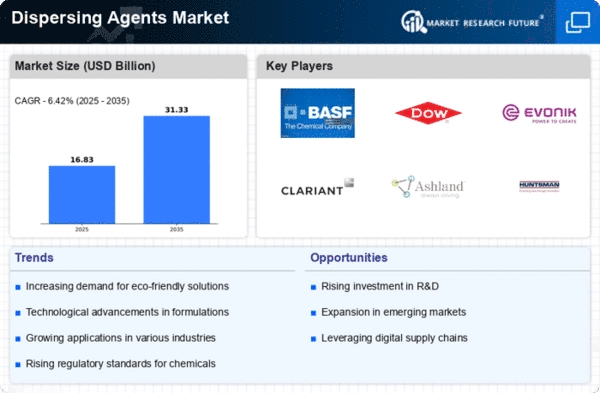
As per MRFR analysis, the Dispersing Agents Market Size was estimated at 15.81 USD Billion in 2024. The Dispersing Agents industry is projected to grow from 16.83 USD Billion in 2025 to 31.33 USD Billion by 2035, exhibiting a compound annual growth rate (CAGR) of 6.42 during the forecast period 2025 - 2035.

Key Market Trends & Highlights

The Dispersing Agents Market is poised for robust growth driven by sustainability and technological advancements.

  • North America remains the largest market for dispersing agents, primarily due to its established industrial base.
  • The Asia-Pacific region is emerging as the fastest-growing market, fueled by rapid industrialization and urbanization.
  • In the paints segment, dispersing agents are crucial for achieving desired product performance, while the coatings segment is witnessing the fastest growth due to increasing applications.
  • Key market drivers include rising demand in the paints and coatings sector and an increased focus on environmental regulations.

Market Size & Forecast

2024 Market Size 15.81 (USD Billion)
2035 Market Size 31.33 (USD Billion)
CAGR (2025 - 2035) 6.42%
Largest Regional Market Share in 2024 Asia-Pacific

Major Players

<p>BASF SE (DE), Dow Inc. (US), Evonik Industries AG (DE), Clariant AG (CH), Ashland Global Holdings Inc. (US), Huntsman Corporation (US), Kraton Corporation (US), Solvay SA (BE), Wacker Chemie AG (DE)</p>

Market Trends

The Dispersing Agents Market is currently experiencing a notable evolution, driven by the increasing demand for high-performance materials across various industries. This market encompasses a diverse range of products that facilitate the uniform distribution of solid particles in liquids, thereby enhancing the stability and performance of formulations. Industries such as paints, coatings, plastics, and pharmaceuticals are increasingly recognizing the value of dispersing agents in improving product quality and efficiency. As environmental regulations become more stringent, there is a growing emphasis on developing eco-friendly dispersing agents, which could potentially reshape the competitive landscape. In addition, the rise of advanced manufacturing technologies appears to be influencing the Dispersing Agents Market. Innovations in formulation chemistry and the introduction of novel materials are likely to create new opportunities for market participants. Furthermore, the increasing focus on sustainability and the circular economy may drive the development of bio-based dispersing agents, which could appeal to environmentally conscious consumers. Overall, the Dispersing Agents Market seems poised for growth, with trends indicating a shift towards more sustainable and efficient solutions that meet the evolving needs of various sectors.

Sustainability Initiatives

The Dispersing Agents Market is witnessing a shift towards sustainability, as manufacturers increasingly prioritize eco-friendly formulations. This trend is driven by consumer demand for greener products and stricter environmental regulations. Companies are exploring bio-based alternatives and reducing the environmental impact of their production processes.

Technological Advancements

Innovations in formulation technology are significantly impacting the Dispersing Agents Market. The development of advanced materials and improved manufacturing techniques is enhancing the performance of dispersing agents. These advancements are likely to lead to more efficient and effective products, catering to diverse industrial applications.

Customization and Specialization

There is a growing trend towards customization in the Dispersing Agents Market, as industries seek tailored solutions to meet specific application requirements. This trend indicates a move away from one-size-fits-all products, with manufacturers focusing on specialized formulations that enhance performance in niche markets.

Dispersing Agents Market Market Drivers

Market Growth Projections

The Global Dispersing Agents Market Industry is poised for substantial growth, with projections indicating a market size of 5.45 USD Billion in 2024 and a potential increase to 14.2 USD Billion by 2035. This trajectory suggests a compound annual growth rate of 9.1% from 2025 to 2035, reflecting the increasing adoption of dispersing agents across various applications. The growth is driven by factors such as rising demand in the paints and coatings sector, technological advancements, and a focus on sustainable solutions. These projections highlight the dynamic nature of the market and the potential for innovation and expansion in the coming years.

Growth in the Construction Sector

The Global Dispersing Agents Market Industry is significantly influenced by the expansion of the construction sector. As urbanization accelerates globally, there is a heightened need for construction materials that incorporate dispersing agents to enhance performance and longevity. These agents are essential in producing concrete, mortars, and other building materials, ensuring optimal consistency and workability. The construction industry's growth is expected to contribute substantially to the market, with projections indicating a shift towards more sustainable and efficient building practices. This trend may further drive the demand for advanced dispersing agents that align with environmental regulations.

Rising Demand in Paints and Coatings

The Global Dispersing Agents Market Industry experiences a notable surge in demand driven by the expanding paints and coatings sector. As industries prioritize high-quality finishes and durability, dispersing agents play a crucial role in enhancing the stability and performance of these products. In 2024, the market is projected to reach 5.45 USD Billion, reflecting the increasing adoption of advanced formulations. Furthermore, the growth trajectory suggests that by 2035, the market could expand to 14.2 USD Billion, indicating a robust compound annual growth rate of 9.1% from 2025 to 2035. This trend underscores the essential function of dispersing agents in achieving optimal product characteristics.

Increasing Focus on Sustainable Solutions

Sustainability is becoming a central theme within the Global Dispersing Agents Market Industry, as manufacturers and consumers alike prioritize eco-friendly products. The growing awareness of environmental issues is prompting companies to seek dispersing agents derived from renewable resources or those that minimize environmental impact. This shift not only aligns with global sustainability goals but also caters to the preferences of environmentally conscious consumers. As a result, the market is likely to see a rise in the development and adoption of bio-based dispersing agents, which could reshape product offerings and drive growth in the coming years.

Technological Advancements in Manufacturing

Technological innovations within the Global Dispersing Agents Market Industry are pivotal in enhancing product efficacy and performance. The introduction of novel formulations and production techniques allows for the development of more efficient dispersing agents, which can significantly improve dispersion quality across various applications. For instance, advancements in nanotechnology are enabling the creation of dispersing agents that offer superior stability and compatibility with diverse materials. As manufacturers increasingly adopt these technologies, the market is likely to witness accelerated growth, driven by the demand for high-performance products that meet stringent industry standards.

Expanding Applications in Various Industries

The versatility of dispersing agents is a key driver in the Global Dispersing Agents Market Industry, as they find applications across multiple sectors, including pharmaceuticals, agriculture, and food processing. This broad applicability enhances market resilience, as demand from diverse industries can offset fluctuations in any single sector. For example, in pharmaceuticals, dispersing agents are crucial for formulating stable suspensions and emulsions, while in agriculture, they improve the efficacy of pesticides and fertilizers. The ongoing exploration of new applications is likely to sustain market growth, as industries continue to recognize the benefits of effective dispersion.

Market Segment Insights

By Application: Paints (Largest) vs. Coatings (Fastest-Growing)

<p>The Dispersing Agents Market showcases a diverse application landscape, with paints leading significantly in market share. The demand for high-quality paints, driven by aesthetic and protective needs, supports its market dominance. Closely following are coatings and inks, both essential in various industrial and consumer applications. Textiles and plastics are notable segments as well, though they hold a smaller share of the market. Overall, paints' substantial contribution reflects the robust growth of the construction and automotive sectors.</p>

<p>Paints (Dominant) vs. Coatings (Emerging)</p>

<p>The paints segment stands as the dominant force within the dispersing agents market, characterized by a vast range of applications that fulfill both functional and decorative needs. The integration of advanced formulations has positioned paints to meet stringent environmental regulations and enhance product performance. Concurrently, the coatings segment is emerging, propelled by rapid innovations and an increasing emphasis on performance coatings, such as anti-corrosive and eco-friendly options. This evolution reflects a shift towards sustainable practices and the necessity for protective finishes in diverse industries like automotive and construction.</p>

By End Use Industry: Automotive (Largest) vs. Construction (Fastest-Growing)

<p>In the Dispersing Agents Market, the automotive sector holds the largest share, being a major consumer of these agents crucial for enhancing the performance and durability of coatings, paints, and other materials. Meanwhile, the construction industry is experiencing rapid growth, driven by increasing investments in infrastructure and the rising demand for eco-friendly construction solutions that utilize dispersing agents for improved material characteristics.</p>

<p>Automotive (Dominant) vs. Construction (Emerging)</p>

<p>The automotive sector is the dominant player in the Dispersing Agents Market, leveraging these agents for applications in coatings, adhesives, and plastics, which are essential for vehicle manufacturing. Dispersing agents help improve the flow and stability of materials used in vehicle coatings, contributing to better surface finishes and durability. Conversely, the construction industry is emerging as a significant player, propelled by a focus on sustainable building practices. The rapid expansion of green construction and advanced material technologies is increasing the demand for dispersing agents. As builders aim for higher efficiency and environmental compliance, the role of dispersing agents in improving material performance is becoming increasingly essential.</p>

By Type: Anionic Dispersing Agents (Largest) vs. Nonionic Dispersing Agents (Fastest-Growing)

<p>The Dispersing Agents Market is primarily dominated by Anionic Dispersing Agents, which hold a significant portion of the market share due to their efficacy in various applications, particularly in water-based formulations. These agents are favored in industries such as paints, coatings, and inks for their superior dispersing capabilities. In contrast, Nonionic Dispersing Agents are rapidly gaining traction as the fastest-growing segment, attributed to their versatility and compatibility with a wide range of solvents and ingredients, making them increasingly popular in formulations across multiple sectors. Growth trends in the Dispersing Agents Market are driven by rising demand in the paints and coatings industry as well as in the manufacturing of advanced materials. The shift towards environmentally friendly and sustainable products has also fueled the growth of Nonionic Dispersing Agents, which often feature more favorable environmental profiles compared to their anionic counterparts. Factors such as technological advancements and the development of new formulations further enhance market opportunities for both segment values, leading to sustained demand and innovation in dispersing agent applications.</p>

<p>Anionic Dispersing Agents (Dominant) vs. Cationic Dispersing Agents (Emerging)</p>

<p>Anionic Dispersing Agents are established as the dominant force in the Dispersing Agents Market, recognized for their effectiveness in stabilizing suspensions and improving the performance of products in diverse sectors such as textiles, ceramics, and automotive. Their ability to provide strong electrostatic repulsion makes them essential for applications that require robust stability. On the other hand, Cationic Dispersing Agents are seen as an emerging segment poised for growth, driven by their unique properties such as positive charge that allows for effective interaction with negatively charged substrates. These agents are increasingly being adopted in personal care products, adhesives, and paper applications, tapping into niche markets that demand specialized performance. The contrasting characteristics of these agents position them uniquely within the market, with Anionic agents maintaining dominance while Cationic agents offer innovative solutions.</p>

By Formulation Type: Water-Based Dispersing Agents (Largest) vs. Solvent-Based Dispersing Agents (Fastest-Growing)

<p>In the Dispersing Agents Market, the formulation type segment is characterized by three primary categories: Water-Based, Solvent-Based, and Powder Dispersing Agents. Water-Based Dispersing Agents hold the largest share within the market, appealing to environmentally conscious consumers and industries. Their widespread application in various sectors, including paints, adhesives, and coatings, enhances their market presence. Meanwhile, Solvent-Based Dispersing Agents are witnessing rapid growth, driven by an increase in industrial activities and demand for high-performance solutions in specialized applications.</p>

<p>Water-Based (Dominant) vs. Powder (Emerging)</p>

<p>Water-Based Dispersing Agents are regarded as the dominant formulation type, noted for their eco-friendliness and effective performance in numerous applications. Their composition not only minimizes harmful emissions but also aligns with regulatory standards, making them increasingly popular across different industries. In contrast, Powder Dispersing Agents are emerging as a viable alternative, offering unique advantages in terms of storage, transportation, and application efficiency. As industries continue to seek innovative solutions for enhancing product performance and sustainability, Powder Dispersing Agents are likely to gain more traction, presenting significant opportunities for growth.</p>

Get more detailed insights about Dispersing Agents Market Research Report- Forecast to 2035

Regional Insights

North America : Established Market with Growth Potential

The North American dispersing agents market, valued at $4.75 billion, is driven by increasing demand in industries such as paints, coatings, and plastics. Regulatory support for sustainable practices and innovations in formulations are key growth catalysts. The region's focus on eco-friendly products aligns with global trends, enhancing market potential. Leading countries like the US and Canada dominate the market, with major players such as Dow Inc. and Ashland Global Holdings Inc. contributing significantly to the competitive landscape. The presence of established companies fosters innovation and ensures a steady supply chain, positioning North America as a vital player in The Dispersing Agents.

Europe : Innovation and Sustainability Focus

Europe's dispersing agents market, valued at €3.8 billion, is characterized by a strong emphasis on innovation and sustainability. Regulatory frameworks, such as REACH, drive the demand for eco-friendly dispersing agents, aligning with the region's commitment to environmental standards. The market is expected to grow as industries adapt to these regulations and consumer preferences shift towards sustainable products. Germany, France, and the UK are leading countries in this market, with key players like BASF SE and Evonik Industries AG at the forefront. The competitive landscape is marked by continuous research and development efforts, ensuring that European companies remain leaders in innovative dispersing solutions. The focus on sustainability is reshaping product offerings and market dynamics.

Asia-Pacific : Rapid Growth and Market Leadership

The Asia-Pacific region leads the dispersing agents market with a valuation of $6.5 billion, driven by rapid industrialization and urbanization. Countries like China and India are experiencing significant growth in demand across various sectors, including construction, automotive, and consumer goods. The region's favorable regulatory environment supports the adoption of advanced dispersing technologies, further fueling market expansion. China stands out as a key player, with numerous local and international companies competing for market share. Major global players like Clariant AG and Solvay SA are also investing in the region, enhancing their presence. The competitive landscape is dynamic, with a focus on innovation and cost-effective solutions to meet the diverse needs of the growing market.

Middle East and Africa : Emerging Market with Growth Opportunities

The Middle East and Africa (MEA) dispersing agents market, valued at $0.76 billion, is emerging with significant growth opportunities. The region's expanding industrial base, particularly in construction and manufacturing, is driving demand for dispersing agents. Government initiatives aimed at diversifying economies and enhancing local production capabilities are key growth drivers. Countries like South Africa and the UAE are leading the market, with a growing number of local manufacturers entering the space. The competitive landscape is evolving, with both regional and international players vying for market share. As the MEA region continues to develop, the dispersing agents market is expected to witness substantial growth, supported by increasing investments in infrastructure and industrial projects.

Key Players and Competitive Insights

The Dispersing Agents Market is currently characterized by a dynamic competitive landscape, driven by increasing demand across various industries such as paints, coatings, and plastics. Key players are actively engaging in strategies that emphasize innovation, sustainability, and regional expansion. For instance, BASF SE (DE) has been focusing on enhancing its product portfolio through sustainable solutions, which aligns with the growing consumer preference for eco-friendly products. Similarly, Dow Inc. (US) is leveraging its technological expertise to develop advanced dispersing agents that cater to specific industry needs, thereby solidifying its market position. The collective strategies of these companies indicate a trend towards a more integrated approach to product development and market penetration, shaping a competitive environment that is both collaborative and competitive.

In terms of business tactics, companies are increasingly localizing manufacturing to reduce lead times and optimize supply chains. This approach not only enhances operational efficiency but also allows for better responsiveness to regional market demands. The market structure appears to be moderately fragmented, with several key players exerting influence while also facing competition from smaller, specialized firms. The interplay between these entities fosters a competitive atmosphere where innovation and customer-centric solutions are paramount.

In November 2025, Evonik Industries AG (DE) announced the launch of a new line of bio-based dispersing agents aimed at reducing environmental impact. This strategic move is significant as it positions Evonik as a leader in sustainable product offerings, potentially attracting environmentally conscious customers and enhancing brand loyalty. The introduction of these products may also set a benchmark for competitors, pushing them to innovate in sustainability.

In October 2025, Clariant AG (CH) entered into a strategic partnership with a leading technology firm to develop AI-driven solutions for optimizing dispersing agent formulations. This collaboration is likely to enhance Clariant's R&D capabilities, enabling faster product development cycles and more tailored solutions for clients. The integration of AI into their operations could provide a competitive edge, allowing for more precise formulations that meet specific customer requirements.

In September 2025, Ashland Global Holdings Inc. (US) expanded its manufacturing capabilities in Asia to better serve the growing demand in that region. This expansion is crucial as it not only increases production capacity but also reduces shipping times and costs, thereby improving overall supply chain efficiency. Such strategic moves are indicative of a broader trend where companies are seeking to enhance their operational footprint in high-growth markets.

As of December 2025, the competitive trends in the Dispersing Agents Market are increasingly defined by digitalization, sustainability, and the integration of advanced technologies such as AI. Strategic alliances are becoming more prevalent, allowing companies to pool resources and expertise to drive innovation. The shift from price-based competition to a focus on technological advancement and supply chain reliability is evident, suggesting that future competitive differentiation will hinge on the ability to innovate and respond to market needs swiftly.

Key Companies in the Dispersing Agents Market market include

Industry Developments

  • Q2 2025: BASF introduces new eco-friendly dispersing agent to meet rising demand for water-borne formulations BASF expanded its product line with a new environmentally friendly dispersing agent, responding to increased demand driven by stricter environmental regulations in the U.S. and Europe and the shift toward water-based formulations in paints, coatings, and personal care sectors.
  • Q2 2025: FDA approves dispersing agents for food applications, broadening use in dietary supplements and beverages The U.S. Food and Drug Administration granted approval for certain dispersing agents, enabling their use in food applications such as dietary supplements and beverages, which is expected to expand market opportunities for manufacturers.

Intended Audience

    • Dispersing agents   market manufacturers
    • Traders and Distributors of Dispersing agents  market
    • Production Process Industries
    • Potential Investors
    • Raw Material Suppliers
    • Nationalized Laboratory 

Future Outlook

Dispersing Agents Market Future Outlook

<p>The Dispersing Agents Market is projected to grow at a 6.42% CAGR from 2024 to 2035, driven by increasing demand in coatings, plastics, and pharmaceuticals.</p>

New opportunities lie in:

  • <p>Development of eco-friendly dispersing agents for sustainable applications.</p>
  • <p>Expansion into emerging markets with tailored product offerings.</p>
  • <p>Integration of digital technologies for real-time dispersion monitoring.</p>

<p>By 2035, the market is expected to achieve robust growth, positioning itself as a leader in innovative dispersion solutions.</p>

Market Segmentation

Dispersing Agents Market Type Outlook

  • Anionic Dispersing Agents
  • Cationic Dispersing Agents
  • Nonionic Dispersing Agents
  • Amphoteric Dispersing Agents

Dispersing Agents Market Application Outlook

  • Paints
  • Coatings
  • Inks
  • Plastics
  • Textiles

Dispersing Agents Market End Use Industry Outlook

  • Automotive
  • Construction
  • Electronics
  • Consumer Goods
  • Aerospace

Dispersing Agents Market Formulation Type Outlook

  • Water-Based Dispersing Agents
  • Solvent-Based Dispersing Agents
  • Powder Dispersing Agents

Report Scope

MARKET SIZE 202415.81(USD Billion)
MARKET SIZE 202516.83(USD Billion)
MARKET SIZE 203531.33(USD Billion)
COMPOUND ANNUAL GROWTH RATE (CAGR)6.42% (2024 - 2035)
REPORT COVERAGERevenue Forecast, Competitive Landscape, Growth Factors, and Trends
BASE YEAR2024
Market Forecast Period2025 - 2035
Historical Data2019 - 2024
Market Forecast UnitsUSD Billion
Key Companies ProfiledBASF SE (DE), Dow Inc. (US), Evonik Industries AG (DE), Clariant AG (CH), Ashland Global Holdings Inc. (US), Huntsman Corporation (US), Kraton Corporation (US), Solvay SA (BE), Wacker Chemie AG (DE)
Segments CoveredApplication, End Use Industry, Type, Formulation Type
Key Market OpportunitiesGrowing demand for eco-friendly dispersing agents in various industrial applications presents significant market opportunities.
Key Market DynamicsRising demand for eco-friendly dispersing agents drives innovation and competition among manufacturers in various industries.
Countries CoveredNorth America, Europe, APAC, South America, MEA

FAQs

Which end user segment would dominate the global dispersing agent market?

The building and construction sector to hold the maximum dispersing agent market share.

Which players would dominate the global dispersing agent market?

The global dispersing agent market has prominent players like Cytec Industries Inc. (U.S.), BASF SE (Germany), Clariant AG (Switzerland), Air Products &amp; Chemicals Inc (U.S.), The Dow Chemical Company (U.S.), Arkema Group (France), Altana AG (Germany), Meadwestvaco Corporation (U.S.), Emerald Performance Materials Llc (U.S.), Croda International Plc (U.K), The Lubrizol Corporation (U.S.), and Gruppo Chimico Dalton Spa (Italy).

Which region is expected to have the maximum share of the global dispersing agent market?

Asia Pacific region is going to lead the global dispersing agent market.

What strategies the market players would initiate for the global dispersing agent market?

The dispersing agent market would witness tactical moves like acquisitions, mergers, better R&amp;D, production plans, advertising, collaborations, product launch, and others.

What factors to boost the global dispersing agent market?

Dispersing agents’ ability to maintain uniformity in mixtures increases its intake as manufacturing of paints, medicines, and gasoline, which can ensure hike in the output of the global dispersing agent market profit.

  1. Executive Summary
  2. Scope of the Report
    1. Market Definition
    2. Scope of the Study
      1. Research
      2. Assumptions & Limitations
    3. Objectives
    4. Markets Structure
  3. Market Research Methodology
    1. Research Process
    2. Secondary Research
    3. Primary Research
    4. Forecast Model
  4. Market Landscape
    1. Porter’s
      1. Threat of New Entrants
      2. Threat of substitutes
      3. Segment rivalry
    2. Five Forces Analysis
    3. Bargaining power of buyers
    4. Value Chain/Supply
    5. Chain of Global Dispersing Agents Market
  5. Industry Overview
    1. of Global Dispersing Agents Market
    2. Introduction
    3. Growth Drivers
    4. Impact analysis
    5. Market Challenges
  6. Market Trends
    1. Introduction
    2. Growth Trends
    3. Impact analysis
  7. Global Dispersing Agents Market by Product
    1. Type
    2. Introduction
    3. Suspension
      1. Market Estimates & Forecast, 2020-2027
      2. Market Estimates &
    4. Forecast by Region, 2020-2027
    5. Solution
      1. Market Estimates &
    6. Market Estimates & Forecast, 2020-2027
    7. Forecast by Region, 2020-2027
    8. Colloid
      1. Market Estimates & Forecast, 2020-2027
      2. Market Estimates &
    9. Forecast by Region, 2020-2027
    10. Powder
      1. Market Estimates & Forecast, 2020-2027
      2. Market Estimates &
    11. Forecast by Region, 2020-2027
    12. Others
      1. Market Estimates & Forecast
    13. Market Estimates & Forecast, 2020-2027
    14. by Region, 2020-2027
  8. Global Dispersing Agents Market by End-use
    1. Introduction
    2. Pharmaceuticals
      1. Market Estimates & Forecast, 2020-2027
      2. Market Estimates &
    3. Forecast by Region, 2020-2027
    4. Oil and Gas
      1. Market Estimates & Forecast
    5. Market Estimates & Forecast, 2020-2027
    6. by Region, 2020-2027
    7. Automotive
      1. Market Estimates
      2. Market Estimates & Forecast by Region,
    8. & Forecast, 2020-2027
    9. Paints and coatings
      1. Market Estimates
      2. Market Estimates & Forecast by Region,
    10. & Forecast, 2020-2027
    11. Agriculture
      1. Market Estimates &
      2. Market Estimates & Forecast by Region, 2020-2027
    12. Forecast, 2020-2027
    13. Pulp &
      1. Market Estimates & Forecast, 2020-2027
      2. Market Estimates
    14. Paper
    15. & Forecast by Region, 2020-2027
    16. Detergents
      1. Market Estimates & Forecast
    17. Market Estimates & Forecast, 2020-2027
    18. by Region, 2020-2027
    19. Others
      1. Market Estimates
      2. Market Estimates & Forecast by Region,
    20. & Forecast, 2020-2027
  9. Global Dispersing Agents Market by Region
    1. Introduction
    2. North America
      1. Market Estimates & Forecast, 2020-2027
      2. Market Estimates &
      3. Market Estimates & Forecast by
      4. U.S.
      5. Mexico
      6. Canada
    3. Forecast by Product Type, 2020-2027
    4. End-use, 2020-2027
    5. & Forecast, 2020-2027
    6. Type, 2020-2027
    7. Market Estimates & Forecast by End-use, 2020-2027
    8. & Forecast by Product Type, 2020-2027
    9. by End-use, 2020-2027
    10. Europe
      1. Market Estimates
      2. Market Estimates & Forecast by Product
      3. Market Estimates & Forecast by End-use, 2020-2027
      4. Germany
      5. Italy
      6. Spain
      7. U.K
    11. & Forecast, 2020-2027
    12. Type, 2020-2027
    13. France
    14. Market Estimates & Forecast by Product Type, 2020-2027
    15. & Forecast by End-use, 2020-2027
    16. Market Estimates & Forecast, 2020-2027
    17. by Product Type, 2020-2027
    18. Forecast, 2020-2027
    19. Market Estimates & Forecast by End-use, 2020-2027
    20. Rest of Europe
    21. Market Estimates & Forecast by Product Type, 2020-2027
    22. & Forecast by End-use, 2020-2027
    23. Asia Pacific
      1. Market Estimates & Forecast, 2020-2027
      2. Market Estimates &
      3. Market Estimates & Forecast by
      4. China
      5. India
      6. Australia
      7. New Zealand
      8. Rest of Asia Pacific
    24. Forecast by Product Type, 2020-2027
    25. End-use, 2020-2027
    26. & Forecast, 2020-2027
    27. Type, 2020-2027
    28. Japan
    29. Market Estimates & Forecast by Product Type, 2020-2027
    30. & Forecast by End-use, 2020-2027
    31. Market Estimates & Forecast, 2020-2027
    32. by Product Type, 2020-2027
    33. & Forecast, 2020-2027
    34. Type, 2020-2027
    35. Forecast, 2020-2027
    36. The Middle East & Africa
      1. Market Estimates
      2. Market Estimates & Forecast by Product
      3. Market Estimates & Forecast by End-use, 2020-2027
      4. Turkey
      5. Israel
      6. North Africa
      7. GCC
      8. Rest of the Middle East & Africa
    37. & Forecast, 2020-2027
    38. Type, 2020-2027
    39. Market Estimates & Forecast by Product Type, 2020-2027
    40. & Forecast by End-use, 2020-2027
    41. Estimates & Forecast, 2020-2027
    42. by Product Type, 2020-2027
    43. & Forecast by Product Type, 2020-2027
    44. by End-use, 2020-2027
    45. Market Estimates & Forecast, 2020-2027
    46. by Product Type, 2020-2027
    47. Latin America
      1. Market Estimates &
      2. Market Estimates & Forecast by Product Type,
      3. Market Estimates & Forecast by End-use, 2020-2027
      4. Argentina
      5. Rest of Latin America
    48. Forecast, 2020-2027
    49. Brazil
    50. Market Estimates & Forecast by Product Type, 2020-2027
    51. & Forecast by End-use, 2020-2027
    52. Estimates & Forecast, 2020-2027
    53. by Product Type, 2020-2027
    54. Forecast, 2020-2027
  10. Company Landscape
  11. Company Profiles
    1. BASF
      1. Company Overview
      2. Product
      3. Financial Updates
      4. Key Developments
    2. SE
    3. Type/Business Segment Overview
    4. Clariant
      1. Company Overview
      2. Product
      3. Financial Updates
      4. Key Developments
    5. AG
    6. Type/Business Segment Overview
    7. The Dow
      1. Company Overview
      2. Financial
      3. Key Developments
    8. Chemical Company
    9. Product Type/Business Segment Overview
    10. Updates
    11. Air
      1. Company Overview
      2. Financial
      3. Key Developments
      4. Company Overview
      5. Financial
      6. Key Developments
    12. Products & Chemicals Inc
    13. Product Type/Business Segment Overview
    14. Updates
    15. Altana AG
    16. Product Type/Business Segment Overview
    17. Updates
    18. Arkema
      1. Company Overview
      2. Product
      3. Financial Updates
      4. Key Developments
    19. Group.
    20. Type/Business Segment Overview
    21. Emerald
      1. Company Overview
      2. Financial
      3. Key Developments
    22. Performance Materials Llc
    23. Product Type/Business Segment Overview
    24. Updates
    25. Meadwestvaco
      1. Company Overview
      2. Financial
      3. Key Developments
    26. Corporation
    27. Product Type/Business Segment Overview
    28. Updates
    29. The
      1. Company Overview
      2. Financial
      3. Key Developments
    30. Lubrizol Corporation
    31. Product Type/Business Segment Overview
    32. Updates
    33. Croda
      1. Company Overview
      2. Financial
      3. Key Developments
    34. International Plc
    35. Product Type/Business Segment Overview
    36. Updates
    37. Gruppo
      1. Company Overview
      2. Financial
      3. Key Developments
    38. Chimico Dalton Spa
    39. Product Type/Business Segment Overview
    40. Updates
    41. Conclusion
  12. LIST OF TABLES
    1. Table 1
    2. World Population by Major Regions (2020 To 2027)
    3. Table 2
    4. Global Dispersing Agents Market: By Region, 2020-2027
    5. Table 3
    6. North America Dispersing Agents Market: By Country, 2020-2027
    7. Table
  13. Europe Dispersing Agents Market: By Country, 2020-2027
  14. Asia Pacific Dispersing Agents Market: By Country, 2020-2027
  15. The Middle East & Africa Dispersing Agents
    1. Market: By Country, 2020-2027
  16. Latin America
    1. Dispersing Agents Market: By Country, 2020-2027
    2. Table 8
    3. Global Dispersing Agents by Product Type Market: By Regions, 2020-2027
  17. North America Dispersing Agents by Product Type Market:
    1. By Country, 2020-2027
    2. Table10 Europe Dispersing Agents
    3. by Product Type Market: By Country, 2020-2027
    4. Table11 Asia
    5. Pacific Dispersing Agents by Product Type Market: By Country, 2020-2027
    6. Table12 The Middle East & Africa Dispersing Agents by Product
    7. Type Market: By Country, 2020-2027
    8. Table13 Latin America
    9. Dispersing Agents by Product Type Market: By Country, 2020-2027
    10. Table14
    11. Global Dispersing Agents by End-use Market: By Regions, 2020-2027
    12. Table15 North America Dispersing Agents by End-use Market: By
    13. Country, 2020-2027
    14. Table16 Europe Dispersing Agents
    15. by End-use Market: By Country, 2020-2027
    16. Table17 Asia
    17. Pacific Dispersing Agents by End-use Market: By Country, 2020-2027
    18. Table18
    19. The Middle East & Africa Dispersing Agents by End-use Market: By Country,
    20. Table19 Latin America Dispersing Agents
    21. by End-use Market: By Country, 2020-2027
    22. Table20 Global
    23. Dispersing Agents by End-use Market: By Regions, 2020-2027
    24. Table21
    25. Global Product Type Market: By Region, 2020-2027
    26. Table22
    27. Global End-use Market: By Region, 2020-2027
    28. Table23
    29. Global End-use Market: By Region, 2020-2027
    30. Table24
  18. North America Dispersing Agents Market, By Country
    1. Table25
  19. North America Dispersing Agents Market, By Product Type
    1. Table26
  20. North America Dispersing Agents Market, By End-use
    1. Table27
  21. North America Dispersing Agents Market, By End-use
    1. Table28
  22. Europe: Dispersing Agents Market, By Country
    1. Table29
  23. Europe: Dispersing Agents Market, By Product Type
    1. Table30
  24. Europe: Dispersing Agents Market, By End-use
    1. Table31 Europe:
  25. Dispersing Agents Market, By End-use
    1. Table32 Asia Pacific:
  26. Dispersing Agents Market, By Country
    1. Table33 Asia
  27. Pacific: Dispersing Agents Market, By Product Type
    1. Table34 Asia
  28. Pacific: Dispersing Agents Market, By End-use
    1. Table35 Asia
  29. Pacific: Dispersing Agents Market, By End-use
    1. Table36 The
  30. Middle East & Africa: Dispersing Agents Market, By Country
    1. Table37
  31. The Middle East & Africa Dispersing Agents Market, By Product Type
    1. Table38 The Middle East & Africa Dispersing Agents Market,
    2. By End-use
    3. Table39 The Middle East & Africa: Dispersing
  32. Agents Market, By End-use
    1. Table41 Latin America: Dispersing
  33. Agents Market, By Country
    1. Table42 Latin America Dispersing
  34. Agents Market, By Product Type
    1. Table43 Latin America Dispersing
  35. Agents Market, By End-use
    1. Table44 Latin America: Dispersing
  36. Agents Market, By End-use
  37. LIST OF FIGURES
    1. FIGURE
  38. Global Dispersing Agents market segmentation
  39. Forecast Methodology
  40. Porter’s Five Forces Analysis of Global Dispersing Agents Market
  41. Value Chain of Global Dispersing Agents Market
  42. Share
  43. of Global Dispersing Agents Market in 2020, by country (in %)
    1. FIGURE 6
    2. Global Dispersing Agents Market, 2020-2027,
  44. Sub segments of
    1. Product Type
  45. Global Dispersing Agents Market size by Product
    1. Type, 2020
  46. Share of Global Dispersing Agents Market by Product
    1. Type, 2020-2027
  47. Global Dispersing Agents Market size by End-use,
  48. Share of Global Dispersing Agents Market by End-use,

Dispersing Agents Market Segmentation

Market Segmentation Overview

  • Detailed segmentation data will be available in the full report
  • Comprehensive analysis by multiple parameters
  • Regional and country-level breakdowns
  • Market size forecasts by segment
Infographic

Free Sample Request

Kindly complete the form below to receive a free sample of this Report

Get Free Sample

Customer Strories

Compare Licence

×
Features License Type
Single User Multiuser License Enterprise User
Price $4,950 $5,950 $7,250
Maximum User Access Limit 1 User Upto 10 Users Unrestricted Access Throughout the Organization
Free Customization
Direct Access to Analyst
Deliverable Format
Platform Access
Discount on Next Purchase 10% 15% 15%
Printable Versions