Direct To Garment Printing Market (2026 - 2035)

ID: MRFR/CG/29965-HCR 128 Pages Pradeep Nandi Last Updated: October 27, 2026
Direct to Garment Printing Market Size, Share, Industry Trend & Analysis Research Report By Substrate (Cotton, Polyester, Cotton-Poly Blends, and More), By Ink Type (Pigment, Reactive, Acid, Disperse), By Application (Clothing and Apparel, Home Decor, Technical Textiles, and More), By Sales Channel (Print Service Providers (PSPs), In-house/Brand-owned, Online Fulfilment Platforms), By Geography (North America, Europe, Asia-Pacific, South America, Middle East & Africa) - Forecast to 2035
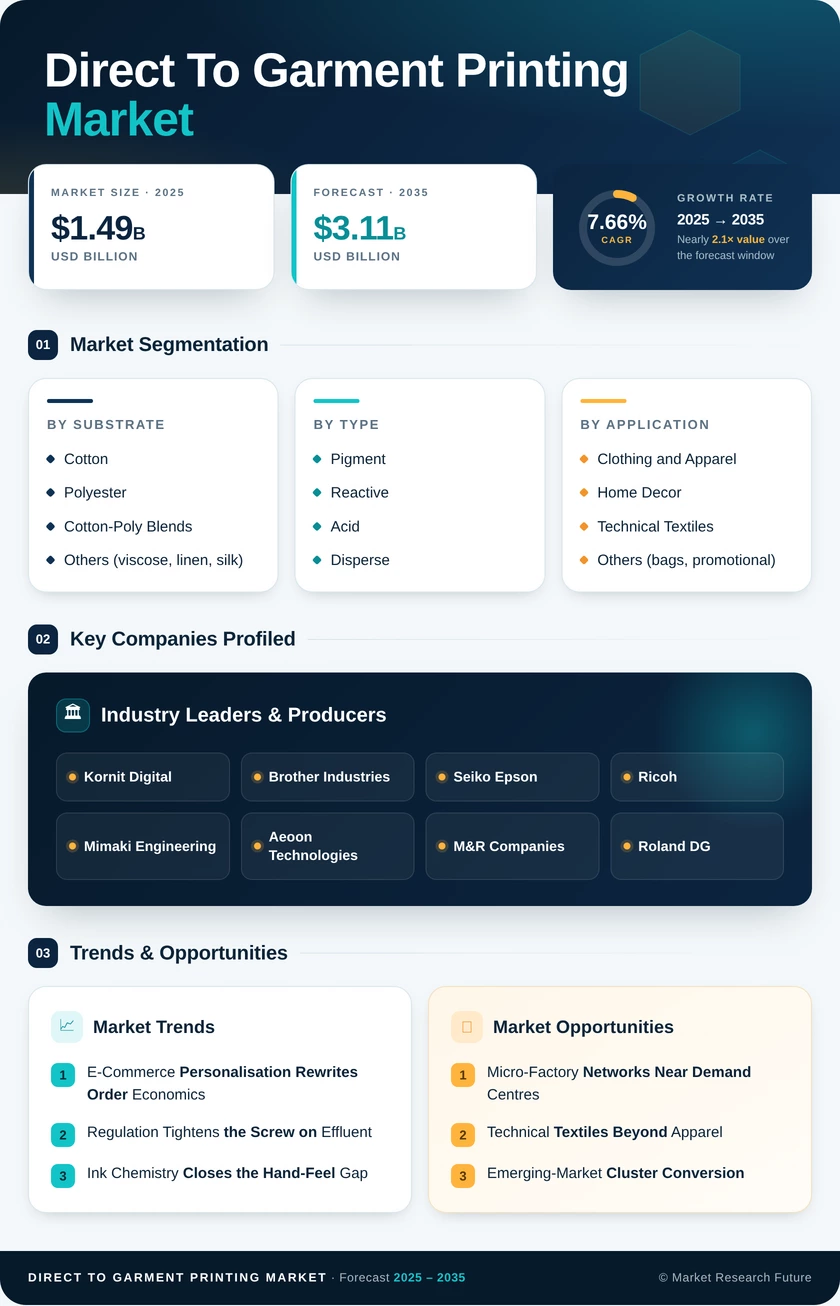
Direct To Garment Printing Market
Market Size
Forecast Period2026-2035
CAGR (2026-2035)7.66%
2025 Market SizeUSD 1.49 Billion
2035 Market SizeUSD 3.11 Billion
Key Players
Kornit Digital
Brother Industries
Seiko Epson
Ricoh
Mimaki Engineering
Aeoon Technologies
Opportunities
  • Micro-Factory Networks Near Demand Centres
  • Technical Textiles Beyond Apparel
  • Emerging-Market Cluster Conversion
  1. 1 Market Overview |
    1. 1.1 Study Assumptions & Market Definition |
    2. 1.2 Scope of the Study |
    3. 1.3 Research Methodology
  2. 2 Market Summary & Key Takeaways |
    1. 2.1 By Substrate |
    2. 2.2 By Sector |
    3. 2.3 By Geography
  3. 3 Market Size & Forecast (2021–2035) |
    1. 3.1 Historical Market Size (2021–2025) |
    2. 3.2 Current & Forecast Market Size (2026–2035) |
    3. 3.3 Market Size by Revenue (USD Billion) |
    4. 3.4 Year-over-Year Growth Analysis
  4. 4 Market Drivers Analysis |
    1. 4.1 E-Commerce Personalisation and Order Economics |
    2. 4.2 Effluent and Wastewater Regulation |
    3. 4.3 Ink Chemistry and Hand-Feel Advances |
    4. 4.4 Capital Subsidy Programmes in Asia-Pacific
  5. 5 Market Restraints Analysis |
    1. 5.1 Total Cost of Ownership and Consumable Lock-In |
    2. 5.2 Throughput Ceilings Versus Screen Carousels |
    3. 5.3 Competition from Direct-to-Film Workflows
  6. 6 Market Opportunity Analysis |
    1. 6.1 Micro-Factory Networks Near Demand Centres |
    2. 6.2 Technical Textiles Beyond Apparel |
    3. 6.3 Emerging-Market Cluster Conversion |
    4. 6.4 Consumables and Data Monetisation |
    5. 6.5 Sustainability Certification as a Sales Wedge |
    6. 6.6 Industry Value Chain Analysis |
    7. 6.7 Porter's Five Forces Analysis
  7. 7 Regional Analysis |
    1. 7.1 North America | |
      1. 7.1.1 US | |
      2. 7.1.2 Canada | |
      3. 7.1.3 Mexico |
    2. 7.2 Europe | |
      1. 7.2.1 Germany | |
      2. 7.2.2 UK | |
      3. 7.2.3 France | |
      4. 7.2.4 Italy | |
      5. 7.2.5 Spain | |
      6. 7.2.6 Nordic Countries | |
      7. 7.2.7 Russia | |
      8. 7.2.8 Rest of Europe |
    3. 7.3 Asia-Pacific | |
      1. 7.3.1 China | |
      2. 7.3.2 India | |
      3. 7.3.3 Japan | |
      4. 7.3.4 South Korea | |
      5. 7.3.5 ASEAN | |
      6. 7.3.6 Rest of Asia-Pacific |
    4. 7.4 South America | |
      1. 7.4.1 Brazil | |
      2. 7.4.2 Argentina | |
      3. 7.4.3 Rest of South America |
    5. 7.5 Middle East & Africa | |
      1. 7.5.1 Saudi Arabia | |
      2. 7.5.2 UAE | |
      3. 7.5.3 South Africa | |
      4. 7.5.4 Egypt | |
      5. 7.5.5 Rest of Middle East & Africa
  8. 8 Future Outlook (2026–2035) |
    1. 8.1 Autonomous Production Cells |
    2. 8.2 Consumables Annuity Displacing Hardware Cycles |
    3. 8.3 Circularity Reporting as Mandatory Infrastructure |
    4. 8.4 Hybrid Analog-Digital Lines
  9. 9 Segmentation Analysis |
    1. 9.1 By Substrate | |
      1. 9.1.1 Cotton | |
      2. 9.1.2 Polyester | |
      3. 9.1.3 Cotton-Poly Blends | |
      4. 9.1.4 Others |
    2. 9.2 By Ink Type | |
      1. 9.2.1 Pigment | |
      2. 9.2.2 Reactive | |
      3. 9.2.3 Acid | |
      4. 9.2.4 Disperse |
    3. 9.3 By Application | |
      1. 9.3.1 Clothing and Apparel | |
      2. 9.3.2 Home Decor | |
      3. 9.3.3 Technical Textiles | |
      4. 9.3.4 Others |
    4. 9.4 By Sales Channel | |
      1. 9.4.1 Print Service Providers (PSPs) | |
      2. 9.4.2 In-house / Brand-owned | |
      3. 9.4.3 Online Fulfilment Platforms
  10. 10 Competitive Landscape |
    1. 10.1 Market Share Analysis (2026) |
    2. 10.2 Competitive Benchmarking Matrix |
    3. 10.3 Company Profiles | |
      1. 10.3.1 Kornit Digital | |
      2. 10.3.2 Brother Industries | |
      3. 10.3.3 Seiko Epson | |
      4. 10.3.4 Ricoh | |
      5. 10.3.5 Mimaki Engineering | |
      6. 10.3.6 Aeoon Technologies | |
      7. 10.3.7 M&R Companies | |
      8. 10.3.8 Roland DG | |
      9. 10.3.9 Konica Minolta | |
      10. 10.3.10 ColDesi / Polyprint | |
      11. 10.3.11 OmniPrint International
  11. 11 Recent Developments & News
  12. 12 Report Scope & Methodology |
    1. 12.1 Study Period & Base Year |
    2. 12.2 Data Sources & Citations |
    3. 12.3 Abbreviations
  13. 13 Detailed Sources & Citations
  14. 14 Frequently Asked Questions (FAQs)
  15. 15 LIST OF TABLES |
  16. TABLE 1 Global Direct to Garment Printing Market Size & Forecast, by Revenue (USD Billion), 2021–2035 |
  17. TABLE 2 Global Direct to Garment Printing Market – Year-over-Year Growth Analysis, 2021–2035 |
  18. TABLE 3 Driver Impact Analysis Matrix, 2026–2035 |
  19. TABLE 4 Restraint Impact Analysis Matrix, 2026–2035 |
  20. TABLE 5 Global Market Size, by Substrate, 2021–2035 (USD Billion) |
  21. TABLE 6 Global Market Size, by Ink Type, 2021–2035 (USD Billion) |
  22. TABLE 7 Global Market Size, by Application, 2021–2035 (USD Billion) |
  23. TABLE 8 Global Market Size, by Sales Channel, 2021–2035 (USD Billion) |
  24. TABLE 9 Global Market Size, by Region, 2021–2035 (USD Billion) |
  25. TABLE 10 North America Market Size, by Country, 2021–2035 (USD Billion) |
  26. TABLE 11 Europe Market Size, by Country, 2021–2035 (USD Billion) |
  27. TABLE 12 Asia-Pacific Market Size, by Country, 2021–2035 (USD Billion) |
  28. TABLE 13 South America Market Size, by Country, 2021–2035 (USD Billion) |
  29. TABLE 14 Middle East & Africa Market Size, by Country, 2021–2035 (USD Billion) |
  30. TABLE 15 North America Market Size, by Substrate and Ink Type, 2021–2035 (USD Billion) |
  31. TABLE 16 Europe Market Size, by Application and Sales Channel, 2021–2035 (USD Billion) |
  32. TABLE 17 Asia-Pacific Market Size, by Substrate and Application, 2021–2035 (USD Billion) |
  33. TABLE 18 South America Market Size, by Ink Type and Sales Channel, 2021–2035 (USD Billion) |
  34. TABLE 19 Middle East & Africa Market Size, by Substrate and Application, 2021–2035 (USD Billion) |
  35. TABLE 20 Competitive Benchmarking Matrix, 2026 |
  36. TABLE 21 Company Profiles – Key Players |
  37. TABLE 22 Recent Developments & Strategic Announcements, 2023–2025 |
  38. TABLE 23 Report Scope & Methodology Summary |
  39. TABLE 24 Detailed Sources and Citations Register
  40. 16 LIST OF FIGURES |
  41. FIGURE 1 Market Dynamics Overview – Drivers, Restraints, Opportunities |
  42. FIGURE 2 Industry Value Chain Analysis |
  43. FIGURE 3 Porter's Five Forces Analysis |
  44. FIGURE 4 Global Market Size Trend and Forecast, 2021–2035 (USD Billion) |
  45. FIGURE 5 Year-over-Year Growth Trajectory, 2022–2035 |
  46. FIGURE 6 Market Share by Substrate, 2025 vs 2035 |
  47. FIGURE 7 Market Share by Ink Type, 2025 vs 2035 |
  48. FIGURE 8 Market Share by Application, 2025 vs 2035 |
  49. FIGURE 9 Market Share by Sales Channel, 2025 vs 2035 |
  50. FIGURE 10 Regional Revenue Share, 2025 |
  51. FIGURE 11 Regional CAGR Comparison, 2026–2035 |
  52. FIGURE 12 North America Country-Level Share Distribution, 2025 |
  53. FIGURE 13 Asia-Pacific Country-Level Growth Comparison, 2026–2035 |
  54. FIGURE 14 Competitive Landscape – Revenue Share Bands, 2026 |
  55. FIGURE 15 Vendor Positioning Matrix – Throughput vs Automation Depth |
  56. FIGURE 16 Technology Adoption Curve – Analog to Digital Transition, 2021–2035

Segmentation Quick Reference

DimensionSub-SegmentsDominant SegmentFastest Growing Segment
By SubstrateCotton, Polyester, Cotton-Poly Blends, and MoreCottonPolyester
By Ink TypePigment, Reactive, Acid, DispersePigmentDisperse
By ApplicationClothing and Apparel, Home Decor, Technical Textiles, and MoreClothing and ApparelTechnical Textiles
By Sales ChannelPrint Service Providers (PSPs), In-house/Brand-owned, Online Fulfilment PlatformsPrint Service Providers (PSPs)Online Fulfilment Platforms
By GeographyNorth America, Europe, Asia-Pacific, South America, Middle East & AfricaNorth AmericaAsia-Pacific


Market Segmentation Overview

By Substrate

Sub-SegmentKey Trend
CottonPretreatment chemistry simplification reducing per-print cost and cycle time.
PolyesterDye-migration blockers unlocking dark-ground activewear decoration.
Cotton-Poly BlendsTri-blend retail basics driving demand for tolerant ink systems
Others (viscose, linen, silk)Premium fashion capsules and low-volume artisanal decoration


Substrate mix determines ink strategy more than any other variable. Cotton's dominance reflects chemistry rather than fashion preference, while polyester's faster trajectory tracks the global shift toward performance apparel and the maturation of disperse formulations for garment-format printing.

By Ink Type

Sub-SegmentKey Trend
PigmentBinder reduction improving hand-feel while preserving wash-fastness
ReactiveRetained in deep-shade cotton and home textile applications
AcidSpecialist growth in silk, wool, and nylon technical decoration
DisperseFastest expansion tied to polyester sportswear penetration


Ink chemistry is the primary battleground for vendor margin. Suppliers owning their formulations capture recurring revenue that outweighs hardware sales over a five-year horizon, which explains sustained investment in proprietary ink ecosystems and the corresponding buyer scrutiny of lock-in terms.

By Application

Sub-SegmentKey Trend
Clothing and ApparelOrder-size compression favouring zero-setup digital workflows
Home DecorCustomisation of cushions, throws, and soft furnishings via e-commerce.
Technical TextilesCertification-gated growth in medical, filtration, and workwear marking
Others (bags, promotional)Event-driven and corporate gifting demand cycles


Apparel supplies volume; technical textiles supply margin. The qualification burden in technical applications limits entrants but rewards those who clear it with specification lock-in that persists for years beyond the initial contract.

By Sales Channel

Sub-SegmentKey Trend
Print Service Providers (PSPs)Consolidation into larger multi-unit operations with automation
In-house / Brand-ownedSelective insourcing where design velocity is competitively decisive
Online Fulfilment PlatformsAggregation of micro-orders into industrially viable throughput


Channel structure is shifting from independent job shops toward platform-integrated capacity. Aggregators convert fragmented single-unit demand into predictable machine utilisation, which in turn justifies the automation investment that individual decorators cannot underwrite alone.




Download PDF ×

We do not share your information with anyone. However, we may send you emails based on your report interest from time to time. You may contact us at any time to opt-out.