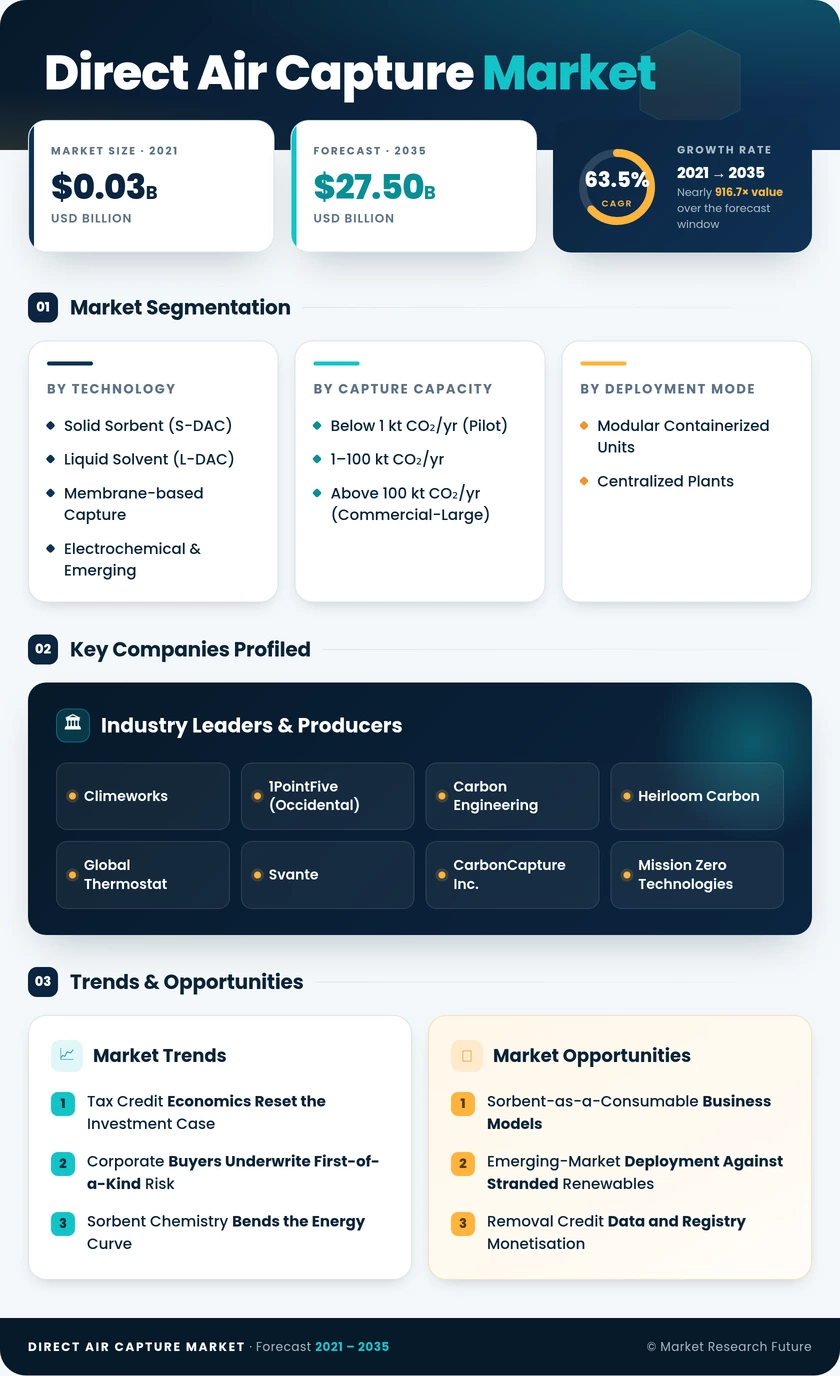
Segmentation Quick Reference
| Dimension | Sub-Segments | Dominant Segment | Fastest Growing Segment |
| By Technology | Solid Sorbent (S-DAC); Liquid Solvent (L-DAC); Membrane-based Capture; Electrochemical & Emerging | Solid Sorbent (S-DAC) | Membrane-based Capture |
| By Capture Capacity | Below 1 kt CO₂/yr (Pilot); 1–100 kt CO₂/yr; Above 100 kt CO₂/yr (Commercial-Large) | Below 1 kt CO₂/yr (Pilot) | Above 100 kt CO₂/yr (Commercial-Large) |
| By Deployment Mode | Modular Containerized Units; Centralized Plants | Modular Containerized Units | Centralized Plants |
| By Application | Carbon Sequestration (Geological); Enhanced Oil Recovery; Synthetic Fuels & Chemicals; Food and Beverage; Building Materials & Other | Carbon Sequestration (Geological) | Food and Beverage |
| By End-User | Oil and Gas; Chemical and Fertiliser; Power Generation & Utilities; Food & Beverage Processing; Technology, Aviation & Other Corporates | Oil and Gas | Chemical and Fertiliser |
| By Geography | North America; Europe; Asia-Pacific; South America; Middle East & Africa | North America | Asia-Pacific |
Market Segmentation Overview
By Technology
| Sub-Segment | Key Trend |
| Solid Sorbent (S-DAC) | Amine-functionalised frameworks pushing working capacity higher while regeneration temperatures fall below 100°C |
| Liquid Solvent (L-DAC) | Concentrated in megatonne facilities with firm heat supply and owned injection assets |
| Membrane-based Capture | Selectivity improvements at ambient concentration attracting semiconductor-grade fabrication entrants |
| Electrochemical & Emerging | Fully electrified regeneration removing thermal infrastructure from plant design. |
Technology selection increasingly follows energy availability rather than the reverse. Developers with access to intermittent renewables favour sorbent cycling that tolerates interruption, while those holding firm geothermal or nuclear heat contracts still find continuous solvent loops economically defensible.
By Capture Capacity
| Sub-Segment | Key Trend |
| Below 1 kt CO₂/yr (Pilot) | Concentrated in MRV protocol validation and sorbent field-testing programmes |
| 1–100 kt CO₂/yr | Anchor units within regional hubs fulfilling contracted corporate offtake |
| Above 100 kt CO₂/yr (Commercial-Large) | Unit cost reduction through shared compression, injection, and grid interconnection |
Capacity composition inverts around the end of this decade. Pilot installations dominate the operating fleet today by count, but hub-scale facilities commissioning from 2029 shift the tonnage centre of gravity decisively toward large plants.
By Deployment Mode
| Sub-Segment | Key Trend |
| Modular Containerized Units | Factory fabrication compressing schedule risk and enabling incremental capital exposure |
| Centralized Plants | Shared balance-of-plant infrastructure delivering superior economics at scale |
Deployment strategy tracks financing structure. Developers funded through staged offtake revenue favour containerised increments, while infrastructure-fund-backed projects with long-dated storage agreements pursue centralised designs from the outset.
By Application
| Sub-Segment | Key Trend |
| Carbon Sequestration (Geological) | Highest credit value under 45Q and clearest durability documentation |
| Enhanced Oil Recovery | Leveraging existing CO₂ pipeline networks in the Permian and Gulf Coast |
| Synthetic Fuels & Chemicals | ReFuelEU and CORSIA blending mandates creating price-insensitive demand |
| Food and Beverage | Merchant CO₂ scarcity supporting food-grade purity premiums |
| Building Materials & Other | Concrete curing mineralisation delivering permanence with performance gains |
Application mix determines revenue architecture. Sequestration monetises through credits and public subsidy; utilisation pathways monetise through product sales, which insulates them from carbon-price volatility but exposes them to commodity cycles.
By End-User
| Sub-Segment | Key Trend |
| Oil and Gas | Subsurface characterisation and injection expertise transferred from legacy operations. |
| Chemical and Fertiliser | Low-carbon urea and methanol specifications entering procurement contracts |
| Power Generation & Utilities | Capture load valued as curtailable demand in high-renewable grids. |
| Food & Beverage Processing | Supply security concerns following repeated merchant CO₂ shortages |
| Technology, Aviation & Other Corporates | Voluntary net-zero commitments converting into multi-year advance purchases |
Buyer composition is broadening. Energy incumbents supplied the first wave of capital and technical credibility. Still, chemical producers and technology firms now drive incremental contracted volume, and their purchasing criteria emphasise verification quality over subsurface familiarity.
By Geography
| Sub-Segment | Key Trend |
| North America | Class VI primacy expansion and enhanced credit monetisation through direct pay |
| Europe | Certification framework maturity linking removals toward compliance instruments. |
| Asia-Pacific | Renewable curtailment absorption paired with dominant sorbent manufacturing capacity |
| South America | Regulated carbon market implementation and biogenic co-location potential |
| Middle East & Africa | Sovereign capital deploying solar-paired capture alongside existing CO₂ infrastructure |
Regional hierarchy rests on the intersection of subsidy depth and storage availability. North America leads because it holds both; Asia-Pacific closes the gap fastest because energy costs there are falling faster than permitting timelines elsewhere are shortening.


 Noah Malgeri
Co-Founder

 Peter Groot koerkamp
Account and Business Manager

 Younghwan Choi
Senior Retail Manager

 Mark Irwin
Management Consultant

 Akif Moroglu
Strategy & Business Development Director

 Guilherme Gomes Martins
Product Management Director

 Joseph Aguayo
Sales Operations & Pricing Manager

 La Terria Dodd
Program Support Specialist

 Rob Kooiker
Group Product Manager HVAC & Fire Protection GMA