×
Request Free Sample ×

Kindly complete the form below to receive a free sample of this Report

* Please use a valid business email

Leading companies partner with us for data-driven Insights

clients tt-cursor
Hero Background
English
Chinese
French
Japanese
Korean
German
Spanish

Dimethylaminopropylamine Market Trends

ID: MRFR/CnM/1853-HCR
135 Pages
Priya Nagrale
October 2025

Dimethylaminopropylamine (DMAPA) Market Research Report Information by Application (Personal Care, PU Catalyst, Pharmaceuticals, Lubricant Additives, Water Treatment, Resins, Agrochemicals, and Others), and Region (North America, Asia-Pacific, Europe, Latin America, and Middle East & Africa)—Forecast till 2035

Share:
Download PDF ×

We do not share your information with anyone. However, we may send you emails based on your report interest from time to time. You may contact us at any time to opt-out.

Dimethylaminopropylamine Market Infographic
×
Dimethylaminopropylamine Market Infographic Full View
Purchase Options

Market Trends

Key Emerging Trends in the Dimethylaminopropylamine Market

The Dimethylaminopropylamine (DMAPA) Market is undergoing notable trends influenced by a variety of factors, including its versatile applications, sustainability considerations, and technological advancements. Here's a comprehensive overview of the market trends presented in a paragraph with a pointer format:

Surging Demand in Personal Care and Cosmetics Industry: A significant trend in the Dimethylaminopropylamine Market is the surging demand from the personal care and cosmetics industry. DMAPA is a key ingredient in the production of hair conditioners and skincare products, where it functions as a softening and conditioning agent. The growing consumer emphasis on personal grooming and the rising demand for high-quality cosmetic products are driving the increased use of DMAPA in the formulation of premium hair and skincare items.

Expansion in the Textile and Leather Industries: The DMAPA Market is experiencing expansion in the textile and leather industries, where DMAPA is utilized in the manufacturing of fabric softeners and dyeing auxiliaries. Its ability to impart softness and improve the hand feel of textiles makes it a valuable additive in the textile and leather processing applications. The demand for enhanced comfort and aesthetics in textiles is contributing to the growth of DMAPA in these industries.

Focus on Sustainable and Bio-Based DMAPA Production: Sustainability is a driving force in market trends, leading to a growing focus on sustainable and bio-based DMAPA production. Manufacturers are exploring alternative feedstocks and environmentally friendly processes to reduce the ecological footprint associated with DMAPA synthesis. The industry's commitment to sustainability aligns with broader efforts to adopt greener practices in chemical manufacturing.

Challenges Amid Regulatory Scrutiny: The DMAPA Market faces challenges associated with regulatory scrutiny, as authorities are increasingly focusing on the environmental and health aspects of chemical substances. Compliance with evolving regulations and the need to address potential health concerns associated with DMAPA are significant challenges for manufacturers. Ensuring the safe and responsible use of DMAPA is a key consideration in navigating regulatory landscapes.

Growing Application in Water Treatment: DMAPA is finding a growing application in the water treatment sector, particularly as a corrosion inhibitor and neutralizing agent. Its effectiveness in controlling corrosion and maintaining the pH balance in water treatment processes is contributing to its increased adoption in industrial water treatment applications. As industries prioritize efficient water management, the demand for DMAPA in water treatment is on the rise.

Technological Advancements in Production Processes: Continuous technological advancements in DMAPA production processes are influencing market trends. Manufacturers are investing in research and development to improve the efficiency of synthesis methods, reduce production costs, and enhance the overall quality of DMAPA. Advanced technologies, including catalytic processes and innovative reaction mechanisms, contribute to the evolution of production methods.

Globalization and Strategic Collaborations: The DMAPA Market is experiencing globalization as key players expand their global presence through strategic collaborations, partnerships, and acquisitions. Companies are forming alliances to strengthen their market position, enhance their distribution networks, and tap into emerging markets. The globalization trend reflects the industry's efforts to diversify its geographic footprint and explore new growth opportunities.

Research Focus on New Applications and Formulations: Ongoing research is focused on exploring new applications and formulations for DMAPA. Manufacturers are investigating its potential uses in areas such as agrochemicals, lubricants, and pharmaceuticals. The versatility of DMAPA as a multifunctional amine is driving the exploration of innovative formulations to meet the evolving needs of diverse industries.

Challenges in Raw Material Availability: The DMAPA Market faces challenges related to the availability and pricing of raw materials, particularly dimethylaminopropyl chloride. Fluctuations in the supply and cost of these raw materials can impact the overall production cost of DMAPA. Manufacturers are actively managing these challenges by optimizing their supply chain strategies, exploring alternative raw material sources, and implementing cost-effective production processes.

Increasing Demand in the Agrochemical Sector: DMAPA is witnessing an increasing demand in the agrochemical sector, where it is utilized as a key ingredient in the synthesis of herbicides and pesticides. Its role as a building block in the production of agrochemical formulations contributes to the effectiveness and stability of these products. The demand for DMAPA in agrochemicals is driven by the need for efficient and reliable crop protection solutions in agriculture.

Author
Priya Nagrale
Senior Research Analyst

With an experience of over five years in market research industry (Chemicals & Materials domain), I gather and analyze market data from diverse sources to produce results, which are then presented back to a client. Also, provide recommendations based on the findings. As a Senior Research Analyst, I perform quality checks (QC) for market estimations, QC for reports, and handle queries and work extensively on client customizations. Also, handle the responsibilities of client proposals, report planning, report finalization, and execution

Leave a Comment

FAQs

At what CAGR is the Dimethylaminopropylamine Market predicted to grow during the forecast period?

Dimethylaminopropylamine Market is predicted to grow at Significant through forecast period of 2025-2035.

What is the forecast period of Dimethylaminopropylamine Market research report?

The forecast period for Dimethylaminopropylamine Market research report is 2025-2035.

Which region will lead the global Dimethylaminopropylamine Market?

Global Dimethylaminopropylamine Market is dominated by APAC region.

What are the key factors driving the Dimethylaminopropylamine Market?

Increase the demand for Industrial cleaning sector

At what CAGR is the Dimethylaminopropylamine Market predicted to grow during the forecast period?

Dimethylaminopropylamine Market is predicted to grow at Significant through forecast period of 2025-2035.

Market Summary

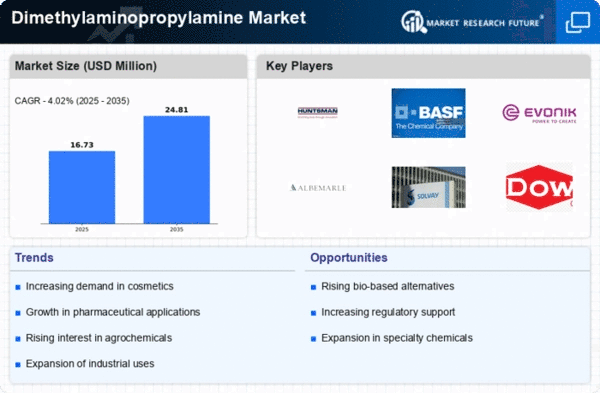
As per MRFR analysis, the Dimethylaminopropylamine Market Size was estimated at 16.08 USD Million in 2024. The Dimethylaminopropylamine industry is projected to grow from 16.72 USD Million in 2025 to 24.81 USD Million by 2035, exhibiting a compound annual growth rate (CAGR) of 4.02 during the forecast period 2025 - 2035.

Key Market Trends & Highlights

The Dimethylaminopropylamine market is poised for growth driven by diverse applications and regional dynamics.

  • North America remains the largest market for Dimethylaminopropylamine, primarily due to its extensive chemical manufacturing base.
  • The Asia-Pacific region is emerging as the fastest-growing market, fueled by increasing industrialization and demand for innovative applications.
  • In the personal care products segment, Dimethylaminopropylamine is widely utilized, while the pharmaceutical segment is experiencing rapid growth.
  • Key market drivers include rising demand in personal care products and technological advancements in synthesis, which are shaping market dynamics.

Market Size & Forecast

2024 Market Size 16.08 (USD Million)
2035 Market Size 24.81 (USD Million)
CAGR (2025 - 2035) 4.02%
Largest Regional Market Share in 2024 North America

Major Players

Huntsman Corporation (US), BASF SE (DE), Evonik Industries AG (DE), Albemarle Corporation (US), Solvay SA (BE), Dow Chemical Company (US), Eastman Chemical Company (US), Mitsubishi Gas Chemical Company (JP)

Market Trends

The Dimethylaminopropylamine Market is currently experiencing a notable evolution, driven by various factors that influence its demand and application across multiple sectors. This chemical compound, recognized for its utility in the production of surfactants, personal care products, and pharmaceuticals, appears to be gaining traction due to its versatile properties. As industries increasingly prioritize sustainable practices, the market is likely to witness a shift towards eco-friendly formulations, which may enhance the appeal of dimethylaminopropylamine in formulations that require biodegradable components. Furthermore, the growing emphasis on research and development within the chemical sector suggests that innovative applications of this compound could emerge, potentially expanding its market reach. In addition to sustainability, the Dimethylaminopropylamine Market is influenced by regulatory frameworks that govern chemical usage and safety. Compliance with stringent regulations may pose challenges for manufacturers; however, it also encourages the development of safer and more efficient production methods. The increasing awareness of health and environmental impacts associated with chemical substances is likely to drive demand for high-quality, compliant products. As the market continues to evolve, stakeholders must remain vigilant to adapt to changing consumer preferences and regulatory landscapes, ensuring that they leverage opportunities for growth while addressing potential risks associated with the use of dimethylaminopropylamine.

Sustainability Initiatives

The Dimethylaminopropylamine Market is witnessing a growing trend towards sustainability, as manufacturers seek to develop eco-friendly products. This shift is driven by consumer demand for greener alternatives and regulatory pressures to reduce environmental impact. Companies are increasingly focusing on formulating products that utilize dimethylaminopropylamine in a manner that aligns with sustainable practices.

Regulatory Compliance

Regulatory frameworks are shaping the Dimethylaminopropylamine Market, as stringent safety and environmental regulations influence production processes. Manufacturers are compelled to adhere to these guidelines, which may lead to the development of safer and more efficient methods. This trend highlights the importance of compliance in maintaining market competitiveness.

Innovative Applications

The exploration of innovative applications for dimethylaminopropylamine is emerging as a significant trend within the market. Research and development efforts are likely to uncover new uses in various industries, including cosmetics and pharmaceuticals. This potential for diversification may enhance the market's growth prospects and attract new stakeholders.

Dimethylaminopropylamine Market Market Drivers

Market Growth Projections

The Global Dimethylaminopropylamine Market (DMAPA) Market Industry is projected to experience substantial growth over the coming years. With an estimated market value of 413.4 USD Million in 2024, it is anticipated to reach 664.9 USD Million by 2035. This growth reflects a compound annual growth rate (CAGR) of 4.41% from 2025 to 2035, indicating a robust market trajectory. The increasing demand across various sectors, including personal care, textiles, and adhesives, underpins this expansion. As industries continue to seek high-performance chemical solutions, DMAPA's versatility positions it favorably within the global market landscape.

Regulatory Support for Chemical Safety

The Global Dimethylaminopropylamine Market (DMAPA) Market Industry is positively influenced by regulatory support for chemical safety. Governments worldwide are implementing stringent regulations to ensure the safe use of chemicals in various applications. This regulatory framework encourages manufacturers to adopt safer alternatives, positioning DMAPA as a viable option due to its favorable safety profile. As industries comply with these regulations, the demand for DMAPA is expected to rise, particularly in sectors such as pharmaceuticals and personal care. The proactive stance of regulatory bodies may enhance market confidence, leading to increased investments in DMAPA-related products.

Growth in Adhesives and Sealants Sector

The Global Dimethylaminopropylamine Market (DMAPA) Market Industry is bolstered by the expanding adhesives and sealants sector. DMAPA is utilized as a curing agent in epoxy resins, which are increasingly favored in construction and automotive applications due to their superior bonding properties. The demand for high-performance adhesives is anticipated to rise, driven by infrastructure development and automotive manufacturing. This sector's growth contributes to the overall market expansion, with a projected compound annual growth rate (CAGR) of 4.41% from 2025 to 2035. As industries seek durable and efficient bonding solutions, DMAPA's role becomes increasingly pivotal.

Rising Demand in Personal Care Products

The Global Dimethylaminopropylamine Market (DMAPA) Market Industry experiences a notable surge in demand driven by its application in personal care products. DMAPA serves as a key ingredient in hair care formulations, enhancing product performance and stability. As consumers increasingly prioritize high-quality personal care items, the market for DMAPA is projected to grow significantly. In 2024, the market value is estimated at 413.4 USD Million, reflecting a robust consumer trend towards premium personal care solutions. This growth trajectory is likely to continue, with the market expected to reach 664.9 USD Million by 2035, indicating a sustained interest in DMAPA-based formulations.

Increasing Applications in Textile Industry

The Global Dimethylaminopropylamine Market (DMAPA) Market Industry is witnessing growth due to its diverse applications in the textile industry. DMAPA is employed in the production of textile chemicals, particularly in dyeing and finishing processes, enhancing color retention and fabric durability. As the global textile market expands, driven by rising consumer demand for innovative fabrics, the need for effective chemical agents like DMAPA is likely to increase. This trend suggests a potential for market growth, as manufacturers seek to improve product quality and sustainability. The integration of DMAPA in textile applications could further solidify its market position.

Advancements in Chemical Manufacturing Processes

The Global Dimethylaminopropylamine Market (DMAPA) Market Industry benefits from advancements in chemical manufacturing processes. Innovations in production techniques enhance the efficiency and sustainability of DMAPA synthesis, reducing costs and environmental impact. As manufacturers adopt greener practices, the appeal of DMAPA as a versatile chemical compound increases. This shift towards sustainable manufacturing aligns with global trends emphasizing environmental responsibility. Consequently, the market is likely to see increased adoption of DMAPA across various industries, further driving its growth. The emphasis on sustainable practices may also attract new entrants into the market, fostering competition and innovation.

Market Segment Insights

By Application: Chemical Synthesis (Largest) vs. Pharmaceuticals (Fastest-Growing)

In the Dimethylaminopropylamine market, the application segment is largely dominated by Chemical Synthesis, which has established a significant market presence. This application encompasses various industrial and chemical processes, leveraging dimethylaminopropylamine for its efficiency in synthesizing complex molecules. On the other hand, Pharmaceuticals is emerging as a fast-growing segment, reflecting the increasing use of dimethylaminopropylamine in drug formulations, particularly for therapeutic applications. The diverse applications within this sector highlight the overall versatility of dimethylaminopropylamine as a valuable compound in modern industries. The growth of the Pharmaceuticals sector is largely driven by rising investments in drug development and the ongoing research into new therapeutic agents. Nearly all segments within this category are witnessing an unprecedented surge in demand, attributed to advancements in healthcare and an aging population requiring more medications. Conversely, the Chemical Synthesis application continues to grow steadily, supported by industries such as plastics and textiles, which rely on this compound for creating essential chemical intermediates. The overall dynamics within these two applications showcase a competitive landscape with different growth trajectories for the Dimethylaminopropylamine market.

Chemical Synthesis (Dominant) vs. Pharmaceuticals (Emerging)

Chemical Synthesis stands as the dominant application for Dimethylaminopropylamine, utilized extensively in various chemical production processes. Its role in facilitating reaction mechanisms and the synthesis of a wide range of chemical intermediates marks its importance in industries such as polymer science and manufacturing. The current applications underline its significance not just as a reagent, but also as a crucial building block in formulating complex molecules. In contrast, Pharmaceuticals represents an emerging application area, characterized by its rapid expansion due to increased research activity and the ongoing demand for innovative therapeutic agents. This segment is particularly attractive for pharmaceutical manufacturers aiming to incorporate dimethylaminopropylamine in their formulations, given its beneficial properties in enhancing drug efficacy. Thus, while Chemical Synthesis leads in market share, Pharmaceuticals is positioned as a crucial area for future growth.

By End Use: Personal Care Products (Largest) vs. Agricultural Products (Fastest-Growing)

In the Dimethylaminopropylamine market, the end-use segment is characterized by significant diversity. Personal Care Products hold the largest share, driven by rising consumer demand for skincare and haircare formulations containing active chemical agents. Industrial Applications also represent a substantial portion of the market, utilized primarily in chemical manufacturing processes. Research Laboratories and Agricultural Products follow, with the former reflecting steady demand in scientific advancements and agriculture experiencing rapid growth due to increased focus on agrochemicals and sustainable practices.

Personal Care Products: Dominant vs. Agricultural Products: Emerging

Personal Care Products are the dominant force in the Dimethylaminopropylamine market, leveraging their use in various formulations such as shampoos, conditioners, and skin creams, which heighten their demand due to consumer trends favoring cosmetic enhancements and personal grooming. These products benefit from strong brand loyalty and extensive marketing strategies. In contrast, Agricultural Products emerge as a key area of interest, fueled by innovation in agrochemical applications and the focus on sustainable farming practices. The growth of this segment is enhanced by regulatory support for eco-friendly solutions and the need for effective crop protection methods.

By Formulation Type: Liquid Formulation (Largest) vs. Powder Formulation (Fastest-Growing)

In the Dimethylaminopropylamine market, the segmentation by formulation type indicates that Liquid Formulation holds the largest share, utilizing its versatility across various applications. The adoption of liquid formulations is prevalent due to their ease of use and effectiveness in a wide range of industrial applications. On the other hand, Powder Formulation is gaining momentum, becoming increasingly significant in niche markets looking for specific properties that powder forms can offer. The growth trends in the formulation type segment are influenced by technological advancements and changing consumer preferences. Liquid Formulation continues to dominate due to its widespread applicability in personal care, pharmaceuticals, and chemical manufacturing. Conversely, Powder Formulation is the fastest-growing segment, driven by the demand for controlled-release products and increased use in specialty applications, making it a focal point for innovators in the industry.

Liquid Formulation (Dominant) vs. Powder Formulation (Emerging)

Liquid Formulation stands out in the Dimethylaminopropylamine market due to its dominance in applications that require quick solubility and adaptability. It is primarily employed in personal care products, agricultural chemicals, and various industrial applications where ease of handling is paramount. In contrast, Powder Formulation is seen as an emerging choice for manufacturers seeking tailored solutions for specific applications. Its appeal lies in the ability to create controlled-release properties and reduce packaging volumes, addressing environmental concerns. As industries evolve, both formulations are likely to coexist, catering to diverse needs while pushing innovation in application methodologies.

By Purity Level: High Purity (Largest) vs. Technical Grade (Fastest-Growing)

In the Dimethylaminopropylamine market, the purity level segment is distinctly characterized by three key categories: High Purity, Standard Purity, and Technical Grade. High Purity accounts for the majority market share due to its extensive application in pharmaceuticals and specialty chemicals. Standard Purity follows with a notable presence, while Technical Grade is emerging, gaining traction as industries seek cost-effective solutions for less critical applications. The growth dynamics of this segment are influenced by several factors, including the increasing demand for high-performance products in pharmaceuticals and cosmetics which drives High Purity. Conversely, Technical Grade is benefitting from the rising interest in budget-friendly alternatives across various industrial applications. These shifts indicate a robust trajectory for all three purity levels, shaped by evolving market needs and technological advancements.

High Purity (Dominant) vs. Technical Grade (Emerging)

High Purity Dimethylaminopropylamine stands out as the dominant segment due to its high-quality standards, making it the preferred choice for critical applications in pharmaceuticals and research. Its superior properties ensure it meets the strict regulations required in sensitive formulations. On the other hand, Technical Grade Dimethylaminopropylamine is gaining momentum as an emerging option, appealing to manufacturers looking for cost-effective solutions without compromising on performance for less sensitive applications. This segment serves a variety of industrial uses where high purity is not essential, allowing for broader market penetration and accessibility, contributing to its rapid growth as consumers seek economical alternatives.

By Distribution Channel: Direct Sales (Largest) vs. Online Sales (Fastest-Growing)

In the Dimethylaminopropylamine Market, Direct Sales holds the largest market share among distribution channels. This traditional method has been favored by several manufacturers due to its established relationships with key customers and the ability to provide personalized services. On the other hand, Online Sales is rapidly gaining traction, reflecting a significant shift in purchasing habits. The convenience and broader reach of online platforms are attracting both smaller and larger entities to consider this mode of distribution.

Direct Sales (Dominant) vs. Online Sales (Emerging)

Direct Sales remains the dominant distribution channel in the Dimethylaminopropylamine Market, characterized by strong relationships between manufacturers and their clients, enabling tailored solutions to meet specific needs. However, Online Sales is positioned as an emerging force, driven by changing consumer behaviors favoring digital transactions. The rise of e-commerce has allowed suppliers to tap into a wider audience and streamline distribution processes. As companies adapt to these trends, integrations between traditional and digital sales strategies are likely to bolster revenue and efficiency in the market.

Get more detailed insights about Dimethylaminopropylamine Market Research Report Forecast - Global Till 2035

Regional Insights

North America : Market Leader in Dimethylaminopropylamine

North America is poised to maintain its leadership in the Dimethylaminopropylamine market, holding a significant market share of 8.0 in 2025. The region's growth is driven by robust demand from various sectors, including pharmaceuticals and agrochemicals, alongside favorable regulatory frameworks that encourage innovation. The increasing focus on sustainable practices and the development of advanced formulations are also key growth catalysts. The competitive landscape in North America is characterized by the presence of major players such as Huntsman Corporation, Dow Chemical Company, and Albemarle Corporation. These companies are investing heavily in R&D to enhance product offerings and meet the evolving needs of consumers. The U.S. remains the leading country in this market, supported by a strong manufacturing base and a well-established supply chain.

Europe : Emerging Market with Growth Potential

Europe's Dimethylaminopropylamine market is projected to grow, with a market size of 4.5 in 2025. The region benefits from stringent regulations that promote safety and environmental sustainability, driving demand for high-quality chemical products. The increasing adoption of Dimethylaminopropylamine in various applications, including personal care and industrial processes, is further fueling market growth. Regulatory bodies are actively supporting innovation in this sector, enhancing competitiveness. Leading countries in Europe include Germany, France, and the UK, where key players like BASF SE and Evonik Industries AG are prominent. These companies are focusing on expanding their production capacities and enhancing their product portfolios to cater to the growing demand. The competitive landscape is dynamic, with a mix of established firms and emerging players striving for market share.

Asia-Pacific : Rapidly Growing Market Segment

The Asia-Pacific region is witnessing a burgeoning demand for Dimethylaminopropylamine, with a market size of 2.5 in 2025. This growth is primarily driven by the expanding pharmaceutical and agricultural sectors, alongside increasing industrial applications. The region's favorable economic conditions and rising investments in chemical manufacturing are significant growth drivers. Additionally, regulatory support for chemical safety and environmental standards is enhancing market dynamics. Countries like China, Japan, and India are leading the charge in this market, with key players such as Mitsubishi Gas Chemical Company making substantial investments. The competitive landscape is evolving, with both local and international companies vying for market share. The increasing focus on innovation and product development is expected to further boost the market in the coming years.

Middle East and Africa : Emerging Market with Opportunities

The Middle East and Africa (MEA) region is gradually emerging in the Dimethylaminopropylamine market, with a market size of 1.08 in 2025. The growth is driven by increasing industrialization and the rising demand for chemicals in various applications, including construction and personal care. The region's diverse economic landscape presents unique opportunities for market expansion, supported by government initiatives aimed at boosting the chemical industry. Leading countries in this region include South Africa and the UAE, where local players are beginning to establish a foothold. The competitive landscape is characterized by a mix of established firms and new entrants, focusing on innovation and sustainability. As the market matures, the presence of key players is expected to grow, enhancing the overall market dynamics.

Key Players and Competitive Insights

The Dimethylaminopropylamine Market exhibits a dynamic competitive landscape characterized by a blend of innovation, strategic partnerships, and regional expansion. Key players such as Huntsman Corporation (US), BASF SE (DE), and Evonik Industries AG (DE) are actively shaping the market through their distinct operational focuses. Huntsman Corporation (US) emphasizes innovation in product development, particularly in specialty chemicals, which positions it favorably against competitors. Meanwhile, BASF SE (DE) leverages its extensive global footprint to optimize supply chains and enhance customer engagement, thereby reinforcing its market presence. Evonik Industries AG (DE) appears to prioritize sustainability, integrating eco-friendly practices into its production processes, which resonates well with current market demands for greener solutions. Collectively, these strategies contribute to a moderately fragmented market structure, where competition is driven by technological advancements and customer-centric approaches.In terms of business tactics, companies are increasingly localizing manufacturing to reduce lead times and enhance responsiveness to market needs. This trend is particularly evident as firms seek to optimize their supply chains amidst fluctuating global conditions. The competitive structure of the Dimethylaminopropylamine Market is moderately fragmented, with several key players exerting influence through strategic initiatives that enhance their operational capabilities and market reach.

In November Huntsman Corporation (US) announced a significant investment in a new production facility aimed at increasing its capacity for specialty amines, including Dimethylaminopropylamine. This strategic move is likely to bolster its market share and enhance its ability to meet rising demand, particularly in the Asia-Pacific region, where growth prospects are robust. The investment underscores Huntsman's commitment to innovation and capacity expansion, positioning it to capitalize on emerging opportunities.

In October BASF SE (DE) launched a new line of sustainable chemical solutions, which includes formulations utilizing Dimethylaminopropylamine. This initiative not only aligns with global sustainability trends but also enhances BASF's product portfolio, catering to environmentally conscious consumers. The launch is indicative of BASF's strategic pivot towards sustainability, which may provide a competitive edge in a market increasingly driven by eco-friendly practices.

In September Evonik Industries AG (DE) entered into a strategic partnership with a leading technology firm to develop AI-driven solutions for optimizing chemical production processes. This collaboration aims to enhance operational efficiency and reduce waste, thereby aligning with the growing emphasis on sustainability within the industry. The integration of AI technologies could potentially revolutionize production methodologies, positioning Evonik as a frontrunner in innovation within the Dimethylaminopropylamine Market.

As of December the competitive trends within the Dimethylaminopropylamine Market are increasingly defined by digitalization, sustainability, and technological integration. Strategic alliances are becoming pivotal in shaping the landscape, as companies seek to leverage shared expertise and resources. The shift from price-based competition to a focus on innovation, technology, and supply chain reliability is evident, suggesting that future competitive differentiation will hinge on the ability to adapt to these evolving trends.

Key Companies in the Dimethylaminopropylamine Market include

Industry Developments

  • Q2 2024: BASF expands DMAPA production capacity at Ludwigshafen site BASF announced the completion of an expansion project at its Ludwigshafen site, increasing its annual production capacity for Dimethylaminopropylamine Market (DMAPA) to meet rising demand from the personal care and home care industries.
  • Q1 2024: Huntsman launches new high-purity DMAPA grade for pharmaceutical applications Huntsman introduced a new high-purity grade of Dimethylaminopropylamine Market (DMAPA) designed specifically for use in pharmaceutical manufacturing, aiming to capture a larger share of the specialty chemicals market.
  • Q3 2024: Solvay signs long-term supply agreement for DMAPA with major personal care manufacturer Solvay entered into a multi-year supply contract to provide Dimethylaminopropylamine Market (DMAPA) to a leading global personal care products company, securing a stable outlet for its European production.
  • Q2 2024: Alkyl Amines inaugurates new DMAPA manufacturing facility in Maharashtra, India Alkyl Amines Chemicals Limited opened a new state-of-the-art plant dedicated to the production of Dimethylaminopropylamine Market (DMAPA), expanding its footprint in the Asian specialty chemicals market.
  • Q4 2024: BASF appoints new head of global DMAPA business unit BASF announced the appointment of Dr. Anna Müller as the new global head of its Dimethylaminopropylamine Market (DMAPA) business, effective November 2024, as part of its strategy to strengthen leadership in specialty amines.
  • Q1 2025: Huntsman secures regulatory approval for expanded DMAPA production in Texas Huntsman received final regulatory clearance to expand its Dimethylaminopropylamine Market (DMAPA) production facility in Texas, enabling increased output to serve North American and export markets.
  • Q2 2025: Solvay partners with European distributor for DMAPA market expansion Solvay entered a strategic partnership with a major European chemical distributor to broaden the reach of its Dimethylaminopropylamine Market (DMAPA) products across new regional markets.
  • Q3 2024: APDI announces major contract win for DMAPA supply to Southeast Asian agrochemical sector APDI secured a significant supply contract to deliver Dimethylaminopropylamine Market (DMAPA) to a consortium of agrochemical manufacturers in Southeast Asia, supporting regional agricultural productivity.
  • Q2 2024: Zhejiang Xier Chemical expands DMAPA export operations to Europe Zhejiang Xier Chemical announced the launch of a new export initiative, increasing shipments of Dimethylaminopropylamine Market (DMAPA) to European customers amid growing demand in the region.
  • Q1 2024: Taminco invests in green DMAPA production technology Taminco, a subsidiary of Eastman Chemical, announced a multi-million dollar investment in sustainable production technology for Dimethylaminopropylamine Market (DMAPA), aiming to reduce the carbon footprint of its specialty amines.
  • Q4 2024: Huntsman signs partnership with Japanese firm for DMAPA distribution Huntsman entered a distribution partnership with a leading Japanese chemical company to expand the availability of its Dimethylaminopropylamine Market (DMAPA) products in the Asia-Pacific region.
  • Q2 2025: BASF announces new DMAPA application development center in Germany BASF opened a dedicated application development center focused on innovative uses for Dimethylaminopropylamine Market (DMAPA), supporting collaboration with customers in personal care, home care, and industrial sectors.

Intended Audience

    • Dimethylaminopropylamine Market Manufacturers

    • Traders and Distributors of Dimethylaminopropylamine Market

    • Research and Development Institutes

    • Potential Investors

    • Raw Material Suppliers

    • Nationalized Laboratories

Future Outlook

Dimethylaminopropylamine Market Future Outlook

The Dimethylaminopropylamine market is projected to grow at a 4.02% CAGR from 2025 to 2035, driven by increasing demand in pharmaceuticals, agrochemicals, and personal care products.

New opportunities lie in:

  • Expansion into emerging markets with tailored formulations
  • Development of eco-friendly production processes
  • Strategic partnerships with pharmaceutical companies for innovative applications

By 2035, the Dimethylaminopropylamine market is expected to achieve robust growth and diversification.

Market Segmentation

Dimethylaminopropylamine Market End Use Outlook

  • Personal Care Products
  • Industrial Applications
  • Research Laboratories
  • Agricultural Products

Dimethylaminopropylamine Market Application Outlook

  • Chemical Synthesis
  • Pharmaceuticals
  • Cosmetics
  • Agricultural Chemicals

Dimethylaminopropylamine Market Purity Level Outlook

  • High Purity
  • Standard Purity
  • Technical Grade

Dimethylaminopropylamine Market Formulation Type Outlook

  • Liquid Formulation
  • Solid Formulation
  • Powder Formulation

Dimethylaminopropylamine Market Distribution Channel Outlook

  • Direct Sales
  • Online Sales
  • Distributors

Report Scope

MARKET SIZE 202416.08(USD Million)
MARKET SIZE 202516.72(USD Million)
MARKET SIZE 203524.81(USD Million)
COMPOUND ANNUAL GROWTH RATE (CAGR)4.02% (2025 - 2035)
REPORT COVERAGERevenue Forecast, Competitive Landscape, Growth Factors, and Trends
BASE YEAR2024
Market Forecast Period2025 - 2035
Historical Data2019 - 2024
Market Forecast UnitsUSD Million
Key Companies ProfiledHuntsman Corporation (US), BASF SE (DE), Evonik Industries AG (DE), Albemarle Corporation (US), Solvay SA (BE), Dow Chemical Company (US), Eastman Chemical Company (US), Mitsubishi Gas Chemical Company (JP)
Segments CoveredApplication, End Use, Formulation Type, Purity Level, Distribution Channel
Key Market OpportunitiesGrowing demand for sustainable chemical solutions drives innovation in the Dimethylaminopropylamine Market.
Key Market DynamicsRising demand for Dimethylaminopropylamine in personal care products drives innovation and competitive dynamics in the market.
Countries CoveredNorth America, Europe, APAC, South America, MEA

FAQs

At what CAGR is the Dimethylaminopropylamine Market predicted to grow during the forecast period?

Dimethylaminopropylamine Market is predicted to grow at Significant through forecast period of 2025-2035.

What is the forecast period of Dimethylaminopropylamine Market research report?

The forecast period for Dimethylaminopropylamine Market research report is 2025-2035.

Which region will lead the global Dimethylaminopropylamine Market?

Global Dimethylaminopropylamine Market is dominated by APAC region.

What are the key factors driving the Dimethylaminopropylamine Market?

Increase the demand for Industrial cleaning sector

At what CAGR is the Dimethylaminopropylamine Market predicted to grow during the forecast period?

Dimethylaminopropylamine Market is predicted to grow at Significant through forecast period of 2025-2035.

  1. SECTION I: EXECUTIVE SUMMARY AND KEY HIGHLIGHTS
    1. | 1.1 EXECUTIVE SUMMARY
    2. | 1.1.1 Market Overview
    3. | 1.1.2 Key Findings
    4. | 1.1.3 Market Segmentation
    5. | 1.1.4 Competitive Landscape
    6. | 1.1.5 Challenges and Opportunities
    7. | 1.1.6 Future Outlook
  2. SECTION II: SCOPING, METHODOLOGY AND MARKET STRUCTURE
    1. | 2.1 MARKET INTRODUCTION
    2. | 2.1.1 Definition
    3. | 2.1.2 Scope of the study
    4. |-- 2.1.2.1 Research Objective
    5. |-- 2.1.2.2 Assumption
    6. |-- 2.1.2.3 Limitations
    7. | 2.2 RESEARCH METHODOLOGY
    8. | 2.2.1 Overview
    9. | 2.2.2 Data Mining
    10. | 2.2.3 Secondary Research
    11. | 2.2.4 Primary Research
    12. |-- 2.2.4.1 Primary Interviews and Information Gathering Process
    13. |-- 2.2.4.2 Breakdown of Primary Respondents
    14. | 2.2.5 Forecasting Model
    15. | 2.2.6 Market Size Estimation
    16. |-- 2.2.6.1 Bottom-Up Approach
    17. |-- 2.2.6.2 Top-Down Approach
    18. | 2.2.7 Data Triangulation
    19. | 2.2.8 Validation
  3. SECTION III: QUALITATIVE ANALYSIS
    1. | 3.1 MARKET DYNAMICS
    2. | 3.1.1 Overview
    3. | 3.1.2 Drivers
    4. | 3.1.3 Restraints
    5. | 3.1.4 Opportunities
    6. | 3.2 MARKET FACTOR ANALYSIS
    7. | 3.2.1 Value chain Analysis
    8. | 3.2.2 Porter's Five Forces Analysis
    9. |-- 3.2.2.1 Bargaining Power of Suppliers
    10. |-- 3.2.2.2 Bargaining Power of Buyers
    11. |-- 3.2.2.3 Threat of New Entrants
    12. |-- 3.2.2.4 Threat of Substitutes
    13. |-- 3.2.2.5 Intensity of Rivalry
    14. | 3.2.3 COVID-19 Impact Analysis
    15. |-- 3.2.3.1 Market Impact Analysis
    16. |-- 3.2.3.2 Regional Impact
    17. |-- 3.2.3.3 Opportunity and Threat Analysis
  4. SECTION IV: QUANTITATIVE ANALYSIS
    1. | 4.1 Chemicals and Materials, BY Application (USD Million)
    2. | 4.1.1 Chemical Synthesis
    3. | 4.1.2 Pharmaceuticals
    4. | 4.1.3 Cosmetics
    5. | 4.1.4 Agricultural Chemicals
    6. | 4.2 Chemicals and Materials, BY End Use (USD Million)
    7. | 4.2.1 Personal Care Products
    8. | 4.2.2 Industrial Applications
    9. | 4.2.3 Research Laboratories
    10. | 4.2.4 Agricultural Products
    11. | 4.3 Chemicals and Materials, BY Formulation Type (USD Million)
    12. | 4.3.1 Liquid Formulation
    13. | 4.3.2 Solid Formulation
    14. | 4.3.3 Powder Formulation
    15. | 4.4 Chemicals and Materials, BY Purity Level (USD Million)
    16. | 4.4.1 High Purity
    17. | 4.4.2 Standard Purity
    18. | 4.4.3 Technical Grade
    19. | 4.5 Chemicals and Materials, BY Distribution Channel (USD Million)
    20. | 4.5.1 Direct Sales
    21. | 4.5.2 Online Sales
    22. | 4.5.3 Distributors
    23. | 4.6 Chemicals and Materials, BY Region (USD Million)
    24. | 4.6.1 North America
    25. |-- 4.6.1.1 US
    26. |-- 4.6.1.2 Canada
    27. | 4.6.2 Europe
    28. |-- 4.6.2.1 Germany
    29. |-- 4.6.2.2 UK
    30. |-- 4.6.2.3 France
    31. |-- 4.6.2.4 Russia
    32. |-- 4.6.2.5 Italy
    33. |-- 4.6.2.6 Spain
    34. |-- 4.6.2.7 Rest of Europe
    35. | 4.6.3 APAC
    36. |-- 4.6.3.1 China
    37. |-- 4.6.3.2 India
    38. |-- 4.6.3.3 Japan
    39. |-- 4.6.3.4 South Korea
    40. |-- 4.6.3.5 Malaysia
    41. |-- 4.6.3.6 Thailand
    42. |-- 4.6.3.7 Indonesia
    43. |-- 4.6.3.8 Rest of APAC
    44. | 4.6.4 South America
    45. |-- 4.6.4.1 Brazil
    46. |-- 4.6.4.2 Mexico
    47. |-- 4.6.4.3 Argentina
    48. |-- 4.6.4.4 Rest of South America
    49. | 4.6.5 MEA
    50. |-- 4.6.5.1 GCC Countries
    51. |-- 4.6.5.2 South Africa
    52. |-- 4.6.5.3 Rest of MEA
  5. SECTION V: COMPETITIVE ANALYSIS
    1. | 5.1 Competitive Landscape
    2. | 5.1.1 Overview
    3. | 5.1.2 Competitive Analysis
    4. | 5.1.3 Market share Analysis
    5. | 5.1.4 Major Growth Strategy in the Chemicals and Materials
    6. | 5.1.5 Competitive Benchmarking
    7. | 5.1.6 Leading Players in Terms of Number of Developments in the Chemicals and Materials
    8. | 5.1.7 Key developments and growth strategies
    9. |-- 5.1.7.1 New Product Launch/Service Deployment
    10. |-- 5.1.7.2 Merger & Acquisitions
    11. |-- 5.1.7.3 Joint Ventures
    12. | 5.1.8 Major Players Financial Matrix
    13. |-- 5.1.8.1 Sales and Operating Income
    14. |-- 5.1.8.2 Major Players R&D Expenditure. 2023
    15. | 5.2 Company Profiles
    16. | 5.2.1 Huntsman Corporation (US)
    17. |-- 5.2.1.1 Financial Overview
    18. |-- 5.2.1.2 Products Offered
    19. |-- 5.2.1.3 Key Developments
    20. |-- 5.2.1.4 SWOT Analysis
    21. |-- 5.2.1.5 Key Strategies
    22. | 5.2.2 BASF SE (DE)
    23. |-- 5.2.2.1 Financial Overview
    24. |-- 5.2.2.2 Products Offered
    25. |-- 5.2.2.3 Key Developments
    26. |-- 5.2.2.4 SWOT Analysis
    27. |-- 5.2.2.5 Key Strategies
    28. | 5.2.3 Evonik Industries AG (DE)
    29. |-- 5.2.3.1 Financial Overview
    30. |-- 5.2.3.2 Products Offered
    31. |-- 5.2.3.3 Key Developments
    32. |-- 5.2.3.4 SWOT Analysis
    33. |-- 5.2.3.5 Key Strategies
    34. | 5.2.4 Albemarle Corporation (US)
    35. |-- 5.2.4.1 Financial Overview
    36. |-- 5.2.4.2 Products Offered
    37. |-- 5.2.4.3 Key Developments
    38. |-- 5.2.4.4 SWOT Analysis
    39. |-- 5.2.4.5 Key Strategies
    40. | 5.2.5 Solvay SA (BE)
    41. |-- 5.2.5.1 Financial Overview
    42. |-- 5.2.5.2 Products Offered
    43. |-- 5.2.5.3 Key Developments
    44. |-- 5.2.5.4 SWOT Analysis
    45. |-- 5.2.5.5 Key Strategies
    46. | 5.2.6 Dow Chemical Company (US)
    47. |-- 5.2.6.1 Financial Overview
    48. |-- 5.2.6.2 Products Offered
    49. |-- 5.2.6.3 Key Developments
    50. |-- 5.2.6.4 SWOT Analysis
    51. |-- 5.2.6.5 Key Strategies
    52. | 5.2.7 Eastman Chemical Company (US)
    53. |-- 5.2.7.1 Financial Overview
    54. |-- 5.2.7.2 Products Offered
    55. |-- 5.2.7.3 Key Developments
    56. |-- 5.2.7.4 SWOT Analysis
    57. |-- 5.2.7.5 Key Strategies
    58. | 5.2.8 Mitsubishi Gas Chemical Company (JP)
    59. |-- 5.2.8.1 Financial Overview
    60. |-- 5.2.8.2 Products Offered
    61. |-- 5.2.8.3 Key Developments
    62. |-- 5.2.8.4 SWOT Analysis
    63. |-- 5.2.8.5 Key Strategies
    64. | 5.3 Appendix
    65. | 5.3.1 References
    66. | 5.3.2 Related Reports

Chemicals and Materials Market Segmentation

Chemicals and Materials By Application (USD Million, 2025-2035)

  • Chemical Synthesis
  • Pharmaceuticals
  • Cosmetics
  • Agricultural Chemicals

Chemicals and Materials By End Use (USD Million, 2025-2035)

  • Personal Care Products
  • Industrial Applications
  • Research Laboratories
  • Agricultural Products

Chemicals and Materials By Formulation Type (USD Million, 2025-2035)

  • Liquid Formulation
  • Solid Formulation
  • Powder Formulation

Chemicals and Materials By Purity Level (USD Million, 2025-2035)

  • High Purity
  • Standard Purity
  • Technical Grade

Chemicals and Materials By Distribution Channel (USD Million, 2025-2035)

  • Direct Sales
  • Online Sales
  • Distributors
Infographic

Free Sample Request

Kindly complete the form below to receive a free sample of this Report

Get Free Sample

Customer Strories

Compare Licence

×
Features License Type
Single User Multiuser License Enterprise User
Price $4,950 $5,950 $7,250
Maximum User Access Limit 1 User Upto 10 Users Unrestricted Access Throughout the Organization
Free Customization
Direct Access to Analyst
Deliverable Format
Platform Access
Discount on Next Purchase 10% 15% 15%
Printable Versions