×
Hero Background
English
Chinese
French
Japanese
Korean
German
Spanish

Dimethylacetamide Market Share

ID: MRFR/CnM/1838-HCR
140 Pages
Anshula Mandaokar
October 2025

Dimethylacetamide Market Research Report Information by Application (Acrylic Fiber, Pesticides, Synthetic Resins, Intermediates, Catalyst and others), End-Use Industry (Pharmaceutical, Agrochemical, Textile, Personal Care and others) and Region (Asia-Pacific, North America, Europe, Latin America and the Middle East & Africa) - Forecast till 2035

Share:
Download PDF ×

We do not share your information with anyone. However, we may send you emails based on your report interest from time to time. You may contact us at any time to opt-out.

Dimethylacetamide Market Infographic
Purchase Options

Market Share

Dimethylacetamide Market Share Analysis

In the competitive landscape of the Dimethylacetamide (DMAc) Market, companies employ diverse strategies to establish a robust market presence and capture a significant share. DMAc, a versatile solvent with applications in various industries, demands a nuanced approach to cater to different customer needs. Here's a breakdown of key market share positioning strategies adopted by players in the Dimethylacetamide Market, presented in a concise pointer format:

Product Quality and Purity Focus:

Stringent Quality Control: Ensuring high-quality Dimethylacetamide through rigorous quality control measures enhances product reliability. Companies that adhere to industry quality standards and certifications build trust and credibility with customers.

High Purity Levels: Offering DMAc with high purity levels is essential, especially in applications where the solvent's quality directly impacts the performance of final products. Consistent purity levels contribute to market competitiveness.

Diverse Application-Specific Offerings:

Customized Formulations: Developing DMAc formulations tailored to specific industry needs enhances market penetration. Companies focus on providing solvent solutions suitable for diverse applications, including pharmaceuticals, textiles, and electronics, to meet unique customer requirements.

Versatility in Usage Recommendations: Offering guidance on the optimal usage of DMAc in different applications ensures customers derive maximum benefits. Technical support and recommendations contribute to customer satisfaction and loyalty.

Global Market Expansion:

Strategic Geographical Presence: Expanding market reach by strategically entering key geographical regions with high demand for DMAc is crucial. Companies consider regional variations in regulations, industry practices, and consumer preferences for effective market adaptation.

Local Partnerships: Forming partnerships with local distributors, manufacturers, or research institutions aids in navigating regional nuances efficiently. Local collaborations enhance market penetration and provide insights into specific market requirements.

Technological Advancements:

Advanced Production Technologies: Embracing innovative manufacturing technologies enhances efficiency, reduces production costs, and contributes to improved product quality. Continuous technological advancements reinforce competitiveness in the Dimethylacetamide Market.

Sustainability Integration: Adopting environmentally friendly production practices, such as the use of renewable energy sources or eco-friendly solvents, aligns with sustainability trends and enhances market appeal.

Cost Competitiveness and Operational Excellence:

Cost Optimization: Implementing cost-effective production processes and supply chain management helps companies maintain competitive pricing. Achieving cost competitiveness is crucial in a market where price considerations significantly influence customer choices.

Operational Efficiency: Striving for operational excellence through streamlined processes, energy efficiency, and waste reduction enhances overall production efficiency. Efficient operations contribute to maintaining competitive pricing and meeting market demands.

Sustainability Initiatives:

Eco-Friendly Manufacturing Practices: Responding to the growing demand for sustainable solutions, companies focus on adopting eco-friendly production practices for DMAc. This includes initiatives such as using renewable energy sources, reducing waste, and implementing green manufacturing technologies.

Bio-Based DMAc: Developing bio-based or renewable DMAc aligns with sustainability goals and appeals to environmentally conscious consumers. Companies investing in green alternatives position themselves as leaders in sustainable chemical manufacturing.

Educational Initiatives and Customer Support:

Technical Support Services: Offering technical support and expertise to customers, especially in the proper use of DMAc, enhances customer satisfaction. This level of support establishes the company as a valuable resource and contributes to market share growth.

Educational Content: Providing educational content about the benefits, uses, and safety considerations of DMAc helps raise awareness among potential customers. Companies actively engaging in educating the market contribute to increased understanding and adoption.

Strategic Pricing and Market Positioning:

Competitive Pricing Strategies: Implementing strategic pricing based on market analysis and competitor positioning helps companies maintain a competitive edge. Offering competitive prices without compromising on quality is essential in the Dimethylacetamide Market.

Value-Based Pricing: Communicating the value proposition of DMAc, such as its superior solvent properties or enhanced performance in specific applications, justifies pricing and positions the product as a premium offering.

Regulatory Compliance and Safety Measures:

Adherence to Regulations: Prioritizing regulatory compliance with standards such as REACH (Registration, Evaluation, Authorization, and Restriction of Chemicals) assures customers of the safety and quality of DMAc. Staying informed and compliant with evolving regulations is vital for market positioning.

Safety Certifications: Obtaining safety certifications and labels reinforces the credibility of DMAc as a safe and reliable solvent. Certifications from reputable organizations contribute to customer trust and enhance market competitiveness.

Author
Anshula Mandaokar
Team Lead - Research

Anshula Mandaokar holds an academic degree in Chemical Engineering and has been contributing to the field for more than 5 years. She has expertise in Market Research and Business Consulting and serves as a Team Lead for a reputed Market Research firm under the Chemicals and Materials domain spectrum. She has worked on multiple projects, generating explicit results in a quick turnaround time. Her understanding of data interpretation justifies her role as a leader.

Leave a Comment

FAQs

How much CAGR would the Dimethylacetamide Market achieve during the forecast period (2020-2035)?

The Dimethylacetamide Market CAGR would be 2.50% during the forecast period of 2023-2035.

What would primarily drive the Dimethylacetamide Market growth?

Increasing use in the pharmaceutical and agrochemical sector would drive the market growth.

What could hold back the Dimethylacetamide Market growth?

Health risks regarding its toxicity could prevent market growth.

Which region would dominate the Dimethylacetamide Market?

The Asia Pacific Dimethylacetamide Market would dominate.

Name the end user industries that would be a part of the Dimethylacetamide Market.

The Dimethylacetamide Market would have industries like agrochemical, pharmaceutical, plastic, personal care, textile, and others.

Market Summary

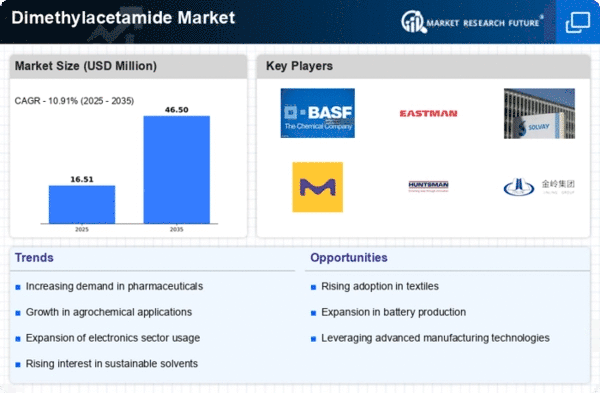
As per MRFR analysis, the Dimethylacetamide Market Size was estimated at 14.89 USD Million in 2024. The Dimethylacetamide industry is projected to grow from 16.51 USD Million in 2025 to 46.5 USD Million by 2035, exhibiting a compound annual growth rate (CAGR) of 10.91 during the forecast period 2025 - 2035.

Key Market Trends & Highlights

The Dimethylacetamide market is poised for growth driven by sustainability and technological advancements.

  • North America remains the largest market for Dimethylacetamide, driven by robust demand in pharmaceuticals.
  • Asia-Pacific is emerging as the fastest-growing region, fueled by rising industrial activities and investments.
  • The solvent segment continues to dominate the market, while the intermediate segment is experiencing rapid growth.
  • Key market drivers include increasing demand in pharmaceuticals and the expansion of agrochemical applications.

Market Size & Forecast

2024 Market Size 14.89 (USD Million)
2035 Market Size 46.5 (USD Million)
CAGR (2025 - 2035) 10.91%
Largest Regional Market Share in 2024 North America

Major Players

<p>BASF SE (DE), Eastman Chemical Company (US), Solvay S.A. (BE), Merck KGaA (DE), Huntsman Corporation (US), Shandong Jinling Chemical (CN), Zhejiang Jianye Chemical (CN), Nanjing Chemical Industry Group (CN)</p>

Market Trends

The Dimethylacetamide Market is currently experiencing a notable evolution, driven by various factors that influence its demand and supply dynamics. This solvent, widely utilized in the production of pharmaceuticals, agrochemicals, and polymers, appears to be gaining traction due to its versatile applications. The increasing focus on sustainable practices and the development of eco-friendly alternatives may also shape the market landscape. Furthermore, the rise in research and development activities in chemical manufacturing suggests a potential uptick in the utilization of dimethylacetamide, as industries seek efficient solvents for their processes. In addition, the global push towards innovation in various sectors, including electronics and textiles, indicates that the Dimethylacetamide Market could witness further expansion. As manufacturers strive to enhance product performance and reduce environmental impact, the demand for high-purity solvents is likely to increase. This trend may lead to a more competitive market environment, where companies are compelled to invest in advanced technologies and sustainable practices to meet evolving consumer preferences. Overall, the outlook for the Dimethylacetamide Market appears promising, with several factors contributing to its growth trajectory.

Sustainability Initiatives

The Dimethylacetamide Market is increasingly influenced by sustainability initiatives. As industries prioritize eco-friendly practices, there is a growing demand for solvents that minimize environmental impact. This trend encourages manufacturers to explore greener alternatives and optimize production processes, potentially reshaping the market landscape.

Technological Advancements

Technological advancements play a crucial role in the evolution of the Dimethylacetamide Market. Innovations in chemical manufacturing processes may enhance the efficiency and purity of dimethylacetamide production. This could lead to improved product offerings and increased competitiveness among market players.

Rising Demand in Emerging Markets

Emerging markets are exhibiting a rising demand for dimethylacetamide, driven by industrial growth and urbanization. As these regions develop their chemical industries, the need for versatile solvents is likely to increase, presenting new opportunities for market expansion.

Dimethylacetamide Market Market Drivers

Rising Demand in Pharmaceuticals

The Global Dimethylacetamide Market Industry experiences a notable surge in demand from the pharmaceutical sector. This chemical serves as a solvent in various drug formulations, enhancing solubility and stability. As the global pharmaceutical market continues to expand, driven by increasing healthcare needs and innovations, the demand for dimethylacetamide is projected to rise. In 2024, the market is valued at 111.5 USD Million, reflecting the growing reliance on this solvent in drug manufacturing. The pharmaceutical industry's growth, coupled with advancements in drug delivery systems, indicates a robust future for dimethylacetamide, potentially leading to a market valuation of 155.9 USD Million by 2035.

Expansion of the Electronics Sector

The Global Dimethylacetamide Market Industry is significantly influenced by the expansion of the electronics sector, where dimethylacetamide is utilized as a solvent in the production of electronic components. The increasing demand for semiconductors and electronic devices drives the need for high-purity solvents, including dimethylacetamide, which is essential for cleaning and processing materials. As the electronics industry continues to grow, propelled by advancements in technology and consumer electronics, the demand for dimethylacetamide is expected to rise correspondingly. This trend indicates a promising outlook for the market, as the electronics sector remains a key driver of growth in the coming years.

Growth in Agrochemical Applications

The Global Dimethylacetamide Market Industry benefits from the increasing utilization of dimethylacetamide in agrochemical formulations. This solvent is essential in the production of pesticides and herbicides, which are crucial for modern agriculture. As global agricultural practices evolve to meet food security demands, the need for effective agrochemicals rises. The compound's ability to enhance the efficacy of active ingredients in formulations positions it as a vital component in the agrochemical sector. This trend suggests a steady growth trajectory for dimethylacetamide, aligning with the overall expansion of the agrochemical market, which is expected to contribute significantly to the industry's valuation over the coming years.

Regulatory Support and Safety Standards

Regulatory support and the establishment of safety standards play a crucial role in shaping the Global Dimethylacetamide Market Industry. Governments worldwide are increasingly focusing on chemical safety and environmental regulations, which can influence the production and usage of dimethylacetamide. Compliance with these regulations often necessitates investment in safer production methods and technologies, which may initially pose challenges but ultimately lead to enhanced market stability and consumer trust. As industries adapt to these regulatory frameworks, the demand for compliant and safer chemical products, including dimethylacetamide, is likely to increase, fostering a more sustainable market environment.

Technological Advancements in Production

Technological advancements in the production processes of dimethylacetamide are driving efficiency and sustainability within the Global Dimethylacetamide Market Industry. Innovations in manufacturing techniques, such as the adoption of greener processes and improved catalysts, enhance yield and reduce waste. These advancements not only lower production costs but also align with global sustainability goals, appealing to environmentally conscious consumers and industries. As manufacturers adopt these technologies, the market is likely to witness increased competitiveness and growth, potentially leading to a compound annual growth rate of 3.09% from 2025 to 2035. This evolution in production methods is crucial for maintaining the industry's relevance in a rapidly changing market landscape.

Market Segment Insights

By Application: Solvent (Largest) vs. Intermediate (Fastest-Growing)

<p>In the Dimethylacetamide Market, the application segment is primarily divided into four categories: solvent, intermediate, reagent, and additive. The solvent application dominates the market with significant share due to its widespread use in numerous industries, including pharmaceuticals and plastics. On the other hand, the intermediate application is emerging rapidly, showcasing promising potential for growth as it plays a crucial role in chemical synthesis processes and production.</p>

<p>Solvent (Dominant) vs. Intermediate (Emerging)</p>

<p>The solvent application of dimethylacetamide is the most established in the market, recognized for its efficacy in dissolving various compounds and facilitating chemical reactions. It serves as a critical component in industries such as pharmaceuticals, where it is employed for drug formulation and as a reaction medium. Conversely, the intermediate application is seeing a rapid rise in demand, primarily driven by its importance in chemical processing and synthesis. Its versatility in interfacing with various chemical products makes it an attractive option for manufacturers looking to enhance production efficiency. As industries evolve, the dual characteristics of these applications highlight their critical roles within the broader market.</p>

By End Use: Pharmaceuticals (Largest) vs. Agriculture (Fastest-Growing)

<p>The Dimethylacetamide market's end use segment reveals that Pharmaceuticals holds the largest share, driven by its critical role as a solvent in drug formulation and synthesis processes. This is followed by significant contributions from Chemical Manufacturing and Electronics segments, which utilize Dimethylacetamide for polymer production and surface treatments, respectively. The Agriculture segment, while smaller, is rapidly gaining traction due to increasing demand for agrochemicals and fertilizers utilizing Dimethylacetamide in their formulations, showcasing its versatility across industries.</p>

<p>Pharmaceuticals (Dominant) vs. Agriculture (Emerging)</p>

<p>The Pharmaceuticals segment remains the dominant force in the Dimethylacetamide market, leveraging its excellent solvation properties for various drug components. This segment is characterized by stringent regulatory standards and a stable demand for innovative drug formulations, facilitating a reliable market presence. Meanwhile, Agriculture is emerging strongly, marked by a growing emphasis on sustainable agricultural practices and enhanced crop protection products. This segment is increasingly utilizing Dimethylacetamide for formulating pesticides and herbicides, indicating a shift towards more advanced agrochemical solutions. The promise of higher agricultural yields and efficiency positions the Agriculture segment as a key player in the ongoing evolution of the Dimethylacetamide market.</p>

By Formulation Type: Liquid (Largest) vs. Aqueous (Fastest-Growing)

<p>In the Dimethylacetamide market, the formulation types exhibit distinct characteristics and market shares. The liquid formulation type dominates the market, primarily due to its versatility and effectiveness in various applications, such as pharmaceuticals and agrochemicals. In contrast, the aqueous formulation has gained traction as a promising alternative, appealing mainly to sectors focusing on environmentally friendly processes and solutions. The solid formulation type holds a smaller share but remains essential in specific applications. Recent trends indicate a shift towards more sustainable practices in chemical formulations, driving the growth of aqueous formulations. As industries increasingly recognize the benefits of eco-friendly solvents, the aqueous segment is positioning itself as the fastest-growing category. This growth is further supported by innovations in formulation technologies, enabling better performance and efficiency in diverse applications.</p>

<p>Liquid (Dominant) vs. Aqueous (Emerging)</p>

<p>The liquid formulation of Dimethylacetamide remains the dominant player in this market segment, appreciated for its versatility and performance across various end-user industries. Its ability to function effectively as a solvent makes it integral in the pharmaceutical sector for drug formulation and in the chemical industry for synthesis and reactions. On the other hand, the aqueous formulation is emerging as a popular choice among companies seeking sustainable alternatives, aligning with global green chemistry trends. Although it currently captures a smaller market share, its growth potential is significant due to increasing regulatory pressures for less toxic solutions. As manufacturers innovate in their aqueous formulations, this segment is expected to gain further traction.</p>

By Purity Level: High Purity (Largest) vs. Technical Grade (Fastest-Growing)

<p>In the Dimethylacetamide Market, the purity level segment exhibits a diverse distribution, with High Purity capturing the largest market share. This segment is preferred in applications requiring stringent quality standards, such as pharmaceuticals and electronics. Technical Grade follows closely, driven by its versatile uses in various industrial processes, while Industrial Grade appeals to larger, cost-driven applications. Each grade serves distinct clientele based on needs for purity and price sensitivity. Growth trends indicate a rising demand for High Purity Dimethylacetamide in sectors that prioritize quality and compliance. Meanwhile, the Technical Grade segment is witnessing rapid adoption in emerging markets where industrialization is accelerating. Increased investments in research and development are also fueling innovations in formulations, further enhancing the attractiveness of the Technical Grade category, which is becoming increasingly essential in diverse applications.</p>

<p>High Purity (Dominant) vs. Industrial Grade (Emerging)</p>

<p>High Purity Dimethylacetamide stands as the dominant player in the market thanks to its critical role in high-value sectors like pharmaceuticals and specialized chemicals. This segment is characterized by its stringent quality parameters, making it suitable for applications that demand exceptional purity and performance. Conversely, the Industrial Grade serves as an emerging force, appealing to a broad spectrum of industries focused on cost-efficiency rather than purity. This grade typically contains higher impurity levels, which align well with applications that prioritize budget over quality, including certain manufacturing processes. Despite being overshadowed by High Purity, Industrial Grade is gaining traction as industries seek to optimize their supply chains and reduce operational costs.</p>

Get more detailed insights about Dimethylacetamide Market Research Report - Global Forecast till 2035

Regional Insights

North America : Market Leader in Dimethylacetamide

North America is poised to maintain its leadership in the Dimethylacetamide market, holding a significant market share of 6.0 in 2024. The region's growth is driven by robust demand from industries such as pharmaceuticals, agrochemicals, and electronics. Regulatory support for chemical manufacturing and innovation in production processes further catalyze market expansion. The increasing adoption of Dimethylacetamide in various applications is expected to sustain this upward trajectory. The competitive landscape in North America is characterized by the presence of major players like BASF SE, Eastman Chemical Company, and Huntsman Corporation. These companies are investing in R&D to enhance product offerings and meet evolving customer needs. The U.S. remains the leading country in this region, supported by a strong manufacturing base and favorable trade policies. This combination of factors positions North America as a key player in The Dimethylacetamide.

Europe : Emerging Market with Growth Potential

Europe's Dimethylacetamide market is projected to grow, with a market size of 4.5 in 2024. The region benefits from stringent regulations that promote the use of high-quality chemicals, driving demand in sectors like pharmaceuticals and specialty chemicals. The European market is also witnessing a shift towards sustainable practices, which is influencing production methods and product formulations. This regulatory environment is a key driver for market growth, encouraging innovation and compliance among manufacturers. Leading countries in Europe include Germany, France, and the UK, where companies like Solvay S.A. and Merck KGaA are prominent. The competitive landscape is marked by a focus on sustainability and technological advancements. The European Chemical Agency emphasizes the importance of safety and environmental standards, which shapes the market dynamics. This focus on compliance and innovation positions Europe as a significant player in The Dimethylacetamide.

Asia-Pacific : Rapid Growth in Emerging Economies

The Asia-Pacific region is witnessing rapid growth in the Dimethylacetamide market, with a market size of 3.5 in 2024. This growth is fueled by increasing industrialization, particularly in countries like China and India, where demand for chemicals in manufacturing and agriculture is surging. The region's favorable regulatory environment and investment in chemical production facilities are also contributing to market expansion. As industries evolve, the demand for high-quality solvents like Dimethylacetamide is expected to rise significantly. China stands out as a leading country in the Asia-Pacific market, with major players such as Shandong Jinling Chemical and Zhejiang Jianye Chemical driving production. The competitive landscape is characterized by a mix of local and international companies, all vying for market share. The region's focus on enhancing production capabilities and meeting international standards is crucial for sustaining growth in the Dimethylacetamide market.

Middle East and Africa : Emerging Market with Untapped Potential

The Middle East and Africa region is emerging as a potential market for Dimethylacetamide, with a market size of 1.89 in 2024. The growth in this region is primarily driven by increasing industrial activities and the need for high-quality solvents in various applications. The regulatory landscape is gradually evolving, with governments focusing on enhancing chemical production standards. This shift is expected to create new opportunities for market players in the coming years. Countries like South Africa and the UAE are leading the way in the Middle East and Africa, with a growing number of chemical manufacturers entering the market. The competitive landscape is still developing, with both local and international companies exploring opportunities. As the region invests in infrastructure and regulatory frameworks, the Dimethylacetamide market is likely to see significant growth in the near future.

Key Players and Competitive Insights

The Dimethylacetamide Market is currently characterized by a competitive landscape that is both dynamic and multifaceted. Key growth drivers include the increasing demand for solvents in pharmaceuticals, agrochemicals, and electronics, alongside a growing emphasis on sustainable practices. Major players such as BASF SE (DE), Eastman Chemical Company (US), and Solvay S.A. (BE) are strategically positioned to leverage their extensive R&D capabilities and global reach. For instance, BASF SE (DE) focuses on innovation in product development, while Eastman Chemical Company (US) emphasizes sustainability in its operations. Collectively, these strategies contribute to a competitive environment that is increasingly shaped by technological advancements and regulatory compliance.

In terms of business tactics, companies are localizing manufacturing to enhance supply chain efficiency and reduce operational costs. The market structure appears moderately fragmented, with several key players exerting influence over pricing and product availability. This fragmentation allows for niche players to emerge, although the collective strength of major companies often dictates market trends and pricing strategies.

In November 2025, Solvay S.A. (BE) announced a strategic partnership with a leading technology firm to develop advanced applications for Dimethylacetamide in the electronics sector. This collaboration is expected to enhance Solvay's product offerings and position the company as a leader in high-performance materials. The strategic importance of this partnership lies in its potential to tap into the growing demand for innovative electronic components, thereby expanding Solvay's market share.

In October 2025, Eastman Chemical Company (US) unveiled a new production facility aimed at increasing its Dimethylacetamide output by 30%. This expansion is significant as it not only meets the rising demand but also aligns with Eastman's commitment to sustainability by utilizing renewable energy sources in its operations. Such moves are likely to bolster Eastman's competitive edge in a market that increasingly values eco-friendly practices.

In September 2025, BASF SE (DE) launched a new line of bio-based Dimethylacetamide, which is expected to cater to environmentally conscious consumers and industries. This initiative reflects a broader trend towards sustainability and positions BASF as a forward-thinking player in the market. The introduction of bio-based products may redefine competitive dynamics, as companies that prioritize sustainability could gain a substantial advantage.

As of December 2025, current competitive trends indicate a strong shift towards digitalization, sustainability, and the integration of AI technologies in production processes. Strategic alliances are becoming increasingly vital, as they enable companies to pool resources and expertise to innovate more effectively. Looking ahead, competitive differentiation is likely to evolve from traditional price-based competition to a focus on innovation, technological advancements, and supply chain reliability. This shift underscores the importance of adaptability and forward-thinking strategies in maintaining a competitive edge in the Dimethylacetamide Market.

Key Companies in the Dimethylacetamide Market market include

Industry Developments

Future Outlook

Dimethylacetamide Market Future Outlook

<p>The Dimethylacetamide Market is projected to grow at a 10.91% CAGR from 2024 to 2035, driven by increasing demand in pharmaceuticals, agrochemicals, and electronics.</p>

New opportunities lie in:

  • <p>Expansion into emerging markets with tailored formulations.</p>
  • <p>Development of eco-friendly production processes to attract sustainability-focused clients.</p>
  • <p>Investment in advanced distribution networks to enhance supply chain efficiency.</p>

<p>By 2035, the Dimethylacetamide Market is expected to achieve robust growth and increased market share.</p>

Market Segmentation

Dimethylacetamide Market End Use Outlook

  • Pharmaceuticals
  • Agriculture
  • Chemical Manufacturing
  • Electronics

Dimethylacetamide Market Application Outlook

  • Solvent
  • Intermediate
  • Reagent
  • Additive

Dimethylacetamide Market Purity Level Outlook

  • High Purity
  • Technical Grade
  • Industrial Grade

Dimethylacetamide Market Formulation Type Outlook

  • Liquid
  • Solid
  • Aqueous

Report Scope

MARKET SIZE 202414.89(USD Million)
MARKET SIZE 202516.51(USD Million)
MARKET SIZE 203546.5(USD Million)
COMPOUND ANNUAL GROWTH RATE (CAGR)10.91% (2024 - 2035)
REPORT COVERAGERevenue Forecast, Competitive Landscape, Growth Factors, and Trends
BASE YEAR2024
Market Forecast Period2025 - 2035
Historical Data2019 - 2024
Market Forecast UnitsUSD Million
Key Companies ProfiledBASF SE (DE), Eastman Chemical Company (US), Solvay S.A. (BE), Merck KGaA (DE), Huntsman Corporation (US), Shandong Jinling Chemical (CN), Zhejiang Jianye Chemical (CN), Nanjing Chemical Industry Group (CN)
Segments CoveredApplication, End Use, Formulation Type, Purity Level
Key Market OpportunitiesGrowing demand for sustainable solvents in pharmaceuticals and agrochemicals drives opportunities in the Dimethylacetamide Market.
Key Market DynamicsRising demand for Dimethylacetamide in pharmaceuticals drives innovation and competitive dynamics in chemical manufacturing.
Countries CoveredNorth America, Europe, APAC, South America, MEA

FAQs

How much CAGR would the Dimethylacetamide Market achieve during the forecast period (2020-2035)?

The Dimethylacetamide Market CAGR would be 2.50% during the forecast period of 2023-2035.

What would primarily drive the Dimethylacetamide Market growth?

Increasing use in the pharmaceutical and agrochemical sector would drive the market growth.

What could hold back the Dimethylacetamide Market growth?

Health risks regarding its toxicity could prevent market growth.

Which region would dominate the Dimethylacetamide Market?

The Asia Pacific Dimethylacetamide Market would dominate.

Name the end user industries that would be a part of the Dimethylacetamide Market.

The Dimethylacetamide Market would have industries like agrochemical, pharmaceutical, plastic, personal care, textile, and others.

  1. Executive Summary
  2. Market Introduction
    1. Market Definition
    2. Scope of the
      1. Research
      2. Assumptions & Limitations
    3. Study
    4. Objectives
    5. Markets Structure
    6. Key Takeaways
  3. Market Research Methodology
    1. Research Process
    2. Primary Research
    3. Secondary Research
    4. Market Size Estimation
    5. Forecast Model
  4. Market Dynamics of the Global Dimethylacetamide
    1. Market
    2. Introduction
    3. Drivers
    4. Restraints
    5. Opportunities
    6. Challenges
    7. Trends/Technology
  5. Market Factor Analysis of the Global Dimethylacetamide
    1. Market
    2. Supply Chain Analysis
      1. Raw Material Suppliers
      2. Distributors/Retailers/Wholesalers/E-Commerce
      3. End User
      4. Bargaining
      5. Bargaining Power
      6. Threat of Substitutes
      7. Intensity of Competitive Rivalry
    3. Manufacturers/Producers
    4. Porter’s Five Forces Analysis
    5. Threat of New Entrants
    6. Power of Buyers
    7. of Suppliers
    8. Pricing Analysis
  6. Global Dimethylacetamide Market,
    1. by Application
    2. Introduction
    3. Acrylic
      1. Market Estimates
      2. Market Estimates & Forecast,
    4. Fiber
    5. & Forecast, 2020−2027
    6. by Region, 2020−2027
    7. Pesticides
      1. Market Estimates & Forecast,
      2. Market Estimates & Forecast, by Region, 2020−2027
    8. Synthetic Resins
      1. Market Estimates & Forecast, 2020−2027
  7. Market Estimates & Forecast, by Region, 2020−2027
    1. Intermediates
    2. Market Estimates & Forecast, 2020−2027
    3. & Forecast, by Region, 2020−2027
    4. & Forecast, 2020−2027
    5. by Region, 2020−2027
  8. Market Estimates
    1. Others
      1. Market Estimates
      2. Market Estimates & Forecast,
  9. Global Dimethylacetamide Market,
    1. by End-Use Industry
    2. Introduction
      1. Market Estimates & Forecast, 2020−2027
      2. Market Estimates & Forecast, by Region, 2020−2027
      3. Market Estimates & Forecast, 2020−2027
      4. Market Estimates & Forecast, by Region, 2020−2027
      5. Market Estimates & Forecast, 2020−2027
      6. Market Estimates & Forecast, by Region, 2020−2027
      7. Market Estimates & Forecast, 2020−2027
      8. Market Estimates & Forecast, by Region, 2020−2027
      9. Market Estimates & Forecast, 2020−2027
      10. Market Estimates & Forecast, by Region, 2020−2027
      11. Market Estimates & Forecast, 2020−2027
      12. Market Estimates & Forecast, by Region, 2020−2027
      13. Market Estimates & Forecast, 2020−2027
      14. Market Estimates & Forecast, by Region, 2020−2027
      15. Market Estimates & Forecast, 2020−2027
      16. Market Estimates & Forecast, by Region, 2020−2027
    3. Pharmaceutical
    4. Agrochemical
    5. Textile
    6. Plastics
    7. Personal Care
    8. Others
    9. Finishing Agents
    10. Others
  10. Global Dimethylacetamide Market, by Region
    1. Introduction
    2. North America
      1. Market Estimates &
      2. Market Estimates & Forecast,
      3. Market Estimates & Forecast,
      4. US
    3. Forecast, 2020−2027
    4. by Application, 2020−2027
    5. by End-Use Industry, 2020−2027
  11. Market Estimates & Forecast, by Application, 2020−2027
    1. End-Use Industry, 2020−2027
  12. Market Estimates & Forecast,
  13. Canada
  14. Market Estimates & Forecast,
  15. Market Estimates & Forecast, by Application, 2020−2027
    1. by End-Use Industry, 2020−2027
    2. Market Estimates & Forecast, 2020−2027
  16. Market Estimates & Forecast,
    1. Europe
  17. Market Estimates & Forecast, by Application, 2020−2027
  18. Market Estimates & Forecast, by End-Use Industry, 2020−2027
    1. Forecast, by Application, 2020−2027
    2. & Forecast, by Application, 2020−2027
    3. Industry, 2020−2027
  19. Germany
  20. Market Estimates & Forecast, 2020−2027
  21. Market Estimates &
  22. Market Estimates & Forecast, by End-Use Industry,
  23. France
  24. Market Estimates & Forecast, 2020−2027
  25. Market Estimates
  26. Market Estimates & Forecast, by End-Use
  27. Italy
  28. Market Estimates & Forecast,
  29. Market Estimates & Forecast, by Application, 2020−2027
    1. by End-Use Industry, 2020−2027
    2. Forecast, 2020−2027
    3. & Forecast, by End-Use Industry, 2020−2027
    4. UK
    5. & Forecast, 2020−2027
    6. & Forecast, by End-Use Industry, 2020−2027
    7. Russia
    8. Estimates & Forecast, 2020−2027
    9. & Forecast, by End-Use Industry, 2020−2027
    10. & Forecast, 2020−2027
    11. & Forecast, by End-Use Industry, 2020−2027
    12. of Europe
    13. Market Estimates & Forecast, 2020−2027
  30. Market Estimates & Forecast,
  31. Spain
  32. Market Estimates &
  33. Market Estimates & Forecast, by Application,2020−2027
  34. Market Estimates
  35. Market Estimates
  36. Market Estimates & Forecast, by Application,2020−2027
  37. Market Estimates
  38. Market
  39. Market Estimates & Forecast, by Application,2020−2027
  40. Market Estimates
  41. Poland
  42. Market Estimates
  43. Market Estimates & Forecast, by Application, 2020−2027
  44. Market Estimates
  45. Rest
  46. Market Estimates & Forecast, by Application,
  47. Market Estimates & Forecast, by End-Use Industry, 2020−2027
    1. Asia-Pacific
      1. Market Estimates &
      2. Market Estimates & Forecast,
      3. Market Estimates & Forecast,
      4. China
      5. Japan
      6. Australia &
      7. Rest of Asia-Pacific
      8. Market Estimates &
      9. Market Estimates & Forecast,
      10. Market Estimates & Forecast,
      11. GCC
    2. Forecast, 2020−2027
    3. by Application, 2020−2027
    4. by End-Use Industry, 2020−2027
    5. & Forecast, 2020−2027
    6. & Forecast, by End-Use Industry, 2020−2027
    7. India
    8. Market Estimates & Forecast, 2020−2027
    9. by Application, 2020−2027
    10. & Forecast, by Application, 2020−2027
    11. Industry, 2020−2027
    12. New Zealand
    13. Market Estimates & Forecast, 2020−2027
    14. by Application, 2020−2027
    15. & Forecast, by Application, 2020−2027
    16. Industry, 2020−2027
    17. Middle East & Africa
    18. Forecast, 2020−2027
    19. by Application, 2020−2027
    20. by End-Use Industry, 2020−2027
  48. Market Estimates & Forecast, by Application, 2020−2027
    1. by End-Use Industry, 2020−2027
    2. Forecast, 2020−2027
    3. & Forecast, by End-Use Industry, 2020−2027
    4. North Africa
    5. Market Estimates & Forecast, 2020−2027
  49. Market Estimates & Forecast,
  50. Israel
  51. Market Estimates &
  52. Market Estimates & Forecast, by Application, 2020−2027
  53. Market Estimates
  54. Market Estimates & Forecast, by Application,
  55. Market Estimates & Forecast, by End-Use Industry, 2020−2027
    1. by Application, 2020−2027
    2. & Forecast, by Application, 2020−2027
    3. Industry, 2020−2027
    4. Market Estimates & Forecast, 2020−2027
  56. Turkey
  57. Market Estimates & Forecast, 2020−2027
  58. Market Estimates & Forecast,
  59. Market Estimates & Forecast, by End-Use Industry, 2020−2027
  60. Rest of Middle East & Africa
  61. Market Estimates & Forecast, 2020−2027
  62. Market Estimates
  63. Market Estimates & Forecast, by End-Use
    1. Latin America
  64. Market Estimates & Forecast, by Application, 2020−2027
  65. Market Estimates & Forecast, by End-Use Industry, 2020−2027
    1. Forecast, by Application, 2020−2027
  66. Brazil
  67. Market Estimates & Forecast, 2020−2027
  68. Market Estimates &
  69. Market Estimates & Forecast, by End-Use Industry,
  70. Argentina
  71. Market Estimates & Forecast,
  72. Market Estimates & Forecast, by Application, 2020−2027
    1. by End-Use Industry, 2020−2027
    2. & Forecast, 2020−2027
    3. & Forecast, by End-Use Industry, 2020−2027
    4. Rest of Latin America
    5. by Application, 2020−2027
  73. Market Estimates & Forecast,
  74. Mexico
  75. Market Estimates
  76. Market Estimates & Forecast, by Application, 2020−2027
  77. Market Estimates
  78. Market Estimates & Forecast, 2020−2027
  79. Market Estimates & Forecast,
  80. Market Estimates & Forecast, by End-Use Industry, 2020−2027
  81. Company Landscape
    1. Introduction
    2. Market Strategies
    3. Key Development Analysis (Expansion/Merger & Acquisitions/Joint
    4. Venture/New Product Development/Agreement/Investment)
    5. Company Profiles
    6. BASF SE
      1. Financial Updates
      2. Product/Business Segment Overview
      3. Key Strategies
      4. SWOT Analysis
    7. Company Overview
    8. Key Developments
    9. DuPont
      1. Company
      2. Financial Updates
      3. Product/Business Segment Overview
      4. Key Developments
      5. SWOT Analysis
    10. Overview
    11. Key Strategies
    12. Ak-kim
      1. Financial Updates
      2. Product/Business Segment Overview
      3. Key Strategies
      4. SWOT Analysis
    13. Kimya
    14. Company Overview
    15. Key Developments
    16. Samsung Fine Chemicals Co., Ltd
      1. Company Overview
      2. Financial Updates
      3. Key Developments
      4. SWOT Analysis
    17. Product/Business Segment Overview
    18. Key Strategies
    19. MITSUBISHI
      1. Financial Updates
      2. Product/Business Segment Overview
      3. Key Strategies
      4. SWOT Analysis
    20. GAS CHEMICAL COMPANY, INC.
    21. Company Overview
    22. Key Developments
    23. Holy Stone Enterprise Co., Ltd
      1. Financial Updates
      2. Product/Business Segment Overview
      3. Key Strategies
      4. SWOT Analysis
    24. Company Overview
    25. Key Developments
    26. Merck KGaA
      1. Company
      2. Financial Updates
      3. Product/Business Segment Overview
      4. Key Developments
      5. SWOT Analysis
    27. Overview
    28. Key Strategies
  82. Conclusion
  83. LIST OF TABLES
    1. Table 1
  84. Global Dimethylacetamide Market, by Region, 2020−2027
    1. Table 2
  85. North America: Dimethylacetamide Market, by Country, 2020−2027
    1. Table
  86. Europe: Dimethylacetamide Market, by Country, 2020−2027
  87. Asia-Pacific: Dimethylacetamide Market, by Country,
  88. Middle East & Africa: Dimethylacetamide
  89. Market, by Country, 2020−2027
  90. Latin America:
  91. Dimethylacetamide Market, by Country, 2020−2027
  92. Global
  93. Dimethylacetamide Application Market, by Regions, 2020−2027
    1. Table 8
  94. North America: Dimethylacetamide Application Market, by Country, 2020−2027
  95. Europe: Dimethylacetamide Application Market, by Country,
    1. Table10 Asia-Pacific: Dimethylacetamide Application
  96. Market, by Country, 2020−2027
    1. Table11 Middle East &
  97. Africa: Dimethylacetamide Application Market, by Country, 2020−2027
    1. Table12
  98. Latin America: Dimethylacetamide Application Market, by Country, 2020−2027
    1. Table13 Global Dimethylacetamide End-Use Industry Market, by
    2. Regions, 2020−2027
    3. Table14 North America: Dimethylacetamide
  99. End-Use Industry Market, by Country, 2020−2027
    1. Table15 Europe:
  100. Dimethylacetamide End-Use Industry Market, by Country, 2020−2027
    1. Table16
  101. Asia-Pacific: Dimethylacetamide End-Use Industry Market, by Country, 2020−2027
    1. Table17 Middle East & Africa: Dimethylacetamide End-Use
  102. Industry Market, by Country, 2020−2027
    1. Table18 Latin
  103. America: Dimethylacetamide by End-Use Industry Market, by Country, 2020-2023
  104. Table19 Global Application Market, by Region, 2020−2027
  105. Table20 Global End-Use Industry Market, by Region, 2020−2027
  106. Table21 North America: Dimethylacetamide Market, by Country,
    1. Table22 North America: Dimethylacetamide
  107. Market, by Application, 2020−2027
    1. Table23 North America:
  108. Dimethylacetamide Market, by End-Use Industry, 2020−2027
    1. Table24
  109. Europe: Dimethylacetamide Market, by Country, 2020−2027
    1. Table25
  110. Europe: Dimethylacetamide Market, by Application, 2020−2027
  111. Table26 Europe: Dimethylacetamide Market, by End-Use Industry,
    1. Table27 Asia-Pacific: Dimethylacetamide
  112. Market, by Country, 2020−2027
    1. Table28 Asia-Pacific:
  113. Dimethylacetamide Market, by Application, 2020−2027
    1. Table29
  114. Asia-Pacific: Dimethylacetamide Market, by End-Use Industry, 2020−2027
    1. Table30 Middle East & Africa: Dimethylacetamide
  115. Market, by Country, 2020−2027
    1. Table31 Middle East &
  116. Africa: Dimethylacetamide Market, by Application, 2020−2027
    1. Table32
  117. Middle East & Africa: Dimethylacetamide Market, by End-Use Industry, 2020−2027
  118. Table33 Latin America: Dimethylacetamide Market, by Country,
    1. Table34 Latin America: Dimethylacetamide
  119. Market, by Application, 2020−2027
    1. Table35 Latin America:
  120. Dimethylacetamide Market, by End-Use Industry, 2020−2027
    1. LIST
  121. OF FIGURES
  122. Global Dimethylacetamide Market Segmentation
  123. Forecast Research Methodology
    1. FIGURE 3
    2. Five Forces Analysis of the Global Dimethylacetamide Market
    3. FIGURE 4
    4. Value Chain of the Global Dimethylacetamide Market
    5. FIGURE 5
  124. Global Dimethylacetamide Market, 2020−2027, by Country, 2020
    1. FIGURE 6
  125. Share of the Global Dimethylacetamide Market, by Application, 2020−2027
  126. Global Dimethylacetamide Market Size, by Application, 2020
  127. Share of the Global Dimethylacetamide Market, by Application,
  128. Global Dimethylacetamide Market Size,
    1. by End-Use Industry, 2020
    2. FIGURE10 Share of the Global Dimethylacetamide
  129. Market, by End-Use Industry, 2020−2027

Dimethylacetamide Market Segmentation

Market Segmentation Overview

  • Detailed segmentation data will be available in the full report
  • Comprehensive analysis by multiple parameters
  • Regional and country-level breakdowns
  • Market size forecasts by segment
Infographic

Free Sample Request

Kindly complete the form below to receive a free sample of this Report

Get Free Sample

Customer Strories

Compare Licence

×
Features License Type
Single User Multiuser License Enterprise User
Price $4,950 $5,950 $7,250
Maximum User Access Limit 1 User Upto 10 Users Unrestricted Access Throughout the Organization
Free Customization
Direct Access to Analyst
Deliverable Format
Platform Access
Discount on Next Purchase 10% 15% 15%
Printable Versions