Request Free Sample ×

Kindly complete the form below to receive a free sample of this Report

* Please use a valid business email

Leading companies partner with us for data-driven Insights

clients tt-cursor
Hero Background
English
Chinese
French
Japanese
Korean
German
Spanish

Digital Printing Market Size

ID: MRFR/SEM/9141-HCR
120 Pages
Aarti Dhapte
December 2024

Digital Printing Market Size, Share and Research Report By Type (Inkjet and Laser), by Ink Type (Aqueous, Solvent, UV-curable, Dye Sublimation, Latex and Others), By Application (Texting, Commercial Printing, Packaging, Paper/Books and Others), Packaging (Labels, Metal Packaging, Flexible Packaging, Cartons and Corrugated Packaging) and by Region (North America, Europe, Asia-Pacific, Middle East & Africa and South America) - Industry Forecast Till 2035

Share:
Download PDF ×

We do not share your information with anyone. However, we may send you emails based on your report interest from time to time. You may contact us at any time to opt-out.

Digital Printing Market Infographic
Purchase Options

Digital Printing Size

Digital Printing Market Growth Projections and Opportunities

The digital printing market is inspired by a myriad of elements that together shape its trajectory and improvement. One pivotal thing is the escalating demand for quick-run and on-call printing. Businesses across numerous industries are seeking the power supplied by digital printing step by step, permitting them to produce smaller quantities without incurring excessive charges. Technological advancements play an essential part in driving marketplace conditions. The relentless pursuit of stronger performance and efficiency by way of technology providers fuels the market's evolution, permitting organizations to access current solutions that deal with their unique printing necessities. Market components are also closely prompted by the versatility of digital printing programs. The capacity of digital printing to cater to diverse substrates, inclusive of paper, textiles, ceramics, and three-dimensional objects, expands its applicability across diverse industries. This versatility is especially glaring in packaging, in which digital printing enables complicated and customized designs on a huge range of substances. The competitive landscape and market consolidation represent vast marketplace factors. The digital printing market is witnessing improved opposition among generation providers, leading to a steady race for innovation and cost-effective answers. Mergers and acquisitions inside the enterprise, in addition, contribute to the evolution of marketplace conditions, with companies searching to reinforce their abilities and develop their market attainment. While the digital printing market offers numerous opportunities, it also faces challenges that affect its trajectory. In summary, the digital printing market is formed by way of a combination of elements, from technological advancements and value-effectiveness to sustainability issues and market opposition.
Digital Printing Market Size Graph
Author
Aarti Dhapte
AVP - Research

A consulting professional focused on helping businesses navigate complex markets through structured research and strategic insights. I partner with clients to solve high-impact business problems across market entry strategy, competitive intelligence, and opportunity assessment. Over the course of my experience, I have led and contributed to 100+ market research and consulting engagements, delivering insights across multiple industries and geographies, and supporting strategic decisions linked to $500M+ market opportunities. My core expertise lies in building robust market sizing, forecasting, and commercial models (top-down and bottom-up), alongside deep-dive competitive and industry analysis. I have played a key role in shaping go-to-market strategies, investment cases, and growth roadmaps, enabling clients to make confident, data-backed decisions in dynamic markets.

Leave a Comment

FAQs

What is the current valuation of the Digital Printing Market as of 2024?

<p>The Digital Printing Market was valued at 31.3 USD Billion in 2024.</p>

What is the projected market size for the Digital Printing Market by 2035?

<p>The market is projected to reach 63.89 USD Billion by 2035.</p>

What is the expected CAGR for the Digital Printing Market during the forecast period 2025 - 2035?

<p>The expected CAGR for the Digital Printing Market during 2025 - 2035 is 6.7%.</p>

Which companies are considered key players in the Digital Printing Market?

<p>Key players include HP Inc., Canon Inc., Xerox Corporation, and Ricoh Company, among others.</p>

What are the main types of digital printing technologies currently in use?

The main types include Inkjet and Laser printing technologies.

How did the Inkjet segment perform in terms of market valuation in 2024?

The Inkjet segment was valued at 18.78 USD Billion in 2024 and is projected to grow to 38.56 USD Billion.

What is the market valuation for the Laser segment in 2024?

The Laser segment was valued at 12.52 USD Billion in 2024, with a projected growth to 25.33 USD Billion.

What are the key applications of digital printing?

Key applications include Commercial Printing, Packaging, and Paper/Books.

What was the market valuation for the Commercial Printing application in 2024?

The Commercial Printing application was valued at 10.0 USD Billion in 2024.

What is the projected growth for the UV-curable ink type segment by 2035?

The UV-curable ink type segment is projected to grow from 7.0 USD Billion in 2024 to 14.0 USD Billion by 2035.

Market Summary

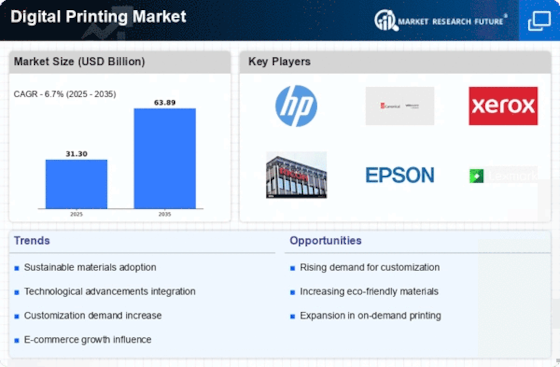
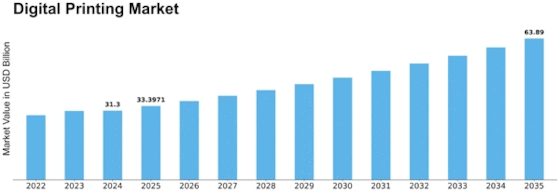
As per Market Research Future analysis, the Digital Printing Market was estimated at 31.3 USD Billion in 2024. The Digital Printing industry is projected to grow from 33.4 USD Billion in 2025 to 63.89 USD Billion by 2035, exhibiting a compound annual growth rate (CAGR) of 6.7% during the forecast period 2025 - 2035

Key Market Trends & Highlights

The Digital Printing Market is poised for robust growth driven by technological advancements and evolving consumer preferences.

  • North America remains the largest market for digital printing, characterized by a strong demand for innovative printing solutions. Asia-Pacific is emerging as the fastest-growing region, fueled by increasing investments in digital printing technologies. Inkjet technology continues to dominate the market, while laser printing is experiencing rapid growth due to its efficiency and quality. Key market drivers include rising demand for short-run printing and sustainability trends, which are reshaping industry practices.

Market Size & Forecast

2024 Market Size 31.3 (USD Billion)
2035 Market Size 63.89 (USD Billion)
CAGR (2025 - 2035) 6.7%
Largest Regional Market Share in 2024 Asia Pacific

Major Players

HP Inc. (US), Canon Inc. (JP), Xerox Corporation (US), Ricoh Company, Ltd. (JP), Epson Corporation (JP), Lexmark International, Inc. (US), Brother Industries, Ltd. (JP), Konica Minolta, Inc. (JP), Durst Phototechnik AG (AT)

Market Trends

The Digital Printing Market is currently experiencing a transformative phase, characterized by rapid technological advancements and evolving consumer preferences. This transformation is driven by modernization of computerized printing infrastructure. Rising adoption of computerized printing solutions is reshaping the global printing landscape. This sector appears to be shifting towards more sustainable practices, as businesses increasingly prioritize eco-friendly materials and processes. The integration of digital technologies into traditional printing methods seems to enhance efficiency and reduce waste, thereby appealing to environmentally conscious consumers. This growth reflects expanding opportunities across the global digital printing business. Furthermore, the demand for customization and personalization in printed products is on the rise, suggesting that companies must adapt to meet these changing expectations. In addition, the Digital Printing Market is witnessing a growing trend towards automation and smart technologies. Advanced digital printing systems are becoming central to operational efficiency. This evolution may lead to improved production capabilities and reduced operational costs, allowing businesses to remain competitive in a crowded landscape. As the market continues to expand, it is likely that innovations in software and hardware will further streamline processes, enabling quicker turnaround times and higher quality outputs. Overall, the Digital Printing Market appears poised for continued growth, driven by technological advancements and shifting consumer demands. Overall, computerized printing is accelerating market evolution.

Sustainability Initiatives

The Digital Printing Market is increasingly focusing on sustainable practices, with companies adopting eco-friendly materials and processes. This trend reflects a broader societal shift towards environmental responsibility, as consumers demand greener options in their printed products. Sustainability initiatives are increasingly embedded within the digital printing business.

Customization and Personalization

There is a notable rise in the demand for customized and personalized printed products within the Digital Printing Market. This trend indicates that businesses must adapt their offerings to cater to individual consumer preferences, enhancing customer engagement and satisfaction. Customization capabilities are enhanced by modern digital printing systems.

Automation and Smart Technologies

The integration of automation and smart technologies is transforming the Digital Printing Market. Smart factories increasingly rely on computerized printing for consistency and speed. This trend suggests that companies are likely to improve production efficiency and reduce costs, positioning themselves competitively in an evolving landscape. Automation is strengthening the role of advanced digital printing systems across workflows. This supports long-term scalability within the digital printing business.

Digital Printing Market Market Drivers

E-commerce Growth

The growth of e-commerce is significantly impacting the Digital Printing Market, as online retailers increasingly require efficient and effective printing solutions. With the rise of direct-to-consumer models, businesses are seeking digital printing technologies that can accommodate rapid production and fulfillment of customized orders. This trend is expected to drive market expansion, with projections indicating that e-commerce-related printing could account for nearly 25% of the overall market by 2026. As e-commerce continues to flourish, the demand for innovative packaging and promotional materials will likely increase, further propelling the Digital Printing Market forward.

Sustainability Trends

Sustainability trends are profoundly influencing the Digital Printing Market, as consumers and businesses alike prioritize eco-friendly practices. The demand for sustainable printing solutions, such as water-based inks and recyclable materials, is on the rise. Companies are increasingly adopting digital printing technologies that minimize waste and energy consumption, aligning with global sustainability goals. Recent statistics reveal that the market for sustainable printing is projected to grow by approximately 7% annually, reflecting a shift towards environmentally responsible practices. This trend not only enhances brand reputation but also positions businesses favorably within the Digital Printing Market, as they cater to the growing consumer preference for sustainable products.

Technological Advancements

The Digital Printing Market is experiencing rapid technological advancements that enhance printing capabilities and efficiency. Innovations such as high-speed inkjet printing and digital textile printing are transforming traditional processes. These advancements allow for faster production times and improved print quality, which are crucial for meeting the demands of various sectors. According to recent data, the adoption of advanced printing technologies is projected to increase market growth by approximately 5% annually. Furthermore, the integration of artificial intelligence and machine learning in printing processes is likely to optimize operations, reduce waste, and lower costs, thereby attracting more businesses to the Digital Printing Market.

Customization and Personalization

Customization and personalization are becoming pivotal drivers in the Digital Printing Market. As consumers seek unique and tailored products, businesses are leveraging digital printing technologies to offer personalized solutions. This trend is particularly evident in sectors such as packaging, textiles, and promotional materials, where individualized designs can significantly enhance customer engagement. Market analysis suggests that the demand for personalized products is expected to grow by over 10% in the next few years, indicating a substantial opportunity for companies within the Digital Printing Market. By embracing customization, businesses can differentiate themselves and foster stronger connections with their target audiences.

Rising Demand for Short-Run Printing

The Digital Printing Market is witnessing a notable rise in demand for short-run printing solutions. Businesses are increasingly seeking to produce smaller quantities of customized products, which traditional printing methods struggle to accommodate efficiently. This shift is driven by the need for rapid turnaround times and the ability to respond to market trends swiftly. Data indicates that short-run printing is expected to account for a significant portion of the market, with estimates suggesting it could represent over 30% of total printing volume in the coming years. As a result, digital printing technologies are becoming essential for companies aiming to remain competitive in the evolving landscape of the Digital Printing Market.

Market Segment Insights

By Type: Inkjet (Largest) vs. Laser (Fastest-Growing)

<p>In the Digital Printing Market, Inkjet technology holds the largest share, primarily due to its versatility and capability to produce high-quality prints at a lower cost. The widespread adoption of Inkjet printers across various applications, including photography, textiles, and commercial printing, has reinforced its dominant market position. Laser printing, while historically popular for office environments, is seeing a substantial surge in interest, catering to industries that require faster production speeds and robust performance for higher-volume print jobs.</p>

<p>Inkjet (Dominant) vs. Laser (Emerging)</p>

<p>Inkjet technology is characterized by its ability to print on a wide range of substrates and produce vibrant colors, making it the preferred choice for graphic-intensive applications such as packaging and promotional materials. Its dominance is attributed to continuous advancements in printhead technology and ink formulations, which have significantly improved print quality and speed. Conversely, Laser printing has emerged as a compelling option for businesses that demand swift output and lower cost-per-page in high-volume scenarios. With innovations focusing on energy efficiency and improved image quality, the Laser segment is quickly gaining traction, appealing to sectors that prioritize rapid printing capabilities without sacrificing quality.</p>

By Ink Type: Aqueous (Largest) vs. UV-curable (Fastest-Growing)

<p>In the Digital Printing Market, the ink type segment is characterized by various options, including Aqueous, Solvent, UV-curable, Dye Sublimation, Latex, and Others. Aqueous inks dominate the market due to their wide applicability in printing on porous surfaces and their environmentally friendly properties. They hold a significant share because of their cost-effective nature, making them a preferred choice among manufacturers. On the other hand, UV-curable inks, though currently smaller in market share, are rapidly gaining traction due to their unique properties such as quick curing times and superior durability on various substrates. The growth trends within the ink type segment are influenced by the increasing demand for high-quality prints and the need for sustainable solutions. The rise of UV-curable inks reflects the industry's shift towards faster production times and innovative printing solutions. Moreover, the growing popularity of digital printing technologies in signage, packaging, and labels is propelling Aqueous and UV-curable inks. As the digital printing landscape evolves, these ink types are positioned to benefit from advancements in technology and changing consumer preferences that favor efficiency and sustainability.</p>

<p>Aqueous (Dominant) vs. UV-curable (Emerging)</p>

<p>Aqueous inks have established themselves as the dominant choice in the Digital Printing Market, widely used due to their eco-friendly characteristics and versatility in application. They are particularly favored for their vibrant color reproduction and high-quality output, especially on paper and cardboard materials. Aqueous inks are less harmful to the environment, aligning with the growing demand for sustainable practices in printing. In contrast, UV-curable inks are emerging as an innovative alternative, using ultraviolet light to cure the ink almost instantly. This technology offers a plethora of benefits, including faster drying times, reduced ink usage, and the ability to print on a wider range of substrates, including plastics and metals. As the market progresses, both ink types will play crucial roles, with Aqueous inks maintaining their strong foothold while UV-curable inks expand their presence driven by technological advancements.</p>

By Application: Packaging (Largest) vs. Commercial Printing (Fastest-Growing)

<p>In the Digital Printing Market, the application segment is characterized by diverse uses spanning various industries. Packaging holds the largest market share due to its essential role in product branding and consumer engagement, witnessing significant adoption across the retail and food sectors. Other applications, such as commercial printing and texting, follow suit, catering to specific demands in advertising and personalization, respectively, but do not match the dominance of packaging. The growth trends in the Digital Printing Market are primarily driven by technological advancements and a shift toward sustainable practices. The burgeoning demand for custom packaging solutions and short-run printing has propelled commercial printing to emerge as the fastest-growing segment. Additionally, factors like the rise of e-commerce and personalized marketing strategies further accentuate the growth potential of this market segment.</p>

<p>Packaging: Dominant vs. Commercial Printing: Emerging</p>

<p>The packaging segment in the Digital Printing Market stands as a dominant force, primarily driven by its critical role in branding and consumer appeal. Digital printing allows for high customization options, enabling brands to differentiate their products through unique designs and finishing options. On the other hand, commercial printing is gaining traction as an emerging application, leveraging digital technology to meet the need for fast, cost-effective print solutions. It caters to a wide array of requirements, from promotional materials to corporate branding, adapting quickly to market demands. The flexibility and efficiency offered by digital printing technology positions commercial printing well for rapid market growth, as businesses seek agile solutions to respond to evolving consumer preferences.</p>

Digital Printing Market Application Insights

The Digital Printing Market segmentation, based on application, has been bifurcated into the categories of texting, commercial printing, packaging, paper/books and others. In 2021, the packaging segment accounted for the most market revenue. In order to save time and money, digital printing is frequently used in packaging. Digital printers are perfect for smaller order quantities because they need very little work and have a far lower setup cost. Furthermore, digital printing is perfect for minimalist packaging designs because it gives a high-quality result for simpler artwork. This highlights the growing importance of digital printing in packaging.

September 2022 - Westrock Company purchased the HP PageWide T1190 inkjet digital press. The company's current offset litho, flexo preprint, flexo direct print, and sheet-fed digital printing activities will be complemented by the digital press across its corrugated box plants and specialty facilities. Packaging adoption continues to expand within the digital printing business.

Digital Printing Market Regional Insights

By Region, the study segments the market into North America, Europe, Asia-Pacific Middle East &amp; Africa, and South America. During the projected period, The Asia Pacific market is predicted to develop at the fastest CAGR due to increased demand for digital printing across numerous business verticals. The Chinese printing sector is paying attention to new data-driven business models, digital platform solutions, and end-to-end digitized value creation chains. Local designers now have access to more than 12,000 carton folding patterns online because of the increased adoption of digital printing.

Businesses are purchasing digital presses because there are fewer steps in the printing process.

As a result, the companies will be able to increase their manufacturing capacity by providing finished goods more quickly. On October 15, 2021, Tomato Cloud Technology Co., Ltd., a Chinese printing business, placed an order for 10 new Fujifilm Jet Press 750S digital inkjet printers. By the end of 2022, the company will be one of Jet Press' key clients thanks to the addition of 10 additional Jet Press 750S presses that will be delivered to its location by that time.

Get more detailed insights about Digital Printing Market Research Report - Forecast till 2035

Regional Insights

North America : Innovation and Market Leadership

North America is the largest market for digital printing, holding approximately 40% of the global share. The region's growth is driven by technological advancements, increasing demand for customized printing solutions, and a robust e-commerce sector. Regulatory support for sustainable practices further catalyzes market expansion, as companies seek eco-friendly printing options. The U.S. leads this market, followed closely by Canada, which contributes around 15% to the overall market share. The competitive landscape in North America is characterized by the presence of major players such as HP Inc., Xerox Corporation, and Canon Inc. This enhances competitiveness across the digital print market. These companies are continuously innovating to meet the diverse needs of consumers and businesses. The region's focus on high-quality printing and rapid turnaround times positions it as a leader in the digital printing market, fostering a dynamic environment for growth and investment. Packaging adoption continues to expand within the digital printing business. Strong enterprise demand supports growth of company digital printing solutions. These investments reinforce advanced digital printing systems.

Europe : Sustainability and Innovation Focus

Europe is the second-largest market for digital printing, accounting for approximately 30% of the global market share. The region's growth is fueled by increasing demand for sustainable printing solutions and advancements in digital technologies. Regulatory frameworks promoting eco-friendly practices and waste reduction are significant catalysts for market growth. Germany and the UK are the leading countries in this region, together holding about 20% of the market share, driven by their strong manufacturing sectors and innovation in printing technologies. The competitive landscape in Europe features key players like Canon Inc., Ricoh Company, and Epson Corporation, which are investing heavily in R&D to enhance their product offerings. The focus on sustainability and digital transformation is reshaping the market, with companies adopting new technologies to meet consumer demands for high-quality, environmentally friendly printing solutions. This trend is expected to continue, further solidifying Europe's position in The Digital Printing Market. Innovation priorities reflect evolving digital printing trends.

Asia-Pacific : Rapid Growth and Adoption

Asia-Pacific is witnessing rapid growth in the digital printing market, holding approximately 25% of the global share. The region's expansion is driven by increasing urbanization, rising disposable incomes, and a growing demand for personalized printing solutions. Countries like China and India are at the forefront, with China being the largest market in the region, contributing around 15% to the global market. Government initiatives supporting digital transformation and manufacturing are also significant growth drivers. The competitive landscape in Asia-Pacific is diverse, with key players such as Brother Industries and Konica Minolta leading the charge. The region is characterized by a mix of established companies and emerging startups, all vying for market share. The focus on innovation and cost-effective solutions is driving competition, as businesses seek to leverage digital printing technologies to enhance operational efficiency and meet the evolving needs of consumers.

Middle East and Africa : Emerging Market Potential

The Middle East and Africa region is gradually emerging in the digital printing market, holding about 5% of the global share. The growth is primarily driven by increasing investments in infrastructure, a burgeoning retail sector, and a rising demand for high-quality printing solutions. Countries like South Africa and the UAE are leading the market, with the UAE showing significant growth potential due to its strategic location and investment in technology. Regulatory support for digital initiatives is also fostering market development. The competitive landscape in this region is evolving, with both local and international players vying for market presence. Companies are focusing on innovative solutions to cater to the unique demands of the region, including customized printing services for various industries. As the market matures, there are significant opportunities for growth, particularly in sectors like packaging and advertising, which are increasingly adopting digital printing technologies.

Key Players and Competitive Insights

The Digital Printing Market is currently characterized by a dynamic competitive landscape, driven by technological advancements and evolving consumer preferences. Key players such as HP Inc. (US), Canon Inc. (JP), and Xerox Corporation (US) are at the forefront, each adopting distinct strategies to enhance their market positioning. HP Inc. (US) focuses on innovation through the development of advanced printing solutions that cater to both commercial and consumer segments. Canon Inc. (JP) emphasizes regional expansion, particularly in emerging markets, while Xerox Corporation (US) is pivoting towards digital transformation, integrating AI and automation into their offerings. Collectively, these strategies contribute to a competitive environment that is increasingly shaped by technological prowess and market adaptability. Strategic investments indicate a maturing digital printing business environment. In terms of business tactics, companies are localizing manufacturing and optimizing supply chains to enhance efficiency and responsiveness to market demands. The competitive structure of the Digital Printing Market appears moderately fragmented, with several key players exerting influence across various segments. This fragmentation allows for a diverse range of products and services, fostering innovation and competition among established and emerging firms alike. AI adoption is redefining computerized printing capabilities.
In August Canon Inc. (JP) announced a strategic partnership with a leading software provider to enhance its digital printing solutions. This collaboration aims to integrate advanced software capabilities into Canon's existing product lines, thereby improving workflow efficiency for customers. The significance of this partnership lies in its potential to position Canon as a leader in the digital transformation of printing, aligning with current market trends that favor integrated solutions.
In September HP Inc. (US) launched a new line of eco-friendly printers designed to reduce environmental impact while maintaining high-quality output. This initiative reflects a growing consumer demand for sustainable products and positions HP as a forward-thinking player in the market. The strategic importance of this launch is underscored by the increasing regulatory pressures and consumer expectations surrounding sustainability, suggesting that HP is keenly aware of the shifting landscape.
In October Xerox Corporation (US) unveiled a new AI-driven printing platform aimed at enhancing operational efficiency for businesses. This platform leverages machine learning to optimize print jobs and reduce waste, aligning with the broader trend of digitalization in the industry. The introduction of this technology indicates Xerox's commitment to innovation and its recognition of the need for businesses to adapt to rapidly changing operational demands.
As of October the Digital Printing Market is witnessing trends that emphasize digitalization, sustainability, and AI integration. Strategic alliances are increasingly shaping the competitive landscape, enabling companies to leverage complementary strengths and enhance their offerings. Looking ahead, competitive differentiation is likely to evolve from traditional price-based competition towards a focus on innovation, technological advancement, and supply chain reliability. This shift suggests that companies that prioritize these elements will be better positioned to thrive in an increasingly complex market.

Key Companies in the Digital Printing Market include

Industry Developments

  • Q2 2024: Digital Printing Market to Grow by 50% over Next 10 Years, to More ... The Cannata Report covered the launch of new high-productivity digital printing equipment in 2024, which is enabling new business models and commercial opportunities for print service providers in the digital printing sector. New launches emphasize high-speed machines for digital printing.

Future Outlook

Digital Printing Market Future Outlook

The Digital Printing Market is projected to grow at a 6.7% CAGR from 2025 to 2035, driven by technological advancements, increased demand for customization, and sustainability initiatives.

New opportunities lie in:

  • <p>Expansion into eco-friendly printing materials Development of on-demand printing solutions for e-commerce Integration of AI for personalized marketing campaigns</p>

By 2035, the Digital Printing Market is expected to achieve substantial growth and innovation.

Market Segmentation

Digital Printing Market Type Outlook

  • Inkjet
  • Laser

Digital Printing Market Ink Type Outlook

  • Aqueous
  • Solvent
  • UV-curable
  • Dye Sublimation
  • Latex
  • Others

Digital Printing Market Application Outlook

  • Texting
  • Commercial Printing
  • Packaging
  • Paper/Books
  • Others

Report Scope

MARKET SIZE 2024 31.3(USD Billion)
MARKET SIZE 2025 33.4(USD Billion)
MARKET SIZE 2035 63.89(USD Billion)
COMPOUND ANNUAL GROWTH RATE (CAGR) 6.7% (2025 - 2035)
REPORT COVERAGE Revenue Forecast, Competitive Landscape, Growth Factors, and Trends
BASE YEAR 2024
Market Forecast Period 2025 - 2035
Historical Data 2019 - 2024
Market Forecast Units USD Billion
Key Companies Profiled HP Inc. (US), Canon Inc. (JP), Xerox Corporation (US), Ricoh Company, Ltd. (JP), Epson Corporation (JP), Lexmark International, Inc. (US), Brother Industries, Ltd. (JP), Konica Minolta, Inc. (JP), Durst Phototechnik AG (AT)
Segments Covered Type, Ink Type, Application, Region
Key Market Opportunities Integration of sustainable materials and technologies in the Digital Printing Market presents substantial growth opportunities.
Key Market Dynamics Technological advancements drive innovation in digital printing, enhancing efficiency and customization across various industries.
Countries Covered North America, Europe, APAC, South America, MEA

FAQs

What is the current valuation of the Digital Printing Market as of 2024?

<p>The Digital Printing Market was valued at 31.3 USD Billion in 2024.</p>

What is the projected market size for the Digital Printing Market by 2035?

<p>The market is projected to reach 63.89 USD Billion by 2035.</p>

What is the expected CAGR for the Digital Printing Market during the forecast period 2025 - 2035?

<p>The expected CAGR for the Digital Printing Market during 2025 - 2035 is 6.7%.</p>

Which companies are considered key players in the Digital Printing Market?

<p>Key players include HP Inc., Canon Inc., Xerox Corporation, and Ricoh Company, among others.</p>

What are the main types of digital printing technologies currently in use?

The main types include Inkjet and Laser printing technologies.

How did the Inkjet segment perform in terms of market valuation in 2024?

The Inkjet segment was valued at 18.78 USD Billion in 2024 and is projected to grow to 38.56 USD Billion.

What is the market valuation for the Laser segment in 2024?

The Laser segment was valued at 12.52 USD Billion in 2024, with a projected growth to 25.33 USD Billion.

What are the key applications of digital printing?

Key applications include Commercial Printing, Packaging, and Paper/Books.

What was the market valuation for the Commercial Printing application in 2024?

The Commercial Printing application was valued at 10.0 USD Billion in 2024.

What is the projected growth for the UV-curable ink type segment by 2035?

The UV-curable ink type segment is projected to grow from 7.0 USD Billion in 2024 to 14.0 USD Billion by 2035.

  1. SECTION I: EXECUTIVE SUMMARY AND KEY HIGHLIGHTS
    1. | 1.1 EXECUTIVE SUMMARY
    2. | | 1.1.1 Market Overview
    3. | | 1.1.2 Key Findings
    4. | | 1.1.3 Market Segmentation
    5. | | 1.1.4 Competitive Landscape
    6. | | 1.1.5 Challenges and Opportunities
    7. | | 1.1.6 Future Outlook
  2. SECTION II: SCOPING, METHODOLOGY AND MARKET STRUCTURE
    1. | 2.1 MARKET INTRODUCTION
    2. | | 2.1.1 Definition
    3. | | 2.1.2 Scope of the study
    4. | | | 2.1.2.1 Research Objective
    5. | | | 2.1.2.2 Assumption
    6. | | | 2.1.2.3 Limitations
    7. | 2.2 RESEARCH METHODOLOGY
    8. | | 2.2.1 Overview
    9. | | 2.2.2 Data Mining
    10. | | 2.2.3 Secondary Research
    11. | | 2.2.4 Primary Research
    12. | | | 2.2.4.1 Primary Interviews and Information Gathering Process
    13. | | | 2.2.4.2 Breakdown of Primary Respondents
    14. | | 2.2.5 Forecasting Model
    15. | | 2.2.6 Market Size Estimation
    16. | | | 2.2.6.1 Bottom-Up Approach
    17. | | | 2.2.6.2 Top-Down Approach
    18. | | 2.2.7 Data Triangulation
    19. | | 2.2.8 Validation
  3. SECTION III: QUALITATIVE ANALYSIS
    1. | 3.1 MARKET DYNAMICS
    2. | | 3.1.1 Overview
    3. | | 3.1.2 Drivers
    4. | | 3.1.3 Restraints
    5. | | 3.1.4 Opportunities
    6. | 3.2 MARKET FACTOR ANALYSIS
    7. | | 3.2.1 Value chain Analysis
    8. | | 3.2.2 Porter's Five Forces Analysis
    9. | | | 3.2.2.1 Bargaining Power of Suppliers
    10. | | | 3.2.2.2 Bargaining Power of Buyers
    11. | | | 3.2.2.3 Threat of New Entrants
    12. | | | 3.2.2.4 Threat of Substitutes
    13. | | | 3.2.2.5 Intensity of Rivalry
    14. | | 3.2.3 COVID-19 Impact Analysis
    15. | | | 3.2.3.1 Market Impact Analysis
    16. | | | 3.2.3.2 Regional Impact
    17. | | | 3.2.3.3 Opportunity and Threat Analysis
  4. SECTION IV: QUANTITATIVE ANALYSIS
    1. | 4.1 Semiconductor & Electronics, BY Type (USD Billion)
    2. | | 4.1.1 Inkjet
    3. | | 4.1.2 Laser
    4. | 4.2 Semiconductor & Electronics, BY Ink Type (USD Billion)
    5. | | 4.2.1 Aqueous
    6. | | 4.2.2 Solvent
    7. | | 4.2.3 UV-curable
    8. | | 4.2.4 Dye Sublimation
    9. | | 4.2.5 Latex
    10. | | 4.2.6 Others
    11. | 4.3 Semiconductor & Electronics, BY Application (USD Billion)
    12. | | 4.3.1 Texting
    13. | | 4.3.2 Commercial Printing
    14. | | 4.3.3 Packaging
    15. | | 4.3.4 Paper/Books
    16. | | 4.3.5 Others
    17. | 4.4 Semiconductor & Electronics, BY Region (USD Billion)
    18. | | 4.4.1 North America
    19. | | | 4.4.1.1 US
    20. | | | 4.4.1.2 Canada
    21. | | 4.4.2 Europe
    22. | | | 4.4.2.1 Germany
    23. | | | 4.4.2.2 UK
    24. | | | 4.4.2.3 France
    25. | | | 4.4.2.4 Russia
    26. | | | 4.4.2.5 Italy
    27. | | | 4.4.2.6 Spain
    28. | | | 4.4.2.7 Rest of Europe
    29. | | 4.4.3 APAC
    30. | | | 4.4.3.1 China
    31. | | | 4.4.3.2 India
    32. | | | 4.4.3.3 Japan
    33. | | | 4.4.3.4 South Korea
    34. | | | 4.4.3.5 Malaysia
    35. | | | 4.4.3.6 Thailand
    36. | | | 4.4.3.7 Indonesia
    37. | | | 4.4.3.8 Rest of APAC
    38. | | 4.4.4 South America
    39. | | | 4.4.4.1 Brazil
    40. | | | 4.4.4.2 Mexico
    41. | | | 4.4.4.3 Argentina
    42. | | | 4.4.4.4 Rest of South America
    43. | | 4.4.5 MEA
    44. | | | 4.4.5.1 GCC Countries
    45. | | | 4.4.5.2 South Africa
    46. | | | 4.4.5.3 Rest of MEA
  5. SECTION V: COMPETITIVE ANALYSIS
    1. | 5.1 Competitive Landscape
    2. | | 5.1.1 Overview
    3. | | 5.1.2 Competitive Analysis
    4. | | 5.1.3 Market share Analysis
    5. | | 5.1.4 Major Growth Strategy in the Semiconductor & Electronics
    6. | | 5.1.5 Competitive Benchmarking
    7. | | 5.1.6 Leading Players in Terms of Number of Developments in the Semiconductor & Electronics
    8. | | 5.1.7 Key developments and growth strategies
    9. | | | 5.1.7.1 New Product Launch/Service Deployment
    10. | | | 5.1.7.2 Merger & Acquisitions
    11. | | | 5.1.7.3 Joint Ventures
    12. | | 5.1.8 Major Players Financial Matrix
    13. | | | 5.1.8.1 Sales and Operating Income
    14. | | | 5.1.8.2 Major Players R&D Expenditure. 2023
    15. | 5.2 Company Profiles
    16. | | 5.2.1 HP Inc. (US)
    17. | | | 5.2.1.1 Financial Overview
    18. | | | 5.2.1.2 Products Offered
    19. | | | 5.2.1.3 Key Developments
    20. | | | 5.2.1.4 SWOT Analysis
    21. | | | 5.2.1.5 Key Strategies
    22. | | 5.2.2 Canon Inc. (JP)
    23. | | | 5.2.2.1 Financial Overview
    24. | | | 5.2.2.2 Products Offered
    25. | | | 5.2.2.3 Key Developments
    26. | | | 5.2.2.4 SWOT Analysis
    27. | | | 5.2.2.5 Key Strategies
    28. | | 5.2.3 Xerox Corporation (US)
    29. | | | 5.2.3.1 Financial Overview
    30. | | | 5.2.3.2 Products Offered
    31. | | | 5.2.3.3 Key Developments
    32. | | | 5.2.3.4 SWOT Analysis
    33. | | | 5.2.3.5 Key Strategies
    34. | | 5.2.4 Ricoh Company, Ltd. (JP)
    35. | | | 5.2.4.1 Financial Overview
    36. | | | 5.2.4.2 Products Offered
    37. | | | 5.2.4.3 Key Developments
    38. | | | 5.2.4.4 SWOT Analysis
    39. | | | 5.2.4.5 Key Strategies
    40. | | 5.2.5 Epson Corporation (JP)
    41. | | | 5.2.5.1 Financial Overview
    42. | | | 5.2.5.2 Products Offered
    43. | | | 5.2.5.3 Key Developments
    44. | | | 5.2.5.4 SWOT Analysis
    45. | | | 5.2.5.5 Key Strategies
    46. | | 5.2.6 Lexmark International, Inc. (US)
    47. | | | 5.2.6.1 Financial Overview
    48. | | | 5.2.6.2 Products Offered
    49. | | | 5.2.6.3 Key Developments
    50. | | | 5.2.6.4 SWOT Analysis
    51. | | | 5.2.6.5 Key Strategies
    52. | | 5.2.7 Brother Industries, Ltd. (JP)
    53. | | | 5.2.7.1 Financial Overview
    54. | | | 5.2.7.2 Products Offered
    55. | | | 5.2.7.3 Key Developments
    56. | | | 5.2.7.4 SWOT Analysis
    57. | | | 5.2.7.5 Key Strategies
    58. | | 5.2.8 Konica Minolta, Inc. (JP)
    59. | | | 5.2.8.1 Financial Overview
    60. | | | 5.2.8.2 Products Offered
    61. | | | 5.2.8.3 Key Developments
    62. | | | 5.2.8.4 SWOT Analysis
    63. | | | 5.2.8.5 Key Strategies
    64. | | 5.2.9 Durst Phototechnik AG (AT)
    65. | | | 5.2.9.1 Financial Overview
    66. | | | 5.2.9.2 Products Offered
    67. | | | 5.2.9.3 Key Developments
    68. | | | 5.2.9.4 SWOT Analysis
    69. | | | 5.2.9.5 Key Strategies
    70. | 5.3 Appendix
    71. | | 5.3.1 References
    72. | | 5.3.2 Related Reports
  6. LIST OF FIGURES
    1. | 6.1 MARKET SYNOPSIS
    2. | 6.2 NORTH AMERICA MARKET ANALYSIS
    3. | 6.3 US MARKET ANALYSIS BY TYPE
    4. | 6.4 US MARKET ANALYSIS BY INK TYPE
    5. | 6.5 US MARKET ANALYSIS BY APPLICATION
    6. | 6.6 CANADA MARKET ANALYSIS BY TYPE
    7. | 6.7 CANADA MARKET ANALYSIS BY INK TYPE
    8. | 6.8 CANADA MARKET ANALYSIS BY APPLICATION
    9. | 6.9 EUROPE MARKET ANALYSIS
    10. | 6.10 GERMANY MARKET ANALYSIS BY TYPE
    11. | 6.11 GERMANY MARKET ANALYSIS BY INK TYPE
    12. | 6.12 GERMANY MARKET ANALYSIS BY APPLICATION
    13. | 6.13 UK MARKET ANALYSIS BY TYPE
    14. | 6.14 UK MARKET ANALYSIS BY INK TYPE
    15. | 6.15 UK MARKET ANALYSIS BY APPLICATION
    16. | 6.16 FRANCE MARKET ANALYSIS BY TYPE
    17. | 6.17 FRANCE MARKET ANALYSIS BY INK TYPE
    18. | 6.18 FRANCE MARKET ANALYSIS BY APPLICATION
    19. | 6.19 RUSSIA MARKET ANALYSIS BY TYPE
    20. | 6.20 RUSSIA MARKET ANALYSIS BY INK TYPE
    21. | 6.21 RUSSIA MARKET ANALYSIS BY APPLICATION
    22. | 6.22 ITALY MARKET ANALYSIS BY TYPE
    23. | 6.23 ITALY MARKET ANALYSIS BY INK TYPE
    24. | 6.24 ITALY MARKET ANALYSIS BY APPLICATION
    25. | 6.25 SPAIN MARKET ANALYSIS BY TYPE
    26. | 6.26 SPAIN MARKET ANALYSIS BY INK TYPE
    27. | 6.27 SPAIN MARKET ANALYSIS BY APPLICATION
    28. | 6.28 REST OF EUROPE MARKET ANALYSIS BY TYPE
    29. | 6.29 REST OF EUROPE MARKET ANALYSIS BY INK TYPE
    30. | 6.30 REST OF EUROPE MARKET ANALYSIS BY APPLICATION
    31. | 6.31 APAC MARKET ANALYSIS
    32. | 6.32 CHINA MARKET ANALYSIS BY TYPE
    33. | 6.33 CHINA MARKET ANALYSIS BY INK TYPE
    34. | 6.34 CHINA MARKET ANALYSIS BY APPLICATION
    35. | 6.35 INDIA MARKET ANALYSIS BY TYPE
    36. | 6.36 INDIA MARKET ANALYSIS BY INK TYPE
    37. | 6.37 INDIA MARKET ANALYSIS BY APPLICATION
    38. | 6.38 JAPAN MARKET ANALYSIS BY TYPE
    39. | 6.39 JAPAN MARKET ANALYSIS BY INK TYPE
    40. | 6.40 JAPAN MARKET ANALYSIS BY APPLICATION
    41. | 6.41 SOUTH KOREA MARKET ANALYSIS BY TYPE
    42. | 6.42 SOUTH KOREA MARKET ANALYSIS BY INK TYPE
    43. | 6.43 SOUTH KOREA MARKET ANALYSIS BY APPLICATION
    44. | 6.44 MALAYSIA MARKET ANALYSIS BY TYPE
    45. | 6.45 MALAYSIA MARKET ANALYSIS BY INK TYPE
    46. | 6.46 MALAYSIA MARKET ANALYSIS BY APPLICATION
    47. | 6.47 THAILAND MARKET ANALYSIS BY TYPE
    48. | 6.48 THAILAND MARKET ANALYSIS BY INK TYPE
    49. | 6.49 THAILAND MARKET ANALYSIS BY APPLICATION
    50. | 6.50 INDONESIA MARKET ANALYSIS BY TYPE
    51. | 6.51 INDONESIA MARKET ANALYSIS BY INK TYPE
    52. | 6.52 INDONESIA MARKET ANALYSIS BY APPLICATION
    53. | 6.53 REST OF APAC MARKET ANALYSIS BY TYPE
    54. | 6.54 REST OF APAC MARKET ANALYSIS BY INK TYPE
    55. | 6.55 REST OF APAC MARKET ANALYSIS BY APPLICATION
    56. | 6.56 SOUTH AMERICA MARKET ANALYSIS
    57. | 6.57 BRAZIL MARKET ANALYSIS BY TYPE
    58. | 6.58 BRAZIL MARKET ANALYSIS BY INK TYPE
    59. | 6.59 BRAZIL MARKET ANALYSIS BY APPLICATION
    60. | 6.60 MEXICO MARKET ANALYSIS BY TYPE
    61. | 6.61 MEXICO MARKET ANALYSIS BY INK TYPE
    62. | 6.62 MEXICO MARKET ANALYSIS BY APPLICATION
    63. | 6.63 ARGENTINA MARKET ANALYSIS BY TYPE
    64. | 6.64 ARGENTINA MARKET ANALYSIS BY INK TYPE
    65. | 6.65 ARGENTINA MARKET ANALYSIS BY APPLICATION
    66. | 6.66 REST OF SOUTH AMERICA MARKET ANALYSIS BY TYPE
    67. | 6.67 REST OF SOUTH AMERICA MARKET ANALYSIS BY INK TYPE
    68. | 6.68 REST OF SOUTH AMERICA MARKET ANALYSIS BY APPLICATION
    69. | 6.69 MEA MARKET ANALYSIS
    70. | 6.70 GCC COUNTRIES MARKET ANALYSIS BY TYPE
    71. | 6.71 GCC COUNTRIES MARKET ANALYSIS BY INK TYPE
    72. | 6.72 GCC COUNTRIES MARKET ANALYSIS BY APPLICATION
    73. | 6.73 SOUTH AFRICA MARKET ANALYSIS BY TYPE
    74. | 6.74 SOUTH AFRICA MARKET ANALYSIS BY INK TYPE
    75. | 6.75 SOUTH AFRICA MARKET ANALYSIS BY APPLICATION
    76. | 6.76 REST OF MEA MARKET ANALYSIS BY TYPE
    77. | 6.77 REST OF MEA MARKET ANALYSIS BY INK TYPE
    78. | 6.78 REST OF MEA MARKET ANALYSIS BY APPLICATION
    79. | 6.79 KEY BUYING CRITERIA OF SEMICONDUCTOR & ELECTRONICS
    80. | 6.80 RESEARCH PROCESS OF MRFR
    81. | 6.81 DRO ANALYSIS OF SEMICONDUCTOR & ELECTRONICS
    82. | 6.82 DRIVERS IMPACT ANALYSIS: SEMICONDUCTOR & ELECTRONICS
    83. | 6.83 RESTRAINTS IMPACT ANALYSIS: SEMICONDUCTOR & ELECTRONICS
    84. | 6.84 SUPPLY / VALUE CHAIN: SEMICONDUCTOR & ELECTRONICS
    85. | 6.85 SEMICONDUCTOR & ELECTRONICS, BY TYPE, 2024 (% SHARE)
    86. | 6.86 SEMICONDUCTOR & ELECTRONICS, BY TYPE, 2024 TO 2035 (USD Billion)
    87. | 6.87 SEMICONDUCTOR & ELECTRONICS, BY INK TYPE, 2024 (% SHARE)
    88. | 6.88 SEMICONDUCTOR & ELECTRONICS, BY INK TYPE, 2024 TO 2035 (USD Billion)
    89. | 6.89 SEMICONDUCTOR & ELECTRONICS, BY APPLICATION, 2024 (% SHARE)
    90. | 6.90 SEMICONDUCTOR & ELECTRONICS, BY APPLICATION, 2024 TO 2035 (USD Billion)
    91. | 6.91 BENCHMARKING OF MAJOR COMPETITORS
  7. LIST OF TABLES
    1. | 7.1 LIST OF ASSUMPTIONS
    2. | | 7.1.1
    3. | 7.2 North America MARKET SIZE ESTIMATES; FORECAST
    4. | | 7.2.1 BY TYPE, 2025-2035 (USD Billion)
    5. | | 7.2.2 BY INK TYPE, 2025-2035 (USD Billion)
    6. | | 7.2.3 BY APPLICATION, 2025-2035 (USD Billion)
    7. | 7.3 US MARKET SIZE ESTIMATES; FORECAST
    8. | | 7.3.1 BY TYPE, 2025-2035 (USD Billion)
    9. | | 7.3.2 BY INK TYPE, 2025-2035 (USD Billion)
    10. | | 7.3.3 BY APPLICATION, 2025-2035 (USD Billion)
    11. | 7.4 Canada MARKET SIZE ESTIMATES; FORECAST
    12. | | 7.4.1 BY TYPE, 2025-2035 (USD Billion)
    13. | | 7.4.2 BY INK TYPE, 2025-2035 (USD Billion)
    14. | | 7.4.3 BY APPLICATION, 2025-2035 (USD Billion)
    15. | 7.5 Europe MARKET SIZE ESTIMATES; FORECAST
    16. | | 7.5.1 BY TYPE, 2025-2035 (USD Billion)
    17. | | 7.5.2 BY INK TYPE, 2025-2035 (USD Billion)
    18. | | 7.5.3 BY APPLICATION, 2025-2035 (USD Billion)
    19. | 7.6 Germany MARKET SIZE ESTIMATES; FORECAST
    20. | | 7.6.1 BY TYPE, 2025-2035 (USD Billion)
    21. | | 7.6.2 BY INK TYPE, 2025-2035 (USD Billion)
    22. | | 7.6.3 BY APPLICATION, 2025-2035 (USD Billion)
    23. | 7.7 UK MARKET SIZE ESTIMATES; FORECAST
    24. | | 7.7.1 BY TYPE, 2025-2035 (USD Billion)
    25. | | 7.7.2 BY INK TYPE, 2025-2035 (USD Billion)
    26. | | 7.7.3 BY APPLICATION, 2025-2035 (USD Billion)
    27. | 7.8 France MARKET SIZE ESTIMATES; FORECAST
    28. | | 7.8.1 BY TYPE, 2025-2035 (USD Billion)
    29. | | 7.8.2 BY INK TYPE, 2025-2035 (USD Billion)
    30. | | 7.8.3 BY APPLICATION, 2025-2035 (USD Billion)
    31. | 7.9 Russia MARKET SIZE ESTIMATES; FORECAST
    32. | | 7.9.1 BY TYPE, 2025-2035 (USD Billion)
    33. | | 7.9.2 BY INK TYPE, 2025-2035 (USD Billion)
    34. | | 7.9.3 BY APPLICATION, 2025-2035 (USD Billion)
    35. | 7.10 Italy MARKET SIZE ESTIMATES; FORECAST
    36. | | 7.10.1 BY TYPE, 2025-2035 (USD Billion)
    37. | | 7.10.2 BY INK TYPE, 2025-2035 (USD Billion)
    38. | | 7.10.3 BY APPLICATION, 2025-2035 (USD Billion)
    39. | 7.11 Spain MARKET SIZE ESTIMATES; FORECAST
    40. | | 7.11.1 BY TYPE, 2025-2035 (USD Billion)
    41. | | 7.11.2 BY INK TYPE, 2025-2035 (USD Billion)
    42. | | 7.11.3 BY APPLICATION, 2025-2035 (USD Billion)
    43. | 7.12 Rest of Europe MARKET SIZE ESTIMATES; FORECAST
    44. | | 7.12.1 BY TYPE, 2025-2035 (USD Billion)
    45. | | 7.12.2 BY INK TYPE, 2025-2035 (USD Billion)
    46. | | 7.12.3 BY APPLICATION, 2025-2035 (USD Billion)
    47. | 7.13 APAC MARKET SIZE ESTIMATES; FORECAST
    48. | | 7.13.1 BY TYPE, 2025-2035 (USD Billion)
    49. | | 7.13.2 BY INK TYPE, 2025-2035 (USD Billion)
    50. | | 7.13.3 BY APPLICATION, 2025-2035 (USD Billion)
    51. | 7.14 China MARKET SIZE ESTIMATES; FORECAST
    52. | | 7.14.1 BY TYPE, 2025-2035 (USD Billion)
    53. | | 7.14.2 BY INK TYPE, 2025-2035 (USD Billion)
    54. | | 7.14.3 BY APPLICATION, 2025-2035 (USD Billion)
    55. | 7.15 India MARKET SIZE ESTIMATES; FORECAST
    56. | | 7.15.1 BY TYPE, 2025-2035 (USD Billion)
    57. | | 7.15.2 BY INK TYPE, 2025-2035 (USD Billion)
    58. | | 7.15.3 BY APPLICATION, 2025-2035 (USD Billion)
    59. | 7.16 Japan MARKET SIZE ESTIMATES; FORECAST
    60. | | 7.16.1 BY TYPE, 2025-2035 (USD Billion)
    61. | | 7.16.2 BY INK TYPE, 2025-2035 (USD Billion)
    62. | | 7.16.3 BY APPLICATION, 2025-2035 (USD Billion)
    63. | 7.17 South Korea MARKET SIZE ESTIMATES; FORECAST
    64. | | 7.17.1 BY TYPE, 2025-2035 (USD Billion)
    65. | | 7.17.2 BY INK TYPE, 2025-2035 (USD Billion)
    66. | | 7.17.3 BY APPLICATION, 2025-2035 (USD Billion)
    67. | 7.18 Malaysia MARKET SIZE ESTIMATES; FORECAST
    68. | | 7.18.1 BY TYPE, 2025-2035 (USD Billion)
    69. | | 7.18.2 BY INK TYPE, 2025-2035 (USD Billion)
    70. | | 7.18.3 BY APPLICATION, 2025-2035 (USD Billion)
    71. | 7.19 Thailand MARKET SIZE ESTIMATES; FORECAST
    72. | | 7.19.1 BY TYPE, 2025-2035 (USD Billion)
    73. | | 7.19.2 BY INK TYPE, 2025-2035 (USD Billion)
    74. | | 7.19.3 BY APPLICATION, 2025-2035 (USD Billion)
    75. | 7.20 Indonesia MARKET SIZE ESTIMATES; FORECAST
    76. | | 7.20.1 BY TYPE, 2025-2035 (USD Billion)
    77. | | 7.20.2 BY INK TYPE, 2025-2035 (USD Billion)
    78. | | 7.20.3 BY APPLICATION, 2025-2035 (USD Billion)
    79. | 7.21 Rest of APAC MARKET SIZE ESTIMATES; FORECAST
    80. | | 7.21.1 BY TYPE, 2025-2035 (USD Billion)
    81. | | 7.21.2 BY INK TYPE, 2025-2035 (USD Billion)
    82. | | 7.21.3 BY APPLICATION, 2025-2035 (USD Billion)
    83. | 7.22 South America MARKET SIZE ESTIMATES; FORECAST
    84. | | 7.22.1 BY TYPE, 2025-2035 (USD Billion)
    85. | | 7.22.2 BY INK TYPE, 2025-2035 (USD Billion)
    86. | | 7.22.3 BY APPLICATION, 2025-2035 (USD Billion)
    87. | 7.23 Brazil MARKET SIZE ESTIMATES; FORECAST
    88. | | 7.23.1 BY TYPE, 2025-2035 (USD Billion)
    89. | | 7.23.2 BY INK TYPE, 2025-2035 (USD Billion)
    90. | | 7.23.3 BY APPLICATION, 2025-2035 (USD Billion)
    91. | 7.24 Mexico MARKET SIZE ESTIMATES; FORECAST
    92. | | 7.24.1 BY TYPE, 2025-2035 (USD Billion)
    93. | | 7.24.2 BY INK TYPE, 2025-2035 (USD Billion)
    94. | | 7.24.3 BY APPLICATION, 2025-2035 (USD Billion)
    95. | 7.25 Argentina MARKET SIZE ESTIMATES; FORECAST
    96. | | 7.25.1 BY TYPE, 2025-2035 (USD Billion)
    97. | | 7.25.2 BY INK TYPE, 2025-2035 (USD Billion)
    98. | | 7.25.3 BY APPLICATION, 2025-2035 (USD Billion)
    99. | 7.26 Rest of South America MARKET SIZE ESTIMATES; FORECAST
    100. | | 7.26.1 BY TYPE, 2025-2035 (USD Billion)
    101. | | 7.26.2 BY INK TYPE, 2025-2035 (USD Billion)
    102. | | 7.26.3 BY APPLICATION, 2025-2035 (USD Billion)
    103. | 7.27 MEA MARKET SIZE ESTIMATES; FORECAST
    104. | | 7.27.1 BY TYPE, 2025-2035 (USD Billion)
    105. | | 7.27.2 BY INK TYPE, 2025-2035 (USD Billion)
    106. | | 7.27.3 BY APPLICATION, 2025-2035 (USD Billion)
    107. | 7.28 GCC Countries MARKET SIZE ESTIMATES; FORECAST
    108. | | 7.28.1 BY TYPE, 2025-2035 (USD Billion)
    109. | | 7.28.2 BY INK TYPE, 2025-2035 (USD Billion)
    110. | | 7.28.3 BY APPLICATION, 2025-2035 (USD Billion)
    111. | 7.29 South Africa MARKET SIZE ESTIMATES; FORECAST
    112. | | 7.29.1 BY TYPE, 2025-2035 (USD Billion)
    113. | | 7.29.2 BY INK TYPE, 2025-2035 (USD Billion)
    114. | | 7.29.3 BY APPLICATION, 2025-2035 (USD Billion)
    115. | 7.30 Rest of MEA MARKET SIZE ESTIMATES; FORECAST
    116. | | 7.30.1 BY TYPE, 2025-2035 (USD Billion)
    117. | | 7.30.2 BY INK TYPE, 2025-2035 (USD Billion)
    118. | | 7.30.3 BY APPLICATION, 2025-2035 (USD Billion)
    119. | 7.31 PRODUCT LAUNCH/PRODUCT DEVELOPMENT/APPROVAL
    120. | | 7.31.1
    121. | 7.32 ACQUISITION/PARTNERSHIP
    122. | | 7.32.1

Semiconductor & Electronics Market Segmentation

Semiconductor & Electronics By Type (USD Billion, 2025-2035)

  • Inkjet
  • Laser

Semiconductor & Electronics By Ink Type (USD Billion, 2025-2035)

  • Aqueous
  • Solvent
  • UV-curable
  • Dye Sublimation
  • Latex
  • Others

Semiconductor & Electronics By Application (USD Billion, 2025-2035)

  • Texting
  • Commercial Printing
  • Packaging
  • Paper/Books
  • Others
Infographic

Free Sample Request

Kindly complete the form below to receive a free sample of this Report

Get Free Sample

Customer Strories

Compare Licence

×
Features License Type
Single User Multiuser License Enterprise User
Price $4,950 $5,950 $7,250
Maximum User Access Limit 1 User Upto 10 Users Unrestricted Access Throughout the Organization
Free Customization
Direct Access to Analyst
Deliverable Format
Platform Access
Discount on Next Purchase 10% 15% 15%
Printable Versions