
Request Free Sample ×

Kindly complete the form below to receive a free sample of this Report

* Please use a valid business email

Leading companies partner with us for data-driven Insights

clients tt-cursor
Hero Background
English
Chinese
French
Japanese
Korean
German
Spanish

Digital Map Market Share

ID: MRFR/ICT/5137-HCR
200 Pages
Nirmit Biswas
Last Updated: May 05, 2026

Digital Map Market Size, Share and Research Report: By Application (Navigation, Fleet Management, Location-Based Services, Geographic Information System, Urban Planning), By Technology (Cartography, Remote Sensing, GPS Technology, Geospatial Analysis), By End Use (Transportation, Retail, Healthcare, Government), By Format (2D Maps, 3D Maps, Vector Maps, Raster Maps) and By Regional (North America, Europe, South America, Asia Pacific, Middle East and Africa) - Industry Forecast to 2035

Share:
Download PDF ×

We do not share your information with anyone. However, we may send you emails based on your report interest from time to time. You may contact us at any time to opt-out.

Digital Map Market Infographic
Purchase Options

Market Share

Digital Map Market Share Analysis

The market for digital maps is fast changing and needs strong plans to have more of it, so it can beat others in business. In this deeply connected world, digital maps are now very important for many uses. These include helping people get around and finding places, to business statistics and city planning. A common way big companies in this market stand out is by using new technology. Firms spend a lot to make top map tools.

These include live traffic reports, digital pictures that go on real places and smart ways of working with maps and locations in detail. These businesses want to catch a big part of the market by giving better things than others. They serve different customer wants and likes in interesting ways. A very important part of getting a good position in the Digital Map Market is making smart deals and teaming up with others. Understanding how valuable it is to bring together information and make services smooth, bosses in the tech business often join forces with other companies that work on software or maker stuff.

This not only makes their digital maps cover more area but also improves the overall experience for users. For example, combining digital maps with commonly used navigation apps helps make a system that works well. This makes it more likely for people to pick one specific map service over others because they can use what they most like in their phones and cars together easily. Also, a main thing that sets digital map services apart is putting the user first and keeping things simple. Firms work hard to make their maps and apps simple for everyone, including people from different groups. They want them easy-to-use and clear so all users can find things on the map okay. This focus on user experience helps keep current customers and attract new ones. This leads to a stronger position in the market. The cost plan is another important thing for digital map sellers in their share of the market. Some companies choose to offer lower prices, aiming at many people with cheap membership deals or free versions.

Some people place themselves as top-notch suppliers, providing fancy functions and services but at a more expensive cost. It's important to find the right mix of price and cost so you can get customers while still making money. Also, price models that can change like pay-as-you-go or company licenses help different groups of customers in what they need. This helps to get more market share from everyone fairly.


Author
Author Profile
Nirmit Biswas
Senior Research Analyst

With 5+ years of expertise in Market Intelligence and Strategic Research, Nirmit Biswas specializes in ICT, Semiconductors, and BFSI. Backed by an MBA in Financial Services and a Computer Science foundation, Nirmit blends technical depth with business acumen. He has successfully led 100+ projects for global enterprises and startups, including Amazon, Cisco, L&T and Huawei, delivering market estimations, competitive benchmarking, and GTM strategies. His focus lies in transforming complex data into clear, actionable insights that drive growth, innovation, and investment decisions. Recognized for bridging engineering innovation with executive strategy, Nirmit helps businesses navigate dynamic markets with confidence.

Leave a Comment

FAQs

What is the projected market valuation of the Digital Map Market by 2035?

<p>The Digital Map Market is projected to reach approximately 7.996 USD Billion by 2035.</p>

What was the market valuation of the Digital Map Market in 2024?

<p>In 2024, the Digital Map Market was valued at 3.89 USD Billion.</p>

What is the expected CAGR for the Digital Map Market during the forecast period 2025 - 2035?

<p>The expected CAGR for the Digital Map Market during the forecast period 2025 - 2035 is 6.77%.</p>

Which companies are considered key players in the Digital Map Market?

<p>Key players in the Digital Map Market include Google, Apple, HERE Technologies, TomTom, Mapbox, OpenStreetMap, Esri, and Navteq.</p>

What are the main application segments of the Digital Map Market?

<p>The main application segments include Navigation, Fleet Management, Location-Based Services, Geographic Information System, and Urban Planning.</p>

How much is the Navigation segment expected to grow by 2035?

<p>The Navigation segment is expected to grow from 1.5 USD Billion in 2024 to 3.0 USD Billion by 2035.</p>

What is the projected growth for the Remote Sensing technology segment?

<p>The Remote Sensing technology segment is projected to increase from 1.17 USD Billion in 2024 to 2.34 USD Billion by 2035.</p>

Which end-use sector is anticipated to have the highest valuation by 2035?

<p>The Transportation sector is anticipated to have the highest valuation, growing from 1.5 USD Billion in 2024 to 3.0 USD Billion by 2035.</p>

What is the expected growth for 3D Maps in the Digital Map Market?

<p>The 3D Maps segment is expected to grow from 1.0 USD Billion in 2024 to 2.0 USD Billion by 2035.</p>

How does the Digital Map Market's growth compare across different formats?

<p>The Digital Map Market's growth across formats indicates that 2D Maps and 3D Maps are likely to see substantial increases, with 2D Maps projected to reach 3.0 USD Billion by 2035.</p>

Market Summary

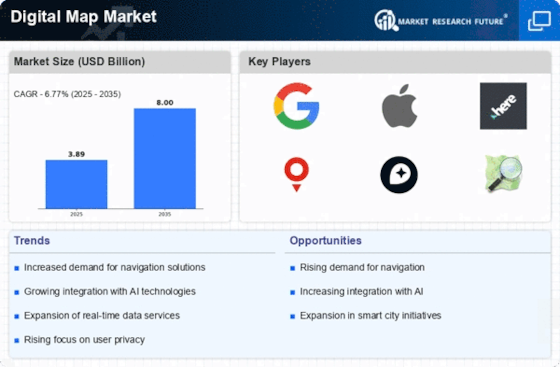
As per Market Research Future analysis, the Digital Map Market Size was estimated at 3.89 USD Billion in 2024. The Digital Map industry is projected to grow from 4.153 USD Billion in 2025 to 7.996 USD Billion by 2035, exhibiting a compound annual growth rate (CAGR) of 6.77% during the forecast period 2025 - 2035

Key Market Trends & Highlights

The Digital Map Market is experiencing robust growth driven by technological advancements and increasing urbanization.

  • The integration of AI and machine learning is transforming the capabilities of digital maps, enhancing user experience and accuracy. North America remains the largest market for digital maps, while the Asia-Pacific region is emerging as the fastest-growing market. The navigation segment continues to dominate the market, whereas fleet management is witnessing rapid growth due to rising logistics demands. Key market drivers include the increased adoption of navigation applications and government investments in infrastructure development.

Market Size & Forecast

2024 Market Size 3.89 (USD Billion)
2035 Market Size 7.996 (USD Billion)
CAGR (2025 - 2035) 6.77%
Largest Regional Market Share in 2024 North America

Major Players

<a href="https://www.google.com/">Google</a>(US), Apple (US), HERE Technologies (NL), TomTom (NL), Mapbox (US), <a href="https://www.openstreetmap.org/">OpenStreetMap</a>(GB), Esri (US), Navteq (US)

Market Trends

The Digital Map Market is currently experiencing a transformative phase, driven by advancements in technology and increasing demand for location-based services. The proliferation of smartphones and the integration of GPS capabilities into various devices have significantly enhanced the accessibility and utility of digital maps. As urbanization continues to rise, the need for accurate and real-time mapping solutions becomes more pronounced. This trend is further fueled by the growing interest in smart city initiatives, which rely heavily on geospatial data to optimize urban planning and infrastructure development. Moreover, the advent of artificial intelligence and machine learning is likely to revolutionize how digital maps are created and utilized, offering more personalized and context-aware navigation experiences. In addition to technological advancements, the Digital Map Market is also influenced by changing consumer behaviors and preferences. Users increasingly seek interactive and user-friendly mapping solutions that provide not only directions but also additional information such as points of interest, traffic conditions, and alternative routes. This shift in expectations is prompting companies to innovate and enhance their offerings, leading to a more competitive landscape. Furthermore, partnerships between tech firms and local governments are emerging, aiming to leverage mapping technologies for public services and community engagement. As the market evolves, it appears poised for sustained growth, driven by both technological innovation and the increasing importance of geospatial intelligence in various sectors.

The widespread adoption of smartphones has significantly increased the use of mapping apps, driving demand for real-time navigation and location-based services. Each digital map product is increasingly designed to integrate real-time data, artificial intelligence, and enhanced visualization features. Companies are expanding their portfolios of digital maps products to address applications ranging from navigation to urban planning and geospatial analytics. The automotive digital mapping market is witnessing strong growth due to the increasing adoption of connected vehicles, autonomous driving technologies, and advanced driver assistance systems. The development of a comprehensive digital global map enables consistent navigation and geospatial services across international markets. This maps market research report provides an in-depth analysis of market size, trends, segmentation, and regional dynamics through 2035. A market demand map helps stakeholders identify high-growth regions and application areas within the digital mapping ecosystem. Analysts use data-driven approaches to map the market, identifying growth opportunities across applications, technologies, and regions. The convergence of map & market intelligence supports strategic decision-making for digital mapping providers.

Integration of AI and Machine Learning

The incorporation of artificial intelligence and machine learning into digital mapping solutions is reshaping the landscape. These technologies enable more accurate data analysis, predictive modeling, and personalized user experiences, enhancing the overall functionality of digital maps.

Rise of Smart City Initiatives

As urban areas expand, the push for smart city initiatives is gaining momentum. Digital maps play a crucial role in these projects, providing essential geospatial data that supports efficient urban planning, resource management, and improved public services.

Demand for Real-Time Data

There is a growing expectation for real-time information in digital mapping applications. Users increasingly desire updates on traffic conditions, weather changes, and other dynamic factors that influence navigation, prompting companies to enhance their data integration capabilities.

Digital Map Market Market Drivers

Emergence of Autonomous Vehicles

The emergence of autonomous vehicles is poised to revolutionize the Digital Map Market. As self-driving technology advances, the need for highly accurate and detailed maps becomes paramount. In 2025, it is projected that the market for digital maps tailored for autonomous navigation will experience a growth rate of approximately 25%. This demand is driven by the requirement for real-time data and high-definition mapping to ensure safe and efficient vehicle operation. Consequently, companies within the Digital Map Market are likely to invest in developing specialized mapping solutions that cater to the unique needs of autonomous vehicles.

Expansion of E-commerce and Delivery Services

The rapid expansion of e-commerce and delivery services has significantly impacted the Digital Map Market. As online shopping continues to grow, logistics and delivery companies require precise mapping solutions to optimize their operations. In 2025, the demand for digital maps in the logistics sector is projected to increase by around 20%, driven by the need for efficient route planning and real-time tracking. This shift necessitates the development of more sophisticated mapping technologies that can accommodate the complexities of urban environments. Thus, the Digital Map Market is likely to see increased collaboration between mapping providers and logistics firms to enhance service delivery.

Increased Adoption of Navigation Applications

The proliferation of navigation applications has been a driving force in the Digital Map Market. As consumers increasingly rely on mobile devices for navigation, the demand for accurate and detailed digital maps has surged. In 2025, it is estimated that the navigation application segment will account for a substantial portion of the market, with projections indicating a growth rate of approximately 15% annually. This trend is fueled by the need for real-time traffic updates, route optimization, and enhanced user experiences. Consequently, companies in the Digital Map Market are investing heavily in improving map accuracy and integrating advanced features to meet consumer expectations.

Government Investments in Infrastructure Development

Government investments in infrastructure development are playing a crucial role in shaping the Digital Map Market. As nations prioritize the enhancement of transportation networks, the demand for accurate and up-to-date digital maps is expected to rise. In 2025, it is anticipated that public sector projects will contribute significantly to the market, with funding directed towards smart transportation systems and urban planning initiatives. This trend suggests that mapping solutions will need to evolve to support these projects, incorporating features such as 3D mapping and geospatial analytics. Consequently, the Digital Map Market is likely to benefit from increased collaboration with governmental agencies.

Growing Demand for Geographic Information Systems (GIS)

The growing demand for Geographic Information Systems (GIS) is significantly influencing the Digital Map Market. Organizations across various sectors, including urban planning, environmental management, and disaster response, are increasingly utilizing GIS for data analysis and decision-making. In 2025, the GIS segment is expected to witness a growth rate of around 18%, driven by the need for spatial data visualization and analysis. This trend indicates that the Digital Map Market must adapt to provide more integrated GIS solutions, enhancing the functionality and usability of digital maps for diverse applications. As a result, the industry is likely to see innovations that cater to the evolving needs of GIS users.

Market Segment Insights

By Application: Navigation (Largest) vs. Fleet Management (Fastest-Growing)

The Digital Map Market exhibits a diverse range of applications, with Navigation standing out as the largest segment. Navigation solutions dominate the market due to the widespread adoption of GPS technology, integrated mapping systems, and the increasing preference for digital navigation among consumers. Fleet Management closely follows, leveraging digital mapping tools to optimize routes, ensuring timely deliveries, and managing logistics efficiently. As urbanization accelerates, demand for Fleet Management is expected to rise significantly. The growth of Location-Based Services is also prominent, driven by advancements in mobile technology and consumer demand for personalized experiences. The Geographic Information System and Urban Planning segments are slower but crucial, supporting smart city initiatives and data-driven decision-making processes.

Navigation (Dominant) vs. Location-Based Services (Emerging)

Navigation has solidified its position as the dominant application in the Digital Map Market due to its integration across various platforms and devices, ensuring user-friendly experiences. Enhanced accuracy and the availability of real-time data put Navigation at the forefront of consumer preferences. On the other hand, Location-Based Services are emerging as a significant force, focusing on delivering tailored information based on the user's geographical position. This segment is characterized by its adaptability to various industries, such as retail, hospitality, and entertainment, providing businesses with critical insights to enhance customer engagement and optimize offerings in line with user behaviors.

By Technology: GPS Technology (Largest) vs. Geospatial Analysis (Fastest-Growing)

In the Digital Map Market, the technology segment exhibits distinct roles for its various components. GPS Technology holds the largest market share, providing the foundational positioning data necessary for digital mapping. Cartography, though traditional, retains a significant stake by integrating new technologies, while Remote Sensing adds depth with aerial and satellite data capturing. Geospatial Analysis, while smaller in market share, is increasingly recognized for its vital role in interpreting complex geographic information and driving decisions across sectors. Growth trends in the technology segment of the Digital Map Market are largely driven by advances in data collection and analytics capabilities. The surge in demand for location-based services fuels the expansion of GPS Technology, while the growing emphasis on data-driven decision-making promotes the rapid growth of Geospatial Analysis. Technological innovations, such as improved satellite imagery and cloud computing, are expected to enhance market potential further, leading to a more integrated digital mapping ecosystem.

GPS Technology (Dominant) vs. Geospatial Analysis (Emerging)

GPS Technology has established itself as the dominant force in the Digital Map Market, serving as the backbone for navigation systems and various location-based services. Its wide adoption across sectors such as transportation, logistics, and personal navigation underscores its essential role. In contrast, Geospatial Analysis is emerging as a powerful tool, leveraging big data and advanced analytical techniques to provide deeper insights into geographic and spatial patterns. As businesses and governments increasingly rely on data-driven strategies, the demand for geospatial analysis is growing rapidly, positioning it as an essential complement to GPS technology in the mapping ecosystem.

By End Use: Transportation (Largest) vs. Retail (Fastest-Growing)

The Digital Map Market exhibits significant variations in market share across its end-use segments, with transportation commanding the largest share. This dominance is primarily due to the widespread adoption of digital mapping solutions for navigation and logistics, facilitating efficient and accurate routing. Retail follows as a dynamic segment, where businesses increasingly leverage digital maps for enhanced customer experience and streamlined operations, demonstrating notable market engagement. Growth trends in the Digital Map Market are influenced by several key factors, including the increasing integration of advanced technologies such as artificial intelligence and machine learning. These innovations are enabling more tailored mapping solutions for end users, driving higher demand across segments like healthcare and government, both of which are also witnessing rapid adaptation of digital mapping for improved operational efficacy.

Transportation: Navigation (Dominant) vs. Retail: Location-Based Services (Emerging)

In the Digital Map Market, the transportation sector is characterized by its reliance on navigation solutions, which have become integral to logistics and personal travel. This segment benefits from robust developments in GPS technologies and real-time traffic updates, ensuring that users receive accurate and timely information. On the other hand, the retail segment is emerging with a focus on location-based services, which are increasingly used for personalized marketing and customer engagement strategies. Retailers are exploring geolocation technologies to understand consumer behavior better and optimize store placements. The contrasting dynamics of these segments highlight transportation's established role compared to the retail sector's innovative approaches to leverage digital maps for enhancing consumer interaction.

By Format: 2D Maps (Largest) vs. 3D Maps (Fastest-Growing)

The Digital Map Market shows a clear distribution of market share among different formats, with 2D Maps leading due to their widespread use in navigation and basic mapping applications. In contrast, 3D Maps are gaining traction for their immersive visualization capabilities, used prominently in urban planning and gaming environments. Additionally, Vector Maps and Raster Maps serve specific niches, with Vector Maps favored for their scalability and Raster Maps preferred for detailed imagery, collectively contributing to the segment's diversity.

Mapping Formats: 2D Maps (Dominant) vs. 3D Maps (Emerging)

2D Maps remain the dominant format in the Digital Map Market, primarily because of their easy integration across various platforms and applications including mobile devices and web-based services. These maps provide users with the fundamental layout necessary for navigation without overwhelming them with details. Conversely, 3D Maps are emerging rapidly, appealing to industries like real estate and tourism, where visual impact enhances user engagement. As technology improves and demand for interactive and immersive mapping solutions rises, 3D Maps are likely to capture a larger share of the market, driven by their ability to deliver a realistic view of terrains and environments.

Get more detailed insights about Digital Map Market Research Report-Forecast to 2035

Regional Insights

The Digital Map Market revenue showcases significant regional variations, with North America leading the way. In 2024, North America is valued at 1.5 USD billion, projected to reach 3.2 USD billion by 2035, marking it as a major player due to its advanced technological infrastructure and high smartphone penetration. Following closely, Europe holds a value of 1.2 USD Billion in 2024, set to rise to 2.6 USD billion by 2035, driven by increasing applications in automotive navigation and urban planning.

Conversely, South America and Asia Pacific are valued at 0.3 USD Billion and 0.8 USD billion, respectively, in 2024, showing growth potential as digital adoption rises, expected to reach 0.7 USD Billion and 1.6 USD billion by 2035.The Middle East and Africa, with a valuation of 0.09 USD billion in 2024, are projected to double to 0.2 USD billion by 2035, representing the smallest market share, indicating slower technological adoption.

Overall, the Digital Map Market segmentation reveals a diverse landscape, with opportunities driven by advancements in mobile technology and increased demand for location-based services, emphasizing the importance of understanding regional dynamics in shaping market strategies.

Key Players and Competitive Insights

The Digital Map Market is a rapidly evolving sector characterized by increasing demand for geospatial data across various industries, such as navigation, urban planning, and environmental monitoring. The competition within this market is defined by the emergence of innovative technologies, leading to advanced mapping solutions. With the proliferation of smartphones and GPS technologies, the accessibility and application of digital maps have grown substantially. Companies in this market aim to leverage artificial intelligence, big data, and cloud computing to enhance their offerings, thereby driving competition. Mergers and acquisitions also shape the competitive landscape as firms seek to enhance their capabilities and expand their market share in response to the growing need for sophisticated mapping solutions.Esri is a key player in the Digital Map Market, known for its robust geographic information system (GIS) technologies that enable efficient mapping and spatial analysis. The company has established itself as a leader with a broad array of products, including ArcGIS, which provides tools for data visualization and real-time analytics. Esri's strength lies in its extensive network of partnerships and a diverse range of applications that cater to numerous industries, including government, transportation, and utilities. With a strong focus on innovation and customer-centric solutions, Esri has been able to maintain a significant market presence and continuously enhance its service offerings, thereby solidifying its position as a dominant force in the digital mapping landscape.DigitalGlobe, now part of Maxar Technologies, is recognized for its expertise in providing high-resolution satellite imagery and geospatial content. Within the Digital Map Market, DigitalGlobe has carved a niche by offering reliable and detailed mapping services that support a variety of applications, from defense and intelligence to urban planning and environmental monitoring. The company’s strengths lie in its advanced imaging technology, which delivers high-quality maps and data that are critical for informed decision-making. DigitalGlobe has also engaged in strategic mergers and acquisitions to enhance its technological capabilities and expand its product offerings. By combining satellite imagery with sophisticated analytics, DigitalGlobe positions itself as a significant contributor to the global mapping ecosystem, catering to the increasing demand for precise and actionable geospatial intelligence.

Key Companies in the Digital Map Market include

Industry Developments

Recent developments in the Digital Map Market have highlighted substantial advancements that have taken place with the unique application of cutting-edge technology and an innovation-oriented thought process. The leading companies of this market have aimed at constant development and

Apple, a prominent technology corporation headquartered in the United States, announced the release of a beta version of Apple Maps for web browsers in July 2024. This move is anticipated to enhance the accessibility of Apple's digital map expertise through web browsers, despite the fact that Apple Maps has been an iPhone exclusive offering since its launch in 2012.

Alphabet (GOOGLE) announced in March 2024 a feature on Google Maps that displays the entrances of buildings to a limited number of users. This feature addresses the challenge of navigating to specific building portions on the map.
In April 2023, Google implemented a new indicator in its mapping platform, "Google Maps."

The indicator will assist users in preventing the loss of their passcode. The new indicator enables users to investigate a location without losing their pin, whether they manually place a pin in the map by tapping a location or discover a location through Maps search.

Microsoft Maps selected Otonomo in February 2023 to enhance its global mapping products and services. Microsoft will be able to improve its mapping services for Microsoft Maps users on Microsoft Azure, Windows, Microsoft 365, and Bing by utilizing the streaming connected vehicle data provided by Otonomo. This will encompass the provision of current traffic conditions, accident notification, and route optimization.


Future Outlook

Digital Map Market Future Outlook

The Digital Map Market is projected to grow at a 6.77% CAGR from 2025 to 2035, driven by advancements in technology, increased demand for navigation solutions, and the rise of smart cities.

New opportunities lie in:

  • <p>Integration of AI-driven analytics for personalized mapping solutions. Expansion of subscription-based models for real-time traffic updates. Development of augmented reality applications for enhanced user experiences.</p>

By 2035, the Digital Map Market is expected to be robust, driven by innovation and diverse applications.

Market Segmentation

Digital Map Market Format Outlook

  • 2D Maps
  • 3D Maps
  • Vector Maps
  • Raster Maps

Digital Map Market End Use Outlook

  • Transportation
  • Retail
  • Healthcare
  • Government

Digital Map Market Technology Outlook

  • Cartography
  • Remote Sensing
  • GPS Technology
  • Geospatial Analysis

Digital Map Market Application Outlook

  • Navigation
  • Fleet Management
  • Location-Based Services
  • Geographic Information System
  • Urban Planning

Report Scope

MARKET SIZE 2024 3.89(USD Billion)
MARKET SIZE 2025 4.153(USD Billion)
MARKET SIZE 2035 7.996(USD Billion)
COMPOUND ANNUAL GROWTH RATE (CAGR) 6.77% (2025 - 2035)
REPORT COVERAGE Revenue Forecast, Competitive Landscape, Growth Factors, and Trends
BASE YEAR 2024
Market Forecast Period 2025 - 2035
Historical Data 2019 - 2024
Market Forecast Units USD Billion
Key Companies Profiled Google (US), Apple (US), HERE Technologies (NL), TomTom (NL), Mapbox (US), OpenStreetMap (GB), Esri (US), Navteq (US)
Segments Covered Application, Technology, End Use, Format, Regional
Key Market Opportunities Integration of artificial intelligence and augmented reality enhances user engagement in the Digital Map Market.
Key Market Dynamics Rising demand for real-time navigation solutions drives innovation and competition in the digital map market.
Countries Covered North America, Europe, APAC, South America, MEA

FAQs

What is the projected market valuation of the Digital Map Market by 2035?

<p>The Digital Map Market is projected to reach approximately 7.996 USD Billion by 2035.</p>

What was the market valuation of the Digital Map Market in 2024?

<p>In 2024, the Digital Map Market was valued at 3.89 USD Billion.</p>

What is the expected CAGR for the Digital Map Market during the forecast period 2025 - 2035?

<p>The expected CAGR for the Digital Map Market during the forecast period 2025 - 2035 is 6.77%.</p>

Which companies are considered key players in the Digital Map Market?

<p>Key players in the Digital Map Market include Google, Apple, HERE Technologies, TomTom, Mapbox, OpenStreetMap, Esri, and Navteq.</p>

What are the main application segments of the Digital Map Market?

<p>The main application segments include Navigation, Fleet Management, Location-Based Services, Geographic Information System, and Urban Planning.</p>

How much is the Navigation segment expected to grow by 2035?

<p>The Navigation segment is expected to grow from 1.5 USD Billion in 2024 to 3.0 USD Billion by 2035.</p>

What is the projected growth for the Remote Sensing technology segment?

<p>The Remote Sensing technology segment is projected to increase from 1.17 USD Billion in 2024 to 2.34 USD Billion by 2035.</p>

Which end-use sector is anticipated to have the highest valuation by 2035?

<p>The Transportation sector is anticipated to have the highest valuation, growing from 1.5 USD Billion in 2024 to 3.0 USD Billion by 2035.</p>

What is the expected growth for 3D Maps in the Digital Map Market?

<p>The 3D Maps segment is expected to grow from 1.0 USD Billion in 2024 to 2.0 USD Billion by 2035.</p>

How does the Digital Map Market's growth compare across different formats?

<p>The Digital Map Market's growth across formats indicates that 2D Maps and 3D Maps are likely to see substantial increases, with 2D Maps projected to reach 3.0 USD Billion by 2035.</p>

  1. SECTION I: EXECUTIVE SUMMARY AND KEY HIGHLIGHTS |
    1. EXECUTIVE SUMMARY | |
      1. Market Overview | |
      2. Key Findings | |
      3. Market Segmentation | |
      4. Competitive Landscape | |
      5. Challenges and Opportunities | |
      6. Future Outlook 2
  2. SECTION II: SCOPING, METHODOLOGY AND MARKET STRUCTURE |
    1. MARKET INTRODUCTION | |
      1. Definition | |
      2. Scope of the study | | |
    2. RESEARCH METHODOLOGY | |
      1. Overview | |
      2. Data Mining | |
      3. Secondary Research | |
      4. Primary Research | | |
      5. Forecasting Model | |
      6. Market Size Estimation | | |
      7. Data Triangulation | |
      8. Validation 3
  3. SECTION III: QUALITATIVE ANALYSIS |
    1. MARKET DYNAMICS | |
      1. Overview | |
      2. Drivers | |
      3. Restraints | |
      4. Opportunities |
    2. MARKET FACTOR ANALYSIS | |
      1. Value chain Analysis | |
      2. Porter's Five Forces Analysis | | |
      3. COVID-19 Impact Analysis | | |
  4. SECTION IV: QUANTITATIVE ANALYSIS |
    1. Information and Communications Technology, BY Application (USD Billion) | |
      1. Navigation | |
      2. Fleet Management | |
      3. Location-Based Services | |
      4. Geographic Information System | |
      5. Urban Planning |
    2. Information and Communications Technology, BY Technology (USD Billion) | |
      1. Cartography | |
      2. Remote Sensing | |
      3. GPS Technology | |
      4. Geospatial Analysis |
    3. Information and Communications Technology, BY End Use (USD Billion) | |
      1. Transportation | |
      2. Retail | |
      3. Healthcare | |
      4. Government |
    4. Information and Communications Technology, BY Format (USD Billion) | |
      1. 2D Maps | |
      2. 3D Maps | |
      3. Vector Maps | |
      4. Raster Maps |
    5. Information and Communications Technology, BY Region (USD Billion) | |
      1. North America | | |
      2. Europe | | |
      3. APAC | | |
      4. South America | | |
      5. MEA | | |
  5. SECTION V: COMPETITIVE ANALYSIS |
    1. Competitive Landscape | |
      1. Overview | |
      2. Competitive Analysis | |
      3. Market share Analysis | |
      4. Major Growth Strategy in the Information and Communications Technology | |
      5. Competitive Benchmarking | |
      6. Leading Players in Terms of Number of Developments in the Information and Communications Technology | |
      7. Key developments and growth strategies | | |
      8. Major Players Financial Matrix | | |
    2. Company Profiles | |
      1. Google (US) | | |
      2. Apple (US) | | |
      3. HERE Technologies (NL) | | |
      4. TomTom (NL) | | |
      5. Mapbox (US) | | |
      6. OpenStreetMap (GB) | | |
      7. Esri (US) | | |
      8. Navteq (US) | | |
    3. Appendix | |
      1. References | |
      2. Related Reports 6 LIST OF FIGURES |
    4. MARKET SYNOPSIS |
    5. NORTH AMERICA MARKET ANALYSIS |
    6. US MARKET ANALYSIS BY APPLICATION |
    7. US MARKET ANALYSIS BY TECHNOLOGY |
    8. US MARKET ANALYSIS BY END USE |
    9. US MARKET ANALYSIS BY FORMAT |
    10. CANADA MARKET ANALYSIS BY APPLICATION |
    11. CANADA MARKET ANALYSIS BY TECHNOLOGY |
    12. CANADA MARKET ANALYSIS BY END USE |
    13. CANADA MARKET ANALYSIS BY FORMAT |
    14. EUROPE MARKET ANALYSIS |
    15. GERMANY MARKET ANALYSIS BY APPLICATION |
    16. GERMANY MARKET ANALYSIS BY TECHNOLOGY |
    17. GERMANY MARKET ANALYSIS BY END USE |
    18. GERMANY MARKET ANALYSIS BY FORMAT |
    19. UK MARKET ANALYSIS BY APPLICATION |
    20. UK MARKET ANALYSIS BY TECHNOLOGY |
    21. UK MARKET ANALYSIS BY END USE |
    22. UK MARKET ANALYSIS BY FORMAT |
    23. FRANCE MARKET ANALYSIS BY APPLICATION |
    24. FRANCE MARKET ANALYSIS BY TECHNOLOGY |
    25. FRANCE MARKET ANALYSIS BY END USE |
    26. FRANCE MARKET ANALYSIS BY FORMAT |
    27. RUSSIA MARKET ANALYSIS BY APPLICATION |
    28. RUSSIA MARKET ANALYSIS BY TECHNOLOGY |
    29. RUSSIA MARKET ANALYSIS BY END USE |
    30. RUSSIA MARKET ANALYSIS BY FORMAT |
    31. ITALY MARKET ANALYSIS BY APPLICATION |
    32. ITALY MARKET ANALYSIS BY TECHNOLOGY |
    33. ITALY MARKET ANALYSIS BY END USE |
    34. ITALY MARKET ANALYSIS BY FORMAT |
    35. SPAIN MARKET ANALYSIS BY APPLICATION |
    36. SPAIN MARKET ANALYSIS BY TECHNOLOGY |
    37. SPAIN MARKET ANALYSIS BY END USE |
    38. SPAIN MARKET ANALYSIS BY FORMAT |
    39. REST OF EUROPE MARKET ANALYSIS BY APPLICATION |
    40. REST OF EUROPE MARKET ANALYSIS BY TECHNOLOGY |
    41. REST OF EUROPE MARKET ANALYSIS BY END USE |
    42. REST OF EUROPE MARKET ANALYSIS BY FORMAT |
    43. APAC MARKET ANALYSIS |
    44. CHINA MARKET ANALYSIS BY APPLICATION |
    45. CHINA MARKET ANALYSIS BY TECHNOLOGY |
    46. CHINA MARKET ANALYSIS BY END USE |
    47. CHINA MARKET ANALYSIS BY FORMAT |
    48. INDIA MARKET ANALYSIS BY APPLICATION |
    49. INDIA MARKET ANALYSIS BY TECHNOLOGY |
    50. INDIA MARKET ANALYSIS BY END USE |
    51. INDIA MARKET ANALYSIS BY FORMAT |
    52. JAPAN MARKET ANALYSIS BY APPLICATION |
    53. JAPAN MARKET ANALYSIS BY TECHNOLOGY |
    54. JAPAN MARKET ANALYSIS BY END USE |
    55. JAPAN MARKET ANALYSIS BY FORMAT |
    56. SOUTH KOREA MARKET ANALYSIS BY APPLICATION |
    57. SOUTH KOREA MARKET ANALYSIS BY TECHNOLOGY |
    58. SOUTH KOREA MARKET ANALYSIS BY END USE |
    59. SOUTH KOREA MARKET ANALYSIS BY FORMAT |
    60. MALAYSIA MARKET ANALYSIS BY APPLICATION |
    61. MALAYSIA MARKET ANALYSIS BY TECHNOLOGY |
    62. MALAYSIA MARKET ANALYSIS BY END USE |
    63. MALAYSIA MARKET ANALYSIS BY FORMAT |
    64. THAILAND MARKET ANALYSIS BY APPLICATION |
    65. THAILAND MARKET ANALYSIS BY TECHNOLOGY |
    66. THAILAND MARKET ANALYSIS BY END USE |
    67. THAILAND MARKET ANALYSIS BY FORMAT |
    68. INDONESIA MARKET ANALYSIS BY APPLICATION |
    69. INDONESIA MARKET ANALYSIS BY TECHNOLOGY |
    70. INDONESIA MARKET ANALYSIS BY END USE |
    71. INDONESIA MARKET ANALYSIS BY FORMAT |
    72. REST OF APAC MARKET ANALYSIS BY APPLICATION |
    73. REST OF APAC MARKET ANALYSIS BY TECHNOLOGY |
    74. REST OF APAC MARKET ANALYSIS BY END USE |
    75. REST OF APAC MARKET ANALYSIS BY FORMAT |
    76. SOUTH AMERICA MARKET ANALYSIS |
    77. BRAZIL MARKET ANALYSIS BY APPLICATION |
    78. BRAZIL MARKET ANALYSIS BY TECHNOLOGY |
    79. BRAZIL MARKET ANALYSIS BY END USE |
    80. BRAZIL MARKET ANALYSIS BY FORMAT |
    81. MEXICO MARKET ANALYSIS BY APPLICATION |
    82. MEXICO MARKET ANALYSIS BY TECHNOLOGY |
    83. MEXICO MARKET ANALYSIS BY END USE |
    84. MEXICO MARKET ANALYSIS BY FORMAT |
    85. ARGENTINA MARKET ANALYSIS BY APPLICATION |
    86. ARGENTINA MARKET ANALYSIS BY TECHNOLOGY |
    87. ARGENTINA MARKET ANALYSIS BY END USE |
    88. ARGENTINA MARKET ANALYSIS BY FORMAT |
    89. REST OF SOUTH AMERICA MARKET ANALYSIS BY APPLICATION |
    90. REST OF SOUTH AMERICA MARKET ANALYSIS BY TECHNOLOGY |
    91. REST OF SOUTH AMERICA MARKET ANALYSIS BY END USE |
    92. REST OF SOUTH AMERICA MARKET ANALYSIS BY FORMAT |
    93. MEA MARKET ANALYSIS |
    94. GCC COUNTRIES MARKET ANALYSIS BY APPLICATION |
    95. GCC COUNTRIES MARKET ANALYSIS BY TECHNOLOGY |
    96. GCC COUNTRIES MARKET ANALYSIS BY END USE |
    97. GCC COUNTRIES MARKET ANALYSIS BY FORMAT |
    98. SOUTH AFRICA MARKET ANALYSIS BY APPLICATION |
    99. SOUTH AFRICA MARKET ANALYSIS BY TECHNOLOGY |
    100. SOUTH AFRICA MARKET ANALYSIS BY END USE |
    101. SOUTH AFRICA MARKET ANALYSIS BY FORMAT |
    102. REST OF MEA MARKET ANALYSIS BY APPLICATION |
    103. REST OF MEA MARKET ANALYSIS BY TECHNOLOGY |
    104. REST OF MEA MARKET ANALYSIS BY END USE |
    105. REST OF MEA MARKET ANALYSIS BY FORMAT |
    106. KEY BUYING CRITERIA OF INFORMATION AND COMMUNICATIONS TECHNOLOGY |
    107. RESEARCH PROCESS OF MRFR |
    108. DRO ANALYSIS OF INFORMATION AND COMMUNICATIONS TECHNOLOGY |
    109. DRIVERS IMPACT ANALYSIS: INFORMATION AND COMMUNICATIONS TECHNOLOGY |
    110. RESTRAINTS IMPACT ANALYSIS: INFORMATION AND COMMUNICATIONS TECHNOLOGY |
    111. SUPPLY / VALUE CHAIN: INFORMATION AND COMMUNICATIONS TECHNOLOGY |
    112. INFORMATION AND COMMUNICATIONS TECHNOLOGY, BY APPLICATION, 2024 (% SHARE) |
    113. INFORMATION AND COMMUNICATIONS TECHNOLOGY, BY APPLICATION, 2024 TO 2035 (USD Billion) |
    114. INFORMATION AND COMMUNICATIONS TECHNOLOGY, BY TECHNOLOGY, 2024 (% SHARE) |
    115. INFORMATION AND COMMUNICATIONS TECHNOLOGY, BY TECHNOLOGY, 2024 TO 2035 (USD Billion) |
    116. INFORMATION AND COMMUNICATIONS TECHNOLOGY, BY END USE, 2024 (% SHARE) |
    117. INFORMATION AND COMMUNICATIONS TECHNOLOGY, BY END USE, 2024 TO 2035 (USD Billion) |
    118. INFORMATION AND COMMUNICATIONS TECHNOLOGY, BY FORMAT, 2024 (% SHARE) |
    119. INFORMATION AND COMMUNICATIONS TECHNOLOGY, BY FORMAT, 2024 TO 2035 (USD Billion) |
    120. BENCHMARKING OF MAJOR COMPETITORS 7 LIST OF TABLES |
    121. LIST OF ASSUMPTIONS | |
      1. |
    122. North America MARKET SIZE ESTIMATES; FORECAST | |
      1. BY APPLICATION, 2025-2035 (USD Billion) | |
      2. BY TECHNOLOGY, 2025-2035 (USD Billion) | |
      3. BY END USE, 2025-2035 (USD Billion) | |
      4. BY FORMAT, 2025-2035 (USD Billion) |
    123. US MARKET SIZE ESTIMATES; FORECAST | |
      1. BY APPLICATION, 2025-2035 (USD Billion) | |
      2. BY TECHNOLOGY, 2025-2035 (USD Billion) | |
      3. BY END USE, 2025-2035 (USD Billion) | |
      4. BY FORMAT, 2025-2035 (USD Billion) |
    124. Canada MARKET SIZE ESTIMATES; FORECAST | |
      1. BY APPLICATION, 2025-2035 (USD Billion) | |
      2. BY TECHNOLOGY, 2025-2035 (USD Billion) | |
      3. BY END USE, 2025-2035 (USD Billion) | |
      4. BY FORMAT, 2025-2035 (USD Billion) |
    125. Europe MARKET SIZE ESTIMATES; FORECAST | |
      1. BY APPLICATION, 2025-2035 (USD Billion) | |
      2. BY TECHNOLOGY, 2025-2035 (USD Billion) | |
      3. BY END USE, 2025-2035 (USD Billion) | |
      4. BY FORMAT, 2025-2035 (USD Billion) |
    126. Germany MARKET SIZE ESTIMATES; FORECAST | |
      1. BY APPLICATION, 2025-2035 (USD Billion) | |
      2. BY TECHNOLOGY, 2025-2035 (USD Billion) | |
      3. BY END USE, 2025-2035 (USD Billion) | |
      4. BY FORMAT, 2025-2035 (USD Billion) |
    127. UK MARKET SIZE ESTIMATES; FORECAST | |
      1. BY APPLICATION, 2025-2035 (USD Billion) | |
      2. BY TECHNOLOGY, 2025-2035 (USD Billion) | |
      3. BY END USE, 2025-2035 (USD Billion) | |
      4. BY FORMAT, 2025-2035 (USD Billion) |
    128. France MARKET SIZE ESTIMATES; FORECAST | |
      1. BY APPLICATION, 2025-2035 (USD Billion) | |
      2. BY TECHNOLOGY, 2025-2035 (USD Billion) | |
      3. BY END USE, 2025-2035 (USD Billion) | |
      4. BY FORMAT, 2025-2035 (USD Billion) |
    129. Russia MARKET SIZE ESTIMATES; FORECAST | |
      1. BY APPLICATION, 2025-2035 (USD Billion) | |
      2. BY TECHNOLOGY, 2025-2035 (USD Billion) | |
      3. BY END USE, 2025-2035 (USD Billion) | |
      4. BY FORMAT, 2025-2035 (USD Billion) |
    130. Italy MARKET SIZE ESTIMATES; FORECAST | |
      1. BY APPLICATION, 2025-2035 (USD Billion) | |
      2. BY TECHNOLOGY, 2025-2035 (USD Billion) | |
      3. BY END USE, 2025-2035 (USD Billion) | |
      4. BY FORMAT, 2025-2035 (USD Billion) |
    131. Spain MARKET SIZE ESTIMATES; FORECAST | |
      1. BY APPLICATION, 2025-2035 (USD Billion) | |
      2. BY TECHNOLOGY, 2025-2035 (USD Billion) | |
      3. BY END USE, 2025-2035 (USD Billion) | |
      4. BY FORMAT, 2025-2035 (USD Billion) |
    132. Rest of Europe MARKET SIZE ESTIMATES; FORECAST | |
      1. BY APPLICATION, 2025-2035 (USD Billion) | |
      2. BY TECHNOLOGY, 2025-2035 (USD Billion) | |
      3. BY END USE, 2025-2035 (USD Billion) | |
      4. BY FORMAT, 2025-2035 (USD Billion) |
    133. APAC MARKET SIZE ESTIMATES; FORECAST | |
      1. BY APPLICATION, 2025-2035 (USD Billion) | |
      2. BY TECHNOLOGY, 2025-2035 (USD Billion) | |
      3. BY END USE, 2025-2035 (USD Billion) | |
      4. BY FORMAT, 2025-2035 (USD Billion) |
    134. China MARKET SIZE ESTIMATES; FORECAST | |
      1. BY APPLICATION, 2025-2035 (USD Billion) | |
      2. BY TECHNOLOGY, 2025-2035 (USD Billion) | |
      3. BY END USE, 2025-2035 (USD Billion) | |
      4. BY FORMAT, 2025-2035 (USD Billion) |
    135. India MARKET SIZE ESTIMATES; FORECAST | |
      1. BY APPLICATION, 2025-2035 (USD Billion) | |
      2. BY TECHNOLOGY, 2025-2035 (USD Billion) | |
      3. BY END USE, 2025-2035 (USD Billion) | |
      4. BY FORMAT, 2025-2035 (USD Billion) |
    136. Japan MARKET SIZE ESTIMATES; FORECAST | |
      1. BY APPLICATION, 2025-2035 (USD Billion) | |
      2. BY TECHNOLOGY, 2025-2035 (USD Billion) | |
      3. BY END USE, 2025-2035 (USD Billion) | |
      4. BY FORMAT, 2025-2035 (USD Billion) |
    137. South Korea MARKET SIZE ESTIMATES; FORECAST | |
      1. BY APPLICATION, 2025-2035 (USD Billion) | |
      2. BY TECHNOLOGY, 2025-2035 (USD Billion) | |
      3. BY END USE, 2025-2035 (USD Billion) | |
      4. BY FORMAT, 2025-2035 (USD Billion) |
    138. Malaysia MARKET SIZE ESTIMATES; FORECAST | |
      1. BY APPLICATION, 2025-2035 (USD Billion) | |
      2. BY TECHNOLOGY, 2025-2035 (USD Billion) | |
      3. BY END USE, 2025-2035 (USD Billion) | |
      4. BY FORMAT, 2025-2035 (USD Billion) |
    139. Thailand MARKET SIZE ESTIMATES; FORECAST | |
      1. BY APPLICATION, 2025-2035 (USD Billion) | |
      2. BY TECHNOLOGY, 2025-2035 (USD Billion) | |
      3. BY END USE, 2025-2035 (USD Billion) | |
      4. BY FORMAT, 2025-2035 (USD Billion) |
    140. Indonesia MARKET SIZE ESTIMATES; FORECAST | |
      1. BY APPLICATION, 2025-2035 (USD Billion) | |
      2. BY TECHNOLOGY, 2025-2035 (USD Billion) | |
      3. BY END USE, 2025-2035 (USD Billion) | |
      4. BY FORMAT, 2025-2035 (USD Billion) |
    141. Rest of APAC MARKET SIZE ESTIMATES; FORECAST | |
      1. BY APPLICATION, 2025-2035 (USD Billion) | |
      2. BY TECHNOLOGY, 2025-2035 (USD Billion) | |
      3. BY END USE, 2025-2035 (USD Billion) | |
      4. BY FORMAT, 2025-2035 (USD Billion) |
    142. South America MARKET SIZE ESTIMATES; FORECAST | |
      1. BY APPLICATION, 2025-2035 (USD Billion) | |
      2. BY TECHNOLOGY, 2025-2035 (USD Billion) | |
      3. BY END USE, 2025-2035 (USD Billion) | |
      4. BY FORMAT, 2025-2035 (USD Billion) |
    143. Brazil MARKET SIZE ESTIMATES; FORECAST | |
      1. BY APPLICATION, 2025-2035 (USD Billion) | |
      2. BY TECHNOLOGY, 2025-2035 (USD Billion) | |
      3. BY END USE, 2025-2035 (USD Billion) | |
      4. BY FORMAT, 2025-2035 (USD Billion) |
    144. Mexico MARKET SIZE ESTIMATES; FORECAST | |
      1. BY APPLICATION, 2025-2035 (USD Billion) | |
      2. BY TECHNOLOGY, 2025-2035 (USD Billion) | |
      3. BY END USE, 2025-2035 (USD Billion) | |
      4. BY FORMAT, 2025-2035 (USD Billion) |
    145. Argentina MARKET SIZE ESTIMATES; FORECAST | |
      1. BY APPLICATION, 2025-2035 (USD Billion) | |
      2. BY TECHNOLOGY, 2025-2035 (USD Billion) | |
      3. BY END USE, 2025-2035 (USD Billion) | |
      4. BY FORMAT, 2025-2035 (USD Billion) |
    146. Rest of South America MARKET SIZE ESTIMATES; FORECAST | |
      1. BY APPLICATION, 2025-2035 (USD Billion) | |
      2. BY TECHNOLOGY, 2025-2035 (USD Billion) | |
      3. BY END USE, 2025-2035 (USD Billion) | |
      4. BY FORMAT, 2025-2035 (USD Billion) |
    147. MEA MARKET SIZE ESTIMATES; FORECAST | |
      1. BY APPLICATION, 2025-2035 (USD Billion) | |
      2. BY TECHNOLOGY, 2025-2035 (USD Billion) | |
      3. BY END USE, 2025-2035 (USD Billion) | |
      4. BY FORMAT, 2025-2035 (USD Billion) |
    148. GCC Countries MARKET SIZE ESTIMATES; FORECAST | |
      1. BY APPLICATION, 2025-2035 (USD Billion) | |
      2. BY TECHNOLOGY, 2025-2035 (USD Billion) | |
      3. BY END USE, 2025-2035 (USD Billion) | |
      4. BY FORMAT, 2025-2035 (USD Billion) |
    149. South Africa MARKET SIZE ESTIMATES; FORECAST | |
      1. BY APPLICATION, 2025-2035 (USD Billion) | |
      2. BY TECHNOLOGY, 2025-2035 (USD Billion) | |
      3. BY END USE, 2025-2035 (USD Billion) | |
      4. BY FORMAT, 2025-2035 (USD Billion) |
    150. Rest of MEA MARKET SIZE ESTIMATES; FORECAST | |
      1. BY APPLICATION, 2025-2035 (USD Billion) | |
      2. BY TECHNOLOGY, 2025-2035 (USD Billion) | |
      3. BY END USE, 2025-2035 (USD Billion) | |
      4. BY FORMAT, 2025-2035 (USD Billion) |
    151. PRODUCT LAUNCH/PRODUCT DEVELOPMENT/APPROVAL | |
      1. |
    152. ACQUISITION/PARTNERSHIP | |

Information and Communications Technology Market Segmentation

Information and Communications Technology By Application (USD Billion, 2025-2035)

  • Navigation
  • Fleet Management
  • Location-Based Services
  • Geographic Information System
  • Urban Planning

Information and Communications Technology By Technology (USD Billion, 2025-2035)

  • Cartography
  • Remote Sensing
  • GPS Technology
  • Geospatial Analysis

Information and Communications Technology By End Use (USD Billion, 2025-2035)

  • Transportation
  • Retail
  • Healthcare
  • Government

Information and Communications Technology By Format (USD Billion, 2025-2035)

  • 2D Maps
  • 3D Maps
  • Vector Maps
  • Raster Maps
Infographic

Free Sample Request

Kindly complete the form below to receive a free sample of this Report

Get Free Sample

Customer Strories

Compare Licence

×
Features License Type
Single User Multiuser License Enterprise User
Price $4,950 $5,950 $7,250
Maximum User Access Limit 1 User Upto 10 Users Unrestricted Access Throughout the Organization
Free Customization
Direct Access to Analyst
Deliverable Format
Platform Access
Discount on Next Purchase 10% 15% 15%
Printable Versions